

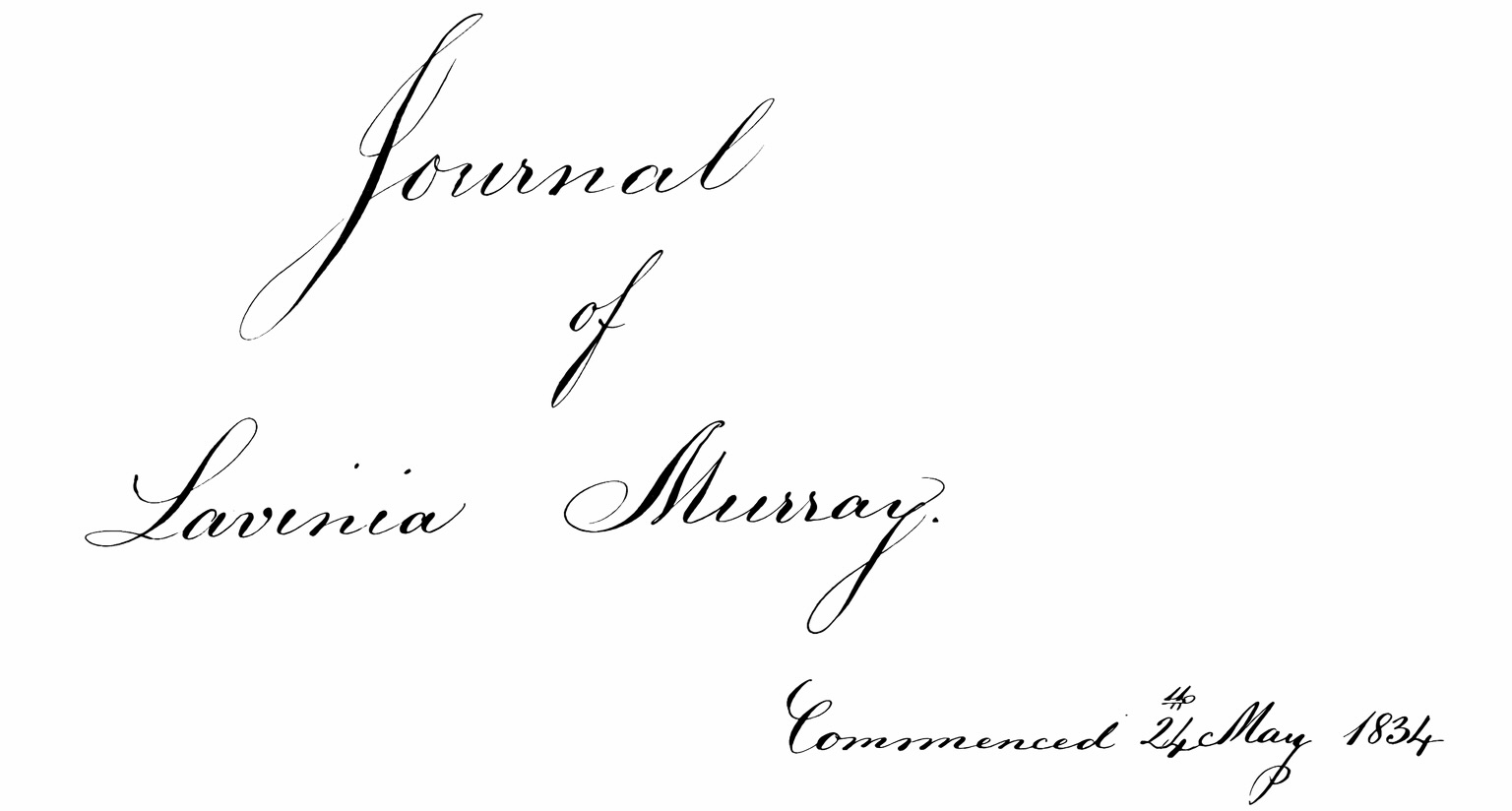
This journal was kept by Lavinia Murray (1818-1896), the daughter of William W. Murray (1784-1865) and Mary Crawford (1800-1853) of Middletown, Monmouth county, New Jersey. Lavinia commenced her journal on 24 May 1834 when she was 15 years old. Her last entry, on the last page of the journal, was dated in 1842 when she 23. She married James M. Hoagland (1818-1857), a New York Merchant, on 26 August 1847 and resided in New Jersey or New York City the remainder of her life, leaving no children. She died in 1896.
Lavinia was the oldest of three children. Her siblings were Eleanor Crawford Murray (1821-1858) and George Crawford Murray (1827-1884). George graduated from Yale in 1845, studied law in New York City and was admitted to the bar in 1849 but gave up law to manage two family farms. [Source: The Scott Family of Shrewsbury, page 20]
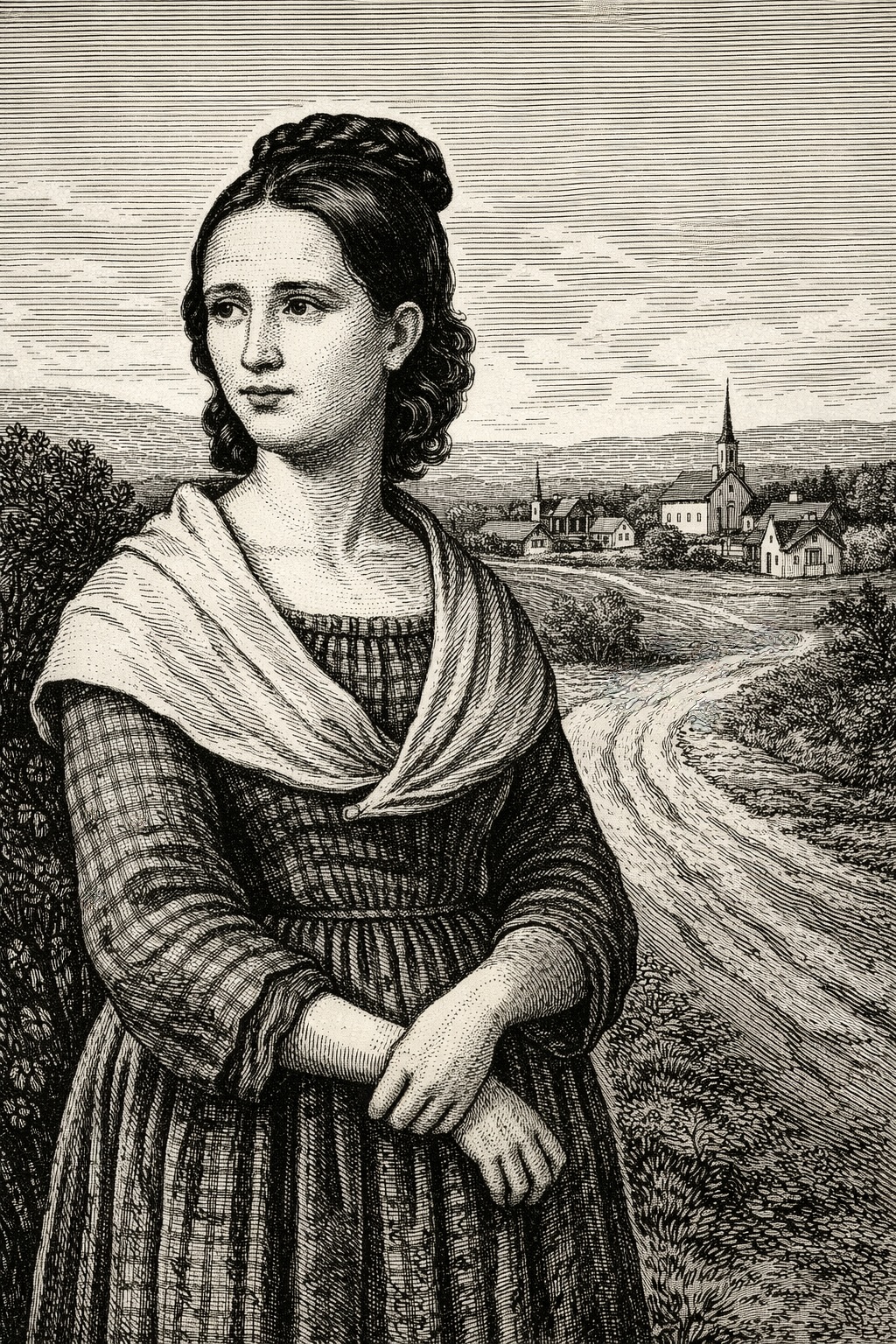
I could find no images of Lavinia; the woodcut depiction of a young woman standing on the outskirts of Middleton, New Jersey, in the 1830s is purely conjectural.
Index to Journal Entries
1834-1835 Journal Entries
1836-1837-1838-1839 Journal Entries are transcribed below.
1840-1841 Journal Entries

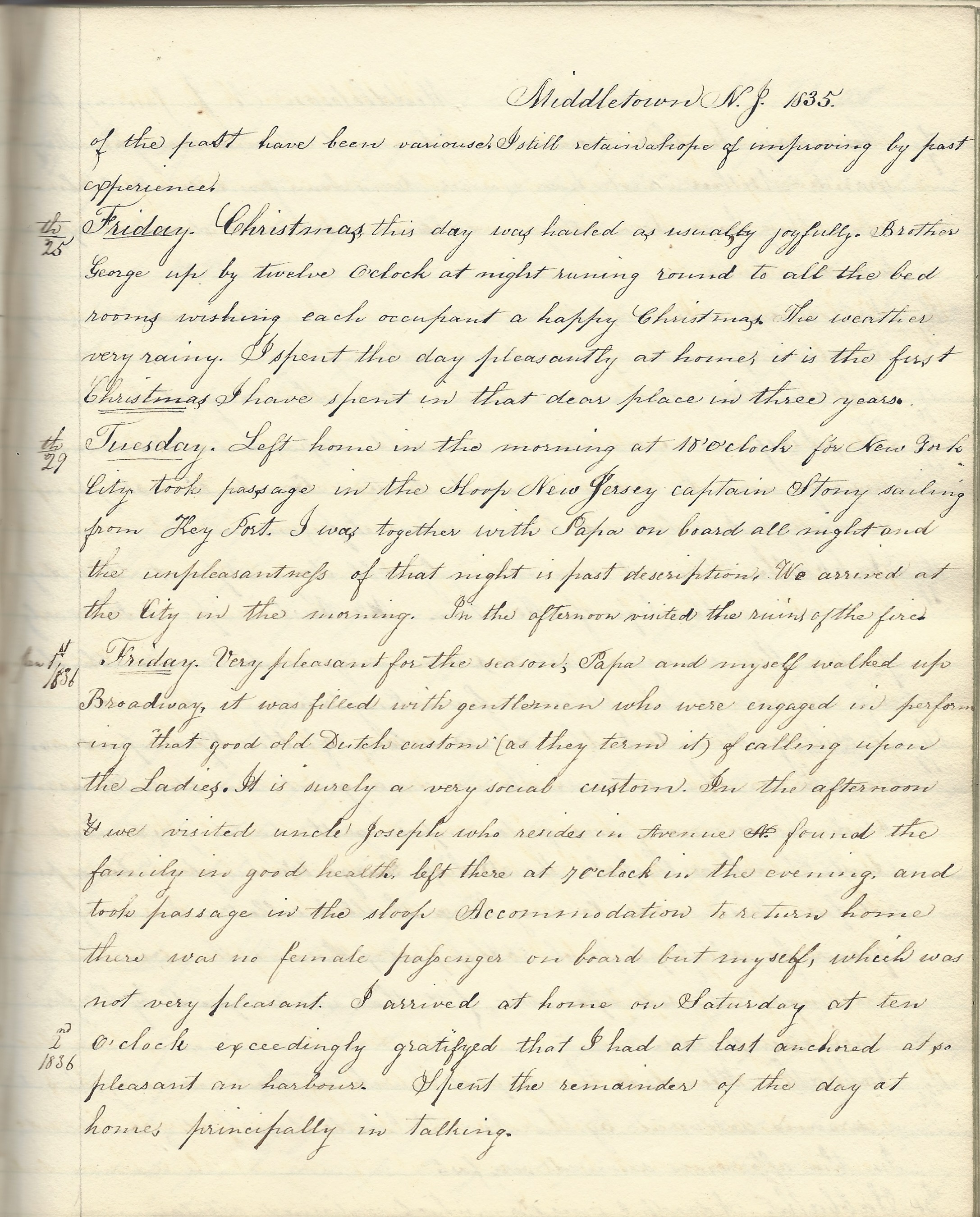
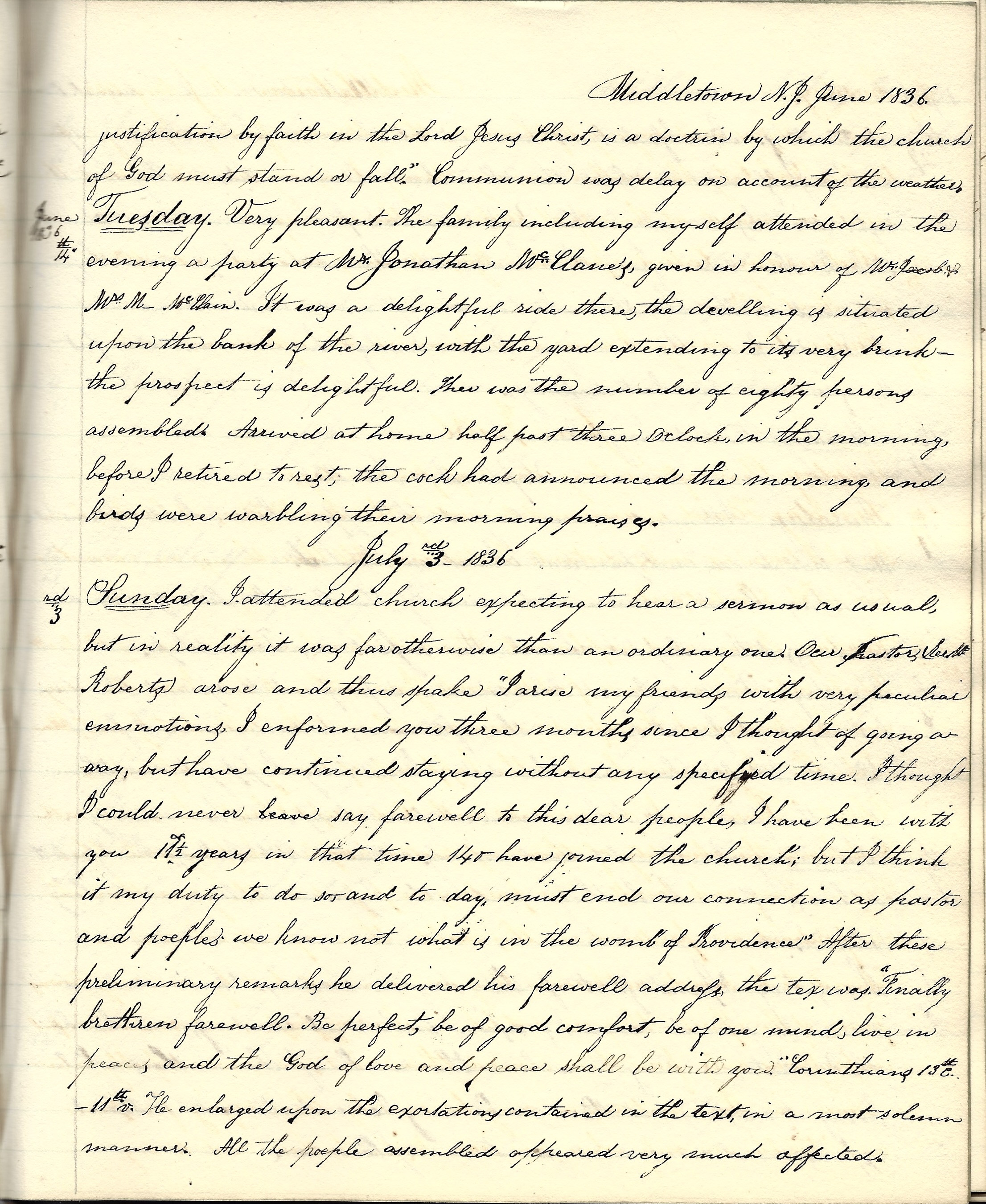
Friday, January 1, 1836. Very pleasant for the season. Papa and myself walked up Broadway. It was filled with gentlemen who were engaged in performing “that good old Dutch custom” (as they term it) of calling upon the Ladies. It is surely a very social custom. In the afternoon we visited Uncle Joseph who resides in Avenue A. Found the family in good health. Left there at 7 o’clock in the evening, and took passage in the sloop Accommodation to return home. There was no female passenger on board but myself, which was not very pleasant. I arrived at home on Saturday at ten o’clock exceedingly gratified that I had at last anchored at so pleasant an harbor. Spent the remainder of the day at home principally in talking.
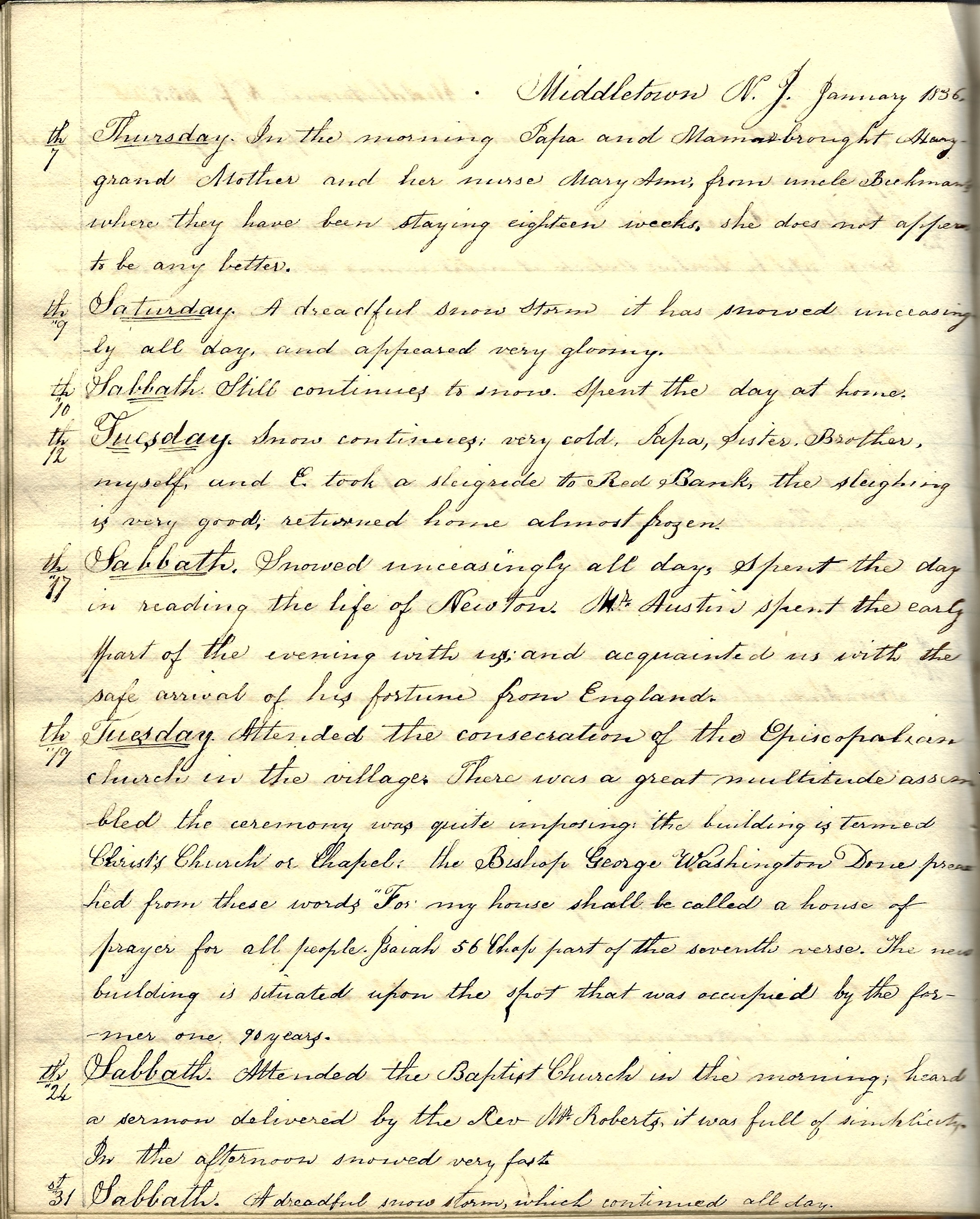
Thursday 7th. In the morning Papa and Mama brought grand Mother and her nurse Mary Ann from Uncle Beekman’s where they have been staying eighteen weeks. She does not appear to be any better.
Saturday 9th. A dreadful snow storm. It has snowed unceasingly all day and appeared very gloomy.
Sabbath 10th. Still continues to snow. Spent the day at home.
Tuesday 12th. Snow continues; very cold. Papa, sister, brother, myself and E. took a sleigh ride to Red Bank. The sleighing is very good. Returned home almost frozen.
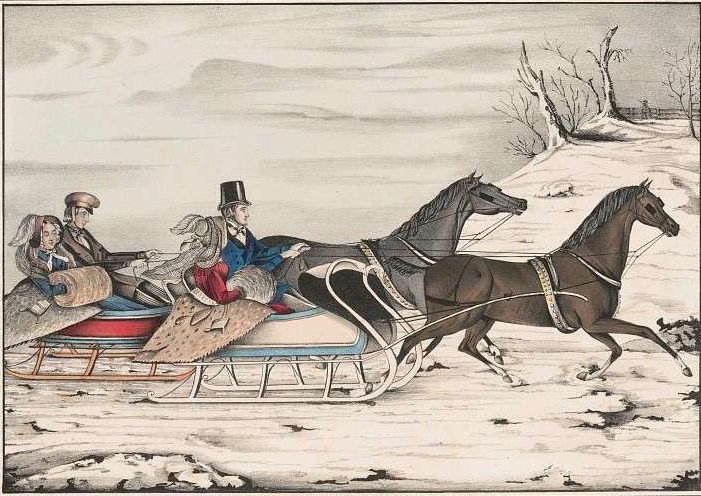
Sabbath 17th. Snowed increasingly all day. Spent the day in reading the Life of Newton. Mr. Austin spent the early part of the evening with us and acquainted us with the safe arrival of his fortune from England.
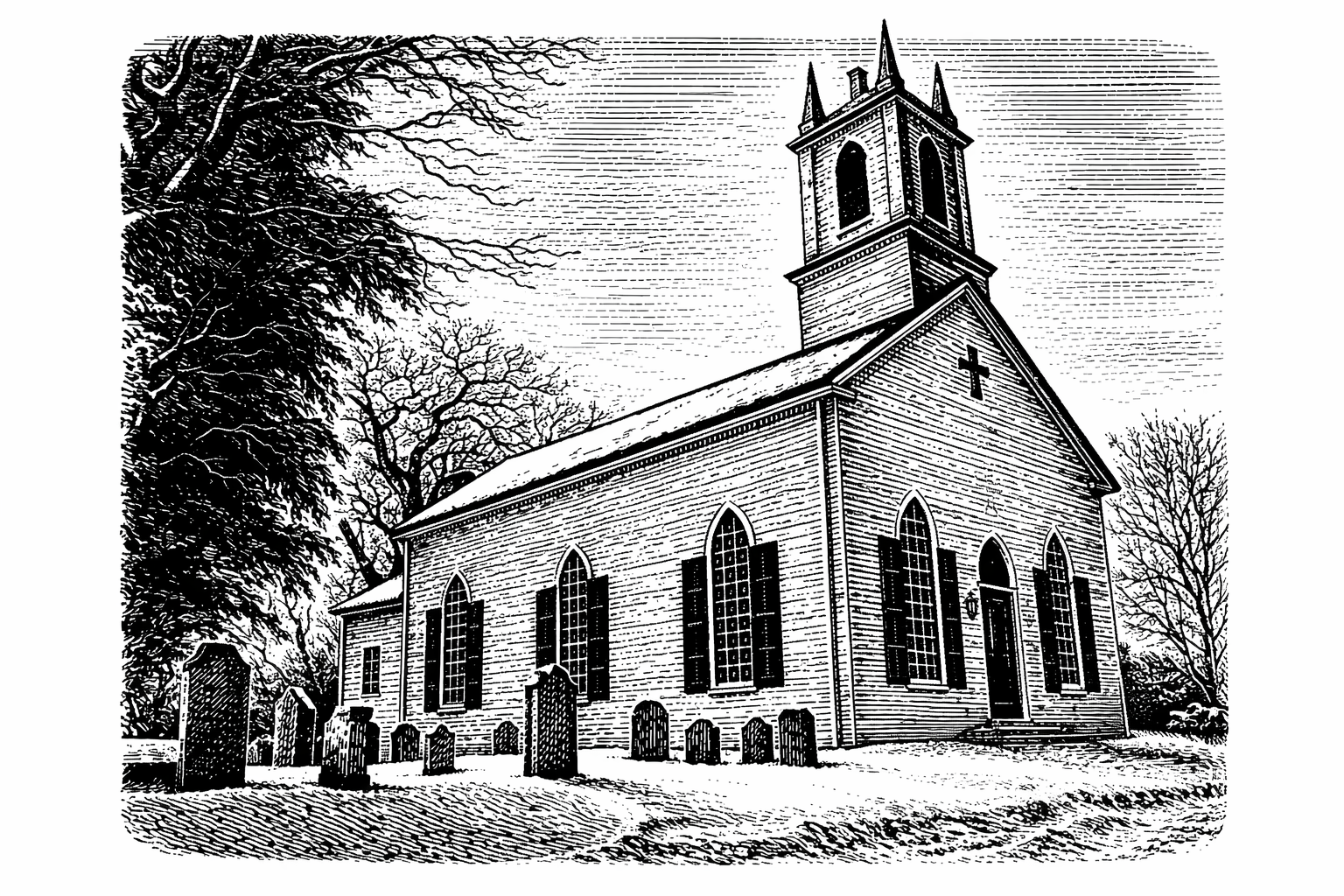
Tuesday 19th. Attended the consecration of the Episcopalian Church in the village. There was a great multitude assembled. The ceremony was quite imposing. The building is termed Christ’s Church or Chapel. The Bishop George Washington Doane preached from these words, “For my house shall be called a house of prayer for all people.” Josiah 56 Chapter, part of the 7th Verse. The new building is situated upon the spot that was occupied by the former one 90 years.
Sabbath 24th. Attended the Baptist Church in the morning. Heard a sermon delivered by the Rev. Mr. Roberts. It was full of simplicity. In the afternoon, snowed very fast.
Sabbath 31st. A dreadful snow storm which continued all day.
Monday, February 29th 1836. Snowed very fast until midday but not regarding the weather, I prepared to attend the wedding of Miss A. B. Conover to Mr. C. D. Beldon. At eleven o’clock Miss. A. Patterson called upon me. I accompanied her to Mr. Van Doren’s, took dinner there, and at two o’clock left for W. J. Longstreet’s accompanied by Miss A, Patterson. Miss M. Conover, Mr. H. Seabrook, and Mr. J. Longstreet, Jr. After an unpleasant sleighride through the rain (for it had ceased snowing) we arrived at Mr. Longstreet’s, tarried there a short time and again commenced our journey. It rained tremendously. We were in an open sleigh and had six miles to ride. We arrived there in safety. The wedding ceremony took place at 7 o’clock and was performed by the Rev. Mr. Roberts. There were two bridesmaids and two that were males by the groom’s side. The bride was very splendidly attired as also were her attendants though differently. There was a company of sixty persons assembled: cakes, coffee, tea, wine, and cordial were handed around to the company at eight o’clock, after which the company were entertained by several of the young ladies playing upon the piano, and some of the gentlemen singing. Took supper at twelve o’clock, standing, the table was set splendidly. Took our departure at four o’clock in the morning. Repaired again to Mr. Longstreet’s and I arrived at home in the afternoon.
Sunday, March 7, 1836. Attended church in the morning. Heard a discourse delivered by the Rev. Mr. [Thomas] Roberts from these words, “Wherefore, holy brethren, partakers of the heavenly calling, consider the Apostle and High Priest of our profession, Christ Jesus.” Hebrews 3rd Chapter, 1st verse. After the sermon was ended, he declared his intention of leaving this church and congregation saying it was the hardest trial he had ever experienced and also gave his reasons for leaving. The people were much affected and many were in tears.
Tuesday, March 15, 1836. The snow is decreasing very fast and appears quite like the oasis of the desert. Sleigh riding is entirely given up with the commencement of this week after the uninterrupted enjoyment of it for nine weeks. Read in the Evening Post a very interesting description of Trinity Church in New York City situated fronting Broadway. The tower and first story ofthe steeple are of stone, the other part of wood, all painted of a dark blue color. The top of the spire is two hundred feet from the ground. The interior and exterior are in perfect keeping. In the interior are many monumental tablets, one containing a bust of Alexander Hamilton. The monument of Bishop Hobart is behind the altar. It represents the Bishop as dying. Religion in the form of a female stands by his side, pointing to a light which is shining from above.
Mr. Hart has been with us all day repairing our clocks.
Sunday, March 20, 1846. Attended church. The Re. Mr. Roberts preached. The text was “Fear thou not, for I am with thee; be not dismayed, for I am thy God. I will strengthen thee; yea, I will help thee; yea, I will uphold thee with the right hand of my righteousness.” Isaiah 41st Chapter, 10th verse…
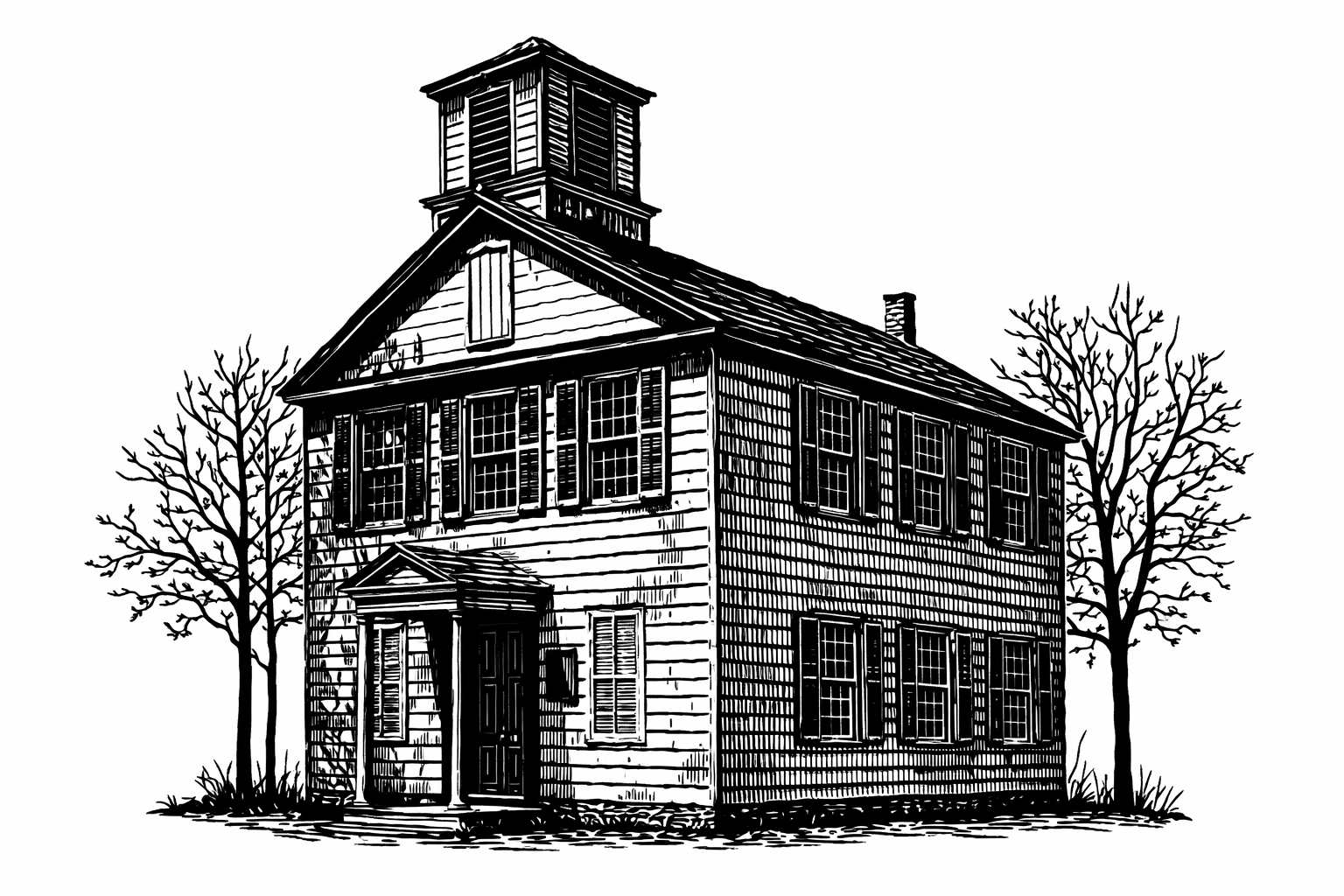
Monday 21st. Mr. [Robert] Austin sent us a copy of an address delivered by him at the present school house where the gentlemen of the place were assembled to consult upon building an Academy. It contained first expressions of gratitude to his Maker for his present unexpected fortune from England, a minute history of himself and family, how he persevered after knowledge and entered Yale College with two dollars in his pocket. His fondness for this place (Middletown) which he came to in 1828, where he has remained ever since, with the exception of a few months. Finally what he will do towards having an Academy in this place.

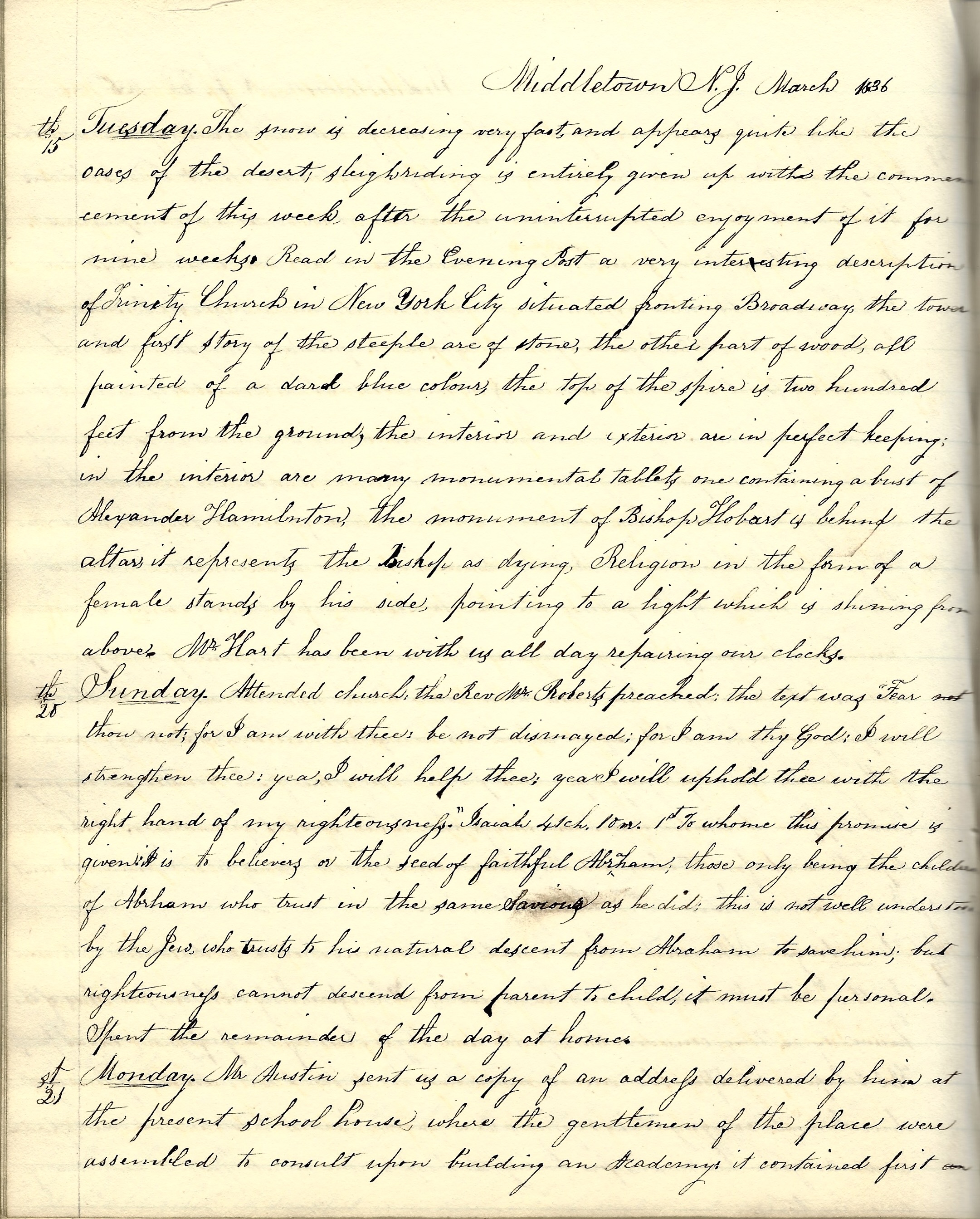
Tuesday 22nd. Snowed very fast until afternoon when it ceased.
Friday, April 1, 1836. The weather continues cold and unpleasant, and it looks almost as dreary out as winter. Miss Catherine Debow called upon us this morning.
Sunday, 24th. A delightful day. I attended church in the morning and heard a sermon delivered by the Rev. Mr. Roberts from these words, “Therefore, whosoever heareth these sayings of mine, and doeth them, I will liken him into a wise man, which built his house upon a rock.” Matthew 7th Chapter, 24-25th verse. He urged upon his hearers the necessity of having a firm foundation for their religion and in this life is the time to lay it, for we will never lead this life again. The holy appearance of this venerable man fills hte church with awe while they listen to the words that proceed from his lips.
Monday, May 2, 1836. The peach and cherry have begun to open their blossoms today and the breath of Spring has given new fragrance to the earth. The Rev. Mr. Roberts has dined with us today. He appears like one not subject to human passions, so much mildness and simplicity is he possessed of. He read to us an extract from Mrs. Wade’s Journal which was very interesting.
Wednesday 4th. Weather most delightful. All vegetation presents a very promising appearance, notwithstanding the cold spring weather until a wekk or two past. Mama and myself visited Mr. G. Van Doren’s. We there had the pleasure of meeting Miss Elizabeth Hendrickson. The time that has past since I went to school with one or two of the above mentioned appears but as yesterday and by observing its rapid flight warns me to improve the present.
Sunday 8th. Was again permitted to attend church. The Rev. Mr. Brown [?] from Wales delivered a sermon. The text was, “The meek will be guide in judgements and the meek will teach His way. ” Psalms 25th Verse 9th. The divisions were 1st, the importance of being in judgement, 2nd, the temper of mind necessary in order to be guided and those whom God will guide, under this head was illustrated the happy effects of being of a meek spirit and where it is wanting, we hear of contentions and disputes.
Monday 9th. I made an excursion to the forest or woods. It is most beautifully ornamented with the white flowers of the dogwood trees. I observed a number of wild turnips in flower. They were situated where the earth is moist and where it is partially protected from the sun. Mrs. Truex spend the afternoon with us.
Wednesday 11th. In the evening attended a party at Dr. Taylor’s. It was a bridal party given to Mr. & Mrs. Redenburg. When I arrived there, all the company were assembled. The room was handsomely lit up and graced with a ring of pleasant and intelligent countenances, among which shone conspicuously those of the bride and bridesmaids, Mrs. R, and Miss M. Schureman and Miss M. H. Forman. The company amused themselves by chatting a short time, when refreshments were handed around. After these succeeded dancing which added great animation to the company. I left at one o’clock. The stillness that reigned without a [sound] in the open air contrasted strangely with the animation that shone in the well filled rooms I had just left.
Sunday, May 15, 1836. I attended church. Heard a sermon delivered by the Rev. Mr. Roberts from the words, “As the apple tree among the trees of the wood so is my beloved among the sons. I sat under his shadow with great delight and his fruit was sweat to my taste.” This comparison is quite apparent today as the apple trees are loaded with bloom. By “the sons” are meant the patriarchs who have beauty when held by themselves, but it disappear when compared with Christ.
Tuesday 17th. Attended in the afternoon the ceremony of laying the corner stone of the Dutch Reformed Church which is located in village. The Rev. Mr. Beekman read a hymn, after the singing of which a discourse was delivered by the Rev. Mr. Messler in which he spoke very highly of the Dutch Reformed Church. The ceremony was ended after a prayer and the singing of a hymn.

Thursday 19th. Weather most delightful. In the evening Papa, sister, brother, and myself attended the nuptials of Mr. Jacob McClair and Miss Mary S, Burrowes. The ceremony was performed by the Rev. Mr. Roberts at 8 o’clock in the evening. There was a large company assembled. We arrived home at two o’clock. I retired hastily much fatigued without labor or any exertion excepting to avoid sleep.
Tuesday 24th. Papa and myself left home in the afternoon purposing a tour to New York City. The weather was very stormy, I was very sea sick on board the vessel. We arrived at the city at 8 o’clock in the evening.
Wednesday 25th. Called upon the Misses Downing who reside at No. 18 Jay Street, New York.
Friday 27th. Very stormy. I arrived at home in the afternoon.
Tuesday, June 7, 1836. Clear after a long storm of fourteen days.
Sunday 12th. Heard a sermon delivered by the Rev. Mr. Hiers at his church in Baptist town six miles distant. The text was, “All these things are against me.” Genesis 42nd Chapter, 36th verse last part.
Tuesday 14th. Very pleasant. The family including myself attended in the evening a party at Mr. Jonathan McClane’s given in honor of W. Jacob & Mrs. M. McClain. It was a delightful ride there. The dwelling is situated upon the bank of the river with the yard extending to its very brink. The prospect is delightful. There was the number of eighty persons assembled. Arrived at home half past three o’clock in the morning. Before I retired to rest, the cock had announced the morning and birds were warbling their morning praises.
Sunday, July 3, 1836. I attended church expecting to hear a sermon as usual, but in reality it was far otherwise than an ordinary one. Our pastor, Rev. [Thomas] Roberts, arose and thus spoke, “I arise my friends with very peculiar emotions. I informed you three months since I thought of going away, but have continued staying without any specified time. I thought I could never say farewell to this dear people. I have been with you 11 and a half years. In that time 140 have joined the church, but I think it is my duty to do so, and today must end our connection as pastor and people. We know not what is in the womb of Providence.” After these preliminary remarks, he delivered his farewell address. The text was, “Finally brethren farewell. Be perfect, be of good comfort, be of one mind, live in peace, and the God of love and peace shall be with you.” Corinthians 13th Chapter, 11th verse. He enlarged upon the exhortations contained in the text in a most solemn manner. All the people assembled appeared very much affected.
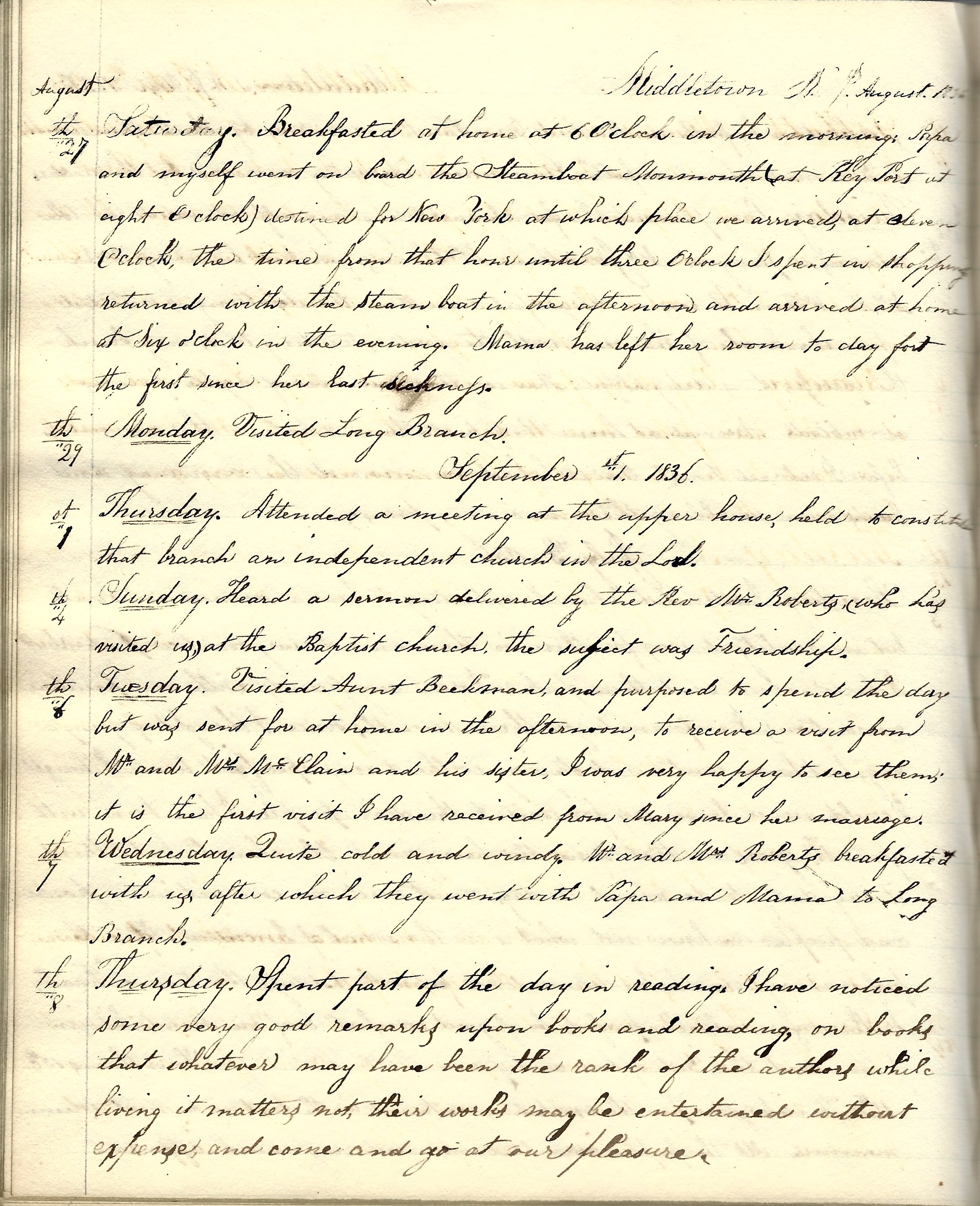
Saturday, August 27, 1836. Breakfasted at home at 6 o’clock in the morning. Papa and myself went on board the steamboat Monmouth (at Key Port at eight o’clock) destined for New York at which place we arrived at eleven o’clock. The time from that hour until three o’clock I spent in shopping. Returned with the steamboat in the afternoon and arrived at home at six o’clock in the evening. Mama has left her room today for the first time since her last sickness.
Monday 29th. Visited Long Branch.
Thursday, September 1, 1836. Attended a meeting at the upper house held to constitute that branch an independent church in the Lord.
Sunday 4th. Heard a sermon delivered by the Rev. Mr. Roberts (who has visited us) at the Baptist Church. The subject was friendship.
Tuesday 6th. Visited Aunt Beekman and purposed to spend the day but was sent for at home in the afternoon to receive a visit from Mr. & Mrs. McClain and his sister. I was very happy to see them. It is the first visit I have received from Mary since her marriage.
Wednesday 7th. Quite cold and windy. Mr. and Mrs. Roberts breakfasted with us, after which they went with Papa and Mama to Long Branch.
Thursday 8th. Spent part of the day in reading. I have noticed some very good remarks upon books and reading, on books that whatever may have been the rank of the authors while living, it matters not. Their works may be entertained without expense and come and go at our pleasure.
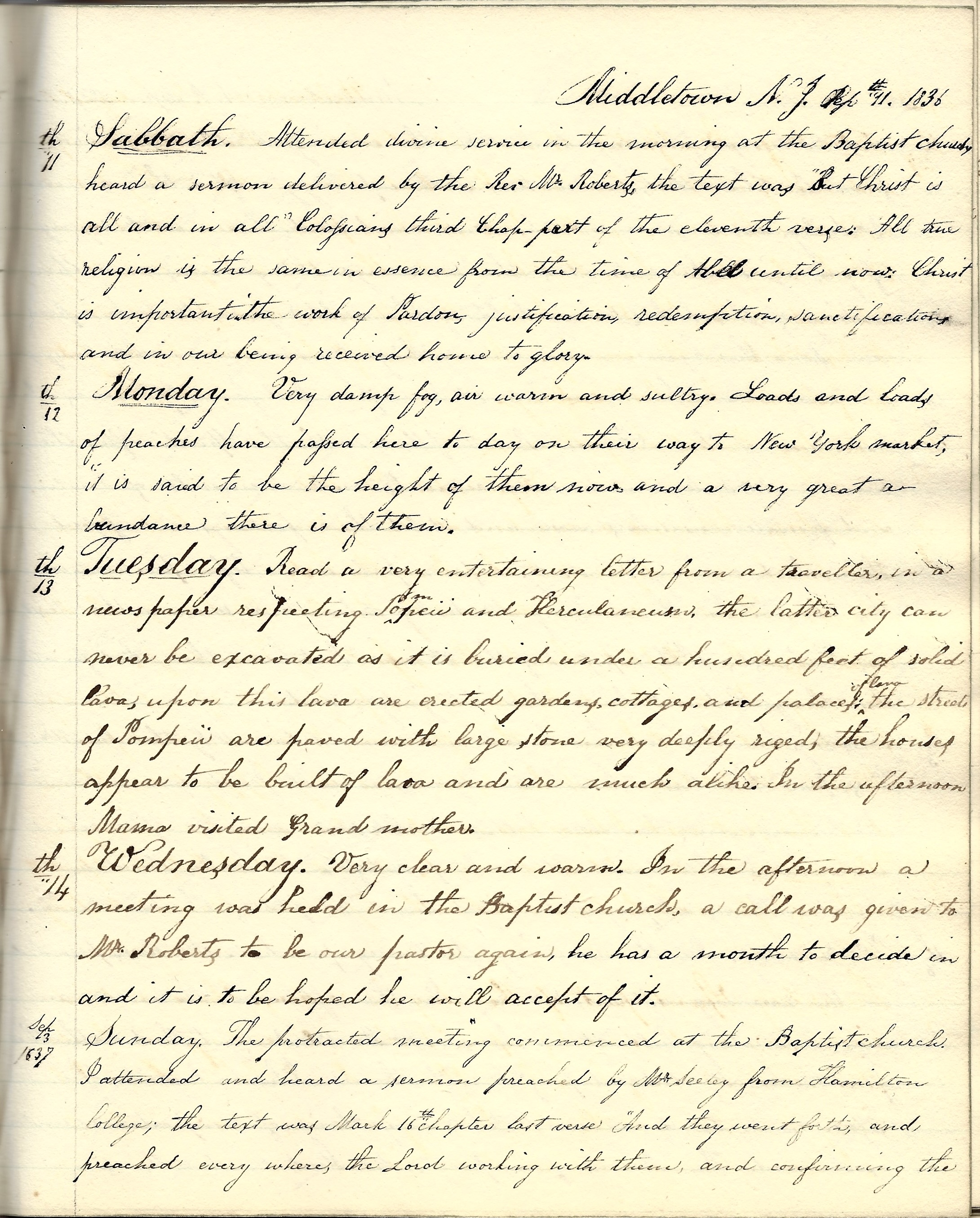
Sabbath 11th. Attended divine service in the morning at the Baptist Church. Heard a sermon delivered by the Rev. Mr. Roberts. The text was, “But Christ is all and in all.” Colossians 3rd Chapter, part of the 11th verse. All true religion is the same in essence from the time of Abel until now. Christ is important in the work of pardon, justification, redemption, sanctification, and in our being received home to glory.

Monday 12th. Very damp fog, air warm and sultry. Loads and loads of peaches have passed here today on their way to New York market. It is said to be the height of them now and a very great abundance there is of them.
Tuesday 13th. Read a very entertaining letter from a traveller in a newspaper respecting Pompeii and Herculaneum. The latter city can never be excavated as it is buried under a hundred feet of solid lava. Upon this lava are erected gardens, cottages, and palaces of lava. The streets of Pompeii are paved with large stones very deeply ridged. The houses appear to be built of lava and are much alike. In the afternoon, visited Grand mother.
Wednesday 14th. Very clear and warm. In the afternoon a meeting was held in the Baptist church. A call was given to Mr. Roberts to be our pastor again. He has a month to decide in and it is to be hoped he will accept of it.

[Editor’s Note: I have transcribed most of the journal entries but skipped some of the purely religious and sometimes repetitive content. Scans are available of all the pages so that readers can look up what I have omitted.]
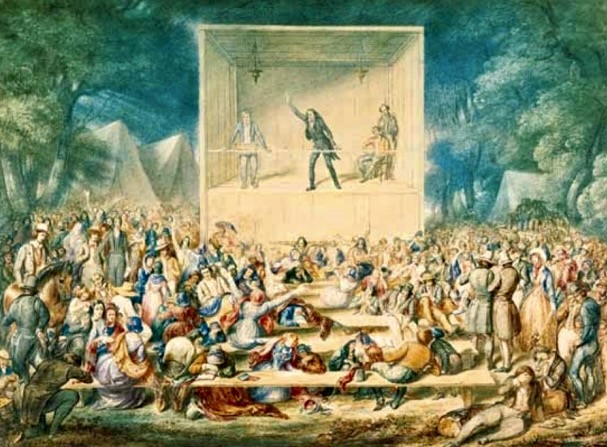
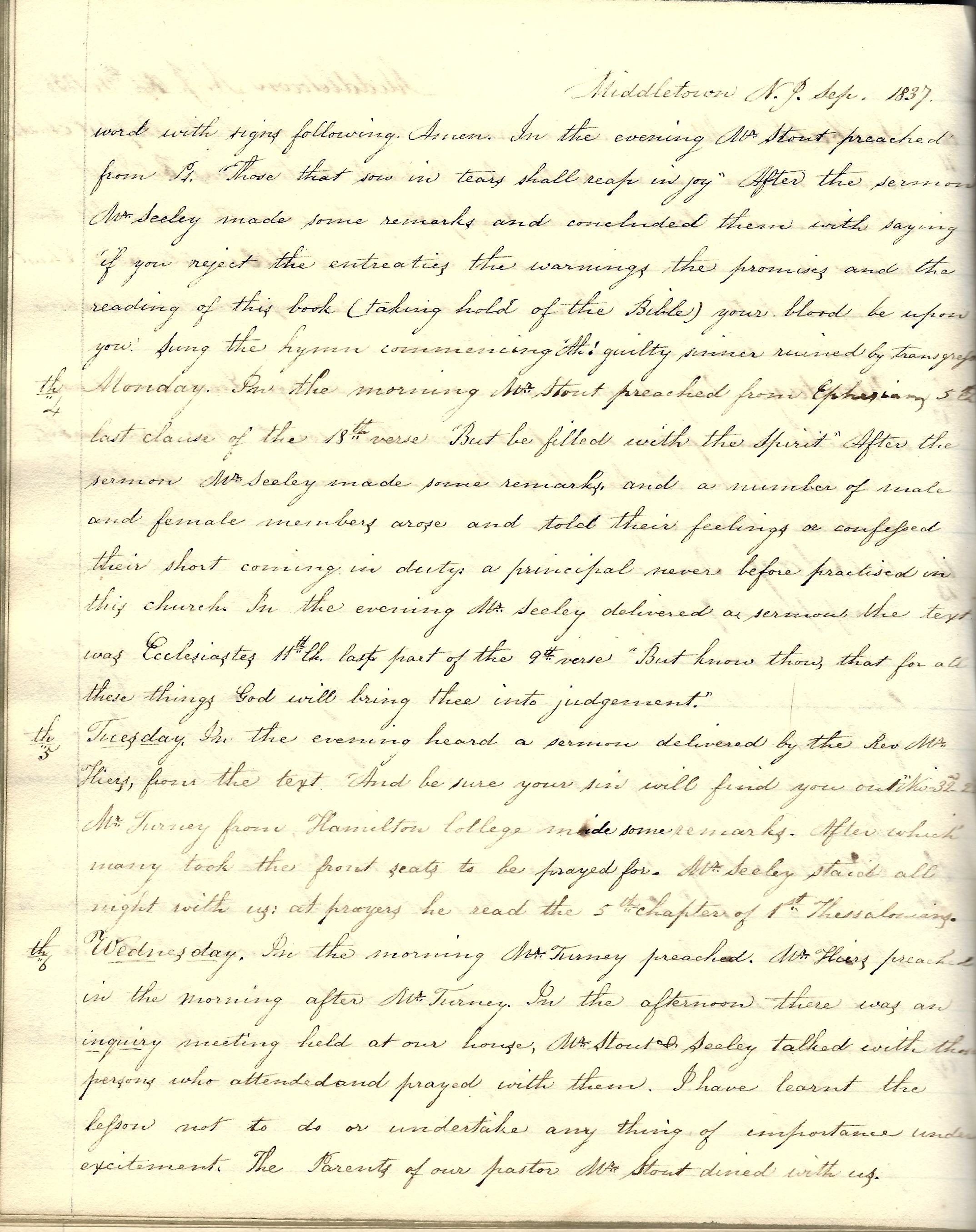
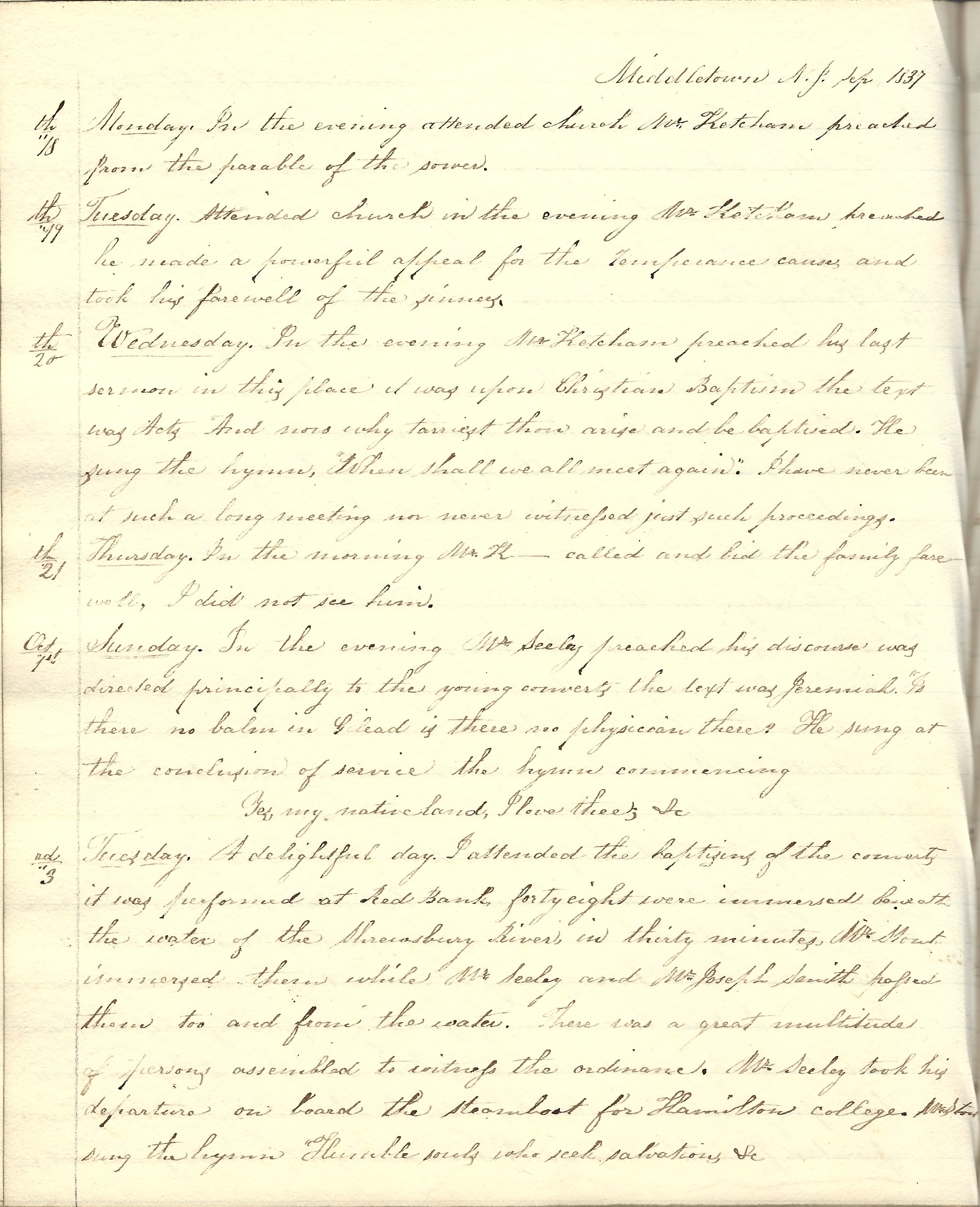
Sunday, September 3, 1837. The protracted meeting commenced at the Baptist Church. I attended and heard a sermon preached by Mr. Seeley from Hamilton College. The text was Mark 16th Chapter, last verse, “And they went forth, and preached everywhere, the Lord working with them and confirming the word with signs following amen. In the evening Mr. [David Bishop] Stout preached from Psalm, “Those that sow in tears shall reap in joy.” After the sermon Mr. Seeley made some remarks and concluded them with saying, “if you reject the entreaties, the warnings, the promises, and the reading of this book (taking hold of the Bible) your blood be upon you. Sung the hymn commencing “Ah! guilty sinner ruined by transgressions.”
Monday 4th. In the morning Mr. Stout preached from Ephesians 5th Chapter, last clause of the 18th verse. “But be filled with the spirit.” After the sermon Mr. Seeley made some remarks and a number of male and female members arose and told their feelings or confessed their shortcomings in duty, a principal never practiced in this church. In the evening Mr. Seeley delivered a sermon. The text was Ecclesiastics 11th Chapter, last part of the 9th verse, “But know thou, that for all these things, God will bring thee into judgement.”
Tuesday 5th. In the evening heard a sermon delivered by the Rev. Mr. Hiers from the text, “And be sure your sin will find you out.” Mr. [Edmund] Turney from Hamilton College made some remarks after which many took the front seats to be prayed for. Mr. Seeley staid all night with us. At prayers he read the 5th Chapter of 1st Thessalossians.
Wednesday 6th. In the morning Mr. Turney preached. Mr. Hiers preached in the morning after Mr. Turney. In the afternoon there was an inquiry meeting held at our house. Mr. Stout & Mr. Seeley talked with the persons who attended and prayed with them. I have learnt the lesson not to do or undertake anything of importance under excitement. The parents of our pastor, Mr. Stout, dined with us.
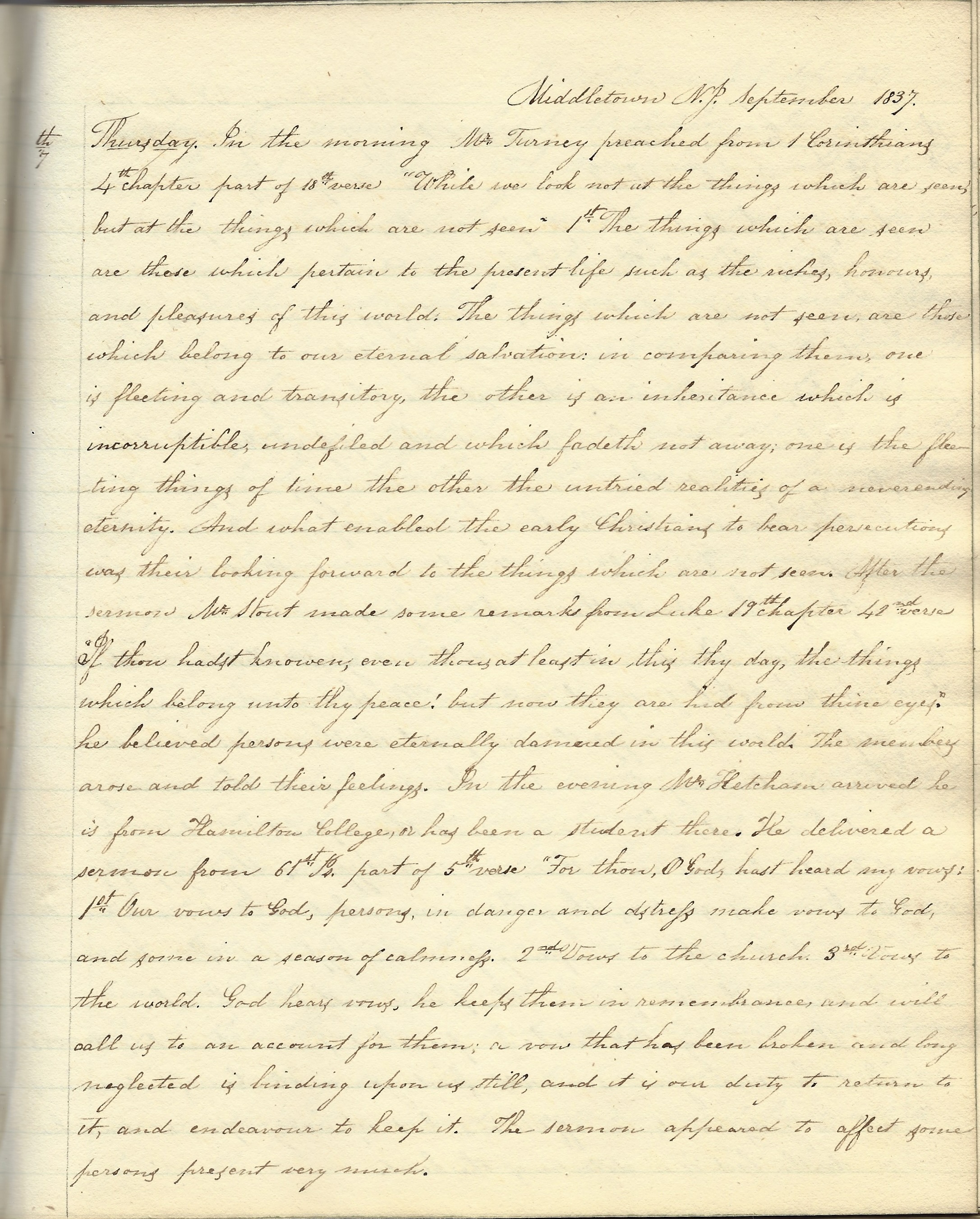
Thursday 7th. In the morning, Mr. Turney preached from 1st Corinthians, 4th Chapter, part of 18th verse, “While we look not at the things which are seen, but at the things which are not seen,” 1st, the things which are seen are those which pertain to the present life such as the riches, honors and pleasures of this world. The things which are not seen are those which belong to our eternal salvation. In comparing them, one is fleeting and transitory, the other is an inheritance which is incorruptible, undefiled and which fadeth not away. One is the fleeting things of time, the other the untried realities of a never ending eternity. And what enabled the early Christians to bear persecutions was their looking forward to the things which are not seen.
After the sermon Mr. Stout made some remarks from Luke 19th Chapter, 42nd verse, “If thou hadst known, even thou, at least in this thy day, the things which belong unto thy peace! but now they are hid from thine eyes.” He believes persons were eternally damned in this world. The members arose and told their feelings. In the evening, Mr. Ketcham arrived. He is from Hamilton College, or has been student there. He delivered a sermon from 61st Psalm, part of 5th verse, “For thou, Oh God, hast heard my vows…The sermon appeared to affect some persons present very much.
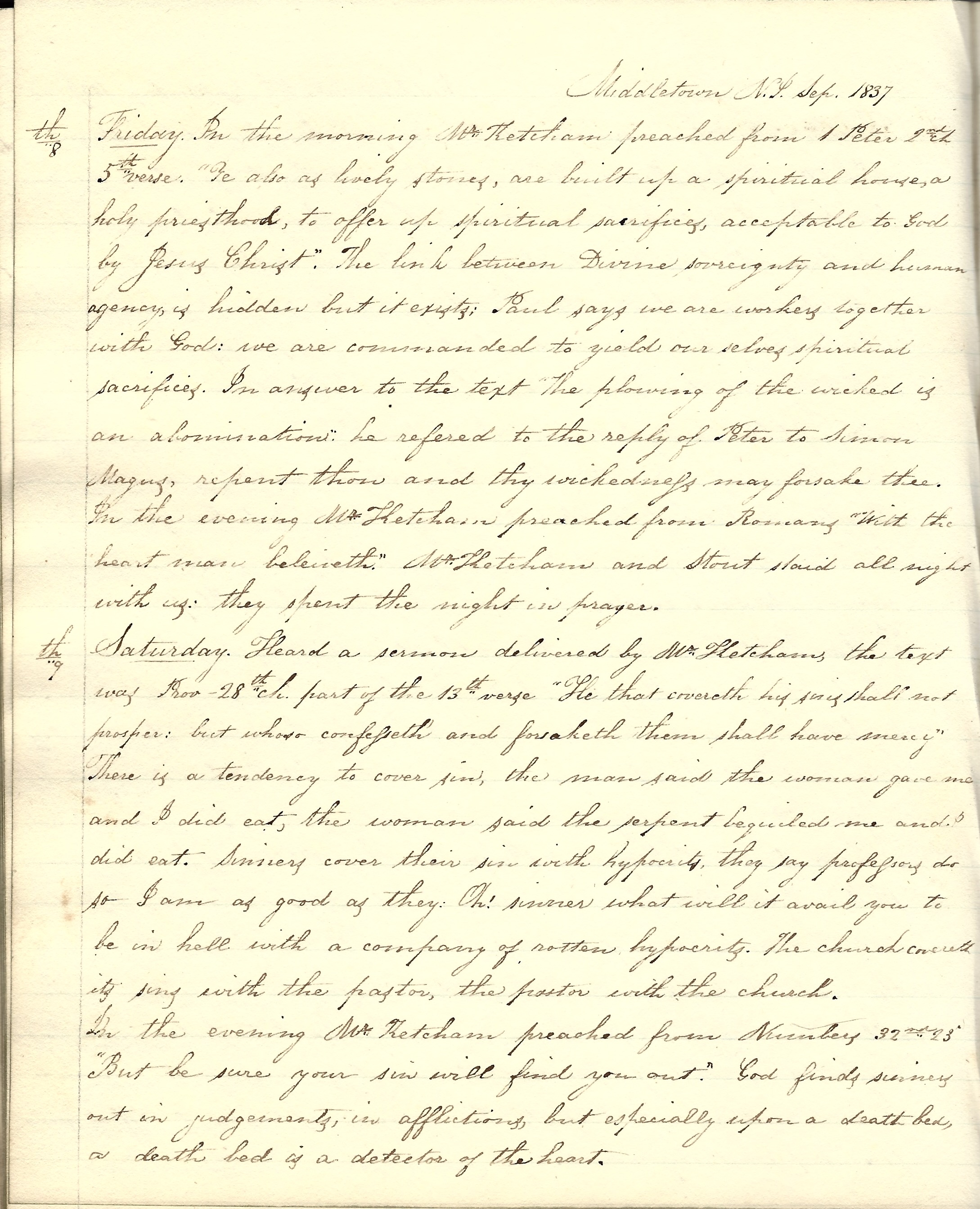
Friday, September 8, 1837. In the morning Mr. Ketcham preached from 1st Peter, 2nd Chapter, 5th Verse, “Ye also as lively stones, are built up a spiritual house, a holy priesthood, to offer up spiritual sacrifice, acceptable to God by Jesus Christ.” The link between Divine sovereignty and human agency is hidden but it exists. Paul says we are workers together with God. We are commanded to yield ourselves spiritual sacrifices. In answer to the text, “The plowing of the wicked is an abomination,” he referred to the reply of Peter to Simon Magus, repent thou and thy wickedness make forsake thee. In the evening Mr. Ketcham preached from Roman “With the heart man believeth.” Mr. Ketcham and Stout staid all night with us. They spent the night in prayer.
Saturday 9th. Heard a sermon delivered by Mr. Ketcham. The text was Prov. 28th Chapter, part of the 13th verse…
Sunday 10th. Three sermons preached by Mr. Ketcham…
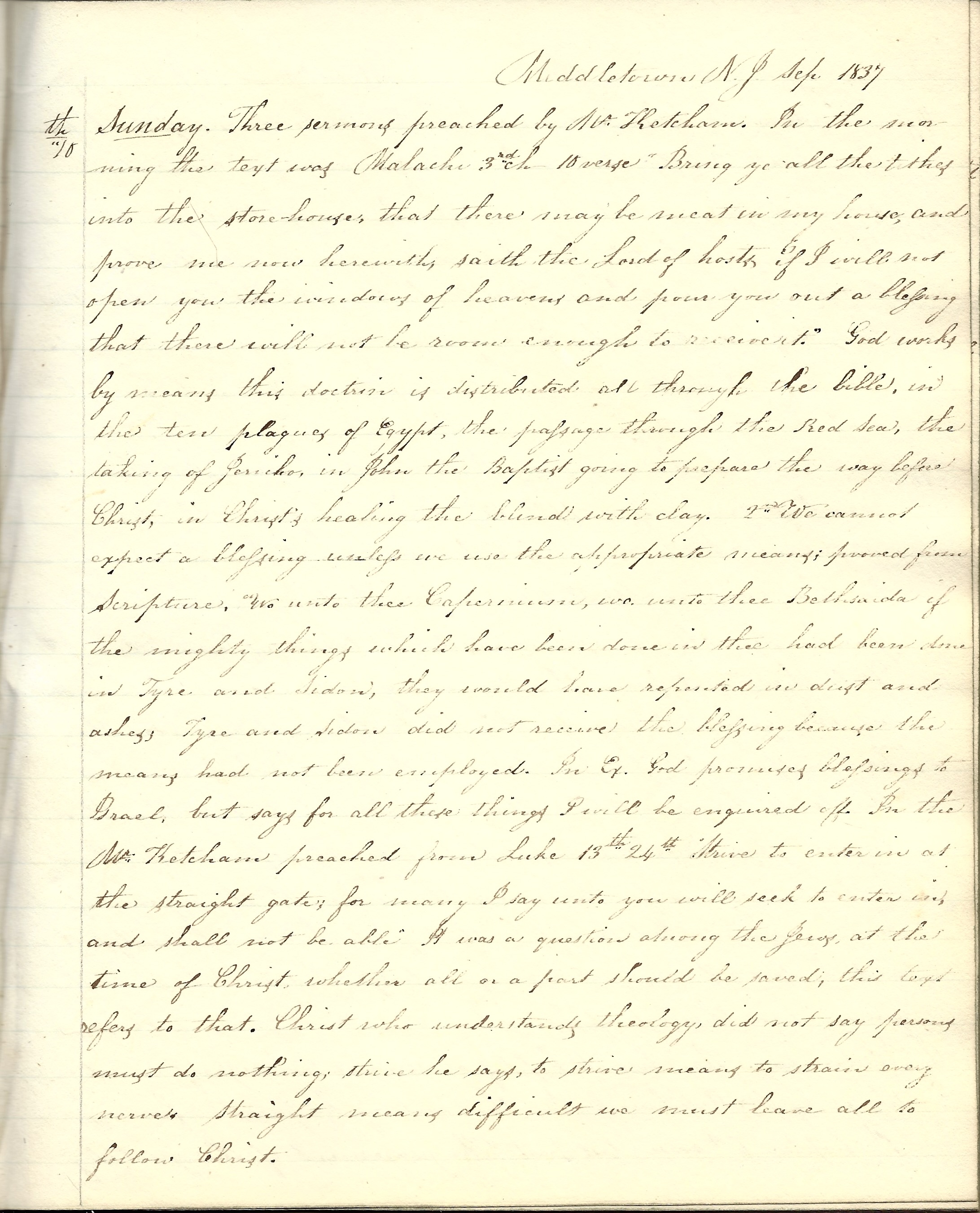
Monday 11th. In the morning heard Mr. Ketcham preach…
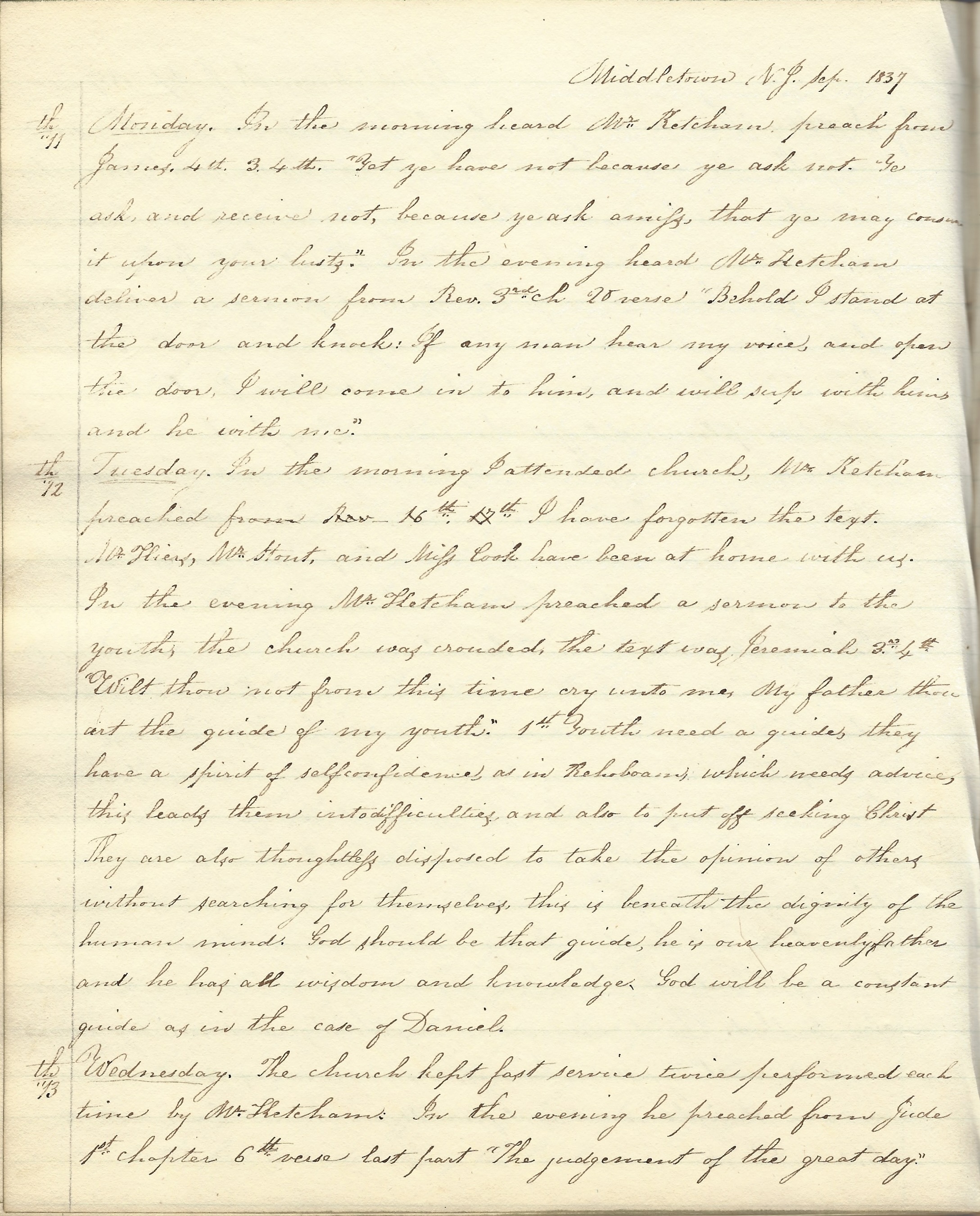
Tuesday 12th. In the morning I attended church. Mr. Ketcham preached. Mr. Hiers, Mr. Stout, and Miss Cook have been at home with us. In the evening Mr. Ketcham preached a seron to the youth. The church was crowded…
Wednesday 13th. The church kept fast service twice performed each time by Mr. Ketcham. In the evening he preached from Jude, 1st Chapter, 6th verse last part, “The judgement of the great day.”
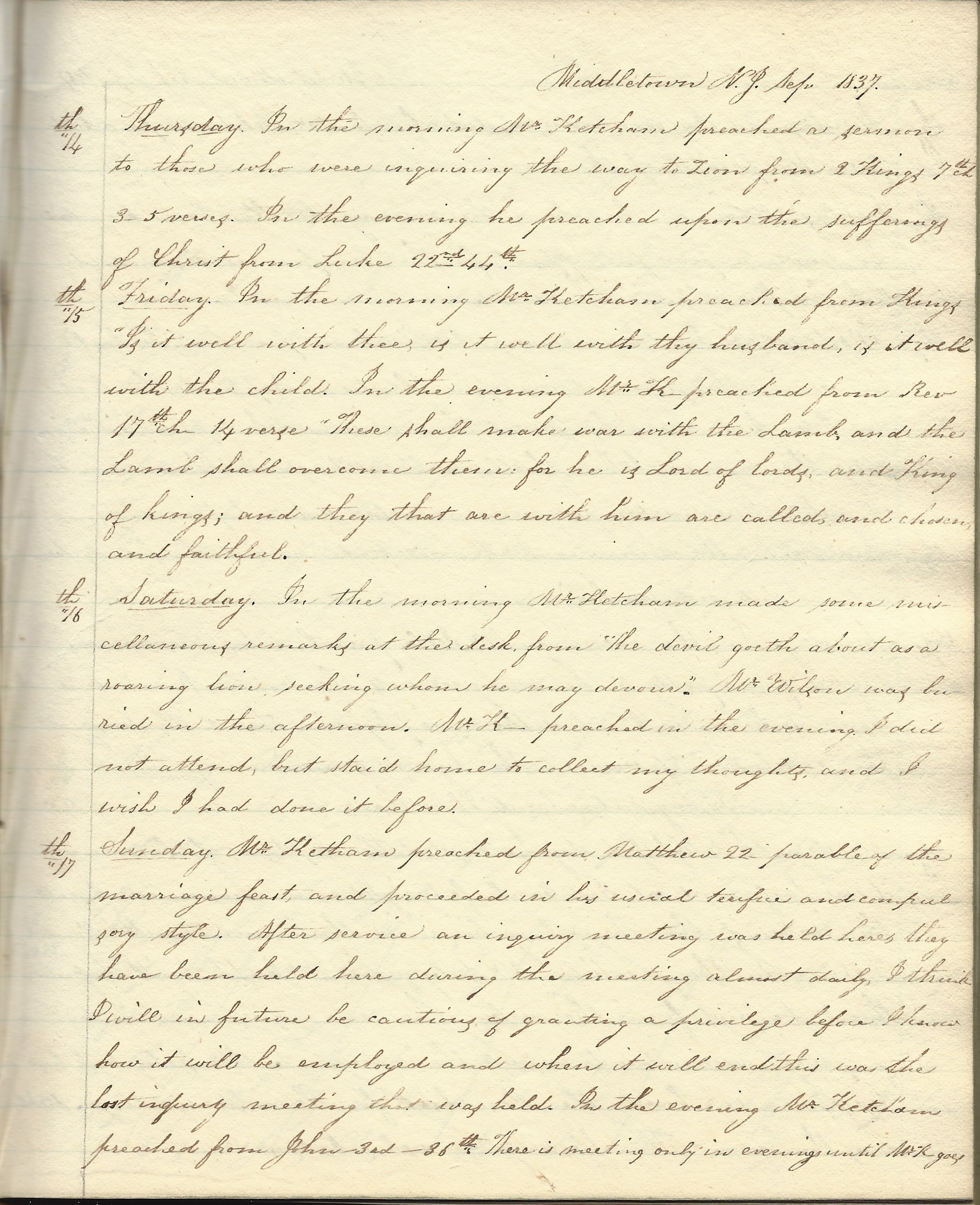
Thursday 14th. In the morning, Mr. Ketcham preached a sermon to those who were enquiring the way to Zion…
Friday 15th. In the morning Mr. Ketcham preached…
Saturday 16th. In the morning Mr. Ketcham made some miscellaneous remarks at the desk from “The devil goeth about as a roaring lion, seeking whom he may devour.” Mr. Wilson was buried in the afternoon. Mr. Ketcham preached in the evening. I did not attend but staid home to collect my thoughts and I wish I had done it before.
Sunday 17th. Mr. Ketcham preached… After service an inquiry meeting was held here. They have been held here during the meeting almost daily. I think I will in future be cautious of granting a privilege before I know how it will be employed and when it will end. This was the last inquiry meeting that was held. In the evening Mr. Ketcham preached… There is meeting only in evenings until Mr. Ketcham goes.
Monday 18th. In the evening attended church. Mr. Ketcham preached from the parable of the sower.
Tuesday 19th. Attended church in the evening. Mr. Ketcham preached. He made a powerful appeal for the Temperance cause and took his farewell of the sinner.
Wednesday 20th. In the evening Mr. Ketcham preached his last sermon in this place. It was upon Christian Baptism. The text was Acts, “And now why tarriest thou, arise and be baptized.” He sung the hymn, “When shall we all meet again.” I have never been at such a long meeting nor never witnessed just such proceedings.
Thursday 21st. In the morning Mr. Ketcham called and bid the family farewell. I did not see him.
Sunday, October 1, 1837. In the evening Mr. Seeley preached his discourse. Was directed principally to the young converts. The text was Jeremiah, “Is there no balm in Giliad, is there no physician there?” He sung at the conclusion of the service the hymn commencing, “”Yea my native land, I love thee,”
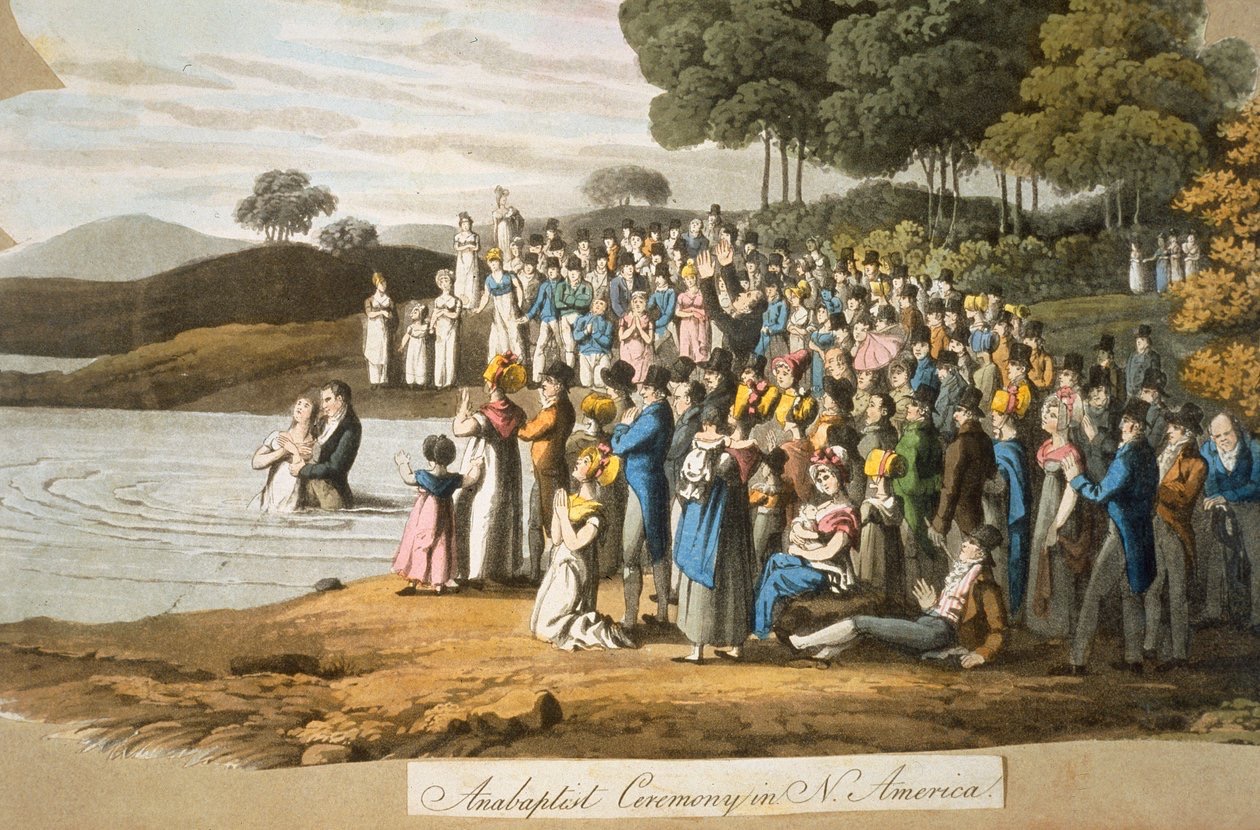
Tuesday, 3rd. A delightful day. I attended the baptisms of the converts. It was performed at Red Bank. Forty-eight were immersed beneath the water of the Shrewsbury River in thirty minutes. Mr. Stout immersed them while Mr. Seeley and Mr. Joseph Smith passed them to and from the water. There was a great multitude of persons assembled to witness the ordinance. Mr. Seeley took his departure on board the steamboat for Hamilton College. Mr. Stout sung the hymn, “Humble souls who seek salvation, &c.”
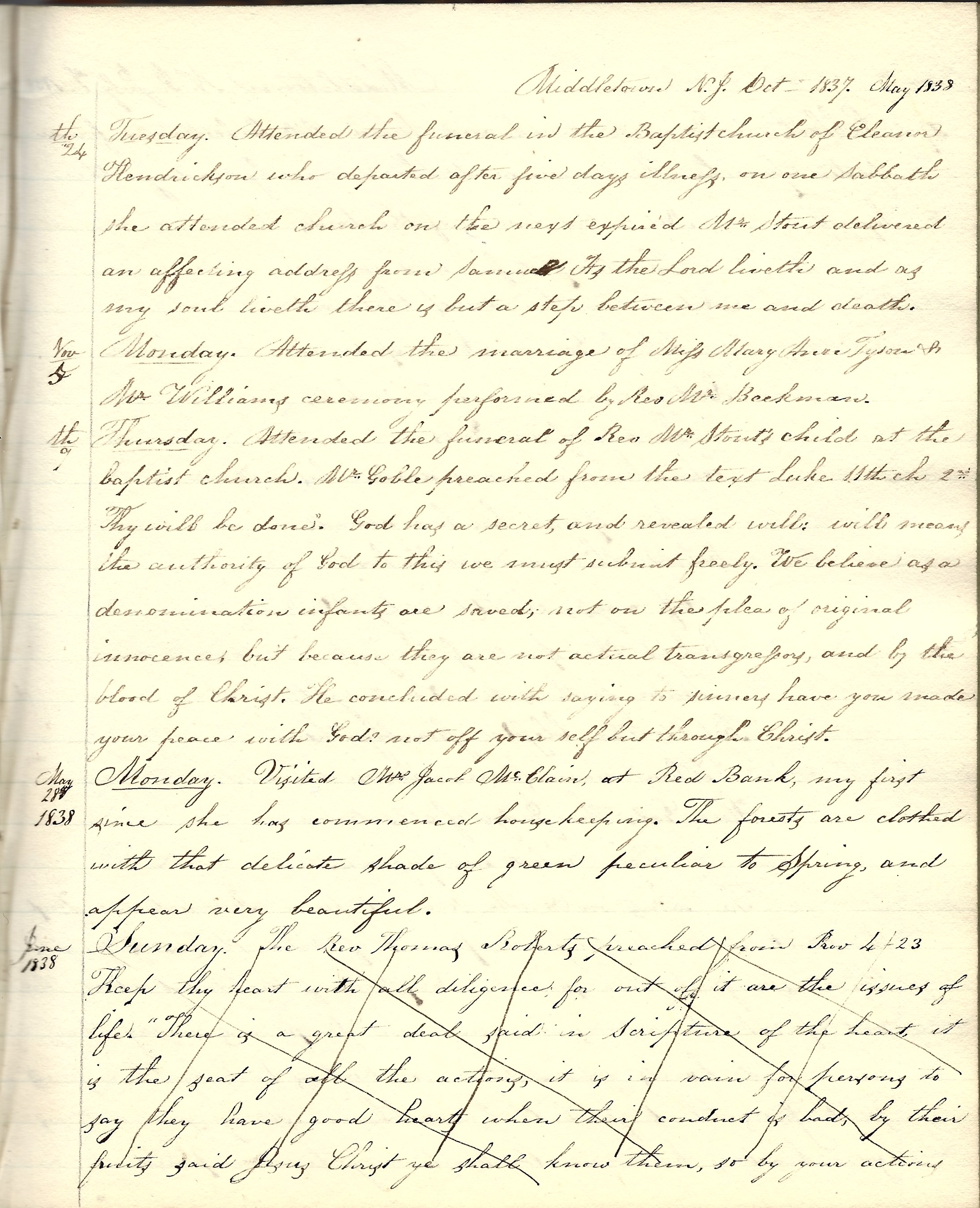
Tuesday, October 24, 1837. Attended the funeral in the Baptist Church of Eleanor Hendrickson who departed after five days illness. On one Sabbath she attended church. On the next expired. Mr. Stout delivered an affecting address from Samuel, “As the Lord liveth an as my soul liveth there is but a step between me and death.”
Monday, November 5, 1837. Attended the marriage of Miss Mary Ann Tyson & Mr. Williams. Ceremony performed by Rev. Mr. Beekman.
Thursday 9th. Attended the funeral of Rev. Mr. Stout’s child at the Baptist Church. Mr. Goble preached from the text Luke 11th Chapter, 2nd verse. “Thy will be done.” God has a secret and revealed will. Will means the authority of God. To this we must submit freely. We believe as a denomination infants are saved, not on the plea of original innocence, but because they are not actual transgressors and by the blood of Christ. He concluded with saying to sinners, have you made your peace with God? not of yourself but through Christ.
Monday, May 28, 1838. Visited Mrs. Jack McClain at Red Bank, my first time since she has commenced housekeeping. The forests are clothed with that delicate shade of green peculiar to spring and appear very beautiful.
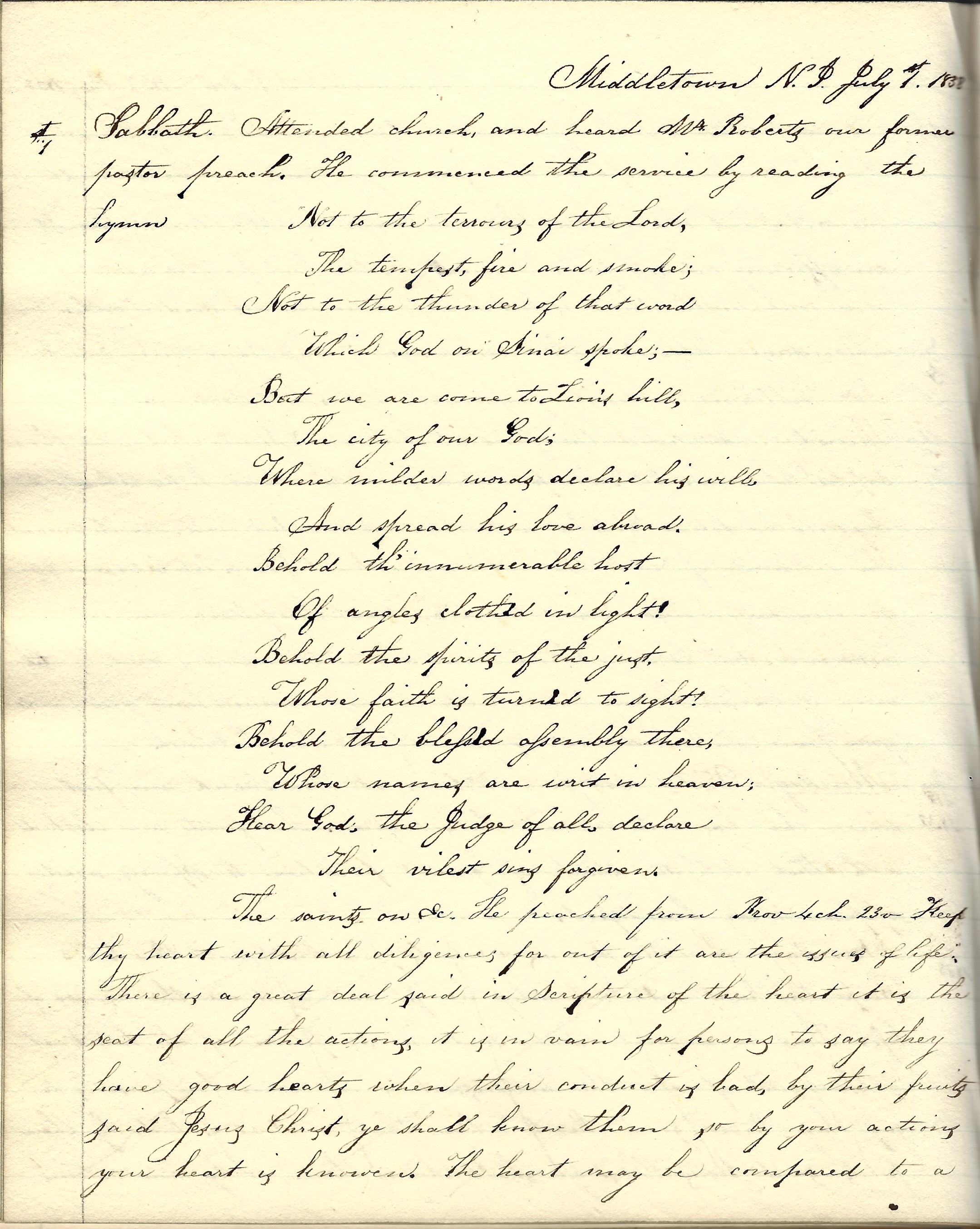
Middletown, New Jersey, Sabbath, July 1, 1838. Attended church and heard Mr. Roberts, our former pastor preach. He commenced the service by reading the hymn:
Not to the terrors of the Lord,
The tempest, fire and smoke;
Not to the thunder of that word
Which God on Sinai spoke.
But we are come to Zion’s hill.
The city of our God;
Where milder words, declare His will,
And spread His love abroad.
Behold the innumerable host
Of angels clothed in light!
Behold the spirit, of the just,
Whose faith is turned to sight.
Behold the blessed assembly there.
Whose names are writ in heaven;
Hear God, the Judge of all, declare
Their vilest sins forgiven.
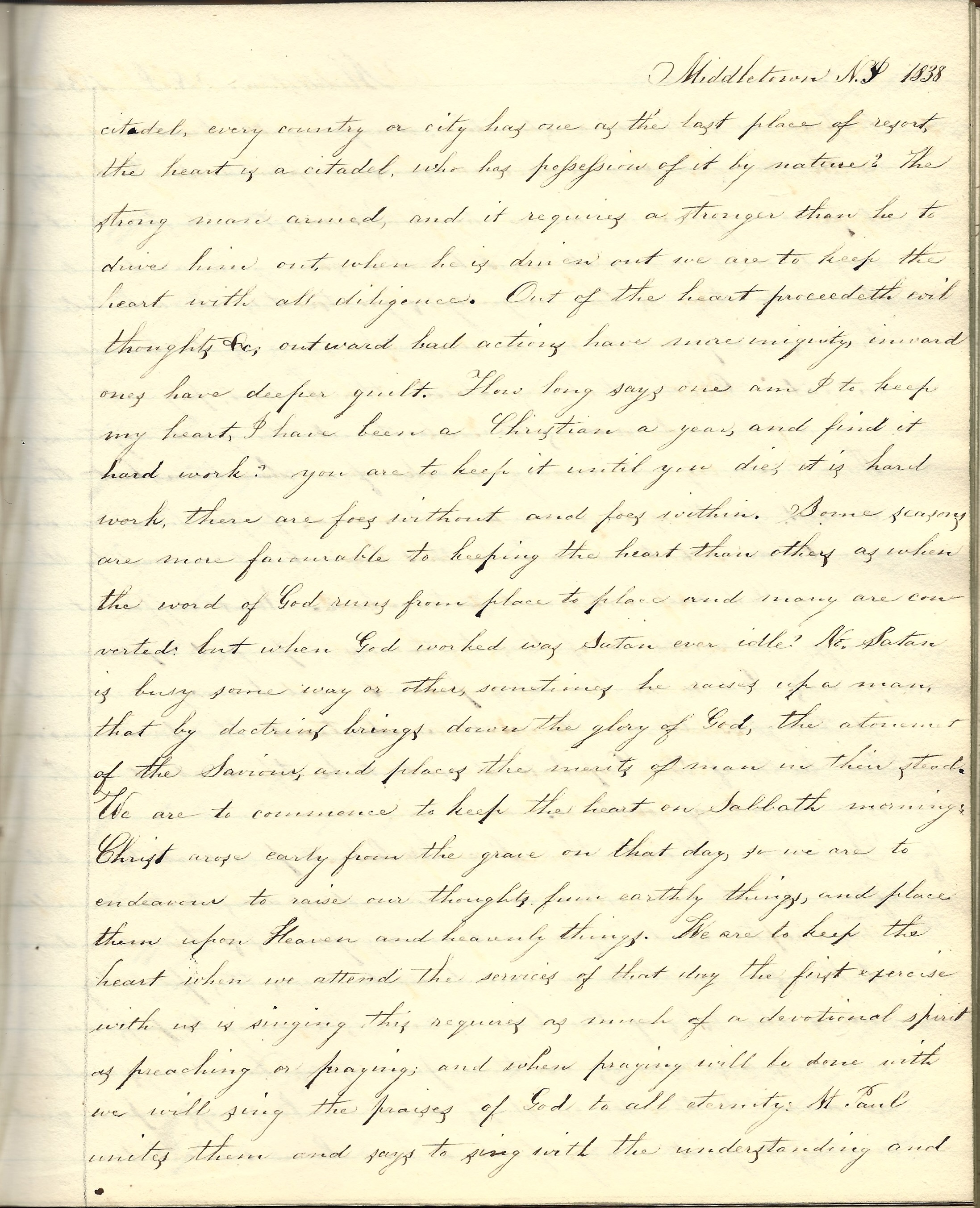
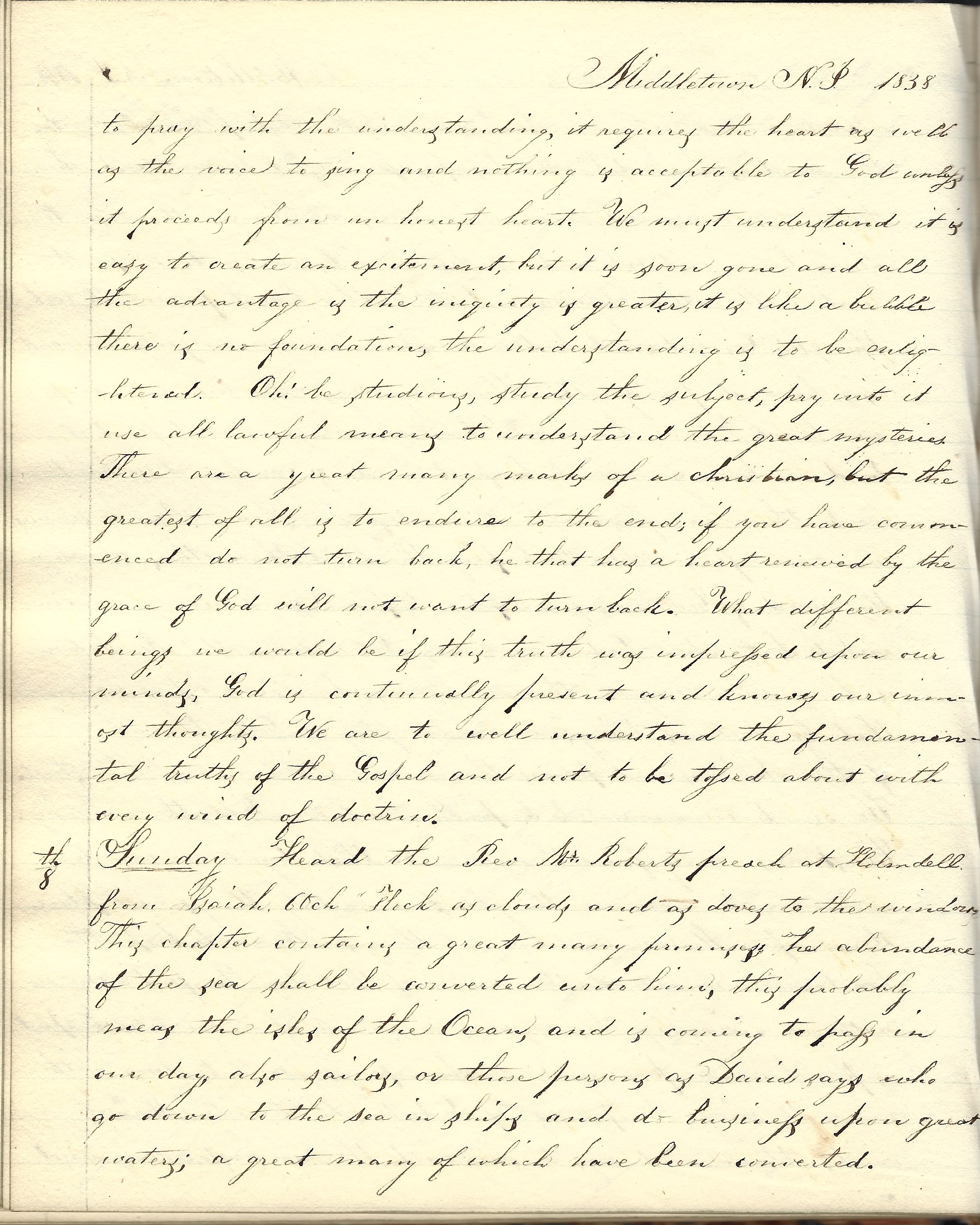
He preached from Proverbs 23rd verse, “Keep thy heart with all diligences for out of it are the issues of life.” There is a great deal said in scripture of the heart. It is the seat of all the actions. It is in vain for persons to say they have good hearts when their conduct is bad, by their fruits, said Jesus Christ, ye shall know them, so by your acting, your heart is known. The heart may be compared to a citadel, every country or city has one as the last place of resort/ The heart is a citadel, who has possession of it by nature> The strong man armed, and it requires a stronger than he to drive him out, when he is driven out we are to keep heart with all diligence. Out of the heart proceedeth evil thoughts, &c., outward bad actions have more inequity, inward ones have deeper guilt. How long says one am I to keep my heart. I have been a Christian a year and I find it hard work? You are to keep it until you die. It is hard work. There are foes without and foes within. Some seasons are more favorable to keeping the heart than others as when the word of God runs from place to place and many are converted. But when God worked, was Satan ever idle? No. Satan is busy some way or other. Sometimes he raises up a man that by doctrine brings down the glory of God, the atonement of the Savior, and places the merit of man in their stead. We are to commence to keep the heart on Sabbath morning. Christ arose early from the grave on that day, so we are to endeavor to raise our thoughts from earthly things, and place them upon Heaven and heavenly things. We are to keep the heart when we attend the services of that day the first exercise with us is singing. This requires as much of a devotional spirit as preaching or praying, and when praying will be done with, we will sing the praises of God to all eternity. Paul unites them and says to sing with the understanding and to pray with the understanding, it requires the heart as well as the voice to sing and nothing is acceptable to God only it proceeds from an honest heart. We must understand it is easy to create an excitement, but it is soon gone and all the advantage is the inequity is greater. It is like a bubble—there is no foundation. The understanding of it it to be only literal. Oh! be studious. Study the subject, pay into it. Use all lawful means to understand the great mysteries…
Sunday 8th. Heard the Rev. Mr. Roberts preach at Holmdel from Isaiah 60 Chapter, “Flock as clouds and as doves to the window.” This chapter contains a great many promises. The abundance of the sea shall be converted unto him. This probably means the isles of the ocean, and is coming to pass in our day, also sailors, or the persons as David says who go down to the sea in ships, and do business upon great waters, a great many of which have been converted.
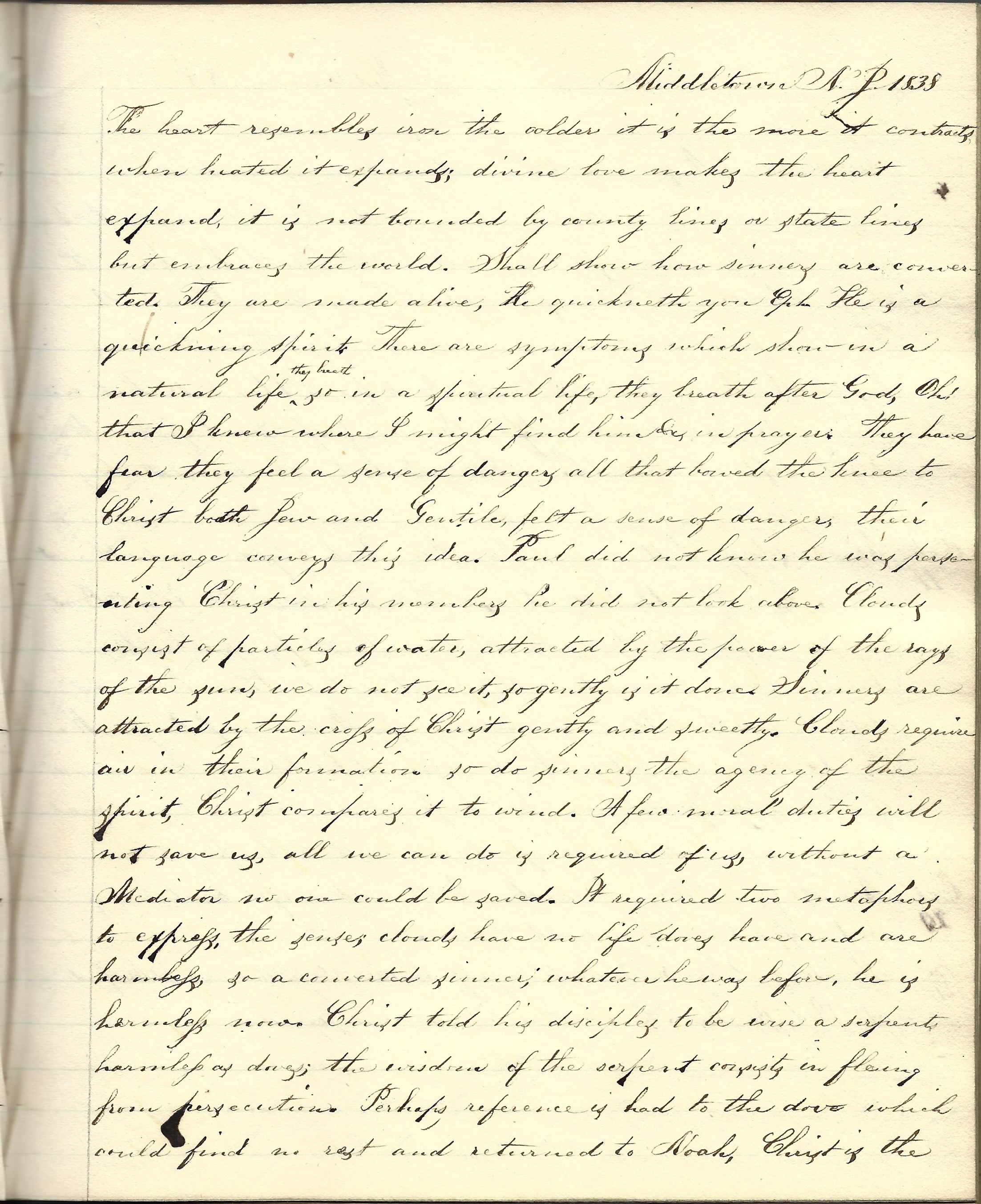
The heart resembles iron. The older it is, the more it contracts. When heated it expands. Divine love makes the heart expand. It is not bounded by county lines or state lines, but embraces the world. Shall show how sinners are converted. They are made alive….
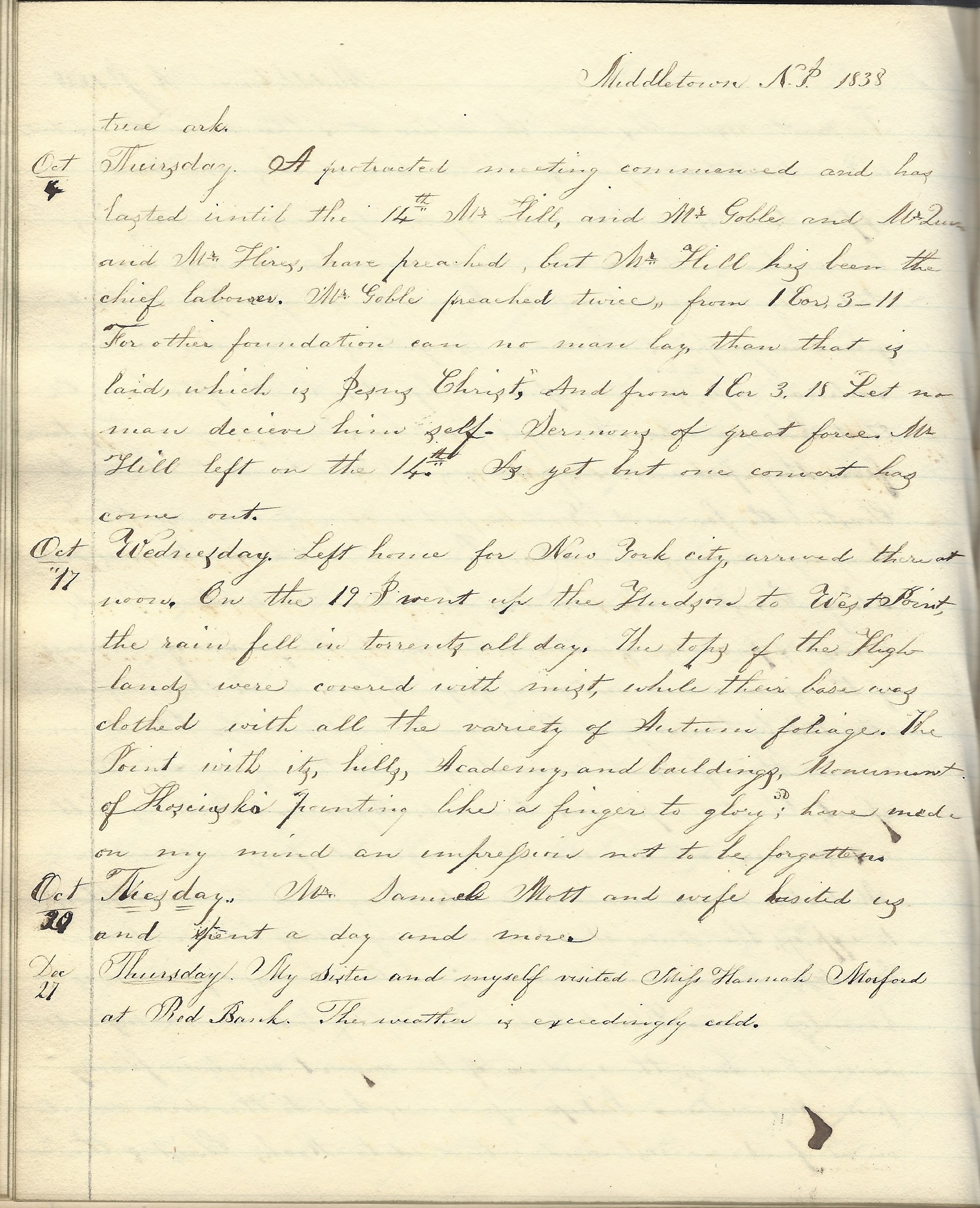
Thursday, October 4, 1838. A protracted meeting commenced and has lasted until the 14th. Mr. Hill and Mr. Goble and Mr. Qu__ and Mr. Hires have preached, but Mr. Hill has been the chief laborer. Mr. Goble preached twice, from 1st Corinthians, 3-11. “For other foundation can no more lay than that is laid which is Jess Christ.” And from 1st Corinthians 2.18 “Let no man deceive himself. ” Sermons of great force. Mr. Hill left on the 14th. As yet but one convert has come out.
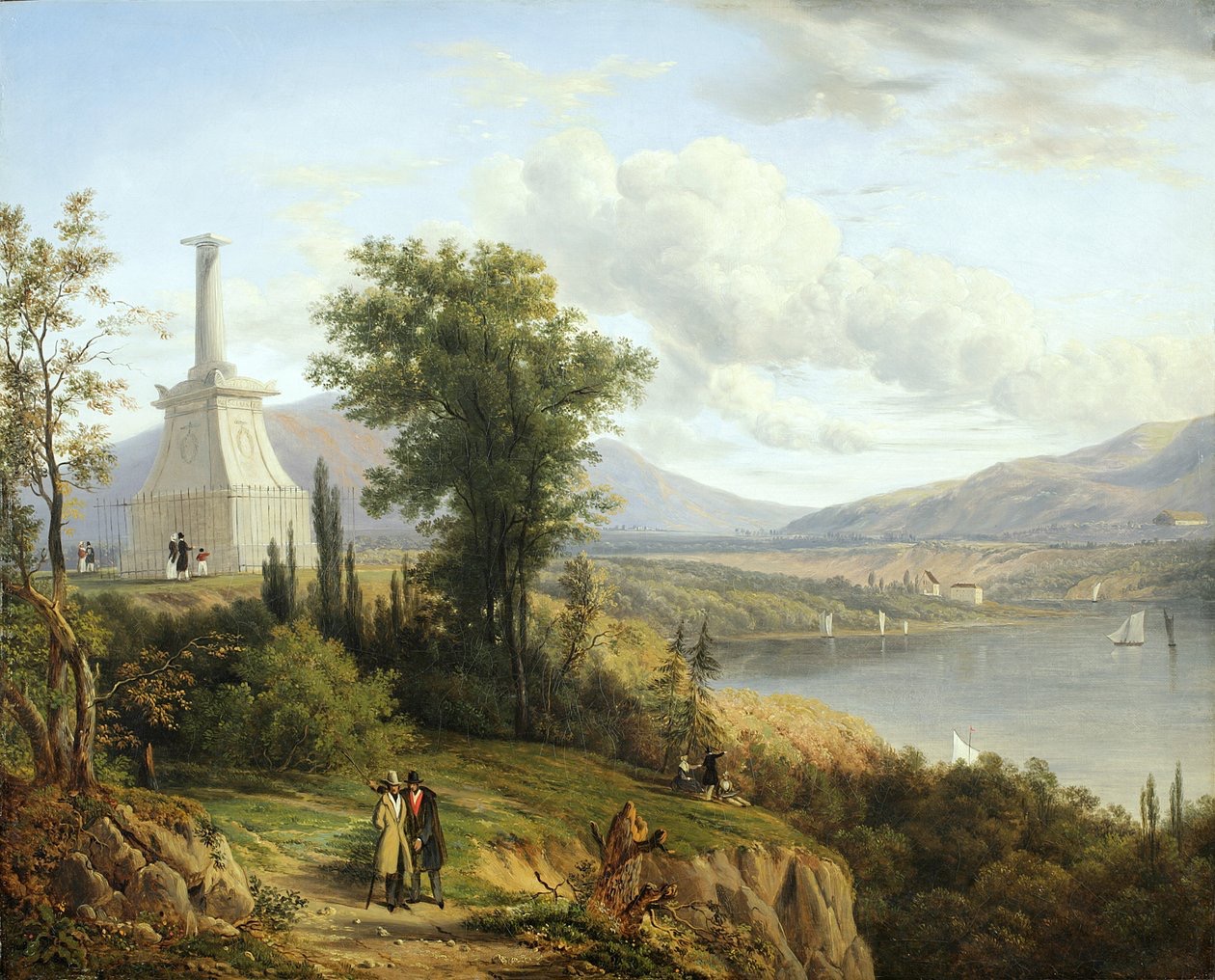
Wednesday, October 17, 1838. Left home for New York City. Arrived there at noon. On the 19th I went up the Hudson to West Point. The rain fell in torrents all day. The top of the Highlands were coverd with mist, while their base was clothed with all the variety of Autumn foliage. The Point, with its hills, Academy and buildings, Monument of Kosciusko pointing like a finger to glory, have made on my mind an impression not to be forgotten.
Tuesday October 20. Mr. Samuel Mott and wife visited us and spent a day or more.
Thursday, December 27, 1838. My sister and myself visited Miss Hannah Morford at Red Bank. The weather is exceedingly cold.

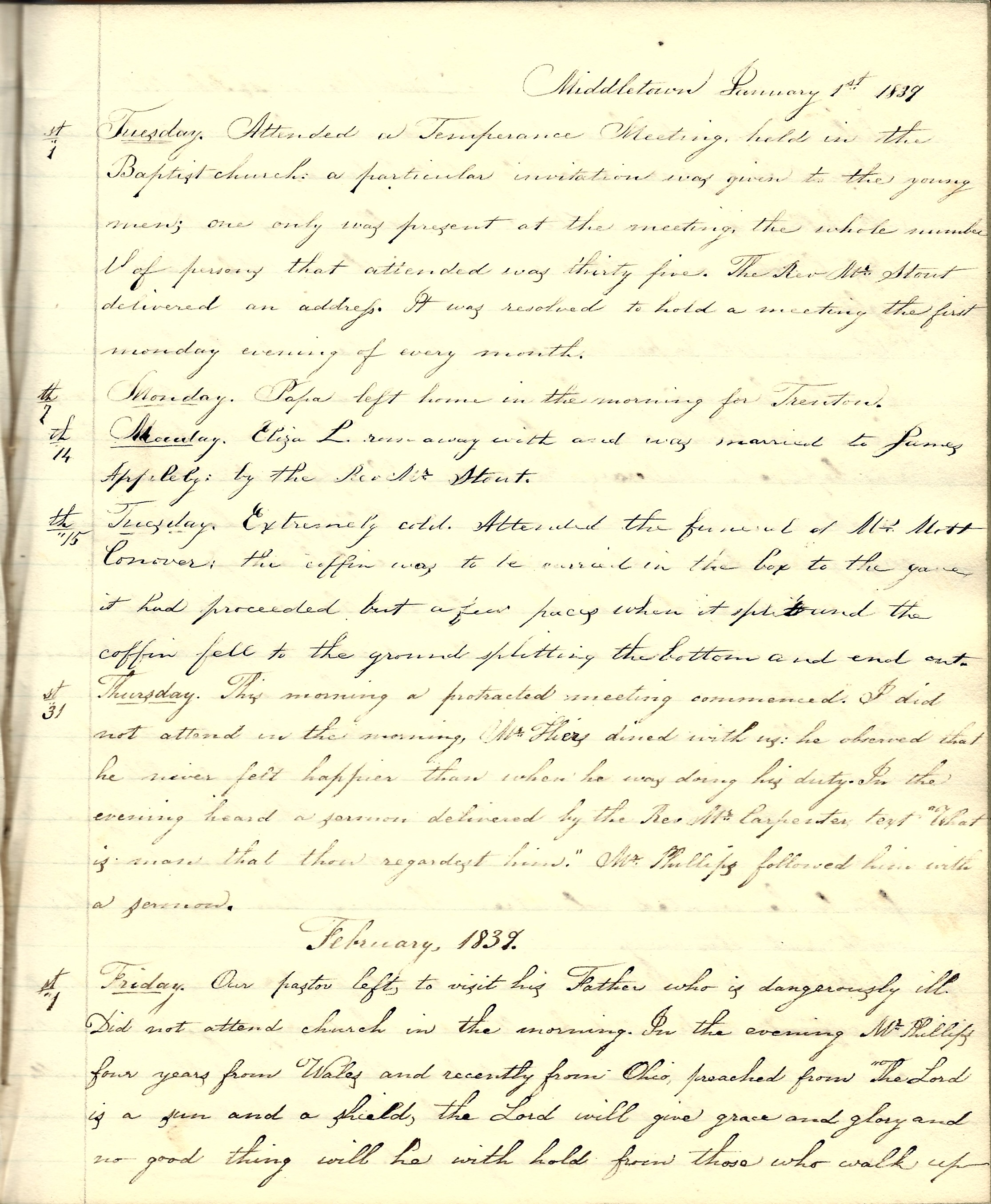
Middletown, New Jersey, Tuesday, January 1, 1839. Attended a Temperance Meeting held in the Baptist Church. A particular invitation was given to the young men. Only one was present at the meeting. The whole number of persons that attended was thirty-five. The Rev. Mr. Stout delivered an address. It was resolved to hold a meeting the first Monday evening of every month.
Monday 7th. Eliza L. ran away with and was married to James Appleby by the Rev. Mr. Stout.
Tuesday 15th. Extremely cold. Attended the funeral of Mrs. Mott Conover. The coffin was to be carried in the box to the grave. It had proceeded but a few paces when it split and the coffin fell to the ground, splitting the bottom and end out.
Thursday 31st. This morning a protracted meeting commenced. I did not attend in the morning. Mr. Hiers dined with us. He observed that he never felt happier than when he was doing his duty. In the evening heard a sermon delivered by the Rev. Mr. Carpenter. Text, “What is man that thou regardest him.” Mr. Phillips followed him with a sermon.
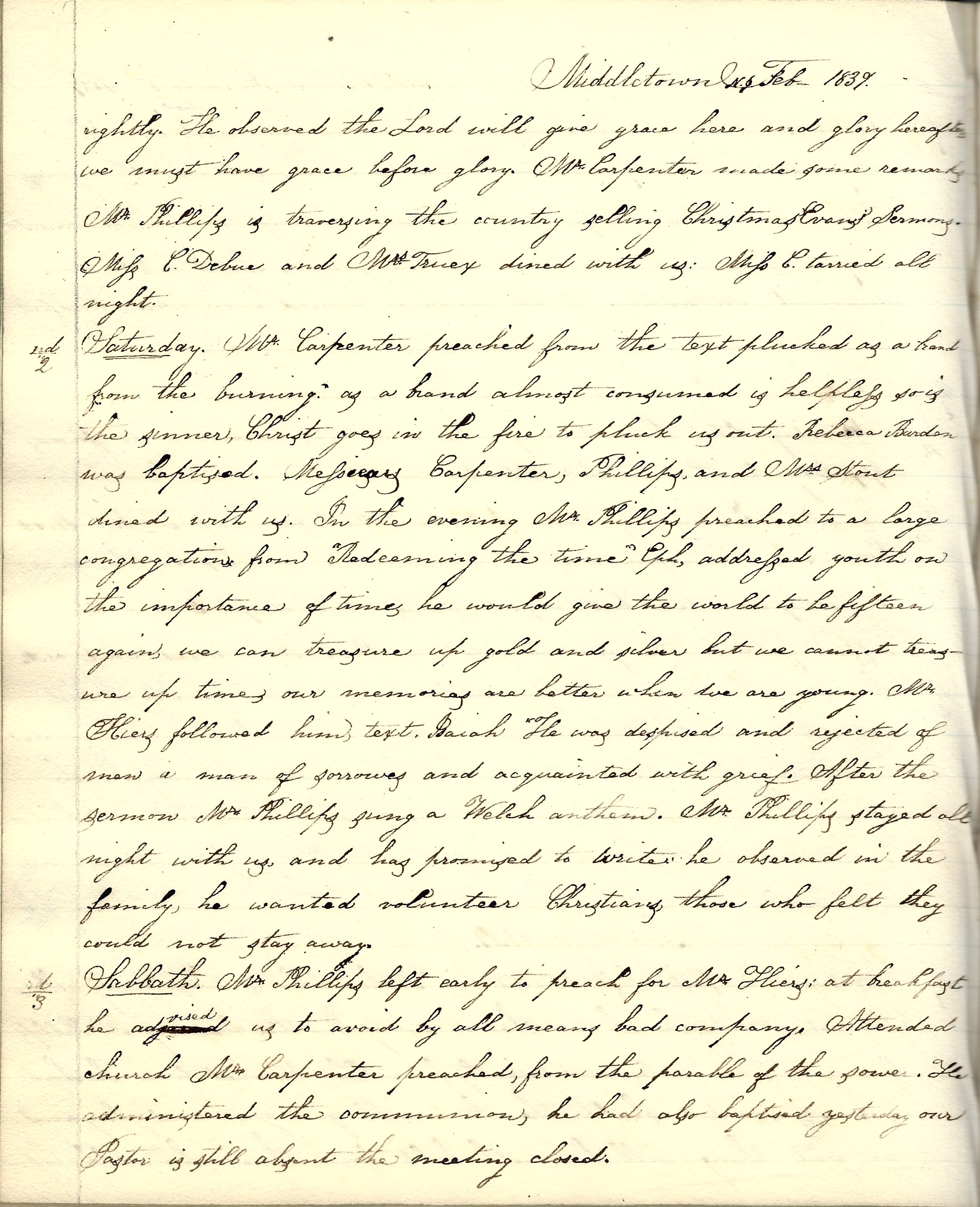
Friday, February 1, 1839. Our pastor left to visit his Father who is dangerously ill. Did not attend church in the morning. In the evening Mr. Phillips, four years from Wales and recently from Ohio, preached from “The Lord is a sun and a shield, the Lord will give grace and glory and no good thing will He withhold from those who walk up rightly. He observed the Lord will give grace here and glory hereafter. We must have grace before glory. Mr. Carpenter made some remarks. Mr. Phillips is traversing the country selling hristmas Evans’ Sermons. Miss. C. Debue and Mrs. Truex dined with us. Miss. C. tarried all night.
Saturday 2nd. Mr. Carpenter preached from the text, “Plucked as a brand from the burning.” As a brand almost consumed is helpless, so is the sinner. Christ goes in the fire to pluck us out. Rebecca Burden was baptized. Messrs. Carpenter, Phillips, and Mrs. Stout dined with us. In the evening Mr. Phillips preached to a large congregation from “Redeeming the time,” Ephesians. Addressed youth on the importance of time. He would give the workd to be fifteen again. We can treasure up gold and silver but we cannot treasure up time. Our memories are better when we are young. Mr. Hiers followed him, text Isaiah, “He was despised and rejected of men, a man of sorrows and acquainted with grief.” After sermon, Mr. Phillips sung a Welsh anthem. Mr. Phillips stayed all night with us and has promised to write. He observed in the family, he wanted volunteer Christians—those who felt they could not stay away.
Sabbath, 3rd. Mr. Phillips left early to preach for Mr. Hiers. At breakfast he advised us to avoid by all means bad company. Attended church. Mr. Carpenter preached from the parable of the sower. He administered the communion. He had also baptized yesterday. Our pastor is still absent. The meeting closed.
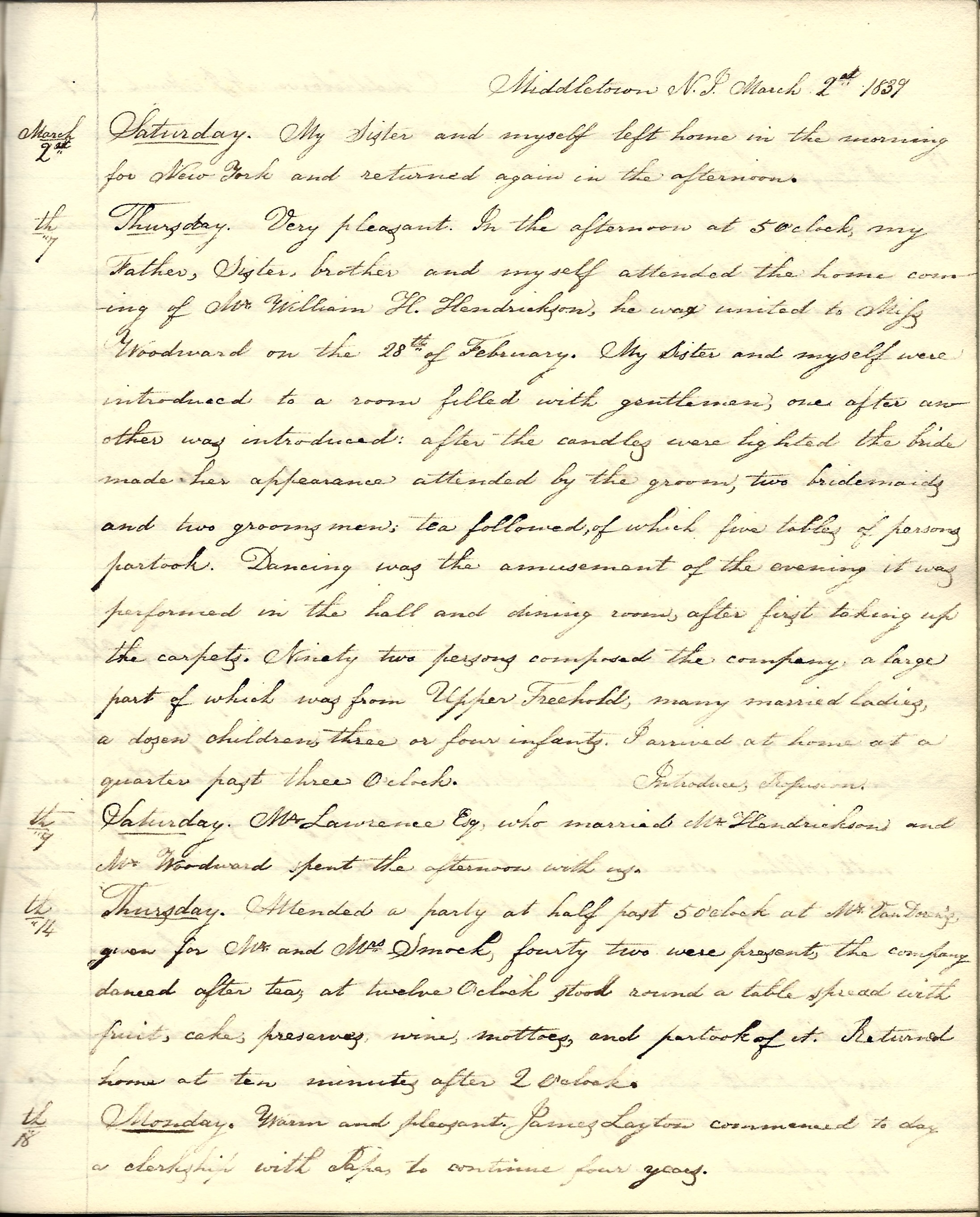
Middletown, New Jersey, Saturday, March 2, 1839. My sister and myself left home in the morning for New York and returned again in the afternoon.
Thursday 7th. Very pleasant. In the afternoon at 5 o’clock my Father, sister, brother, and myself attended the homecoming of Mr. William H. Hendrickson. He was united to Miss Woodward on the 28th of February. My sister and myself were introduced to a room filled with gentlemen; one after another was introduced. After hte candles were lighted, the bride made her appearance attended by the groom, two bridesmaids, and two grooms men. Tea followed of which five tables of persons partook. Dancing was the amusement of the evening. It was performed in the hall and dining room, after first taking up the carpets. Ninety-two persons composed the company, a large part of which was from Upper Freehold, many married ladies, a dozen children, three or four infants. I arrived at home at a quarter past three o’clock.
Saturday 9th. Mr. Lawrence, Esq., who married Mr. Hendrickson and Ms. Woodweard spent the afternoon with us.
Thursday 14th. Attended a party at half past 5 o’clock at Mr. Van Doren’s given by Mr. and Mrs. Smock. Forty-two were present. The company danced after tea. At twelve o’clock, stood round a table spread with fruit, cake, preserves, wine, mottoes, and partook of it. Returned home at ten minutes after 2 o’clock.
Monday 18th. Warm and pleasant. James Layton commenced today a clerkship with Papa to continue four years.
Tuesday 19th. My sister and myself visited Miss Caroline Crawford. A pleasant visit. Nothing but learning can give refinement.
Saturday 30th. All the neighbors are engaged in moving Mrs. Carhart who has resided thirty years in Middletown. I feel some regret at parting with so old an acquaintance. D. Holmes left the service of my Father in which he has been engaged seven years. Never within my memory has there been so much changing in Middletown.
Sabbath, April 7, 1839. Sabbath School commenced. I went to perform the duties of a teacher—a service new to me. Six male and female, excepting myself presented themselves as teachers.
Sabbath 14th. Rainy; no church.

Tuesday 16th. My sister and myself visited Miss Morford of Shrewsbury. The green upon the trees is just perceivable. A pleasant ride of four hours conveyed us to our place of destination. Spent the afternoon pleasantly with Miss Morford and her Mother. Their yard showed that the inmates had a taste for flowers. It was filled with Althea, rose bushes, and Syringo, &c. I found them as willing to give roots and shrubs as they were diligent to collect them. By visiting persons at their own houses, we see them as they are.
Sabbath, June 2, 1839. Anna Hendrickson was received in the church. She is in her fourteenth year. She was baptized yesterday. A man also joined. I remained to witness the members partake of the communion. They appeared very solemn.
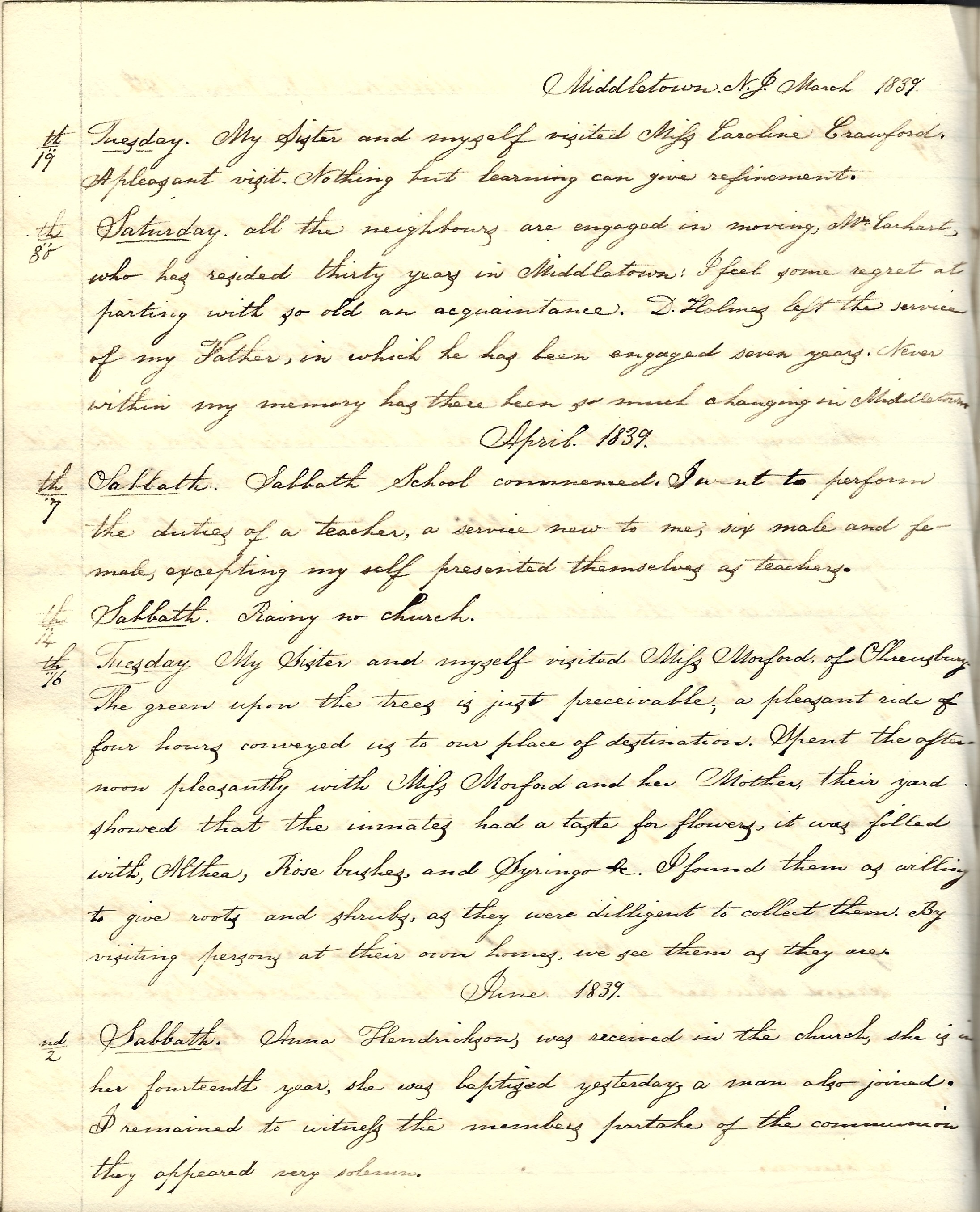
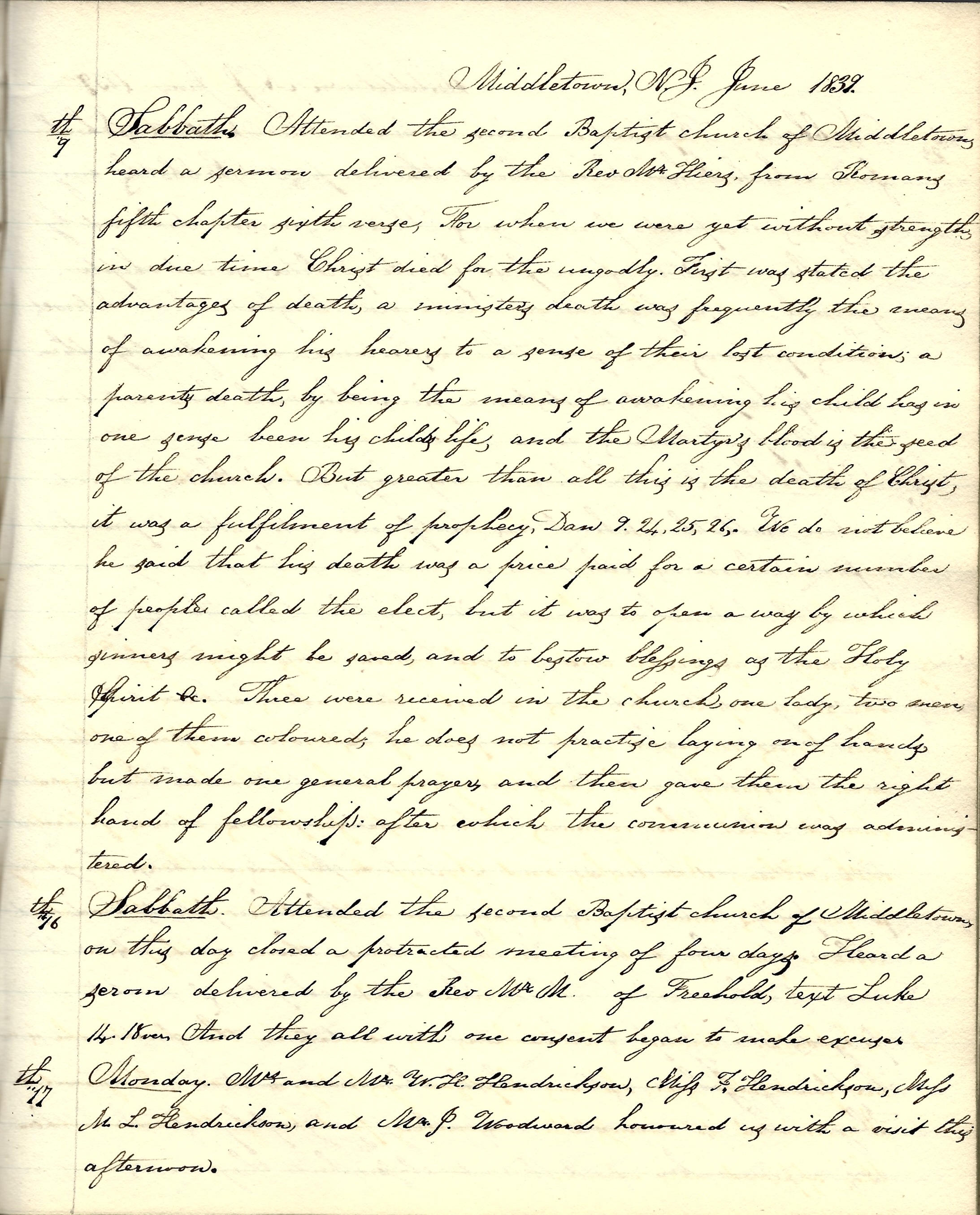
Sabbath 9th. Attended the Second Baptist Church of Middletown. Heard a sermon delivered by the Rev. Mr. Hiers, from Romans 5th Chapter, 6th verse, “For when we were yet without strength, in due time Christ died for the ungodly. First was stated the advantages of death. A minister’s death was frequently the means of awakening his hearers to a sense of their lost condition. A parent’s death by being the means of awakening his child has in one sense been his child’s life, and the Martyr’s blood is the seed of the church. But greater than all this is the death of Christ. It was a fulfillment of prophecy, Dan, 9.24.25,26. We do not believe he said that his death was a price paid for a certain number of people called the elect, but it was to open a way by which sinners might be saved, and to bestow blessings as the Holy Spirit, &c. Three were received in the church; one lad, two men—one of them colored. He does not practice laying on of hands but made one general prayer, and then gave them the right hand of fellowship; after which the communion was administered.
Sabbath 16th. Attended the 2nd Baptist Church of Middletown. On this day closed a protracted meeting of four days. Heard a sermon delivered by the Rev. Mr. M of Freehold, text Luke 14th Chapter 18th verse, “And they all with one consent began to make excuses.”
Monday 17th. Mr. and Mrs. W. H. Hendrickson, Miss F. Hendrickson, Miss M. L. Hendrickson, and Mr. J. Woodward honored us with a visit this afternoon.
Middletown, New Jersey, Sabbath, June 23, 1839. Repaired at 9 o’clock to the Sabbath School from which I have been absent the two past Sabbaths. My class was composed of nine girls. Heard a sermon delivered by Rev. Mr. Stout from 1st Epistle of Peter, 2nd Chapter, 7th verse, 1st clause, “Unto you therefore which believe, he is precious.” I feel the importance more forcibly than ever of keeping at a distance from those who have acted a double part towards me.
Sabbath 30th. Five scholars in my class; two of them arrived when Sabbath School was half out. Mr. Stout preached from Romans, 6th Chapter, 12th verse, “Let not sin, therefore, reign in your mortal body, that ye should obey the lusts thereof.”
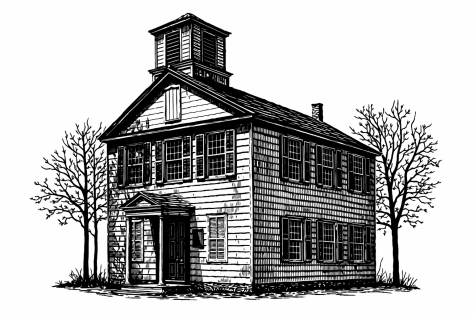
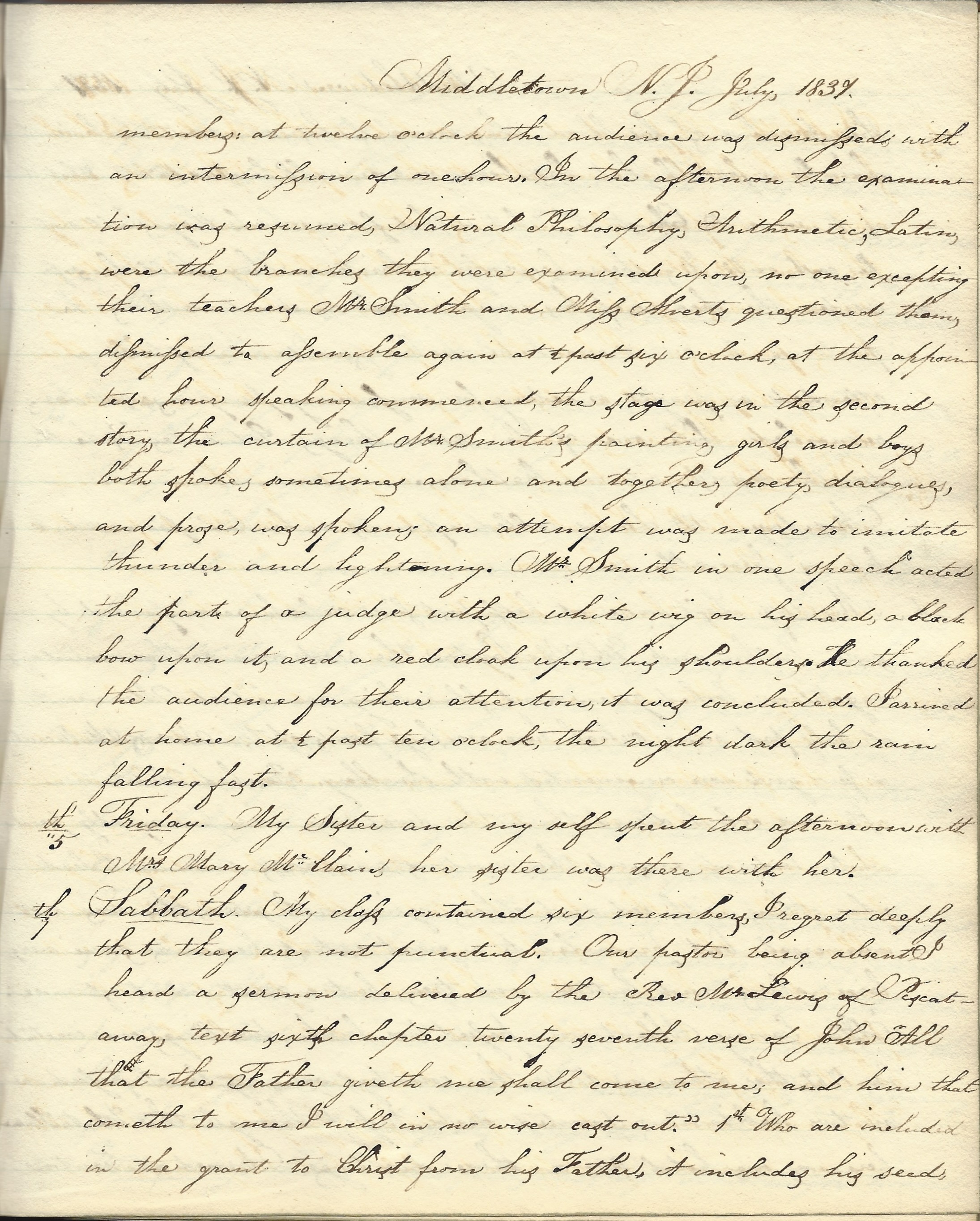
Tuesday, July 2, 1839. Attended an examination at the Franklin Academy which commenced at ten o’clock. It was held in the first story. The room was decorated with laurel, cedar, and white lilies around the windows and columns. Around the room was hung specimens of the pupils’ writings. The girls principally had their hair plaited with three plaits tied and ribbon the ends and hung down their neck; also ribbon around the head. Mr. Smith read a chapter of scripture, prayed, the pupils then read in rotation the first and second chapter of John, after which the examination commenced. They were examined in spelling, geography of which there was a number of different classes but they were small in members. At twelve o’clock, the audience was dismissed with an intermission of one hour.
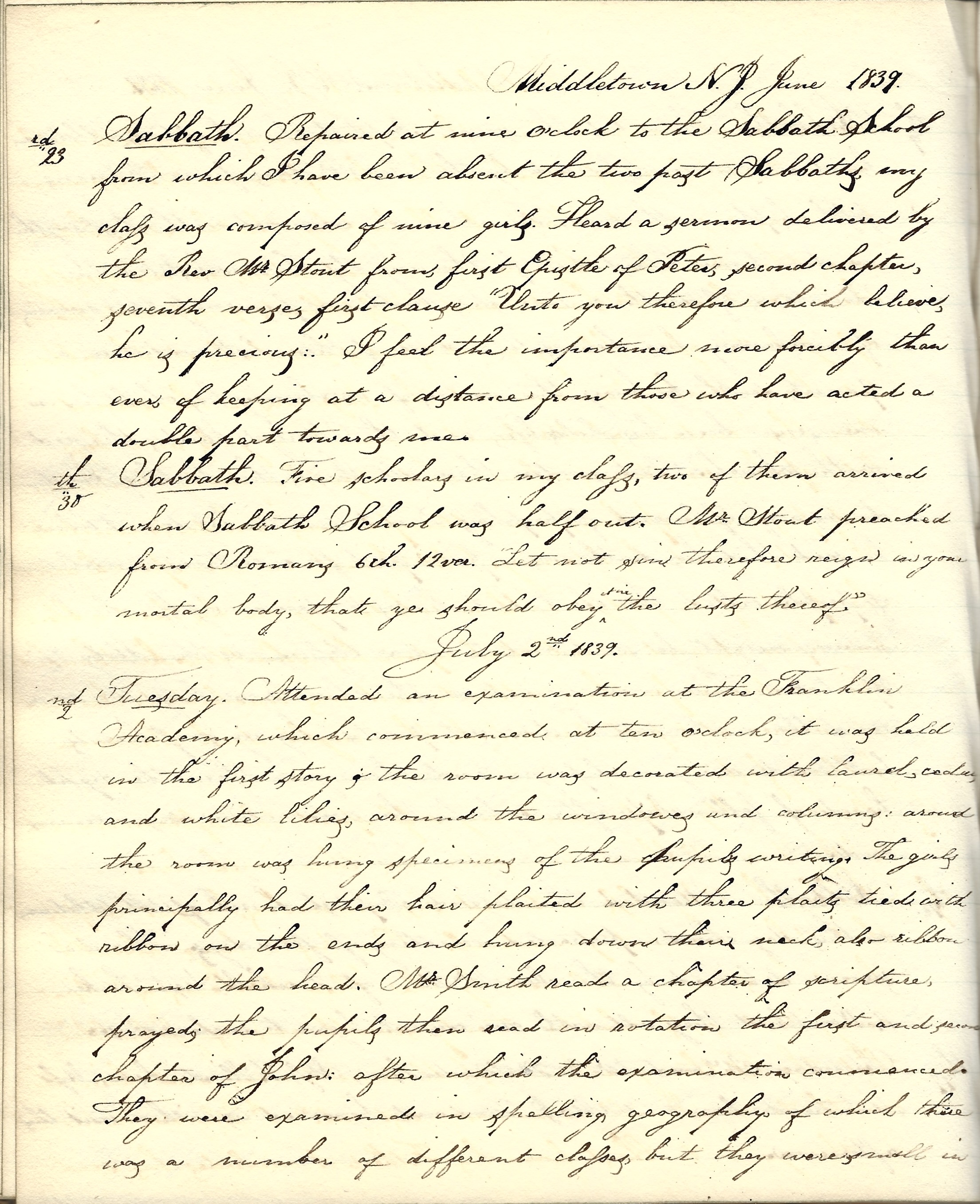
In the afternoon the examination was resumed. Natural Philosophy, Arithmetic, Latin, were the branches they were examined upon. No one excepting their teachers, Mr. Smith and Miss Alverts, questioned them. Dismissed to assemble again at half past six o’clock. At the appointed hour, speaking commenced. The stage was in the second story, the curtain of Mr. Smith’s painting. Girls and boys both spoke, sometimes alone and together, poetry, dialogue, and prose was spoken. An attempt was made to imitate thunder and lightning. Mr. Smith in one speech acted the part of a judge with a white wig on his head, a black bow upon it, and a red cloak upon his shoulders. He thanked the audience for their attention. It was concluded. I arrived at home at half past ten o’clock, the night dar, the rain falling fast.
Friday 5th. My sister and myself spent the afternoon with Mrs. Mary McClain. Her sister was there with her.
Sabbath 7th. My class contained six members. I regret deeply that they are not punctual. Our pastor being absent, I heard a sermon delivered by the Rev. Mr. Lewis of Piscataway. Text 6th Chapter, 27th verse of John, “All that the Father giveth me shall come to me, and him that cometh to me, I will in no wise cast out.” 1st, who are included in the grant to Christ from his Father. It includes his seeds, the purchase of his blood, the travail of his soul, and the bride the Lamb’s wife, all that has been or ever will be saved. 2nd what is to come to Christ. 3rd What is that from which they shall not be cast out. It is their heavenly inheritance, They shall be safe under the shadow of his wing. Mr. Lewis dined with us. He pretends to no remarkable holiness. In the afternoon attended a prayer meeting for missionary purposes; Mr. Lewis remarked that one of the seven things God hates, “Is he that soweth discord among brethren.
Monday 8th. Mr. Lewis called upon us as he had promised to bid us farewell.
Monday [July] 22nd. Left home at half past five o’clock accompanied by my sister, brother, and W. M. Layton. The roads were rather muddy, vegetation looked green and flourishing. Arrived at Monmouth at half past nine o’clock. Here are large fields of the Morus Multicaulus [Mulberry], a few yards were ornamented with shrubbery. Reached Allentown after one o’clock, dined there. The dwellings were principally painted white, bordered around the windows and doors, some with lead color, others with red and others with green. This was not universal but prevailed to a great extent. Here was some very large elms and buttonwood trees, but a great want of more.
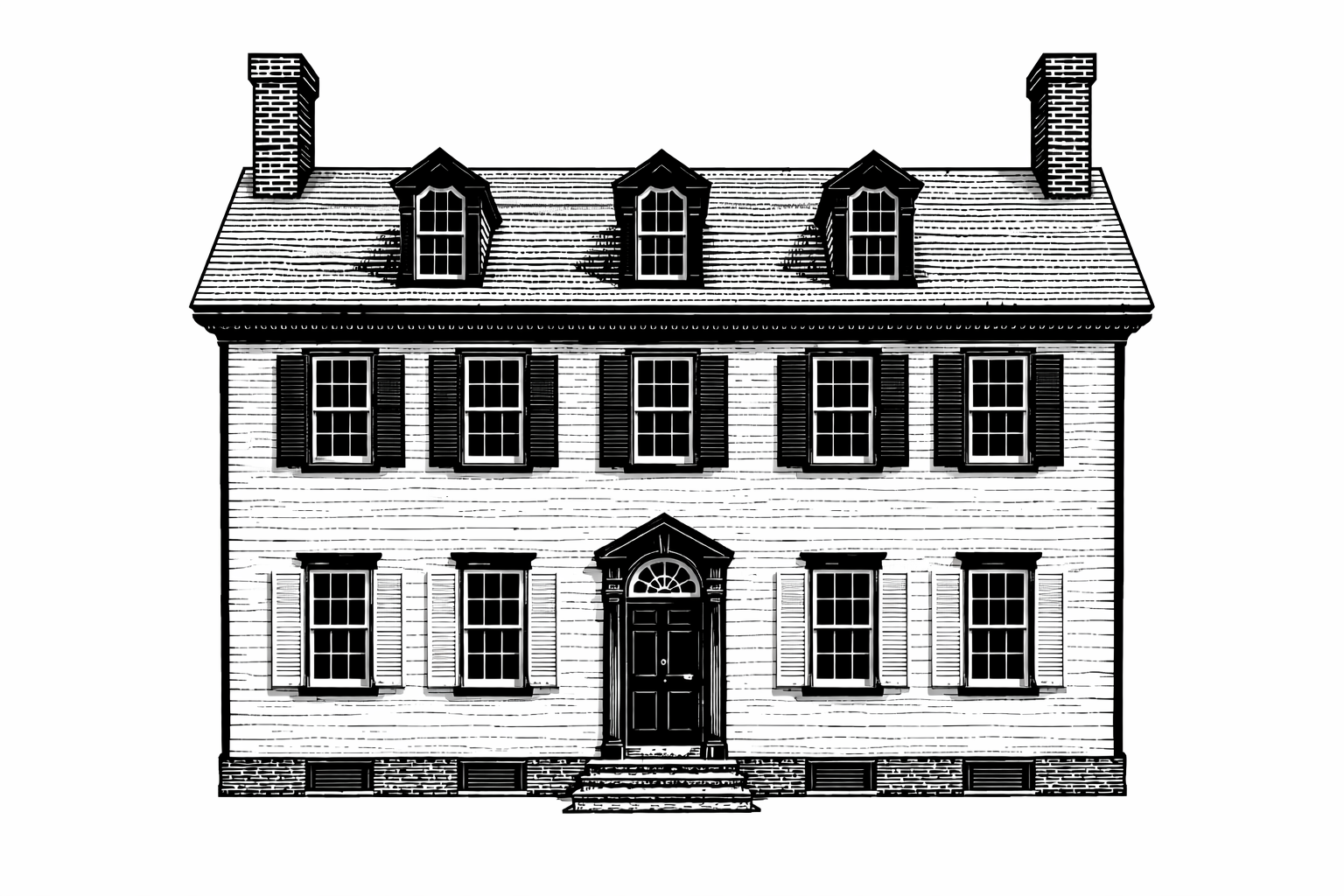
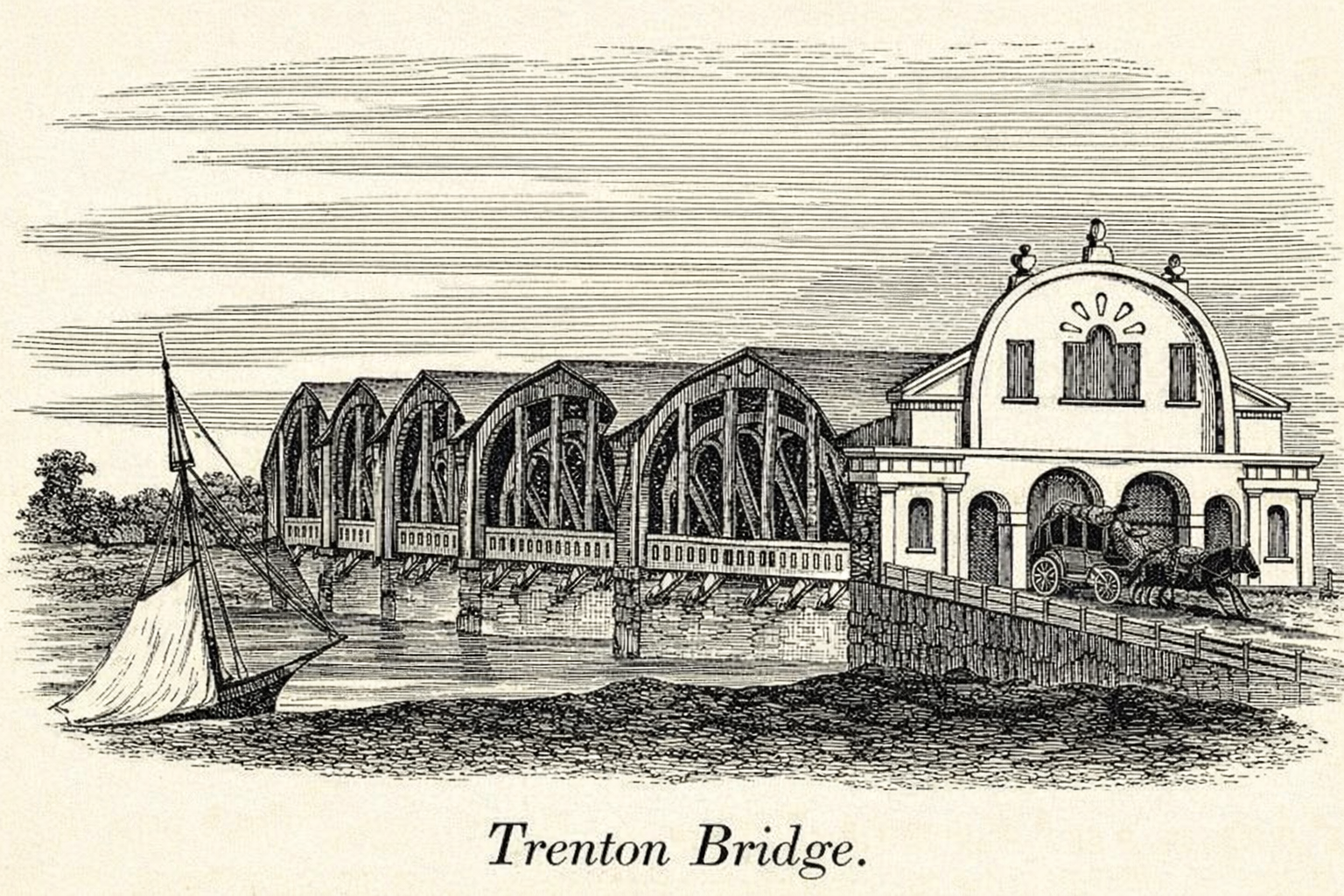
After leaving Allentown, passed two brick dwellings, one erected in 1769, the other in 1734. The country was very level. Passed one or two habitations painted drab. Passed through the White Horse. Here was one hotel [and] two or three dwellings. Arrived at Trenton after five o’clock. Engaged accommodations at Hollinshead’s Hotel [the Rising Sun Tavern run by Joshua Hollinshead from 1834 to 1842; the building was later expanded into the American Hotel in Trenton which hosted Abe Lincoln on his way to the White House in 1861]. Took a walk over the bridge which crosses the Delaware. It has two roads for carriages and two paths for pedestrians. The Delaware here is full of rocks or stones and very narrow. On the Pennsylvania side the country sloped gradually and looked beautiful. Returned for tea.
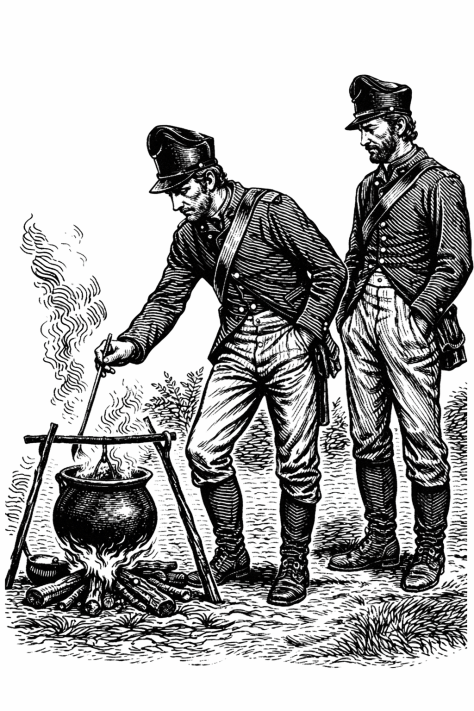
Tuesday 23rd. A great quantity of rain had fallen during the night, but a pleasant morning. At 8 o’clock repaired to Camp Washington which is located on the old battleground. Contains three or four hundred tents occupied by 1,000 troops—those who have served in Florida. They are encamped here for their health. The encampment is in a most beautiful woods. Walked through the camp. The soldiers were some idle, some cooking, others cleaning their arms. Saw a part of the troops reviewed. The sentinels walked round the camp. The American flag wantoned in the wind. A great number of horses belong to the camp.
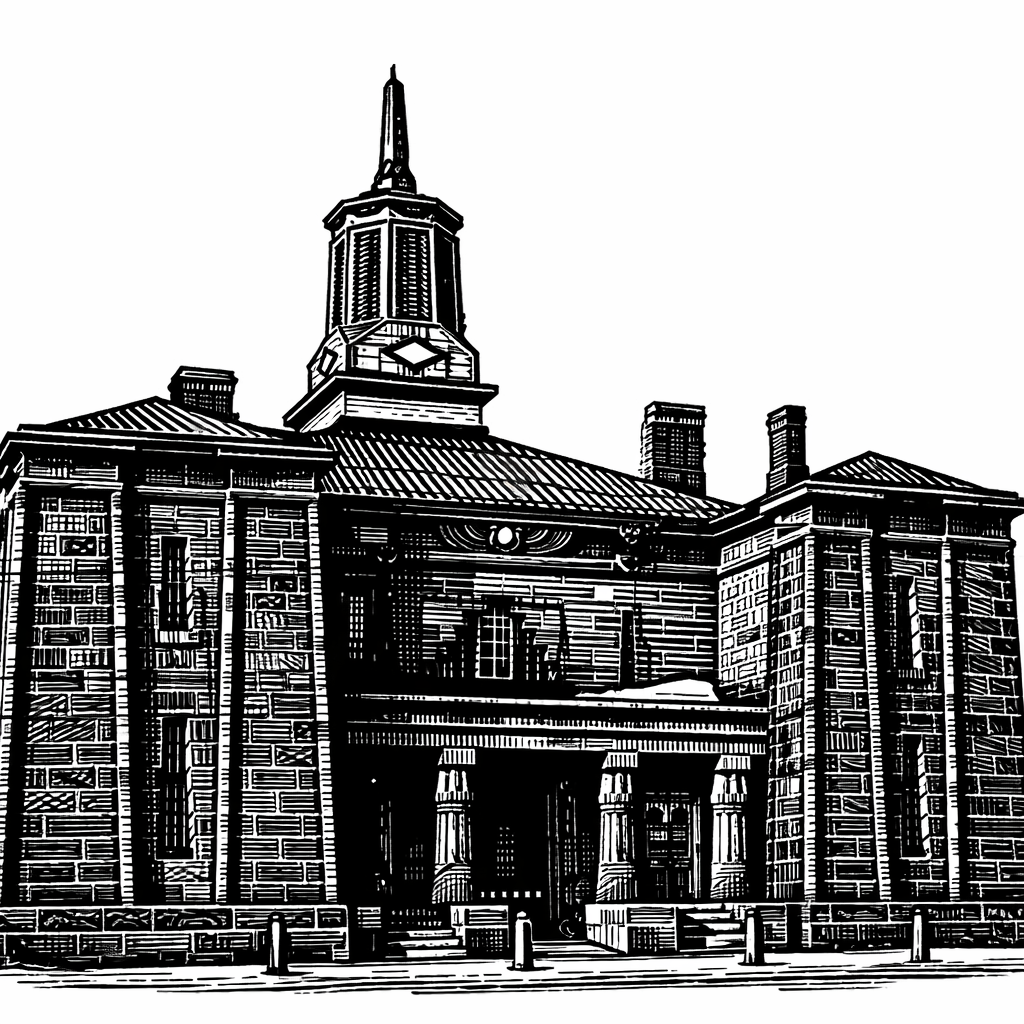
Visited the new prison to view it. Erected 1834 and 1835, it is the most splendid building in Trenton. There are a few hieroglyphics over the entrance. It is of brownstone. The old one is still standing. It was erected in 1797. After dinner, visited the residence of Joseph Bonaparte at Bordentown, walked through the grounds, around the lake, not permitted to enter the dwellings. He is in mourning for the recent death of his daughter.
Wednesday 24. Clear and pleasant. Left Trenton for home. Passed through Princeton which is beautifully ornamented with trees. The dwellings principally of wood painted white. The College buildings are the most splendid. Passed through Kingston, dined at the Cross Roads, passed through Spotswood, arrived at home half past twelve o’clock at night.
Wednesday 31st. Some agitation has been produced in the quiet of our village by the arrival of Mr. John Van Dusen and Lady on Saturday 27th, the day of their marriage—a clandestine marriage. They were united in New York. The frequent occurrence of runaway marriages speaks loudly of the disobedience and ingratitude of children.
Sabbath, August 4, 1839. Mr. Ketcham visited the Sabbath School. He arrived at Middletown the past week. He designs to make some stay for the benefit of his companion’s health. He addressed the Sabbath School, observing it was better to learn short lessons and all the class recite the same lesson, and how great was the teacher’s charge. They must meet this class in heaven. Also related two instances of the conversion of children—one five, the other seven years of age. Sabbath School was well attended. Heard a sermon delivered by the Rev. Mr. Ketcham from Ephesians 2nd Chaprer, part of the 12th verse, “Having no hopes and without God in the world.” First a definition of hope. It is composed of desire and expectation. Hope is based upon faith, and faith is shown by works, by; by their works ye shall know them. Showed the foundation of the hope of different persons. It is vain for an apple to say it is a pear tree when it bears apples.
Monday 5th. In the afternoon received a visit from Mrs. Tyson and Mr. Williams.
Tuesday 6th. Had the pleasure of a visit in the afternoon from Miss Susan Truex and Miss Mary Carhart, school companions. I was much gratified to see them. Their presence forcibly reminded me of the loss of time, and the departure of youth. Both are unsettled for life. I feel as one awaking from the dead. May the Lord sustain me. May I remember my opportunity.
Wednesday 7th. My sister, brother, J. Layton, and myself visited Long Branch. Dined at Mrs. Renshaw’s. There are eighty boarders there. Spent an hour or more in beholding the Atlantic [Ocean]. A shoal of fish came very near shore to avoid the porpoises. As they swam [by], they shone most beautifully in the sun. Returned home at eight o’clock.
Sabbath 11th. Seven pupils in my class this morning. They appear anxious to learn. Heard a sermon delivered by the Rev. Mr. Stout from Mark 1st Chapter, 24th verse, “Saying, let us alone; what have we to do with thee, thou Jesus of Nazareth? Art thou come to destroy us? I know thee who thou art, the Holy One of God. If the Lord would grant the desire of sinners to be let alone, it would be the means of their eternal destruction. In the afternoon attended a woods meeting at High Point. Mr. Ketcham preached for a week. He has been preaching there in evenings. A respectable collection of persons were present this afternoon, some sat on boards made for seats, others were round seated in their carriages. He preached from Matthew 13th Chapter, 14th parable of the sower.
Monday, August 12, 1839. Left home in the morning for New York, decidedly for, and with a great desire to visit Niagara Falls, but many doubts of accomplishing it. The steamboat Monmouth conveyed us to New York. There was fifty colored person passengers. They had been to attend a camp meeting in the country and were returning to the city. They enjoyed themselves in eating nuts, cakes, apples, &c. until within a short distance from the city when they sung hymns.
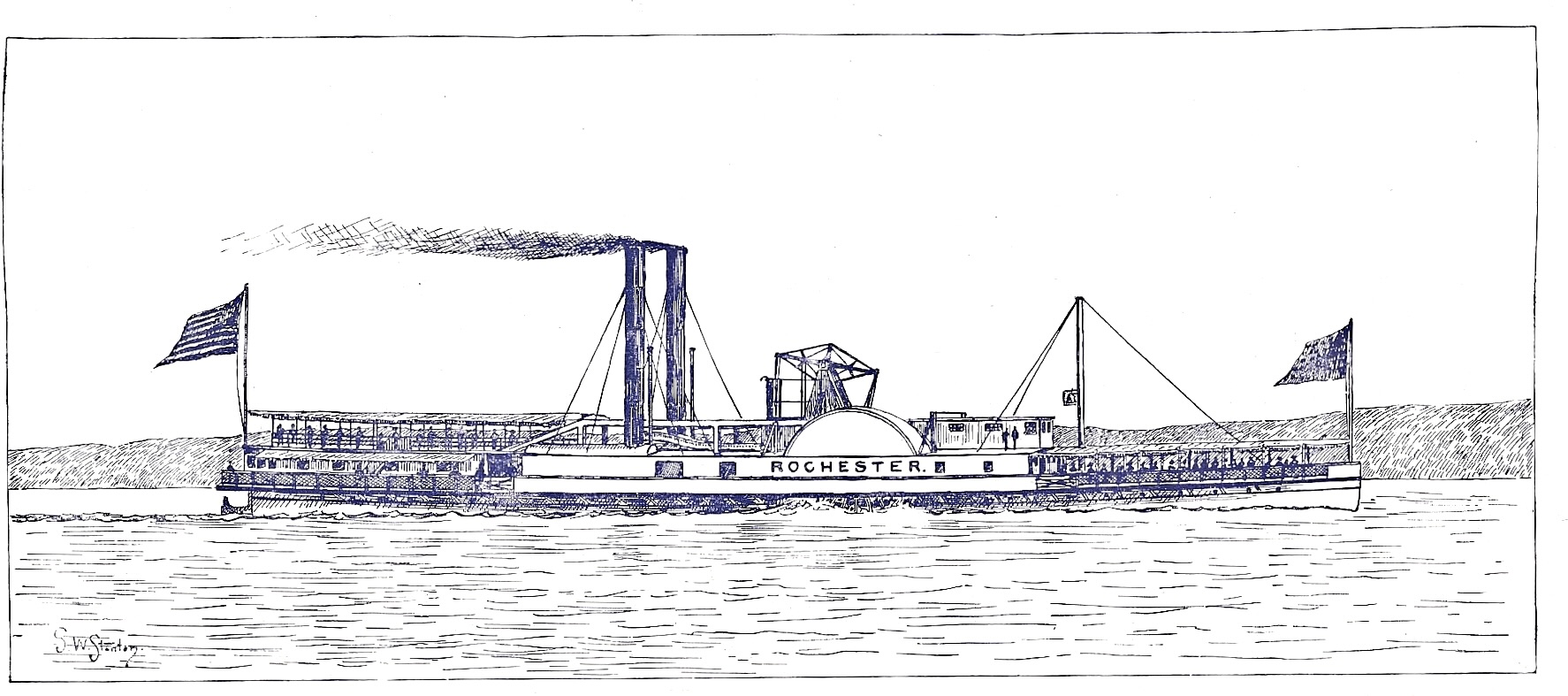
At 2 o’clock arrived at New York. Took passage on board of the steamboat Rochester for Albany. Left New York at five o’clock in the afternoon. There was a large number of passengers. All appeared cultivated. Arrived at Albany at 4 o’clock in the morning. Breakfasted there. The streets are wide.
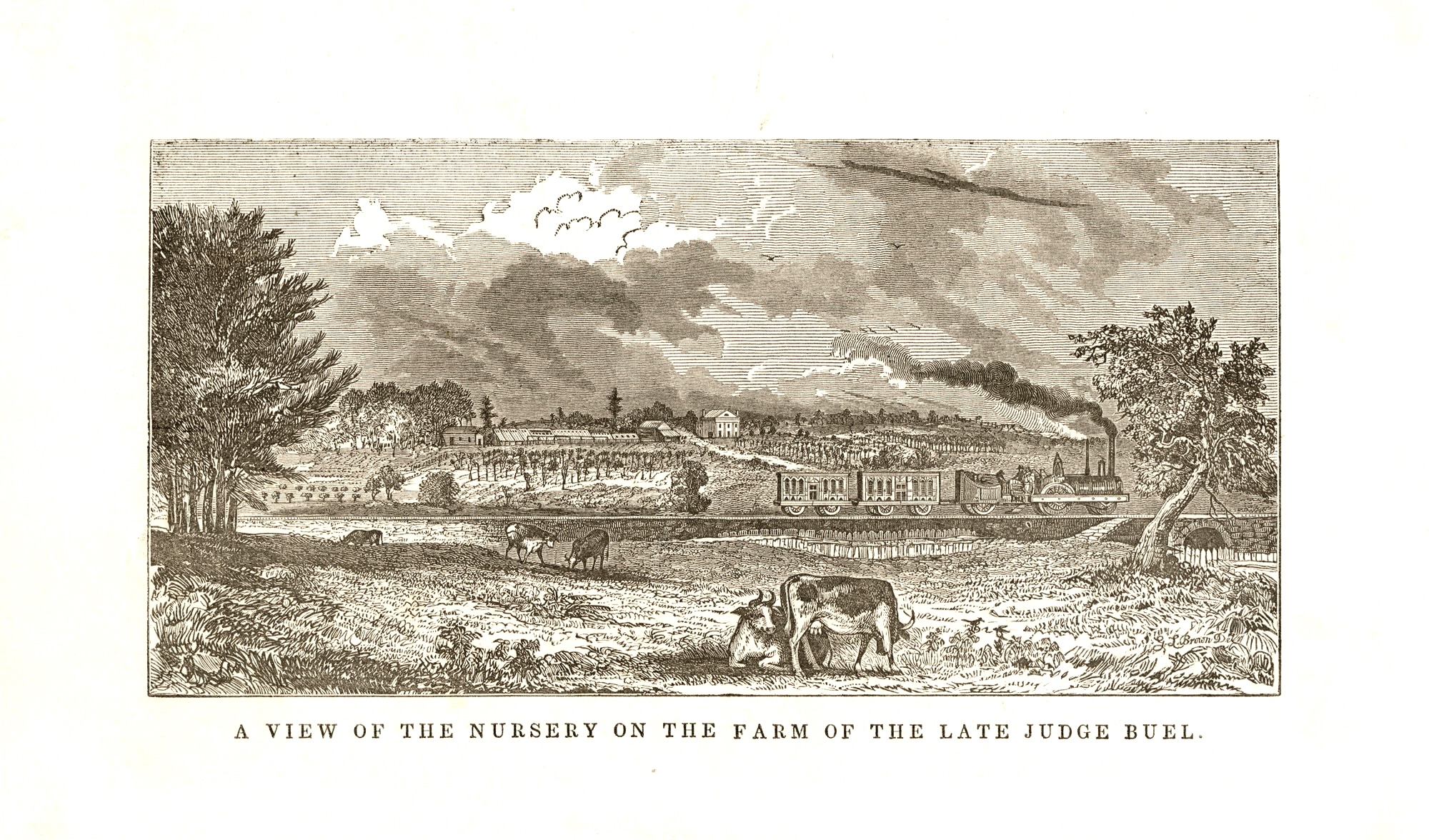
Tuesday 13th. Left at half past eight o’clock in the railroad cars. Passed Judge Buel’s farm. His residence was painted white with green shutters. It looked comfortable.
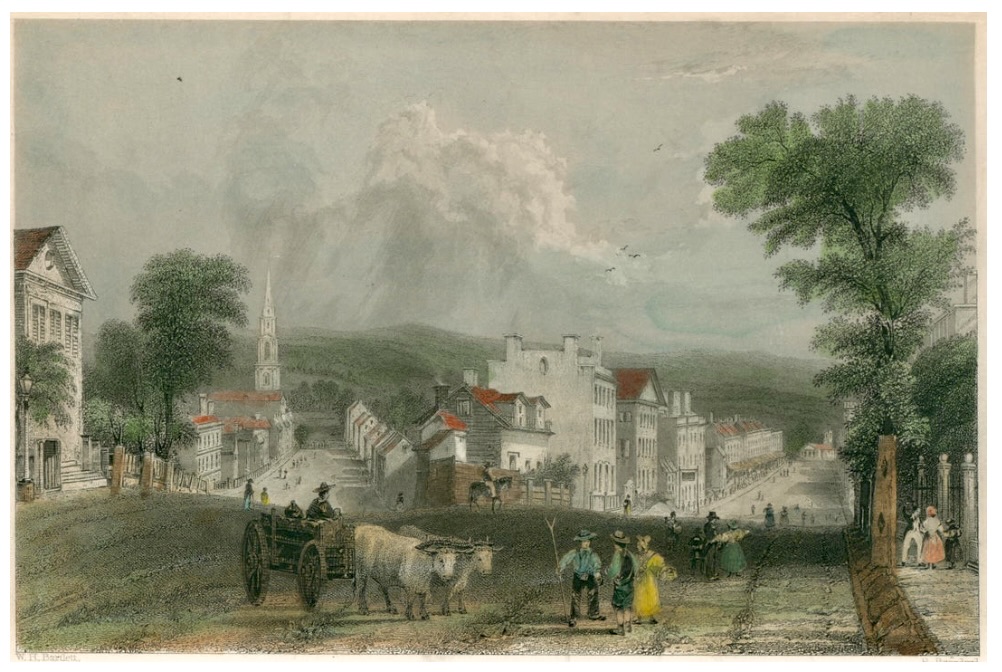
Just above Albany the country is infertile, partly covered with shrub pines. It is called Little Arabia. Changed cars at Schenectady. The college buildings appeared pleasantly situated on a ridge. Passed along the valley of the Mohawk. The country rises beautifully above it. Passed Amsterdam, stopped at Fonda for water at St. Johnsville [and] at Rockville. At all these places are houses for refreshment. They are large, look neat. The scenery on approaching and leaving Rockville is most romantic. Dined at Utica. Left immediately. Passed Whitesboro [and] Rome. The country level. The woods look old. The trees are covered with moss. Look as if they were decaying standing. Most beautiful meadows. Passed near Oneida Castle. Saw some Indians at an Inn. Halted to have the engine repaired. Arrived at Syracuse at ten o’clock at night. Viewed the place in the morning. It is beautifully situated. Wide streets. The Erie Canal passes through it and here unites with the Oswego Canal.
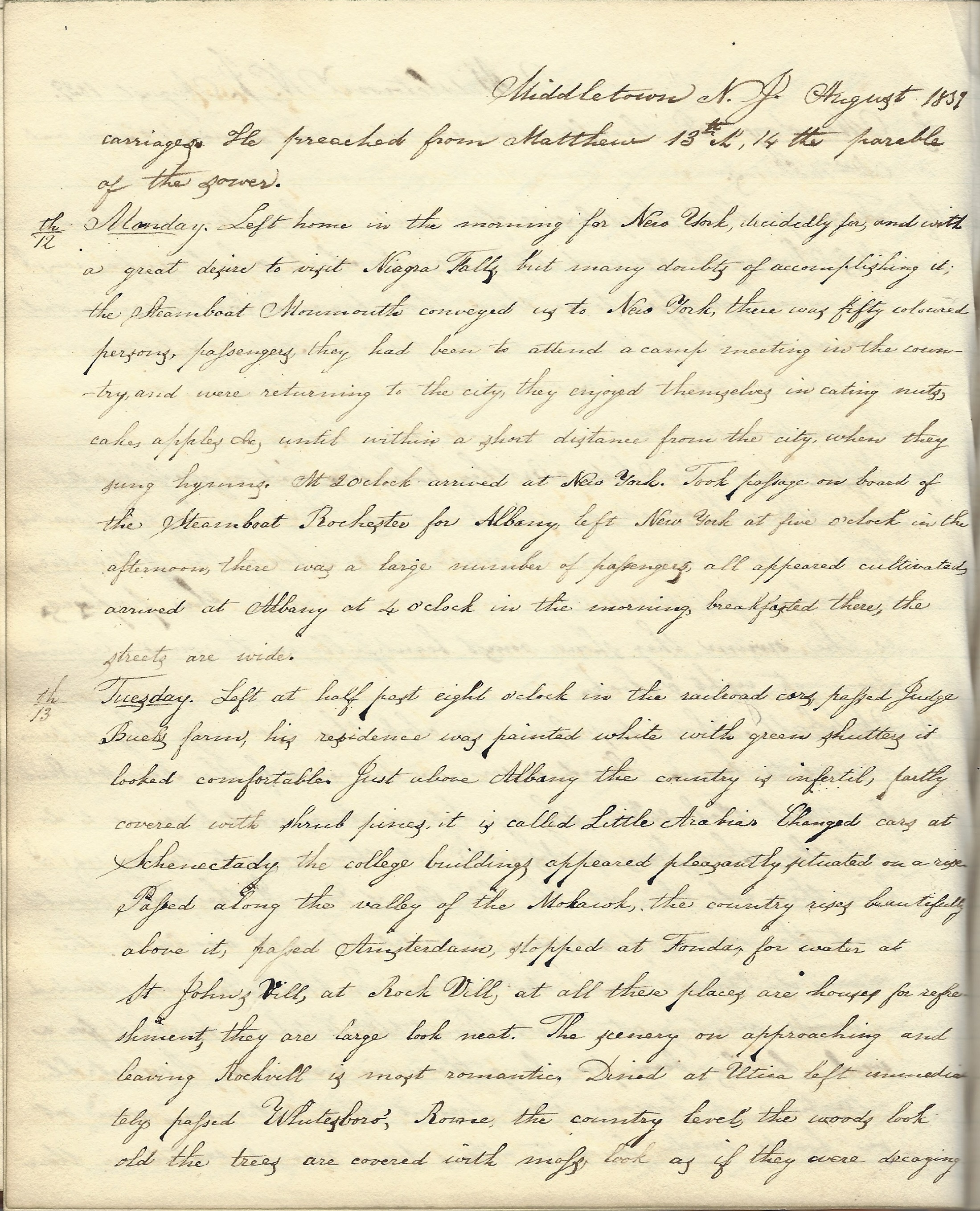
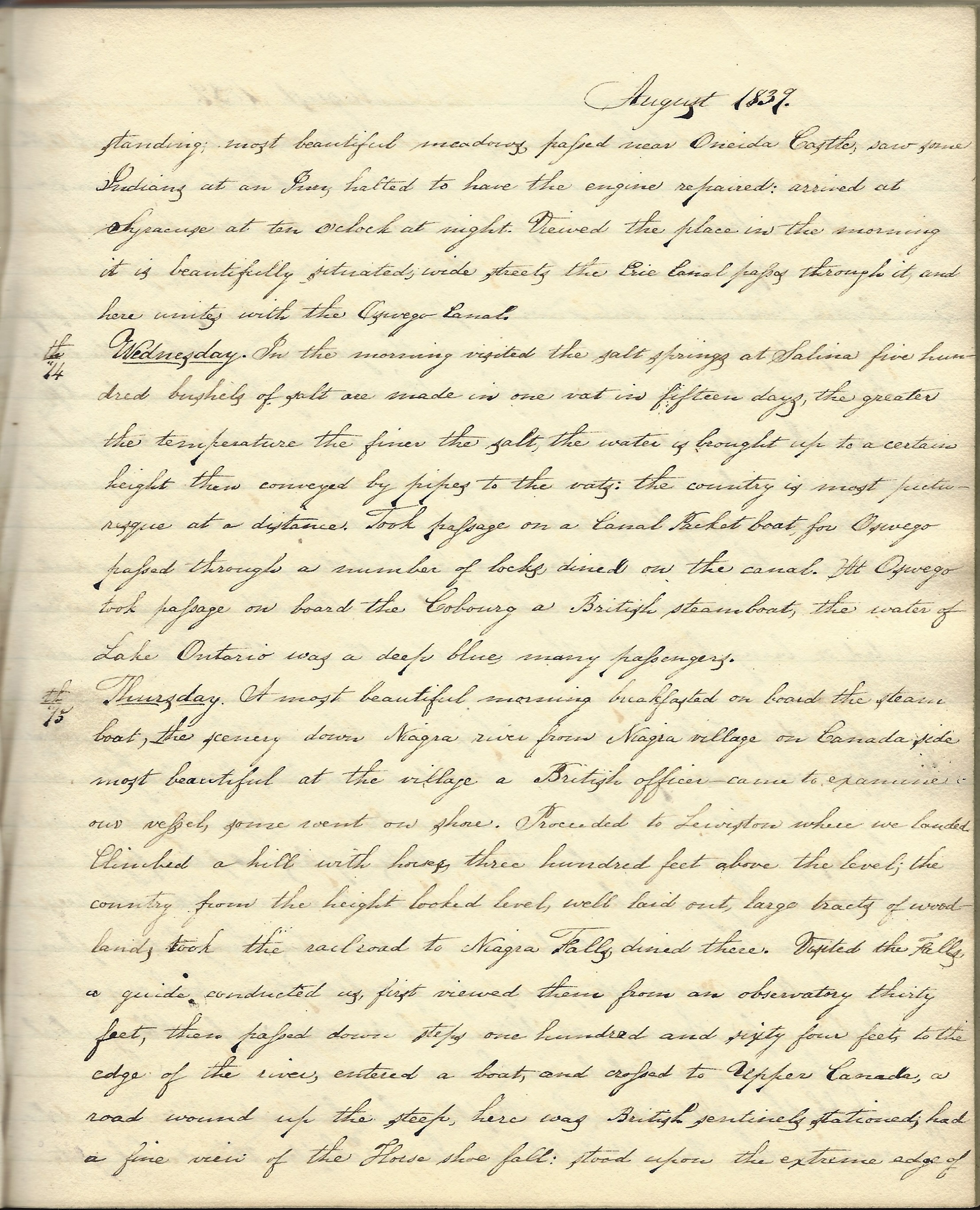
Wednesday, August 14, 1839. In the morning visited the salt springs at Salina. Five hundred bushels of salt are made in one vat in fifteen days. The greater the temperature, the finer the salt. The water is brought up to a certain height, then conveyed by pipes to the vats.
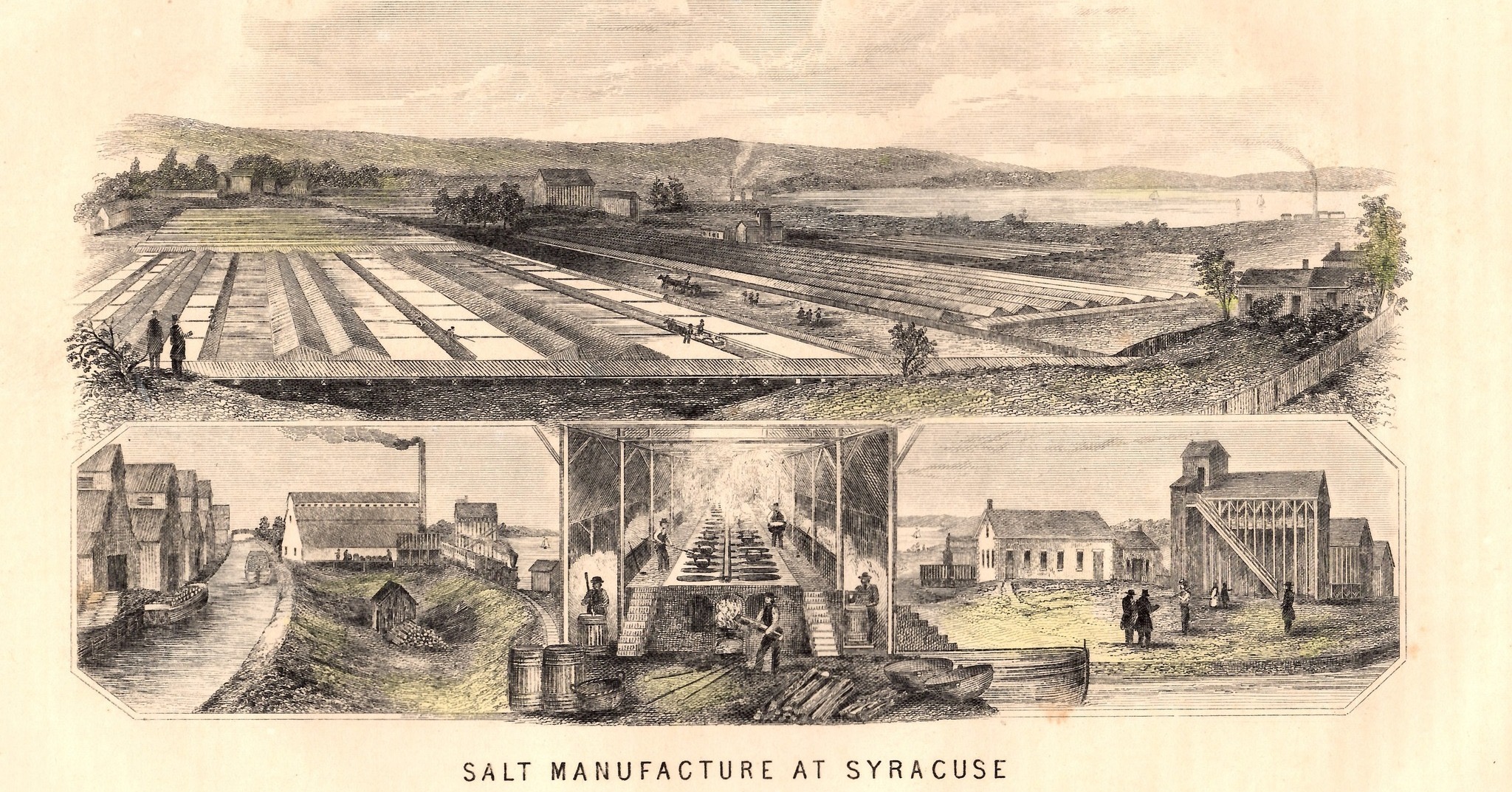
The country is most picturesque at a distance. Took passage on a Canal packet boat for Oswego, Passed through a number of locks, dined on the canal. At Oswego took passage on board the Cobourg—a British steamboat, The water of Lake Ontario was a deep blue. Many passengers.
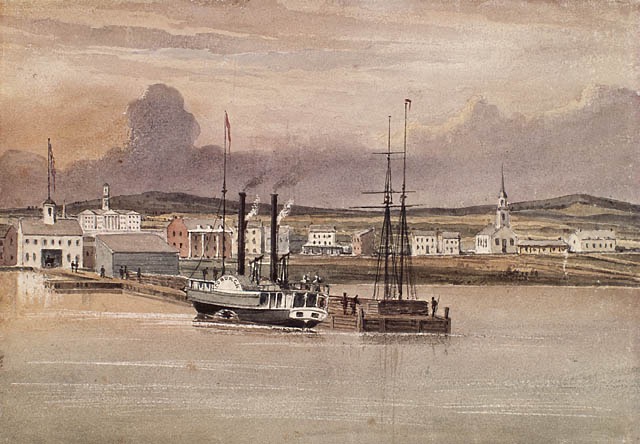
Thursday, August 15, 1839. A most beautiful morning. Breakfasted on board the steamer boat. The scenery down Niagara river from Niagara village on Canadian side most beautiful. At the village, a British officer came to examine our vessel. Soe went on shore. Proceeded to Lewiston where we landed. Climbed a hill with horses three hundred feet above the level. The country from the height looked level, well laid out. Large tracts of woodlands.
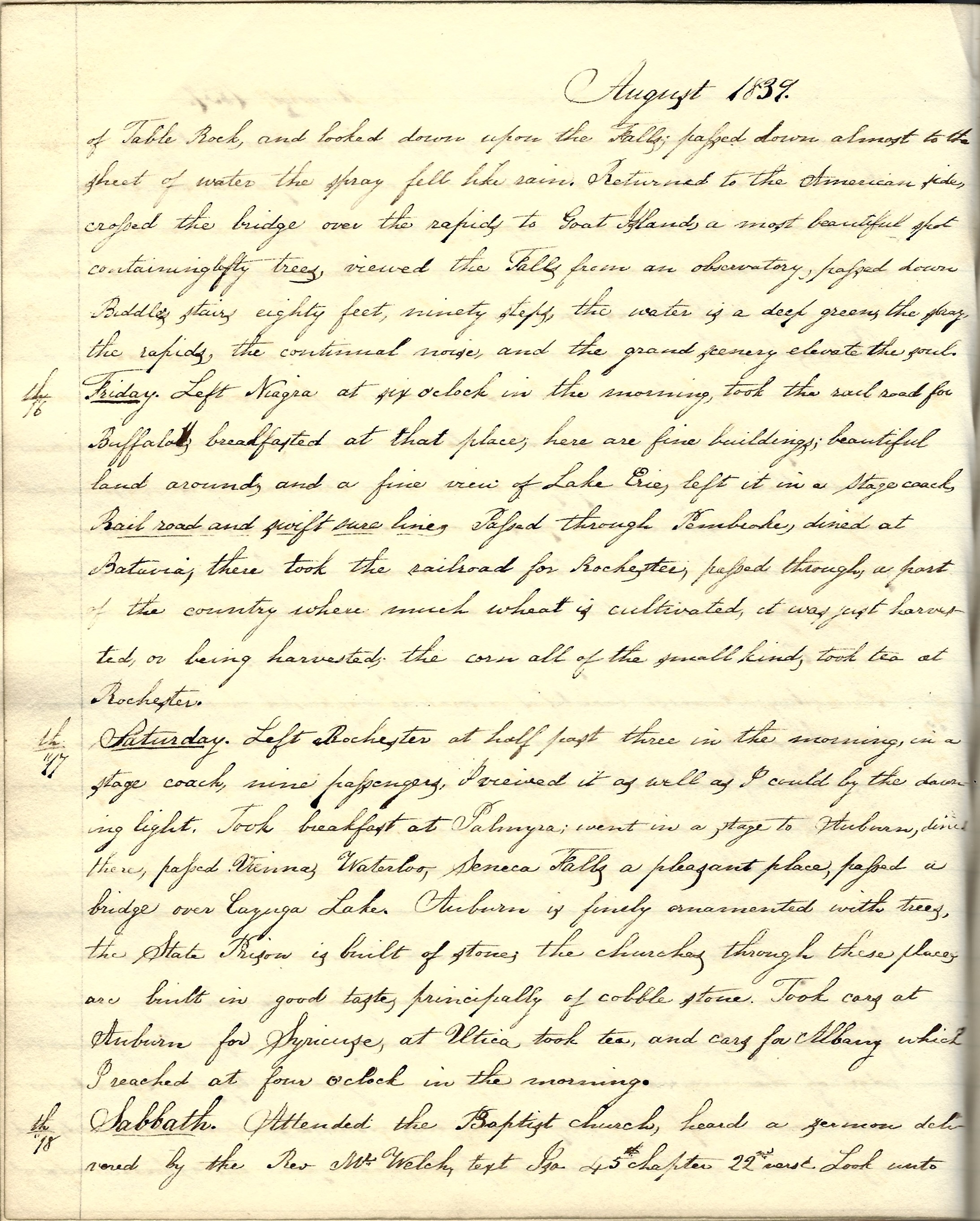
Took the railroad to Niagara Falls [and] dined there. Visited the Falls. A guide conducted us. First viewed them from an observatory thirty feet. Then passed down steps one hundred and sixty-four feet to the edge of the river, entered a boat and crossed to Upper Canada. A road wound up the steep [hill]. Here was British sentinels stationed. Had a fine view of the Horse shoe fall. Stood upon the extreme edge of Table Rock and looked down upon the Falls. Passed down almost to the sheet of water. The spray fell like rain.
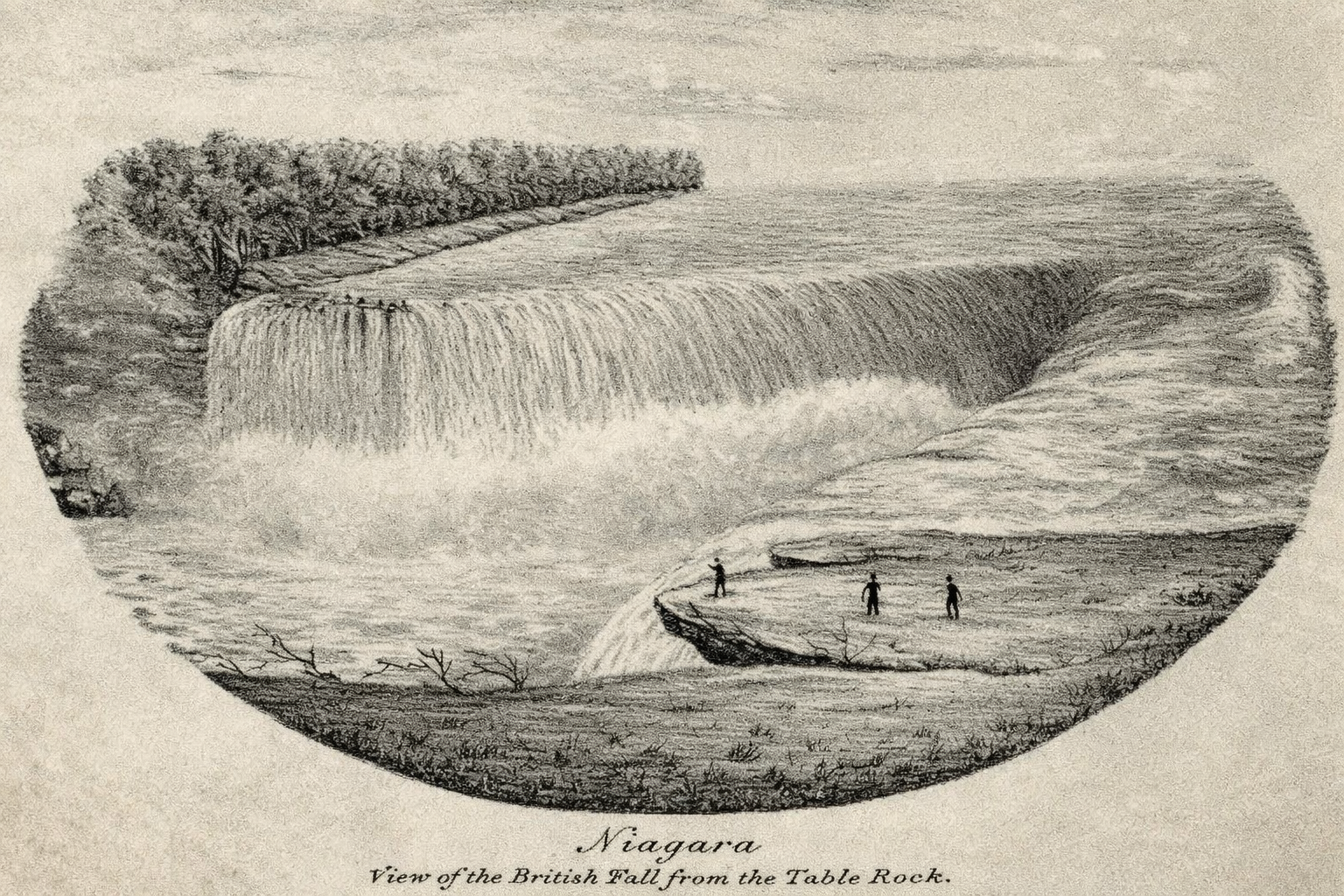
Returned to the American side, crossed the bridge over the rapids to Goat Island—a most beautiful spot containing lofty trees. Viewed the Falls from an observatory, passed down Biddle stair eighty feet, ninety steps. The water is a deep green. The spray, the rapids, the continual noise, and the grand scenery elevate the soul.
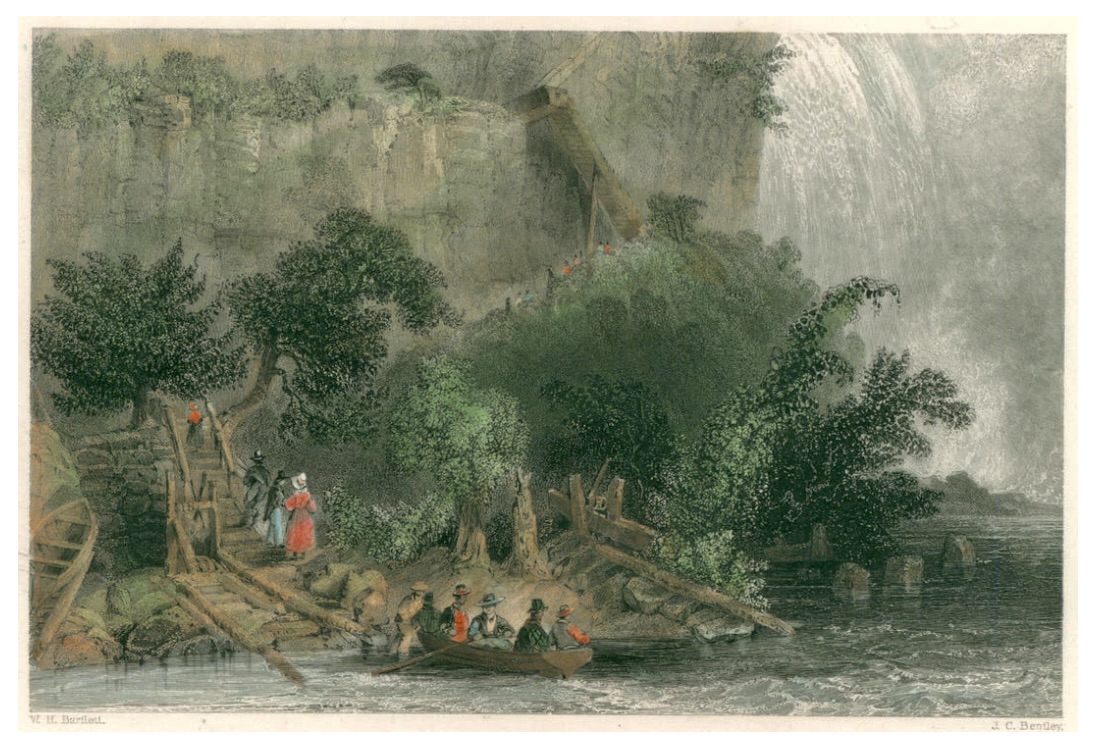
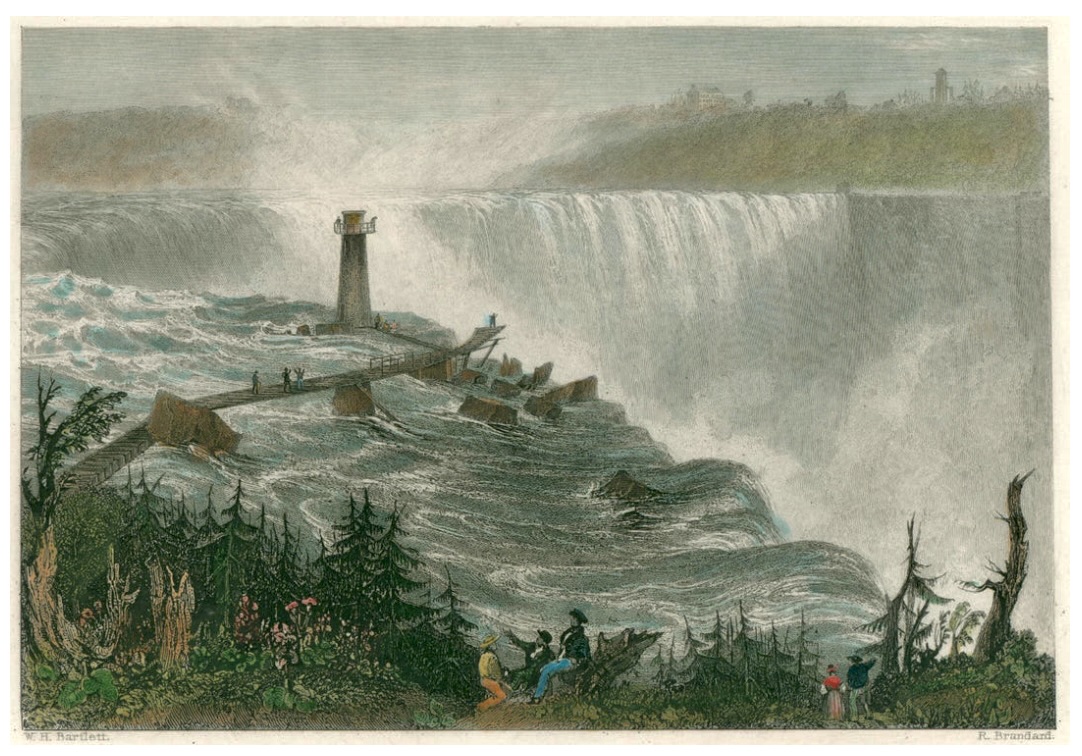
Friday, 16th. Left Niagara at 6 o’clock in the morning. Took the railroad for Buffalo. Breakfasted at that place. Here are fine buildings, beautiful land around, and a fine view of Lake Erie. Left it in a stage coach. Railroad and swift, sure lines. Passed through Pembroke, dined at Batavia. There took the railroad for Rochester. Passed through a part of the country where much whest is cultivated. It was just harvested, or being harvested. The corn all of the small kind. Took tea at Rochester.
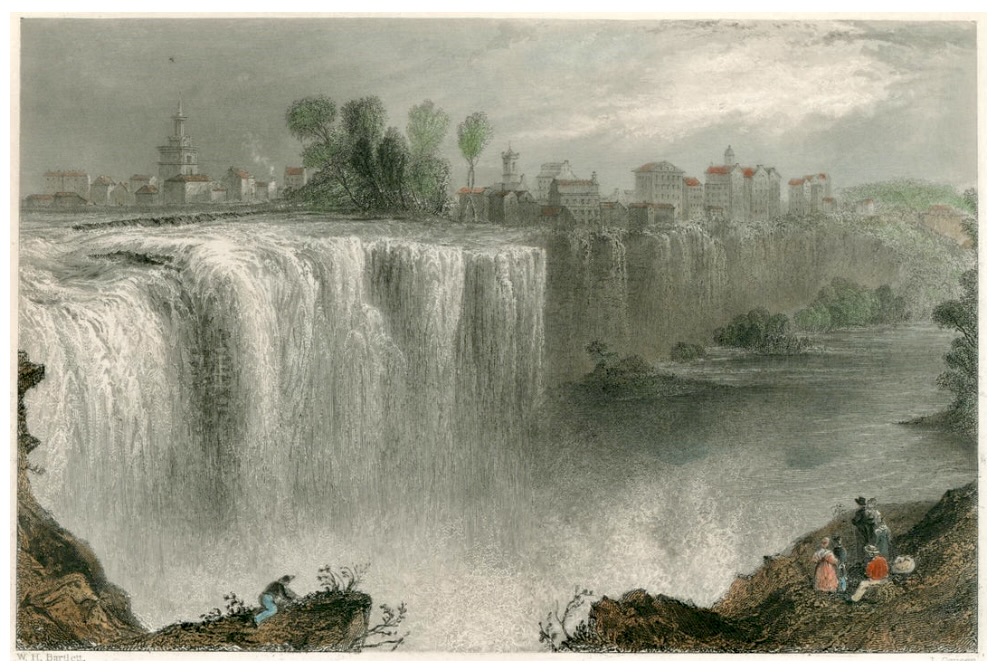
Saturday 17th. Left Rochester at half past three in the morning in a stage coach, nine passengers. I viewed it as well as I could by the dawning light. Took breakfast at Palmyra. Went in a stage to Auburn. Dined there. Passed Vienna, Waterloo, Seneca Falls—a pleasant place. Passed a bridge over Cayuga Lake. Auburn is finely ornamented with trees. The State Prison is built of stone. The churches through these places are built in good taste, principally of cobble stone. Took cars at Auburn for Syracuse. At Utica took tea, and cars for Albany which I reached at four o’clock in the morning.
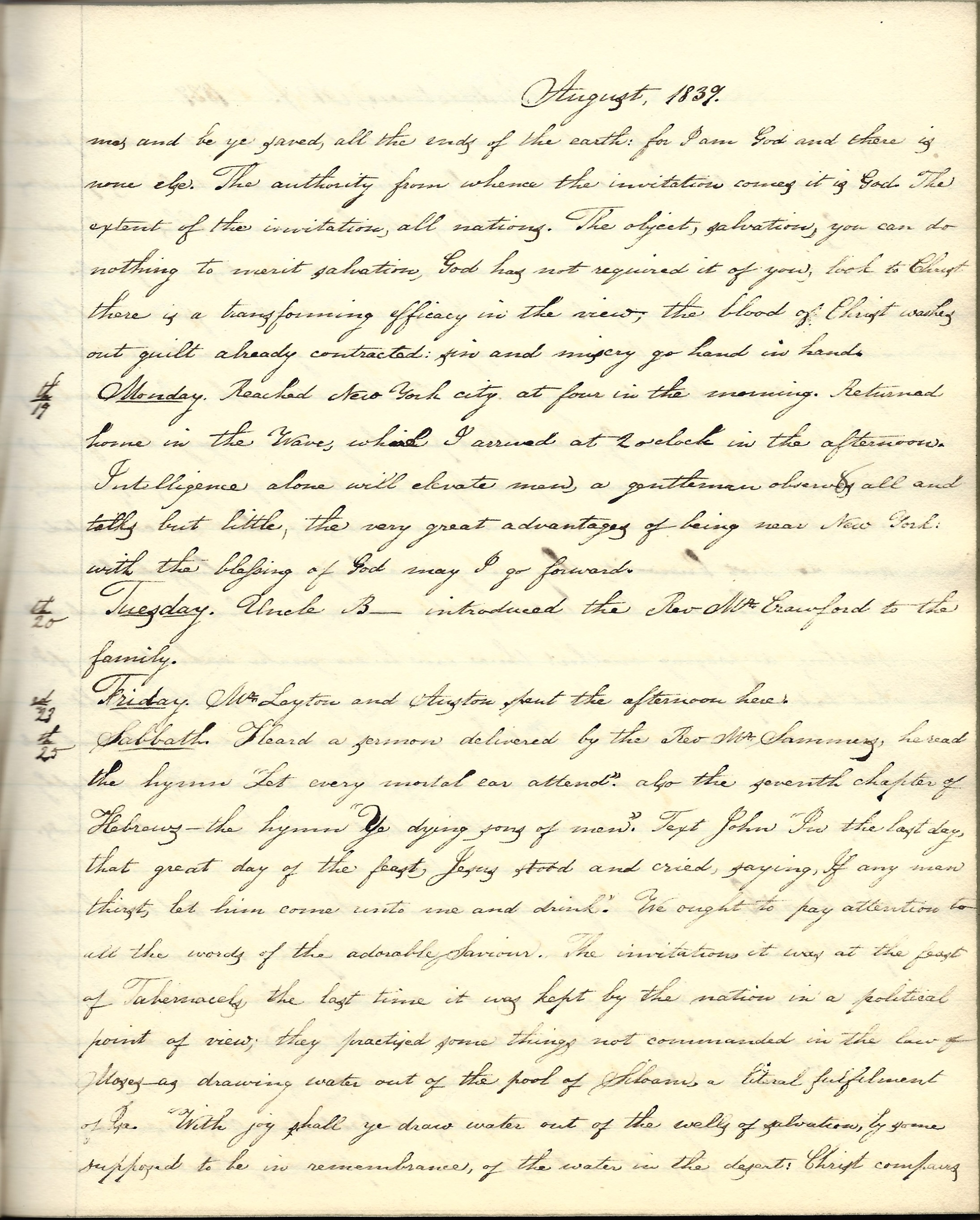
Sabbath 18th. Attended the Baptist Church. Heard a sermon delivered by the Rev. Mr. Welch. Text Isaiah 45th Chapter, 22nd verse, “Lord unto me, and be ye saved, all the ends of the earth for I am God and there is none else. The authority from whence the invitation comes it is God. The extent of the invitation, all nations. The object, salvation. You can do nothing to merit salvation. God has not required it of you. Look to Christ. There is a transforming efficacy in the view. The blood of Christ washes out guilt already contracted. Sin and misery go hand in hand.
Monday 19th. Reached New York City at four in the morning. Returned home in the Wave which I arrived at 2 o’clock in the afternoon. Intelligence alone will elevate man, a gentleman observes all and talks but little. The very great advantages of being near New York with the blessing of God may I go forward.
Tuesday 20th. Uncle B. introduced the Rev. Mr. Crawford to the family.
Friday 23rd. Mr. Layton and Augusta spent the afternoon here.
Sabbath 25th. Heard a sermon delivered by the Rev. Mr. Sommers. He read the hymn, “Let every mortal ear attend.” Also the 7th Chapter of Hebrews. The hym, “Ye dying sons of man.” Text John, “In the last day, that great day of the feast, Jesus stood and cried, saying, If an man thirst, let him come unto me and drink.: We ought to pay attention to all the words of the adorable Savior. The invitations it was at the feast of Tabernacle, the last time it was kept by the nation in a political point of view; they practiced some things not commanded in the law of Moses as drawing water out of the pool of Sloam, a literal fulfillment of [ ]. With joy shall ye draw water out of the wells of salvation, by some supposed to be in remembrance of the water in the desert. Christ compares his spirit to water. Like water he gives it without money and without price…
Sabbath, September 1, 1839. A delightful day. Attended the 2nd Baptist Church of Middletown. Heard a sermon delivered by the Rev. Mr. Sommers. Text John, 3rd Chapter, last verse. “He that believeth on the Son hath everlasting life, and he that believeth not the Son, shall not see life but the wrath of God abideth on him. The terms of salvation by which is meant the way in which God has declared He will save sinners, and no other, that is faith in Christ. The acceptance of those terms to believe in Christ. The consequences of not accepting those terms, eternal condemnation. My Bible condemns you. We are all on a race. There is no turning out and we will be until we close our eyes in death. Time appears shorter as we grow older. I can scarcely realize that my youth is past. I have great hopes with the young. I did not come here to trifle with you but to show you how to escape that condemnation. Christians have nothing to say of themselves but much of Christ. John said he was not the Messiah. God gave a perfect law to cut us off from all hope of salvation by that law and turn us to Christ. A Sabbath ought not to begin at eleven o’clock and end at six o’clock. In the first prayer, he thanked God that he had opened a way from earth to heaven and when the shadows of evening draw around us, say we thank God for His holy day.
Sabbath 15th. Clear and pleasant. Heard a sermon delivered by the Rev. Mr. Sommers for Luke 9th Chapter 59th verse, “And he said unto another, Follow me. But he said, Lord, suffer me first to go and bury my father.” A spirit of procrastination shows itself in young persons in the words of an English poet, they know the right but still the wrong pursue…
Sabbath [September] 22, 1839. Mr. Ackerson preached in the Dutch Reformed Church in the afternoon, text 1st Peter, 1st Chapter, 13th verse, “Wherefore gird up the loins of your mind, be sober, and hope to the end for the grace that is to be brought unto you at the revelation of Jesus Christ.” The figure is taken from the orientals, girding their loose flowing robes, servants were girded, soldiers were girded, pilgrims were girded, the loins were the seat of strength, the girdle gave them strength. Paul to the Ephesians tells what the girdle was, viz—truth. Our minds like the robes of the orientals will clash with the world and dabble in the dust, if not stayed upon divine truth. To gird up the loins of the mind is to strengthen them, by the application of divine truth. Though young Christians have a glorious object in view, yet the earth is their place of probation, and has many avenues direct and indirect to temptation, half allurements, and mares [?] on every hand.
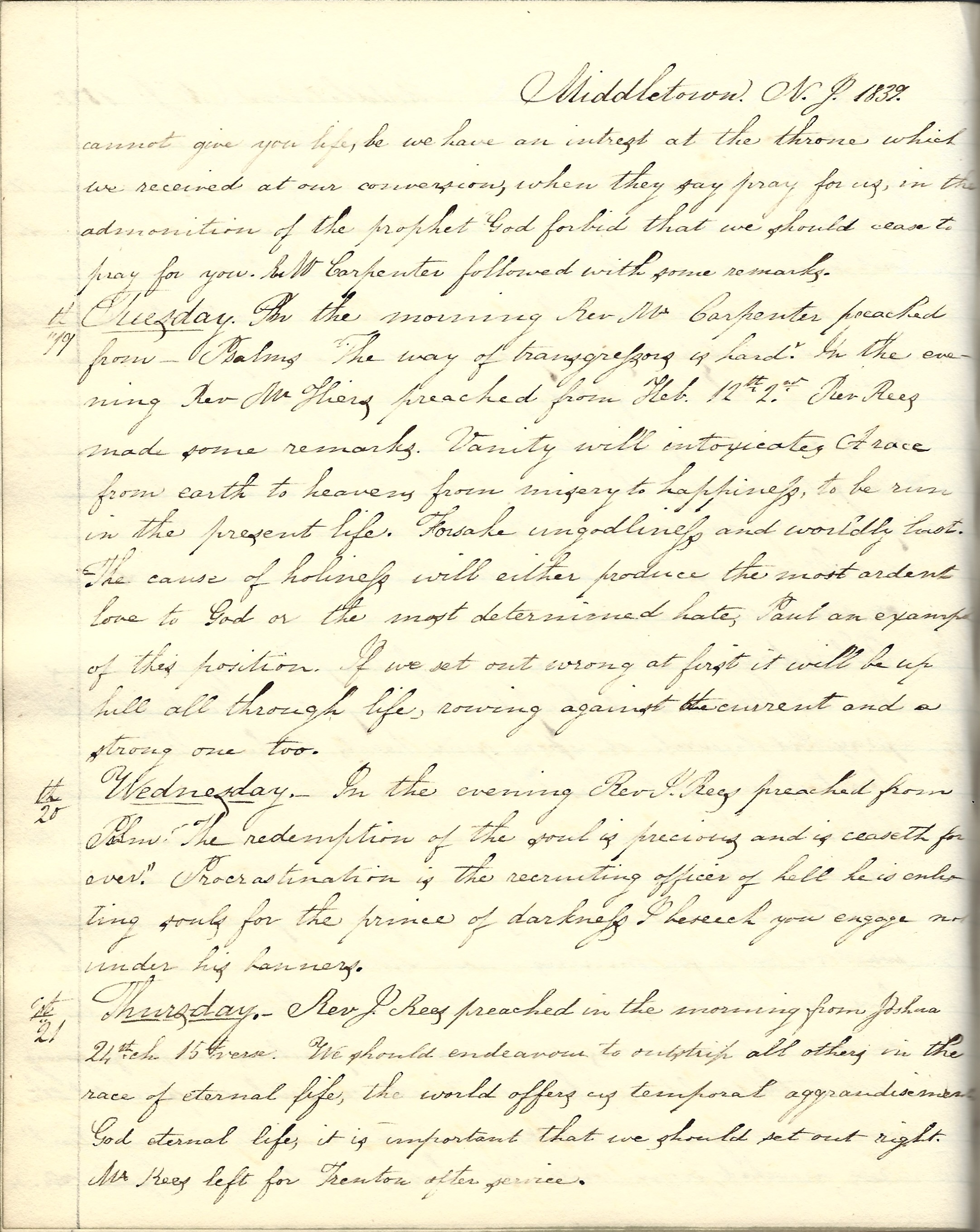
Thursday, October 3, 1839. In the afternoon attended prayer meeting, after some prayers were offered. The Rev. Mr. Roberts made the following remarks. We have much to thank God for. In this age, religion is generally respected if Christians respect themselves. Men can read the bible and remember what they read, and compare Christians with it, if we do not live up to it we dishonor the blessed cause for which Christ suffered and died. The bible is a wonderful book, thy testimonies, said David are wonderful, therefore, my soul loveth them,” in the bible we find we were chosen in Christ before the world was made, or time began, make it your companion, when you cannot read it, think of it. Faith cannot give you life, be we have an interest in the throne which we received at our conversion, when they say pray for us, in the admonition of the profit. God forbid that we should cease to pray for you. R. W. Carpenter followed with some remarks.
Saturday, October 5, 1839. Attended church in the morning. The Rev. Mr. Roberts performed the duties. In his prayer, one petition was that the people like Jacob of old may continue until they prevail. He read the 2nd Chapter of Hebrews…There will be many wonders on the day of judgement. We will see our neighbor there whom we did not expect to see, but the greatest wonder will be if we are there ourselves. Two persons gave in their experiences. Baptizing at Walling’s Landing.
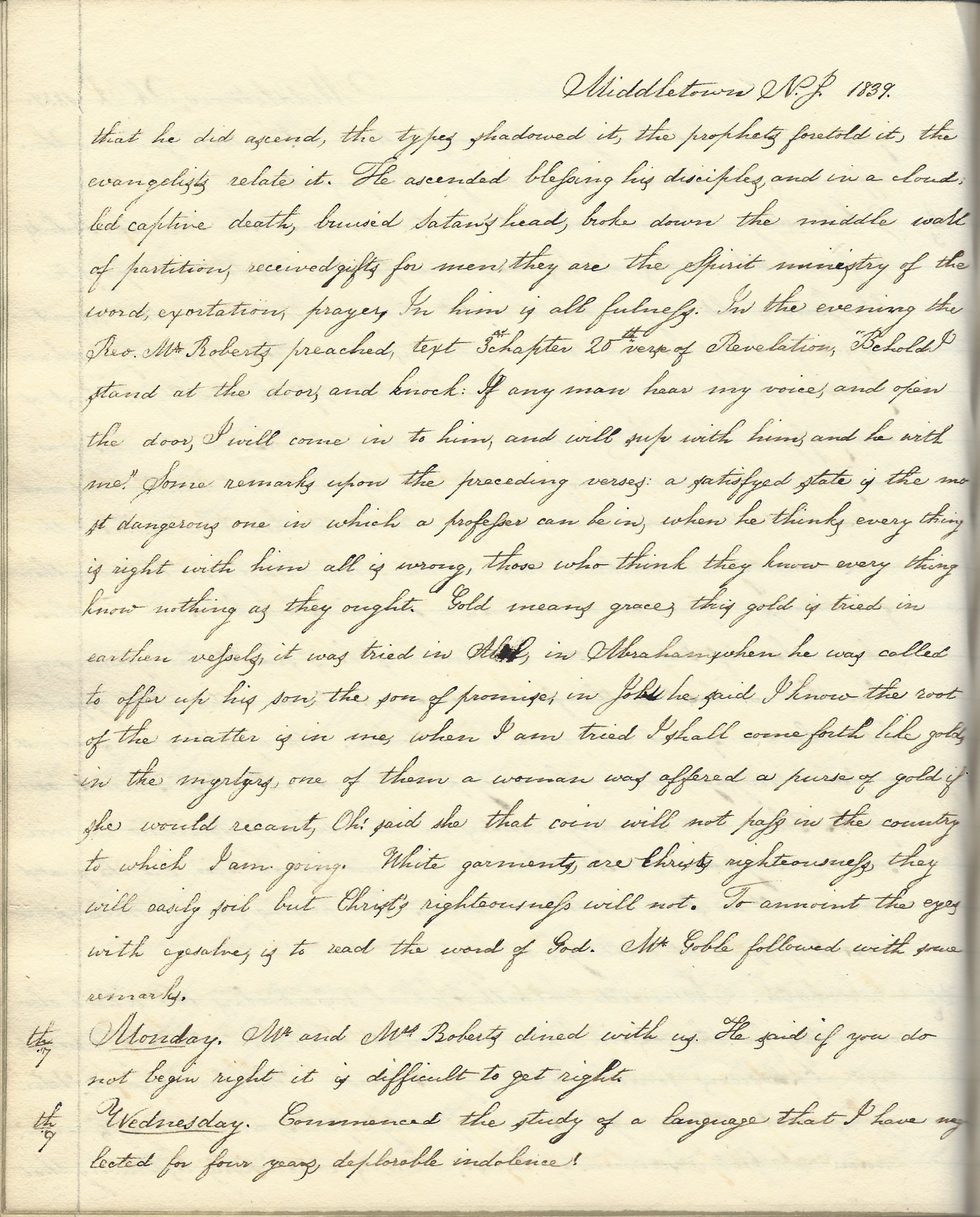
Sabbath 8th. Attended Sabbath School. Six scholars. The school closed to day for the season. I have been aided. The Rev. Mr. Gobb preached, Text Ephesians 4th Chapter, 8th verse, “Wherefore he saith, when he ascended up on high, he led captivity captive, and gave gifts unto men.” Subject Ascension of CHrist. There is concurring testimony that he did not ascend, the types shadowed it, the prophets foretold it, the evangelists relate it…
Monday 7th. Mr. and Mrs. Roberts fined with us. He said if you do not begin right, it is difficult to get right.
Wednesday 9th. Commenced the study of language that I have neglected for four years. Deplorable indolence!
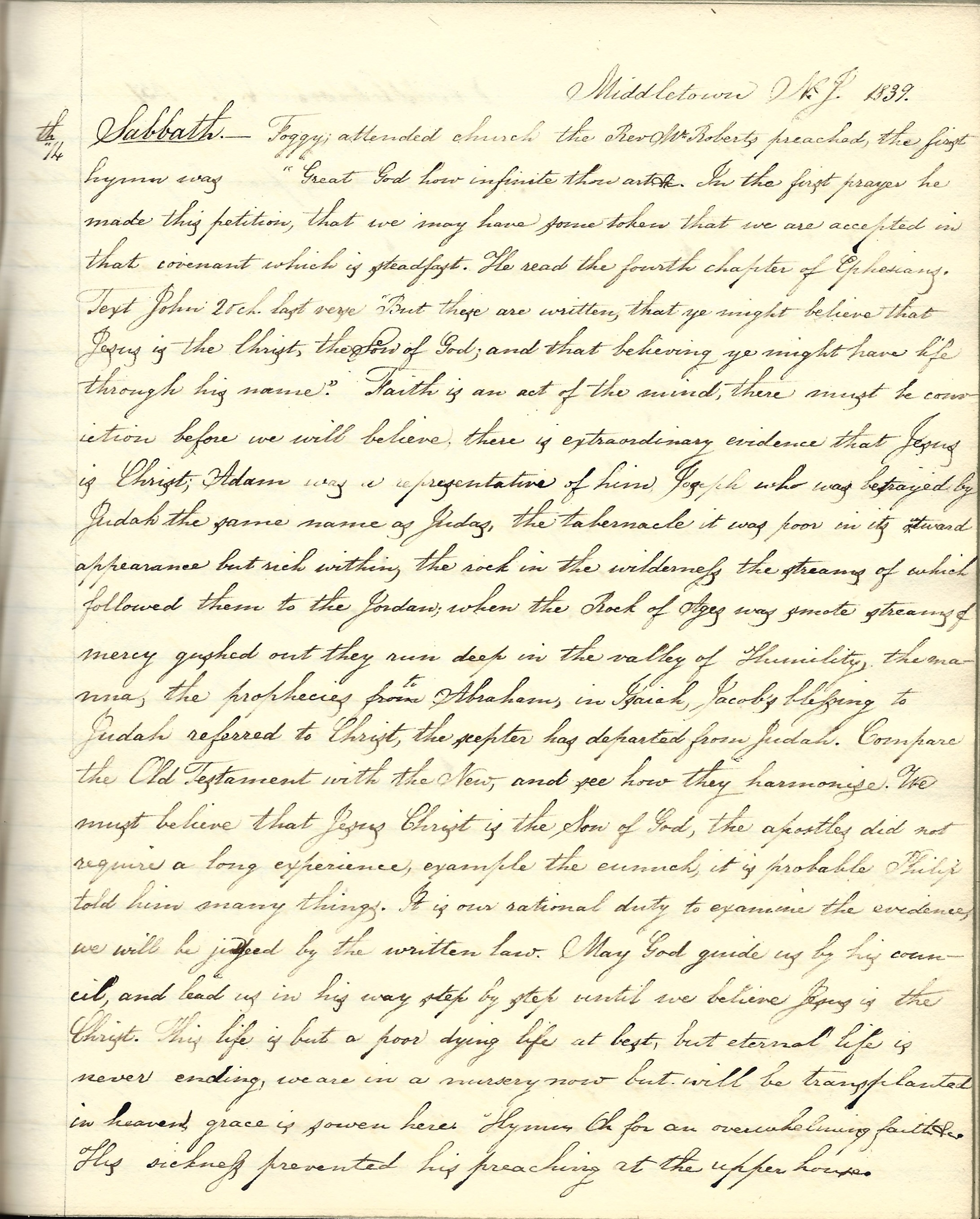
Middletown, New Jersey, Sabbath, October 14, 1839. Foggy. Attended church. The Rev. Mr. Roberts preached. The first hymn was, “Great God, how infinite thou art.”….
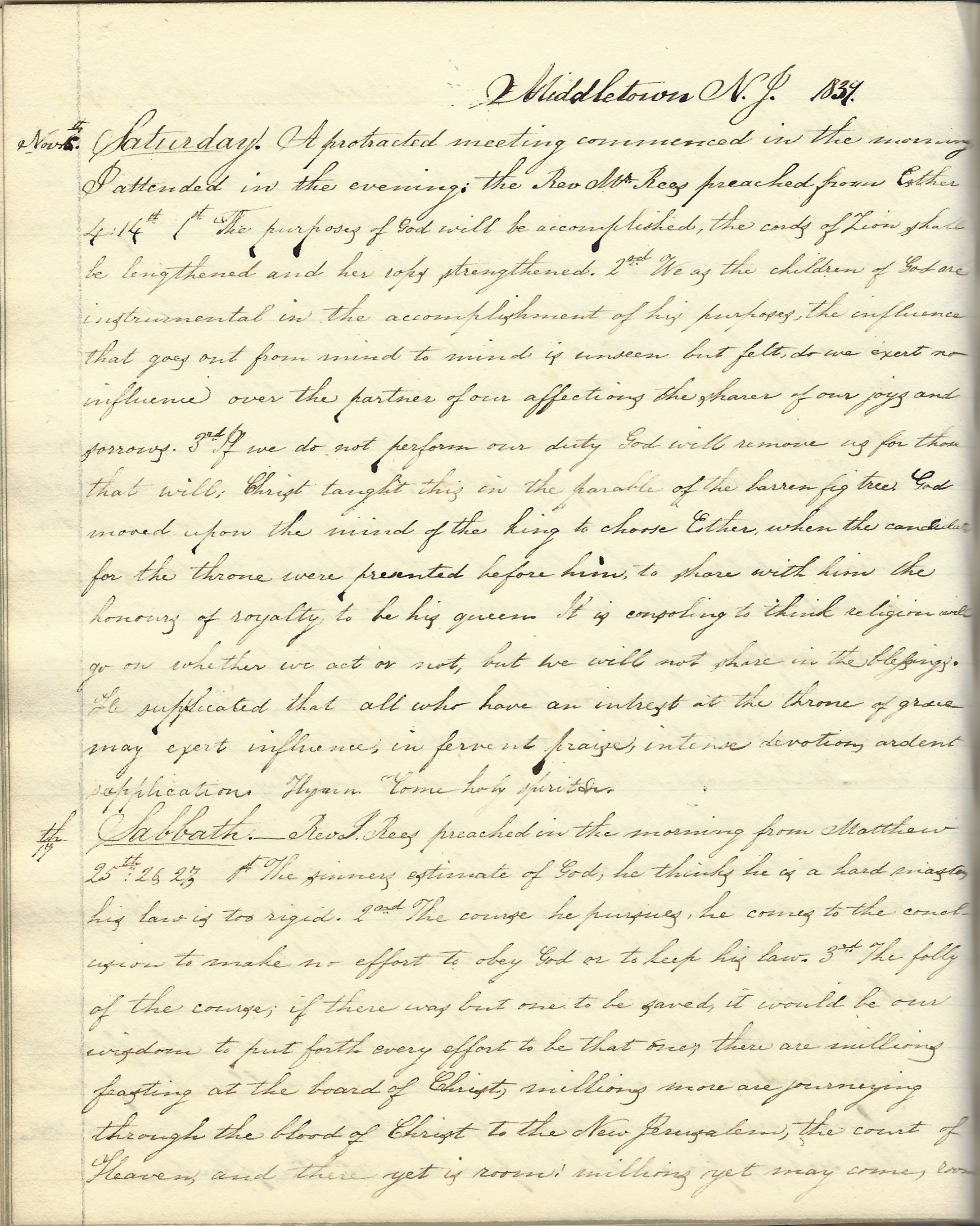
Middletown, New Jersey, Saturday, November 16, 1839. A protracted meeting commenced in the morning. I attended in the evening. The Rev. Mr. Rees preached from Esther 4th Chapter, 14th verse, “The purposes of God will be accomplished, the cords of Zion shall be lengthened and her ropes strengthened.” ….
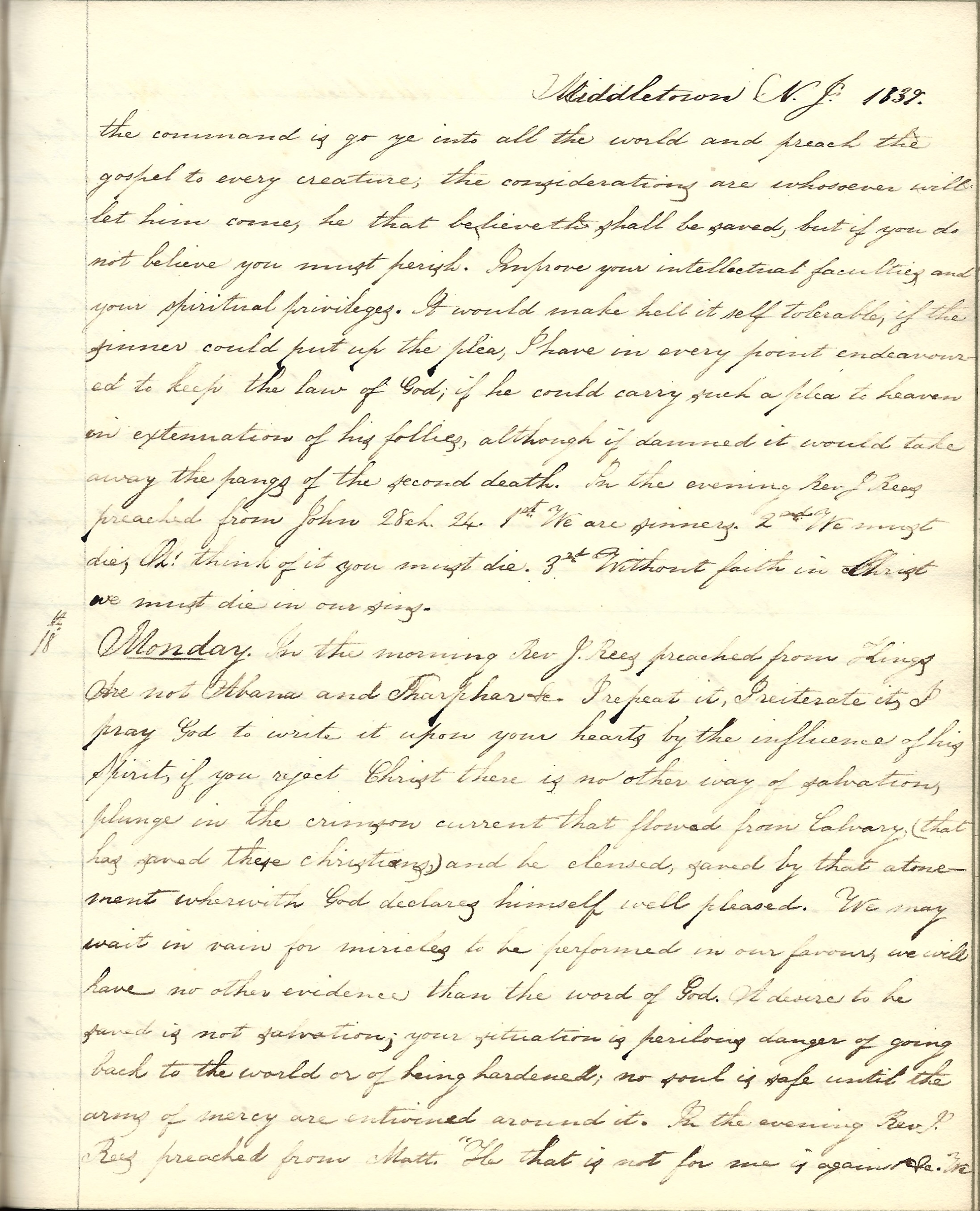
Sabbath 17th. Rev. J. Rees preached in the morning from Matthew 25th: 26, 27….
Monday 18th. In the morning Rev. J. Rees preached from Kings…
Tuesday 19th [November]. In the morning Rev. Mr. Carpenter preached from Psalms. “The way of transgressors is hard.” In the evening Rec. Mr. Hiers preached from Hebrews 12th, 2nd. Rev. Rees made some remarks. Vanity will intoxicate a race from earth to heavens, from misery to happiness to be run in the present life. Forsake ungodliness and worldly lust. The cause of holiness will either produce the most ardent love to God or the most determined hate. Paul an example of this position. If we set out wrong at first, it will be up hill all through life, rowing against the current and a strong one too.
Wednesday 20th. In the evening Rev. J. Rees preached from Psalm, “The redemption of the soul is precious and is ceaseth forever.” Procrastination is the recruiting officer of hell. He is enlisting souls for the prince of darkness. I beseech you engage not under his banners.
Thursday 21. Rev. J. Rees preached in the morning from Joshua 24th Chapter, 15th verse. We should endeavor to outstrip all others in the race of eternal life. The world offers us temporal aggrandizement. God eternal life. It is important that we should set out right. Mr. Rees left for Trenton after service.
 Spared & Shared 23