

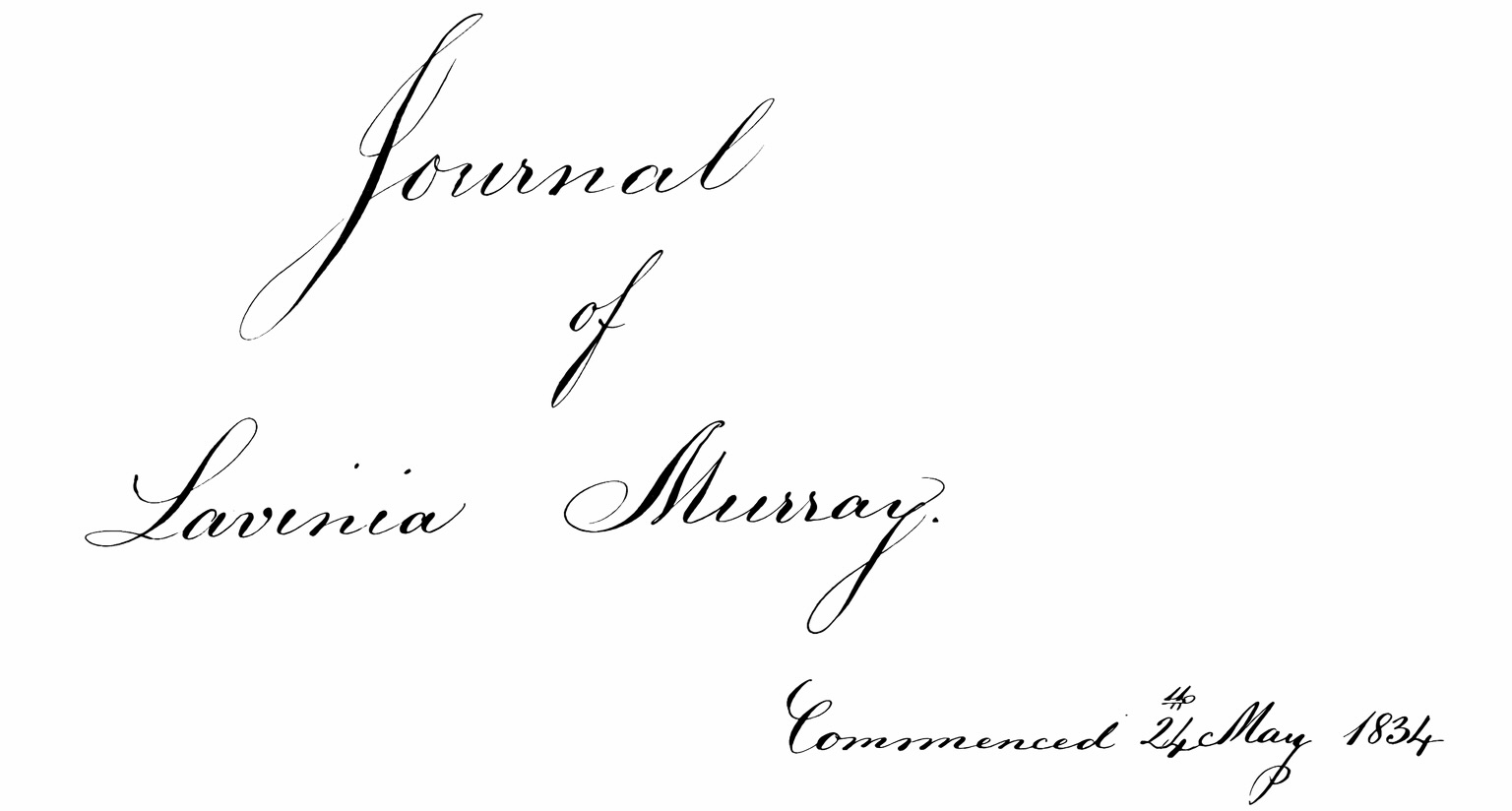
This journal was kept by Lavinia Murray (1818-1896), the daughter of William W. Murray (1784-1865) and Mary Crawford (1800-1853) of Middletown, Monmouth county, New Jersey. Lavinia commenced her journal on 24 May 1834 when she was 15 years old. Her last entry, on the last page of the journal, was dated in 1842 when she 23. She married James M. Hoagland (1818-1857), a New York Merchant, on 26 August 1847 and resided in New Jersey or New York City the remainder of her life, leaving no children. She died in 1896.
Lavinia was the oldest of three children. Her siblings were Eleanor Crawford Murray (1821-1858) and George Crawford Murray (1827-1884). George graduated from Yale in 1845, studied law in New York City and was admitted to the bar in 1849 but gave up law to manage two family farms. [Source: The Scott Family of Shrewsbury, page 20]
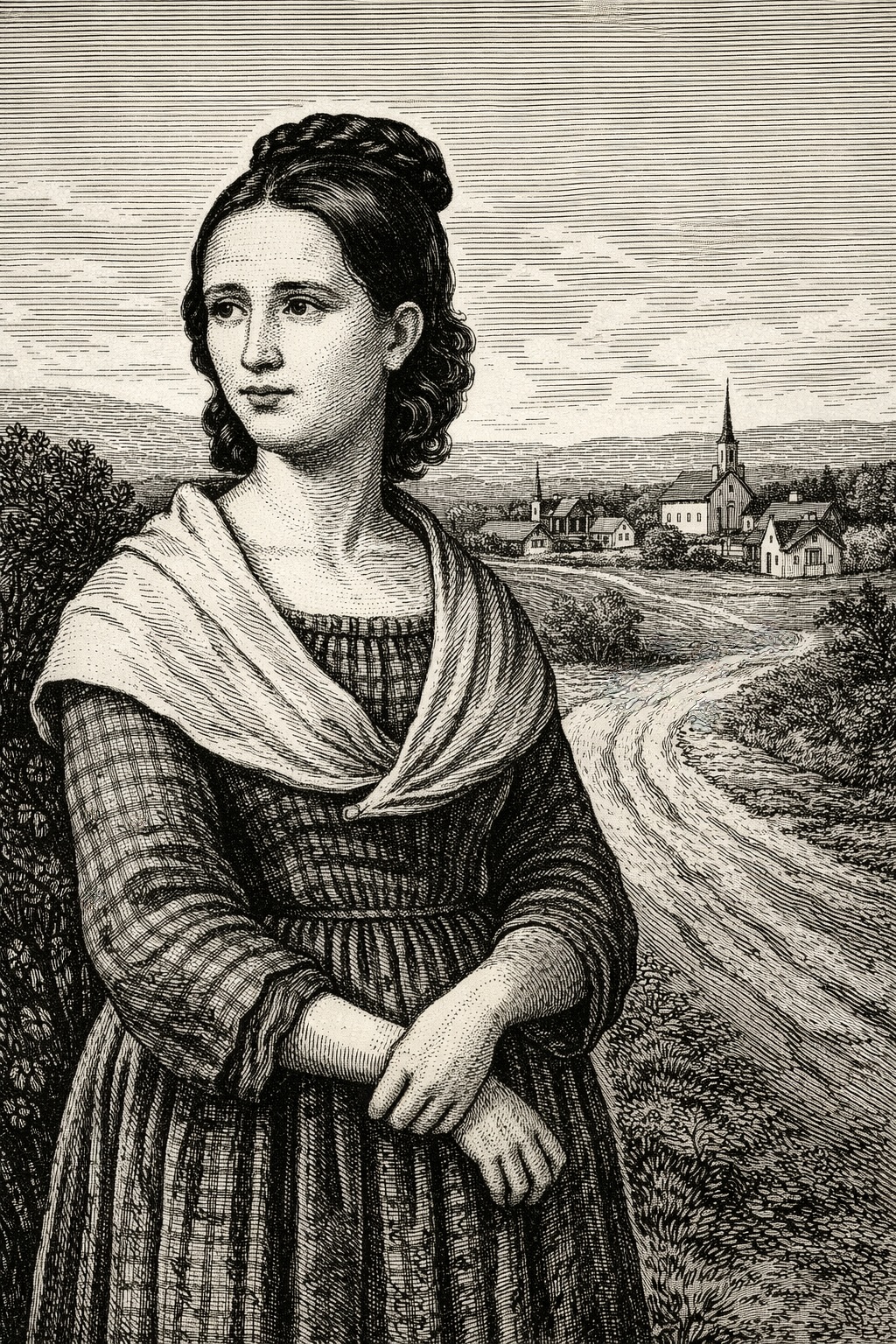
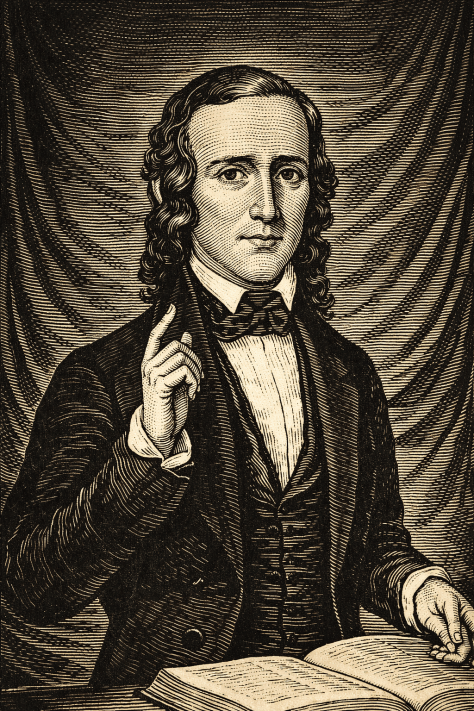
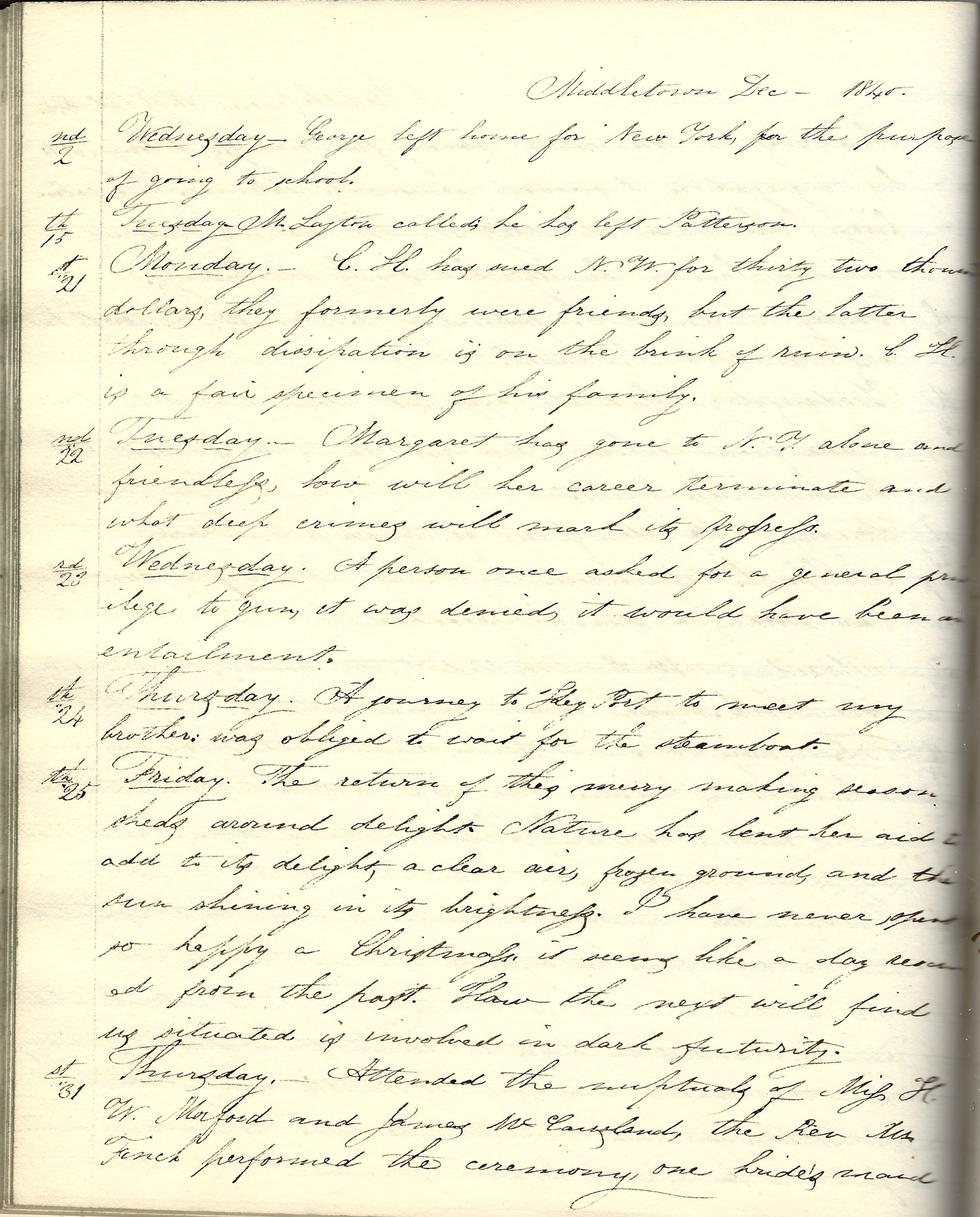
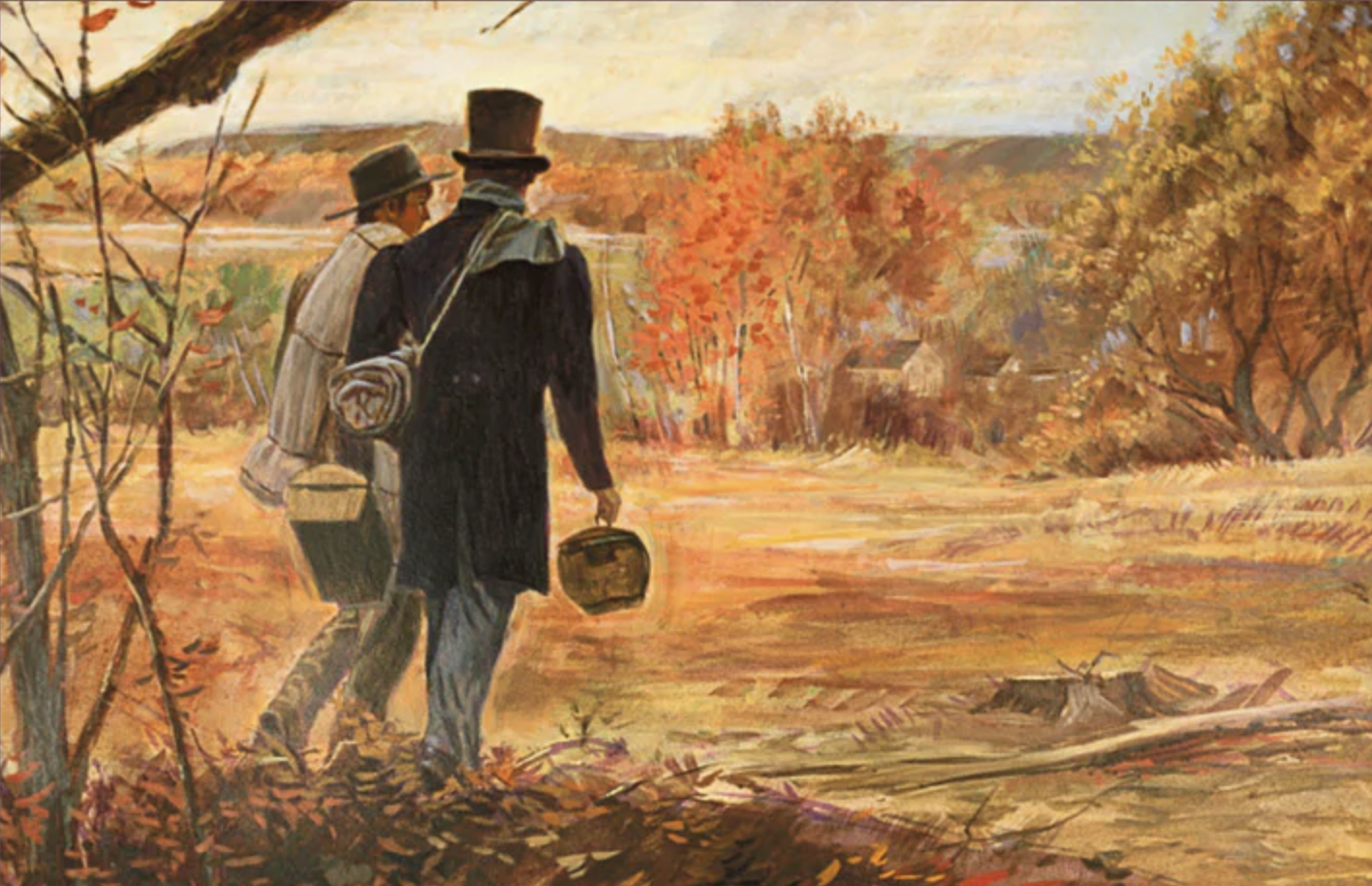
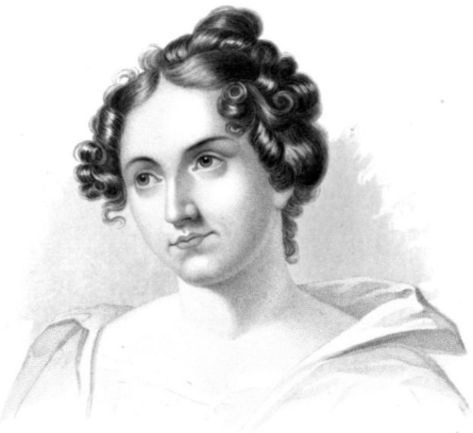
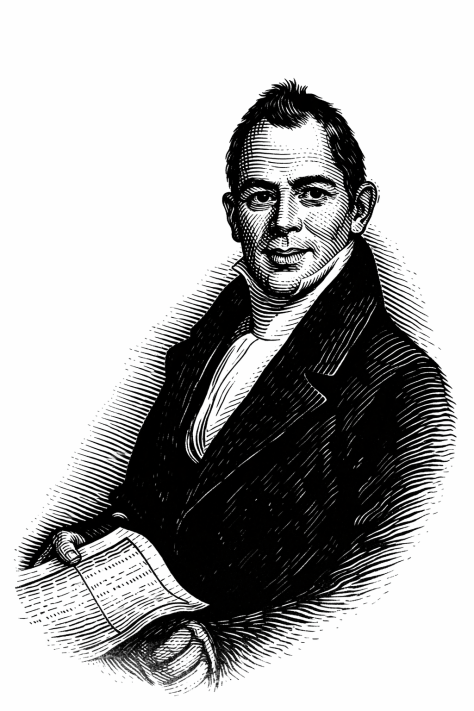
I could find no images of Lavinia; the woodcut depiction of a young woman standing on the outskirts of Middleton, New Jersey, in the 1830s is purely conjectural.
Index to Journal Entries
1834-1835 Entries
1836-1837-1838-1839 Entries
1840-1841-1842 Entries are published below

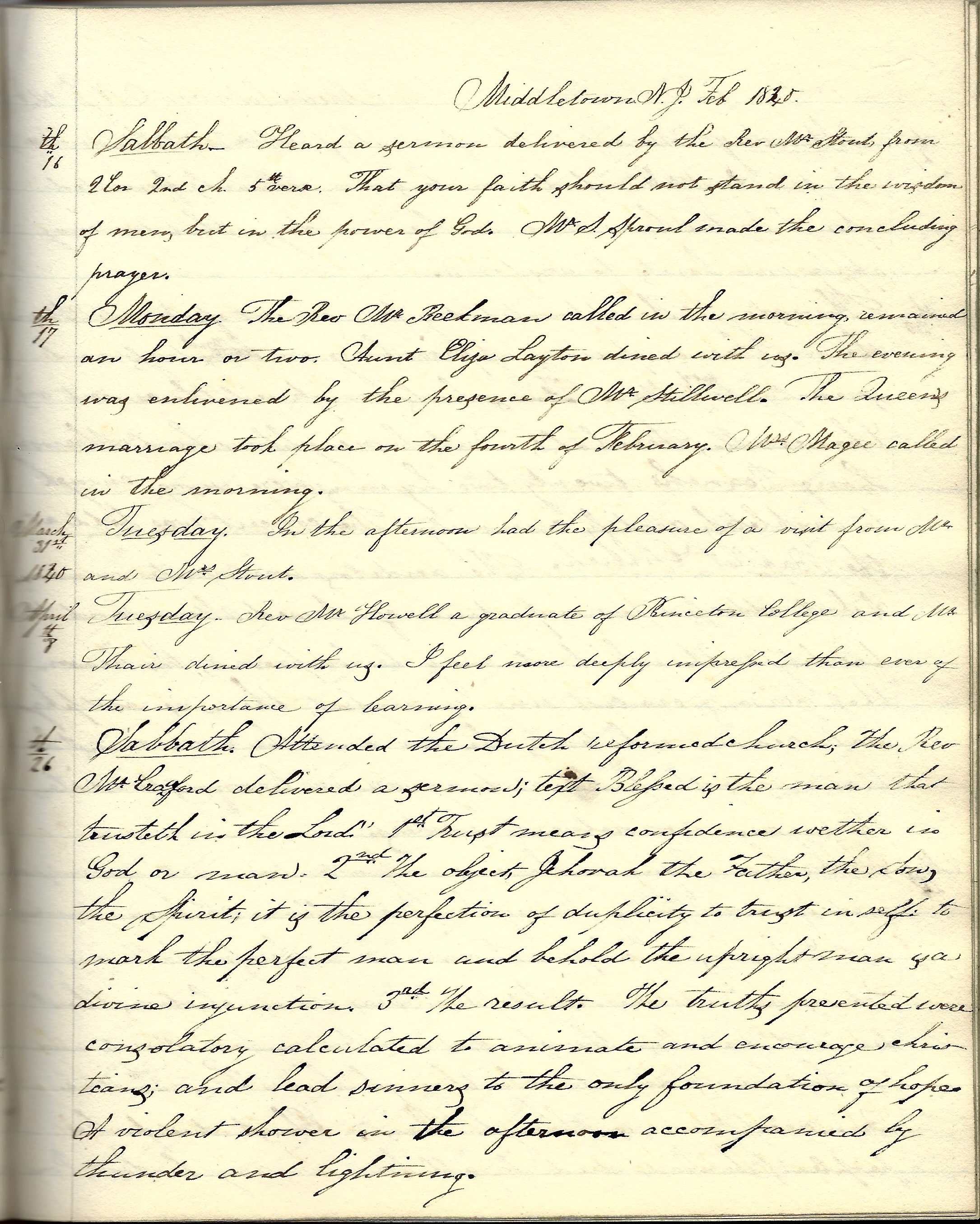
Middletown, New Jersey, Tuesday, March 31, 1840. In the afternoon had the pleasure of a visit from Mr. and Mrs. Stout.
Tuesday, April 8th. Rev. Mr. Howell, a graduate of Princeton College, and Mr. Thair dined with us. I feel more deeply impressed than ever of the importance of learning.
Sabbath 26th. Attended the Dutch Reformed Church. The Rev. Mr. Crawford delivered a sermon, Text: “Blessed the man that trusted in the Lord….”
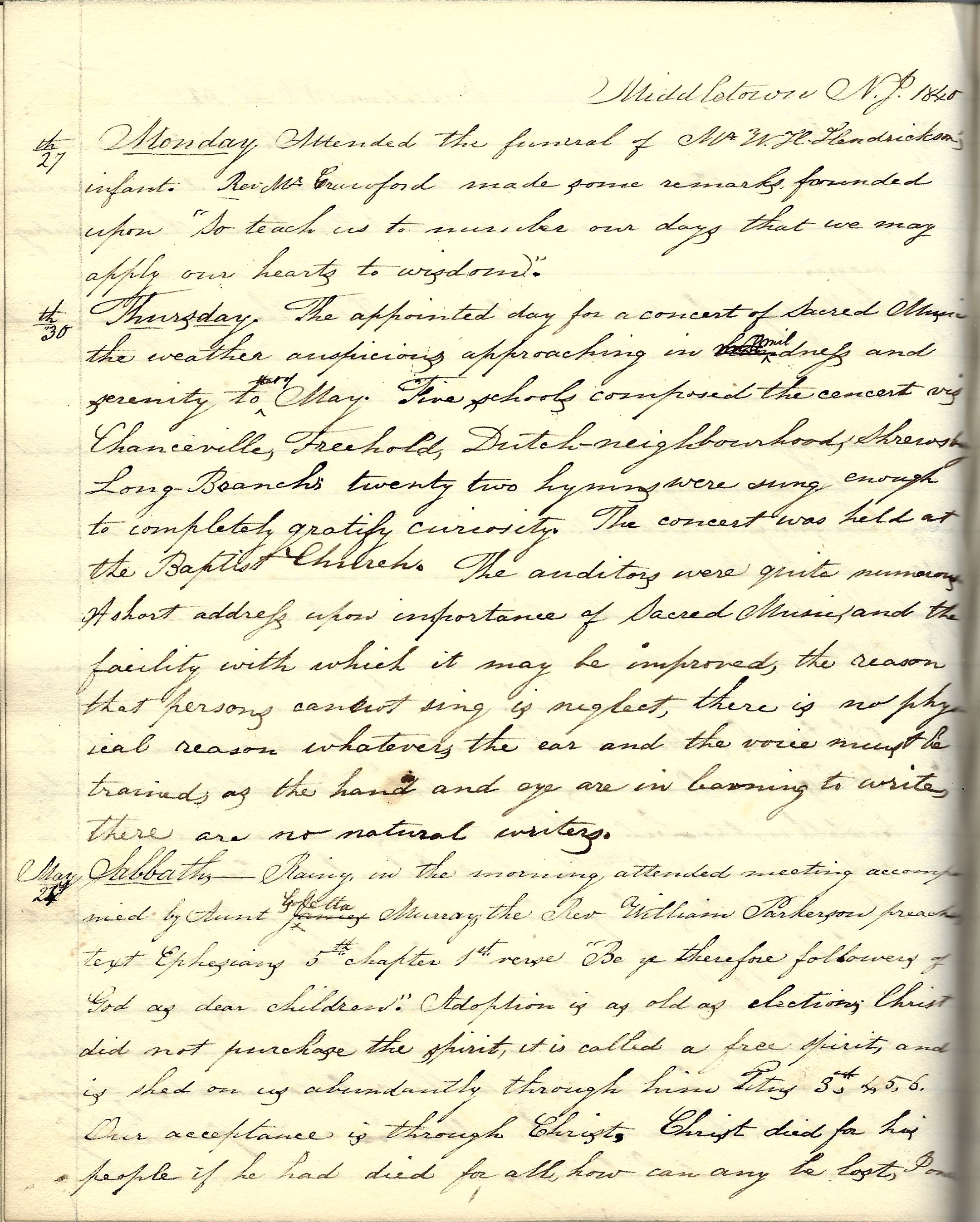
Monday 27th. Attended the funeral of Mr. W. H. Hendrickson’s infant. Rev. Mr. Crawford made some remarks founded upon, “So teach us to number our days that we may apply our hearts to wisdom.”
Thursday 30th. The appointed day for a concert of Sacred Music. The weather auspicious approaching in mildness and serenity toward May. Five schools composed the concert; viz—Chanceville, Freehold, Dutch Neighborhood, Shrewsbury, and Long Branch. Twenty-two hymns were sung—enough to completely gratify curiosity. The concern was held at the Baptist Church. The auditors were quite numerous. A short address upon importance of Sacred Music and the facility with which it may be improved. The reason that persons cannot sing is neglect. There is no physical reason whatever. The ear and the voice must be trained as the hand and eye are in learning to write. There are no natural writers.
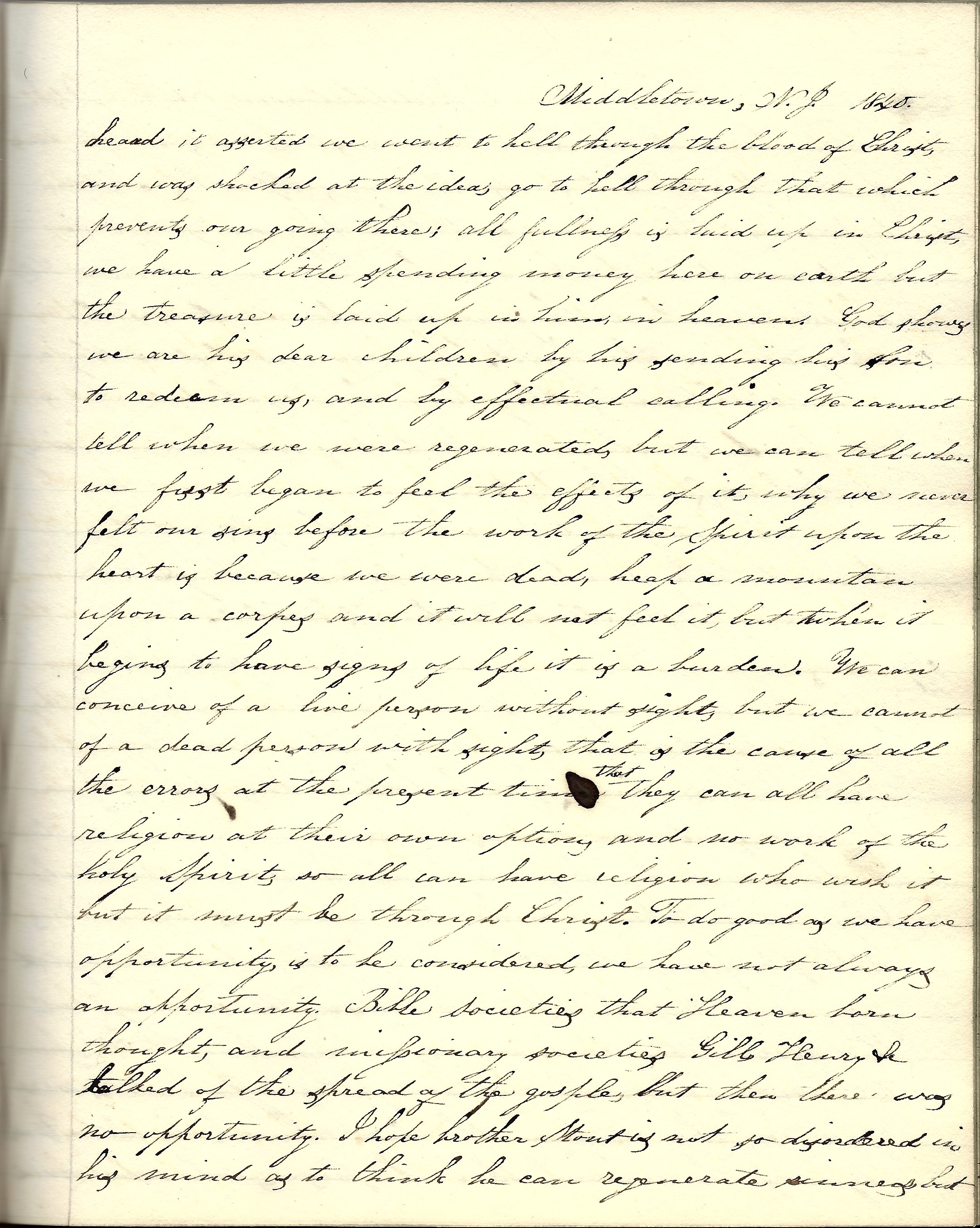
Sabbath, May 24th. Rainy in the morning. Attended meeting accompanied by Aunt Goletta Murray. The Rev. William Parkerson preached. Text, Ephesians 5th Chapter, 1st verse. “Be ye thereore followers of God as dear children.” Adoption is as old as election. Christ did not purchase the spirit. It is called a free spirit, and is shed on us abundantly through Him. Peters 3rd Chapter, 4,5, 6. Our acceptance is through Christ. Christ died for his people. If he had died for all, how can any be lost. I once heard it asserted we went to hell through the blood of Christ, and was shocked at the idea. Go to hell through that which prevents our going there? All fullness is laid up in Christ. We have a little spending money here on Earth but the treasure is laid up in Him, in heaven. God shows we are his dear children by his sending his Son to redeem us, and by effectual calling. We cannot tell when we were regenerated, but we can tell when we first began to feel the effects of it. Why we never felt our sins before the work of the Spirit upon the heart is because we were dead Heap a mountain upon a corpse and it will not feel it, but when it begins to have signs of life, it is a burden….To do good as we have opportunity, is to be considered. We have not always an opportunity. Bible Societies that Heaven born thought, and Missionary Societies. Gill Henry &c. talked of the spread of the gosple, but then there was no opportunity. I hope brother Stout is no so disordered in his mind as to think he can regenerate sinners but I hope he and me have been instruments in the hand of the Spirit. God sends afflictions upon his children to preserve them from evil, that they may not be condemned with the world. They are as much God’s children when they are in the dark as when they are in the light. They are not lost if they are God’s children., if they have been excluded. That is no kind of religion which does not produce [ ] at holiness.
The first hymn was, Distressed I turn my thoughts within, &c. The second, Why should the children of the king, &c. An exceedingly small number assembled.
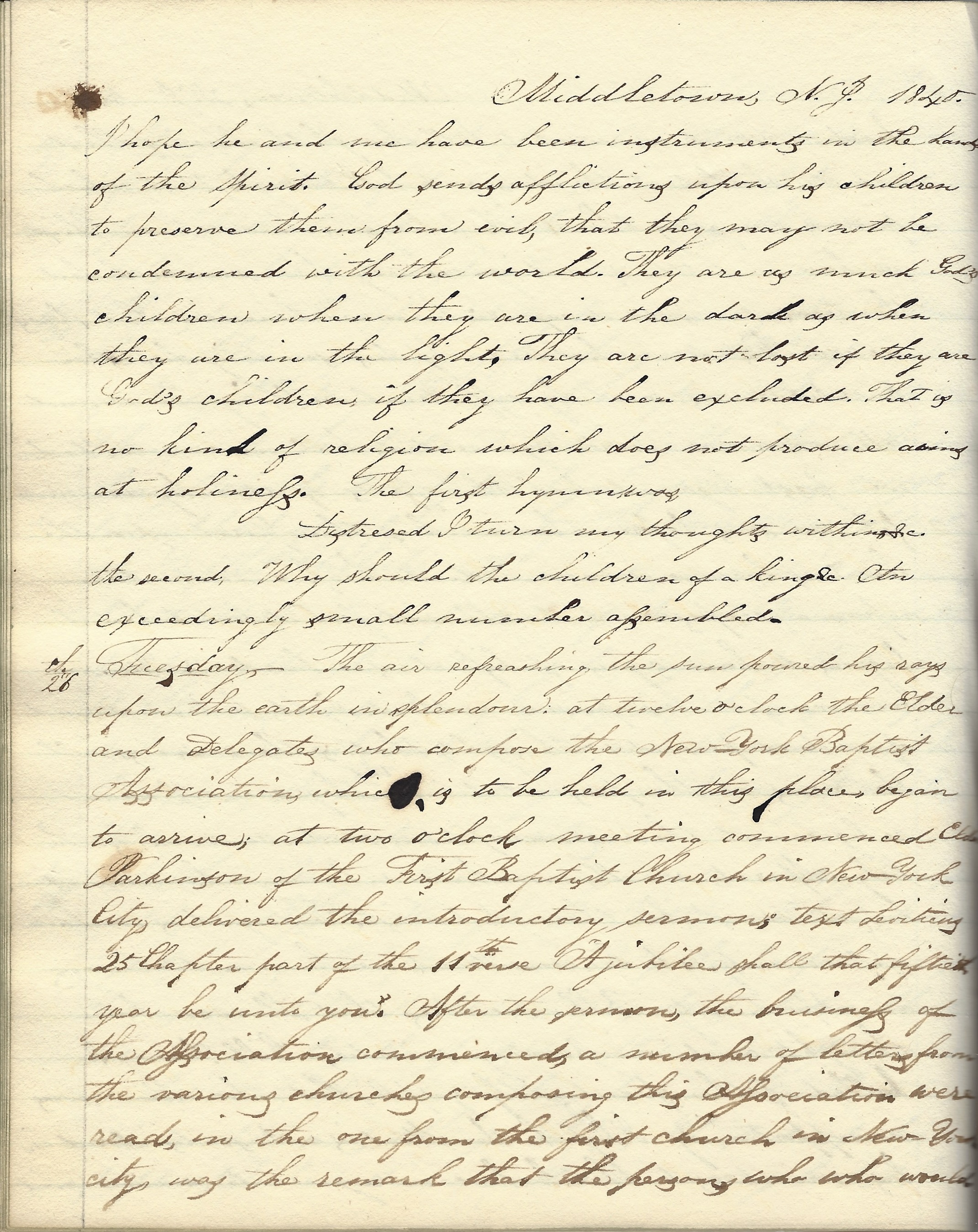
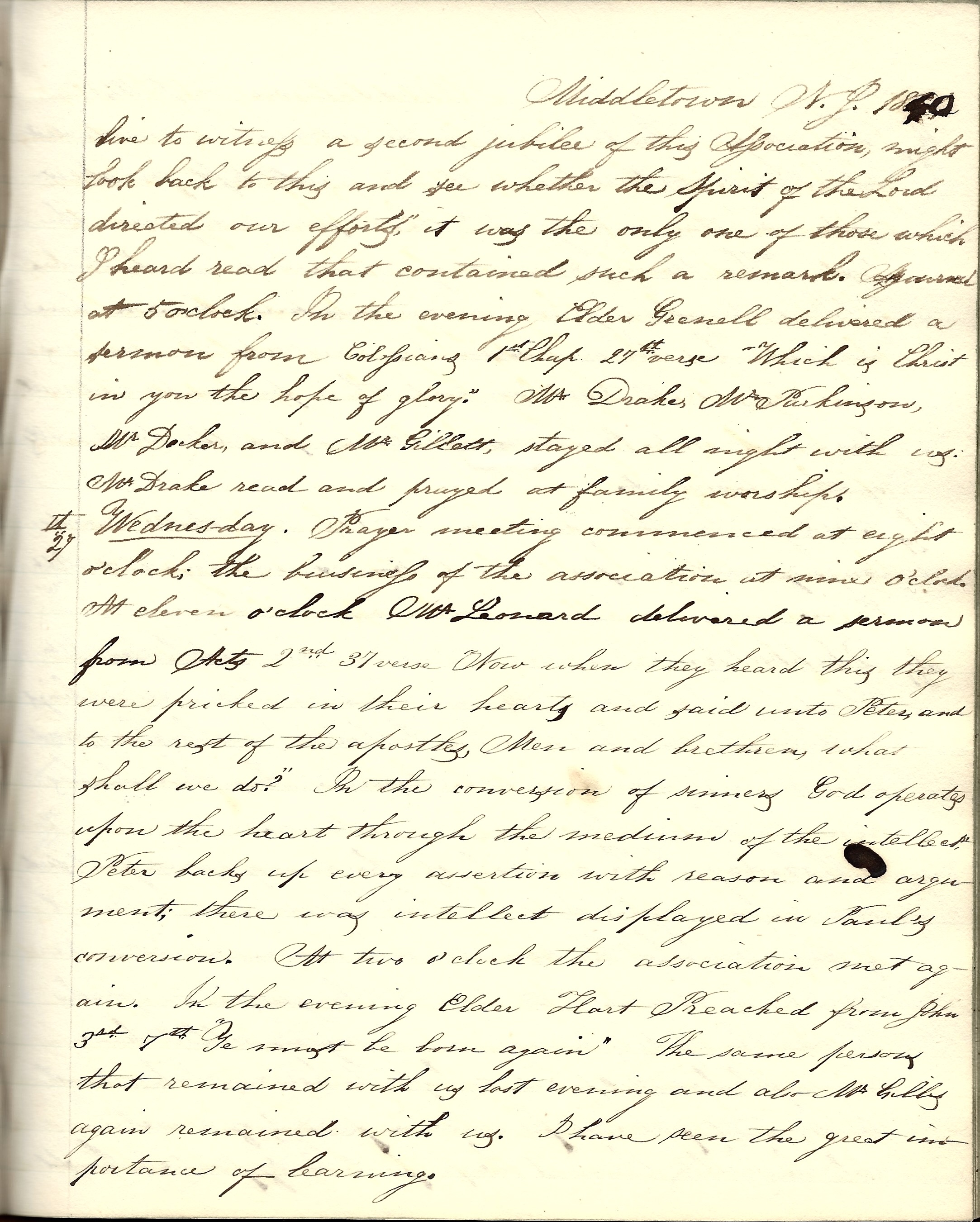
Tuesday 26th. The air refreshing. The sun poured his rays upon the earth in splendor. At twelve o’clock, the Elder and Delegate who compose the New York Baptist Association, which is to be held in this place, began to arrive. At two o’clock, meeting commenced. Elder Parkinson of the First Baptist Church in New York City delivered the introductory sermons; text Leviticus 25th Chapter, part of the 11th verse. “A jubilee shall that fiftieth year be unto you.” After the sermon, the business of the Association commenced. A number of letters from the various churches composing this Association were read. In the one from the first church in New York City was the remark that the persons who would live to witness a second jubilee of this Association might look back to this and see whether the Spirit of the Lord directed our efforts. It was the only one of those which I heard read that contained such a remark. Adjourned at 5 o’clock.
In the evening, Elder Grenell delivered a sermon from Colossians 1st Chapter, 27th verse, “Which is Christ in you the hope of glory.” Mr. Drake, Mr. Parkinson, Mr. Decker, and Mr. Gillett, stayed all night with us. Mr. Drake read and prayed at family workship.
Wednesday 27th. Prayer meeting commenced at eight o’clock. The business of the Association at nine o’clock. At eleven o’clock Mr. Leonard delivered a sermon from Acts 2nd 37th verse. “Now when they heard this, they were pricked in their hearts and said unto Peter and to the rest of the Apostles, Men and brethren, what shall we do?” In the conversion of sinners, God operates upon the heart through the medium of the intellect. Peter backs up every assertion with reason and argument. There was intellect displayed in Paul’s conversion. At two o’clock, the Association met again. In the evening Elder Hart preached from John 3rd [Chapter] 7th [verse] “Ye must be born again.” The same persons that remained with us last evening and also Mr. Gillis again remained with us. I have seen the great importance of learning.
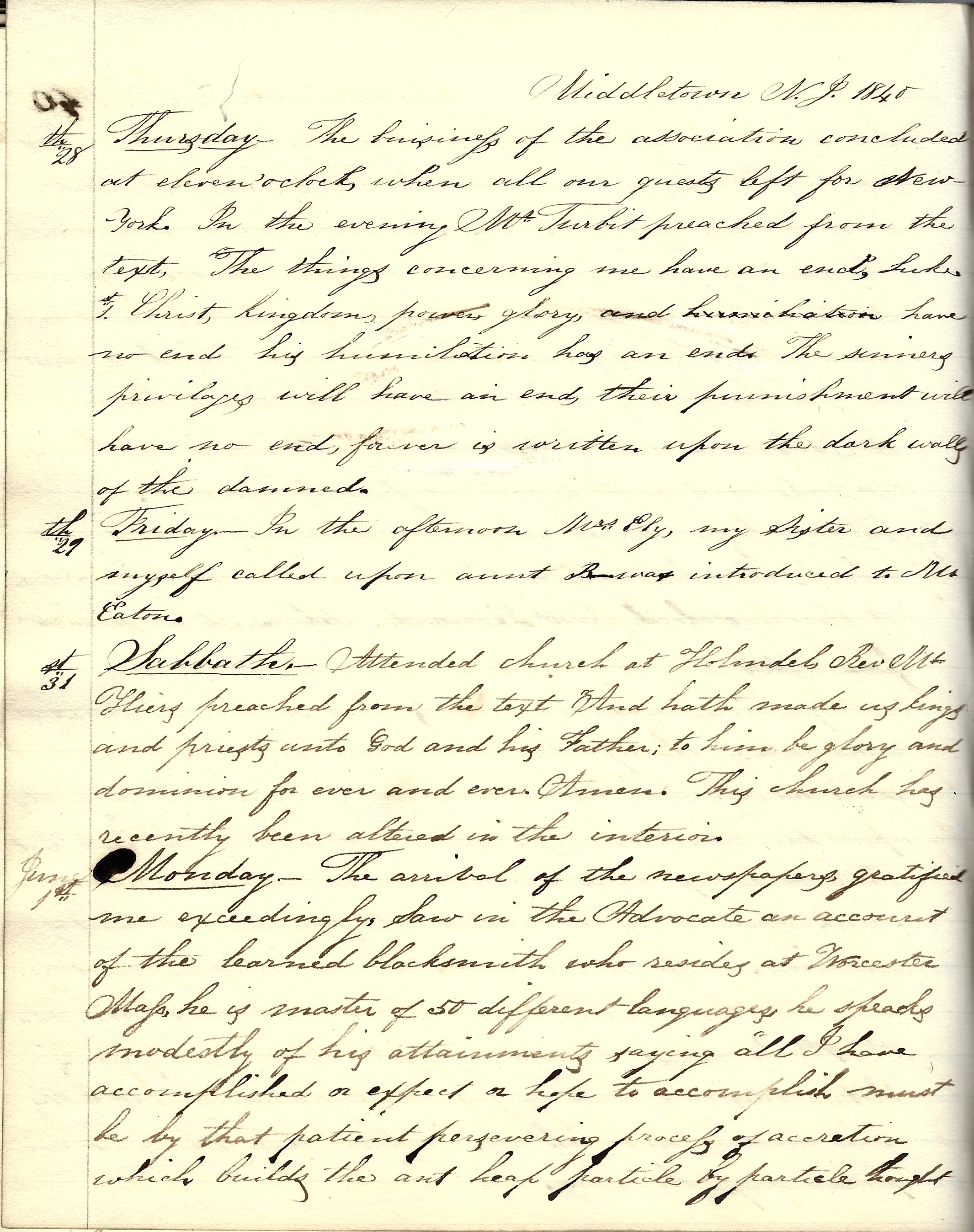
Thursday 28th. The business of the Association concluded at eleven o’clock when all our guests left for New York. In the evening Mr. Turbit preached from the text, “The things concerning me have an end….”
Friday 29th. In the afternoon, Mrs. Ely, my sister and myself called upon Aunt B___. Introduced to Ms. Eaton.
Sabbath, [May] 31st. Attended church at Holindel. Rev. Mr. [D. B.] Hires preached from the text, “And hath made us kings and priests unto God and his Father; to him be glory and dominion for ever and ever, Amen.” This church has recently been altered in the interior.
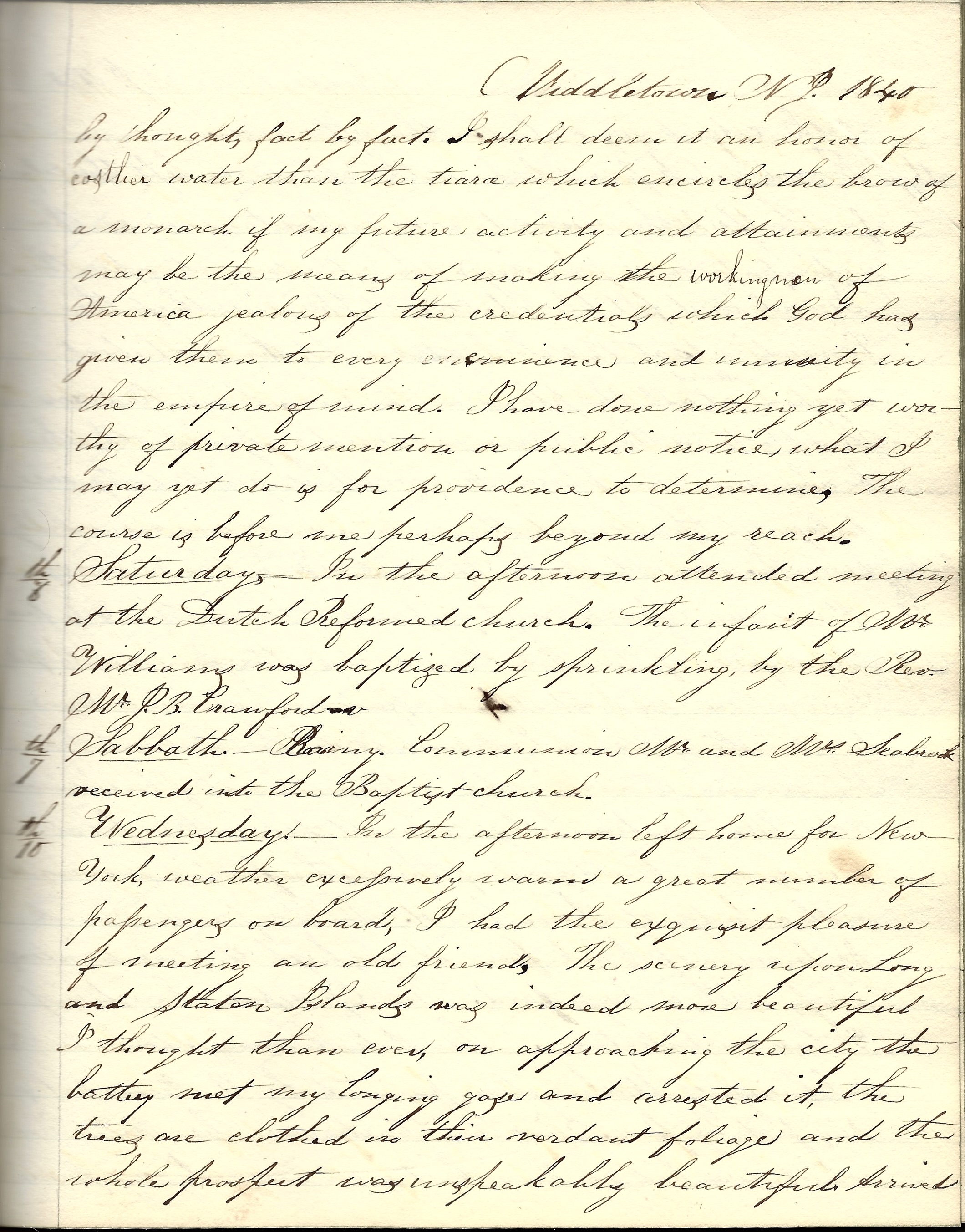
Monday, June 1st [1840]. The arrival of the newspapers gratified me exceedingly. Saw in the Advocate an account of the learned blacksmith who resides at Worcester, Massachusetts. He is master of 50 different languages. He speaks modestly of his attainments saying, “all I have accomplished or expect or hope to accomplish must be by that patient persevering process of accretion which builds the ant heap particle by particle, thought by thought, fact by fact. I shall deem it an honor of costlier water than the tiara which encircles the brow of a monarch if my future activity and attainments may be the means of making the workingmen of America jealous of the credentials which God has given them to every eminence and unity [?] in the empire of mind. I have done nothing yet worthy of private mention or public notice. What I may yet do is for Providence to determine. The course is before me, perhaps beyond my reach.
Saturday, 6th. In the afternoon attended meeting at the Dutch Reformed Church. The infant of Mr. Williams was baptized by sprinkling by the Rev. Mr. J. B. Crawford.
Sabbath, 7th. Rainy. Communion. Mr. and Mrs. Seabrook received into the Baptist Church.
Wednesday 10th. In the afternoon left home for New York [City]. Weather excessively warm. A great number of passengers on board. I had the exquisite pleasure of meeting an old friend. The scenery upon Lond and Staten Island was indeed more beautiful I thought than ever. On approaching the city the Battery met my longing gaze and arrested it. The trees are clothed in their verdant foliage and the whole prospect was unspeakably beautiful. Arrived at the city at 6 o’clock in the afternoon.
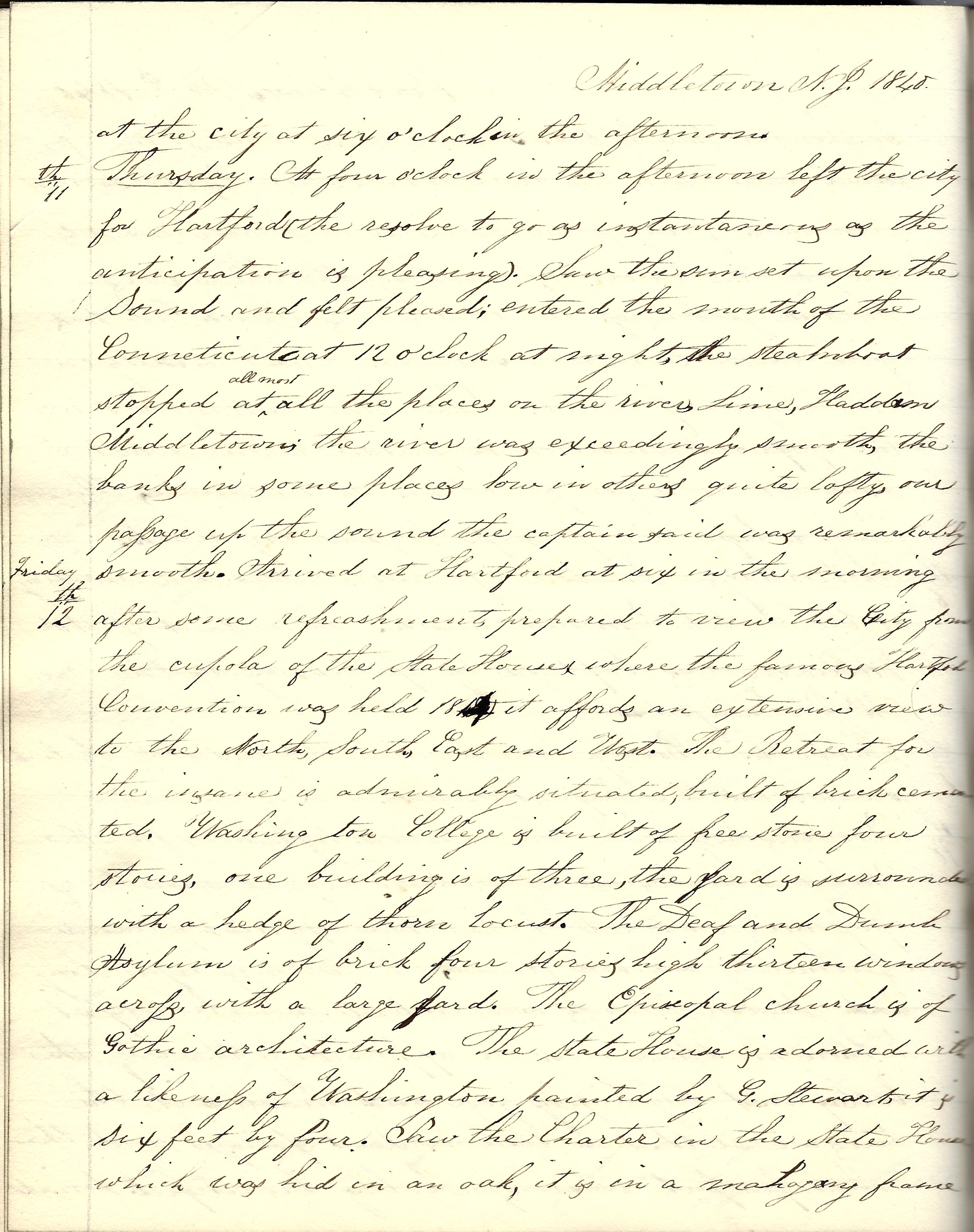
Thursday 11th. At 4 o’clock in the afternoon, left the city for Hartford (the resolve to go as instantaneous as the anticipation is pleasing). Saw the sun set upon the [Long Island] Sound and felt pleased. Entered the mouth of the Connecticut [River] at 12 o’clock at night. The steamboat stopped at almost all the places on the river—Lime, Haddam, Middletown. The river was exceedingly smooth; the banks in some places low [and] in others quite lofty. Our passage up the Sound the captain said was remarkably smooth.

Friday [June] 12th. Arrived at Hartford at six in the morning. After some refreshments, prepared to view the city from the cupola of the State House where the farmer’s Hartford Convention was held 1834. It affords an extensive view to the north, south, east and west. The Retreat for the Insane is admirably situated, built of brick cemented. Washington College [later renamed Trinity College] is built of free stone four stories. One building is of three. The yard is surrounded with a hedge of thorn locust. The Deaf and Dumb Asylum is of brick four stories high, thirteen windows across with a large yard. The Episcopal Church is of Gothic architecture. The State House is adorned with a likeness of Washington painted by G[ilbert] Stuart. It is six feet by four. Saw the Charter in the State House which was hid in an oak. It is in a mahogany frame and considered “one of the lions of Hartford.” The Charter Oak is still flourishing as if rejoicing in its patriotism. The aperture in which the charter was placed is closed. The tree is private property. It stands in the yard before a private dwelling.

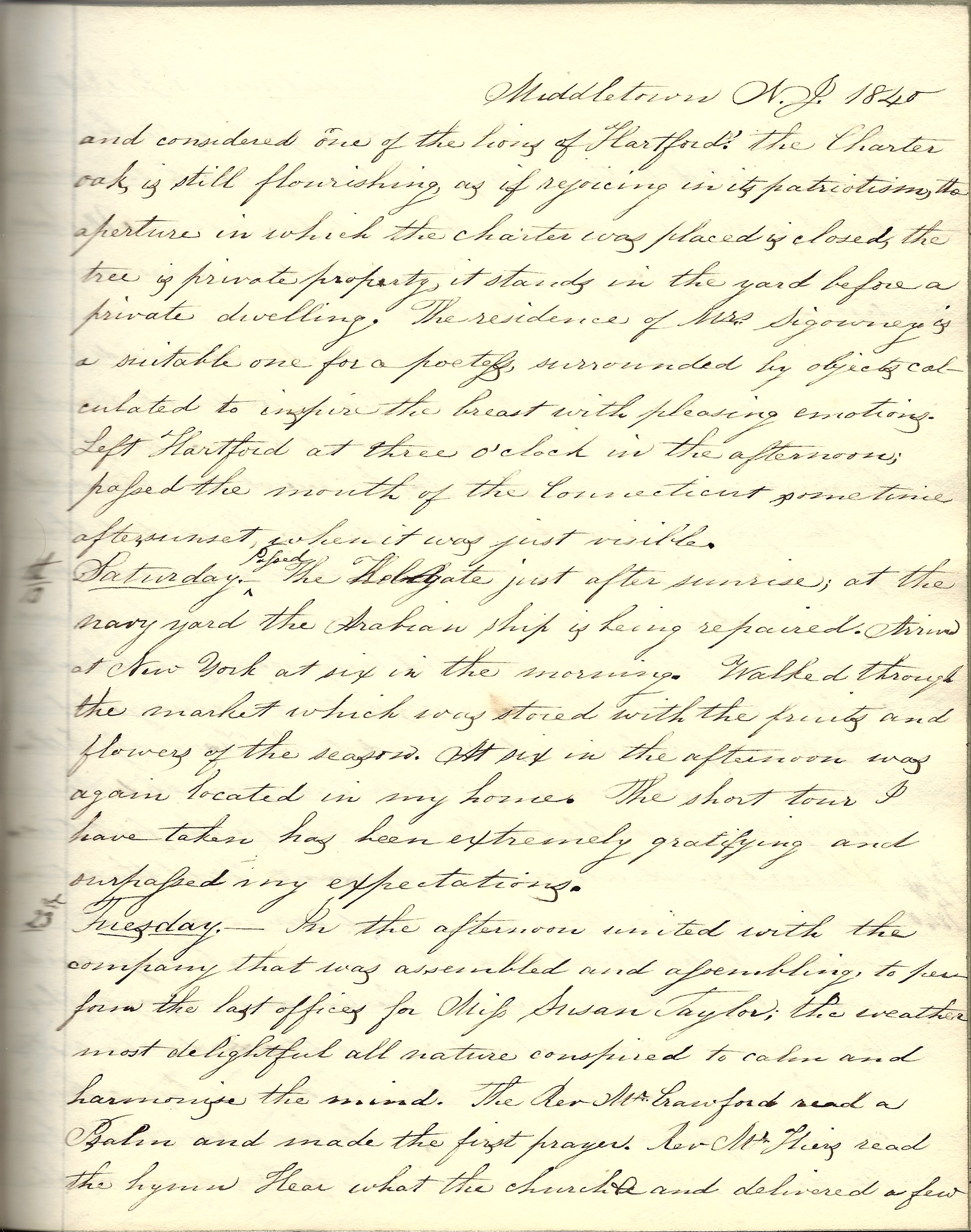
The residence of Mrs. [Lydia Huntley] Sigourney is a suitable one for a poetess, surrounded by objects calculated to inspire the breast with pleasing emotions. Left Hartford at three o’clock in the afternoon. Passed the mouth of the Connecticut [River] sometime after sunset when it was just visible.
Saturday 13th. Passed the Hell Gate just after sunrise. At the Navy Yard, the Arabian ship [al-Sultanah] is being repaired. Arrived at New York at 6 in the morning. Walked through the market which was stored with the fruits and flowers of the season. At six in the afternoon, was again located in my home. The short tour I have taken has been extremely gratifying and surpassed my expectations.
Tuesday 23rd. In the afternoon united with the company that was assembled and assembling to perform the last offices for Miss Susan Taylor. The weather most delightful. All nature conspired to calm and harmonize the mind. The Rev. Mr. Crawford read a Psalm and made the first prayer. Rev. Mr. Hires read the hymn, “Hear what the church, &c.,” and delivered a few remarks founded on Revelations 14th Chapter, 3rd verse. Spoke of the believers being united to the Lord; of the terror of death to a sinner. But in some sense a friend to the believers. We have a great many conflicts in this world and are sometimes ready to say with the poet—
Weary of wandering round and round
We long to quit this unhallowed ground
And dwell with Christ at home.
The life of a Christian in not a life of sloath. He must take the sword of the spirit and wield it manfully….
Saturday, July 4, 1840. Quite cool but pleasant. With the return of this day, emotions of joy and sorrow arise to welcome it; hallowed indeed it is in our history, and dear to every American. On the last anniversary of this day, some now numbered among who rest in the grave was then full of spirit and hope. Fancy cannot conjecture what events will have transpired by the dawn of the next anniversary of this memorable day.
In the afternoon, heard a sermon delivered by the Rev. Mr. Finch at the Episcopal Church. Text, Malachi 1st Chapter, 2nd and 3rd verses. He remarked upon the pious Washington and the bold audacity of the infidel Jefferson and despondingly of the present situation of the country and what little regard was paid to the Sabbath—the cruelty to the white and red man. Thirteen persons were assembled.
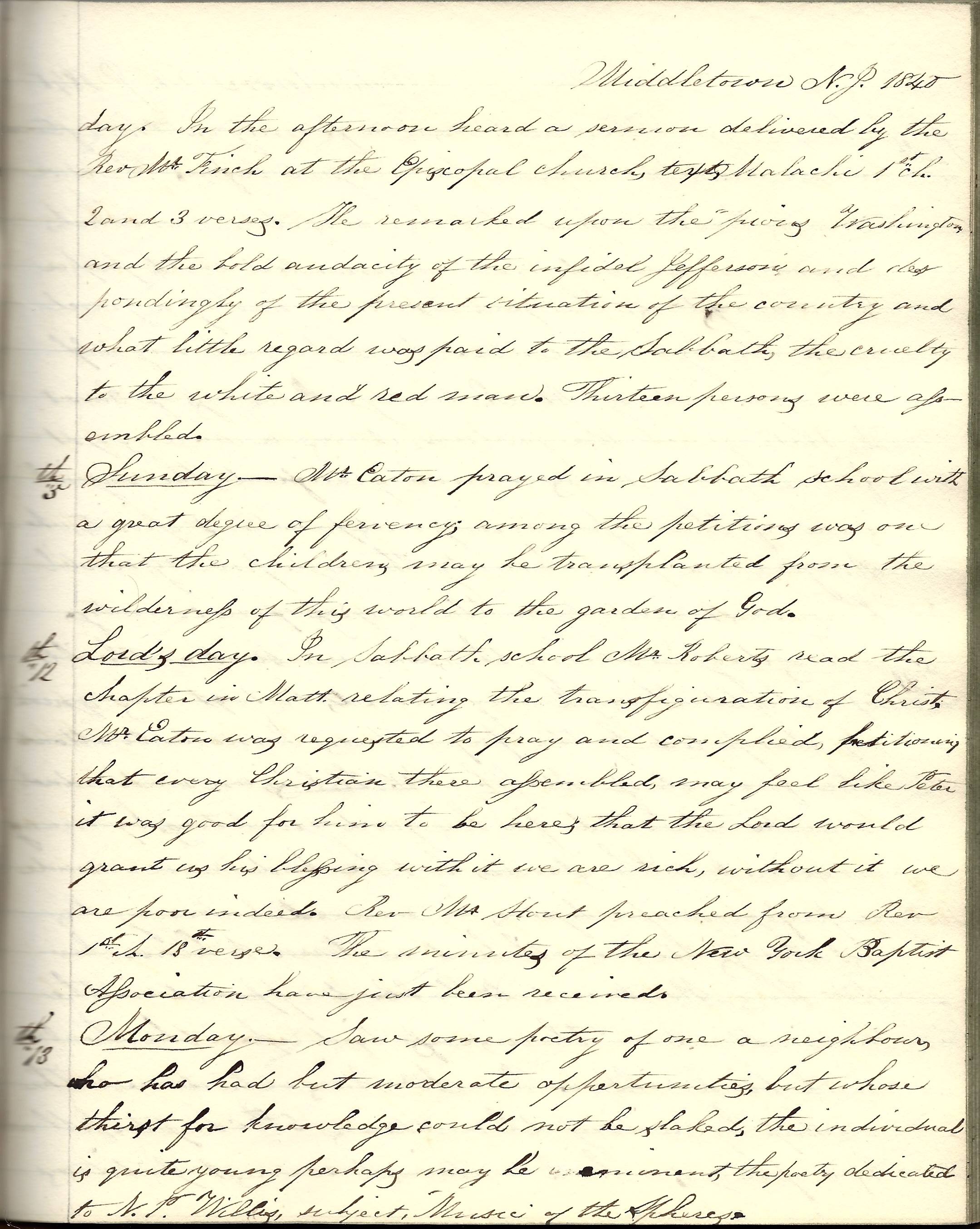
Sunday 5th. Mr. Eaton prayed in Sabbath school with a great deal of fervency. Among the petitions was one that the children may be transplanted from the wilderness of this world to the garden of God.
Lord’s Day 12th. In Sabbath school, Mr. Roberts read the chapter in Matt. relating the transfiguration of Christ. Mr. Eaton was requested to pray and complied, petitioning that every Christian there assembled may feel like Peter. It was good for him to be here—that the Lord would grant us his blessing. With it we are rich; without it we are poor indeed. Re. Mr. Stout preached from Revelations 1st Chapter, 18th verse. The minutes of the New York Baptist Association have just been received.
Monday 13th. Saw some poetry of one—a neighbor—eho has had but moderate opportunity, but whose thirst for knowledge could not be slaked. The individual is quite young—perhaps may be eminent. The poetry was dedicated to N[athaniel] P[arker] Willis. Subject: “Music of the Spheres.”
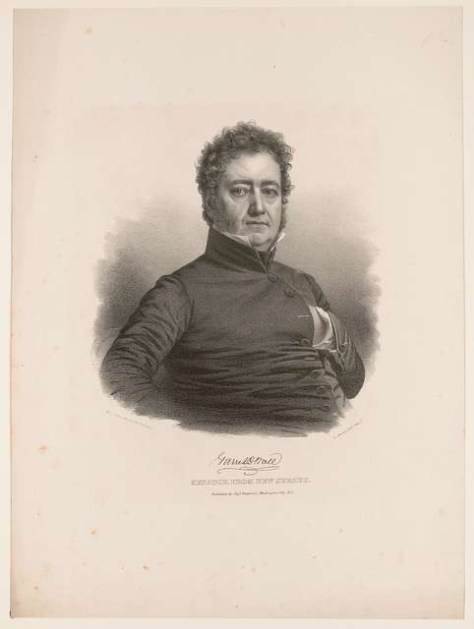
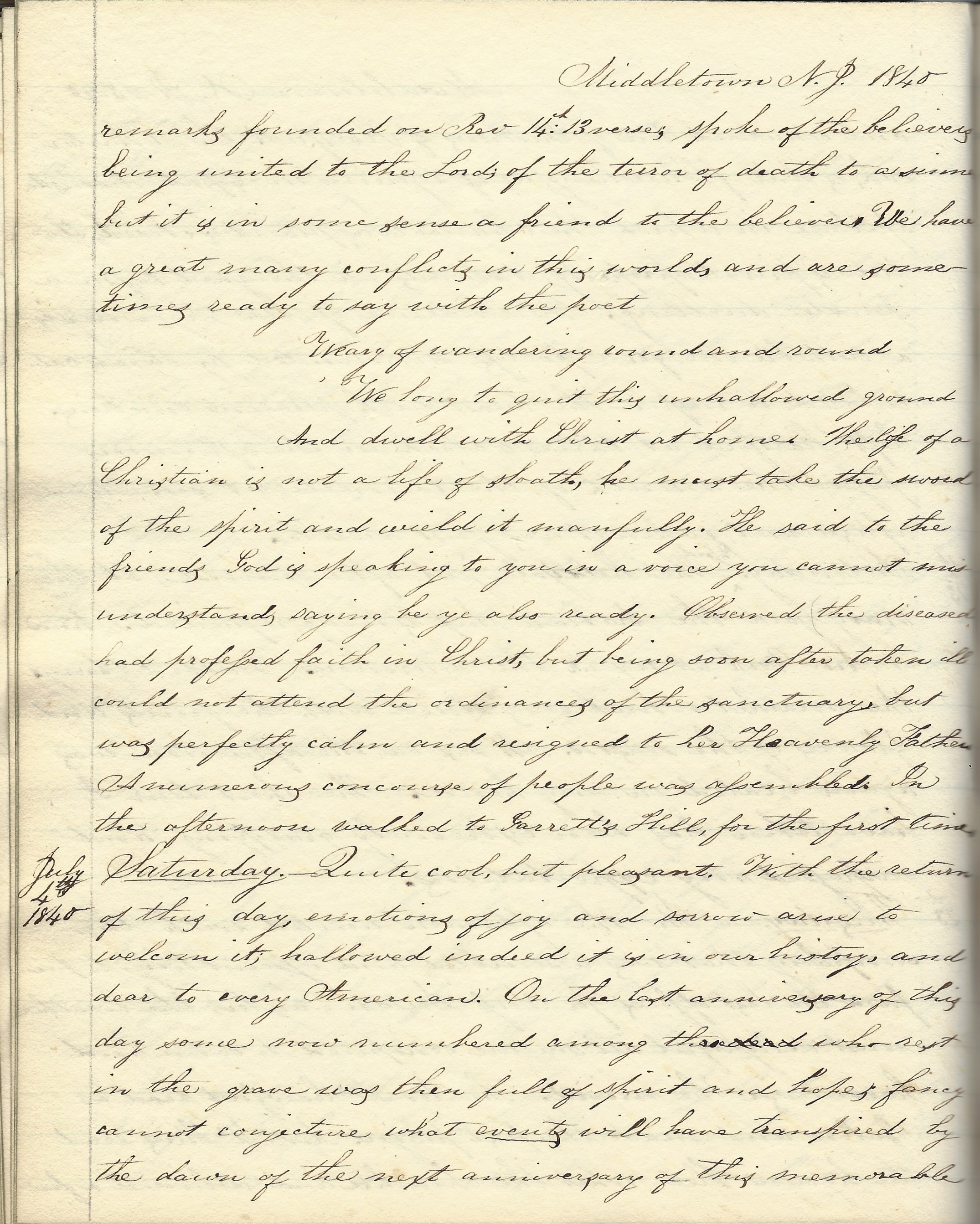
Monday 20th. Decided to visit a family in the afternoon whose threshold I never had crossed before. The dwelling is located upon the bank of the Navesink [river], a yard whitewashed, and ornamented with paper huckleberry trees; the garden small, having a gravel walk through the center. My sister and myself were received by Mr. Phindly. A likeness of Garret D[orset] Wall graced the parlor. It was a new sight for me and I was much gratified. The original is one of those persevering independent spirits who struggled on from obscurity through poverty until he is at last seated in the Congress of our country.
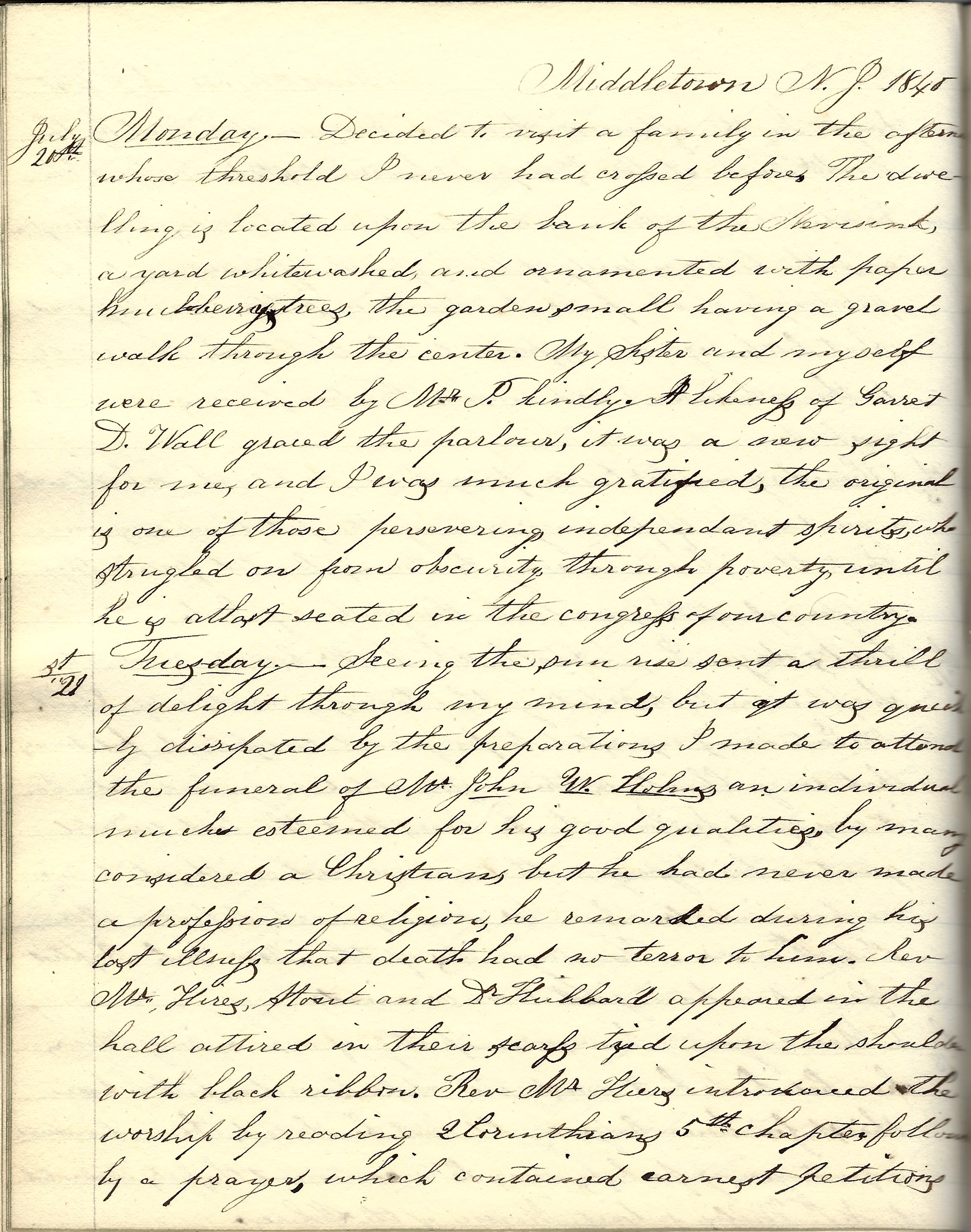
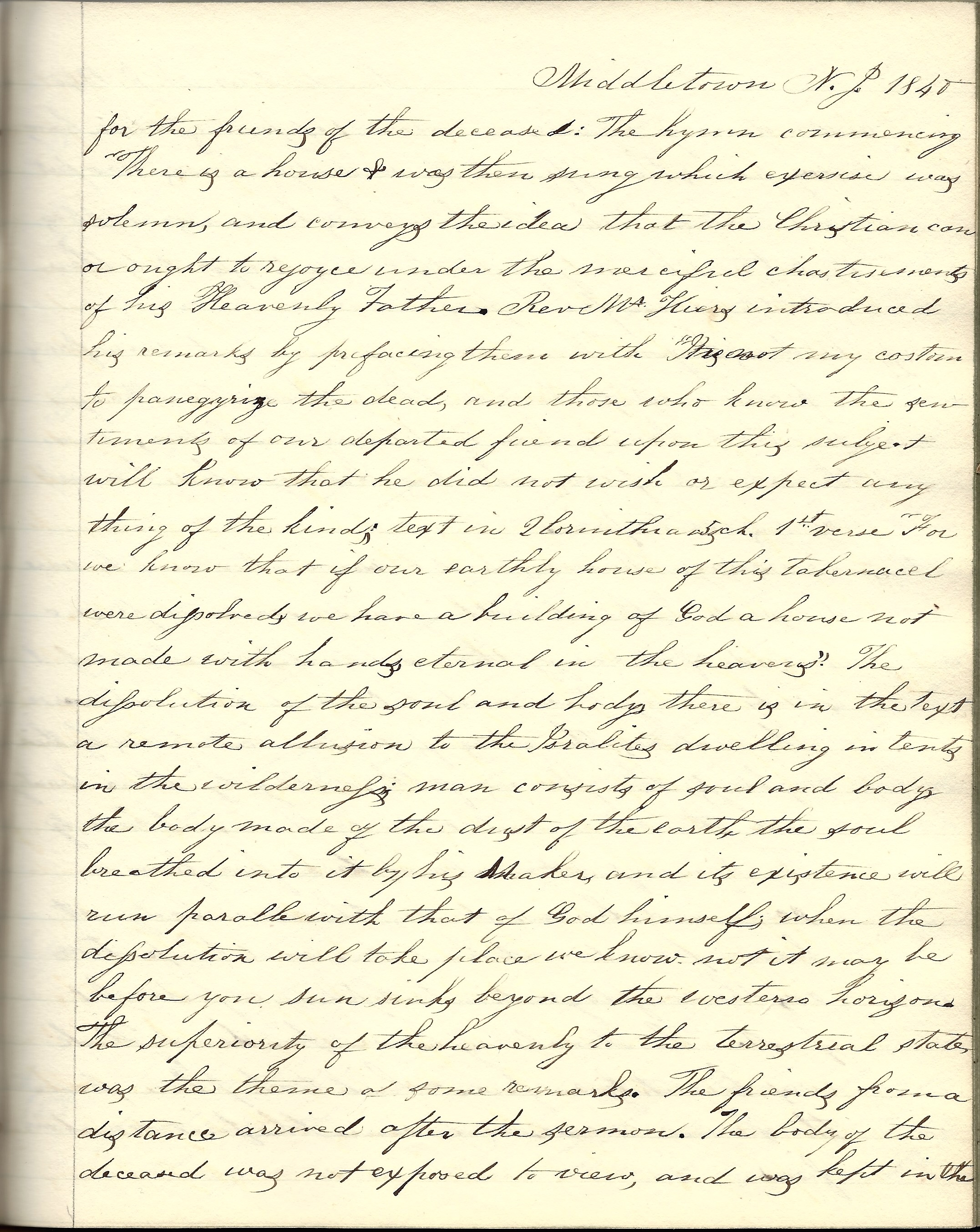
Tuesday 21st. Seeing the sun rise sent a thrill of delight through my mind, but it was quickly dissipated by the preparations I made to attend the funeral of Mr. John W[atson]. Holmes—an individual much esteemed for his good qualities, by many considered a Christian, but he had never made a profession of religion. He remarked during his last illness that death had no terror to him. Rev. Mr. Hires, Stout and Dr. Hubbard appeared in the hall attired in their scarfs tied upon the shoulder with black ribbon. Rev. Mr. Hires introduced the worship by reading 2nd Corinthians, 5th Chapter, followed by a prayer which contained earnest petitions for the friends of the deceased.
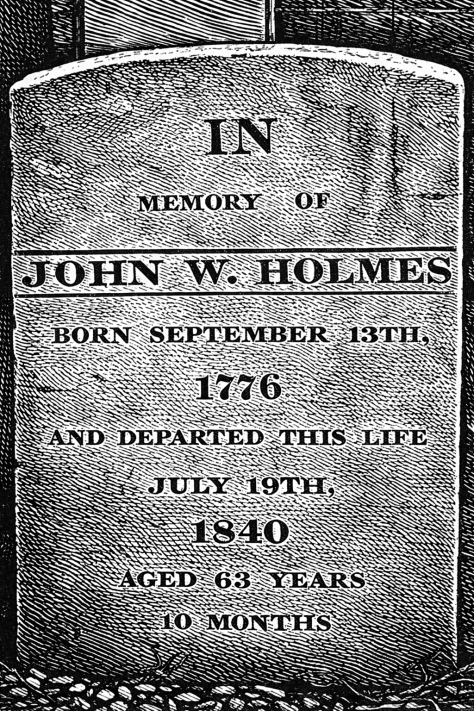
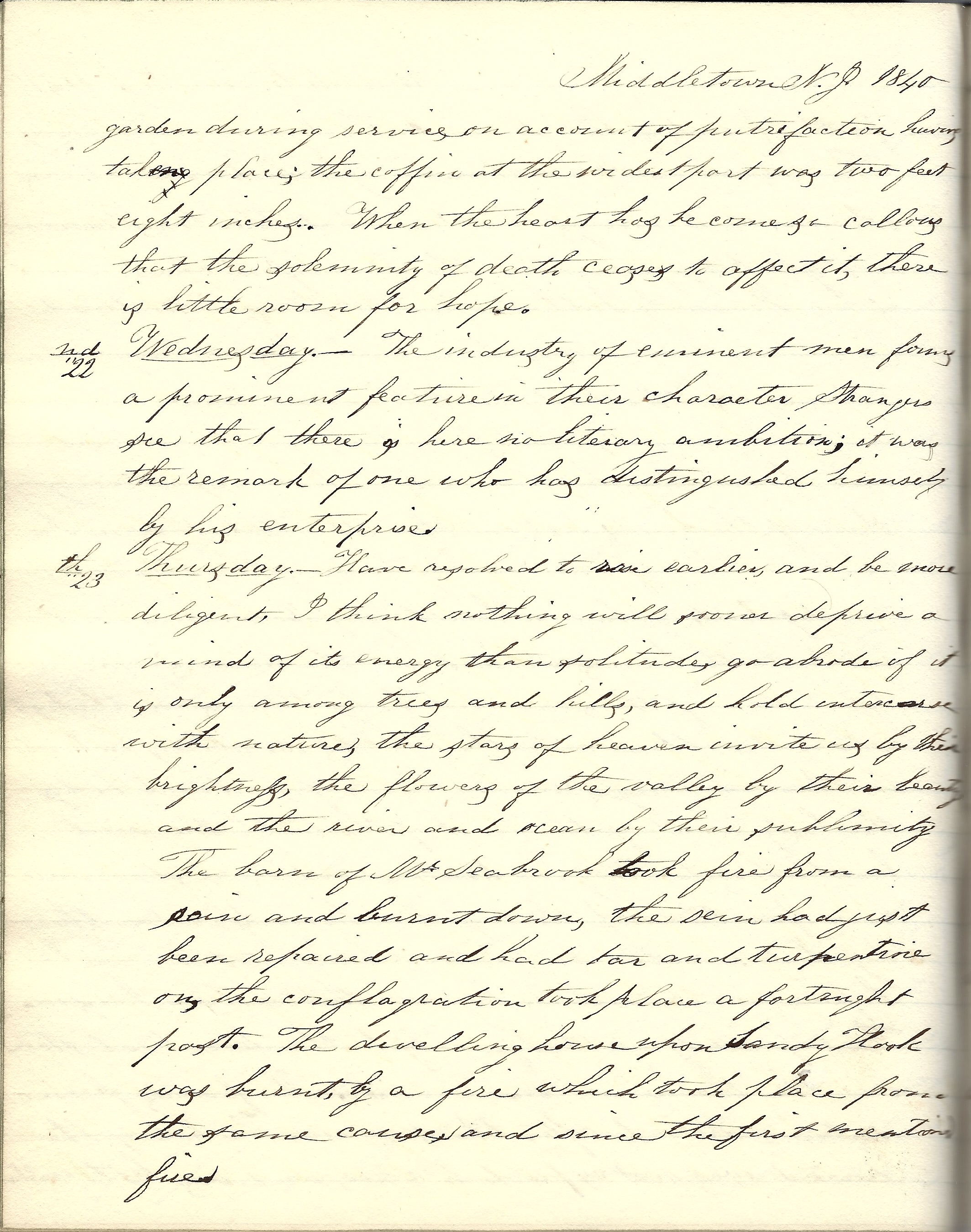
The hymn commencing, “There is a house, &c.” was then sung which exercise was solemn and conveys the idea that the Christian can or ought to rejoice under the merciful chastisements of his Heavenly Father. Rev. Mr. Hires introduced his remarks by prefacing them with “It is not my custom to panegyrize the dead, and those who know the sentiments of our departed friend upon this subject will know that he did not wish or expect anything of the kind. Text in 2nd Corinthians, 5th Chapter, 1st verse, “For we know that if our earthly house of this tabernacle were dissolved, we have a building of God, a house not made of hands, eternal in the heavens….” The friends from a distance arrived after the sermon. The body of the deceased was not exposed to view and was kept in the garden during service on account of putrefaction having taken place. The coffin at the widest part was two feet, eight inches. When the heart becomes so callous that the solemnity of death ceases to affect it, there is little room for hope.
Wednesday 22nd. The industry of eminent men form a prominent feature in their character. Strangers see that there is here no literary ambition. It was the remark of one who has distinguished himself by his enterprises.
Thursday 23rd. Have resolved to rise earlier and be more diligent. I think nothing will sooner deprive a mind of its energy than solitude. Go abroad if it is only among the trees and hills and hold intercourse with nature. The stars of heaven invite us by their brightness, the flowers of the valley by their beauty, and the river and ocean by their sublimity.
The barn of Mr. Seabrook took fire from a seine and burnt down. The seine had just been repaired and had tar and turpentine on [to protect it from rotting in saltwater] . The conflagration took place a fortnight past. The dwelling house upon Sandy Hook was burnt by a fire which took place from the same cause and since the first mentioned fires.
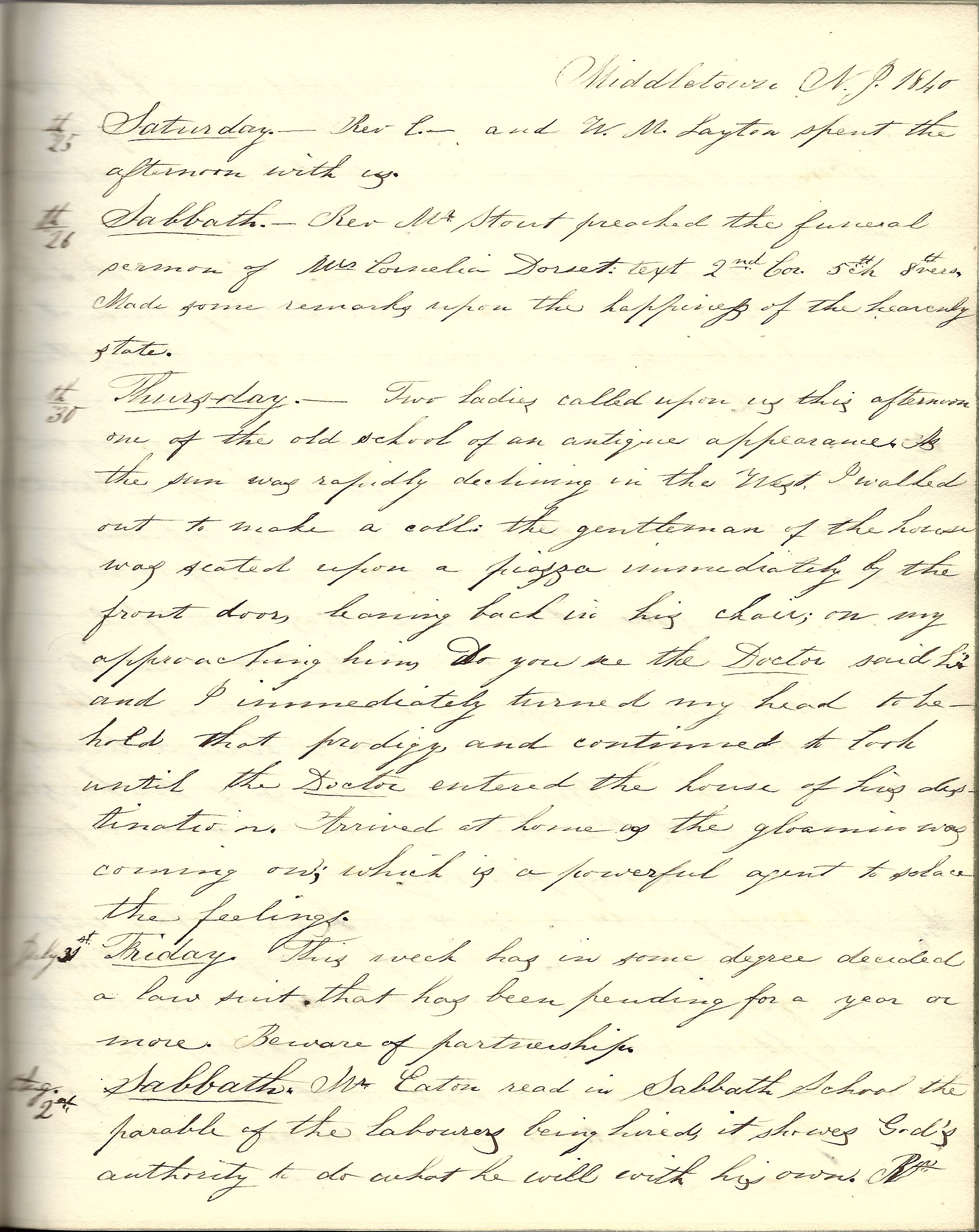
Saturday 25th. Rev. C and W. M Layton spent the afternoon with us.
Sabbath 26th. Rev. Mr. Stout preached the funeral sermon of Mrs. Cornelia Dorset. Text 2nd Corinthians, 5th Chapter, 8th verse. Made some remarks upon the happiness of the heavenly state.
Thursday 30th. Two ladies called upon us this afternoon—one of the old school of an antique appearance. As the sun was rapidly declining in the west, I walked out to make a call. The gentleman of the house was seated upon a piazza immediately by the front door leaning back in his chair. On my approaching him, “Do you see the Doctor,” said he? and I immediately turned my head to behold that prodigy and continued to look until the Doctor entered the house of his destination. Arrived at home as the gloaming was coming on which is a powerful agent to solace the feelings.
Friday July 31st. This week has in some degree decided a lawsuit that has been pending for a year or more. Beware of partnership.
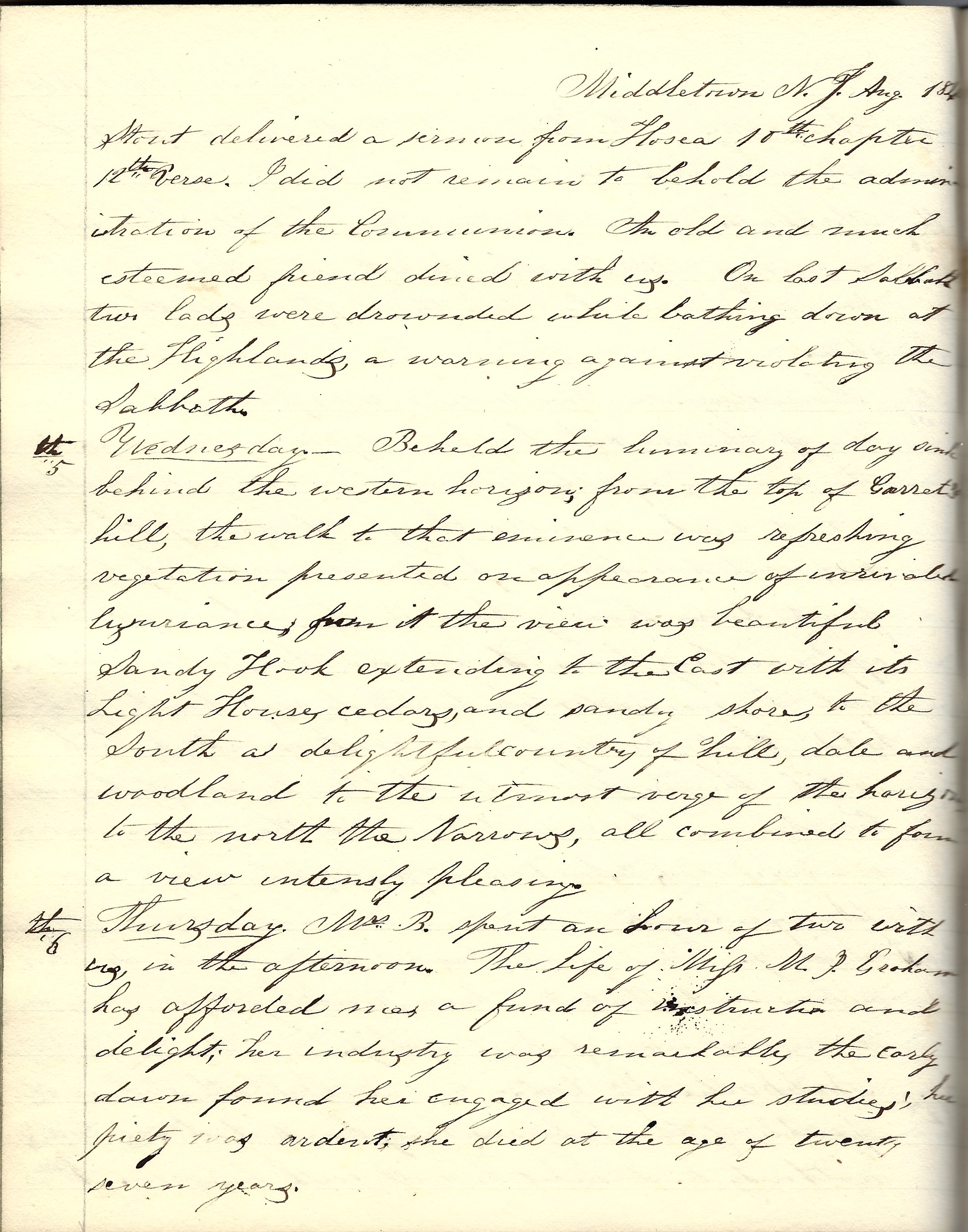
Sabbath, August 2nd. Mr. Eaton read in Sabbath School the parable of the laborers being hired. It shows God’s authority to do what he will with his own. Rev. Stout delivered a sermon from Hosea 1st Chapter, 12th verse. I did not remain to behold the administration of communion. An old and much esteemed friend dined with us. On last Sabbath two lads were drowned while bathing at the Highlands—a warning against violating the Sabbath.
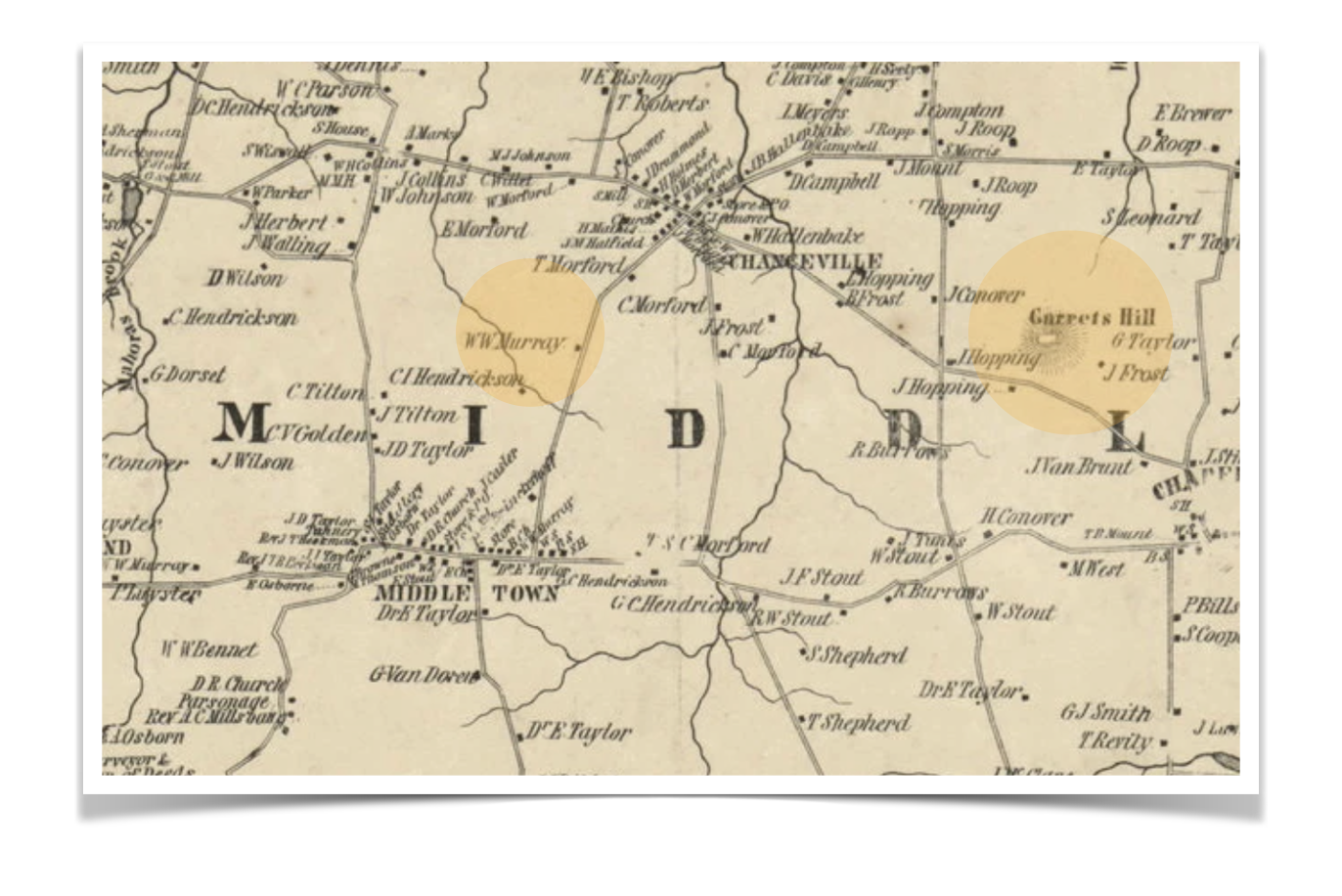
Wednesday 5th. Beheld the luminary of the day and behind the western horizon from the top of Garrett’s Hill. The walk to that eminence was refreshing. Vegeation presented an appearance of unrivaled luxuriance. From it the view was beautiful. Sandy Hook extending to the east with its light house, cedars, and sandy shore; to the south as delightful country of hill, dale, and woodland to the utmost verge of the horizon; to the north the Narrows, all combined to form a view intensely pleasing.
Thursday 6th. Mrs. B. spent an hour or two with us in the afternoon. The Life of Miss M[ary] J[ane] Graham has afforded me a fund of instruction and delight. Her industry was remarkable. The early dawn found her engaged with her studies. Her piety was ardent. She died at the age of 27 years.
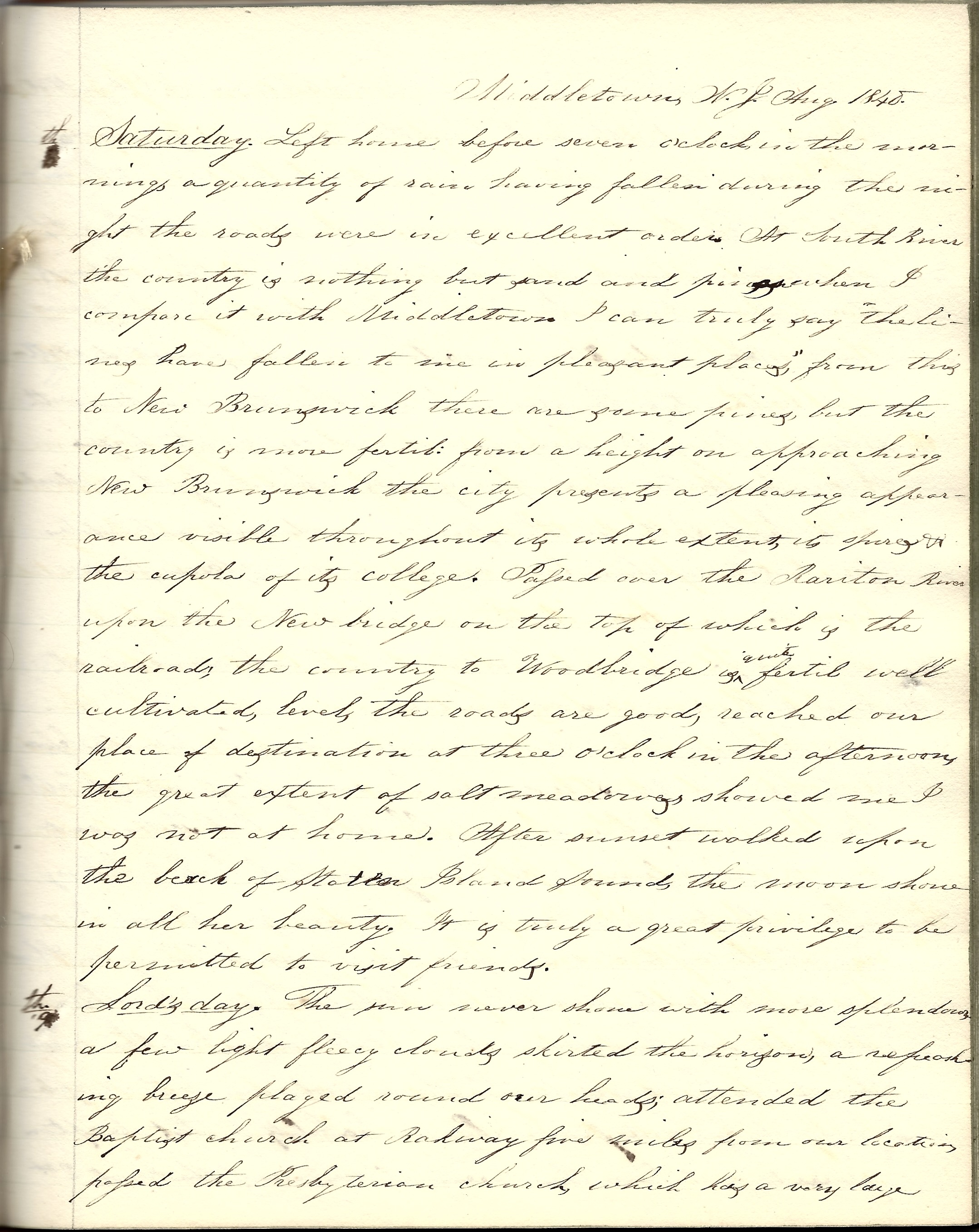
Saturday 8th. Left home before seven o’clock in the morning. A quantity of rain having fallen during the night, the roads were in excellent order. At South River the country is nothing but sand and pines when I compare it with Middletown. I can truly say “the lines have fallen to me in pleasant places.” From this to New Brunswick there are some pines but the country is more fertile. From a height in approaching New Brunswick, the city presents a pleasing appearance—visible throughout its whole extent, its spires & the cupola of its college. Passed over the Raritan River upon the new bridge on the top of which is the railroad.
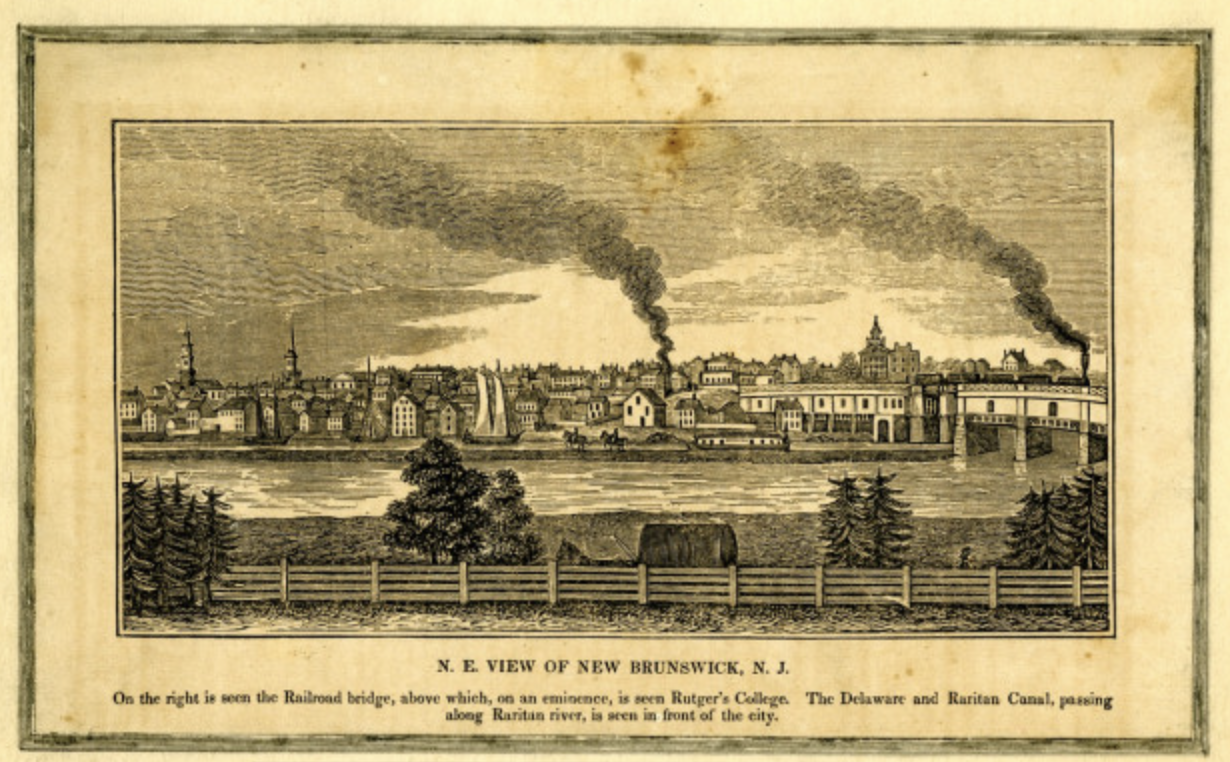
The country to Woodbridge is quite fertile, well cultivated, level, the roads are good. Reached our place of destination at three o’clock in the afternoon. The great extent of salt meadows showed me I was not at home. After sunset walked upon the beach of Staten Island Sound. The moon shone in all her beauty. It is truly a great privilege to be permitted to visit friends.
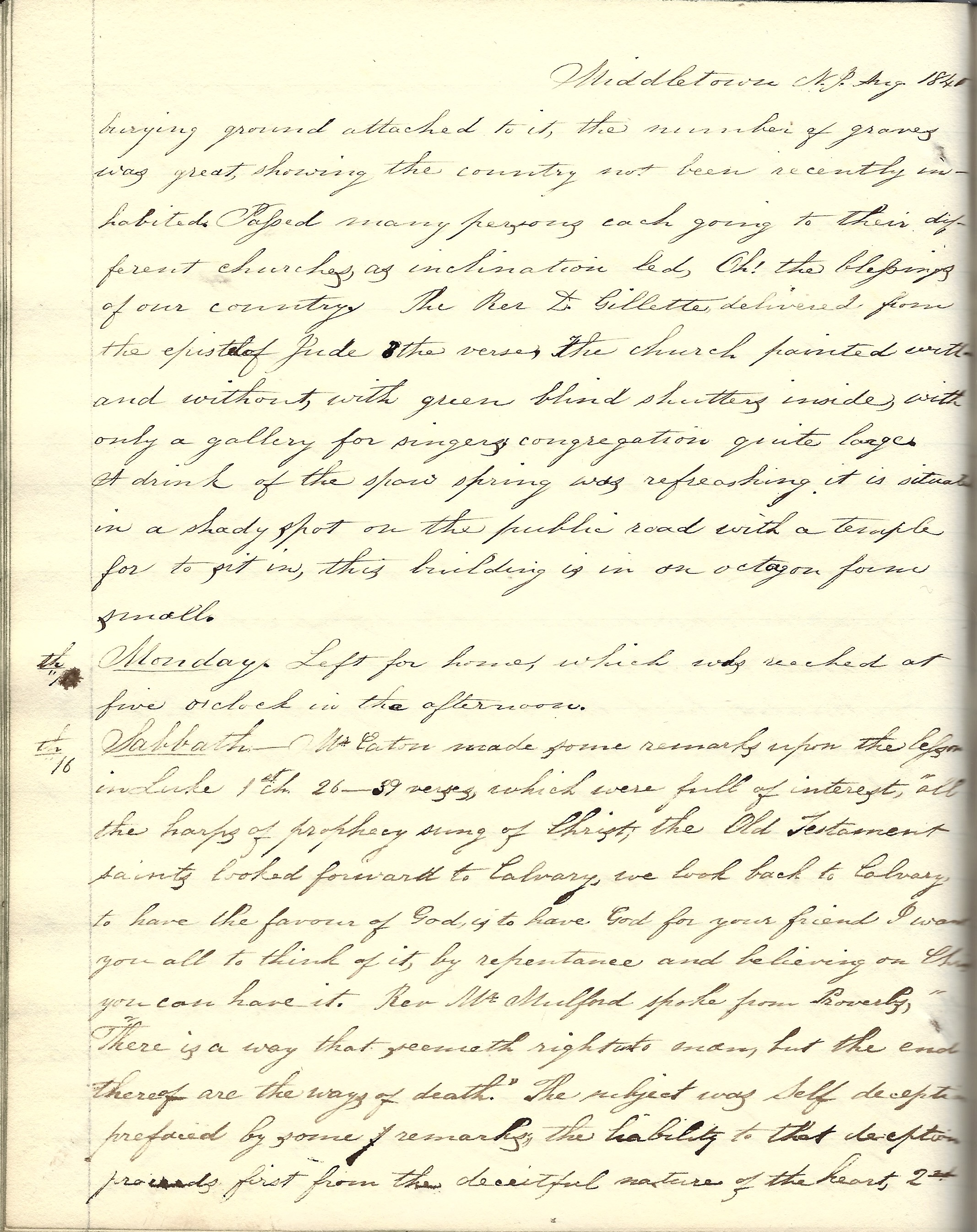
Lord’s Day 9th. The sun never shone with more splendor. A few light fleecy clouds skirted the horizon. A refreshing breeze played around our heads. Attended the Baptist Church at Rahway five miles from our location. Passed the [First] Presbyterian Church which has a very large burying ground attached to it. The number of graves was great, showing the country not recently inhabited. Passed many persons each going to their different churches as inclination led. Oh! the blessings of our country. The Rev. D[aniel Holbrook] Gillette delivered from the epistle of Jude, 7th verse. The church was painted within and without, with green blind shutters inside, with only a gallery for singers. Congregation quite large. A drink of the spaw [mineral] spring [see “The Woodbridge Spaw”] was refreshing. It is situated in a shady spot on the public road with a temple for to sit in. This building is in an octagon form and small.

Monday 10th. Left for home which was reached at five o’clock in the afternoon.
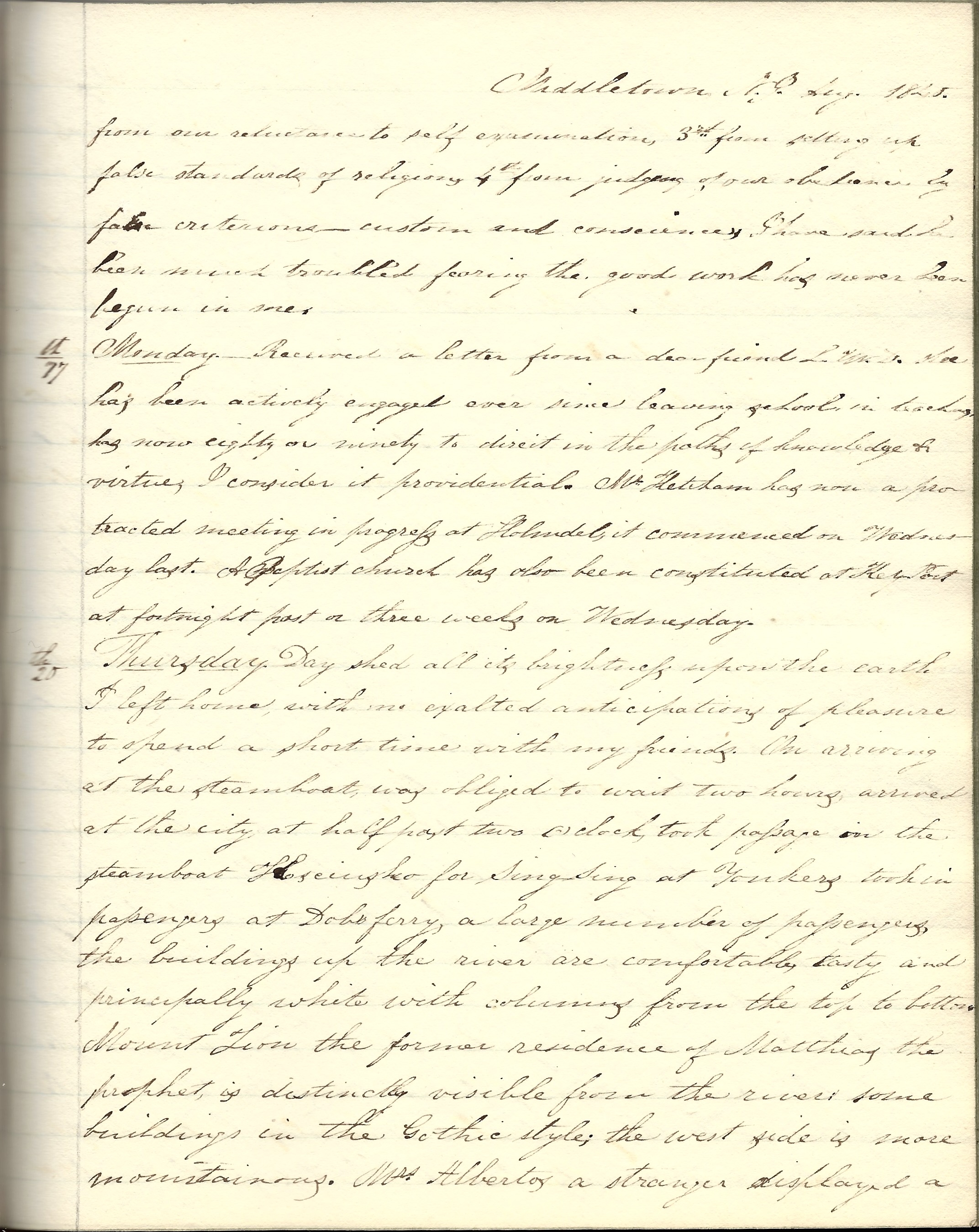
Sabbath 16th. Mr. Eaton made some remarks upon the lesson in Luke 1st Chapter, 26-39 verses which were full of interest, “all the harps of prophesy sung of Christ; the Old Testament saints looked forward to Calvary. We look back to Calvary. To have the favor of God is to have God for your friend. I want you all to think of it by repentance and believing on Christ you can have it. Rev. Mr. Mulford spoke from Proverbs, “There is a way that seemeth right unto man, but the end thereof are the ways of death. ” The subject was self deception prefaced by some remarks; the liability to that deception proceeds first from the deceitful nature of the heart. 2nd, from our reluctance to self-examination. 4rd, from setting up false standards of religion. 4th, from judging of our obedience by false criterions—custom and consciences. I have been much troubled fearing the good work has never been begun in me.
Monday 17th. Received a letter from a dear friend, L. W. D[awson]. She has been actively engaged ever since leaving school in teaching. Has now eighty or ninety to direct in the paths of knowledge and virtue. I consider it providential. Mr. Ketcham has now a protracted meeting in progress at Holmdel. It commenced on Wednesday last. A Baptist church has also been constituted at Key Port a fortnight past or three weeks on Wednesday.
Thursday [August] 20th. Day shed all its brightness upon the earth. I left home with no exalted expectations of pleasure to spend a short time with my friends. On arriving at the steamboat, was obliged to wait two hours. Arrived at the city at half past two o’clock. Took passage in the steamboat Kosciusko for Sing-Sing [later Ossining, New York] at Yonkers, took in passengers at Dobbs Ferry—a large number of passengers. The buildings up the [Hudson] River are comfortable, tasty, and principally white with columns from the top to bottom. Mount Zion, the former residence of Matthias the profit, is distinctly visible from the river. Some buildings in the Gothic style. The west side is more mountainous.
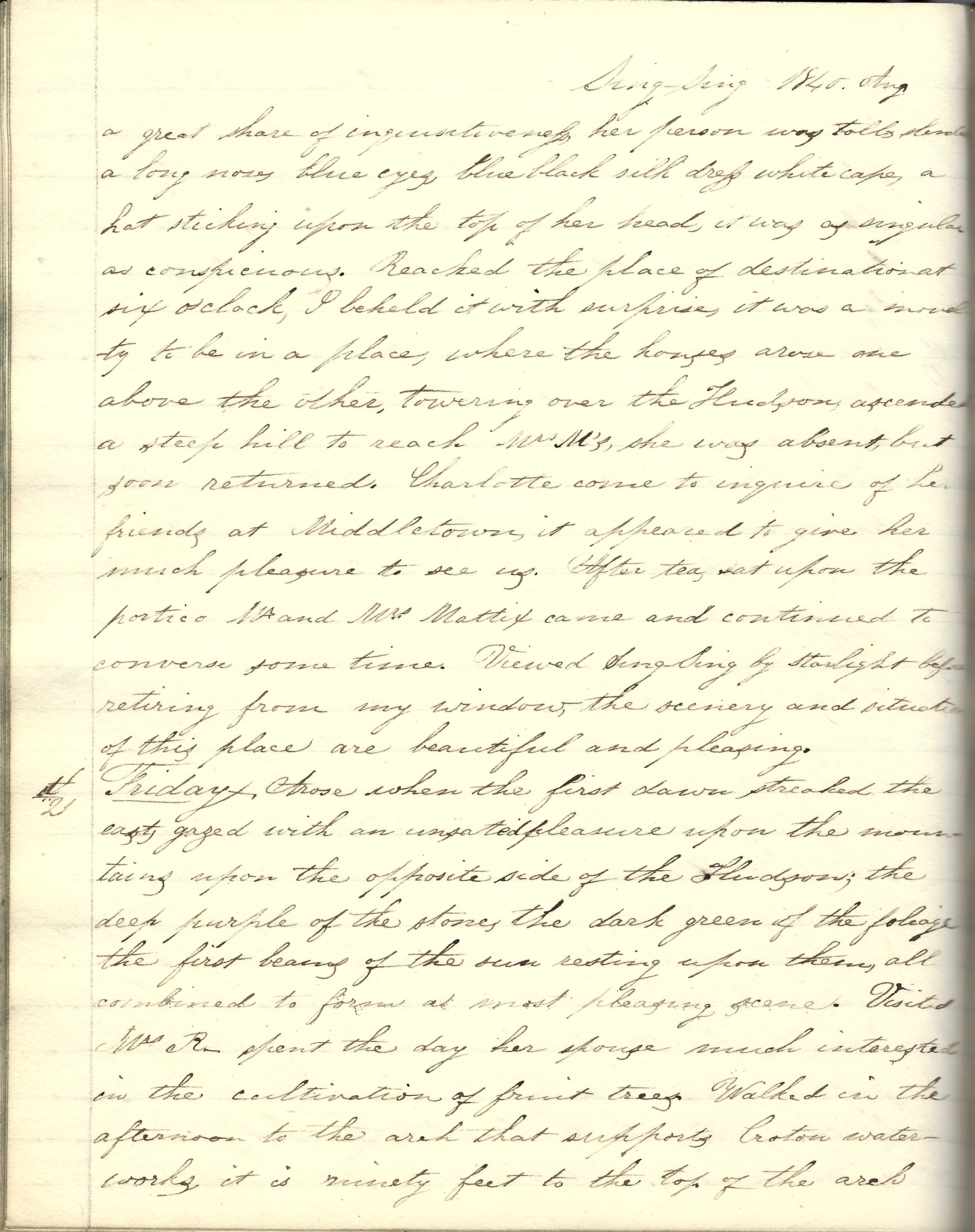
Mrs. Albertos—a stranger—displayed a great share of inquisitiveness. Her person was tall, slender, a long nose, blue eyes, blue black silk dress, white cape, a hat sticking upon the top of her head. It was as singular as conspicuous.
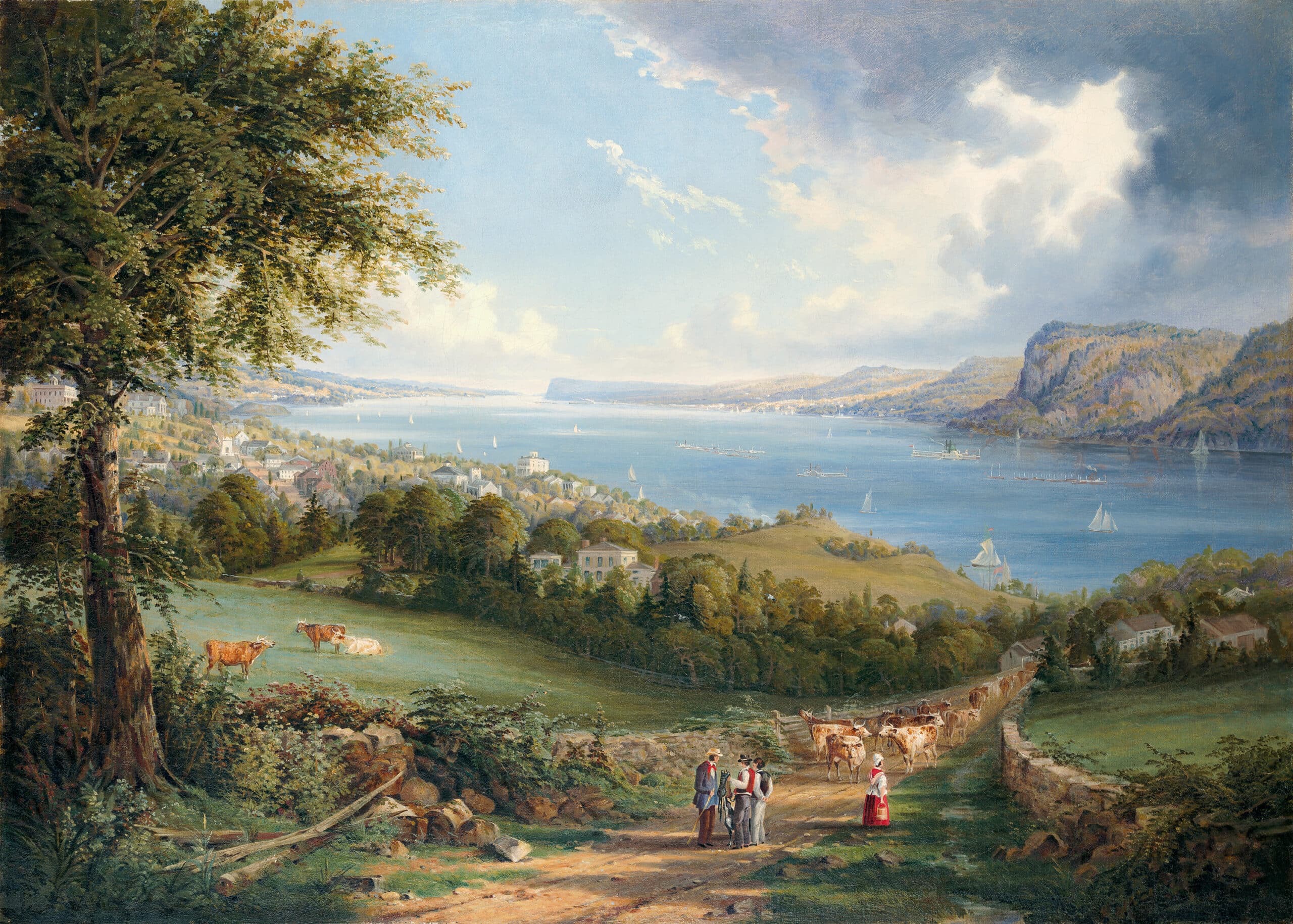
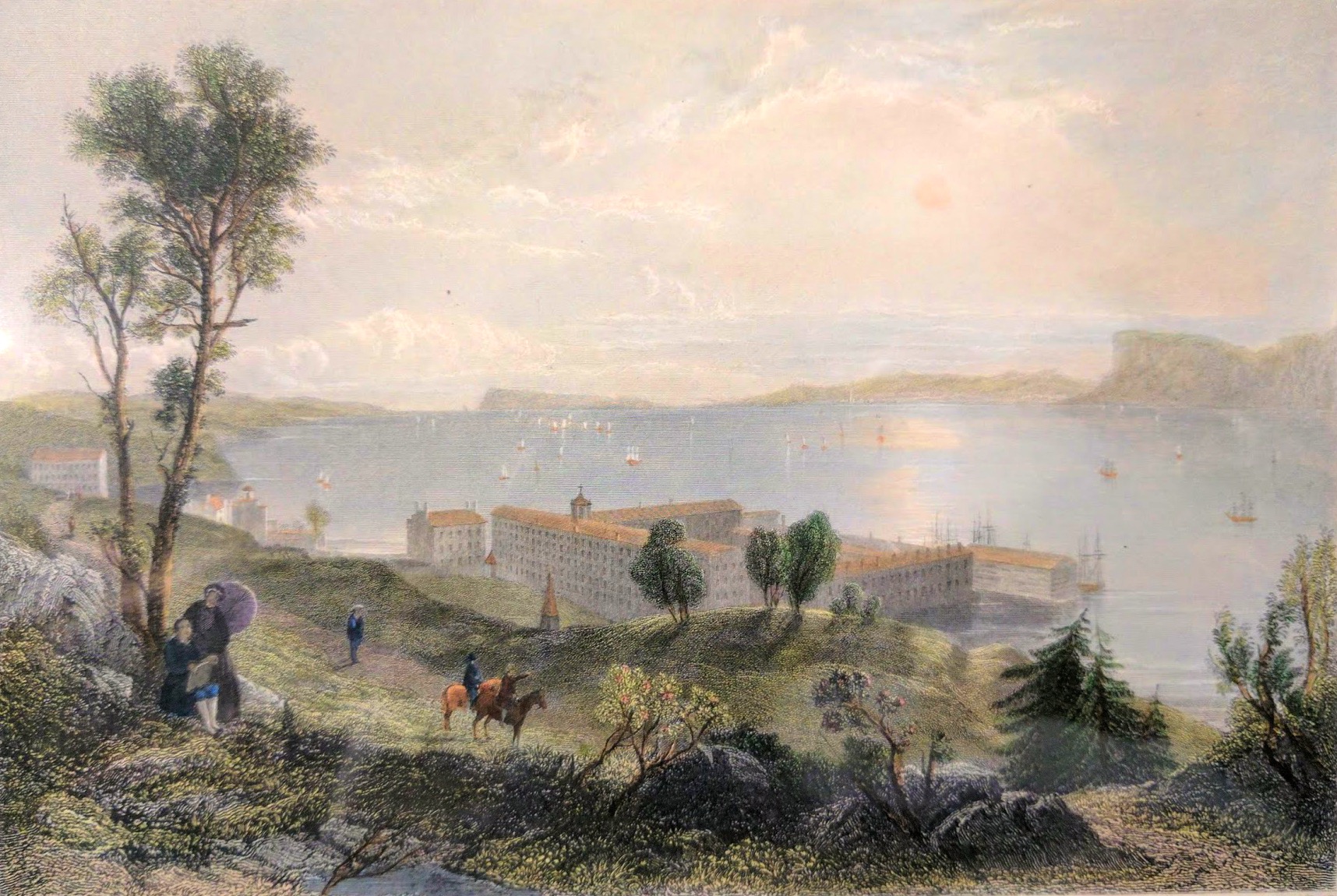
Reached the place of destination at six o’clock. I beheld it with surprise. It was a novelty to be in a place where the houses arose one above the other, towering over the Hudson. Ascended a steep hill to reach Mrs. M’s. She was absent but soon returned. Charlotte come to inquire of her friends at Middletown. It appeared to give her much pleasure to see us. After tea, sat upon the portico. Mr. and Mrs. Mattix came and continued to converse some time. Viewed Sing-Sing by starlight before retiring from my window. The scenery and situation of this place are beautiful and pleasing.
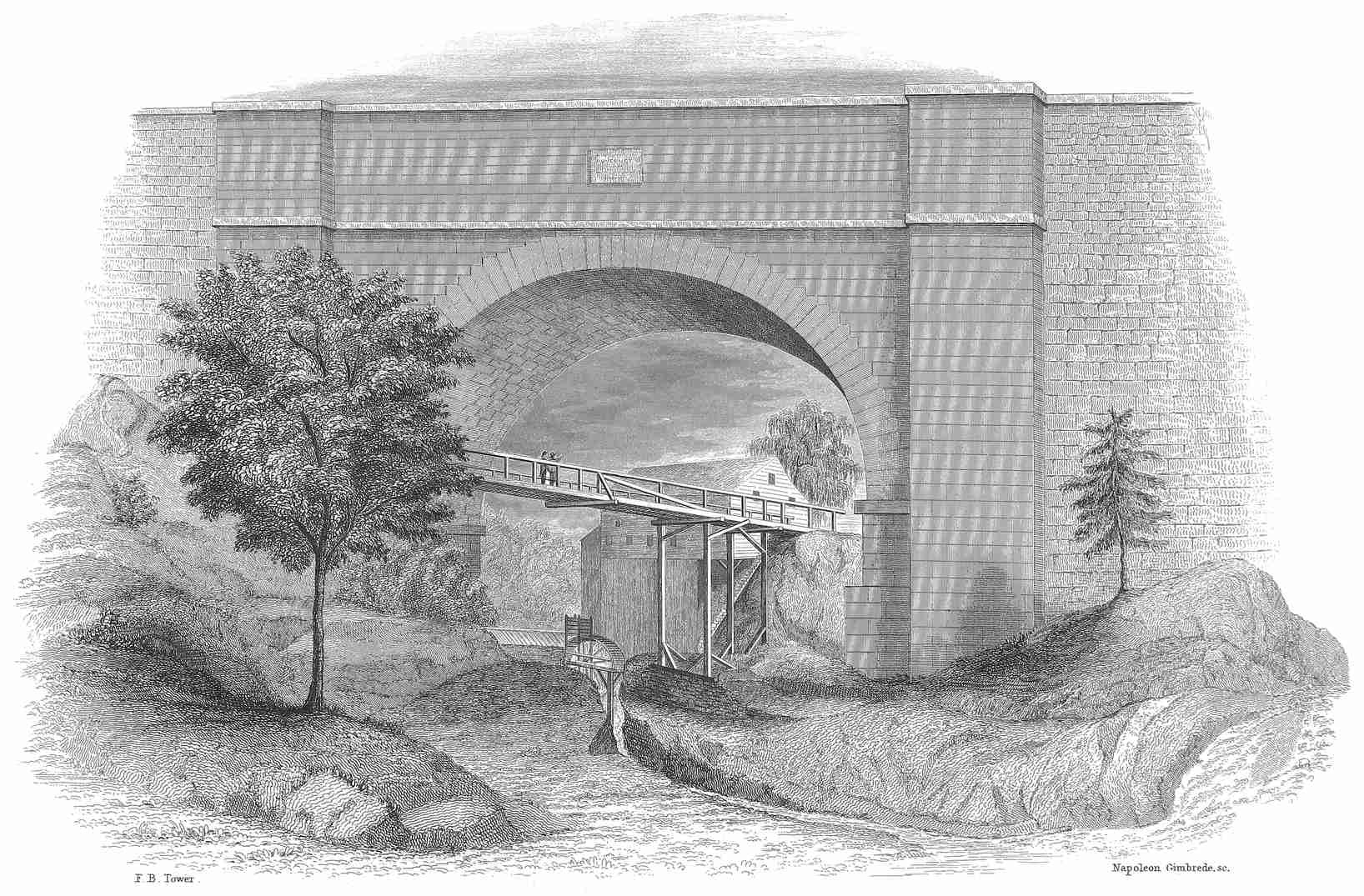
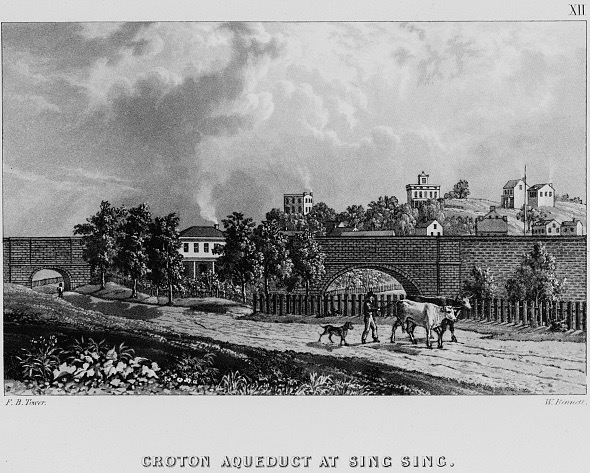
Friday 21st. Arose when the first dawn streaked the east. Gazed with an unsated pleasure upon the mountains upon the opposite side of the Hudson—the deep purple of the stone, the dark green of the foliage, the first beams of the sun resting upon them, all combined to form a most pleasing scene. Visited Mrs. R. Spent the day. Her spouse was much interested in the cultivation of fruit trees. Walked in the afternoon to the arch that supports Croton Water Works. It is ninety feet to the top of the arch and a hundred to where is filled up. Was obliged to return as the darkness rapidly increased.
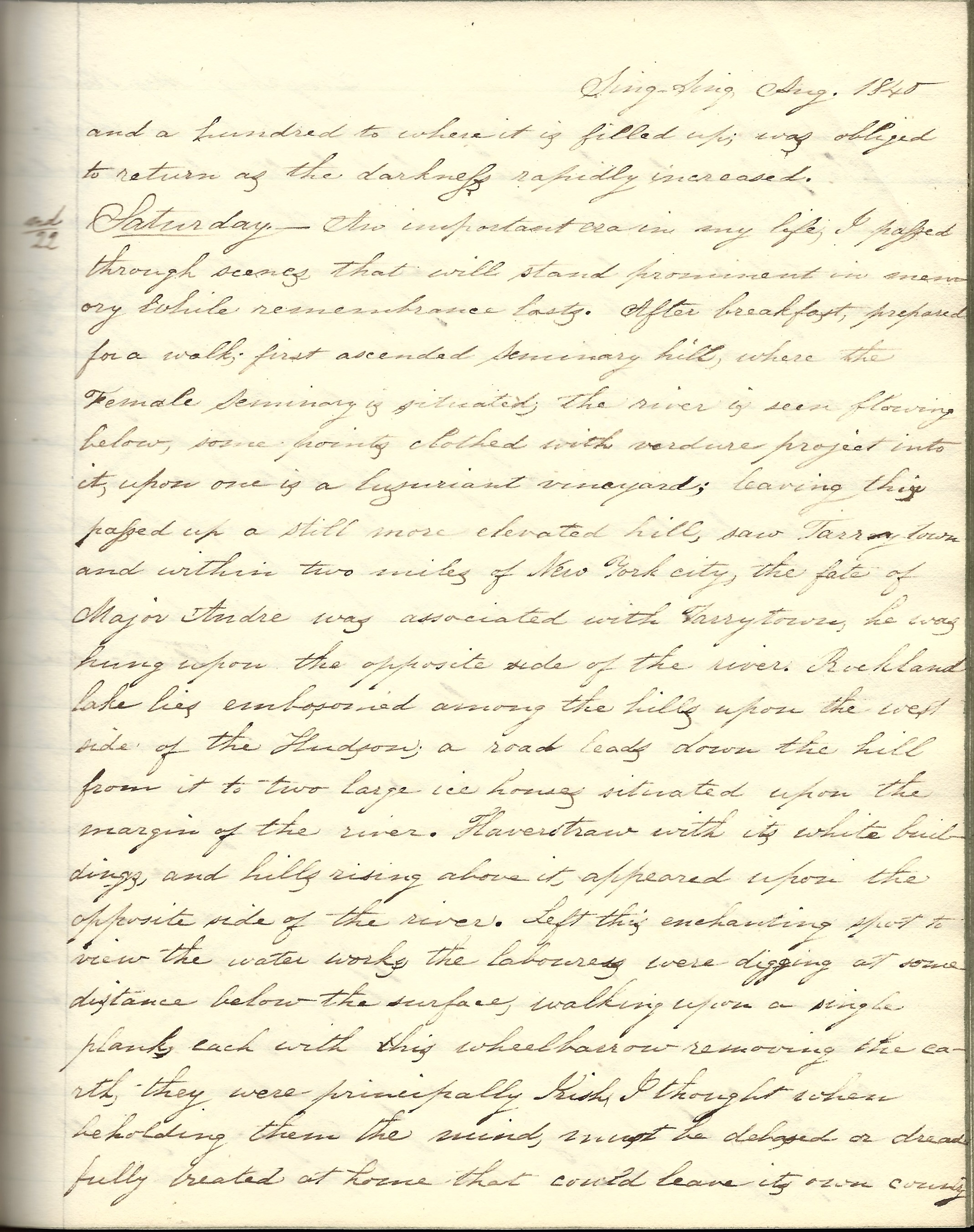
Saturday 22nd. An important era in my life, I passed through scenes that will stand prominent in memory while remembrance lasts. After breakfast, prepared for a walk. First ascended Seminary Hill where the [Mount Pleasant] Female Seminary is situated. The river is seen flowing below. Some points clothed with verdure project into it. Upon one is a luxuriant vineyard. Leaving this, passed up a still more elevated hill. Saw Tarrytown and within two miles of New York City, the fate of Major Andre was associated with Tarrytown. He was hung upon the opposite side of the river. Rockland Lake lies embosomed among the hills upon the west side of the Hudson. A road leads down the hill. From it two large ice houses situated upon the margin of the river. Haverstraw with its white buildings and hills rising above it appeared upon the opposite side of the river.
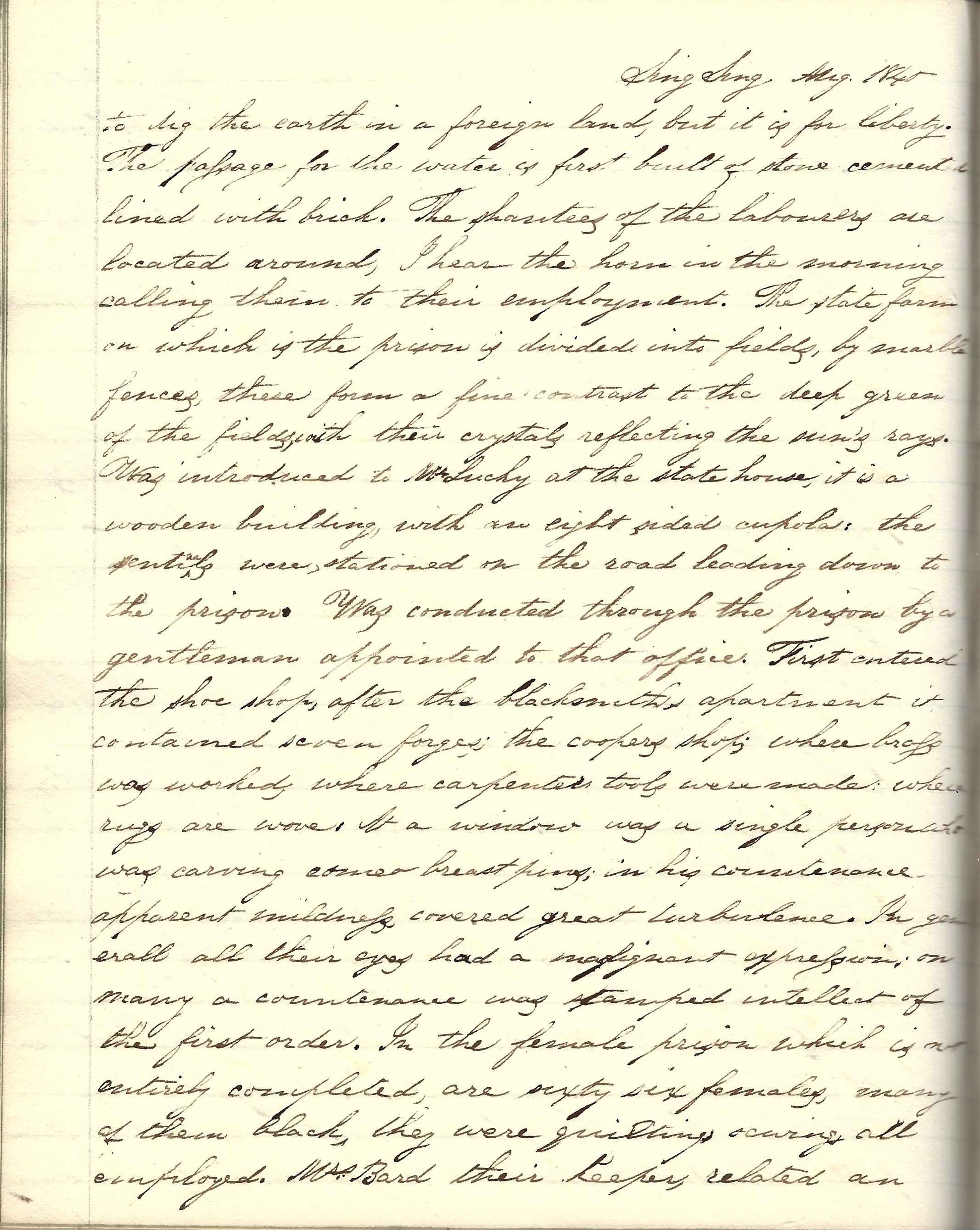
Left this enchanting spot to view the water works. The laborers were digging at some distance below the surface, walking upon a single plank, each with his wheelbarrow removing the earth. They were principally Irish. I thought when beholding them the mind must be debased or dreadfully treated at home that could leave its own country to dig earth in a foreign land, but it is for liberty. The passage for the water is first built of stone cemented, lined with brick. The shanties of the laborers are located around. I hear the horn in the morning calling them to their employment.
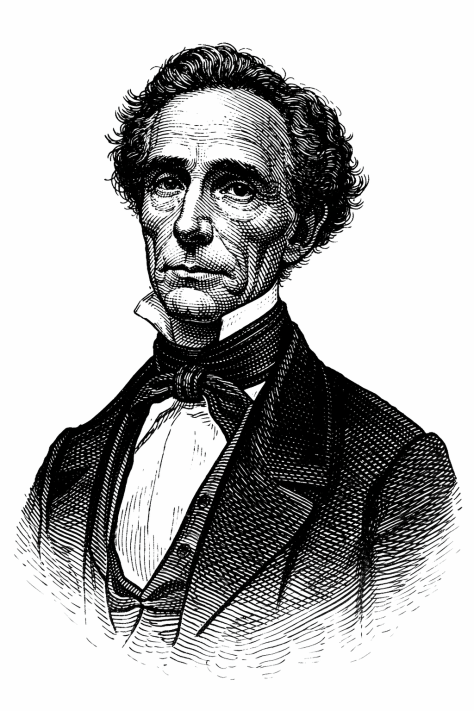
The state farm on which is the prison is divided into fields by small fences. These form a fine contrast to the deep green of the fields with their crystals reflecting the sun’s rays. Was introduced to Mr. [John] Luckey at the State House. It is a wooden building with an eight sided cupola. The sentinels were stationed on the road leading down to the prison. Was conducted through the prison by a gentleman appointed to that office. First entered the shoe shop, after [that] the blacksmith’s apartment—it contained seven forges; the cooper’s shop, where brass was worked, where carpenter’s tools were made, where rugs are wove. At a window was a single person who was carving cameo breast pins. In his countenance, apparent mildness covered great turbulence. In general, all their eyes had a malignant expression. On many a countenance was stamped intellect of the first order.
In the female prison, which is not entirely completed, are sixty-six females, many of them black. They were quilting & curing & all employed. Mrs. Bard, their keeper, related an account of the conversion of one. Visited some friends. Dined with them. Their one child appeared to be the foundation of mother’s, father’s and grandmother’s hopes.
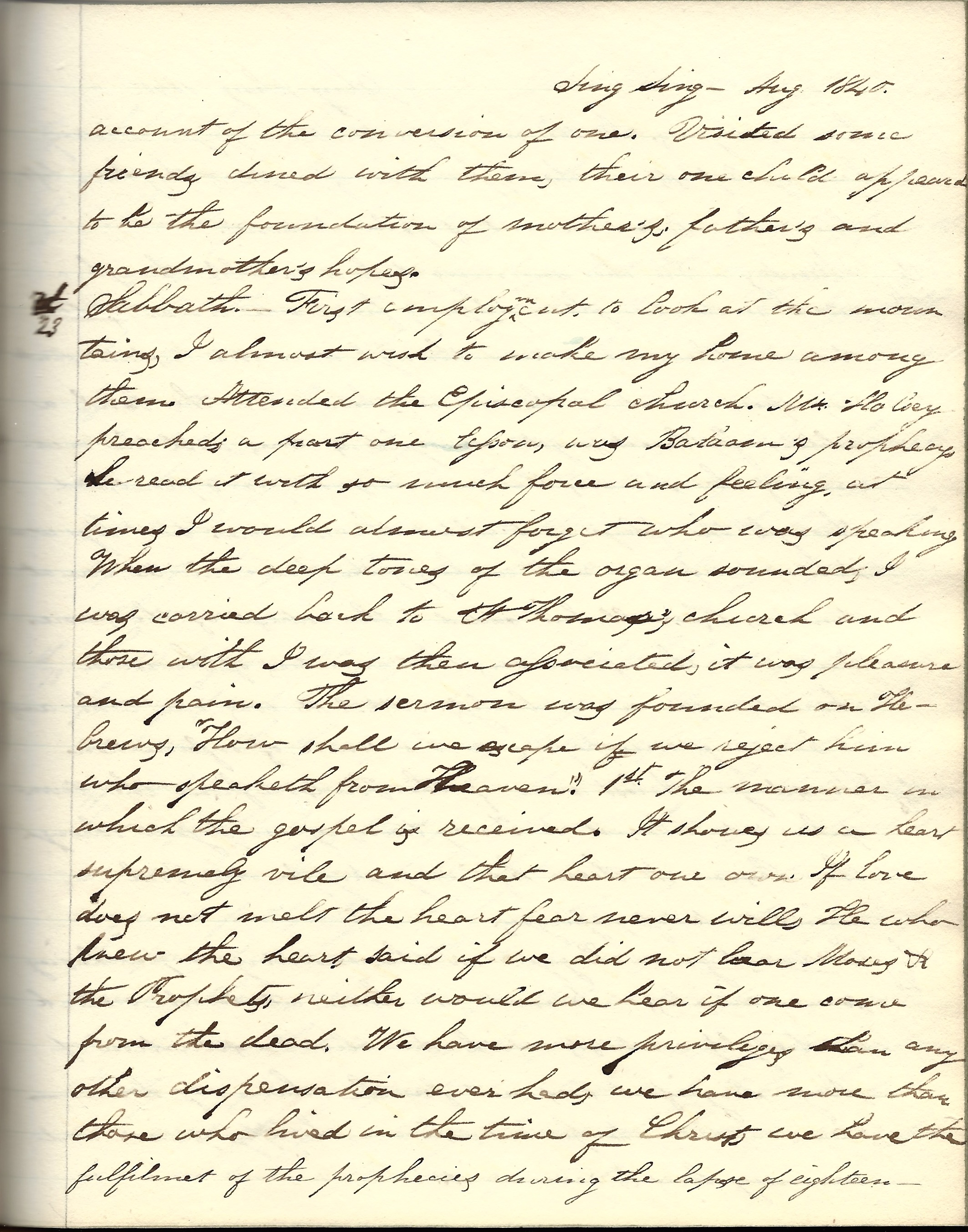
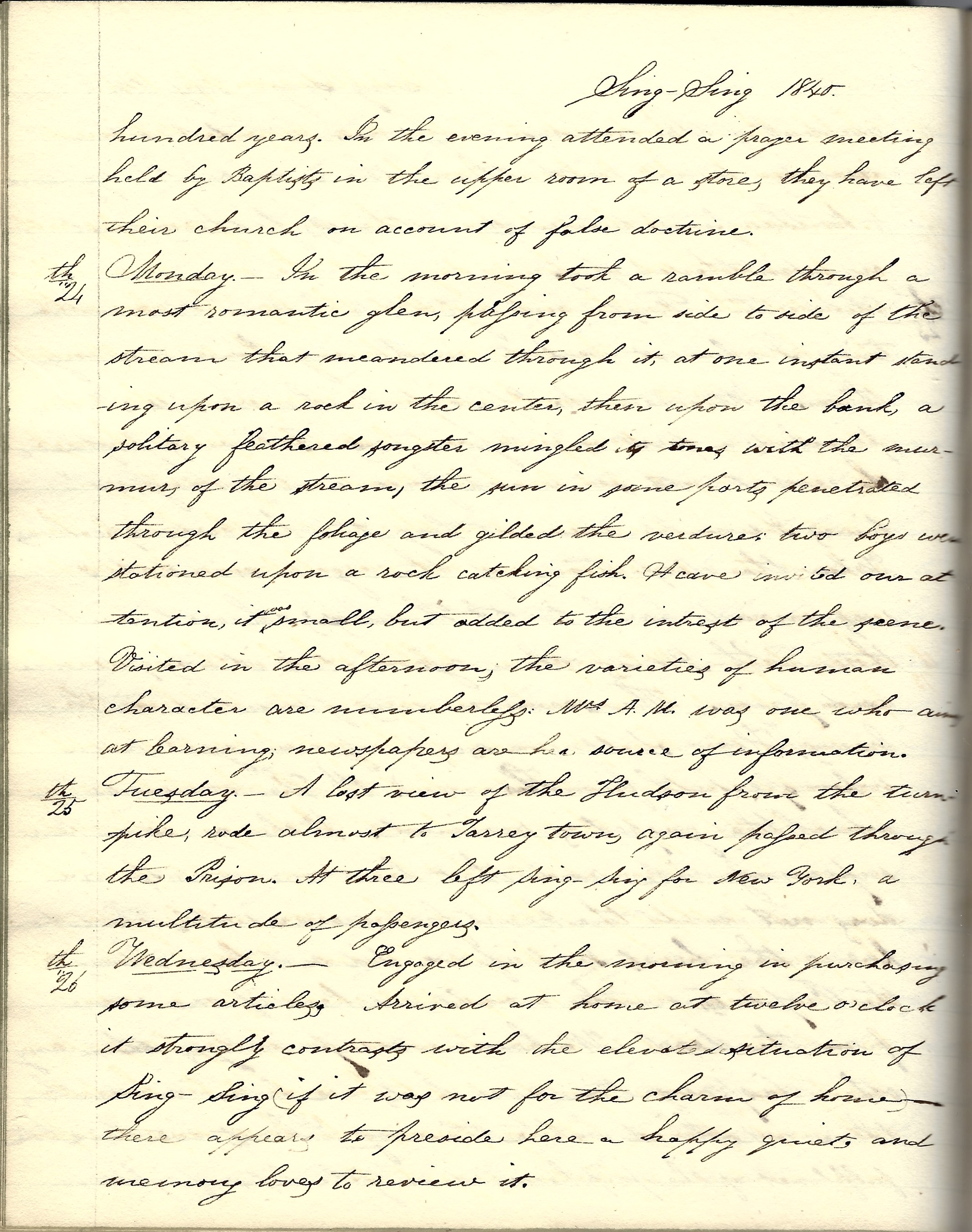
Sabbath, 23rd. First employment. to look at the mountains. I almost wish to make my home among them. Attended the Episcopal Church. Mr. [Charles Henry] Halsey preached…He read it with so much force and feeling at time I would almost forget who was speaking. When the deep tones of the organ sounded, I was carried back to Thomas’ church and those with [whom] I was then associated. It was pleasure and pain. The sermon was founded in Hebrews, “How shall we escape if we reject him who speaketh from Heaven?”…In the evening attended a prayer meeting held by Baptists in the upper room of a store. They have left their church on account of false doctrine.
Monday 24th. In the morning took a ramble through a most romantic glen, passing from side to side of the stream that meandered through it, at one instant standing upon a rock in the center, then upon the bank. A solitary feathered songster mingled its tones with the murmur of the stream. The sun in some parts penetrated through the foliage and gilded the verdure. Two boys were stationed upon a rock catching fish. A cave invited our attention. It was small but added to the interest of the scene. Visited in the afternoon; the varieties of human character are numberless. Mrs. A. M. was one who aims at learning. Newspapers are her source of information.
Tuesday 25th. A lost view of the Hudson from the turnpike. Rode almost to Tarrytown. Again passed through the prison. At three, left Sing-Sing for New York [City]. A multitude of passengers.
Wednesday 26th. Engaged in the morning purchasing some articles. Arrived at home at twelve o’clock. It strongly contrasts with the elevated situation of Sing-Sing (if it was not for the charm of home). There appears to preside here a happy quiet and memory loves to review it.
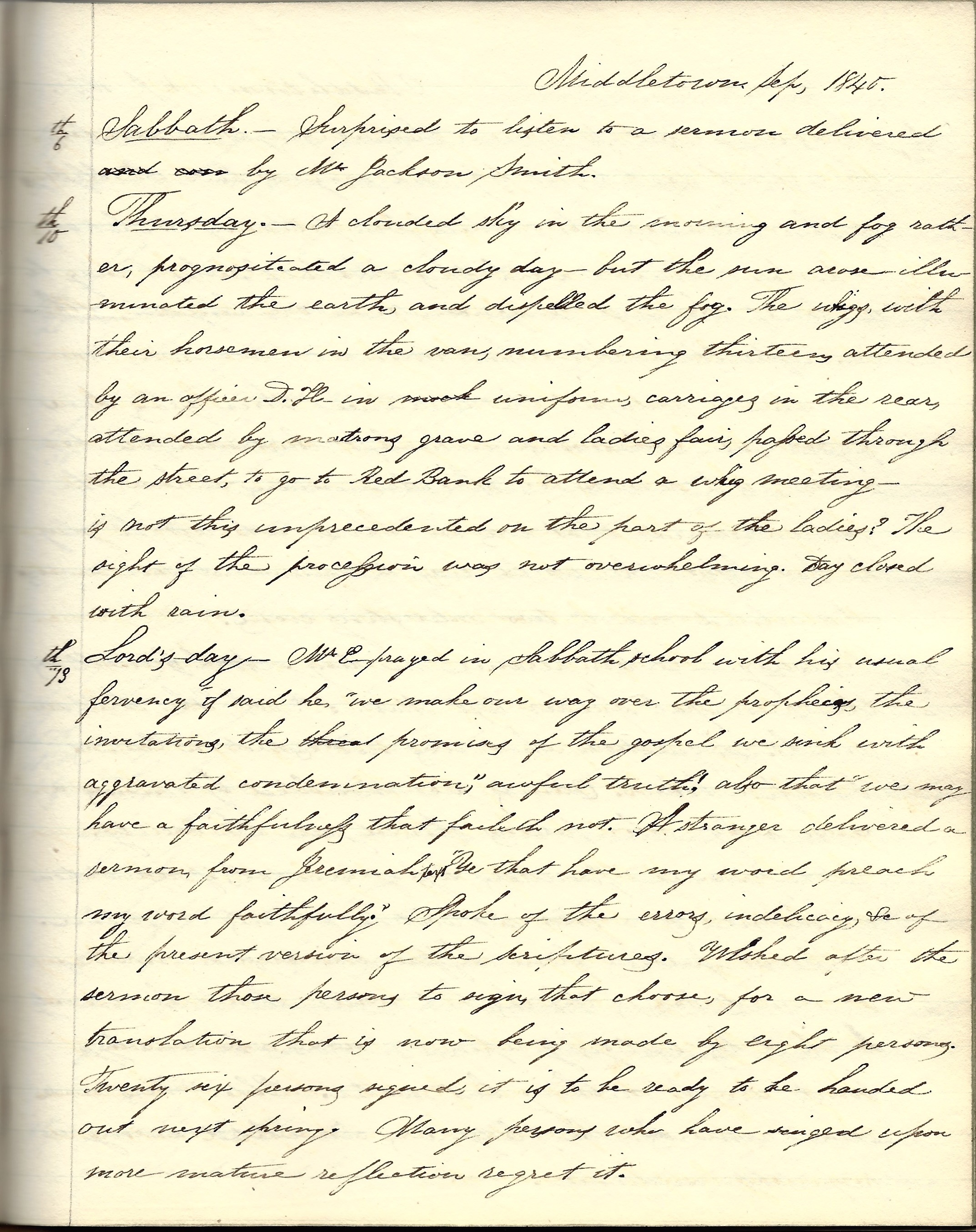
Sabbath, September 6, 1840. Surprised to listed to a sermon delivered by Mr. Jackson Smith.
Thursday 10th. A clouded sky in the morning and fog rather, prognosticated a cloudy day—but the sun arose illuminated the earth and dispelled the fog. The Whigs, with their horsemen in the van, numbering thirteen, attended by an officer D. H. in uniform, carriages in the rear, attended by matrons grave and ladies fair, passed through the street to go to Red Bank to attend a Whig Meeting. Is not this unprecedented on the part of the ladies? The sight of the procession was not overwhelming. Day closed with rain.
Lord’d Day, 13th. Mr. E. prayed in Sabbath School with his usual fervency. If, said he, “We make our way over the prophecies, the invitations, the promises of the gospel we sink with aggravated condemnation,” awful truth! Also, that “we may have a faithfulness that faileth not.” A stranger delivered a sermon from Jeremiah, text: “Ye that have my word preach my word faithfully.” Spoke of the errors, indelicacy &c. of the present version of the scriptures. Wished after the sermon those persons to sign, that choose, for a new translation that is now being made by eight persons. Twenty-six persons signed. Itis to be redy to be handed out next spring. Many persons who have signed upon more mature reflection regret it.
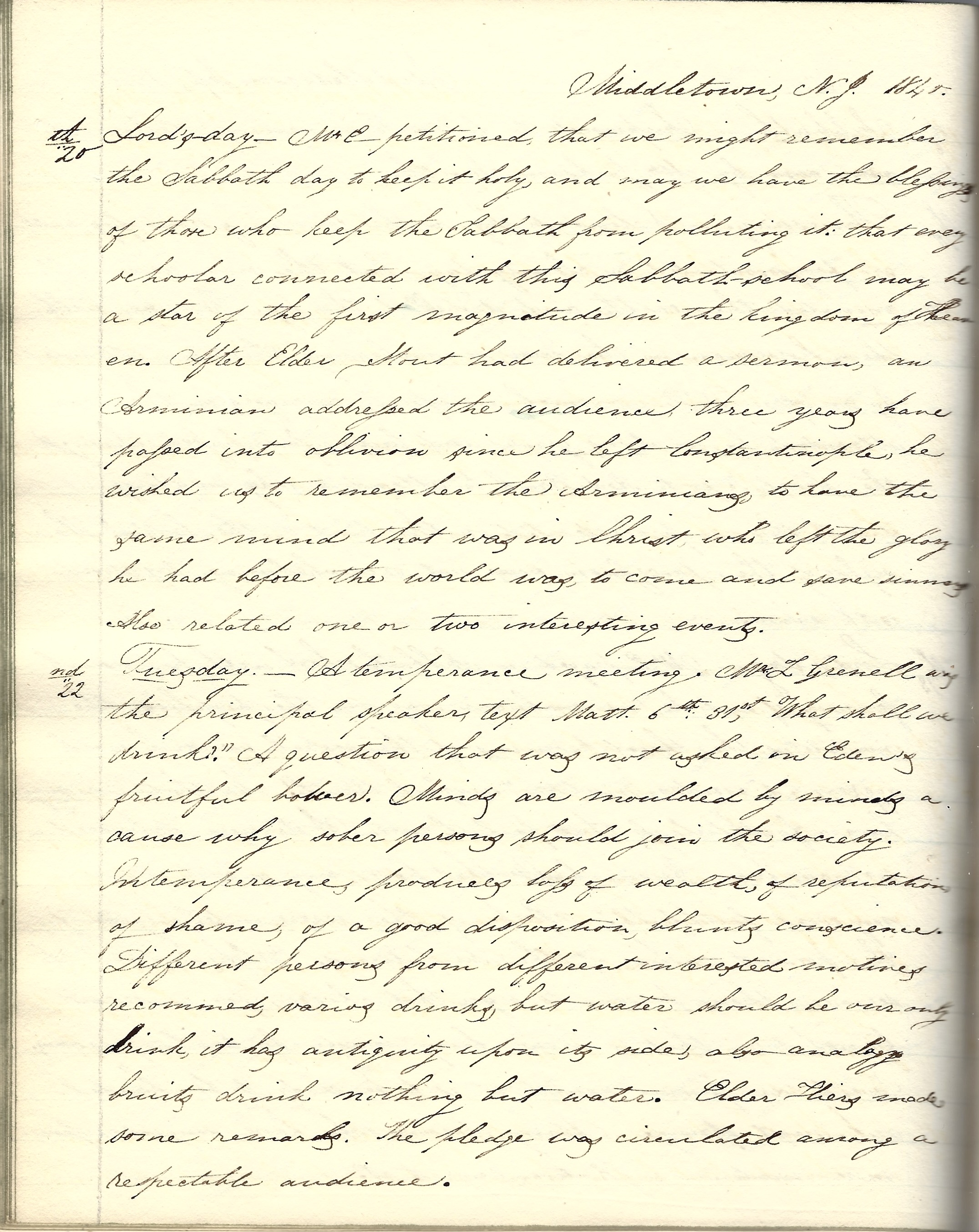
Lord’s Day, 20th. Mr. E petitioned that we might remember the Sabbath day to keep it holy and may we have the blessings of them who keep the Sabbath from polluting it; that every scholar connected with this Sabbath school may be a star of the first magnitude in the Kindom of Heaven. After Elder Stout had delivered a sermon, an Arminian addressed the audience. Three years have passed into oblivion since he left Constantinople. He wished us to remember the Arminians, to have the same mind that in Christ who left the glory he had before the world was to come and save sinners. Also related one or two interesting events.
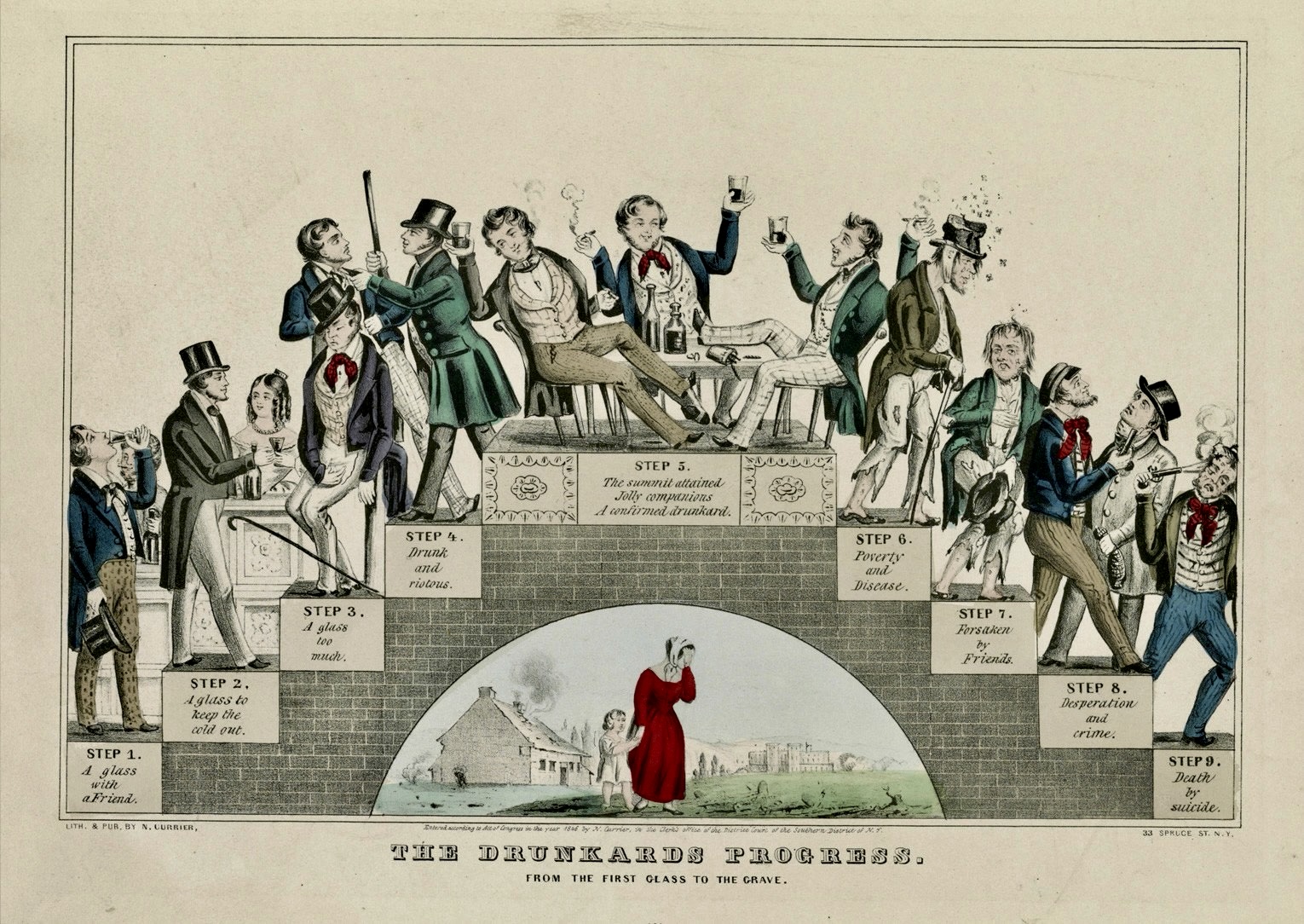
Tuesday 22nd. A Temperance Meeting. Mr. L. Grennell was the principal speaker. Text, Matthew 6th Chapter, 31st verse. “What shall we drink.” A question that was not asked in Eden’s fruitful bower. Minds are moulded by minds—a cause why sober persons should join the society. Intemperance produces loss of wealth, or reputation of shame, of a good disposition, blunts conscience. Different persons from different interested motives recommend various drinks but water should be our only drink. It has antiquity upon its side. Also analogy bruits drink nothing but water. Elder Hires made some remarks. The pledge [to abstain from drink] was circulated among a respectable audience.
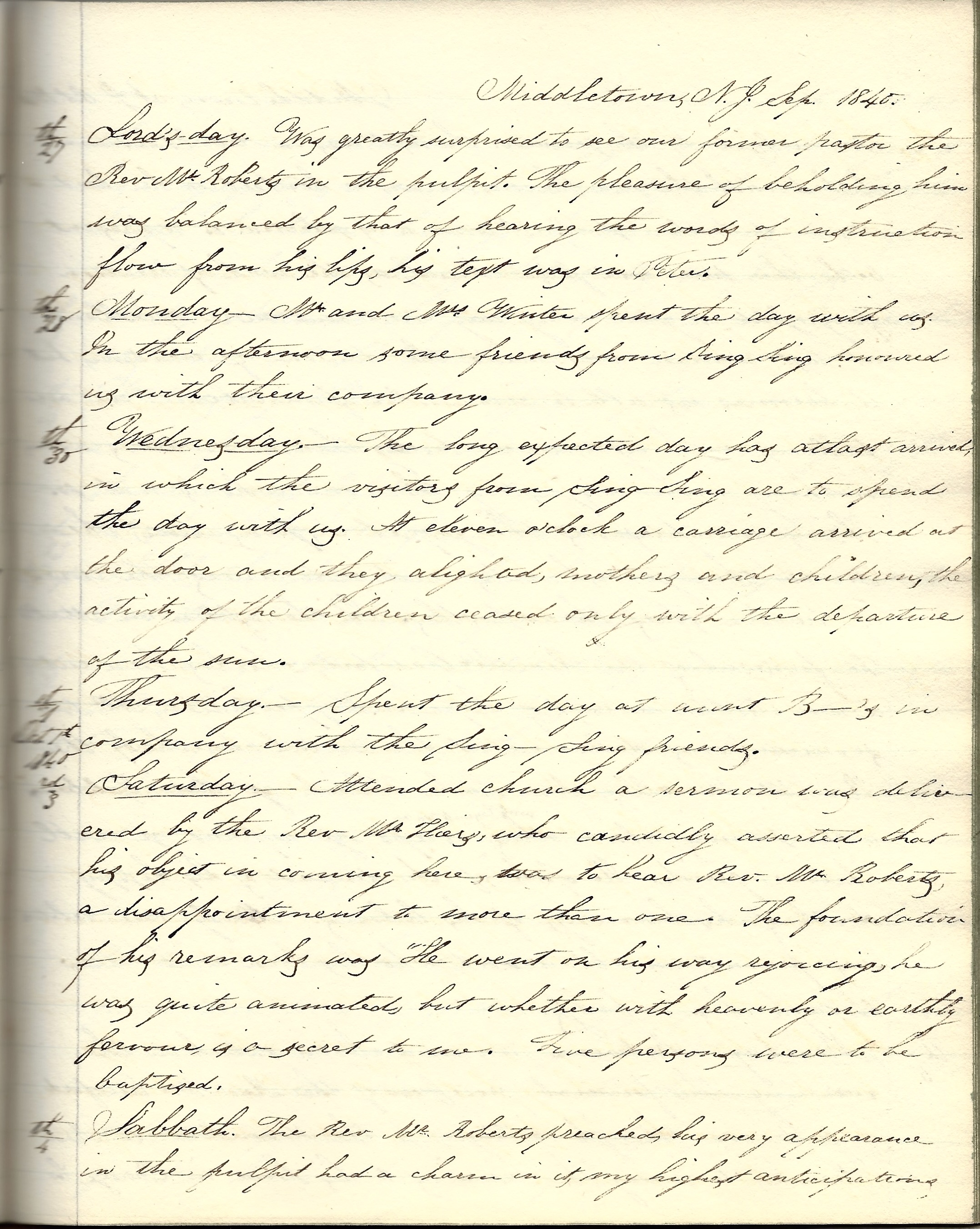
Lord’s Day, 27th. Was greatly surprised to see our former pastor, the Rev. Mr. Roberts in the pulpit. The pleasure of beholding him was balanced by that of hearing the words of instruction flow from his lips. His text was in Peter.
Monday 28th. Mr. and Mrs. Winter spent the day with us. In the afternoon some friends from Sing-Sing honored us with their company.
Wednesday, 30th. The long expected day has at last arrived in which the visitors from Sing-Sing are to spend the day with us. At eleven o’clock, a carriage arrived at the door and they alighted, mothers and children. The activity of the children ceased only with the departure of the sun.
Thursday, October 1, 1840. Spent the day at Aunt Beekman’s in company with the Sing-Sing friends.
Saturday 3rd. Attebded church. A sermon was delivered by the Rev. Mr. Hires who candidly asserted that his object in coming here was to hear Rev. Mr. Roberts—a disappointment to more than one. The foundation of his remarks was “He went on his way rejoicing.” He was quite animated, but whether with heavenly or earthly fervor is a secret to me. Five persons were to be baptized.
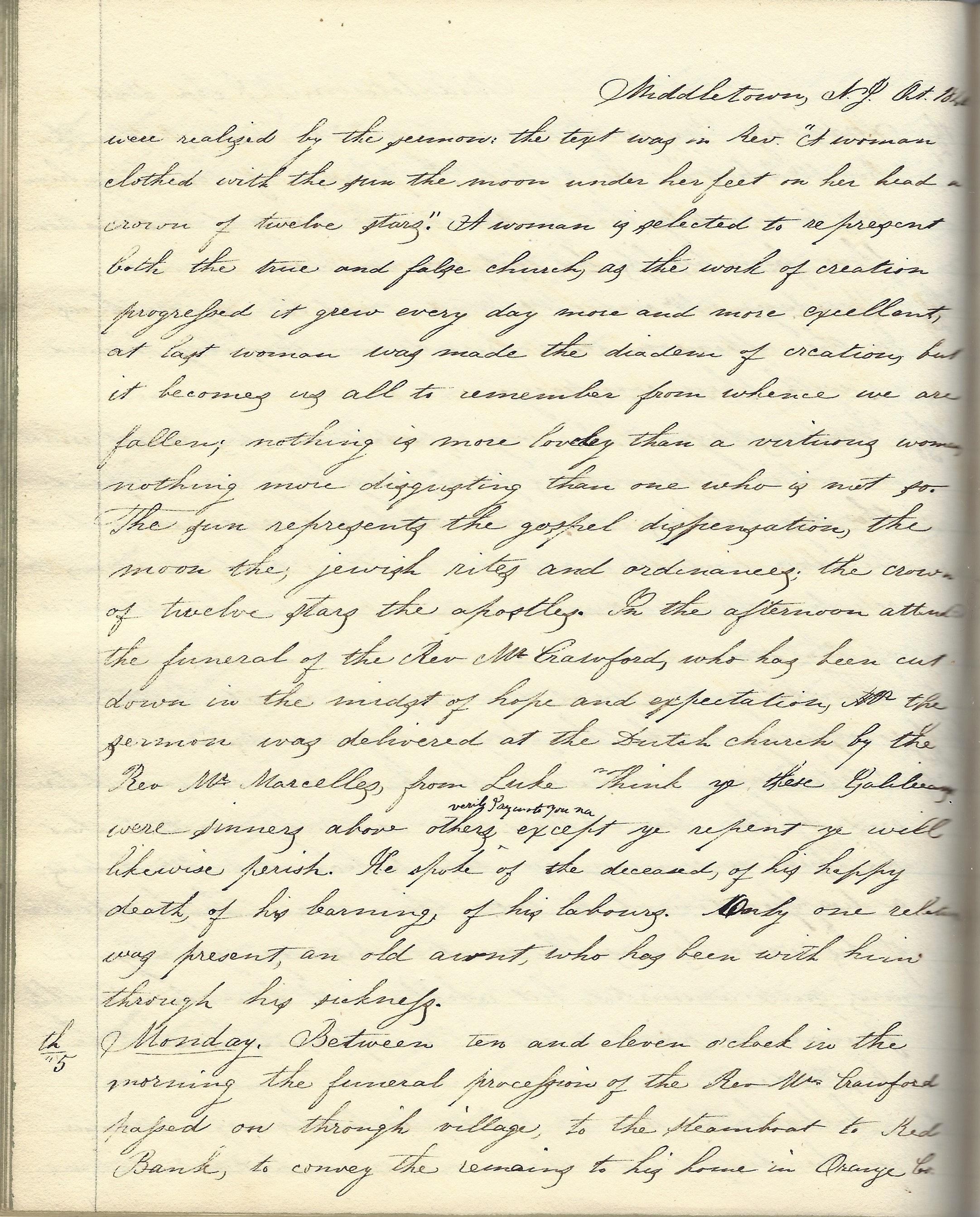
Sabbath 4th. The Rev. Mr. Roberts preached. His very appearance in the pulpit had a charm in it. My highest anticipations were realized by the sermon. The text was in Revelations, “A woman clothed with the sun, the moon under her feet, on her head a crown of twelve stars.” A woman is selected to represent both the true and false church. As the work of creation progressed, it grew every day more and more excellent. At last woman was made the diadem of creation, but it becomes us all to remember from whence we are fallen. Nothing is more lovely than a virtuous woman. Nothing more disgusting than one who is not so. The sun represents the gospel dispensation, the moon the jewish rites and ordinances, the crown of twelve stars the apostles.
In the afternoon attended the funeral of the Rev. Mr. [John B.] Crawford [1814-1840] who has been cut down in the midst of hope and expectation. The sermon was delivered at the Dutch church by the Rev. Mr. Marcellus, from Luke, “Think ye these Galilean were sinners, above others…. ” He spoke of the deceased, of his happy death, of his caring, of his labors. Only one relative was present—an old aunt who has been with him through his sickness.
Monday, 5th. Between ten and eleven o’clock in the morning the funeral procession of the Rev. Mr. Crawford passed on through village to steamboat to Red Bank to convey the remains to his home in [Pine Brush] Orange county [New York]. There was in attendance twenty-five carriages belonging to his congregation. It seemed unusually solemn. The calm breeze, the blue cloudless sky, the various tents of autumn have a beauty that soothe the feelings.
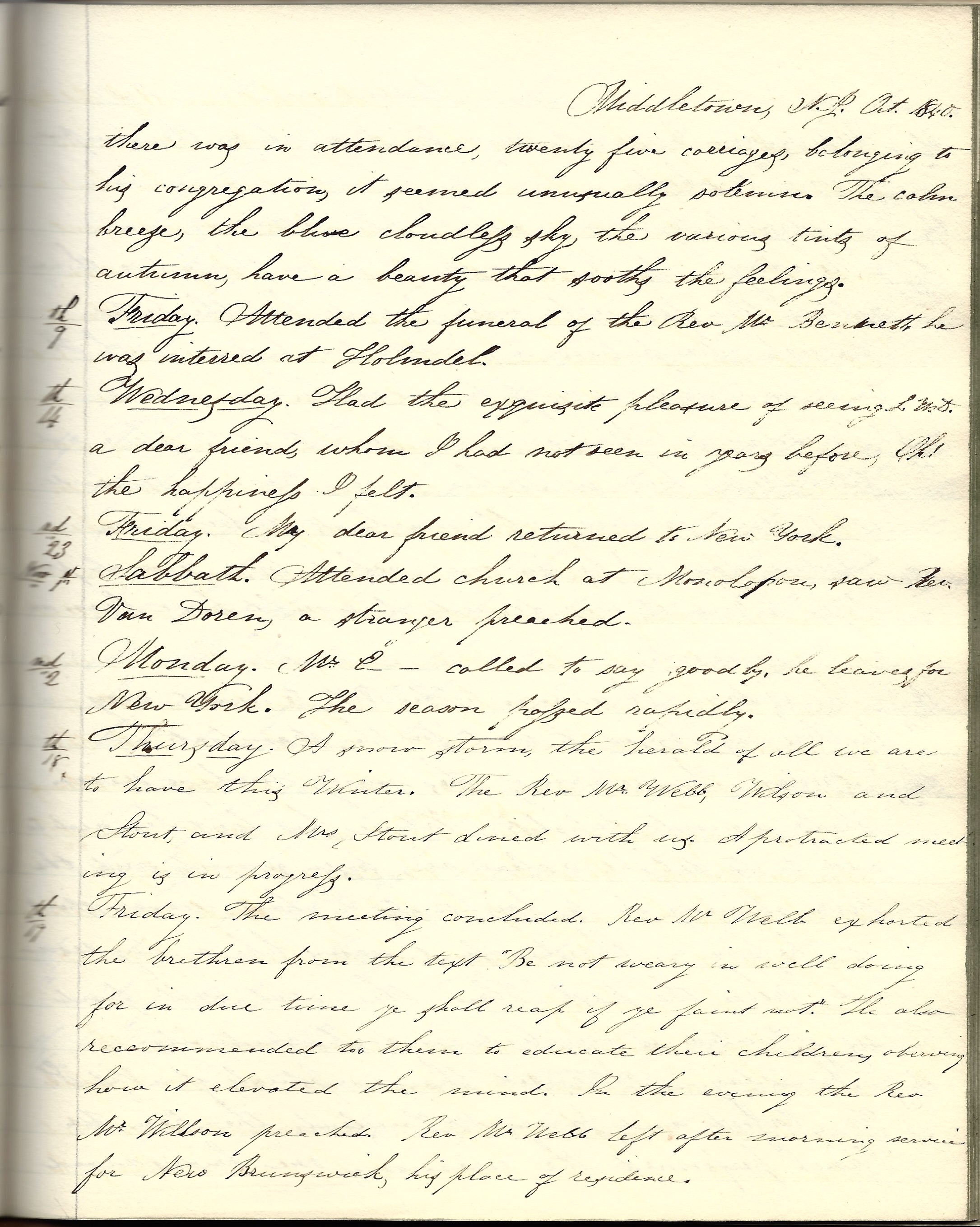
Friday 9th. Attended the funeral of the Rev. Mr. Bennett. He was interred at Holmdel.
Wednesday 14th. Had the exquisite pleasure of seeing L. W. D., a dear friend whom I had not seen in years before. Oh! the happiness I felt.
Friday 23rd. My dear friend returned to New York.
Sabbath, November 1, 1840. Attended church at Manalapan. Saw Rev. Van Doren. A stranger preached.
Monday, 2nd. Mr. E. called to say goodbye. He leaves for New York. The season passed rapidly.
Thursday 18th. A snow storm, the herald of all we are to have this winter. The Rev. Mr. Webb, Wilson and Stout dined with us. A protracted meeting is in progress.
Friday 19th. The meeting concluded. Rev. Mr. Webb exhorted the brethren from the text, “Be not weary in well doing for in due time ye shall reap if ye faint not.” He also recommended to them to educate their children observing how it elevated the mind. In the evening the Rev. Mr. Wilson preached. Rev. Mr. Webb left after morning service for New Brunswick, his place of residence.
Wednesday, December 2, 1840. George left home for New York for the purpose of going to school.
Tuesday 16th. M. Layton called. He has left Patterson.
Monday 21st. C. H. has sued N. W. for 32,000 dollars. They formerly were friends but the latter through dissipation is on the brink of ruin. C. H. is a fair specimen of his family.
Tuesday 22nd. Margaret has gone to New York alone and friendless. How will her career terminate and what deep crimes will mark its progress.
Wednesday 23rd. A person once asked for a general privilege to [ ]. it was denied, it would have been an entailment.
Thursday 24th. A journey to Key Port to meet my brother. Was obliged to wait for the steamboat.
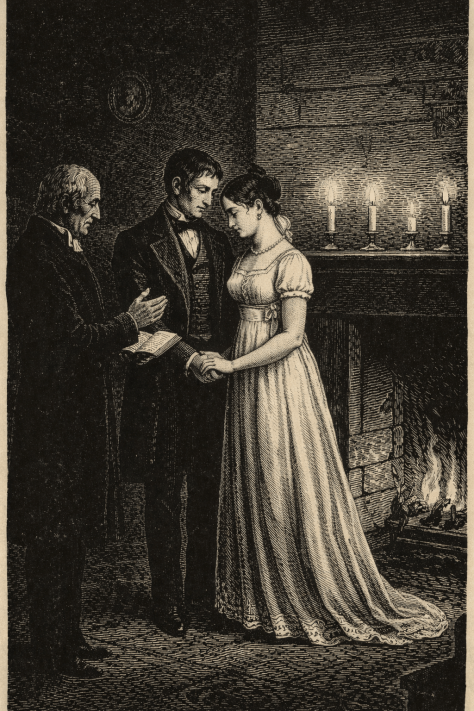
Friday 25th. The return of this merry making season sheds around delight. Nature has lent her aid to ass to its delight a clear air, frozen ground, and the sun shining in its brightness. I have never spent so happy a Christmas. It seems like a day reached from the past. How the next will find us situated is involved in dark futurity.
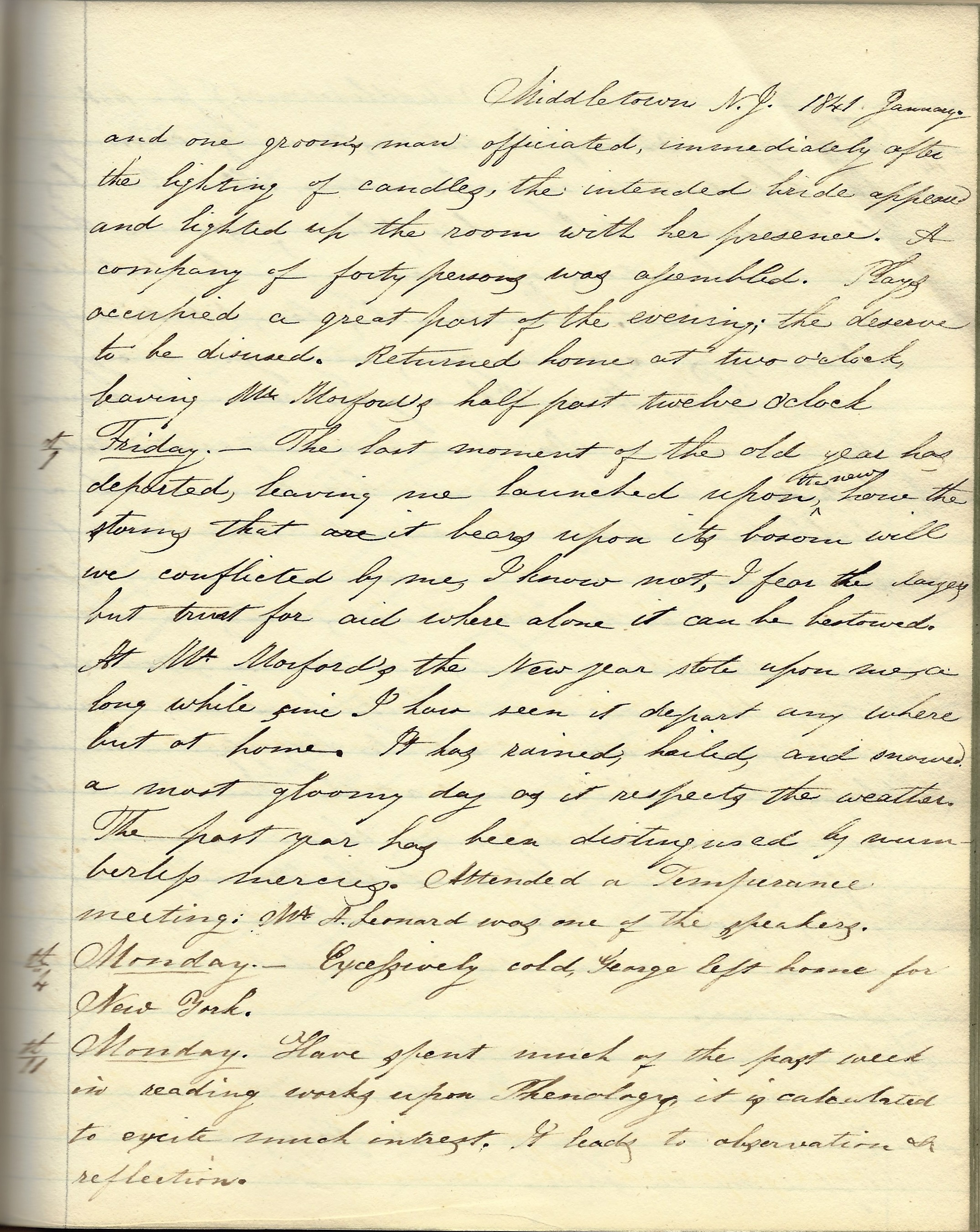
Thursday [December] 31 [1840]. Attended the nuptials of Miss H[annah] W[hite] Morford and James McCausland. 1 The Rev. Mr. [Harry] Finch performed the ceremony. One bride’s maid and one groom’s man officiated. Immediately after the lighting of candles, the intended bride appeared and lighted up the room with her presence. A company of forty persons was assembled. Plays occupied a great part of the evening. They deserve to be disused. Returned home at two o’clock leaving Mr. Morford’s at half past twelve o’clock.
1 James McCausland (1807-1844) took Hannah White Morford (1819-1894) as his second wife. They were married on 31 December 1840 in the home of Hannah’s father. Hannah was the daughter of Garrett Morford (1781-1865) and Catherine C. White (1798-1869) of Shrewsbury, New Jersey. Garrett’s father was a slaveholder but Garrett soon freed the slave he inherited from his father in 1818. Note that James McCausland died just three years after his marriage to Hannah.

Friday, January 1, 1841. The last moment of the old year has departed, leaving me launched upon the new. How the storms that it bears upon its bosom will be conflicted by me, I know not. I fear the largess but trust for aid where alone it can be bestowed. At Mr. [Garrett] Morford’s, the New Year stole upon me—a long while since I have seen it depart anywhere but at home. It has rained, hailed, and snowed—a most gloomy day as it respects the weather. The past year has been distinguished by numberless mercies. Attended a Temperance Meeting. Mr. A. Leonard was one of the speakers.
Monday 4th. Excessively cold. George left home for New York.
Monday 11th. Have spent much of the past week in reading works upon Phrenology. It is calculated to excite much interest. It leads to cultivation and reflection.
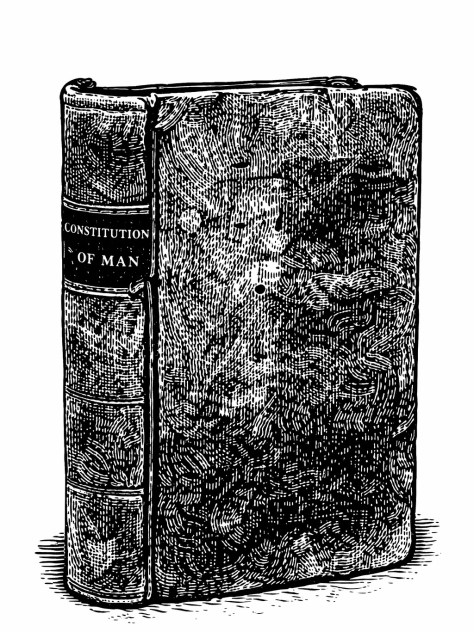
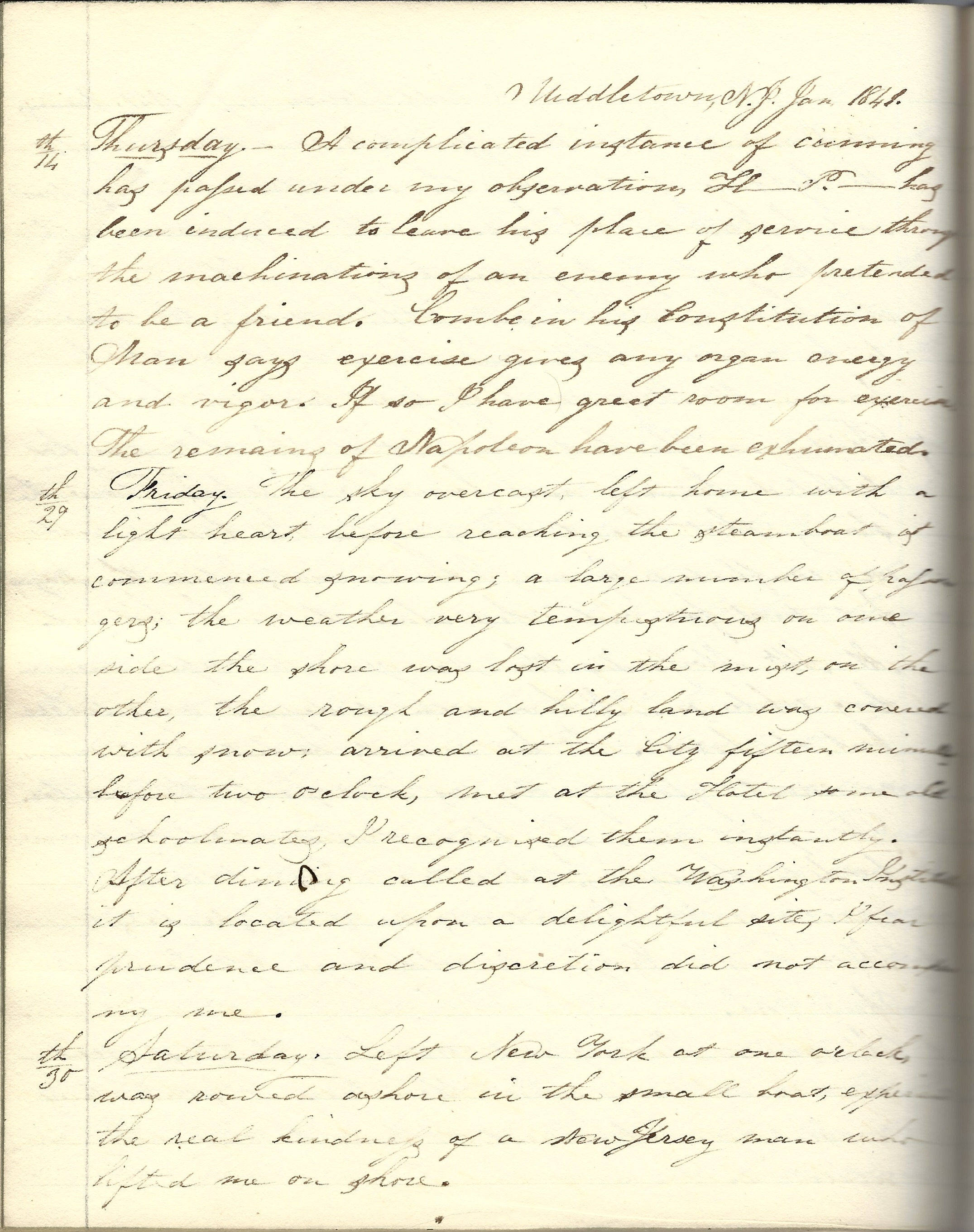
Middletown, New Jersey, Thursday, January 14, 1841. A complicated instance of cunning has passed under my observation. H____ P____ has been induced to leave his place of service through the machinations of an enemy who pretended to be a friend. [George] Combe in his Constitution of Man says the exercise gives any organ energy and vigor. If so, I have great room for exercise. The remains of Napoleon have been exhumated.
Friday 29th. The sky overcast. Left home with a light heart. Before reaching the steamboat, it commenced snowing. A large number of passengers. The weather very tempestuous. On one side the shore was lost in the mist. On the other, the rough and hilly land was covered with snow. Arrived at the City fifteen minutes before two o’clock. Met at the hotel some old schoolmates. I recognized them instantly. After dinner called at the Washington Institute. It is located upon a delightful site. I fear prudence and discretion did not accompany me.
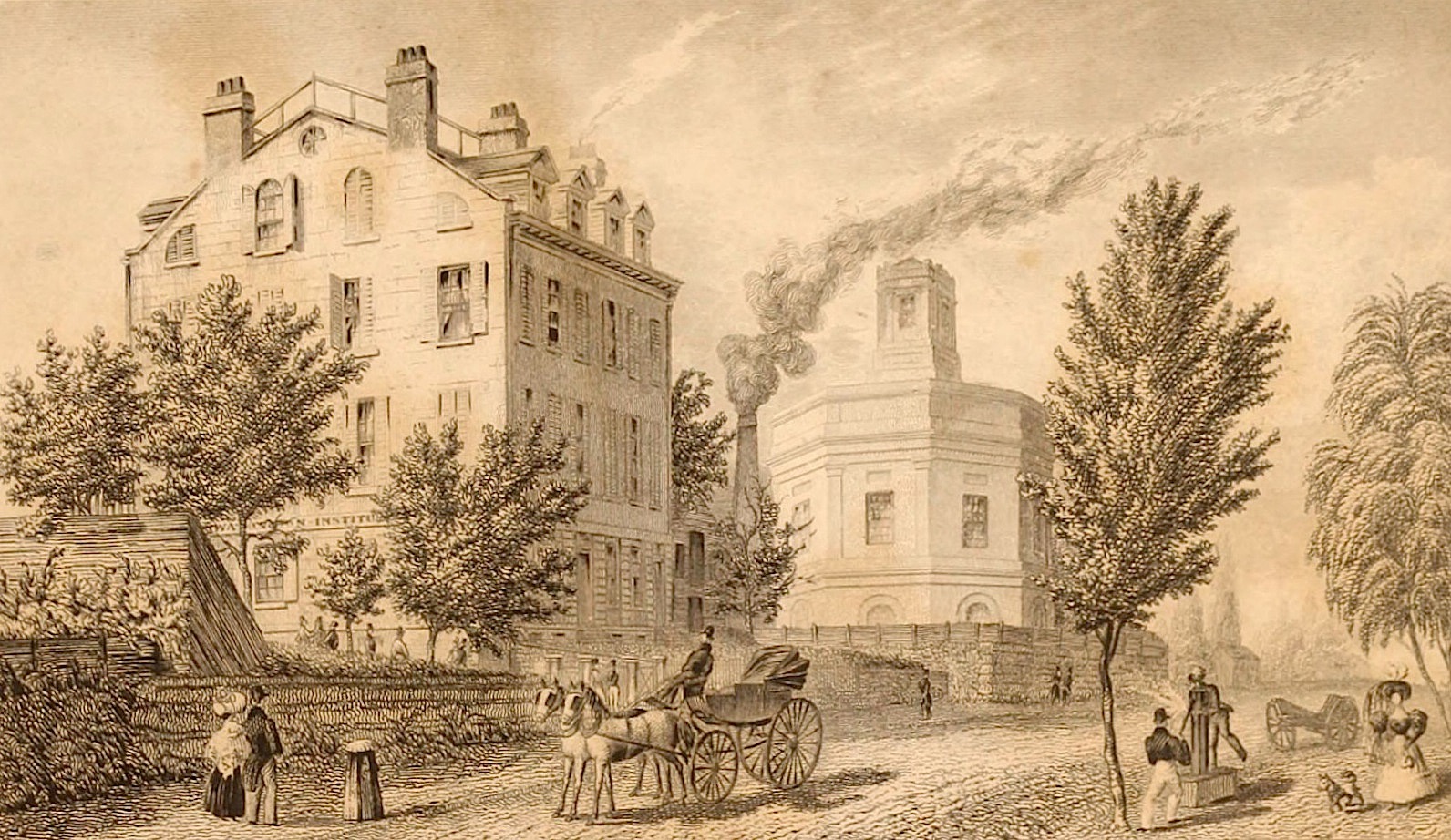
Saturday 30th. Left New York at one o’clock. Was rowed ashore in the small boat. Experienced the real kindness of a New Jersey man who lifted me on shore.
Tuesday, March 2, 1841. In the evening listened to a sermon delivered by Bishop [George W.] Doane in the church. The text was Zachariah 12th [chapter] and 10th verse, “This verse like the acorn which contains the oak, contains the scheme of redemption. He to whom they will pray will pour them the spirit of supplication. Persons are drawn through the cross by contemplating the sufferings of him who died thereon. You who have found the cross peace cling to it with affections fondest grasp. God forbid I should glory in anything except the cross of Christ and God forbid I should glory in that, except as by but the world is crucified unto me and I unto the world… The Bishop makes few gestures. He has been invited to preach a consecration sermon at Leeds, England, and will sail in July.
Wednesday 3rd. My brother left home. He has been spending a few days with us. The pleasure of seeing him has removed a layer of anxiety. Mr. B. received a letter from Mr. Roberts who says he has been a year writing it. He must have bestowed upon it a fund of thought. Such a letter is of value.
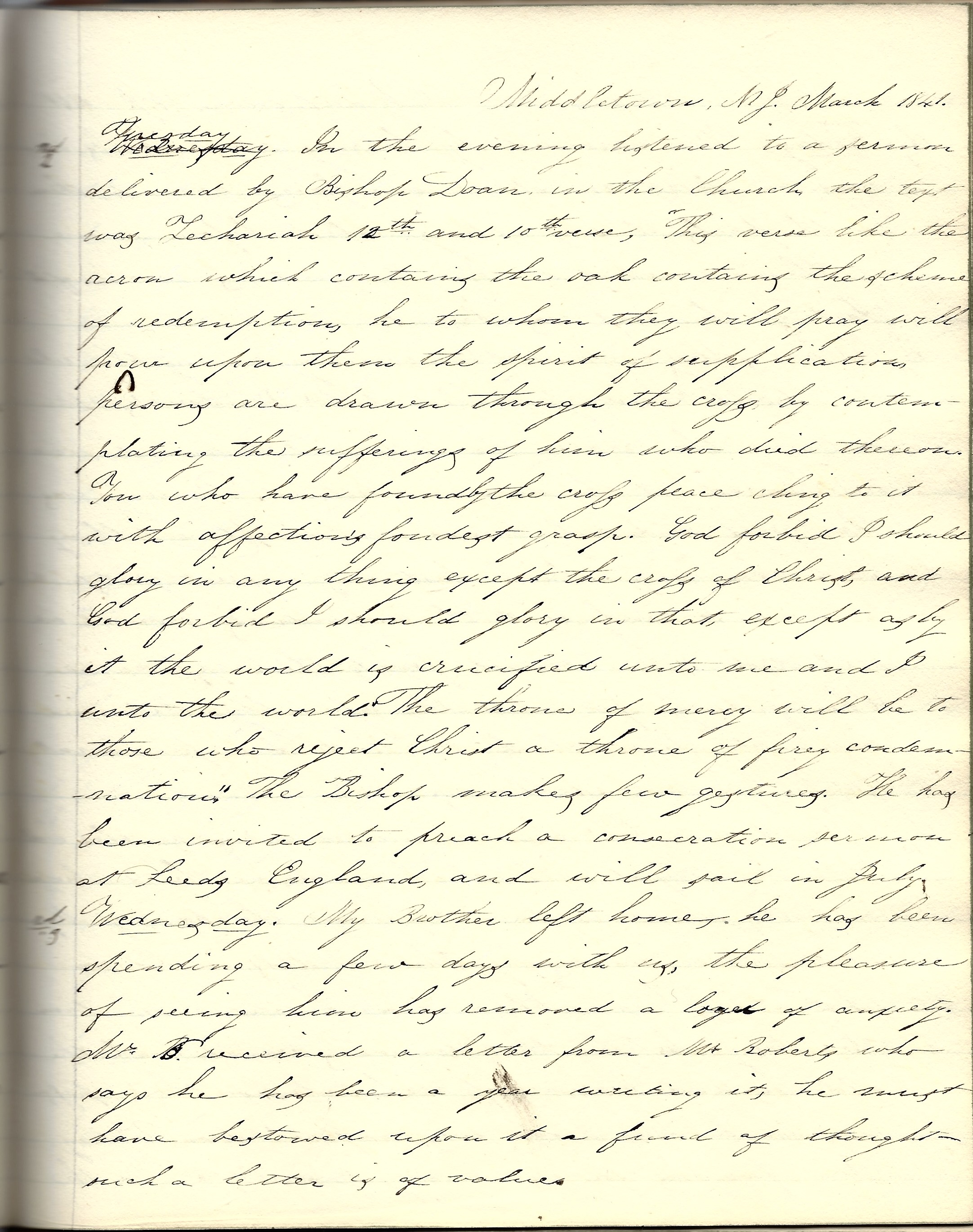
Friday 5th. Were aroused by hearing Aunt Ann’s house was on fire. Mustered our forces, armed them with pails. It was extinguished before some of them reached it. Mary T. sent us word of it. Part of the roof was burnt.
Wednesday 10th. Spent the evening among the eclat of Middletown assembled at Mr. Van Doren’s. After entering the room, the bride and bridesmaid were introduced at the door and entered. Dancing was the great and only amusement excepting talking and observing, which last was a great gratification to me. So rarely is it the individuals around are collected, one almost forgets their appearance. Cheerfulness pervaded the assembly. Returned home at three o’clock. Intellectual improvement is one of the greatest excellencies.
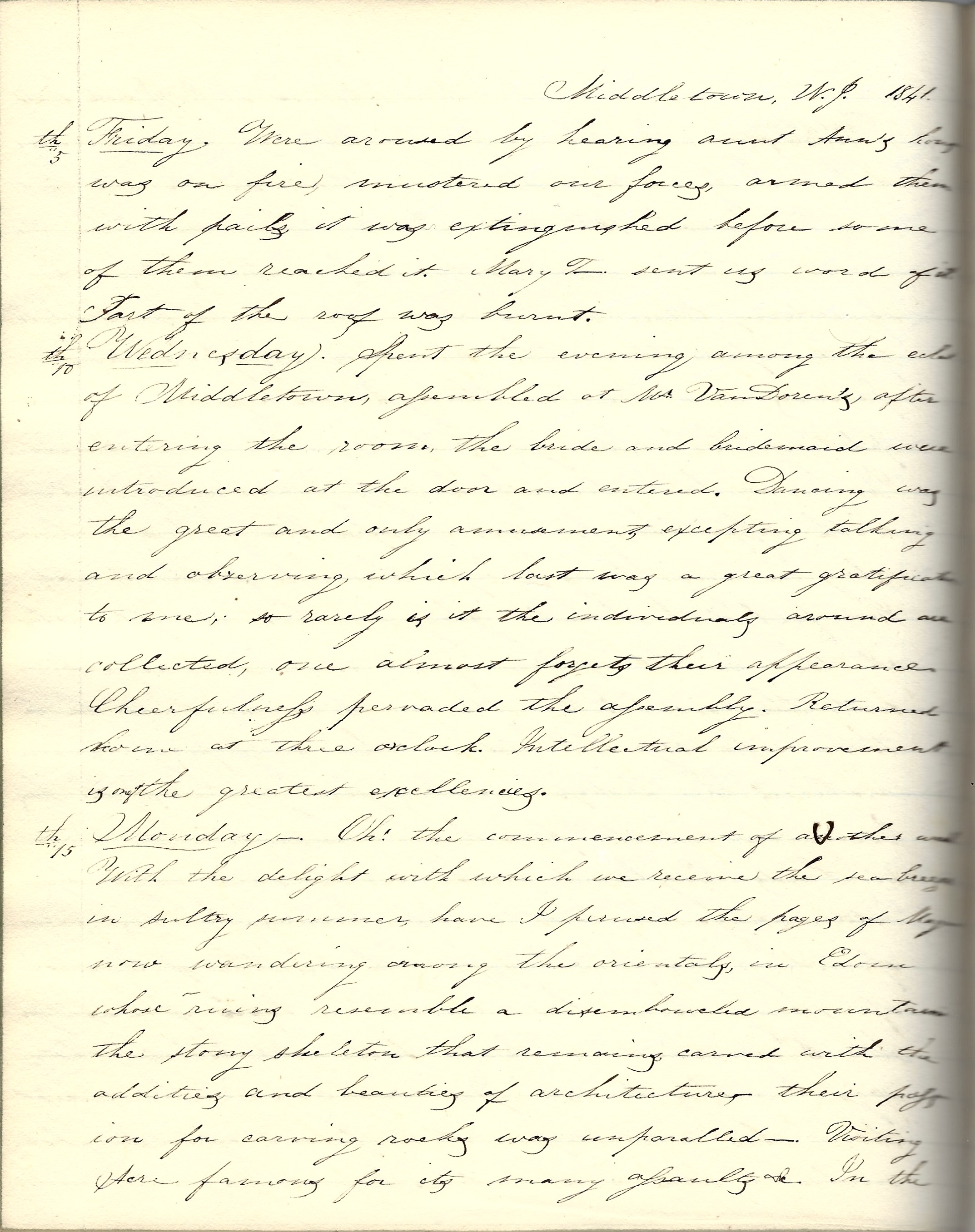
Monday 15th. Oh! the commencement of another week. With the delight with which we receive the sea breeze in sultry summer have I perused the pages of a Maga[zine]—now wandering among the orientals in [the ancient kingdom of Israel named] Edom whose rivers resemble a disemboweled mountain, the stony skeleton that remains carved with the additions and beauties of architecture. Their passion for carving rocks was unparalleled. [Also in] visiting Acre famous for its many assaults [in the Crusades] &c. In the evening a mother and son graced our room with their presence to the latter. Mr. B. has sold many Durhams and Berkshires, and says he would have let no one else have them.
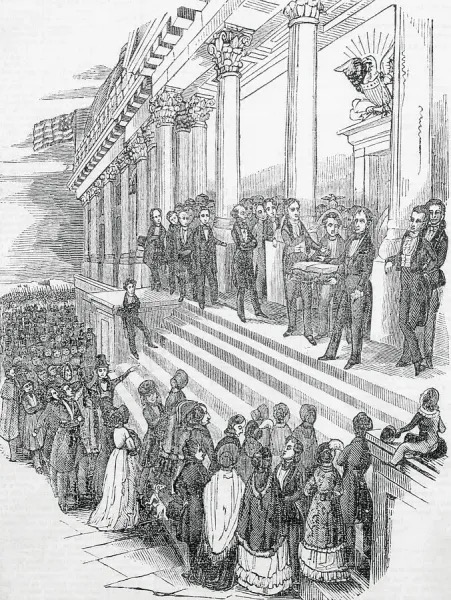
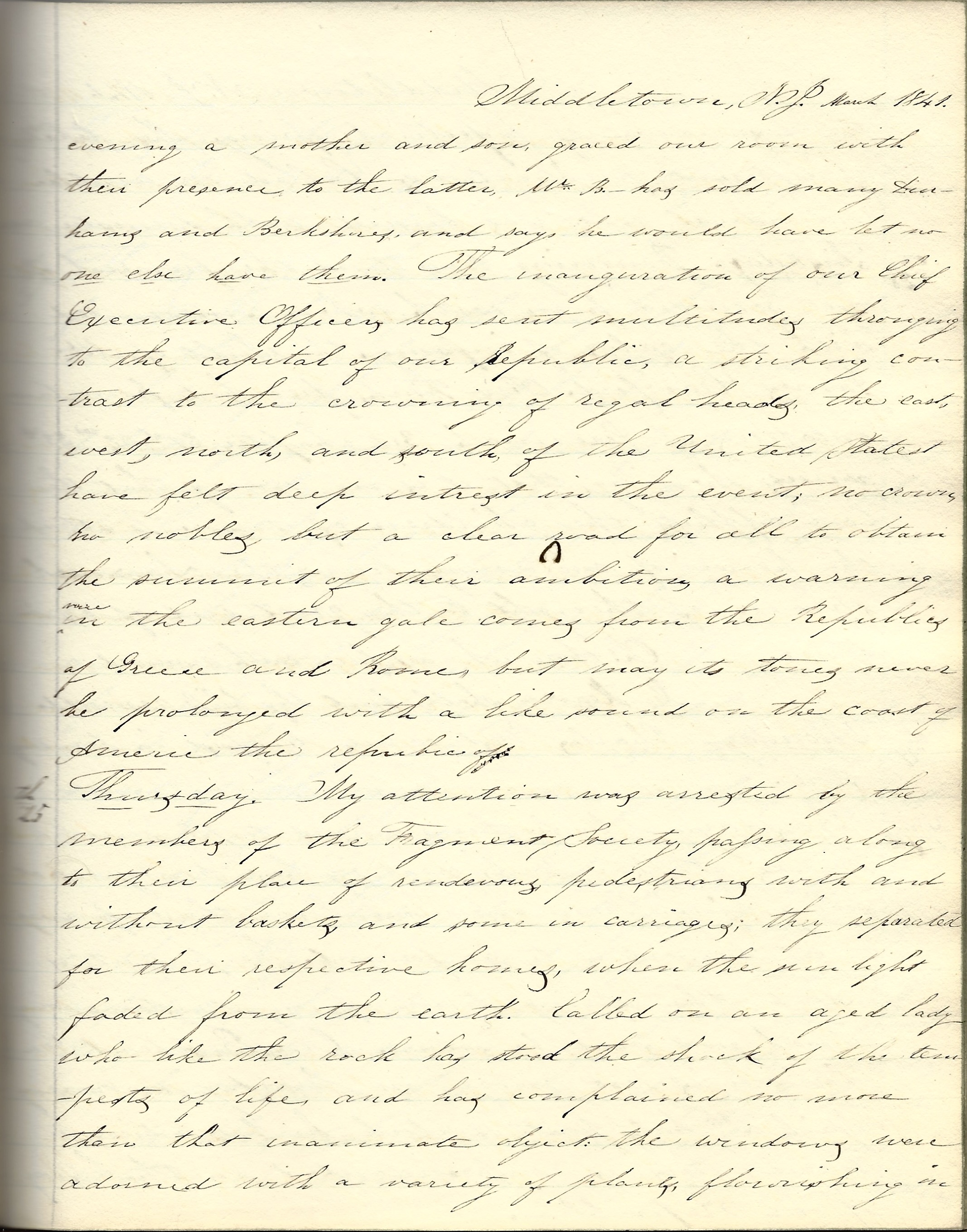
The inauguration of our Chief Executive Officer has sent multitudes thronging to the Capital of our Republic—a striking contrast to the crowning of regal heads. The east, west, north and south of the United States have felt deep interest in the event. No crown, no nobles, but a clear road for all to obtain the summit of their ambition. A warning voice in the eastern gale comes from the Republic of Greece and Romem but may its tones never be prolonged with a like sound on the coast of the Repubic of America.
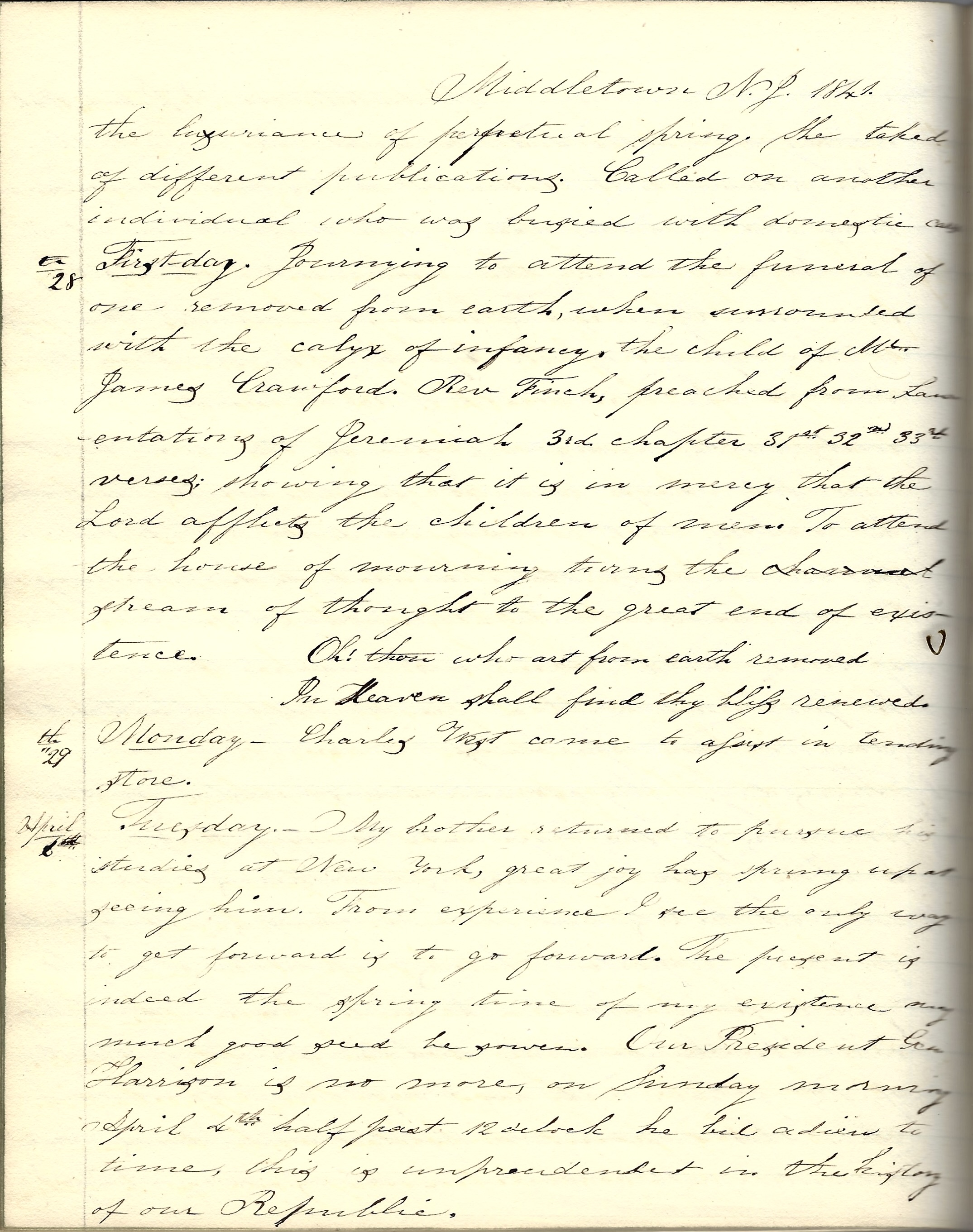
Thursday 25th. My attention was arrested by the members of the Fragment Society, passing along to their place of rendezvous, pedestrians with and without baskets, and some in carriages. They separated for their respective homes when the sunlight faded from the earth. Called on an aged lady who like the rock has stood the shock of the tempests of life and has complained no more than that inanimate objet. The windows were adorned with a variety of plants, flourishing in the luxuriance of perpetual spring. She talked of different publications. Called on another individual who was busied with domestic cares.
First Day 28th. Journeying to attend the funeral of one removed from earth when surrounded with the calyx of infancy—the child of Mr. James Crawford. Rev. Finch preached from Lamentations of Jeremiah, 3rd Chapter, 31st, 32nd, 33rd verses, showing that it is in mercy that the Lord afflicts the children of men. To attend the house of mourning turns the stream of thought to the great end of existence.
Oh! thou who art from earth removed
In Heaven shall find thy bliss renewed.
Monday 29th. Charles West came to assist in tending store.
Tuesday, April 6th. My brother returned to pursue his studies at New York. Great joy has sprung up at seeing him. From experience, I see the only way to get forward is to go forward. The present is indeed the spring time of my existence, May much good seed be sown.
Our President, Gen. Harrison, is no more. On Sunday morning, April 4th at half past 12 o’clock, he bid adieu to time. This is unprecedented in the history of our Republic.
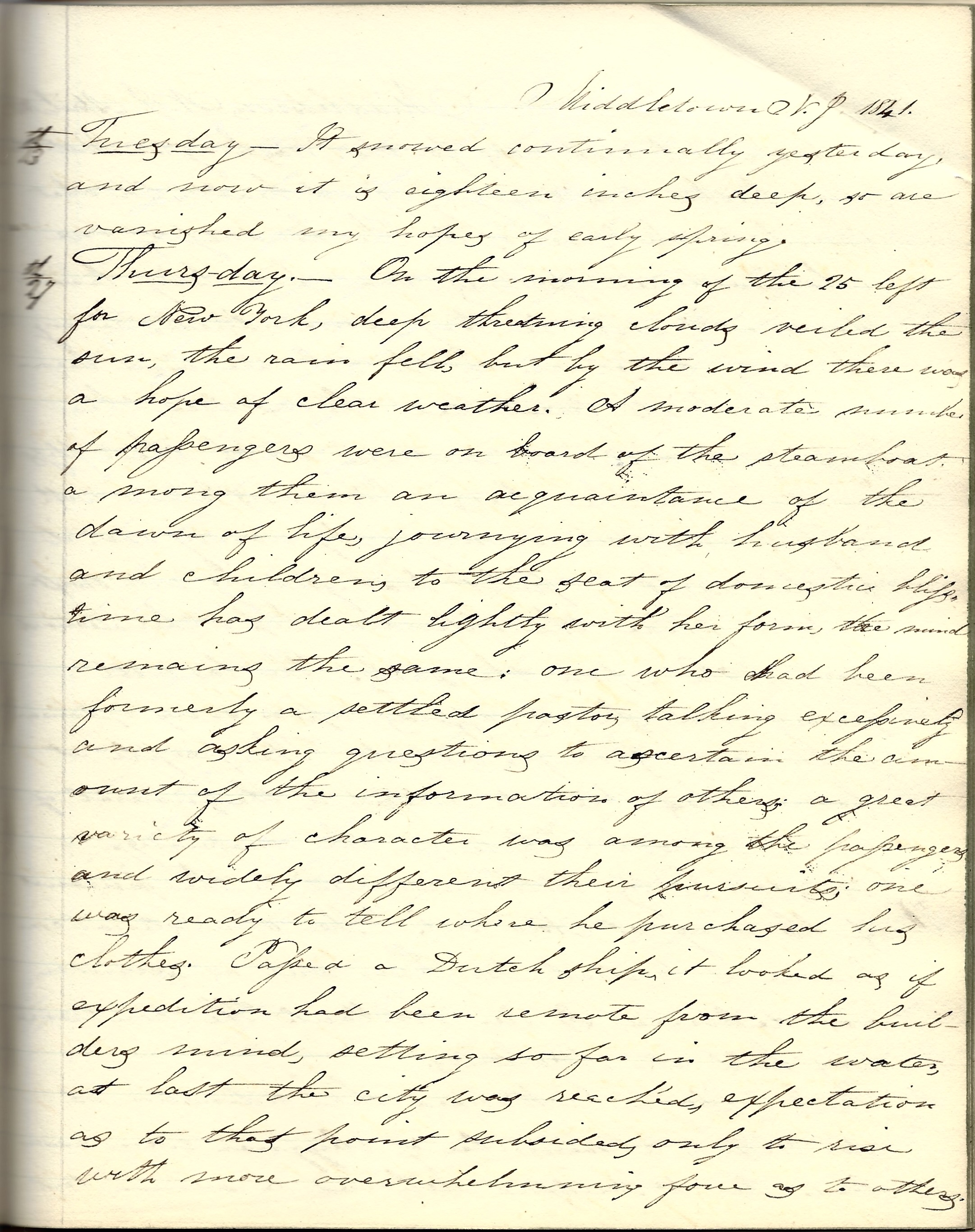
Tuesday 13th. It snowed continually yesterday and now it is eighteen inches deep, so are vanished any hopes of early spring.
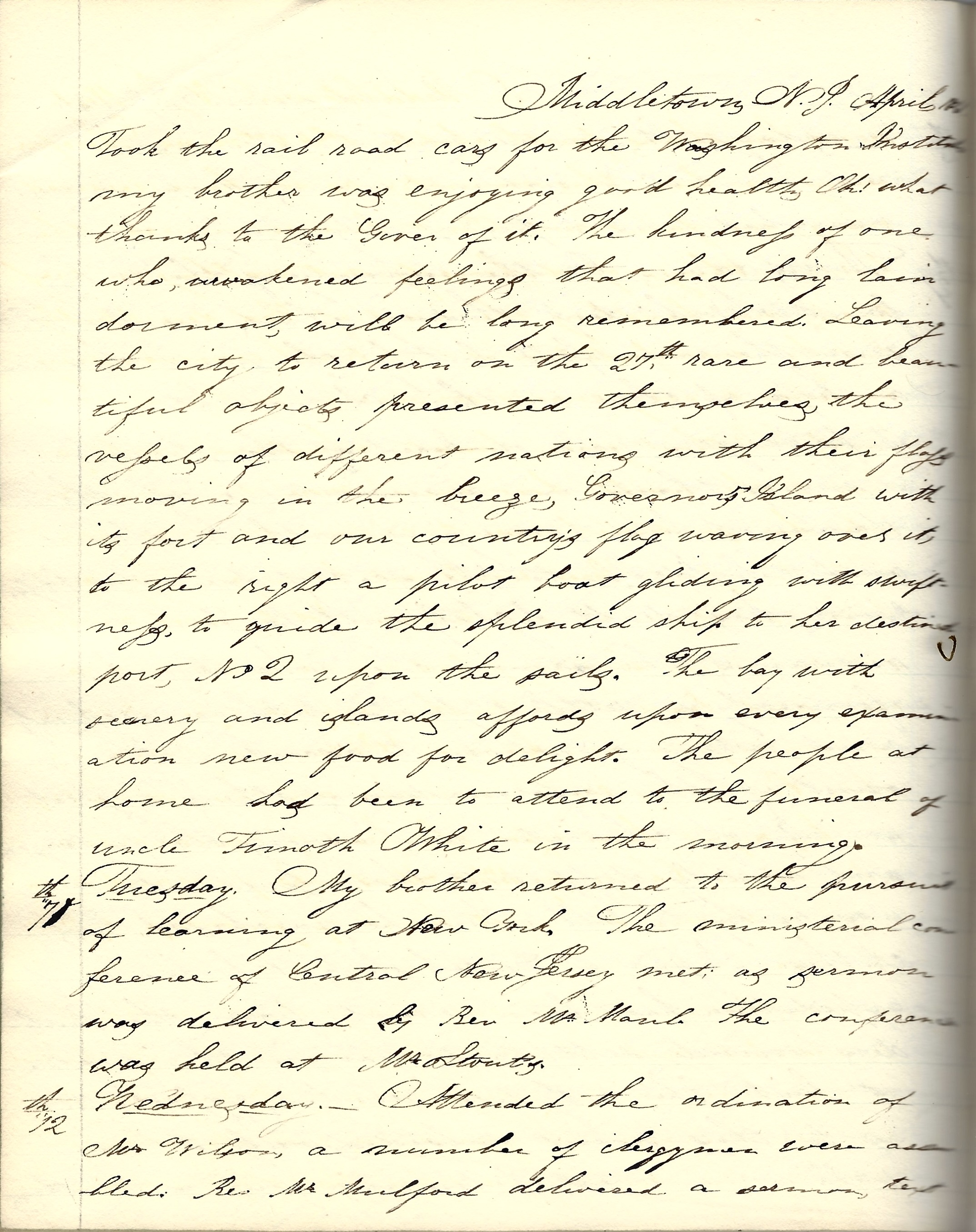
Thursday 27th. On the morning of the 25th, left for New York. Deep threatening clouds veiled the sun. The rain fell but by the wind, there was a hope of clear weather. A moderate number of passengers were on board of the steamboat. Among them an acquaintance of the dawn of life, journeying with husband and children to the seat of domestic bliss. Time has dealt lightly with her form. The mind remains the same. [There was also] one who had been formerly a settled pastor, talking excessively and asking questions to ascertain the amount of the information of others. A great variety of character was among the passengers and widely different their pursuits. One was ready to tell where he purchased his clothes. Passed a Dutch ship. It looked as if expedition had been remote from the builder’s mind, setting so far in the water.
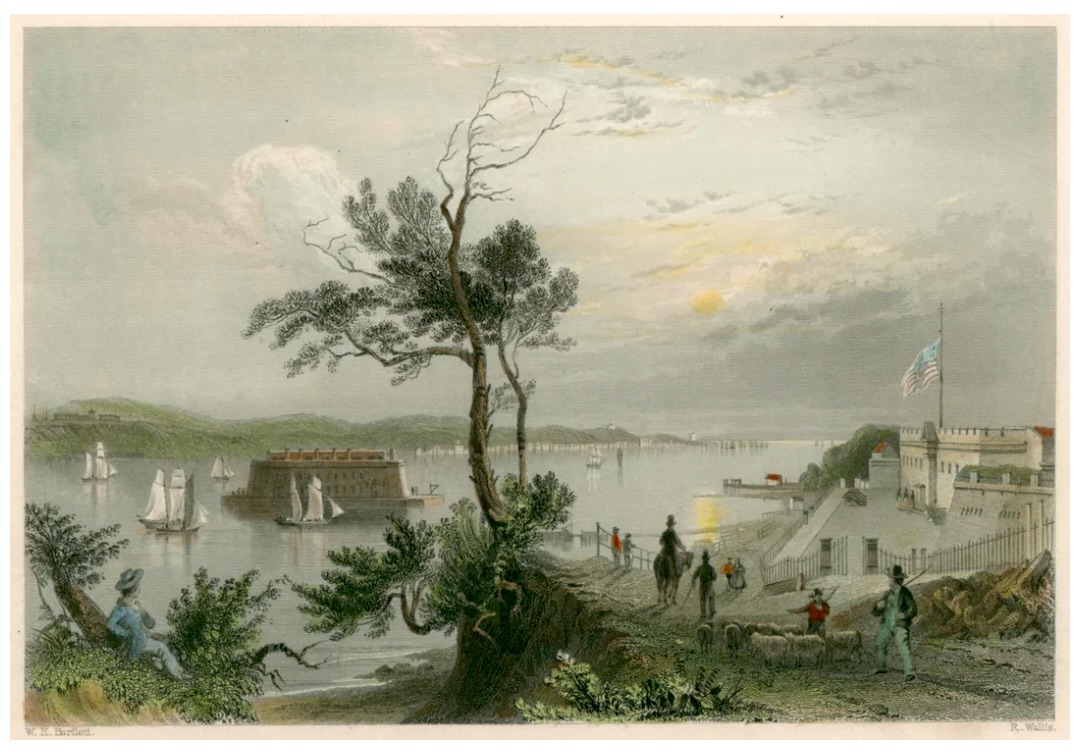
At last the city was reached, expectation as to that point subsided only to rise with more overwhelming force as to others. Took the railroad cars for the Washington Institute. My brother was enjoying good health. Oh! what thanks to the Giver of it. The kindness of one who awakened feelings that had long lain dormant will be long remembered. Leaving the city to return on the 27th. Rare and beautiful objects presented themselves. the vessels of different nations with their flags moving in the breeze, Governor’s Island with its fort and our country’s flag waving over it. to the right a pilot boat gliding with swiftness to guide the splendid ship to her destined port, No. 2 upon the sails. The bay with scenery and islands affords upon every examination new food for delight. The people at home had been to attend to the funeral of Uncle Timothy White in the morning.
Tuesday, April 7, 1841. My brother returned to the pursuit of learning at New York. The ministerial conference of Central New Jersey met as sermon was delivered by Rev. Mr. [William] Maul. The conference was held at Mr. [D. B.] Stout’s.
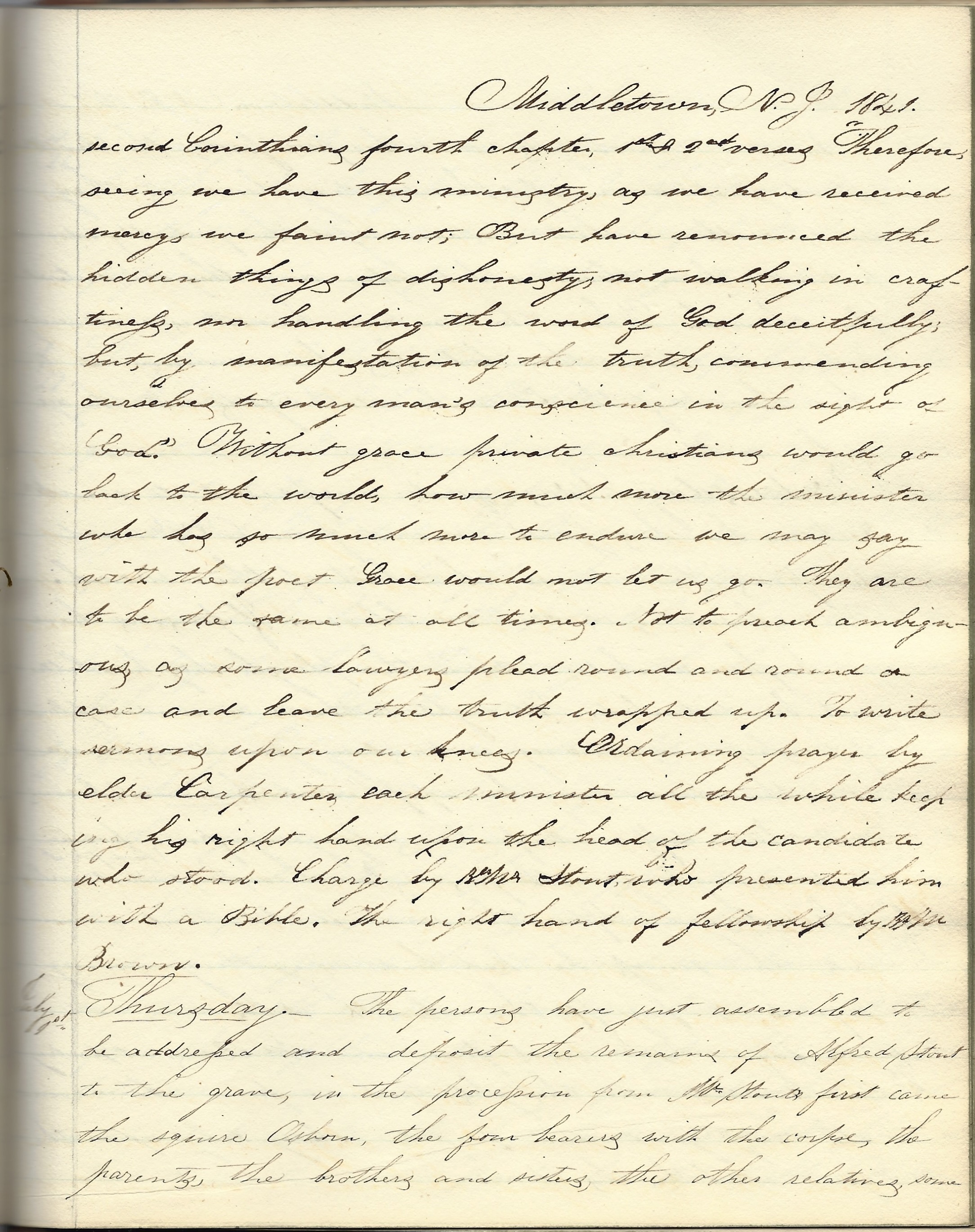
Wednesday 12th. Attended the ordination of Mr. Wilson. A number of clergymen were assembled. Rev. Mr. Mulford delivered a sermon. Text 2nd Corinthians, 4th Chapter, st and 2nd verses. “Therefore, seeing we have this ministry, as we have received mercies, we faint not.”… Ordaining prayer by Elder Carpenter, each minister all the while keeping his right hand upon the head of the candidate who stood. Charge by Mr. Stout who presented him with a Bible. The right hand of fellowship by Mr. Brown.
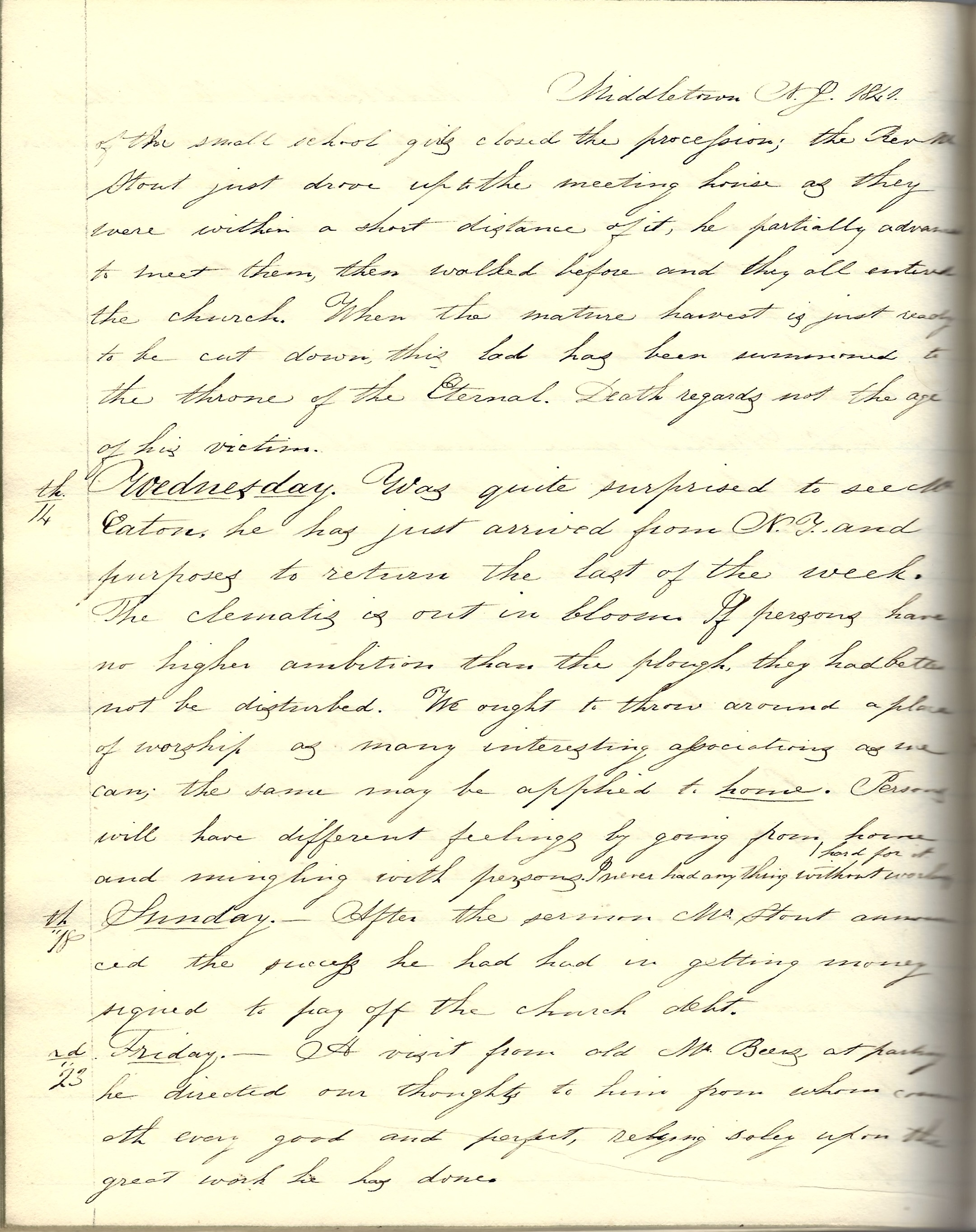
Thursday, July 1, 1841. The persons have just assembled to be addressed and deposit the remains of Alfred Stout to the grave. In the procession from Mr. Stout’s, first came the squire Osborn, the four bearers and the corpse, the parents, the brothers and sisters, the other relatives, some of the small school girls closed the procession. The Rev. Mr. Stout just drove up to the meeting house as they were within a short distance of it. He partially advanced to meet them, then walked before and they all entered the church. When the mature harvest is just ready to be cut down, this lad has been summoned to the throne of the Eternal. Death regards not the age of his victim.
Wednesday 14th. Was quite surprised to see Mr. Eaton. He has just arrived from New York and purposes to return the last of the week. The clematis is out in bloom. If persons have no higher ambition than the plough, they had better not be disturbed. We ought to throw around a place of worship as many interesting associations as we can. The same may be applied to home. Persons will have different feelings of going from home and mingling with persons. I never had anything without working hard for it.
Sunday 18th. After the sermon Mr. Stout announced the success he had had in getting money signed to pay off the church debt.
Friday 23rd. A visit from old Mr. Beers. At parting he directed our thoughts to him with whom cometh every good and perfect, relying solely upon the great work he has done.
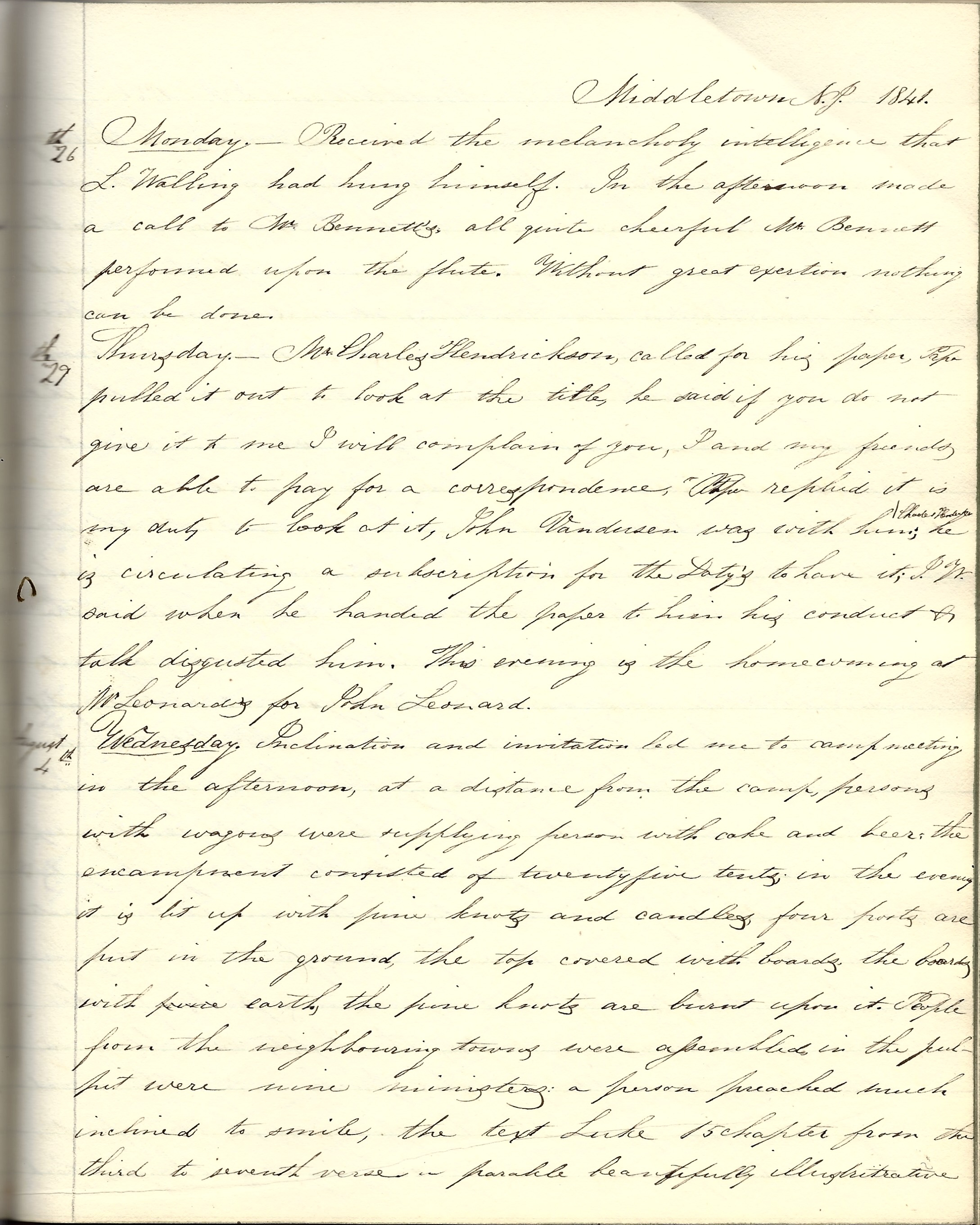
Monday 26th. Received the melancholy intelligence that L[eonard] Walling [of Holmdel] had hung himself. In the afternoon made a callto Mr. Bennett’s. All quite cheerful. Mr. Bennett performed upon the flute. Without great exertion, nothing can be done.
Thursday 29th. Mr. Charles Hendrickson called for his paper. Papa pulled it out to look at the title. He said if you do not give it to me, I will complain of you. I and my friends are able to pay for a correspondence.” Papa replied, “It is my duty to look at it.” John Van Dusen was with him. He (Charles Hendrickson) is circulating a subscription for the Doty’s to have it. J. W. said when he handed the paper to him his conduct & talk disgusted him. This evening is the homecoming at Mr. Leonard’s for John Leonard.
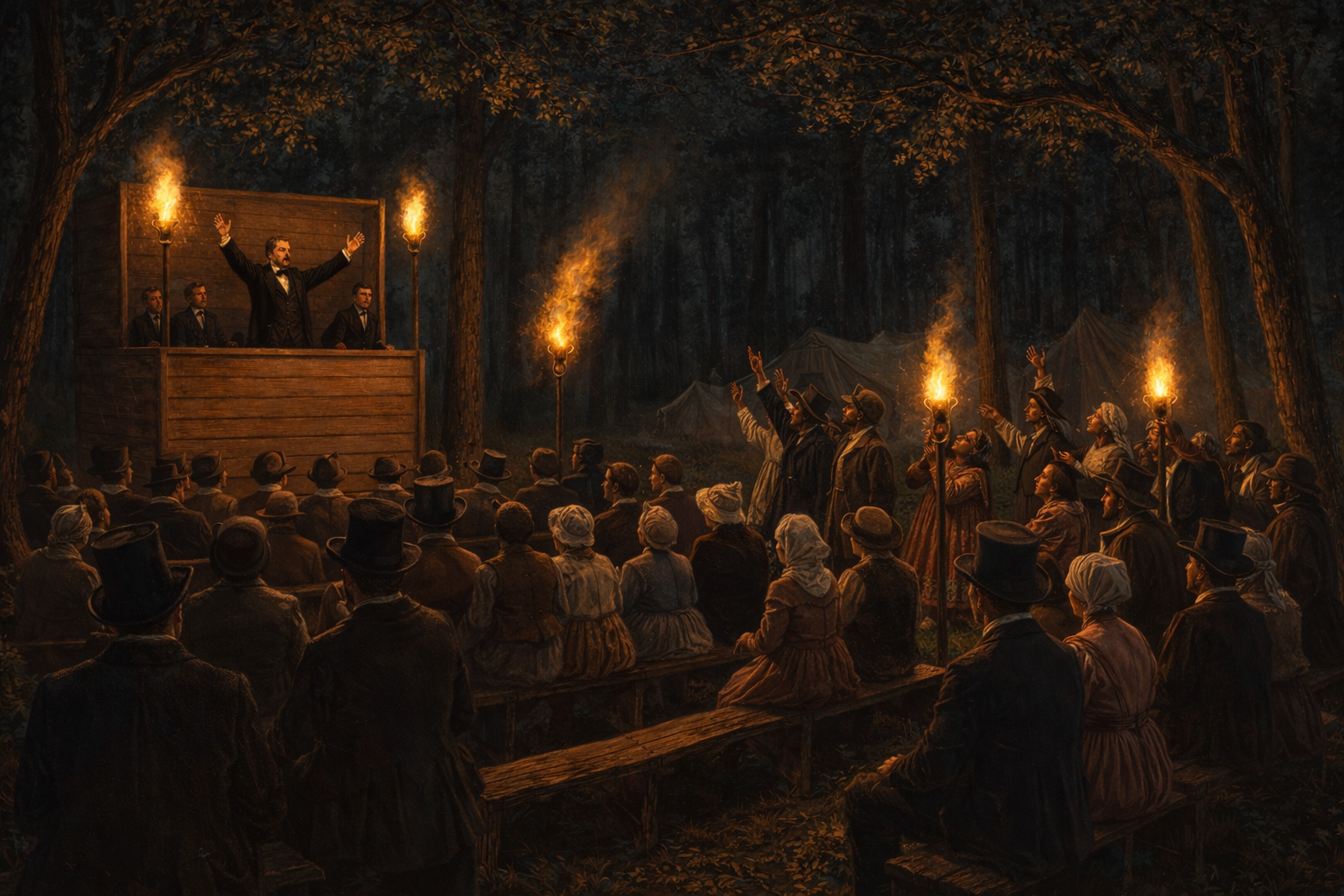
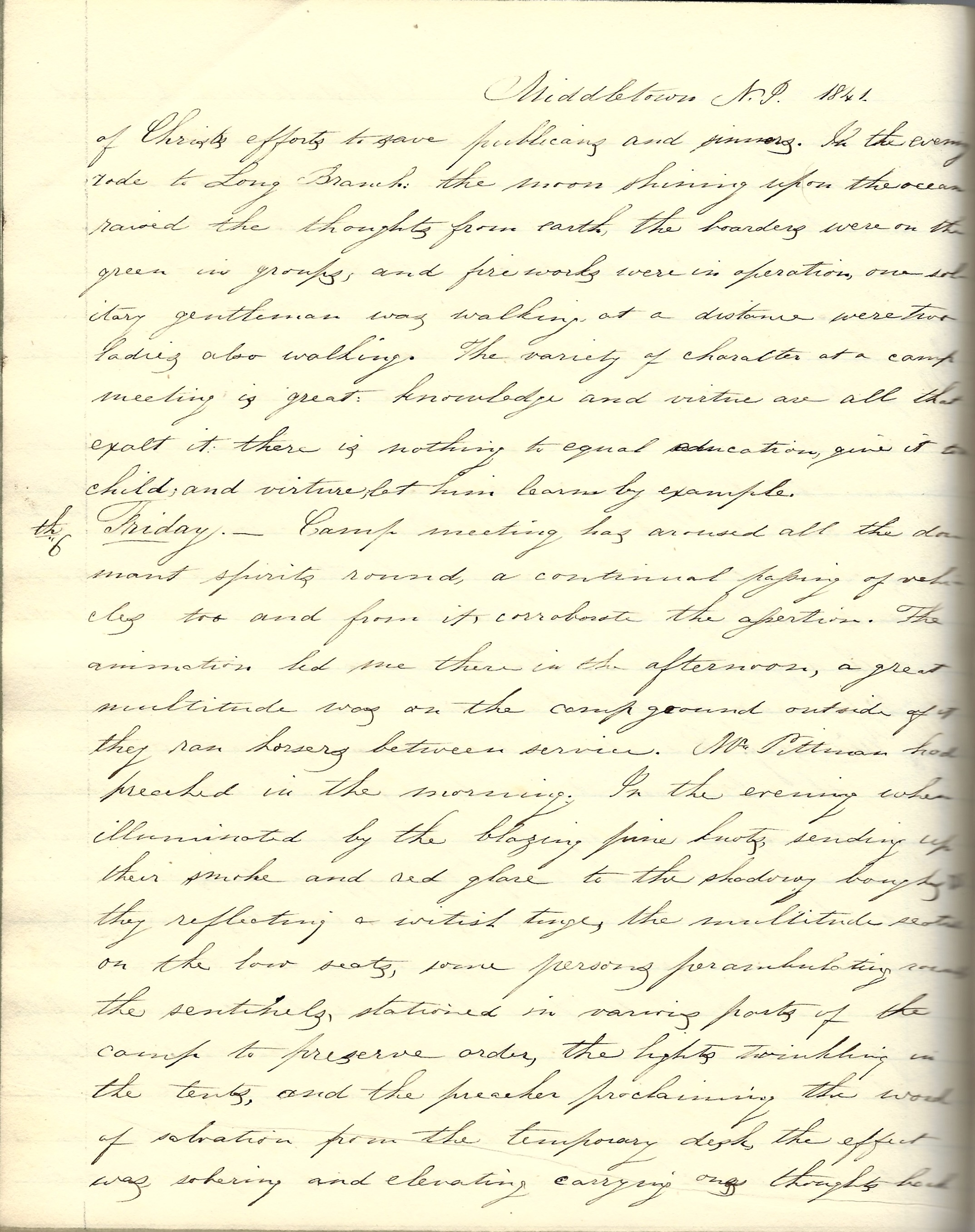
Wednesday, August 4, 1841. Inclination and invitation led me to camp meeting in the afternoon. At a distance from the camp, persons with wagons were supplying persons with cake and beer. The encampment consisted of 25 tents. In the evening it is lit up with pine knots and candles. Four posts are put in the ground, the top covered with boards; the boards with earth. The pine knots are burnt upon it. People from the neighboring towns were assembled; in the pulpit were nine ministers. A person preached much inclined to smile. The text was Luke, 15th Chapter from the 3rd to the 7th verse—a parable beautifully illustrative of Christ’s efforts to save publicans and sinners.
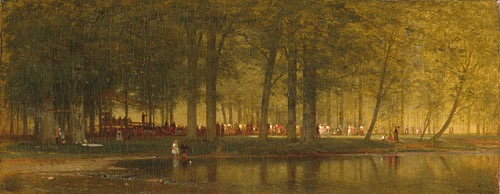
In the evening, rode to Long Branch. The moon shining upon the ocean raised the thoughts from earth. The boarders were on the green in groups and fireworks were in operation. One solitary gentleman was walking at a distance. Were two ladies also walking. The variety of characters at a camp meeting is great. Knowledge and virtue are all that exalt it. There is nothing to equal education. Give it to a child; and virtue, let him learn by example.
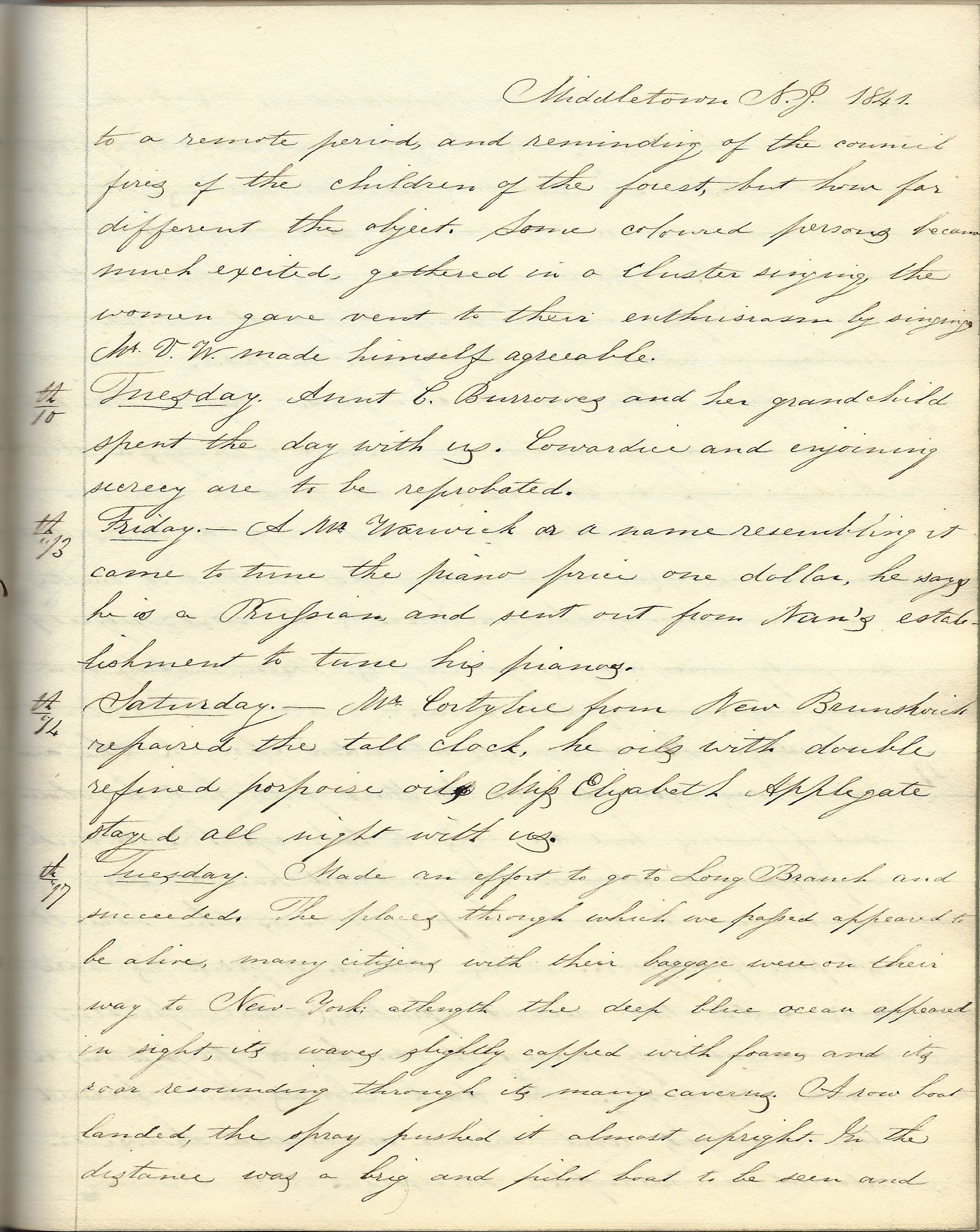
Friday 6th. Camp meeting has aroused all the dominant spirits round, a continual passing of vehicles to and from it, corroborate the operation. The animation led me there in the afternoon. A great multitude was on the camp ground. Outside of it they ran horses between service. Mr. [Charles] Pitman had preached in the morning. In the evening when illuminated by the blazing pine knots sending up their smoke and red glare to the shadowy bough & they reflecting a whitish tinge, the multitude seated on the low seats, some persons perambulating the word of salvation from the temporary desk, the effect was sobering and elevating, carrying one’s thoughts back to a remote period and reminding of the counsel fires of the children of the forest. But how far different the object. Some colored persons became much excited, gathered in a cluster singing. The women gave vent to their enthusiasm by singing. Mr. V. W. made himself agreeable.
Tuesday 10th. Aunt C. Burrows and her grandchild spent the day with us. Cowardice and enjoining secrecy are to be reprobated.
Friday 13th. A Mr. Warwick or a name resembling it came to tune the piano. price one dollar. He says he is a Prussian and sent out from Nun’s establishment to tune his piano.
Saturday 14th. Mr. Cortylue from New Brunswick repaired the tall clock. He oils with double refined porpoise oil. Miss Elizabeth Applegate stayed all night with us.
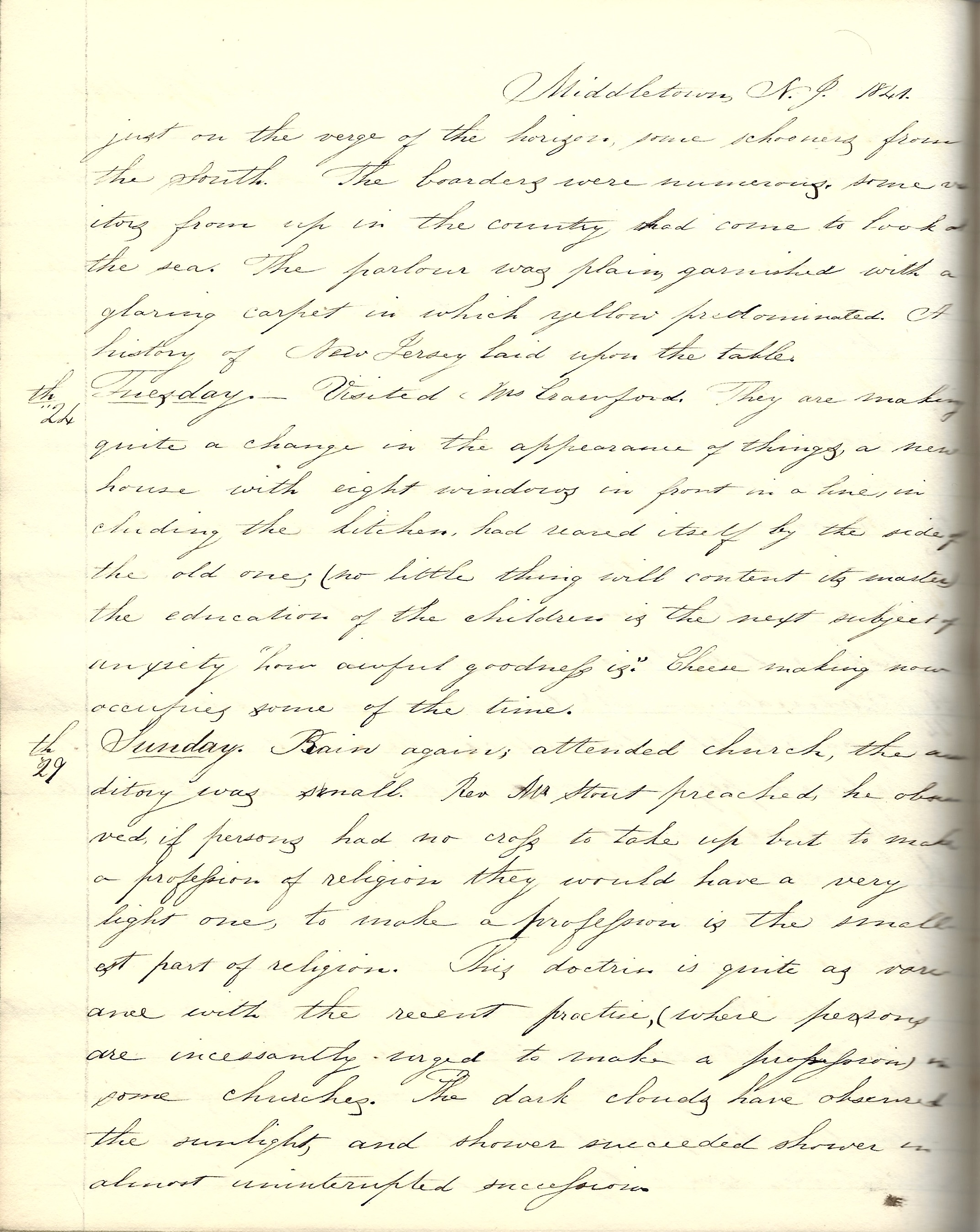
Tuesday 17th. Made an effort to go to Long Branch and succeeded. The places through which we passed appeared to be alive. Many citizens with their baggage were on their way to New York. Although the deep blue ocean appeared in sight, its waves slightly capped with foam and its roar resounding through its many caverns. A row boat landed. The spray pushed it almost upright. In the distance was a brig and pilot boat to be seen and just on the verge of the horizon, more schooners from the South. The boarders were numerous. Some visitors from up in the country had come to look at the sea. The parlor was plain, garnished with a glaring carpet in which yellow predominated. A history of New Jersey laid upon the table.
Tuesday, 24th. Visited Mrs. Crawford. They are making quite a change in the appearance of things—a new house with eight windows in front in a line, including the kitchen, had reared itself by the side of the old one (no little things will content its master). The education of the children is the next subject of anxiety “how awful goodness is.” Cheese making now occupies some of the time.
Sunday, 29th. Rain again. Attended church. The auditory was small. Rev. Mr. Stout preached. He observed if persons had no cross to take up but to make a profession of religion they would have a very light one. To make a profession is the small part of religion. This doctrine is quite at variance with the recent practice (where persons are incessantly urged to make a profession) in some churches. The dark clouds have obscured the sunlight and shower succeeded shower in almost uninterrupted succession.
Middletown, New Jersey, September 1, 1841. My father and George left for New York. George to proceed with his studies.
Thursday 2nd. Something new under the sun, to me—two letters came broken open. The receiver said it was because they had been brought by private conveyance from Ireland. If they had not been broken open, the bearer would have to have paid a heavy price. The meeting of days held yesterday the Mormons commences today—held a few miles from here. A graduate from Princeton made some remarks upon them.
Monday 6th. Yesterday the Mormon meeting concluded. Was agreeably surprised to see a friend of my sister’s, Miss Robb. She came from Deal alone with the driver from Red Bank. She has been spending three weeks at Saratoga. Miss Sedgwick’s letters are powerful persuaders to “go and do likewise.” Miss Robb brought them with her. [See Letters from Abroad to Kindred at Home (1841) by Catharine Maria Sedgwick of Stockbridge Massachusetts]
Tuesday 7th. In the afternoon, Miss Robb and [sister] Eleanor called to see M. H. T.
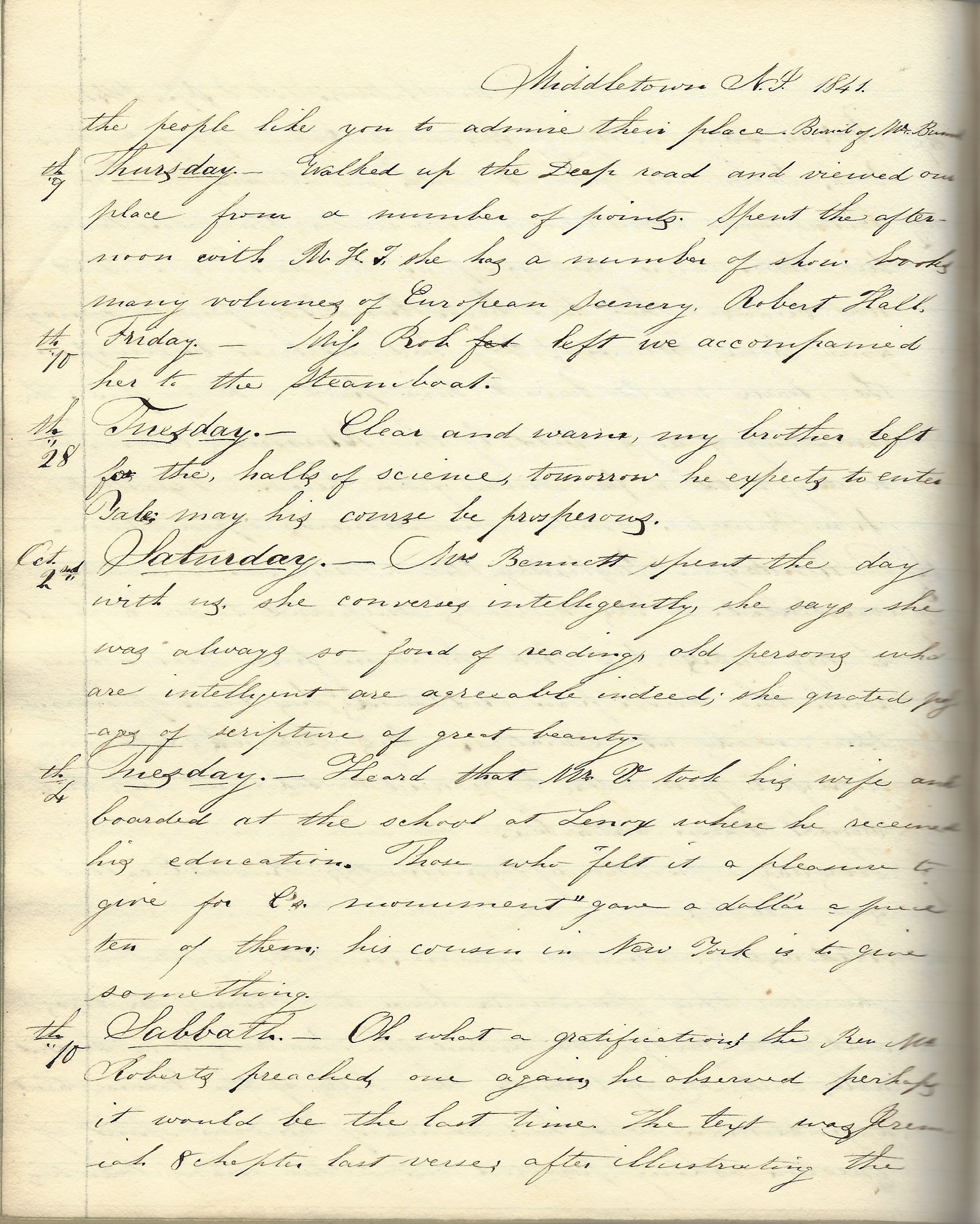
Wednesday 8th. In the afternoon, M. H. T. visited us. She has this summer been to Niagara, Saratoga, and Stockbridge. She found the Yankees very hospitable, and coming through the falls of the Connecticut [river], a gentleman who had much of her own spirit of question asking, pointed out to her many beauties the people like you to admire their place. Burial of Mr. [Lyman Phelps] Bunnell.
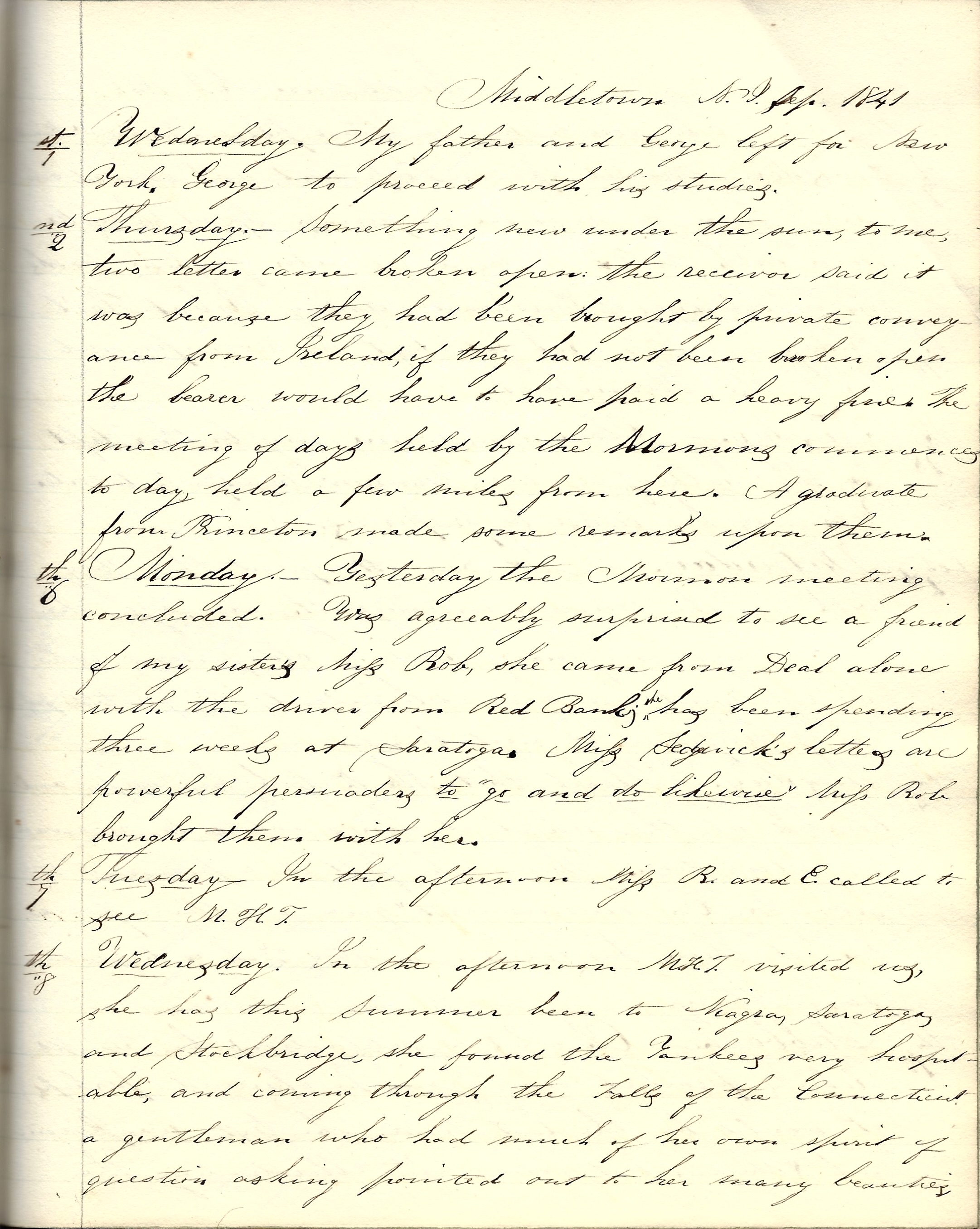
Thursday 9th. Walked up the Deep road and viewed our place from a number of points. Spent the afternoon with M. H. T. She has a number of show books, many volumes of European scenery. Robert Hall.
Friday 10th. Miss Rob left. We accompanied her to the steamboat.
Tuesday 28th. Clear and warm. My brother left for the halls of science. Tomorrow he expects to enter Yale. May his course be prosperous.
Middletown, New Jersey, Saturday, October 2, 1841. Mrs. Bennett spent the day with us. She converses intelligently. She says she was always so fond of reading. Old persons who are intelligent are agreeable indeed. She quoted passages of scripture of great beauty.
Tuesday 4th. Heard that Mr. V. took his wife and boarded at the school at Lenox where he received his education. Those who “felt it a pleasure to give for C’s [Crawford’s?] monument” gave a dollar apiece—ten of them. His cousin in New York is to give something.
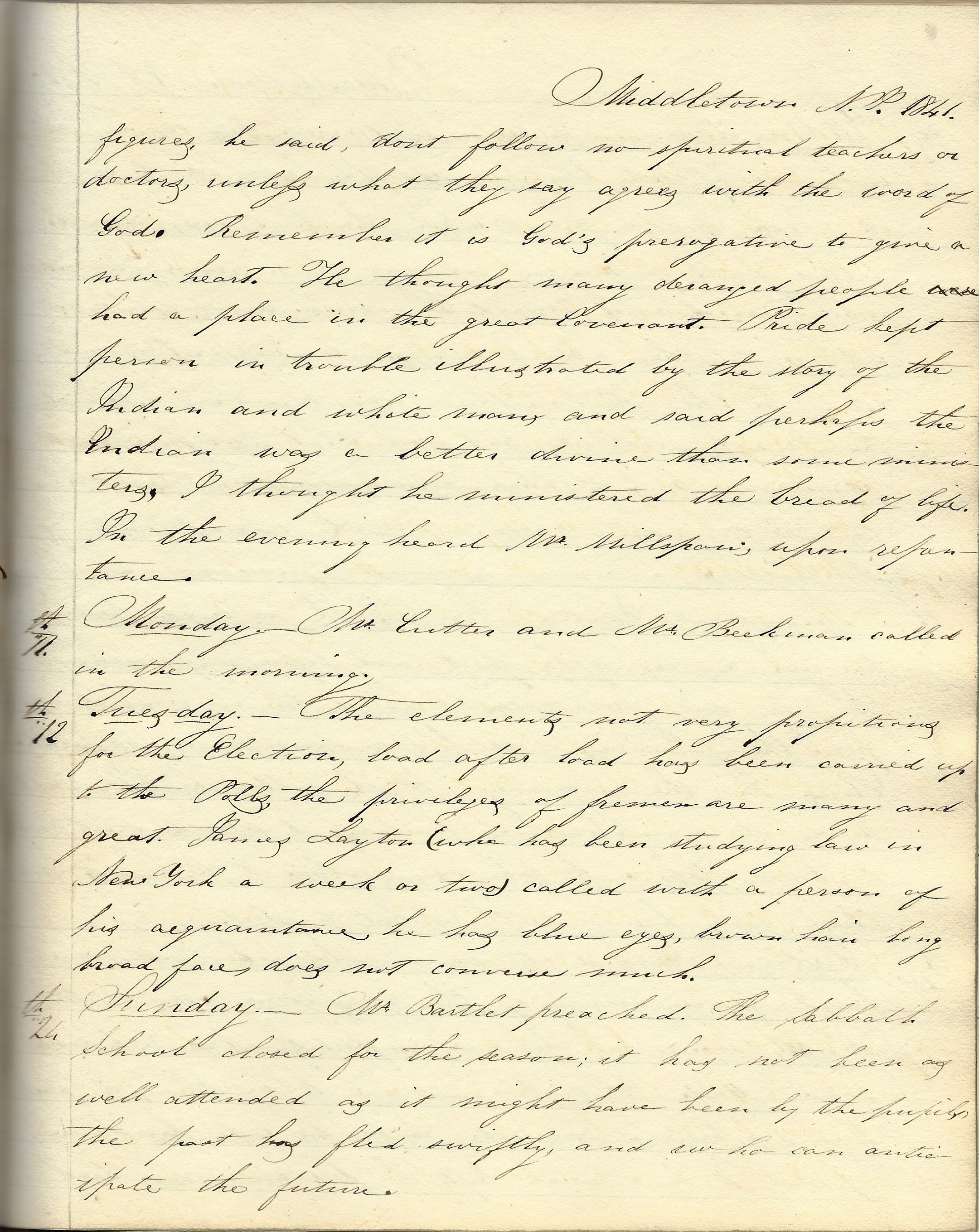
Sabbath 10th. Oh, what a gratification. The Rev. Mr. Roberts preached once again. He observed perhaps it would be the last time. The text was Jeremiah 8th Chapter, last verse. After illustrating the figures, he said, don’t follow no spiritual teachers or doctors unless what they say agrees with the word of God. Remember it is God’s prerogative to give a new heart. He though many deranged people had a place in the great Covenant. Pride kept person in trouble illustrated by the story of the Indian and the white man, and said perhaps the Indian was a better divine than some ministers. I thought he ministered the bread of life. In the evening heard Mr. Millspan upon [the subject of] repentance.
Monday 11th. Mr. Cutter and Mr. Beekman called in the evening.
Tuesday [October] 12th. The elements not very propitious for the Election. Load after load has been carried up to the polls—the privileges of freemen are many and great. James Layton (who has been studying law in New York a week or two) called with a person of his acquaintance. He has blue eyes, brown hair, long broad face. Does not converse much.
Sunday 24th. Mr. Bartlett preached. The Sabbath School closed for the season. It has not been as well attended as it might have been by the pupils. The past has fled swiftly and who can anticipate the future.
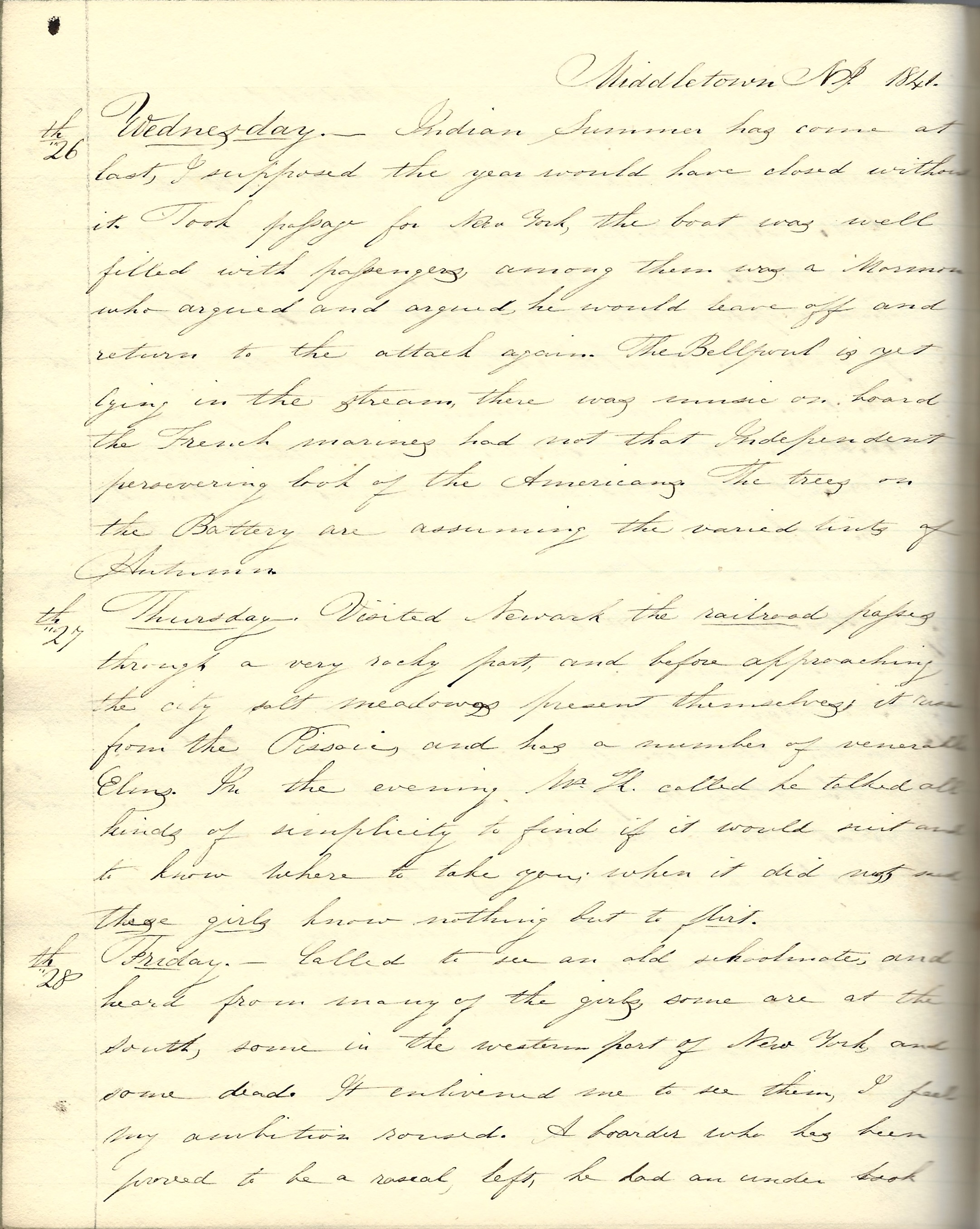
Wednesday 26th. Indian summer has come at last. I supposed the year would have closed without it. Took passage for New York. The boat was well filled with passengers. Among them was a Mormon who argued and argued. He would leave off and return to the attack again. The Bellfont[e] is yet lying in the steam. There was music on board. The French marines had not that independent, persevering look of the Americans. The trees on the Battery are assuming the varied tints of Autumn.
Thursday 27th. Visited Newark. The railroad passes through a very rocky part and before approaching the city salt meadows present themselves. It rises from the Passaic and has a number of venerable Elms. In the evening Mr. K. called. He talked all kinds of simplicity to find if it would suit and to know where to take you. When it did not, said these girls know nothing but to flirt.
Friday 28th. Called to see an old schoolmate and heard from many of the girls. Some are at the South, some in the western part of New York, and some dead. It enlivened me to see them. I feel my ambition roused. A boarder has been proved to be a rascal, left. He had an under look out of his eyes and was always telling how rich he was and to crown all, left without paying his bill. In the evening visited the Panorama of Rome. It seemed like classic ground and every object stands prominent in memory.
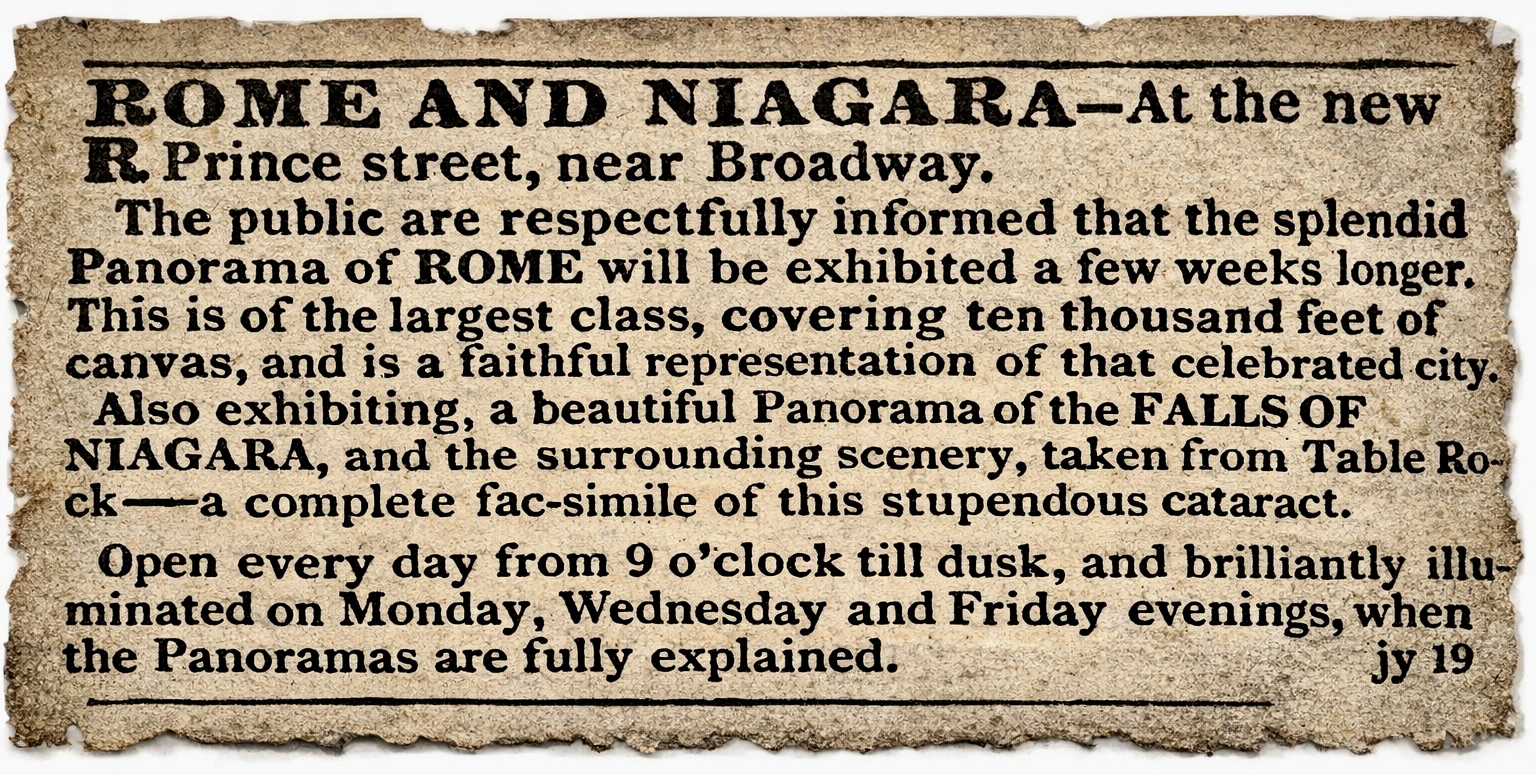
Saturday 29th. I think when persons question you they do not think much of you. At [ ] Dock was a lady with a horse and one waiting for a gentleman. They presented quite a spectacle to the passengers. Had a pleasant passage over; the leaves are just ready to fall.
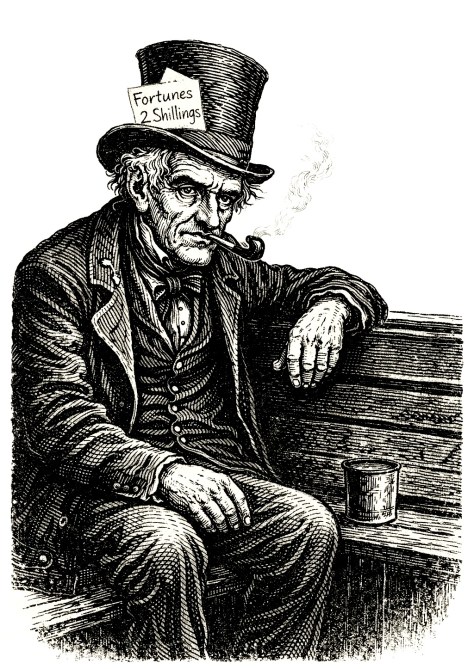
Tuesday, November 9, 1841. Left home for New York. The steamboat was loaded with passengers. Amusing the multitude was a person who told fortunes—old, gray haired, high forehead, eyes deep set [with] a shrewd look out of them. He was a native of New England. He told them gratuitously what he did tell, though no one would give him the required remuneration.
Landed a person to Fort Hamilton. Twilight was fast settling upon the Narrows. As I looked back upon them from Fort Hamilton, they never appeared more beautiful. Having reached New York, the cab men came crowding on board, as vociferous as usual, requiring tongue and whip to get passengers.
Wednesday 18th. Joyously left New York for New Haven at 7 a.m. The number of passengers was small. After much expectation, New Haven appeared in view laying in all its beauty. Had the pleasure of seeing my brother.
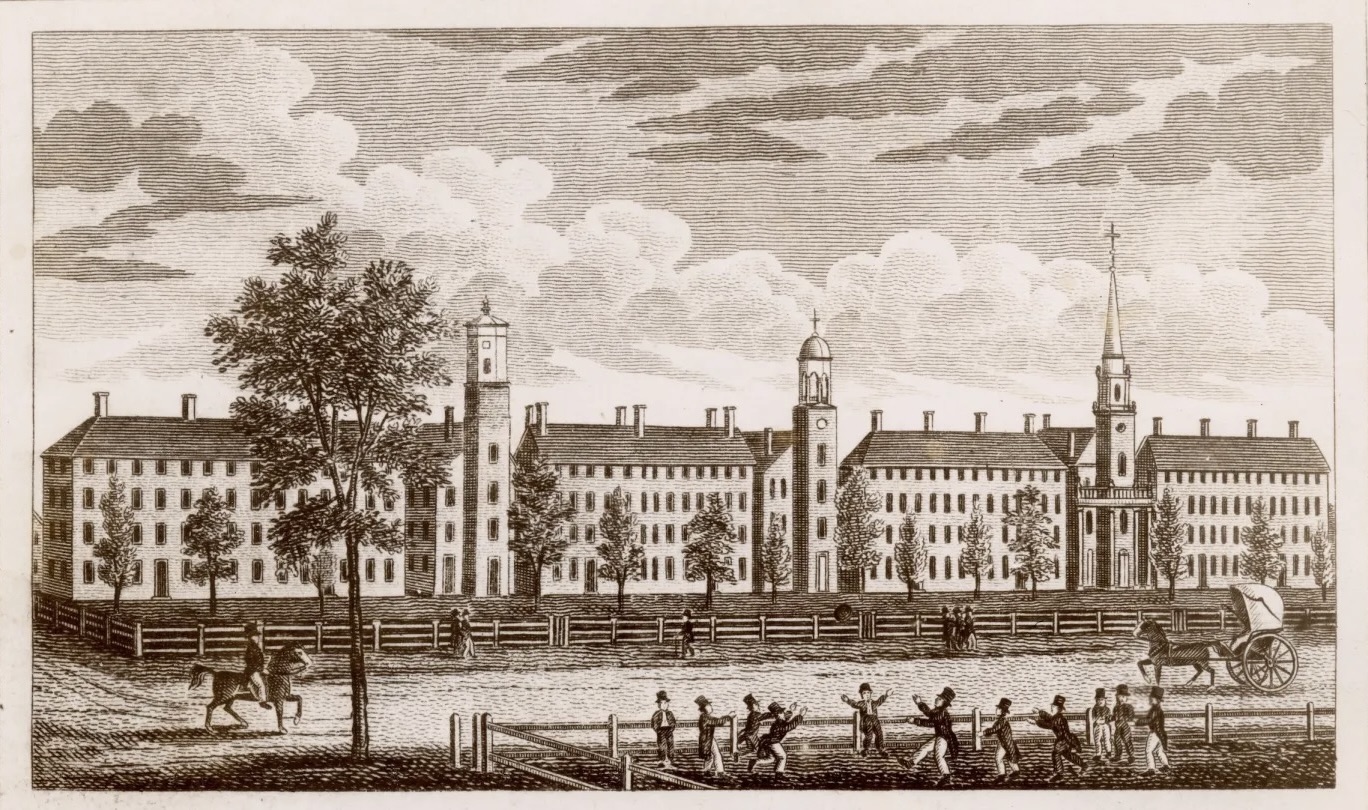
Thursday 11th. Took a last look at the college buildings and green, and churches. Left New Haven for New York. Many passengers were on board, each displaying his several characteristics. The atmosphere was so clear that Bridgeport and several [other] places upon the Sound were distinctly to be seen.
Friday 12th. A storm. Left for home which I reached at noon.
Monday 29th. At ten o’clock this evening it ceased snowing. This is the first snow storm this winter. It commenced yesterday evening at seven o’clock. The moon shining upon the new fallen snow which covered hill and dale, and was just perceivable through the leafless woods had a fine appearance. It was the purity of Heaven. Not a stain had marred its whiteness. The lovers of sleigh riding are, I presume, anticipating enjoyment in abundance. I know of nothing to prevent.
Tuesday 30th. Mr. Samuel Beekman and his bride [Henrietta Lyon] spent the evening with us. Henrietta has been to [the Moravian Seminary for Girls] school at Bethlehem [Pennsylvania], four times across the State of New Jersey.
Middletown, New Jersey, Wednesday, December 1, 1841. Attended the opening of the Baptist Church at Keyport. The church is beautiful. There were in the pulpit Mr. Webb, Mr. Stout, Mr. Hires, and Mr. Willson. A short time below it were Mr. [Samuel] Sproul and three Methodist brethren, and Mr. Willson’s. The musicians sung accompanied by a person who played upon a basse viol. The Rev. Mr. Webb preached from 122 Psalm. 1st verse. He showed the peculiarities of the house of God. The Bible is to be read there. If Christ and the work he has done is put out of sight, let what will be substituted in its place. All will be darkness and moral death. The influence of the spirit if it does not accompany our ministrations, they will be of no avail. There is danger before the people upon that point. The Lord’s Supper to be taken then. The influence of a place of worship upon families and places. We buy our gold too dear when we place our families where there is no religious instruction.
Thursday 2nd. Mr. Chambers from New York called in the evening.
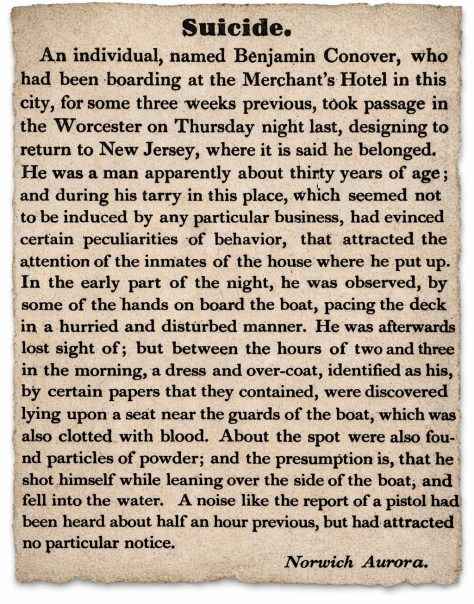
Monday 6th. The winds of Heaven are loaded with either good or evil tidings. Today has been wafted to us the tidings of Mr. Benjamin Conover’s cutting his throat. It was done on board the steamboat Worcester on its rout from Norwich to New York. He fell over board. In his pocket was a note payable by Griffin Clark of Middletown.
Thursday 9th. Appointed by the Governor as a day of public thanksgiving. Service in the Baptist church which has never been before at the order of the Governor. Rev. Mr. Stout preached from Psalm 103, 10th verse, “He hath not dealt with us after our sins, nor rewarded us according to our inequities.” Spent the afternoon at Mr. B’s.
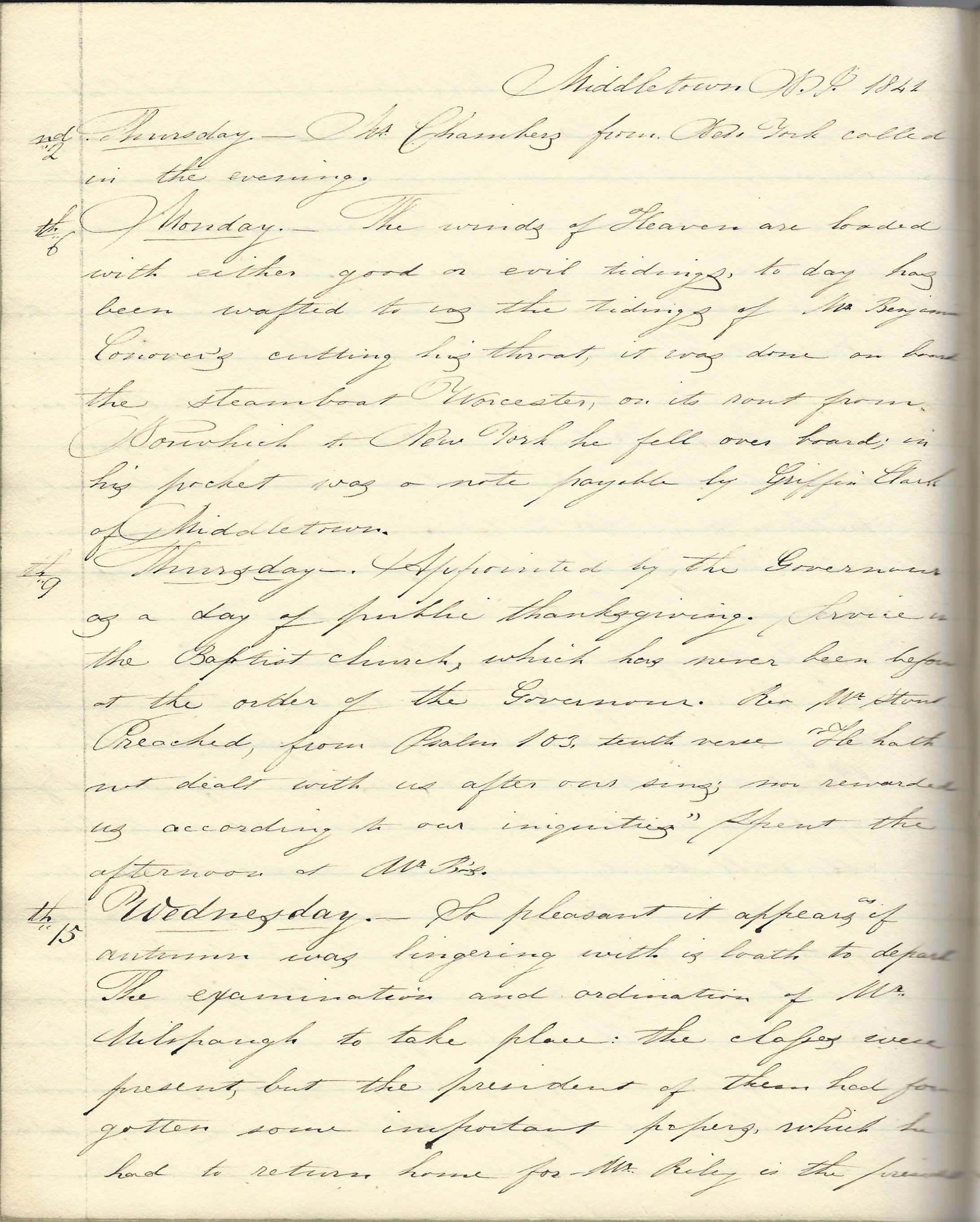
Wednesday 15th. So pleasant it appears as if Autumn was lingering with us, loath to depart. The examination and ordination of Mr. [Alexander G.] Millspaugh to take place [at the Reformed Dutch Church]. The class were present but the president of them had forgotten some important papers which he had to return home for. Mr. Riley is the president during his absence. A sermon was preached. The congregation was not present at the examination. In the evening the ordination took place. Eight ministers were present. Rev. Mr. Demun preached the sermon, Rev. Mr. Riley gave the pastoral charge, and Rev. Mr. Marcellus gave the charge to the people.
Friday 17th. My birthday. In looking at the past, I can see no great improvement simply for want of effort. Every mercy has been mine.
Sunday, [December] 19th. Attended the funeral of Mr. Gordon who assisted in the Sunday School the past summer. He died quite young. Rev. Mr. Stout preached from the text, “To die is gain.” He enlarged upon the piety of the deceased. Most gloomy weather, a threatening of snow.

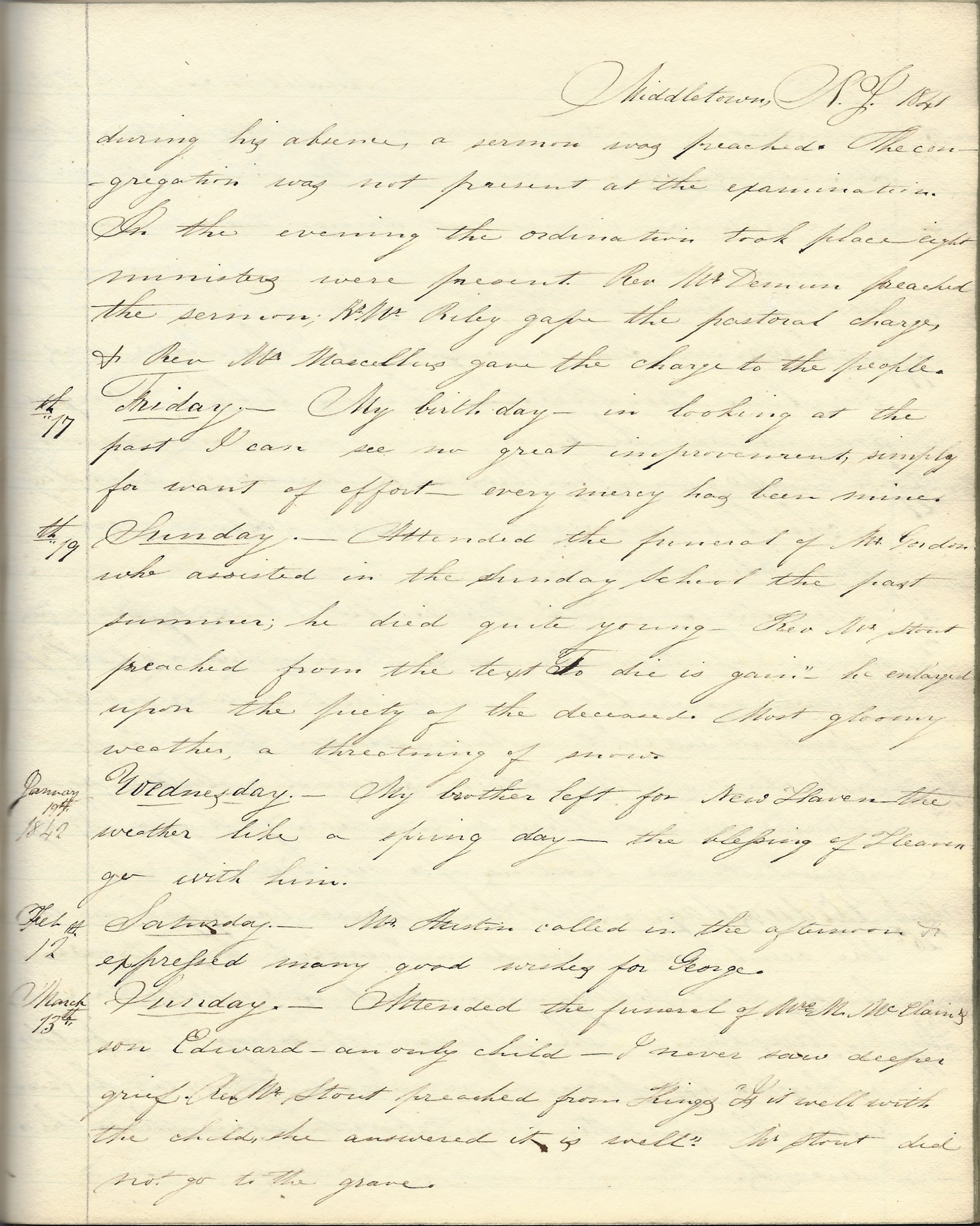
Middletown, New Jersey, Wednesday, January 19, 1842. My brother left for New Haven. The weather like a spring day. The blessing of Heaven go with him.
Saturday, February 12, 1842. Mr. Austin called in the afternoon & expressed many good wishes for George.
Sunday, March 13, 1842. Attended the funeral of Mrs. M[ary] McClane’s son Edward—an only child. I never saw deeper grief. Rev. Mr. Stout preached from Kings, “It is well with the child, she answered it is well.” Mr. Stout did not go to the grave.
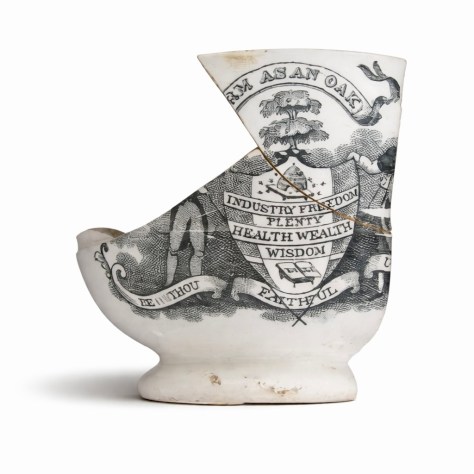
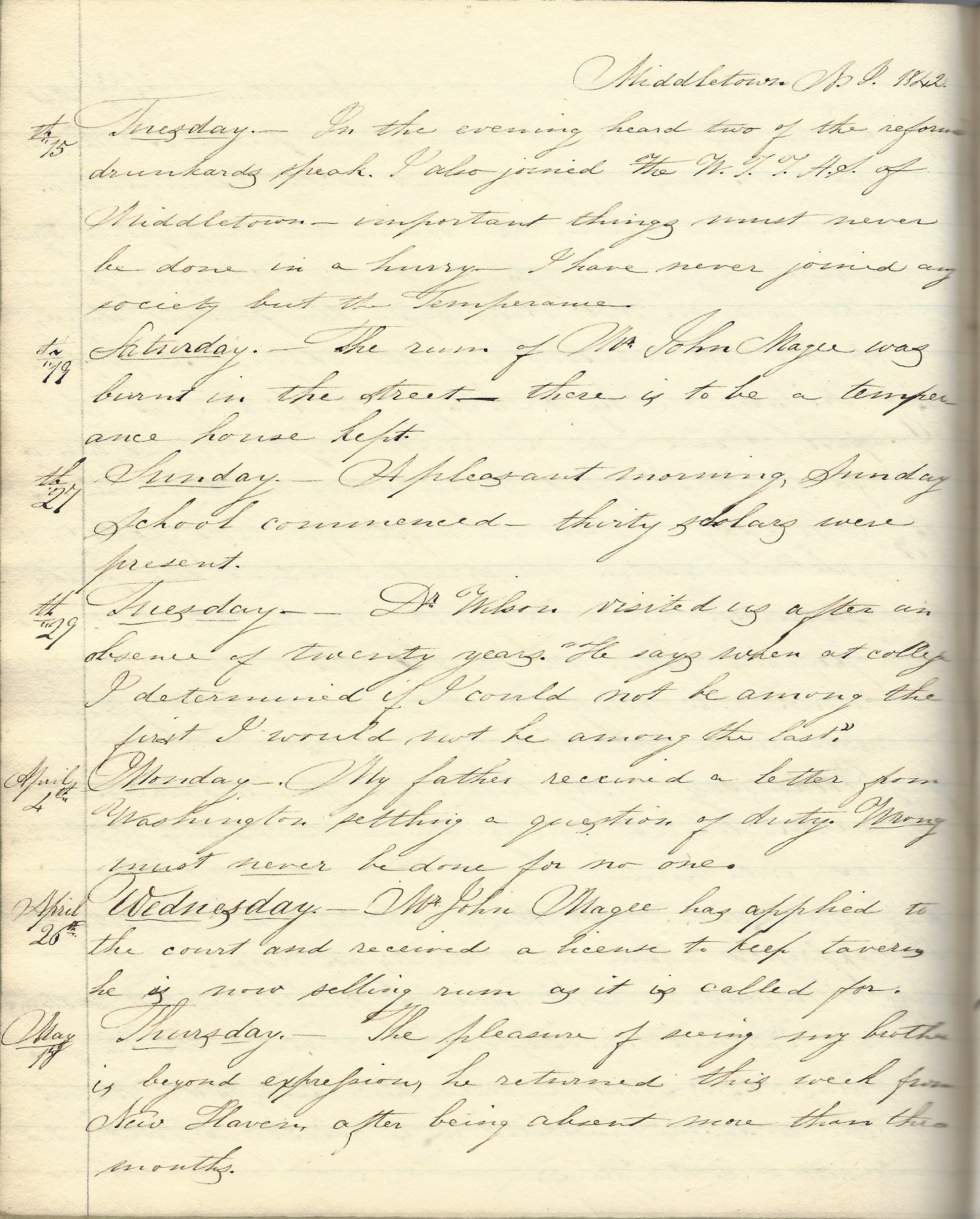
Tuesday, 15th. In the evening heard two of the reformed drunkards speak. I also joined the W. T. T. A. S. [Washingtonian Temperance Total Abstinence Society] of Middletown—important things must never be done in a hurry. I have never joined any society but the Temperance.
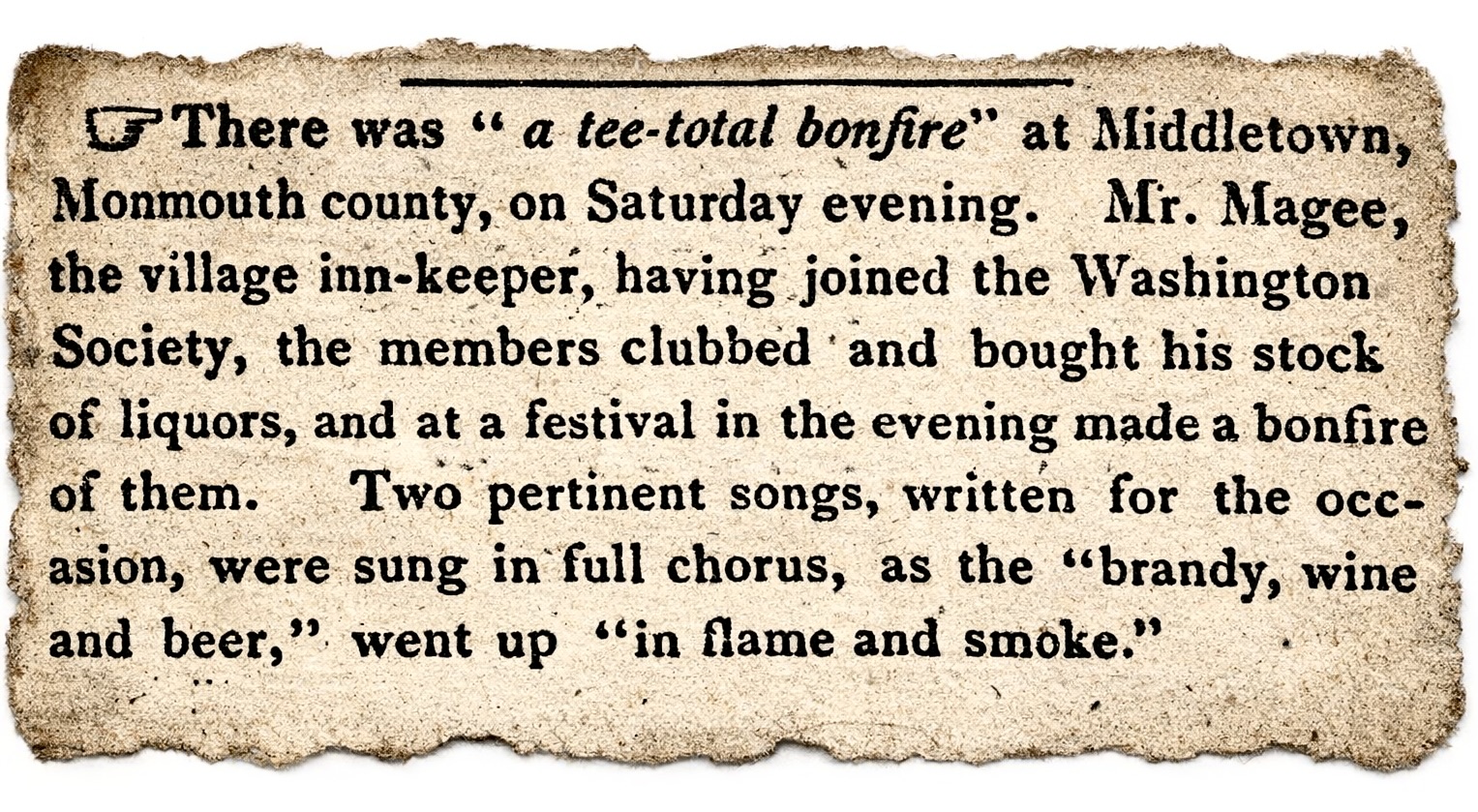
Saturday [March] 19th. The rum of Mr. John Magee was burnt in the street. There is to be a temperance house kept.
Sunday 27th. A pleasant morning. Sunday School commenced. Thirty scholars were present.
Tuesday 29th. Dr. Wilson visited us after an absence of twenty years. He says, “When at college, I determined if I could not be among the first, I would not be among the last.”
Monday, April 4, 1842. My father received a letter from Washington settling a question of duty. Wrong must never be done for no one.
Wednesday, April 26th. Mr. John Magee has applied to the court and received a license to keep tavern. He is now selling rum as it is called for.
Thursday, May [?], 1842. The pleasure of seeing my brother is beyond expression. He returned this week from New Haven after being absent more than three months.
Wednesday, May 11, 1842. In the evening attended the anniversary of the Home Missionary Society. One that addressed the meeting was the Rev. Dr. [Peter] Parker. He spoke of the American Missionary remarking there was a boldness andexpectancy about him, the stamp of the national character. The anniversary was held in the Tabernacle. Thousands were present.
Friday 13th. Returning home passed through Staten Island Sound. Upon its shores are some tasteful situations.
Middletown, New Jersey, Sunday, May 15, 1842. Dr. Milldollar delivered a sermon in the Episcopal Church in the afternoon, text, “I have thought on my ways and turned my feet to thy testimonies.” He said a good man might be turned in his course by temptation, but he never rested until in the narrow path again. A noble ship, by winds, may be turned out of its course, while with set sails and lashed helm, its course is onward.
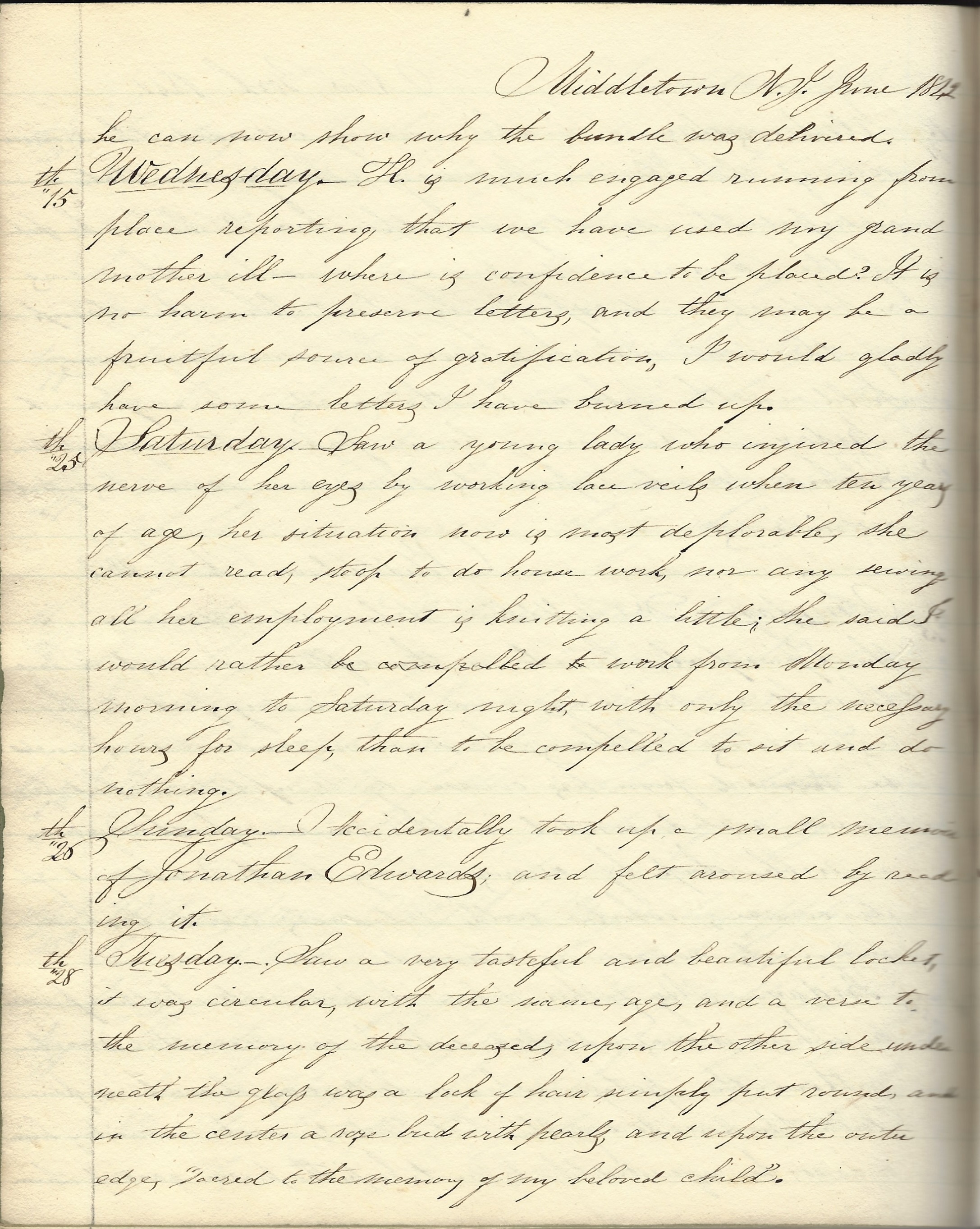
Friday, June 3, 1842. My father delivered a bundle to the person to whom it was addressed which came in the mail without the postage when a letter was shown him from Fuller, the Assistant of the Postmaster General instructing him to do so. [When] he requested the letter to keep, the person gave it to him. He can now show why the bundle was delivered.
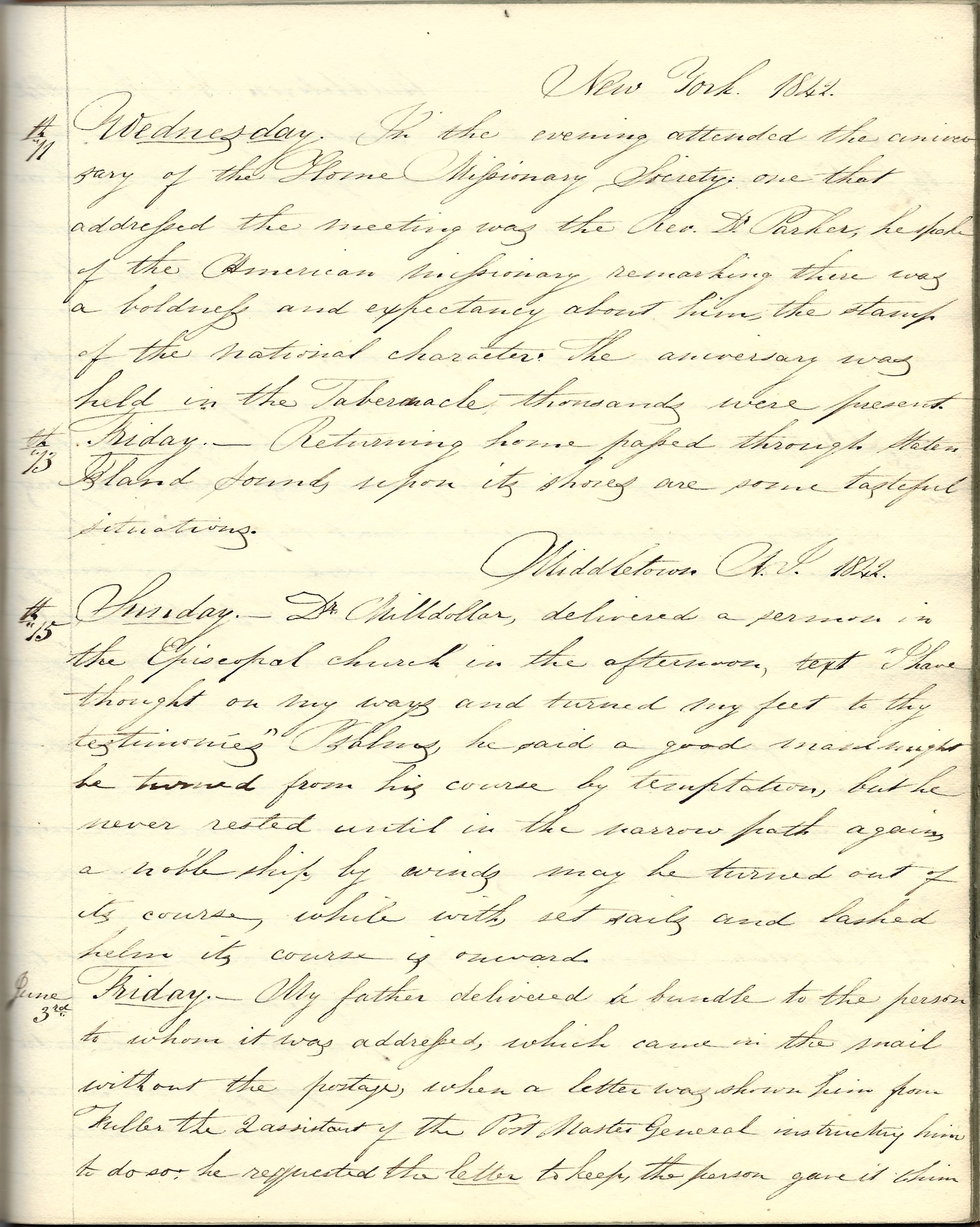
Wednesday 15th. H. is much engaged running from place [to place] reporting that we have used my grandmother ill. Where is confidence to be placed? It is no harm to preserve letters and they may be a fruitful source of gratification. I would gladly have some letters I have burned up.
Saturday 25th. Saw a young lady who injured the nerve of her eyes by working lace veils when ten years of age. Her situation now is most deplorable. She cannot read, stoop to do house work, nor any sewing. All her employment is knitting a little. She said I would work from Monday morning to Saturday night with only the necessary hours for sleep than to be compelled to sit and do nothing.
Sunday 26th. Accidentally took up a small memoir of Jonathan Edwards and felt aroused by reading it.
Tuesday 28th. Saw a very tasteful and beautiful locket. It was circular with the name, age, and a verse to the memory of the deceased. Upon the other side underneath the glass was a lock of hair simply put round and in the center a rose bud with pearl, and upon the outer edge, “Sacred to the memory of my beloved child.”
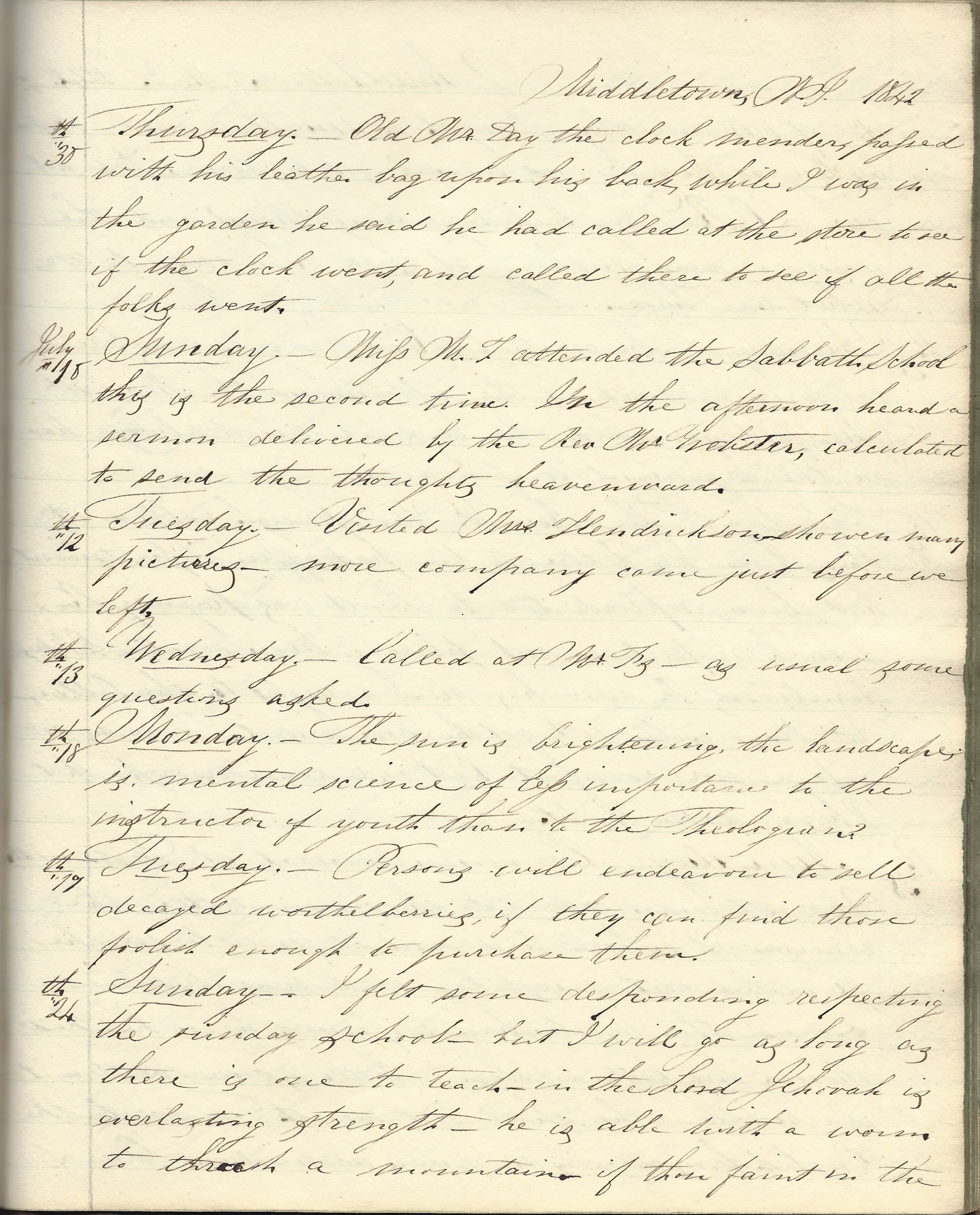
Thursday 30th. Old Mr. Day, the clock mender, passed with his leather bag upon his back while I was in the garden. He said he had called at the store to see if the clock went and called there to see if all the folks went.
Monday, July 10, 1842. Miss M. T. attended the Sabbath School. This is the second time. In the afternoon heard a sermon delivered by the Rev. Mr. Webster calculated to send hte thoughts heavenward.
Tuesday 12th. Visited Mrs. Hendrickson. Shown many pictures. More company came just before we left.
Wednesday 13th. Called at Mr. T’s. As usual some questions asked.
Monday 18th. The sun is brightening the landscape. Is mental science of less importance to the instructor of youth than to the Theologian?
Tuesday 19th. Persons will endeavor to sell decayed whortleberries if they can find those foolish enough to purchase them.
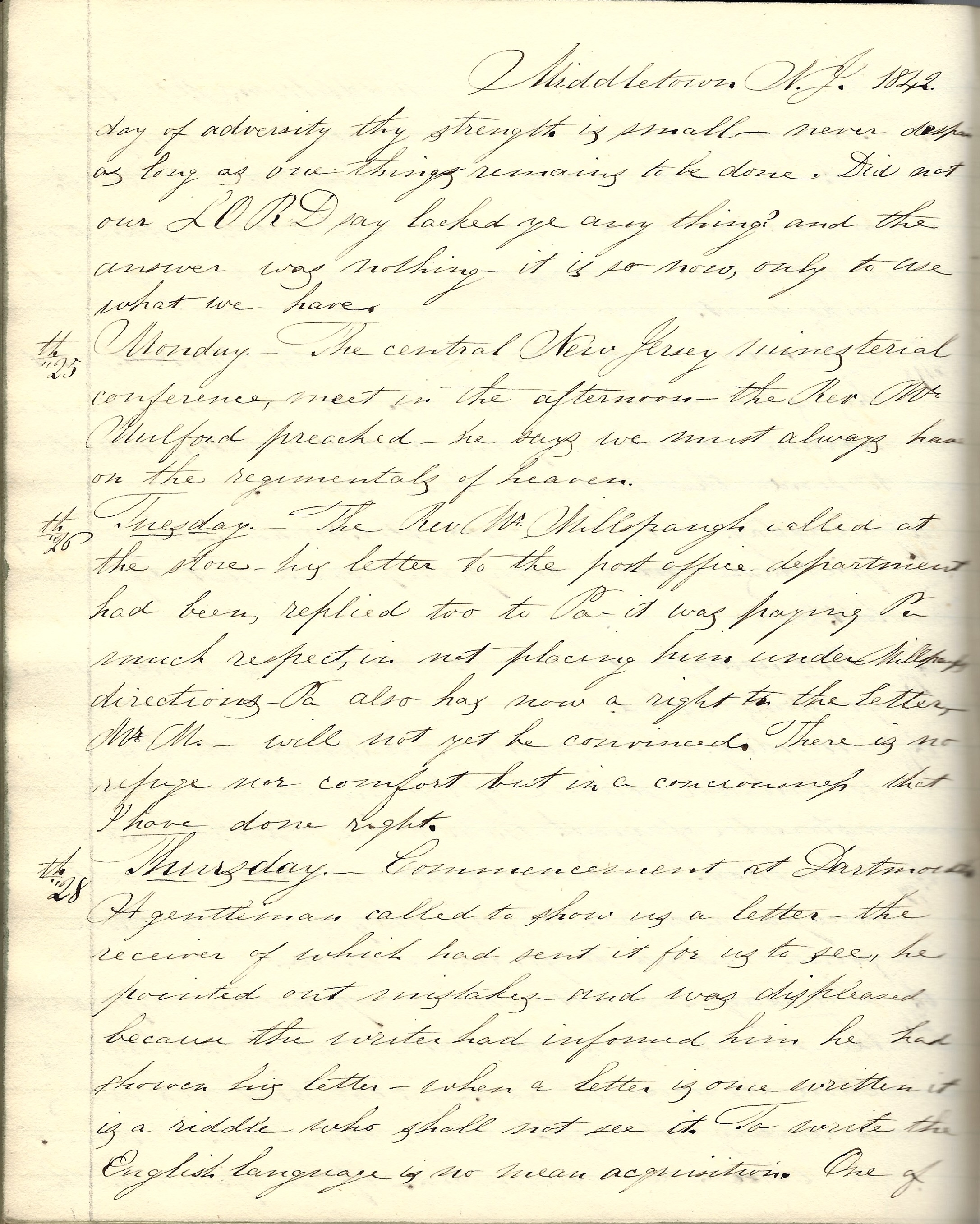
Sunday 24th. I felt some desponding respecting the Sunday School but I will go as long as there is one to teach in the Lord Jehovah is everlasting strength. He is able with a worm to thrash a mountain. If thou faint in the day of adversity, thy strength is small. Never despair as long as one thing remains to be done. Did not our LORD say lacked ye anything? and the answer was nothing. If is so now, only to use what we have.
Monday 25th. The Central New Jersey Ministerial Conference met in the afternoon. The Rev. Mulford preached. He says we must always have on the regimentals of heaven.
Tuesday 26th. The Rev. Mr. Millspaugh called at the store. His letter to the Post Office Department had been replied to to Pa. It was paying Pa much respect in not placing him under Millspaugh’s directions. Pa also has now a right to the letter. Mr. M. will not yet be convinced. There is no refuge nor comfort but in a consciousness that I have done right.
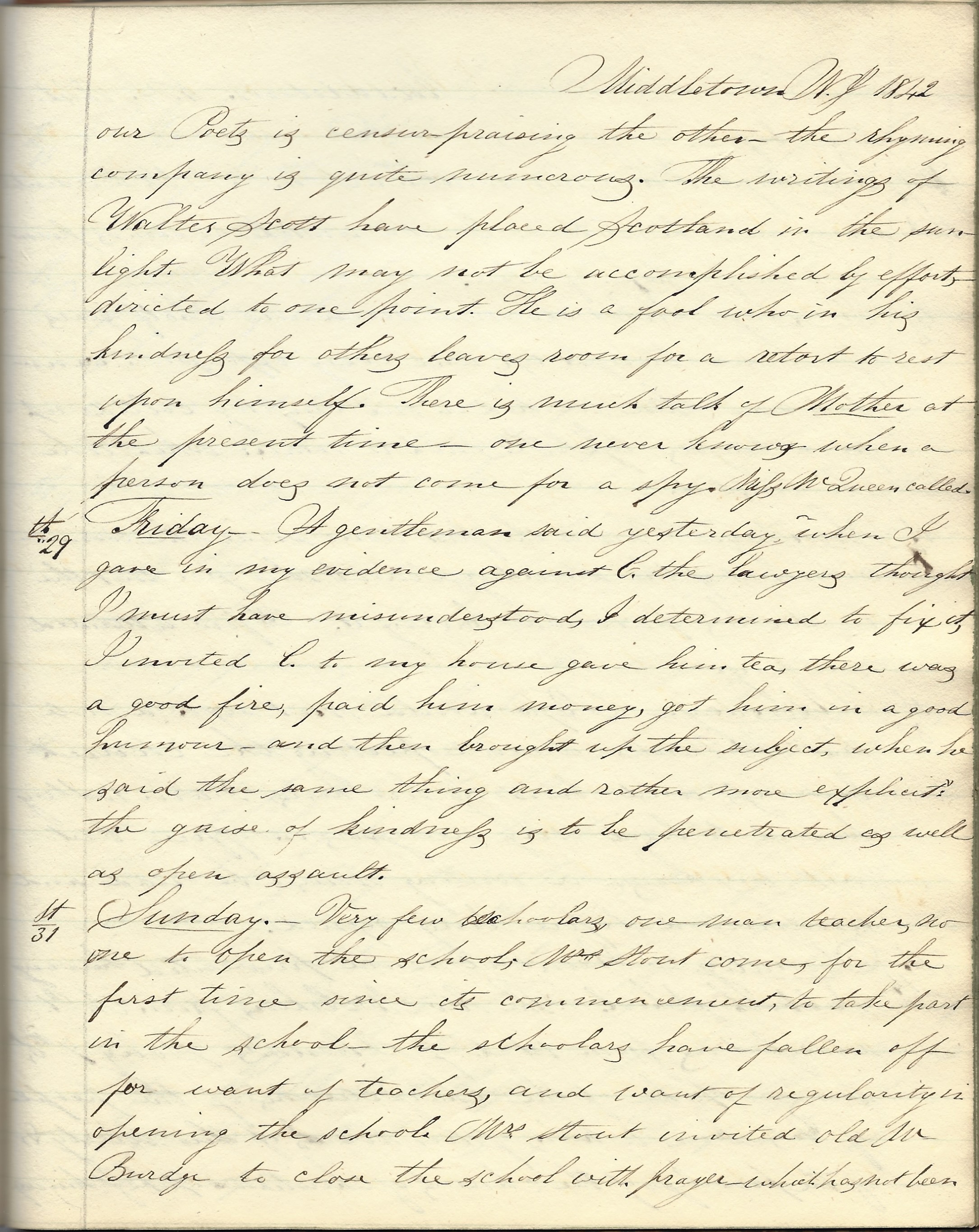
Thursday 28th. Commencement at Dartmouth. A gentleman called to show us a letter, the receiver of which had sent it for us to see. He pointed out mistakes and was displeased because the writer had informed him he had shown his letter. When a letter is once written, it is a riddle who shall not see it. To write the English language is no mean acquisition. One of our poets is censur-praising the other. The rhyming company is quite numerous. The writing of Walter Scott have placed Scotland in the sunlight. What may not be accomplished by effort, directed to one point. He is a fool who in his kindness for others leaves room for a retort to rest upon himself. There is much talk of Mother at the present time—one never knows when a person does not come for a spy. Miss McQueen called.
Friday 29th. A gentleman said yesterday when I gave in my evidence against C. the lawyers thought I must have understood. I determined to fix it. I invited C. to my house, gave him tea. There was a good fire, paid him money, got him in a good humor, and then brought up the subject when he said the same thing, and rather more explicit. The gaze of kindness is to be penetrated as well as open assault.
Sunday 31st. Very few scholars. One man teacher. No one to open the schools. Mrs. Stout came for the first time since its commencement to take part in the school. The scholars have fallen off for want of teachers, and want of regularity in opening the schools. Mrs. Stout invited old Mr. Burdye to close the school with prayer which has not been done before.
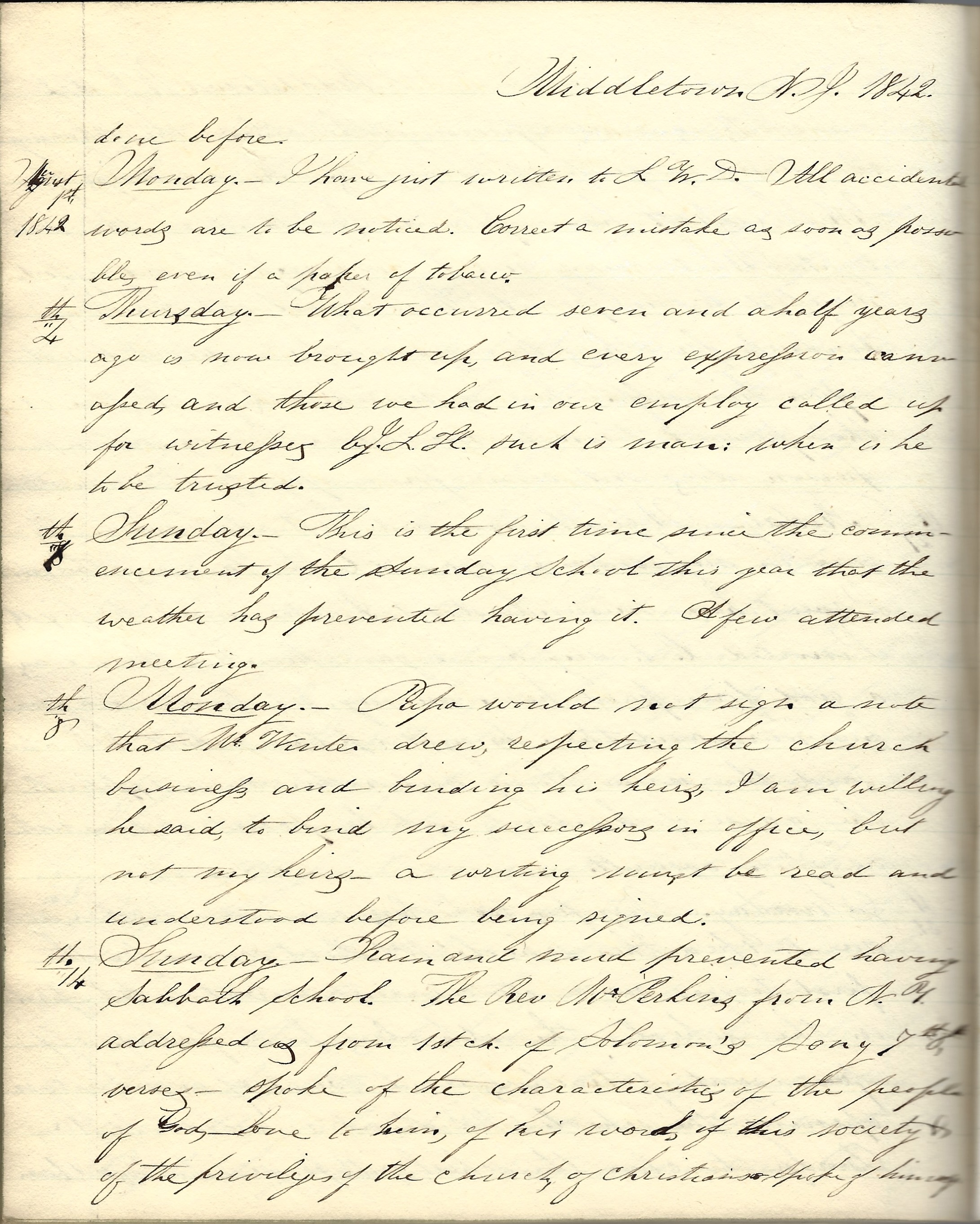
Middletown, New Jersey, Monday, August 1, 1842. I have just written to L. W. D. All accidental words are to be noticed. Correct a mistake as soon as possible even if a paper of tobacco.
Thursday 4th. What occurred seven and a half years ago is now brought up and every expression canvassed, and those we had in our employ called up for witnesses by J. L. H. Such is man. When is he to be trusted.
Sunday 7th. This is the first time since the commencement of the Sunday School this year that the weather has prevented having it. A few attended meeting.
Monday 8th. Papa would not sign a note that Mr. Winter drew, respecting the church business and binding his heirs. I am willing, he said, to bind my successors in office, but not my heirs. A writing must be read and understood before being signed.
Sunday 14th. Rain and mud prevented having Sabbath School. The Rev. Mr. Perkins from New York addressed us from 1st Chapter of Solomon’s Song 7th, [ ] verses. Spoke of the characteristics of the people of God, love to him, of his words, of this society &c., of the privileges of the church of christians…
Monday 15th. Mr. Dennis received a reply to his letter from the 2nd Assistant Postmaster General. Papa asked a copy and received it.
Tuesday 10th. On board the Rockland, a Yankee teacher speaking of the manner in which we conduct our schools said as we do not examine our teachers, are we not liable to be imposed upon and laughed. We are most wretchedly imposed upon.
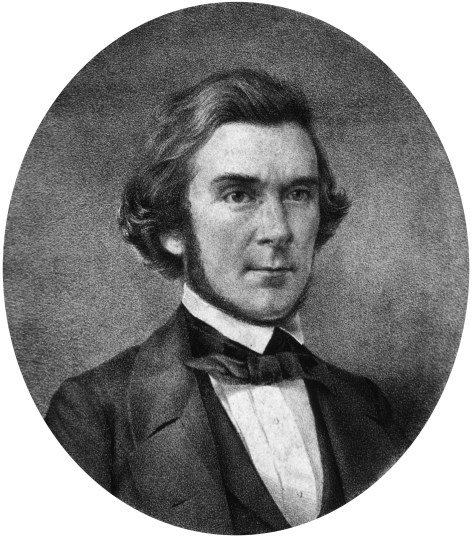
Wednesday 17th. Left New York at 6 o’clock in the morning. A great crowd on board the steamboat. Presently the sound was “all this is going ashore, go!” when there was a bustle and we were off. Many persons were on board going to attend the commencement [at Yale]. The procession of students was just entering the church & we passed to hear an address from Prof. Silliman. Was accommodated at a boarding house. In the afternoon visited Trumble Gallery. It contains many portraits of their great men. Elisha Yale stands among them in ancient style. The cabinet of the minerals containing an endless variety. It makes me want to study mineralogy. In the evening heard an address before the Phi Beta Kappa Society of Prof. [Samuel Henry] Dickson from the South. It was upon the power of knowledge.
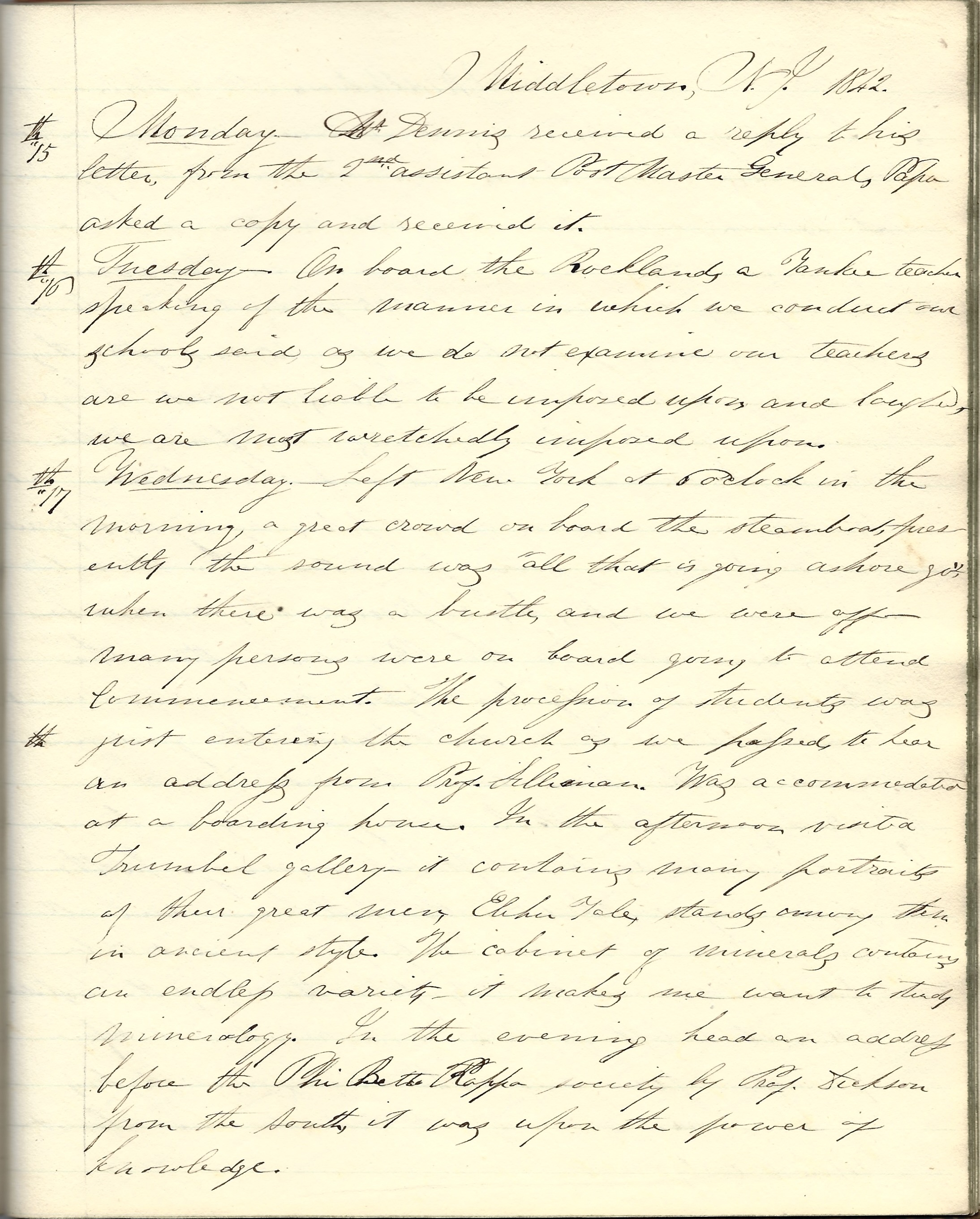
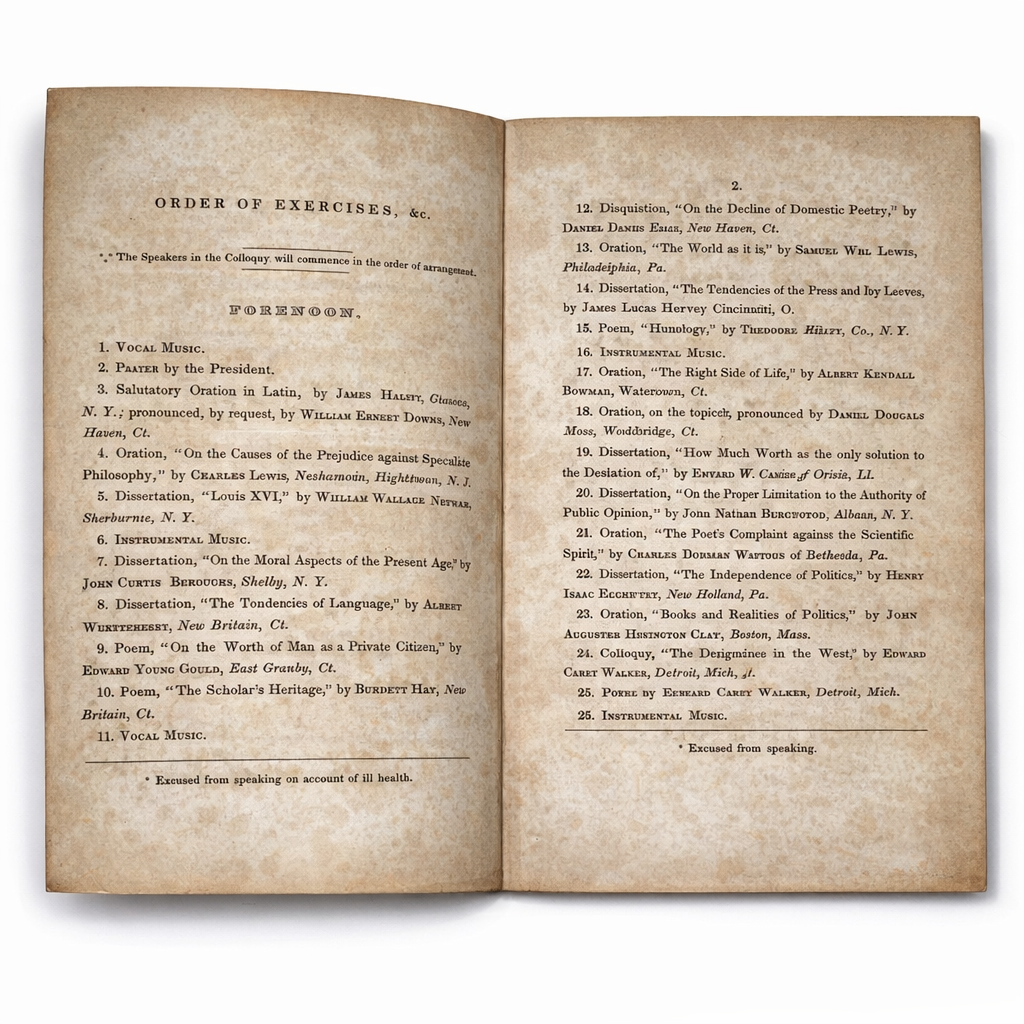
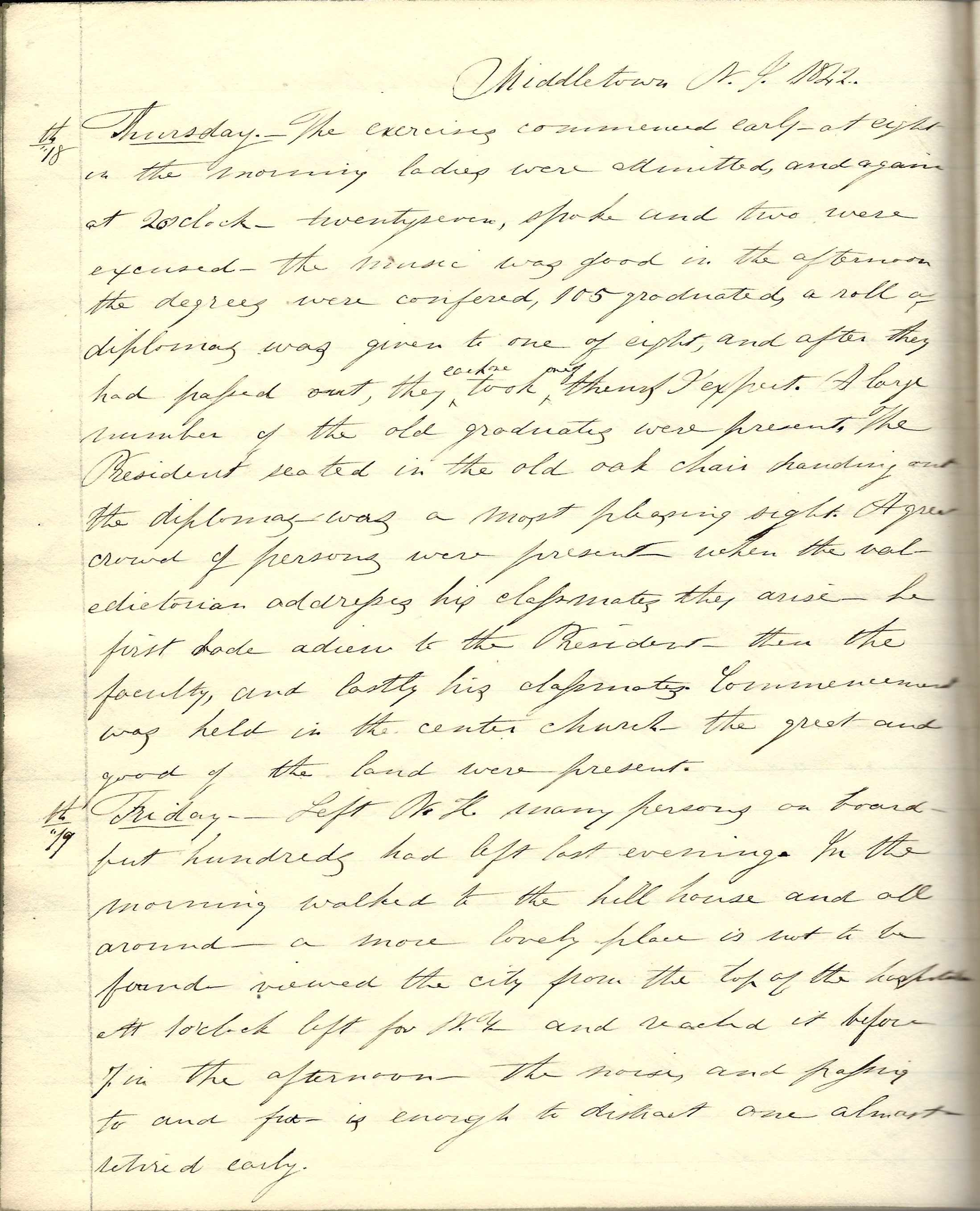
Thursday 18th. The exercises commenced early. At eight in the morning Ladies were admitted and again at 2 o’clock. Twenty-seven spoke and two were excused. The music was good. In the afternoon the degrees were conferred. 105 graduated. A roll of diplomas was given to one of eight and after they had passed out, they each one took one of them. I expect a large number of the old graduates were present. The President seated in the old oak chair handing out the displomas was a most pleasing sight. A great crowd of persons were present when the valedictorian addresses his classmates they arise. He first bade adieu to the President, then the faculty, and lastly his classmates. Commencement was held in the center church [chapel]. The great and good of the land were present.
Friday 19th. Left New Haven. Many persons on board but hundreds had left last evening. In the morning walked to the hill house and all around. A more lovely place is not to be found. Viewed the city from the top of the hospital. At ten o’clock left for New York and reached it before 7 in the afternoon. The noise and passing to and fro is enough to distract one almost. Retired early.
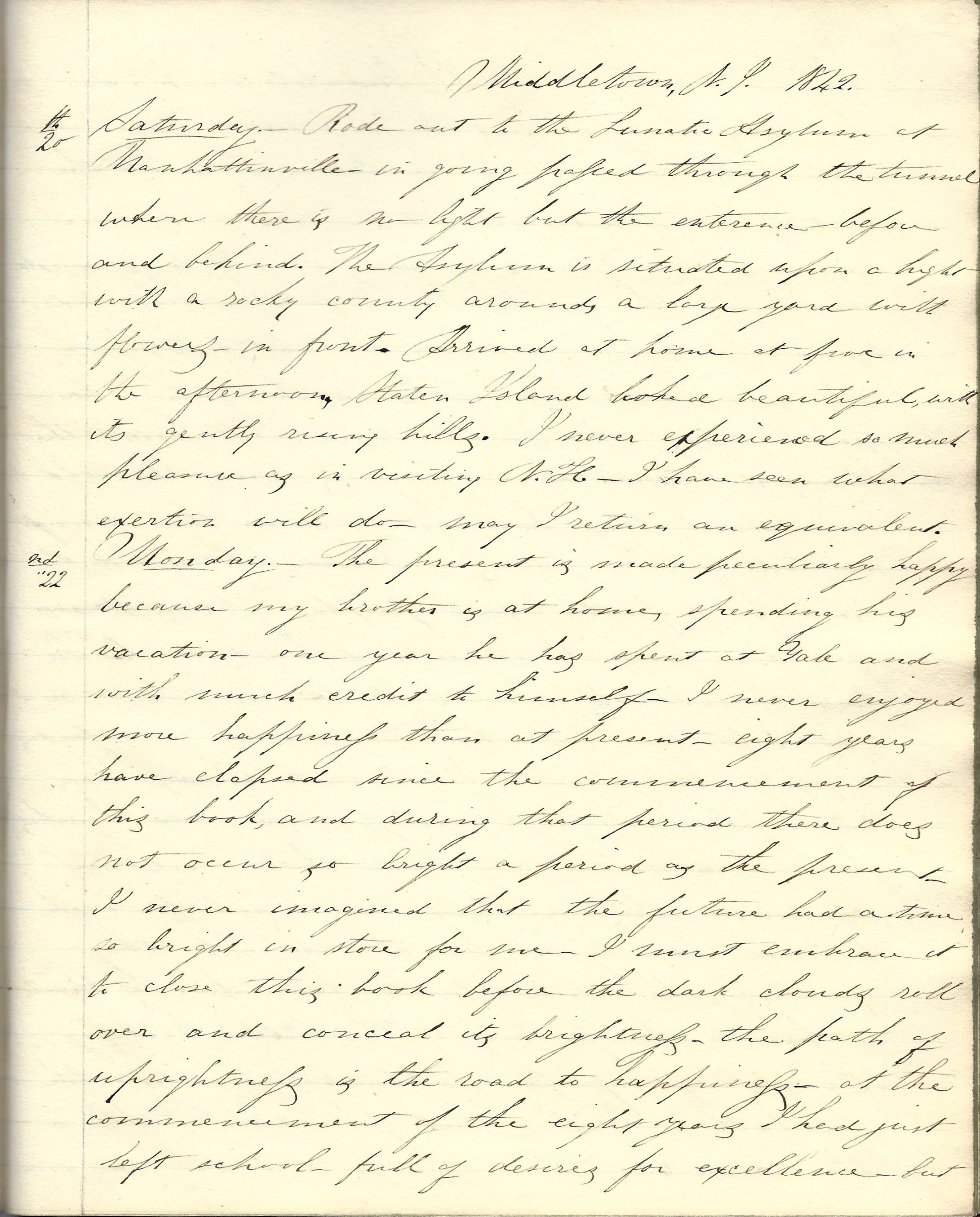
Saturday 20th. Rode out to the Lunatic Asylum at Manhattanville. In going, passed through the tunnel where there is a light but the entrance before and behind. The Asylum is situated upon a hight with a rocky county around a large yard with flowers in front. Arrived at home at five in the afternoon. Staten Island looked beautiful with its gently rising hills. I never experienced so much pleasure in visiting New Haven. I have seen what exertion will do. May I return an equivalent.
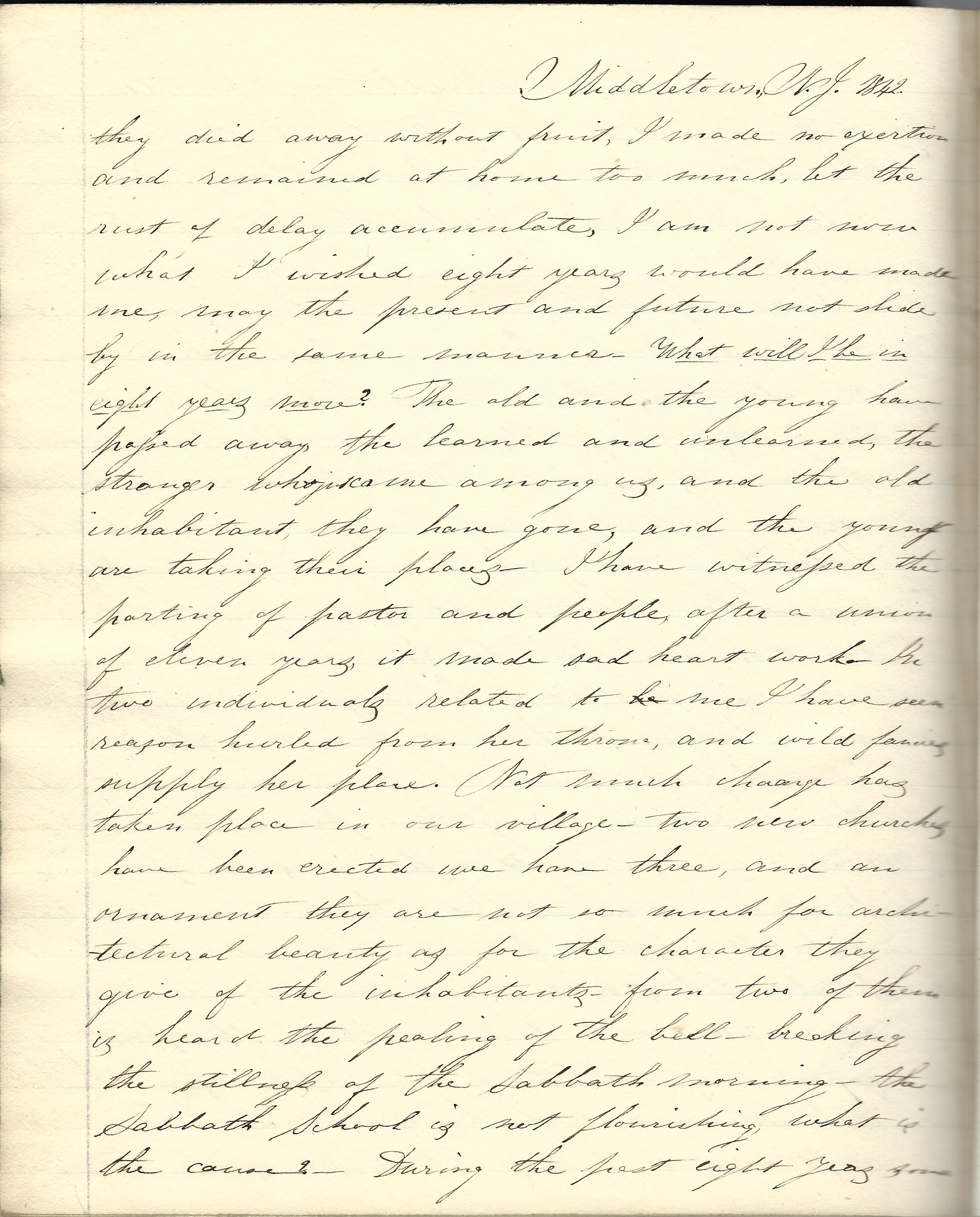
Monday 22nd. The present is made peculiarly happy because my brother is at home, spending his vacation. One year he has spent at Yale and with much credit to himself. I never enjoyed more happiness than at present. Eight years have elapsed since the commencement of this book, and during that period there does not occur so bright a period as the present. I never imagined that the future had a time so bright in store for me. I must embrace it to close this book before the dark clouds roll over and conceal its brightness—the path of uprightness is the road to happiness. At the commencement of the eight years I had just left school, full of desires for excellence, but they died away without fruit. I made no exertion and remained at home to much, let the rust of delay accumulate. I am not now what I wished eight years would have made me. May the present and future not slide by in the same manner.
What will I be in eight years more? The old and the young have passed away, the learned and unlearned, the stranger who just came among us, and the old inhabitant, they have gone, and the young are taking their place. I have witnessed the parting of pastor and people after a union of eleven years. It made sad heart work. In two individuals related to me I have seen reason hurled from her throne, and wild fancies supply her place.
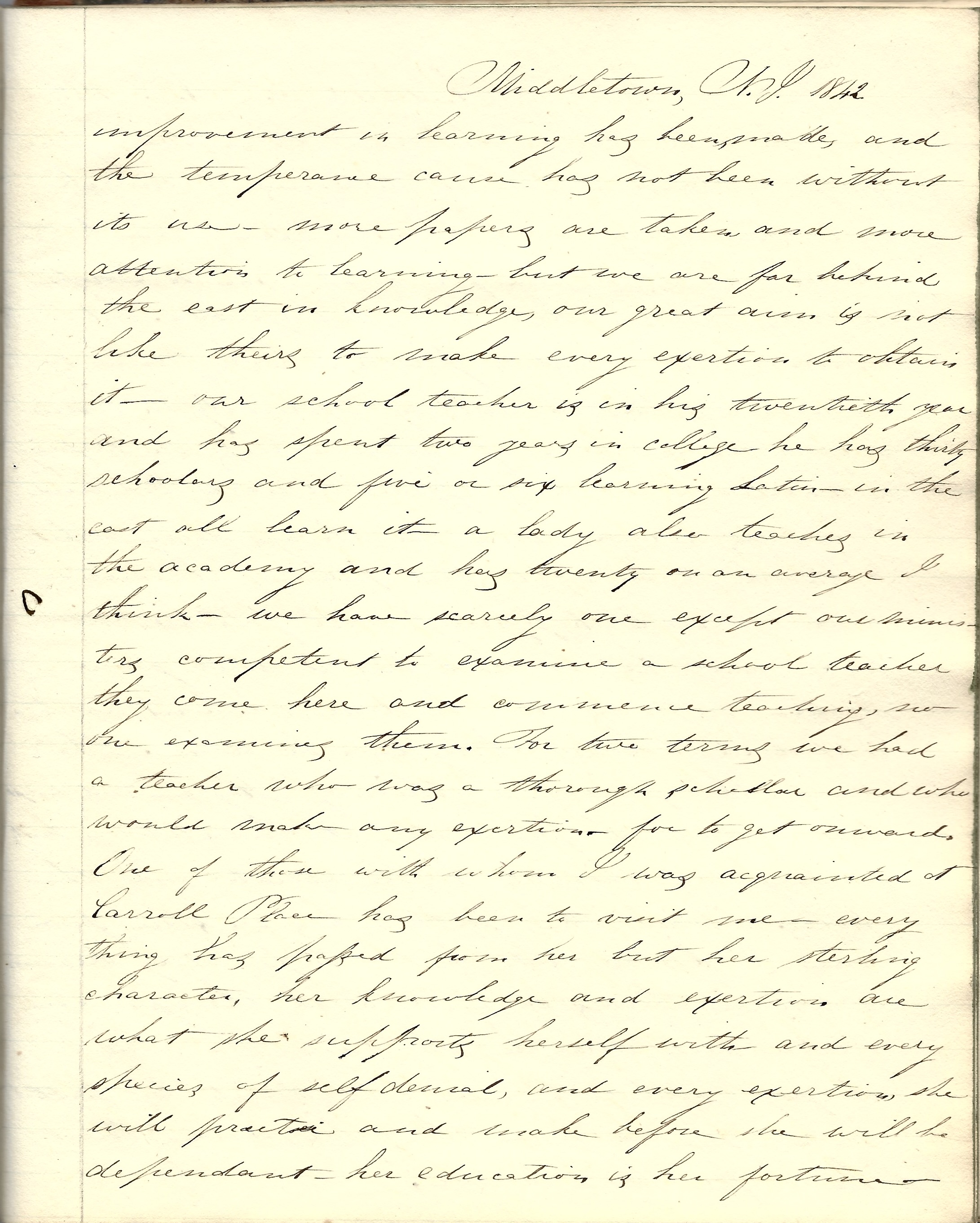
Not much change has taken place in our village—two new churches have been erected. We have three and an ornament they are, not so much for architectural beauty as for the character they give of the inhabitants. From two of them is heard the pealing of the bell, breaking the stillness of the Sabbath morning. The Sabbath School is not flourishing—what is the cause? During the past eight years some improvement in learning has been made and the temperance cause has not been without its use. More papers are taken and more attention to learning, but we are far behind the East in knowledge. Our great aim is not like theirs—to make every exertion to obtain it. Our school teacher [Austin] is in his twentieth year and has spent two years in college. He has thirty scholars and five or six learning Latin. In the East, all learn it. A lady also teaches in the Academy and has twenty on an average I think. We have scarcely one except our ministers competent to examine a school teacher. They come here and commence teaching, no one examining them. For two terms we had a teacher who was a thorough scholar and who would make any exertion for to get onwards. One of these with whom I was acquainted at Carroll Place has been to visit me. Everything has passed from her but her sterling character, her knowledge, and exertion are what she supports herself with and every species of self-denial, and every exertion she will practice and make before she will be dependent. Her education is her fortune.

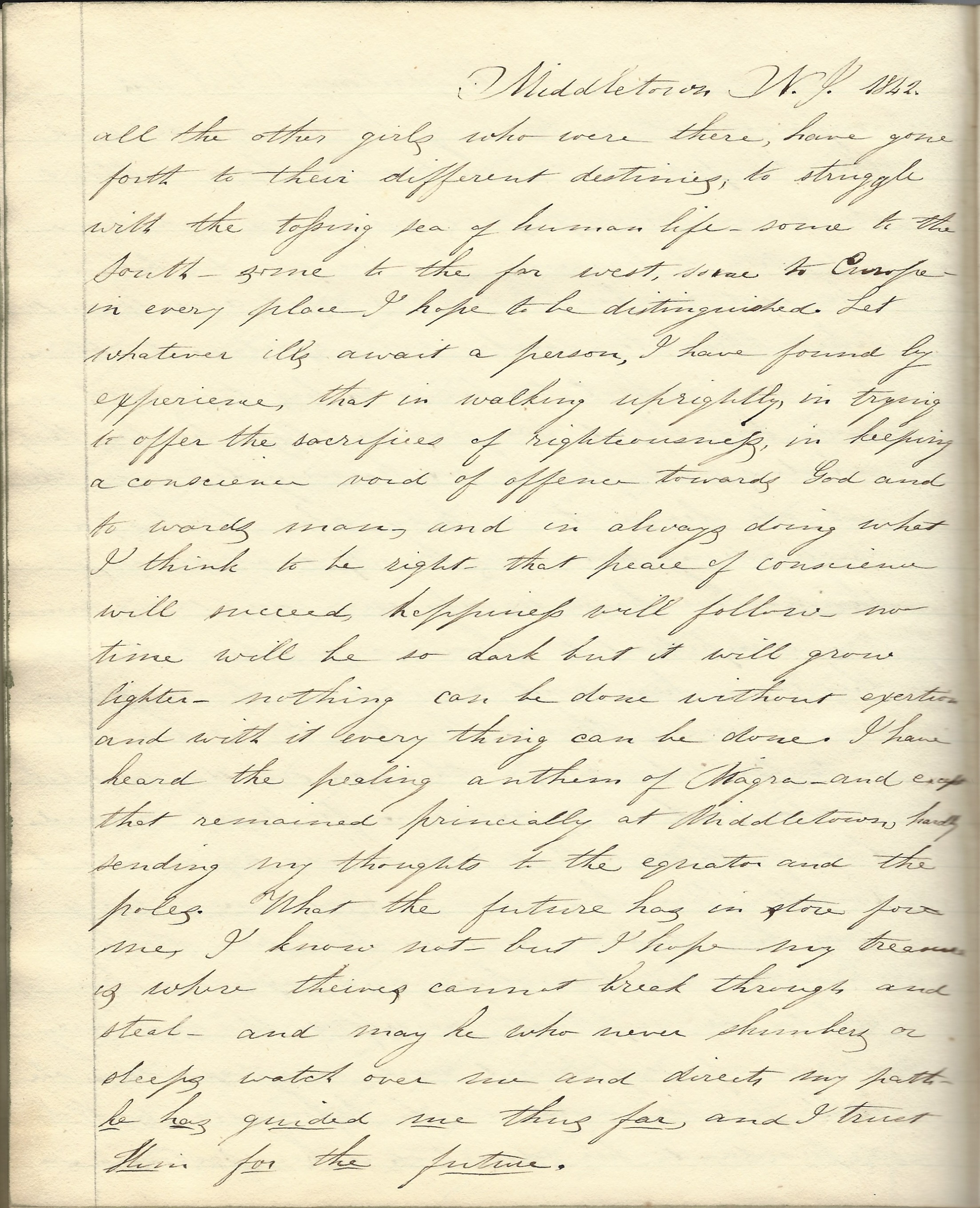
All the other girls who were there have gone forth to their different destinies, to struggle with the tossing sea of human life—some to the South, some to the far West, some to Europe—in every place I hope to be distinguished. Let whatever ills await a person, I have found by experience that in walking uprightly, in trying to offer the sacrifices of righteousness, in keeping a conscience void of offense towards God and towards man, and in always doing what I think to be right, that peace of conscience will succeed, happiness will follow—no time will be so dark but it will grow lighter. Nothing can be done without exertion and with it everything can be done. I have heard the pealing anthem of Niagara and except that I remained principally at Middletown, hardly sending my thoughts to the equator and poles, what the future has in store for me, I know not. But I hope my treasure is where thieves cannot break through and steal. And may He who never slumbers or sleeps, watch over me and direct my path. He has guided me thus far and I trust Him for the future.
 Spared & Shared 23