
My Journal of daily events or Diary of a Union Soldier, Book III
Recounting incidents that transpired within the dates of October 14th and November 26th. Containing the accounts of our march from Covington to Lexington, Kentucky, & my entry into the hospital at Lexington.
Preface
The events recorded in this book were written or sketched down generally under trying circumstances & when laboring under oppressive difficulties. The fore part contains the occurrences attending the march & was for the most part written late at night by the campfire or early in the morn, or sometimes I would snatch a few moments of leisure in the day. Then after the 1st of November, I continued the task under the disadvantage of disability. Here I ran up a big batch of sketching.
Tuesday, 14th October 1862. About 12 o’clock. Again I make an entry on board of the cars preparatory to taking a journey synonymously with just one month ago today. We sit here waiting the motion of others. I stood on picket last night as before. After daylight before I went up to camp, I finished my letter home, informing them of what was going on, Then went up & with the rest went to getting ready for marching, packing our knapsacks, drawing our two day’s rations, &c. About 8 o’clock we struck the tents.
The camp baggage was put aboard of our company wagon. About 9 we shouldered our knapsacks &c., formed into line, and took up our line of march for Camp “Hooker” or “Gravel Pit.” About 64 of the men were able to march. The rest were taken up in the ambulance. After arriving at the camp, we stopped over an hour waiting for the rest of the regiment. The baggage is to be taken to Cincinnati with the teams, I believe. We do not know as yet where our destination is—only that we are to go to Cincinnati, thence across to Covington & it is reported that we are to go south 70 or 80 miles.
Sundown, We have halted for the night on a very pretty location in the State of Kentucky about 2 miles from Cincinnati. We are very tired & dirty. Shall have to sleep out in the open air tonight. We arrived within the City of Cincinnati in due course of time, landed, formed in line, and marched into the City parallel with the river. Marched half mile or so into the suburbs, turned a square corner across the Ohio River on a pontoon bridge into the City of Covington. Stopped and rested a short time. Then proceeded to our present location. We passed several encampments on the way—one was the 112th Illinois.
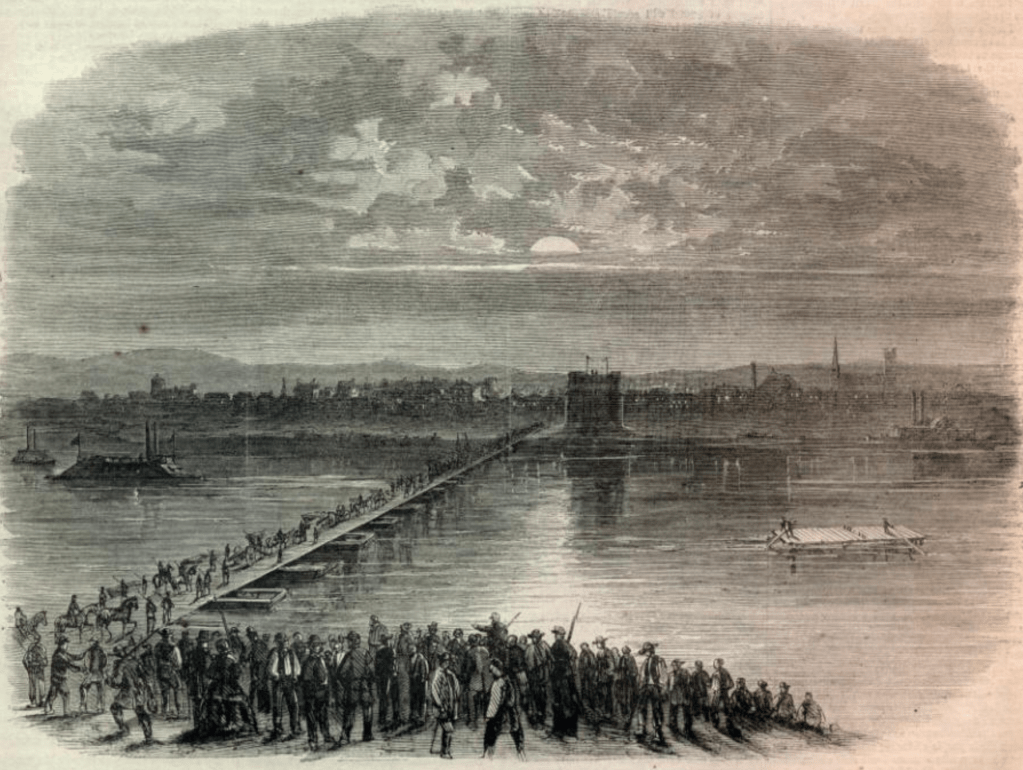
My knapsack lags me pretty well. It was pretty hard work to keep up. Was very glad to be relieved of it as we stopped about 5 o’clock. We sat down & ate a little of the grub which we brought along. The day has been warm and pleasant. The ride in the cars from camp was very pleasant. The scenery is very picturesque & often impressive. The people seemed to live principally by gardening. There were as we neared Cincinnati many fine buildings laid right on the side hill. I noticed the tomb of Gen. Harrison on a hill surrounded by trees.
Wednesday, 15th. About 10 o’clock. Well, we have got established again on our new camping ground, though I suppose we are not to stay but a few days. Have been engaged all the morning a setting our tents. We are arranged by “division,” two companies on a line, are considerably crowded. I rested very well last night. The night seemed very long. A good many caught cold as the air was quite cool. We laid down there as we stood in two ranks & numbered off in 2’s, 4 men, 2 in front and 2 in rear rank stacked their guns together. Then the 4 laid down by their stack, two on one side and two on the other side. We use our knapsacks for pillows.
The peddlers flock in among us without number, mostly women. They have cakes & pies, fruit,—apples, peaches, grapes, &c. which they ask an enormous price for. Also stationery, prize packages, song books, &c. &c. I have only spent one cent as yet for a stick of candy. I now have 19 cents left. I feel sorely tempted to purchase some of the numerous things which surround me on every side but I believe it better to reserve what little I have for occasion of necessity. Tis said that it’s dangerous to eat the pies, &c. about here as several soldiers have been poisoned by them—so supposed at any rate. They look tempting but the less we buy of the the better. We will relish our grub better without them.
Our camp ground & vicinity requires a word of description. The country is open & very uneven. Deep gullies are frequent. Our camp is situated among scattering beech trees, a couple large farm house a few rods east & south of us; three or four camps are to be seen scattered about north of us; a part of our company are detailed to stand camp guard as we used to do at Wilcox & for a week at Grand [ ].
Covington can be seen about 2 miles north of us, Cincinnati beyond, it being so hilly only a few buildings can be seen distinctly Several churches show prominently. The black coal smoke rising from 1,000 pipes & chimneys obscuring the distant sight. I think we traveled over three miles after leaving the cars. No opportunity was given us t purchase anything in the cities.

5 p.m. We have been out on company drill this p.m. Our baggage train arrived in p.m. The most of the stuff was sent by the cars. A couple more regiments came in in the a.m.—the 14th Kentucky & 33rd Indiana from “Cumberland Gap.” They have been in service over a year and a half. They present to us something like a true representation of war. They look pretty hard up—ragged and dirty—and they tell a pretty hard story of what they have had to endure. Have had to live on just what they could pick up as they passed through the country. Have not been in any big battle—only skirmishes. They wear tall black wool hats. Have been nearly a month on the road. Had to go a round about the rebels. Have come here to recruit up.
Those who have never been vaccinated are now having the operation performed. A man in one tent, T[homas] Carrel [in Co. I], has come down with the measles. My turn will probably come soon. (written Thursday) We went on dress parade at night. Our chaplain made a prayer at the close. His name is [Israel Coggshall] and belong to the regiment. He entered the regiment a week ago I believe. The weather is warm & pleasant. Cloudy in p.m.
We drilled company drill over three hours in a.m. The corporal put us through on the different moves at a great rate. The 19th [?] Kentucky Regt. has just come in. They belong in the same Brigade with those yesterday.
(At night) Went on dress parade at night. Just before it closed a man rode up & handed the Colonel a package. He opened it & announced the astounding intelligence that we had received orders from headquarters to be ready for “marching to the front” next Saturday morning. Probably our destination is Lexington, Kentucky, right in the heart of Rebeldom. I began a letter home tonight. The men generally have got the writing mania tonight. During the evening the surrounding camp fires to the northwest in particular present a beautiful sight.
“After a long time I will endeavor to pen a few lines to let you know that I am a Soldier in the 19th regt. of Mich. and we are camped in Covington Kentucky and are agoing to march from here tomarow the rumor is that we are going to Lexington but I dont know where we are a going nor I dont know as I care so I can serve my country and save the union. I am as well as usual and the rest of the boys are generaly well I believe if you get this let me know how George is and alsoe[sic] how the rest of the folks are ther is about 120 thousand troops inside of 15 miles of here but there is some of them leaving all the time and some a coming all of the time so you see they dont diminish much ther was one division came from Cumberland gap yesterday and the rebels have got possession of it again our men got starved out and had to leave but they destroyed all the property that they could not take with them and then they burnt up about 1 million of dollars of property but they could not help it I have not any more time to write so you will have to excuse bad writing and for I have no chance to write.” Source: G[ideon] E. Portman of Co. K, 19th Michigan; Letter to his Sister dated from Camp Granger, 16 October 1862. Kalamazoo Valley Museum]
Friday, 17th. We went out on Battalion drill in a.m. We formed in ranks of 4 and marched about a mile across the Licking river onto a pretty good piece of ground. Been used for a camp ground at one time. High hill on most every side. We passed several very fine residences surrounded by handsome garden & shade trees, &c. The fields are all open to the common. Were not cultivated the past year, I should think. The devastating effects of war! The fruit, if there was any, was stripped long ago. Most of the woods have been cut away for “artillery range,” several batteries are planted on the hills.
In p.m., we went out on “Company Knapsack Drill.” We donned all of our accoutrements ready for marching & drilled. Dress parade next in order. We received our knapsack strap today with cartridges enough to make out 40 rounds apiece. Our knapsack s were numbered last night & this morning—the number that each one holds in the ranks according to his height, and the “Co. G” is marked on the knapsacks/ Preparations are still going on for leaving tomorrow. Each one drew his plate, cup, knife, fork and spoon tonight. They are to be carried in the haversack. If we keep on getting [more to carry], in all probability we shall have a pretty respectable load.
The Licking river is a small rasty, dirty, insignificant stream. We crossed it on a pontoon bridge however. It’s about as big as Black river where we crossed it, but it dwindled into nothing almost above apiece. There are pickets stationed all through the country. Many breastworks &c. are built. The water that we have to drink is what soaks into holes dug into the clay at the bottom of gullies—miserable dirty stuff. I managed to get my canteen filled out of a first rate well at one of the farm houses. The most of the sick have been transferred to the hospital at Cincinnati today.
Saturday, 18th. I sent a letter home in the morning. Also my diary. In p.m., received a letter from home stating that they do not get any letters from me. Strange! for I have now sent three out.
Sunday, 19th. I will go back and begin with yesterday morning though I am expecting to be called away every moment. There was much controversy yesterday morning concerning our marching orders. The prevalent idea was that we would not go after all that day. But between 1 & 2 o’clock orders came to headquarters to be on “the move in one hour.” The tents were struck and packing began immediately & between 2 and 3 we started. No one knew definitely where. My turn came yesterday to go on guard with 6 others in our company. We were in the 2nd Relief. Came on at 10 o’clock, I only stood one “trick.” We, the guards, had to follow in the rear of all the rest to pick up stragglers of which there were many. By the time we arrived at the stopping place, our guard of 66 men swelled to near double the number. Those utterly unable to walk were taken into the wagons. Others feeling a little better walked, putting their knapsacks aboard. I was pretty tired but stood it better than I was afraid I should when I started. It is said that our luggage weighs about 80 lbs.—clothes, provisions, ammunitions and gun, &c. I should like to know for certain. If I was any wise unwell, I could not stand it.
Our place of encampment on Saturday night demands particular attention. It had at some past time served in the capacity of accommodating the agricultural dwellers of this section of the globe as they made their annual gatherings & brought forth the products of their labors for critical examination. It was quite extensive & well got up. Ample accommodations for stock and a large & grand amphitheater for spectators. It was under a cover of this building that we took up our abode for the night. It made a hard bed but was clean and being so tired, we rested well. Water was scarce. We were up before day[light].
Monday, 20th. This page and the following apply more particularly to Sunday. This morning finds us encamped in a large open field, we on one side & the 92nd Illinois Regt. on the other. They stopped at the same place we did night before last. They started before we did & came ahead of us all day. I learn that there is two more regiments a mile or so ahead of us. We passed about noon a spot where the rebel Morgan had encamped a couple of weeks ago. We got here a little before sundown. Our greatest concern was to find a place where we could get water. They have very good wells of water at some places but so very many soldiers have passed through here that they have drained them about dry. Have to depend on “dammed water” which is but partially pure by mixing in plenty of lime. Our company only put up a part of the tents though against the Colonel’s orders. We did not understand the programme. The night was quite cold. I slept outside. Took my India rubber and blanket & slept quite comfortable. The regiment burned up about 20 rods of rail fence. Kept up big fire all night. Some of the other companies appropriated to their own use several pigs, also apples in abundance. In fact, confiscation is the order of the day. But more on this subject hereafter.
As to the water, it was very precious. There was a couple wells but they were low & continual use soon rendered the water quite unfit for use. A little pond of dammed surface water furnished drink for the teams.
Sunday (written Monday) At noon we stopped an hour and baited at one of the Kentucky reservoirs (in the night). I took off my shoes & bathed my feet & they felt much better after it. My feet do not blister as most of them do, only the bones do ache. We stopped & rested 10 minutes or so through the day every two or three miles. We marched by the “left flank” today, our company being next to the road. Co. A acted as “rear guard.” The dust was almost suffocating sometimes. It’s composed of powdered stones. It wears off the stones which compose the “pike.” These “pike roads” are as durable as time. This Sabbath has been the hardest spent Sunday that I ever passed. I guess few ever thought that it was Sunday, I could not realize that it was.
Whenever we marched, the music goes ahead. The Colonel and Major generally are ahead. The bugle will sound whenever we are to stop or to start. We are not required to keep step—only when passing through a town. The rest of the time “rout step” and “arms at will.” The line is about a quarter mile long while on the march, four men march abreast.
Monday, 20th continued. Tonight finds us very comfortably encamped about 16 miles from our encampment of last night. There was a heavy frost last night. We turned at right angles from the turnpike this morning and traveled in a southeasterly direction. The road was extremely crooked, angling and winding around among the hills. The country is very uneven, but the road winding so the road was quite level. About 11 o’clock we entered a deep hollow a mile across in which in time of rain I guess runs quite a stream. No running water now; everything presents a sterile, dry, arid aspect. How different from our Michigan water courses.
This day we marched by the “right flank” which brought us behind & Co. B acting as “rear guard.” The dust was still very oppressive. I never suffered with the dust or since we have been marching. Water still continues very scarce. We occasionally came across what the poor, miserable inhabitants were pleased to term springs, but in reality nothing but sink holes, though perhaps in a wet season they would run off a stream. Are generally so riley that we would never think of drinking it in Michigan. My philter (or filter) which I paid 50 cents for does not operate very well. Clogs up somehow.
The inhabitants along the way today have been of a much poorer class than those of yesterday. Did not see one colored person in p.m. & but a few in a.m. A union sentiment generally seems to prevail among the citizens. The “gentler sex” greatly predominating over to opposite sex, showing how unanimously & faithfully they have obeyed their country’s call. I noticed many women dressed in black. I supposed in token of mourning the loss of some new and dear relative—the victim of this barbarous war.
I stood the jaunt very well today, full as well and even better than I ever expected to. I think that I am better off than the regiment will average. I ask not a single favor of anyone. I carry all of my own duds and wait upon myself generally. Still there is no real fun about it. My feet do not trouble me so much as most of them complain of. My shoulders are somewhat lame, the effects of carrying the knapsack. My cartridge box of 40 rounds weight down pretty well; only 2 of our company, I believe, were obliged to “fall out.” The baggage wagons pick up all that could not possibly walk of which I think there were but few.
It now becomes my lot, though very reluctantly, to do it. To narrate the particulars of a most disgraceful affair connected with our regiment though we did not carry the thing so far as the Illinois regiment which encamped a short distance from us (we have come ahead of them today). We enquired all along back for the last four or five miles for a place handy by water. We arrived at the place designated about 4 o’clock. It is termed a creek with scarcely a perceptible current. The excuse for a stream is about two rods wide. It creates considerable dispute among the men as to which way it runs. It’s 2 or 3 feet deep. The hogs and cattle run all through it. We make coffee of it. Many drink it. But to return to the before-mentioned transactions too shocking for rational contemplation.
We had hardly stacked [arms] when men belonging to companies ahead began to pass us loaded with all the honey that they could conveniently carry. There are always more or less men breaking ranks though its against the rules, & strolling out after apples, &c. This honey happened to belong to a house standing on a turn in the road & the men cut across & discovered it. The family were absent at the time. The infection for sweetening soon spread throughout the camp and they came and went by 10’s or 20’s including some from our company for honey. There were five or six hives pretty well stored with the nectarine composition which they took possession of and bore off in triumph. The bees as may be supposed did not submit to the treatment of the invaders very peaceably & many of the scamps got pretty badly stung by them. As a matter of natural consequence among such a rabble, a great deal of good honey was wasted, or after they had stripped all and left it, I went and picked up off the ground all I wanted to eat. It was worse than wholesale murder to see the very best of honey wasted and scattered all over the ground. But rascalities did not stop here. Not contented with robbing the poor family of their honey, they broke into the house & literally ransacked & robbed it of everything of value from top to bottom. Articles that could be of no possible use to them. They took butter, sugar, milk, clothing, & private papers even, &c.
But the thing did not stop here either. There were about a dozen chickens running in the yard which they also appropriated. Then about this time the guns and pistols began to resound from every direction throughout the woods and the pigs and hogs had to suffer. Also several sheep were brought in though I believe the Illinois Regiment did worse than we did in this matter. But I am happy to say that Co. G are quite free from the implication of these scandalous acts. Only one pig was taken which some of the rest had shot and wounded & let go. They cooked and ate it at midnight.
The reader may be curious to know whether our superior officers sanctioned the deeds just related. Well this is a question I cannot answer definitely. they seem divided on the subject. The peculiarity of the case & the position of circumstances needs a [ ] discrimination to decide, but the Colonel endeavored to check the proceedings somewhat & placed a guard around the premises after it was too late. The owners returned about dark. They were an old couple who had a couple sons in the Union army. The pitiful tale they told excited sympathy among our men and a bill was made out and the thing adjusted to their satisfaction. It reflects a bad state of morals on the side of our army.
Tuesday, 21st. (written Wednesday) More frost last night. We got underway again about the usual time—vix: between 7 and 8 o’clock. Marched by thr “right flank” again. The 92nd Illinois went ahead today. They keep out of sight. Our point of destination today was Falmouth about 10 miles distant. Our road lay through oak woods mostly. The settlers were scattering & in poor circumstances. Many had only been situated a year or two. It was a noticeable fact as we would pass a habitation what ab innumerable lot of the inmates there would be who would come out to view us. Children of all sizes & ages. It did not seem possible that so many could be contained in so small a building. Another remarkable feature about the country is the stones or rocks—more properly ledges. They do not appear above the surface on the level ground, but on the side hills & in the hollows theyappear in the shape of flat rocks just fit for building purposes. No round ends to be seen. It seems to be a perfect bed of rock beneath the surface a few feet. All in layers about 6 inches thick. I don’t perceive any use made of them—only occasionally a stone chimney. The chimneys are all outside of the house.
As to the agriculture of the county, it seemed to consist principally of corn, tobacco, and stock, wheat and hay is raised. It has been so dry that no winter wheat has been sowed yet.
We arrived at this place, our present encampment, about 7 o’clock [and] immediately went to work & pitched our tents. On the way the calculation was that we were to stop here awhile & recruit up. As we were setting our tents, the Colonel informed us that we were to proceed the next day. As to our camp ground and vicinity, there is much to be said. This is a large encampment containing 5, 6, 7, or 8 regiments. In fact, I don’t know how many. Our brigade is all here and 2 or 3 other regiments. Some old ones [like] the Illinois 115th came in after we did.
The camp is situated upon a large field (it was 2 or 3 fields before the fences were burned). This is situated upon a valley formed by what I believe is said to be the Cheat river & what an excuse for a river! When a perfect deluge came it may then swell to something of a magnitude. But we crossed it dry shod. There are several small springs which come from out the banks. These form small pools of comparativel pure and cool water where the soldiers to their washing & procure water for coffee. The bottom is very rocky, large flat rocks. The current is about equal to the Butternut Creek, running among the stones.
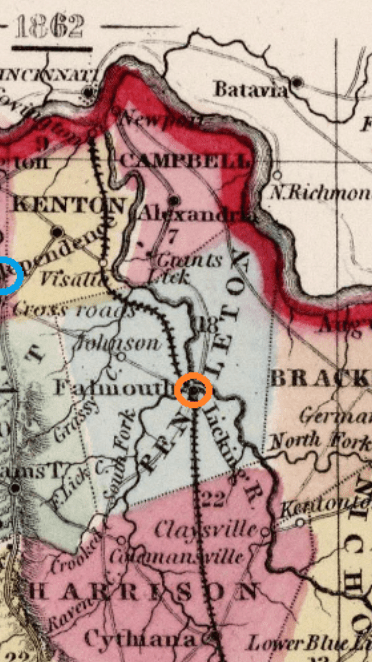
As to the town of Falmouth, I have not seem much of it as yet. In fact, there isn’t much to be seen according to all accounts. Two or three have been out today & say it’s an old dilapidated place & nothing but a little village anyhouse. A railroad [Kentucky Central Railroad] runs by here from Covington & Cincinnati. Goes, I believe, to Lexington. The bridge where it crosses the river is a new temporary concern. The old one was burned by the rebels about two weeks ago as I understand. It was a middling good-sized bridge, being covered, a stone abutment in the center. The new one was finished so that the cars just crossed it today. Learned no particulars.
Wednesday, 22nd (written Thursday) The programme was again changed this morning & it was determined that we should stay here today and recruit up, do our washing, &c. &c. No drill.In fact, there is no knowing how long we will stay nor where we shall go when we start again. As usual there are a hundred thousand surmises, conjectures, and reports about it. Some fix Cumberland Gap or East Tennessee, Lexington, Paris, & 40.11 other places as our destination. It seems that we are brigaded and under command of Brig. Gen. Baird, a former Indiana Colonel.
Three men out of every company making 30 in all, with certain number of corporals, sergeants, & two lieutenants were detailed for picket duty. They were sent off outside somewhere. Not yet returned.
I spent today in writing diary & cleaning up. Dress parade as usual at night. Three other regiments were also out on dress parade. Theirs and our movements & performances are similar. The other regiments are armed with Springfield and Enfield rifles—a lighter and better looking arms than ours. All have bayonet scabbards. No scabbards are to be found to fit our bayonets as our arms were captured arms without scabbards. I guess they don’t shoot any better than ours.
The day was cool and cloudy most all day. It seems as though it was colder here than in Michigan. A good fire feels quite comfortable. We burn everything we can get hold of—board or rail fences. The teams went out and picked up some brushwood out in the woods. This is a pretty good place for a campground, being level and capacious and tolerably well provided with water. The greater objection is the dirt as the grass is all wore off, so it’s impossible to lay down without getting as dirty as a hog. Confiscation still progresses. Co. B went out & confiscated a lot of hogs & a “negro servant.” They say they took them off a secesh. Also pigs and chickens, &c.
A train of cars passed through this evening with 118 rebel prisoners aboard—a part of the rebel Morgan’s command. Taking them to Cincinnati, Did not learn where they were captured. When we left Covington, those two wall tents which were given us at Gravel Pit were exchanged for another kind of tent. They are a lower tent & I do not think much better. Will accommodate about the same number of men.
Thursday, 23rd. Again it is said that we are to proceed forward this afternoon, in certainty. We went on Company drill in a.m. A good many companies belonging to other regiments were out also. They performed some new movements. Another set of pickets were sent out this morning. The old ones not yet returned. (Sundown) Just after dress parade, hurrah for marching orders to be ready for marching tomorrow morn at 7 o’clock. I know nothing further. The natural consequences is that each must follow his file leader. Our destination is involved in a mystery.
Went out on battalion drill in p.m. When not otherwise engaged, I have been writing a letter home. Another set of pickets were detailed this morn & the old ones came in. They with some others were reported upon a high hill a mile or so out. They searched a house nearby and discovered some rebel ammunition. I lost my towel this morn which I brought from home. Tonight I took a new one of O[smer] Letson on what he is owing me—price 25 cents—though not so good as my old one. It was a provoking shame to lose it. Just before we left camp Cov. I procured a bill on the sutler to the amount of $1. It is taken from my wages at payday. Half of it, 18 ginger cakes and a lemon.
This evening I understand that we are to go to Cynthiana, a point 25 miles distant south of here. It is desired that we proceed there in one day. I suppose that the whole brigade will move together. We are organized as near as I can make out thus:
(Written in March 1863) I never ascertained the regular order of the arrangements of our brigade. Since leaving the regiment, I have learned that the 22nd Wisconsin, 85th & 33rd Indiana, 32nd and 36th Illinois & the 19th Kentucky Regiments belonged in our brigade with us. There is a battery & some cavalry also with it. Perhaps another regiment or two.

Wednesday, October 29th [1862]. I am now nearly a week behind hand with my diary. When not on the march, my time has been occupied so constantly with domestic duties that I could not possibly find time to do more than to make a few brief notes into the back part of my book. I cannot therefore detail all the particulars so minutely. Besides, I am not flush with time now. To commence with the beginning, Friday 24th, we started as was intended day before from the insignificant town of Falmouth between the hours of 7 & 8 o’clock. Two or three regiments started ahead of us which hindered us a great deal. There was a very high and hard hill to climb about a mile from town. It took the teams a long time for the teams to get up. It was noon by the time we arrived ay the top. The hill was very stony. I made a misstep and fell & hurt my head pretty bad. A prominent feature of the day was a great scarcity of water. I happened to have enough for my own use. It was a miserable barren country that we passed through. To get the water we had to travel till after 12 o’clock. Camped near Barry Station on the South Licking river. This is another flash-in-the-pan river but tolerable good water. These southern rivers are rather mysterious affairs to me. They are nice streams with little spots. We traveled about 15 miles and did not pitch the tents.
Saturday, 25th. This day opened upon us cloudy and gloomy. A fine misty rain continued all day. My India blanket came very acceptable. The appearance of the country greatly improved upon yesterday. Marched by the left flank today. We were not troubled by the dust as usual—one good thing. We traveled about 15 miles & stopped near the town of Cynthiana about 3 o’clock. Pitched tents on good high ground. Other camps in vicinity. We got a good supply of straw to sleep on which was very fortunate for us for soon after dark it began t o snow & kept up most the night. We suffered some from the cold. Late in the evening I was handed a couple letters—from home and Hattie M.
Sunday, 26th. This was a tough & hard spent day. We had entertained the ideas that we would be allowed to stop here today and rest but before 8 o’clock we were on the move again. We passed through the town which like the rest we have seen is old and fast falling into decay. An excuse for a river passes through it & a railroad. The snow fell last night to the depth of 3 or 4 inches perhaps. Rained some which made it extremely wet and nasty. It stood in the road on the pike like custard. We only went three or four miles on the pike, then left it to take a shorter cut, aid to be four miles nearer but the road was much worse.
The snow did not melt scarcely any during the day. Our road was somewhat stoney which made it some better traveling, but for the most part, the mud was deep and there was not much of a chance of picking our way, but had to wallow through. We struck onto the pike again just before we stopped. Traveled till dark to within a mile or so of Paris. Encamped in a good place. Pitched tents, built fires, and warmed ourselves. THe snow had to be scraped off for a place for the tents. I stood the jaunt better than I would have supposed I could. I guess that if we had had such roads to begin with, there would have been some “falling out.”
Monday, 27th. We picked up early this morning & made up our minds to see Lexington by night but after marching four or five miles, we were suddenly brought to a halt, turned aside and encamped. No one knew why. Other regiments camped near. The day was clear and the location pleasant, near a stream of water. We spent the rest of the day in cleaning up. Dress parade at night. Passed through Paris in the morning. It was quite a large place but so old and dingy. Most of the people we see are blacks. The country is truly splendid, or was one day.
Tuesday, 28th. We were on the move again early this morn. I with five others was detailed for guard again. We came in the 1st Relief. I no. 3, consequently we marched at the head of the column, I came in 1st rank. Followed behind the ambulances. Our road today was a smooth had pike, good traveling though apt to make a person’s feet sore. We passed through some splendid country. Saw many large and grand old mansions. The land is owned by large planters. They have slews of negroes about them who would come out & see us pass, mostly of the smaller fry. The farms are well fenced. About half the fences are stone. There don’t see, to have been much done besides getting in the crops for the past 40 years. Previous to that time, there was much dome on a large scale. They have done nothing to keep up repairs since. They seem to have delighted in making an expensive show at first, and if they had kept in improving and making additions, this would have truly been a magnificent country! Behold the “direful effects of slavery.”
But to continue the events of the day. We reached the noted town of Lexington about 3 o’clock. Did not stop only a few minutes to rest. Proceeded into the town apiece but turned to the right before arriving at the business part of it. The houses are scattering but large and spacious. Beautiful surroundings. Plenty of really good-looking white females greeted us as we passed. Also Blacks innumerable.
After turning we marched due north about three miles and entered a large field where there were several other regiments encamped. Got all ready to pitch the tents when we were suddenly ordered to shift our position. We had to go on our back track about half a mile and turn west half mile & finally made a halt and encamped upon a very good piece of ground interspersed with trees, walnuts, &c. The object of moving to this place was to get a supply of water. There are several springs which furnish an old cotton factory and flouring mill with tolerable good water. I don’t like the taste of it very well. The cotton part of the concern has ceased operation.
(Written November 13th.)
As soon as we stopped I with the rest went immediately “on guard” which was anything but a pleasant prospect to contemplate for the coming night, but considering the circumstances they were not very strict on us. We built fires and most of us sat down most of the time. I felt unwell all day today & for the first time it seemed sometimes that I could not possibly carry my knapsack much further. BUt resting often I managed to keep along. I think now that at this time I was beginning to feel the effects of the coming attack of the measles. It grew worse everyday afterwards.
Wednesday, 29th. I was off guard at 8 o’clock morning but had to go on police duty till noon. Did not do much—only make a dam across a small run to hold water for team. The men are quite busy when at leisure cracking walnuts. There are lots of them here. I wrote some home in p.m. Our rations today were flour of which we made some very good pancakes. The crackers being minus, we also had fresh beef. We cook in squads now. Each tent by itself. A man detailed to cook a week at a time. Suits all. Day pleasant.
Thursday, 30th. We were ordered to devote this a.m. to washing our clothes & cleaning up our guns, &c. I did a lot of washing for myself and others. There were a hundred or more around the “old factory” engaged at the same.Source: G[ideon] E. Portman of Co. K, 19th Michigan; Letter to his Sister dated frm Camp Granger, 1 November 1862. Kalamazoo Valley Museum] Was quite a busy scene. We have to wash in our kettles and mess pans. Hot water can be procured in small quantities but not enough to supply half the demand. It trickles from the steam pipes. In p.m., battalion drill. The Wisconsin 22nd Regt. belonging to this brigade came today. They have a splendid brass band. Cost $1000 dollars.
Friday, 31st. In a.m., we were “mustered for pay.” Had to come out with knapsacks all packed and all accoutrements on. The Colonel called the roll of each company. We may expect to receive our pay sometime soon. Don’t know when. There are host of preliminaries to be gone through with yet. I sincerely hope it will come soon, nor al I alone either. We are also inspected by the Dr. in regard to cleanliness. In p.m., battalion drill again. We drilled on the “double quick” a good deal which was more than I was able to stand, not feeling really able to drill anyway, so I was obliged to fall out for the first time. I hated to do so but I could hardly stand up.
NOVEMBER 1862
“I received your letter last night and was glad to hear that you was well but sory [sic] for Georges misfortunes but hope it will not injure him I am not very well today but I am not so bad as not to do Camp duty for I am on guard to day we mustered for pay yesterday but dont know when we will get it but I hope in a short time for I want to send some home to pay taxes. I dont know when we shall leave here nor anything about it but I am in hopes that when we do it will be for home I think that the rebels is about gone up for there is nothing for them to eat after they leave Kentucky and there is but very few of them in this state now there is a report if it be true that there is to be no fighting on either side for 60 days and that it will be setteled [sic] at the end of that time. I have not seen a armed rebel yet. you must excuse bad writing for I am in a hury and will have to close for the present Direct as before.” Source: G[ideon] E. Portman of Co. K, 19th Michigan; Letter to his Sister dated from Camp Granger, 1 November 1862. Kalamazoo Valley Museum]
Saturday, 1st. I felt so unwell this morning that I thought it was best to go to the Dr’s. & have something done for me. I coughed incessantly and the diarrhea kept me trotting continually. I was getting run down very weak. The Dr. only gave me a couple doses of “cough syrup” during the day. Excused from heavy duty. I went down to the factory & did some more washing. Was clear exhausted by the time I got back. A letter from home awaited my arrival. All well. Had just got my last letter and diary.
I spent most of the p.m. writing a letter home. I began at Falmouth. There was no drill today. A general cleaning up of everything to be done preparatory to a grand inspection tomorrow. This camp is designated as Camp Granger after one of the general commanding here. There are three regiments encamped adjoining—viz: the 19th Michigan, 22nd Wisconsin, and 85th Indiana encamped as so indicated.
We had to carry by hand all the water we used about half a mile from the factory. It was tolerable good water—spring water—but not so good as Michigan spring water.
Our first march from Covington, Ky. was one of this kind. We marched ten miles after four o’clock P.M. and I do not think I was ever so completely worn out in my life. When we got to our stopping place I layed down on the soft side of an oak board that was there without supper and slept soundly till aroused in the morning by the beating of drums and blowing of fifes, which is called the “revelles” whenwe were ordered to take up our line of march again for another place distant twenty-two miles. T h i s march was made i n less than seven hours. But I will not attempt to give you a detailed account of our journey to this place, suffice i t to say that we passed through some of the most forlorn looking country that was ever my lot to behold, nothing but hills and stone heaps. I n fact, i n some portions of the State the stones are so thick that one neighbor has to borrow land of another to pile stones upon. I do not see how it is possible for anyone to obtain a living on such land. [Source: Lt. David Joshua Easton, Co. E, 19th Michigan. Letter to his Mother from Camp Granger, 2 November 1862; Library Coldwater Michigan]
(Written at intervals long afterward.)
Sunday, 2nd. This day it became my unfortunate lot to be destined to experience another of the common vicissitudes which always & inevitably attend the practice of warfare. Continuing to feel weak & very miserable, I went in the morn with several others that were ailing to the Dr’s. It was some time before I received attention. As soon as I was ushered into the presence of the doctor, he at once announced the astounding fact that that I was a victim of that army scourge, the measles, & that I muts remain in the hospital. But as there was no room in the hospital then, I returned to the tent and covered up warm & staid till noon. I had no appetite. Gus Bailey was very kind & attentive to me & done what he could to make me comfortable. I was not in any very great distress, only diarrhea pains. My eyes felt very curious, were very weak, & kept gumming up so I could scarcely see. At noon I entered the hospital, had to lie on the ground the first two or three days; nothing was done for me till night. All that were able went out on grand inspection drill in a.m. In the p.m., had preaching by the chaplain. They gave me medicine during the night for the diarrhea which is running me hard. I was very flighty for a couple days which is characteristic of the measles.
Monday, 3rd. A long weary day. Spent most the day in trying to write home. Could not sit up. Had to write lying down which was very tedious but I wanted to write a certain amount. I wanted to do it up before I got worse. My diarrhea is partially checked, I am very tired of lying abed. It makes me so lame, Today I finished reading the Book of Matthew. The chaplain brought in some reading matter. I begged a hymn book of him (which I have yet). They built a flue extending underground clear through the tent, a fire is built at one end and it warms up the apartment very effectually.
Tuesday, 4th. I am very weak, almost helpless. Read some & wrote in a letter home. My back and hips ached so that the Dr. ordered them rubbed in camphor last night. Feel much better today. The measles spots are beginning to disappear on me. I do not feel particularly uncomfortable; only weak and tired of lying abed. When I close my eyes, all sorts of images & figures imaginable—kind of visions, not dreaming exactly—for I would not be sound asleep. I would keep getting in trouble & scrapes. In fact, my sensations were indescribable. It was a specie of somnambulism, I believe. Capt. B. called in the evening. A review of the regiment by Gen. Baird in p.m.
Wednesday, 5th. Another wearisome day has nearly passed. I accomplished but little. Made out to conclude my letter home—11 closely written pages. The flue and furnace did not operate to their entire satisfaction & they have been fixing it. The weather is growing colder & somewhat windy. Rained some during the night.
Thursday, 6th. One measles man discharged from the hospital. He came in when I did. He had them light but I think that they have sent him out too soon to be good for him. Two or three more entered—Fred Klickner [of Co. G] also. About one-third of the sick, I think, have the measles. For the measles, the principal remedies given is mucilage drinks & hot ginger tea. A great deal of medicine is given, however, for other little complaints—diarrhea, headaches, &c. &c. In fact, they deal out drugs by the wholesale.
They commenced in the corner where I lay to make homemade bedsteads (there were but three or four cots in the hospital) formed by driving posts into the ground and nailing slats. It was an improvement on lying on the ground. While at work at it, I sat up.
I gave me letter to the chaplain to send out after he had procured that note of Capt. B & enclosed it. He has charge of the mail. The day warm.
Friday, 7th. A cold, cheerless day. I was put onto a cot. It is quite easy to lie on. Twelve of the sickest were removed to a hospital in Lexington. Gen. Baird passed through inspecting the premises. Two of the hospital attendants were discharged. They are regularly detailed from their respective companies and receive extra pay. I have lain here all day perfectly helpless & useless. I manage to raise ambition to read a chapter or two in the testament. They do not give me much of anything to take now. Ate nothing but three crackers today. They have been giving us currant sauce once or twice a day long back, but have stopped it for the past day or two. I wish they would keep it up. I relished it first rate.
Saturday, 8th. The day spent in a listless idleness. Three more of the sickest taken to the hospital in town. It is now near night & not one of my companions have come near me. Rather strange I think. I made out to nerve myself to wash and change my shirt. I feel so extremely weak & languid. Have no appetite to eat what they furnish which isn’t but a precious little to say the most. I crave for fruit, sauce, preserves, & pickles in particular. I find from subsequent observations that this taste for everything sour is characteristic of measles cases. I actually languished for something sour.
Sunday, 9th. I feel as though I was improving little. The burses washed us all up nice. Our spirits underwent a complete renovation in unison with the delight, occasioned by the cleansing experienced by the body. I expressed the desire the other day to Capt. Bigelow for a baked apple, &c. Today he sent one in for me all baked nice. It did relish good & no mistake, I hardly know how to express my gratitude for the little deed of kindness. I shall remember him for it. A couple ladies called in and brought us some reading. Preaching by our chaplain in camp. I sat up and wrote in diary in p.m.
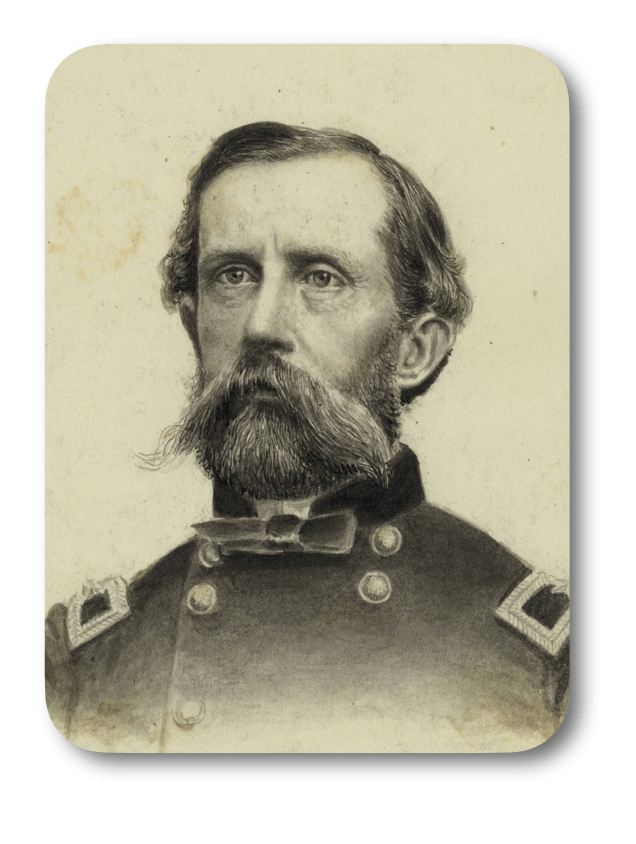
Monday, 10th. I felt quite unwell today. Gripes and pains in my bowels. Some person, perhaps, would attribute it to eating that apple yesterday. Allow me to differ. Brig. Gen. Baird called around to inspect matters and things. The general is a tall, sallow faced, light complected man. The most prominent feature about his face is a remarkably long red mustache. He is a very pleasant appearing man & I think a good general. Have seen him a few times. Two more men were sent to the hospital.
Tuesday, 11th. Felt greatly improved in both health and spirits. The Dr. allowed me “full rations” which consisted of two potatoes, hard tack, and coffee for dinner. The boys sent me a baked apple. We had apple sauce for breakfast. I have sat up a considerable today. Pleasant. I am not free from the diarrhea yet, I believe it’s that principally that makes me so weak. My knees trouble me mostly. I have fell away some in flesh.
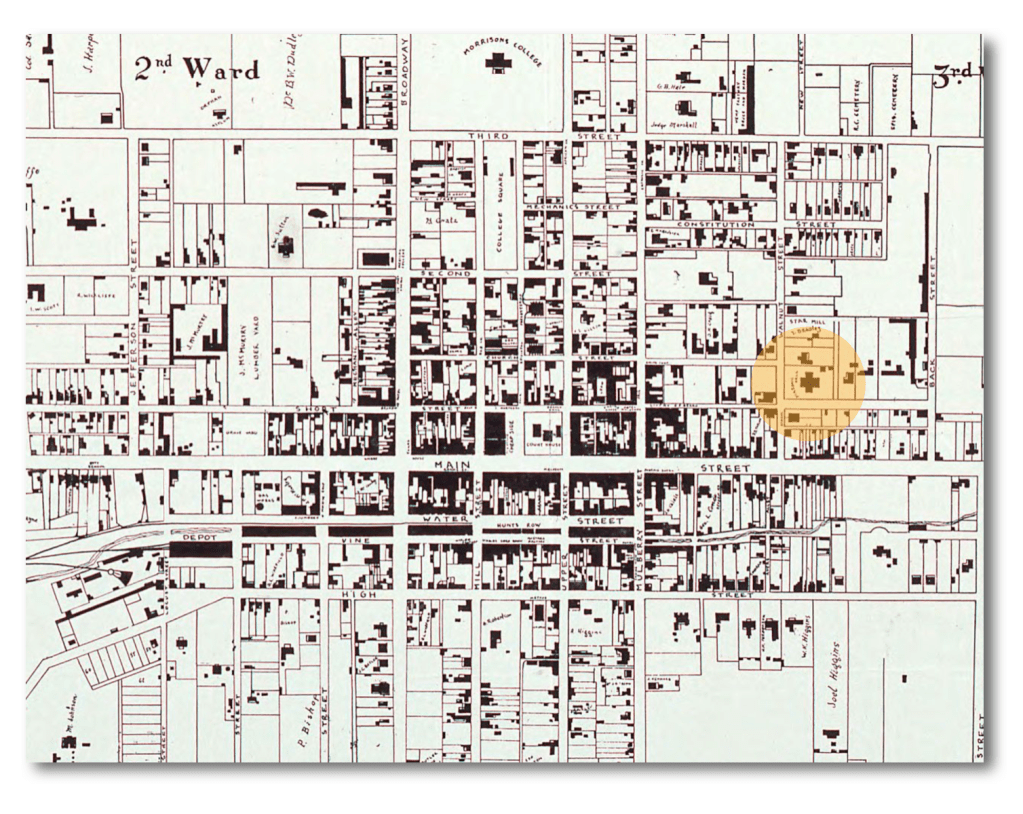
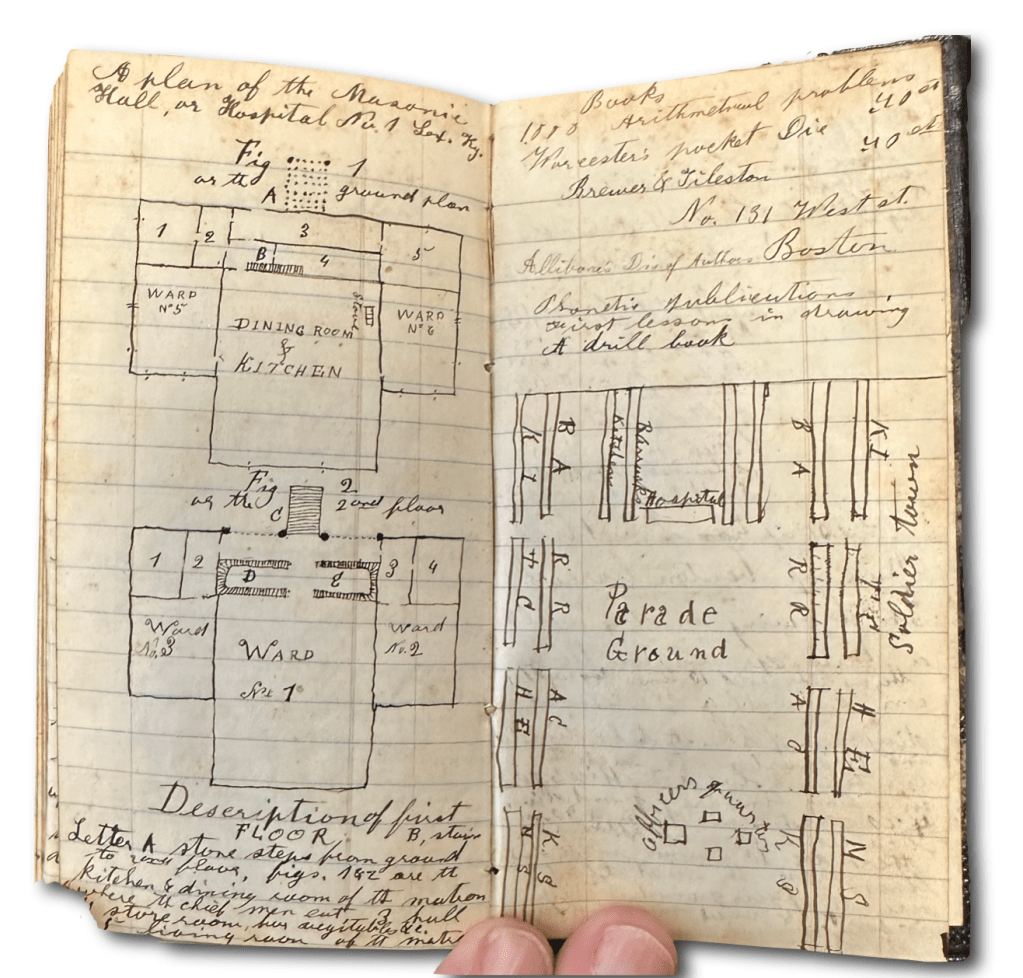
Wednesday, 12th. Early in the morning we heard that the regiment are to march to Nicholasville—a place on the Kentucky River 12 miles distant. A list of the sick were made out. Those worst off to be sent to Lexington Hospital; the rest to be taken along intending to carry a few in the ambulance. I was put down as “doubtful.” In p.m., orders came for everyone not able to walk to be sent to Lexington. Accordingly, a dozen or so with myself were packed off in a couple ambulances. Seven were in the one with me. It was closed up tight as the weather was damp—a little misty rain; a very bad time to expose men. I tried my strength to the utmost to climb into the ambulance. It was very comfortable and easy & I experienced no inconvenience whatever from my ride. A part of the squad was left at the Old College or Hospital No. 2. The measles cases including myself were taken after much delay to the Masonic Hall further in town, or Hospital No. 1. We were placed in Ward No. 5—a room on the ground floor. There were 8 or 10 already in the room from Illinois regiments. They came in day before yesterday—the first that were entered. The hospital was partially opened on the 10th. It had been occupied by the Rebel sick. The last were removed today. The house is very dirty & all in confusion.
The man who drove the ambulance was retained for a nurse as there was a great scarcity of these very necessary personages. It keeps him pretty busy to take care of us. I felt a good deal stronger when I arrived at our destination. I walked around considerable, was very cautious about taking cold. Two from the regiment, one of them—Abner Sherwin [Shermin]—from my company, besides the nurse, are in the room with me. Wilson is a first rate nurse. He has served in the English service. Is a Scotchman. The steward discovered his worth & immediately appointed him ward master or more precisely chief nurse of Ward 5.
Thursday, 13th. I sat up most of the day. I wrote a letter home. I ventured to go out doors awhile as it has cleared off pleasant. There were more measles cases brought in from the 18th Michigan Regiment. We have plenty of light bread, sugar, tea, coffee, meat, rice, &c. Rather course grub. There were several colored girls in the kitchen the first day or two but they were soon discharged. Only one returned to help do the washing. Three washer women; two Irish women. There are two and sometimes three Irishmen kept constantly employed sawing wood, cleaning and scrubbing and all sorts of odd job. I sat up pretty late this evening reading.
Friday, 14th Though I did not go to bed till quite late last night, I could not sleep much. I got up about three o’clock in the morning and went to writing. Finished a letter home and began one to Uncle Marco. Did not sleep any during the day and now at 9 o’clock tonight I do not feel sleepy. I have not done much but ramble around. Ticks and pillows were furnished us. There are now 25 sick men in the room, most of them have the measles. Eight took first medicine tonight—Dover Powders. I schemed around & got some mush for supper. A man belonging to the 115th Illinois [William R. Anderson, Co. F] died out of one of the other wards. I learn that a week ago, 7 died in No. 2. Two men from my company are helping a few days to get established in the hospital.
Saturday, 15th. This date reminds me that I have been a soldier of the Union army just three eventful months. I have felt pretty well today. Have helped considerable to take care of the rest of the sick. There is more work than one man can attend to. Wrote some in letter to Uncle Marco and diary, catching up writing. Another man of the 115th Illinois died in p.m. [possibly John P. Roberts of Co. F]. I managed to get a piece of cheese which relished first best. Pleasant cool.
Sunday, 16th. I wanted to go to church but the Dr. ordered that not a measles man was to be let out. The colored population held a meeting nearby. It was interesting to watch them pass by. They are dressed to the tip top height of the most approved fashion & promenade the streets with all the pomp imaginable.
Monday, 17th. As there was more to do than Mr. Wilson could attend to conveniently and sad deficiency of able-bodied men to nurse, I was finally induced to sign my name as assistant or “first nurse” as it was styled then. Another man yet is required. I do not feel able nor competent to take charge of the sick as I am still very weak & unable to bear much fatigue. But I cannot stand by and behold my helpless fellowman suffering from inattention when I have it in my power to relieve their misery. I am now entitled to 25 cents a day extra. Worked hard all day. Feel somewhat tired tonight. Began a letter to the regiment. Began to rain last night—a nasty wet time. Three more men come in. Two sent out.
CURSORY OBSERVATIONS
Well, I have just finished a long, lingering & much dreaded job. I have copied my sketchings made mostly while I was sick in camp hospital & inserted many more items & enlarged on important & interesting subjects. It seems eventually that I did not make a very close estimate of how much space it would require in which to copy the “sketches.” Here are, therefore, 12 blank pages & I am utterly at a loss what to fill them up with. I dislike very much to leave them unoccupied. I have matter in store for part of the space at least, if I can only have time to transcribe it.

Concerning the regimental doctors and surgeons. The Chief, or Head Surgeon is Dr. [William E.] Clark. He has been in service before but was discharged for some misconduct they say. He is not very well liked by the regiment. He may be a skillful doctor. Then there is Dr. [Leander D.] Tompkins—a little “patchky” chap, but I guess a pretty well read man. The other, Dr. [John] Bennett is a tall, pleasant-looking man & I guess as good a man as they average. He is better liked than any of the rest. They are all good to deal out the drugs by the wholesale quantity. A little steward has charge of the sick, the beds, and all arrangements.
As to the arrangements of the Camp Hospital, a word or two of description may not come amiss. The main part consists of three large square tents, house-shaped, joined together endways. The first tent is the Medical Department. The other two are occupied by the sick. I laid in the middle tent. The tents are about, I should judge, 15 feet square. Each I think would hold a dozen persons. There there were two or three small tents for the cook, waiters, or any surplus sick.
Synopsis of the officers and medical attendants attached to Hospital No. 1 [Masonic Hall in Lexington, Ky.] Dr. [Robert] Peter, an aged, portentous, awe-impressive, sort of a man, is the chief of the institution, or “Surgeon in charge.” He attends to the convalescents in the schoolhouse attached nearby & oversees the rest & has the say about matters and things.
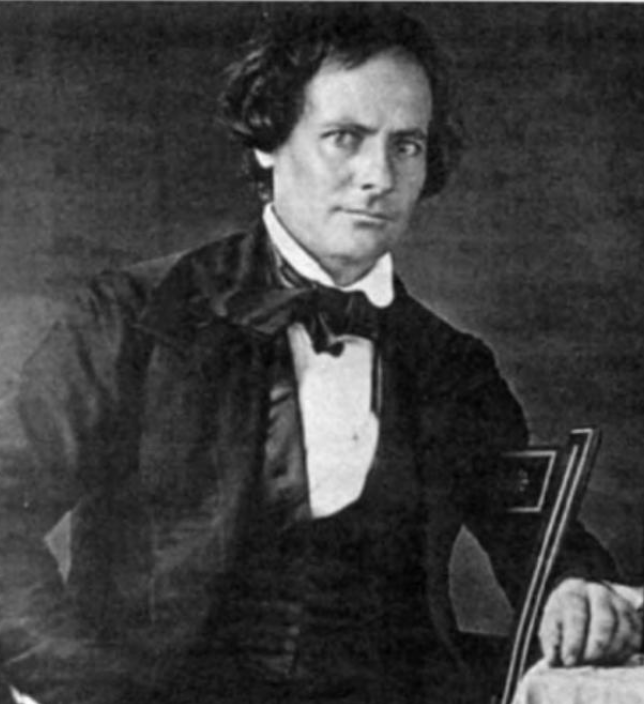
“Pa [Dr. Robert Peter] resumed command at Hospital No 1. … Pa said that when he went to hospital No 1 today. Drs. Root & Fox were there, and the provost Marshall came to see about moving the rebels. The doctors didn’t seem to wish to have them moved until after Dr Fox (who is going back to his regiment and who has had command of that hospital) should have left. But Pa got introduced to the Provost Marshall, and urged their immediate removal. During the conversation the two Drs congratulated themselves that there had been no death within the last 36 hours, when Pa said that there were as he found afterwards four corpses lying in the house two of whom had died last night.” [Source: “The diary of Frances Peter” (daughter of Dr. Peter), edited by John Davis Smith and William Cooper, Jr.; entry in November 1862.]
The next in importance is the steward or Dr. Flint as he is sometimes called. He is an active, energetic gentleman whose business it is to attend to and provide & keep track of all the proceedings and arrangements connected with the hospital. He is pretty well qualified for the station.
The clerk, Mr. Wilson, attends to the keeping of the books and doing all the writing connected with the establishment which is no small job. He belongs to the 77th Illinois Regiment.
Burnham Vincent next in order is the general Ward Master & his business is to look to the comforts and conveniences of each ward—the beds, the blankets, &c. &c., attend to laying out of the dead and taking care of their things, He is kept pretty busy. Was formerly a sergeant in some regiment. He also attended to the mail. These were the regular officers. [Burnham Trickey Vincent (1818-1891) of Delavan (IL) was a corporal in Co. H, 115th Illinois Regiment.]
During most of the fore part of the winter, there were three physicians besides Dr. Peter in attendance. They were Dr. Fletcher who died the forepart of February [1863]. He was said to be the best doctor of all. The next, Dr. Bruce, [was] a very good sort of a man, kind and attentive. He was taken sick along in January [1863] when the duty all devolved on Dr. Young & Dr. Peter. Dr. Young was nothing extra for a doctor. A son of Dr. Peter, he always staid in the office to develop and mix the medicines prescribed by the doctors. They don’t give so awful much as the camp doctors used to.
The Matron, Mrs. Miller, was a real motherly old lady & resided in the building. He husband was a helpless invalid. I never got a chance to see him but often heard him. He had a great notion for calling out for a certain “Corporal Shaley.” Mrs. Miller’s duty was to cook for the officers of the establishment. They lived well, of course. She also had charge of and fixed the delicacies, if there were any; made the toast, dealt out the milk and butter when they had it. She kept one hired girl. She has been here ever since the institution was started.
Mrs. Flint who also stayed in the building did the sewing, mending, and various other tinkering. She was a very kind and amiable lady. She and I were great friends. She was a true-born Southerner though not a secessionist. An earnest advocate of slavery and a despiser of Abolitionists, as in fact nearly all here are. There there were 2 and sometimes 4 Irishmen to do the cleaning, cut the wood, carry water for the washerwomen & any other extra jobs. They never got out of employment. They lived in town somewhere. Frequently had a soldier or two to help them.
Finally there were three and sometimes four washerwomen kept constantly employed—one colored, the rest Irish. They washed the sheets and pillow slips every week and did all the washing for them men each week. Also lived out in town. A small building separate from the rest was used for washroom and a part for the dead house. One horse was kept and a man detailed from among the convalescents to drive him to draw the water & run on errands, &c., being in provision or any other articles wanted.

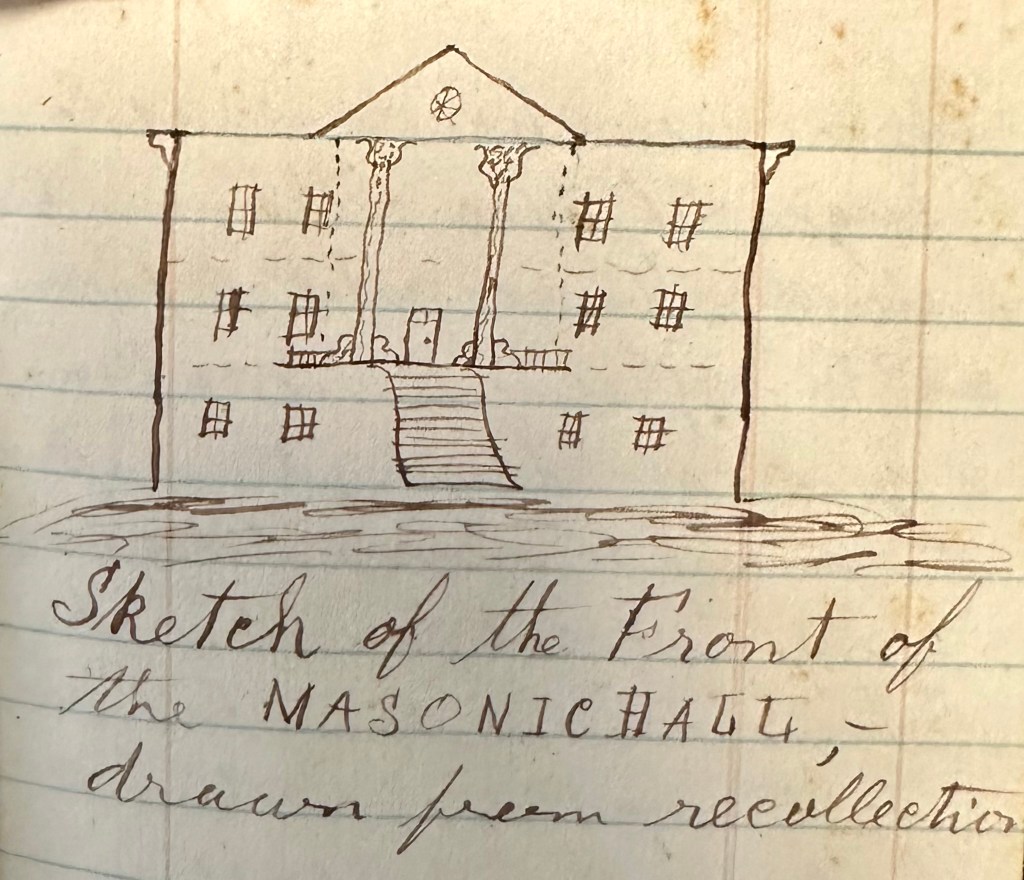
The Masonic Hall seems to have been quite an institution one day. The building is large & well built & presents quite an imposing appearance from a distance. It is built tasty though not ornamental. Composed of brick as is every other building of any consequence about Lexington, and pained a leaden color—cannot be said to be white. At the front are broad stone steps from the ground to the second floor. At the top of the stairs is a large porch, two round pillars rising from the second floor to the cornice of the roof. The grounds belonging to the hall were spacious and filled with trees and shrubbery, walnut and spruce principally, some pine, surrounded on two sides by an iron fence. The grounds were about five feet higher than the street, walled up with stone, a fence set into the stone, A broad brick walk all around the length.

Here are still a couple pages of spare room which I hardly know what to fill with. Guess I will attempt a description of the ancient and somewhat renowned city of Lexington, Kentucky. I have several times before written it in letters to various individuals. It always seemed a mystery to me what particular attraction this locality possessed to cause a city of such dimensions to be reared here, being distant from any navigable water course thereby rendering it easy access & communication. The general inference is that the fertility of the soil and garden-like appearance of the landscape were the chief attractions. The face of the country is slightly undulating. The streets are regularly laid out but rather narrow & shade trees planted by the sidewalks. The general aspect of the town is dark, dingy, and dirty, old & dilapidated, needing repairs. The business part of the town presents a lively appearance. The streets pretty well filled & have a good run of custom grocery and provision stores and candy shops are very numerous—seemingly anyway—to supply the whole state.
Tuesday, November 18th [1862]. I am over two weeks behind in keeping my regular and full account of daily events and that too without much prospect with the present aspect of affairs of ever catching up again if I keep on as I have been doing for the past month, by sketching down each day and trusting to some future time for copying and making the additions. I therefore this evening made a estimate of how much space the two weeks would occupy & had skipped over two pages for a day on an average and I now proceed as usual as I foresaw that I could not get time to copy & ever catch up. Now the material can be copied as I have leisure.
Another day as nurse in Hospital No. 1, Lexington, Kentucky. I have been jept pretty busy all day doing all that I am able to bear in my present weal condition. My partner, the “Ward Master” went out awhile today & left me alone with them. There are one or two in this ward who I think are well off or better than I am & might take hold & help us if they but had the feeling of ambition but for the most part we are alone and it keeps us on the jump most of the time. Fortunately for us, we have none that are very low so that they cannot help themselves out of bed. Roll call instituted tonight by the steward.
I finished my letter to the boys and sent it out. Wrote four pages, directed it to A[ugustus] Bailey. Report tonight that the pay master will be around here tomorrow but I am afraid it will do me no good unless some of our officrs happen to come down with my “descriptive list” and other documents which I suppose are requisite to draw pay. It will be too provoking if I am put off till next pay day.
I took time & made a side pocket in my dress coat today. Still continues cloudy. Very mild weather. Rained last night. It’s about 11 o’clock at night. All is quiet. We do not have to sit up. Anything wanted, they must call.
Wednesday, 19th. Nothing of importance has turned up today within my knowledge. One of our boys got a letter from one in the regiment. They were at Nicholasville yet. Stray rebels were reported to be prowling around. We received a new case of measles today. It has rained considerable today. Cleared off tonight. I had quite a severe attack in my stomach tonight. Something I ate did not agree with me. I have been taking some diarrhea powders which has partially stopped it excepting a Dover Powder. I have not taken any medicine since I came here.
Thursday, 20th. After doing up my morning chores, I procured a pass and went “down town” for the first time. Went more particularly to get some articles for a sick man. It is but about 48 or 50 rods [1/8 miles] to the business center of the place which is truly a place of business. The external appearance as usual in old is old and dingy in the extreme but within the shops & stores are quite nice & fancy. Indeed, the appearance of the place compared with our Northern towns is quite indescribable. There is a striking difference. They seem to keep a complete assortment of everything imaginable and oh! how I longed for the means requisite to obtain some of the many thousand articles which I saw. But they ask a double or triple price for everything. I took down my pocket inkstand which I got of the sutler for 30 cents and exchanged it for 6 apples which they asked 10 cents for. I sold three when I came back for five cents. I let the last of my money (5 cents) go for an apple pie which was first rate. I was bound to have something good to eat & that was the best chance that offered itself. I saw delicacies innumerable & it was hard to decide what to choose.
I was only gone about an hour. Pass extended till 11 o’clock. While down there I was weihed. Still a lower figure—viz: 117 lbs. A decrease of 13 lbs. since last winter. If that ain’t encouraging! I was halted twice by the guards stationed all through town and required to show my pass. Among other things, I saw a piano for the first time. It was a nice thing. A man was operating it.
The doctors discharged four men for this ward. Send them to their regiments tomorrow. I wrote a short letter to send to our boys by one of our regiment. They are not entirely well but out of danger. I borrowed a set of shaving tools and performed the operation, shaving for the first time since leaving hime. My face was getting somewhat hairy. I spared those on the chin, which were doing so well, being about an inch long for the sale of keeping my word good not to shave till I came back. The doctor that attends us here does not come around but once a day. He does not then deal out one-quarter the drugs that our camp doctors used to. He does not examine into these cases very closely anyway. Has never taken any notice of me except when I called his attention twice to stop my diarrhea. Gave me powders which has variably taken effect.
Friday, 21st. It has been quite pleasant most of the day. Dried off the mud a considerable. The most noticeable feature of the day that concerns myself is the receipt of a letter & package from home. They came through pretty direct. The package contained a flannel & a parcel of dried peach sauce from the appearance. I think it originally contained something more & what is more suspicious, the letter envelope was open at one end, & further no mention was made in the letter concerning the package. They had been sent to the regiment and forwarded here. All right at home but they denounce me in harsh terms for not writing oftener. I began a letter back immediately.
We had the promise of a reenforcement of three more men tomorrow. The sick get a flourish of extras occasionally now. Have had milk with mush in small quantities twice now. Tonight had some bread pudding & one of the men had some butter and dried cherries which he shared around. I sold my two remaining apples for two stamps today.
Saturday, 22nd. A very sad and melancholy occurrence happened here this morn. Those three men were brought in which we had the promise of yesterday. Two of them were just coming down with the measles. The other—a fine appearing fellow about 20 years of age named Caleb Cole of [Co. G], 18th Michigan Infantry—fainted away just as he got to the door and was carried in by his comrades & laid out onto a cot. As soon as I saw him I could see that he was actually dying. I went for the doctor but it was too late. In 10 minutes he was a corpse. A smart piece of business sending a dying man out that way.
Another man was detailed to help us a day or two or longer if we wanted him. We mopped the place pff and cleaned up in general, the sheets and pillow cases were changed, and all the dirty clothes of this ward were washed by the washerwomen. I have felt quite unwell all day today. I ache all over in my bones. Feel very tired and languid. The detestable diarrhea still runs me bas as ever. I have been trying to doctor myself. Last night I applied the towel & [ ] wet in cold water across my bowels which did not seem to do any good. Tonight I shall try hot water; [ ] the flannel through today. A clerical gentleman dropped in and made a few remarks & offered a prayer.
Sunday, 23rd. A man died last night in Ward No. 6 and another this p.m. in one of the wards above [possibly Niles A. Wood of Co. C, 115th Illinois]. I understand that there were 9 bodies to be buried today. The one that died here yesterday was taken away. He was placed in a very decent coffin as they all are but shameful to relate, there had been nothing done in the way of laying him out. He was unwashed with his dirty clothes on.
I wanted to go to meeting today but the other two nurses thought they should have the first chance so I had to stay to take care of the rest. I have felt a good deal better today than yesterday. Have no appetite. The doctor gave me some pills to take. I got two letters—one from Willie C, and Jo. Wilson. Wilson writes that Thomas [W.] Carroll of our company died at the hospital in Covington. Spent my leisure time in writing home. I ought to write four more immediately. Cool pleasant.
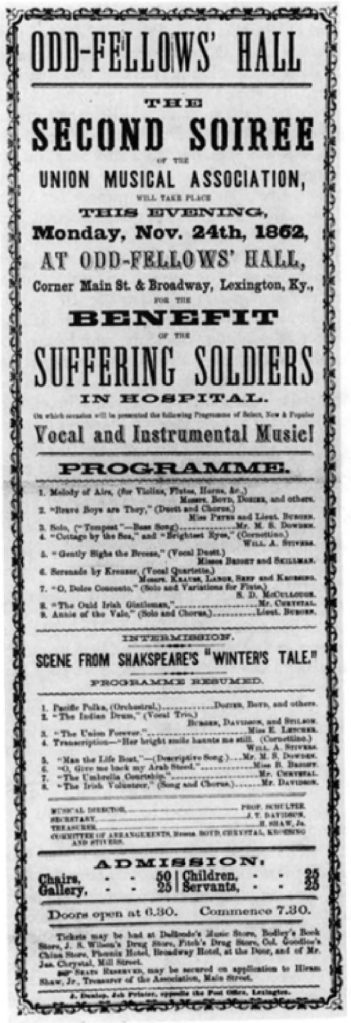
Monday, 24th. Two more men from this ward received their discharge to make room for a couple more measles men from the 18th Michigan. They are not very bad off yet. I finished a letter home and sent out. I have barely been able to crawl around today. I am afraid I shall have to give up trying to nurse. I am required to do more than I am able to bear. There are those that I have to wait upon & bring their victuals for, who I am confident—yes, know—have twice the strength that I have & are enjoying better health generally. They will get passes and run all over town and cut up otherwise. But when it comes meal times, they are “unable” to go into the kitchen adjoining, are afraid of “taking cold,” and other absurd & ridiculous excuses. But the amount of it is this; if they can manage to play off so sick, they can get better living by it, as these are furnished better grub but dealt out in smaller quantities not calculated enough for a hearty man. Now these stronger ones naturally will have roaring appetites and as soon as the tray is brought in will crowd around and literally rob the helpless ones. I have had charge of the feeding lately and it makes me so provoked. I have talked and reasoned with them but they are too much like hogs. The two that left today had never got a meal in the kitchen, The very essence of meanness! The Dr. has given me a whiskey bottle one-quarter full of a tonic. Spoonful to be taken three times a day, It’s very bitter. Pleasant [weather].
Tuesday, 25th. I got word last night by way of another that the boys at the other hospital (No. 2) would like to see me if I was able to get there. Accordingly, today about 10 o’clock I got my pass & started. The time only extended till 12 o’clock but it was noon when I got there. I went out with a canteen to get it filled with milk for another person, he furnishing the money. I was directed to a very kind-hearted lady. She would not accept pay but she was a regular Southern [lady], down on the abolitionists. Arrived at the hospital and found the boys all on the gain. Learned that one of our company, [Henry A.] Potter, had died.
I have felt much better today than usual. I think the tonic is doing me good. It’s very disagreeable to the taste. Towards night it began to grow colder. Prospect of snow.
Wednesday, 26th November 1862. Have not done much today. Laid down mostly. They are all very lenient towards me. My awful cadaverous appearance being proof of my inability. I don’t fel a particle stronger than I did ten days ago. The diarrhea still runs me regularly—two a day. Scarcely any appetite of late. There must be some strenuous means taken to effectually stop this everlasting murdering complaint. Cold and cloudy all day. Snowed a little.
I wrote a letter to Jo. Wilson in answer to his to me, concerning my descriptive list. He stated in his that it was made out by the Captain the morning that I left the [camp] hospital & was handed to the surgeon with several others. He must have taken them back to camp again, I think, as I cannot find them at this or the other hospital. He, Wilson, said he would send it to me if I could not find it here which I directed him to do. They will have to make out another.
End of the Journal of Events
 Spared & Shared 23