
Editors Note: This diary is housed in the collection of Michigan’s Military Heritage Museum and was transcribed for publication on Spared & Shared by the express consent and encouragement of the museum. I wish to thank Scott Gerych particularly for reaching out to me and making the incredible Civil War Diaries of Almon J. Pierce available to me for transcription. Once all of Almon’s diaries are transcribed, they will be linked to a summary page that will provide a summary sketch of Almon and his diaries.
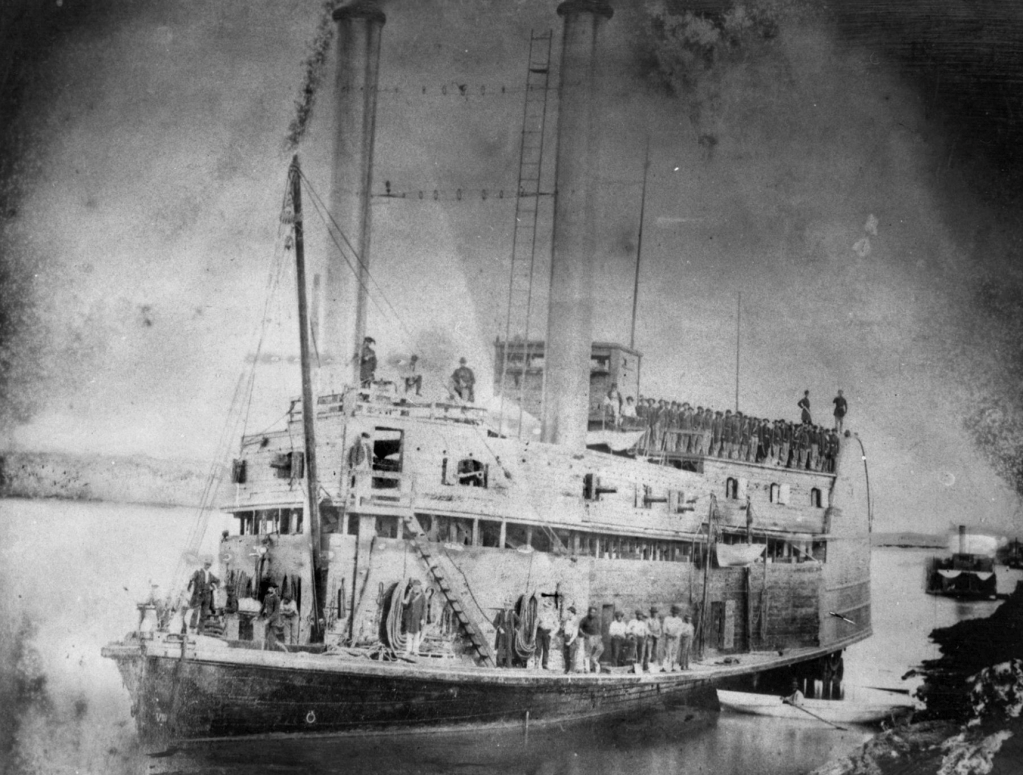
[Aboard the B. J. Adams, or “Adams”, Mississippi Marine Brigade. This steamer operated commercially on the Mississippi river between Louisville and New Orleans prior to the Civil War and was outfitted much the same as the Autocrat, Baltic. Diana, and John Raine—other boats used by the Brigade. I believe she was built in 1859-60 and she only drew a smidge over 3 feet of water. “Outfitting involved extensive retrofitting to protect the boilers with heavy, thick timbers and large bunkers. Extending from the lower deck all the way to the overhead, two-inches of solid oak shielding provided protection for the Union riflemen. Into these bulwarks, workmen cut loopholes for Union troops to aim their weapons and large portholes with hinged covers on them to provide ventilation. To protect the pilots from rebel gunfire, the pilothouses had large sheets of boilerplate iron installed along the walls. Other alterations to the boats involved the use of pulleys hanging from the forecastle to raise and lower a large, railed gangway, which allowed two horses to embark or disembark at the same time. This ramp facilitated the on loading and off-loading of troops and equipment. The gangway also had attachments that allowed a large crane to swivel to either side of the vessel for deployment of Union forces. The living quarters for the officers, located in the aft-part of the cabin decks, allowed them to gain access to the main deck area in case of attack, and the forepart of the cabin deck was converted into mess halls for the men. The middle deck area, just to the rear of the boilers contained the enlisted men’s sleeping quarters. To prevent the Confederates from boarding, each vessel had large hot-water hoses to tap into the boiler water system for a readily available supply of hot water. Ellet outfitted a few of the vessels for support duties; he equipped the Fairchild as a quartermaster and commissary boat and the Woodford as a floating hospital boat.” [Origins of the MMB: First use of Brown Water Tactics by the US in the Civil War, by Thomas E. Walker, 2006]
My Diary, a record of Daily Events from March 6th to April 15th, 1863
Introduction. Here is recorded nearly a month and a half of my first experiences and notes of scenes and objects on the Mississippi River, recounting our first trip down the river, the first glimpse of Vicksburg, and our return, and our starting up the Tennessee River. This is the largest of any of my pocket books & I have taken much pains to make it interesting and instructive, and leave nothing for inquiring mind to seek further in the way of description. How well I have succeeded in this respect, I leave my gracious friend to judge.
Friday, March 6th 1863 at St. Louis, Mo. The day spent as usual in “gaping” around from one boat to another without really ever discovering anything actually worth a moment’s notice. I see a great deal too that perhaps it might interest some few to describe, but generally speaking most of it can be so easily imagined by the general reader that I hardly think it worth the time, ink, and paper to specify every little incident that may pass before my observation. The general business in landing the boat with hay and grain for the horses and provisions, army stores, &c. &c. preparatory for departure someday nears. The commissary boat arrived about 11 o’clock, same size and build of the rest. but no loop hole cut through for muskets. Intended for carrying army stores and everything in general—name, E. H. Fairchild. The hospital boat is yet wanting. I suppose our fleet will be complete.
The steamer Planet started for Vicksburg with army supplies, &c. &c., a Missouri regiment to be left on the way somewhere. A clergyman distributed testaments—all that wanted them free. It is amusing to watch the 4 or 5 ferry boats that keep continually crossing back and forth. They are altogether differently built from our boats, are propelled by the screw wheel. Three or four steamers have passed by here carrying army stores. Generally they are not more than half as big as these.
Our fare has to be rather tough. We were told when recruited that we could always have plenty of good soft bread, that we might bid farewell to hard tack, but for supper last night & today we were given but little else—only coffee and friend pork. Notnight hard tack and coffee alone. The men are quite dissatisfied but we are promised better fare now. A celebrated cook has been procured & we are to have brisket for breakfast.
There is some excitement tonight in consequence of a couple men being robbed today of $75 and $85. Cavalrymen. They had been in town and got pretty drunk. It is very hard to get a pass out to town. Only a limited number can be out at a time. I should like to go if I had more money. Weather cool.
Saturday, [March] 7th. The day has passed without any very important or noteworthy occurrences. There is a considerable mischief going on among some of the men—the hard cases. They will run the guard nights and get drunk. Two or three have been locked in the guard house today. Others ought to have been to do justice by them. One man of our company got his head broke pretty badly in a scrape with the provost guard. I tried to get a pass out but others were in ahead of me and no chance. We had tolerable good brisket for breakfast only. I got three letters, one from home containing one from M. G., from cousin Arthur, and from Mr. Biddle. Home said that they had started some things for me but R. had not got them yet. Weather cool. Snowed 2 inches deep last night.
Sunday, 8th. Well. the Sabbath is about over. Passed as usual among soldiers. Nothing of special importance has transpired. Had inspection of arms and a short drill in the manual of arms above on the hurricane deck this morn. I have been engaged most the rest of the day in writing. Wrote a letter home and began one to Mr. Biddle. The paper contains a short account of the Battle of Spring Hill near Nashville but the most important of all, it is stated that the greater part of the 19th Michigan with four other regiments of the same brigade were taken prisoners. I wish I knew all the particulars.
The carpenters have been building a partition across the dining hall to segregate the stove off. Weather continues about the same—cool.
Monday, 9th. Nothing of special importance has occurred within my knowledge. The women peddlers have been prohibited from coming within the guard line as heretofore they have been in the habit of bringing in whiskey and selling to the men concealed in their clothes. The men arrived from the different companies for the formation of Co. H. We drilled manual of arms a couple hours p.m. I have come across my old blanket again today. Man pretended that it was issued to him. One of our worst characters was locked in the guard house tonight for insulting the officer. He’s nothing but a bad boy but feels very important & is outrageous, impudent, and was half drunk. I have engaged in writing to Biddle most my spare time. Still cool.
Tuesday 10th. In a.m., finished the letter to Biddle. He wished me to write a detailed account, the origin and purpose of this “Marine” expedition & I have endeavored to comply with his wish. In p.m. we drilled but before we commenced the exercises, we were introduced to our future captain, Thomas C. Goshon—a total stranger to all of us. He is a tall, fine looking, middle-aged man. He is rather short and exacting in his manner. Co. C Cavalry drew their “Sharps Carbines.” They are splendid arm. Affairs aboard are improving considerably. Heretofore we have not had any knives, forks, nor spoons. All furnished today. Had soft bread for dinner and supper and beef steak for supper also. My combined army knife has done good service & been very handy previous. I should like to sell it now. Day pleasant.
Wednesday, 11th. We have had ourselves in readiness all day for mustering but that important event has again been deferred to another day. The other two companies, G and H were mustered. I don’t see what makes our officers so slow. There is some mismanagement somewhere. Co. E was paid off today. There is talk that we are to leave here tomorrow for Cairo. I am afraid that we will not be paid before leaving. The boat hands are cleaning up the engine, &c. We came out on dress parade this eve. We expected some announcement as to our future prospects but were disappointed. I wrote some to Will, I have a dreadful cough. Have got some medicine for it. I lent 50 cents to a fellow on the promise of 60 cents on pay day.
Thursday, 12th. Another quite an important preparatory step has been taken today. We are lying tonight on the Illinois side of the Mississippi river. The reason assigned for this movement is to prevent so many of the loafers from running by the guard into town and getting drunk so much as they do. They break through by the dozen every night and keep stealing through the crowd that is always congregated about in the day time. Two or three drunken fellows were put into the guard house last night but they broke the door down in short order. Several from the other companies have deserted notwithstanding several have taken their pay. Our company were all accounted for tonight—something that I don’t think another company can brag of.
Another important event transpired worthy of special notice. The all important & much talked of operation of mustering into the Marine Service was finally effected this morn. My friend Hall & another man did not pass muster. Hall is quite unwell, doing rather poorly. He will probably get a discharge in his old regiment. They both went to the barracks in town somewhere to await transportation. Hall left me some business to do for him. We intend to keep a correspondence. I was detailed for guard. Did not go on till about [ ] o’clock. Stood till about 4 o’clock when the boats shoved off one after the other except the Jo. Raine which is not calculating to start under a week yet. The Fairchild started down this morn.
The Autocrat started out first, the Diane next, Baltic next, and our boat, the [B. J.] Adams last. Went across and tied up directly opposite. I occasionally see Gen. Ellett around on business. He is a very plain, common placed man, Does not get in so much style as a great many of the [ ] do. We commenced firing up about noon. Our quarters are now plenty warm enough, As a matter of course the weather is moderating. They made a new detail of guards & have put out three lines to prevent desertion. There are [ ] railroad depots in the vicinity. There is no town or an excuse for one on this side of the river. Mostly timbered land & rather low and wet. The water of the river is much cleaner on this side. I counted 30 women all in a line peddling pies, cakes, candy, apples, &c. Some few boys and even men—mostly Irish and French. They have plenty of customers.
Friday, 13th [March 1863] Evening 7 o’clock. We have just tied up, tis said 150 miles below ST. Louis at a little insignificant landing on the Illinois side of the river to replenish our supply of fuel with wood. They are carrying it aboard “right smart.” What a contrast between this and the land service. Here we have made a march of a hundred and a half miles and no more feel the effects of it than if we had laid in the harbor all day. No blistered feet to nurse & doctor up, no lame legs and shoulders from carrying knapsacks to mourn over, and then the extra duty of pitching tents after the tedious days march of 15 or 19 miles after which the grub has to be cooked and ate and finally at a late hour of night you lie your weary limbs on the frequently cold, wet ground. In the morning, the routine repeated, &c. &c. &c.
We begun to get underway a little before sunrise, the Autocrat taking the lead. She got near a mile downstream when the Diana and Baltic took after. They had got about half mile, then we got under way. We kept our distance very well till noon, p.m. [when] we fell behind as this is the slowest running boat of all. The Baltic kept close to the Diana as the pilot of the Baltic in inexperienced. It was a splendid sight to see them go one after the other following the channel of the crooked Mississippi. The day was very pleasant though not very warm. These boats are so easily discerned from all others by their massive, dark-yellow hulls, being a third larger than any others I have yet seen.
The general aspect of the country so far, on each side of the river, has been somewhat monotonous in one sense of the word, though varied in another. The banks of the river have alternately been high, abrupt hills or bluffs & low, marshy bottom lands grown up to willows or, if dry enough, to sycamore & cottonwood. The low land predominating on the east side and the rocky bluffs on the west side. In many places the bank would be of solid rock rising almost if not quite a hundred feet perpendicular. Frequently to fantastic form of the rocks would remind me of pictures of old Oriental ruins, as the woods resemble pillars and broken [ ], also niches for images would seem to be cut into the solid rock, also pinnacles.
We passed a great manny islands, mostly low and sandy, orvergrown with willows. Plenty of timber and as it is most all the way on either bank, the country does not seem to be settled uch. We passed a small town named St. Genevieve at noon, St. Marys an hour after—both on the west side. Chester, Illinois, 9 miles lower down. We only met two boats under headway, several at different landings. I should like to see a map of this section of the country but not one is to be found. Sand bars and snags are numerous. It don’t seem as though they could run when the water is anywise low. We have kept mostly on the west side of the river. It is very crooked.
I was detailed for “police” duty and worked most of the time cleaning the cabin decks, &c. We clean the decks by means of a long India rubber hose which runs a strong steam of water wherever directed.

We were given 20 rounds of cartridges apiece. Also issued clothing. I drew a shirt and pants. The shirts are white flannel about like my old ones. Don’t like them very well. Drew pants for extra occasions as my old ones are perfectly whole yet but are somewhat dirty or rusty. I wanted a cap but all that were left were too large for me—the opposite difficulty from what the others were when I drew. Most all now have their uniforms. The caps are the chief peculiarity of our uniform shaped thus [sketch], the band in green.
I got a letter today though it came last night from Dr. Peters. He merely writes and certifies upon honor that I, Almon J. Pierce, have served so & so & am therefore entitled to said pay from the government. They tell me that this is not sufficient for me to receive said recompense, that there is a lot of preliminaries to go through with yet. He does not say anything why it was not entered on my Descriptive Roll, nor nothing else—only a certificate. I hope to hear something further by way of Biddle. I must have a reenforcement of greenbacks pretty soon. Our Capt. [Thomas C.] Goshon stayed behind to arrange matters in regard to our pay, to meet us tomorrow morn at Cairo. That’s the program as far as I know.
Just at sundown we arrived at quite a large town on west side named Cape Guerago [Girardo]. or some other awful name. Here the Autocrat undertook to tie up. Don’t know but all were intending to but she pulled the big anchor stone out of its bed. The boats all then turned around and went on again five or six miles. While we were turning around, the sunset gun upon a high hill adjacent to the town was fired. We passed a large encampment of soldiers a.m. I picked up a piece of waste lead pipe and have cut out a nice little anchor as an emblem of my service & an ornamental “F” to signifying my company. They attract considerable attention. Well, it’s getting late and I can’t get sleep. My rest is not overly comfortable.
Saturday, 14th [March 1863]. A little after daylight we again began to move in the same order as yesterday. For awhile we went in a southeasterly course. About 8 o’clock, I found we were going due north. I think we turned east, went north several miles, then turned southeasterly. The country on either side was low and marshy or timbered as far as could be seen. About 9 o’clock we drew nigh, not the far-famed, but a perfect flash-in-the-pan town of Cairo. We rounded the low, narrow point of land on which was planted a battery of several guns and entered the mouth of the Ohio river. Passed up the river a couple miles or so and cast anchor near the Kentucky shore, about 12 o’clock. Soon after, Gen. Ellett came over in a skiff, stopped awhile, then proceeded on to the village.
Just at noon, a new to me and odd-looking craft came to us bringing a supply of coal. She is a regular gunboat, not an ironclad. She is wooden clad with port holes like these but differently constructed otherwise and about [ ] as large. She carries 10 or 12 cannons aboard. The outside is painted or enclosed by the smoke black. There were several of these wicked looking concerns lying at the wharf, one of which fired several salutes as we passed. Here I first saw those powerful little steam tugs. They are indeed a curiosity and present most a luxurious appearance to one used only to the steamboat. They are so small that they might be stuck into the vest pocket very conveniently, seemingly, yet are so powerful that tis said they will tow two such boats as this upstream. They go almost as fast as comets [?].
Evening. About the middle of the p.m., that gunboat came around and took several of the officers to the city. When she returned about sundown, I learned something of her history. She is the famous gunboat Lancaster. The name is familiar to me but I don’t now remember anything special concerning her deeds. She was present at the time when the rebel ram Arkansas came down the Yazoo [river] and run the gauntlet to get to Vicksburg. The Arkansas fired two shots at the Lancaster—one passed through the wheelhouse framing, damaging the wheel considerably, killing a negro and wounding a white man. The other cut the steam pipe and scalded five men to death. She is intending to accompany us. 11 o’clock. [She] is tied up by us now. We are taking coal aboard.
A little event partially transpired this p.m. which we have long anticipated and anxiously hoped for. Capt. Goshon and the paymaster arrived & those who had their Descriptive Rolls & had handed them in, signed the payroll & were paid off. Only 15 or 20 were thus fortunate. I received $45.95—considerably less than the 9 months back pay that is behind. They say that my clothes are taken out of my wages—all that I have drawn. I don’t see the justice of that. I supposed we were allowed so much extra for clothing yearly. Well let me see. Come to think over the matter the way they have got things charged to me, I guess I have overrun my allowance. I don’t know up to what time we have been paid. I think if I have a chance, I shall send $30 home. The fellow I lent 50 cents to the other day returned it with 10 cents interest. Tonight I lent another man a dollar. Those who have not got their pay feel somewhat depressed and low-spirited in consequence thereof. Their Descriptive Rolls have not arrived yet from their old regiments. They are promised it in a week or two. We will not receive our Marine pay for some time yet. One man received $111 and some change—a pretty snug pile.
There is considerable excitement tonight in consequence of the mysterious disappearance of a man who either fell overboard accidentally or jumped over intentionally. A man was seen by one of the deck hands to walk over to the coal barge wrapped in a blanket & go over board. Not known what to believe.
There is a marked difference between the color of the Mississippi and Ohio water, the Mississippi water being much cleaner & more dark. The Ohio is yellowish like clay. The make of the country as represented by the maps agree with just as I see it before me. The points of compass are a little changed. West is nearly where it seems north out to be. The rivers are about a mile wide. The land is low in every direction—half swamp and heavily timbered. Looks like sycamores and elm. There are a good many steamboats in and about the harbor. Some have flank protection something like these boats.
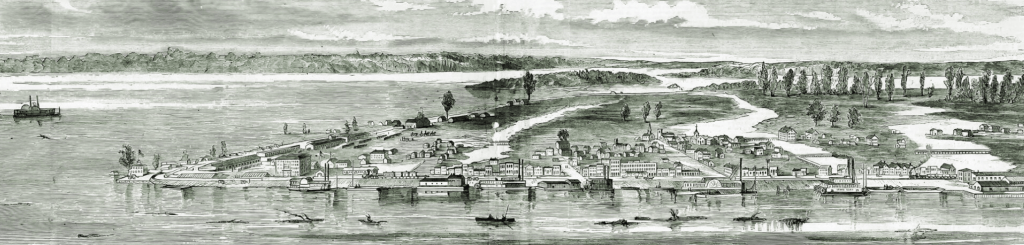
Concerning Cairo, I hardly know what words to use to express the disappointment I felt when first beholding this little insignificant but remarkably well known place. I can best compare it to the “Soldier’s Town” at Benton Barracks. All the buildings except two are seemingly only temporary, rickety wooden concerns. There is a splendid large brick hotel and a block of brick stores, &c. These and three church steeples is all that is visible from here. We are about a mile distant. But they say that there are several very good buildings down behind the levee. It must be a delightful hole in rainy times. I can see some of the houses partly under water now. The city certainly does not extend very far. I can see to the back side of it. The river is really up pretty high. Cairo may be a wealthy town but its pretty certain it’s not a healthy place. Oh but if the country here was only all high and dry, who could estimate the importance of the point from its central position and commanding as it does the commerce of the entire West. It would undoubtedly soon become the capitol of the United States.
The Illinois Central Railroad runs along on the shore of the Ohio river. The steamboat landing, railroad depot, and business part of the place is all on the Ohio river. I have made up my mind that no business man has any business trying to make any business in the town of Cairo unless he engages in mercantile business. I don’t think the population can exceed over 1,000.
Sunday, 15th [March 1863]. Today is the 7th monthly anniversary of my enlistment in the service of my country. I have an idea the next ensuing month will be the most eventful month of all, or the event that will undoubtedly occur during the month will exceed in importance those of the 7 preceding ones. I finished reading the testament through today. I have done it in about 6 months. Did not begin reading by course till about a month after enlisting. I have scarcely missed of reading from 6 or 8 chapters each day for the past four months or more. I have read many passages to try to understand them.
We came out on inspection of arms & persons this morn. Everyone who had not his shoes black was pretty severely reprimanded. Thee is a sutler on every boat. As soon as the sutler gets a supply of blacking, no one will be allowed above on deck without his boots or shoes nicely blacked. The Diana dropped down along side of us by the coal barge that is tied up by us to get her share of the coal. The barge contained 1200 bushels of coal which is to be divided between the two boats. The men have been engaged all day in taking it aboard. Have got most of it out now. It is probable that we will leave here tomorrow. Not known where to. I should like to go to town and make a few purchases.
The Lancaster came around and touched at each of our boats. I learned today that our 2nd Lieutenant [Albert] Dean served aboard her all last summer. He was present at the time she was shot into by the Arkansas. One of the cannon ball holes can yet be seen. The others have been patched up. A large seemingly square old ironclad came up from below and anchored about half a mile below us. She is said to be clad with railroad iron & is to accompany us. I understand that several others are to join us. Undoubtedly this will amount to most a formidable fleet for attack or defense.
I had the exquisite pleasure of receiving a couple letters from home today, one by way of [ ], the other direct. Latest dated and mailed March 10th. They were the two best letters I have received in a long time. Each member of the family wrote except Father. They do not upbraid me for my change in situation but rather approve my choice. I immediately commenced a letter in return.
A man broke with some kind of infection yesterday thought by the doctor to be the small pox. He was removed to the city or elsewhere. That man that went overboard, it is decided, belonged to this company named [Melvin H.] Ransom. He has been very quiet for some time. A strange performance anyhow. [Melvin previously served in Co. A, 21st Michigan Infantry before joining Co. F, 1st Regt. MMB. He was from Ronald, Ionia county, Michigan.]
The weather is most delightfully pleasant & quite warm. The heat is almost intolerable where we have to sleep. There appears to be a storm a brewing.
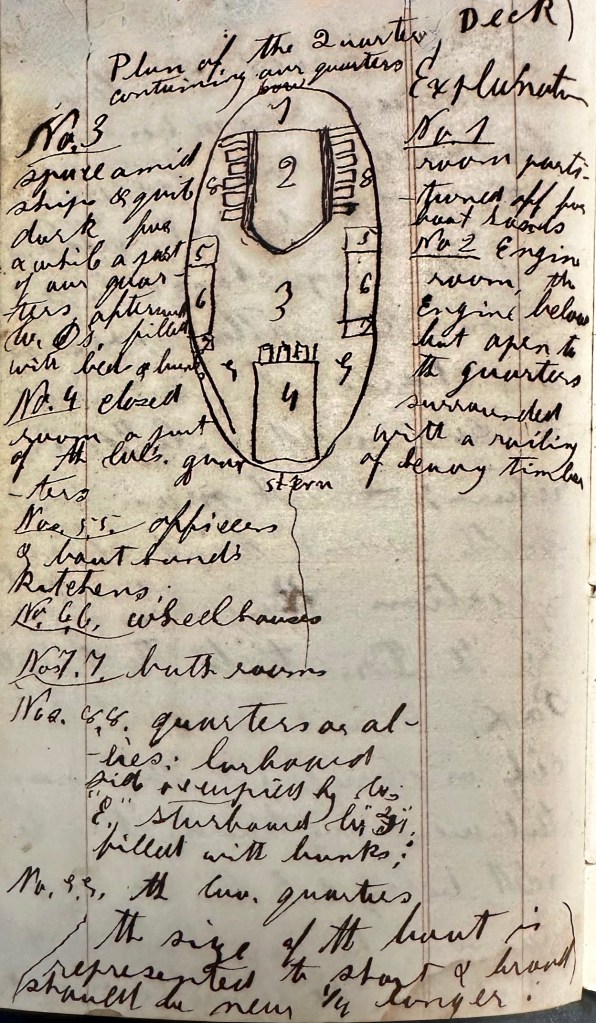
[Almon includes a sketch of the B. J. Adams he entitled “Plan of the Quarter Deck containing our quarters.”]
Monday, 16th [March 1863] About midnight. I have just finished a letter home. I have been playing my old profession again today—that is, nursing the sick of our company. There are four at present. Quite sick in the stateroom. Things have been going on at loose ends long back and I have been kept almost constantly busy righting up again. I feel quite tired tonight. The three rooms, two in one room, were all very dirty. I mopped and washed out on my own responsibility. Such dirtiness would not be allowed by a considerable at “No. 1.” I placed $30 in the hands of Lieut. Whitehead to express home. I should have sent more if I had had a $10 bill broke. The noncommissioned officers were appointed. It is intimated that we are to start up the Cumberland [river] tomorrow.
We had light warm biscuits for supper once a day after this. The boys have raised a contribution for a supply of soda with which to make them in the future.
(written afterwards) The cooks, bakers, waiters, &c. are detailed from the companies so long as they do their duty properly. If they get slack or heedless, new ones are put in. Johnson and [William B.] Julian of my company are a regular detail. The latter is baker.
Tuesday, 17th. Again we are steaming down the Mississippi at the rate of [ ] bound for Memphis. The program of yesterday seems to have been changed or else never existed. The operations are kept very secret from the privates anyhow. We began to get under headway about 8 o’clock. The boats in the same order as heretofore. At Columbus [Kentucky], the Fairchild fell in behind us and the Ram Lancaster brought up the rear. I was kept so busy with the sick that I did not have time to take many notes of the surroundings. Flood wood floating down in great quantities. We passed Columbus about 10 o’clock. It is a strongly fortified place situated on a bluff, a point of the high bank coming down to the river opposite & all around low and over blowed.
The Mississippi River is not never so high as the Ohio causing more overflow below here than above Cairo. They say the river is as high as it usually gets. Shanties log and frame, half under water are quite common. Hickman 45 miles below Cairo which we reached about 11 o’clock is situated on another bluff which is all the high land we have seen today. About noon we passed the famous Island No. 10 rendered famous by the siege it once undertook to sustain but didn’t. I used my faculties for perception here to the best advantage. I took a sketch as we passed this island. Was the highest, driest island we have passed I think this side of St. Louis. The shore on the outside was also dry. Seemed 8 or 10 feet. The island is not more than a mile long, I should not think. Part of it is thinly wooded. There was quite a large encampment there. There were large guns on the southeast point and on the south side were several. Also a tow boat with a lot of pivot guns aboard tied up. It’s not a very attractive spot only for the association connected therewith.
About 1 o’clock we reached New Madrid and stopped half an hour. This is another interesting locality. The town is of little importance. A little below are the fortifications—several large cannon. Two Iowa Regiments are encamped here—the 23rd and 38th. I don’t know why we stopped. The General, I suppose, had some special business on shore. 9 o’clock, we tied up on the east side of Island No. 26. all under water, made fast to the cottonwood brush sticking out. I feel rather unwell tonight. Have a bad cold. Co. E was under arms all day. Mr. Messenger did my washing for me today. I have been doing a [good] business at loaning money. It’s yet to be seen whether it will be a prosperous business. I have now over $9 out to 4 different persons. Part of them promise me a big percentage but if I can get the principal back, it will be sufficient to those that have not received their descriptive rolls. I took a bath p.m. There are three bath rooms—one for the officers, two for the men. Cold water is turned on & heated by steam. A very nice arrangement. The weather is very warm and pleasant.
Wednesday, 18th. We started quite early this morn. Passed Fort Pillow about 8 o’clock. This is another place like Columbus or Hickman, situated on a sort of a point of the true bank. There were several water batteries to be seen but no guns. A few houses, a small encampment to be seen back. About 11 o’clock we arrived at the deserted fortifications denominated Fort Randolph. Here we “rounded to” and tied up and immediately the cavalry got ready and started off on a scout & the infantry to drill. It seems that they heard back at New Madrid that there were a band of rebels in this vicinity. As my patients did not require my constant attention, I had an opportunity to go out on an exploratory tour.
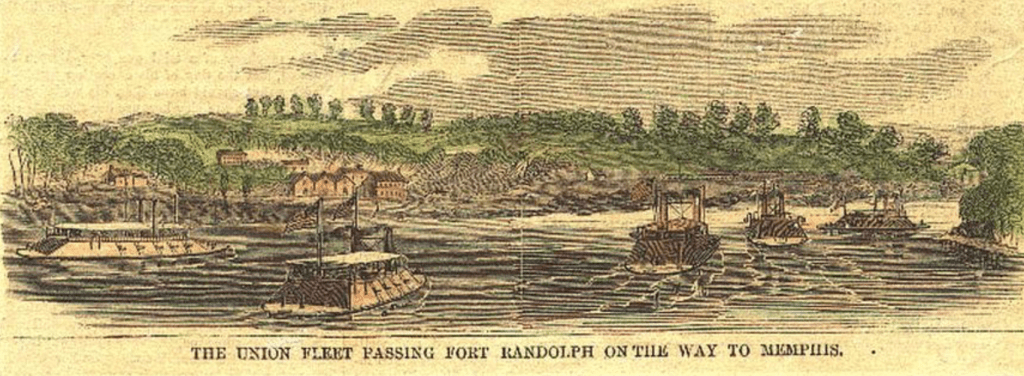
This is a very interesting locality. All not on duty were allowed to go out. We made many interesting discoveries. I do not recollect anything in particular about the place in the papers, but those who pretend to know say it was fortified by the rebels & occupied for some time by them. But the gunboats happened around this way one day and forced the secesh to skedaddle. They burnt & destroyed the store & some dozen houses first, the chimneys and ruins yet remain. The place looks desolate enough now. There are a couple farm houses back half a mile or so standing. The country is very rough and broken. Many deep gorges. The banks are very high, of clay. There is room between the foot of the bank and the water for several buildings and water batteries. There were several water batteries near there. I picked up a couple six pound balls. Some of the others found grape shots. I should like to [have] found a grape shot to keep as a memento. The six pounders were too heavy to lug around. There were lots of oyster cans among the ruins of the store. The breastworks above on the hills were quite extensive, seemingly work enough done there to keep a thousand men busy for six months or longer. The ground being hard clay, it must have ben very hard work. There were three fortifications that might be called forts. One or two sides there were heavy square timbers about 15 or 20 feet long set in the ground endways [and] loopholes were cut to shoot through. There was a graveyard on one of the hills. Not a very extensive one though. One man, George Frazer. But the greatest curiosity was the magazine upon the hill. It was truly an important work. It was excavated into a small hill, built or walled up and over with brick and covered over again. The entrance alley [was] about four feet wide and according to my measurement, 45 feet long. Then it took a turn of 15 or 20 feet, and then turned straight ahead again no knowing how far. I don’t know whether it contained an alley or was a room as I did not have a chance to go any further before the light went out for it was darker than pitch. [Note: This was probably the magazine at Fort Wright, an earlier fort constructed on the site.] There were a large quantity of shells in there and scattered about outside. The fuse and powder had been taken out. There were 6, 8, & 11 inch shells. No guns whatever here. This is the first battle ground I have seen. There were also near the magazine two large cisterns, all cemented up all so nice. Down by the water batteries was also a small magazine about 6 by 10 feet.
About half past 12 o’clock, the cavalry returned, all safe and sound & infantry came aboard and we immediately proceeded down, bound for Memphis. The Lancaster and Fairchild started half an hour before us. Each three companies are now to take turns at standing under arms. Are to strap their accoutrements on and their arms stacked by the loopholes. Co. F today. I have resigned my nursing to Rust who is not able to drill & would rather nurse and just as leave he would. It is so much bother to get anything that they can eat.
We today beheld the first signs of coming spring. The most noticeable feature were some peach trees in bloom. The trees are also beginning to leaf out and the grass I noticed had started an inch or two long, and the frogs I hear too for the first evening. We lie tied up about a mile above the City of Memphis. Got here the sun about half hour’s high. Tied up last night to small cottonwood trees where the water is 8 or 10 feet. The water effectually prevents the men deserting into town which many of them are inclined to do. In fact, I should like to go myself very well. Guards are stationed to prevent any from taking any of the boats or cutting the cable. Exasperated.
Memphis presents quite a respectable appearance from here. It is built on a gradual ascent and on the top are churches & other steepled structures which show off to good advantage. Many very large brick buildings are to be seen. A piece beyond is an encampment to be seen. The Colonel and some other officers went to town. The ram came up to us. I know nothing about how long we are to remain here. Weather very warm.

There is a wide difference between this steamboat riding here on the river and riding in a sailboat or any other boat, I suppose, on the lake, excepting a slight trembling of th boat and the noise of the engines, you would hardly know that it was moving. It is rather difficult to write while in motion though it can be done.
Thursday 19th. We again began to move a little after sunrise & went down about a mile below the city and the Autocrat and Adams went ashore and tied up; the other two anchored out in the river. None were allowed to go ashore. A lot of coal barges were lying between us and the land. The Lancaster came around after a while & several of the officers went up to town. The ram does all the running around &c. I missed a chance to send to town as usual. I suppose that the letter I wrote home at Cairo did not go out till today. Reported here that Vicksburg is being evacuated by the rebels and lots of prisoners were captured by the Federals. A great deal of sickness there, dying off.
Below the city and all along where we landed the bank is steep & high. Near us was a steam engine that forced and raised water out of the river in pipes to the top of the bank into tubes, &c. for the use of the soldiers encamped all around—several Ohio and Indiana regiments. The fortifications here are said to be very extensive. Only 6 or 8 very large cannons to be seen from the river. There was once quite an engagement about here. We could distinguish several large piles of cannon balls in one place. About noon each of the other boats took a coal barge in tow and started down the river. We had to wait some time for our officers to return. The others got clear out of sight. Our course has been due north [south?] considerable of the way.
We entered into the State of Mississippi about middle of p.m. [We] passed the burned village of Commerce about 4 o’clock. I did not happen to see it. We saw quite a respectable levee at one place and occasionally see a plantation mansion surrounded by the invariable negro quarters in the distance. 8 o’clock, we are still a going. Intend to go through to Helena, I suppose. We drilled manual of arms p.m. Very warm.
Friday, 20th. The boats landed as I was writing the closing lines last night. Tied up to the Arkansas shore by a low building. It’s some “landing,” I suppose. [Esque Landing] There were a lot of chickens in the neighborhood & the cavalry boys being on guard, their company kept guard all night bringing them in. Had a good meal. Again we started about the usual time. Arrived at Helena at half past 8 o’clock & rounded to & stopped about 15 minutes. This is about as large a place as Cairo appeared to be though not the business place. A very good situation—quite high hills rise back of the main part of the town. The hills do not extend along in the river but a short distance. This is the first & only high land that I have seen on the west side. There are several camps of soldiers here. I saw the house that Gen. Curtis used for his headquarters a while last year. The property of a rebel, General Ham—something (?) [Thomas C. Hindman], in a hill was a large fortification with several heavy guns about it. Several steamboats lying [here]. Saw Lady Pike that used to pass our camp last fall. Saw some mortar boats. A couple miles below was another quite large encampment & on low ground. Eight large steamers lay near Fry’s [Friars] Point or Old Town Landing—a small low place ten miles below Helena in the Mississippi side. At Horseshoe Bend we went due north, [and] passed the mouth of the White River about 4 o’clock. A peculiar looking gunboat lat at the mouth guarding the entrance.
A little before sundown we passed another novel craft tied up to the Mississippi shore. She is what they call a coasting steamer. They says she was captured from the rebels at the Battle of Memphis, pained black, but appears an extra fine boat. A couple of large guns visible. Guarding the mouth of the Arkansas river nearby.
A little after sunset we passed the almost sunken town or village of Napoleon at the mouth of the Arkansas river. The place is actually below the level of the river. A levee is built to protect it. A large Marine Hospital stands a few rods from the mouth of the river—a large building. The Arkansas river appeared about 40 rods [220 yards] wide. Tied up for the night a few miles below Napoleon on the Arkansas side is the woods as usual. In the operation of making fast, the jackstaff got entangled in a tree top and broke in two about 1/3 of the way from the top. They are now splicing it again. We fell behind consistently today. A boat passed us this morn loaded with soldiers. We drilled a.m. and p.m. Near night, I beheld for the first time a cotton field containing a hundred or more acres. It looks as though it had not been picked last year. Quite white.
We occasionally saw large plantation mansions surrounded by a dozen or so negro houses. Levees in front of most of the plantations. I sold my spyglass, that valuable assistant in satisfying curiosity, for $2 though I got 50 cents more than original cost. Still I was loathe to part with it. I shall get another as soon as I have a chance. The weather is very warm. A thunder shower coming up in the northwest.
Saturday, 21st. As heretofore, we were again moving at about sunrise. Passed Bolivar, a little place back from the river two or three miles below where we stopped. About 9 o’clock, at a small landing styled Eunice, Arkansas side, a man on shore signaled to the Autocrat which was a couple miles in advance of us. She halted and after a while rounded to and went ashore. Our bot had come up by this time & we discovered no less than 15 regular “Butternuts” with their arms &c. They were taken aboard the Autocrat. There are many conjectures concerning these chaps, The general impression is that they are rebel deserters & came here to surrender themselves. They are a hard-looking set from what we could see of them.
At noon we halted again & the Autocrat went ashore for something. Don’t know but for some more deserters. The river has been very crooked. At one place it formed an island, Little places containing about a dozen buildings are quite common. I can’t ascertain all their names, if they have any. The country looks a little better down this way. Cypress swamps are frequent. They are quite a large tree and generally square topped & were of a dark color caused by the moss. At about sunset we arrived at Providence, Louisiana—a little low flat place. A very large encampment here. Passed a couple miles below and tied up on Louisiana side. A fort to be seen a mile or so below.
It came my turn to go on guard today. There were four on each relief. One on the deck to keep things straight. Another on the top pf the wheel house to keep the men from going up there. One back of the wheel house or cabin deck to precent anyone from stealing the clothes from being stolen that are washed and hung there to dry. And the other on the opposite side to prevent any noise or other rustics being cut up by the officers. Tonight we are to stand on the bow of the boat to prevent any from running off. I paid the colored man who pretends to do the barbering 20 cents for shaving and cutting my hair. He is most a miserable hand. I did some writing for one of the boys. Day pleasant as usual. The storms flashed out.
Sunday, 22nd [March 1863] In sight of Vicksburg. Well this renowned, impregnable stronghold—the pride and dependence of Rebeldom, lies open to full view at variously stated distances down the river. It’s somewhere between 5 and 8 miles. Some say that its still nearer. It’s a glorious and imposing spectacle when the associations connected with it are taken into consideration. It was with peculiar emotions and feelings of unutterable awe that I first beheld & gazed upon this besieged city, the center of attraction of the two great military powers. Nature has done much that’s certain towards rendering it another Gibraltar. From here the river appears rather to go to the left of the city, while really it goes to the right. It seems to disappear in the hills. The city is situated on high hills. The principal part is situated behind the hills they say. The most prominent object is the Court House which shows quite plainly. With the field glasses, they could distinguish a crowd of people in, on, and about its fortifications, breastworks, &c. There is considerable timber on the hills. That birdseye view represented on some of the letter paper they have around here is quite an accurate delineation from what I can see from here.
We started this morn rather earlier than usual. I stood guard from 11 to 12 o’clock last night & from 5 to 7 this morn. Two or three of the boys tried to pass me while I was on. A part of this little village of Providence was burned, they say, yesterday. I could only discern a a quite large fire in the distance, said to be a cotton gin burning—the light that we saw last night. There was a church and several tolerable good houses near the river. The property destroyed belonged to some rabid secesh, I suppose. Union troops and several boats all around. That new canal is being cut through here somewhere through to Lake Providence. I did not notice it though as we passed.
We rounded Eagle Bend during the forenoon; the river almost formed an island. At noon, rounded Milliken’s Bend. Passed Milliken’s Landing at the beginning of the bend. Here was another large encampment. Also several steamers. The Autocrat halted here a few minutes. Here too was a large hospital boat—a regular floating house, to be towed about. About half past 12 o’clock, we passed the mouth of the Yazoo River. In the river and by the point opposite were several steamers used for hospital boats. Up the Yazoo we saw a couple gunboats similar to the Lancaster and an ironclad lying very quietly there. The [ ] was quite narrow.
About one o’clock as we slowly rounded a point, the city gradually burst into view. We steered for a bunch of boats on the Louisiana side and tied up. Four or five transports, two gunboats similar to the Lancaster, and a regular old Ironclad of the pattern of the one building [being built] at St. Louis. These and the ones before mentioned are all that are to be seen. There don’t seem to be any between here and Vicksburg. I am somewhat disappointed in this respect for I had expected from all accounts to see the river jammed full of gunboats, ironclads, mortars, ships of war, transports, and every other considerable and imaginable kind of water crafts. So?
The country before us is mostly overflowed on the levee and what dry land there is, it is occupied by the tents which extend about as far as can be seen, though they are not so numerous as I had anticipated of finding them. Towards Vicksburg to the right, it’s all swamp and timber. The canal begins about half a mile below us. A large dredging machine named the Samson lay at the entrance of it. Soon after a steamer towed it up just above us. It’s an odd looking thing and no mistake. I wrote a letter home after we got here and sent out. Cloudy most all day. Began to rain 4 o’clock. Prospect of much rain now.
About 8 o’clock, we heard the boom and felt the attendant jar of a heavy piece of artillery in the direction of the city, supposed to be the rebels firing. About 9 o’clock, another, and some say they kept it up at intervals all night. This is the first cannonading that I ever heard, fired with the intention to kill or destroy. Some pretend that they heard them last night at Providence. Guess they did for tis by those here that they actually did throw shells in the vicinity of where we now lie. One struck in the camp near here and killed an orderly. If that is the case, I should think that we were not in a very safe place, no! I have not ascertained anything about what is going on about here. It is rumored that we are to proceed up the Yazoo tomorrow.
Monday, 23rd [March 1863]. With the exception of pretty heavy cannonading about 11 o’clock in the direction of Warrenton or Port Hudson, the say has passed very quietly & nothing of special importance has occurred to disturb our tranquility. It has been a day of leisure generally. Some of the boys went ashore to see some of their regiments camped in the vicinity. I can’t hear of any old acquaintances about here. I have spent the day in reading, writing, watching and sleeping. They got another supply of caps and I drew one not more than twice too big for me. We noticed considerable smoke in two or three places in the city. A train of cars one time. A towboat came down from the mouth of the Yazoo and towed another dredging machine from the canal up just above us. What titles indicative of power and strength they do affix to these machines—“Samson” and “Hercules!” The [ram] Lancaster started up stream in p.m. with Gen. Ellett aboard. It’s rumored today that we are to go back to Memphis to tow down some coal. The day has been partially clear. Several showers of rain, however. I fell down stairs—or where the stairs ought to have been but wasn’t. I hurt myself considerably. They had been removed unbeknown to me. I came along in the dark, caught hold of the banister.
Tuesday, 24th. Another day of leisure. Though cO. F was under arms today, still we were at liberty on the boat. Two able-bodied men were detailed out of each company to accompany the General on a reconnoitering expedition down in the canal. Went armed with two days rations. Took skiffs. I learn that that cannonading which we heard yesterday was Commodore Farragut in the act of sinking a couple of rebel gunboats which was accomplished in short order by sailing one of his large warships between the and pouring in a broadside. We saw the white smoke rise above the trees in the distance. It has been very quiet today. Last night at dusk we saw a light on an eminence in the city—probably a signal light. For breakfast we had a new dish served up as a change and variety—viz: sour-krout. I did not particularly fancy the stuff. A storm of wind & rain arose about 10 o’clock and continued about an hour. It was quite severe. P.M. Cleared off and pleasant. Pity the poor bog trotters.
Wednesday, 25th [March 1863] This day has been marked by an unfortunate and melancholy event occasioned by most a rash and foolhardy act on our part. There are various and conflicting accounts of the affair but the weight of evidence is on this wise. For the purpose of transporting troops across the river for Commodore Farragut, about 4 o’clock this morn, the Rams Lancaster [commanded by John Ellett] and Switzerland [commanded by Maj. John W. Lawrence] started on the hazardous attempt of running the blockade by Vicksburg. As they were wooden boats and wholly unprotected except by a few cotton bales, to think of attempting such a project knowing all those heavy batteries to be there, such nonsensical foolhardiness seems almost without a parallel & that too in almost broad daylight.

It is stated that they actually did pass the first batteries unharmed and it was not till they had got pretty well down that the shots began to hit. About the 3rd or 4th shot that struck the Lancaster cut one of the legs of the pilot entirely off between the knees and ankle. The same shot also cut the ropes attached to the wheel so that she could not be steered. Soon after a ball entered the boilers and effectually disabled her. Finally, as the iron hail still kept pelting and riddling her wooden hull through and through, a shot or two struck her water line and she began to fill. The men then began to get out into the yawls and some to jump overboard. One man is known to be lost by drowning [Orderly Sgt. William H. McDonald] and another went down in the hold at the beginning of the action and no more was seen of him. Some others were prettty badly scalded. As was anticipated and expected, along about 10 o’clock, portions of the crew who had escaped, began to come in in the yawls reporting the total loss of the Lancaster and the Switzerland in a crippled condition & deserted.
Those voyagers that went out yesterday in the skiff returned tonight. I have not ascertained yet that they accomplished anything noteworthy.
I have been on police duty today, scrubbing the decks, sweeping, &c. Had an easy time. The rest drilled. Canteens ad haversacks were issued to us today. The haversacks are oil cloth like some we had in the [19th Michigan] regiment. I brought my good old canteen with me & some toper stole it at St. Louis to get whiskey in I suppose. A stern wheel ram [tender]—the Horner—came down and tied up by us in p.m. I crossed over on the other boats and visited the ram Monarch in the morning. She is of the same pattern as the Lancaster. It has four guns mounted, I believe. They have lots of negroes aboard of it to do most of the work.
Soon after the men left the ill-fated Lancaster, she was seen to sink beneath the waters of the Mississippi—those waters through which she had so often poughed her way. Concerning the fate of the Switzerland and her crew, I have not ascertained so minutely but it sees she was severely damaged & deserted and left to float down as Commodore Farragut was not far below. She was picked up by some of the fleet. The men are supposed to all have escaped unhurt. Considering the number of shots fired (said to be about 200) and the damage done, it’s a miracle that any of our men escaped at all. Some were almost chilled to death in the water before they were picked up by the yawls. Many shots fell very near them then. Commodore Farragut was below at “Warrenton” picking it to them there. He is supposed to be trying to get into rear of Vicksburg.
But what seems mysterious beyond all account, is that the flash of the guns were distinctly seen by a great many on the boats here, but “nary” a report was heard. In fact, those on board the doomed boats barely heard them. As the weather was extremely calm, the conclusion is that if there is any such thing as noiseless or white powder, sometimes all French powder in existence, the rebels must have used it on this occurrence. It is said that cannonading was heard in the direction of Commodore Farragut at a greater distance. I understand that the Rams never fired a shot.
I was over on the Autocrat and saw part of the operation of amputating the pilot’s leg just below the knee. It was a horrid object—shattered badly. The man was put asleep by chloroform. He is a noble-looking fellow. Was cheerful.
Thursday, 26th. Tonight we are lying on the Mississippi side about two miles above the mouth of the Yazoo [river]. At a lately deserted residence of some poor secesh, the boys immediately ransacked the premises and brought away numerous articles, chairs, a few plates and some outdoor furniture. The cavalry boys are busy now bringing aboard a crib of corn. As soon as we landed, the cavalry took their horses out to exercise. Not much of a chance though as the place is low and wet—a swamp a few rods back from the river. Got here about sunset or a little before. We did not know that we were going to start till the whistle blew to that effect. Probably will start again for some drilling ground.
Between 8 and 9 o’clock, the boys have just discovered the body of a man a few feet from the house, barely covered over with dirt. There is a large gash cut in his head. All fresh seemingly done within a day or two. There is a mystery about the affair and many conjectures as to his fate. The general impression is that he has been murdered. They say that a pillow was found all bloody. I was all through the establishment and did not see it. There was a bed stead & a blanket. They say when the Autocrat first came up, a couple men and a woman or two was seen to leave the house and run back in the woods. An investigation of the matter is to be made tomorrow. Probably a search will be made for the scamps.
We drilled three or four hours as usual. I made out to finish my letter to Will. 12 closely written pages. I enclosed one of my photographs. I had lost my ivory tablet or I reckon think someone has possession of it. I deplore the loss of it very much. It was so useful and handy. For half an hour before dark, there was quite brisk firing, seemingly of light artillery up the Yazoo. I guess that they were only drilling or practicing. The Captain and remaining crew of the ill-fated Lancaster are aboard of the Monarch which has taken the place Lancaster used to occupy. The stern wheeler Horner also is following us. Day mostly cloudy.
Friday 27th. Still lying here where we landed last night. It is about at the lower end of Milliken’s Bend. We, Co. F, have been under arms today. We started to go out & fire our guns as other companies were doing, but it began to rain a little just then. In p.m., we drilled on land. A sergeant [Thomas Dickson] of Co. H on the Baltic died this morn. Was buried in p.m. The ground is so very low and wet that they had to keep continually dipping the water out [as they dug the grave]. Nothing was done with that body found yet. I think we ought to show decency enough to bury it respectfully. As might be expected, the boys have torn down two or three outhouses & nearly the house itself. The boat hands have brought everything in shape of wood aboard. Cloudy.
[A notation in the back of Almon’s diary informs us that Thomas Dickson, Co. H, 1st Infantry M. M. Brigade, died on 27 March 1863. Age 40. Thomas was a brave and good soldier. Buried in the Mississippi shore between Young’s Pint at Milliken’s Bend.]
Saturday, 28th [March 1863]. We have made another short move today. Started after dinner and went up the river a few miles to Milliken’s Bend Landing. Came up here for the purpose of drilling. There is a large encampment half a mile above. There is a small collection of houses belonging to a plantation or two. Got here about 3 o’clock, went out and drilled a short time. Then got ready for dress parade at 5 o’clock. The appointments of non-commissioned officers in Co. G & F were read. The ground is not very favorable for drilling just here near the boats, being wet and covered with weeds, burrs, stick tights, &c. There are two [ ] along here.
We drilled a couple hours in a.m. When not on drill, I did some washing for myself—two shorts, drawers, and my old pants. The facilities for washing are very good. Wash tubs and boards are furnished us, soap, &c. Can’t always depend on having hot water as they often will shut off the steam, but it generally runs when the fires is kept up. I was fortunate. We distinctly heard heavy firing either at Vicksburg or Warrenton.

In a.m, there was a pretty general uprising or insurrection by the men on this boat [Adams] and the Diana & Baltic in regard to our fare. I don’t know any particulars about it on the other boats—only that they overturned the tables and benches, tore down the partition between [ ] room and officer’s room. The rumpus on this boat was occasioned by our being restricted to but two small biscuits apiece with rice and coffee. This aroused the evil in some of the men and then the officer of the day, Capt. [Oscar F.] Brown of the cavalry [Co. C], who is much disliked by all, as the men began to get noisy, he only made matters worse in endeavoring to still them. There was considerable of an uproar and confusion for a while & I was afraid of serious consequences. But all finally cooled down though there is danger of another outbreak if more bread is not furnished them. I took no part in the affair either way. Two biscuits were all I wanted. Capt. Brown and Capt. [Calvin G.] Fisher [commanding Adams] both threatened to use their pistols. Very cloudy. Raining tonight. Thunder and lightning.
Sunday, 29th [March 1863]. Last night was a stormy, tedious night. Heavy rain forepart and then the wind set in and blew a hurricane so severe that it capsized the smoke pipes of the Fairchild, damaging them so that new ones will have to be procured. As they fell, they broke and jammed all to pieces. The men have been engaged all day patching them up. No is the answer till she can go to Memphis. Fortunately the wind blew from the other side of the river or it is probable that all would have broke loose. Inspection as usual at 9 o’clock. The rest of the day to ourselves. All were allowed to go ashore who wanted to. As there are several regiments camped near here that many of the boys used to belong to, you may be sure there was considerable visiting. I was out a little while in the morn and again in p.m. I visited five regiments and the 7th Michigan Battery which is all the Michigan troops here. They are from Cold Water. They heard that all of the 19th Michigan were killed or taken prisoners but two companies. The regiments I saw were the 114th, 42nd and 16th Ohio, and 22nd Kentucky, and 54th Indiana. This last [regiment] is pretty well reduced down, only reporting 120 men fit for duty; lost 400 men at a battle up the Yazoo (Chickasaw Bluffs). The camps are very well situated and the men seem fixed quite comfortably and enjoying themselves. It strongly reminded me of past days in my old regiment as they were cooking their grub and otherwise making the best of life. They fare tolerably well, have soft bread about half the time. Their sutlers charge exorbitant prices for the goods. I visited several: butter 50 cents & cheese 35 cents per pound, Dried peaches 25 cents and apples 20 cents a pound. I bought a pound of each. Potatoes 8 cents a pound which I should think was equal to about $4.50 per bushel, maybe $5. and not very sound at that. So with everything else in proportion, about 5 or 6 times more than such goods were bearing when I left home. Still each sutlery was crowded with customers. They are much dearer than our sutlers. To cap the climax, daily newspapers a week old 15 cents apiece. I spent a part of today writing a letter to Miss Martha G. The mail boat has finally got around and brought our mail. I got a letter from home. Expected others. L. sent me a poem of her own for me. It is a splendid thing—very patriotic. I must return one. Dry. windy and cold.
March 30th. The guards for the next 24 hours came out of Co. F today. There are 21 in all, 7 on relief besides the corporals and sergeant. It was my turn. Post same place as last time. The rest had to go out on police duty—that is, clearing off a parade ground, leveling down and clearing off the stalks of an old cornfield. Prospect is that we are to stay here awhile. I commenced a letter home. Wrote three stanzas of a poem to L. The men raised another rookery at supper tonight. Had only cold rice that nobody eats and hard tack & coffee. They pitched in and threw the stuff off the table all over the floor. They tore around some and subsided. There will be no peace till we have soft bread.
Tuesday, 31st [March 1863]. They have taxed us pretty heavy today in the duty line—especially those who were on guard the post day and night for all were required to go out on drill. Went out at 9 o’clock & blazed away at Battalion drill till noon, then again two hours or more in p.m.. winding up with dress parade at 6 o’clock. So that considering we were not used to such heavy work lately, it was rather severe on many. I have not felt as tired in some time as tonight. But drill is nearly the same here as in the old regiment. Some difference, however. The Lieut.-Col. Curry is the commander and gives the orders, We have no colonel that I know of unless it’s young Col. Ellett (nephew of the General) and he belongs to the rams.
I received a short letter from Dallas Wood after so long a time. His letter don’t amount to much anyhow. I guess I shan’t be in a fret about answering it till I attend to some other more pressing engagements. We had a very good supper tonight—coffee, soft bread, and meat. There was no grumbling at that. All were satisfied. The officers were convinced that it was useless trying to bamboozle the boys out of the rations that the government allows us and they made strenuous efforts to gratify our greatest desire of furnishing soft bread at least once a day, foreseeing that there would be a perpetual row if not. I had no hand in the rumpus last night nor did I uphold the course that the boys took but something really must be done to remind the officers that we are human beings and bad soldiering too long perhaps will [ ] us. They have painted the upper deck way.
Wednesday, April 1st 1863. We got up this morn and found ourselves lying very peaceably at the mouth of the Yazoo river and here we have laid all day with nothing occurring to disturb the tranquility. We took a sudden start last evening about 9 o’clock & came down here. No one knew what object was in view, whether anything, nor do we yet know what is the next in order on the nook of futurity. We drilled a while a.m. and p. m. the manual and the facings. Several transports and hospitals have passed a repassed. A gunboat just in the mouth of the river. I sent a letter home this morning. Have been engaged getting one of my diaries ready to send home. Lieut. [Albert] Dean was put under arrest for ordering soft bread.
Thursday, 2nd. Another very pleasant day has passed quietly by. The most important event of the day being the court martialing of four men belonging to a cavalry company on the Autocrat for disobedience and improper conduct. The court being held on board the Adams. It seems there was a row on the Autocrat night before last about the grub as usual. They tipped over the tables adn cut up other diabolical rusties and finishing up with knocking the Officer of the Day down, Four of the most forward were put under arrest & irons clapped onto their wrists. They are a hard-looking set. I have not heard what their sentences was. It will probably go hard with the one who struck the officer.
We drilled awhile in a.m. and p.m. We were called out and the names of all those taken who had not had their Descriptive Rolls here, & measures taken to procure them of the old regiments. There seems to be some doubt though about getting them. In fact, it is rumored this is rather an unstable concern anyhow, liable to bust up. They say it has not been sanctioned by the Secretary of War yet. It’s very probable that we are to move somewhere pretty soon, Rumored that we are to go back to St. Louis. I got my diary book III ready and started it home.
10 or 12 or more steamers went up the Mississippi river loaded wit troops. Some say they were going up to Fort Randolph. Some miserable unprincipled thieving scamp has stolen my blanket. Had it hung out to air.
Friday, 3rd. Again we are moving up the Mississippi. Started a little before midnight last night & kept steadily a going though our progress has been very slow. Got to and passed Lake Providence about sunset. Said to be 63 miles from where we started. Having run it in about 18 hours. While we went down, we made the distance in about 7 hours. The current and wind is both against us. A little above Providence is where we tied up. Saturday night going down. I made a wrong statement then in saying we went below to tie up that night. What I suppose was the town was a camp and plantation. The little village of Providence is almost surrounded by water and water all through it with water in the far distance. I have scarcely recognized any place today that we passed. We don’t have much chance to make observation as we did coming down for none but the officers are allowed on the upper deck as they’ve been putting on a coating of paint & are very careful of it.
We drilled as usual. I have a slight touch of the diarrhea. Went to the doctor’s to get some Cayenne pepper to take. 9 o’clock in evening, we are still a going. The boats ahead drew up and partly had toed up, but something turned up and we put out into the river again but did not go ahead. Kept fooling around there for an hour, then went on again and are still going. Our destination is supposed to be Greenville, 70 miles farther up. Nothing known by us positively. Moonlight nights. Day very pleasant.
Saturday, April 4th [1863]. Once more we have toed up to the Arkansas shore. We went all night and just at noon we brought up by a big plantation [Gregg Plantation], not quite arriving at Greenville which is said to be a few miles above yet. As the Autocrat which was 6 miles or so in advance of us struck the shore, the cavalry aboard, which were all saddled and ready for action, immediately started out on a scout likketybrindles. Many on our boat took them for rebels and another company starting out from the Diana they supposed was our men in hot pursuit. When our boat landed, our cavalry also went out. All were gone till middle p.m. Didn’t amount to much anything except stealing a few chickens. It is all water back a few miles. The river takes a bend and comes around.
In the meantime the infantey drilled company drill a couple hours. I felt very miserable. Did not eat any breakfast nor dinner but went out and made out to get through with it. Soon after they landed, some men off the Diana set fire to the buildings near a very respectable house and two or three negro’s houses were burned to the ground.The General is quite angry about it and has several of the perpetrators under arrest. I believe that they were not occupied. Have not heard that they were. After drill we were allowed to go ashore. Upon inspection, this place seems a no very mean situation for a home. The land is quite high and dry at present. A good levee along the river, however. This seems a large and well cultivated plantation. There is quite an extensive orchard of apple, peach and fig trees. Apple trees are just in bloom. Figs are nearly as large as a hickory nut. Appearance of a good garden last year and everything comfortable generally. It seems too bad to destroy the buildings so though it probably belonged to some secesh. A little above is another big plantation with negro quarters innumerable, a cotton gin full of cotton. A family of negroes there, I understand, say that there are plenty of guerrillas a few miles from here beyond Columbia. Six or eight steamers loaded with troops passed here going up. There is probably some fighting anticipated in this vicinity. Five or six women ran down from back somewhere claiming redress for injuries from our men. Their chickens all stole & two or three cows drove off. I don’t know exactly how it was settled. They went back with a pack of salt at any rate. The hog was killed and several pigs.
Sunday 5th. Again we steamed up about 10 o’clock and proceeded up the river, passed the small collection of structures known as Greenville. Those boats that passed us going up last night were lying here. The troops that were aboard of them were just starting out into the country. (Afterwards learned to be Gen. Steele’s Division). There was infantry, cavalry and artillery accompanied with baggage and ambulance wagons. The infantry had their knapsacks. The rebels in considerable force are said to be fortified back a few miles. If these accounts prove true, & to judge by the warlike demonstration that we are making, we may expect to hear of an engagement between said combatants. That Yazoo Pass is said to come in here. One of the “Mosquito Fleet: laid here.
Passed Columbia at one o’clock. There were some splendid plantations about here and no mean appearing mansions built thereon, surrounded by regular little villages of those types of slavery negro quarters. They are small frame buildings, whitewashed, divided into two apartments by an open alley in the middle & a brick chimney outdoors. The river was very crooked along here.
9 o’clock. We are still a going. There are various rumors concerning our destination. It’s not for privates to know what the intentions are. It came my turn to go on guard today. Stood by the arms. I feel considerably better today. Continued letter to Martha. Though there are novels innumerable and some perhaps very fashionable, yet I have not read a page in one yet.
Monday, 6th. We kept on the move all last night steadily all day and at 9 o’clock tonight are still a going. There must certainly be some sort of urgent hastiness in view to cause them to drive things so. The captain of the boat has been heard to say that the first sand bar this old thing runs onto would use it up so I should think they were running some risk putting through so by night, though part of the night is bright moonlight. The Autocrat and Diana have got out of sight ahead of us. We passed Napoleon ’tis said at about 4 o’clock this morning. At 5 o’clock we passed a peculiar-looking old Ram anchored out in the stream. Her form is different from the others set sea. At 8 o’clock we passed the mouth of White River. Near here layed that coaster seen going down, one of the mosquito fleet. The White River appears about the size of Black River. Its confluence with the Mississippi is in a swamp. Nothing more of interest was seen all day—not by me at least; not even a deserted habitation & the excuses for them were exceedingly scarce and continued sway on either side. I finished my letter to Martha G. It’s rather tedious writing so many letters, telling the same long story over so many times for I can’t cut it short any. Drilled as usual.
Tuesday, 7th. Another night and another day of constant motion & still a going. Expect to reach Memphis within a couple hours. Passed Helena toward morn last night. I have not noticed anything special on the way. Did not notice Commerce. About noon they had some artillery exercise in the Diana and Baltic. Discharged the cannon aboad of them several times. Threw some shells. It was rather a tame show. One shell whistled very audibly as it went through the air. Some burst in the air and some in the water. They are fixing for painting the other side of the boat, clearing out & allowing none there. A fight between a couple of our hard heads last eve. [Weather] pleasant.
Wednesday, 8th. We woke up this morn and found ourselves lying before the City of Memphis. Arrived about 11 o’clock last night. We tied up to the dock among a lot of other boats. A guard was placed out of ours to prevent [the men from] running into town as we were opposite the main business part of the city. No passes were given to go ashore as it was not known how long we were to stop. The steamer Illinois came up from below with the 9th Illinois Cavalry aboard. They landed and went ashore. They are to await further orders now. At about 9 o’clock the signal again sounded to be on the move once more and we started forthwith for Cairo. It was so smokey and misty so that it very much onstructed the vision. Accordingly our sight seeing was rather limited. Newsboys came around with the daily Memphis Argus. I bought a copy of it for 5 cents. No very special news of importance. They cut dollar bills in two to make change—a keen way of doing business. I got rid of it again. Gave 10 cents for 4 apples—very good ones. About noon we met the steamer John Raine coming down. She immediately faced about and joined us; fell in behind. Our fleet is now complete, I believe, with the exception of the hospital [boat]—if there is any. I feel rather under the weather. Eat scarcely anything. Slept considerable today. Finished reading The Life of Tecumseh—quite an interesting work. Cloudy. Rained some in p.m.
Thursday, 9th. Just as I was closing my writing last night, the whistle blew 6 times which is the signal of distress in answer to the signals from some of the boats below, we had to blow it the 2nd time before the boats above answered us. The Diana and Autocrat were [leaving] all the rest behind and out of sight except the Fairchild. We all came to a halt and the Autocrat turned and went back to ascertain what as the matter. All was conjecture as to the cause of the signals. In the meantime the rest here tied up. About midnight the Autocrat returned with the sad and melancholy intelligence of the loss of a couple of our officers by drowning. For some reason they were in the act of passing over from the Baltic to the Jo. Raine and the others from the Jo. Raine to the Baltic & both fell in between the boats and instantly disappeared and was seen no more. Dreadful fate of a couple of good officers as we possess. One was 2nd Lieutenant of the Cavalry on this boat, acting as adjutant. The other, a Lieut. Sloan. I did not know.
We again proceeded on our way and tonight at about 8 o’clock tied up. Tis said 25 miles below New Madrid [on the] Arkansas side. It seems a high and dry level forur or five feet above the water. A plantation nearby as the officers have been out and brought in a lot of chickens. The men are quite indignant because they can’t get out. A strong guard to prevent any. We passed some light bluffs about sunrise—suspect ut was Fort Pillow. There was an encampment there and it looked some like the place. Passed [Fort] Randolph in the night. We have noticed more life and animation along the store this p.m. than usual. Several habitations with their inmates surrounded by the domestic comforts such as cattle, sheep, hogs, chickens, &c. and looking like life generally. The Baltic discharged her guns several times towards eve. I was detailed for police duty with others. Had to clean the boat. Give the dining room and deck their daily scrubbing.
Friday, 10th. Tonight finds us at Cairo again. Tied to the shore [on] Illinois side near where we were anchored before.
We started again this morning about 3 o’clock. We passed N. Madrid middle a.m. There are but a very few soldiers there now. Also passed Island No. 10 about 11 o’clock. We passed up on the east side. It hardly looked like the same place for the water has fallen so. The banks are near 15 feet high now. There were but few soldiers here either. It don’t seem possible that such important scenes ever transpired here that history ascribes to it. There don’t seem to be over 60 acres of surface in the whole [ ]. No fortifications of consequence visible. I did not notice when we passed Hickman. Passed Columbus middle p.m. Here were soldiers a plenty. This is quite an interesting & picturesque place. A railroad comes in here. It seemed to have been quite a business place one day. The village is built on the bottom; fortifications on the bluff. We drew nigh unto Cairo just in time to see the sundown gun fired. the city looked more insignificant if possible, than ever. There were not a great many boats being [ ] at the wharf, but 4 or 5 gunboats anchored near the mouth of the river. The ironclad that we left at St. Louis lay here. Others of different pattern—no two alike. One had 12 guns. Pleasant [weather].
Saturday, 11th. I am on guard again today on the boat. I finished a letter to Uncle M. and commenced one home. Received one this afternoon. All well [at home]. Notwithstanding the [posting of a] guard, a great many of the men have managed to get out to town, all through the day & tonight continually going. One of the companies from the the other boats have been patrolling the town all day arresting a great number. They would be coming along back one man between two every little while. A few got passes out but not many, i believe. I should like to get out right well but i believe I shall have to be harder [ ed] than I ever have been yet to run the guard. It’s hard that the civil ones have to suffer for the deeds that the ruffians do. I think I could go down there and back without damage either to myself, the [ ] or anyone else. I wonder if my for forbearance ever will be appreciated.
Sunday 12th. We are lying on the opposite side—Kentucky shore of the river. Crossed over this morn about 8 o’clock. The Col. or Gen. or both seem to have been seized with the drilling mania and are bound to have us make up lost time. Accordingly have put us through on battery drill nearly all p.m. A tolerable good ground for drilling. We practiced firing for a while. We were all drawn up in a line and had a couple targets placed about 40 rods in front of us. We then fired by “file”—“rank”—“company”—and wing—9 rounds in all. As a matter of course, the two boards were cut all to pieces, but no one knows the effect of his own shot. I know that mine went every time somewhere. It’s a miserable way to test either the gun or the man, I think. Topped off with a charge bayonet.
The ten companies were present today for the first. The two last men that come down in the Jo Raine have not received all their accoutrements yet. A great many awkward moves and blunders were made by both men and officers—generally the latter. It seems surprising since there war has been going so long that there should be so many seemingly green ones in this service—especially where it is made up exclusively of old regiments who have long been in the service. I really believe that the the old ’19th” [Michigan] performed better the first time they ever came out than we did today. One reason may be assigned for our awkwardness as we were made up of cavalrymen, artillery men, and infantry from regiments which have drilled under different tactics. In making a “charge,” they would all go like a flock of sheep or as a set of fools instead of moving more slow in a body.
After drill yje boats shoved out into the river and anchored. All the sick and those unfit for duty & have been for sometime without immediate prospect of recovery (about 60 in all) were sent up to the hospital at Mound City. The river is falling so fast that they are afraid that they will be aground first thing they know. The river has fallen greatly since we were here before. I supposed then that it was a perfect swamp all along on this side. But now its high and dry ground and mostly under cultivation. There is a very good house and farm near us; below here it is principally woods. The soil is light, sandy. The river water is quite clear and clean. I finished a letter home.
One of the boys have an Rays Practical Arithmetic & another a spelling book & we [have] good times reviewing our studies. i wish I could get a full assortment of school books. the weather is decidedly cool/
Monday, 13th. We are still lying quietly at anchor as last night. There was a report about 8 o’clock that we were to leave in an hour or so but for some reason it seems that we are here yet. The Ram Horner has been quite busy running to town and back but no privates have been allowed to go off/ the commanding officers are all absent about now. There has been no drill. We had something of a job to clean out our guns this morning [after] parching corn. I began a letter to cousin Arthur.
This Marine Brigade is pretty thoroughly denounced by the papers—the Chicago Tribune in particular; having put the Governor to an expense of several million dollars, the loss of several lives, and a national disgrace generally, it says it’s “unauthorized.”
Tuesday, 14th. Another important move has been made today though our future destinies are as much involved in darkness as ever. About half past 8 o’clock the well known five signals sounded for starting somewhere. We moved slowly up the river onto the Illinois side where were several large barges. Each two boats took one between them. The Diana joined with us in towing one. Our progress was slow. About 11 o’clock we passed Mound City. This is quite a pretty place, much better situated than Cairo. There is a large sawmill and another factory or two, quite a large brick hotel, and another long block of a building formerly a store, I guess, but now used as a hospital—said to be a very good one. These are the chief attractions.
The banks of the Ohio are very much more pleasanter than anywhere down on the Mississippi excepting those occasional points of the bank at Columbus, Randolph, &c. The banks of the Ohio average 15 to 20 feet, I should think, from the waters edge, but for all it appears so inviting, it is but thinly settled—visibly at least. It is principally covered with a medium growth of timber. About 4 o’clock we passed the very prettily located village denominated Metropolis City. This is a place about like Mound City but better situated, the ground rising high back. There was a very fine large ediface in the distance, two or three sawmills or factories. At Mound City a steamboat was being built. It appeared to be a sort of gunboat.
About sundown we arrived at the some considerable town of Paducah, Kentucky side, situated at the mouth of the Tennessee River. We proceeded a short distance up the Tennessee and tied up to the opposite shore, of course, [at] a low, wet point covered with low woods. Paducah seems quite a business little place. There are quite extensive fortifications just below the town or on the lower end of it and several large guns are visible. A part of the fortifications seem to have been built for some time as they are most beautifully green with grass. There are several small river boats being built and under repair here. Several Tennessee crafts being at the wharf. No getting out to town as usual. We were allowed for a while to [go] back and forth on to the Diana. I went and got some butter and cheese of their sutler. Butter 50 cents per pound. Bought ten cents worth. My present cash worth is $5.50. Several of the boys drew check on the sutler. I got 50 cents of Messenger, one of my debtors. He now oes me $5.50. There has been no drill. It has been a day of leisure generally. I have accomplished nothing worth recording. Spent considerable time in perusing rather a favorable specimen of yellow covered literature a “Tale of the Revolution.” It’s barely readable and that’s all. Best one I have seen though. The day has been cloudy and misty. A light rain most all day. Rained hard last night.
There is a very perceptible backwardness in the growth of vegetation up this way. The woods are not so green here now and when we were at Vicksburg two weeks ago, & he weather is decidedly cool. It being so cool and dry is the reason, I suppose, for the tardiness in the growth of vegetation up here.
Finis of the Diary
For the past month or two I have gone by the cognomen of “Admiral” (originated by David Weaver) almost universally. I do not much dislike the nickname essentially as it used in a way denoting superiority or distinction. Lieut. Whitehead apples to title of “Judge.”
I think it may be said with truth & to the honor of Co. F, that the members thereof composing it are more civil and behave themselves more properly generally than any other company in the fleet—on this boat particularly. As a company, they are the least addicted to cutting up, mean, nasty, dirty low-lived capers, which are so common in the army. Since the expulsion of those infamous characters, Perry Holland & Owen Thorman, the company has borne a very respectable name. The the unlawful practice of gambling is pursued by fewer of our company than any other. A gaming table, or “bank” having never yet dishonored our quarters. I have never yet had a word of difficulty or hard feelings with any of the boys, not even with the most virulent in the cavalry. There is where the “hard shells” abound. There is but comparatively few of them that I would trust though they are good soldiers in action, brave and daring, and hard to be conquered.
[written later]
Holland was sentenced to be shot for rape, but escaped after being under guard a long time. His escape was thought to have been winked at by the officers.
Thorman was drummed out of service for sleeping on post.
 Spared & Shared 23