
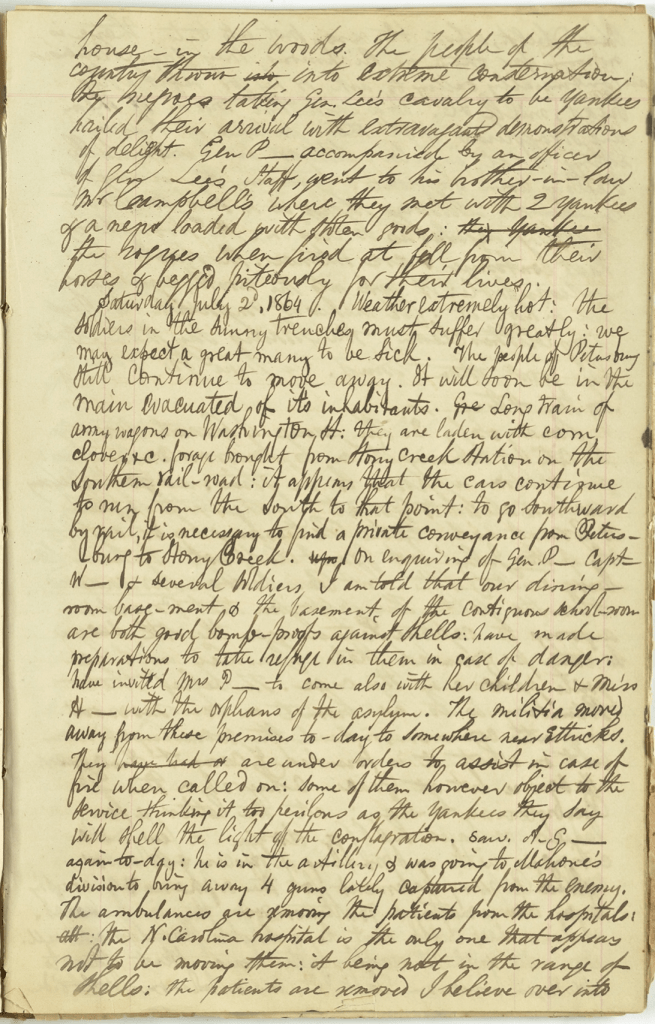
Saturday, July 2nd 1864—Weather extremely hot. The soldiers in the sunny trenches must suffer greatly. We may expect a great many to be sick. The people of Petersburg still continue to move away. It will soon be in the main evacuated of its inhabitants, Long train of army wagons on Washington Street. They are laden with corn, clover, &c. forage brought from Stone Creek Station on the Southern railroad. It appears that the cars continue to run from the South to that point. To go southward by rail, it is necessary to find a private conveyance from Petersburg to Stony Creek. On enquiring of Gen. P[ickett], Capt. W and several soldiers, I am told that our dining room basement & the basement of the continuous schoolroom are both good bomb proofs against shells. Have made preparations to take refuge in them in case of danger. Have invited Mrs. P to come also with her children and Miss H. with the orphans of the asylum. The militia moved away from these premises today somewhere near Ettricks. they are under orders to assist in case of fire when called on. Some of them, however, object to the service thinking it too perilous as the Yankees will shell the light of the conflagration. Saw A. S. again today. He is in the artillery & was going to Mahone’s Division to bring away 4 guns lately captured from the enemy.
The ambulances are among the patients from the hospitals. The North Carolina hospital is the only one that appears not to be moving them—it being not in the range of shells. The patients are removed, I believe, over into Chesterfield where they are put into tents. There is no room for them in Richmond they say. Soldiers are continually calling to ask or buy for vegetables, bread, milk, &c. It is said that many of them are stragglers & that their pretense of having nothing to eat is false. Soldiers are continually stealing from gardens. Between the drought and the soldiers, there is a bad prospect of getting vegetables to live on. The drought & heat continue and are intense. The dust is indescribable. It gets into the mouth, eyes, nose. We inhale it. It makes it impossible to keep any clothes clean. The soldiers say that it is far worse than mud. We hope for rain by the 4th.

Sunday, July 3rd. The panic of Grant’s storming the city & burning it on tomorrow continues. The notion appear to be this: as Vicksburg was surrendered to Grant by the 4th of July, so Grant will take Petersburg by or on the 4th of this July! But Grant did not take Vicksburg on the 4th, but Pemberton surrendered it on the 4th. The supposition that Grant is a going to capture Petersburg on the 4th seems to take for granted that Gen. Lee will be quite passive in the case. The belief that Petersburg is to be burnt on tomorrow is quite common—indeed, the prevailing opinion. But on what it is founded, I cannot discover. No service but at Grace Church and the 2nd Presbyterian today. At the latter, a few ladies—perhaps half a dozen, a few make citizens, with a sprinkling of officers and soldiers. Preparing basement for the orphans, &c. Sweeping, laying down matting and mattresses & putting in benches. There is a deep ditch next to a double foundation wall running north and south the width of the house.

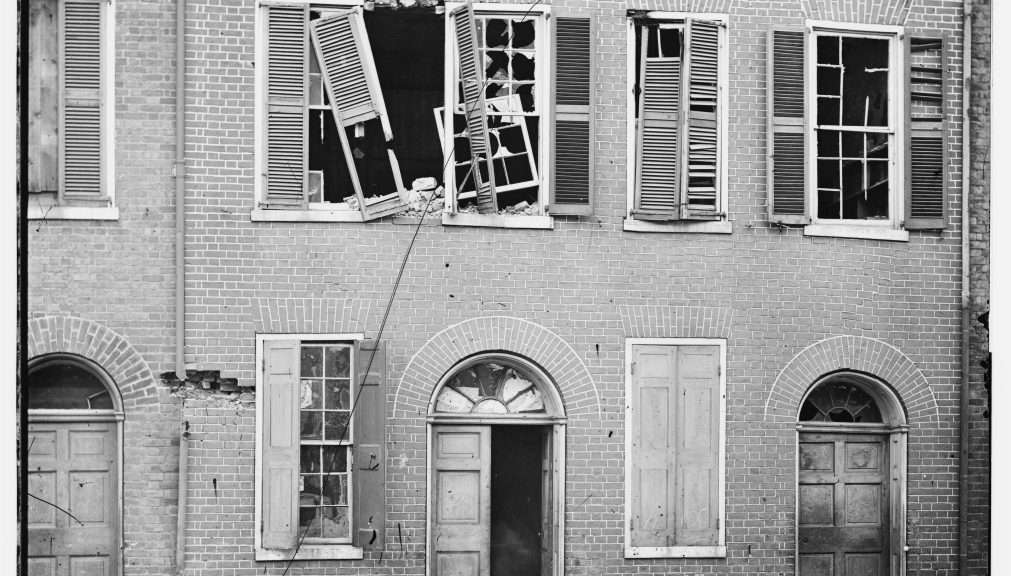
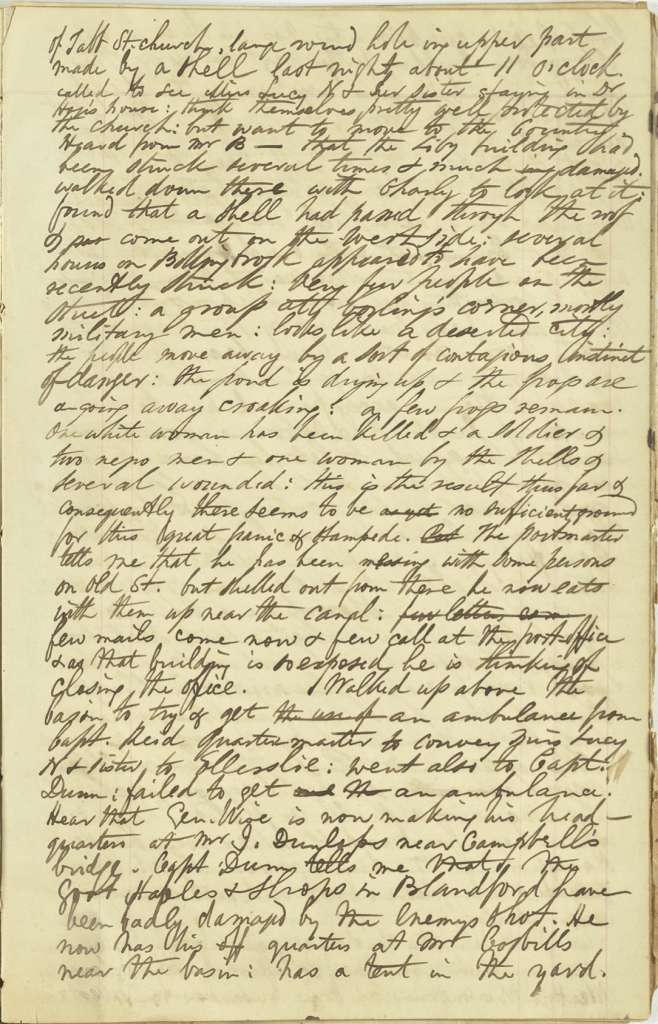
Went down to Dr. [William J.] Hoge’s house on Tabb Street. Saw a hole on west side of Tabb Street [Presbyterian] Church. Large round hole in upper part made by a shell last night about 11 o’clock. Called to see Miss Lucy N & her sister staying in Dr. Hoge’s house. Think themselves pretty well protected by the church but want to move to the country.
Heard from Mr. B that the Liby Building had been struck several times & much damaged. Walked down there with Charley to look at it. Found that a shell had passed through the roof and come out on the west side. Several houses on Bollingbrook [Street] appeared to have been recently struck. Very few people on the street. A group at Bolling’s corner—mostly military men. Looks like a deserted city. The people move away by a sort of contagious instinct of danger. The pond is drying up & the frogs are going away croaking. A few frogs remain. One white woman has been killed & a soldier & two negro men and one woman by the shells & several wounded. This is the result thus far & consequently there seems to be no sufficient ground for this great panic and stampede.
The postmaster tells me that he has been messing with some persons on Old Street but shelled out from there, he now eats with them up near the canal. Few mails come now and few call at the post office & as that building is so exposed, he is thinking of closing the office.
Walked up above the basin to try and get an ambulance from Capt. Reid, Quartermaster, to convey Miss Lucy N and sister to Ellerslie. Went also to Capt. Dunn. Failed to get an ambulance. Hear that Gen. Wise is now making his headquarters at Mr. J. Dunlops near Campbell’s bridge. Capt. Dunn tells me that the government stables and shops in Blandford have been badly damaged by the enemy’s shot. He now has his quarters at Mr. Cogbill’s near the basin. Has a tent in the yard.

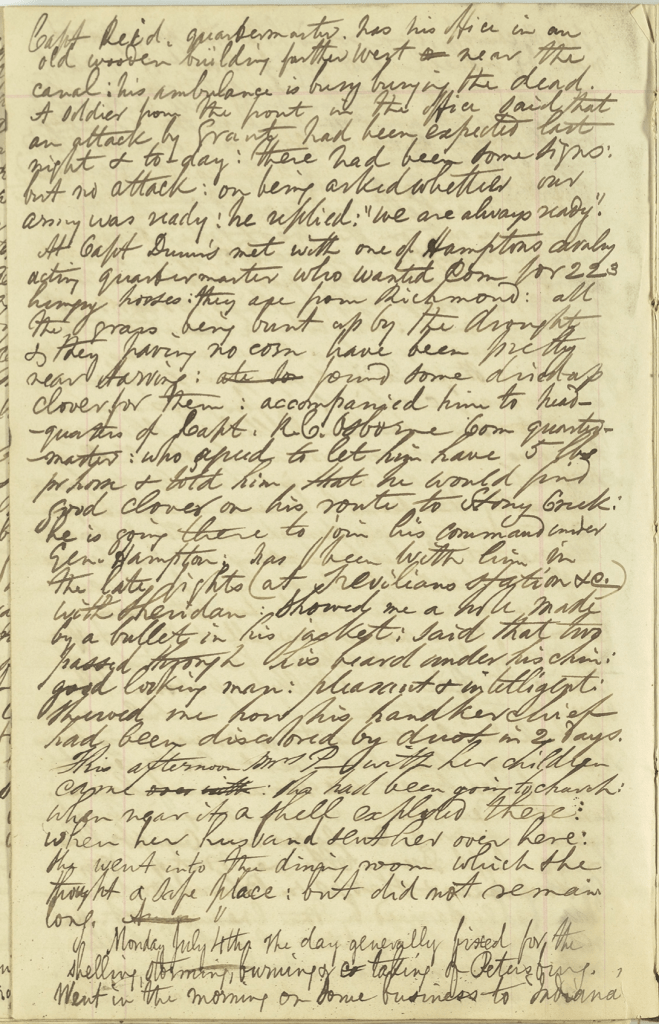
Capt. Reid, quartermaster, has his office in an old wooden building farther west near the canal. His ambulance is very busy burying the dead. A soldier from the front in the office said that an attack by Grant had been expected last night and today. There had been some signs but no attack. On being asked whether our army was ready, he replied, “We are always ready.”
At Capt. Dunn’s, met with one of Hampton’s cavalry acting quartermaster who wanted corn for 223 hungry horses. They are from Richmond. All the grass very burnt up by the drought and they having no corn have been pretty near starving. Found some dried up clover for them. Accompanied him to headquarters of Capt. R. C. Osborne, commissary quartermaster, who agreed to let him have 5 lbs. per horse and told him that he would find good clover on his route to Stony Creek. He is going there to join his command under Gen. Hampton. Has been with him in the late fights (at Trevilian’s Station, &c.) with Sheridan. Showed me a hole made by a bullet in his jacket. Said that two passed through his beard under his chin. Good looking man—pleasant and intelligent. Showed me how his handkerchief had been discolored by dust in two days.
This afternoon, Mrs. P with her children came. They had been going to church when near it a shell exploded there, when her husband sent her over here. They went into the dining room which she thought a safe place but did not remain long.

Monday, July 4th—The day generally fixed for the shelling, storming, burning, and taking of Petersburg. Went in the morning on some business to Indiana [Street] at the west end of Washington Street. On the way noticed at the grove divers brigade hospitals—Gracie’s, Evans’, Johnson’s, &c., indicated by small flags, mostly red. Along Washington as usual, officers on horseback, cavalrymen, foot soldiers, all covered with dust, army wagons drawn by 4 mules—the hair trimmed off their tails except at the end. At Indiana [Street] and at other places on the way, private families in tents. Gen. [James Green] Martin’s headquarters in the yard at Indiana.
Returning home, found T. K. W. of Richmond, He tells me that we have from Chaffin’s Bluff up five pontoon bridges. That Chaffin’s Bluff is well defended & that has a strong force in front of it. Thinks that Gen. Lee was too slow in sending reinforcements to Petersburg. Gen. Grant out-generalled him. Beauregard only asked for a reinforcement of 2,000 men and Gen. Lee refused it saying, “It will not do to uncover Richmond while I am ignorant as to Gen. Grant’s whereabouts.” Mr. W. saw the correspondence. He thinks that 2,000 additional men would have sufficed to hold the outer works of Petersburg but this admits of doubt. Mr. W says that he saw the correspondence of Gen. Pickett with the Secy. of War & thinks that he must have been drunk when he wrote them. They were made outré and insulting. In one he enquired why the rams had not been sent out? Mr. W was introduced to Gen. Bragg by President Davis. Gen. Bragg had a bad face—mean and malignant.
Tuesday, July 5th—We have the same hot sun, same drought, same dust, same war circumstances, same shelling today as on ever day. Went down to the chamberlain’s office on Bank Street where had to wait more than an hour for the chamberlain. Bank Street nearly deserted. The Express office has been struck by a piece of shell. The post office has been removed to Dunlop Street, not far from the basin. The telegraph office has been transferred to the head of Old Street. I find that it was not Mrs. Lumsden who walked 25 miles to escape from the Yankees but her sister Mrs. Armstrong.
F___ who was reported to have been hung by the Yankees has been heard from & is alive & a prisoner in their hands. Horrid barbarities upon females by negro marauders near Fort Powhatan. Rice is $2 or #$3 per lb. Flour extra superfine $350. A shell exploded in a house on Sycamore & broke every pane of glass in front. I picked up a fragment of the shell. B. V. tells me that he can see the park of the Yankee guns from his house. The country on Grant’s left is very destitute of water. Perhaps that is one reason why he is contracting his line. He appears not to have many siege guns. Some say only six. They throw 12, 20, & 32 pounders. Two r three sometimes throw them at once.
There was a rumor today of an engagement at Drewry’s Bluff & the capture of 9,000 prisoners. I did not credit it and there is no confirmation of it from Richmond this evening. It is thought that Grant’s army exposed to the sun will be reduced by sickness; unacclimated foreigners especially are apt to be affected by the climate. Heard this evening of the death of Dr. Hoge at Mr. James Jones’ in Chesterfield.

Wednesday, July 6th 1864—Bought a bushel of meal at Johnson’s Mill for 50 dollars. Brought half bushel of it home myself. Servant brought the other half. Walked to upper end of Old Street. Good many soldiers and refugees from lower part of town thereabouts. Noticed a bakery there. Mr. Lester has established his office for distributing supplies to the poor there. He had good pile of middling in front of the door & some barrels of flour.
The miltia have removed from their camp over in Chesterfield & are now at Mr. John Hair’s at west end of Washington Street. Capt. Robert Osborne, quartermaster for Longstreet’s Corps, now acting for whole of Lee’s army, this morning made Anderson Seminary lot his depot for corn. Made two gaps in the fence—one to enter, the other to go out by. 125 wagons that bring corn from Stony Creek Station on Southern road. The wagons hold from 20 to 25 bags of 2 bushels each making 2500 bags or 5,000 bushels. This quantity they haul once in three days. The wagons came from west end of Washington Street, entered through Capt. Sydnor’s lane and go out on Washington Street. They are drawn by 4 mules each. the teamsters nearly all white. Some of them Irish. They say that the railroad will soon be repaired and the train will run in a few days.
Rev. Dr. W. H. Hoge’s funeral took place at 10 o’clock today in his brother’s church (2nd Presbyterian) in Richmond.
Met with Mr. McP who narrowly escaped from the raiders lately at Liberty. Took refuge in the woods on horseback. Gave me some particulars of the wanton & cruel barbarities of the raiders. He has been today to Gen. Lee’s headquarters—Violet Bank [farm]—to see Adjutant Gen. Taylor. Gen. Lee has only three members on his staff and thinks lightly of a staff. Adjutant Taylor is from Norfolk. Has been with the General from the commencement of the war and enjoys the full confidence of the General. Gen. Lee was never more hopeful in regard to the war than at present. [He] has a poor opinion of Grant’s army. Grant can never approach any nearer Petersburg. Persons visiting headquarters & thereabouts were today notified to retire as they drew the fire of the enemy. Four thousand bushels of corn for the horses and mules of Lee’s army for three days. Very little shelling today. Very hot. No rain yet. Gardens burning up. We get scarcely anything from the garden yet. June apples for eating at market this morning $3 a dozen. For cooking $1.50 per quart, Tomatoes, poor ones, $10 per dozen. Nothing now sold at Old Market & not much at the new. At an auction for sale of some damaged meat and meal today, there were three or four persons present. The streets appear more deserted than ever. Heard that a member of the Petersburg police named Johnson had deserted to the Yankees. Noticed some bales of cotton in an army wagon, which Mr. Ronlett had sold some citizen to barricade his house with against the shells. Price $2.50 per pound.
The continued drought must distress Grant’s army the more for want of water. A large army requires a great deal of water and good water. Lee is supposed to have some 60,000 men. Grant perhaps some 75,000 or 80,000. Wells Foundry having been badly shelled, the operatives have removed to near Campbell’s bridge. The extraordinary quiet today seems ominous.
Thursday, July 7th—In this part of town we heard scarcely any shelling. A very quiet day. But we hear that a servant woman of Dr. T[homas] S[tanley] Beckwith was killed at his residence on Market Street. The Dr. removed his family shortly afterwards. A white woman was also killed in Blandford. The night was unusually quiet. I heard no cannon or picket firing.
Friday, July 8th—Still very hot & dusty. A drought of 7 weeks continuance. No grass for the cows. Scarcely any vegetables to be gotten from the garden. Capt. O. tells me that Grant’s 6th Army Corps—Wright’s—has embarked for some other point. The Signal Corps gives the intelligence. This afternoon we again hear the whistle of the shells. Mr. M, just from Pocahontas, says that the Yankees are shelling the Pocahontas Depot & the Southside. In the forenoon, they shelled Wells’ Foundry. The factories and stores are closed. Business discontinued. Paper money depreciating more and more. The scarcity of provisions great & increasing. Scarcely any to be got for love or money. The Poor Association & contributions from the army alleviate the sufferings of the poor somewhat. I hear that the patients have not been removed from the Confederate hospital. Before breakfast this morning noticed what appeared to be a regiment of soldiers going up Washington Street towards west end. I hear that the Petersburg militia quite a small number have been at last relieved from duty. They have had a hard time of it and aquitted themselves well, setting a good example to others.
July 9th, Saturday. Hear of several houses set on fire by shells. The Express Office at the Pocahontas Depot & two other buildings burnt down. Also the Ladies Hospital on Bollingbrook Street. Also Mr. Drummond’s store on Sycamore and another lower down set fire to.
Sunday, July 10th—Went in forenoon to Grace Church. Sermon by Rev. Mr. Dra Voss of South Carolina. A good many officers and soldiers there. Two general at that church in the afternoon and a soldier of the Washington Artillery killed yesterday by a random shot. In afternoon, saw an Extra of Richmond Whig giving from Northern papers an account of Early’s invasion of Maryland. Also of the sinking of the Alabama by the Kearsage. Drought continues.

Monday, July 11th—Took a walk to a point in the woods about a quarter of a mile southeast of Butterworth’ Bridge to Maj. Elliott Braxton’s Headquarters. Found him in a tent with two other officers. He has 8 ambulances the mules of which he has to provide for but the surgeons direct the movements of the ambulances. Met with in the woods a Georgia band, ten in number, practicing. They played several hymns, among them Old Hundred. Owing to the drought & the soldiers, no blackberries to be found. All the blackberries dried up. Saw smoke to the south which I supposed to be the woods on fire. Hear that we have two divisions guarding the Southern road. Our people hold the breastworks lately thrown across it by the enemy. A soldier told me that he had seen the smoke of a house on fire. Learned afterwards that it was Ragland’s farmhouse, this side of Rives’ farm, fired by a Yankee shell. Passed Mt. Airy which is now the railroad depot.
The heat intense. the dust far worse than I ever knew it to be. Noticed in the woods a well about 4 feet deep, the water of which is used by the soldiers. They said the water was good. The horses and mules look much better than one would expect to see them now when the grass is all dried up. It is said that the corn crop is now suffering much.
Col. Archer showed me the pieces of the shell that exploded in the wall of his parlor. The pieces put together restore the shell. It is a 32 pounder. A shell fell in the Medical Purveyor’s establishment near Ettrick’s today & destroyed the culinary apparatus & the provisions. The post office is now at the chapel on Dunlop Street. Two slats taken out of the window shutter admit letters which drop into a mail bag. The Southern mail is now sent via Richmond. The army letters &c. are attended to by an army Postmaster.
Straggling soldiers continue to rob houses and gardens. We had a gentle fall of rain this evening but not enough to lay the dust. Mrs. G and daughter went lately with Mr. S’s family to a place of refuge in the country. There a fight occurred very near the house between our cavalry and some Yankee raiders. The party of refugees, 15 in number, now returned in a wagon, in the midst of our cavalry covered with dust. In avoiding the Cylla of shells, refugees fall into the Charybdis of Raiders.
Tuesday, July 12th 1864—Walked up to Indiana [Street]. Passed through some of the brigade hospitals in and about the grove. The heat and dust continue undiminished. The little rain of last evening made no perceptible impression. Saw an intelligent young man from the front. Hoke’s Division on our left on Windsor farm north of Iron-bridge. He says that they have an excellent spring there, sufficient to supply the whole division.He says that our army is now supplied with rifles, muskets no longer used by either army. This is a disadvantage to the Confederates. With the musket they fought the Yankees at close quarter and charged them, when they ran. But now they stand off 1500 yards with their rifles. He considers the artillery now of as little account as the cavalry were formerly. They and the infantry have to do the main work. the Yankees annoy our men in the trenches with mortar shells. One day killed some 40 but our artillery make but little use of mortars although they have them. He thinks that the Yankees are not suffering so much for want of water as some suppose. But Col. P who knows the county of Prince George well says that for some 12 miles to the southwest of Petersburg, there is scarcely a branch. There is a great deficiency of water—especially in such a season of drought as the present. It is said that the Yankees have made a canal conducting water from the Appomattox some two miles. In what direction is not ascertained. On the lines held by Grant’s army there is no branch of any respectable size except that which runs near White Hill & that must be very small at present. They, however, no doubt dig wells where practicable but the Col. says that in that region generally, water cannot be reached under 20 feet or more.
The young soldier above-mentioned, says that the delay of Hoke’s Division in coming to Petersburg was owing to the orders of Gen. Lee who detained them at Malvern Hill to await the movement of Grant’s army. Owing to this delay, the enemy took the outer line of defenses.
Walked down town this afternoon. A shell has penetrated the Exchange Bank & smashed up the Director’s room. Another seriously damaged the upper part of Young’s Jewelry Store, Lunsford’s Store, & that next to McNeece’s reported burnt, though damaged, are still standing.
Bought bushel of meal with a great deal of bran in it for 50 dollars. Two lbs brown sugar $24. Two lbs. lard $16 (a dollar a pound cheaper than I have bought it for some months), $36 for 4 lb. middling.
Wednesday, July 13th 1864—Paid at the New Market for 6 eggs $6.00. One quart blackberries $3.00. One quart green apples $2.00. Tomatoes pretty good ones $12 per dozen. Corn, roasting ears, poor ones, $10. Snaps $4 per quart.
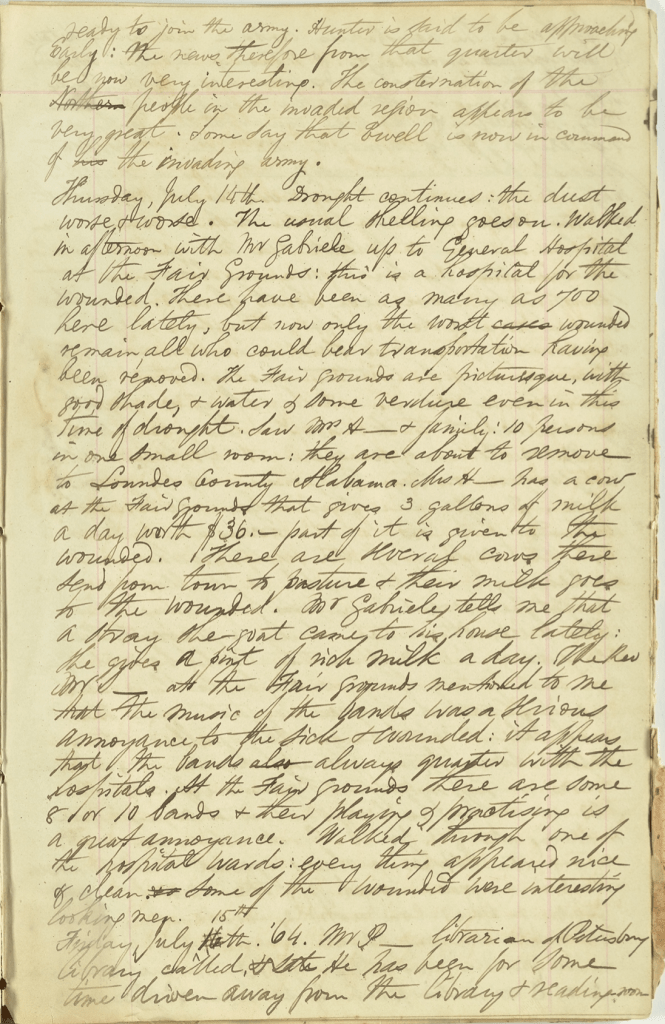
Pretty quiet day in upper part of town. Good deal of shelling in direction of Wells’ Foundry and Southside depot in forenoon. In afternoon, a good deal apparently in direction of High H. Heard in afternoon that a telegram had brought intelligence of the defeat of Lew Wallace & Sigel by Early & his advance within 3 miles of Baltimore. That city is therefore probably in the hands of the Rebels, there they will find or have found ample supplies flour, bacon, sugar, coffee, &c. also many friend ready to join the army. Hunter is said to be approaching Early. The news, therefore, from that quarter will be now very interesting. The consternation of the Northern people in the invaded region appears to be very great. Some say that Ewell is now in command of the invading army.
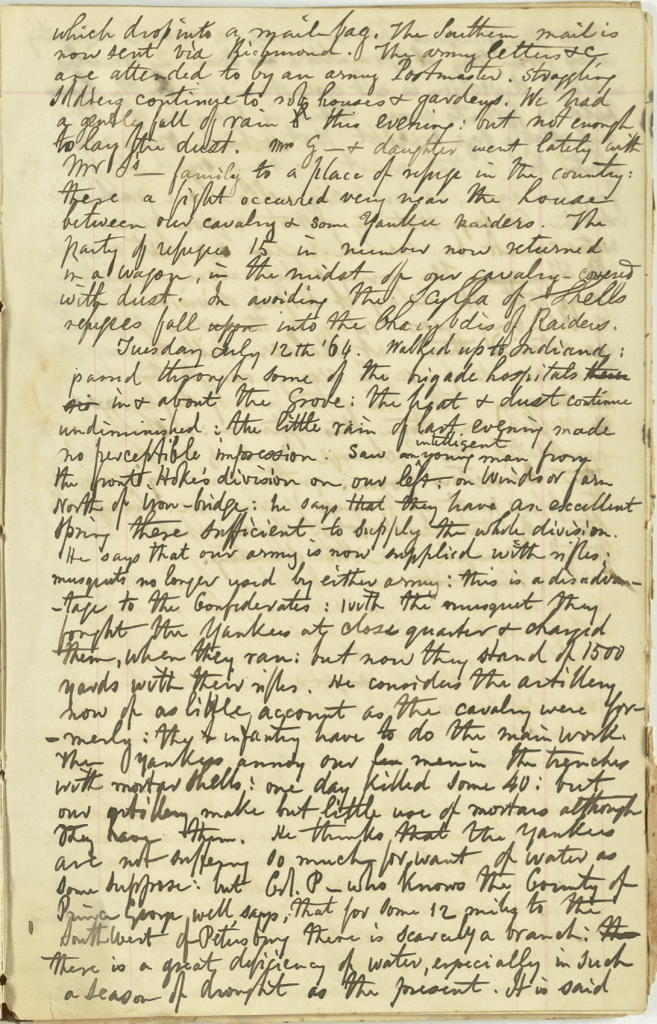

Thursday, July 14th—Drought continues; the dust worse and worse. The usual shelling goes on. Walked in afternoon with Mr. Gabriele up to General Hospital at the fairgrounds. This is a hospital for the wounded. There have been as many as 700 here lately, but now only the worst wounded remain—all who could bear transportation having been removed. The fairgrounds are picturesque with good shade & water and some verdure even in this time of drought. Saw Mrs. H & family. 10 persons in one small room. They are about to remove to Loundes county, Alabama. Mrs. H has a cow at the fairgrounds that gives 3 gallons of milk a day worth $36—part of it given to the wounded. Mr. Gabriele tells me that a stray she-goat came to his house lately. She gives a pint of rich milk a day. The Rev. Mr. S at the fairgrounds mentioned to me that the music of the bands was a serious annoyance to the sick and wounded. It appears that the bands always quarter with the hospitals. At the fairgrounds there are some 8 or 10 bands and their playing and practicing is a great annoyance. Walked through one of the hospital wards. Everything appeared nice and clean. Some of the wounded were interesting looking men/
Friday, July 15th 1864—Mr. P.—librarian of Petersburg library—called. He has been for some time driven away from the library and reading room by shells. The newspapers contain interesting details of Early’s movement. A thousand cavalry surround Baltimore. The railroads have been cut. Early with his army is within a few miles of Washington City. Lincoln had been towards the front reconnoitering. It is rumored that the Point Lookout prisoners have been released but this is probably without foundation. Point Lookout is at the mouth of the Potomac river & too distant to have been reached in time to release the prisoners. It is also rumored that blockade-running steamers at Wilmington have been sent off with small arms on board destined for Maryland. Wood, the Naval officer, it is said is in command. The Florida, Confederate privateer, has captured a prize near Cape Henry. A flag-of-truce boat has arrived at Varina. There are said to be 30,000 Federal prisoners at Andersonville in George—rather too many to be in one place. The Yankee shells have deprived Petersburg of gas-light. Fears are entertained that the engine of the water-works will be destroyed, which would be a serious disaster & might be prevented by barricading it with cotton bales, wetting them daily to prevent their being set on fire. But as they could be wet only an inch or two, they would be liable to take fire if knocked to pieces. In that case the fired bale might be quickly pulled out.
Walked down town. Noticed damage to several houses on Bollingbrook & Sycamore Streets. Gave $30 for 2 lbs. butter which is cheaper than middling at $9 per lb. Great indignation felt among the suffering class against the extortioners. There is an order issued for the removal of cotton & other combustible materials. Heard last night the Confederate big gun said to be a 100-pounder firing in the night. She fired every 2 or 3 minutes for half an hour.
Mr. L. rode over part of our lines today. Found our men very confident. Their earthwork defenses strong. Saw the Yankees at the distance of half a mile. They blew up a caisson on our lines & thereupon gave a great shout. Our men have tents and arbors. Stay in the trenches only when under fire. Gen. Mahone’s headquarters at Walnut Hill, Wilcox’s farm. The Yankee lines about half a mile back from where Rives’ house stood. Ragland’s farmhouse is not burnt. The Purveyor’s establishment near Ettricks has not been struck by a shell. The weather cooler with pleasant breezes but no signs of rain.
Saturday, July 16th—The quartermaster is today storing some corn in McEnerny’s Factory. It comes now on the railroad. The men engaged in this work of unloading & loading corn complain of being overworked. They are greatly exposed to the sun—as much they say as the men in the trenches. The shelling today as usual. In afternoon heard the fire bells ringing twice, probably on account of houses set on fire by shells. Gen. P[ickett] from the front brings word that a Washington Chronicle of 14th has been obtained. It states that Gen. Early who had invested Washington by land, had retired to Rockville on the road to Fredericktown & that 150 prisoners had been captured from him. As it has been reported that Hunter and Couch had combined their forces at Fredericktown, perhaps Gen. Earaly has gone to attack them.
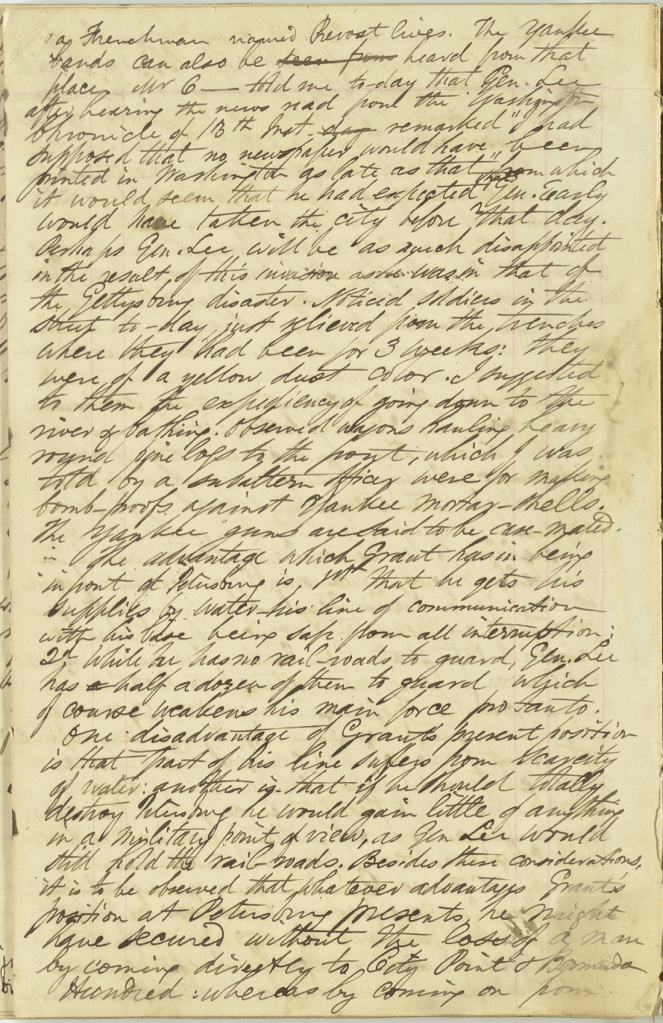
A flag of truce came from Grant’s army today on some matter of burying some of their dead. Coffee was obtained from the truce men in exchange for tobacco. Gen. P[ickett] gave me a small bag of the coffee. Gen. Gracie estimates our loss by picket firing in front of Petersburg at 1400. It is said that a good view of the Yankee mortar shells is to be seen from the signal corps station [on] a hill at Roslin where a Frenchman names Revost lives.


The Yankee bands can also be heard from that place. Mr. C told me today that Gen. Lee, after hearing the news read from the Washington Chronicle of 13th inst., remarked, “I had supposed that no newspaper would have been printed in Washington as late as that” from which it would seem that he had expected Gen. Early would have taken the city before that day. Perhaps Gen. Lee will be as much disappointed in the result of this invasion as he was in that of the Gettysburg disaster.
Noticed soldiers in the street today just relieved from the trenches where they had been for three weeks. They were of a yellow dust color. I suggested to them the expediency of going down to the river and bathing. Observed wagons hauling heavy round pine logs to the front which I was told by a subaltern officer were for making bomb-proofs against Yankee mortar shells. The Yankee guns are said to be case-mated.
The advantage which Grant has in being in front at Petersburg is 1st, that he gets his supplies by water—his line of communication with his base being safe from all interruption. 2nd, while he has no railroads to guard, Gen. Lee has half a dozen of them to guard which of course weakens his main force pro-anto. One disadvantage of Grant’s present position is that part of his line suffers from scarcity of water. Another is that if he should totally destroy Petersburg. he would gain little if anything in a military point-of-view, as Gen. Lee would still hold the railroads. Besides these considerations, it is to be observed that whatever advantages Grant’s position at Petersburg presents, he might have secured without the loss of a man by coming directly to City Point & Bermuda Hundred; whereas by coming on from the Rapidan overland, he lost a large portion of his army. The two armies now seem to be at a dead-lock, neither being willing to attack the other.
It is said in the papers that Grant is about to make another raid upon the Southern road. The Examiner says that the railroads ought all to be guarded but this is easier said that done. It would require a great many more men to guard even 3 or 4 hundred miles of road. The enemy now feels something of railroad cutting and breaking up in Maryland. With all their numerous forces, they cannot protect their railroads even against a small body of cavalry.
Miss S. called today. She has been staying at a farmhouse some 8 miles from town in Chesterfield, plaiting straw and living in large part on blackberries and huckleberries. They hear the report of the cannon distinctly out there but hear no news and are kept in anxious suspense so she expects to return to town shortly. Several families have lately returned. Charming days. Delightful breezes.
Sunday, July 17th—Attended service at Grace Church. Heard Rev. Mr. Gibson preach. Pretty full congregation, the majority being of the military. An army chaplain read the service. Thanks were returned for a recent victory—probably that at Monocacy in Maryland. But Forrest lately defeated the enemy, inflicting heavy loss on them.
In afternoon, shells falling near New Market. A piece of one struck tree in my mother’s yard/ Mrs. P came over with her children.
Monday, July 18th 1864—The picket firing appeared to be kept up during the whole of last night. It is said by officers from the front that some important movement is meditated by Gen. Lee to take place in a few days. Cooked rations have been prepared, they say, for Hill’s Corps. Some say that our batteries enfilade the enemy’s lines but this is doubted.
It is certain that if Gen. Lee proposes to make an attack upon Grant, now is the auspicious time, when the enemy are depleted by the reinforcements sent to Washington. Some of the officers criticize Gen. Lee’s not sending a competent force to Petersburg in time to hold the outer line of earthworks. They say that Hoke’s Division was unnecessarily detained at Malvern Hill. Gen. D. H. Hill censures Gen. Lee very freely in regard to the matter. Gen. Hill offends many by his bold and free remarks. He is so impudent as to denounce the Episcopal CHurch saying that he would think better of them if instead of imitating in a half-way style the mummences & gemiflexions [?] of the Romish Church, they would go over bodily to Rome. The impression among the few persons that I meet with is that Washington is too strong to be taken by Early. Some forebode evil from the invasion and say that it will result as the former two. I, however, doubt not but that it was judiciously and wisely planned and will be vigorously executed and I am glad that it was undertaken. As to the risk of disaster, it is impossible to win without incurring the risk of losing.

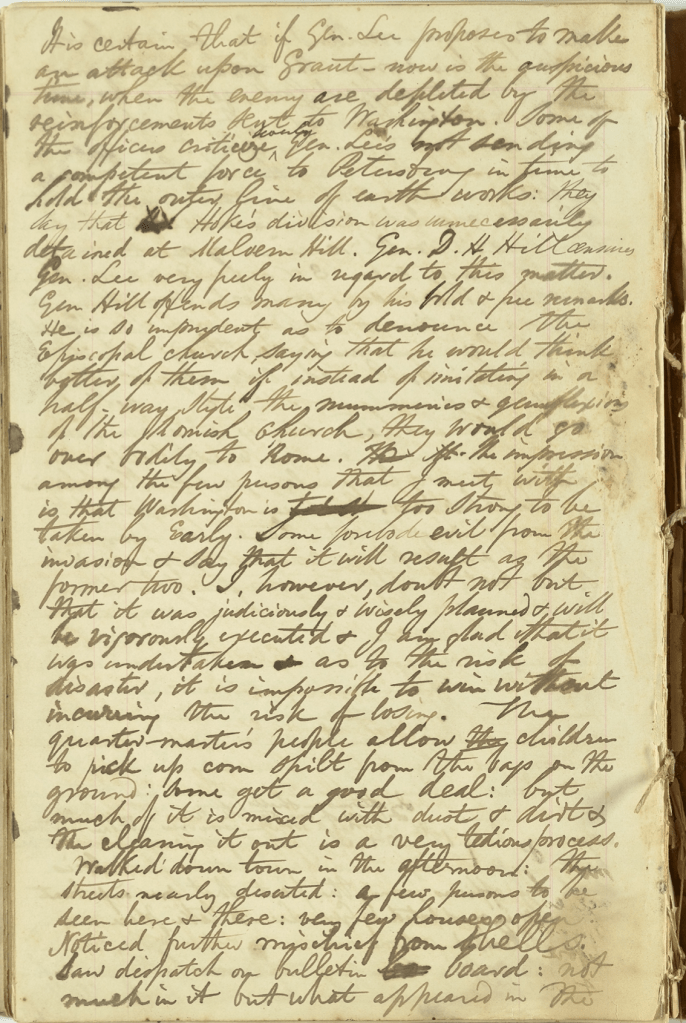
The quartermaster people allow children to pick up corn spilt from the bags on the ground. Some get a good deal, but much of it is mixed with dust and dirt & the cleaning it out is a very tedious process. Walked down town in the afternoon. The streets nearly deserted. A few persons to be seen here and there. Very few houses open. Noticed further mischief from shells. Saw dispatch on bulletin board. Not much in it but what appeared in the morning papers.
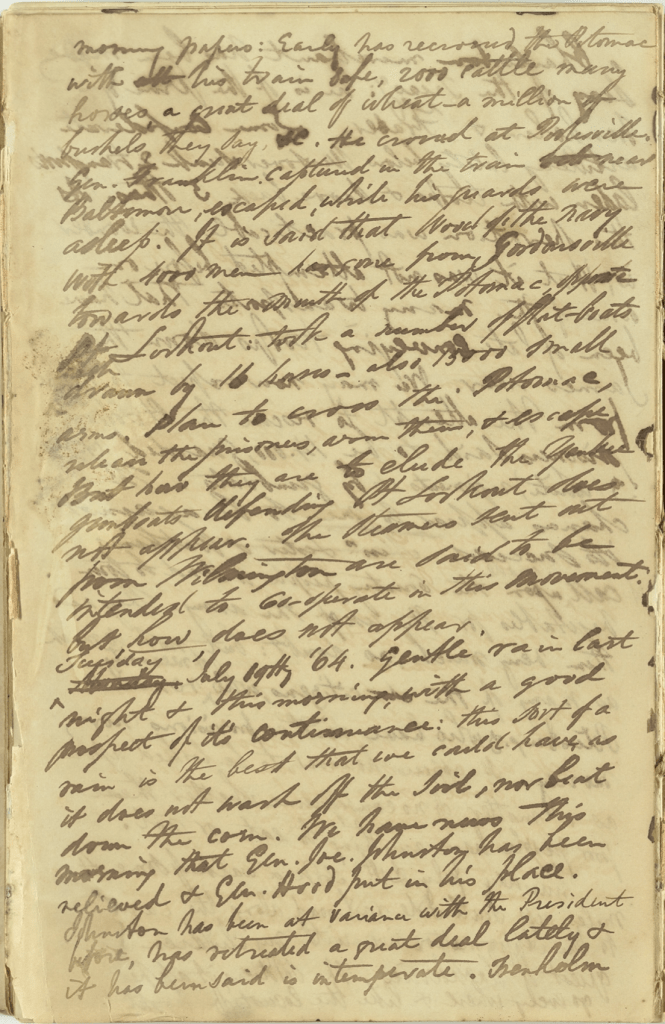
Early has recrossed the Potomac with his train safe, 2,000 cattle, many horses, a great deal of wheat—a million of bushels they say, &c. The crossed at Poolesville. Gen. Franklin captured in the train near Baltimore, escaped while his guard were asleep. It is said that Wood of the Navy with 4,000 men has gone from Gordonsville towards the mouth of the Potomac opposite Pt. Lookout, took a number of flatboats drawn by 16 horses. Also 15,000 small arms. Plan to cross the Potomac where the prisoners, arm them, and escape. But how they are to elide the Yankee gunboats defending Pt. Lookout does not appear. The steamers sent out from Wilmington are said to be intended to cooperate in this movement but how, does not appear.
Tuesday, July 19th 1864—Gentle rain last night & this morning with a good prospect of its continuance. This sort of a rain is the best that we could have as it does not wash off the soil, nor beat down the corn. We have news this morning that Gen. Joe Johnston has been relieved & Gen. Hood put in his place. Johnston has been at variance with the President before, has retreated a great deal lately and it has been said is intemperate.
[George] Trenholm, a Charleston merchant, has been made Secretary of the Treasury. He is of the firm of Trenholm & Fraser. Some Cofederate artiller lately below Westover sunk two transports laden with troops & drove back 5 others. As this operation was practicable, the wonder is that it was not attempted before on some of the many transports that have been lately conveying troops down the James river. We may noe expect to hear from the attempt to rescue the Pt. Lookout prisoners said to be 14,000 guarded by three (white) regiments & by gunboats. The chances appear to me to be against its success.
A call is made upon the country people to send to town vegetables for the use of the army. They need them very much, no doubt, but not so much as many of the citizens who of necessity, remain Petersburg & who have neither provisions nor money. It appears, however, to be looked upon as a matter of no consequence whether these poor people have anything to eat or not.
Thursday, July 21st—Took a walk some 4 miles up Southside railroad along the canal & to the Appomattox river with my children in quest of blackberries. The soldiers, it appears, go everywhere & like the locusts of Egypt, eat up everything—even blackberries. With difficulty we got about a quart, a considerable part of which were sour. Returning, came by some neat farms with wattled or post & rail fences. Noticed some orchards, gardens, and summer houses. Passed by Mayfield, an old time house, with dormer windows. Saw the breastworks on west side of Petersburg. Found soldiers, teamsters, &c. encamped all along the road. Met with a South Carolina soldier relieved for a day or two from the trenches. He appeared intelligent beyond the average of soldiers. He says that the best portion of the South Carolina rice lands is still in possession of the people of that state. He has known rise to sell at Charleston at 1.5 cents per pound. It is now $3 in Petersburg, if it can be gotten at all. He thinks that Grant can never break through the defenses in front of Petersburg and that it would cost Gen. Lee too many men to attack Grant so that there is a prospect of a period of “Masterly inactivity.” This do-nothing system is more unfavorable to Grant than to Lee because Grant has come here to take Richmond & subjugate the Confederacy & he cannot consistently be doing nothing. This soldier says that the trenches after the late rain were a perfect quagmire.


Friday, July 22nd—Last night we heard uncommonly loud and frequent cannonading on the enemy’s left. One very large gun fired frequently. The flash of a gun could be w.occasionally seen from our chamber window. Heard this morning that the shelling was in the southeastern part of the town. Mr. Andrew Dunn’s house was struck and he was wounded. Went down to the library this morning with Mr. Pleasants, the librarian. The folks there are in some danger from the shells. Met on the street two negroes moving their chattels from Blandford near Mr. Harmon’s. They report that a great many shells were thrown in that quarter last night intended to strike two brigades of Confederate troops that have been quartered. they had, however, been removed before the shelling of last night.
The weather is fine now. The dust is now laid. Fine breezes blowing from the northwest. The firing last night was from mortars. The very large gun is said to be on a Yankee battery. It is said that Beauregard is mining towards the enemy’s lines; that 100 men are detailed at night to work on the mine; that the superincumbent earth is propped up and supported by posts as the mine is extended. It is also said that Beauregard has had wells dug & men put at the bottom of them to listen for mining noises of the enemy. The report of Grant’s death is still repeated & harped upon although it appears to be without any foundation.
Finished copying this book at Hazel Hill, Fredericksburg, July 13, 1864. — C. C.


 Spared & Shared 23