
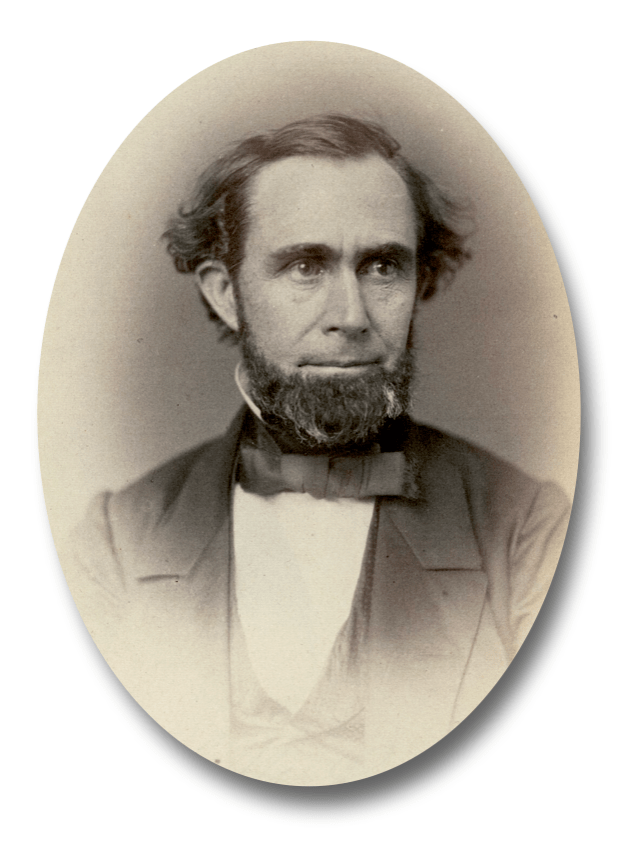
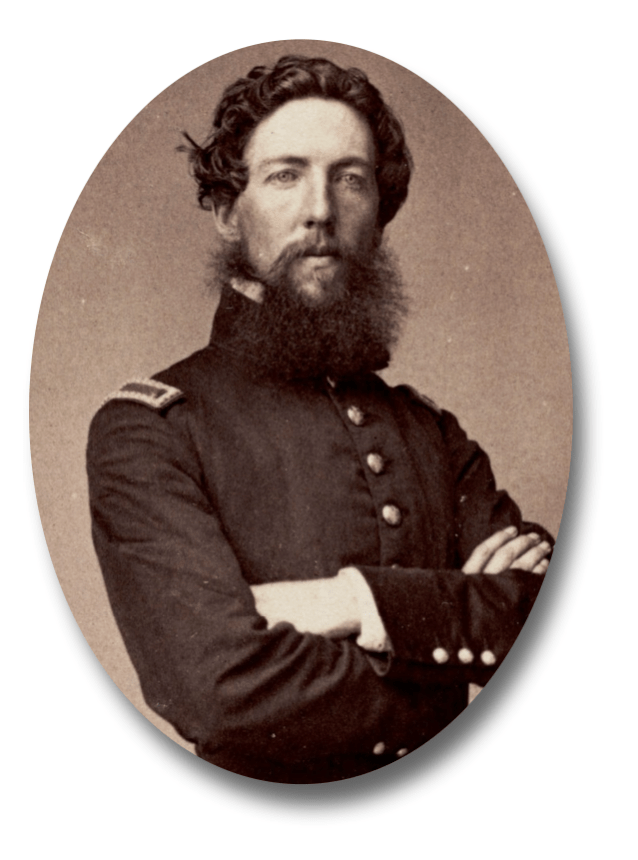
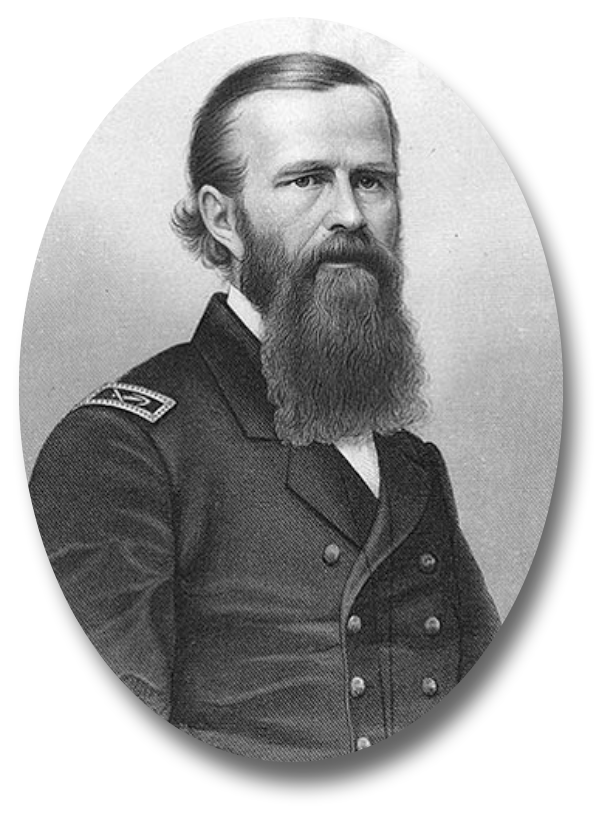
By the time the Civil War began in 1861, Capt. Hiram Paulding, at the age of 64, had dedicated over 46 years to the US Navy. He had carefully planned his retirement to a small farm on Long Island, envisioning peaceful days in his seaside garden, listening to the rhythmic sound of the waves as seagulls gracefully glided above. One can only imagine his disappointment as the Union he had faithfully served for decades was torn apart in an instant by the election of a President whom Southern politicians simply feared would not uphold their rights under the US Constitution. In the wake of President Lincoln’s election, Southern States seceded, leaving Paulding astonished as his naval comrades resigned their commissions to serve their native states. This astonishment soon gave way to anger and a call to duty. He knew he had the knowledge and leadership skills necessary to be an indispensable asset to the incoming Lincoln Administration, whose primary task would be to put down the rebellion and restore the Union. His retirement would simply have to wait.
The contributions of Paulding during the Civil War were crucial in enabling the US Navy to fulfill its mission. These contributions were pivotal in preventing existing US Navy vessels and supplies from falling into the hands of the insurrectionists, manufacturing warships, acquiring troop and matériel transport vessels, and establishing the blockade of Southern ports necessary to implement Gen. Scott’s Anaconda Plan, often referred to as “Scott’s Great Snake.”
Few individuals are acquainted with the account of Paulding’s endeavor to protect the Gosport Naval Yard at Norfolk and salvage the US Navy warships harbored there in April 1861. Prejudiced journalism unfairly attributed the subsequent conflagration of the Yard and the deliberate sinking of those vessels to him, following Virginia’s secession from the Union. The government suffered substantial financial losses, prompting a Congressional inquiry into Paulding’s actions. However, subsequent investigations exonerated him, establishing that he ought to be acknowledged for his courageous efforts to safeguard Gosport, even at the risk of his own life.
There were only a few seasoned Naval career men that Secretary Gideon Welles could call upon who knew the strengths and weaknesses of the US Navy in 1861, and the skill and trustworthiness of its officers. A steady hand at the helm was needed. Paulding was such a man. It took little convincing that warships were needed, but what kind should be built? and how quickly could they be completed? It was Paulding who advocated for a new type of armored vessel and embraced the prototype proposed by John Ericsson called a monitor. Paulding’s connections with builders led to contracts for the building of a fleet that could be deployed in short order—soon enough to take the blockade from an idea to a reality within months, not years.
Vessels that were mothballed or only partially constructed were recalled or put on fast tracks to make them seaworthy. Commercial vessels were purchased, renovated, and made serviceable for military duty. Though Gustavus V. Fox, a former naval officer turned business man before the war, was recruited to work for Gideon Wells as his Assistant Secretary, and often got credit for much of what the Navy accomplished in the first year because of his connections to the prominent Blair family and his friendship with President Lincoln, it was really Paulding that worked behind the scenes, paying attention to the details of outfitting the fleet and selecting the right officers for each ship.
As the war dragged on, it was Paulding at his post in the Brooklyn Navy Yard, tirelessly meeting the demands of the US Navy—seeing to the construction and outfitting of ships with men and matériel, deploying them, and relieving them. He even willingly offered his advice, when invited, to engineers studying the vulnerability of the New York Harbor defenses. The letters in this private collection, which have been in a private collection for decades since purchased from the Paulding descendants, hold promise to raise awareness of Paulding’s invaluable contribution to the US Navy—particularly in the first year of the Civil War.

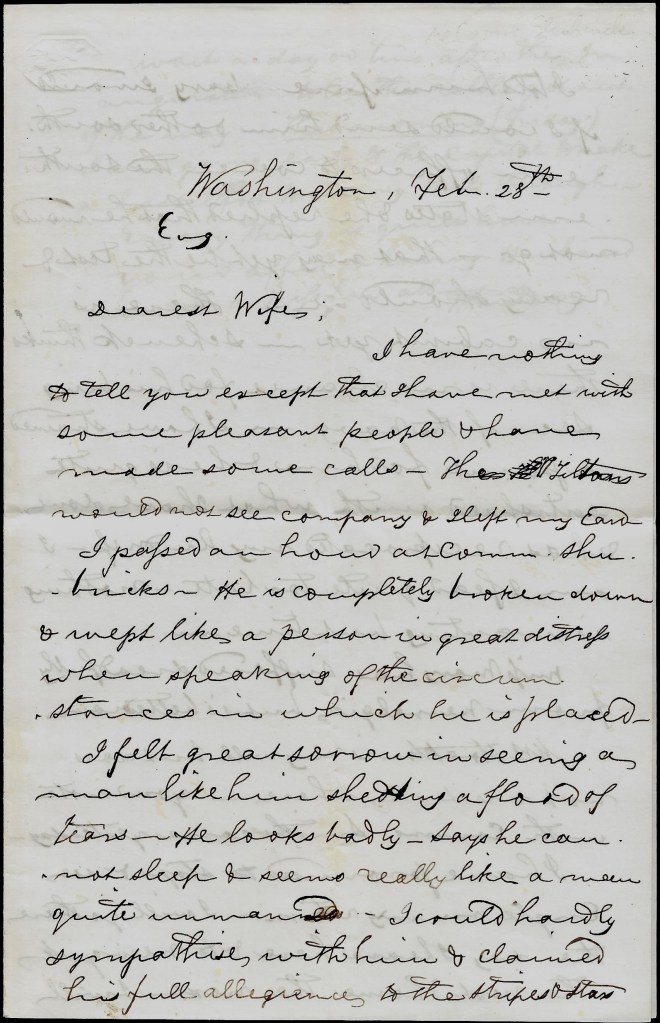
[Note: “His 3 sleeve stripes (with no small stripes in-between the larger stripes and no star) are definitely indicative of Captain rank per uniform regulations of 1852 through July 31, 1862. He seems to be in an undress frock coat, no shoulder straps and we can’t see his cap insignia. He was promoted to captain on February 29, 1844 and retired as such on December 21, 1861. He was made rear admiral on the retired list dated to July 16, 1862 with the new set of ranks created by legislation of that date. Then on July 31, 1862, Secretary Welles issued a new General Order that established the indications of rank of Naval officers and modified uniforms. So, this is clearly a prewar photo of Paulding that could have been taken maybe in the 1850s, explaining why he looks younger.“—Gary McQuarrie, Managing Editor Civil War Navy]
Vitae (self-composed)
Memorandum of professional Life of Rear Admiral Hiram Paulding
U.S. Navy
Appointed Midshipman Sept. 1st, 1811. Served on Lake Ontario at the commencement of the war with England 1812 & transferred to Lake Champlain. Served there till the close of the war & commanded a Division of guns in the action with the British Fleet.
1815—Served in the Frigate Constellation in the Squadron of Comm. Decatur in the war with Algiers & participated in the capture of the Algerine cruisers in 1815.
1816—Was promoted to Lieut. in 1816. Served on board the 74 Independence and Brig Prometheus in 1817. Ordered to the Frigate Macedonian in 1818 & made a cruise of three years in the Pacific Ocean. Passed the year 1822 at Partridges Military Academy in Vermont. In 1823 was ordered to the U.S. Steamer Sea Gull & served in Commodore Porter’s Anti piratical squadron on the coast of Cuba nearly five years, one of which was in the Schooner Dolphin. In 1830 made a cruise to the Mediterranean as First Lieut. of the Frigate Constellation, In 1834 sailed in command of U.S. Schooner Shark and made a cruise in the Mediterranean.
1837—Was promoted to Commander. In 1838 was appointed to command U.S. Sloop of War Levant and made a cruise in the West Indies. In 1841 served as Executive officer in the Navy Yard at New York.
1843—Was promoted to Post Captain.
1844—Was appointed to command U.S. Sloop of War Vincennes and made a cruise in the Eastern seas & left in command by Com. Biddle.
1848—Was appointed to command U.S. Frigate St. Lawrence to cruise in the Baltic, North Sea down coast of Europe.
1852—Was ordered to command the Vermont for a cruise in the Eastern seas but her sailing was countermanded. Was subsequently ordered to command the Navy Yard at Washington and after serving there three years, was in 1855 appointed to command the Home Squadron.
1858—Was relieved from that command soon after sending the Filibuster Walker & his men home from Central America.
1861—At the commencement of the Rebellion, was appointed by President Lincoln to assist in the Navy Department in putting the Navy afloat & rendering other services consequent upon the demoralization of the times. In the performance of these duties was the destruction of the Navy Yard at Norfolk in obedience to orders. Afterwards in 1861 appointed to command the Navy Yard at New York and continued in command until the close of the War of the Rebellion.
1866—Ordered as Governor of Naval Asylum at Philadelphia.
1869—As Port Admiral at Boston.
Was born in 1797 and will be seventy-three on the 11th day of Dec. 1870.
During the Riots in New York in 1863 & 4 the Marines & Naval Recruits on the station protected public & private property on the Hudson & East River, the Arsenal, custom House, subtreasury and many other public & private Buildings in New York & the Rear Admiral in this as in the command of the Navy Yard at New York is believed as in his many stations of honor and trust to have acted with discretion and a zealous devotion to the public good.


Letters
Letter 1
Washington
Feb. 24th, 1861
Dearest Wife,
I came safely last evening, dined with [Maxwell] Woodhull, slept at Mrs. [Frances] Stockton’s, passed an hour with Doctor & Mrs. [David Shelton] Edwards this morning, went to church with Mrs. Stockton, & dined with Woodhull. Had pain all day & came to my room in great suffering. Sent Woodhull for Doctor Edwards who came armed with medicines & found me quite well again. I am just about to retire at eight & in the morning seek an interview with the President Elect. I send the enclosed by which you will see I am permitted to receive from Nicaragua if the President assents. What else has been done I will learn as soon as I can. Excuse the scrawl. I hope you will get home comfortably.
I am as comfortable as I can be away from you. Your affectionate & loving husband, with love to all, — H. Paulding
Evening 25th. I did not send this today because on calling on my friend Mr. [John Pendleton] Kennedy, I found the leave to accept had not passed the Senate as was reported in the papers. I passed the day at the Capitol & this evening in calls with reference to the Nicaragua grant. In the Senate Committee of Foreign Affairs, they had stricken out the land which some of my friends were disposed to acquiesce in but which I have informed them was not acceptable to me & that I wanted all or nothing. I think now it will go through. 1
This evening I spent at the house of Judge [Stephen A.] Douglas, Woodhull having taken me there in his carriage after dinner. I have had a private interview with Mr. Lincoln & a very pleasant call upon the lady who I think will fill her place acceptably.
The Powells were not home when I called. He left his card for me when out. Always yours, — H. Paulding
1 The Nicaragua Affair refers to the illegal act by William Walker who led an armed mob into Nicaragua in 1857 and took over the government—an act known as filibusterism. The act was supported by the Southern states who saw Central America as a place where the United States might acquire more slave territory. It was Commodore Paulding of the US Navy who took it upon himself to enter Nicaragua and arrest Walker and his men but in doing so, created further agitation between the Northern and Southern States. President Buchanan attempted to appease both sides by reprimanding Paulding for landing on foreign soil, but at the same time praising his effort to rescue Nicaragua from invasion by the filibusters.


Letter 2
Washington
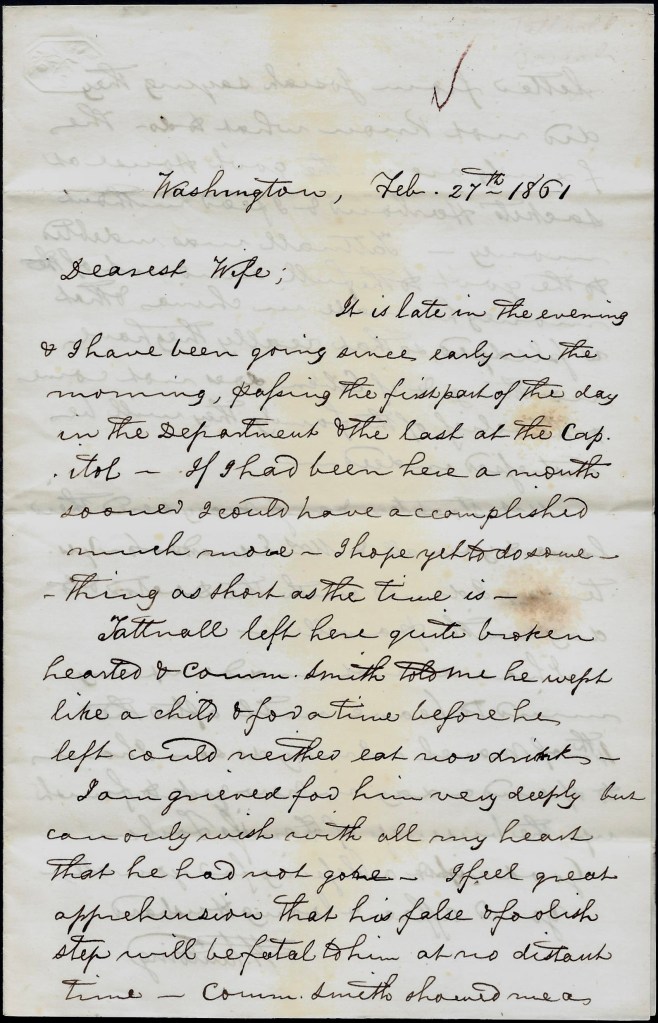
Feb. 27th 1861
Dearest Wife,
It is late in the evening & I have been going since early in the morning, passing the first part of the day in the Department & the last at the Capitol. If I had been here a month sooner, I could have accomplished much more. I hope yet to do something as short as the time is.
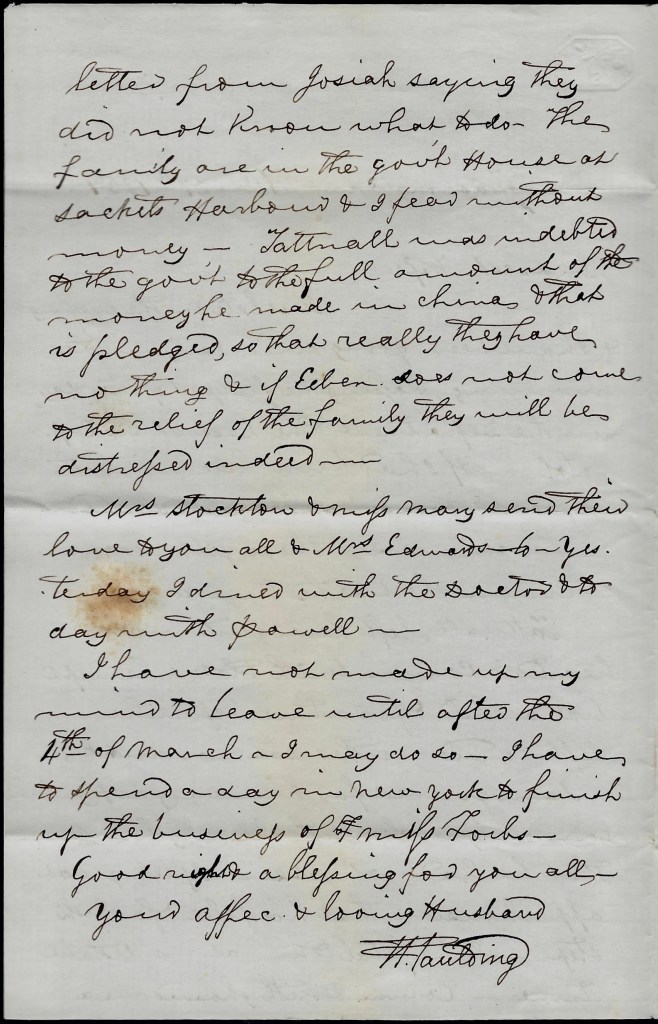
[Josiah] Tattnall 1 left here quite broken hearted & Commodore [Joseph] Smith told me he wept like a child & for a time before he left, could neither eat nor drink. I am grieved for him very deeply but can only wish with all my heart that he had not gone. I feel great apprehension that his false & foolish step will be fatal to him at no distant time. Commodore Smith showed me a letter from Josiah saying they did not know what to do. The family are in the Government House as Sackets Harbor & I fear without money. Tattnall was indebted to the government to the full amount of the money he made in China & that is pledged, so that really they have nothing & if Eben does not come to the relief of the family, they will be distressed indeed.
Mrs. Stockton and Miss Mary [H. McKnight] send their love to you & Mrs. Edwards too. Yesterday I dined with the Doctor and today with Powell.
I have not made up my mind to leave until after the 4th of March. I may do so. I have to spend a day in New York to finish up the business of Miss Forbes.
Good night and a blessing for you all. Your affectionate & loving husband, — H. Paulding
1 Josiah Tattnall and Hiram Paulding had been Naval buddies since 1817 when they first met and were assigned as young lieutenants on the frigate USS Macedonian. Because Tattnall’s father and grandfather were from Savannah, he had a strong sentimental attachment to the South and was conflicted as the Civil War loomed. Late in life, Paulding recalled that Tattnall visited him in early 1861 and they held “many conversations” on the subject; Paulding “begging and imploring him to stand by the old flag” but to no avail. [Life of Hiram Paulding, by Rebecca Paulding Meade (1910), p. 208]
Letter 3
Washington
Feb. 28th [1861]
Dearest Wife,
I have nothing to tell you except that I have met with some pleasant people & have made some calls. The Tiltons would not see company & I left my card.
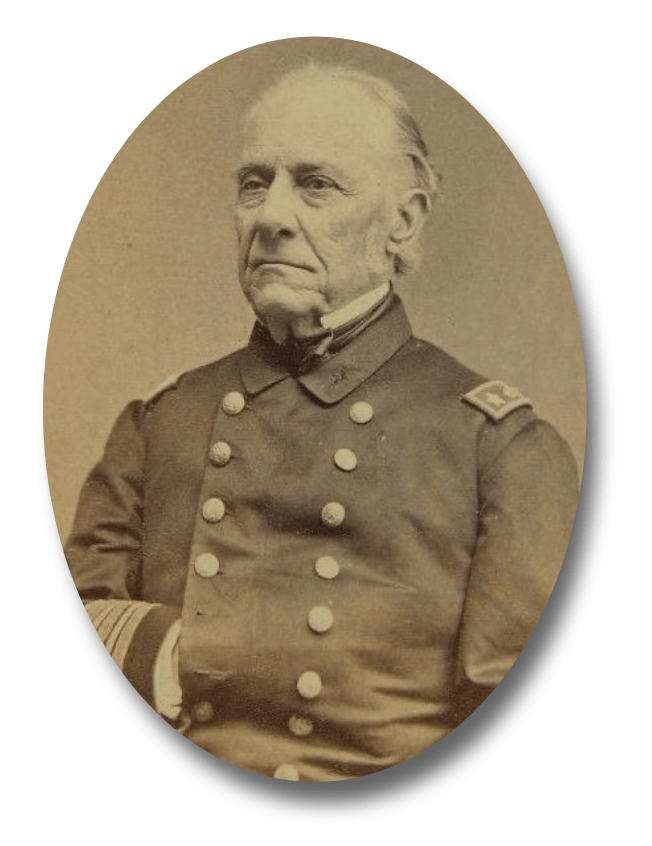
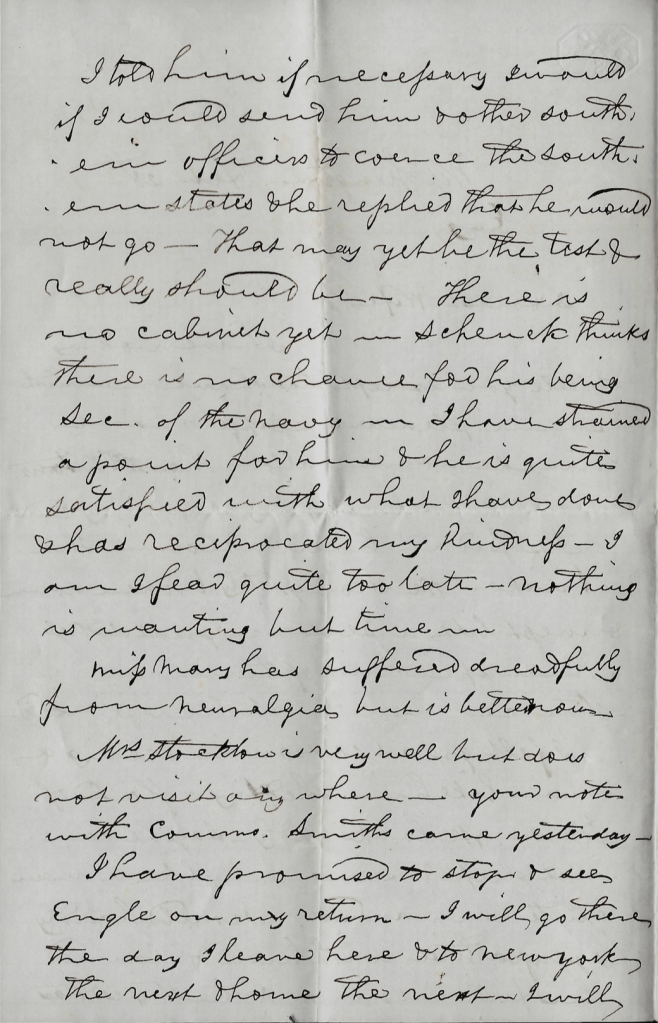
I passed an hour at Commodore [William Branford] Shubrick’s. He is completely broken down & wept like a person in great distress when speaking of the circumstances in which he is placed. I felt great sorrow in seeing a man like him shedding a flood of tears. He looks badly. Says he cannot sleep & seems really like a man quite unmanned. I could hardly sympathize with him & claimed his full allegiance to the stripes & stars. I told him if necessary I would—if I could—send him & other southern officers to coerce the southern states & he replied that he would not go. That may yet be the test & really should be.
There is no cabinet yet. [Commander James Findlay] Schenck thinks there is no chance for his being Secretary of the Navy. I have strained a point for him & he is quite satisfied with what I have done & has reciprocated my kindness. I am I fear quite too late—nothing is wanting but time.
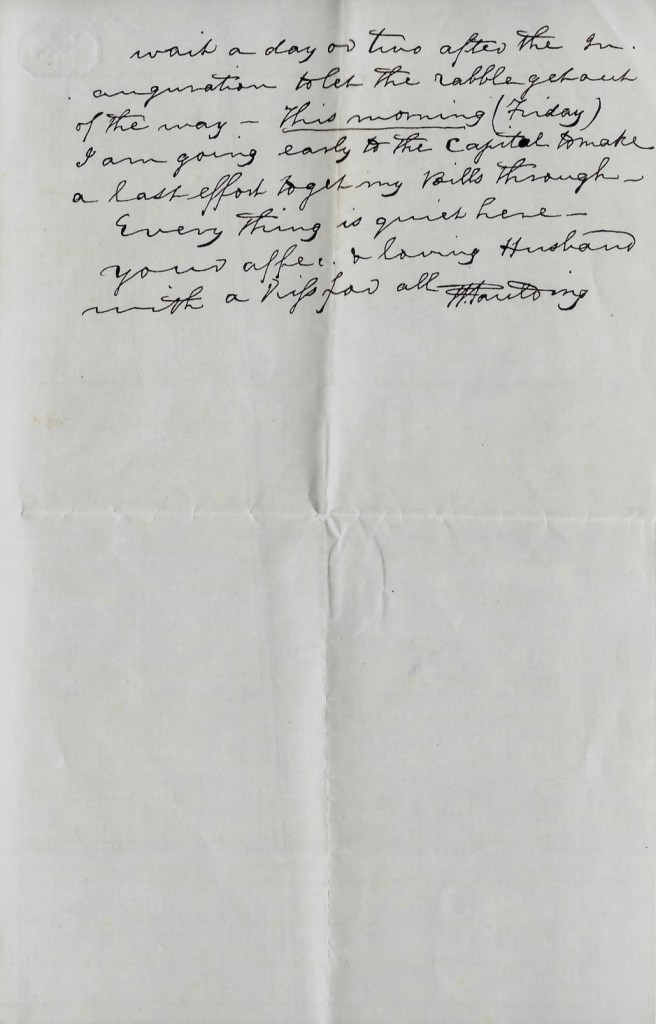
Miss Mary has suffered dreadfully from neuralgia but is better now. Mrs. Stockton is very well but does not visit anywhere. Your notes with Commodore Smith’s came yesterday. I have promised to stop & see [Frederick K.] Engle on my return. I will go there the day I leave here & to New York the next & home 1 the next. I will wait a day or two after the Inauguration to let the rabble get out of the way.
This morning (Friday), I am going early to the Capitol to make a last effort to get my Bills through.
Everything is quiet here. Your affectionate & loving husband, with a kiss for all, — H. Paulding
1 “Home” for the Pauldings in 1861 was a farm of 100 acres on West Neck, near Huntington, on the north shore of Long Island, 30 miles east of New York City. “The original house was a frame building with a wing on one end, and later, another wing was added, giving ample room for a family of six children…A road passing the home led through the woods to a beautiful stretch of pebbly beach extending half a mile or more toward Bouton’s Point. Fruit of every kind flourished on the farm, and Paulding took pride in having everything that farm and garden could produce of the best.” [Life of Hiram Paulding, by Rebecca Paulding Meade, (1910), p. 224]
Letter 4
Washington
March 3rd, 1861
Dearest Wife
I wrote by yesterday’s mail & afterwards made my last visit to the Capitol for this congressional session. My two bills 1 from the Senate were on the clerk’s table. Might be possibility be taken up, but Mr. [Emory Bemsley] Pottle was apprehensive they would not be reached. Congress has adjourned but I have not heard what they did last night. Mr. Pottle says I was a week too late.
I meet with much civility by the Republicans of distinction & have no one to complain of but Mr. Seward. Against him I fear I shall bear malice for a long time to come.
It is like summer here & the dust in clouds. Tomorrow [the President’s Inauguration] will be insufferable if there is not a change. I think I will not mix up with the crowd to go to the Capitol.
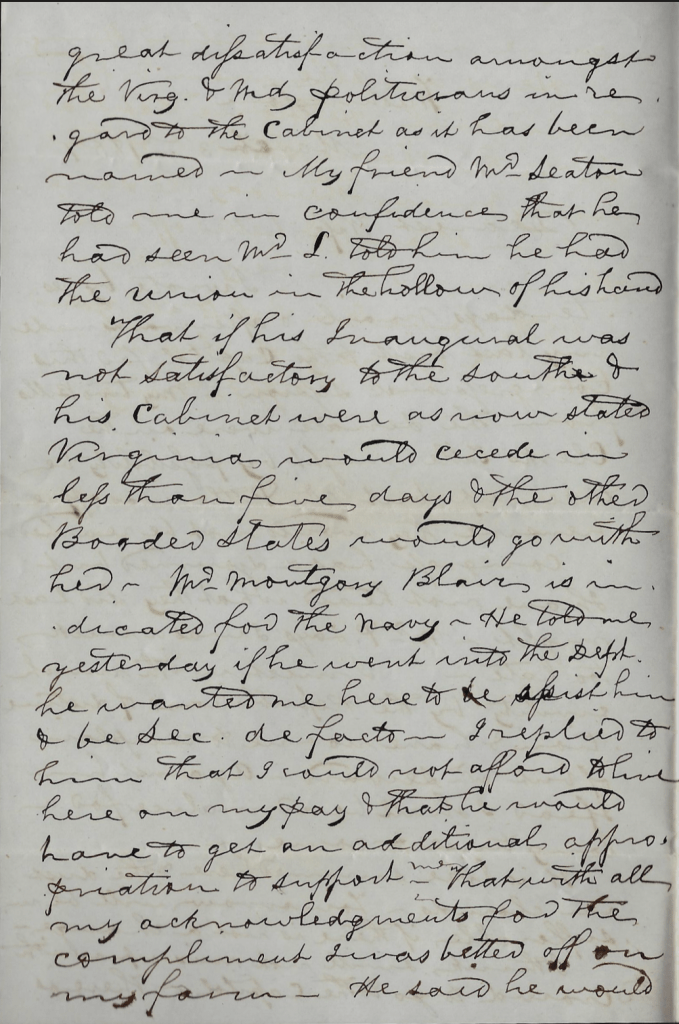
There is great dissatisfaction amongst the Virginia & Maryland politicians in regard to the cabinet as it has been named. My friend Mr. [C. W.] Seaton told me in confidence that he had seen Mr. Lincoln. Told him he had the Union in the hollow of his hand. That if his Inaugural was not satisfactory to the South & his cabinet were as now stated, Virginia would secede in less than five days & the other border states would go with her.
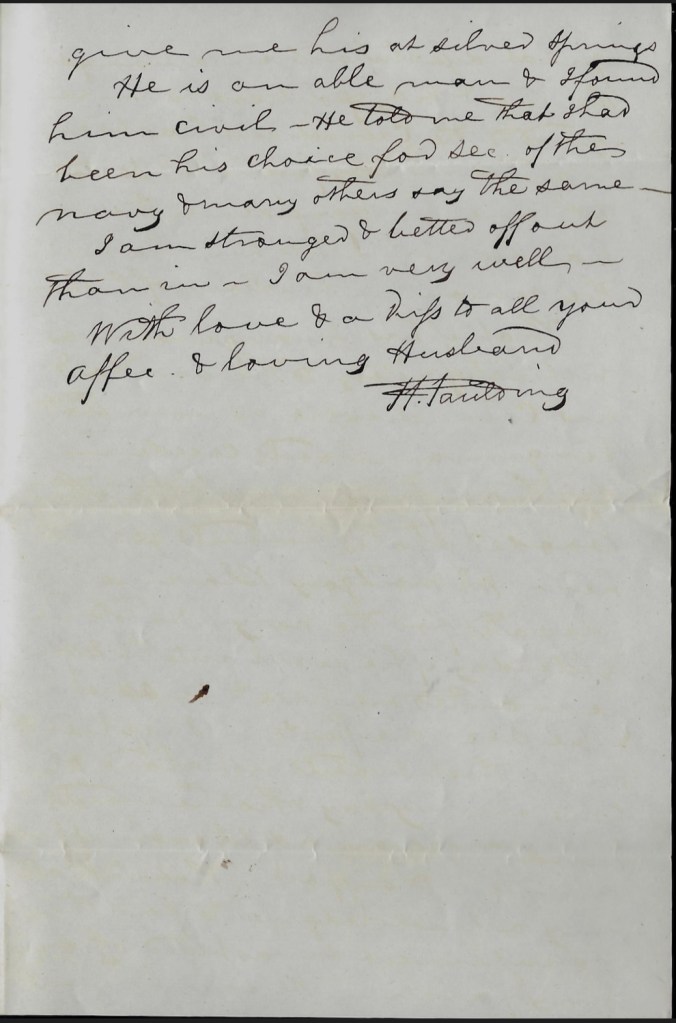
Mr. Montgomery Blair is indicated for the Navy. He told me yesterday if he went into the Department, he wanted me here to assist him & be Secretary defacto. I replied to him that I could not afford to live here on my pay & that he would have to get an additional appropriation to support me—that with all my acknowledgments for the compliment, I was better off on my farm. He said he would give me [use of] his [house called Falkland] at Silver Spring. He is an able man & I found him civil. He told me that I had been his choice for Secretary of the Navy & many others say the same.
I am stronger & better off out than in. I am very well. With love & a kiss to all, your affectionate & loving husband, — H. Paulding
1 The Bills most likely referred to here were for the purpose of appropriating sums of money, in one case $1200, for expenses Paulding incurred defending himself in a lawsuit brought against him for taking one of William Walker’s followers (Charles McDonald) out of Nicaragua in 1857. That particular Bill did not get taken up until April 1862 in the 37th Congress.

Letter 5
Washington
March 12th, 1861
Dearest Wife,
I spent an hour at Mr. Costairs [?] on Sunday. Saw Tom & James & Robert & took tea. On Monday I came here and was most comfortably established in the evening in my pleasant room where I am now writing at midnight & where I have been doing the same thing for the last three hours.
We met today & organized & arraigned the prisoner & adjourned until eleven tomorrow having called on the Secretary of the Navy.
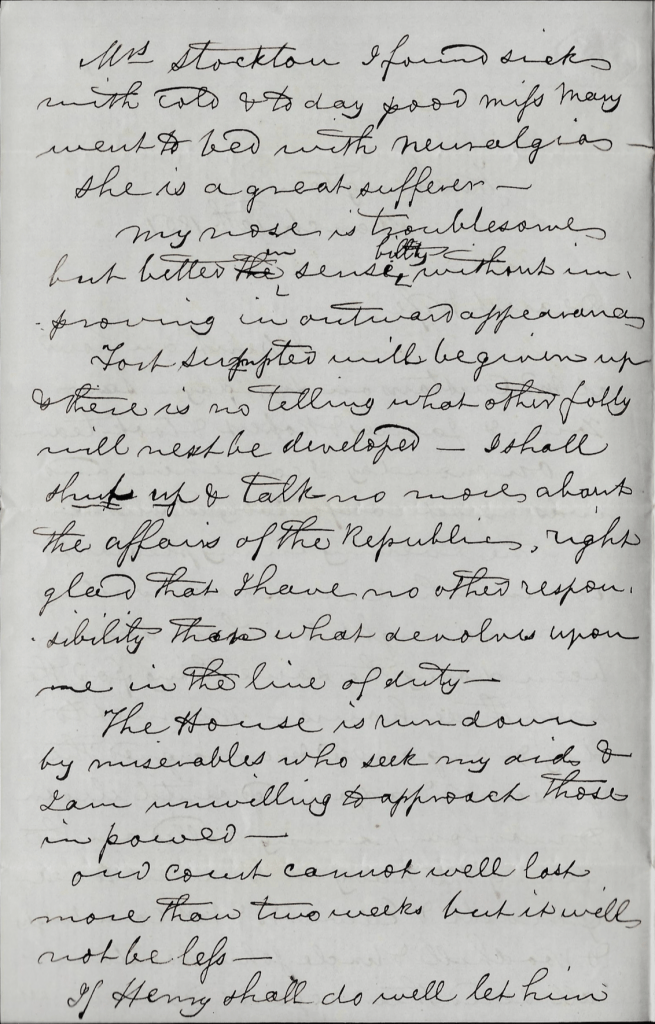
I went to see Powell & Edwards & Mrs. Commodore Rodgers & Woodhull & Uncle John Houston & all send their regards to you & the rest. Mrs. Stockton I found sick with cold and today poor. Miss Mary went to bed with neuralgia. She is a great sufferer. My nose is troublesome but better in a sense but without improving in outward appearances.
Fort Sumpter [sic] will be given up & there is not telling what other folly will next be developed. I shall shut up & talk no more about the affairs of the Republic, right glad that I have no other responsibility than what devolves upon me in the line of duty. The House is run down by miserables who seek my aid & I am unwilling to approach those in power.
Our court cannot well last more than two weeks but it will not be less.
If Henry shall do well, let him bring another load as soon as he can & the men have some hay for him when he comes again.
Tell me everything & with love to all, I am always your affectionate & loving husband, — H. Paulding


Letter 6
Washington
March 17th 1861
Dearest Wife,
I had the pleasure to receive your letter with our would be Secretary’s yesterday & thank you for it. I am glad that things are going on so pleasantly at home & wish I was there. The officers—some of them—want me to consent to fill a place in the Department, but I have persistently declined & as it seems I must take something, I must fall back on the New York [Brooklyn Naval] Yard. For many reasons, it is better than anything else that I can think of just now.
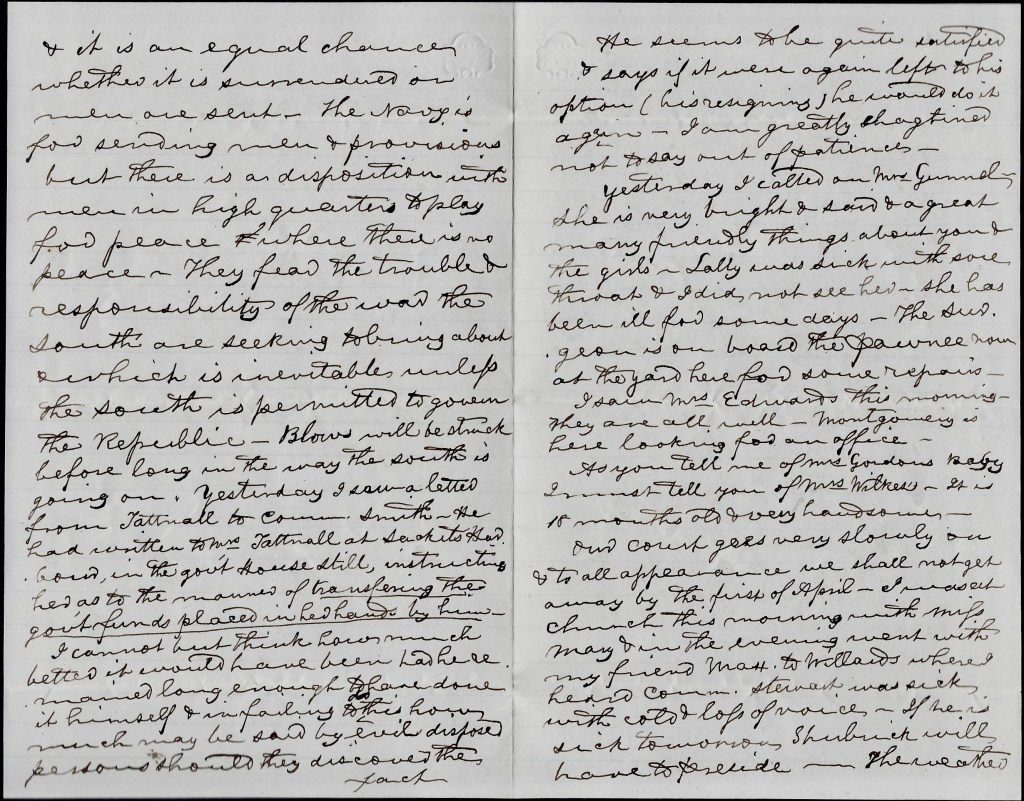
Yesterday no orders had been given to surrender Fort Sumpter & it is an equal chance whether it is surrendered or men are sent. The Navy is for sending men & provisions but there is a disposition with men in high quarters to play for peace where there is no peace. They fear the trouble & responsibility of the war the South are seeking to bring about & which is inevitable unless the South is permitted to govern the Republic. Blows will be struck before long in the way the South is going on.
Yesterday I saw a letter from Tattnall to Commodore Smith. He had written to Mrs. Tattnall at Sackets Harbor in the government house still, instructing her as to the manner of transferring the government funds placed in her hands by him. I cannot but think how much better it would have been had he remained long enough to have done it himself & in failing to do this how much may be said by evil disposed persons should they discover the fact. He seems to be quite satisfied & says if it were again left to his option (his resigning), he wold do it again. I am greatly chagrined not to say out of patience.

Yesterday I called on Mrs. [Helen Magruder Mackall] Gunnell. She is very bright and said a great many friendly things about you & the girls. Sally was sick with sore throat and I did not see her. She has been ill for some days. The Surgeon [Dr. Francis Mackall Gunnell] is on board the Pawnee now at the [Naval] Yard here for some repairs. 1
I saw Mrs. Edwards this morning. They are all well. Montgomery is here looking for an office.
As you tell me of Mrs. Gordon’s baby I must tell you of Mrs. Wilkes’s. It is 18 months old and very handsome.
Our court goes very slowly on & to all appearance we shall not get away by the first of April. I was at church this morning with Miss Mary & in the evening went with my friend Max to Willard’s where I heard Commodore Stewart was sick with cold and loss of voice. If he is sick tomorrow, Shubrick will have to preside.
The weather has been disagreeable today with northeastern wind threatening rain.
I am glad Rebecca and Manie were well enough to go to the reading & would like to have been one of them, It is very kind in Mrs. Combseling [?] to make it so pleasant for the children. Please remember me with every good wish to our excellent neighbors.
I am very well and very comfortable—only that my fire has gone out and room is getting cool. Good night and sweet repose. Your affectionate and loving husband, — H. Paulding
P. S. If they have scarlet fever at Mr. Willard’s, it will be dangerous for Barry and Mary to visit you. It is as you know almost as contagious as small pox.
1 Dr. Francis Mackall Gunnell (1827-1922) received his medical degree from Georgetown University in 1846 and was commissioned an Assistant Surgeon in the US Navy in March 1849. He was aboard the USS Niagara at the laying of the first Atlantic cable in 1858, and was wrecked on the Steamer Fulton in 1859. He served with such distinguished officers as Tatnell, Worden, Rowan Farragut, and enjoyed their confidence and friendship. He was serving aboard the USS Pawnee when it was ordered to Washington to protect the inauguration of President Lincoln and he was promoted to Surgeon on 23 April 1861.

Letter 7
Washington
March 21st, 1861
Dearest Wife,
I received your letter yesterday and cannot express my grief in the condition of dear little Eliza Jane and Maria. How unfortunate it is that the Doctor was not sent for sooner! I would by all means allow Emma to be absent if it is convenient to send her & Eliza Jane is not likely to live long. Yet if Emma would prefer to remain and see the last of her poor little companion, I leave it to you to think what is best.
As Henry is so slow in coming, perhaps Lawrence had been engage as load from the man that bought Hoyt’s sloop. If Henry has brought a load & it appears satisfactory & can bring another without delay, it may be well to let him do the work. It is a grand time to cart now when they have so little to do. Lawrence must put all the fences in good condition.
We have yet three or four witnesses to examine & then we close if we do not wait for Lt. [Jeremiah H.] Gilman who has been summoned from Fort Pickens & who cannot get here in less than six weeks.
I note what you say about my getting some appointment. It is something new for you to suggest that I should apply for orders. Stringham has been appointed Assistant Secretary of the Navy very much against his wishes. It was offered to me & I declined. I am to have the [Brooklyn] navy yard on the first of November when [Samuel Livingston] Breese‘s time expires. The Secretary wants in the meanwhile to give me anything I can think of acceptable to me.
It is a pleasant change to breathe such an atmosphere. A great many changes will be made in & about the Department. Mr. Berrien is a fine fellow—a man of intelligence & a gentleman. He will probably be 4th and Mr. Thomas A. Smith, formerly Chief Clerk, take his place by and bye.
I had a letter from Himes this morning who says his eyes are so weak that it hurts him to study. Would you have him leave before the school breaks up? If so, please write to Mr. Belden.
Whether the turkeys are troublesome or not, you must have them disposed of to suit your wants & judgment. I do not intend to keep any over. I think I shall be at home between the middle and last of net week but it is uncertain.
If Ned Brush should come for any of the fat cattle, don’t let him have them before my return.
Mrs. Stockton and Miss McKnight have been well for some days. They were glad to receive your civil message. With a kiss for all, your affectionate and loving husband, — H. Paulding


Letter 8
Washington
March 25th 1861
Dearest Wife,
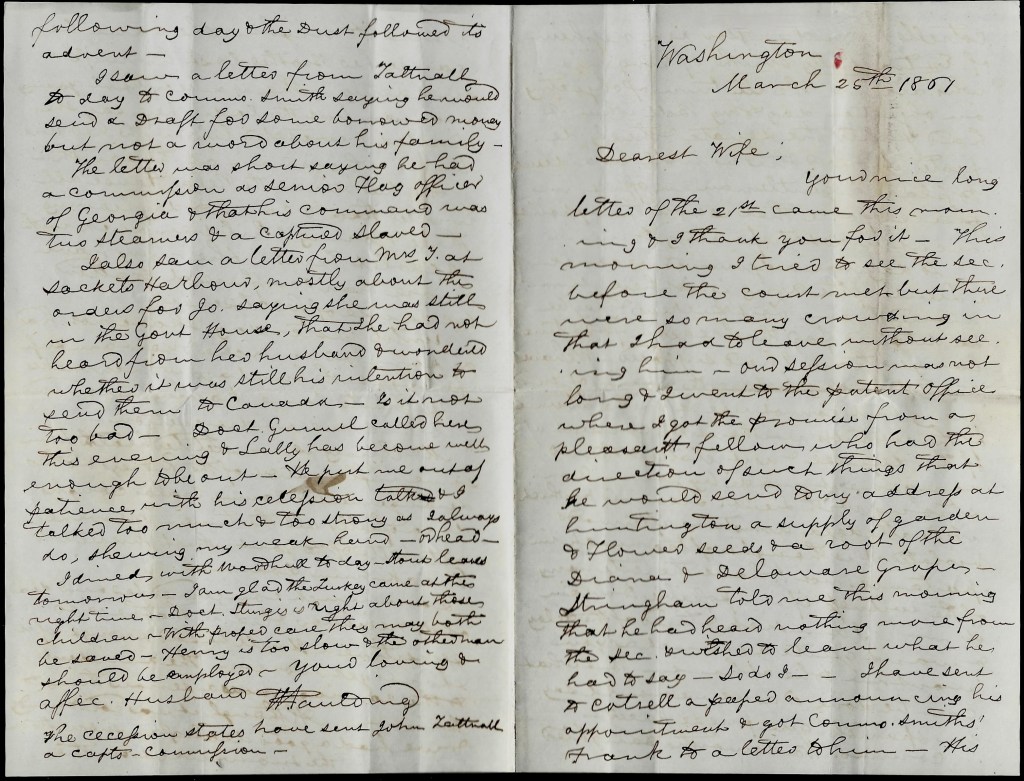
Your nice long letter of the 21st came this morning and I thank you for it. This morning I tried to see the Secretary [of the Navy] before the court met but there were so many crowding in that I had to leave without seeing him. Our session was not long & I went to the Patent Office where I got the promise from a pleasant fellow who had the direction of such things that he would send to my address at Huntington a supply of garden and flower seeds & a root of the Diana & Delaware grapes.
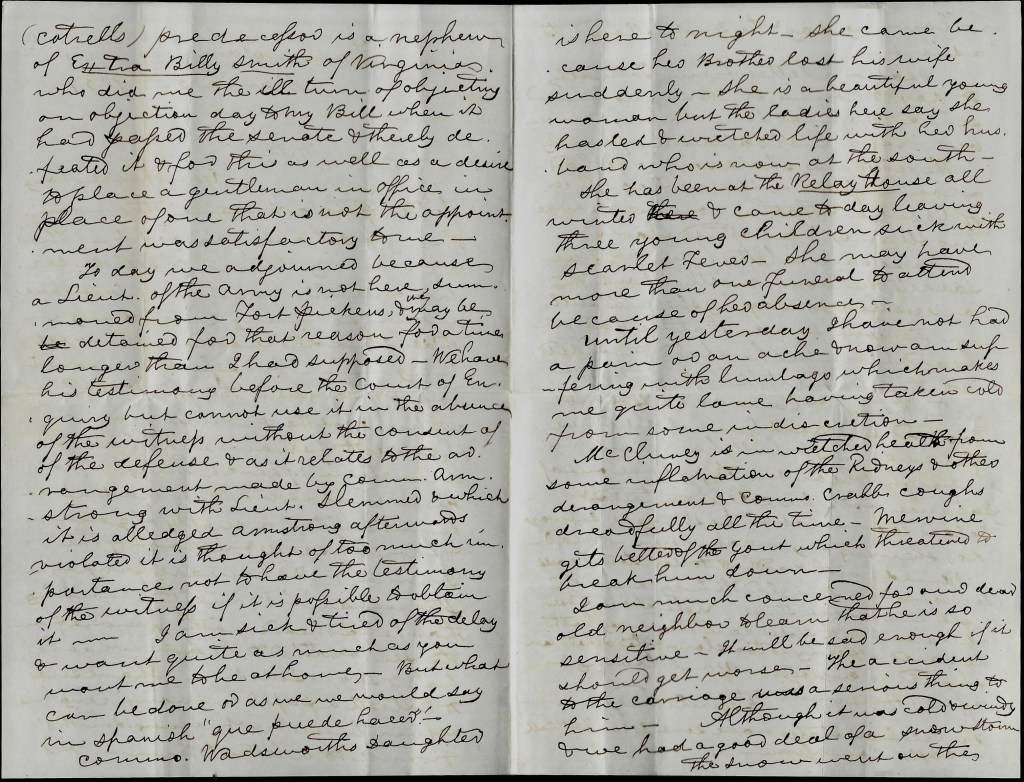
[Silas H.] Stringham told me this morning that he had heard nothing more from the Secretary and wished to learn what he had to say—so do I. I have sent Cotrell a paper announcing his appointment & got Commodore Smith’s frank to a letter to him. His (Cotrell’s) predecessor is a nephew of Extra Billy Smith of Virginia who did me the ill turn of objecting on objection day to my Bill when it had passed the Senate & thereby defeated it & for this as well as a desire to place a gentleman in office in place of one that is not the appointment was satisfactory to me.
Today we adjourned because a lieutenant of the army is not here, summoned from Fort Pickens, and he may be detained for that reason for a time longer than I had supposed. We have his testimony before the Court of Enquiry but cannot use it in the absence of the witness without the consent of the defense & as it relates to the arrangement made by Commodore Armstrong with Lieut. [Adam J.] Slemmer & which it is alleged [James] Armstrong afterwards violated, it is thought of too much importance not to have the testimony of the witness if it is possible to obtain it. 1 I am sick and tired of the delay and want quite as much as you want me to be at home. But what can be done or as we would say in Spanish, “Que puede hacer.”
Commodore Wadsworth’s daughter is here tonight. She came because her brother lost his wife suddenly. She is a beautiful young woman but the ladies here say she has led a wretched life with her husband who is now at the South. She has been at the Relay House all winter and came today, leaving three young children sick with scarlet fever. She may have more than one funeral to attend because of her absence.
Until yesterday, I have not had a pain or an ache and now am suffering with lumbago which makes me quite lame, having taken cold from some indiscretion.
I am much concerned for our dear old neighbor to learn that he is so sensitive. It will be sad enough if it should get worse. The accident to the carriage was a serious thing to him. Although it was cold and windy and we had a good deal of a snow storm, the snow went on the following day and the dust folloed to advent.
I saw a letter from Tattnall today to Commodore Smith saying he would send a draft for some borrowed money but not a word about his family. The letter was short saying he had a commission as Senior Flag Officer of Georgia & that his command was two steamers & a captured slaver. I also saw a letter from Mrs. Tattnall at Sackets Harbor mostly about the orders for Jo. saying she was still in the government house, that she had not heard from her husband, and wondered whether it was still his intention to send them to Canada. Is it not too bad?
Dr. [Francis M.] Gunnell called here this evening and Sally has become well enough to be out. He put me out of patience with his secession talk and I talked too much and too strong as I always do, showing my weak hand—or head.
I dined with Woodhull today. Stout leaves tomorrow. I am glad the turkey came at the right time. Doctor Sturgis is right about those children. With proper care they may both be saved. Henry is too slow and the other man should be employed. Your loving and affectionate husband, — H. Paulding
The secession states have sent John Tattnall a Captain’s commission.
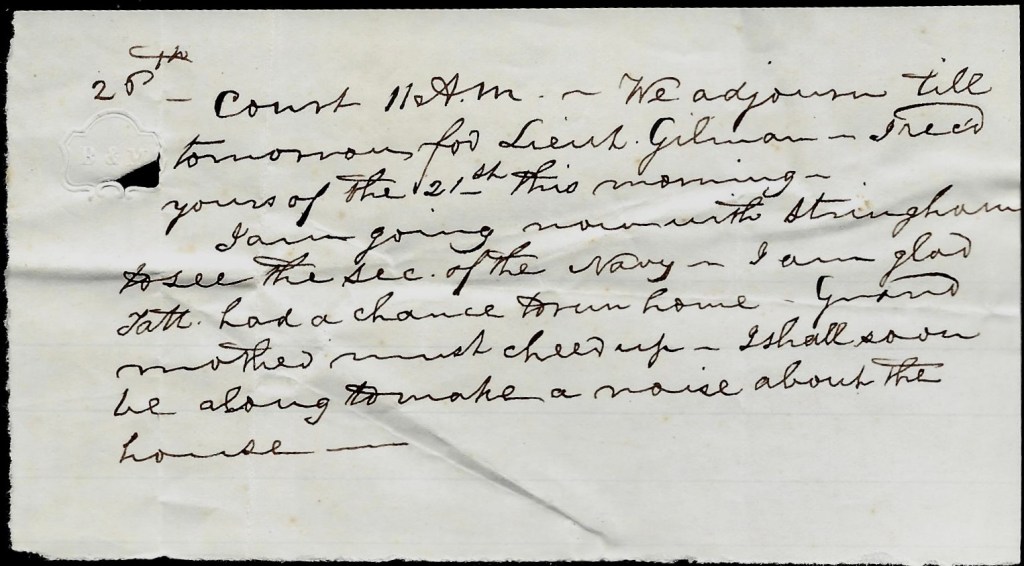
26th. Court. 11 a.m. We adjourn till tomorrow for Lieut. [Jeremiah H.] Gilman. I received yours of the 21st this morning. I am going now with Stringham to see the Secretary of the Navy. I am glad Tattnall had a chance to run home. Grandmother must cheer up. I shall soon be along to make a noise about the house.
1 The Court of Inquiry on which Paulding sat in March 1861 appears to have convened to look into whether Commodore James Armstrong committed treason by failing to cooperate with the Lieutenant Slemmer’s attempt to move his small US force into Fort Pickens which controlled the entrance to the Bay of Pensacola. Lt. Gilman was 2nd in command of that force and witness to the conversation between Slemmer and Armstrong. [See The New York Times, 14 January 1861. Armstrong was court martialed on 4 May 1861.
Letter 9
Washington
March 31st 1861
Sir,
I do not wish to be considered an alarmist whilst I simply convey a theory as it is presented to my mind. The Cotton States have decreed an army and an indefinite force is assembling about Pensacola, not to attack Fort Pickens but for ulterior objects of greater importance. When a body of men are inured to the life of a camp, trained to arms and instructed in the varied evolutions of the field by able officers, a few thousands make a formidable army & may be used for mischievous purposes & with great effect if not opposed by men equal in discipline to themselves. If in conspiracy against the government, with an able leader at their head, they can move secretly and with celerity.
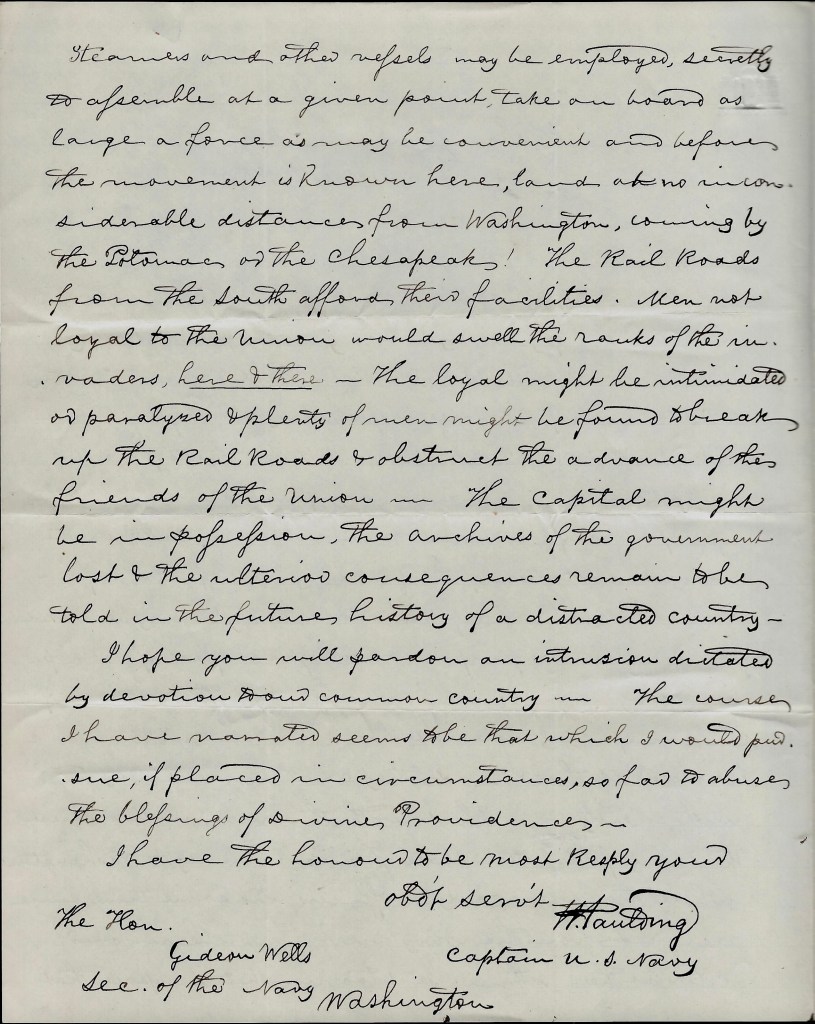
What with this view will prevent the army of the Cotton States from coming to Washington when they are ready? Officers who some time since resigned from the Navy are known to be in our cities at the North. Is it too much to suppose that steamers and other vessels may be employed, secretly to assemble at a given point, take on board as large a force as may be convenient and before the movement is known here, land at no inconsiderable distance from Washington, coming by the Potomac or the Chesapeake!
The railroads from the South afford their facilities. Men not loyal to the Union would swell the ranks of the invaders, here & there. The loyal might be intimidated or paralyzed & plenty of men might be found to break up the railroads & obstruct the advance of the friends of the Union. The Capitol might be in possession, the archives of the government lost, & the ulterior consequences remain to be told in the future history of a distracted country.
I hope you will pardon an intrusion dictated by devotion to our common country. The course I have narrated seems to be that which I would pursue, if placed in circumstances, so far to abuse the blessings of Divine Providence.
I have the honor to be, most respectfully, your obedient servant, — H. Paulding, Captain U.S. Navy
[to] the Hon. Gideon Wells, Secretary of the Navy, Washington

Letter 10
[Washington D. C.]
Monday, 11 a.m. April 1, 1861
Dearest Wife,
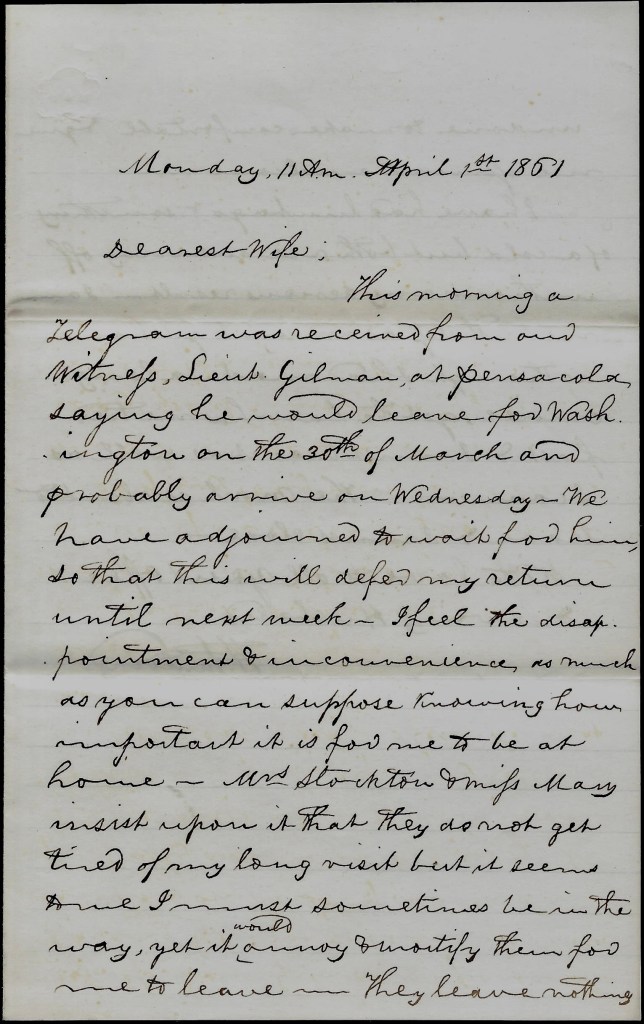
This morning a telegram was received from our witness, Lieut. [Jeremiah H.] Gilman, at Pensacola saying he would leave for Washington on the 30th of March and probably arrive on Wednesday. We have adjourned to wait for him. so that this will defer my return until next week. I feel the disappointment and inconvenience as much as you can suppose, knowing how important it is for me to be at home. Mrs. Stockton and Miss Mary insist upon it that they do not get tired of my long visit but it seems to me I must sometimes be in the way. Yet it would annoy and mortify them for me to leave. They leave nothing undone to make [me] comfortable and give me assurance a welcome.
I have had lumbago and something of a cold but both are wearing off without any serious result. I am nevertheless as anxious to get home as though I had made a long cruise, yet the law has me tied fast and I must hear it as well as I can. The mail is about to leave and I must close.
With love to all, your affectionate and loving husband, — H. Paulding

Letter 11
Washington
April 2nd 1861
Dearest Wife,
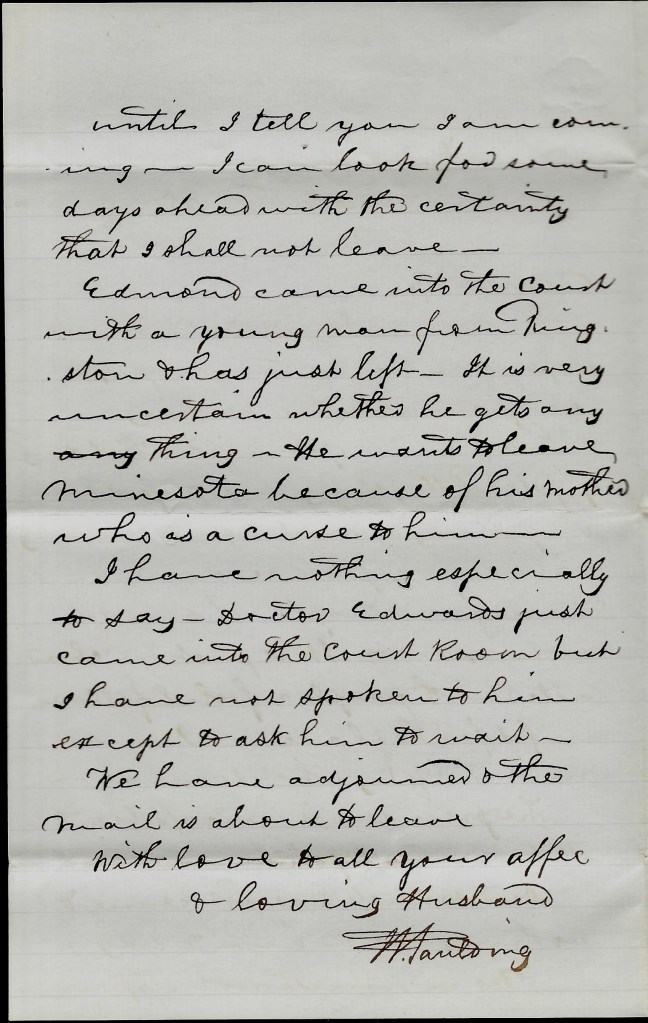
I am so constant a correspondent that I promised myself to hear from you this morning. I had a letter from John Paulding of Peekskill asking me to assist him in getting a mail agency & sending some very good recommendations from people whom I do not know. It is just in character with a foolish fellow unfit for the place. I must nevertheless try what I can do. The President is inaccessible to all but small politicians.
Our witness has not come and nothing from him today.
You must not stop writing until I tell you I am coming. I can look for some days ahead with the certainty that I shall not leave.
Edmond came into the court with a young man from Kingston and has just left. It is very uncertain whether he gets anything. He wants to leave [the] Minnesota because of his mother who is a curse to him. I have nothing especially to say. Doctor Edwards just came into the court room but I have not spoken to him. Expect to ask him to wait.
We have adjourned and the mail is about to leave. With love to all, your affectionate and loving husband, — H. Paulding

Letter 12
Court Room
Washington City
April 5th 1861
Dearest Wife,
We have adjourned until tomorrow when we hear the defense & make up the finding. If we get through in time which I do not think I shall leave in the evening train tomorrow—otherwise in the evening train on Sunday. Or should we have to meet again on Monday in the morning train on Tuesday. I shall want part of a day in New York to visit the [Navy] Yard &c. and then take the steamer or cars as the case may be.
We shall want another load of manure & I think Hoyt’s man might as [well] bring it if he can do so at once. Otherwise Henry if his is good. You may as well let whichever is most convenient bring it. We cannot wait long without inconvenience.
Your esteemed famous reached me this morning. You must not starve everybody because I am not at home. I am sorry the sick do not improve more.
They want me here so much that I must fight to get away and even then be hurried as though I had no right to think or care for anybody or anything but the Navy and its affairs. Everybody congratulates me and I fear always reply rudely.
We may as well keep the hay for better sale than 75 cents. I don’t have time to visit much being engaged most of my leisure [time] in other peoples affairs.
The peach and plum trees are in blossom here. The weather has been rough and damp. God bless you all. With love and a kiss, your affectionate and loving husband, — H. Pauling


Letter 13
Washington
Sunday, April 7, 1861
Dearest Wife,
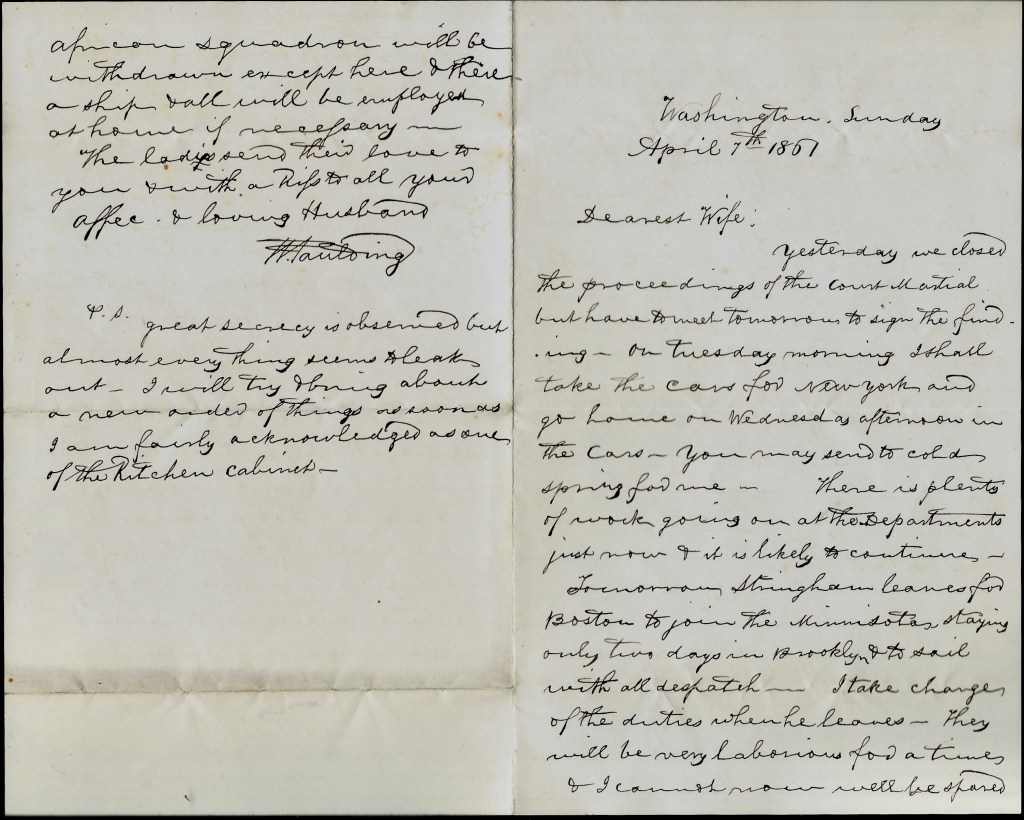
Yesterday we closed the proceedings of the court martial but have to meet tomorrow to sign the finding. On Tuesday morning I shall take the cars for New York and go home on Wednesday afternoon in the cars. You may send to Cold Spring for me. There is plenty of work going on at the Departments just now & it is likely to continue.
Tomorrow Stringham leaves for Boston to join the Minnesota, staying only two days in Brooklyn & to sail with all dispatch. I take charge of the duties when he leaves. They will be very laborious for a time & I cannot now well be spared. I will try & stay at home for a week but fear the Secretary will not listen to so long an absence.
I hope you will make up your mind to come back with me. We can go to Willard’s [Hotel] or come here. Mrs. Stockton says we may have the house for the summer—that she and her sister must leave for a time & if I do not occupy it, she must hire someone to take care of it. She has despaired of renting it.
I have Commander [George Foster] Emmons & Lieut. [John Lorimer] Worden 1 & Woodhull in my office to do the work. I shall have to do hard work which will be quite sufficient.
The order was sent from the War Department to the officer commanding the artillerists on board the Brooklyn to land with his men at Fort Pickens but as no order was sent to the Capt. of the Brooklyn, he would not land them. The President was much chagrined & will send a messenger overland & orders by water. I suppose the expedition that sailed yesterday from New York is destined for the relief of Fort Sumpter. I fear they have waited so long, that they are not strong enough. The government should risk nothing but always strike with an irresistible hand. I think we may now consider that peace is at an end. The people of the Northwest have compelled the President to go forward & are ready to march with a host whenever the first blow is struck. There will be a new era in the future which it is sad enough to contemplate. The Navy—with the exception of the African Squadron—will be withdrawn except here & there a ship & all will be employed at home if necessary.
The ladies send their love to you & with a kiss to all, your affectionate and loving husband, — H. Paulding
P. S. Great secrecy is observed but almost everything seems to leak out. I will try & bring about a new order of things as soon as I am fairly acknowledged as one of the kitchen cabinet. 2
1 John Lorimer Worden (1818-1897) of the US Navy would later command the USS Monitor in her famous engagement against the CSS Virginia in the Battle of Hampton Roads, Virginia on 9 March 1862. It would be the first ver engagement between ironclad steamships.
1 It seems evident that by this time, Paulding has been offered and accepted a position in the Navy Department that he could not refuse. In a memorandum written in 1869, Paulding recalled that he was invited by the Secretary of the Navy, Gideon Welles, “to fill a place in the Navy Department which I twice respectfully declined and on a third occasion he informed me that it was the order of the President that I should do so. It therefore became my duty to aid the Secretary in putting the Navy afloat and to render whatever professional service I could.” [Life of Hiram Paulding, by Rebecca Paulding Meade (1910), page 236]

Letter 14
The following letter was penned by Frederick Washington Moores, Sr. (1795-1869), a native of Columbia county, New York. Frederick W. Moores was a career U.S. Navy Sailing Master primarily attached to the Mediterranean foreign station, but who also sailed the globe many times including the Pacific and both hemispheres. On October 24, 1815, while a young man, he was dismissed from the Religious Society of Friends (Quakers), for boarding a ship that was armed.
Navy Yard Boston
April 9, 1861
My dear Sir,
For the first time in my life, I venture to write in behalf of a man for a place in our Yard. John R. Rice was formerly the Master Black Smith of this yard, and a better man in all respects we never had. A good mechanic, and one who carried on the duties of his branch with efficiency. He was removed for his political views, and in respectfully soliciting your kind offices in obtaining his restoration, I believe I reflect the views of every officer at this Yard.
I am dear Sir, very respectfully, your obedient servant, — F[rederick] W[ashington] Moores
[to] Com. Hiram Paulding, Washington City

Letter 15
[Maxwell] Woodhull’s [Residence]
Washington [D. C.]
April 15th 1861
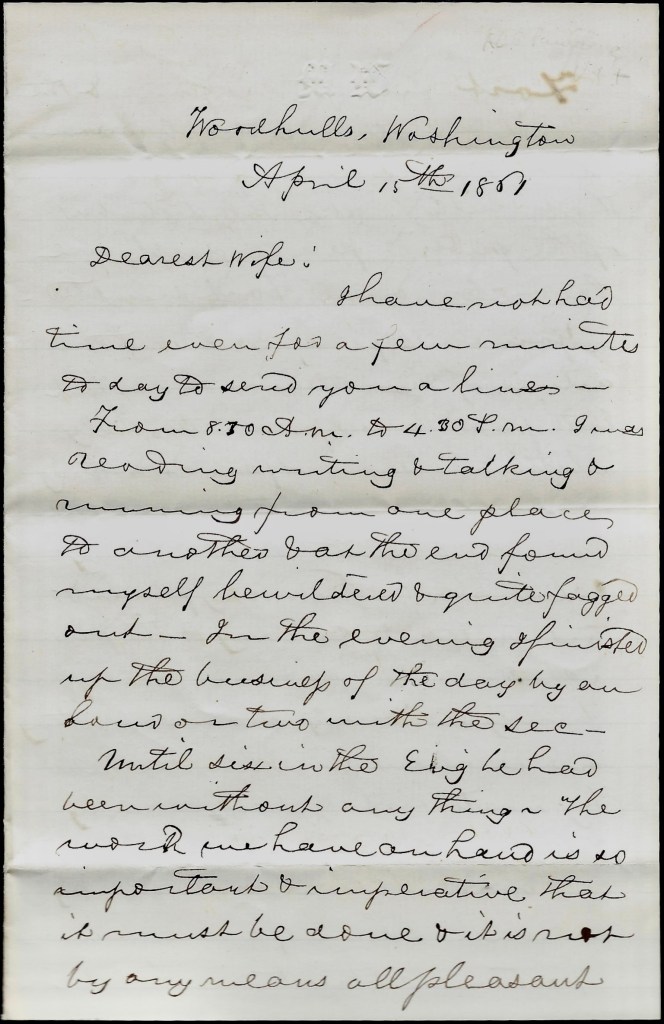
Dearest Wife,
I have not had time even for a few minutes today to send you a line. From 8:30 a.m. to 4:40 p.m., I was reading, writing and talking & running from one place to another & at the end found myself bewildered & quite fagged out. In the evening I finished up the business of the day by an hour or two with the Sec[retary Gideon Welles].
Until six in the evening, he had been without anything. The work we have on hand is so important & imperative that it must be done & it is not by any means all pleasant. Fort Sumpter is gone & the government & Nation is deeply wounded & a sentiment produced that will make the disturbers of the public peace deeply rue the victory over Fort Sumpter.
You will perceive that the failure of Mr. Seward’s shameful enterprise is as I predicted—only a little worse. If such a thing is again undertaken whilst I am here in the same way, I shall ask to yield my place & this I intend to convey to the President as soon as I have an opportunity. We may know something more about it when we hear by water. As yet we learn by telegraph in the hands of the South.
I was not here too soon. My presence I deem of so much importance at this time that I can readily forget my own affairs for the good of the country. The Secretary seems an excellent man & listens with great interest to all I have to say & seems inclined to yield to my judgment & wishes—at least he has done so today & we have accomplished a great deal of work.
I saw Capt. Bailey tonight and he told me he met with you on Saturday.
It is late now but I must tell you I saw Mrs. Stockton & Miss Mary. They have the young lady friend and child & did not not deprecate my absence. Mrs. Edwarrs is well. She had just heard from Hattie. With love to all, your affectionate and loving husband, — H. Paulding


Letter 16
Barnum’s [Hotel]
Baltimore, [Maryland]
10 a.m., Thursday, April 18th [1861]
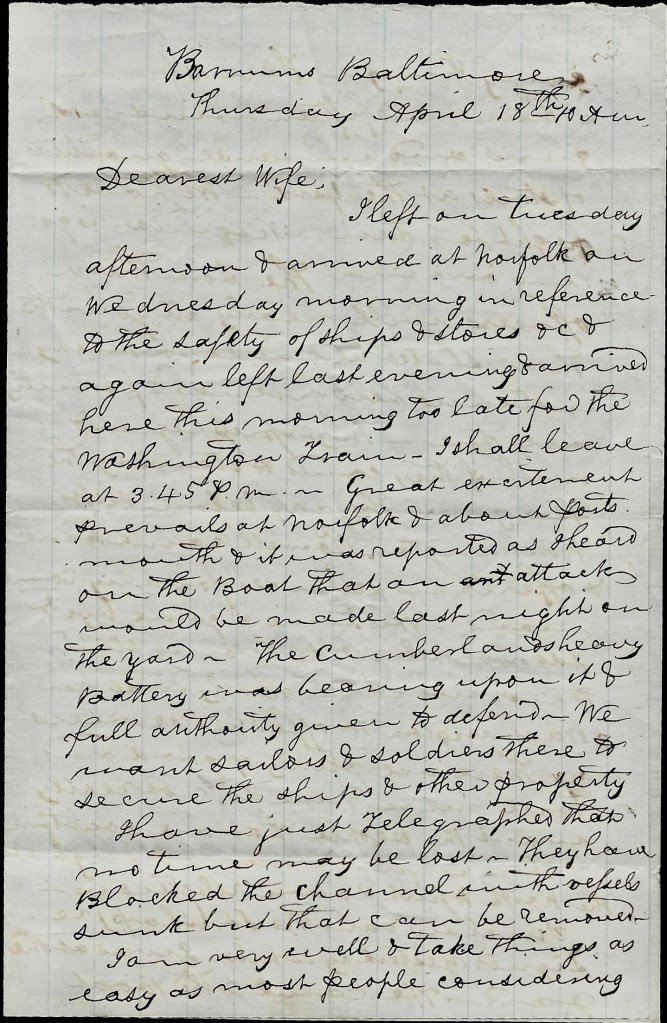
Dearest Wife,
I left on Tuesday afternoon & arrived at Norfolk on Wednesday morning in reference to the safety of ships & stores &c., and again left last evening & arrived here this morning too late for the Washington train. I shall leave at 3:45 p.m. Great excitement prevails at Norfolk & about Portsmouth & it was reported as I heard on the boat that an attack would be made last night on the [Naval] Yard.
The Cumberland’s heavy battery was bearing upon it & full authority given to defend. We want sailors & soldiers there to secure the ships and other property. I have just telegraphed that no time may be lost. They have blocked the channel with vessels sunk but that can be removed.
I am very well & take things as easy as most people considering every thing.
There is from a thousand to fifteen hundred guns and immense quantities of stores at the yard. We may have to fight for them. Virginia is going out. The Southern officers will nearly all go with their states because in many instances, their friends & families are there. They express regret & wish & they could stand by the flag. The day before I left Washington, [Levin M.] Powell came to me & offered his services for any command. His time is gone by & I do not believe he would stand to his work. [Theodorus] Bailey was in Washington to offer his services. There are plenty of good and true men & we do not really want the people that are doubtful. There is spirit & men enough at the North to put down rebellion. Sinclair & another Lt. (Sharp) resigned yesterday whilst I was at the [Gosport Navy] yard. He came to the boat before I left to see me with his wife & child. He says he loves Virginia better than his wife & his wife loves Virginia better than she does him. He expects to join the southern army at the head of a battery of flying artillery.
I have told [Charles Stewart] McCauly to burn what he cannot defend at the [Gosport Navy] Yard.
I hope your man Mc won’t break down. If so, we must see what is next best to be done. Give him a fair chance but don’t send him away from the farm on any business if it can be helped. In haste, your affectionate & loving husband, — H. Paulding


Letter 17
Washington
April 19th 1861
Dearest Wife,
I write you early in the morning as the only time when today I shall have the least chance. After my line of yesterday, I arrived here at 6 p.m. & having made report to the Secretary of the Navy, went to the President who had Seward, Blair, Smith and Chase with him. Then I returned to the Department & by 9 p.m., we had telegraphed & written, getting three hundred men and officers on the move tomorrow for Norfolk to get the vessels from the [Gosport Navy] yard that are in a state of readiness to move.
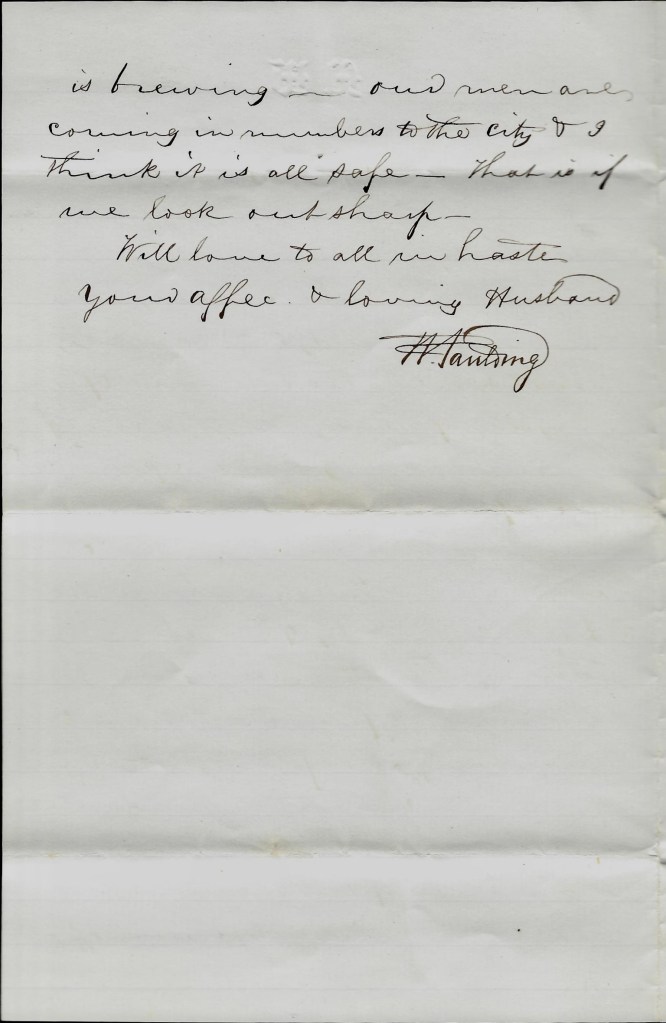
The ladies of Washington are real alarmed. The telegraph is cut off at Richmond and we fear that mischief is brewing. Our men are coming in numbers to the city & I think it is all safe—that is, if we look out sharp.
With love to all in haste. Your affectionate and loving husband, — H. Paulding

Letter 18
Confidential
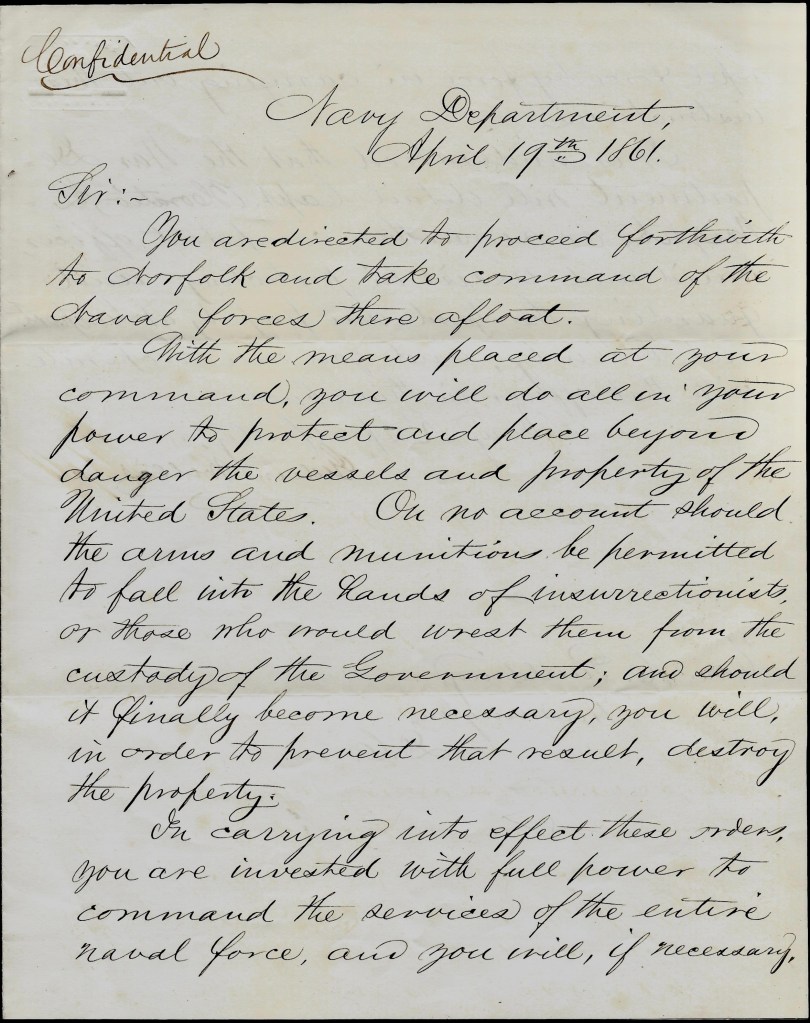
Navy Department
April 19th 1861
Sir,
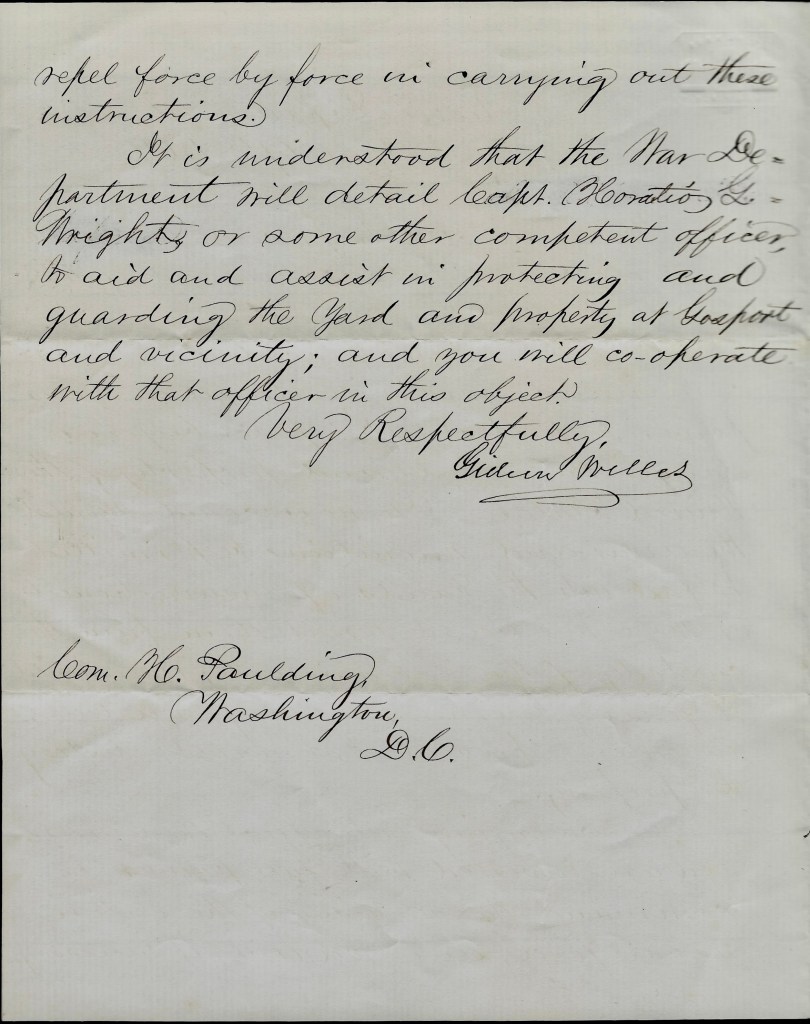
You are directed to proceed forthwith to Norfolk and take command of the Naval forces there afloat. With the means placed at your command, you will do all in your power to protect and place beyond danger the vessels and property of the United States. On no account should the arms and munitions be permitted to fall into the hands of the insurrectionists, or those who would wrest them from the custody of the Government; and should it finally become necessary, you will, in order to prevent that result, destroy the property.
In carrying into effect these orders, you are invested with full power to command the services of the entire naval force, and you will, if necessary, repel force by force in carrying out these instructions.
It is understood that the War Department will detail Capt. Horatio G. Wright or some other competent officer, to aid and assist in protecting and guarding the yard and property at Gosport and vicinity; and you will co-operate with that officer in this object.
Very Respectfully, — Gideon Welles
Letter 19
Steam Tug Keystone State
off Sewall’s Point, Va.
April 22nd, 1861
Sir,
I send a pilot to the Cumberland & you will when the tide serves, get underway & anchor in mid-channel off Fortress Monroe until the further pleasure of the Department is known.
I have been informed that one or more arrived vessels have been seen in this vicinity coming from James River & would suggest to you the importance of vigilance in the detention of all such vessels.
Be pleased to send on board this steamer, the arms & ammunition sent on board the Cumberland from the Navy Yard at Gosport, Virginia, for safe keeping.
Very respectfully your obedient servant, — H. Paulding, Commanding the Naval Forces in the waters of Virginia
[to] Flag Officer, G[arrett] J. Pendergast, Commanding Home Squadron
Note. Vessels of all description carrying arms or armed men not belonging to the government of the US.

Letter 20
U.S. Steamer Keystone State
on the Potomac River
Eve., April 22nd, 1861
Dearest Wife,
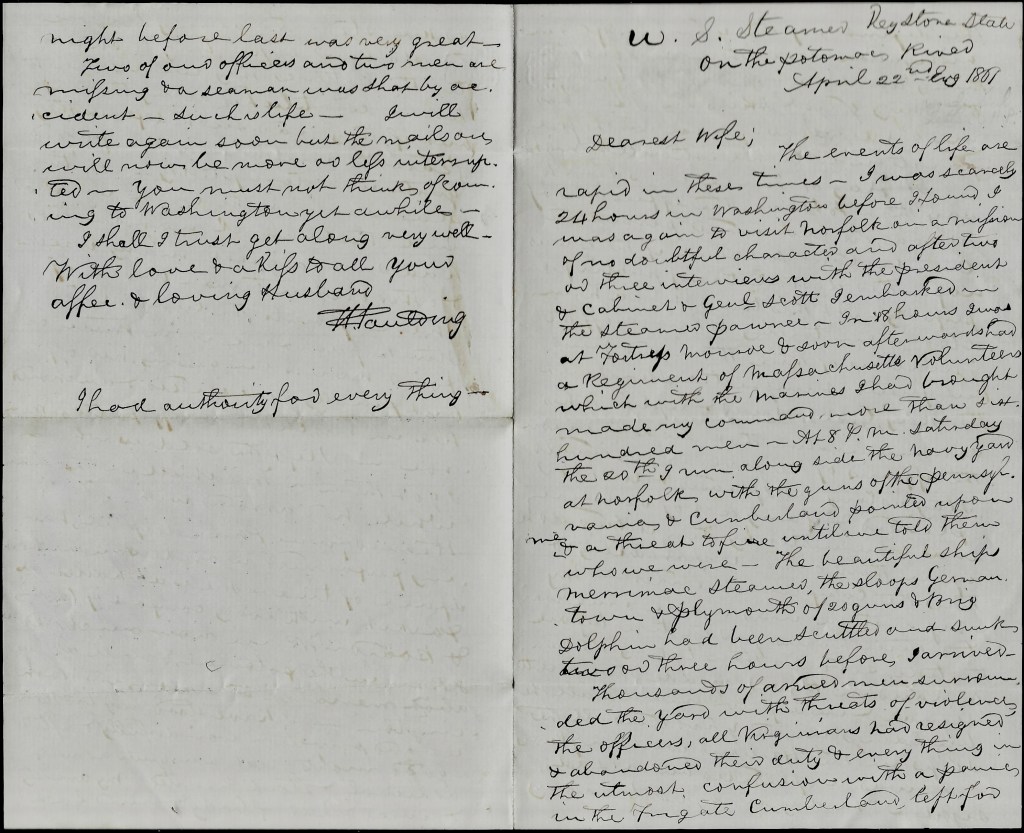
The events of life are rapid in these times. I was scarcely 24 hours in Washington before I found I was again to visit Norfolk on a mission of no doubtful character and after two or three interviews with the President & Cabinet & General Scott, I embarked in the Steamer Pawnee. In 18 hours I was at Fortress Monroe & soon afterwards had a Regiment of [3rd] Massachusetts Volunteers which, with the marines I had brought, made my command more than six hundred men.
At 8 p.m. Saturday the 20th, I run along side the Navy Yard at Norfolk with the guns of the Pennsylvania & Cumberland pointed upon me & a threat to fire until we told them who we were. The beautiful ships Merrimac Steamer, the sloops Germantown & Plymouth of 20 guns & the Brig. Dolphin had been scuttled and sunk two or three hours before I arrived. Thousands of armed men surrounded the Yard with threats of violence. The officers—all Virginians—had resigned & abandoned their duty & everything in the utmost confusion with a panic [and only] the Frigate Cumberland left for the defense of the yard.
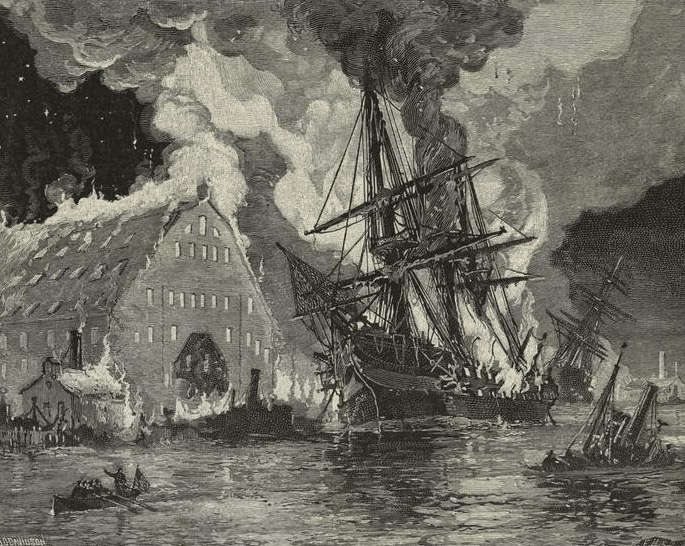
After investigation I saw there was but one thing to be done & that was to burn the Navy Yard & ships. I landed my soldiers & went on with preparation which lasted all the night.
A Flag of Truce was sent [to us] to say that to save the effusion of blood, the General would permit the Cumberland to leave if there was no further destruction of public property. At this time I had a hundred men trying to knock off the trunnions of three thousand guns but found it impracticable. I met the Flag General [George] Blow [of the Virginia Militia] & replied to his communication that I was there upon the affairs of the government, would stay as long as I pleased, & do what I pleased, & if any act of violence was committed by them, it would be upon their own responsibility & thus the conference ended. My preparation was made & we waited three hours for the tide before the tide served, & then, taking the Cumberland in tow, I made the concerted signal & in a few minutes all the buildings in the yard and all the ships in the Harbor were in flames. It was a splendid but a sad sight.

The day was just breaking as we steamed along down the Harbor expecting to encounter the batteries they were said to have established along the shore. But if they had such defenses, they feared to use them as we passed quite uninterruptedly. At two places where the land was near and the channel narrow, they had sunk a great many wrecks & other obstructions. At one of these points, the Cumberland stuck fast & we were three or four hours in getting her off but finally succeeded & anchored her in mid channel off Fortress Monroe.
I left the soldiers where I got them. Woodhull in the meanwhile had arrived with a Tug Steamer from Philadelphia, having performed wonders in a short space of time. She is a Charleston packet with every comfort of Bed & Board. We are now anchored 8 p.m. in the Potomac & will arrive about meridian tomorrow in Washington. I have stood my broken rest and privation wonderfully & after a good nights rest, am quite as well as usual & stout hearted. My anxiety & wear & tear of body & mind night before last was very great.
Two of our officers and two men are missing & a seaman was shot by accident. Such is life. I will write again soon but the mails will now be more or less interrupted. You must not think of coming to Washington yet awhile. I shall I trust get along very well. With love and a kiss to all, your affectionate & loving husband, — H. Paulding
I had authority for everything.

Letter 21
Rough Draft of Report to Secretary of Navy Gideon Welles
April 23rd 1861
In obedience to your order of the 19th Inst., I embarked in the Steamer Pawnee & with one hundred Marines sent on board from Head Quarters, arrived in the afternoon of the following day at Fortress Monroe. Capt. Wright of the Engineer Corps, sent under orders from General Scott, waited upon Col. Dimick & obtained the services of Col. Wardruth’s Regiment of Massachusetts Volunteers and at 8 P.M., we were at the Gosport Navy Yard.
As soon as I communicated with Flag Officer McCauley, I ascertained that all the officers in public employment here, being southern men, had tendered their resignation and abandoned their duty. The workmen on the preceding day had absented themselves from the usual muster & such people as came into the yard clandestinely possessed themselves of the arms belonging to the government. An angry feeling towards the government was known to exist amongst the people of Portsmouth & Norfolk. Many were enrolled in military companies & a force of some two or three thousand men were said to be assembled for the purpose of taking the Navy Yard when preparations were completed.
The powder of the government had been taken from the Magazine near Norfolk & reports were circulated of Batteries being established along the shore approaches to the navy yard. At two different points where the main channel is narrow, at Craven Island and Sewell’s Point, numerous hulks and other obstructions where three of the Light boats having been used for that purpose, & the work was still going on each day rendering the difficulty of the passage greater; the object being to prevent the Men of War at the Navy Yard from leaving the port. The Merrimac steamer of fifty guns had been fully repaired & with the exception of her Battery & stowage of her hold, was ready to put to sea.
When orders were given a few days previous to take her under the shears to place her guns on board, the order was countermanded upon the representation of certain parties, that such a proceeding would certainly in bring on a collision with the people outside of the yard & nothing further was done. The Sloop of War Germantown was along side of the yard completely equipped for sea, requiring nothing more than a crew. The Plymouth sloop, also of twenty guns, was in a similar state of preparation & a few hours would have placed the Dolphin in a condition to have gone to sea.
In carrying out the orders of the Department it was my intention to have placed these vessels in the channel to protect it from further obstruction & at my convenience, take them under the guns of Fortress Monroe or send them to sea as might be most expedient. Greatly to my regret, however, I found that these vessels had all been scuttled about two or three hours before my arrival and were sinking so fast that they could not be saved.
In view of this condition of things, there was but two alternatives presented to my mind. The first to leave the Navy Yard and ships in the hands of people hostile to the government, for it was apparent that the yard could not be held by our available means of defense, or using the power with which I was invested, destroy the public property of every description. I was not long in adopting the latter expedient & when all the arrangements were made and the tide served to remove the Frigate Cumberland, I took her in tow & when she was out of danger from the fire, gave the concerted signal & in a few minutes afterwards, the ships & buildings in the yard were in flames.
The Frigate United States, a rotten hulk of no value & the Plymouth which was sunk so deep that the fire would make no impression upon her were the only vessels not destroyed.
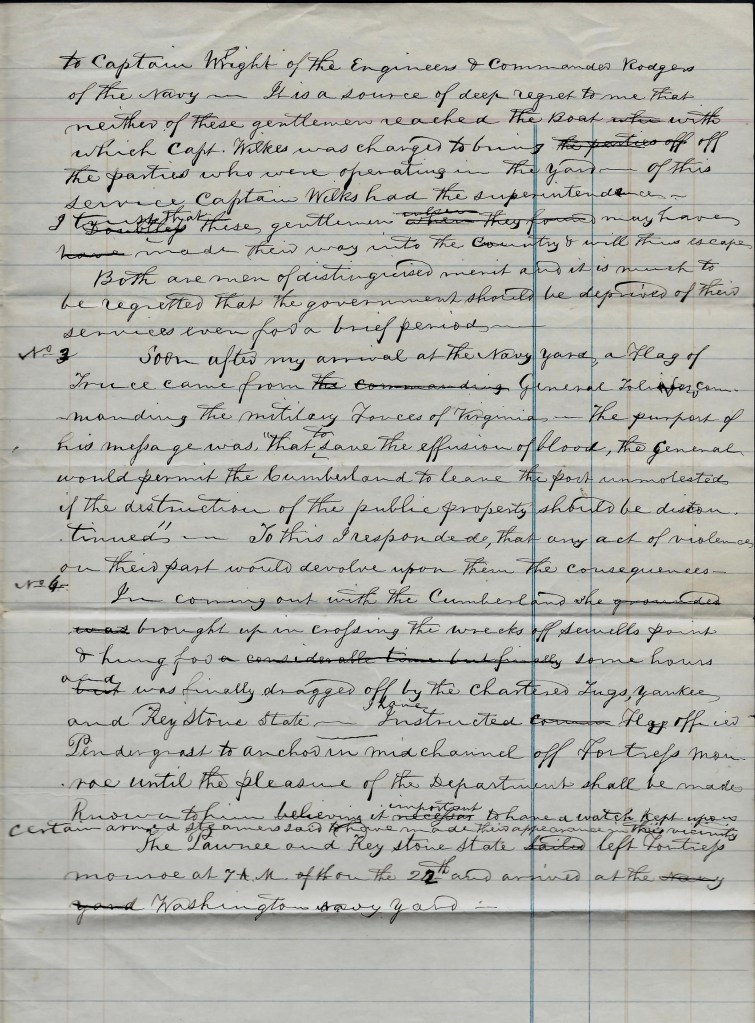
The Dry Dock was mined & this duty was assigned to Captain Wright of the Engineers & Commander Rodgers of the Navy. It is a source of deep regret to me that neither of these gentlemen reached the boat with which Capt. Wilkes was charged to bring off the parties who were operating in the yard. Of this service, Captain Wilkes had the superintendence. I trust that these gentlemen may have made their way into the country & will thus escape. Both are men of distinguished merit and it is much to be regretted that the government should be deprived of their services even for a brief period.
Soon after my arrival at the Navy Yard, a Flag of Truce came from General Taliaferro commanding the military forces of Virginia. The purport of his message was, “that to save the effusion of blood, the General would permit the Cumberland to leave the port unmolested if the destruction of the public property should be discontinued.” To this I responded that any act of violence on their part would devolve upon them the consequences.
In coming out with the Cumberland she brought up in crossing the wrecks off Sewell’s Point & hung for some hours and was finally dragged off by the chartered tugs, Yankee and Keystone State. I have instructed Flag officer Pendergrast to anchor in mid-channel off Fortress Monroe until the pleasure of the Department shall be made known to him, believing it important to have a watch kept upon certain armed steamers said to have made their appearance in this vicinity.
The Pawnee and Keystone State left Fortress Monroe at 7 A.M. on the 22nd and arrived at the Washington Navy Yard.


Letter 22
Washington [City]
April 24th 1861
Dearest wife,
I returned from Norfolk yesterday, having with the Pawnee burnt the building and ships at the Navy Yard there. We send a steamer to New York today for provisions—nothing comes through by mail & has not for four days.
I am tolerably well and leave Woodhulls today to go to Mrs. Stockton’s where she and Miss Mary are very much in want of protection. The city is very quiet under martial law. We have four or five thousand soldiers at last & more are coming but they advance slowly.
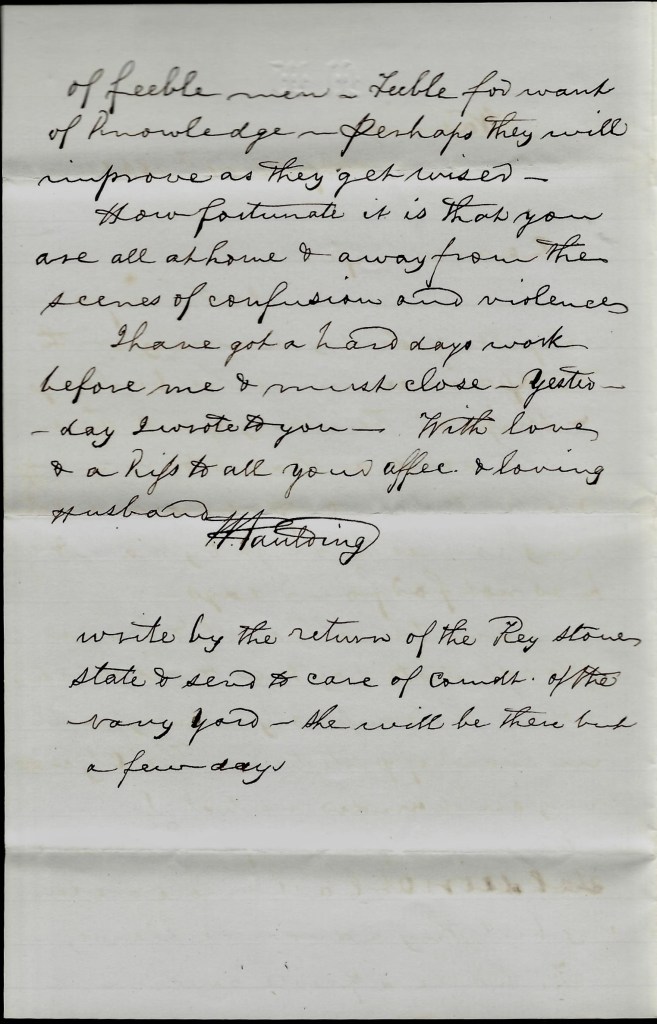
We have a feeble government of feeble men—feeble for want of knowledge—perhaps they will improve as they get wiser. How fortunate it is that you are all at home and away from the scenes of confusion and violence.
I have got a hard days work before me & must close. Yesterday I wrote to you. With love & a kiss to all. Your affectionate and loving husband, — H. Paulding
Write by the return of the Keystone State and send to care of Commandant of the Navy Yard. She will be there but a few days.

Letter 23
Washington
April 25th, 1861
Dearest Wife,
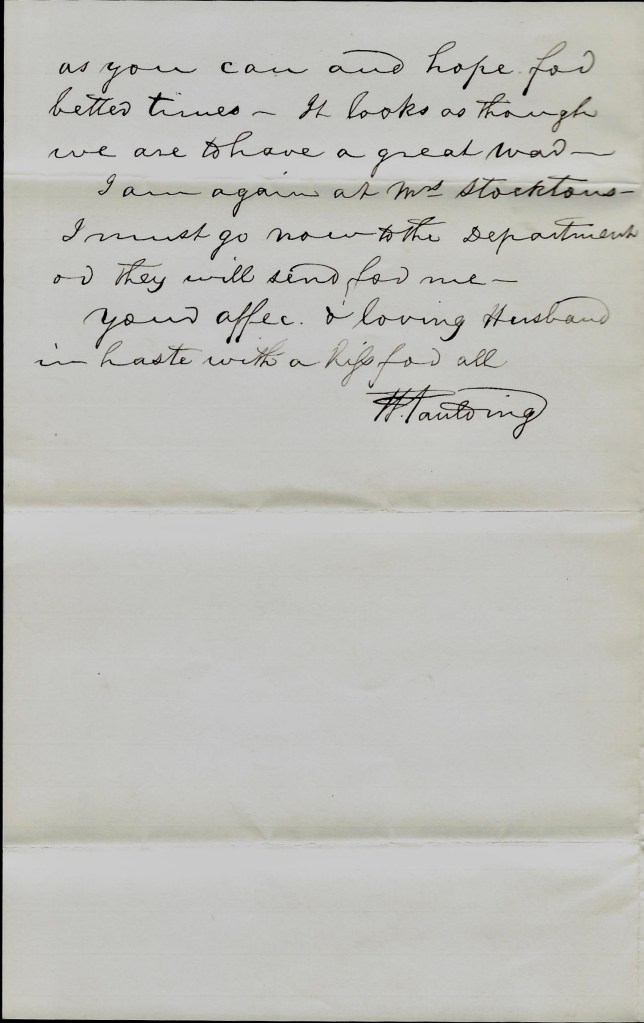
I wrote to you yesterday by the Keystone State & the day before by mail, & today Doctor & Mrs. Edwards leave for New York & thence New Bedford where the surgeon is ordered to rendezvous. The two officers [Wright & Rogers] that were missing have turned up in Norfolk all well. Three or four thousand troops should arrive this morning from New York & there are two or three thousand at Annapolis. Five thousand here. In Baltimore the rail is torn up & the whole line of communication broken. They will a pay for it bye & bye.
I am pretty well over the fatigue of my trip to Norfolk. Make yourselves as comfortable and happy as you can and hope for better times. It looks as though we are to have a great war.
I am again at Mrs. Stockton’s. I must go now to the Department or they will send for me. Your affectionate and loving husband in haste with a kiss for all. — H. Paulding

Letter 24
Washington
April 26th 1861
Dearest Wife,
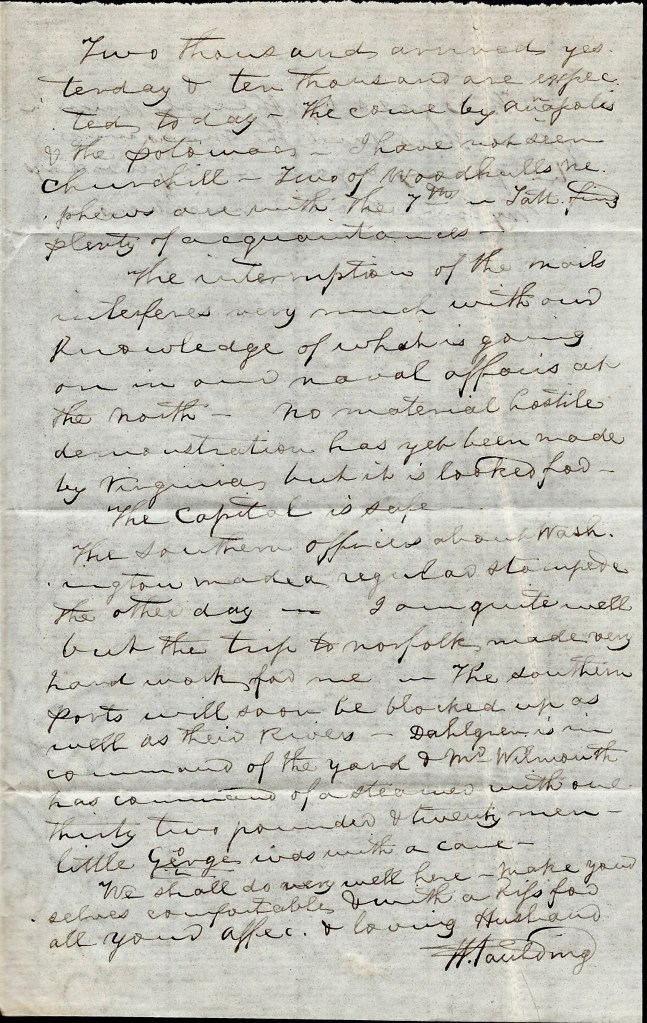
[Or son] Tatt[nall] arrived here yesterday with the 7th Regiment in fine health & spirits. After sleeping a few hours & making his toilette, he looked as fresh and well as ever. Mrs. Stockton & Miss Mary & Doctor Parker who was here were all charmed with him. He was making bridges, laying railroad track & hauling cars all the night before. The Marylanders had broken the locomotive & thrown it off the track & tore up seven miles of the road & broken down the bridges. The Massachusetts Regiment was in part composed of machinists & of the number was a man who had helped to construct the engine. They repaired it, laid the track, made the bridges, & moved on. Two thousand [troops] arrived yesterday & ten thousand are expected today. They come by Annapolis & the Potomac.
I have not seen Churchill. 1 Two of Woodhull’s nephews are with the 7th. Tatt finds plenty of acquaintances.
The interruption of the mails interferes very much with our knowledge of what is going on in our naval affairs at the North. No material hostile demonstration has yet been made by Virginia, but it is looked for.
The Capitol is safe. The southern officers about Washington made a regular stampede the other day. I am quite well but the trip to Norfolk made very hard work for me. The southern ports will soon be blocked up as well as their rivers. Dahlgren is in command of the yard & Mr. Wilmouth has command of a steamer with one thirty-two pounder & twenty men. Little George was with a cane.
We shall do very well here. Make yourselves comfortable & with a kiss for all, your affectionate & loving husband, — H. Paulding
1 1st Lt. Churchill J. Cambreleng, Co. G, 5th New York Infantry. His Captain was Judson Kilpatrick.

Letter 25
This letter was written by 64 year-old Frederick K. Engle (1797-1868) who entered the US Navy as a midshipman in 1814 and was promoted to lieutenant in 1825. He became a captain in 1855 and commanded the flagship Wabash in the late 1850s. At the beginning of the Civil War, he was sent to China to bring home the Hartford and then served in the Union blockading squadron. Fred wrote the letter to his former colleague, 61 year-old Franklin Buchanan, a native of Maryland, who resigned from the US Navy while serving as the commander of the Baltimore Navy Yard and eventually joined the Confederate Navy. He had been in the US Navy for 47 years. He was offered chief command at Hampton Roads and at Mobile, gave him fame but no comfort. For his early success in commanding Merrimac {Virginia), the first ironclad in a naval battle, he received a Resolution of Thanks from the Congress of the Confederate States of America for “unsurpassed gallantry.” He also was promoted in rank which made him the first admiral in the Confederate States Navy. [See Franklin Buchanan—A Study in Divided Loyalties by Oretha D. Swartz, December 1962]
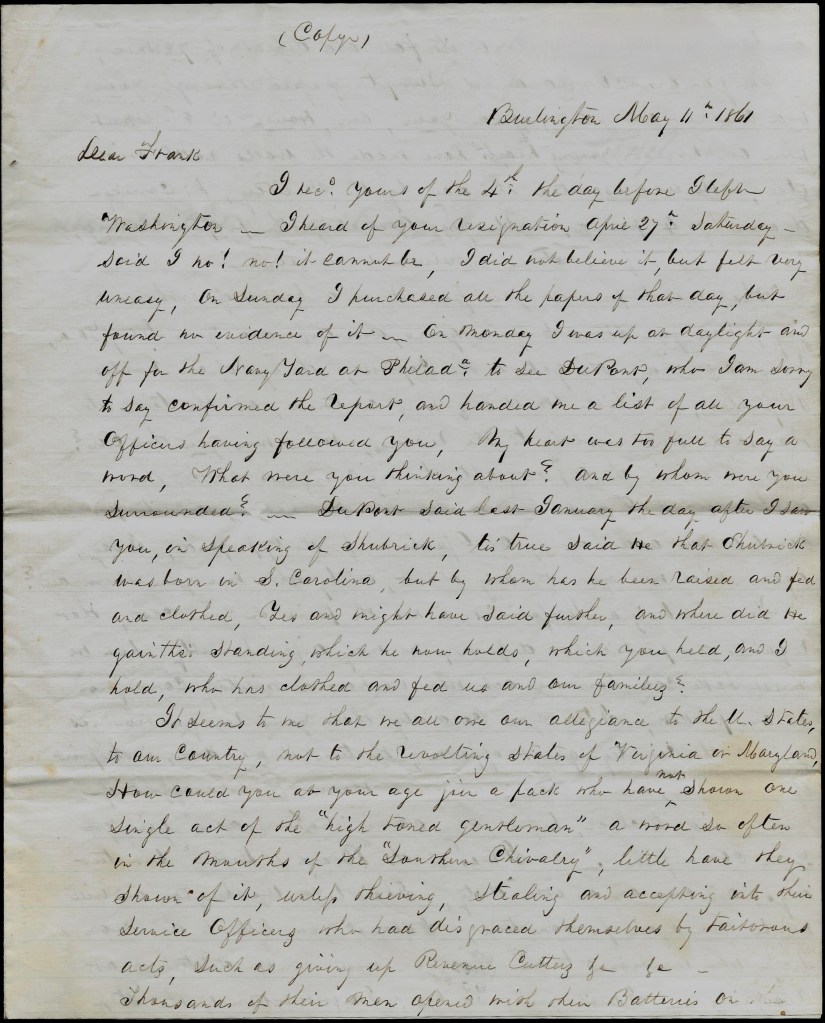
Copy
Burlington
May 11th 1861
Dear Frank
I received yours of the 4th, the day before I left Washington. I heard of your resignation April 27th Saturday. Said I, No! No! It cannot be. I did not believe it, but felt very uneasy. On Sunday I purchased all the papers of that day but found no evidence of it. On Monday I was up at daylight and off for the Navy Yard at Philadelphia to see Dupont, who I am sorry to say confirmed the report and handed me a list of all your officers having followed you. My heart was too full to say a word. What were you thinking about? And by whom were you surrounded?
Dupont said last January the day after I saw you, in speaking of Shubrick: ’tis true, said he, that Shubrick was born in South Carolina, but by whom has be been raised and fed and clothed? Yes, and might have said further, and where did he gaineth standing, which he now holds, which you held, and I hold? Who has clothed and fed us and our families?
It seems to me that we all owe our allegiance to the United States—to our country, not to the revolting states of Virginia or Maryland. How could you, at your age, join a pack who have not shown one single act of the “high toned gentleman”—a word so often in the mouths of the “Southern Chivalry.” Little have they shown of it, unless thieving, stealing and accepting into their service officers who had disgraced themselves by traitorous acts, such as giving up Revenue Cutters, &c., &c. Thousands of their men opened with their batteries on our honored flag and glory in its fall and defeat of 78 men.
The gallant commander of Sumpter [sic] passed through your old Chestnut St. and passed your—our—house in 8th Street where our honest young hearts have made the walls rattle with glee. He was escorted this day by the military, his carriage drawn by 4 proud, noble grey animals, the people cheering, the whole line from street to street uncovered. What was to prevent you from such a burst of enthusiastic joy? had you stood to your guns, and defended your Navy Yard, your command, the gate of the Capitol, the eye of our noble Republic, on which millions were centered. At the time when thousands were rushing to the rescue, where were you then, Sir? Sitting alone in the office, after having resigned rather than defend one of God’s noblest works—our free nation, and its free constitution and laws, an asylum for the oppressed. I say again, what were you thinking about, and by whom were you surrounded?
Your not being a Secessionist is not the point of your case. That requires no particular defense. We may differ honestly, but we must take care how we act when we have a military commission in our pocket. I tell you candidly that your resignation has given to the country great offense. The time it was done, is the point of your case, and to that you must throw the best efforts of your mind to clear, before any administration dare give you your commission.
I was in the “Board of Detail” but two days, and now am on other duty. I have left Washington and will not be there again for some time. I showed your letter to the Hon. Secretary who mentioned to me that you were much distressed at resigning. I wish you goodbye. I regret extremely the step you have taken and am sorry to say, that whether you are in the Navy or not, we never can again meet as friends. — F. Engle
[to] Franklin Buchanan, Esqr.
[Note to Paulding:]
Goodbye Commodore. When you fail in your duty, the sturdy oak will forget to leaf. My kind regards to the Hon, Secretary and to Mr. Berrien. Tomorrow I leave my wife and all my children. Sunday, 11th May, –F. E.
[to] Commodore Paulding


Letter 26

The following letter was penned by Lt. Edward Tatnall Nichols (1823-1886) of Georgia who began his naval service in 1836. He attended the Philadelphia Naval School, 1841-42, after which he passed as a midshipman and served in the Mediterranean Squadron and later the Brazil Squadron and the Pacific Squadron. He served stints at the Pensacola Navy Yard and the Portsmouth Navy Yards and when the Civil War broke out, he remained loyal to the Union and was given command of the steamer USS Winona in the West Gulf Blockading Squadron. He participated in the bombardment of forts Jackson and St. Philip, receiving the latter’s surrender on 28 April 1862. He went on to an illustrious career in the war, receiving his promotion to captain in July 1866. He was married to Caroline E. Bowers (1829-1865) in 1851 in Rhode Island.
Unofficial
U.S. Navy Yard Boston
May 12th 1861
My Dear Sir,
Yours of the 8th Inst. was duly received yesterday and I hasten to reply to it, with many, many thanks for your extreme kindness, and for your approval of my course, trusting that my conduct will ever merit the friendship you so kindly express therein. My mind has been made easy, comparatively, but since I wrote you before, and also since the receipt of your reply, I have been thinking over my position and have come to the conclusion that, on the whole, it would be better for me if I can, to go on a foreign station. The sudden and great increase of force afloat will, I imagine, call every Lieutenant into active service. Even were I to remain at this yard, it would give rise to unpleasant remarks, and I should be constantly feeling that some brother officer was performing the unpleasant duty that by right should devolve upon me, and that under any other circumstances, I should feel myself wanting in self respect, if I did not claim. If I remain at a shore station, there are many of my grade who have returned from sea since myself, who would be compelled to go on active service again, and though they might go willingly enough, yet in their [minds] they must think that even handed justice has not been measured out.
I know that I am performing my legitimate duty to my government where I now am, and my services are important at this time, but when the work now upon our hands is finished, I shall be idling, while those who have been sent to sea, because perhaps, a too kind friend would not send me, will be going through the tedious duty of blockading and perhaps in actual conflict with former messmates and dear friends. I do not think I could feel easy or comfortable under these circumstances.
You may say that by going on a foreign station, I only change the scene of my labors, and undoubtedly this is true, but I am out of the country, and almost beyond the possibility of being sent against my early home and relations. Again, my dear Sir, I may not always have so kind a friend at Washington as yourself, and even were you to remain in your present position, might it not be said that you were showing favoritism to the adopted son of your early friend? I think, my dear Sir, that on the whole, it would be more satisfactory to myself, as well as to my wife, to go abroad, rather than remain at home in a state of uncertainty, and if the Vincennes is really going to Africa, would you be so kind as to have me detailed for her? 1 If you should coincide in my views, would it be encroaching too much upon your kindness, Sir, to ask that I might be detached from this yard sufficiently in advance of the time of reporting for the ship to enable me to pack up and remove my family and provide a home for them during my absence?
As yet we have done nothing towards the spring cleaning &c in our quarters owing to the uncertainty of my situation, and I do not wish to incur any unnecessary expense in purchasing things for the house. I trust, my dear Sir, that you will pardon me for troubling you again, after the very kind reception of my former letter, and your more kind reply to it, attributing to my conduct the proper motive. I know that your time must be very much occupied in official business, giving but little leisure to devote to your friends, but I shall esteem it a great favor if you can send me a few lines in reply. Be pleased, Sir, to present my best respect to Mrs. Paulding.
I remain, dear Sir, most gratefully yours, — E[dward] T. Nichols
[to] Flag Officer H. Paulding, Washington D. C.
1 It may have been the original intent for the USS Vincennes to go to Africa but it was not. After it was recommissioned at the Boston Navy Yard, it was assigned to the Gulf Blockading Squadron.


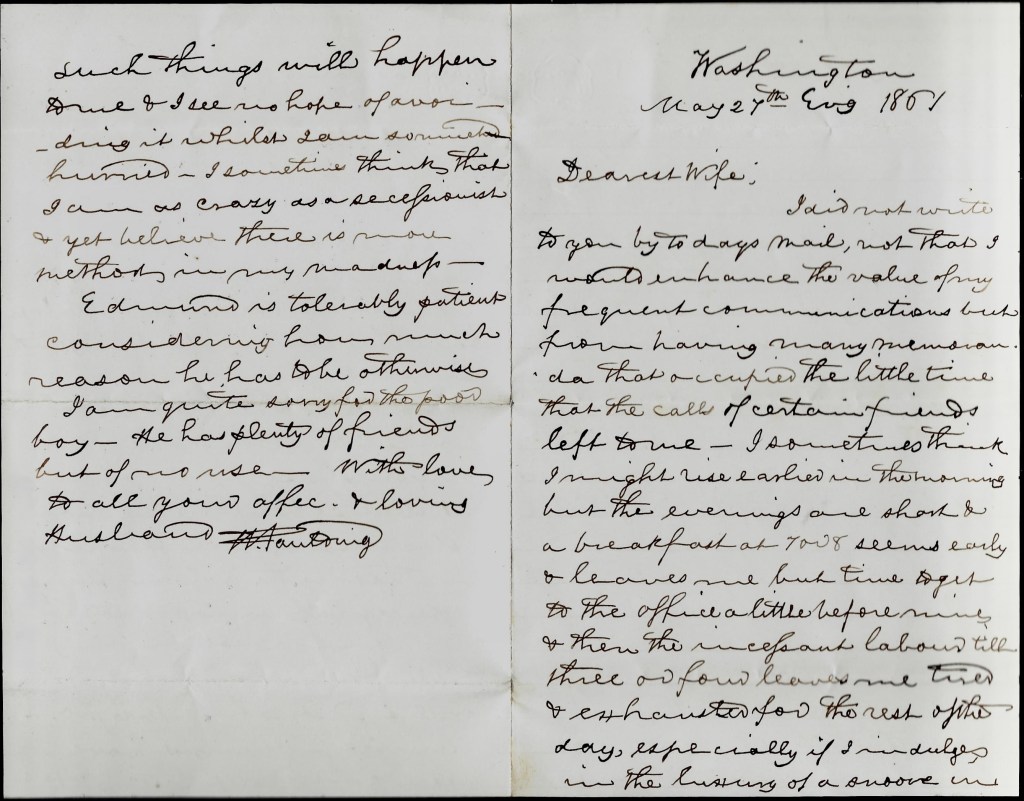
Letter 27
Washington
Evening, May 27th 1861
Dearest Wife,
I did not write to you by today’s mail, not that I would enhance the value of my frequent communications but from having many memoranda that occupied the little time that the calls of certain friends left to me. I sometimes think I might rise earlier in the morning but the evenings are short and a breakfast at 7 or 8 seems early & leaves me but time to get to the office a little before nine and then the incessant labor till three or four leaves me tired and exhausted for the rest of the day—especially if I [do not] indulge in the luxury of a snooze in my chair.
The troops are nearly all out of Washington on the Virginia side—more than twenty thousand entrenched at various points & advanced for some distance from the River. Today it was reported that the Virginians had advanced but I doubt whether it is so. Three men were brought in this morning who had fired upon the advanced pickets & were captured by them. It made quite a crowd around the General’s Quarters. They will probably meet with rough usages.
Church 1 with his Lieutenants uniform spent some time in my office today waiting to see whether one of our steamers was going to Old Point where he wants to join his regiment under Col. [Abram] Duryée. I promised him that when again we met on Long Island, we would “shoulder our crutch & show how fields were won.”
I called on Mrs. Smoot with Capt. Davis this evening after dining with [Paymaster General] Horatio Bridge. Mrs. Welles is here looking for a house to come to one of these days. She soon returns home. Robert Schenck is here. No application or friend of him has been noticed by the administration. He is greatly annoyed and mortified.
I find a note on my table for [our son] Tatt of old date & will send it to him. It is from Annie. It must have been covered up in my papers. Such things will happen to me and I see no hope of avoiding it whilst I am so much hurried. I sometimes think that I am as crazy as a secessionist and yet believe there is more method in my madness.
Edmund is tolerably patient considering how much reason he has to be otherwise. I am quite sorry for the poor boy. He has plenty of friends but of no use. With love to all, your affectionate and loving husband, — H. Paulding
1 1st Lt. Churchill J. Cambreleng, Co. G, 5th New York Infantry

Letter 28
Navy Department
Washington
May 29th 1861
Dearest Wife,
Although I have but little to say, I have come here early and will drop you a few lines. Yesterday Edmund and myself had a very good cup of chocolate and neither of us an appetite for any through the day. This morning I am very feeble although I slept well.
Washington is a very quiet place just now. The soldiers are nearly [all] in Virginia where they are throwing up defensive works. They had shown some impatience in the City for want of employment. Everyday they bring in a few prisoners but I hear of no collision yet. What is to be the plan of operations, I do not know. The Army officers say they want more men and the Government refuse to accept many who are organized in different states & impatient to come. We want more ability in the Cabinet as much as we want soldiers and fear great mistakes will be made from the deficiency.
I have great curiosity to visit the camp but have not time. They penetrate fifteen or twenty miles into Virginia.
My friend Capt. Davis is of great assistance to me and a very pleasant companion. Max[well] Woodhull is as usual. Sometimes very clever and sometimes almost intolerable for his bad temper.
People are beginning to come in and interrupt me so I must close. With love and a kiss for the children, your affectionate and loving husband, — H. Paulding


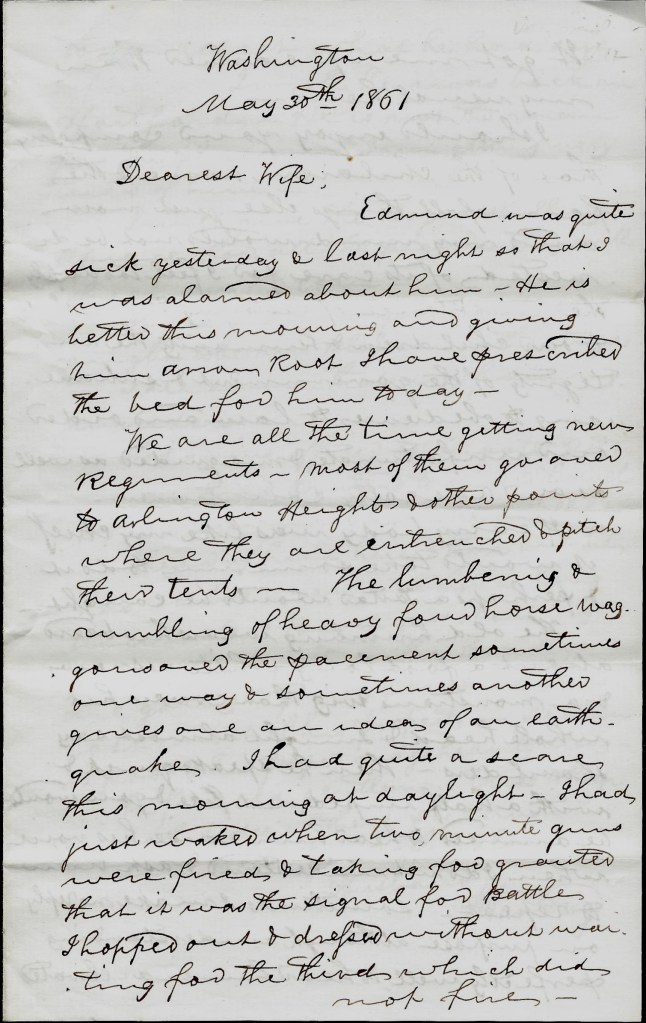
Letter 29
Washington
May 30th 1861
Dearest Wife,
Edmund was quite sick yesterday and last night so that I was almost alarmed about him. He is better this morning and giving him ar___ root. I have prescribed the bed for him today.
We are all the time getting new regiments. Most of them go over to Arlington Heights & other points where they are entrenched & pitch their tents. The lumbering & rumbling of heavy four-horse wagons over the pavement sometimes one way & sometimes another gives one an idea of an earthquake.
I had quite a scare this morning at daylight. I had just waked when two minute guns were fired, & taking for granted that it was the signal for battle, I hopped out & dressed without waiting for the third which did not fire. It got me up earlier than my usual hour.
I should enjoy your company, that of the children, home & the farm of all things else just now, and my mind would not be divested of its care for I feel too deeply the importance of restoring to ourselves, to our children & humanity the integrity of the government & subduing to obedience to law and order our unfortunate & misguided as well as our rascally countrymen.

If everybody was like my chief [Gideon Welles], it would take some time to do it & perhaps a Tartar would be caught. The old humbug wears his beard about a foot long, white as snow & a monstrous wig that covers his whole head & I might almost say shoulders. Then he speaks quick & with a half impediment like & you would be amused to hear him raise his voice when I do not understand & ask him to repeat. Sometimes I make no reply on purpose although understanding perfectly well, to hear him in an elevated tone repeat what he had said before. I wish he was back in Hartford. He is not the man for the place. I am getting very tired of him. 1
I will give the boys a shilling apiece for all the pigeons they will shoot on the corn. It seemed to me your early peas ought to be in blossom by this time. I see some that are from my window.
Today we officer the Frigate Potomac and I intend to order [Levin Mynn] Powell to her. I wonder how he will like it. I hear of him here & there but he has not been near me for a long time. Mrs. Powell goes about bragging of his loyalty.
The Bradleys are going to Piney Point. He has lost most of his property. [William Winston] Seaton is poor & his paper drags heavily along. The fine old gentleman tries to keep on both sides without pleasing either.
Love to all, your affectionate & loving husband, — H. Paulding
1 “Although Lincoln requested Welles to serve in a position under his administration he did not initially make clear which position that was. Welles and many others expected that Lincoln would assign him to the position of Postmaster General due to his former experience as Hartford’s postmaster. Although Welles also had significant experience in the navy his appointment as its Secretary was mainly a political move. Lincoln realized that composition of the newly formed Republican Party was one of various political and geographic backgrounds. As part of a plan to diversify his cabinet Lincoln chose Welles in order to propitiate former Democrats living in New England.” [Source: Connecticut History.org]

Letter 30
Washington [City]
[Thursday] May 30th 1861
Dearest Wife,
After the days work, I took a lunch which means a dinner with Henry Wise of the Navy who married Mr. Everett’s daughter and at half past five, in company with Mr. [Gustavus Vasa] Fox 1—the chief clerk, went with Lewis in the carryall to Alexandria to see the encampment. We met many people who had been there for a drive & it was sundown when we arrived at the Marshall House where the young Col. of the Zouaves [Col. Elmer E. Ellsworth] was shot by [the inn’s proprietor James W.] Jackson. Straggling soldiers with here & there a guard with arms were about the town mixed up with the low people of the town—everybody smoking. There were women and children too.
The place looked as if occupied by enemies although it wore a peaceful & melancholy air in other respects. We drove to the Headquarters of Col. [Charles Pomeroy] Stone, second in command—a poor kind of a place—& there I had a conversation that gave me some information. The camp was a mile & a half off & it was too late to go there. About fifteen miles were the enemy, in double the number of our people, who had their pickets advanced four miles from Alexandria. I said to myself that if I were at the head of the Rebels, it would be bad for the Zouaves. Yet the fellows would fight hard & it is thought from their character would never know when they were whipped. Two regiments of ours were stationed & & encamped at no great distance this side of Alexandria that might by a smart march be available for support.
My impression is that in Virginia the force is exaggerated as well as the character of the troops & that they are afraid of our people, I believe, with [good] reason, for they are young & strong, full of ambition to fight in what they think a good cause, well fed, well clothed, & in good condition & discipline. The great camp is on Arlington to the right where there are many thousands, & so on to the Little Falls & aqueduct.
The Rebels have, I trust, left their assault too long for any a hope of success & soon a large army from here will advance upon Richmond & another from Fortress Monroe. We have now daily from five hundred to thousand men arriving here & such men as no country can excel & do what the South can. It is impossible for them to send as many or as good men to the field or support them when there. If numbers & means of support could decide, our foolish enemies would soon knock under for it is apparent to common sense that this would be on our side as well as every other indication of physical and mental force & to this last test, when it comes, the scoundrels who disturb the peace of the country will find themselves wretchedly deficient in materiel.
With all my hopes, I fear we shall have to smell Jeff Davis’s gun powder & try the temper of his steel, & I trust & hope & believe if he lives through it, that he & many others for the good of the humanity, may be the recipients of a hempen cord as a “tribute to humanity.”
“To this complexion it will come at last” & what a commentary on the most liberal & beautiful system of government in the history of man! Be it so! The sun will shine the more brightly & we may pray & believe that the smiles of Providence will the more benignantly bless the sons & daughters of rational freedom.
My heart is fully engaged in the cause of our dear country. I do not like all the men in power & would change if I could, but with the elements we have, I would drive home the thunderbolt of national power until resistance is swept away & humbled into nothingness. I always think of that infamously impudent threat of Jeff that we should smell southern gunpowder & feel southern steel! The miserable fool & demagogue—as though we did not understand that game as well as traitors, thieves & rascals of the last degree.
In less than six months from this time—mark the date—the steel & gunpowder of the South will be impotent & if not then, soon after the sufferings of the South will claim our compassion, not from any reason why we should be merciful, but for the sake of charity. I say this thinking my views will be carried out in consonance & keeping with the spirit of the North, which to my mind seems brave, generous, & in a high degree patriotic in the true sense of the word conveying the national sentiment of freedom.
Today I saw a Regiment of Germans & the Garibaldi Italians march in review before the President at his mansion. Can anything more be said than this. They are the victims of European Despotism come here for liberty & in their exile here in free America alas! must fight for freedom. Alas! Alas! What a page for the historians in the time to come.
But for the blessed cause of my country, I could not be tempted to remain here a willing victim to the cares of official life & in this good services may remain yet for a time but not, my dear wife, without the hope of soon seeing you at our happy home. Edmund is better. He had Doctor Riley today. I am tired of such sick people & don’t think much of him for being sick where he has not his own household to take care of him. Good night. I have written a long scrawl and my eyes and head may pay for it. I had quite a long and friendly letter from my friend Mr. Doolittle the other day. Wrote him what I think will be a satisfactory reply.
Morning 31st. I eat some strawberries yesterday and last night whilst writing suffered intense pain in the stomach. It passed off by eleven and I slept well. With all my love to all, your affectionate & loving husband, — H. Paulding
1 “Gustavus V. Fox was born in Saugus, Massachusetts, on 13 June 1821. He entered the Navy as a midshipman in 1838; was advanced to passed midshipman, 1844; and to lieutenant, 1852. The Dictionary of American Biography is in error in stating that he graduated from the Naval Academy. In addition to duty in cruising warships, he served with the Coast Survey and in the Merchant Marine as first officer of the Collins transatlantic liner Baltic in 1851 and had command of U. S. Mail steamers running between New York, New Orleans, and Panama from 1853 to 1856. He thereby began his civilian career in the Navy Department with more experience in ocean-going steamships than most officers in the Navy, and he did not hesitate to let them know it. Fox never held a naval command, however, the honorary title “Captain” being derived from his merchant marine days. He had resigned in 1856, married, and accepted a position as business agent for the Bay States Mills of Lowell, Massachusetts. Another resident of Lowell, the controversial Benjamin F. Butler was a schoolmate and lifelong friend, which may be a reason for Butler’s participation in so many Civil War joint operations. Fox married Virginia, daughter of Levi Woodbury of New Hampshire, a former Secretary of the Navy and Associate Justice of the Supreme Court. Another Woodbury daughter was married to Montgomery Blair, of the politically powerful Blair family, and the two men were close friends. Blair became Postmaster General in Lincoln’s cabinet, and through him Fox was given the chance to play a major part in the abortive attempt to relieve Fort Sumter, off Charleston, S. C., in April 1861.” [Source: “Captain Fox—He is the Navy Department” by Rear Admiral John D. Hayes, 1865]
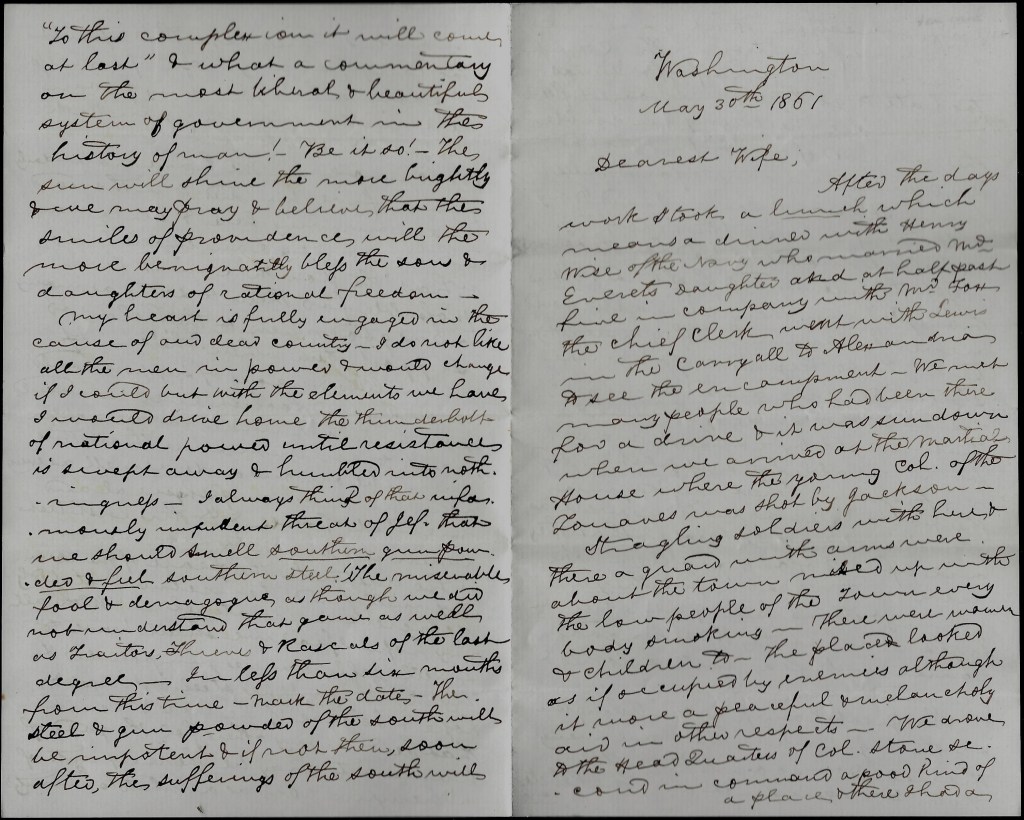
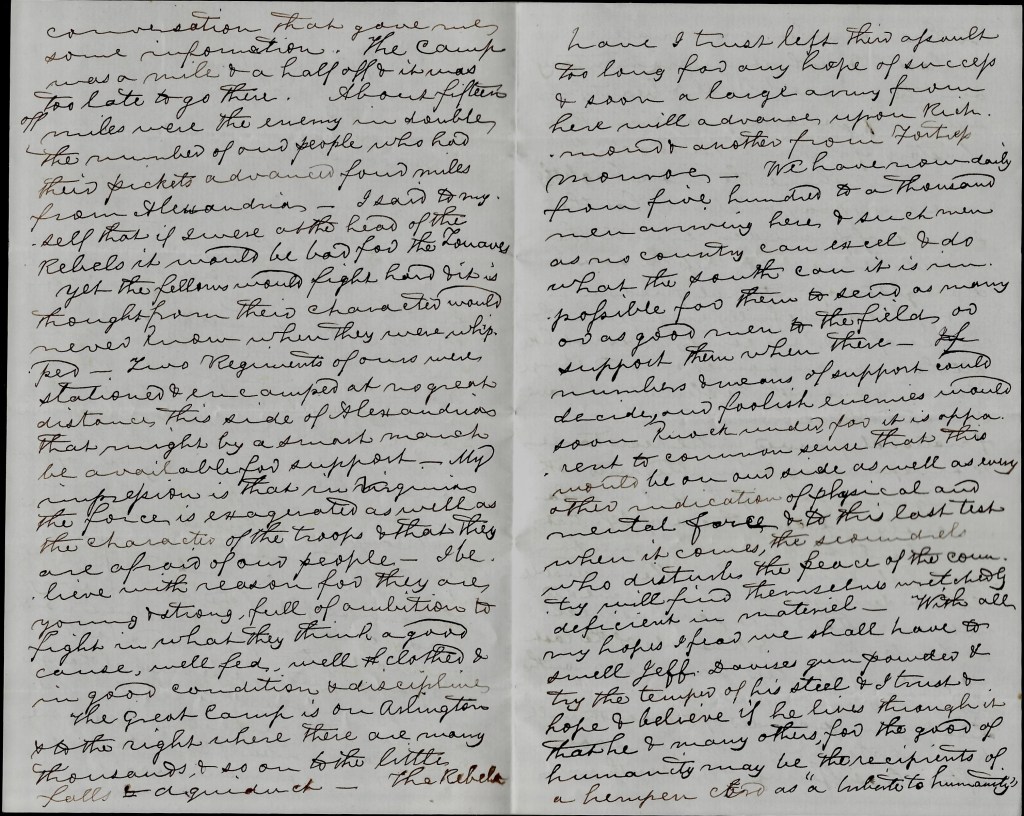

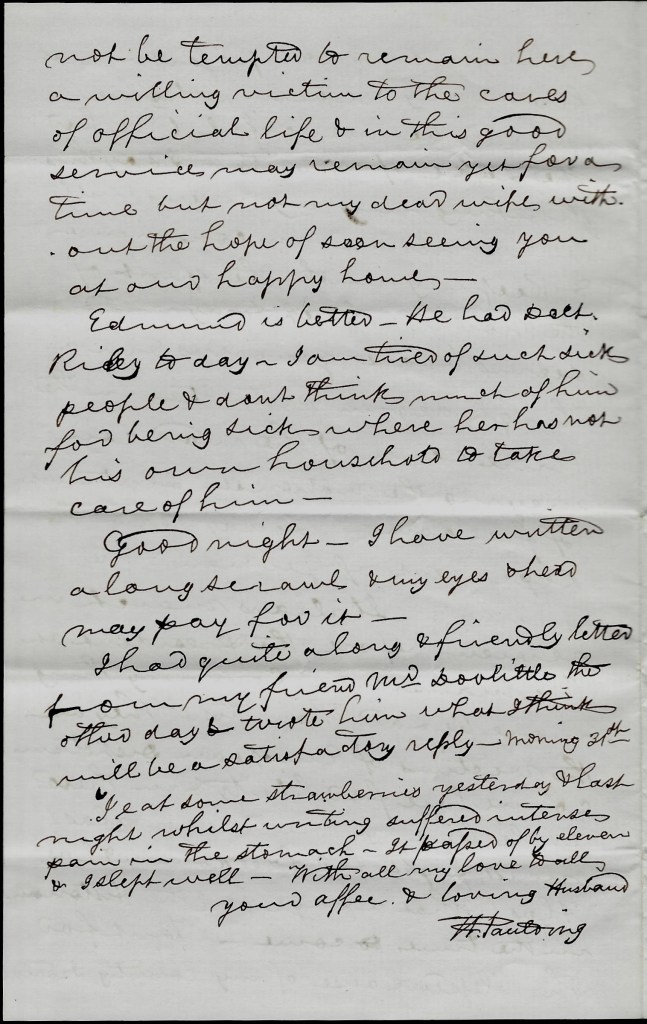
Letter 31
Navy Department
Washington
June 2nd 1861
Dearest Wife,
James came yesterday morning and took me by surprise, G. D. Morgan in company. I hope we may find something for them to do that will pay the expense of travel. James has it in view to establish a line from New York to Fortress Monroe, the squadron and troops. his part of the capital being the passport that my letters will give him. It is probable that it will succeed if there is not too much competition. Lafe Bartlett came to the house this morning with an omnibus load & took James to the Navy Yard where the 71st [New York State Militia] is quartered.
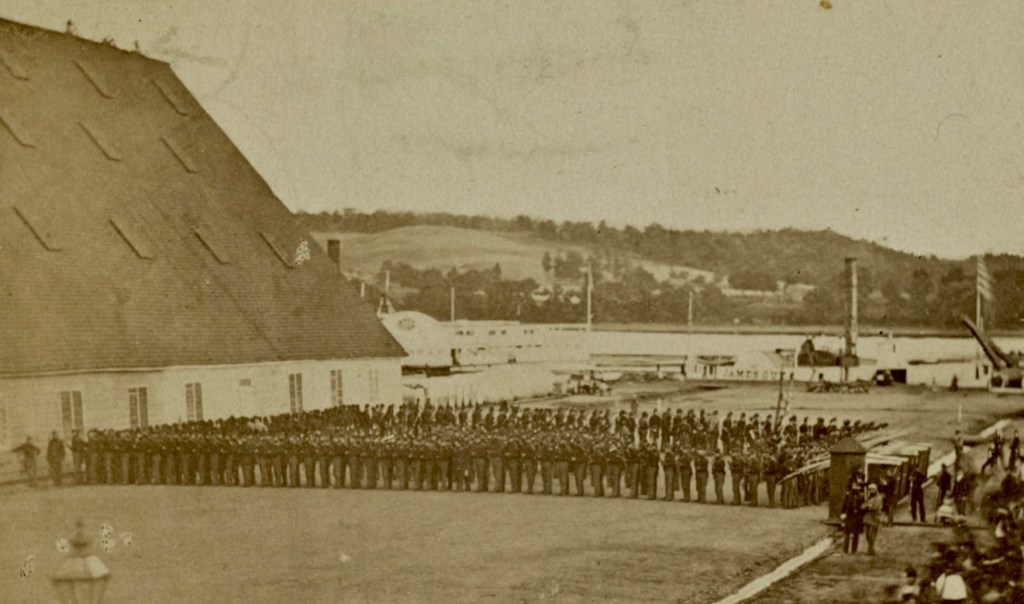
You will see by the papers that the war has commenced. Our little flotilla on the Potomac has been firing upon the Batteries recently established on the shore. Nobody hurt although the vessels [Freeborn and Pawnee] were struck several times by rifle cannon shot. 1
Two nights ago sixty Dragoons were reconnoitering about Fairfax Court House fifteen miles from Arlington when they were fired upon by a force there consisting of near three hundred men. The Dragoons charged & dashed through the enemy three times, killing it is said 27 & bringing with them five prisoners—the sesesh having retreated to the Court House where they [can]not be approached. One of the prisoners is a nephew of Mrs. Doctor Washington. Both the officers of the Dragoons had their horses killed under them & one of them is said to be badly wounded besides three dragoons missing. 2
Washington is just now the most quiet place anywhere to be found. It is only when a regiment arrives & is marching in review by the President’s mansion or when they are leaving for Virginia or Rebel prisoners are brought to the headquarters of General Mansfield—which is just opposite to the Department—that we have much of the stir of war. The ships of the Navy will all be officered tomorrow & nearly every officer on the Register assigned to duty & then in ten days they should be all at sea.
I shall now soon be on my way for a visit home for a few days & then I fear the pleasant faces, the green fields, & all that makes life pleasant will tempt me to me remain & render my return doubly repugnant.
Your bundle—or rather mine—came safely to hand by the Keystone State. I thank you for it. As yet I have not seen the contents of the bundle but will as soon as I go to the house again. It is now a long time since I have heard from Mrs. Stockton or her sister. I hope you will be well prepared to receive them before they make you a visit. With love to all, your affectionate and loving husband, — H. Paulding
P. S. I sent Ned Bush’s nephew an appointment as soon as I heard of him.
1 See Battle of Aquia Creek. “By late April, Confederates began to construct batteries along the Virginia side of the Potomac River. The first of these was at the confluence of Aquia Creek and the Potomac River. In the process of seizing the land, Confederates captured several small ships. On May 29, 1861, Union ships Freeborn and Pawnee sparked an artillery duel. After four hours, the Confederate volunteers abandoned their position.” [National Park Service]
2 See Battle of Fairfax Court House (1861). “Neither the reports by the participants nor the contemporary accounts in the newspapers about this battle were entirely accurate since both sides inflated the number of men on the other side and the number of casualties their force inflicted on the other side, at least initially. Because the war had just begun and no major battles had been fought, any sort of battle was given undue attention at this stage of the war.“
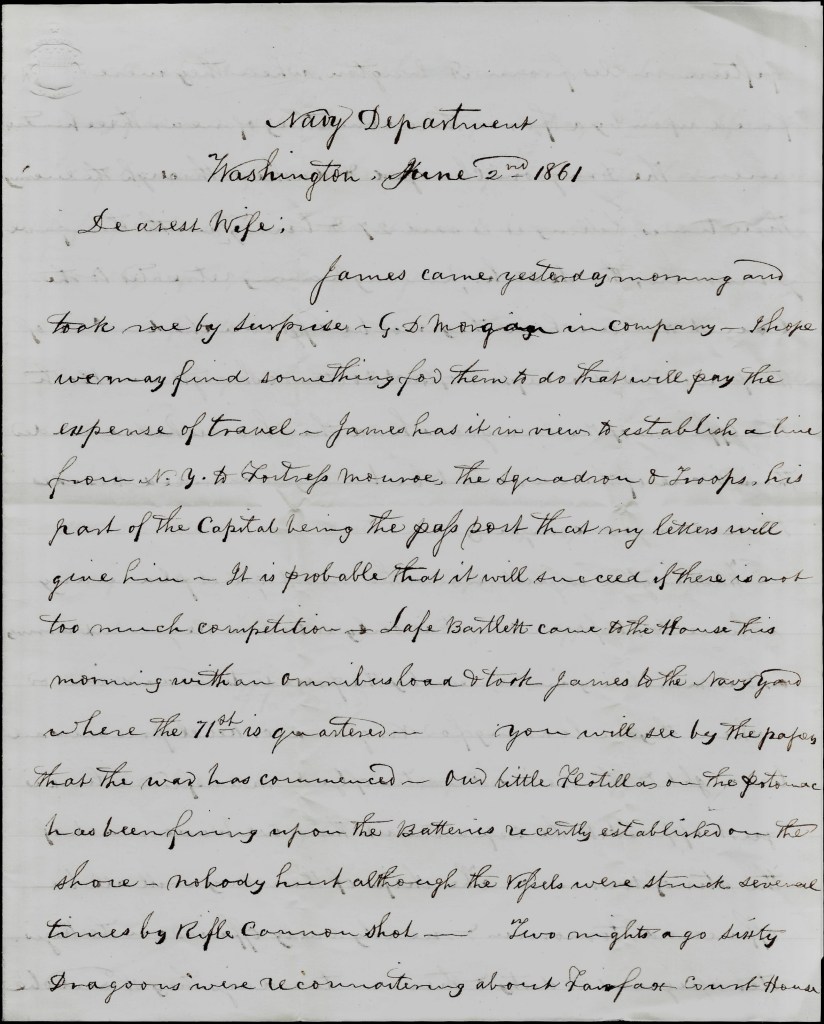

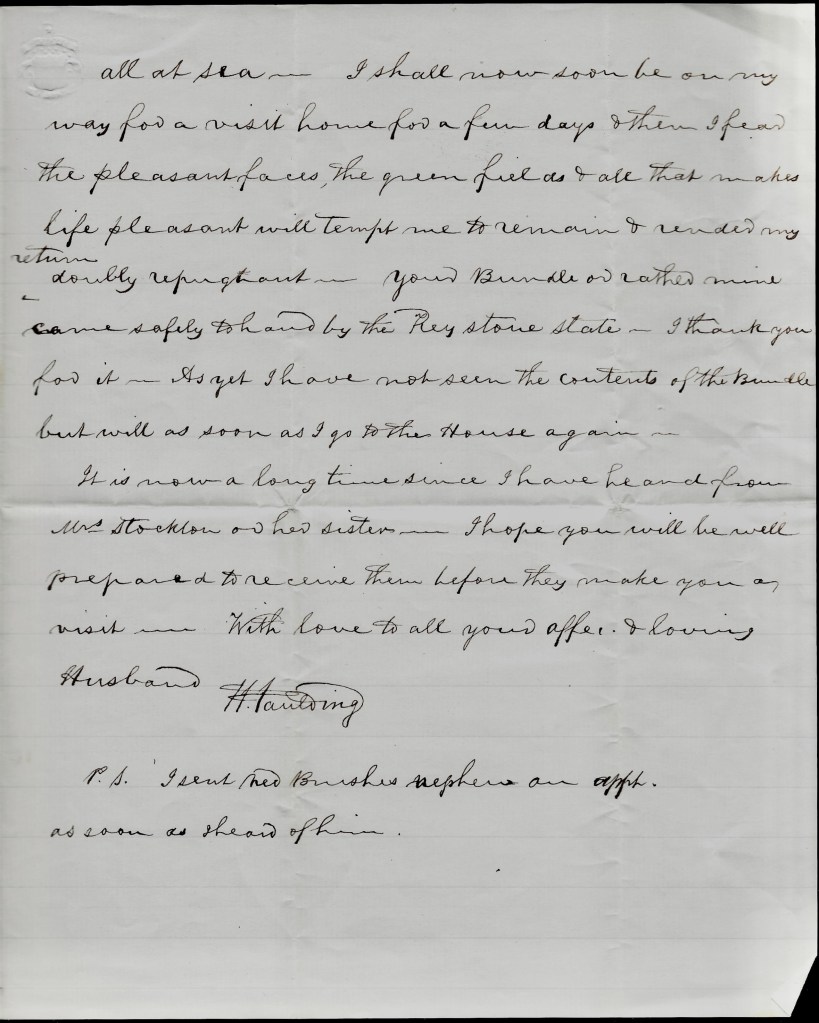
Letter 32
Navy Department
Washington
Monday morning, June 3rd 1861
Dearest wife,
In the midst of business I drop you a hurried line. I think I shall be at home the last of the week. I am offered a Second Lieutenancy of Cavalry for Tatt. 1 Think whether he shall take it. James will leave for Old Point in a day or two. Charles McClure has made a contract to furnish horses to the government & feels greatly indebted for my recommendation. I am very well.
Edmund is going away from here on my recommendation. Have no more time.
Love to all. Your affectionate and loving husband, — H. Paulding
1 Hiram’s son, Tattnall Paulding (1840-1907), received his commission as a 2nd Lieutenant on 14 May 1861 and was appointed to the 3rd US Cavalry. See: 1863: Tattnall Paulding to Hiram Paulding.
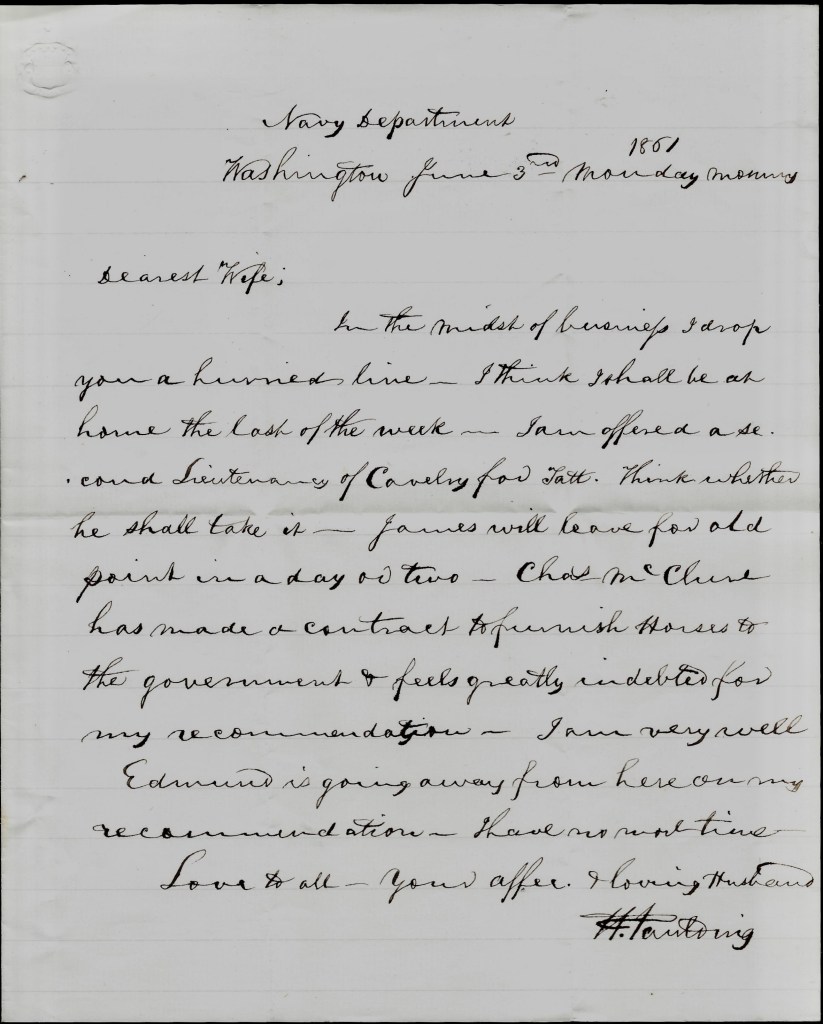
Letter 33
Navy Department
Washington
June 4th [1861]
Dearest Wife,
I had the pleasure to hear from you yesterday & wrote you a few lines. This morning it was my happiness to get your letter of the 2nd. I am glad the no horn [?] has come forward so early. I feared it would have been later. Mike is a gentleman to have behaved so well & McIntyre a humbug so far to have imposed his infirmities upon us. I fear the farm will get behind hand & that our farms will cost more than he is worth. Mike may raise the calf if you like. I am glad the girls are working for the soldiers. We cannot do too much for them. The poor fellows now want their clothes, shirts, and trousers. We with others should give what we can, and do what we can.
There has been a collision at Grafton between eastern and western Virginians. The secessioners were routed with loss. Jeff Davis is in Richmond & they say is bound to make a move. We may have a fight on the other side of the river before long. Our people are bound to give them a terrible thrashing.
I have not got much to write about. I shall hold myself responsible to Hime for all the good work he performs. It is very warm here. I have got Ed offers for my clerk at twelve hundred dollars a year.
James talks of going to Fortress Monroe but does not say when. I want to get clear of my guests and shut up the house. It is expensive and troublesome. In great haste. Powell has just come in. So has General [James Watson]Webb. 1 He is going as minister to Brazil.
Your affectionate and loving husband, — H. Paulding
1 “General” James Watson Webb (1802-1884) was a New York politician whom Lincoln appointed as a minister to Turkey, but even though it had been confirmed by the United States Senate, he declined. According to biographer Glyndon Van Deusen, “Webb, an inveterate beggar for office, wanted a diplomatic appointment that would be lucrative.” Shortly afterward, Webb was appointed minister to Brazil and served in that position for eight years, resigning when he was accused of extorting a large sum of money from the Brazilian government. He tried to sever US ties with the country without Washington’s knowledge. At Paris in 1864, Webb claimed he was instrumental to negotiating a secret treaty with Emperor Napoleon III for the removal of French troops from Mexico.
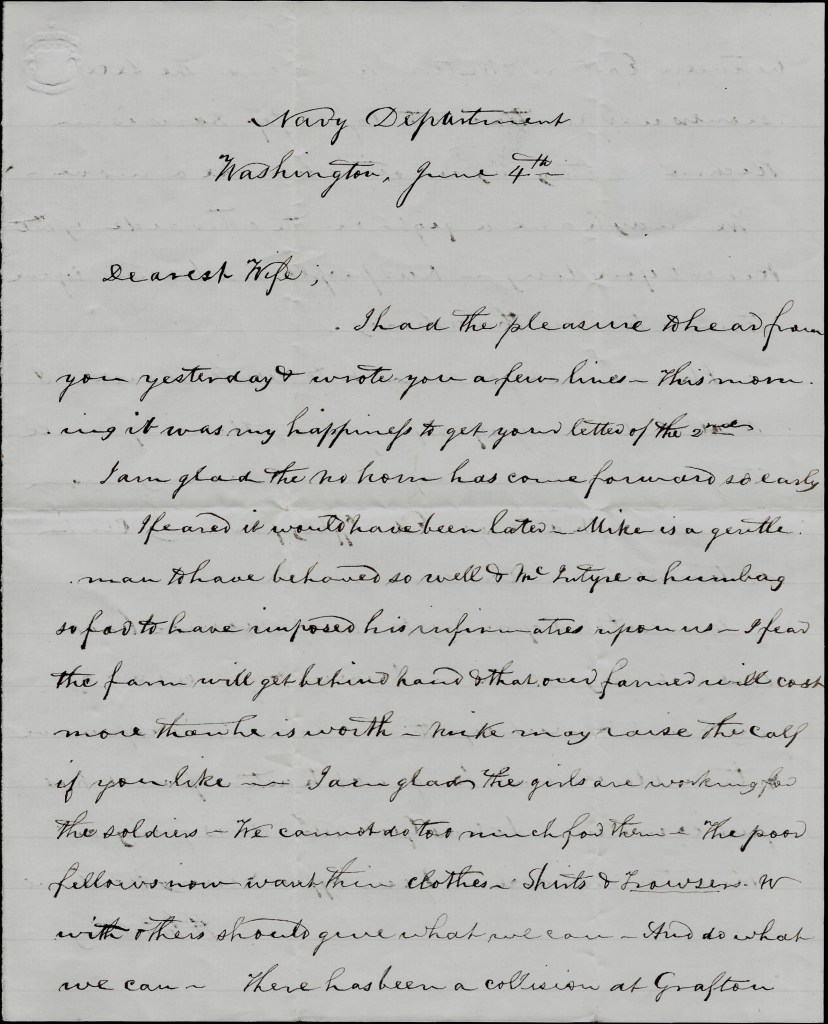

Letter 34
Washington
Evening, June 4th 1861
Dearest wife,
James dined at the Navy Yard and after a plain repast with Edmund, I dozed [?] and kept him from going out in the rain as he is complaining of debility & looking feeble. I had a note yesterday and a visit at the office today from our friend Mrs. Noble who has set herself to work to get Mat in office at the Treasury where there is a vacant desk in her Father’s office. I wrote a letter for Mat. He failed in New York and is very poor. Adair is in the ranks of secession.
We have news today that the Rebels are within eight or ten miles of our people in very large force and as Jeff Davis is in Richmond and Toombs and Wigfall is also there making speeches to inspirit their men, with all else considered the inference here is that they design an assault & that it cannot long be deferred. Let it come, we say here, and the sooner the better. I am just…
Wednesday 12:30. [Levin Mynn] Powell came & now I have no time. James goes home today. Your affectionate and loving husband, — H. Paulding


Letter 35
Washington
Evening, June 5th 1861
Dearest Wife,
I made a brief conclusion to my letter last evening intended to have been a more ample communication when I commenced it. [Levin Mynn] Powell stayed until after midnight telling James and me about his loyalty & of Virginia. Then James kept me up to the small hours of the night & I have been half sick all day. Now at 9 p.m. and after he has just left, after calling upon my neighbor Capt. Woodberry’s family and Doct. Parker’s, and getting a cup of tea at home, he has gone off to Willard’s [Hotel] asking me to wait for him till eleven which I have positively refused, arranging to have him let in the house. He did not leave today because Lafe was sick but goes tomorrow morning. Perhaps Edmund will go too. I should have told him over and again there was no use in his remaining & he had better go. I cannot afford to have such people to get sick here. I think whilst I am in the house, it is better to be alone but think when I return from my visit home, I will find some other location.
I believe there is nothing new about the Capitol. Everything seems quiet. Some of the officers of the army seem to think we ought to have more men. I thought we had plenty but really know not how many there are or ought to be. If I had my way, there should be twice as many as could by possibility be necessary.
I have not yet been able to fix the time of my leaving. We meet for counsel—the Bureau—every day for two or three hours and have not yet disposed of certain important matters and as I am the secretary and spokesman and have the indication of measures to be carried, I cannot leave whilst there is anything under consideration.
[James Watson] Webb was in my office yesterday and today and goes Minister to Brazil. Schenck is Brigadier General to be employed on the western waters. We shall have a naval force & a great army there. My aide Woodhull will join that part of our naval operations and his family probably go to live in Ohio.
I think James will accomplish something by coming & yet that remains to be seen. You know how much happiness it would give me to be instrumental in whatever might conduce to his fortune or happiness. I am now without waiting for his return going to bed as soon as I close and with my prayers and the best wish of my head with love to all, your affectionate & loving husband, — H. Paulding
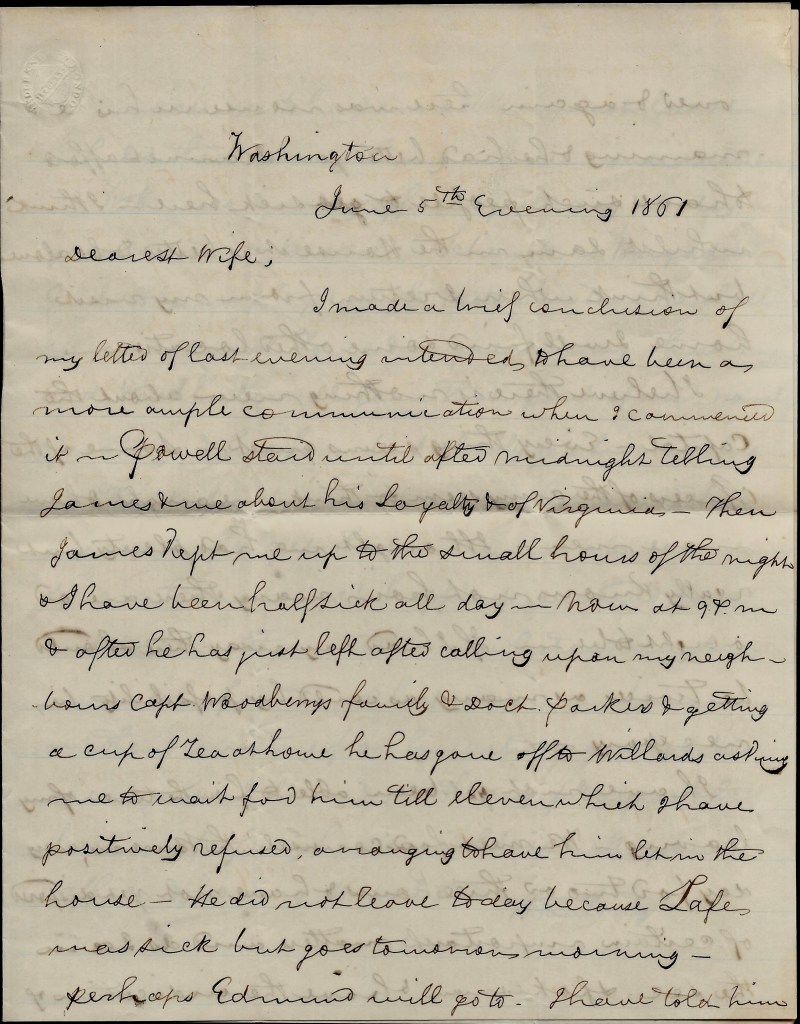


Letter 36
Mrs. Stockton’s
Washington
June 28th, 1861
Dearest Wife,
It is 11 p.m. I arrived at six thirty and called on the [Navy] Secretary as soon as I had washed the dust which was a great nuisance as well as the heat. I was in Philadelphia last night at the Continental Hotel where I occupied the room of the Prince of Wales. This morning I visited the [Navy] Yard.
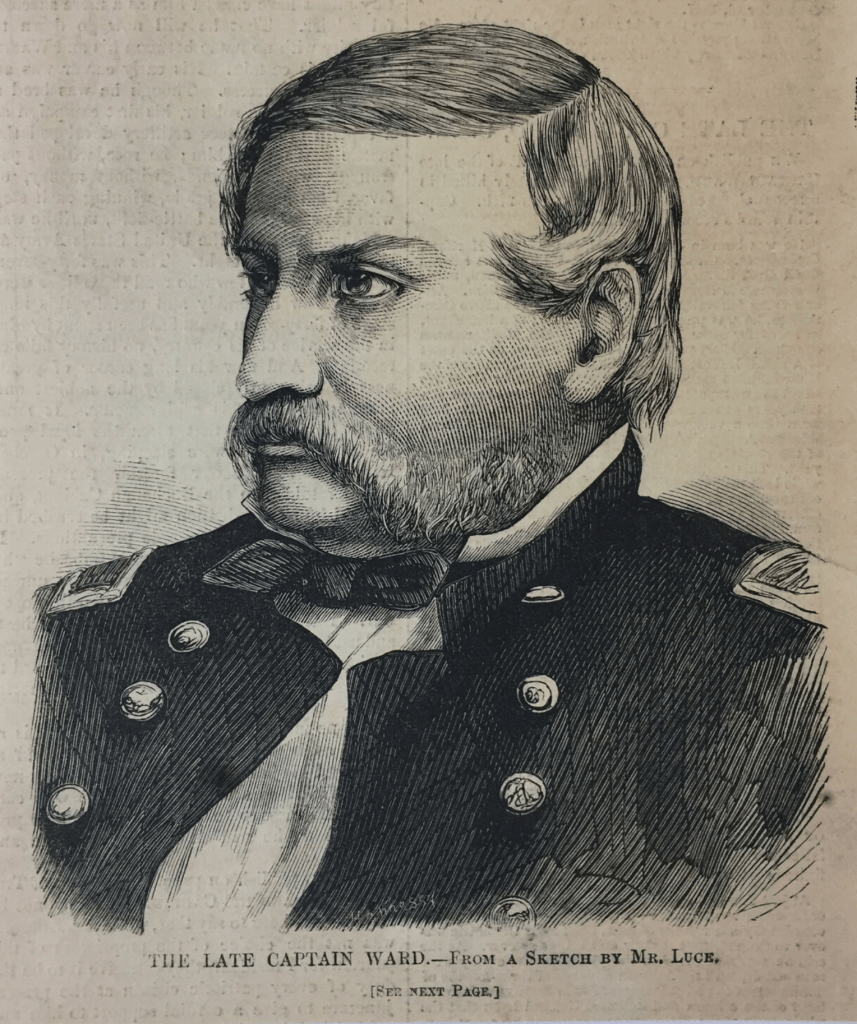
Before reaching Washington I had the sad information that Capt. [James H.] Ward of the Freeborn was killed yesterday at “Mathias Point” by a musket shot whilst directing his gun to defend his men, then on shore, against a large body of infantry that came down upon them suddenly. The wonder is that more casualties did not occur. Much gallantry was displayed by the seamen & Lieut. [James C.] Chaplin swam to the boat under a heavy fire with a wounded seaman on his shoulders. This is indeed true manhood. It is a charming exhibition of a brave & chivalrous spirit & whilst I live, I will not lose sight of him.
Everything in and about the house I found in perfect condition & Teresa, ready to open the door. Tell Mrs. Stockton all the plants were put out the day after I left except the lemon which will go tomorrow. The grass is cut and walks in good condition.
I called on Mrs. Woodbury, my next door neighbor whose husband is in the camp and on the post m. Gen. Lady and have read the dispatches in regard to my lamented brother officer, so you will see I have not been idle. Edmund was sick here in the house for a week after I left & never has written me a line! How strange it is? There is someone at my bell and I have called to Teresa not to let them in. She came to say that a gentleman wants to see some documents about Mathias Point. Thought was Mr. Fox who gave them to me to read & sent for the gentleman. He came to my room and was a stranger. I met him at the door with, “Who are you, sir, and what so you want?” “I am Mr. Hill of the Tribune” and wanted to see the documents, &c. I said to him you cannot see them and it is beyond the hour when a stranger should disturb a gentleman. He begged my pardon and left but I suppose I shall pay for it. It was only a little after ten. I thought it was later. He had no business to ring the bell as the lights were out below. He won’t come again.
I am very well but tired & will soon retire. All is quiet in Washington. It is not known what are the enemy’s plans & thoughts. General Scott has none. “Nons verons” [not knowing]
Love to all, your affectionate and loving husband, — H. Paulding


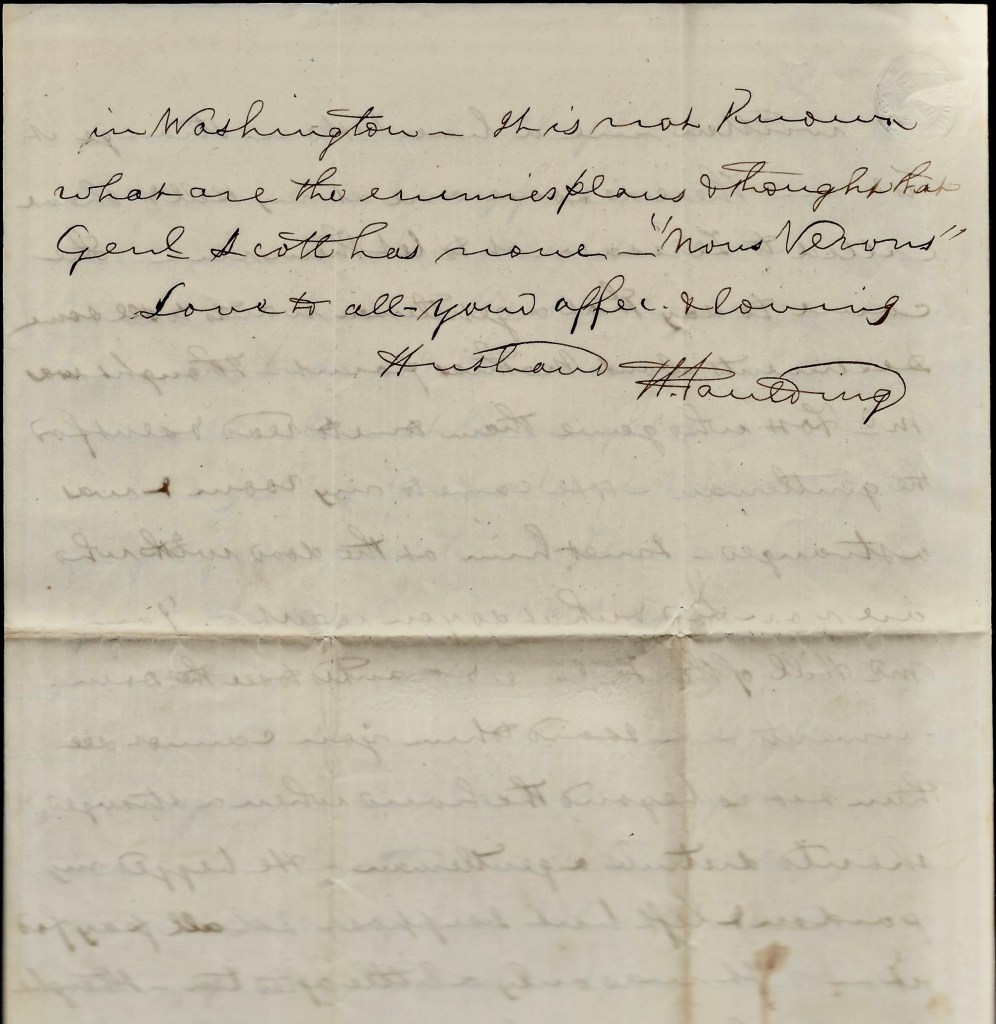
Letter 37
At Home
Washington
Sunday, June 30th, 1861
Dearest Wife,
It is two p.m. and I have just returned from my labors at the Department. It is raining steadily having commenced some hours since. It looks as though it might extend to Long Island and whilst it will give everything a start, it may clear so as to make good hay making tomorrow. Davis was with me this morning but neither the Secretary [Welles] nor Chief Clerk [Fox] appeared.
My letters & papers have been accumulating so long that there seems no end to them. Many have to be answered or acted upon & if I had the power of the President, I might provide offices for all the applicants. Amongst others, our friend Eben Jackson wants to know how he is to get his dividends from Savanna & Augusta! How can I tell? Jo. Tattnall for talking secession & drinking the health of Jeff Davis has been dismissed & writes to know what he shall do! Commodore [Joseph] Smith says Jo. [Tattnall] will commit suicide but I don’t believe it. What can I do for such a miserable? From what I learn it is evident that John Tattnall intends to resign when he gets home. They are anxious to have his prize money paid in advance of his coming.
Edmond came to the office yesterday. He has hard work in paying. His complaint he says is chronic. Jonathan is with him. His sureties are from Minnesota, Rice and others. Woodhull out of friendship to me volunteered for five thousand separately but would not sign the general bond for 40,000. I was sorry he had proposed at all but he was fortunately not taken in.
George Kellogg came yesterday with his machinist friends & called this morning to say he was going to the Virginia side with his friends. He will leave tomorrow. I introduced him & his friends to the Chief of the Bureau but it is yet doubtful whether they will get work to do. J. L. Paulding & Co. has got shot & shell to make to the amount of 6,000 and are much encouraged.
Tell me the name of young Lockwood who came for some appointment. I may find a place for him but don’t say so Ask Bryer if you see him the name of an older brother of Fred Jones. He spoke to me—seemed intelligent. When I can do good, I would like to & it is always gratifying in our own community.
It is said the Rebels are check mated & will soon have to retire. Our people are coming fast—about seven thousand arrived yesterday. Many take the place of the three-months men whose times expire. It is said the men at Old Point will not move whilst Pierce remains & the fool does not go. Sumner & Wilson of the Senate sustain him against the positive wish of Gen. Scott that he should go. A dashing movement will soon be on foot. I cannot tell you what it is. It meets the views I have entertained & urged. The Rebels are scared. They would gladly be rid of their movement. The women say they will fight when the men are killed & the men say they will not surrender. This is the talk & what is written from the South. Be it, so say I. If the men yield to force, it is my belief the women will yield to caresses. What say you with your knowledge of the sex to that? It is the only argument I can use if I reply. Mohammed was a great prophet and he believed in this. There is such absurdity in woman’s talking about fighting in such a cause that I cannot help speaking in derision to all such clap trap.
Capt. Wards remains went yesterday escorted by a marine guard & Captain Ringgold of the navy. He was killed whilst pointing his gun— a glorious death. I thought it would be so. He was quite too regardless of consequences or danger. I told him I feared what has come to pass & offered him a better command but he preferred to remain for a time. Thom. Craven is ordered in his place with a larger Flotilla as soon as it can be prepared. The Potomac must be guarded & kept free.
July 1st 1861—no news & no time to write more. Love to all. Your affectionate and loving husband, — H. Paulding

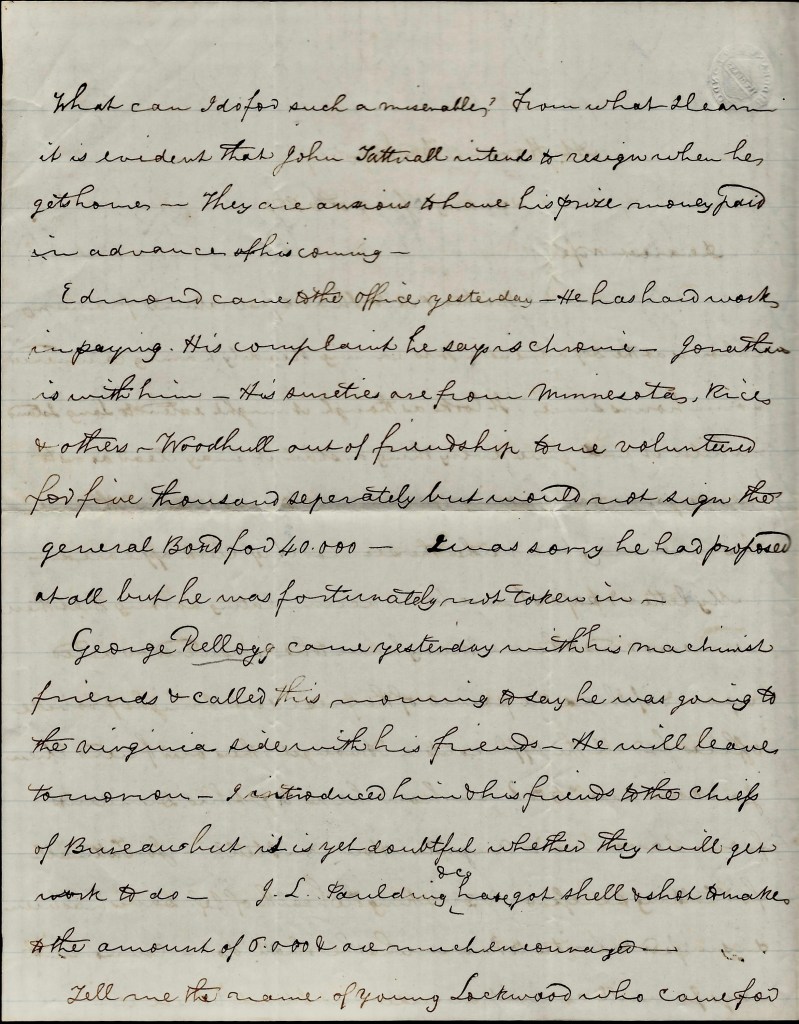
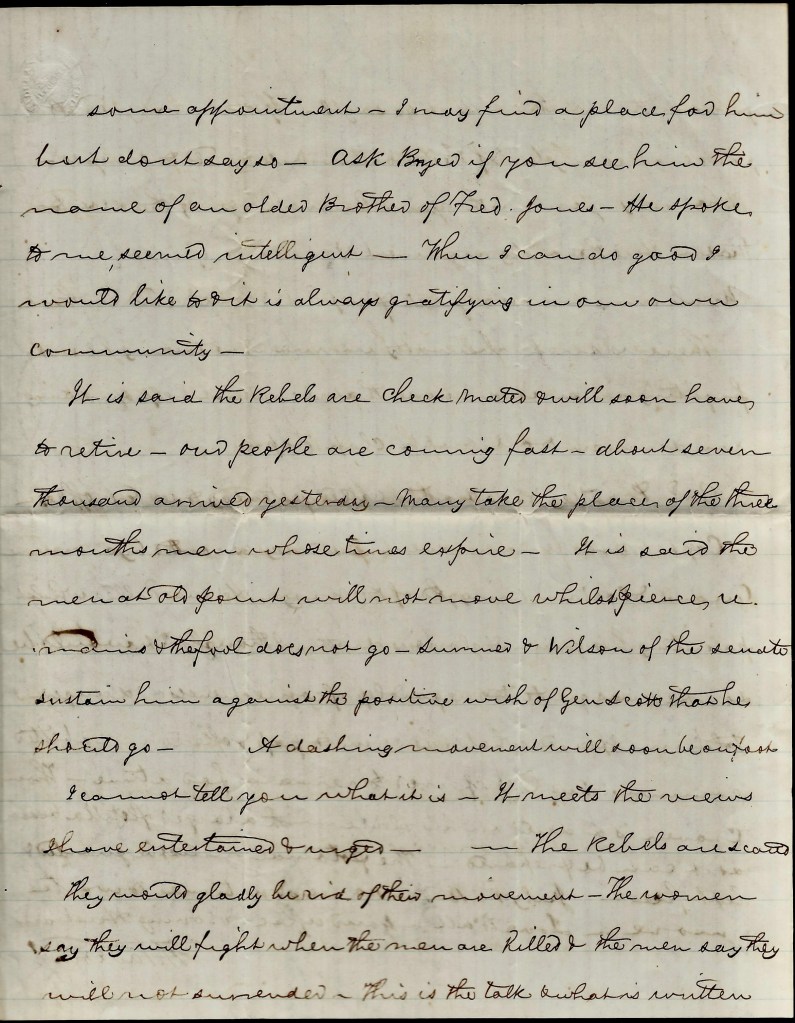
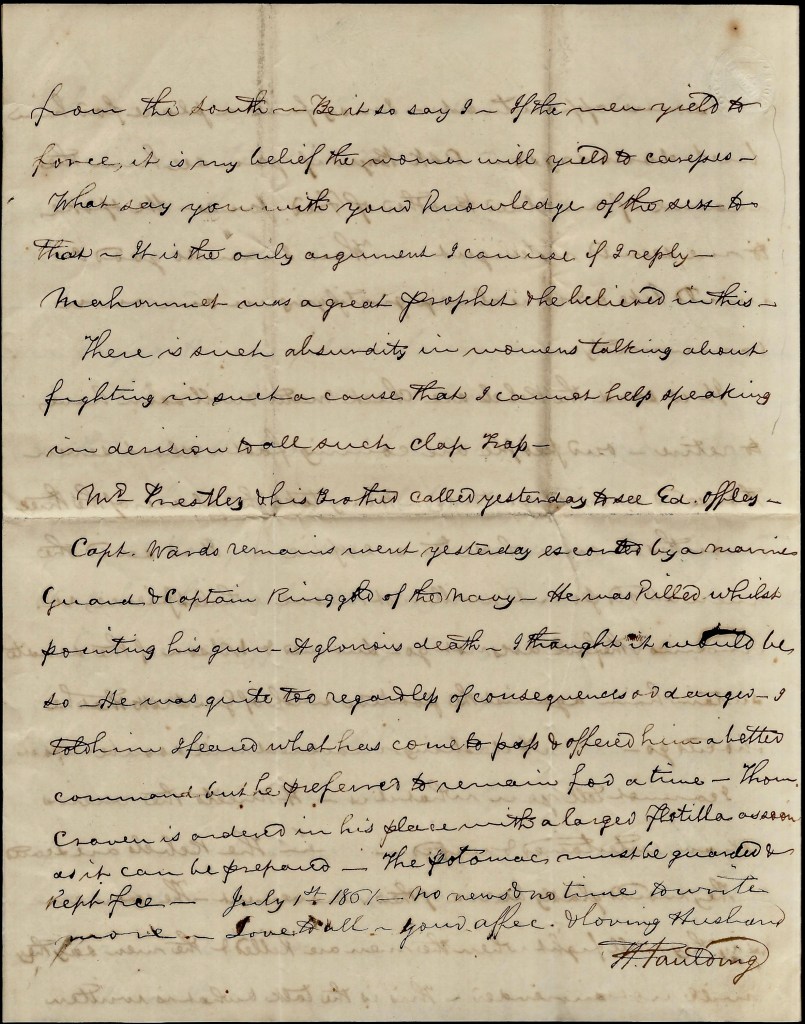
Letter 38
Navy Department
Washington
July 12th 1861
My dear [son] Tatt[nall Paulding],
I have received your letter of the 7th and yesterday heard from home. All well. Much of the hay had been gathered and the work was in a fair way for the men to be ready for the wheat. Mother seemed disposed to make me a visit & I think she will. We have a prospect of such terrible work in the early advance of the army that I do not much encourage her coming. Se thinks I am so lonely in Mrs. Stockton’s house by myself that it gives her great concern. Really, however, I am not lonely at all.
From early in the morning I am at the Department until four and then when at five I get my dinner, my head wants rest and by the time I can look round, get a paper and read it or write a little, it is time for repose and so the day and night go. If she makes the sacrifice of her home comfort to come and see me, it is well. And if she does not, she will think be better off.
I saw General Thomas yesterday and told him you did not receive the box he spoke of and he says you will get it in good time. Today I called on Col. [David] Hunter 1 and dined with Mrs. Hunter and some friends. The Colonel has for more than a week been under the doctor’s care with a bruised shin occasioned by the shying of his horse bringing him in contact with an iron railing & which he neglected for some days, making it quite serious. He is much better & ready to take the field when the movement, soon to be made, takes places and in fine health and spirits. I told him your regrets about not commanding the 3rd but he looks forward to it. Young Sam[uel W.] Stockton 2 is his aide and I saw him. He is a smart, handsome, young fellow, and a horseman from early life.
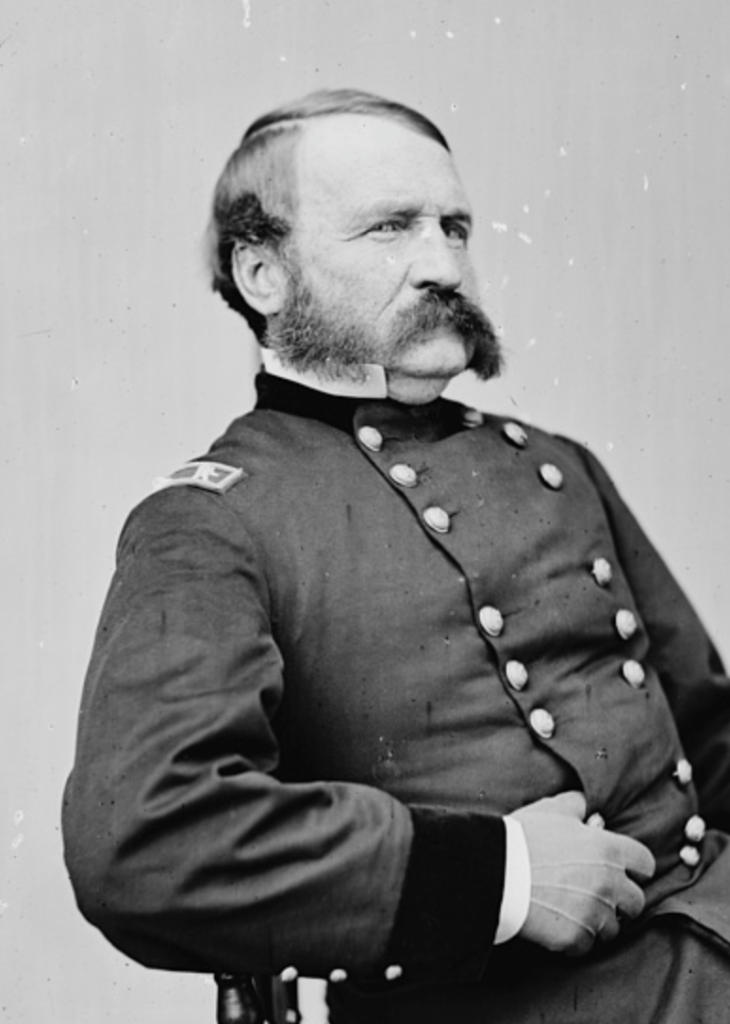
It is doubtful whether Col. [William Hemsley] Emory will be confirmed. There is great hostility against all the officers that resigned and I partake of it & yet am very sorry in this case. His friends are my friends and there is no doubt that he is a good officer. His case is one that may claim quite as much attention as any other and although I am sure I could defeat his conformation, I will not take measures to do so. 3
As you have elected to serve as an officer, bear yourself bravely my boy, and discreetly too. Although discretion is not always the better part of valor, it is a quality of much importance and if it is in your physical and mental character, never lose or permit your presence of mind to be wanting—especially in a moment of danger or the face of the enemy. This is the great quality of a good officer and a great general. When the mind that directs is lost or bewildered from personal apprehension or undue excitement, the power to command is gone and victory, which always fight for, will fade from your disturbed mental vision.
There never was so great and good a cause to fight for as ours. The lawful trades and the pirate, the Christian man and the midnight robber, the law abiding citizen and the cub purse cut throat are all in my mind fair illustrations of the abominable civil war with which we are oppressed. The Congress is going steadily on in legislation quite regardless of the few traitors that have been sent here for treason. The government will be sustained in all its power and the scoundrels that disturb society will soon be brought to justice.
We are equipping all the ships as fast as they come in and will take strong measures by sea. Some of our merchant ships are said to have been captured. It will but increase the bitter hostility of the North which will break with terrible vengeance if pressed beyond the feeling that now exists.
I think the army will move in a day or two from the banks of the Potomac and then the plan of the campaign will be better understood. My plan [see letter dated 22 July 1861] will be carried out soon but I will say nothing about it to you now.
I did not know you had to buy your horse. I will pay for it & hope you have written to Charley McClure to send you a good one. You want a horse of eight years old, of endurance, and good speed, that you may quickly advance and retreat in good time. I am glad you went forward to recruit before going home. It is a good thing to do the work before we seek repose.
With all my good wishes, my dear boy, your affectionate father, — H. Paulding
Lieut. Tattnall Paulding, 3rd Reg. Cavalry, Pittsburgh, Penn. Care of Lieut. Hutchings
1 David Hunter (1802-1886) was an 1822 graduate of the US Military Academy. He spent most of his military career before the Civil War in the West and was stationed at Fort Leavenworth in 1860 when he began a correspondence with Abraham Lincoln that centered on anti-slavery. Soon after the fall of Fort Sumter, Hunter was promoted to Colonel of the 3rd US Cavalry but was quickly appointed a Brigadier General of Volunteers and served under Major General Fremont in the Western Department. He was best known for his unauthorized 1862 order (immediately rescinded) emancipating enslaved people in three Southern states and later as the president of the military commission trying the conspirators involved with the assassination of Abraham Lincoln.
2 Lt. Samuel Witham Stockton (1834-1899) of the 1st US Cavalry, was a relative of Hunter’s as Richard Stockton (1764-1828), signer of the Declaration of Independence, was Hunter’s maternal grandfather.
3 A native of Maryland, William Hemsley Emory (1811-1887), after a long military career, initially wrote a letter of resignation on 9 May 1861, out of concerns for his family. He immediately regretted his decision and tried to prevent the delivery of the letter but was unable to do so. In spite of his resignation letter, he was informally commissioned as major general of the 3rd, later 6th, Cavalry. However, an official review was required that included testimony on his behalf from General Winfield Scott and Lieutenant A. V. Colburn, as well as Emory’s own testimony to Secretary of War and the Senate before his resignation was formally rescinded and his rank was officially confirmed.
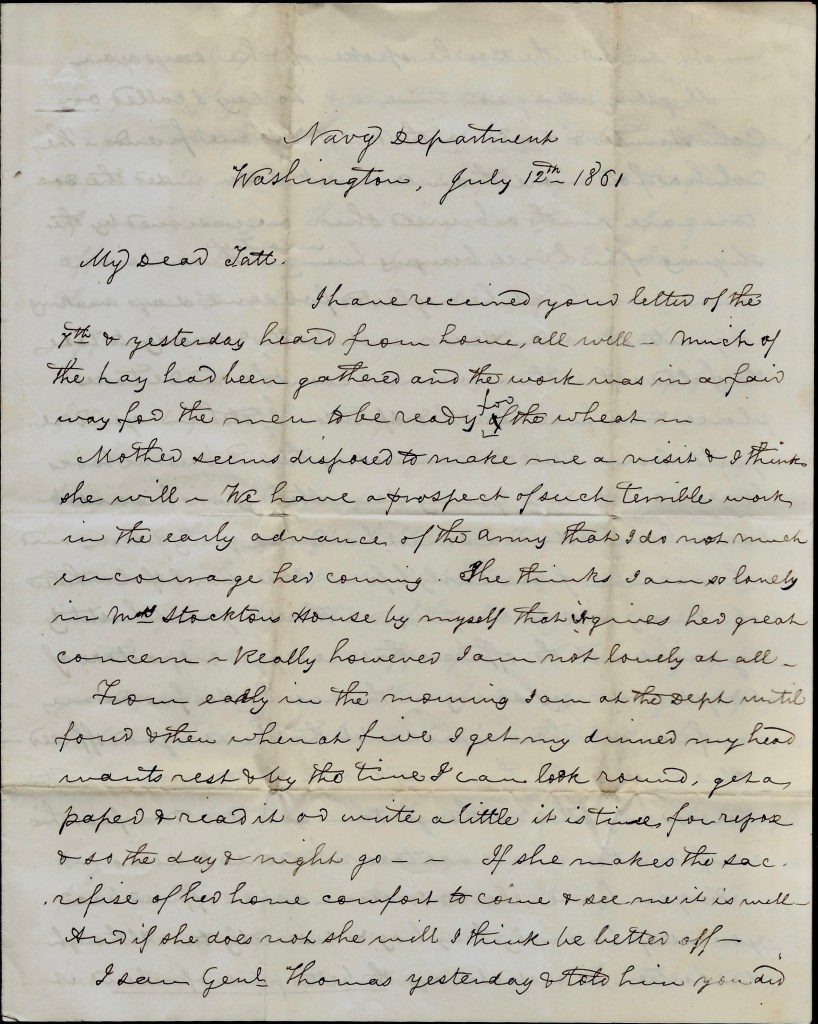

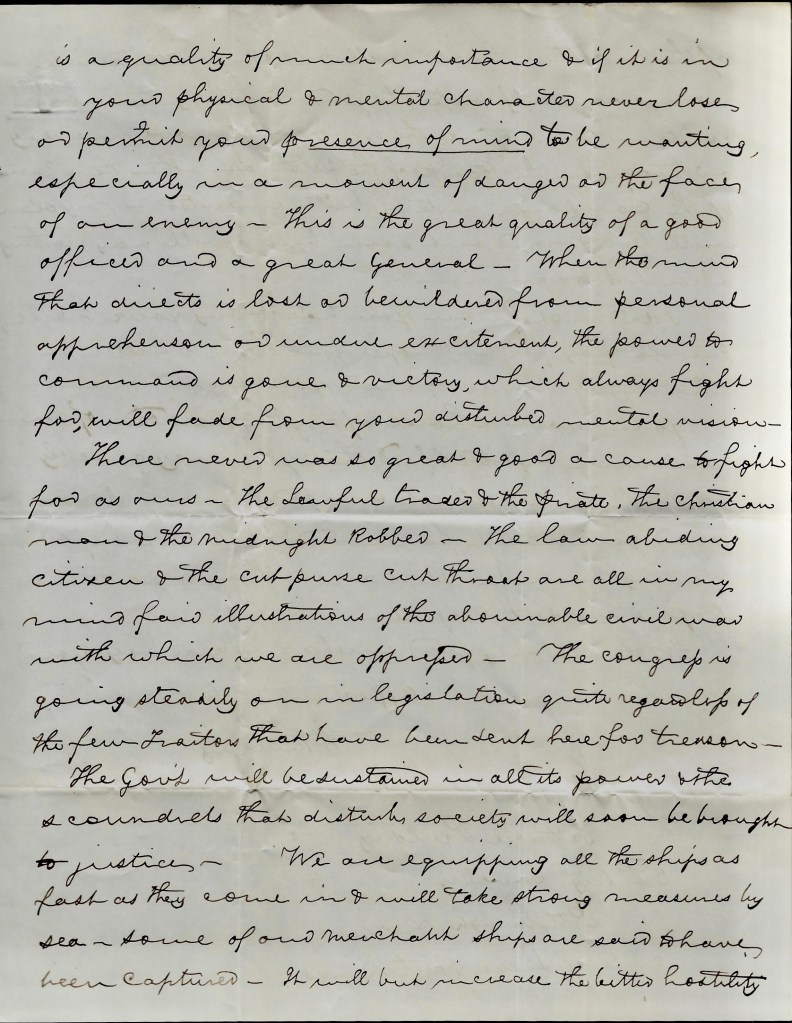

Letter 39
[Copy of letter delivered to Navy Department Gideon Welles outlining his plan to increase the size of the U. S. naval fleet and the mobilization of troops to be in readiness for transport.]
Navy Department
Washington
July 22nd 1861
Sir,
With some diffidence and the earnest zeal of an old officer, I presume to lay before you a recommendation to Congress for the building of ships for Naval purposes deemed necessary now and prospectively. The view I have taken is that some of the ships are necessary now to suppress Rebellion & some to assert the dignity of the Nation if it should be invaded by an impertinent interference with with our domestic affairs. In the exhibition of strength, we may at this time most safely place our dependence upon exemption from interference & it is for this reason most especially that I would recommend the building of the ships of the two larger classes.
It is true that there is not at this time any certain purpose declared to interfere with us, yet we cannot be blind to the cupidity or unscrupulous antecedents of our powerful neighbor & there is no telling with the conflict before us at what moment we may meet with a hostile attitude & weakness we know invites the aggression of power.
I have named the boats & ships for transportation feeling assured that these provisions will be indispensable & knowing how much cheaper & better it is in every view that we should be a little comprehensive in our wants of tomorrow.
In the same spirit, & with the same anticipation of our wants, I would say and most a emphatically recommend to you, & through you to the President, to have a camp of one hundred thousand men assembled on Staten Island and that vicinity as soon as possible to be trained & ready for embarkation at any time. If they are wanted, they are ready at any time to do good service & surely it is in the policy of the government to send not only one, but two hundred thousand men by sea in a few months and quite as soon if they were there now as they can be fit for the field.
This will be but the beginning of our wants if the Rebellion is not speedily broken & to accomplish that purpose without delay the whole country should be a camp.
If the exhibition of great power does not discourage the leaders, we have then the power to destroy them.


[Undated but probably drafted at the same time:]
Be it enacted by the Senate and House of Representatives in Congress assembled.
That the Secretary of the Navy be authorized and is hereby instructed to contract for the building of the following named war steamers for the Navy of the United States.
Twenty side-wheel steamers of not less than three hundred tons to draw five feet water when armed with two nine-pound rifle guns and howitzers with all stores and equipments.
Twelve steam gunboats of not less than five hundred tons, to carry one rifled gun each of eleven such bore and howitzers for defense, to draw from seven to nine feet with all stores and equipments.
Twelve steam ships of war of not less than twelve hundred tons for heavy guns.
Twelve steam ships of war of not less than two thousand tons for heavy guns.
That the side wheel steamers and gun boats be contracted for and finished with the least possible delay consistent with their efficient construction.
That the steamers of twelve and twenty hundred tons be built in the Navy Yards or in private yards as soon as it can be done having a due regard to the public interest and with this provision, there shall be no delay in their completion.
That is in the construction of the engines, no experimental machinery shall be used.
That in view of the prospective wants of the government, five hundred boats of approved construction for landing men from transports be contracted for and built without delay.
That the Secretary of the Navy be further authorized & instructed to purchase steamers and other vessels equal to the transportation of ten thousand troops as soon and at such times as it can be done consistently with the public interest, the vessels thus purchased being placed at points available for transportation by the government at any given times.
That the steamers Franklin on the stocks at Portsmouth, New Hampshire, be prepared for sea as soon as practicable.
And to carry out the provisions of this Act, the sum of —- millions of dollars be appropriated.
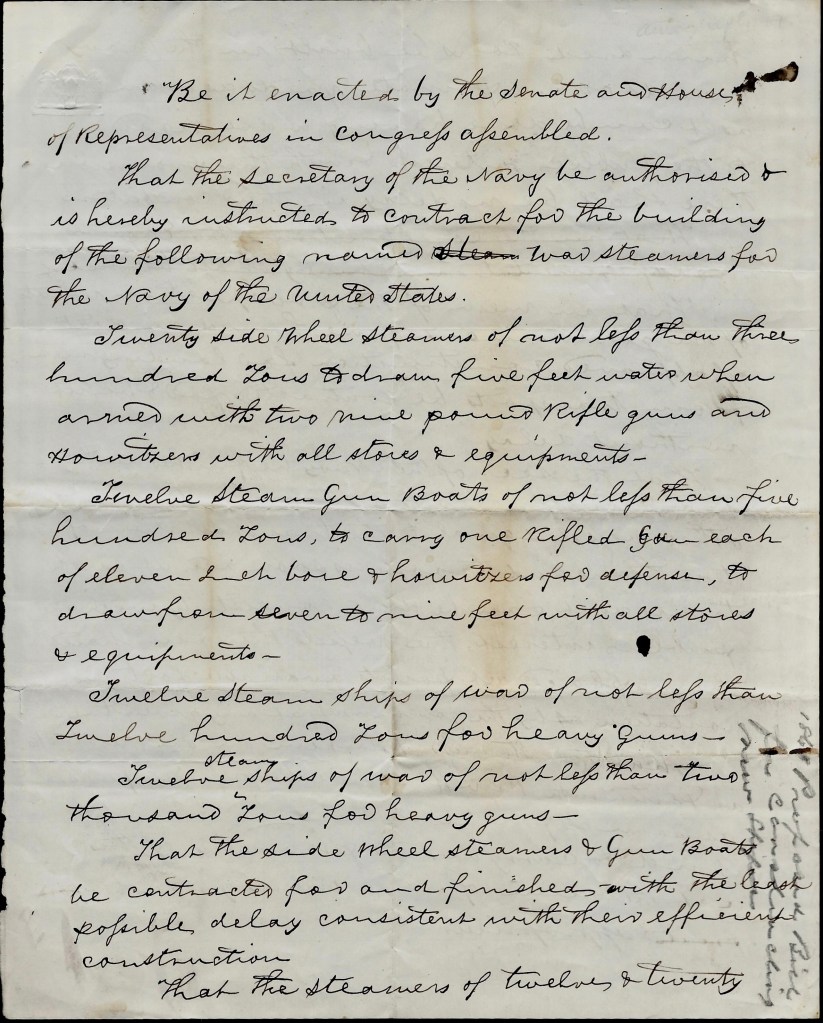

Letter 40
[Letter refers to the Battle of 1st Manassas or Bull Run fought on 21 July 1861.]
Navy Department
Washington
July 25th 1861
My dear [son] Tatt.
I received your letter when about to march with your men & would have written & sent you money if I had known where to send it. If you were not taken up on the road, I suppose you are in Pittsburgh by this time.
It was scandalous for you to be left without means in the performance of duty. If you want money, let me know. McClure will bring you the horse. All were pretty well at home a few days since.
We have had a sad time here in our mismanaged military operations. Col. [David] Hunter was severely wounded on the throat under the left ear passing close to the jugular vein. It was thought he would bleed to death when first taken to the house. He is doing well without any considerable danger. I have not seen him yet. The army was greatly disorganized but are getting together again and many troops are on their way. The enemy had a larger force than was supposed & our men fought eight hours—much of the time two to one besides storming batteries. In killed and wounded we have lost about three thousand and the enemy are said to have suffered severely. the volunteers are said to have fought well until a panic took place.
Your affectionate father, — H. Paulding
[to] Lieut. Tattnall Paulding, Pittsburgh
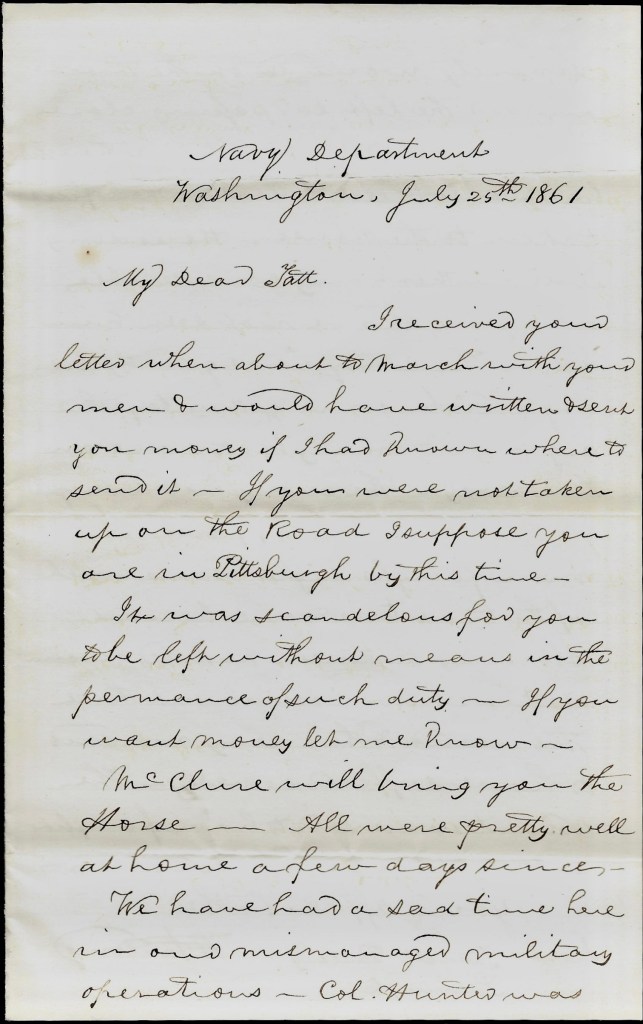
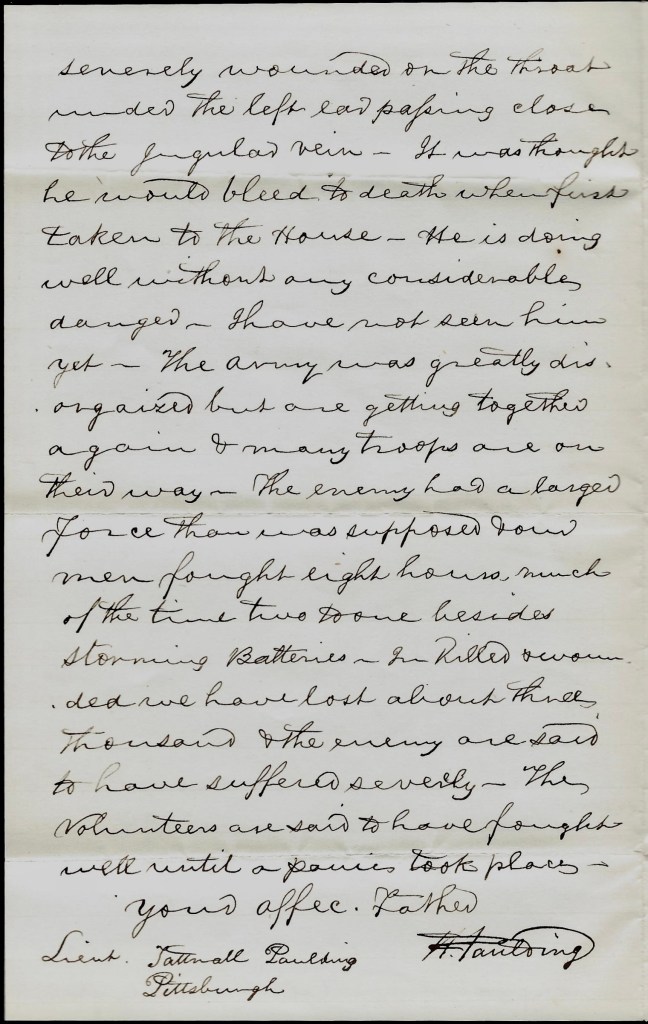
Letter 41
Navy Department
23rd October 1861
Sir,
The Committee of the Senate appointed to investigate the circumstances connected with the abandonment of the Navy Yard, Norfolk, Virginia., will meet at the City of Washington on the sixth day of November next.
You will report, in person, at the time and place appointed, to Senator John P. Hale, Chairman of the Committee. 1
I am respectfully your obedient servant, — Gideon Welles
[to] Commodore Hiram Paulding, US Navy, Brooklyn, New York
1 “Members of Congress were not long in investigating the Navy’s destruction of the Gosport Navy Yard. A committee was appointed on June 25, 1861, headed by Senator John Hale, one of the most vociferous critics of Welles and the Navy Department. After hearing much testimony the committee concluded that the administration, McCauley, Pendergrast, and Paulding were guilty of varying degrees of negligence and inefficiency. Welles remained loyal to his department. Although he thought the affair was unfortunate, he excused the action of his subordinates; it was, he said, due to the “extraordinary circumstances of the case.” It is understandable that contemporaries attempted to find a scapegoat for the Gosport affair.” [The Gosport Affair, 1861, by John Sherman Long]


These pages identify the members of the standing committees in the 37th US Congress, and in particular, the names of those serving on the Committee of Naval Affairs. Annotated next to each of the members names are their residences and their party affiliations.
Letter 42
The following letter was penned by Lt. Edward Tatnall Nichols (1823-1886) of Georgia who began his naval service in 1836. He attended the Philadelphia Naval School, 1841-42, after which he passed as a midshipman and served in the Mediterranean Squadron and later the Brazil Squadron and the Pacific Squadron. He served stints at the Pensacola Navy Yard and the Portsmouth Navy Yards and when the Civil War broke out, he remained loyal to the Union and was given command of the steamer USS Winona in the West Gulf Blockading Squadron. He participated in the bombardment of forts Jackson and St. Philip, receiving the latter’s surrender on 28 April 1862. He went on to an illustrious career in the war, receiving his promotion to captain in July 1866. He was married to Caroline E. Bowers (1829-1865) in 1851 in Rhode Island.
Winona off Sandy Hook
P.M., December 20, 1861
My dear Commodore,
With this you will receive my official report of my search for the steamer as directed in your note received last night. Had there been anything on the beach within five miles of Barnegat [Inlet] at the time I was a breast of it, I should have seen it for I swept the beach very carefully with a good glass, and I do not think we were more than two and a half to three miles off shore. The pilot makes an extra charge, as I took him beyond the limit of his ground in piloting a vessel to sea. I presume the charge will be allowed as it was incurred with the view of facilitating the duty upon which I was sent. I trust that my proceedings will meet your approval.
When I parted from you the other day, my dear Sir, I had much to say to you, but I had but recently parted from my wife and child and my heart was too full for words. Permit me now, therefore, to thank you for the many and repeated acts of kindness I have received at your hands, and let me assure you that nothing shall be wanting on my part to prove myself worthy of them. In times like these, when we part from friends, we know not if we may meet again. If I should not return from this cruise, may I further tax your kindness by asking you to put my family in the way of securing a pension for I have little else to leave them. My wife, with our youngest child, are residing at No. 28, East 30th Street, New York.
With kindest regards by our family, I am, dear Sir, very sincerely yours, — E. T. Nichols

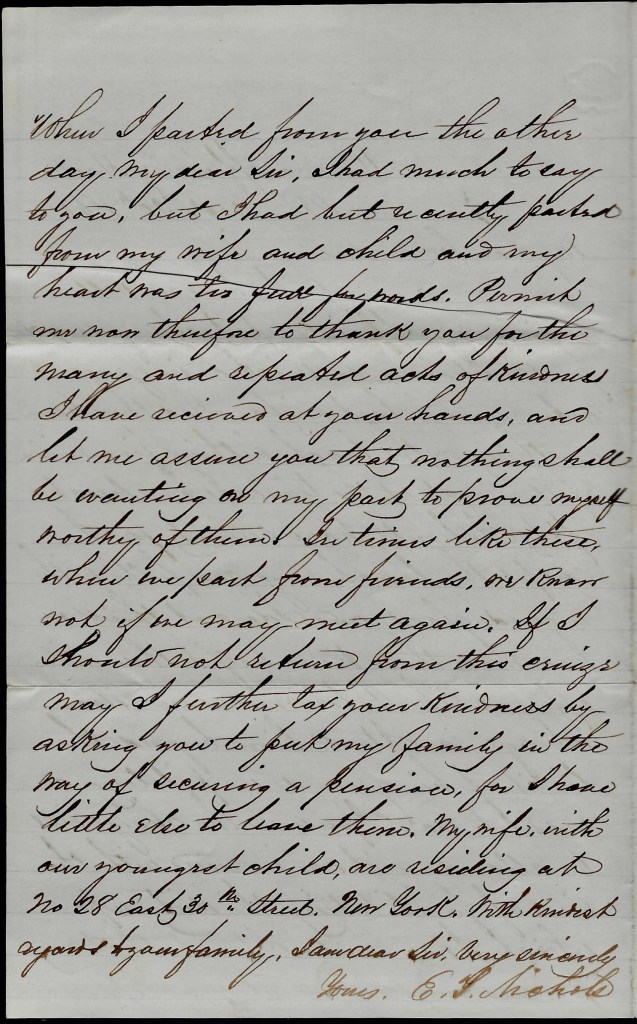
Letter 43
Navy Yard, New York
December 25th 1861
My Dear [son] Tatt.,
A Merry Christmas to you if that can be in the midst of civil war & the discomforts of a soldiers life. I have been trying for a long time to get time to write you but there are so many things to be said & done that my private correspondence is sadly neglected. The children sent you a box about a week ago and I hope you have received it. But Uncle Joe, who is informed about such matters, told us the Express they sent it by is the slow line & you may be some time yet without the box. They must try and arrange it better the next time. I hope [ ] succeed in attending satisfactorily to your affairs. He reports a scarcity of Alligators skins. Now that we are in a fair way to have access to the southern swamps, a supply of this important article may be obtained for prospective use.
We are still sending forward gunboats of varied structure and a sail ship for every two steamers. We get one off for every two or three days. Com. D[avid] D[ixon] Porter is here preparing twenty schooners for mortars of 13-inch caliber. They weigh 17,000 lbs. & are most awkward looking things. The Flotilla will get off in about two weeks. It will be very formidable & if required to do so, will break up the blockade of the Potomac or any other place. They look to me as though nothing could resist them.
All the McBride’s dine with us today and the turkeys and chicks and oysters are in profusion. I wish you could be with us if that can do you any good. In the evening there is to be a considerable mustering of the ladies. I have not been to peach blossom since my return from Washington. Dick and Susan are there in possession.
If you go to the Navy Yard, remember me to the Morris’s and all, and Mrs. Coston if there. The mail is about to close & so must I. Write when you can and say if I can do anything for you. All send love to you.
Your affectionate Father, — H. Paulding
Lieut. Tattnall Paulding 6th Reg. U.S. Cavalry, Washington
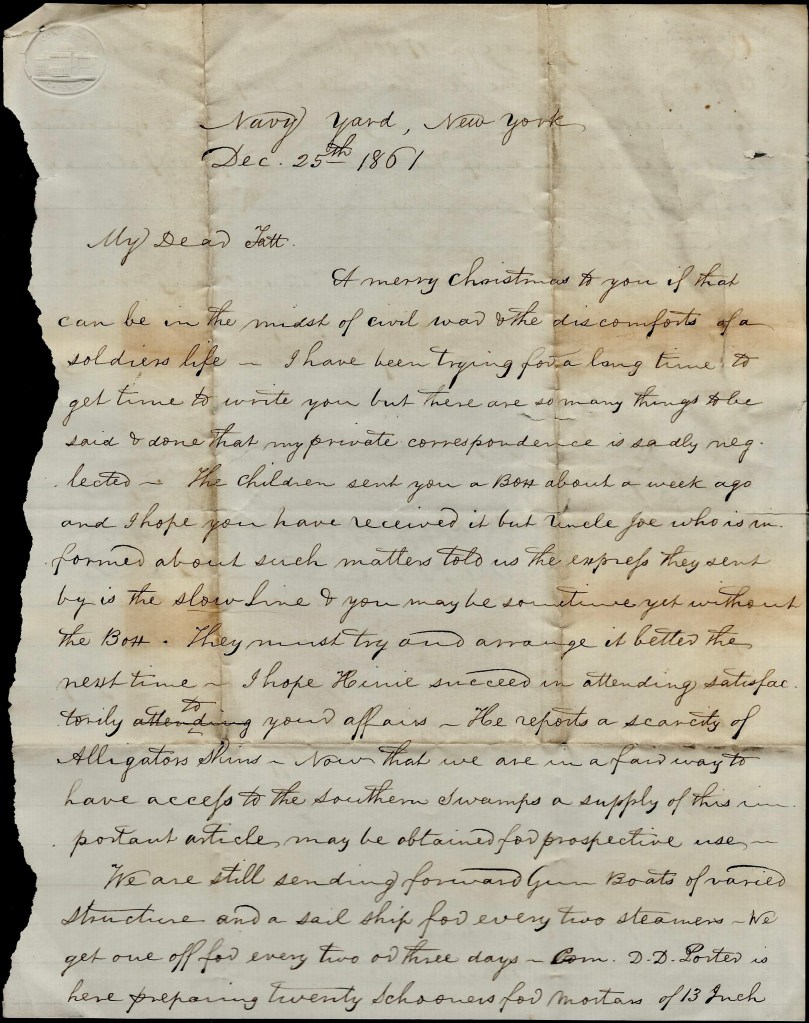
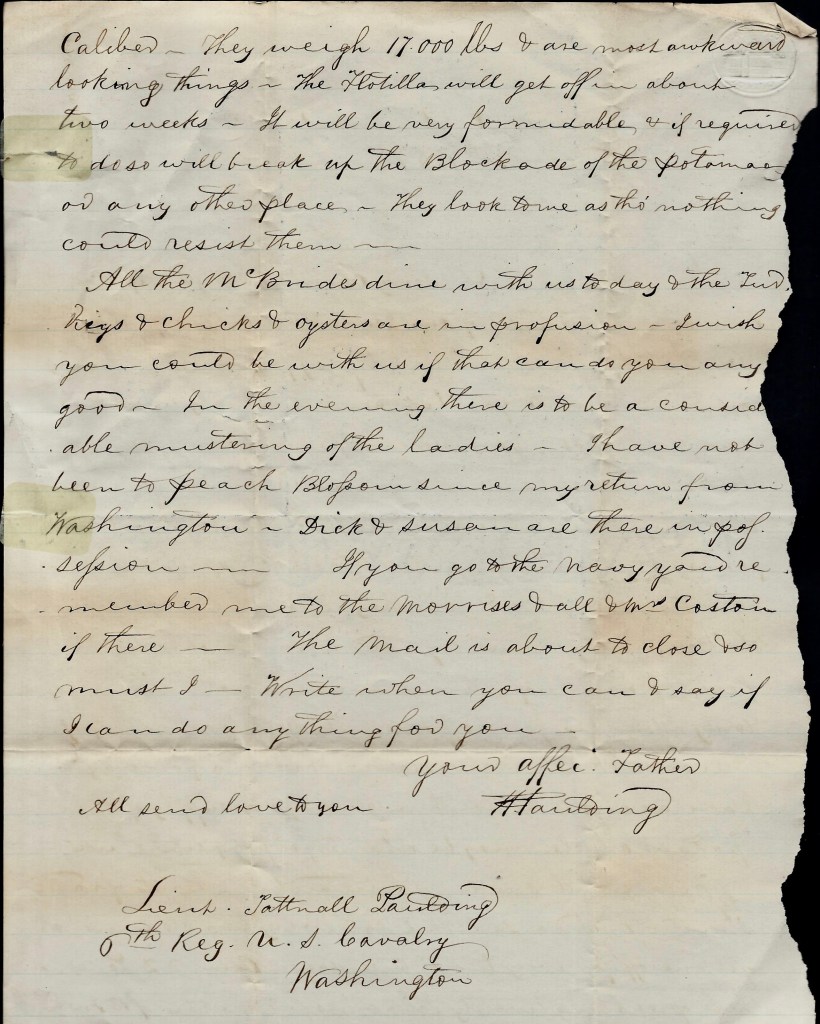
Letter 44
[This letter, though unsigned, was penned in Hiram Paulding’s hand and was most likely a draft copy of a letter sent to Capt. [Levin Mynn] Powell based on the reference to Mrs. Powell and the USS Potomac. During the Civil War, Powell commanded the USS Potomac from August 20, 1861, to June 29, 1862 which was on blockade duty in the Gulf of Mexico.]
Navy Yard,New York
January 18th 1862
My Dear Capt.
My correspondence fails for the want of time as usual for months past. I work from early to late & from day to day, find the same routine of labor. Officers & clerks here all do the same thing. This is the great work shop of the Nation. Since I came here less than three months, we have sent to sea nearly fifty armed vessels besides an indefinite number of others. Porter’s Bomb Fleet are beginning to move & in a week will be on their mission of destruction. There are twenty heavy schooners with each a 13-in. mortar weighing 17,000 pounds & two 32 of 57 cwt. Perhaps you may see them in the Gulf & it is not unlikely that they will interrupt the operation of some of the enterprising gentlemen who fire upon honest men with long range guns, by knocking their strongholds into a cocked hat.
There are forty-five bomb vessels on the western waters with two each of such bombs & in less than a month, or at all events before the first of March, I expect New Orleans may—if it is our policy—be opened to the commerce of the world with old Virginia, Kentucky, North Carolina back in the Union as well as some others, whilst the Rebels will have to take up a new programme in the best way they can.
A large supply of Rifled Parrott guns went to the Gulf in the Connecticut & I trust you may have a dozen steamers, some of them the new gunboats by the time this reaches you. The Sabine has been in dock & will be off in a week. The Richmond is now in dock & she will sail in ten days. Our naval force is rapidly increasing & effective ships will soon take the place of those prepared so hurriedly. Don’t complain too much. We are just getting ready to fight & under all the disadvantages, we have done a great deal. We shall in a very short time have ships, guns, & men to the Rebels hearts content & there will be such a thundering as they have not heard yet.
Two ironclad gun boats will be added to our force in a few weeks. The builder of one of them—Mr. Ericsson—says with five such, he could burn the city of London. She will be at the yard in a few days & we shall know then more about her. 1
With the force going to the Gulf, I would not hesitate at all about going to New Orleans & they will do it.
As to that part of your first letter complaining about the government’s sending Irish & Germans to fight the South, I disagree with you entirely. These people have made this country their home; have their property & families here and are as much as any other men interested in having a country & a government. Such is my view of the atrocity & base villainy of the Rebellion that I can use no terms too strong to express my abhorrence & abomination of its infamy & I am for its suppression & condign punishment of all who have taken a leading part in it & trust it may be effected though it should be necessary to resort to harsher measures than the employment of the “Irish and the Germans.” It is the worst Rebellion & for less cause in my view that can be found in the history of the world. Besides all this do not the Rebels employ Irish & Germans whenever & wherever they can get them & have they not made war to the knife & treated their prisoners with harshness little short of brutality. Instances of cruelty are well authenticated that would rival the instincts of the children of the forest. Nor have they omitted to take the initiative in employing in their ranks these ruthless savages.
Alas! my dear captain, for your sentimentality claiming in behalf of such an enemy that none but natives of the North shall be sent to the field in such a war as this. With such opinions I am so much at war that I cannot realize you are as much in earnest to put the Rebellion down as I am.
I am as much as any one opposed to the present abolition of slaves amongst loyal men, but if I had my way, no traitor who has voluntarily taken up arms against the government should ever again hold a slave to disturb the peace of society.
As for the old Potomac, it will soon be time to lay her up—that is, when a sufficient number of more effective vessels are provided. I should not be surprised if you yet had a chance to make a dash upon the enemy & show what one of the old officers can do. I do not think much more of the old fellows than you do, & grieve withal to find one half of the young ones [to be] premature Fogies.
The English will make war upon us if it is their policy & for one, I am greatly concerned that we should be prepared in every possible way. Should France lend her counsel then we must fight England.
Your Requisitions have gone to the Bureau. I have not heard from Mrs. Powell for a long time but [expect] to have her make us a visit as she promised before going to Washington. You will have seen by the papers what an embarrassment the daughter of our friend Gen. Thomas’s has occasioned and that his retirement is named.
[unsigned]
1 In the summer of 1861, Congress authorized $1.5 million for the construction of armored warships (“iron clads”). They also authorized the appointment of an Ironclad Board to review designs. “The Board consisted of Flag Officer Joseph Smith, Flag Officer Hiram Paulding, and Captain Charles Henry Davis. Bids were solicited on August 7, 1861. Once received, they surveyed 16 designs, including one made of rubber. Two designs were quickly selected: a European-styled broadside ironclad and the iron clapboard corvette Galena. While the Galena design was approved, Captain Davis questioned the vessel’s stability. Cornelius Bushell, who had made a fortune in shipping and railroads, was advised to meet Naval Engineer John Ericsson to understand more about his proposed ironclad. Ericsson explained to Bushnell that Galena was seaworthy; however, the Swedish-American engineer showed the financier a model of his tower battery, which would eventually be known as USS Monitor. The Monitor was indeed a unique shot-proof design, and it could be built quickly. When Monitor became the first ironclad commissioned, it was thrust into battle on March 9, 1862. It stopped CSS Virginia‘s (Merrimack) destruction of the rest of the wooden Federal fleet in Hampton Roads. Ericsson’s Monitor became the toast of the country as the “little ship that saved the nation.” [See: Coastal Ironclads Other than Monitors, by John V. Quarstein, 2022.]

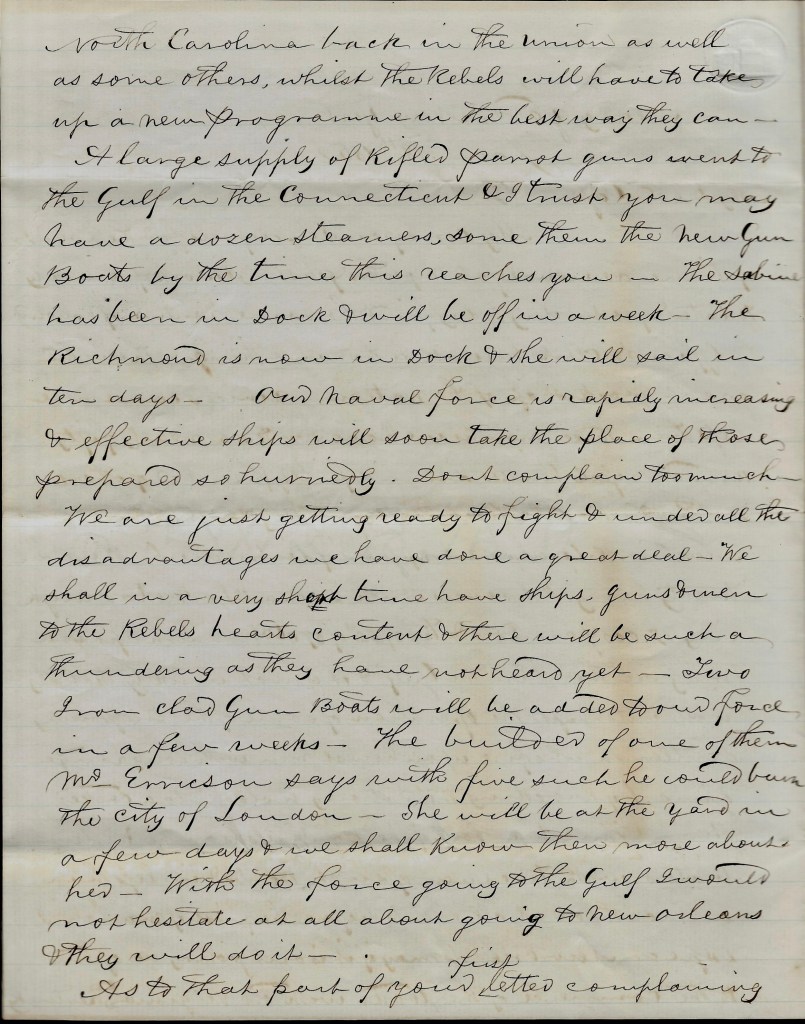
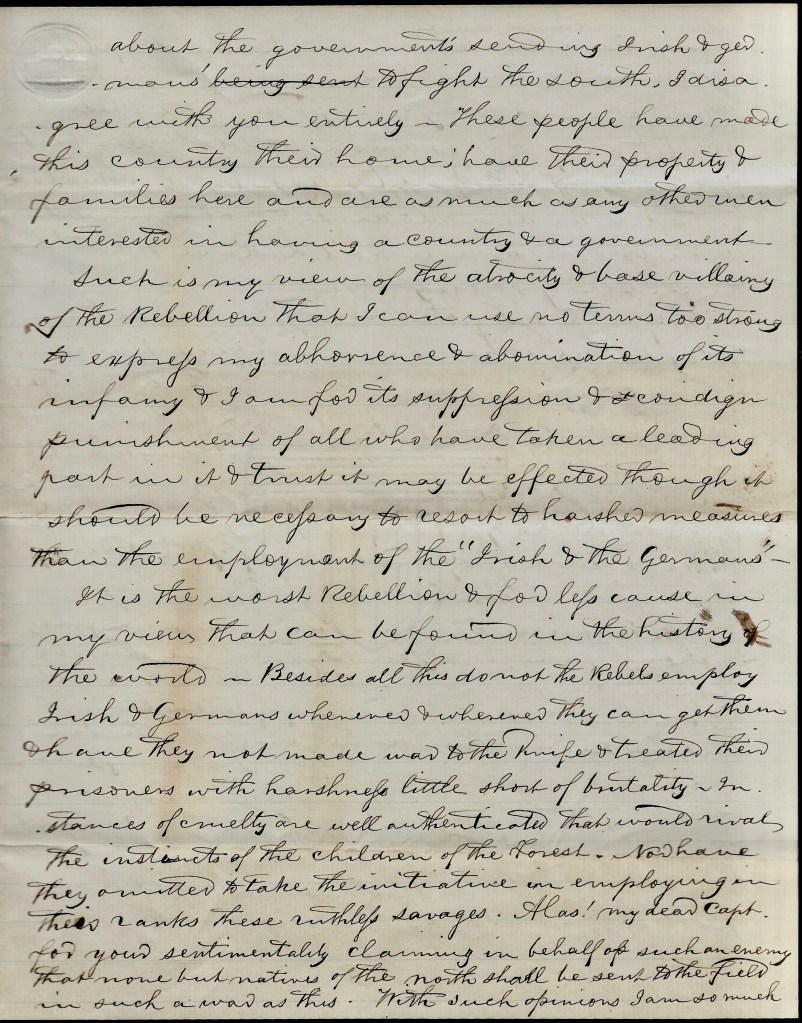
Letter 45
U.S. Gunboat Winona off S.E. Pass
February 26th 1862
My dear Commodore,
The Rhode Island made her appearance yesterday and by her I received your most welcome, but entirely unexpected letter sent by Captain Gurst of the Owasco. I say your letter was unexpected because I could not imagine for a moment that you could find time to read and answer all your official letters, besides the many hundred times you have to sign your name in the course of each day to bills, requisitions, &c. But it seems you have found time to write me, and I am truly obliged, and accept it as an earnest [sign] of your kindly feeling and interest. I am happy to find that you continue in the enjoyment of good health, and as work appears to agree with you, I suppose I can make no better wish than that it may continue, though it would better please us all, were we working against others than our own misguided fellow citizens.
I had heard from Captain Woodhull the report of Captain Tattnall’s resignation and that he had been mobbed in the streets of Savannah—his native state. If this is true, it must have been a sad blow to his pride and disastrous to himself and family. I hardly think, however, that the report can be true for some of the papers received yesterday speak of his attempting to get supplies down to the troops in Fort Pulaski, it being cut off from communication with Savannah by a Battery above which commands the river.
You speak, my dear Commodore, of my being in New Orleans by the first of March, and from this I infer that Porter’s Flotilla is intended to operate against that city. As yet, only a portion of the vessels have arrived at Key West, and it will take some time yet to assemble and organize them. Our Blockading force about this river might be doing something, were we not so sadly deficient in persons familiar with the coast and river. Our charts are entirely unreliable for inshore work. My anchorage here by the chart according to cross bearings of Light Houses and other permanent marks, is southwest of land forming the western side of the pass, but my actual position is directly in the mouth of the pass within three cables of the bar and nearly due east from the outermost land. Where the chart shows fathoms, I find feet, and vice versa, so that in moving about I have to move very cautiously.
We have an exceedingly dull time of it, and very uncomfortable, for it cannot be denied that these gunboats roll fearfully. I get so tired and weary with the constant motion by night, that I am willing and anxious to go to bed, but scarcely a night do I go there before midnight, and nearly half the time I sleep in my pantaloons. My officers, except the first Lieutenant, who is a very capable young man, are merchant sailors, and though doubtless very good seamen, are not good officers. They have not been brought up in those habits of strict attention to duty, vigilance, and prompt execution of orders, so essential to the efficiency of a vessel of war, and so relieving to the anxieties of a commanding officer. They try to learn, but knowledge comes slowly. I try, however, to bear all my trials philosophically, consoling myself with the hopes that I am aiding in my humble way, in putting down this wretched rebellion.
Our secesh friends have a few armored steamers of different kinds in the river, and one comes down occasionally to take a look at us, but all that I have seen have kept out of gunshot. If we had good pilots, we might catch some of them by going up one pass as they come down another and thus heading them off. They burn wood or soft coal and can be traced for a long distance by their smoke, while we make no smoke and our masts cannot be seen far. Flag officer Farragut has arrived out and assumed command of the Western division of the Squadron, and judging from what I heard on board the Rhode Island, we shall have some active service soon.
A vessel with a party of surveyors has been sent to buoy out the S.W. Pass, and Fort Livingston at Barataria bay [ ] to be spoken of. A steamer came out of Pass a “Loutre” a few mornings since in a dense fog. The Brooklyn & Mercedita from their mast heads, caught sight of a puff of his black smoke over the fog, and both slipped in chase. He was much faster than either of them and by the time they got outside of the fog, he had got a long start of them and the chances of catching him were rather slim. Fortunately a strong southerly wind set in with a rough tumbling sea, in which, being very heavily loaded with cotton, we tumbled about a good deal, and the Brooklyn being fortunately to windward, had the use of her canvas. The two ships chased him to within sight of the Blockaders off Mobile and had got within good range of him, when one of his boilers burst. Just then a heavy squall came on and while the Brooklyn was hunting for him, the South Carolina picked him up.
The prize proved to the Steamer Magnolia, of about a thousand tons, built to run between Galveston and New Orleans, had been recently thoroughly repaired and had on board twelve hundred bales of cotton. I fear, however, that others got out and escaped on the following morning before the two ship returned to their station, for the Captain of the Preble at the N.E. Pass, reports having seen the smoke of three steamers at Pass a Loutre that morning at three o’clock. I see it reported in the papers that the Winona arrived at Ship Island, “broke down.” This is a mistake; we were in better condition for service when we arrived there than when we left New York and did leave the following evening on a an expedition up Mississippi Sound. Our condenser is out of order—almost useless, and was so when we left New York, but not a thing has been broken, and nothing has happened to our engines beyond the ordinary wear and tear of service. Indeed, for new engines, ours have worked remarkably well.
I have written you a long letter, my dear Commodore, and I hope you won’t think the time wasted which it will take to read it. If you can find time to drop me a line occasionally, I shall be very happy to receive it, and if you cannot get the time, just give my old and esteemed friend Cooper an order to write for you. With kindest regards to Mrs. Paulding and your family, I remain, dear Commodore, your attached young friend, — E.T. Nichols

Letter 46
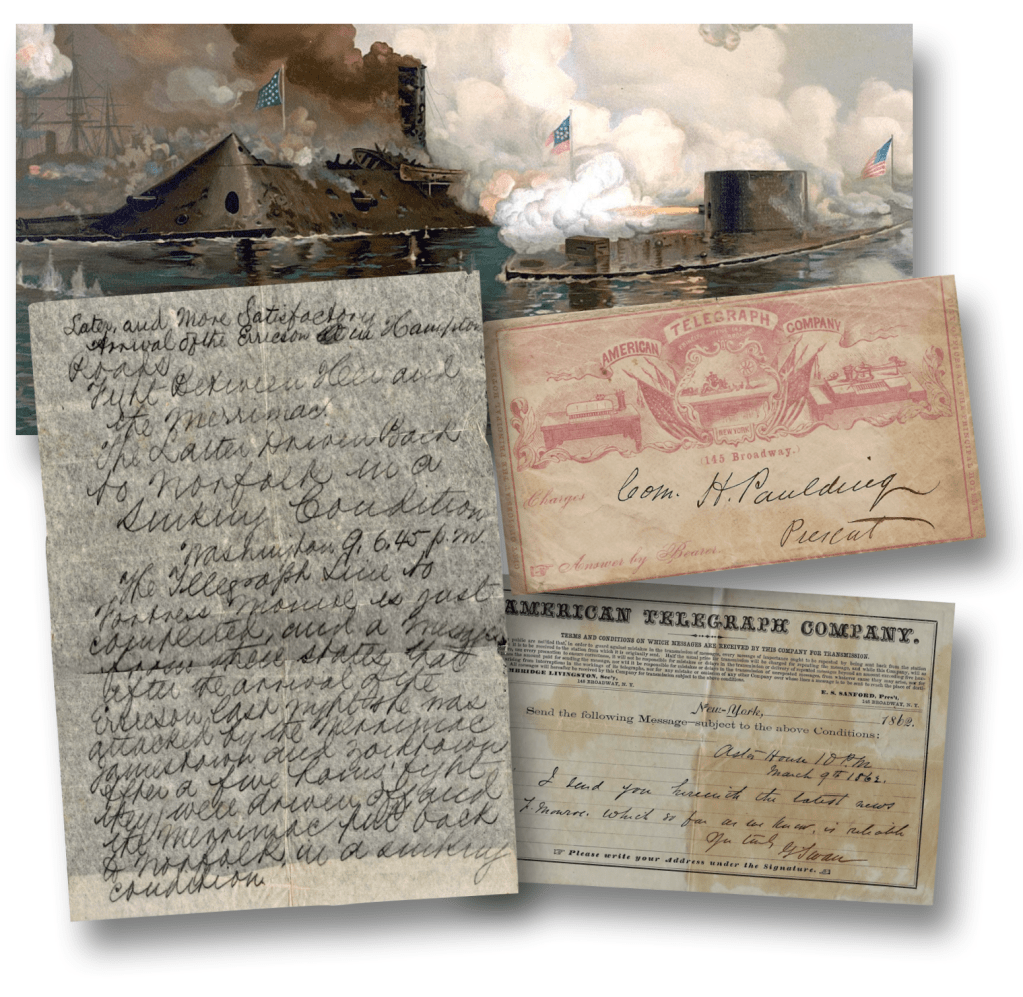
A nice little grouping of ephemera pertaining to the Battle of Hampton Roads in which the Monitor fought the Rebel Ironclad Merrimac to a draw. This telegram was sent to Commander Hiram Paulding in NYC informing him that, “Later and more satisfactory. Arrival of the Erricson [Monitor] in Hampton Roads. Fight between her and the Merrimac. The latter driven back to Norfolk in a sinking condition. Washington [March] 9th 6.45 p.m. The Telegraph Line to Fortress Monroe is just completed and a message from there states that after the arrival of the Erricson last night, she was attacked by the Merrimac, Jamestown, and Yorktown. After a five hours’ fight, they were driven off and the Merrimac put back to Norfolk in a sinking condition.” At the time, Paulding was the Commander of the Brooklyn Naval Yard. Paulding had more than a passing interest in the result of that engagement as John Erricsson publicly acknowledged that the Monitor would never have been built were it not for Paulding’s support and influence in the Navy Department in 1861.
Letter 47
Navy Department
Sept. 11, 1862
Sir,
I have received your letter of the 9th inst. stating that you are prepared to move with the men at the Navy Yard to assault the enemy in Maryland, &с.
Appreciating alike your motives and suggestions which are worthy of yourself and the Navy, I nevertheless am of opinion that the exigencies are not such as to render it necessary that you and the men in the Navy Yard should repair to Maryland to confront the insurgents who have crossed the Potomac. Of the efficiency of the Navy veterans, who as you remark “can form such a force of artillery as will be irresistible to the enemy,” I entertain not a doubt, but I do not deem the crisis so imminent as to require their services in the field. The men in the Navy Yard are rendering invaluable and indispensable service in their legitimate present employment and I should regret to have them withdrawn from it.
Thanking you for this evidence of your promptness and patriotism, I am respectfully, &c, — Gideon Welles, Secretary of the Navy
to Rear Admiral Hiram Paulding
Commander Navy Yard, New York
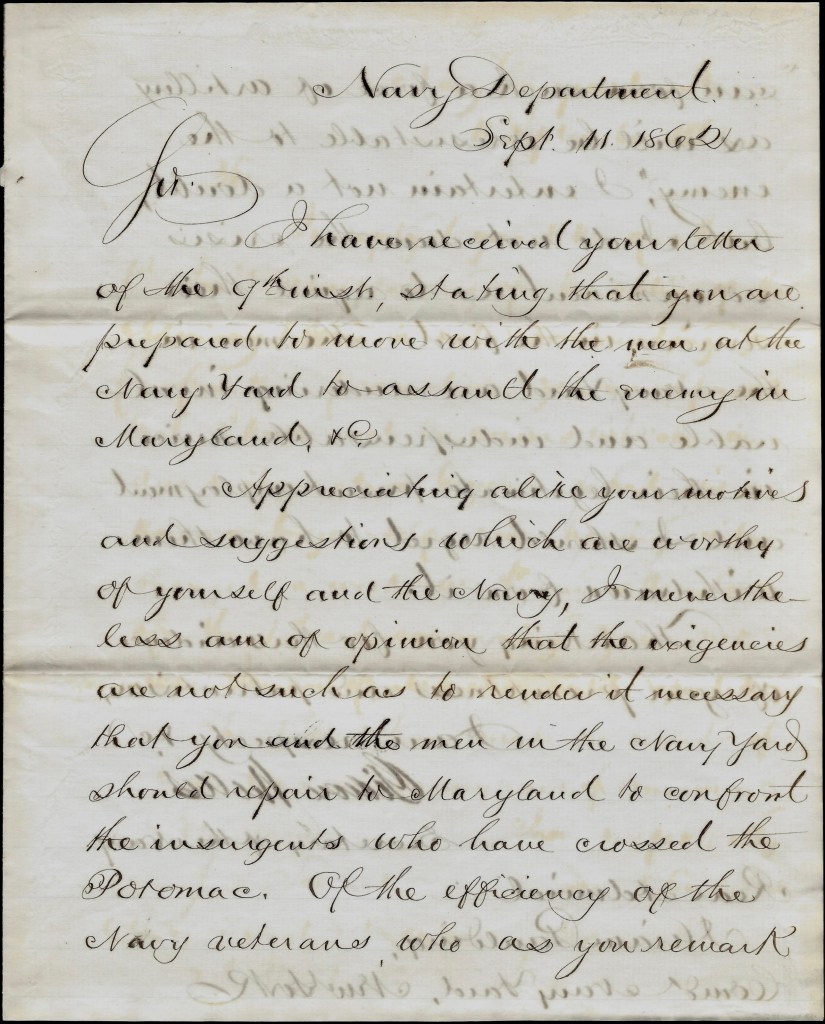

Letter 48
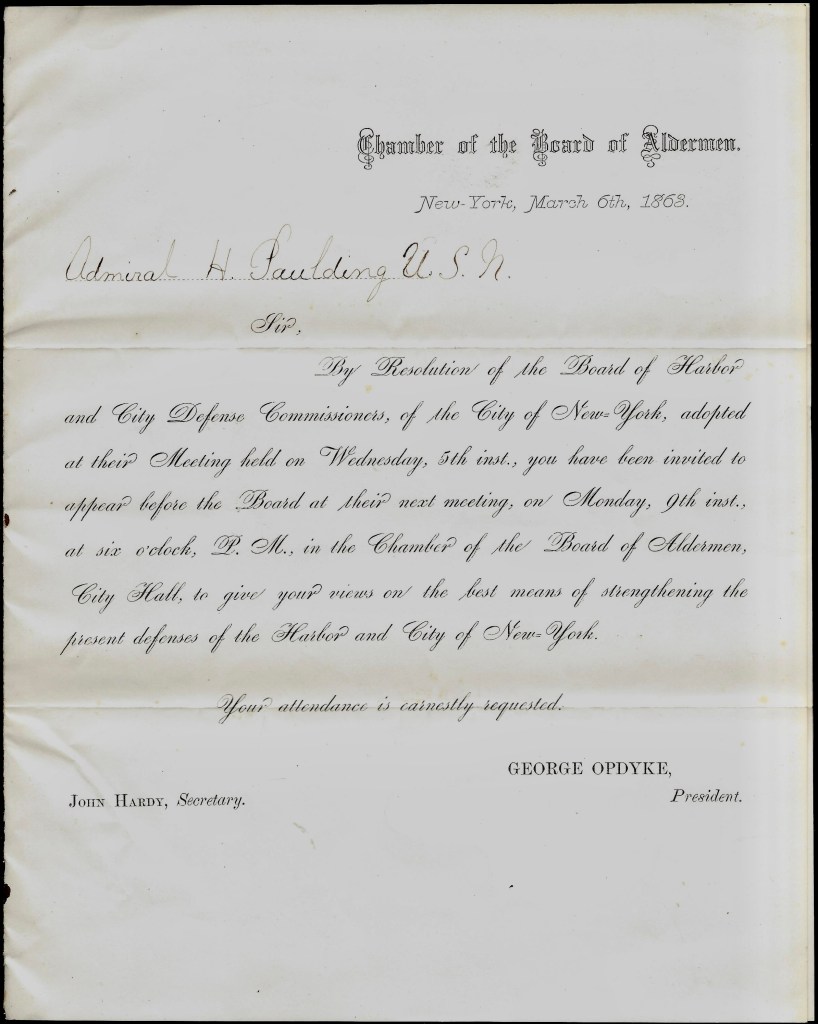
Hiram’s Paulding’s response to the Commission follows:
[Copy]
Navy Yard, New York
March 8th 1863
Sir;
I have the honor to acknowledge the receipt of your communication of the 6th inst. informing me that I had been named amongst other gentlemen to make suggestions in reference to the necessary means of defending the city of New York and inviting me to be present at —– on Monday the 9th inst. to meet the gentlemen whose counsel on this interesting subject will be given.
I regret to state that indisposition has confined me to my room for the last ten days & my medical attendant deems it necessary for me to remain at home.
The subject of the defenseless condition of New York has been painfully present to my mind from the time of assuming the command of this station and as far as I am informed, nothing has been done, unless it be some preliminary preparation in the lower part of the Harbor and I cannot but believe but that we are greatly exposed to the assault of even a feeble enemy.
Without means of information, I do not know what preparation has been made to defend the main approach to the city by way of the narrows & that part of the subject I must leave to the Engineers that have it charge.
On this subject I may be permitted to say without infringing upon their prerogative that from the outer commencement of our defensive works, the whole line of the shores on both sides in the narrow part of the channel should be armed in the most thorough manner with guns of the most formidable character & a corp of Artillerists trained and kept in readiness to fight them.
That ships of any description should not be permitted to enter the Harbor at night further than the first range of defense and that one or more boarding vessels in signal communication with the Forts should be kept constantly on service to report the character of every vessel that may cross the Bar at Sandy Hook.
Governors Island should be well armed and manned and a first class Battery of heaviest caliber established on the Battery of New York.
On the sound, Fort Shuyler should be fully & heavily armed and a formidable work should be established on Willets Point. The same precaution of Boarding vessels should be provided here & no vessel of any description suffered to pass Fort Schuyler after an early hour in the evening. Near Hurl Gate, other defensive points might be selected by the Engineers.
At the Navy Yard a Battery of heavy guns should be established.
All this will take time and involve heavy expenses and after two years delay it would appear to the most superficial observer that we cannot commence too soon with all the vigor and all the means at the disposition of the nation & this great & wealthy city.
I presume it is known to but few people that we are quite defenseless and have been so from the commencement of the Rebellion—at times, really, at the mercy of a piratical assault.
In addition to the defenses that I have named, I would always have at least two Ironclads in the Harbor & in the apprehension of a war with a formidable maritime power of Europe, the means of partial obstruction to the channel under the heavy guns of our fortifications.
[unsigned]
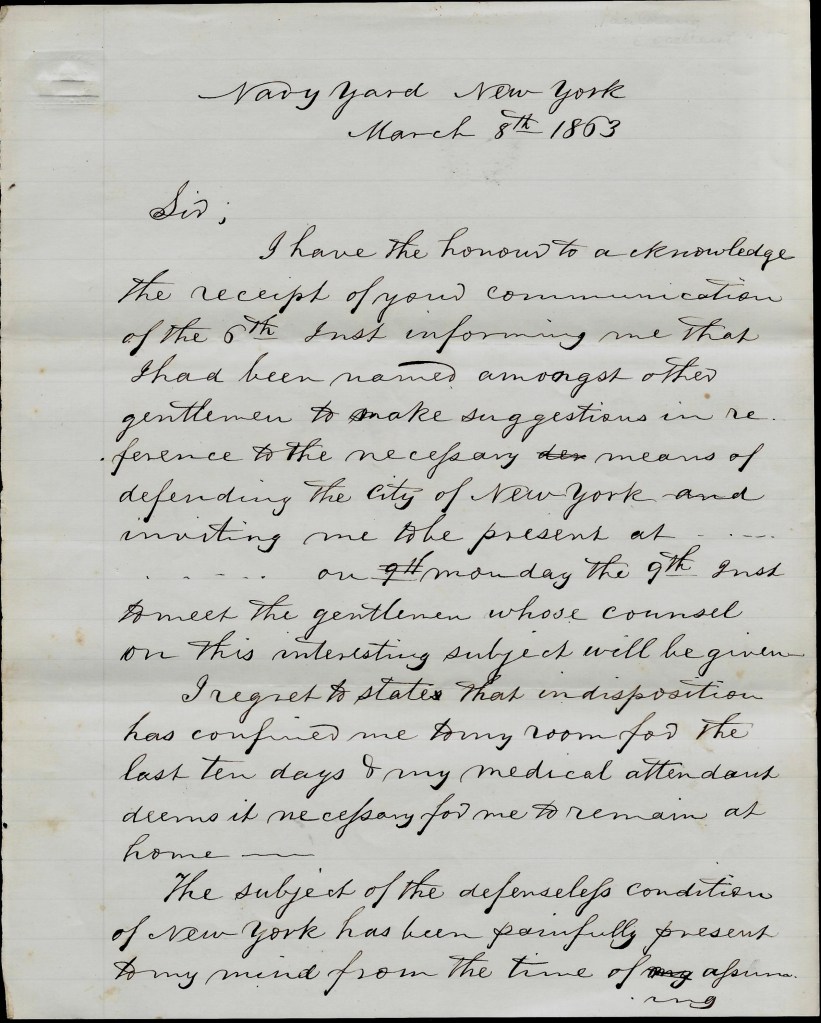

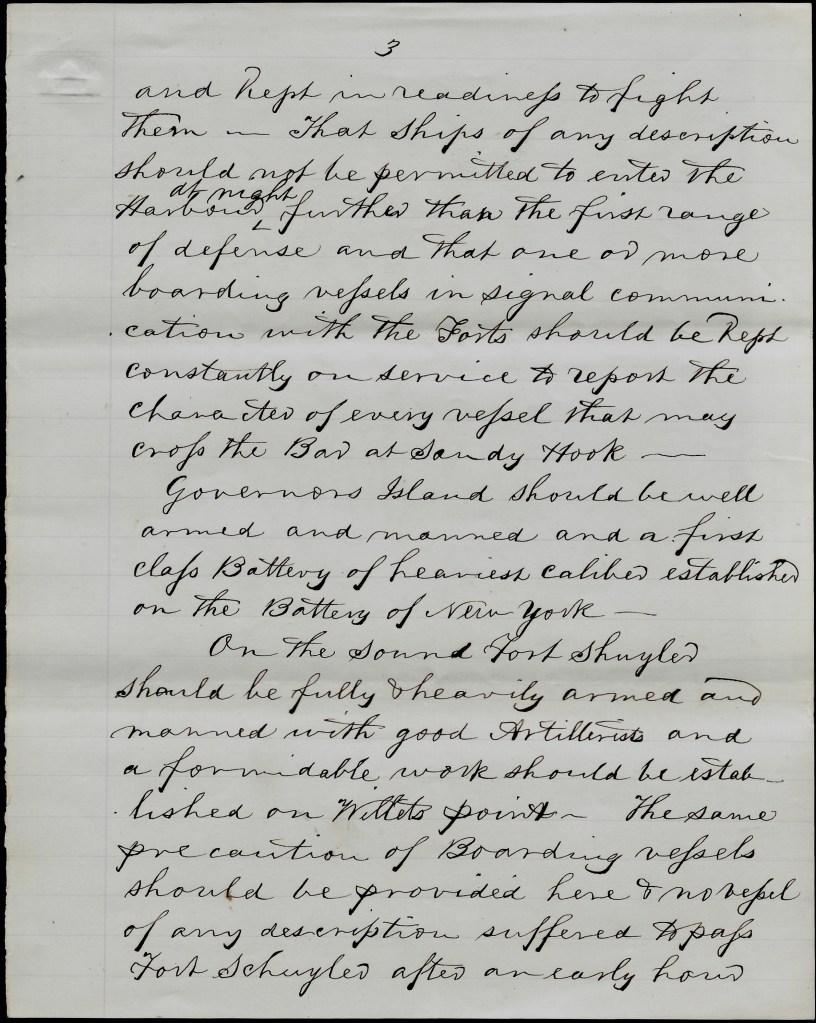

 Spared & Shared 23