
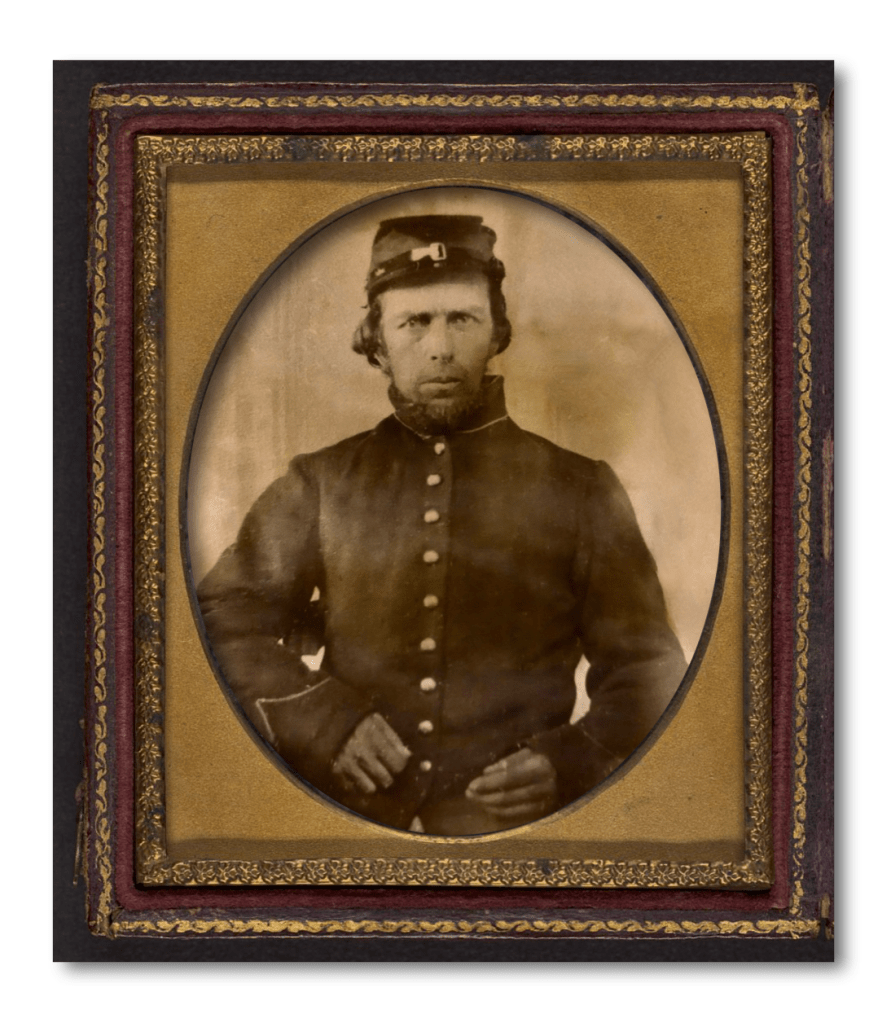
The Civil War Letters of John Hager, Co. B, 110th New York Infantry
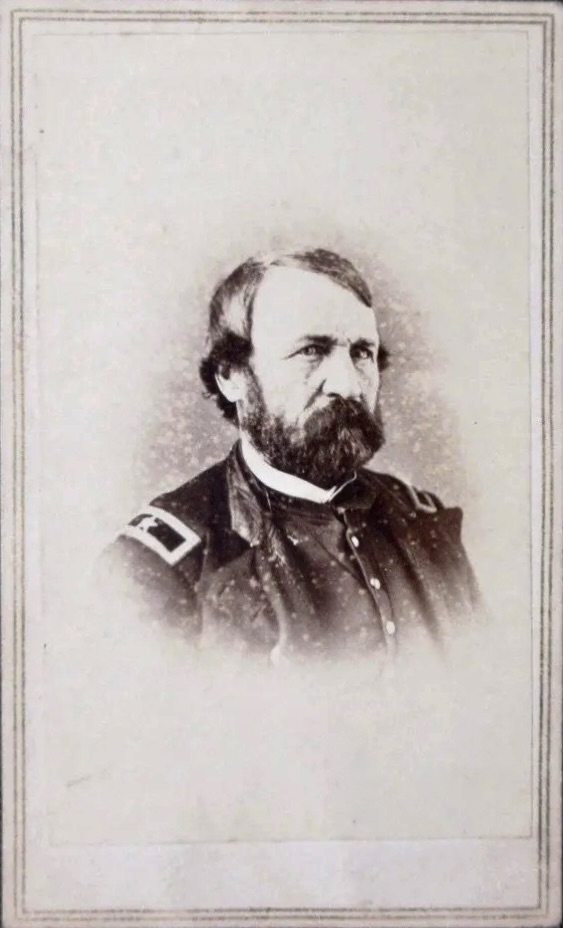
The following 171 letters were made available for transcription and publication on Spared & Shared by Sue Hager, a descendant of John Hager (1829-1897) of Oswego who served in Co. B, 110th New York Infantry during the American Civil War. According to company rolls where he was borne as “Hagar”, John mustered in as a private on 13 August 1862 and mustered out with the company on 28 August 1865 at Albany, New York (3 years, 23 days). The enrolling officer described John as 5′ 7″ tall, with blue eyes and sandy hair.
Letter 30
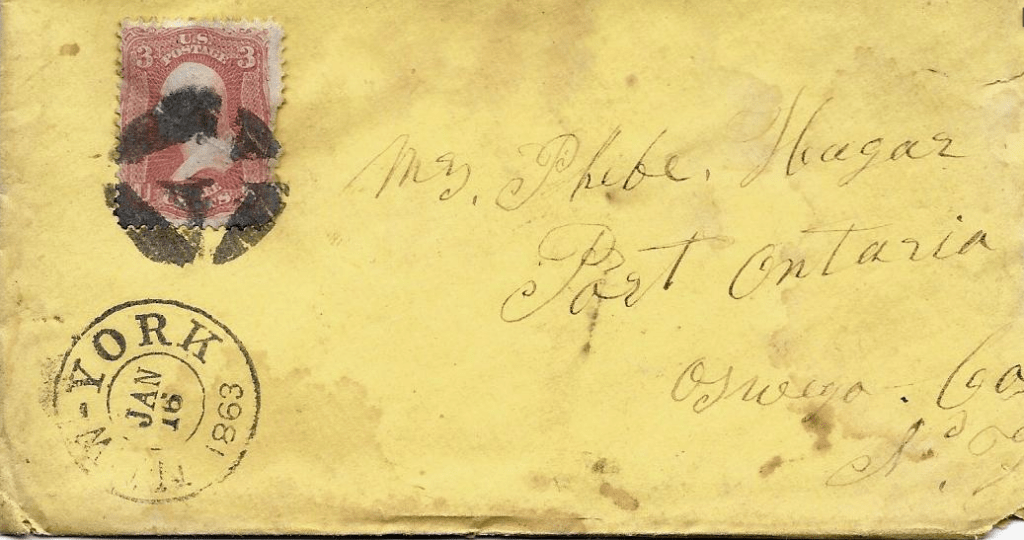
[New Orleans, Louisiana]
January 1, 1863
It is the nicest day for New Years that you ever saw. It is warm and nice as could be. I went down to the river to get some water. It seemed like the Fourth of July to see the little boys a shooting off their fire crackers and to see the gardens all in bloom…
I will tell you what potatoes are worth here—5 cents a pound and onions the same. Flour 12 dollars, sugar 12 cents, apples two for 5 cents, oranges 3 for 5 cents. but I don’t like them very well. I bought a pie for New Years. I give 5 cents for it and a piece of ginger bread. That is what I had extra for today. Everything is five cents here. They won’t take nothin’ less. They never see no pennies here till we come here.
Phebe, I want you to write about the weather there when you get this. And say how you get along a livin’ alone. The boys are in a hurry to get a letter from home and guess that I would like one or two to read about now. It has been 26 days since I have had one from home or anywhere else. You know that is sometime to wait for a letter when I have had them so often. But we can’t help it. I have wrote every chance that I have had to send them. You can see that by the way they’re wrote.
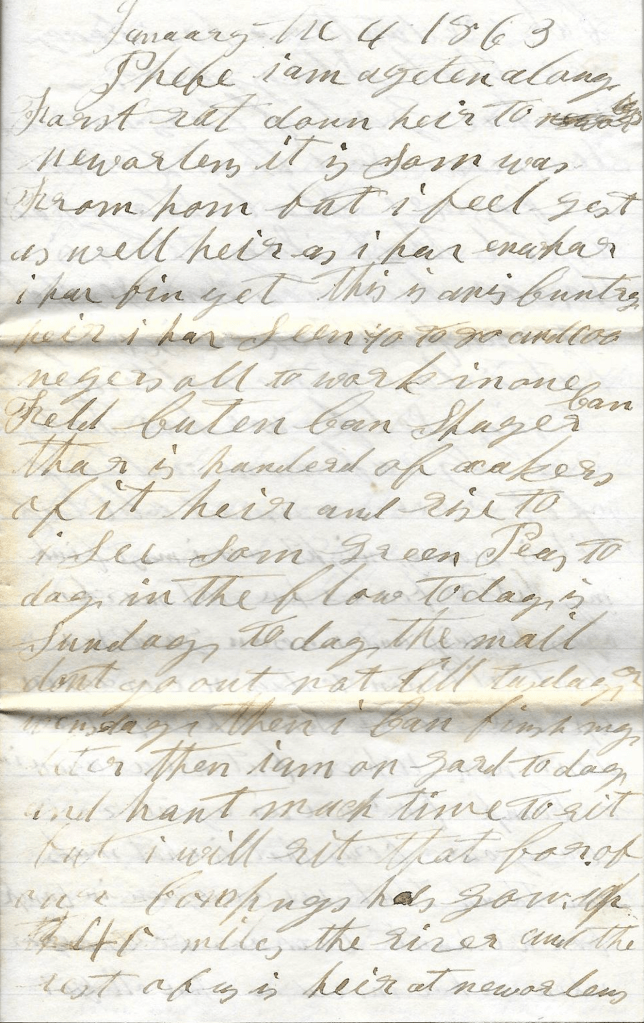
January 4, 1863
I got 5 letters from you yesterday and I will write one to you. I am well at present and hope that this will find you all well at home. Phebe don’t get discouraged. Hold up your head as long as you can. I hope you will get along first rate for I do. I hope you will have what tea you want for I know you like it…
Phebe, I got that dollar that you sent to me. It ain’t worth nothin’ here. They never see no Oswego money here so I will send it back to you. But I han’t got none. When you send any money, I want you should send United States money. That is all the money that is good here. But I would like a little. I think that we shall get some in a month. Then I will send you 20 dollars when I send any. But I don’t know when I shall get any pay. But we have been mustered for it the last day of December. Maybe the paymaster will be here in one week, maybe in one month. Maybe we shan’t get none in two months yet, but I can get along with 5 dollars if you send it to me. That will be enough till I get my pay if I get it in a month. I do hate to send home for any money but I do hate to do without it. But in that, Chet can send it to me if you can’t. But you mustn’t take none but my duty money, then it is good anywhere. They don’t take no other.
January 4, 1863
Phebe, I am a gettin’ along first rate down here to New Orleans. It is some ways from home but I feel just as well here as I have anywhere I have been yet. This is a nice country here. I have seen 70 to 80 and 100 niggers all to work in one field. Cotton, sugar sugar—there is hundreds of acres of it here, and rice too. I see some green peas today in the [flow?].
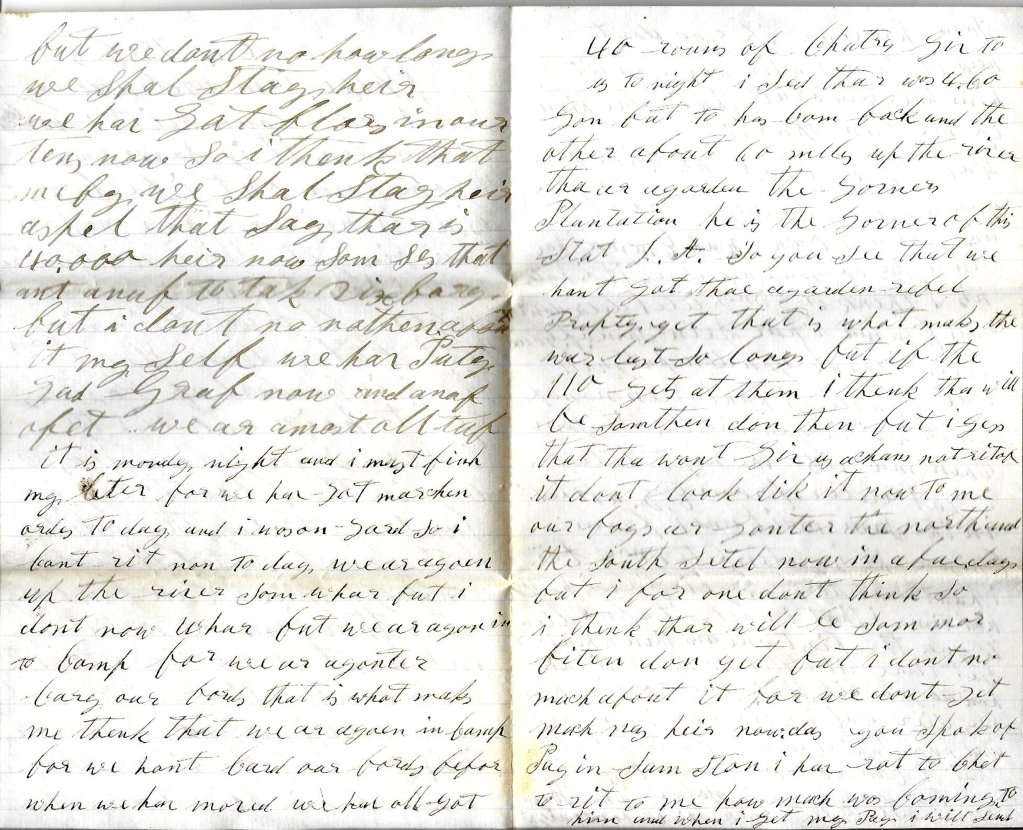
Today is Sunday. Today the mail don’t go out—not till Tuesday or Wednesday. Then I can finish my letter. I am on guard today and han’t much time but I will write that four of our companies has gone 40 miles [up] the river and the rest of us is here at New Orleans but we don’t know how long we shall stay here. We have got floors in our tent now so I think that maybe we shall stay here a spell. They say there is 40,000 here now. Some say that ain’t enough to take Vicksburg but I don’t know nothing about it myself. We have pretty good grub now and enough of it. We are a most all tough.
It is Monday night and I might finish my letter, for we have got marching orders today and I was on guard so I can’t write none today. We are a goin up the river somewhere but I don’t know where, but we are a goin’ to camp for we are a goin’ to carry our boards. That is what makes me think that we are a goin’ in camp for we han’t carried our boards before when we have moved. We have all got 40 rounds of cartridges given to us tonight.
I said there was 4 companies gone but two has come back and the others [are] about 60 miles up the river. They are guarding the Governor’s Plantation. He is governor of this state of Louisiana. So, you see that we han’t got through a guarding rebel property yet. That is what makes the war last so long. But if the 110th [New York] gets at them, I think there will be something done then. But I guess that they won’t give us a chance—not right off. It don’t look like it now to me. Our boys [think] the North and the South [will] settle now in a few days, but I for one don’t think so. I think there will be some more fighting done yet. But I don’t know much about it for we don’t get much say here now-a-days.
You spoke of paying Sam Stone. I have wrote to Chet to write to me how much was coming to him and when I get my pay I will send some home. And if you don’t need it, then I will have you let him have some or all that is due him, if we can spare it.
Well Phebe, I hope this will find you all well and tough, for I be, and right as a buck. Well, Emma, I have seen a piece of your new dress. It is pretty nice. I think it is, my little dear. Don’t you Emma? I have seen some of your writing. I think you done pretty well. Well, Charley, I han’t seen none of your writing. You must write some when Ma writes the next letter. I got a letter from Ezra Whitehead in the same mail and one from Emerson. He is getting fatter now. But I han’t wrote to him yet for I han’t had time. I thought I would write a few lines to you the first one, and then when I get time, write a little to the rest. And how do you like that way of doing things my dear. Well, I will close. I am well and hope that you all be. That is all that I can do for you at present. This from your soldier, — John Hager
To his wife Phebe Hager. This is all for tonight.



Letter 31
Camp Mansfield on the Shell Road
January 11, 1863
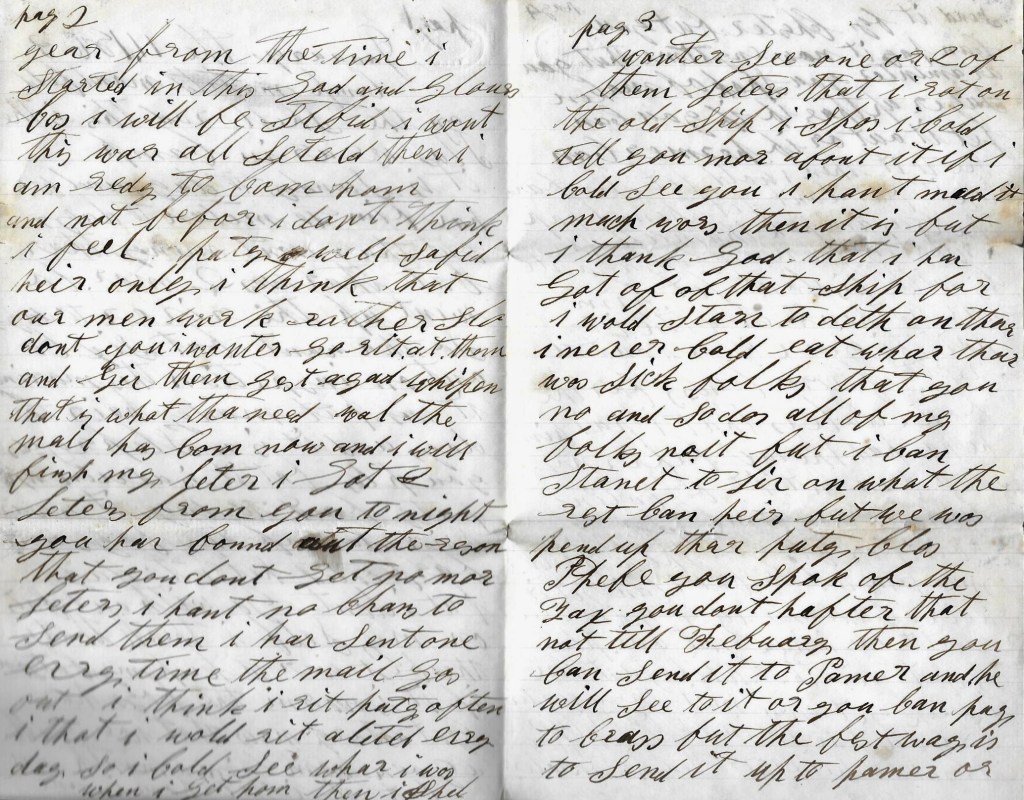
This is the place we are in camp. It is Sunday today and we have been to meeting today. But there wasn’t many there. But there was 2 more companies that went up the river today so there weren’t but six companies out on inspections this morning. It was pretty muddy here today and it is as slippery as you please. But it is a dryin’ up pretty fast today. It is warm here. Some of the boys are barefooted today but I don’t go without boots on myself. I think that is the best—to keep my boots on, [even] if it is warm. The boys have got a story now that we are all a goin’ home in a month or two. But if I get home in one year from the time I started in this good and glorious cause, I will be satisfied. I want this war all settled. Then I am ready to come home and not before. I feel pretty well satisfied here, only I think that our men work rather slow, don’t you? I want to go right at them and give them just a good whipping. That is what they need.
Well, the mail has come now and I will finish my letter. I got two letters today from you tonight. You have found out the reason that you don’t get no more letters. I han’t no chance to send them. I have sent one every time the mail goes out. I think I write pretty often. I thought I would write a little every day so I could see where I was when I get home. I want to see one or two of them letters that I wrote on the old ship. I s’pose I could tell you more about it if I could see you. I han’t made it much worse than it is, but I thank God that I have got off of that ship for I would starve to death on there. I never could eat where there was sick folks, that you know, and so does all of my folks know it. But I can stand it to live on what the regiment can here. But we were penned up there pretty close.
Phebe, you spoke of the tax. You don’t have to do that, not till February. Then you can send it to Palmer and he will see to it, or you can pay to Cross. But the best way is to send it up to Palmer or send it by Chester. But you can pay it now anytime that you are a mind to. You spoke of making sugar up there. If you can get it out, or if Permer [?] can see to it, then I would let Sam [ ] take it. But don’t let them chop the trees and take them all up. What is John Rafer a goin’ to do with his? Don’t let him have nothing to do with it—not this year. You want a receipt from [ ] for the four dollars that I paid him. He has paid the tax before now. You can get it by calling for it anytime that you call for it. You spoke of sending me some tobacco but I can get it here. I han’t used all of that you sent to me. I have got one plug left yet that will last me a week yet. You might try a quarter if you have a mind to but I can get it here 150. They is 2.00 dollars here. Things are about the same here that they are there. I got one letter that you wrote the 21st and [you] didn’t know where to direct it. Now I will tell you where to direct:
To New Orleans, Co. B, 110th [New York] Regiment, Banks Expedition, and it will follow us anywhere we go. I guess they do all come.
Now I s’pose you have got the letter that I wrote for the money. I wrote for 5 dollars. I would like it but I think that we shall get our pay this week. But I don’t know. I s’pose that we shall do guard duty in the city of New Orleans—Provost Guard for the city. If we don’t, we shall go up to the river, maybe up to Vicksburg. I s’pose that is the hardest place there is. The have got boats on both sides for 8 miles. We don’t get much news here.
Well, we shall get some more mail. I close for this time. So goodbye my dear. I would like to write some more but I han’t time now. But I am well and hope this will find you the same.
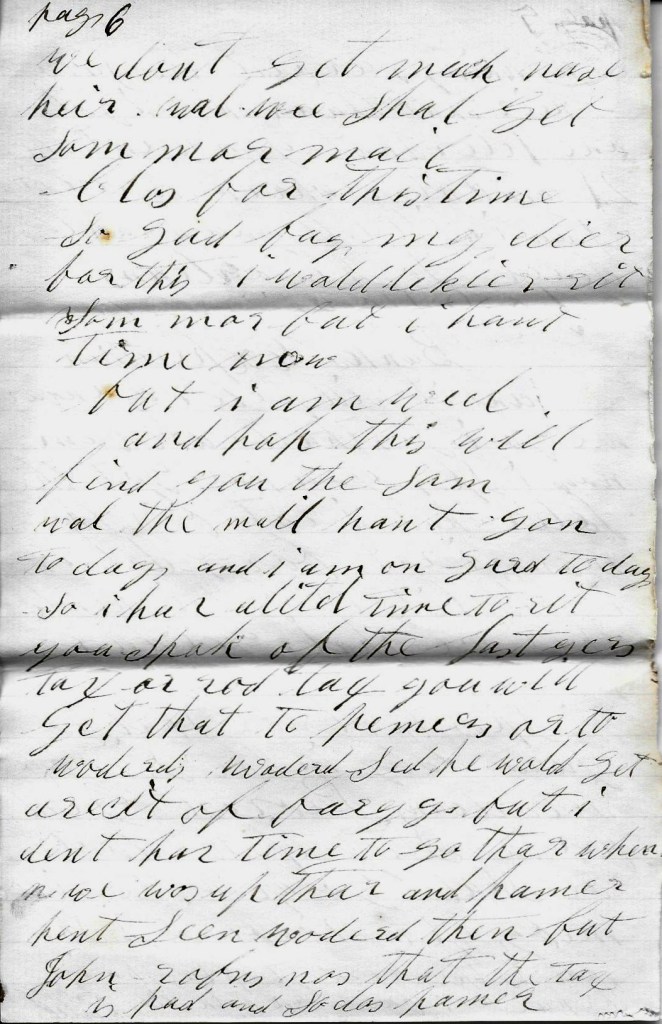
Well, the mail han’t gone out today and I am on guard duty today so I have a little time to write. You spoke of the last year’s tax or road tax you will get that to [ ] or to Woodard. Woodard said he would get a receipt of [ ] but I don’t have time to go there when I was up there and Palmer went and seen Woodard then. But John Rafins [?] knows that the tax is paid and so does Palmer.
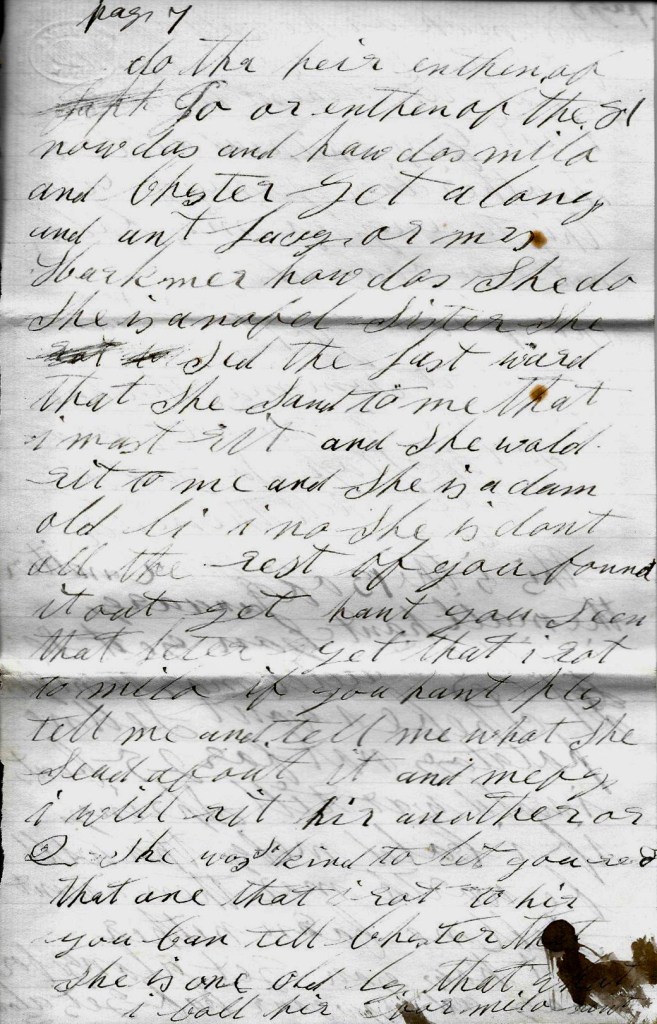
Do they hear anything of Joe or anything of the 81st now-a-days? And how does Milo and Chester get along? And Aunt Lucy or Mrs. Harkimer? How does she do? She is an awful sister. She said the last word that she said to me that I must write, and she would write to me, and she is a damn old liar. I know she is. Don’t all the rest of you found it out yet? Han’t you seen that letter yet that I wrote to Milo? If you han’t, please tell me and tell me what she said about it and maybe I will write her another or two. She was so kind to let you read that one that I wrote to her. You can tell Chester that she is one old lady. That’s what I call her for Milo not write much or he would of wrote. But I don’t care whether they do or not write them they will write. I wrote E[zra] Whitehead a letter the other day. You may read this to any of my folks, not anybody else.
This from John Hager. I would write tomorrow. They have called me to go on guard. So I shall stop. So, good bye my dear, tell them all to write when they a (writer?)
This is the 13 of January. The mail han’t gone out yet so I will write a little more tonight. Phebe, I want sell no potatoes, not for 25 cents. I would wait till spring if I could, maybe they will be worth more then. I want sell no corn neither. Write how you get along for hay and how your calf gets along.




Letter 32
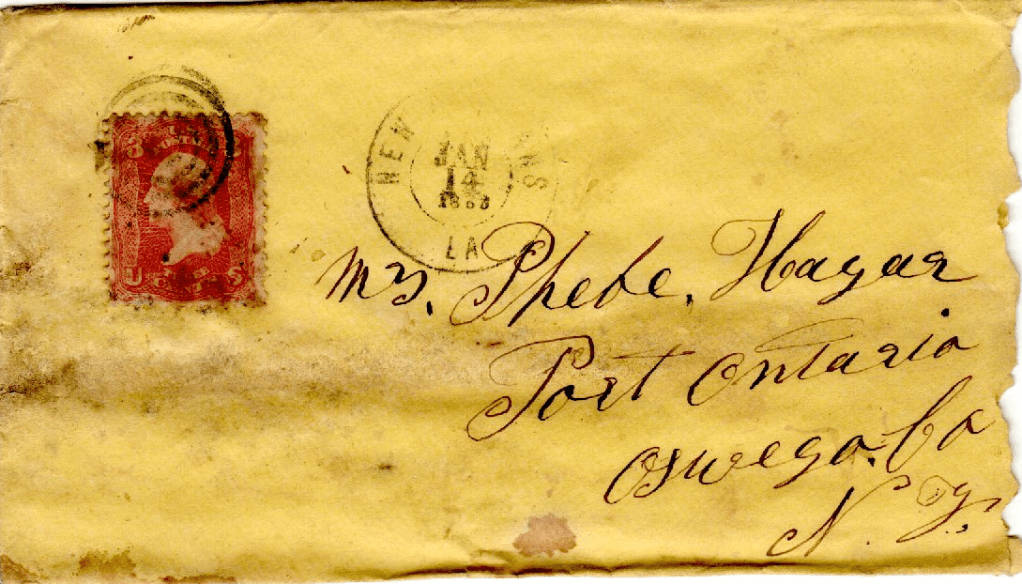
Carrollton, Camp Mansfield, Louisiana
January the 14, 1863
We are here yet and it still rains. This is the first day that it has rained so we can’t drill. But this is a stopper today, so we will sit in our tents and talk about putting the rebels down. If talking would do it, it would have been done before now. But we have some good times here and we live pretty well here—a good deal better than I expected we should. We all have got a good appetite. I drink coffee now. We have 1 pound of sugar for 10 days rations. We can put it in our coffee or eat it on our bread. I drink mine. I eat some on my bread for I think it is better than to eat so much grease. We have plenty of that.
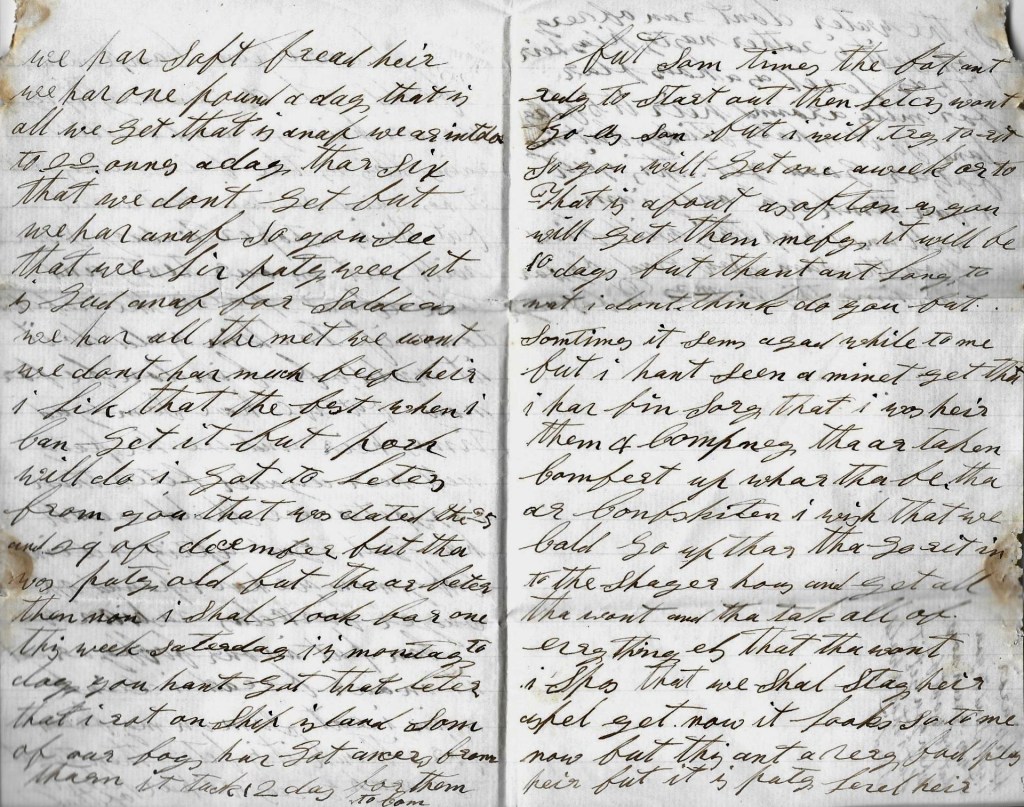
We have soft bread here. We have one pound a day—that is all we get. That is enough. We are limited to 22 ounces a day. There is six that we don’t get but we have enough. So you can see that we live pretty well. It is good enough for soldiers. We have all the meat we want. We don’t have much beef here. I like that the best when I can get it, but pork will do.
I got two letters from you that was dated the 25th and 29th of December but they was pretty old. But they are better than none. I shall look for one this week Saturday. It is Monday today. You han’t got that letter that I wrote on Ship Island. Some of our boys have got answers from there. It took 12 days for them to come, but sometimes the boat ain’t ready to start out; then letters won’t go as some.
But I will try to write so you will get one a week or two. That is about as often as you will get them. Maybe it will be 10 days but that ain’t long to wait, I don’t think—do you? But sometimes it seems a good while to me. But I han’t seen a minute yet that I have been sorry that I was here. Them four companies, they are taken comfort up where they be. They are confiscating [property]. I wish that we could go up there. They go right in the sugar house and get all they want and they take all of everything else that they want. I s’pose that we shall stay here a spell now. It looks so to me now, but this ain’t a very bad place here, but it is pretty level here.


Letter 33
[Carrollton, Camp Mansfield, Louisiana]
January 15, 1863
Ever dear friend, I now take my pen in hand to let you know that I am well and I hope this will find you the same. I think that the 110th [New York] can do something to putting this rebellion down if they have a chance to. But I think that Co. D. C. Littlejohn will do his best to keep us back as long as he can. He did keep us from Harpers Ferry. He done that up pretty nice. We would of all been taken prisoners there for we hadn’t drilled—not a bit then. I do think that we are pretty well drilled now. Maybe we shall have a chance to do something, but I do not think that we will get in any fight as long a Col. Littlejohn stays with us. I am a little afraid he will leave us but I don’t know whether he will or not. But all I have got to say about it is, I hope he won’t leave us—not till the war is over. But not because I am afraid to go into battle, because I am ready every time, and I am rather anxious to do something to put this rebellion down, and it must be done, and I hope it will be done and that pretty soon if possible for it is a costing a good deal to carry this war on now, I tell you.
Today is the 16th so I will write a few lines tonight. George—he sent one today and I didn’t have mine done, but I s’pose you will get two or three at a time. We heard that there was another late mail for us. We have been here three weeks now and we have had the mail twice. I don’t know whether there is any for me yet in this yet as not but I think pretty likely there is, for I most always have one or two when the mail comes.
Well, I han’t got much to write this time but I have got a little to write. You said you wanted I should write it all. I can’t do that, but I will write some of it. We had orders last night to be ready to march at a minute’s notice with 100 rounds and our guns, today’s grub in our haversacks, and leave our knapsacks and our blankets in our tents. We was a going to Baton Rouge. That is 70 miles up the river. But we han’t gone yet and I don’t know as we shall go. We han’t got our pay yet. If we stay here a few days longer I think we shall get it, but maybe not. We have been out a drilling today. They put us right through on a double quick most all day. It has been a cold day.


Letter 34
January 20, 1863
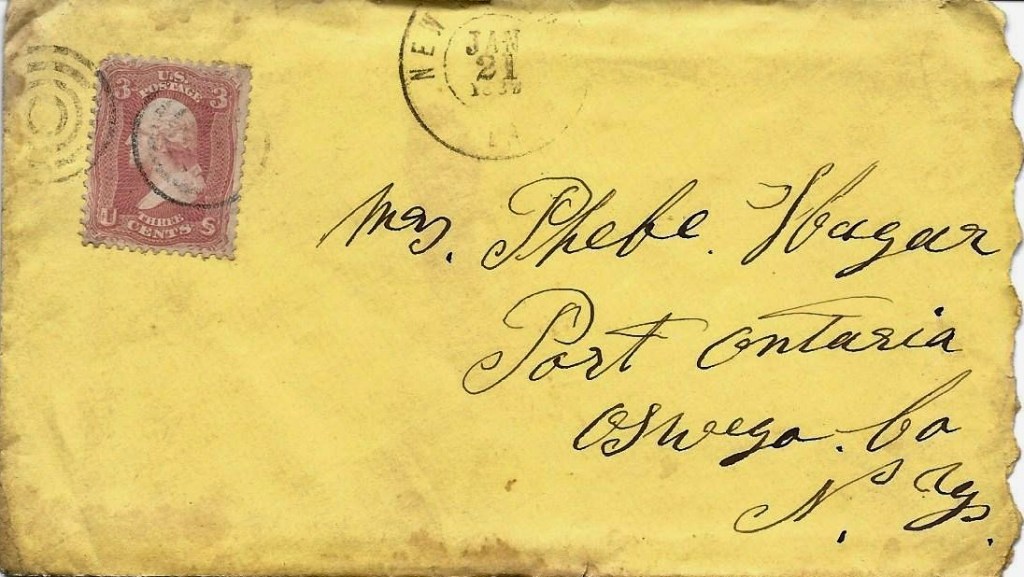
Mrs. Phebe,
I will write a few lines to you. We are here yet but the talk is now that we are a goin’ to Texas. But maybe we shan’t.
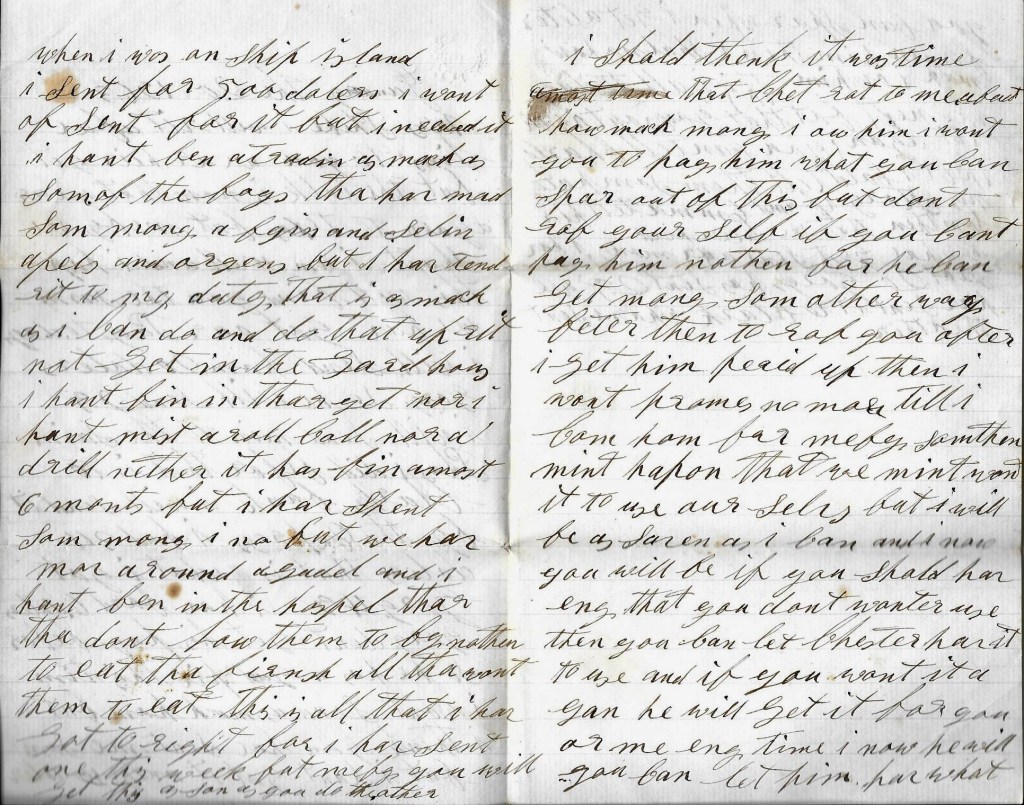
I am well and I hope this will find you the same. We have got our pay today. I will send home 20 dollars. George says he will send 25. I will send mine to the same place I did before—that is to Clark’s bank. I will send it by the Express. I had 34 dollars—that is what I got. Geore [got] 48. I have borrowed 6 dollars. George didn’t get his pay before so he has a good deal this time. I won’t send as much home but I think you have sent me some but I han’t got it—only $1 when I was on Ship Island. I sent for $5. I wouldn’t of sent for it but I needed it. I hain’t been a needin’ as much as some of the boys. They have made some money a buying adn selling apples and oranges but I have tended right to my duty. That is as much as I can do and do that up right [and] not get in the guard house. I haven’t been in there yet, not I hain’t missed a roll call nor a drill neither.
It has been almost 6 months. I have spent some money, I know, but we have moved around a good deal and I hain’t been in the hospital. There they don’t allow them to buy nothin’ to eat. They furnish all they want them to eat. This is all that I have got to write for I have sent one this week but maybe you will get this as soon as you do the other.
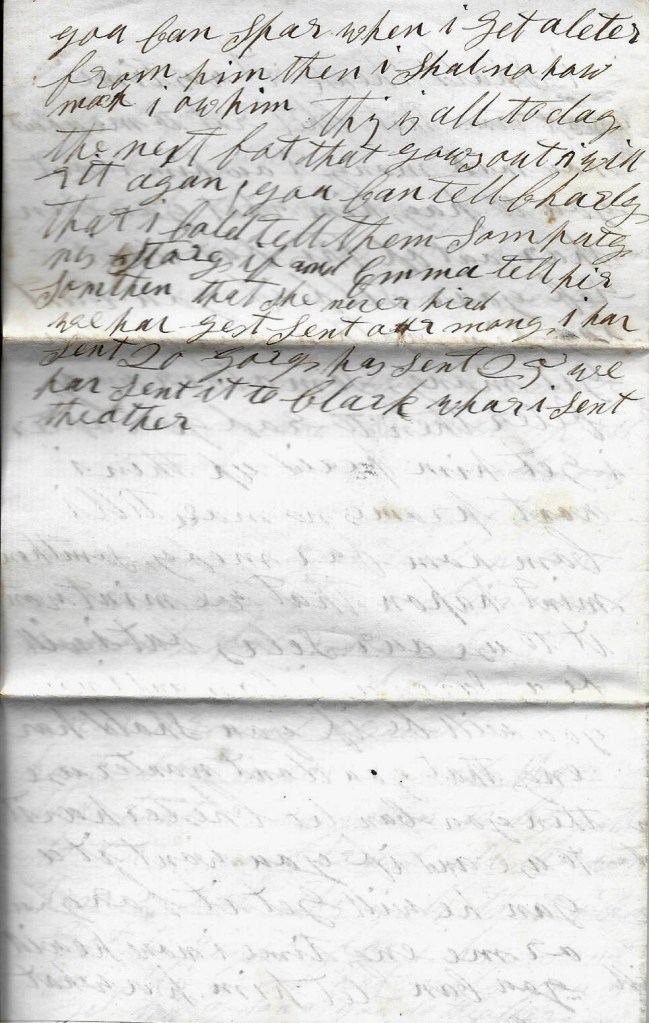
I should think it was time that Chet wrote to me about how much money I owe him, I want you to pay him what you can spare out of this but don’t rob yourself if you can’t pay him nothin’ fr he can get his money some other way better than to rob you. After I get him paid up, then I won’t promise no more till I come home for maybe something might happen that we might want to use ourselves. But I will be as saving as I can and know you will be. If you should have any that you don’t want to use, then you can let Chester have it to use and if you want it again, he will get it for you or me any time, I know he will. You can let him have what you can spare. When I get a letter from him, then I shall know how much I owe him.
This is all today. The next boat that goes out I will write again…

Letter 35
[Carrollton, Camp Mansfield, Louisiana]
January 22nd, 1863
I got a letter today that you wrote the 7th. It was a pretty small one. It had 50 cents in it. I am glad to hear that you are all well. Yours found me well and tough. Phebe, I don’t want you to send me no tobacco for I can buy it here. It ain’t but $1.25 to 1.50 here so you can see it won’t pay to send it to me. Phebe, don’t send me nothing—only what I ask for [and] that will be enough. I sent for 5 dollars and you sent me 50 cents. But I got my pay two days ago so I got along pretty well for money. But I can’t do without it—not very well—but I did after a spell.
I thought that John Robbins had got a discharge. 1 That is the way I read it in one of the letters that you wrote to me. I thought that he had run away all the time. I knew he was not stand right up to the rack like a man. Everybody knew he was a coward. He could talk and that is all he can do. That is what we all know.
You want I should write where Byron [Douglass of Co. K] is and how he gets along. The morning that he went up the river, I seen him. He was well then. I talked with him, asked him where they was a going He said they was a going up the river too. That was all he knew about it. But I heard today that they had got a good place there. They are doing guard duty there. They are in barracks there. Their tents are here yet their company is the Color company and we are next to it now for we have got changed around so their tents are right by the side of ours now. So when he was here, I seen him every day.
I haven’t much news to write this time—only you spoke of a funeral there. We had one here today. This man was in Co. H. I don’t know what his name is now. He had the measles. That is 4 in 10 days. That is all we have lost here. We all went to the funeral. I tell you we all look nice for we was all dressed alike and all walk alike. We formed a hollow square. Then after preaching was over, we all went to the grave. There was 24 guns fired over his grave. He had a good coffin and was well buried. We have got the best colonel that there is in the whole world, I think. I don’t know what you think there. I can’t think of nothing to write tonight.
You don’t say whether you got that letter that I wrote on Ship Island or not. I sent you 20 dollars yesterday. I paid 40 cents to have it insured and to send it and I only got this little small letter. I thought that I should get one from Chester but I haven’t yet. Old Herkimer—I don’t look for none from her now. This is all tonight so I will say goodby my dear.
It is morning now and I will write a little more. I will ask if Mr. [ ] talks as much as he did, and what does Albert say about the war now? I don’t think that John has got many friends for he will be called a deserter now. Let him go where he will. I would like to have some of them Secesh folks here in this camp. We could fix them in a hurry.
1 John A. Robbins—Age, 28 years. Enlisted,August 8, 1862, at Richland, to serve three years; mustered in as private, Co. B, August 13, 1862; transferred to One Hundred and Forty- seventh Infantry, August 22, 1862; also borne as Ribbins.


Letter 36
Camp Mansfield, [Louisiana]
January 24, 1863
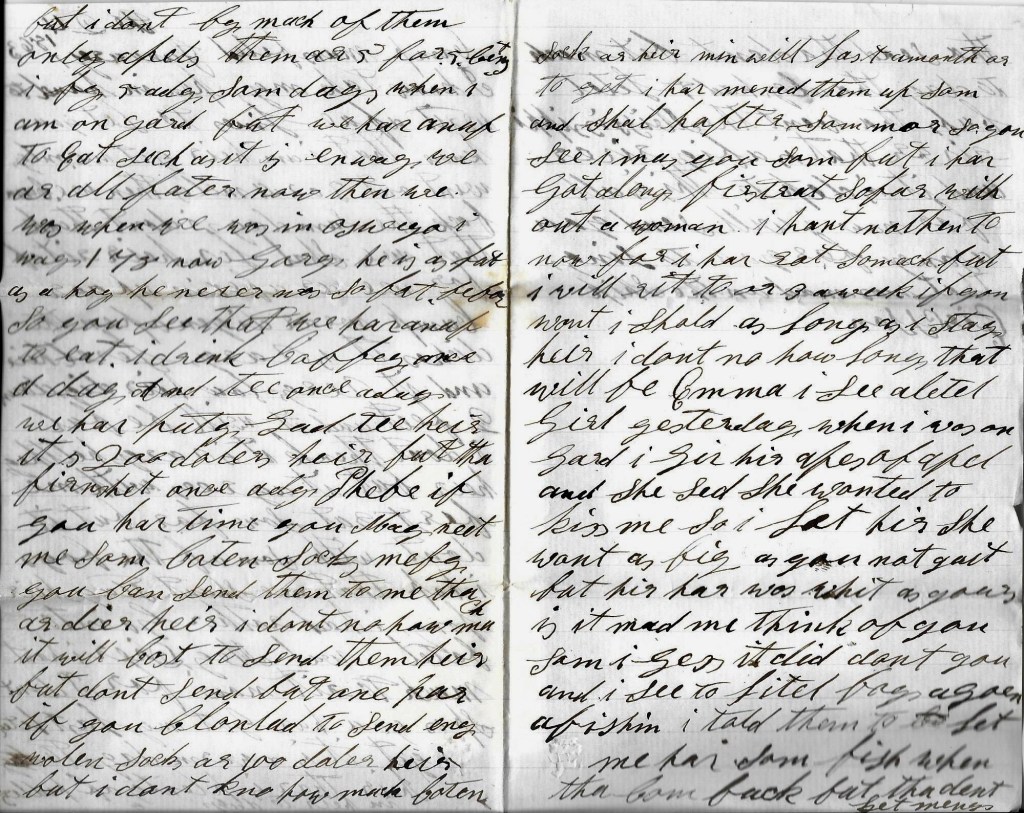
I now take my pen in hand to write a few lines to let you know that I am here yet. We only went out 3 or 4 miles. Then we came back the same day. I don’t think that we shall leave here right off for we are a fixing up our camp. We are digging open the ditches. It is very level here and it’s very low here. Dig down two feet and it will be full [of water]. I don’t think it is very healthy here but it agrees with me first rate so far. But it don’t with some of the boys. I hope that we shan’t stay here long. I had rather go into battle.
Well my dear I haven’t much to write now for I don’t s’pose you have got my last letter yet. It is a warm day today here. There is plenty of peddlers in here today but I don’t buy much of them—only apples. They are five for 5 cents. I buy five a day some days when I am on guard. But we have enough to eat, such as it is. Anyway, we are all fatter now then we was when we was in Oswego. I weigh 175 now. George—he is as fat as a hog. He never was so fat before. So you see that we have enough to eat. I drink coffee once a day and tea once a day. We have pretty good tea here. It is $2 dollars here but they furnish it once a day.
Phebe, if you have time, you may knit me some cotton socks. I don’t know how much it will cost to send them here but don’t send but one pair if you conclude to send any. Woolen socks are 1 dollar here but I don’t know how much cotton socks are here. Mine will last a month or more. I have mended them up some and shall have to some more so you see I have got along first rate so far without a woman.
I haven’t nothing to write now for I have wrote so much but I will write two or three a week if you want. I should as long as I stay here. I don’t know how long that will be. Emma, I seen a little girl yesterday when I was on guard. I give her a piece of apple and she said she wanted to kiss me so I let her. She wasn’t as big as you—not quite—but her hair was white as yours. It made me think of you some, I guess it did, don’t you? And I see two little boys a goin’ fishing. I told them to let me have some fish when they come back but they didn’t get many. They said they didn’t bite much today. They went the Mississippi river. That is a big river and it is deep too. That is all for now. I will send you a song for you to sing that was made on the Ship Ericsson.

Letter 37
January 26, 1863
I received four letters—one that you wrote when you was out to Shirley and another that had that plug of tobacco in, and anther that had 55 cents in it. That is $1.55 that I have got from you but I guess I have got enough now for it won’t be long before we shall get our pay…
John Robbins has finally got clear at last, but he is aboard and we hain’t got many secesh men as he in our company and I am glad of it… We have got a good captain. he is a good boy. He was our 1st Lieutenant. I s’pose you know who it is.
It has been a very warm day here today. It made us sweat some today, now you had better believe that. But I stood it first rate.
You wanted I should write just as it was here. Well I have wrote something about it adn maybe I have made it worse than it was. If I should write that I didn’t have enough to eat and you should see me, then you would know that I had lied about it for we are all gettin’ fat as hogs here. So you see that we have enough to eat and you know that we have a good place to sleep but it ain’t soft as some folks have at the North but it does first rate for me. If you could see George and me, then you would think that we fared pretty well here.
You say keep up good courage that hain’t failed me—not a bit. But I think of home some when I hear of one dying. That makes me think of it more than ever.
When we went off the other day on that long march the brigade was all together then—4,000 of us. One of the Massachusetts boys…

Letter 38
[New Orleans, Louisiana]
Jan. 29, 1863
My ever dear wife,
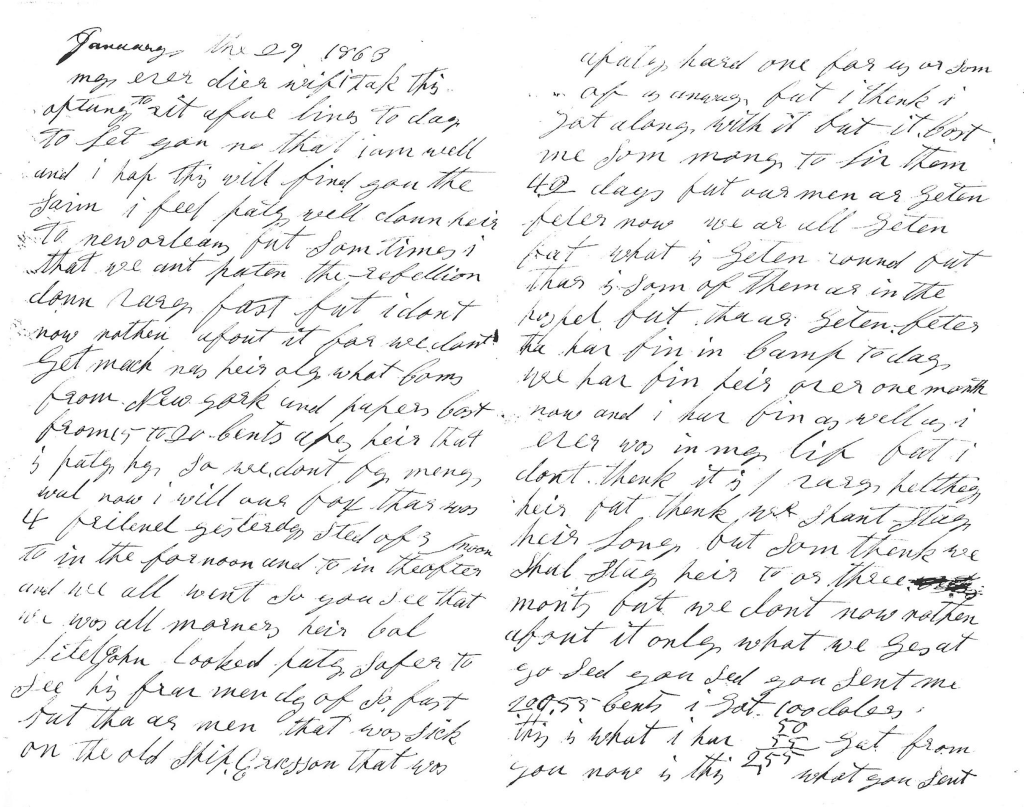
I take this opportunity to write a few lines today to let you know that I am fine and hope this letter finds you the same. I feel pretty well down here to New Orleans but sometimes I don’t think we are putting the rebellion down very fast. I don’t know nothin’ about it for we don’t get much news down here—only what comes from New York and papers cost 15 or 20 cents here. That is pretty high so we don’t buy many.
Well now, I will say there were 4 funerals yesterday—two in the forenoon and two in the afternoon. We all went so you see we were all mourners here. Col. Littlejohn looked pretty sober to see his men die off so fast. But they were men who was sick on the old Ship Ericsson. That was a pretty hard one for us, or some of us anyway. I got along pretty good but it cost me some money to live them 42 days. Our men are gettin better now. We are all gettin fat—them that is gettin’ around. There is some still in the hospital but they are gettin’ better. They was in camp today. We have been here over 1 month. I have been as well as ever in my life. I don’t think it is very healthy here. They think we shant stay here very long. Some think we shall stay 2 or 3 months. We don’t know nothin’ about it—only what we guess at.
You said you sent me 2.55. I got 1.00 This is what I got from you. It’s 6.29 cents that Chester has got to pay that 3.00 note. So you see it wont take 6.00 to pay it but I borrowed a little money of him. He will tell you how much it was. This is all for this time. If there is anything I haven’t answered tell me and I will. This from John Hagar to his friend and wife God bless you
Jan. 30, 1863
Co. K has got back. They came last night. I have seen Byron and he is well, fat as a bear. You wouldn’t hardly know him. He says they had a good time up there They didn’t have nothin to do and they had all the sugar they wanted and once in a while they had a little [ ] to eat. Ganston says he won’t write nothin’ about anybody dying here but I must because I promised you I would tell you all the truth about it here. Maybe I have left some of it out, when we were on the old Ericsson Boat. We have got along with that and now we are here in New Orleans.
We have a good deal of guard duty to do here so it keeps us out of trouble. I would rather do guard duty as to drill all the time. I haint got homesick yet. I don’t think I shall. That is all so good by my dear. God bless you.
Letter 39
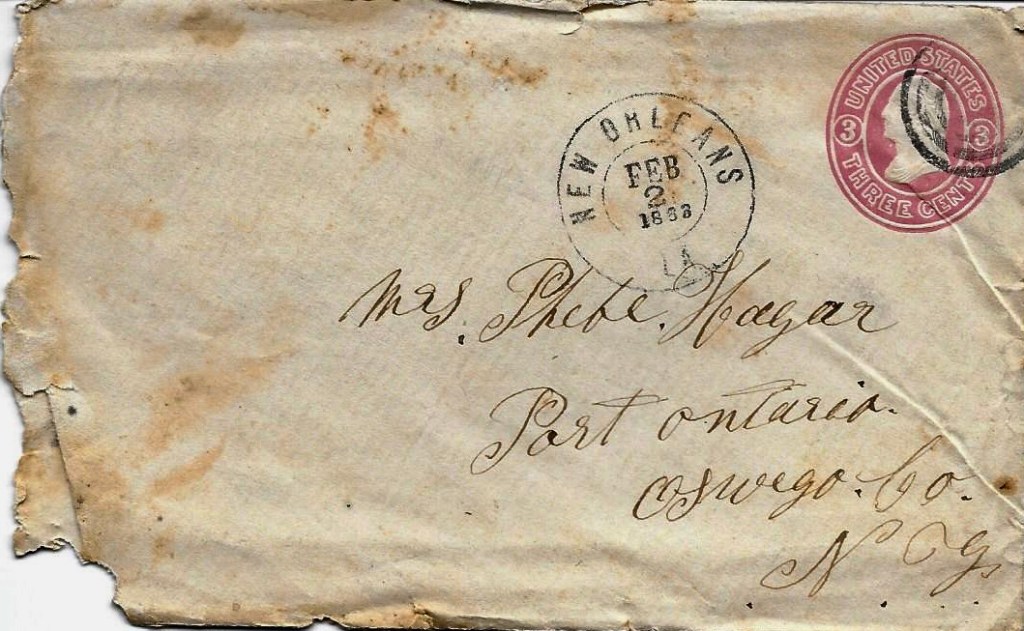
February 1, 1863
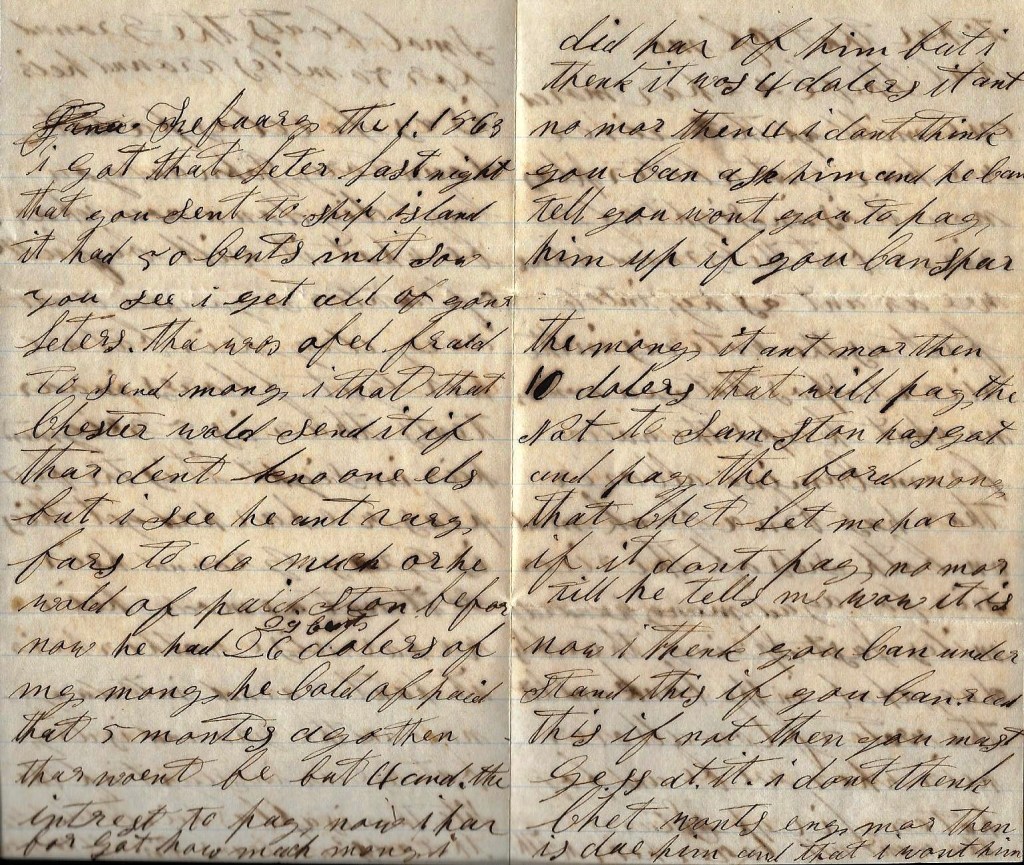
I got that letter last night that you sent to Ship Island. It had 50 cents in it so you see I get all of your letters…
Well, Phebe, we have moved one mile up the river. We have got a better place now. It is in sight of the river but the ground where we are ain’t as high into 6 feet as the water is in the river. I suppose that you want to know what keeps the water from coming all over. There has been a bank [levee] made on both sides of the river here for a good many hundred miles. Last spring, the rebels dug a hole in the bank and let the water flow all over here where we be and folks have to fix up stairs. They went all over here with small boats. The ground for 50 miles around here is a level, flat country. You can’t dig down no where but what it will be full of water. So you see, it ain’t very dry here. But we have got floors in our tents.
There is five regiments here in sight. It is the best place we have had yet. There is grassy ground here so it ain’t muddy. We have nice weather here. It ain’t rained in two days now and the ground is dry. But we are in sight of the city. There is a place called Delta. That and New Orleans in all together.
I have got back from the funeral. It was one of Co. C men that was buried today and tomorrow [Danford] Claflen will of be buried that is out of Co. B. That is all we have lost yet. Jason [Wright] says we mustn’t say nothing about his being sick. He is a good deal better tonight. But I have got it wrote now so I will send it. But you won’t read it to nobody. Then there won’t nobody know but you. I wouldn’t send it but I haven’t no time to write tonight and the mail is a going in the morning to New York.
You see I haven’t made my “f” like that. I am glad you told me how to make them. Is this the way, “f”? You can tell Chester he called it about as well as I could. His wrote with a pencil and wasn’t more than half written at that. I know mine ain’t half wrote but you can make some of it out. If you can, then it will do pretty well.
You said we must be sparing of paper and write fine so I will try it but George is writing so I can’t hardly see the lines tonight. I wrote Charles Smith a letter the 30 of January. I sealed it up but I hant sent it yet. But I shall in the morning. I am a going down to New Orleans tomorrow to see the City. All the rest of the boys has been down.
Phebe, I thought I could fill this sheet when I first began but I can’t think of nothing hardly to write but I will that. I hope you won’t fret and stew about me till you will make yourself sick. There ain’t no use of borrowing any trouble about me for I get along first rate here and I hope you will there. We have had some cold night here but they say we won’t have no more this winter.
There is lots of pedlers here every day. They are all knocked up as big as they can tumble. Their men is in the rebel army—most of them. Damn ’em. I won’t buy nothing of them. They want to make all the money but they hain’t made much out of me. I have bought some apples. Them won’t hurt nobody. I think now that I shan’t buy nothin’ more of them. I don’t mean they will make much out of me. They don’t like me very well for I call them rebels. They come around here a beggin’ bread. When the little children come, then I give them some, for we have more than we can eat. But [when] them secesh women come around, it makes me mad to see them. This is all I can write.
Jason [Wright] is a little worse tonight so I will stop. I think I shall get a letter tomorrow, then I shall have more to write. So as long as I ain’t there to go to bed with you, you will have to sleep alone. I am sorry for you but I s’pose that don’t do you much good. I s’pose you feel so you would like a man by this time. I think I could sleep with you tonight. It would do me some good, don’t you think it would? But that can’t be—not tonight. So I will say good night. This from your friend, — John Hager
To his wife, Phebe Hager.


Letter 40
February 4, 1863
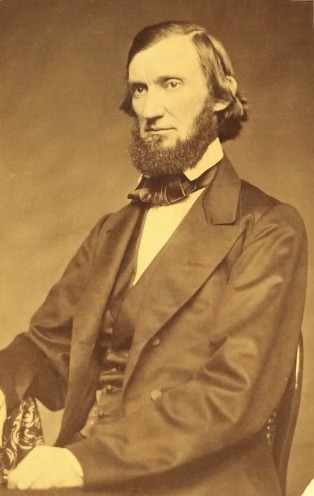
Today Col. Littlejohn made his last speech to us and he has gone home. He started from New Orleans this afternoon. He made us a first rate speech. He said he could do more towards putting his rebellion down in Congress than he could in the field. He said that Col. Sage could do as well here as he could if he stayed and he has got to be at Washington. He thinks that he can do something towards settling [things]. He told us all about how he pledged himself to stay with us till the war was settled. I tell you, some of our [men]—they swore if he went home, they would follow him and they said they never would vote for him again. But now, after he made his speech, they say it is all right now. I don’t think there is a man in the whole regiment but what thinks just as much of him as they did when we started from Oswego and you all know we all liked him first rate then and I like him better now. But I did hate to see him leave us as bad as I would if it had been my own brother.
But Phebe, if it wasn’t for so many damn Rebels there at the North, this war might of been all over long ago. But there is lots of them all over the world. Only let all of the soldiers go right in and kill and destroy as fast as we get to them—that is what would end this war right up in a hurry. But our folks, they want to try to save too much of the rebel’s property. But I am afraid it never will be settled in the world at this rate. We will go on and take small places. Then we have to send three or four regiments to guard that for the Rebels. I say damn ’em. If I had them to deal with, I would burn and destroy as I went along. That is the Yankee’s way to settle with them. That is the only way we can conquer, I think. That is one great reason that D. C. Littlejohn think he can do more at Congress than he can here. He has been here now and he knows how the thing is a goin’ and if I had of known that, I never would of come here. But I am here and I shall do the best I can. It is all a speculation this whole war and nothing else. But I am here and I shall stay and help fight it out. I don’t think I shall ever desert my regiment.
I have had a chance to enlist into a cavalry [regiment] 1 that they are gettin’ up in New Orleans. Banks has called for 12 men out of five regiments each to furnish 12 men. There has 12 gone. Ben Ridgeway has gone for one. There has two gone out of our company—[Elisha] Daniel Beardsley and Charles Prodolliet. He lives in Albion. He don’t live but a little ways from Garner’s. He is a good soldier but I thought that I won’t go. I will stick by my one company as long as I can, I guess. That is the best way for me, don’t you [think]? But if you think it is best, I will go into thhe horse company. I think I should like it full as well. I must stop, I guess. I have wrote more now than you can read. So goodbye, my dear.
1 The cavalry regiment was the 1st Louisiana Cavalry.


Letter 41
February 5, 1863
To Mrs. John Hager,
I will tell you how we are gettin’ along here. Our sick is getting better now. Bill Weed has got well. He went out on drill today for the first time since we left Ship Island—over 40 days [ago].
We have just got another mail. It came on another boat. I got 45 cents in it. I see you han’t got that money yet but I guess you will get it… I am glad you are all well there. You mustn’t let Charley go with wet feet in wet weather. You had ought to keep him to home. You don’t let Emma go to school this winter, do you? I would not let her go this winter but if it ain’t too cold, then Charles can go if he feels tough and well. If not, then I would keep him at home. How do you get along for feed for your cow and calf? Hay is worth 8 dollars in Pulaski so you had better buy some. Who feeds your cow? You had better stop her some for she is used to it in the spring…
I must say that I have been in the service 6 months now and I han’t lost one day nor [missed] one roll call yet. So you can see I have been pretty tough. I have had the shits—have for two weeks now, but I have done my duty all the time yet. I have got over it now. Some of our boys did get discharged for our boys died off so fast… I feel about the same [as] I have all the time. I hain’t been homesick yet—not one minute. But I would like to see you all once more before I die if I could.
Did Emma get those shells that I sent when I was on Ship Island? I sent her one since I have been here if it ain’t got broke. It is only one but that was a most God forsaken place that ever was in the world. And this ain’t none of the best of places but I can stand it if the rest can. I left off drinking coffee and goin’ to drink tea. That is good for the shits and it done me all sorts of good. I drank it pretty strong. I think you had better drink tea. I shall have to stop of drinking tea now for it cost so much but I want you to drink it. I don’t think you can do it though.
Well, I must close… This from John Hager
To Phebe Hager, his wife. Goodbye.


Letter 42
February 8, 1863
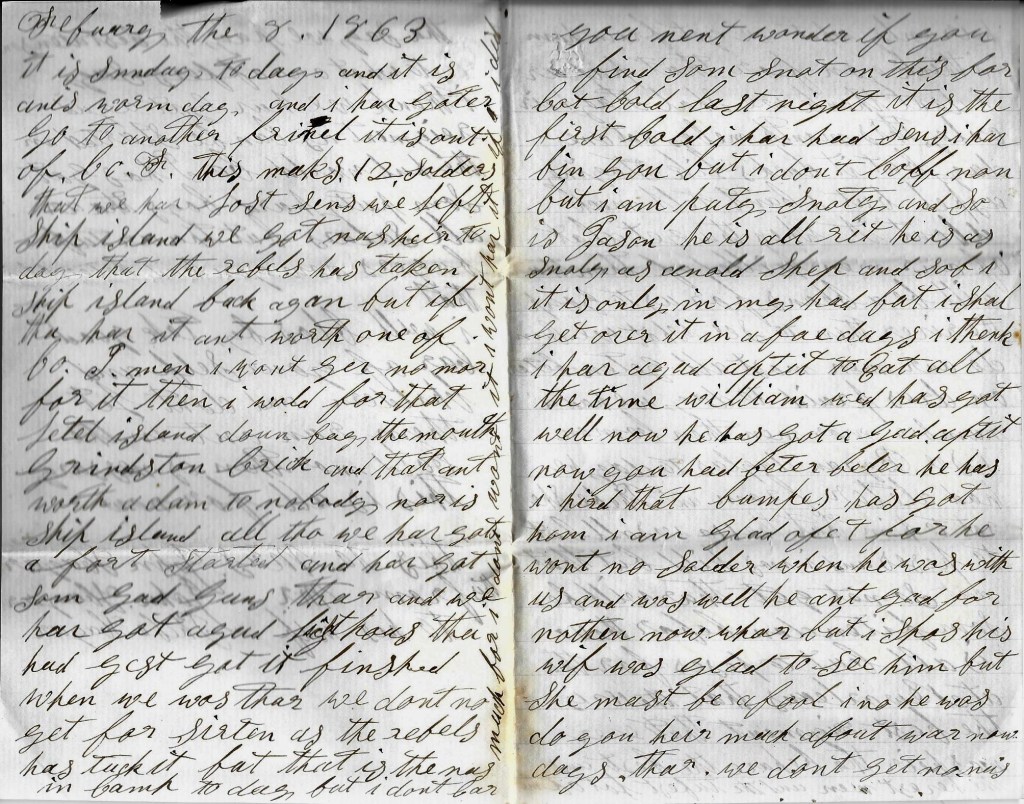
It is Sunday today. It is a nice warm day here. I have got to go to another funeral. It is out of Co. F. This makes 12 men we have lost since we left Ship Island.
We got news here today that the Rebels have taken Ship Island back again but if they have, it hain’t worth one of Co. F’s men. I wouldn’t give no more for it than I would that little island down by Grindstone Crick and that ain’t worth a damn to nobody. Nor is Ship Island although we have got a fort started and we do have some good guns there. And we have a good light house. They had just got it finished when we was there. We don’t know yet for certain as the Rebels has took it but that is the news in camp today. I don’t care much for I don’t want it. I wouldn’t have it if I did.
You won’t wonder if you find some snot on this for I caught cold last night. It is the first cold I have had since I have been gone but I don’t cough now but I am pretty snotty. So is Jason [B. Wright]. He is all right. He is as snotty as an old sheep and so am I. It is only in my head. I shall get over it in a few days, I think. I have a good appetite to eat all the time. William Weed has got well now. He has got a good appetite now, you better believe. He has heard that [Guilford M.] Bumpus got home. I am glad of it. He weren’t no soldier when he was with us and was well. He ain’t good for nothin now but I s’pose his wife was glad to see him. But she must be a fool. I know he was.
Do you hear much about war now-a-days there? We don’t get no war news here—only what we get from home. I thank you for the papers. I don’t think we shall stay here only this month. Not one day but it looks like staying a spell, but I can’t tell much about it. When they get a lot of our men killed off, then there will be a chance for us to go up the river then to see what we can do. Our men most all are gettin’ better on dress parade. Today we had a number more men than common.
I seen Bryon Douglas today. He had a letter from Aunt Phebe. She wrote to him that the 110th [New York] was all cut to pieces and I was killed but that ain’t so—not yet. There will be some fightin’ done before we is all cut to pieces.
They say at New Orleans that the 110th [New York] is the best regiment there ever was. They behave the best and are honest men and the toughest lot of men. They say we pay the best attention to what our officers have to say. I think we have got as good regiment as can be started in the whole world. Co. G [?] has got some pretty hard boys. They are all sailors but they are tough buggers now you had better believe that.
I will close. Take good care of yourself and the children. Don’t let them run out in the cold more than is necessary. This is all for now. This from John Hager to Phebe Hager
You say I don’t get all of your letters. I think I do, but some of them are a good while a comin’ here. I guess I get them all, I hope I do. I hope you get all of mine. I don’t believe you can read half I write. Can you? I can read yours—every word.
I think William Weed won’t never get well but maybe he will. Jason Wright told me he didn’t thank me for writing when he was sick. I thought I would write it for he was pretty sick when I wrote. But I don’t care a shit for him nor old Mrs. Thompson neither. He is a pretty good boy. He feels first rate for he is sargeant. All the men that has got office feel it here to war. But I don’t want no office here. I had rather be a private here than anything else. I feel contented here. Ain’t homesick not a bit yet. I hope you won’t get homesick there. I hope you will get tough while I am gone and fat. I don’t think you would scare me if I should see you. This from your friend, — John to Phebe Hager, his wife and friend.
Emma, do you learn to read any this winter? You don’t go to school this winter, I don’t s’pose. But next summer you will go. I hope you will learn well. I hope you will be a better writer than your pa is. I never wrote a word to school. Emma, I s’pose you sleep with ma. John Hager, your pa, to Emma Hager.
.Charley, I will write one word to you. Charley, I hope you will be a good boy and help ma take care of the cow and calf. I hope you learn pretty well to school this winter. I have lost one winter. There ain’t no winter down here. It is all summer. It will learn you to write and I want to hear from you. This to Charley


Letter 43
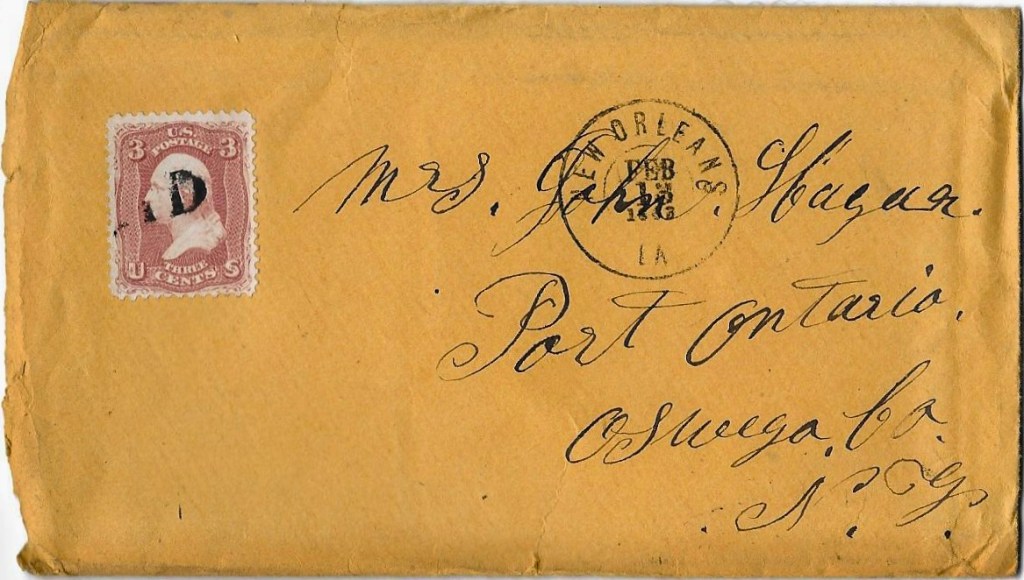
February 12, 1863
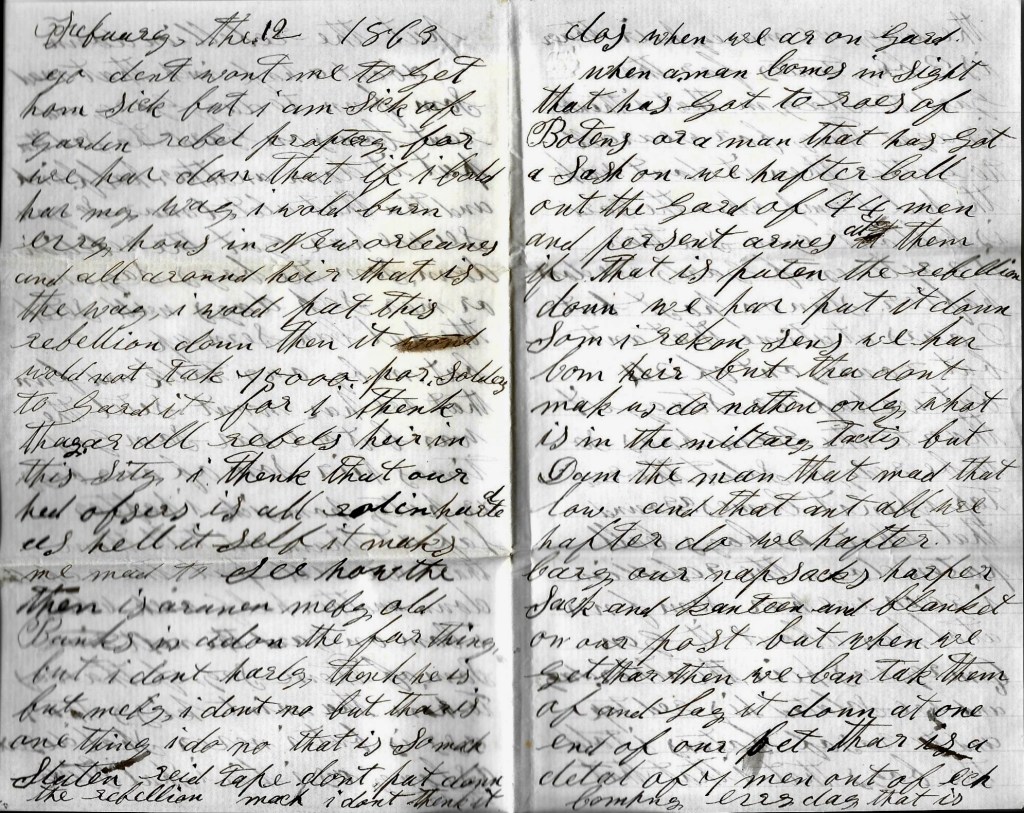
You don’t want me to get homesick but I am sick of guarding rebel property for we have done that. If I could have my way, I would burn every house in New Orleans and all around here. That is the way I would put this rebellion down. Then it would not take 75,000 poor soldiers to guard it for I think they are all rebels here in this city. I think that our officers is all rotten-hearted as hell itself. It makes me mad to see how the thing is agoin’. Maybe Old Banks is a doin’ the fair thing but I don’t hardly think he is. But maybe I don’t know. But there is one thing I do know—that is so much stinking red tape don’t put down the rebellion much. I don’t think it does.
When we are on guard and a man comes in sight that has got two rows of buttons, or a man that has got a sash on, we have to call out the guard of 44 men and present arms at them. If that is putting the rebellion down, we have put it down some I reckon since we have come here. But that don’t make us do nothing—only what is in the military tactics. But damn the man that made that law. And that ain’t all we have to do. We have to carry our knapsacks, haversacks, and canteen and blanket on our post but when we get there, then we can take them off and lay it down at one end of our beat. There is a detail of seven men out of each company every day. That is the way we manage. There is three big tents for the guard to stay in. That I think is a good thing for we are all together. Then it don’t wake the whole camp when the guard is called out. You see there is three reliefs of guards. We don’t have to stand on post but two hours at a time. That ain’t but 2 hours out of 24, but we have to stay right there to the guard house so to be ready to salute the red tape when it comes around. That’s what us boys call puttin’ down the rebellion.
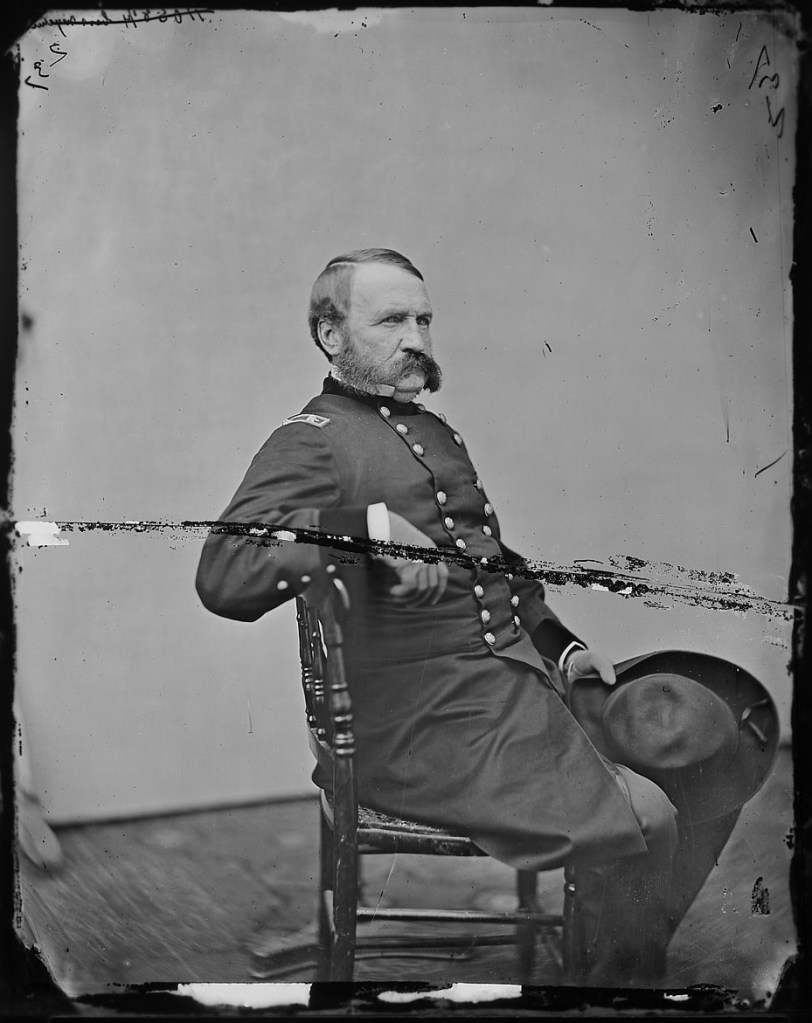
I reckon we have some fun a talkin’ about it. Gen. [William Hemsley] Emory was here the other day and we saluted his red tape and two rows of buttons. I told the boys that I thought that put the rebellion down about a half inch. That made some fun. Today George and Rant comes on guard. They said that put it down another half inch and they thought a little more. So you see we have got the rebellion down some. They boys say one or more such days will settle [things]. But maybe our talk and fun that we have won’t settle the war but we have some good times here.
Some of our boys are pretty homesick. I have to laugh at them and tell them that we will put the rebellion down another half inch when I come on guard the next time. Some of them say if they was to home, they might kiss their asses but I never shall desert as long as I live. I shall stick to it.

Letter 44
February 17, 1863
Mrs. Phebe, my dear,
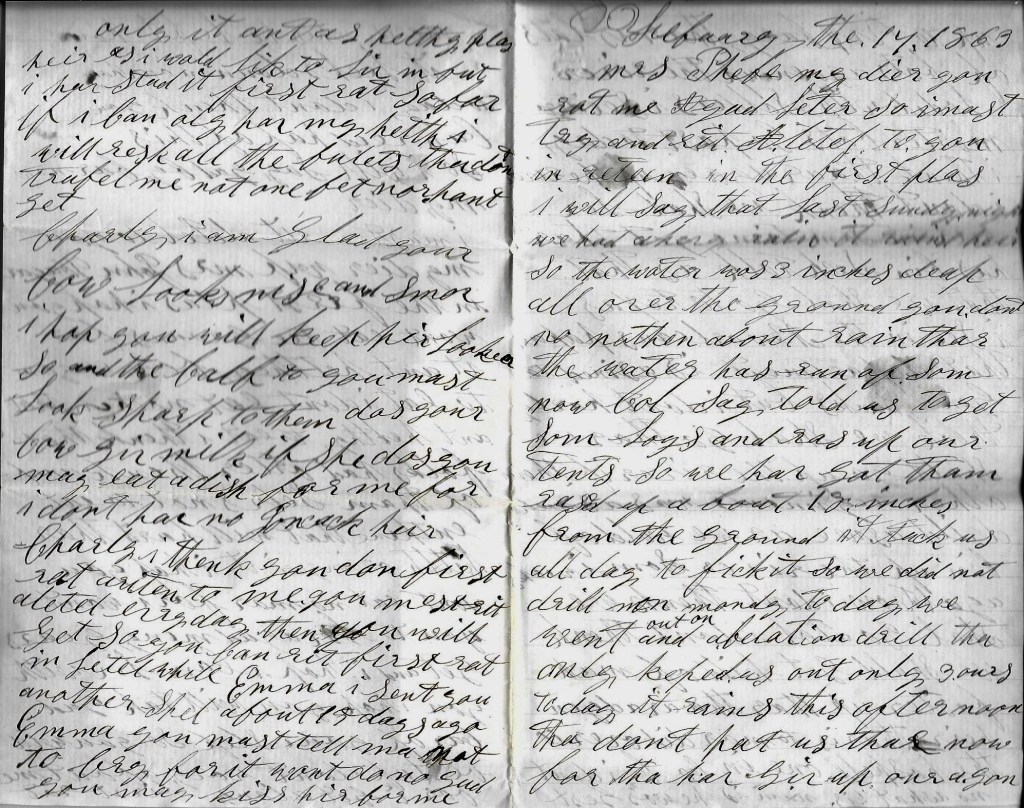
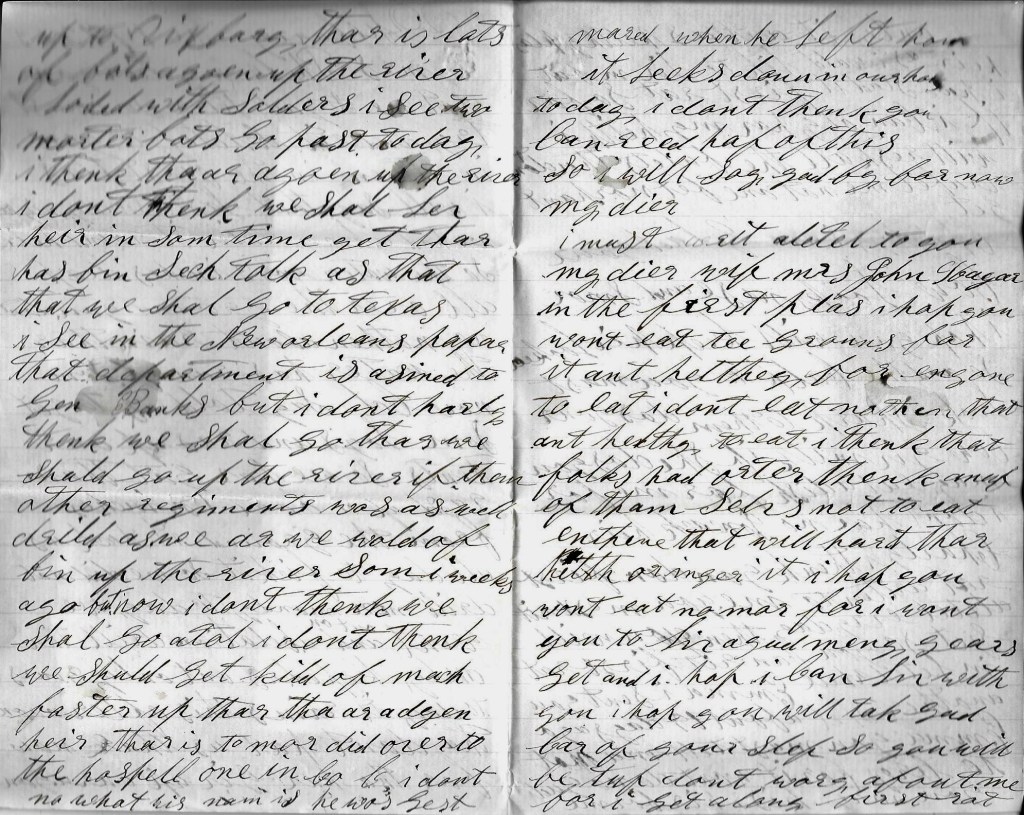
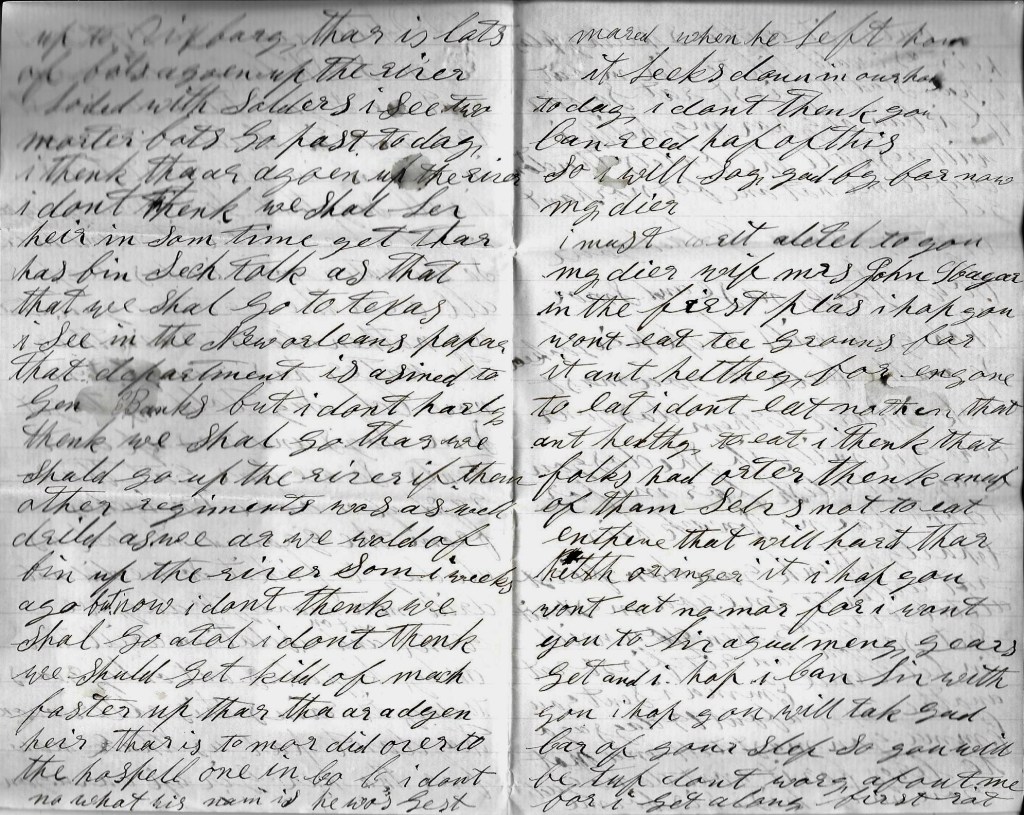
You wrote in your letter that I must try and write a little to you in return. In the first place I will say that last Sunday night we had a hard rain here. The water was three inches deep all over the ground. You don’t know nothin’ about rain there. The water has run off some now. Col. Sage told us to get some logs and raise up our tents so we have got them raised up about 12 inches from the ground. It took us all day to fix it so we did not drill on Monday. Today we went out on battalion drill. They only kept us out three hours today. It rains this afternoon. They don’t put us there now for they have given up on our goin’ up to Vicksburg. There is lots of boats goin’ up the river loaded with soldiers. I seen two mortar boats go past today. I think they a goin’ up the river. I don’t think we shall leave here in some time yet.
There has been such talk as that we shall go to Texas. I see in the New Orleans paper that department is assigned to Gen. Banks but I don’t hardly think we shall go there. We should go up the river if them other regiments are. We would of been up the river some weeks ago but now I don’t think we shall go at all. I don’t think we should get killed off much faster up there as there are a dyin’ here. There is two more died over to the hospital—one in Co. C. I don’t know what his name is. He was just married when he left home.
I don’t think you can read half of this so I will say goodbye for now my dear.
I must write a little to you, my dear wife. In the first place, I hope you won’t eat tea grounds for it ain’t healthy for anyone to eat. I don’t eat nothin’ that ain’t healthy to eat. I think that folks had ought to think enough of themselves not to eat anything that will hurt their health or injure it. I hope you won’t eat no more for I wat you to live a good many years yet and I hope I can live with you. I hope you will take good care of yourself so you will be tough. Don’t worry about me for I get along first rate only it ain’t a healthy place here as I would like to live in but I have stood it first rate so far. If I can always have my health, I will risk all the bullets. They don’t trouble me—not one bit, nor han’t yet.
Charley, I am glad your cow looks nice and smart. I hope you will keep her looking so—and the calf too. You must look sharp to them. Does your cow give milk? If she does, you may eat a dish for me for I don’t have no Johnny cake here. Charley, I think you done first rate writing to me. You must write a letter every day. Then you will get so you can write first rate in a little while. Emma, I sent you another shell about 15 days ago. Emma, you must tell Ma not to cry for it won’t so no good. You may kiss her for me.
Letter 45

New Orleans, [Louisiana]
February 19th 1863
Mrs. John Hager,
I now take this opportunity to write a few lines to you to let you know that I am well and hope these few lines will find you well. Well, Phebe, …I must tell you that we han’t got 360 men in the 110th [New York] that is able for duty. They are almost all sick. It don’t agree with them down here. There han’t but one or two that has died but what was sick on the Old Ericcson. We could not get nothin’ [to eat] on there so when we came here, I guess we got too much. Anyway , we have all got the shits. One or two has died with them. The doctors could not stop it and I don’t believe but what there is 400 men now that has got the dysentery. Some of the boys say that there ain’t a man in the whole regiment but what has got the shits. I don’t think it is very healthy down here—not for Northern soldiers. It rains a good deal here and there is very hazy days here. It is pretty foggy here in the morning. I would not write if I knew I could live to come home but I do expect to come home. I don’t make no other calculation. I expect to live through this war and come home. I don’t know but we shall have to come back there and kill off some of them rebels that is there at home. There is lots of them there. That is what keeps this war a hanging along so slow. I don’t want you to feel bad because I write the things just as it is. I don’t make it no worse than it is. I would not of written it but you wanted me to write the thing just as it was and so I thought I would.
There has 7 or 8 run away in Company I. They say they will all run away but I do not think there is some that will if they can get a good chance. They are homesick enough to live anytime. I never have seen no time yet that I would run. I never shall do that. I had rather die in battle than to desert the regiment. That you know I can’t do. I came down here to fight and I expect to, but maybe I shan’t. I hope you won’t worry about me, not at all, for it won’t make it no better for me nor you. So you must make the best of it you can.
I want you to cure up your breast. I hope you will be careful and not get cold in it. I am afraid if you do that you can’t bear it…
You can read this to Chester or any of the rest of my family but I don’t want none of them Democrat rebels to see it or have it read for it will suit them too well….

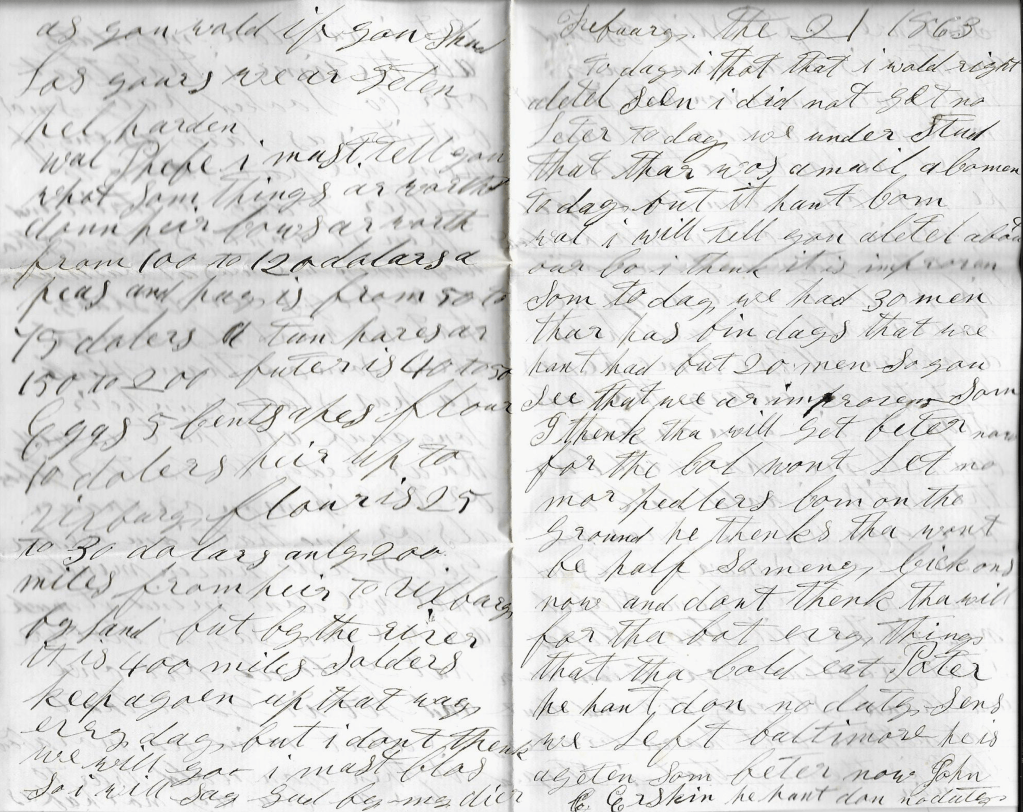
Letter 46
February 21, 1863
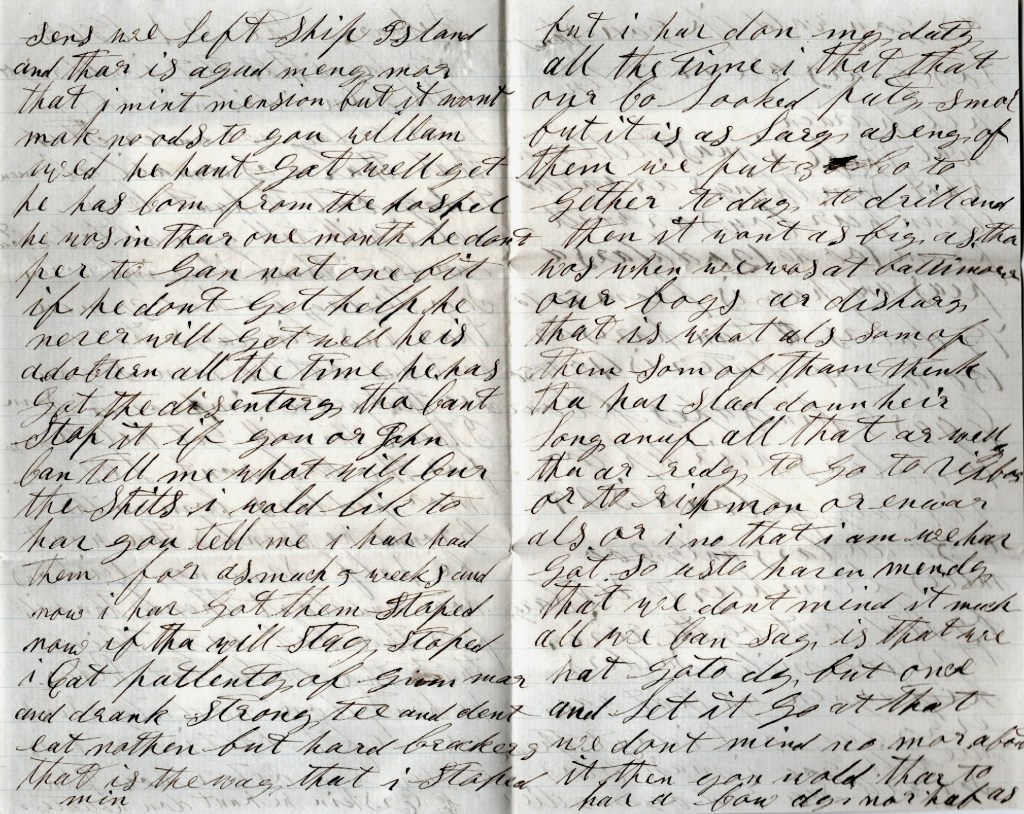
Today I thought that I would write a letter since I did not get no letter today. We understood that there was a mail a comin’ today but it hain’t come. Well, I will tell you a little about our company. I think it is improving some. Today we had 30 men [on duty]. Three has been days that we hain’t had but 20 men so you see that we are improving some. I think they will get better now for the Colonel won’t let no more peddlers come on the ground. He thinks there won’t be half so many sick ones now and don’t think they will for bought everything that they could eat. Potter—he hain’t done no duty since we left Baltimore. He is a gettin’ better now.
John Erskine—he haint done no duty since we left Ship Island and there is a good many more that I might mention but it won’t make no odds to you. William Weed—he han’t got well yet. He has come from the hospital. He was in there one month. He don’t appear to gain—not one bit. If he don’t get help, he never will get well. He is a doubting all the time he has got the dysentery. They can’t stop it. If you or John can tell me what will cure the shits, I would like to know. You tell me. I have had them for as much as 5 weeks and now I have got them stopped—if they will stay stopped. I eat plenty of [gum mar?] and drink strong tea and don’t eat nothin’ but hard crackers. That is the way that I stopped mine. But I have done my duty all this time. I thought that our company looked pretty small but it is as large as any of them. We put three companies together today to drill and then it wasn’t as big as they was when we was at Baltimore.
Our boys are discouraged. That is what ails some of them. Some of them think they have stayed down here long enough. All that are well—they are ready to go to Vicksburg or to Richmond, or anywhere else, or I know that I am. We have got so used to having men die that we don’t mind it much. All we can say is that we hain’t goin’ to die but once and let it go at that. We don’t mind no more about it then you would there to have a cow die, nor half as you would if you should lose yours. We are getting well hardened.
Well Phebe, I must tell you what some things are worth down here. Cows are worth from 100 to 120 dollars a piece and hogs is from 50 to 75 dollars. [ ] are 150 to 200. Butter is 40 to 50. Eggs 5 cents apiece. Flour is 10 dollars here, up to Vicksburg flour is 25 to 30 dollars. Only 200 miles from here to Vicksburg by land but by the river it is 400 miles. Solders keep agoin’ up that way every day. But I don’t think we will go. I must close, so I will say good bye dear.
Letter 47

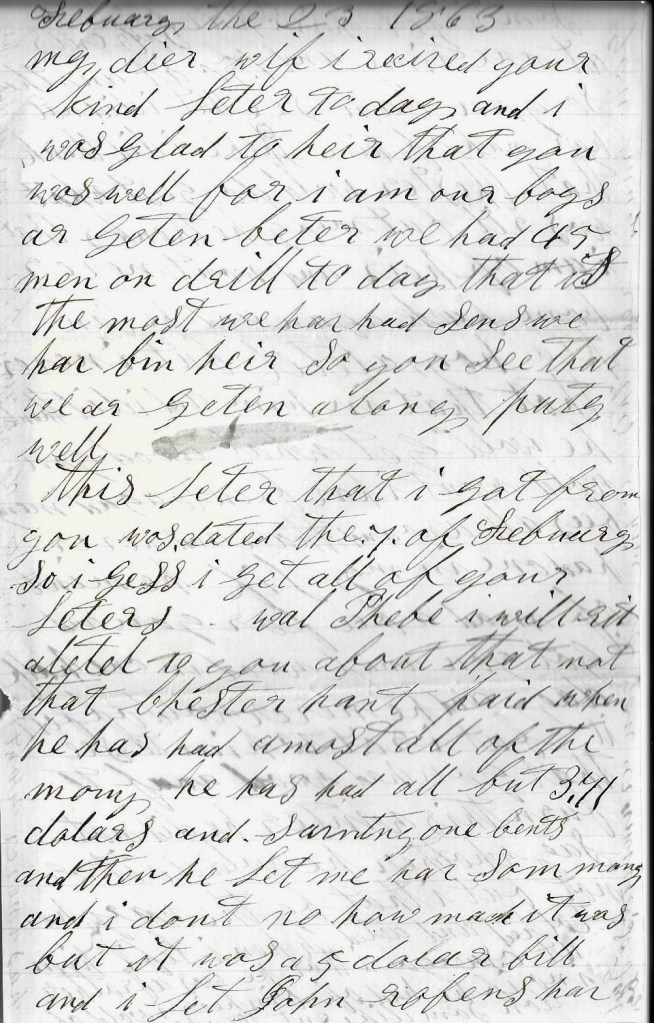
February 23, 1863
My dear wife,
I received your kind letter today and was glad to hear that you was well for I am. Our boys are gettin’ better. We had 45 men on drill today. That is the most there has been since we have been here. So you see, we are gettin’ along pretty well.
This letter that I got from you was dated the 7th of February so I guess I get all your letters.
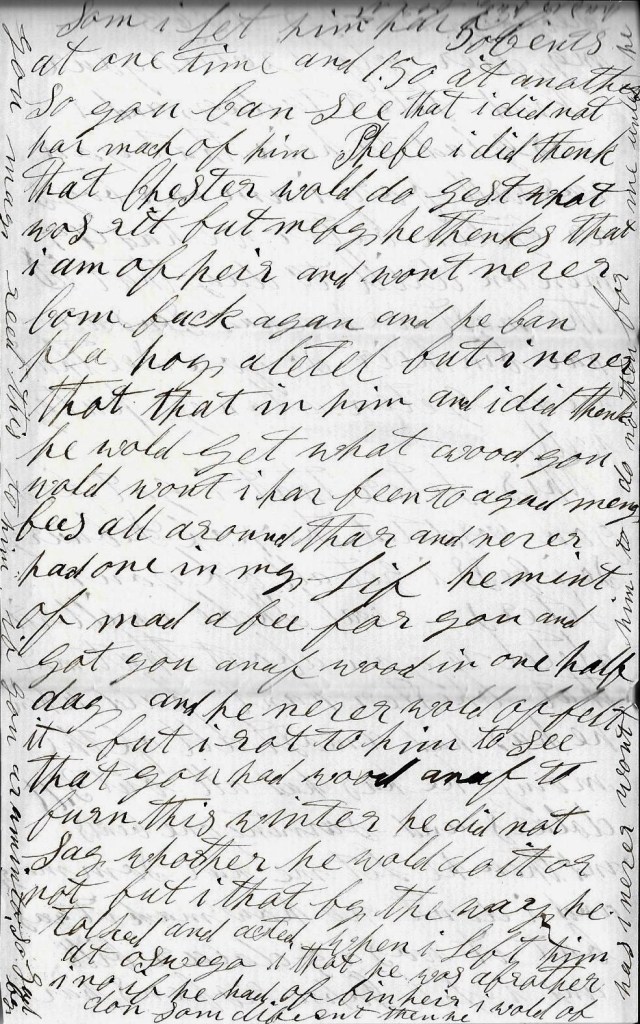
Well Phebe, I will write a little about that. Not that Chester haint paid when he has had almost all the money. He has had all but 3.71 cents and then he let me have some money and I don’t know how much it was but it was a 5.00 bill and I let John Robbins have some of it. I let him have .50 one time and 1.50 another. So you can see I didn’t have much of him. Phebe, I did think Chester would do what is right but maybe he thinks I am off here and maybe never come back again and he can play hog a little. But I never thought that in him. I did think he would get what wood you would want. I have been to a good many bees around there and never had one in my life. He might have made a bee for you and got enough wood in one half day and he never would of felt it. But I wrote to him to see that you had enough wood for the winter. He did not say whether he would do it or not but I thought by the way he talked and acted when I left Oswego he would. I thought he was a brother. I know if he had been here I’would have done different than he has. I never want him to do another thing for me unless he is paid for it. You may read this to him if you have a mind to. So good by.
Letter 48
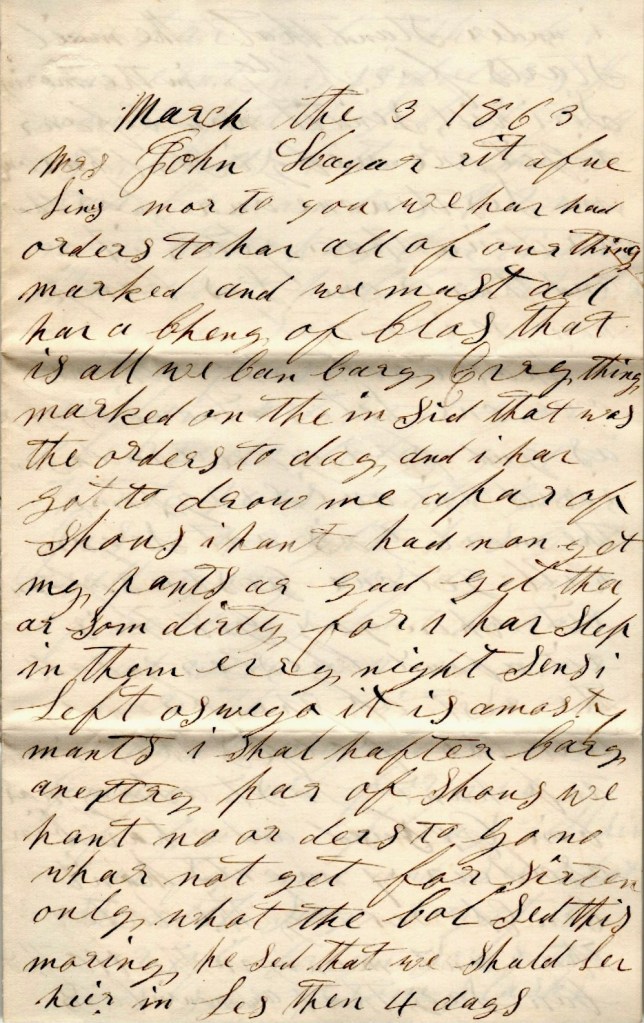
March 3, 1863
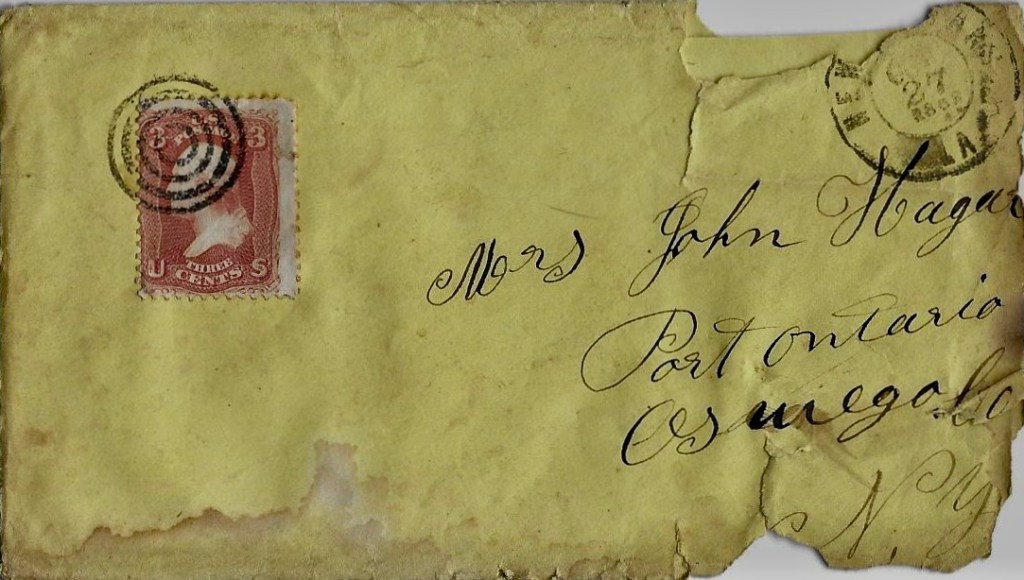
Mrs John Hager,
I will write a few more lines to you. We have had orders to have all our things marked and we must have a change of clothes. That is all we can carry and everything marked on the inside. That was the orders today and I have got to draw me a pair of shoes. I haint had none yet. My pants are good yet. They are some dirty for I have slept in them every night since I left Oswego. It is almost 7 months. I shall have to carry an extra pair of shoes. We haint no orders to go nowhere—not yet, for certain. Only what the Col. said this morning. He said that we should leave here in less than 4 days.
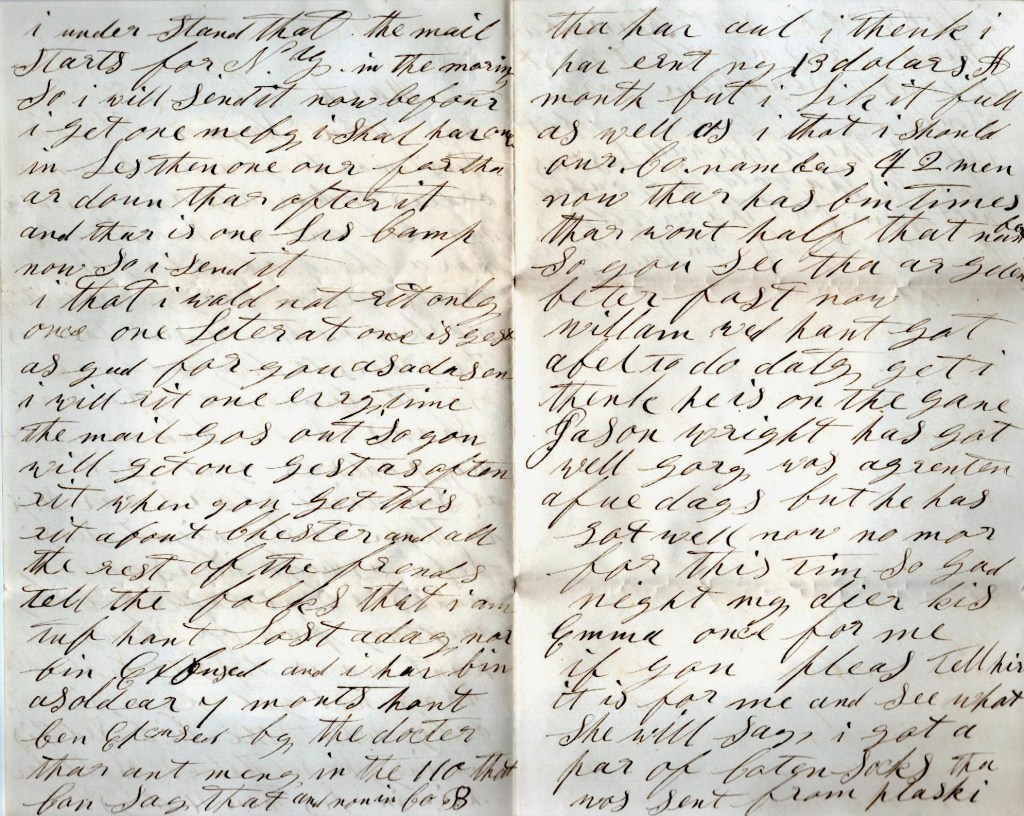
I understand that most of the mail starts for New York in the morning so I will send it now before I get one. Maybe I shall have one in less then one hour for they are down there after it… I thought that I would write only one letter at once… I will write one every time the mail goes out. You will get one just as often. Write when you get this. Write about Chester and all the rest of the friends. Tell the folks that I am tough—ain’t lost a day or been excused and I have been a soldier 7 months. Haint been excused by the Doctor. There ain’t many in the 110th New York who can say that and none in Company B. Therefore, I think I have earned my $13 a month. But I like it full as well as I thought I should. Our company numbers 42 men now. There has been times [when] there weren’t half that number. So you see, they are getting better fast. William [Weed] hain’t got able to do duty yet. I think he is on the mend. Jason Wright has got well. George was a gruntin’ a few days but has got better now.
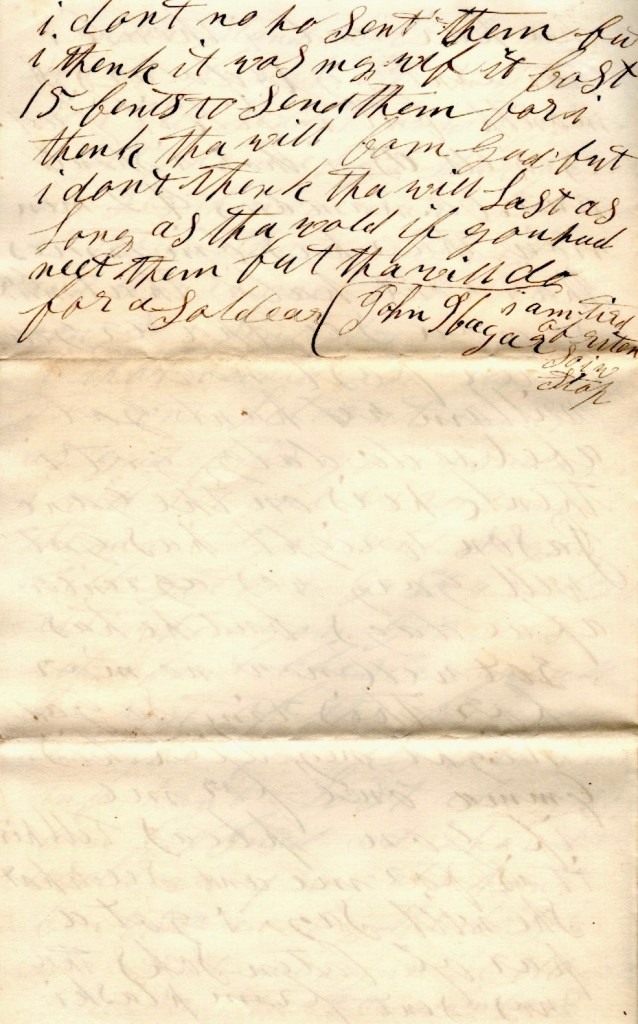
No more for this time so good night my dear, kiss Emma once for me, if you please. Tell her it is for me and see what she will say. I got a pair of cotton socks from Pulaski. I don’t know who sent them but I think it was my wife. It cost 15 cents to send them. I think they will be good but I don’t think they will last as long as they would if you had knit them. But, they will do for a Soldier. I am tired of writing so I will stop, — John Hager.
Letter 49
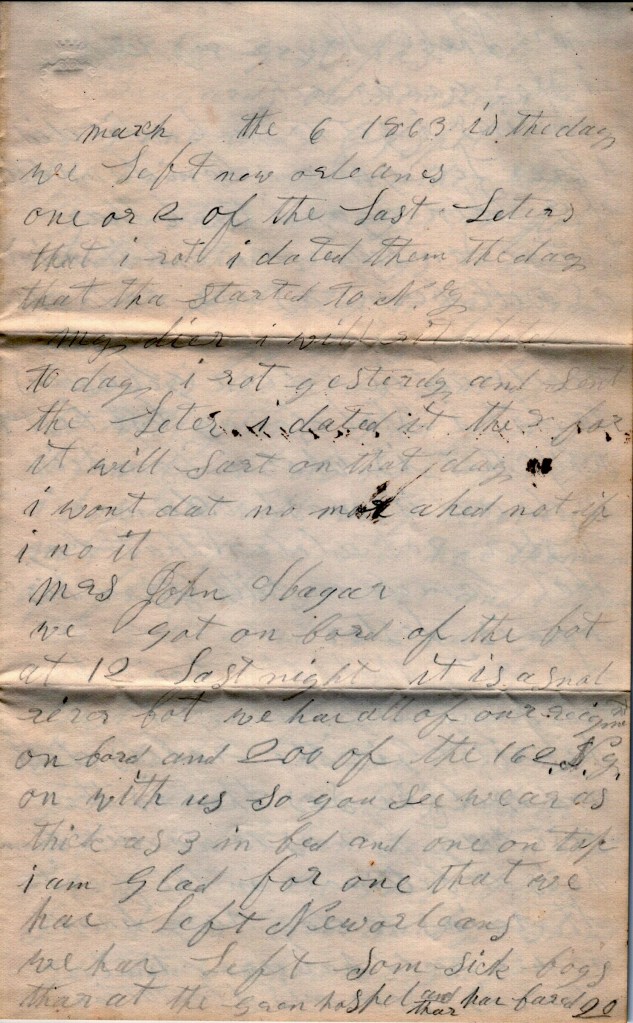
March the 6 1863 is the day we left New Orleans. One or two of the last letters that I wrote I dated them the day that they started to New York.
My dear I will write a little today. I wrote yesterday and sent the letters. I dated this the 6 for it will start on that day. I won’t date no more ahead—not if I know it.
Mrs. John Hagar, we got on board the boat at 12 last night. It is a small riverboat but we have all of our regiment on board and 200 of the 162nd New York on with us, so you see we are as thick as three in a bed and one on top. I am glad for one that we have left New Orleans. We have left some sick boys there at the General Hospital there and have buried 20 there.
Mrs. Phebe Hagar my wife, I s’pose you are yet. Sometimes I get to think why did I ever leave you and come down here for? Then again, I think there has to somebody come and it might as well be me as anybody else. And I am here now amongst the rebels. And if I ever get a chance to fight, I shall do my best to whip. That is what I came here to do, and it must be done.
Lester wrote a letter to that boy that come down with Ezra. His name is Lester. Let writes that they han’t had no pay only once yet. He writes, “give the rebels death and hell.” He says that is the best way for us to do with them. He is at Baltimore in the fort. It rains today really hard or we would have a good time. There is some nice plantations. We have just passed Old Beauregard’s old homestead. It is a nice one and I expect to see him or some other rebel general when we get to Port Hudson. That belongs to the rebels yet. We shall stop to Baton Rouge—that belongs to us. But Port Hudson is the place that the 110th [New York] will strike their first blow. If we do have a fight there, I hope we will whip them. If not, I hope we will have the name of fighting first rate and I think they will. But we have got a good many men on the sick list. Some of them more scart [scared] than hurt.
I don’t know as you can read this. I don’t know when I can send it. I thought I would write a few lines today seein’ [as] I had time. Maybe I shan’t get time when we stop. I shall send this back by this boat when we get settled again. Then I will write again. This is all for now, so I must say goodbye to you again my dear.
The 7th [March]. It is morning again and all is well. We are a going to stop to Baton Rouge. This is ours now. Nothing more today. So goodby for this time, my dear wife. I shall see you in the after world if I don’t in this. I think I shall in this. I shall think so as long as I have got one breath left. May God bless you my dear. This from John Hager
To my best friend on earth. I know it is.


Letter 50
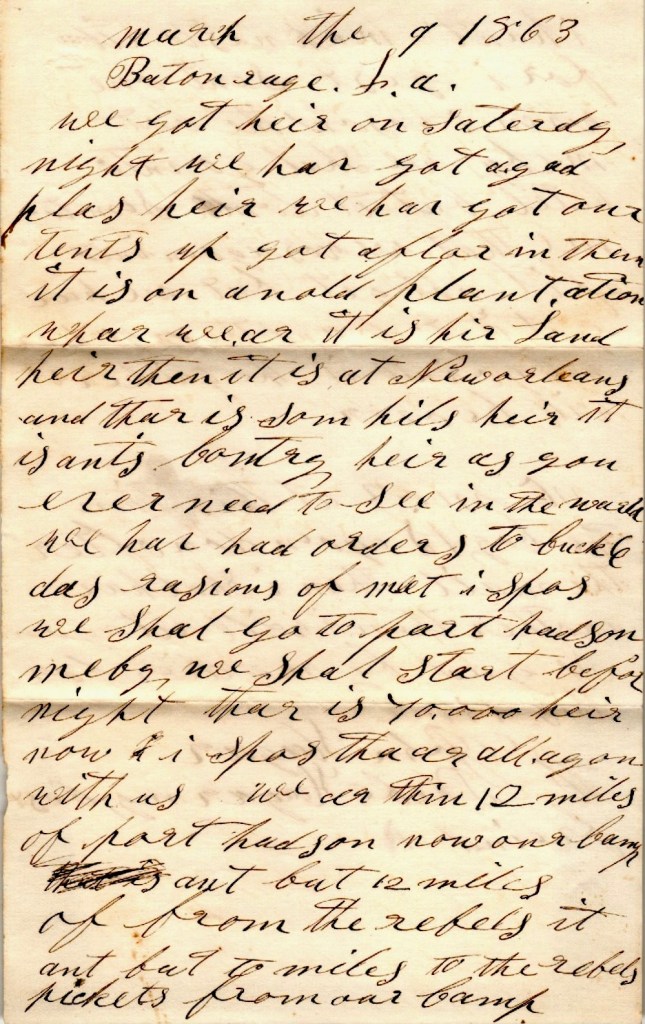
March the 9, 1863
Baton Rouge, Louisiana
We got here on Saturday night. We have got a good place here. We have got our tents up, got a floor in them. It is on an old plantation where we are. It is higher land here than it is at New Orleans and there is some hills here. It is as nice country here as you ever need to see in the North. We have orders here to pack 6 days rations of meat. I s’pose we shall go to Port Hudson. Maybe we shall start before night. There is 70,000 here now. I s’pose they are all a going with us. We are within 12 miles of Port Hudson now. Our camp ain’t but 12 miles from the rebels. It ain’t but two miles to the rebels’ pickets from our camp.
I han’t much news to write for I just sent one when I was on the boat. Maybe we shall go into battle but it don’t seem to me that we was a going into a fight—not yet. But we have got it to do, and the quicker we go into it, the quicker it will be over.
No more at this time. The boys is a going down after the mail. Then I shall have another. then I will write again. So goodbye, my dear, for this time. — John Hager
To Phebe Hager, my best friend.

Letter 51

March 12th, 1863
We han’t gone today. We have had 6 days rations ready ever since Monday and had our knapsacks packed all the time. Tonight or tomorrow morning we shall start for Port Hudson. Robert Aird don’t go nor [William] Weed—he don’t go neither. Phebe, I don’t hardly [know] what to write to you. I am willing to go but if I could see you 5 minutes before I do, I should be more willing. I could tell you more than I have time to write.
Phebe, I have seen more that looks like war the last 6 days than I ever saw in my whole life. I have seen over 50 gunboats and a good many batteries of artillery, about today I have seen 50 or 60 regiments all together. General Banks had us out to march in review.
We han’t got no mail yet. I don’t know what the reason is. I thought I would write a few lines to my dear for you are the one I love as I love my eyes. Phebe, if anything should happen to me in this battle, William Weed will send one coat and my portfolio and paper, one pair drawers and my old socks and my blanket. I think I shall leave that large overcoat, two pair of socks. I shall leave my mittens and gloves.
We don’t get our pay—not till the battle is over. This is all for now so I must say goodbye for this time. John Hager to my wife, Phebe
I am yours truly for ever and ever, — John


Letter 52

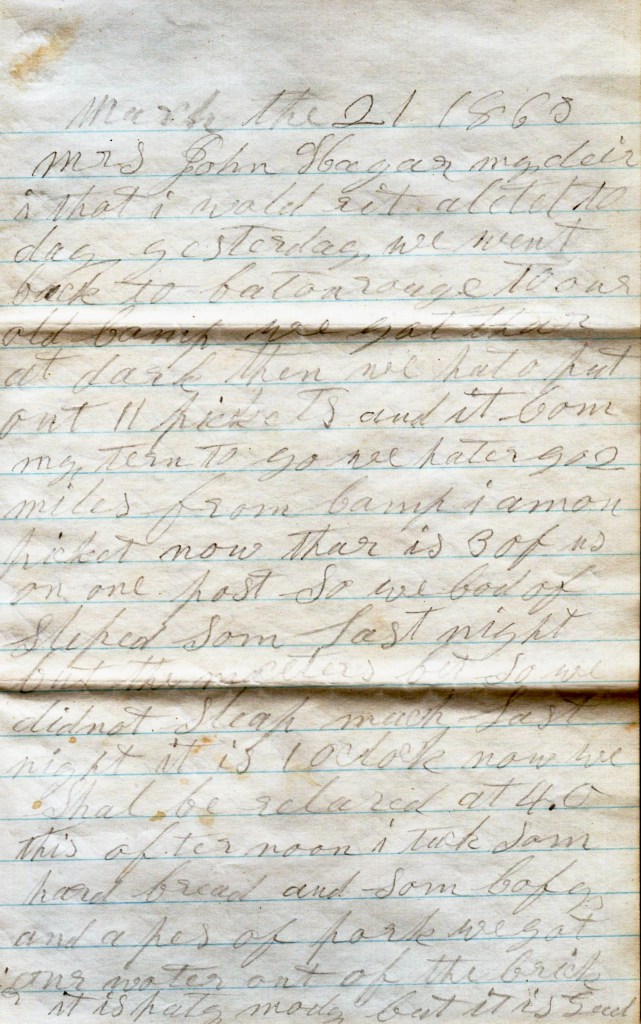
March 21, 1863
Mrs. John Hager—my dear,
I thought that I would write a letter today. Yesterday we all went back to Baton Rouge to our old camp. We got there at dark. Then we had to put out 11 pickets and it came my turn to go. We had to go two miles from camp. I am on picket now. There is three of us on one post. So we could of slept some last night but the mosquitoes bit so we did not sleep much last night. It is 10 o’clock now. We shall be relieved at 4 o’clock.
This afternoon I took some hard bread and some coffee and a piece of pork. We got our water out of the crick. It is pretty muddy but it is good enough for soldiers. I han’t no fault to find if they will only push the thing right along—that is just what suits me. We made some good strides out of this tramp. We took 100 loads of cotton and a lot of sugar. The cotton was in the woods to hide it. A Negro told us [where].
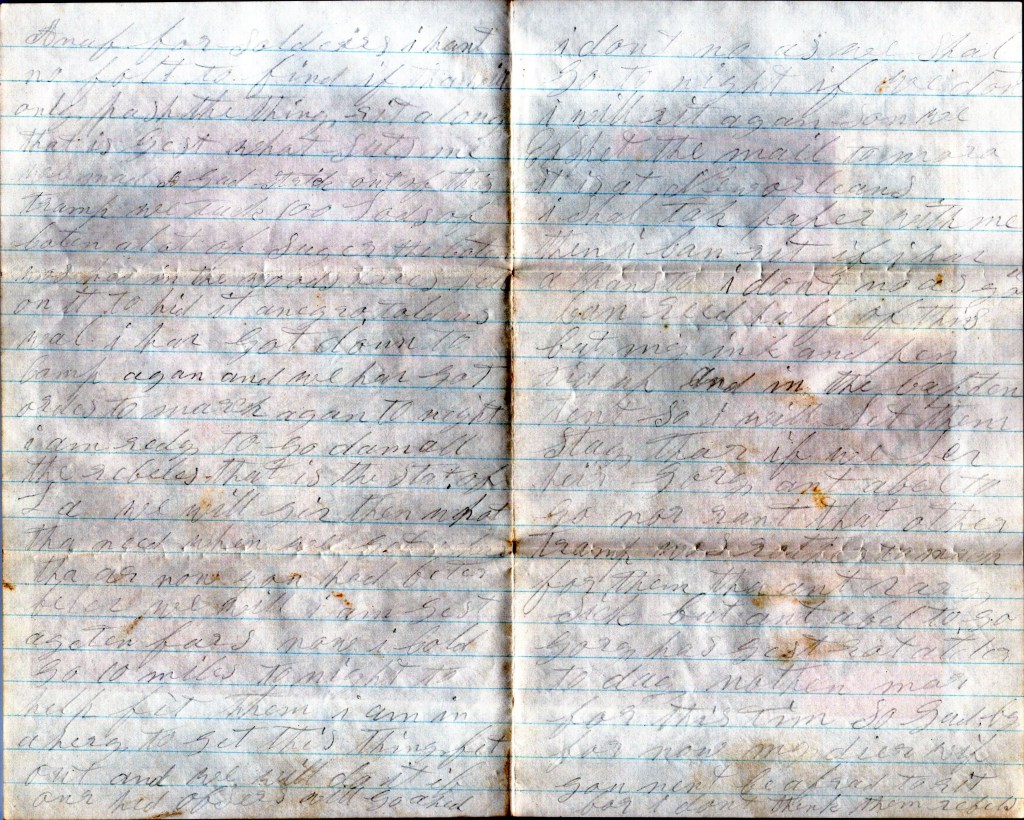
Well I have got down to camp again and we have orders to march again tonight. I am ready to go. Damn the rebels that is [in] the state of Louisiana. We will give them what they need when we get there, you better believe we will. I am just a getting fierce [?] now. I could go ten miles tonight to help fight them. I am in a hurry to get this thing fight out and we will do it if our head officers will go ahead.
I don’t know as we shall go tonight. If we don’t I will write again soon. We expect the mail tomorrow. It is at New Orleans. I shall take paper with me. Then I can write if I get a chance. I don’t know as you can read half of this but my ink and pad dried up in the captain’s tent so I will let them stay there if we leave here.
George ain’t able to go nor Rant. That other tramp was rather too much for them. They ain’t very sick but ain’t able to go. George has just wrote a letter today. Nothing more for this time so goodbye for now, my dear wife. You won’t be afraid to write for I don’t think them rebels can kill me. I shall stand my ground every time. Write all you can. I will do the same by you. May God bless you. I hope He will. They are putting us right there. We tell them we are 9 months men. What do you think of that? Write it in the next if you gonna say anything about it as our being 9 months men. That is all my dear.

Letter 53
Baton Rouge, Louisiana
March 23, 1863
Mrs. John Hager–my dear,
I will write a few lines tonight. I want to tell you that we have got the best place we have had since we left Baltimore. It is upon a hill. ‘Tis a level place. I haven’t seen a stone since we left Ship Island. And there wasn’t many [there]. This is a nice country. Water ain’t very good here. The water in the river is best, unless it is rain water. That is the best. The water in the Mississippi River is pretty muddy. They say it always was so. This is a pleasant place.
Baton Rouge ain’t a very big place, about like Mexico [New York]. Our men took the State House for a hospital. It is a larger house, then, too, like the courthouse in Oswego. We had it all clear before we started to go to Port Hudson to put our sick and wounded in. It is the General Hospital now. It is a good one. Our men are getting along pretty well now. We had about 70 men in our company when me was on the march. There have been times [before] when we could not start over 25 fit for duty. So you can see our army is improving some.
The shits made me grow hair, but I am fat enough now. When I was at New Orleans I weighed 178. I was weighed the other day, I weighed 157. I can stand it to travel better now and I feel just as well as I ever did in my life and I hope you do.
I haven’t got much news to write this time. You spoke of the General. I think he is all right. He went with us. But Old Emory, I don’t like him. He is a tuff old cuss, I think.
Well, my dear, if Mr. Chester Hagar doesn’t want to do anything for you, then let him go to the devil. I never shall ask him to do anything more for you nor for my own self. You may share this with any of my folks. I don’t think Chester has done the far thing by you; if he had he would have got you what you wanted. He knew I thought he would do it. I hope he will have to come down here; and all the rest of them rebels. I want to see some of them down here.
I don’t think they are any better than I am. It will do them good to come down here. Nancy wanted me to write, if I don’t write but three lines; but they don’t write to me. I won’t write to them; they have written two letters to me in 7 months. I think they have done pretty well for them. You may let them see this. If you have a chance to, read it to her.
Nothing more this time. I wrote one yesterday so I haven’t got anything to write. So I will say good night to you, my dear. — John Hagar to his wife Phebe Hagar
[There are no images of the letter to accompany this transcription so I cannot verify its accuracy.]
Letter 54
Baton Rouge L.A.
March the 25, 1863
Mrs. John Hagar–my dear,
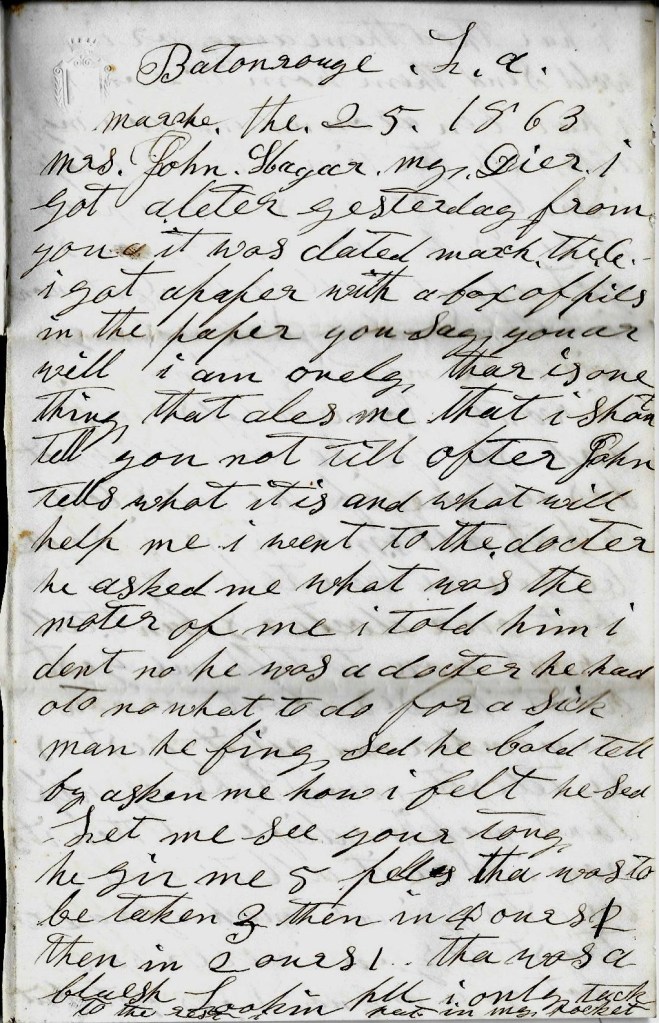
I got a letter yesterday from you. It was dated March the 6. I got a paper with a box of pills in the paper. You say you are well. I am [too] only there is one thing that ails me that I shan’t tell you—not till after John tells what it is and what will help me. I went to the doctor. He asked me what was the matter of me. I told him I didn’t know. He was the doctor—he had ought to know what to do for a sick man he finds. Said he could tell by asking me how I felt. He said, “Let me see your tongue.” He give me five pills. They was to be taken three, then in 4 hours two, then in 2 hours one. They was a bluish looking pill. I only took two. The rest I put in my pocket. I have throwed them away or I would send them home to you.
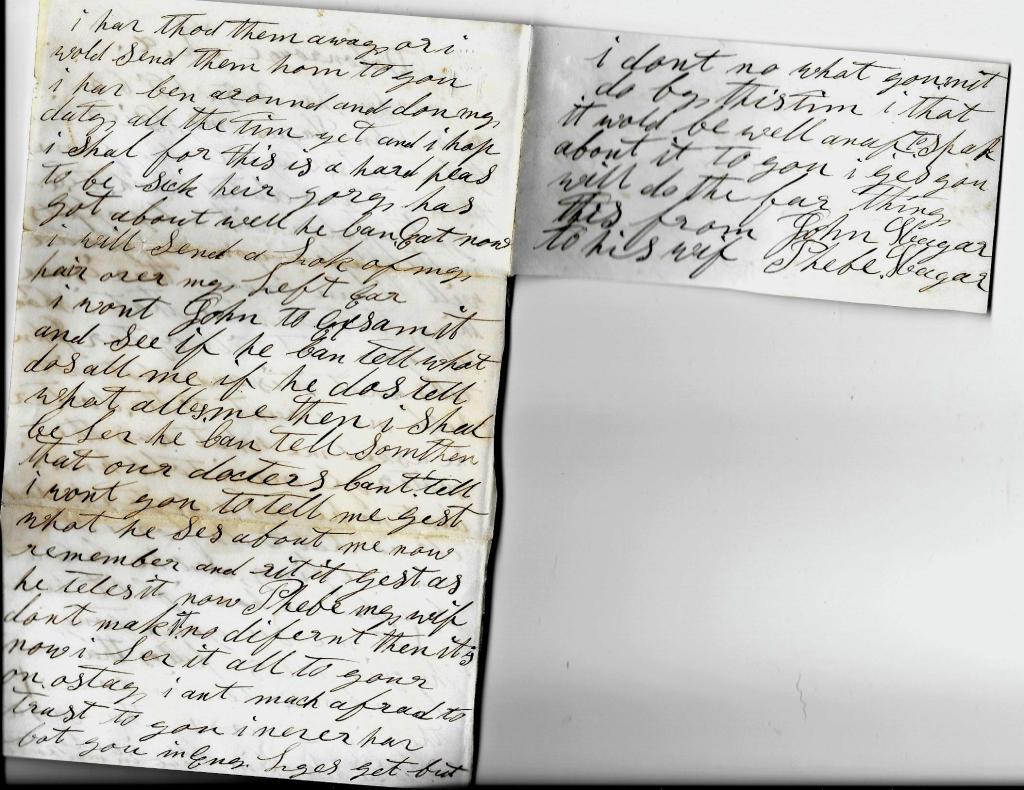
I have been around and done my duty all the time yet and I hope I shall for this is a hard place to be sick here. George has got about well. He can eat now. I will send a lock of my hair over my left ear. I want John to examine it and see if he can tell what does ail me. If he does tell what ails me, then I shall believe he can tell something that our doctors can’t tell. I want you to tell me just what he says about me. Now remember and write it just as he tells it. Now Phebe, my wife, don’t make it no different than it is now. I leave it all to your own honesty. I ain’t much afraid to trust to you. I never have caught you in any lies yet but I don’t know what you might do by this time. I thought it would be well enough to speak about it to you. I guess you will do the fair thing. This from John Hager to his wife Phebe
Baton Rouge L. A. (continued)
Mrs. John Hagar my dear,
On this piece of paper I will tell you how I am. My head did ache some and I had the dysentery the worst way. That was what made me grow poor and my water looks some red now. The Doctor said I had the intermittent fever. I knew I had some fever that was a few days before we started to Port Hudson. The old Dr. said he would excuse me from going on the march but I wanted to go with them and I went. I feel a bit better now, only I [ ]; kidneys are affected some, I think. If I had some good bitters to take it would help my water works. But I am getting better; my water don’t look so red as it did. I have got a pretty good appetite to eat.
Now I must tell how I cured the dysentery. I only eat one hard cracker at a meal. I don’t drink nothing—not till after I got done eating. Then I drank strong tea. I give 50 cents for a quarter pound. Some days I didn’t eat over one cracker a day. I drilled all the time and stood my guard duty. I am afraid of them doctors. Our boys did die one or two a day. Most all of them died with the dysentery. You know I never was [ ].
I don’t think I would have had the dysentery so long but it was pretty warm here and they put us right through on double quick. Our officers was a getting us ready to go up to Port Hudson. And another thing, it was a darned hard place there—right in a swamp. It was in a worse place than it would be in Pa’s corn field or anywhere on his farm. It was wetter ground than any he has got. It was ditches all around it and all through it was so hard, the water won’t run off much. There was a swamp on one side of us and a river on the other. Now we are moved today about one mile from the old plantation that we have been on [ ].
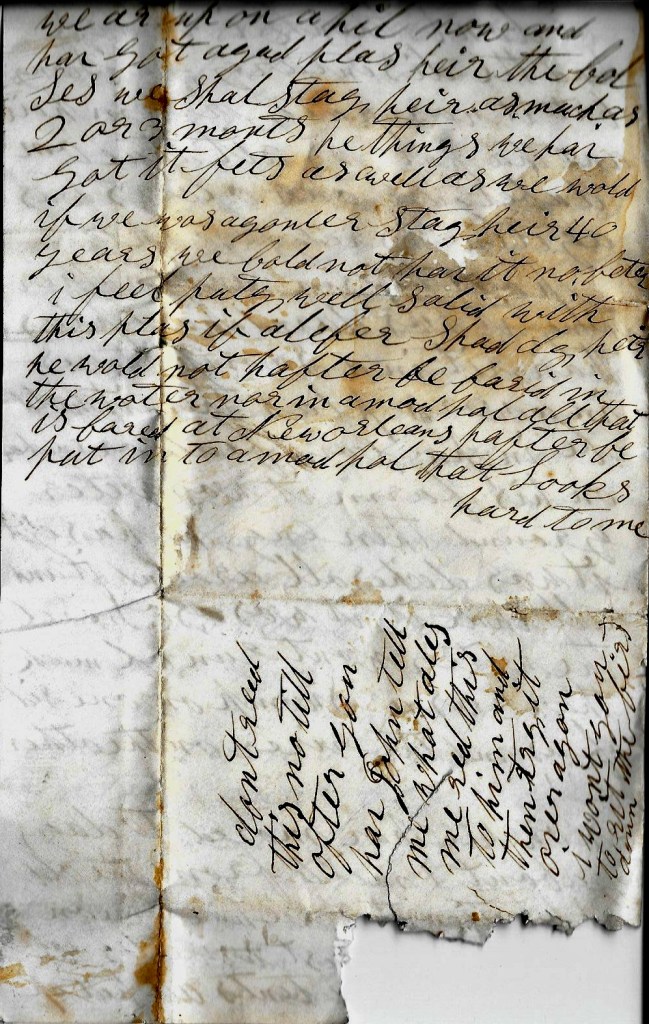
We are up on a hill now and have got a good place here. The colonel says we shall stay here a much as 2 or 3 months. He thinks we have got it fixed as well as we would if we was a goin’ to stay here 40 years. We could not have it no better. I feel pretty well solid with this place. If I ever should die here, we would not have to be buried in the water nor in a mud hole. All that is buried at New Orleans have to be put in a mud hole. That looks hard to me.
Don’t read this—not till after you have John tell be what ails me. Read this to him and then try it over again. I want you to write the first down.

Letter 55
Baton Rouge [Louisiana]
March 26, 1863
Mrs. John Hagar—my dear,
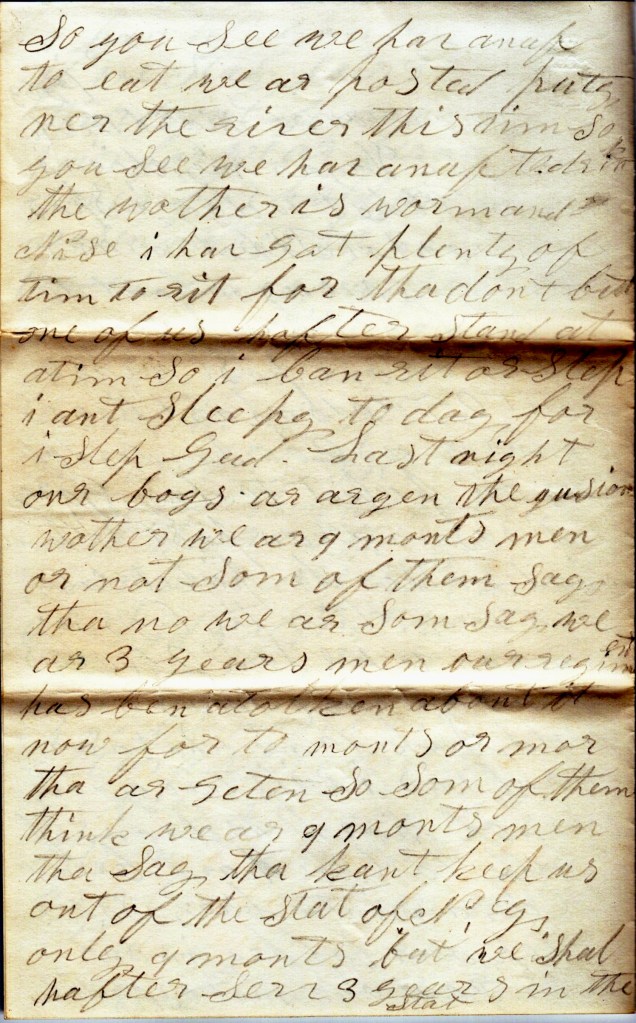
I am on picket today. I s’pose you know what picket means, don’t you? We are about two miles from camp. 30 of us stand on one post. We are about 25 rods apart. There is as many as 200 hundred of us on picket today. George and Ransom are on post with me. I had as rather do picket duty than any other. The boys say they hate to. We take 24 hours grub with us. I s’pose you would like to know what our grub was. I will tell you. A piece of pork, two drams of coffee, [and] all the hard bread we are a mind to carry. So, we steep our coffee in our cups, [and] roast our meat over the fire. So you see we have enough to eat. We are posted pretty near the river this time so you see we have enough to drink.
The weather is warm and nice. I have got plenty of time to write for they don’t but one of us have to stand at a time. So I can write or sleep today, for I slept good last night. Our boys are arguing the question whether we are 9 months men or not. Some of them say they know we are. Some say we are 3 years men. Our regiment has been a talking about it now for two months or more. They are getting so some of them think we are 9 months men. They say they can’t keep us out of the state of New York only 9 months, but we shall have to serve 3 years in the state. We weren’t sworn in at Albany nor New York. Some of our men say they can’t keep us only 9 months but I don’t know whether they can keep us or not.
Col. D. C. Littlejohn says we ain’t but 9 months men. He told his hostler so when he went off. His hostler wasn’t an enlisted man. He was hired by the month. But I don’t pay no attention to what I hear for where there is so many men, they have to talk some. But the other regiment that we are being drilled with are nine months men—the 16th New Hampshire, 4th Massachusetts, 162nd New York. These make our brigade and we all camp together and all drill together and if we have any fighting to do, we will fight together. So you can see we had ought to go home when the rest does.
I can tell you one thing, if we stay here three years, there won’t be much left here for we are burning up the fences for [fire]wood and they ain’t a raisin’ nothing here. There is thousands and thousands of acres of good land. It lays idle. They have raised a good deal of corn here. The ground lays in corn hills. There is a field with more than 100 acres in it. They raise this 8 rods with corn here. We got a number of loads of it. It won’t hurt yet. We feed it to our horses. I know we must use them up after a while, don’t you think we will. If you can read this, make as much of it as you can. Nothing more today. — John Hager



Letter 56
March 27, 1863
My dear,
We have got back to camp. I have wrote to Emerson today. H is in a Baltimore Hospital sick yet. I will send his letter to you. We are under marching orders. They say to go to New Orleans again but maybe we shan’t go. I hope not. I had rather stay here. I like it here first rate and we have got our camp fixed up first rate here.
Nothing more now. I can send this this afternoon. So I must say goodbye to my dear wife again. Keep up good courage. Don’t get down-hearted for I don’t. Make the best of this war you can. Write all you are a mind to me. I will write all I can think of.


Letter 57
Baton Rouge, Louisiana
March 28, 1863
Mrs. John Hagar,
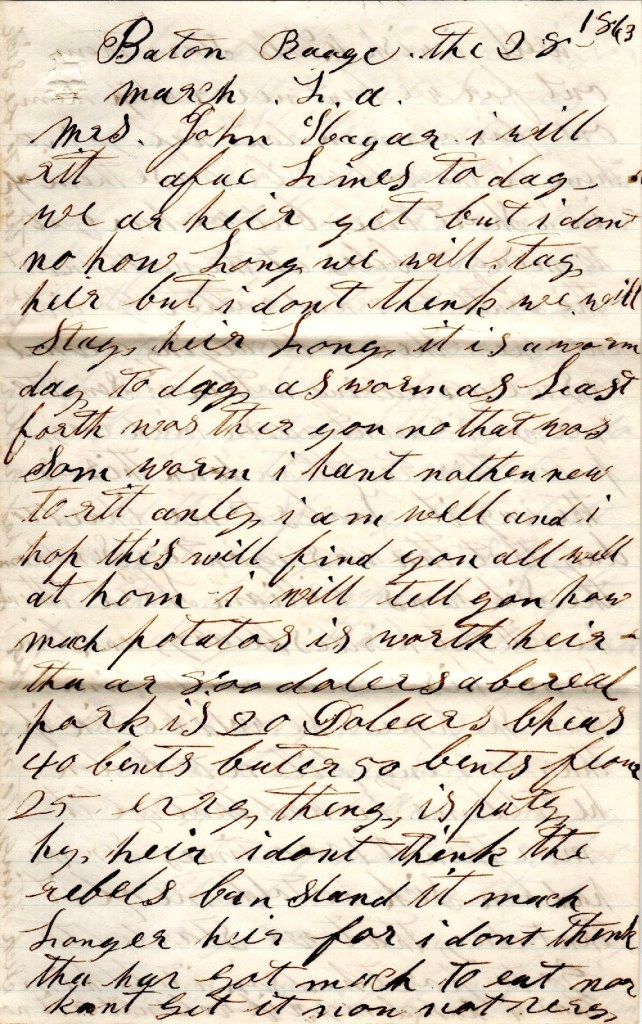
I will write a few lines today. We are here yet but I don’t know how long we will stay here but I don’t think we will stay here long. It is a warm day today—as warm as last fourth was there. You know that was some warm. I han’t nothing new to write—only I am well and I hope this will find you all well at home. I will tell you all how much potatoes is worth here. They are 8 dollars a barrel. Pork is 20 dollars, cheese 40 cents, butter 50 cents, flour 25. Everything is pretty high here.
I don’t think the rebels can stand it much longer here for I don’t think they have got much to eat, nor can’t get it now—not very well. I wish we could starve them out for we can’t never whip them out, for our men don’t have go into them. If they would, we could use them up in a short time. But we have got too many rebels at the North and the South too. I had rather go right into them than to be a lying around as we are doing nothing it seems to me. So, we won’t be a doing much to putting this rebellion down. This is the way it looks to me.
I heard today that they was a going to send home the sick ones. William Weed—I think he will get his discharge and come home. His woman wrote to him that she hoped he would be sick if there was any fighting to be done. He told me he had thought of it more than a thousand times since he had been sick. He told me of it that day that we started to go to Port Hudson. I told him that I hoped my wife would not write no such thing to me for I had rather fight than to be sick. That is what I came here for and now they won’t let us. But I hope William will come home for I know he wants to come bad enough. We all want to come home bad enough but I want this war settled before I come. Then I am ready to come, [even] if it was today. But I don’t see no prospects of it being settled this year, do you?
I hear that it would be settled this spring, but I can’t see as it is any nearer settled now than it was when I left home. Do you there at the North?
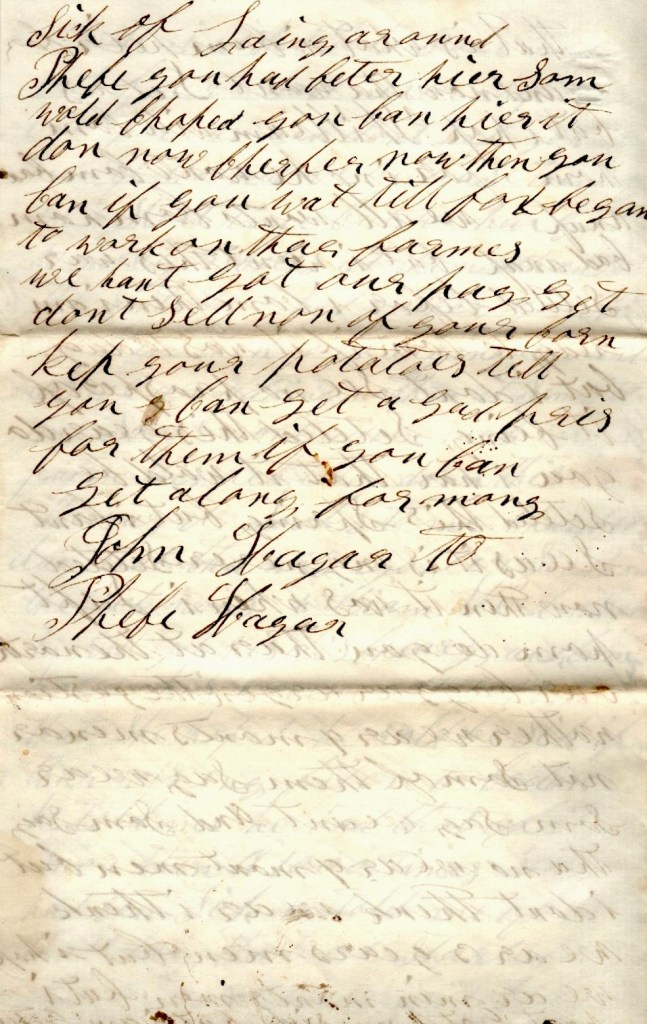
Our boys are arguing the question whether we are 9-months men or not. Some of them say we are. Some say we ain’t and some say they know we are 9-months men, but I don’t think we are. I think we are 3-years men, but I hope we are nine-months men. I han’t got home sick, but I am getting sick of laying around.
Phebe, you had better hire some wood chopped. You can hire it done cheaper now than you can if you wait till folks begin to work on their farms. We han’t got our pay yet. Don’t sell none of your corn. Keep your potatoes till you can get a good price for them if you can get along for money. — John Hager
To Phebe Hager

Letter 58
Baton Rouge, Louisiana
March the 29, 1863
Mrs. Hagar—my dear,
I didn’t send my letter yesterday so I will write a word or two. I have been reading over your letters today. I think they are good ones. I don’t keep but 3 or 4 of them. Do you keep all of mine that I send to you? I don’t think you do.
Today is Sunday and so I thought I would write a little. I wrote we had marching orders but we don’t go yet. I s’pose you would like to know where we was a going to. I don’t know myself but it is down the river somewhere. Maybe it’s to Texas. Maybe to Charleston. I don’t know where we will go. Some of the boys say we are a goin’ to Fortress Monroe, but I don’t think we shall go there. Maybe we shall go to New York. I think it would suit the 110th [New York] as well as anything. I don’t think there would be as many sick ones. I think that state would agree with them better than it does here. It don’t agree with us here very well.
I think we shall get our pay now in a few days. I heard that they had paid to New Orleans. If they had paid the soldiers there, I think we will get ours here. Well, I will tell what I have done today. I have been to meeting. I han’t had nothing to do today. It is the first day in a good while, but tomorrow I come on guard. George and Rant is on today’s picket guard. I shall come on here at the camp this time. I can see the boats again down the river loaded with troops. I expect it will be our turn to start for someplace in a few days now. I will stop and eat my dinner. Then maybe I will have something more to write.
At 2 o’clock pm the 110th [New York] is a going to have the Articles of War read to them. The law says they must read them once a month but they haven’t read none to us since we left Baltimore. But today we have had orders to fall in to the ranks at 2 pm to hear the law read and now I will go. Well, we have had the laws and articles of war read to us today. Ain’t nothing new. We have heard it a number of times before.
Phebe, I have sewed them pieces on my socks. My pants are good yet, and so is both coats. I never see a place like this. Yesterday was very warm and today is the coldest day I have seen since I left home. It ain’t none too warm with an overcoat on, but we had a heavy rain last night.
I han’t nothing more to write this time. Excuse my short letters, and for writing and bad spelling. So I will say goodbye for now, my dear. I hope you won’t get discouraged in these war times. Keep up good courage for that is half the battle in war times.
— John Hager to his wife, Phebe Hager, Charles Hager, Emma Hager. Here is a pretty good lot of Hagers, I think. Don’t you?


Letter 59

Baton Rouge, Louisiana
March 31, 1863
Mrs. John Hager–my dear,
I got a letter today from you. It was wrote March the 3rd and 4th. I got the one you wrote the 10th a week ago. I am glad you are all well at home. I am well and hope these few lines will find you well. I have just come off from guard [duty]. It was a pretty cold night. We did not go into the guard tents. We had a fire outdoors so we sat by that when we went on duty so I feel rather sleepy to write much this time.
You said you and Chester has settled. I think he will do the fair thing by you. If he won’t, then don’t never settle with him. My dear, I don’t hardly understand your figures. You says I paid him $5.05 on the note and 4.01 of borrowed money. I will show you how to set it down. You say you paid on the note, then on the borrowed [but] you don’t put no dates. [$5.05 + $4.10 = $9.15.]…
Look in the book. That will tell you how to figure anything you want, but your was good enough, but it don’t look so well. I hope you won’t get mad at me for telling you how to do it when you told me how to make “c” [and] “f.” I thank you very much. If there is other lettres that I don’t make right, I would thank you to tell me how so I won’t write fuck but I don’t s’pose a letter would…

Readers are referred to a letter by Samuel Nichols (1829-1904) of Mexico, Oswego county, New York, who also served in the 110th New York Infantry. His letter of April 2, 1863 to a relative gives the regiment’s movements during the month of March 1863. See—1863: Samuel Nichols to his Cousin Kate.
Letter 60
New Orleans, Louisiana
April the 5 1863
Brother and sister Mary,
I thought I would write a few lines to you all, both great and small, old and young. I will say that I am well and have been all the time. But we have lost some good soldiers since we have been in this state. But I am yet alive. I must say I am thankful that I have been well all the time for this is a bad place here to be sick now, you had better believe it is. We have been up the river to Baton Rouge. We stayed there 20 days. We went within four miles of Port Hudson. There we took 100 loads of cotton. We took almost all the rebels had. Our army killed 14 head of cattle in one lot. That was all they had in one night. We killed over 100 sheep. You better believe that we lived while we was on the march. I han’t got time to write much—not this time.
I will tell you where we are a going to. We are a going to Berwick Bay. It is 80 miles from here. There is lots of rebels up there. I s’pose when the 110th [New York] gets there, we will give them fits. I am ready to go. I won’t care if we was ready to start tonight. I am getting fierce now to whip them out. We could have had them whipped before now if we had good union officers. I think our officers are rebels. I don’t know what to think of old General Emory. We are in his brigade. Well, I will cut a long story short if you can read this, then make as much of it as you can.
I han’t heard from Phebe in two weeks. I hope you won’t be afraid to show this to Phebe. Mrs. Herkimer—she didn’t let Phebe see it. She is a tough old fuss, I think.
William Weed—he has got his discharge. He is coming home. And William Lester—he is a coming home. He lives at Centerville. I had a letter from Emp. He is in the hospital at Baltimore. He wrote he was a getting better now. I hope he will get well so he can go back to his regiment again. If Lester gets home, then you call and see him. But he can’t tell you much about war for he has been sick half the time. If you see Phebe, please let her see this. From — John Hager
This from John Hager to Gardner Hager and Mary Hager, Albion Dugway [?], Oswego, N. Y.
Direct to New Orleans, Banks Expedition, Co B, 110th [New York] Louisiana
Lyman Brown says give his best respects to Gardner and wife. He says he has seen you and worked with you. I will say he is a good boy. He is well.


Letter 61
Opelousas, Louisiana
April 26, 1863
Mrs. Phoebe—my dear,
It is with pleasure that I write a few lines to you today. I am 20 miles from Opelousas. We have been down here 3 days after cotton and guns that the rebels throwed into the river. We got out a lot of guns and 500 sabers. They are worth 9 dollars apiece. We got some of them. They burned their boat and they burned all of the bridges they could. And we found a lot of saddles and bridles and lots of horses. There is lots of darkies here. They feel pretty well. They say that they are free now. They say they won’t work no more unless master will pay them. Then they will stay. This is a pretty good place here. We have pretty good water here to drink. It is rather warm but it does pretty well for soldiers.
There is 4 companies of us here and the other six companies are at Opelousas. I don’t know when we shall go back where the others is but in a day or two, then I think we shall go to Port Hudson or at Vicksburg, if they ain’t taken before we get there. There is one thing I can tell you all. We have done some big marching on this trip. If old McClellan had put his army along as Banks did us, he would have took Richmond before now. But he is one old rebel.
We are taken prisoners every day. Some come in and give themselves up. We had two today. They say they are getting sick of the war.
Phoebe I don’t know what to write to you but I am well and hope you are all at home. I s’pose you can get some news about the war now-a-days but we don’t get none here—not now. I don’t know when I can send this letter but I think in a day or two. This all from your friend, — John Hager
To his wife Phoebe Hager
Today is the 24th and we are here yet. We have got 20 times a dozen cotton today. I think we shall stay here a week or so.
I will write a little more. I s’pose you have heard all we have done before now so I won’t write all the particulars for it will be in the papers. But on the 20th of April, General Banks read this much to us. He said we had traveled 300 miles in 20 days, fought 4 battles and took 2,000 prisoners and 10 guns. And we had drove the enemy every time. He said we had done our duty every time and we had done bigger marching than ever had been done in the world before. He said we had destroyed their navy and I know that, for I see their boats burn and some of ours too. And we destroyed their big saltworks that was keeping them alive all through the war and now we are taking their cotton away and sugar. They are all rebels that own it so the government won’t have to pay for it.
It is about 50 miles to Port Hudson from here. We are by the side of a little stream that runs into Red River. The Rebels had 5 or 6 boats up this stream. They found we was so close to them, they burnt them. They was loaded with arms and liquor. They destroyed the liquor; they hid the guns in the water. We got out a good many of them. They are good guns, the most of them. I tell you we followed them up pretty close. We are taking prisoners every day now.
I must tell you what flour is worth here: 75 dollars, coffee 5.00, tobacco 5.00, eggs, 50 cents, beef 500 a hundred, pork and beef is plenty here and there is plenty of sheep here. There are 200 to 250. Some men have got 200 sheep. Some men have got 4,000 head of cattle. Some have got 6,000 head. So you can see they have got lots of meat. They hain’t got much corn around here. The niggers has planted a good deal for they are afraid to starve if they don’t, for their masters are off to war and some of them have got killed there. I makes them laugh to hear of that. And the white men say they lost as many by sickness as any other way for it is hard work to soldier and they aren’t used work. They are in a hurry to have the war come to a close and we all would like that I guess. But I imagine myself pretty well here but I have enough of war so I should be willing to come home if peace was declared. I could tell you all something about war.
You spoke of wearing short dresses. I told you folks would talk about it but it ain’t none of their business what you wear nor how much money you have got. If you only behave yourself and I think you do that well.
Phebe, you say when I [write I should] send some money, but I hain’t got none to send. But you can get it of John. I don’t know when I shall get any. We mustered for pay the other day. The government owes me 50 dollars now. My dear, I will send some home when I get it…I don’t want you to work out. I had rather you would go to school with the children…


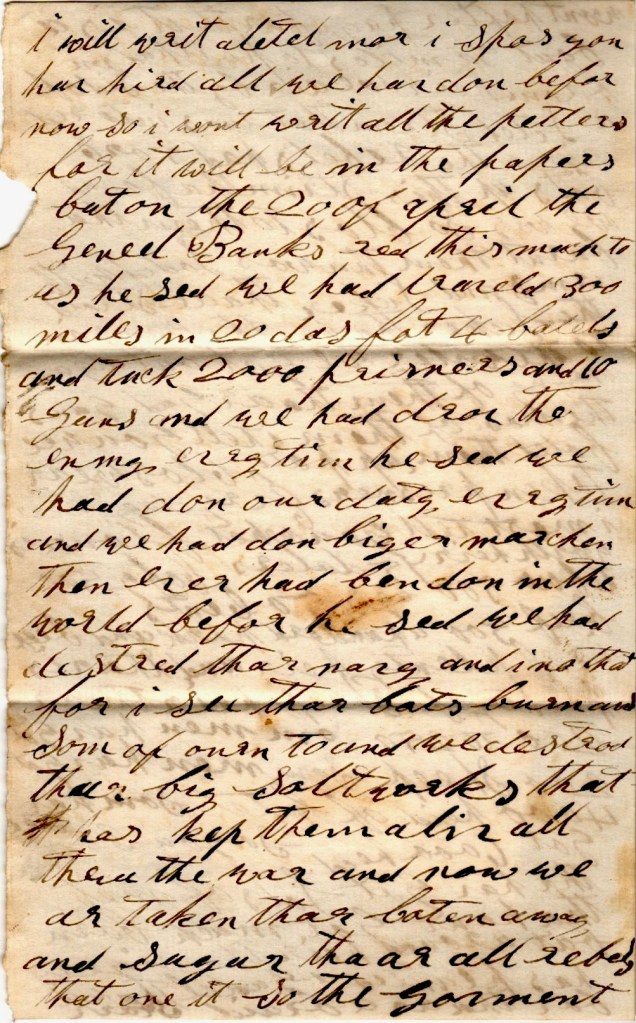


Letter 62
Louisiana
April the 30 1863
Today we muster for pay again but I don’t know when we will get it. But we don’t want much money here—not when I am well. I wrote part of a letter the other day but didn’t have time to finish it so I write this today. I don’t know as you can read the other.
We are here yet a drawing cotton. Our regiment has got 150 teams to work a drawing cotton. When we can’t find it, the niggers will tell us where it is. They are glad to have us get it. We take all we can find and give the owner a receipt for it. We shall stay here a few days more, then I don’t know where we shall go then. We are having a good time here. It is nice, warm weather here.
Corn is about knee high. There ain’t much planted for the men are most all gone to war. They are at Vicksburg, the most of them. They has some come home from there. This old planter where we are—he was a Captain there. He took the Oath [of Allegiance]. He had one son killed at Vicksburg. He keeps 100 slaves now. We are in camp in the road in front of his house. Last Sunday his darkies was here in camp. They said they would tell old Master I am free nigger now. Old women—they scamp right up and down to see the Yankee soldiers come in here. One old lady said she was at New Orleans when Old [Andrew] Jackson come there. She has been a slave ever since. Now she says this iron work is took off from her shoulders and neck and now I am free. She says “soldiers, I feel so well over it that there ain’t pain in my old body.”
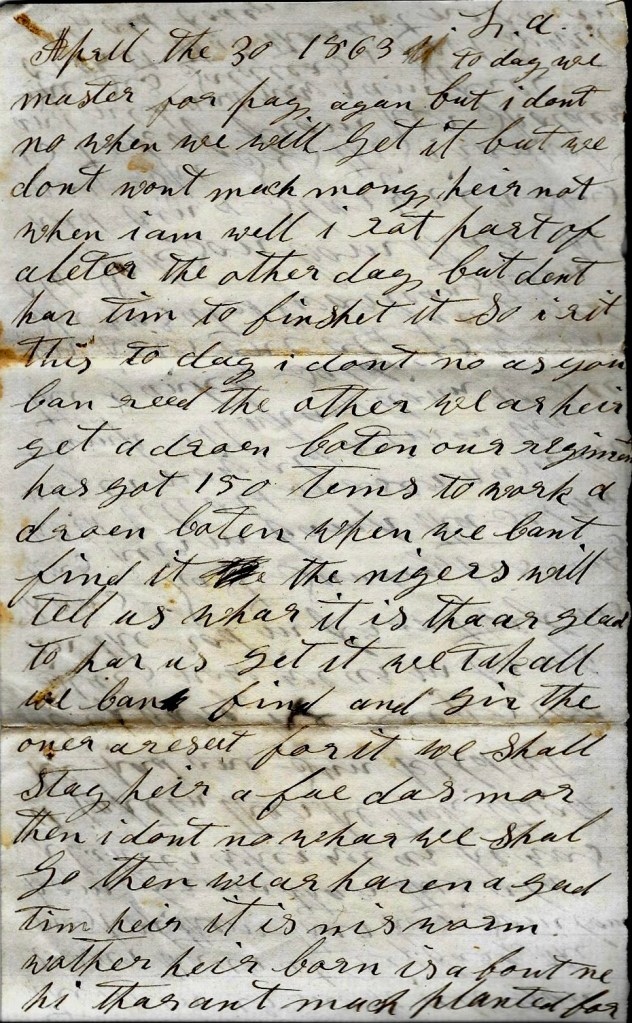

Letter 63

Opelousas Louisiana
May 4, 1863
Mrs. John Hager,
We are here yet a drawing cotton. The talk now is that we are a going back to New Orleans in a few days but I don’t know whether we shall or not. If we are nine-months men, then I think we shall go to New Orleans and then to New York. But I don’t know that yet. Some of the boys say they are 9-months men and they know it. But I don’t know it myself. I hope we are—that is all I can do for it don’t lack now but 2 days of 7 months since I have been a soldier, but I don’t think we shall have to stay 3 years down here. Do you think so there at the North? If you do, I wan’t you to write it to me.
I hear they are a drafting there. I want you to tell Chester if you see him not to come. I understand they can get clear by paying 300 dollars. If he can, tell him to pay and say it is cheap enough. I know 300 dollars is a good deal to pay, but he won’t like soldiering. I know he won’t. But I don’t want to discourage him if he wants to come down here. The more the merrier. We all like camping, so come on all that want to. We have some pretty good times a soldiering and some middlin’ hard ones. I like it full as well as I expected I should when I started. I have stayed now about as long as I thought I would have to stay when I left from home. But I can stay a little longer if it is necessary. I would like to be to home by the 4th [of July] so you and I could go to Texas [a small hamlet in Oswego N. Y.] again to the dance.
I have had a pretty good fourth down here. It was a rather noisy one, but I am well satisfied with it. I don’t never expect to see another show like the one I have seen. I think we have got them cornered up so they won’t fight no more. They keep coming in and giving themselves up. There has another come in today. They say they got tired of soldiering. They say it is too hard work. They say the Yanks are too smart for them. They say we are tougher than they are. They say we stand it better than they do.
They have got as good guns as we have, but they ain’t half as well disciplined as we are for we are as well drilled now. We are drilled well enough for regulars now. But I don’t think I shall enlist in the regulars—not till after I come home and stay a spell. Nor in the cavalry. I had a chance to go but I thought I would stick to the 110th [New York] a spell yet. I don’t think they are the worst regiment there is in the service, and I know they ain’t. Company I is a pretty hard one, but the rest [of the companies] are pretty good ones I think.

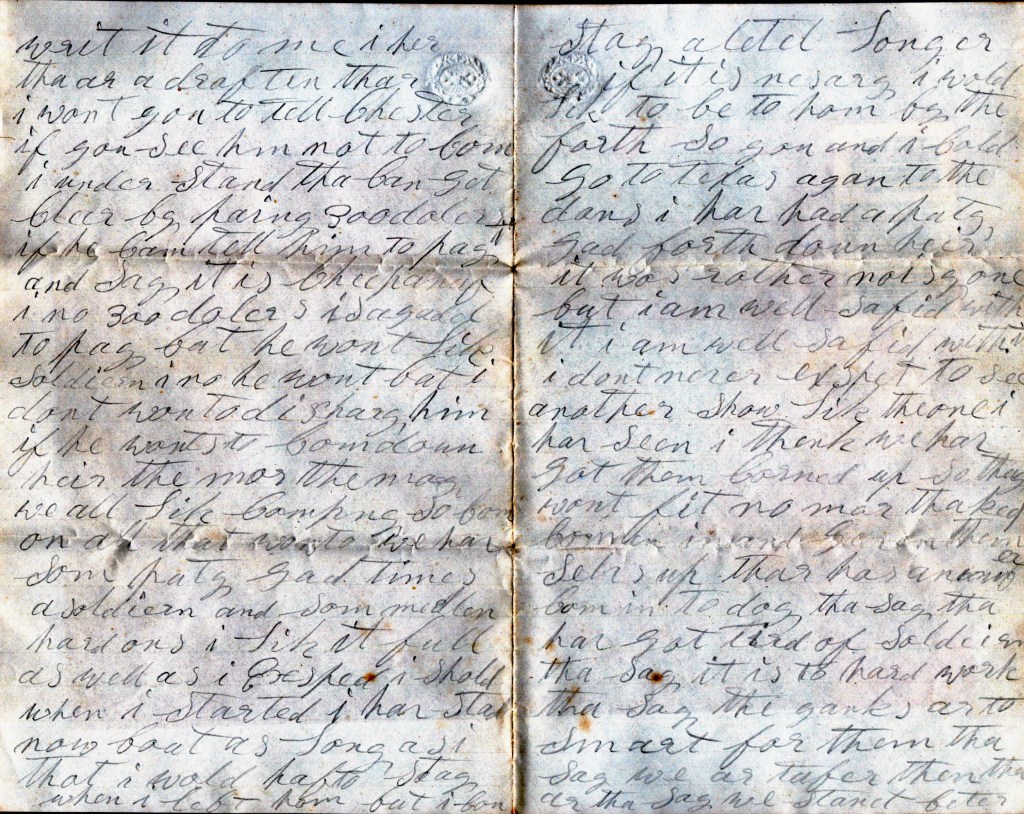
Letter 64
Barre’s Landing, Louisiana
May 10, 1863
Mrs. Hagar, we have started for some place, I don’t know where. I think we shall fetch up at Port Hudson. It is Sunday today. We heard a heavy cannonading all night. We heard that our folks have got Alexandria but I don’t know how true it is. We are in camp in the woods here. We have got a good cool place here. Our boys are pretty healthy here on this march. It has been a pretty long one but we had a pretty easy time there while we was a getting cotton. We didn’t have to help load any cotton—the Negros loaded it all while we stood there. We enlisted 200 Negros and they have gone to drilling. They marched off with us after they got in the rank. It made me think of old Oswego. Their wives took on the awful kind. I never seen folks appear to think more of one another than they do. Some of the women say they will go where their men do and so they have come along. They are in camp about one mile from here. They is about 1200 of them here. They are a going to have white officers. They are fierce to fight. They say they are free now. When they passed by their master, they said they was a going to fight now. They said they would fight till they died—they would whip all the rebels. I think they will fight pretty well, I tell you. They are a tough lot of boys. We took 30 [slaves] from one man. They had got 400 or 500 acres of corn. It is about 2 feet high and it been hoed yet.
We burned the fence for [fire]wood to cook our meat on, and chickens. I guess they missed some sheep and some hens and some honey. We took what we wanted to eat but we weren’t allowed to go more than one mile from camp. I had all the blackberries I wanted to eat while we was at camp. But there ain’t none around here. It is pretty early for them to be ripe.
Our regiment has gone on. They started two days before we did. I han’ t seen them now in over two weeks. The Major is with us. We are a waitin’ for orders to march. We have got some prisoners with us. I think we are as likely to go to New Orleans as any other place. Now I don’t hear no more news at Port Hudson and Vicksburg and nothin’ to do with us, for old Grant he is there and that is out of Banks latitude. So, we don’t go there. I would like to go up there and see the place. I have seen some of the state of Louisiana but I don’t like this state—not any place I have seen yet.
This is the damndest ink I ever seen in this world or any other and I don’t know as you can read half I write to you. But you are a [spirtles?]. You can guess at some of it, if you can’t make it out no other way.
What made the women feel so bad, the old planters killed 50 or 50 Negros two or three day ago. They are afraid they will kill them. We told them that they daren’t kill no more. If they do, we will all come back and hang every one of them and they know it, for we told them so. We weren’t afraid to talk to them. We talked right up to them. It made them stare to see the Yankee soldier. They never seen none before. When they seen we was a comin’, they took their flag down and hang out a white rag at almost every house. But I think we had ought to hang half of them and take the rest prisoners. But if this war last much longer I don’t know what they will do for bread here. They can’t buy none nor raise much. We have got all of their cotton—or the most of it. There is some that ain’t put up in bales yet. I don’t know whether our folks are a going to get that or not.
Old Banks says he is a going to make a clean sweep where he goes but we have left a good many cattle and sheep and horses and some mules. I think they will have to build some fences for they won’t raise no corn. They han’t got nothing else planted. They han’t got no niggers to hoe that now. I tell you, it looks pretty darned hard to see so much fence torn down and burned up. They stand and see it done but don’t say their soul is there.
Some of them has just bought niggers and paid from 500 to 1700 dollars for them. They han’t had them over 2 months and now they are a soldiering. Now I tell you, it makes them grunt some. There has a good many gone out of the 110th [New York] to drill them and four officers. I could go but damn a nigger—I won’t go if I could get Colonel berth.
It has been some time since I have had any letters from you—since the 13 of March when you wrote your last that I have got. We are looking for a mail every day Lon Daily we left to Berwick Bay. He was sick but I heard from there a few days ago. He was better then. We left Sam down there and Raff and Dick, Mr. White, and a number of others. We left Samuel Dawly. He lives in Albion. He has shot his finger off on his right hand. We left him where we had the fight. He said he was sick so he went back. It burnt him when he see the [ ]. I am well and hope this will find you all the same.
This from the soldier — John Hager to Phebe Hager, his wife.
When we get to someplace, then I will write again.


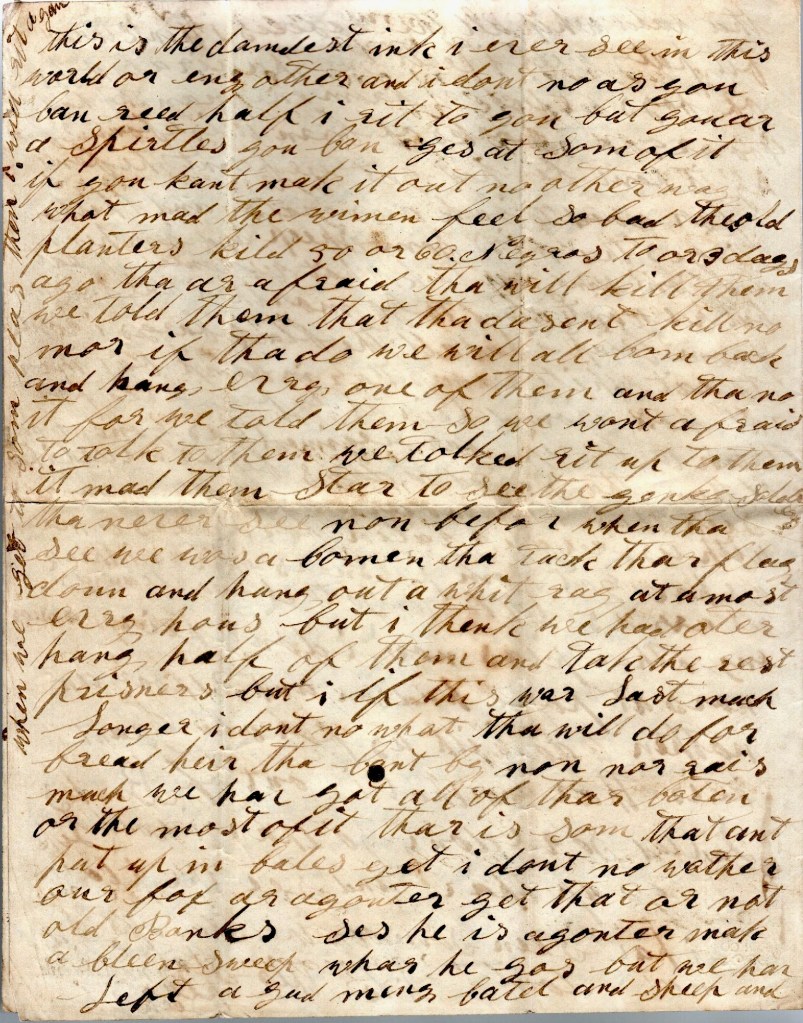
Letter 65
Barre’s Landing, Louisiana
May 11, 1863
Today is Monday and I have got another piece of paper so I write. We are here yet. Co. H is a goin’ to Alexandria with the supply wagons and we three companies stay here. Six companies has gone up the river. We are pretty well scattered around now. There is one thing certain, we are 9-months men. I know that for I have been a soldier 9 [months] and 5 days now and han’t lost a day yet. I think I have done pretty well. I know now what it is to be a soldier but we have had a pretty easy time for the last 15 days but the 14 days before we was on a march that wasn’t so easy.
I wish you would send me a few stamps if you can get them. I give five cents for 1 stamp, five for one envelope. I borrowed the paper of Joe Preston. He had plenty of it.
I don’t know how long we shall stay here. I think not long. You spoke of winterin’ your cow. You will have plenty of hay on your place to winter two cows. It won’t cost much to draw it and you can buy all the potatoes you want in the fall for 25 cents/ I will send the money to you if I get it. If I don’t get it, then I cannot send any. I wouldn’t work out doors, not a bit if I was in your place.
They say at New Orleans that they have had the warmest weather that they have had in a good many years. It is pretty warm here today. It hain’t rained in three weeks here. It is pretty dry here now. It is so dry we can’t hardly see one another [for the dust] when we are a marching. I had rather march in the mud. I s’pose Charles has waited a good while for his money to buy his sheep but I will send it to him when I get it. Then he can buy it if they are to buy…
I don’t know when I can send this. We are a watin’ for a boat. We expect it today. Then I shall look for a letter. They we shall get orders where we are a goin’ to. I must close by saying keep up good cheer and never cry till you are hurt, so good day, my dear, for now. This from the soldier, — John Hager
To Phebe Hager, my wife.
[Editor’s note: This undated sheet was most likely added to this letter]
Mrs. John,
I have a little more to write. One of the Sergeants—Mr. [Henry D.] Rogers 1 from Pulaski died at New Orleans. He was a pretty tough man till we went on the first march. He was taken sick when we got at Berwick Bay. There we left Mr. White and William Weed. They went back to New Orleans, and Rogers died and Weed. 2 So we have lost 4 men out of Co. B. Some are sick and some have got their discharge. We have got 52 men fit for duty now. Some nights on the march we don’t have more than 35 men to answer to their name. They got tired out. But I stood it first rate myself. We don’t seem to mind nothing about it when one dies here on duty. Say he is dead; he won’t soldier no more, that is all for him. We have got so used to it [that] when we see them dead rebels lay in the road, we all walk along. Most all [that is] said [is] here is a rebel and there is a rebel. We was all glad to see them. I s’pose you think we are pretty hard-hearted boys but this was what we all thought and it was the way I felt at that time. We was after rebels then and we are after them yet, but not as fast now as we was then. I could have went 40 miles a day after them, or 50 if I had good water to drink.
Phebe, I must tell you what I have got for my supper. I have a johnny cake—no butter, but I have got honey to eat on it. Coffee, I make it in my cup. We have plenty of meat here. Pork and beef, some mutton—all we want. We live better on a march than I do when we are in camp some days. Since we have been on this march, we hain’t had but four crackers a day. But we get enough to eat.
When folks wouldn’t give it to us, we took it in welcome hens, or sheep, or sugar, or anything we could eat. That is the way that soldiers do when they are among the rebels. I’d rather be among them than to stay in camp. I can get more good things to eat. I will stop writing for I have wrote more now than you can read in two days, I guess. All of this to my old gal, Phebe Hager, my wife.
From — John Hagar
Write all you are a mind to, Phebe. I don’t think I should write again till I get in camp again.
1 Henry D. Rogers—Age, 33 years. Enlisted, August 1, 1862, at Bichland, to serve three years; mustered in as private, Co. B, August 13, 1862; promoted sergeant, August 25, 1862; died of typhoid fever, April 25, 1863, at University Hospital,. New Orleans, La.
2 William Weed—Age, 33 years. Enlisted,-August 6, 1862, at Eichland, to serve three years; mustered in as private, Co. B , August 13, 1862; died of typhoid fever, April 21, 1863, at Marine Hospital, New Orleans, La.



Letter 66
Barre’s Landing, Louisiana
May 16, 1863
Mrs. Phebe Hager,
We are here yet guarding the cotton. We are taking it to New Orleans as fast as we can get them. We shall stay here till it is all loaded. Then we shall go to Alexandria. We heard from there today. We heard that the Rebels were a comin’ here to burn the cotton so we took it and made a breastwork of it. It makes a pretty good fort. We are all on guard all the time now. We have got 1,000 saddles here. We are boxin’ them up to take along. I think we shall go on to Texas when we start again but I don’t know anymore where we are going till we get there than you do nor half as well for you have the papers to read. I s’pose you know what we are about here. Old Banks is a doin pretty good, I think.
We have a pretty good place to stay but the guard duty is pretty hard now for all the troops have gone now but two regiments and our four companies. I will tell you how many men we have for duty— 42, officers and all, and the others about the same. Our men are pretty well scattered around about these times. I think 100 when we were at Baltimore and now 42; over on-half in 9 months. Four died and 4 or 5 have been discharged. Some is sick at Fortress Monroe, some at Brashear City, some at New Orleans. They are all well that is here now. I think I have been pretty lucky. I have been with the regiment all the time.
I have got the mail when the rest did. The letters all come on after the regiment did. I am glad I can go on with the regiment for I can see a good deal. We have scored around here pretty well. We have took almost all they had got. I think the Union men will be glad when we are gone from here; I know the Rebels will. There is some good Union men here and a good many Rebels. There was 25 come in and gave themselves up as prisoners of war. They was on one side of the river and we was on the other. They was on picket and so was we. We was there 2 or 3 days before we seen them. The river hain’t more than 2 rods [11 yards] wide.
We have got 300 pickets out now I am on post now while I write this to you. I like being on picket the best of any duty. I know there is a little more danger here than in some other place, but I don’t feel any afraid—not in anyplace nor never have yet. Stood right up to the mark every time. I can’t write too much news today for I hain’t got it. I don’t know if we have got Port Hudson yet or not. We heard we had, then we heard we hain’t. But our men fired into them one hour or two and didn’t get no answer back. That is the news here today. But if we haint got it, we can take it, I know, for we have done everything we have tried and we have got the tools to do it with.
This from your friend and soldier, — John Hager to Phebe Hager, my wife


Letter 67
Louisiana
May 28, 1863
Mrs. Hager,
When I wrote I didn’t know where we was goin’. Now I know. We are goin’ to Port Hudson. We are on the boat now at New Orleans and the other six companies are there. Maybe we shall stop at Baton Rouge but I think not to stay long.
We enlisted 4,000 niggers and fetched 2,000 down. It made a train over seven miles long. I tell you it was a sight for any white man to see. We come all right till we got to Franklin. Then we was attacked by 400 rebels in the rear of the train. We went back on a double quick step. We was in front—all but 25 men. We lost one man and one man badly wounded—he sprained his ankle. We drove them back 4 miles. We was 6 days on the road. We got to Berwick Bay the 26th. We started the 20th. We took the cars for New Orleans the 27th and got on the boat last night.
I thought I would wait till we got someplace before I would write. I got 2 letters last night—one had your likeness in it. I think it is very nice. I was in hopes we would get some pay before long. I don’t know how you will get along without any more money. After we take Port Hudson, then I think we shall get some pay.
I hain’t no chance to write much but I will write one word or two. I am well—only my eyes are sore from the dust. But I guess they will come out all right. This is all. I s’pose we shall start out so I send this.
Phebe, it done me more than a 100 dollars’ worth of good to help take the guerrillas [?] and his nice span of horses and buggies. It done me good to see them Rebels have as many of them as we have, but they got skart [scared]. They can’t stand fire very well, I don’t think. I tell you we have done some tall marchin’. We had come 19 miles, had stopped for the night, when we got word, then we went back on a double quick, then we drove them, then come back, told the niggers to drive on. I was glad that I wasn’t an ox nor a mule for they just laid it right to them the rest of the night. In the morning at daylight. we got to the place where we had the battle when we went up. Then we got something to eat. Didn’t have no supper.
Well my dear, I think after we get to Port Hudson then there won’t be no more fighting done. I think they will miss the old mules and carts if they don’t the niggers. We took over 80 right out of the field. They came [right] along. They say they had rather soldier than to work for nothin’. I seen a lot of them down here. They have got dressed up and they look first rate. No more today.
This from John Hager to Phebe Hager, my wife, if you can read it.
So you can see that the darkies are glad to see us. They fetch us eggs and milk and [ ]. I tell you, they are glad to see us here. But damn a nigger. I don’t like them nor I can’t—nor I won’t. Co. C has gone to New Orleans with the prisoners that we took in the fight. We have got a lot more to go.
Phebe, I don’t know hardly what to write to you but I s’pose if I write I am well, that is the most. I am well and hain’t lost a day yet since I left Oswego. But it is pretty warm here to march 20 miles in one day. But we have done it and some days 26 miles. But we was after the rebels then and we got some of them, I tell you. How they ran after they got started. But they stuck to it like buggers. They know how to fight and they can stand it to travel better than we can for they wear summer clothes. There aren’t no two dress[ed] alike hardly. I have got me a hat now [but] I don’t s’pose they will let me wear it when we get in camp again. But I can wear it on the march. When I get back to camp, then I can get another and some pants. I han’t but one shirt now. Took that off and washed it last Sunday and put it on again. That is the way soldiers have to do on a march. But I am pretty well pleased with myself. I ain’t sorry that I came down her now. I know something how the thing is a goin’ and I could not half walk when I was there.
I think we shall whip them out now in less than 3 years, don’t you? Then I can come home and pay my debts and be satisfied. I could come home now if peace was declared but it ain’t and I can stay here a good spell longer. But I would like to see you all first rate, but I can’t and there ain’t no sense talking. But I am a coming home when the 3 years is up. That is the way to talk it. But I hain’t been more contented since I left home than I do now. Write how you get along and how the children [are]. Nothin’ more today so I will close by saying do the best you can.
All of this from John Hager to his old gal, Phebe Hager, dear wife.
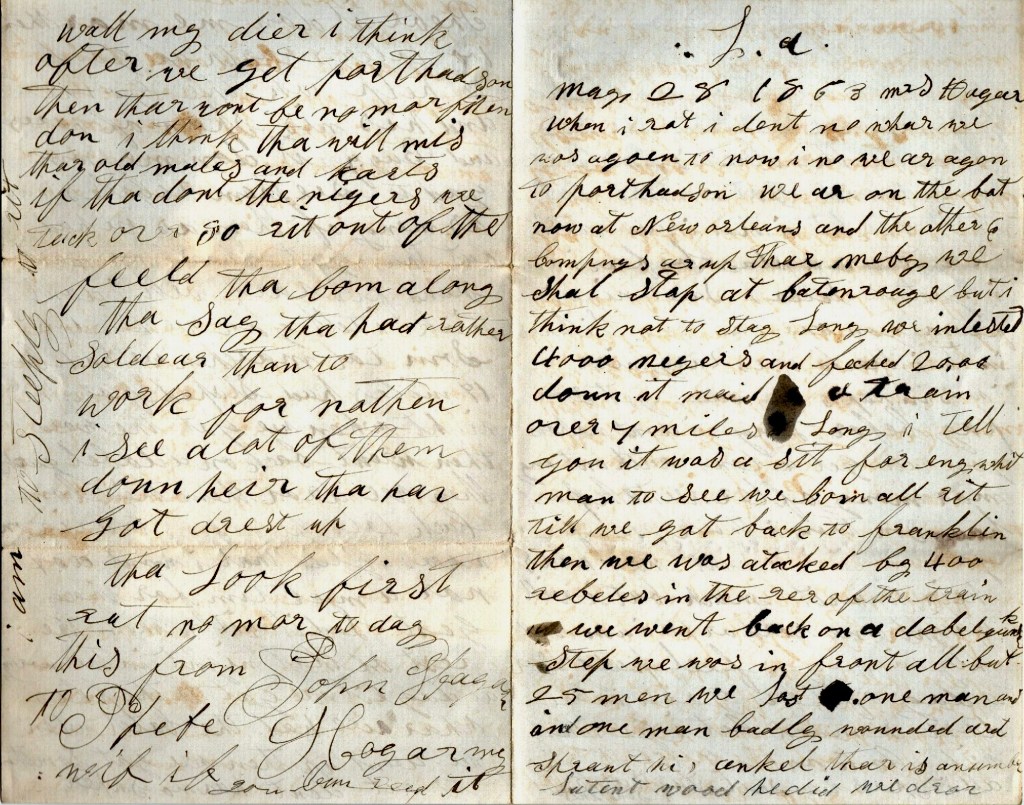

Letter 68
Today is the 29th [May, 1863]
Within 4 miles of Port Hudson. They are fighting yet. I can send this back on the boat, so I send it. We are a going to take Port Hudson now. I think we can do it. Our regiment han’t got to go yet but I think we shall in a day or two. This from John Hager to his wife Phebe Hager
If you can read this. When we take this place, then I will write gain

Letter 69
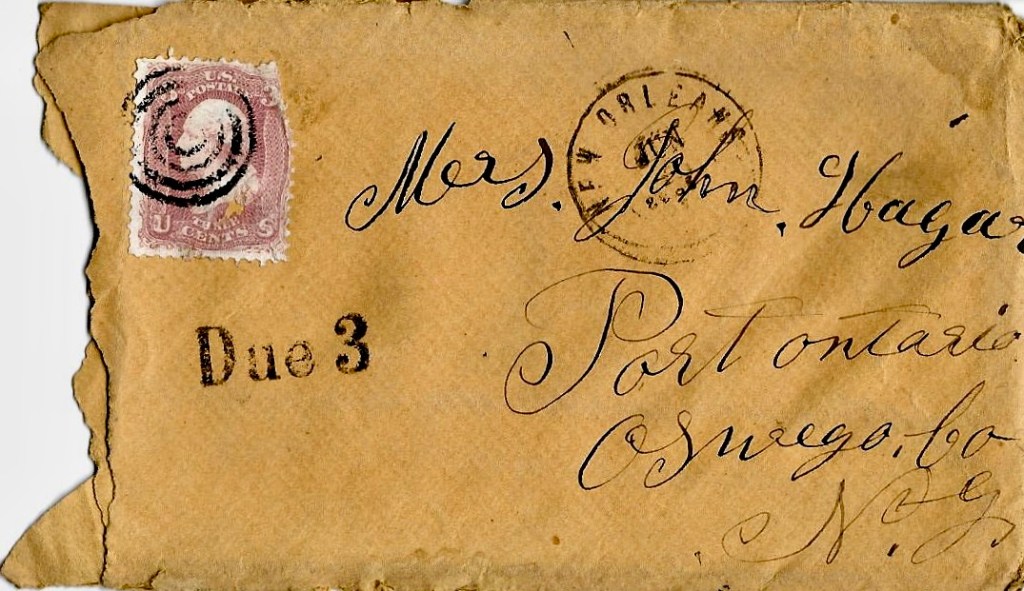
Port Hudson
June 1, 1863
I am at this [place] and a fightin’. I have been here two days. We have gained some ground but we don’t get along very fast. I think we can take the place but it is strongly fortified.
The first day we lost 100 killed, 300 wounded. They are badly [wounded]—the most of them. Our regiment hain’t suffered not much yet. Banks has sent for 1,000 men from Vicksburg. They will be here today. Then we shall charge on them. The darky regiment—they charged on the fort. They lost 400 or 500. The fought like devils and I think we shall all have to. I tell you, it is pretty sorry times about here just now but I dread the shells worse than anything else—worse than a charge and that is bad enough. But I am ready to fight them. That is just what I came here for.
It sounds like the 4th of July all around here now. I am close up to the rebels now but we ain’t a firin’ now so I will write a line or two.
I got four letters, one had stamps in and one had two in. I will send this paper back. There ain’t but four companies of us here. We now number over 50 strong. I will send Jane’s letter to you. It is a pretty good one.
When we came back from Barwick Bay, we brought along some of the boys [with us. George has gone back to New Orleans; he wasn’t very well—he said he wasn’t fit to march. We had a pretty hard tramp to get here when we got off of the boat. It wasn’t but four miles to Port Hudson, but the way we came, it was more than 19 miles. We didn’t start, not till dark. Then we traveled all night. When we got rested, we were ordered into the field and now we have got our mortars to work on them. Maybe that will do something more. I think we get along pretty slow but I guess we will make a sure thing when this place is ours. Then I don’t think there will be much more fighting to be done.
I hain’t time to write much. You can read this to Chester. That will do just as well [as though] I wrote to him. I wrote this on my knee, and there is some noise around here—more noise than any of you ever heard in one day. Some have shot 45, some 55, some 60 rounds, and some of our batteries have shot 400 to 500 times—or the guns have. I think I am in a pretty tight place here, but I am here and I shall do my duty. I feel just like fightin’ today. Maybe I will get all I want. I know I shall get that if we get there in five minutes, but we are bound to whip [them]. I will write again.
This from your soldier — John
to Phebe Hager


Letter 70
Port Hudson
June 2,1863
I will write a little more today. There was some firing all night. Not as much as the night before. They have got breastworks for seven miles and it takes a good many men to surround them. We are all around them and we are a givin’ them fits about now, I think. I think Port Hudson will be ours in a short time but it will cost a good deal of hard fighting to get it. But we must have it, let it cost what it will. But we hain’t got hardly men enough here but we shall get reinforcements in a few days, I think. If not, we can whip them alone, I think.
I don’t know hardly what to write to you, my dear, but I am well and hope this finds you all the same. It has been 13 years today since we was married. I feel as well today as I did that day although I am some ways from you but here is the place where it wants fighting men. It don’t want cowards or deserters.
Phebe, I would rather you would stay at home this summer than to work out, unless you can’t. It is pretty hard work to work out by the week, I think. But you can do as you think best, my dear. God bless you all. I hope you may live to bring up our children if l don’t live to come and help. But I think I shall come home some time.
You can tell Chester that I have wrote to him since he has to me. Nor none of my brothers nor my sisters, nothing. If [they] don’t write to me, I shan’t write to them. But you can read my letters to Chester. It takes a month for letters to come. When we get this here place, then they will come in a week or two.
You can tell Mr. Milo and wife that John never will desert the army. No—never. Not for nothing. I never will be called a deserter. What did I come here for? If you don’t know, I came here to fight if I was needed and now I am in the fields where the cannons are but it don’t scare me much.
Keep up the good work Charlie, maybe we shall see better times. I hope I shall live to come home if not I hope you will get along some way. I don’t hardly know but I s’pose you will get something from here. I don’t know how much but there is 5 months pay due me and however more you will get, I don’t know.
I wrote an answer to that letter, I told you to swear the truth. I don’t think you would do anything else for the whole world. If there is anything else you want to know, I will answer it.
I think there will be hay enough to winter your cow and calf so you won’t have to buy none. I must close by saying goodbye to the one I love. So dear, this from your soldier, — John Hager
To Phebe Hager, my wife and friend.

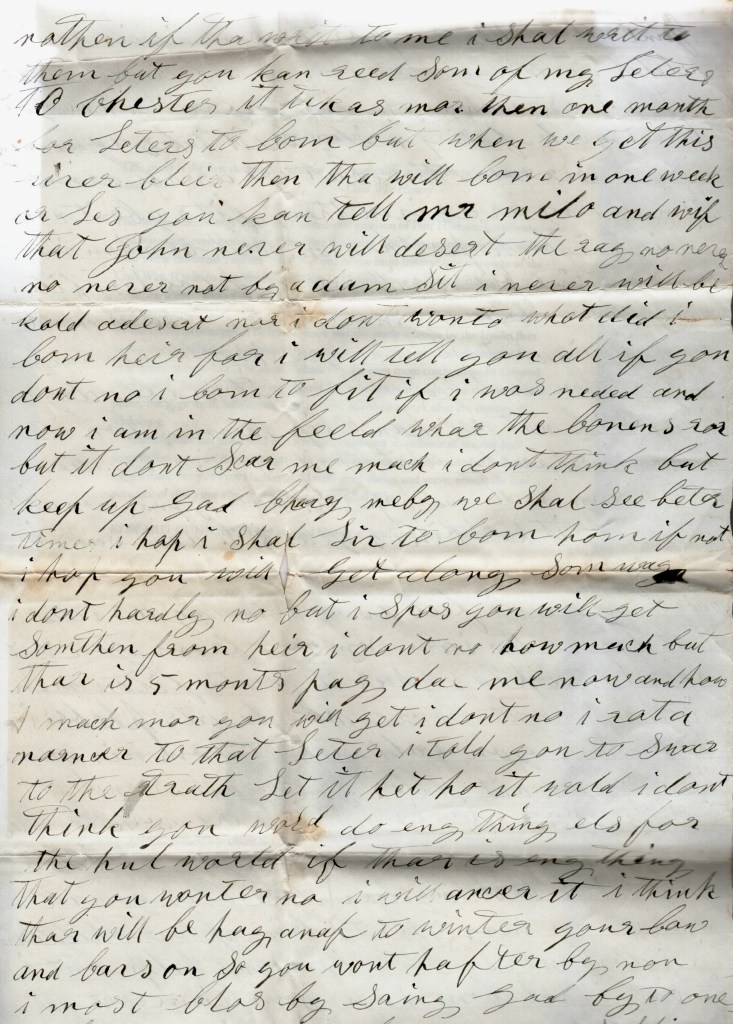
Letter 71

Port Hudson, Louisiana
June 3, 1863
Mrs John Hager,
I now take this time to write to tell you how we get along. We are here yet and Port Hudson ain’t ours yet, but I think we can take it. I know we can but I don’t know how long it will take to do it. Our forces have been here to work at it now for two weeks. We have gained some ground. We are right where we can see all that is a goin’ on. We are here to support a battery. Last night the shot and shell came pretty close. They went all around us and over our heads. They fire more nights than days and so we have been here for three days now and there has been a continuous firing all the time, ever since I have been here.
Phebe, don’t worry about me for I am doing first rate now. I am in hopes I will come out all right and I think I shall. But I shall stand my ground, let what will happen. I hain’t got to die but once but I would like to live to see this war over and see peace once more. This is what I came here for. I write just as I feel about it. This war is a awful thing but let them come back in the union. I know we have brought some back where they will stay. They have lost a good many men as well as us.
When our men drove them in the fort. they lost a good many. They have offered to surrender under their own flag now but we won’t do that. Old Banks thinks he can lick them to his own terms and so do I. Damn ’em. Don’t spare ’em—not one bit. Give them fits—that is what I say in these war times, and it looks some like war here just now I reckon. But I feel like a colt myself. I am as hungry as a bear all the time now-a-days and I feel first rate although we had a pretty hard time since we started from Barre’s Landing with that long train of niggers. It was the biggest show there ever was out. I know it was something, our goin’ up there and fightin’ them four battles and fetchin’ all them negroes. That is the biggest thing that has been done in this whole war or will be done. Only look at the sugar and the cotton that we took. So you have some idea that we have dome something. — John Hagar

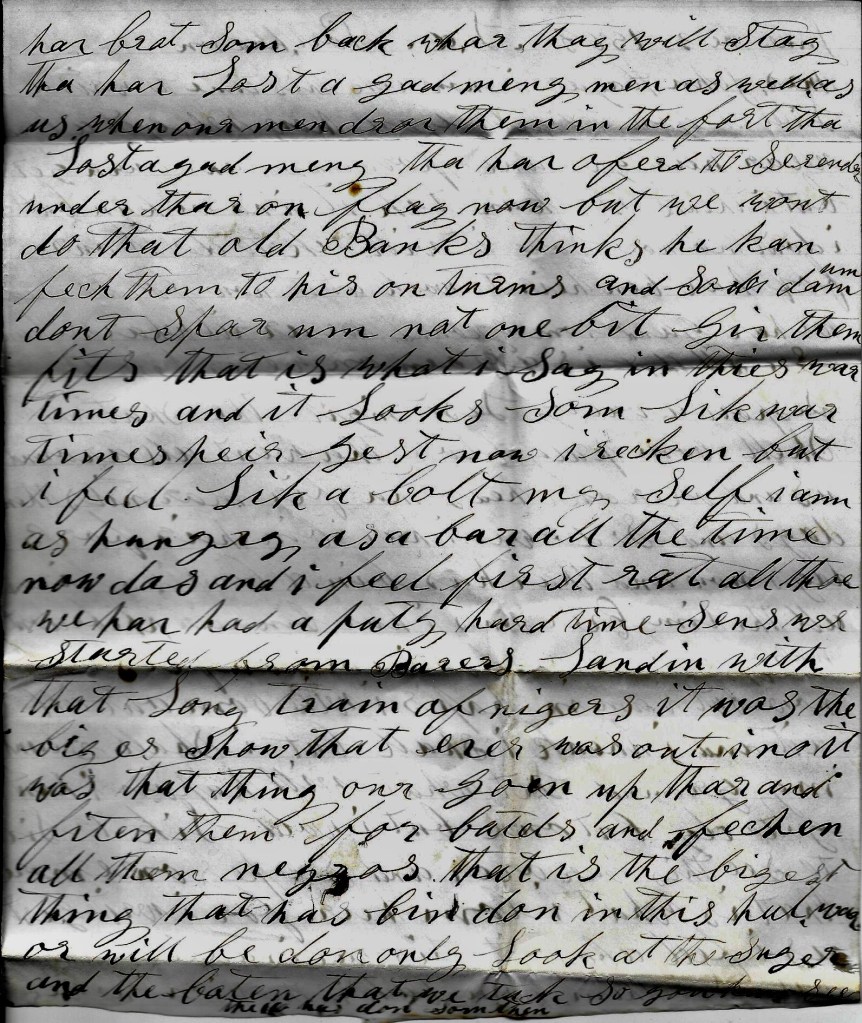
Letter 72
Port Hudson
June 6, 1863
Mrs. John Hagar–my dear,
I thought I would write a little to you today for I han’t nothin’ to do—only to eat and fetch water. It is a nice warm day today and we are a shellin’ the rebs this afternoon. But the talk now is that Banks is a going to open on them Monday. But he is a giving them fights, I think, today so I hope that they will surrender. But if they don’t, then damn them. We will give them hell. I know we can whip them, but we shall lose a good many men. But I s’pose it is in a good cause. I feel so it is the duty of all honest men to fight. But I s’pose you will get the news how we get along here.
Phebe, I don’t want you to work out. I think you had better stay to home this summer and take care of the children. Then you will be all together. But you can do as you think best. You are there and I am here. I don’t hardly know what is best for you to do, but if you have got any money, please send me some as soon as you get this. I hope you will send it before you get this. I han’t got that medicine that you sent me. I don’t know why it don’t come but maybe it will come. I want some money to buy me some tobacco and a little tea.
I wrote to Chester yesterday but I thought that I would write a little today. This is the last paper and the last stamp, but I should write again after we take Port Hudson. Maybe before I will write on this old letter. I could buy some if I had the money and could get where it is, but I don’t know when that time will come when I can have all the money I want. Then I will have all the tobacco I want. But I han’t suffered much yet for it. Don’t worry not one bit about me in these war times.
This to my wife Phebe Hager
All of this from — John Hager
Letter 73
Port Hudson
June 8, 1863
Phoebe I got two letters today. One the first of May and one the fourth of May. Well, my dear, I am well and hope this will find you all well, and you and the children all to home together. I don’t want my boy to be dragged around by none of my folks. I would rather he would stay at his grandpa’s than anywhere else. He won’t work him to death. But I want him to go to school all he can. And I hope you will be contented to stay there too. I don’t think it best for you to work out.
You can make what butter you want. And Phoebe I think you are pretty well off.
What a good many are but I want you to keep the children to home. Keep them with you as long as you live, if it is 100 years, if I do not never come home. But I expect to come home. But I must say to you, I am in a pretty hard place now. We are drawn in a line of battle in front of the fort. We have been a firing pretty smart. It is of [ ] and some of us has fired 45 rounds this morning. I think the 110th [New York] will do something yet if they keep on as we have for the [ ] to man this. Phoebe don’t worry about me for I am a doing first rate here.
There hain’t none of our men fed today—not yet, but they did some yesterday. I tell you the rebs shoot pretty darned close but I have seen some of them fall and I expect to see more of them fall today. James Ridgeway played sick so he ain’t here. Sherman fired 150 rounds at the rebels yesterday. It was a very warm day. You never seen as warm day as it is today, but I feel first rate. We are right between two hills and the sun pass right down on us. We are about 300 yards from the fort. We are on the right wing. Our folks every few minutes send over a shell that goes right over our heads. We go up to the top of the hill to shoot, then step back to shoot. I stayed right in one place and fired 45 rounds. Now I come down to clean my gun and write this to you. Since I have been writing this there has been more than 50 balls right over my head and I haven’t been not 30 minutes a writin’ it. But I don’t never get hurt but tell you for we are a going to take Port Hudson. I think it will be taken before you get this.




Letter 74
Port Hudson
June 9, 1863
My dear,
Here is the place you will read of the 110th [New York Infantry] doin’ something. I don’t know how much it will be, but I guess they will do their share of fightin’. We have been in the field now for ten days and have been in front of them and have only lost one man. He is in Co. I. His name is [Edwin H.] Platt. He was buried. His coffin was 3 cracker boxes. It done pretty well in war times, I think. The Rebs had more than one to bury. We understood that Banks was a goin’ to open on them today but I think it won’t be till tomorrow. But they are firing pretty often this morning on both sides. But we dismounted one of their big guns that has been a firin’ at us. We have got a big elm tree that the General goes up and looks over into their fort and we can see their breastworks by goin’ out a few steps I have blotted this up so that I don’t know as you can read half of it but I can tell you how it is when I come home. I won’t make it no worse than it is. I will tell you it ain’t none too good to tell of but I feel contented here. More so than than I did in New Orleans. This from John Hagar to his friend and wife Phebe Hagar.
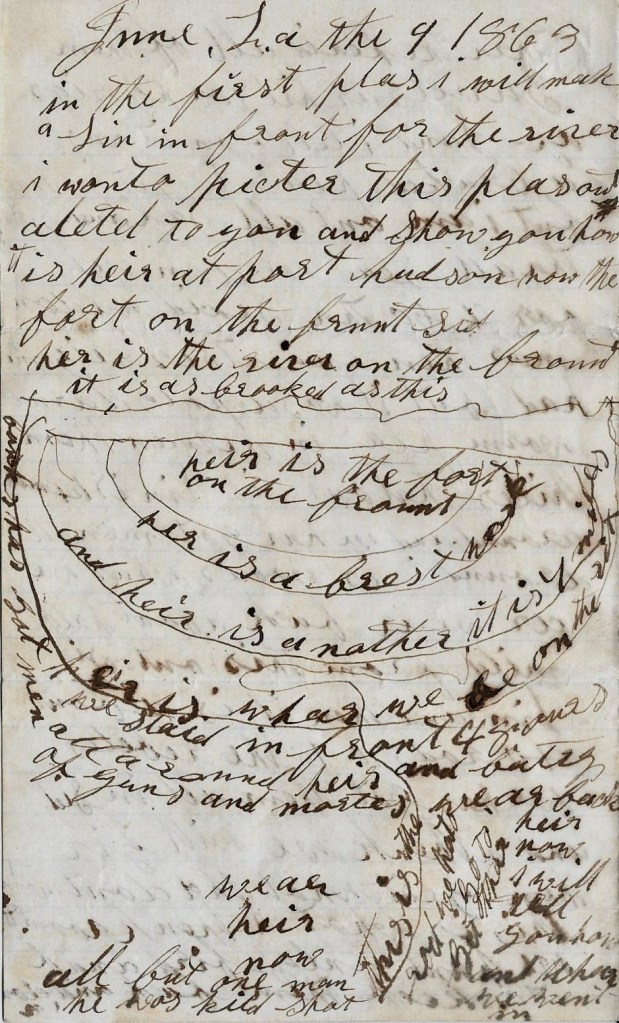
In the first place, I will make a line in front of the riser. I want to picture this place out a little to you and show you how it is here at Port Hudson. Now the fort on the front side here is the river on the front. It is as crooked as this.
They hit all of them circles and hills or high ridges of sand. I tell you it was a wicked place to get into but I am all safe and sound. They all said we done well for [only] four companies They said we done more than any other regiment had but it was a pretty darn warm place in between them hills. The outside line is 14 miles all around and we have men all around it. It is woods back where we are. We are about half a mile from this outside line and then it is about 40 rods [220 yards] from the Rebels. We have got them all inside and I think we will give them just what they don’t want. That is what I think about it. We ain’t only fired enough to keep them back and down.
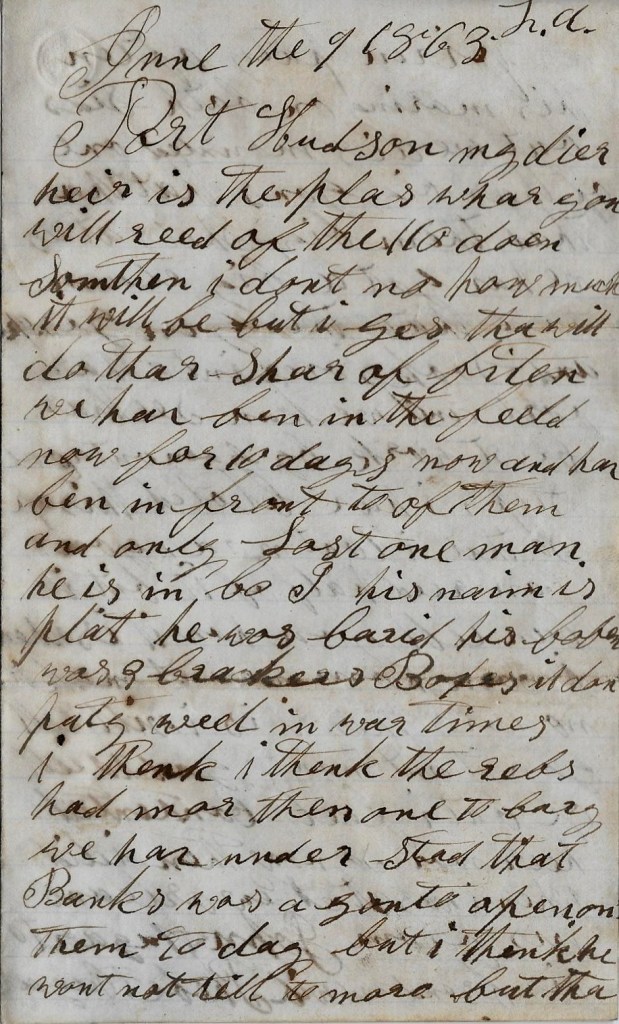
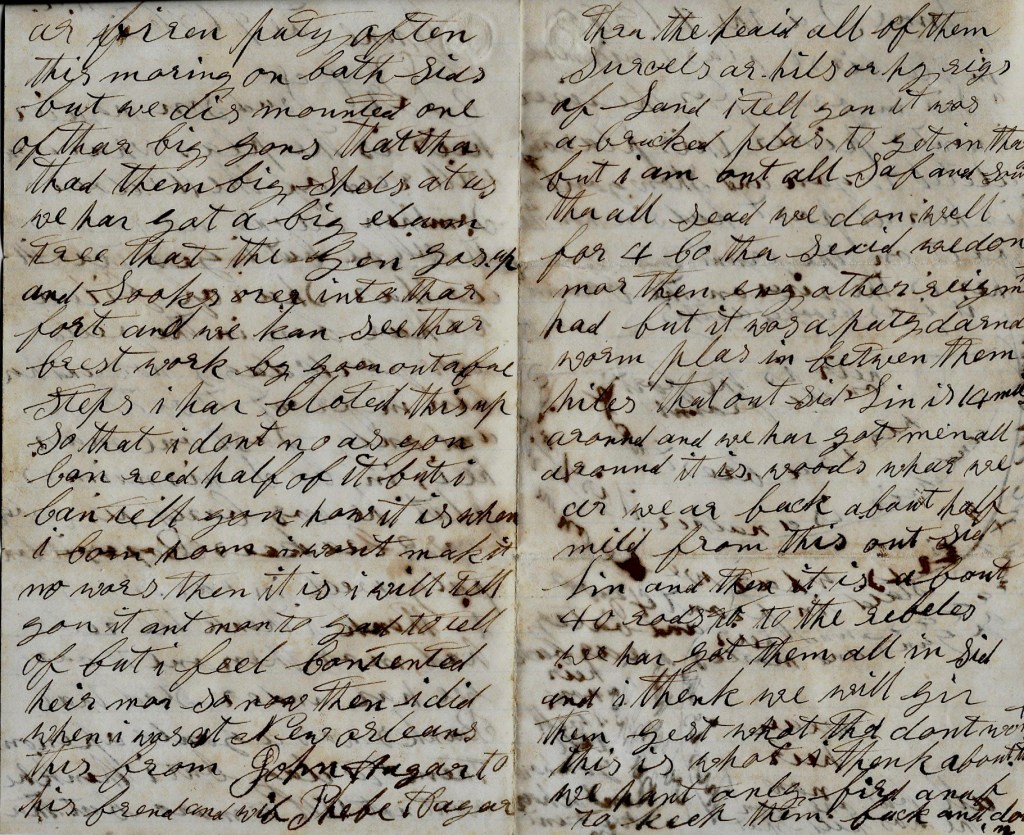
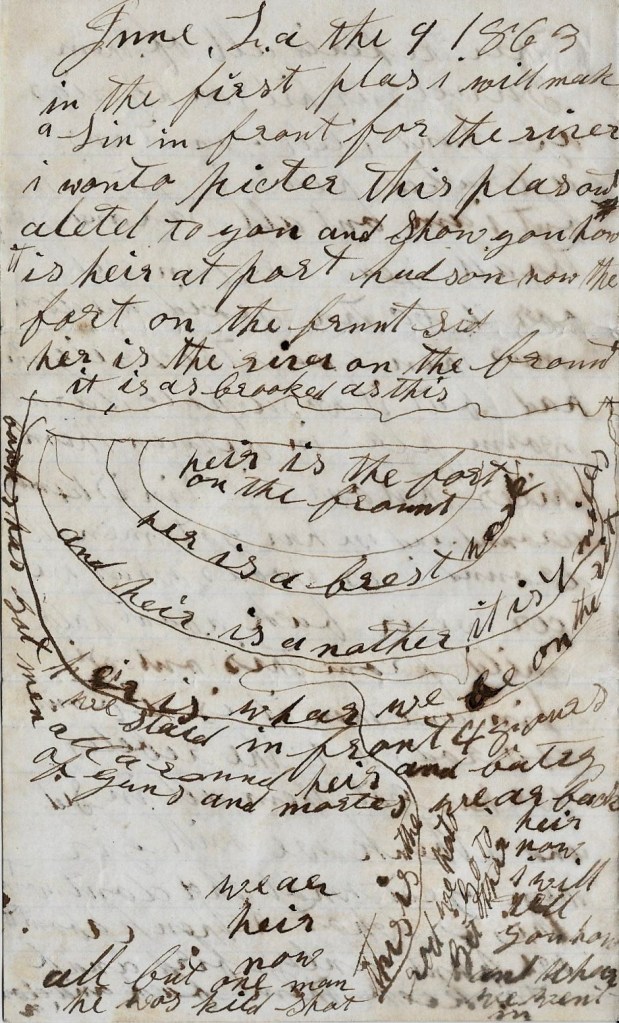
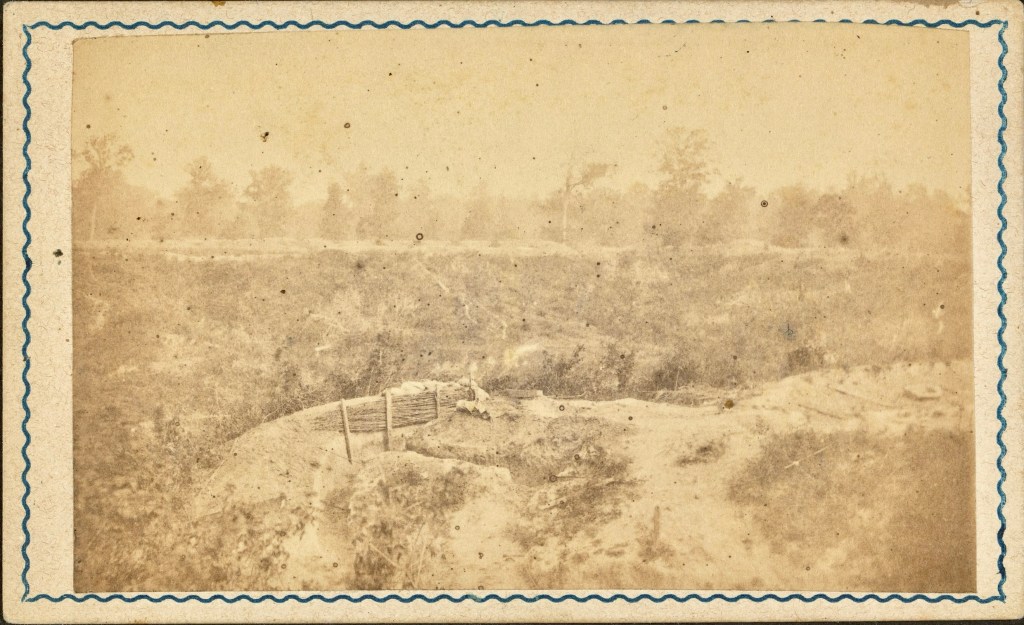
Letter 75
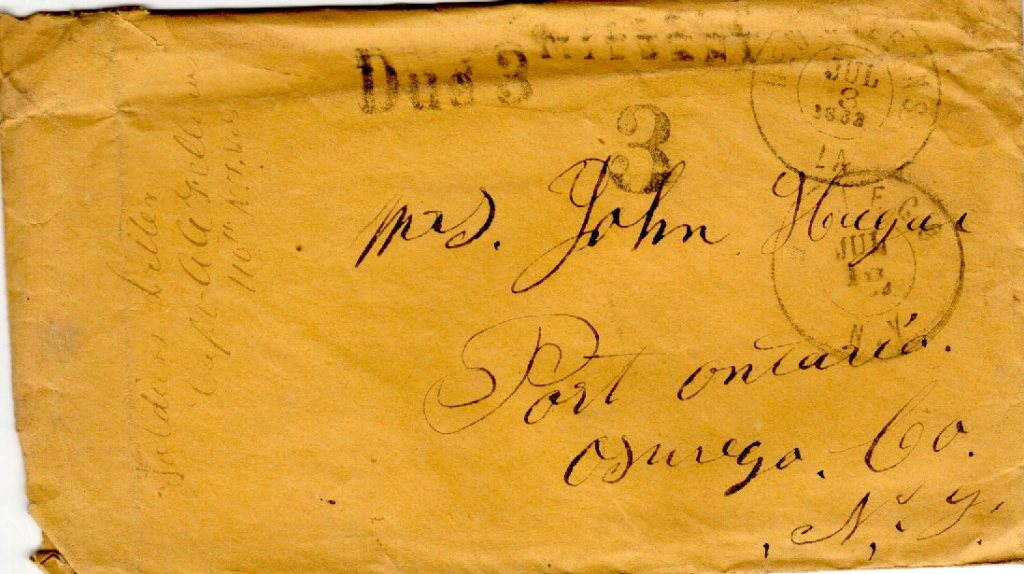
Port Hudson, Louisiana
June 16, 1863
Phebe,
I wrote to you yesterday but I thought I would write a little more today. I can’t tell you nothin’ about what a time we had. If I could, you won’t believe it. But I won’t make it worse than it is. Our loss of killed and wounded about 40. We went in 140 strong. When we came out, we had about 80, but there has some come into us this morning.

We came out better than a good many did for some companies lost all but 5 or 6 men. I think that they was most to fast but General [Halbert E.] Paine is a first rate man. He was a man that don’t put on much. Still, he was a common man. He stayed right with his men all the time. I s’pose we shall try it over again now in a few days. I am ready but I ain’t as anxious as I was for I thought if we took this place, then our fighting was all done. But I don’t think we have got men enough here. I wish our other 6 companies was here. If they was, I think we would have as good a regiment as Banks has got—unless it is the 4th Wisconsin. They are the boys for battle. But they had the write kind of colonel—General Paine. He was their colonel but he is General too.
Our doctor was here today. He said he wished he was here to lead us in but the way it has turned out, I think we come out better than we should if our colonel had been here for he would of followed the General.
I must stop writing for this is all the paper that I have got. The last letter that I had from you was the 19th of May. I shall look for one today. If I do, I shall write some more. I lost my ink. If you send me money I can buy some, and paper. But stamps I can’t get here. Well, my dear if you should not never hear nothin’ more from me, I think I am in this war. But it is a hard war. If I had more paper, I would write more so I cut it all short.
This to Phebe Hager
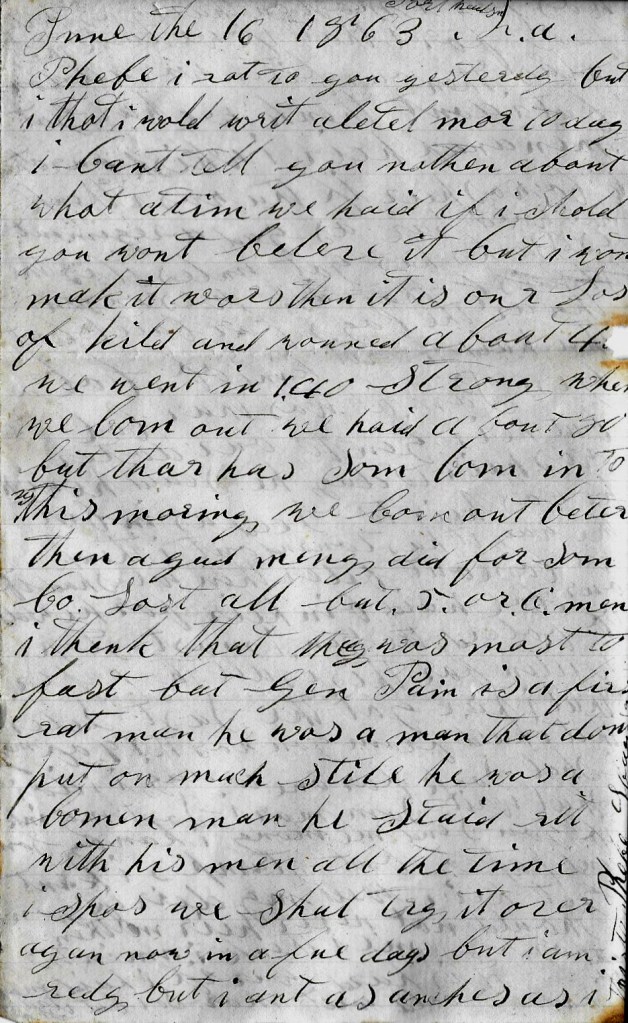

Letter 76
Port Hudson
June 21, 1863
Today is Sunday and all is well here. We held a meeting here today. The rebs hain’t attacked us yet, nor I don’t think they dare. For the 110th is here and Col. Sage said to them, “There ain’t many cowards in this regiment now.” But I must say that the 156th New York was fightin’ some when we was on the battlefield. They started to run but the 110th stopped them and the 4th Massachusetts—they run too. But their officers was afraid to do anything, so they said. The Major of the 156th New York was shot. He was about 6 feet of me when he was shot. He made an awful fuss about it. I don’t think he would of been shot if he had stayed with his own company or regiment. But he come into our company and about 8 or 9 others. It seems that the rebs pick them out for they only hit one of our boys in Co. B. But right in amongst us they was over 20 wounded, only one killed. So you see we was lucky boys that time.
It seems odd enough over here where we are. We can’t hear the sound of guns at all unless we go down to the river. I went down last night to see what they was about. Our boys was a firing into them like thunder. I stayed about 2 hours. I thought by the noise that they was a making another charge on them, but I han’t heard how we did make it this time—not yet.
George has come back from the hospital. He has got his pay. He got paid at New Orleans. I don’t know when we will get ours but not till Port Hudson is taken. Then the talk is that one of us can have furlough to come home 60 days.
It begins to rain, and my [ ] of powder ain’t very good, so I will stop till tomorrow.
George had two letters sent to him but he wasn’t here and Rant said he would take them—he and Jason Wright—and they lost them. They thought there could not anybody else keep them for him but them. But I don’t care a damn for none of them. They feel pretty big. You know how big Rant felt when we at the Port there. He is about the same here, but he ain’t liked none the best. He is a damn hog. I don’t care how relation he is, and he will lie when the truth will answer better. That is all for him. But I don’t have to trouble with none of the boys. We had a nice rain last night. The weather is nice and warm.
I had a mess of green corn yesterday. Corn is plenty big enough to roast. Some of the boys had some the first of the month. Potatoes are ripe but we don’t get none. We han’t had none but once since we was at Berwick Bay. Then I give 10 cents for what I could eat. We han’t had potatoes but two or three times since we was at Baton Rouge. That is almost three months. But we have had plenty of meat most of the time, and plenty of hard tacks. Some of the time we have half rations, but I han’t much fault to find. But if I would of had money, I should have bought a little. Once in a while we can buy flour for 5 cents here or anywhere that we have been. We buy it off the commissary. We have to get an order of our Captain to buy it. They can sell not any other way. Sep Homes and I went together. We have got a spider and a little pail to make coffee in. Mr. White—he is to the hospital yet. He has been there two months.
Now the Rebs have got a ditch about 4 feet wide and 8 feet deep. It is close to the fort and this bank is a pretty hard place to get into. I think it can be done but it will take some darned good fighting. I s’pose this looks foolish to you. I do. This is so I can see how Port Hudson looks when I get home. I s’pose you think there is a good many guns but I don’t think I have got more than one half of them on here. And over we have got 48 men for duty in our Co. B.
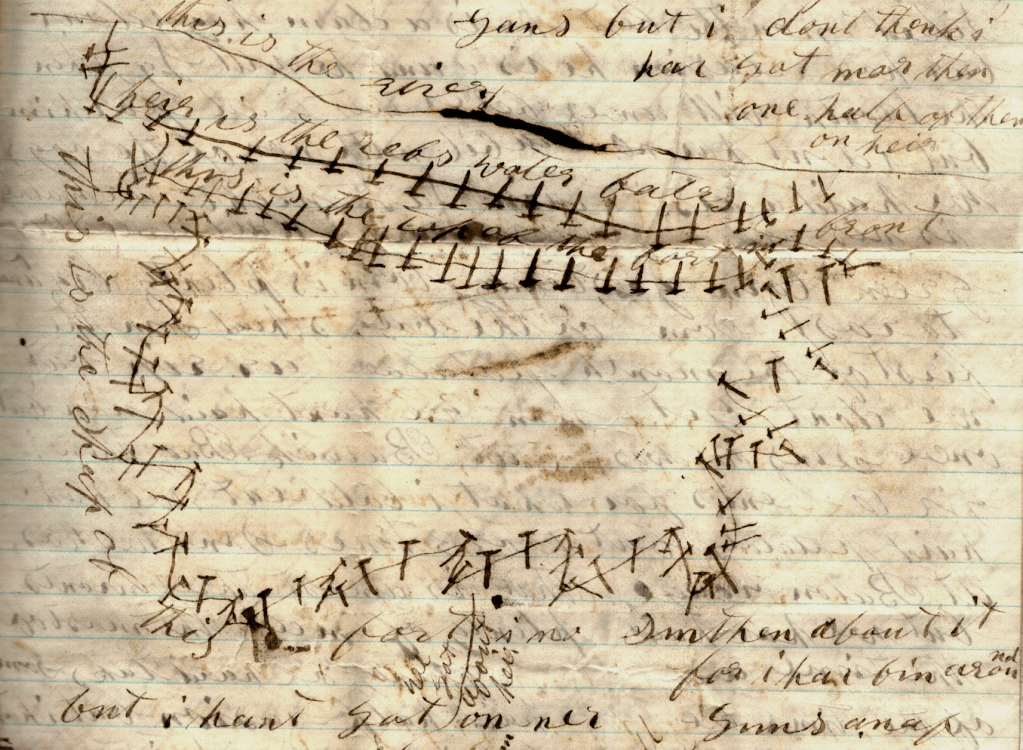
Well Phebe, I did think that I should be a home in time enough to go to Texas [hamlet in Oswego County N.Y.] with you, or somewhere else the 4 of July, but I shan’t get there now. I may get there in time for New Years if we have good luck a taking Port Hudson. But we don’t get it yet. But we are a going to give it another try today. I am in hopes that we can get in there. They have offered to surrender the place if we will give them 2 men. But old Banks won’t do that for he thinks we can whip them. But it is a damn hard place to take around on the outside. It is 14 miles so you see they have got a large place, as near as we can find out. They have got 15,000 men in there and we have got less that 40,000. Maybe some less now. But we had more than that when we first commence here. But we han’t lost near as many as they have at some places, not yet. I spose you will hear all about it before you get this.
Phebe I wouldn’t stay at home all the time. I would go around some among your friends. I don’t care whether you go around among mine as not. If they don’t come to see you then let them go, for what they will fetch. If you want any time work, you can get Albert to do it or if you want any money, he will let you have it for he knows I will send it to you when I get it. You can tell Aunt Phebe that her boy han’t seen no fighting yet nor he don’t know nothing about marching. He ain’t been with us in 3 months. He is at New Orleans hospital. Phebe I ain’t much to writing for I have wrote so often but don’t worry about me for I am all right.
This is the 22 day of June all of this to my wife and children. I want you to keep this till I come home Phebe. I want you to send me some stamps if you have money.


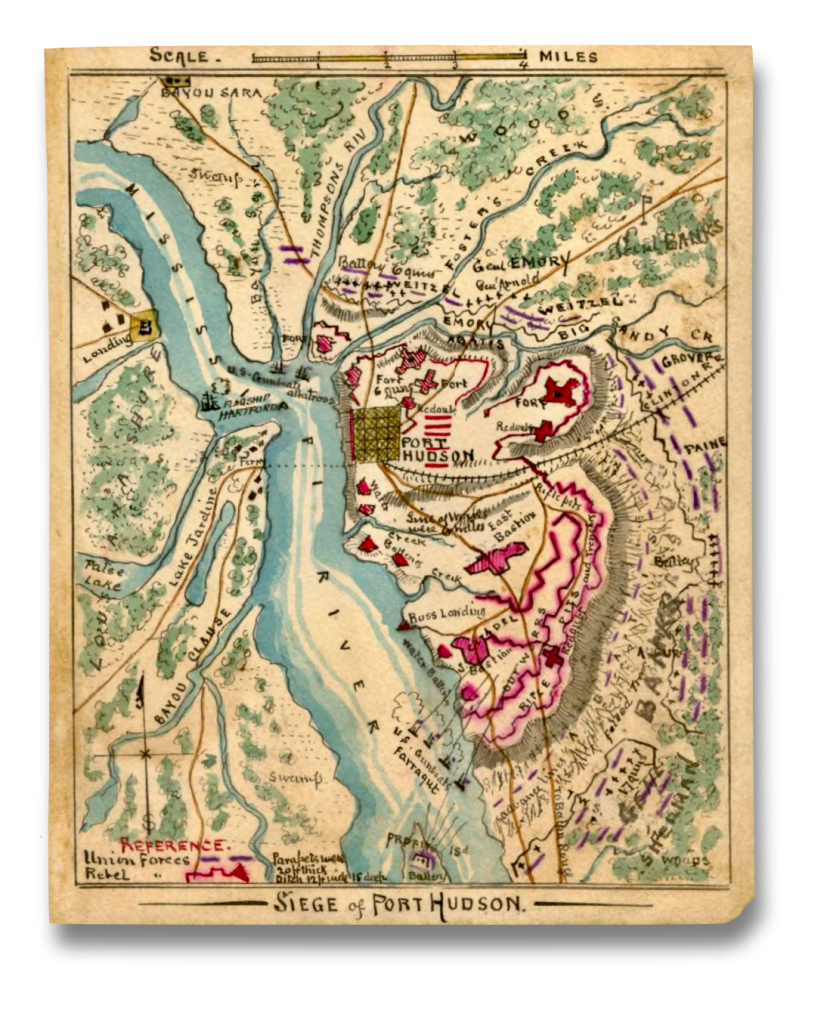
Letter 77
Port Hudson
June the 25 1863
My dear today I will write a line or two to you on this old paper. First, I will say I am well and hope this will find you all well at home. It is nice warm weather here. We are here in camp yet—just across the [Mississippi] river from Port Hudson. It is a pretty good place here, but it seems rather lonesome here to what it did on the other side of the river for they don’t allow us to shoot any here unless we see a rebel and I han’t seen none on this side.
On Monday we were ordered out to go a foraging—two companies of us to see if we could see any rebs. We went out two miles and got 6 hogs and 2 [ ] of sugar. So now we have got plenty of sugar and we got a lot of Irish potatoes. I got over one peck for myself and I got some peaches and stewed them. Peaches ain’t hardly ripe but they taste very good to a soldier. We have all the sugar we want. There is a sugar house full where we went. We could take all we want and I found a nice stand jar to put my provisions in. We stayed out on the plantation all day. They had 4 mules to fetch in our stuff for Co. B we live pretty well for soldiers.
The worst is we han’t got dishes enough to use. I lost my haversack and all I had in it. I had my cup borer and water sucker. That is the thing to drink water out of any mud hole. I give 75 cents for it. I had them pills in it. I had hard tack, 4 of them. If I had 4 now, I would take them but I can’t get them here.
I can get calomel pills but I don’t want to take them. Phebe, I want you to send me some pills in a letter. Put in 4 or 8 at a time if it won’t cost much to send them. I think them other ones was good ones. I know I felt better after I took them. I don’t know as you can get money to get them with but you can borrow it till I send some to you. The talk is now that we will get our pay in July. Maybe the first, maybe the last. I don’t know when but I s’pos a little would come good to you if you had it.
If Port Hudson was ours, I would write for you to send me a pair of light shoes for I can’t get them here if I had 100 dollars to buy them with. If you do send them yet, get good ones and them that are light for it is pretty warm here. The most of the boys go barefooted but you know I can’t do that. One of the boys had a box sent from Pulaski. It cost 3 dollars. It weighed 35 pounds. He has a lot of tobacco in it and he had some medicine in it. It tastes of the medicine. But I don’t want you to send me anything to eat. But them socks come darned good, for mine was all worn out. If you should conclude to send me a pair of shoes and have to send them in a box, then I want you to go and have Chester buy me a hat just like that old black one of mine. Then fill up the box with small papers of tobacco. Then no matter where I am I can get rid of my [stub?]. If Chester don’t offer it to you, if he does then take it.
If I was a going to stay here, I would send for a lot of paper and envelopes. But if they should come and we had orders to march, then I could not bring them and a light pair of shoes I can carry when I am on a march. My boots are too heavy to wear in camp. I offered 7 dollars for one pair of shoes that one of the soldiers had sent to him from Oswego. They was calf shoes. If you send any, send them that are light and I won’t buy one. 8 is the size, and a hat that will fit Chester will fit me. But I don’t want a little low one. I want it about as high as my old black one is.
The shoes will cost about 3 dollars I guess and the hat 2.50. I have lost my handkerchief. If you send these things, send me a good pair of suspenders. I can’t get here or at New Orleans less than 100 dollars. Now we will see how much it will cost, 3.00 and 3 for sending, 2.50 and 3.00, 4.50 besides the tobacco and the socks. Well, we will call it 12 dollars. Now if you think you can afford it then I will get them. If not, let them all go. I han’t never drawed no shoes yet. Phebe, I will tell you where you can get the money for a short time. Albert will let you have 15 or 20 dollars any time, then tell him you will lend him some sometime if he wants it.
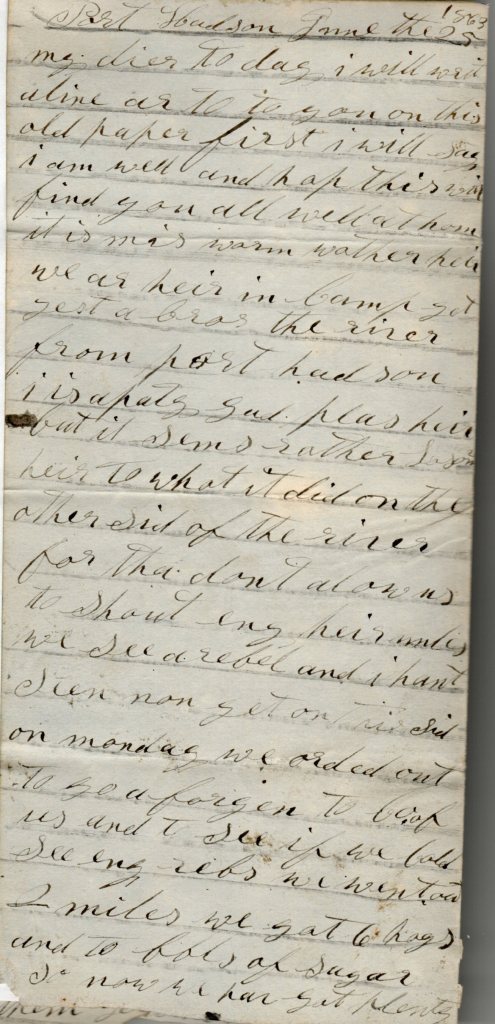


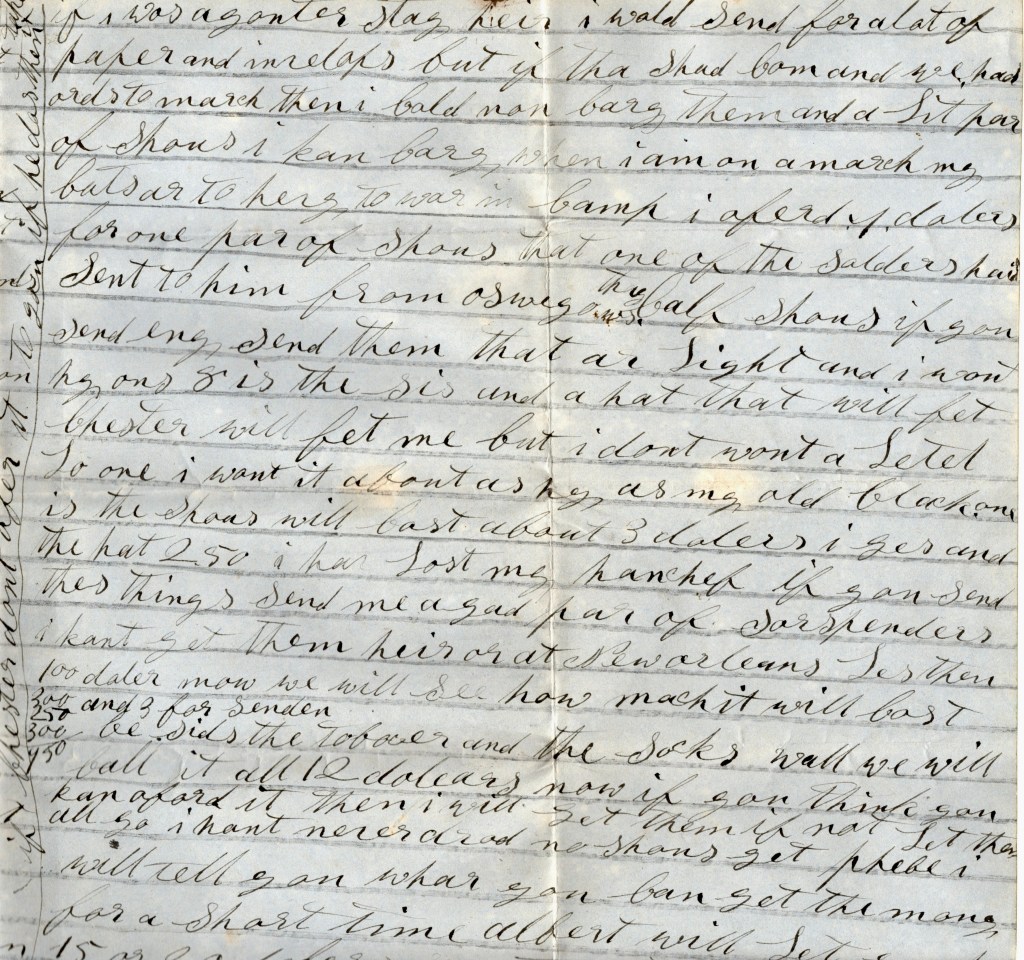
Letter 78
Port Hudson, Louisiana
June 28, 1863
Mrs. Hager–my wife,
Today I take my pen in hand. I write a few lines to you to let you know where I am and what I am a doing. I ain’t a doin’ much now-a-days—only have to stand guard once a week. The rest of the time we have to cook and eat. We live here like fighting cocks. We are a havin’ the best time ever that we have had yet, but we have had a rough time when we was on the other side of the river. But now for two weeks we have had the easiest time that I ever had in my life.
The gunboats opened on them last night but I don’t know how they did make it, but I know one thing, that old Commander Farragut ain’t the man that he ought to be for there don’t more than one half of his shots reach the fort. Last night he give them a few shots of grape and canister. It [fell] in the river and a good many of his shots fall there to [ ]. His men don’t care how long this war does last. I don’t know how long it will last, nor I don’t know when we will get Port Hudson, but I think before you read this—maybe not. I do want to see the inside of this fort. Banks wanted 3000 men to volunteer to charge on the fort when we was over there. I did have some notion of going, but I did volunteer once and that made my old woman feel pretty bad so I don’t go, but he has got the 3000 men to charge on the fort. They say all they want is [ ] If our men hadn’t of run the other way, I think we would of taken it the other time. But when Colonels and Majors lay down in fear of being shot, then what can the soldiers do?…
I got a letter two days ago with that [crossed out] in it, but we have moved now and I don’t know as I can sell it for anything. But if I had of had it when I first sent for it, then I could of sold it for a big price. You won’t send me no more not till I tell you to. I guess you think I send for a good many things and don’t get no money to buy them with but you will have all the more when you do get it.
You spoke about 9-months men. I don’t hear much about that here, but there is some say we weren’t sworn in at Albany nor New York. They can’t hold us out of the state only 9 months but I don’t know nothing about it. But if we was 9-months men, then they could keep us here till Port Hudson is taken. For the 4th Massachusetts—they are 9 months men. They are in our brigade [and] they have stayed now 20 days over their time now.
But my dear, I enlisted for 3 years or sooner if discharged. So you see I shan’t have to stay only my 3 years if the war last 10 years. But I don’t think it will last more than 3 months. I think they will give it up as a bad job. But folks there at the North talk about starving them out here. We may do that in the fort where we have got all around them.
But you can tell anybody that they raise more corn here in this state than they do in New York state. More than 3 times over when we was in one field. It was more than 2,000 acres and all over where I have been. There is lots of it. But it ain’t hoed. But it will be a pretty good crop for it is good land here. It is a rich country here. There ain’t no big cities here. But if there was, it would be ahead of New York. But it ain’t healthy here, I do not think. You won’t be scared that I will come home when my time is out or when I get my discharge. I would come home on a furlough if I could get one now, for 60 days take July and August. Them two months are the sickly part of the season and I would like to see my family once more. But maybe I can’t get no furlough. But if can get one I shall come home. I think Corporal [Cyrus F.] Emery is a coming home now pretty soon. He lives at H_____.
Warren Wing—he has got home, but he has never seen no fighting nor no marching, so he can’t tell you nothing about war. But if I could see you. I could tell you and the children all you would want to hear about war. I guess I could. You said when I told you that they let the Negroes ride and our sick and lame go by boat—that is Gods truth. I know that to be so. But they get their horses themselves and [ ] but where we had sick men, we took them right off and put on the soldier. But damn a nigger anyway I say. They are free now and I am glad of that.
This from — J. Hager
to Phebe Hager

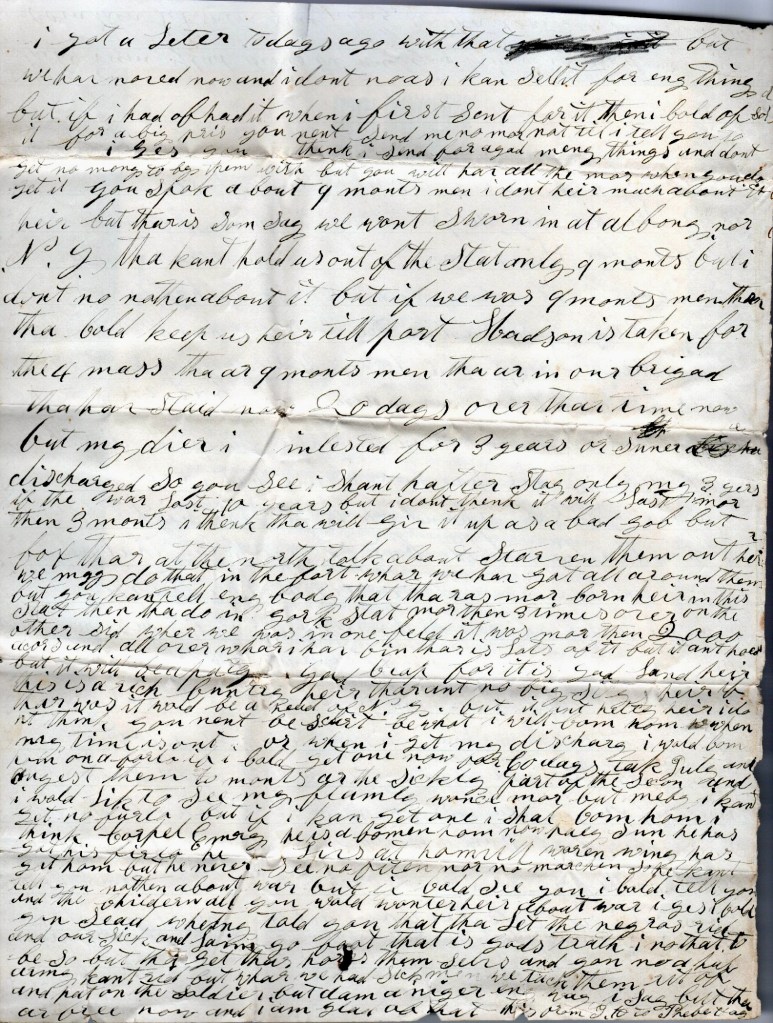
Letter 79
Port Hudson, Louisiana
July 6, 1863
Today I take my pen in hand to tell you that I am well and hope this will find you all well at home. It is pretty warm here now-a-days, but I stand it first rate so far. I have spent one 4th of July in the state of Louisiana. I was a rather lonesome one to me, for I didn’t have nothin’ to do on that day. So I went out from camp about 40 rods and laid down in the shade of a tree. I stayed there till noon, then come to dinner, then went back until 5.
I lay there in the shade and heard our gunboats bang away at the rebs. They fired pretty sharp all day. The rebs fired back pretty readily. We have got 4 guns now on this side of the [Mississippi] river. They upset one for us, but we tip them over the next shot with our 32-pounder. That is one of our heavy artillery guns. The most of them are 12-pounders. Them are brass pieces. We have two of them here where we guard but we hain’t had to use them here yet. I han’t seen no rebs now in some time. It seems rather lonesome on this side [of the river], but I suppose Banks will take Port Hudson now in a few days for he is a diggin’ under their works. Our boys have got most through to the rebs. But that has been the talk for some time that we would take the fort, or we had got it.
I see it in the Oswego papers that Port Hudson is ours but it ain’t so—not yet. And Vicksburg, the New Orleans paper said we had got that, but we hani’t—not yet. I heard from there the 2nd of July [that] two gun boats come down. Then they said old Grant had taken their outside works, so he has got them pretty tight, but not much tighter than we have got them here. One of our men that they took prisoner, they was a going to parole the next day, so he swam the river and come over here. He says they have got out of meat. He says they have commenced to kill mules for meat. So I think they are getting rather hard up for meat. We have plenty of good beef to eat—all we want, and all the pork too.
I han’t had no letter in some time now. I don’t know hardly what to write but I have got paper now. The captain give me an order to go to the Sutler to get it, and some tobacco. It was $1 so I can write. Only I han’t no stamps, but maybe they will come to you all right. Maybe you won’t have the money to pay when they do get there. Then what will you do? Well, I have got 75 dollars due me the first day of this month, but I have used up about 9 of that. It all went for tobacco and tea and something to eat. When I was hungry I should of spent 5 more if I had it, but there ain’t a man in the company that has got it.
Phebe, you talked of me sending back some of your old letters. There was something in it that I wanted you to see. I don’t remember what it is now. Most all of the boys send their letters home but I hain’t sent many back. I won’t send no money home. I have got that quinine yet. I hain’t seen nobody to sell it to. One old planter said he paid 30 dollars for one ounce but when I want anymore, I will send for it. You needn’t send me none till then. I must go and get my dinner. Then maybe I can think of something to write.
It is 12 p.m. now. I have got my dinner now so I will write a little more. I must say some of our boys eat like hogs eat and lay right down. There ain’t but 20 fit for duty today. I am glad that I am one of them. I have done all my duty yet since I have been a soldier, If I am well all the time, than I can stand it to soldier duty well. Sometimes I think it is too easy work for me but when we are on a forced march, then it is hard enough work for anybody. But I don’t think we have as much more big marchin’ to do as we have done. But I can’t tell nothin’ about what we will have to do. But I know we won’t have to charge on Port Hudson again. That is better than Hell, I think.

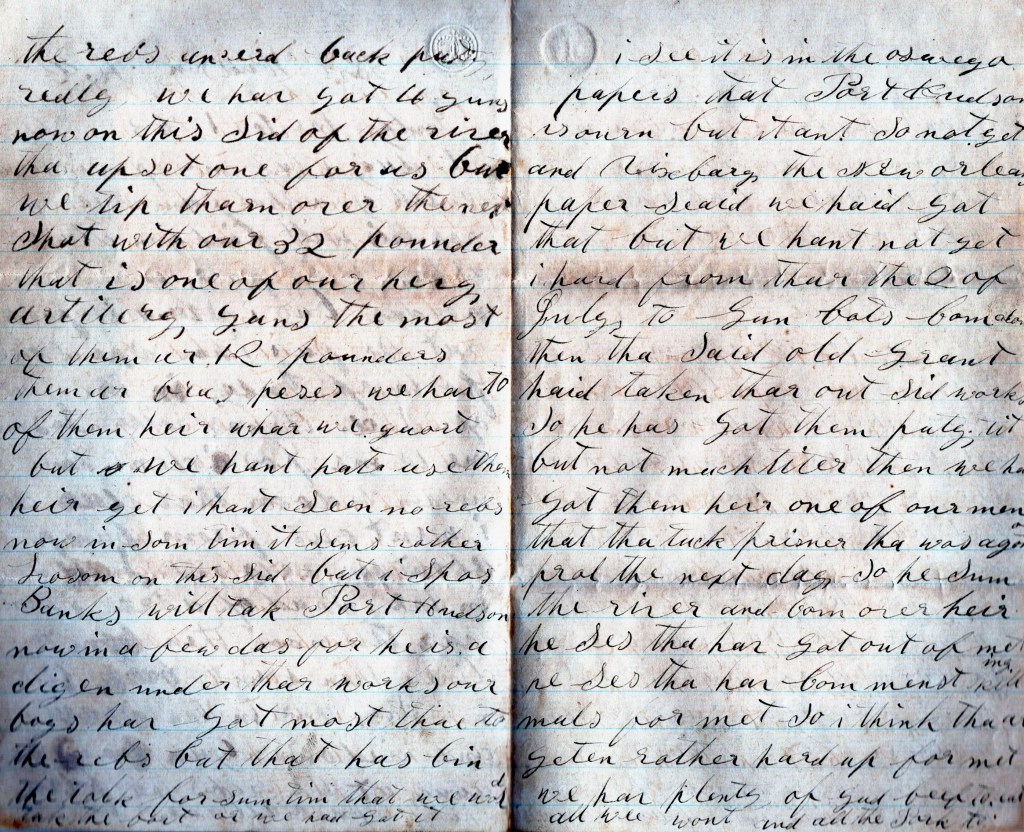


Letter 80
Port Hudson
July 7, 1863
Phebe, I have scribbled this off. I don’t know as you can read it. If you can’t, then send it back and I will read it for you or you can wait till I come home. Then I will read it for you. Then I s’pose you can wait till then. It won’t be but two years and one month now. That ain’t long. It has been 11 months tonight since I have been a soldier. Phebe, I don’t think you will have to pay any road tax on the land for I believe that men that has got a farm, it ain’t rated as much as $45 dollars and [if] he [is] off to war, he don’t have no tax, and I know he don’t have to pay no interest on—not for the time he is in the service. You can find out whether you have to pay the tax or not. I don’t know hardly how that is. I know it will clear me from the road tax. Maybe you can ask your father. Maybe he knows something about it. The mail has come now and I will stop till I see if I get a letter. I can’t send it not till tomorrow. Today is the 7th and I will finish this and send it.
We hear good news. We hear that Vicksburg is taken. If it is, Port Hudson will fall soon—maybe before you get this. But we hear that the rebs has got into Pennsylvania. If they have got there, I guess it will make Mrs. Flemming think they are a coming there. If she knew what I know, she will drive off boys to fight them back. I hear there is 40,000 [rebels]. That is a pretty good army. If they should go by old Flemming’s, they would take every horse and wagon he has got and his cattle. If they didn’t take him, he might think himself darned well off. I hear that Old Abe has called for 100,000 more men. He had ought to call for 500,000 more. [Even] then he won’t have any too many.
Corporal Eli Alexander—he is dead. He was sent to New Orleans. He was wounded in the ankle. It wasn’t wounded bad, but after he got in the hospital, the fever set in. He was an old man. He lives at Pulaski. He has been in the war 11 years before this time so he knew what it is to soldier. Now 11 months, almost 12 years. He was a good old man. He has got a family at Pulaski. 1
[Asel] Wilmot has [wrote?] that he was sick 3 or 4 days. He ain’t died yet. He was crazy. 2 I guess he will get well. He lived at Hannibal. He is in Co B. We didn’t think he was much sick. You won’t read this to nobody for maybe he won’t want anybody to know it. We took him to an old house and have two men to take care of him. If he don’t get well, I will tell you in my next. Then you can read it to anybody. If he don’t, I won’t of wrote it. But it was right here in the house all together. Skip this.
We are having a pretty good time here. We only come on guard every other night now. Since I did not get a letter, I will close by saying be a good girl and write the news you know. They don’t no one write to me but you. But I don’t care a D.
This to Phebe Hager my wife, — John Hager
1 Eli J. Alexander (1812-1863)—Enlisted at age 43 on August 6, 1862 at Richland, to serve three years; mustered in as private, Co. B, August 13, 1862; promoted corporal, August 25, 1862; wounded in action, April 14, 1863, at assault on Port Hudson, La.; died of his wounds, July 2, 1863, at University Hospital, New Orleans, La.; also borne as Elij Alexander.
2 Asahel (Asel) C Wilmot (1824-1863) Enlisted at age 38 on August 9, 1862 at Williamstown, to serve 3 years; mustered in as private, Co. B August 13, 1862; transferred to Co I, no date; died of camp fever, April 13, at General Hospital, Baton Rouge L.A.; also known as Azel Wolmot. The periods of high fever caused by Malaria sometimes resulted in delirium and caused others to believe the victim was going “crazy.” Massive doses of quinine were needed to treat the disease.


Letter 81
Port Hudson
July 8, 1863
Brother [Chet] and sister[in-law] Jane,
I now take this time to write a few lines to you to let you know I am yet alive and well and hope this will find you the same.
Port Hudson is ours now. They surrendered it today—the 8th day of July. But I don’t know how long we will keep it. I tell you there has been some hard fighting done here.
It is pretty warm weather here. I have got plenty of paper now but no stamps—nor we can’t get them. So I will send it and let you pay for it. I got two letters from Phebe today. She says money is pretty hard there. I know it is here. I don’t know where we will go to now. I don’t think we shall stay here long.
Now tell my old woman that if money is so hard to get, she needn’t send them things for I can do without them. I think now we will get our pay in a short time. Then I will have a lot of money for her. I guess she needs some by this time. I don’t s’pose anybody would offer her any if she needs it ever so bad.
Well, Chet, we are having a pretty good time about now here. We have got some sick boys but those that is well, they feel like colts now. You had better believe we all do. We hear that the rebs has got an army in Baltimore. I don’t know but they will get down as far as New York yet.
How is coopering this summer? I don’t hear nothing about barrels this summer. It is all war here and nothing else but I stand it first rate so far. Our regiment is about 400 strong. Our company is 46 now and 10 of them ain’t fit for duty, but are getting better. There ain’t many bigger regiments then our is. We have done a good deal of marching—more than the 24th [New York] ever done or the 81st three times over. Besides [that], we have done some darned good fighting. I don’t think we will have to do march more. I think they are pretty well whipped out. We have got the Stars and Stripes up here at Port Hudson now. [Asil] Wilmot is dead and buried today. 1
One word more to Phebe. You are not to worry about me nor send me nothing. You say it is pretty hard times there. If you have bought them things, then you may send them. All of this from John Hager the soldier.
When you answer this then I will write one more to you. Charlie Fuller is well. He says he will write when he gets time. 2
1 Asil C Wilmot, age 38 years, Enlisted, August 9, 1862, at Williamstown, to serve 3 years; mustered in as private, Co. B August 13, 1862; transferred to Co I, no date; died of camp fever, April 13, at General Hospital, Baton Rouge L.A.; also known as Azel Wolmot.
2 Charles Fuller-Age 39 years. Enlisted, August 4, 1862, at Volney, to serve three years; mustered in as private, Co A. August 6, 1862; Promoted corporal, February 22, 1863; mustered out with company, August 28, 1865, at Albany, N.Y


Letter 82
Port Hudson
July 15, 1863
Today I will write a letter to you for we are all feeling pretty good now for we have got Port Hudson. I know for certain for I am here myself. But it is an awful hard place to take. The ground lays just right for a fort. I don’t know how many prisoners we did take. Old General Gardiner, he says he had 10,000 men when we came here about 30 days ago. They took some of our men prisoners—one in Co. A ,110th N. Y. He was with us in the fight the 14th of June. He says they lost a good many men and he says they had from 8 to 10 die a day ever since he was in there, besides what we killed. He says we killed 25 at one shot with the gun we planted on the other side of the river. We put 4 of them there right in front of the fort. We put them there in the night when the Rebs didn’t see us. This is enough of this, but we have got this God awful place called Port Hudson and we can hold it. All the Rebels in the world may come on now but the 110th [New York] is there.
I don’t know whether we will go in the fort or not. I think not. The talk is now that we will go back to New Orleans. They say there is a lot of guerrillas down there and we have to hunt them. They go in small bands. Some has 800 and 900, and some don’t have more than 100, some [only] 50. They have horses. They don’t go on foot in this country.
Well now the Mississippi river is all clear and we can get letters now a little sooner. I don’t suppose it is more than 2500 miles this way home. Wouldn’t care if I had a furlough now to come home. I believe I would come but I don’t suppose I could get one now. I shan’t try—not till I find out how long this war is a going to last. Some think it won’t last much longer. If it don’t, then I don’t want no furlough. But if I have to stay 3 years, then I shall come and see my old gal and my babes. I shan’t stay away from them no three years—no, no, never that can’t be. No, no, never. You know that, don’t you. I do if you don’t.
The wind blows my paper some. It is a nice cool day today. Phebe, I don’t feel very well today. I ate some beans last night for supper and they gave me the shits. But that ain’t nothin here. You see I write when anything ails me. Then I write all about it. But, there is some that don’t do that—not every time. But I hain’t ever wrote nothing worse than what it is. I don’t spell Wilmarnth, this is the way it was put on a board for a tomb stone. It says, J. F. Wilmarnth, died July 5, age 23, Co. B. 110 N.Y. These letters was all put on the board. I think he was well liked. For I ain’t nothing more to write. Not as I know of. This from John Hager to his wife, Phebe Hager




Letter 83
Port Hudson
[Mid-July, 1863]
Phebe, I have got plenty of time to write so I will improve it, but I don’t know what to write. You spoke of Dawley. He is at New Orleans. He ain’t with us. I han’t seen him in 3 months. 1 Nor I hain’t seen Byron Douglass in 3 months. 2 If we go to New Orleans then I shall go and see the boys.
I hain’t seen Mrs. Sherman’s brother yet but maybe I shall if we go into camp. Then we will all be nearer together than we are now.
I hain’t wrote to Jane yet. I wish you would write for me. I can’t write well enough to write to her so I will let you do it for me. You can tell them I am at Port Hudson. You can tell them it is ours now and we shall keep it now. They surrendered it to us, but we lost in the charge that we made about 3000 men beside some wounded. The wounded has almost all died. 3
It is pretty warm weather here to have a wound if it ain’t a very bad one. We have took and killed about 12,000 here at Port Hudson and we have got all of their guns.
You may tell Charley and Emma that I seen an awful big alligator. He was big enough to swallow a man. There is lots of them here in the river. Charley, my boy, I would like to see you and my little lady Emma. I hope you both will be good children and mind your mother. I hope you will learn to read and write both of you. I should think Charley could write some by this time. Charley, I will tell you something about war when I come home. Do you keep your drum yet? I hain’t heard a drum in a most 3 months, till the 8th of this month. Then the drums all played.
We have been on a march ever since the first day of April and had to sleep on our arms every night and have to now. We have got pickets out all around here yet. I was out on picket last night. We all have our guns loaded and we all have 60 rounds in our cartridge box. So you see we are ready all the time.
Charley, I s’pose you have all the milk you want to eat. I won’t care if I had one good dish with you. I hain’t had any but once in two months, nor we don’t have no potatoes. I have had one week’s ration since I have been here. Then I went and dug them. I don’t know where is any more or I would go and get some more but when we get in camp, then we will have them once a week. But we can buy them and have them a little more often.
I guess I have wrote more now than you will want to bother with so I will stop. So, I must close. This from John Hager, to my wife Phebe Hager
There, I thought I had got this wrote all over but I seen I han’t, so I must fill this. Phebe, I think you should sell what potatoes if you can’t get but 20 cents. I don’t s’pose you have got many to sell. How does your cow do this summer? Who works for John this summer? What does apples fetch a piece this summer? Did they have any doings the 4 [of July] there? I would of liked it if I had of been there to went somewhere the 4th. But maybe I will be there New Years and maybe I shan’t. I hope you will excuse my short letter. Maybe I will write a big one if I have time. This is all from this time, so good day my dear. Write all you can, all of this from John Hagar to his never forgotten wife and friend.
This is the last end of this letter. If you have to pay any extra postage on this, then tell me in the next.
1 Samuel Dawly, age 30 years. Enlisted, August 12, 1862 at Albion, to serve three years; Mustered in as private, Co. B. August 13, 1862; mustered out with company, August 13, transferred to Veteran Reserve Corps, May 1, 1864; also borne as Dawley and Dolly.
2 Byron Douglass—age 30 years. Enlisted August 10, 1862 at West Monroe, to serve three years; mustered in as private, Co K, August 25, 1862. Died June 28, 1863 at hospital, New Orleans, La; also known as Byron F.
3 This remark by John is a mystery given his letter written on 8 July 1863 to his sister-in-law Jane posted previously.
Letter 84
Port Hudson
July 15, 1863
Mrs. John Hager–my dear,
I must write a little today since I am in the fort. We went over on the other side of the [Mississippi] river last Sunday. We went into camp about a half mile from the fort. There is 160 men in the fort. That is all the men we have fit for duty. We are a doing guard duty here in the fort. I don’t know how long we will stay here but we will stay [at least] 3 days. I know that for we brought 3 days rations. But when we got on the boat to come across, we all s’posed that we was a going to reinforce General Weitzel. He has been having a fight 40 miles above New Orleans. But I hear today that we have drove them and whipped them out now.
Now I will tell you a little about this place. It is a darned hard-looking place in here. We have good water in here but it stinks of rebels and old mules and cattle that our shells killed. When we get [it] all cleaned up, then it will be a good place to stay. I tell you, it is a pretty strong fort—and a big one too. I was a talking with one of the rebs. He said they all thought no one could get by here with no boat that ever was built in the world. They had a number of big guns—142 pounders—and they fired them red hot. I saw the place where they had them. There is 100 or 150 in the place ready to shoot. But our boys made some pretty close shots with our guns. They dismounted their big guns. I should think the soldiers flew some there by the looks of the gun and blood around it.
We have got our artillery in here. They have got about 40 good guns. Our boys are placing them around. They didn’t spike none but we find a good many that is spiked. I won’t care if they would let us stay here the rest of our time out.
I wrote a letter the 10th. I don’t s’pose it has gone yet, but I thought I would write a little for I felt rather down when I wrote, for our boys was getting sick so fast. There was one day there wasn’t but 14 men fit for duty and some of them grunted some. Some had the fever and ague [malaria], but they are getting better now. We number 46 and 16 fit for duty today. This is Co. B. But after they shake a spell, then they will be all right. The talk is now that we are a goin’ into summer quarters somewhere. I don’t know where, but I hope pretty soon.
I went and see Mrs. Sherman’s brother yesterday. You can tell her he is well and fat as a bear. He looks as tough as I do. He says he hain’t been sick none. They lost over one hundred in making the charge the 27th of May. It was the 14th of June when we made our charge. They lost more men than the 110th [New York] did. There was about 14,000 rebels here. We took 14,000 of stand of arms anyway.
I don’t know when I can send this. I think of nothing more at present, so I stop.
Today is the 17 of July and I am well. We have gone out of the fort. We are about 2 miles of the place where we was when we charged on the fort or on the rebels. We have gone in to camp for the summer unless the rebs make another raid. If they do then we shall march again and we will give them fits.
I got 3 letters from you today so I will write to you and answer all you wrote to me. If I don’t, then you tell me and I will, if I know enough to. In the first place. I won’t trade no land with John Robbins nor none of his relations. I won’t trade acres for acres, no how, for ours is worth more than his is for there is a good many good butternut trees on that little strip. In the next place, you mustn’t send me no more tobacco for I can get it here. But stamps I can’t get here. When you get this, if you have money to spare, you may send me some. The talk is now that we will get our pay now in a few days, then I shall.
I hope you have sent them shoes and hat. If you hain’t, I hope you will. Write so I can send to New Orleans and get them. I shall wait till the first of August, then if I get my pay then, I shall send and get them then if you don’t send them.
Well, we took 6000 Prisoners and damn ’em, I think we had ought to hang them. But they are all paroled and if we catch them again in arms, we will shout every devil of them.
Our boys are all a getting better now. We have had a nice rain here today. I will tell you how I have got my house [he means bed] built. I drove four stakes in the ground, then put on two poles. Then I found a knocked [up] salt barrel. I took the staves and laid them across. Then took my rubber blanket and put over for a cover. I drove down four more stakes for that. These staves just fit my old back. Then I have got one half of a shelter tent to put over me that keeps me warm enough. I sleep first rate here in the shed. I have got my bed up from the ground about 2 feet. I have got a good blanket to New Orleans. The same one that I had at O. S.
The talk is now that the Colonel is a going to send and get them, but I can’t tell nothing about it for we don’t stay in the fort but 24 hours. Then we had orders to march. Then we went in camp and then marched about 4 miles that night. Now we are a cleaning up the levee and dirt. We have got a nice place here.
Phebe, I have wrote a letter some time ago. Now l will stop and open it and I think I shall put them in one and send them. I don’t s’pose you can read one half of this but I don’t care if you can make out half of it. I can read all of yours and they are all pretty good ones. Only you must not feel so down-hearted. Hold up your head—that is the way in war times. We all know this is a hard war. Now we have had a pretty hard time for the last 3 and half months now. We are in camp; we have to salute right up. I thought it had plaid out but it ain’t. We have 30 men on guard at a time. That is 3 out of each co. so l don’t come on not only once in 3 or 4 days. I think I have a pretty easy time now days. I have been on guard 4 days and nights right along. Not take my straps off.
Now we han’t know other orders but to sleep on our arms.
I don’t know but you think as that woman does out to Albion. She says it looks darned curious to her that some men get their pay and others don’t. I will tell you this reason, we weren’t lucky enough to get in the hospital. If we had, then we would of got our pay when them sick ones died. We have done all the work and they have had all the money. There are some in our company that are willing to make the rest do their duty. They would rather stay in their bunks and sleep. But I don’t sleep none in the daytime. It makes them lazy. Ones that sleep and lay on their bunks so much, are the ones that are sick. So, my old woman, keep a stiff upper lip. The war will soon be over. Don’t worry yourself about me for 1 am all right and I hope you are, and all the rest of the good folks. I hope you will excuse my short letter for I han’t no more time tonight.
This from John Hager to Phebe Hager, my wife.



Letter 85
Port Hudson, Louisiana
July 22, 1863
Mrs. John Hager–my old woman,
I will write a few lines today. I am well and hope this will find you the same. You can tell Mrs. Leroy that the negroes are all free now. You know she used to say she knew they weren’t about half as bad as folks told they was but I never heard nothing when I was there half as bad as has been done. They have been abused as bad as them old abolitionist use to preach it. I don’t think they made it any worse than it was and I know they didn’t for I know they have been abused in every way that any human being could be abused. At the North some say they ain’t human, but I know they are. You may think by this that I am a nigger man but I ain’t no nigger man. but I do believe in freedom. I don’t like a negro no better than them old secesh old devils do, but they make good soldiers. We have got 6 or 8,000 in Port Hudson. We are a goin’ to leave them in the fort to garrison it.
I have seen some as white women here that is slaves as I ever seen. I see one at Barre’s Landing. She looked like Philo Manmurn’s wife. I did think it was her at first. She was about her size. I could not hardly make myself believe that as good a lookin’ woman could be a slave. She had one daughter. She was married. She was black and her man enlisted. This white woman—she wanted to know what she and her daughter should do. This white woman says, right there before the whole of us, my daughter is in a family way and she can’t walk. Some of our officers got a cart for her to ride in. The mother says I can go afoot myself. This white woman had been sold a good many times. She and the daughter was sold for 1700 dollars when the girl was 3 years old.
I don’t suppose you will think this letter is very interesting to you but I hain’t nothing else to do so I write this to you. I am a waiting for my hard tacks to soak so I can have some pancakes for dinner. I think the fighting is about all done for the war. I think now that we will be at home this winter, what is alive. Maybe they will keep us the 3 years but I guess not.
I will tell you what we have to do here. It takes 4 men out of a company for guard. Guard mount at 9 pm, dinner at 12 am then we don’t have nothing more to do—not until 5 pm. Then we do have company drill one hour, then dress parade at 6:30. So we have to get our supper at 4:30 or wait till 7:30, then it is sundown. So you can see we don’t have much to do. Soldiering is the darndest work that I ever done. You don’t never know where you are a goin’ nor how long you are a goin’ to stay. I don’t know how long we will stay here but we may stay two months—maybe not till night. We are under marching orders and have been now for 4 days. But I won’t wonder if we stayed here some time now. The paymaster is in the fort.
I see in the papers that they had a 3-days fight at Gettysburg. I guess you thought they was getting pretty near home but our folks gained the battle. I guess Old Lee has got all he wants. What do they think of the war there? You can tell old Dutch that I want one dollar. He said he would give one dollar a piece for all I would kill. It does look hard to shoot right at a lot of men but we done it. When we was at it, we didn’t think nothin’ of it. All we thought of was to kill all we could. We all took us good aim at them and loaded and fired as fast as we could. That is the way we done. If you see him, you tell him to send me cheese and I will send him the money for it. Cheese is 40 cents here. One that will weigh 4-5 won’t cost but 3.00 dollars to send it. And it ain’t more than 10 there and here it is 40 cents. Now we will see how it figures here. [ciphering at top of page]. Here you see I won’t lose nothing. Here is what it is worth here. 18.45. I will send him the money. I can sell it here all (750/10.95) in less than one hour if I had it. But I would like a little to eat. You see here is 10.40 dollars difference.
There was a number of boxes came to the regiment today. But no cheese. But if there had been, I could not buy more, for I han’t no money to buy with. The old sutler is a goin’ to have some now. He started for New Orleans. It is 55 there… I must stop and make my pancakes now. I know I will write a little more. Phebe, you may send me one cheese, let it cost what it will. Some of the boys in Co. C, they have sent for one.
James Ridgeway—he and his brother-in-law Snyder, they have said they both got the ague and fever. Most all their company is sick as well as ours. This is a darned hard place here. Can’t buy nothing unless you pay four times as much as it is worth. I would like a little of good cheese. Hard tacks and meat is pretty dry eating for me but I stand it first rate. But I had rather use some of the money for something to eat, than to have it for anything else. Old Dutch can let you have the cheese and wait till I send the money to you. I learned it is from 10 to 12 cents there. Here the old Sutler charges 50 cents. He han’t got none now, you know I must have a little. It won’t cost no more for you to send it than it will for me to buy it here. I think we will stay around here till it will come…
I know I han’t send much home but I think some of the boys are too stingy and some are right the other way. Some buy most too much, but I don’t think I have. But l have kept out of the hospital so far and hope I shall.
Phebe, I have wrote all most everything in this letter. Don’t even try to read this to no one. I will send this but I don’t know you will think of such a letter. But I don’t know what to write if you will tell me, I will write it in the answer to this. Chester don’t write to me. He is as bad as old Herkimer, but it don’t make no odds to me. Maybe she may talk and pray all she is a mind to. I never will write her another word if I stay here 10 years. She is about like all the rest of the good Christians. They don’t never do as they say they will. But I don’t care one damn for none of them. Phebe, please excuse my short letter. I have just come from battalion drill. It is just sundown now, nothing more. John Hager to Mrs. J. H., his wife. So good night my dear.

Letter 86
Port Hudson
July 24, 1863
Mrs. John Hagar–my dear,
I now write a line or two today to let you know that I am alive and well yet and hope this will find you all well. I have got my pay. I have sent home $50 dollars for you. I want you to use what you will, and put the rest away where you can lay your hand on it anytime. I hope I shan’t have to call on you for any more money, but if you don’t need it all, then it will be a good plan to keep some on hand. If you send me them things, I shall send home some more money. If not, I shan’t have no more than I shall want to use. But I feel first rate today and I hope you all do.
I don’t know whether we will go in the fort or not. I am in hopes we will go up the river but God only knows where we will go. I don’t know as it matters where we go or where we stay.
Meant to send a little money to Charley. I s’pose he thinks by this time that I don’t mean to pay him. Charley, my boy, you shall have your money if I live, and if I don’t, then you and Emma will have as much for you as your pa and ma had to start on, and a darn site more. Charley where did you go the 4th [of July] and what kind of a time did you have? Well, my boy, I had my 4th [on] the 14th of June. That was the biggest 4th that I ever seen. I have seen a good many big fire works but never see none as big as I have seen here. Charley you must write. I am in a hurry now so I must close.
One word to my lady Emma. Emma, I would like to see you, don’t you think I would. You may kiss ma once for me and tell her that is from pa.
Phebe, I don’t know but you think I use a good deal of money but I s’pose you know we have been all over God’s creation and part of Rebeldom. And some of the time I hain’t had a very good appetite to eat….
We sent the money to Mr. Clark’s bank at Pulaski. You can go and get it as soon as you get this. I would have sent a little more but I am so far from home and you are rather afraid to send me anything. But I don’t want you to let nobody have any of this for no length of time. I shall write a short letter this time. Folks may talk and be damned. You mustn’t tell them whether you have got any money or not. It ain’t nobody’s business whether you have got any money or not—not as long as I am to war. Folks that don’t talk much—them I shall pay if I live to come home. If I don’t, they want of none of them. Let the folks say what they will. This is all for today. This is to Phebe Hager my wife, — John Hager
Today is the 27th and I hain’t sent my letter yet so I write a little more today. I feel first rate. I hain’t felt as well in five weeks as I do today. The reason I didn’t send my letter two days ago [is] we heard there was a big mail sent and I thought that there must be some letters for us by this time but we got none. They are all gone to the regiment and I am a goin’ there myself in a few days now, I hope. But Brashear City is a pretty sickly place. It is a low, swampy place. I s’pose this is the healthiest place here that there is in the state. It is high land here.
I must tell you what I had to eat this morning—three baked potatoes, four small biscuits and butter, and tea. I give ten cents for the biscuits. Now it is 9 and the old milk peddler has come. I went down and got a pint of milk and eat that so you see I made out a pretty good meal this morning. The old Doctor said we must eat or we never will get well. We are a goin’ to have potatoes for dinner and beef soup and bread. I don’t eat no soup but potatoes—them I can eat as many as a hog can. I don’t know as you can read half [of what] I have wrote now so I will stop.
The darkies have some fish here to sell. Yesterday it was a big catfish so I bought a piece. I tell you that tasted good. I never eat nothin’ better in my life. Tell Charley that the [there] are fish here that will weigh 50 to 60 [pounds]. Some is Buffalo fish. They look like shad. They are a pretty good fish. Tell my little lady Emma that I dreamed I seen her last night and she didn’t know me but I thought I knew her and I think I should if I could see her. I thought that won’t let me kiss her but Charley—he knew me. And that ain’t all. I seen you and you wouldn’t speak to me, nor you wouldn’t let me come near you. So you see I had quite a dream, don’t you think I did? Nothin’ more today. This from John Hager
To Mrs. Phebe Hager, my wife.

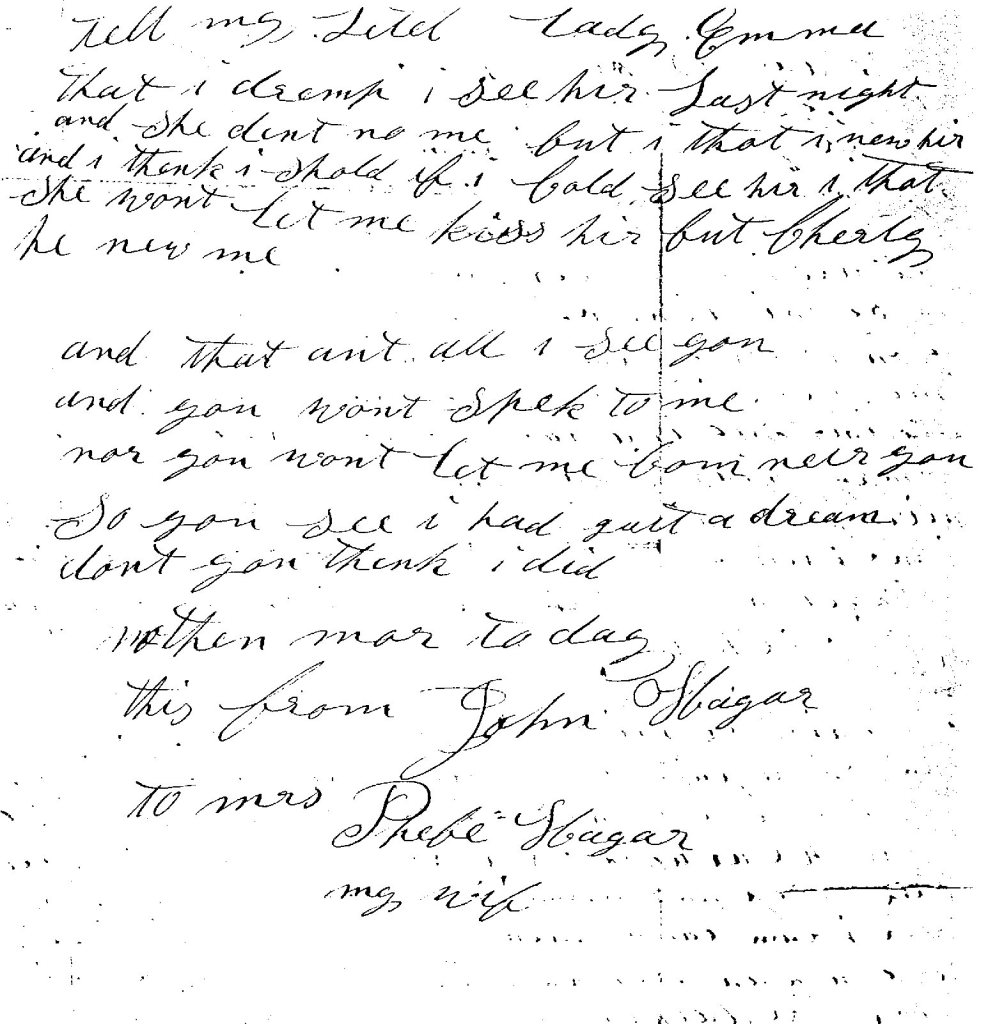
Letter 87
Port Hudson, Louisiana
July the 28, 1863
Mrs. John Hager, my dear,
I now take my pen in hand to write a few lines to you to tell you that I am well and hope this will find you all well. I sent you $50 dollars the 26th. I wrote a few lines then and sent it. I put in 10 cents in it. I sent the money to Clark’s Banks in Pulaski. I write this for fear you won’t get the other one. It has been some time since I have had a letter from you but we look for a mail today.
We had a nice rain night before last. It has been nicer and cool for two days now. The sick boys all look better this morning. Mr. White is a comin’ home. He hain’t done no duty since we went on the first Port Hudson march some time in March. He has come from the Hospital. He is here now but he has got his [discharge] papers all made out—all but signing. If he gets them signed, then he will start this week. He is able to walk around but we have got some pretty sick boys here with the ague [malaria] and fever. And some that is sick that hain’t got the ague.
George is sick yet. He don’t get no better. I do think he had ought to have his discharge and come home. He told me not to write that he is sick but I have wrote it. But you mustn’t read it to nobody. Then it won’t do no hurt [to tell you]. I am afraid he won’t get well if he stays here much longer for this country don’t agree with him and he ain’t up to par for any hard work. Put them both together and they don’t agree with him. Phebe, don’t read this first to no one for he don’t want his folks to know that he is sick. I don’t know what he writes nor I don’t care. If I am sick I had as leave he would write it as to write it myself. I know I should write it myself. But he is afraid it will make his folks worry about him. I don’t know but that is the best way, but you want[ed] I should write it just as it is in war times and so I will do.
We have 17 men for duty today in our company. It makes rather a small show on dress parade but the most of them are not hard sick, just about, and some are making sick and lame to get rid of doing their duty. They are kind of playing off to get their discharge. That is what is the matter of one half of them. A good many of them just come here for their bounty and nothing more. There has a good many that hain’t never done nothing yet since we come in this state nor they won’t never do nothin’.
This is the 29th. I had to stop writing yesterday to go in the fort and help with the tents and other things. Our things are in awful bad shape. The 162nd are all in the with ours and our tents have all been opened and the coats all mixed up. Them that has theirs marked will get them. I think I shall get mine but the stockins’ I shan’t get and some of the other things I shan’t get. I stayed in the fort all day. There is seven black regiments in the fort. They got their pay yesterday and they feel pretty rich now. You had better believe they do. They was a trying to buy the soldiers all out.
Now you see we have gone into summer quarters here at Port Hudson although we ain’t in the fort. We are on the outside on the next plantation to the fort. The fort used to be a small plantation. There is some good level land in the fort. There is [also] some of the roughest land that you ever seen. There is some woods in the fort. I seen oak trees one foot and a half there that our [cannon] balls hit and cut them down. Some trees was two feet and it [ ] them so they laid down. Some of those trees are pretty tough. It looks like a foundry in the fort. There is plenty of iron there. You can’t hardly step without seeing pieces of shells and a good many solid balls and some grape and plenty of musket balls. You can pick them up by the handful where we shot them in there.
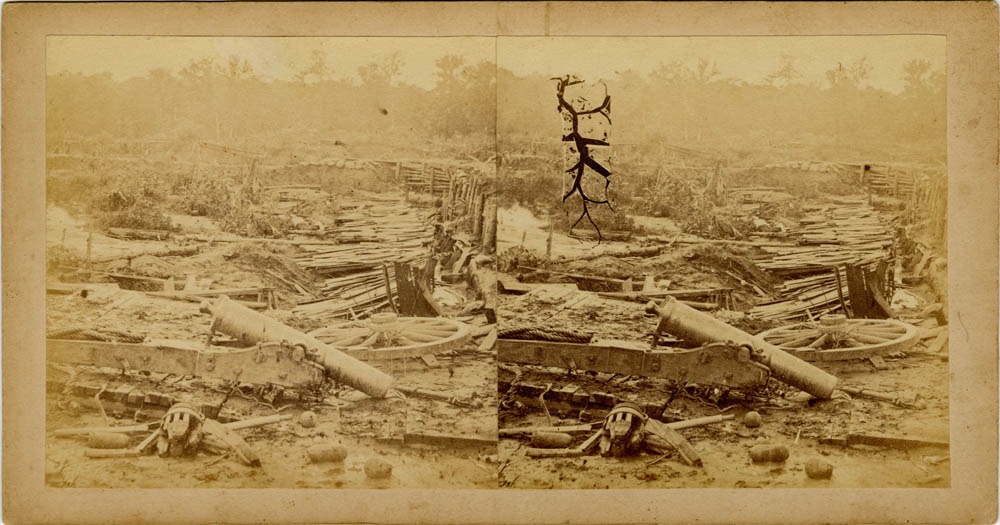
The mail hain’t come and I don’t know hardly what to write so I will write a short letter. I hope you will write me a good long one when you have the time. This is rather poor paper to write on but it will do well enough for soldiers to write on. Most anything is good enough for us in war times when we are a whippin’ the rebs out in a fast. I think we are a doin’ good business about now-a-days. We are a whippin’ them everywhere. I s’pose you get all the news there. I s’pose you take the papers. I hope you ain’t too poor yet that you can’t take a paper and send me one once in two or 3 months. Papers costs 15 cents here—that is New York papers. I have seen them sold in New Orleans for 50 and 75 cents apiece. But they will be cheaper now. I shan’t send this—not till tomorrow—so I won’t write no more today and go and wash my shirt.
I have got white shirts now. They are most darned hard to keep white and clean. I wish I had my old woman where she could wash for me. It is a most darned mean business to have a woman and not have no good of them. I have to do my own cooking and have to sleep alone in the bargain. So you see you ain’t of much use to me—not in war times. Only to take care of my two babes. I s’pose you do that. I know you will and have for me. I know I hain’t done much toward taking care of them nor you neither. I told you when I left home that you mustn’t look for much money from me for I should use what I thought was necessary, but I hain’t used half as much as I should of and if I han’t been in debt and hadn’t of thought you would have suffered for the want of it. Now I will stop till morning so goodbye for today.
This is the 30th. We gave got our tents and I got the most of my things. I got my ink today we are a goin’ to put up our tents. I was on picket last night.
Today I ain’t doing nothing so I write this today. Feel pretty sleepy today I have been on guard or detail almost all the time for the last two weeks. We only report 14 men for duty today. They make darned hard work a shaken’. I don’t see what the reason is that we don’t get a mail but I will send this whether I get one or not. This all. To Phebe A. Hager, my wife, — J. A. Hager


Letter 88

Port Hudson [Louisiana]
July 31, 1863
Today I got two letters from you. One was wrote July the 4th, the other the 9th. My dear, I was glad to get them for it has been some time since I had one. We are busy a puttin’ up our tents this afternoon.
Robbins had a box come from Pulaski. It cost 2 dollars. It weighed 23 pounds. His was all tobacco, all but 4 or 5 pounds of dried apples, and one pint of whisky. He wrote the same week that I did for mine. I don’t know as you will send me any or not. The small paper costs 4 cents, apples and the other 80 cents. It was all fine but tobacco I don’t care much whether you send me any tobacco or not. I can get it here for two dollars a pound but I want the cheese and hat.
I got me a darned good pair of shoes. When we come to unload the things, I told the quartermaster them shoes. I blamed them. He said take them and so I did. They was about new ones. I have got the same pair of boots that I wore from home. I think they have lasted pretty well. Old Spencer never made a better pair of boots than them was.
I don’t believe that I have been everywhere that the regiment has been. I have been in four battles—two at Port Hudson, one at Bayou Teche, [and] one at Franklin. And we have had some little skirmishes. And we was in front here at Port Hudson a sharp-shooting two days and one night.
I han’t got nothing new to write—not this time. Maybe I shall in the next. Some of the boys say we are a going north to recruit this summer but I don’t think we shall. Phebe, you don’t know nothing about rain there. You never see it half rain there. When it rains here, it comes right down in almost whole water. It will raise the river from 15 to 20 feet.
Well, Phebe, I don’t think there will be much more fightin’ done unless Great Britain sets in. And if she does, we can whip him out in a short time. But sometimes I think we will have to stay here or in the service our whole 3 years. That is all they can hold us. Charley Fuller says he thinks we will come home this fall. He was a good mind to send Chester 50 dollars to keep till he comes there and I don’t know but he will yet. He don’t hear nothing from them—not lately. [ ] is well and fat as a bear.
Tell my little Lady Emma not to cry for me while I am off to war for when I come home I will tell her a little about war. I sent you 50 dollars the 26th of this month. I wrote in two other letters all about it. I must go on dress parade so I can’t write no more in this go good bye for now. All of this to Mrs John Hagar, my wife and friend. — John Hager
I have got plenty of paper now.
You said you had been to Mr. Airds. He don’t know nothin’ about fighting for he was sick. He never was in no battle nor George neither nor some [ ] of them smart men. They are in the hospital or they are lame or something is the matter of them. This is for you to read to yourself. Well Phebe, George is almost as poor as Weed was when we left him at Baltimore City and I won’t wonder if he didn’t get well. He don’t say nothing about himself—only he ain’t much appetite to eat. Don’t read this to no one for he don’t want them to know he is sick. Maybe he will be well in two weeks.


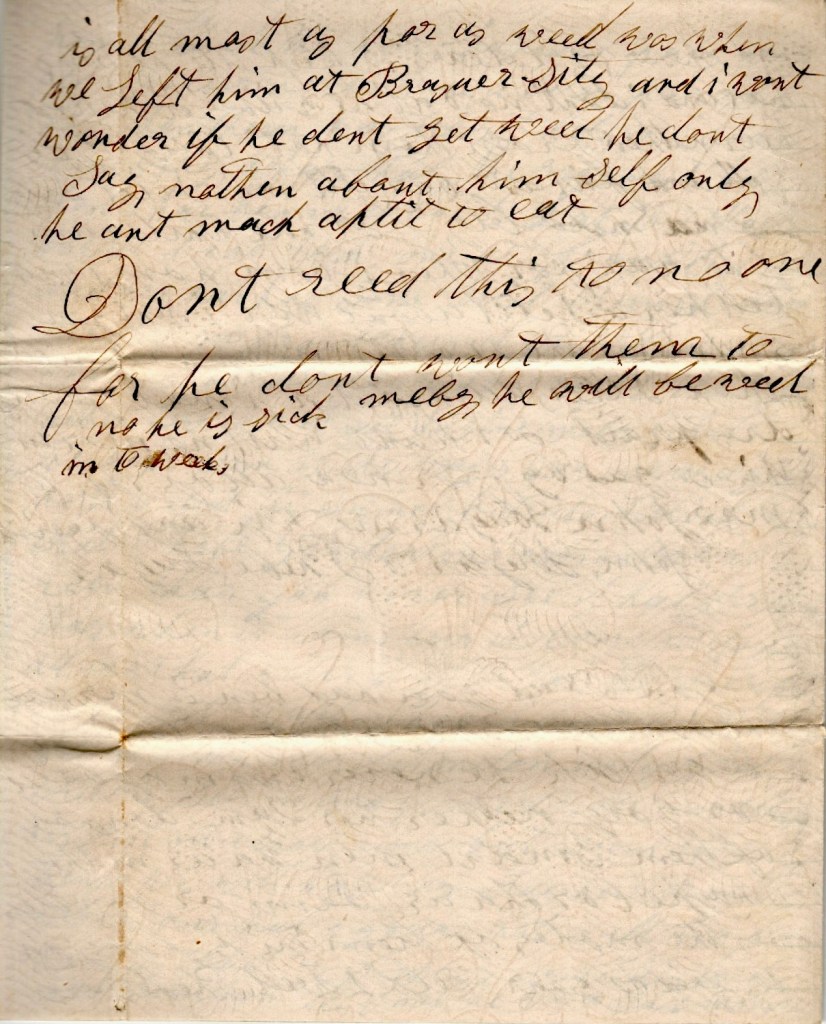
Letter 89
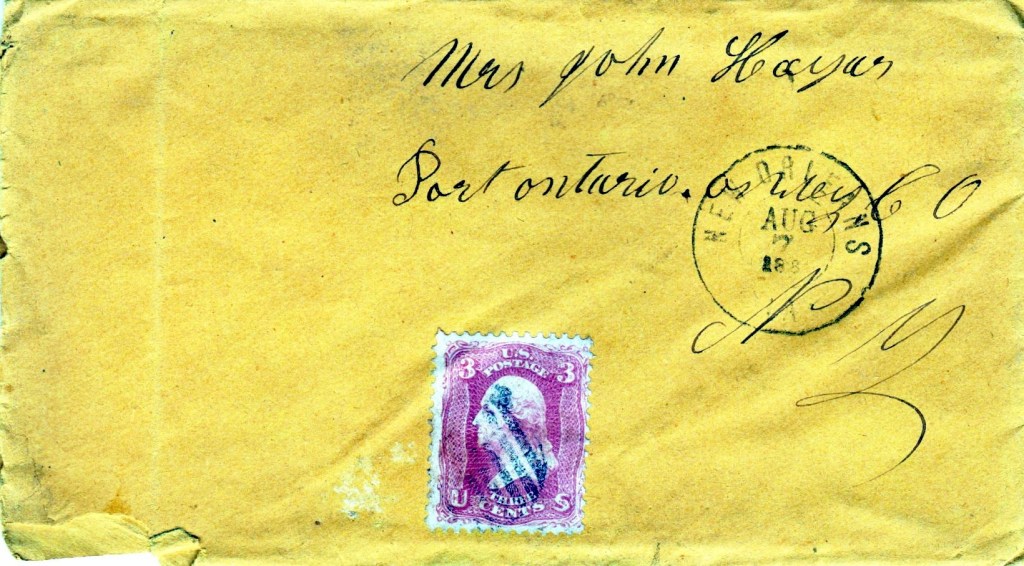
Port Hudson [Louisiana]
August 2, 1863
I now take this opportunity to write a few lines to you. I am well and hope these few lines will find you all well. It is Sunday today. I am on guard today. I have been on guard every other day now for the last 10 days. We ain’t but 7 or 8 men fit for duty now, so it fetches me on guard pretty often. But I ain’t very hard work.
It is August. I think the days and months go off fast. It will soon be one year since I started in the good and glorious cause. And if I ever get home alive, I never shall be sorry I started in. But I never would have come if I had of known we would of come away down here for I always heard it was a sickly place at New Orleans.
But where we are it ain’t not so bad. We have good water here. It is spring water. We keep a guard over it. Here is where I am on guard today. I have to stay 24 hours. There is 2 more men with me. There is 8 or 9 other regiments that get water at this spring. They come 2 miles, some of them, but they have tins to draw their water. There is from 10 to 20 here a waiting for water all the time. We make them dip it up with their cups. We don’t let them put no pots, nor wash them in the spring. I tell you it is as nice a spring as you ever saw. We can’t hardly dip it dry. It is worth everything to us [even] if it is away down in Dixie Land. I won’t wonder if we stayed here a spell. The talk is that Col. Sage is a goin’ home on a furlough this summer. I s’pose he will start now in a few days.
Phebe, you have heard a good deal said about the vine and the fig tree. I am a setting under a fig tree. There ain’t no vine on this tree but there is wood vines and grass vines on a most of the trees here in the woods.
Phebe I was here on guard night before last and there is 4 or 5 niggers huts here. They had a little child die and they had a meetin’ and we sat here and heard them pray two or 3 three hours. Then we went over there. It was 11 o’clock at night and the little house was full of darkie. I and the other boy sat down about 2 rods from the door and heard them pray and sing till the old General sent his orderly over to tell them to stop for there could not anybody sleep within 10 miles of them. I tell you, they was the happiest lot that I ever saw in my life yet. Then we come away. I don’t know what they did do with the child.
There is niggers that have lived here for 20 years or more. They say their master has gone away on the other side of the river. They say he took 400 hogs and he drawed corn 4 or 5 weeks with 20 teams before we came here. Now where he had born it is all dug up and made [into] breastworks. There is ditches dug 12 feet wide and 6 deep. This is one and ½ miles from Port Hudson. Here where we be is the place where the fight was the 27th of May. That was the day before we got up here but our boys drove them back towards the fort after all their digging so much. I tell you the rebels have done a good deal of digging around Port Hudson—or they have made their darkies do it. These old planters don’t work none themselves. This one here had 100 darkies—men, and 8 women. Now there ain’t nothing but weeds a growin’ on his whole plantation and we use his house for a stable and his cotton gin for a hospital and we burn up his rails for [fire]wood. They make first rate wood. God damn them. We will use them up after a while. If they don’t let us fight them, there won’t be many fences nor nothing else.
I han’t nothing to write today hardly, but I thought I would write a few lines to my old woman. I won’t care if I could see her and her two children. I don’t s’pose you have got any more yet. I see there is some that has gone to war, their women hain’t got no more, but are just a going to have one or two more in a few days. I heard the boys a talking about it to him. But I know it ain’t so with my wife so I don’t care a damn for no other but her. I guess I would like to see and the two little white heads, don’t you think I would. So now I will close.
I don’t think this letter is hardly worth 3 cents so I will put in a nine months Mass. song. One of their own men made it. Rather hits some of the 9 months men for they ain’t worth a damn two bits—not one half of them.
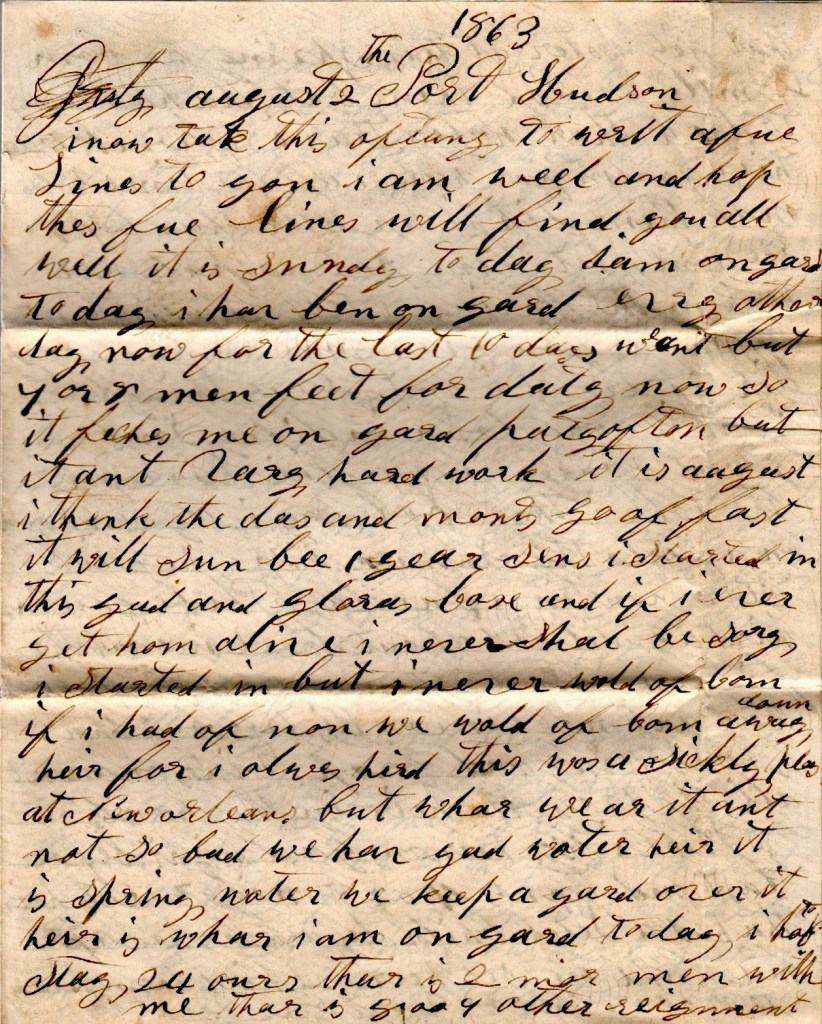
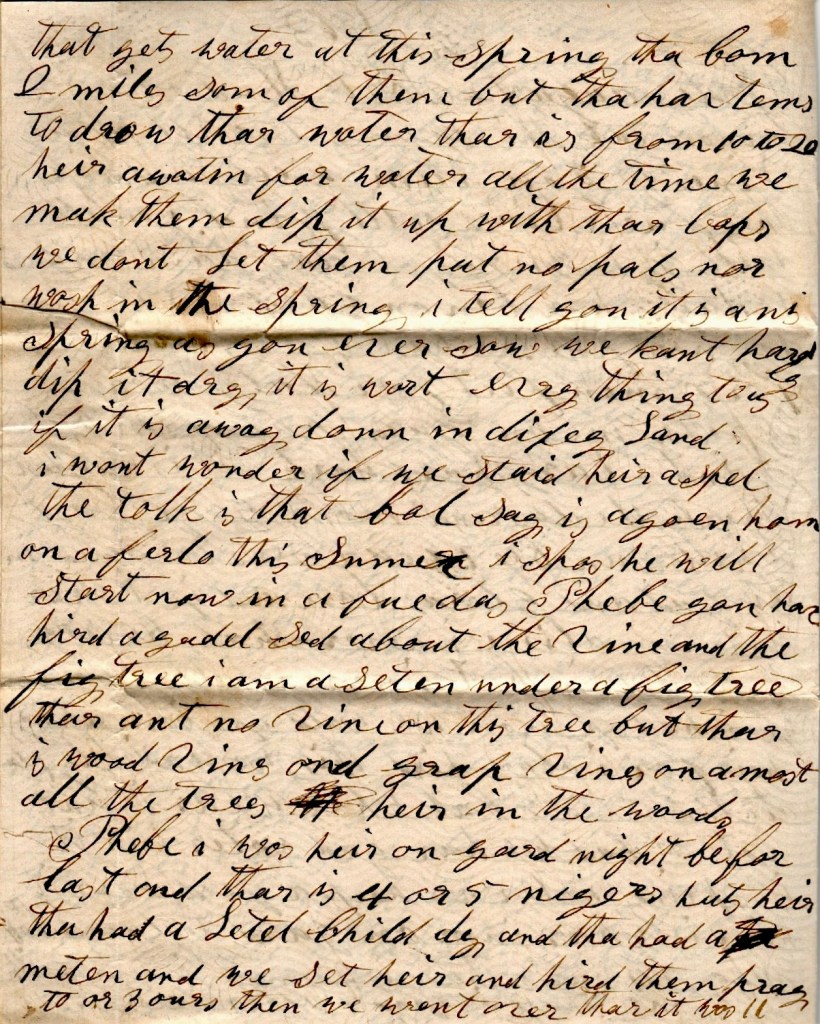

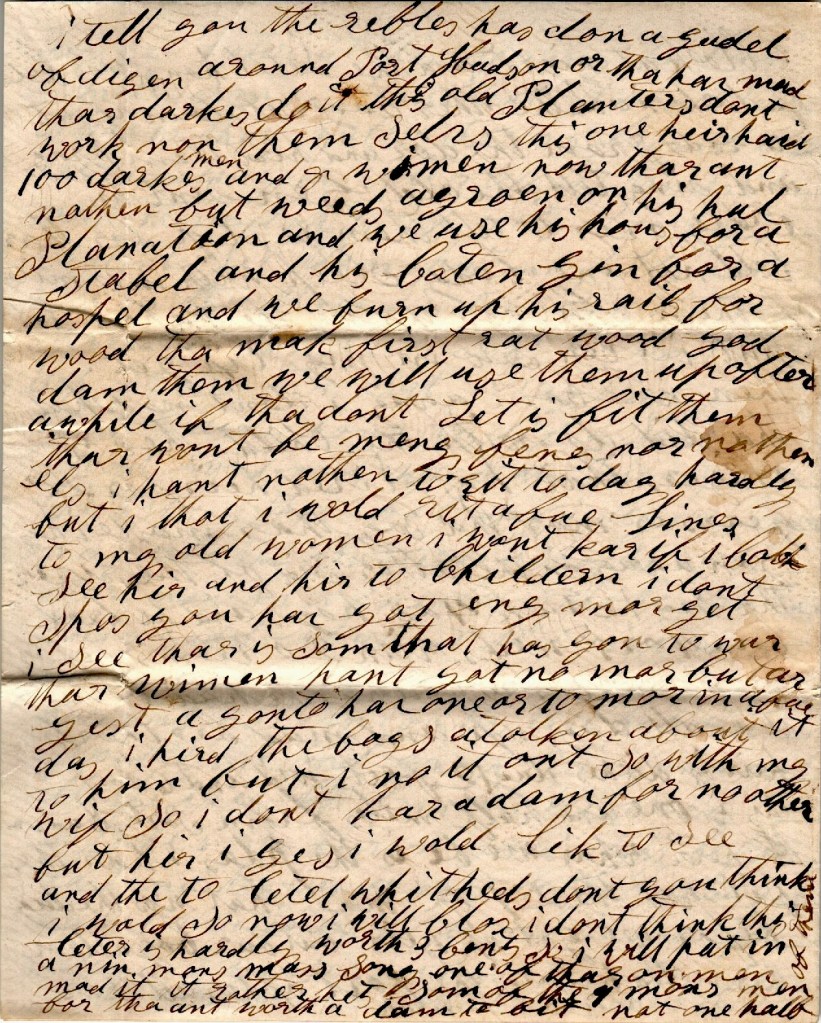
Letter 90

Port Hudson
August 4, 1863
I didn’t leave room on to the other letter to say goodbye so I write on this. I don’t know as you thank me for writing so often. Chester don’t seem to care whether he writes or not. I don’t care one damn if he don’t write.
I understand they are a draftin’ there. Tell me who goes from there if you know who they are. I am glad I ain’t one of them nor no 9-months men. I won’t be in no such regiment no how, for they ain’t worth a damn to fight nor nothing else. They have to have them go in front or we can’t keep them.
John Robbins 1 has got clear, hain’t he? I don’t hear nothing about him lately. I han’t had no letter from Chester since March nor none the rest of my folks. Only E. Y. Whitehead. He wrote me one letter. Nancy—she wrote one. I have had two letters apiece from them all in one year. They have all done first rate I think, don’t you? But it is all the same with me if it was Joseph Hagar, or some other one, then all could write once or twice a month to them. Two days more, then I have been a soldier one year. It seems like a short one to me. I don’t know how it is with you.
I have just eat my breakfast. I had beans and applesauce and hard tacks. I bought one pound of dried apples. I give 20 cents. I cook and eat alone now. I think I shall tent with Septimas Holmes 2 and Mr. White, if he don’t go home. Septimus has got ague and fever now but he is getting better. When he gets well, then I shall go in the tent with him. I think it is healthier to sleep alone than it is to be in a tent. But I wouldn’t stand about it if I had you to sleep with.
— John Hager
This to my wife Phebe Hager. So good day my dear.
1 John A. Robbins–Age 28 years, Enlisted, August 8, 1862 at Richland, to serve three years; mustered in as private, Co. B, August 13, 1862; transferred to One Hundred and Forty-seventh Infantry, August 22, 1862; also borne as Ribbins. From roster of the N.Y. 147: John A. Robbins— Age 28 years. Enlisted August 8, 1862, at Richland, to serve three years; mustered in as corporal, Co. C, September 22, 1862; deserted, November 27, 1862, at Tennally town, D.C.
2 Septimas A. Holmes. Age 43 years, Enlisted, August 6, 1862, at Richland, to serve three years; mustered in as private, Co. B, August 14, 1863; mustered out with company, August 28, 1865, at Albany N.Y.


Letter 91
Port Hudson, [Louisiana]
August 8, 1863
I got a letter yesterday from you. You said you had sent me a box but I hain’t got it yet and today I got another letter. It was dated July the 25th. You said you was havin’ bad luck—had lost your little calf. I am sorry but it can’t be helped so let it go. Phebe, you spoke of my coming home before the box got here. No [such] good luck as that unless we have to come and help drive them drafted men down here. We hear all sorts of news about them copperheads in York State and in the City of New York. The Union men—they have to use their artillery. They just mowed down 200 or 300 hundred of them. They scared them just right. They will have to come. They can’t get out of it unless they pay that little 300 hundred dollars that will clear them. But them that can’t pay it [must] come. They ain’t no better than I be. If it wasn’t for them damn copperheads, this war would been closed a long time ago. I am glad that some of them have to come to us.
I understand there is three men a goin’ out of each company to escort them conscripts down here. They are goin’ to fetch them to fill up the old regiment. We need about 200 hundred in the 110th [New York]. But I don’t think that they will have to do much fightin’ but they will have to come. Tell me who is drafted there. I don’t know if there has been any drafted yet but let them come. They ain’t no better than the rest of us. I am down here and I am ready and willin’ to fight for my country. I understand that Banks won’t let none of us go home on a furlough, nor after none of the conscripts—not now. I don’t learn the reason. He don’t [even] let the old Colonel go home neither. He has been a trying to get a pass to go home.
I don’t know but Banks is a goin’ to move us from here. Some of the boys say we are a going north but I don’t think so. I don’t think this is the worse place in the world here, but it don’t agree with us to just live on hard tack and meat and coffee. I think that is what kills a good many of us. We can’t get no green stuff to eat—only the old sutler, he had some pickles to sell. I bought one bottle of them. One quart for 75 cents. That was pretty high I think. But I wish I could get some more at the same price or some onions.
The most of our boys say they don’t know but they have the dropsy. Their feet and legs is all swelled up—some of them—so that they can’t get on their shoes. I wish you would see John and see if he can tell the cause of it. Mine is swelled some. I got a dose of salts the first of July and now it is the 8th of August and I took them this morning. I have been waiting for them pills, but when they do come I should take some for I have got the belly ache like hell today. I ain’t had nothing pass my bowels but a kind of bloody slime and not but a little of that at a time. But, I am [still fit] for duty yet. I think them salts done me some good but I had rather have some good pills. I don’t like them none to well but we have drank so much poor water that I suppose it is a good thing to flush out once in a while. Don’t you think? I shall take another potion tonight. Then that will bring me around all right.
I shan’t get that box, not now till the next mail comes in. I hope there will be one pound of cheese in it. The sutler sold his for 60 cents. That is pretty high for cheese and only 13 dollars a month and take all of that to live on. But I shall use some of my money for some such things unless you are all a starving to death. But our rations is more than we can eat. But it ain’t all the right kind to make men healthy. There ain’t no potatoes raised around here or nothing else but a little corn, and that ain’t fit for us to eat—not in warm weather.
Phebe, if you hain’t sent me that cheese, I want you should send a good one. You don’t know nothing about hard times. I should think it was pretty hard times if Chester nor John can’t let you have 15 or 20 dollars. I will remember them for being so kind to you and me. I ain’t got to you what I want you to do with what money you don’t use, Phebe. I hope you have enough to eat if it ain’t quite so good. I know one thing, you have what milk and potatoes you want and all the Johnny cake, but I ain’t a starvin’ here. Phebe, I hope you don’t worry about me for I am in a pretty good place here. It’s so good that if I knew I was going to stay here six months, I should send for you to come down here. I don’t think we will stay here long. I think they will take us north. Phebe, don’t worry about one dead calf nor about me. This to my best friend in the whole world. — John Hager
The mail is a going to start so I stop.


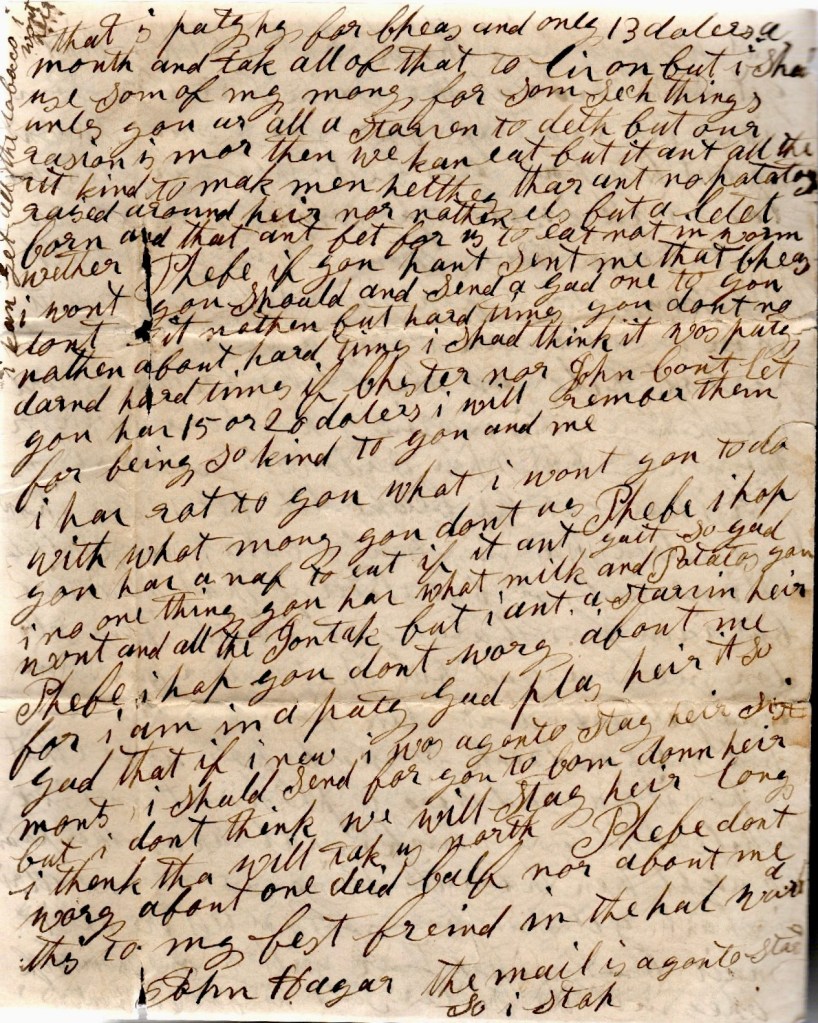
Letter 92
Port Hudson [Louisiana]
August the 12 1863
Mrs. John Hager–my dear,
I now take this opportunity to write a few lines to you to let you know how I am a getting along here. I have been sick 4 days now but am getting better now. I feel pretty smart today. I had the bloody dysentery. I had to run all the time almost both night and day. I took two large teaspoons of salts. That is all the medicine I have took. The doctor sent me some pills but I didn’t like them so I didn’t take them. They are most all quinine. I han’t eat much for the last 4 days. I bought some cheese and some onions. Onions are 20 cents a pound, cheese 60, and I bought 1 dollar worth of pickles. I can eat them along with my hard tacks.
I think know that I shall be all right in a few days. I could of went to the hospital but I didn’t want to for I could get the boys to fetch what water I wanted to drink and some of the time I could get them to make me a little tea. The most of the time I could do it myself. But I must say I miss my old woman some in these 4 days for I never felt no worse than I did some of the time.
We have had a nice rain here today. It han’t stopped yet but the sun has come out. Phebe, I am almost sorry I said anything about me being sick but I have wrote it and I will send it. I hope it won’t make you swirl up your face when you come to read it. If it does, I won’t write nothin’ about it again. Rant [Ransom Soule] hain’t been to the hospital—not at all. But he has been sick. He ain’t for duty now but he ain’t much sick. George [Filkins] has just put a letter in the office today.
Phebe, you had ought to had your potatoes down here. Here is the place where they would sell for the little more—the price of 4 dollars a bushel or 15 cents a pound. But now we have got the river open, maybe we can get them. But we live pretty well for soldiers. But I don’t think the government finds us in as much such stuff as it ought to, to make us healthy. Dry hard tacks that has been baked ever since the war commence. They ain’t much life in them you know. They do first rate for a short time. But I han’t no fault to find with what we have—only our boys are a most all sick. Some is a getting better and are shaking [with ague]. I han’t had no shakes—not yet, nor I don’t think I shall. I hain’t got that box yet. I think it will come in the next mail. But when them apples come, I think I shall take a dose or two but I should think I was pretty well cleaned out now.
We hear of their fighting at Charleston and all around us but none here. We have been looking for an attack on us every night from Alexandria. The rebels has got 3,000 or 4,000 up there. It is about 60 miles from here but I don’t think they will come down here. If they do, we are ready for them. I know I don’t feel very stout today but I can shoulder my old gun and I could travel a few miles if it was necessary. But I am in hopes we all shall be able to fight or march or anything else that we are called on to do.
I wrote that Joe Preston 1 was sick but he has got better now.
Well, my dear, today is the 13th and I feel pretty smart. I have just stood some apples for dinner. I thought that I would have something good but now I have got them all ready and now they don’t taste none the best. I don’t like it half as well as I do pickles and onions. Something sour tastes the best to me. If I had one or two good fried cakes, I think they would taste pretty well.
We hear there is a mail coming down to New Orleans for us. When we get it, then I will send my letter. I can’t think of nothing to write to you. If you was here, or I was there, then I could ask you what to write but you know I am a damn poor writer. But I can write pretty fast, but I don’t know as you can read more than half I write. I will stop writing and go over to the old sutlers and get me a little more cheese for dinner.
Well, Phebe, it is the 14th morning now and all is well. I feel pretty smart this morning. Robert Aird 2 starts for Albany today—he and 6 or 7 others. They are a goin’ after the conscripts to fill up our regiment. He don’t know whether he will get a chance to come home or not. The old colonel said he should send all married men so if there was a chance to go home, then they had ought to have the chance first. They are all officers that is a going. Aird is a sergeant—just what he was when we started. He has tried his best to get lieutenant but he can’t do that. I hope he is high enough now for an Irishman. He feels pretty big now.
The mail han’t come but I will send this. This from the soldier. Tell all of the friends that I am doing first rate. I send my old respects to them. So I must say good morning to my old woman. John Hager to Phebe Hager, my dear.
1 Joseph Preston—Age 21 years. Enlisted, August 8, 1862 at Palermo, to serve three years; mustered in as private, Co. E, August 11, 1862; promoted corporal, September 1, 1864; mustered out with company, August 28, 1865 at Albany N. Y.
2 Robert Aird—Age, 38 years. Enlisted, August 6, 1862, at Richland, to serve three years; mustered in as private, Co. B, August 13, 1862; promoted sergeant, August 21, 1862; mus- tered out with company, August 28, 1865, at Albany, N . Y .
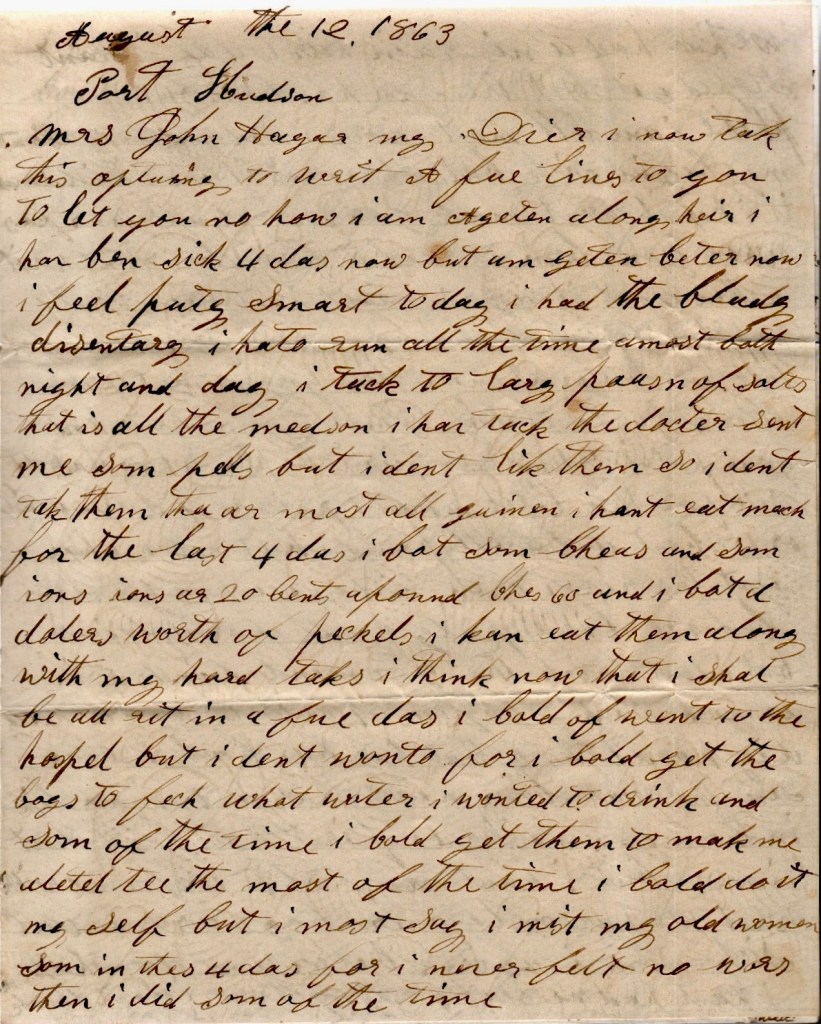

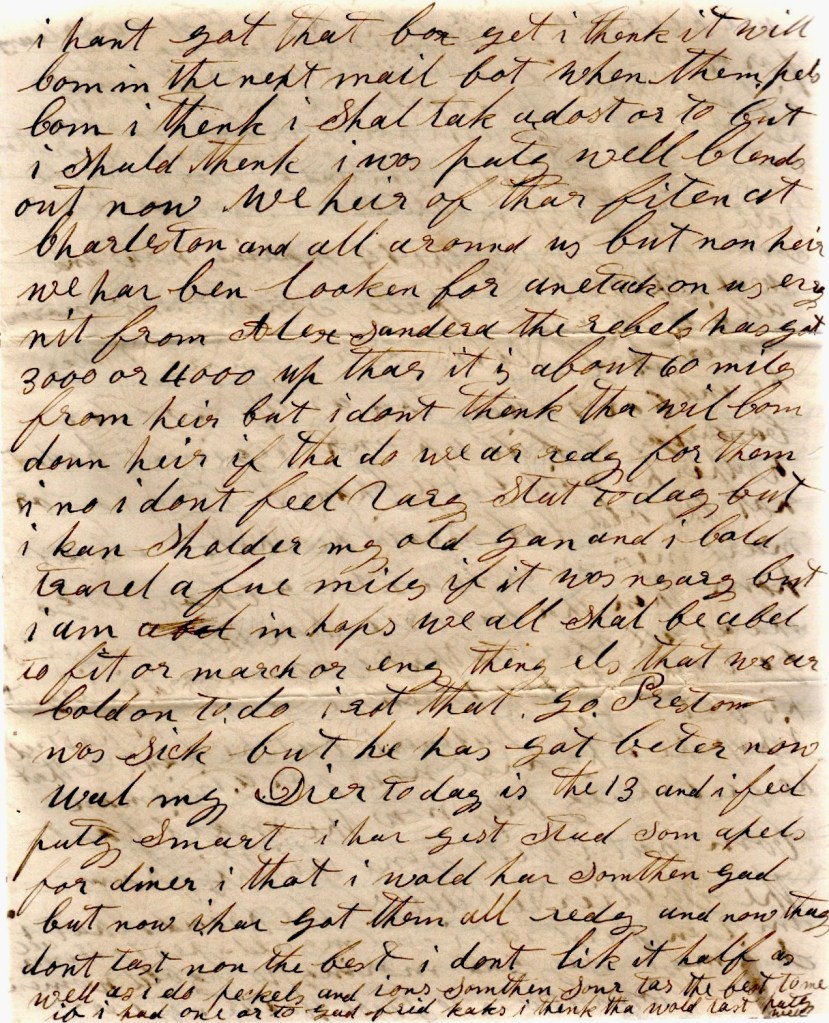

Letter 93
Port Hudson, Louisiana
August 18, 1863
Today I take my pen in hand to write a few lines to tell you how I am a getting along. I feel pretty smart—only I have got a swelling [boil] under my arm. It is the first one that I have had. I han’t had no sores of no kind, but this one makes me feel a little sick to my stomach. I didn’t know as I could write, but I can some, but I don’t know as you can read it.
We are a going to have a company cook now. They have one white man and two darkies to a company. We had a company cook when we was at New Orleans. I didn’t like it then but it is pretty warm work to cook in the sun here. But we have 4 stakes drove down and put on some brush to make a shade and we put up our shelter tents in front. It makes a nice piazza and keeps the sun off a good deal. I think they calculate to keep us here now till cold weather. Then I don’t know where we will go to, nor I don know as it makes any odds where. We hain’t but 2 years now to stay. That ain’t long. One has gone.
Phebe what is the matter of John and Chester? I don’t hear nothin’ about them—not lately. I guess they are scared or afraid of the war. Tell them not to be afraid for I ain’t and I have seen a few rebels. I s’pose there is some there. I hope they will all get shot before the war closes and I think there will some of them get laid out as many men as New York state has furnished. Then to have a few copperheads turn against the volunteers. I would like to have some of them down here. Some of them men that was so afraid to come down and fight their way back. Them is the men that ought to come and do the fightin’. But they ain’t here. Them is the men that keeps this war a hangin’ along so slow. Old Abe is a’most too easy with them. I think he had ought to draft them and fetch them right along and make them fight whether they want to or not. If we can’t settle it no other way, then I want to help fight it out. I am ready and waiting to do my part.
I think I have done first rate. I was in one year and han’t been excused by the doctor but one day. That was the day we went on the first Port Hudson march, and I went along with the rest. And now I han’t done no duty for 7 days, but I could. But I see that there are a good many ain’t no worse than I am [and] they don’t do no duty, and so I will play off a few days and see how that will go. I got in one year all right and now if I can get in the other two as well, then I shan’t find no fault if I get home alive. And I think I shall. I stand it better than I thought I should down here. I don’t know but it ain’t so I hain’t never been afraid yet. I made my mind that I had only once to die and there don’t nothin’ frighten me. It don’t seem to me that one of these big guns make as much noise as the small ones did when we first started.
There was a little thing happened yesterday. One of the artillery men drove in the rod in the gun to hitch his horse to. He hit it one rap and it went off. It cut off one of his legs. It cut one of the tent poles off. There was one boy in the tent. I stood about 8 rods from the gun when it went off. I guess he will hitch his horse to some other post next time. They took him in the fort. I don’t know how he does get along.
Nothing new—only I am a getting along first rate. I hope this will find you all right side up. Tell Chet and John not to be afraid, for there won’t nobody hurt them but rebels, and then they want to shout. I s’pose it did make you all look around some when Old Lee started that way. He didn’t come hardly far enough. He had ought to come a little farther. We will say, down to Port Ontario. I guess then your neighbors won’t say they would rather their boys would go to state prison than go off to war. But I think if Old Lee’s army had of come by there, they would of turned their tune in a hurry. But I don’t like this place none the best, but I shall make the best I can of it. This from John Hager to P. Hager


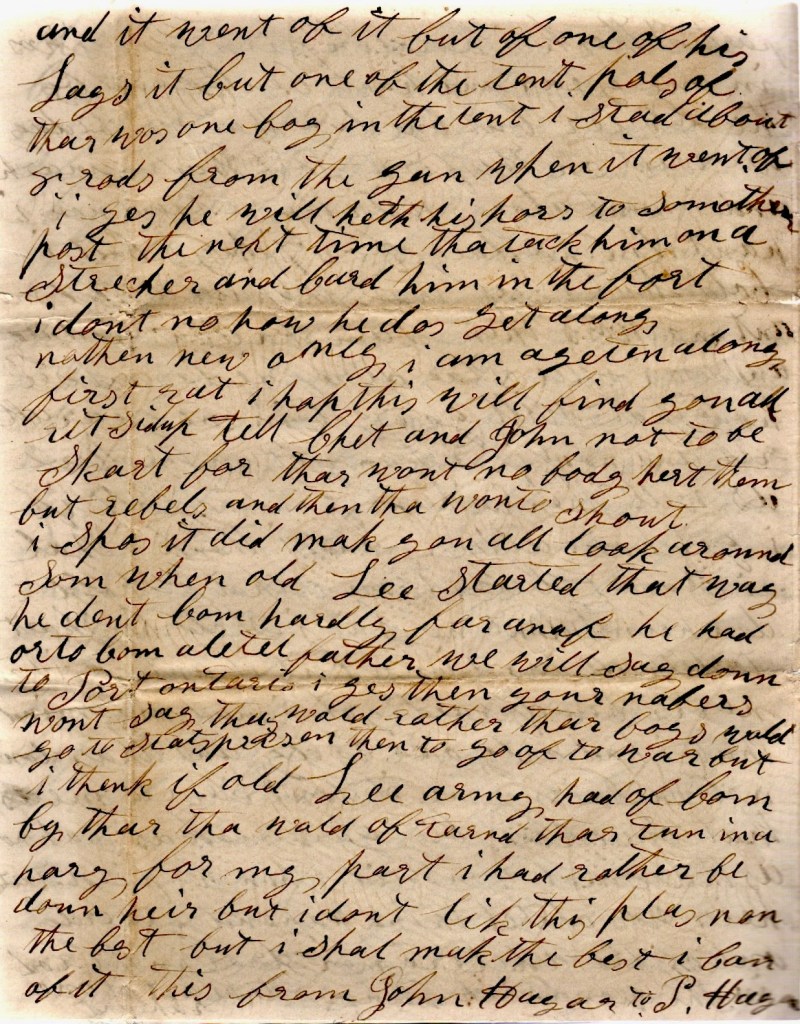
Letter 94
[Port Hudson]
[August] 19, 1863
Today is the 19 and my [shakes] has broke 1 and I feel better and the boys has got some arches built for a cook house. We are all rigged up here just so we was a goin’ to stay here 5 years. Maybe we shan’t stay two days but I think we shall stay here a month or two now. One of our boys has gone to New Orleans. I think he will bring that box when he comes back. He has gone after the mail. I hope that cheese has come for the sutler hain’t got none now. But I have got a half pound left yet. If you hain’t sent it, I want you should. There ain’t no Post Office at Port Hudson—not yet, or I would have you send your letters there. I s’pose the mail will come by Vicksburg.
Today is the 20th and all is well here. Tomorrow the mail is a comin’ and then I shall look for that box. We have got our arch done and it goes off first rate. I am [fit] for duty today and I feel pretty [well]. I have been to see the doctor three times. He told me that I was bound not to be sick much here. I told him I hoped not for I thought there was enough [sick] without me. But he give me three pills and I guess I will send them home for you to take for I don’t believe that I like them and I don’t believe you will. There is two kinds, this and salts, is all the medicine that they give. But I am afraid of them.

But we don’t have as many [sick] today as the 177th New York—they are 9 months men—they are a going home now, but they have lost more men than we have and only been in 9 months. They are from Albany City. They didn’t have as many killed as we did here at Port Hudson. We han’t lost more than 21 or 22 in ours for the last month but they don’t die here as fast as they did at New Orleans. That is a little the hardest place for Northern soldiers that I have seen yet. I don’t think this is the worst place in the world here. I have been in worse places than this is here. But this is hard enough, God knows.
Phebe, I have wrote this in a hell of a hurry. I don’t s’pose you can read more than half of it. If you can do that, you will do pretty well. Harvy Menter is here. He got his finger shot off. It is the fourth finger in his right hand. It has got almost well. He is as fat as a bear. 2
I see Charles Fuller today. He is well. He said he was almost a mind to send Chester Hagar 50 dollars to keep for him till he comes home. But Chester don’t write to him nor to me so he don’t know hardly what to do about it. But I told him to send it along for I thought it would be all right. But I guess he won’t send it—not till he hears from him. 3
Co E reports 4 men for duty today. Co. B 12 men fit for duty. I think we are rather on the gain now, and maybe tomorrow not half as many and maybe more. I guess you think I do keep you posted on the health of this regiment but you wanted I should write some of the hard times with the good times. I don’t know as you will thank me for writing so much hard times. I don’t s’pose my letters agree very will with them that you hear read but I don’t write nothing but the truth. If you or any of the rest of the good folks think I do, just tell me what ain’t right and I will prove it by a 100 or more. I hope you don’t think that I try to make it no more worse than it is. Phebe, you don’t know nothing about it nor you never will if I live to come home. Then I could tell you something about it. I tell you this war is an awful one and I see they are ain’t no other way, only to fight it out. So I hold up both hands for goin’ right in and whip all the rebels out. That is what they are a waitin’ for. I for one are ready.
Yours truly, — John Hager
To Phebe Hager, my dear wife all sound.
Read this Chester if you like but keep the letter for I want to see it when I get home, if that day should come. And I think it will when my time is out, and not much before I don’t think—not the way things are a goin’.
1 John was probably suffering from malaria. The disease caused periodic fevers that resulted in the victims shivering or having the “shakes” for a several hours every other day or two. Quinine was the drug used to treat it.
2 Harvey H. Menter-Age, 29 years. Enlisted, August 8, 1862 at Mexico, to serve 3 years; mustered in as private C. E August 11, 1862, wounded in action, June 14, 1863 at Port Hudson, La; Died, February 1, 1804, in Pest Hospital, Franklin, La; also borne as Menton and Mentor.
3 Charles Fuller–age 39 years, enlisted, August 4, 1862 at Volney, to serve 3 years; mustered in as private, Co A, August 6, 1862; promoted to corporal, February 22, 1863; mustered out wit company August 28, 1865 at Albany N. Y.
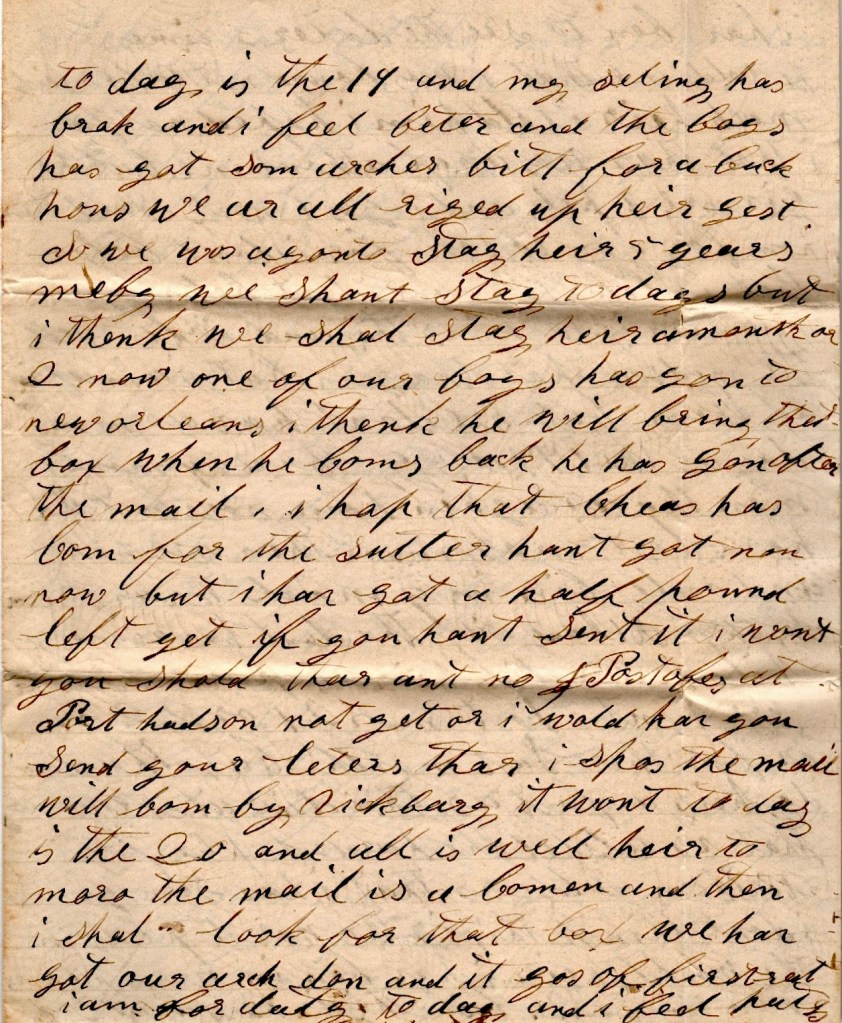

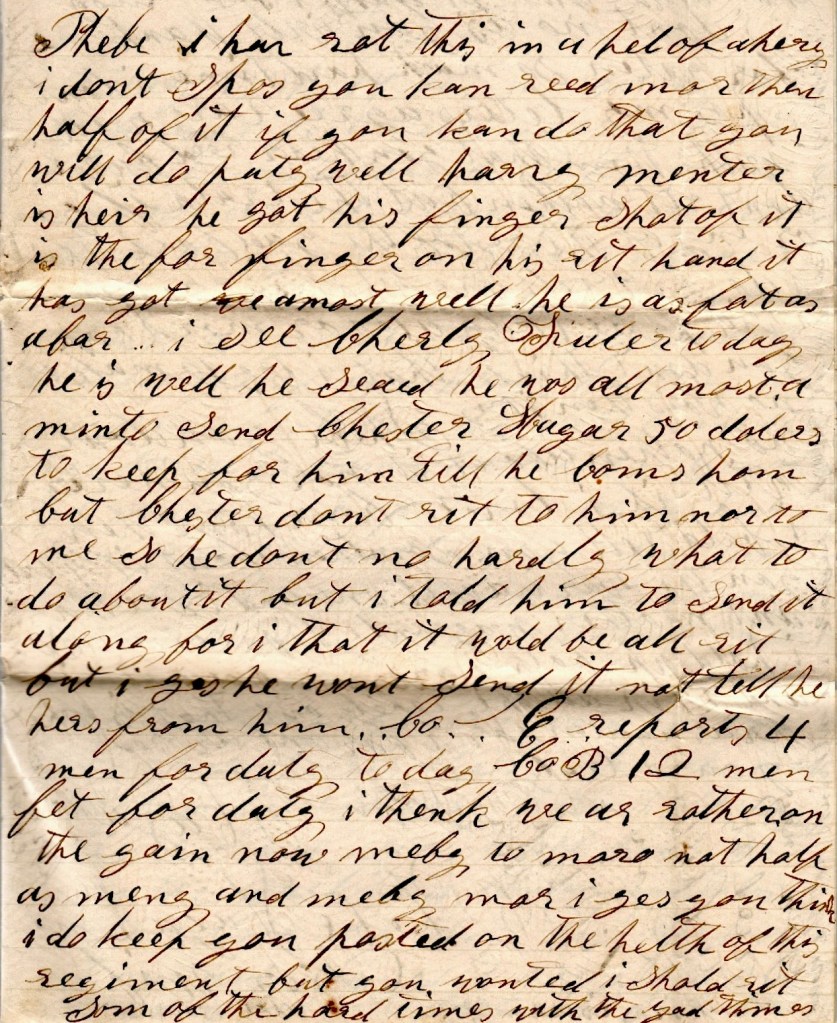
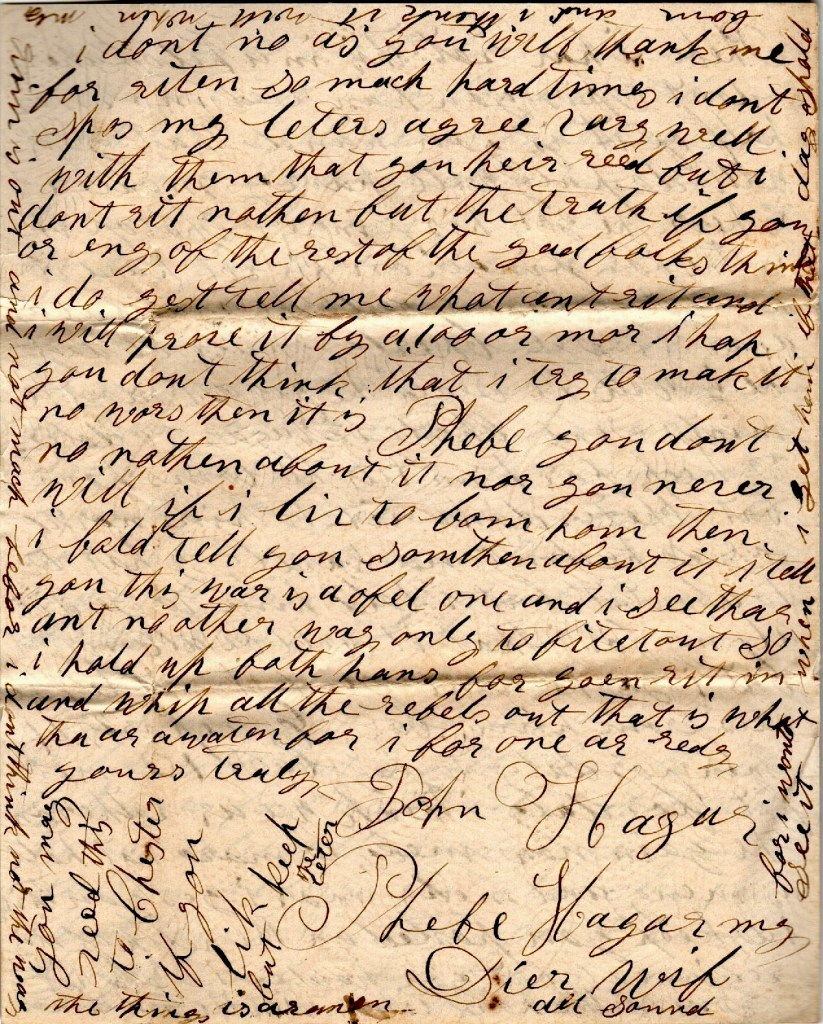
Letter 95
Baton Rouge, Louisiana
August 22, 1863
We had orders to strike tents yesterday morning and we got here at sunset. We was marched in the fort. We lay down like a lot of hogs and I don’t feel none the best today. I won’t wonder if I was a goin’ to have a touch of this swamp fever that our boys has got. We had orders to march—all that was able—and the rest come down on the boat. It is 24 miles. I thought that I had rather ride so I rode down on the boat. We had about 12 that started. Co. E only had 1 private and 1 sergeant, [and] 1 lieutenant. That is all they had. They went with the ambulance tent wagons. Some say we are a going to Mobile. Banks is a fighting out for there, but I don’t know whether this regiment will be able to do much—not today. But this is a pretty good place. Here is 5 or 6 large buildings made on purpose for soldiers to stay in. I guess a man gets good care here.
Phebe, I han’t nothing new to write so I will write a short letter this time. But I won’t care if I had you here. But I s’pose you won’t want to come down here and I don’t s’pose you have got money enough to come if you wanted to. If you should come, you would come by Vicksburg. That is the best way. But I don’t think you will come. The mail hain’t come from New Orleans yet. We look for it today. Well, I will stop for today for my head aches some. Maybe tomorrow it will be all right. I hope we shall stay here a spell for can buy anything here to eat what we want.
Well Phebe, today is the 25th of August and I feel a little better. I am here yet on the piazza of the hospital. I might of went in the hospital yesterday but l thought I would rather go in camp with the rest of the boys. Then I can have tea to drink. Here they have coffee, and I can’t bear that. I went and seen the doctor here in the fort yesterday. He give me another ration of salts and he give me four powders to take. I asked him if I could drink cold water. He said, no he won’t. He is sick yet the same that I am. It is a kind of bloody dysentery. I thought that when we started to come down here that I was a getting along first rate but I drank a good deal of water and it brought it on again.
Phebe, if you was tough enough to stand it and was a mind to come, we are a goin’ in camp about one half mile up the river from the fort here at Baton Rouge. They all say our regiment has been condemned and we are a going to lay here to get recuperated up. We all know we ain’t good for nothing now.
I see Grant is a sendin’ his troops down this way. Four boat loads went down this morning. I s’pos they are a going to Mobile. We have got to take that yet. Phebe you must do as you think best whether to come here or not. I shan’t find no fault if you don’t come. You wanted I should tell you how you would have to manage after you got here. You would have to report as a wash woman for the company. Then you could draw rations and a tent. If you weren’t able to do more than your own washing it would be all the same. Maybe it would agree with you here.
I don’t know how [much] that is to come from New York. I costs 35 dollars to New Orleans. That is the cheapest passage when I was at New Orleans. I think it will cost from 40 to 50 dollars for you to come here. It won’t take not over 6 or 7 days to come if you should start to come. I want Gardner or Ezra to take Charley till we come back. I don’t know what you would do with Emma but I want to get Charley back from the lake. I don’t want him a fishing around there. If you do come, I will try to pay the cost if I live long enough, and pay for boarding the children. I wouldn’t sell nothing to come. If there ain’t nobody that you can get the money to come, then I don’t know as you had better try to come. If I had of known, I might of sent you money enough when I sent the other. But I hain’t much time to get anything so I bought some, then and there, at Port Hudson. It cost pretty high.
If you should make a fool of yourself and start, you want to get you a large satchel—that is the handiest for you women wear long dresses down here and I see some of them wear hats, and some ware the same kind of bonnets like that one you have. Negro wenches wear grimy handkerchiefs on their heads. You can wear what you like if you come or stay. This from John to Phebe
It is the 23rd [of August,] 1863
All is well. We have sent to New Orleans for our tents and things so you may send me the clothes for mine is all worn out. I lost my haversack and two of my towels. I hain’t used them much yet but I will try to make them last till you can send me some. I have made them last pretty well, I think.
I hain’t no ink of my own so I use this. The talk now is that we are going into the fort but I don’t know that—not yet. Some say we are a going north to recruit. I think there is need enough of that. The boys have got the ague. I hain’t got it—not yet. Joe Preston—he is well and tough and fat. I ain’t very fat. I weigh 150 now, nor I ain’t very poor, just about right. You may tell Chester and Jane that Charley is well. I just went to a funeral, a boy in Co. G. I don’t know what his name is. 1
I don’t we have the right kind of grub to eat. We don’t have no potatoes nor onions—nothing but meat and hard tack and coffee, and sugar. We do have a little rice once a week and beans once a week. That is what we live on. It does first rate when everyone is well and has a first rate appetite. Phebe, I hope you won’t think I am suffering here for I ain’t. But I need all I have called for…
John Hagar to his wife.
1 Probably Cassius M. Burt who enlisted when he was 18 years old. He enlisted 7 August 1862, at Scriba, to serve three years; mustered in as private, Co. G, August 16, 1862; died of congestive fever, July 17, 1863, at camp, near Port Hudson, La. [Date of death may be wrong by a few days]


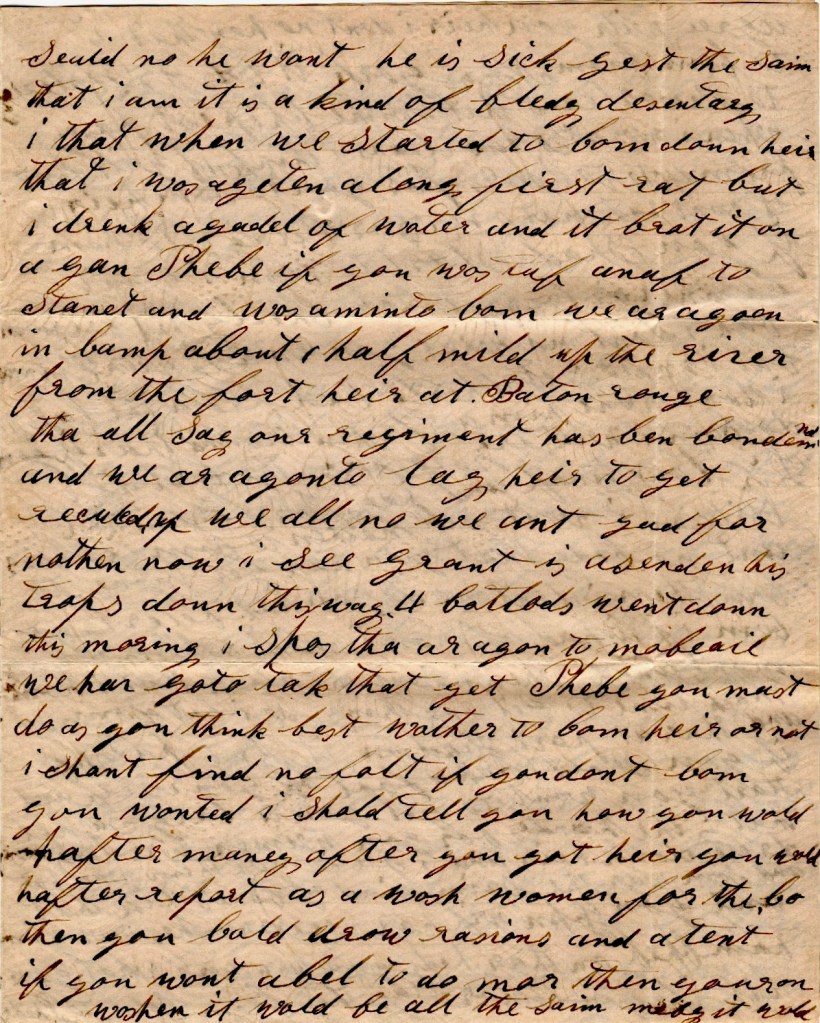


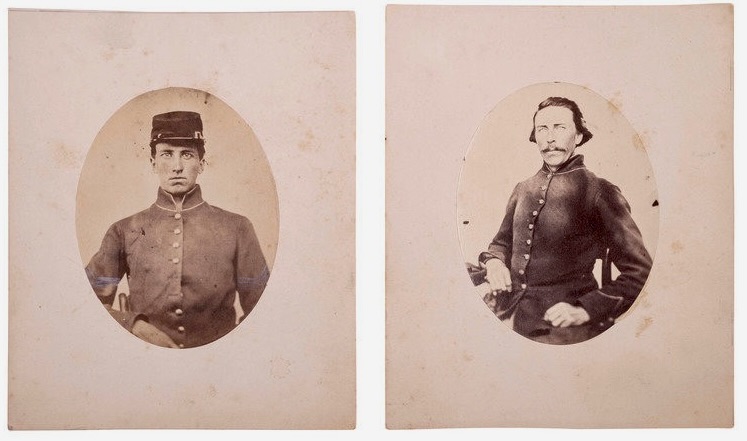
Letter 96

Baton Rouge
August 27, 1863
My dear,
I got two letters from you two days ago. I had a letter almost wrote. I did think I would send for you to come here, but now I don’t think it best for you to come. I am getting a little better I hope. I am here yet but I think I should go into the hospital today if there is any chance and stay a few days. Our tents have come now and I can have my blanket to sleep on if nothing more. I have got that box. The shoes are just a fit and the so is the hat. This is some of the paper. It has been 7 days now since I sent a letter. I would of sent it yesterday but our regiment was under marching orders again and I thought I would wait a day or two and see what they was a going to do.
You wanted I should write just how I was. I will answer as [best] I can. In the first place, I had what is called the bleeding dysentery. I had that for 3 days. Then I thought I would get along, but all this time what passes off, it looks like the scraping from some old hog’s guts. But I don’t have to run now more than 6 or 7 times in a day. So, I think I am getting along pretty well. I am pretty weak but I can walk. I hain’t got much of an appetite to eat. I don’t drink no water. I think that was what made me worse. I ain’t in no pain—not now. I think if I go in the hospital that I shall get some care. I have got pretty well run down. I think I will get over it after a while but there is a good many died. We had 7 die in our regiment from 4 that night we started from Port Hudson till 4 the next day and we buried one out of one company before we [even] started. William Mulvihill 1—he is the last one that has died in our company that I know of.
Some of the boys was over here. They say they ain’t more than 100 or 115 men in the 110th [New York] now [who are fit] for duty. So I don’t think the 110th will march—not right off. But I can’t tell nothing about it for we have got such a lot movin’ about.
Phebe, today is the 24th. It is Sunday morning and I will finish this most awful letter. I think that I am getting better. I don’t take no medicine. My appetite is getting a little better and now I think I will get along. If we had been in camp I should of sent for you. I didn’t know where we was a going nor nothing else hardly when I wrote the first part of this letter. There is 10 or 11 of us in this building. The name of the hospital is the Burk Hospital. There is so many sick so they use the barracks for a hospital. It is right close to the river. I went down to the river and washed this morning and I have every morning.
There is six boats here for troops this morning. They are fittin’ out an expedition for Texas, but I hear this morning that our regiment ain’t a goin’. The talk is that we are a goin’ to stay here. If we do, I don’t know but I would send for you to come down here and stay a spell. A man could go from here to Oswego for 26 dollars. I don’t know what it would cost for you to come but don’t come not till I write for you to come. And then I don’t know as you could come. I will write again in a few days. So, I guess I will put in all of this letter. I don’t think of nothing to write, but don’t be scared at this letter and don’t be afraid of your money getting poor. I ain’t afraid. Hold on to it. Maybe I shall want some, I have got some yet. Things are a getting cheaper here now. Potatoes 5 cents now. When I get a little better, then I will have a mess. I had one meal; they didn’t hurt me.
This to Phebe Hager my wife, — John Hager.
I won’t wait so long the next time.
1 William A. Mulvihill—Age, 34 years. Enlisted, August 6, 1862, at Williamstown, to serve three years; mustered in as private, Co. B. August 13, 1862; died of typhoid fever, August 20, 1863, at Regimental Hospital, Point Pleasant, La.; also– borne as Mulvirhill.


Letter 97
Baton Rouge, Louisiana
August 30, 1863
One year ago today [we] marched through Baltimore and today I am here on the bed in the hospital. No, I ain’t in the hospital. I am on the piazza up one pair of stairs. It is a good cool place. We have cold nights here now.
Our regiment hain’t gone yet bor I don’t think they will. But they have put their tents in the store house just as we did when we went on the other march. Today I feel pretty smart but come to walk off, I tell you I am pretty weak yet. I don’t have not a very good appetite—not yet.
The boys say I must take some quinine and whiskey. I think a little whiskey would be good. I got a pint when I was at Port Hudson [and] I think it done me good. I am going to send and get a little more. Whiskey is pretty high but I don’t drink much.
It is hard work for me to write so I won’t write no more today.
Today is the last day of August and we are mustered for pay today. If the Captain send my DescriptiveList, I shall get my 2 months pay now in a few days.
Today I feel pretty smart. I can send and get a bottle of wine. I think that will give me a little strength. I know it makes me feel better. I feel today so I shall get well in 2 or 3 weeks if nothing happens more than I know of. But I have got kinder run down just as William Weed was when I see him. I don’t think I am as bad as he was for I hain’t got as poor—not yet. But I don’t gain not very fast. Not as fast as I would if I had my old woman to fix up something for me to eat. I had some rice for dinner.
I have toast, that is all but coffee, and that I can’t drink so I go down to the river and make a little tea. There is two old darkies a cooking for the officers and they have got a stove. It is pretty darn hard work to go three times a day but I feel enough better to pay me. Good tea is 1.50 here, butter is 50 cents. Phebe, I don’t know hardly what to write. I don’t feel like writing. But I think I shall get well sometime. I don’t know when. What is the matter of Chester [that] he don’t write? Well, I will call this a good long letter.
This to Phebe Hager, my wife
You may send your letters just as you have all of the time. Them that will go to the regiment whether I am there or not. But I hope I shall be there before long. If I don’t then I will have them sent here to Baton Rouge. This from John Hager
I will write you again in a day so nothing more tonight. So I will do it up and send it and send it just as it is. I am most sorry I sent the other letter but you wanted I should write the good and the bad both and so I did. But I hope after this, it all will be good. After we all get toughened to the climate, then we will be all right.
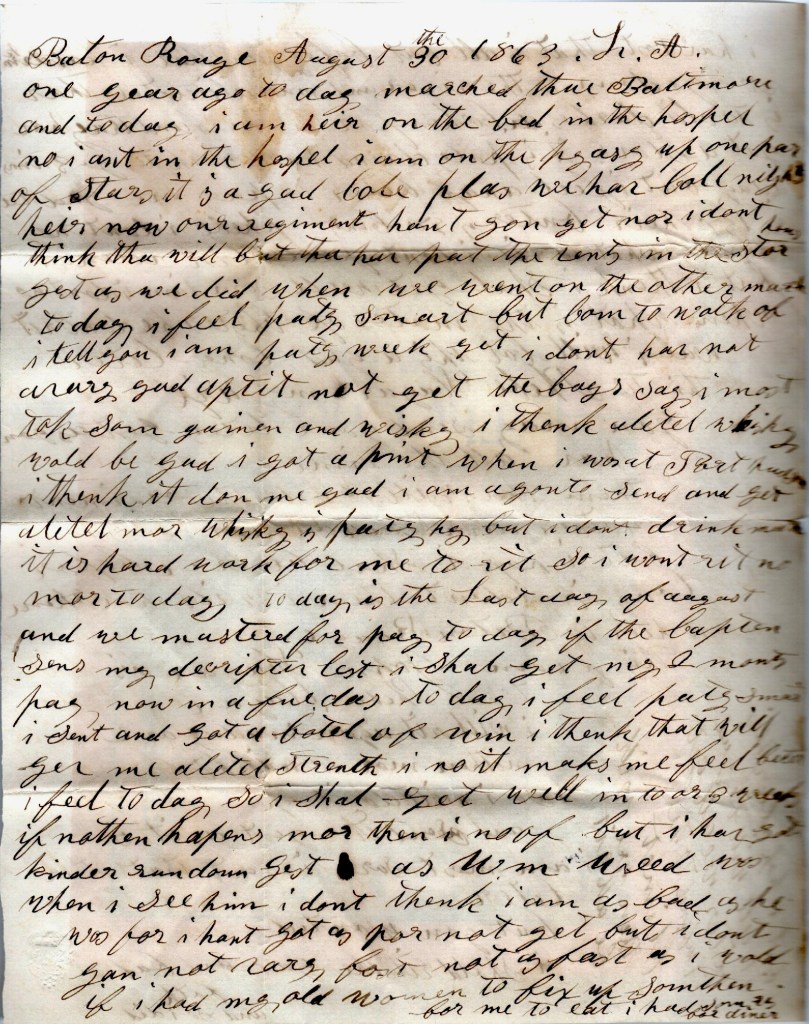
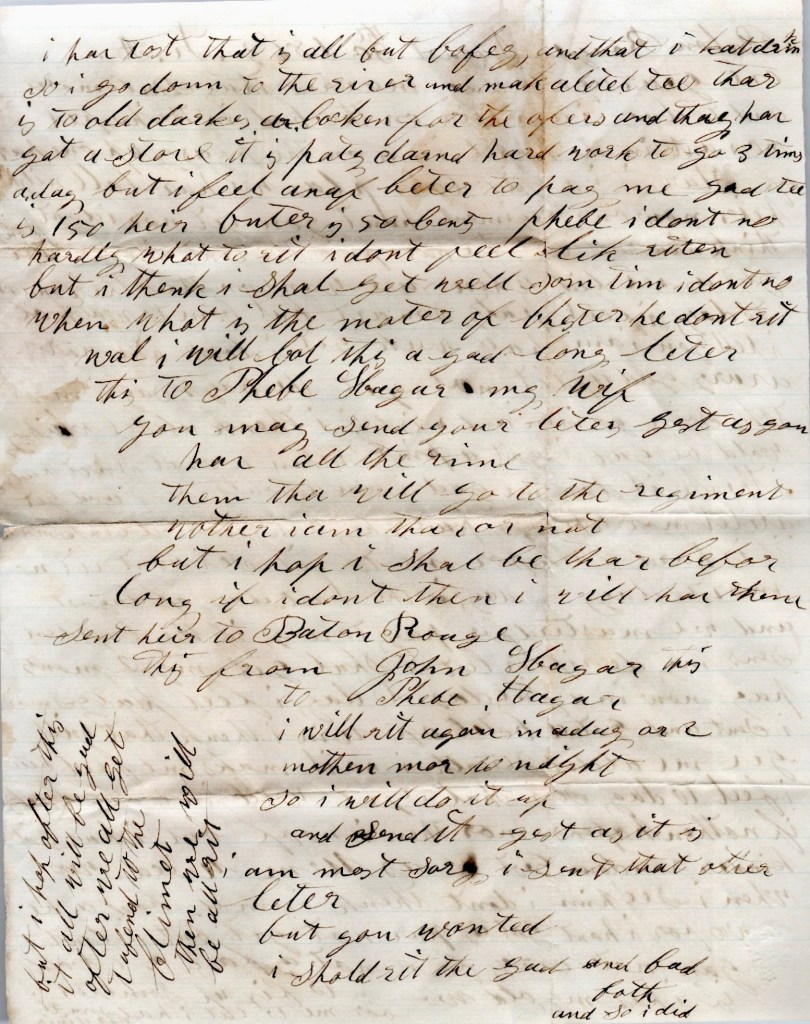
Letter 98
Baton Rouge, Louisiana
Barracks Hospital
September the 2, 1863
Today I feel pretty smart. I think now in one week more I shall be ready to go to the regiment. They have started for some place, I don’t know where. Some say they are a goin’ to Texas. I tell you I wanted to go with them but I don’t feel hardly stout enough for a march–not yet. I have got a pretty good place here to stay. I have a good bed to sleep. It ain’t a feather bed, but it does first rate for me, I tell you. I feel so much better today that I think I am almost well. I think it is that wine that helped me.
So I will write you a short letter. I do hate to write. I won’t write but I s’pose you kind of want to know how I get along and so I will tell you. I am a getting along first rate. Six days ago I didn’t think I should be as well as I am now—not in one month, if ever. But now I think that I shall be as well as I ever was in a short time.
Phebe, don’t worry about me not one bit for it won’t do me nor you any good. If there is any chance to get a furlough to home I shall try and get one. But the 110th [New York] don’t get many furloughs. I don’t s’pose I can get one but I don’t care much now for l am getting well so fast.
The doctors say the 110th boys get along pretty slow. They say they have been marched to death. But I am alive yet. Our regiment went with less than 150. Pretty small regiment.
Rant is here. He has the fever and ague. He has now and then a little shake. There is lots of our boys here. They are all getting better. I can’t think of nothing to write so I will stop. I shall be with the regiment before you can get a letter back to me, so you may send your letters just as you have all the time.
All of this to Mrs. John Hager–my dear. So I will say goodbye for now, — John Hager
I don’t know how often the mail goes but I shall write often. We look for a large mail today.
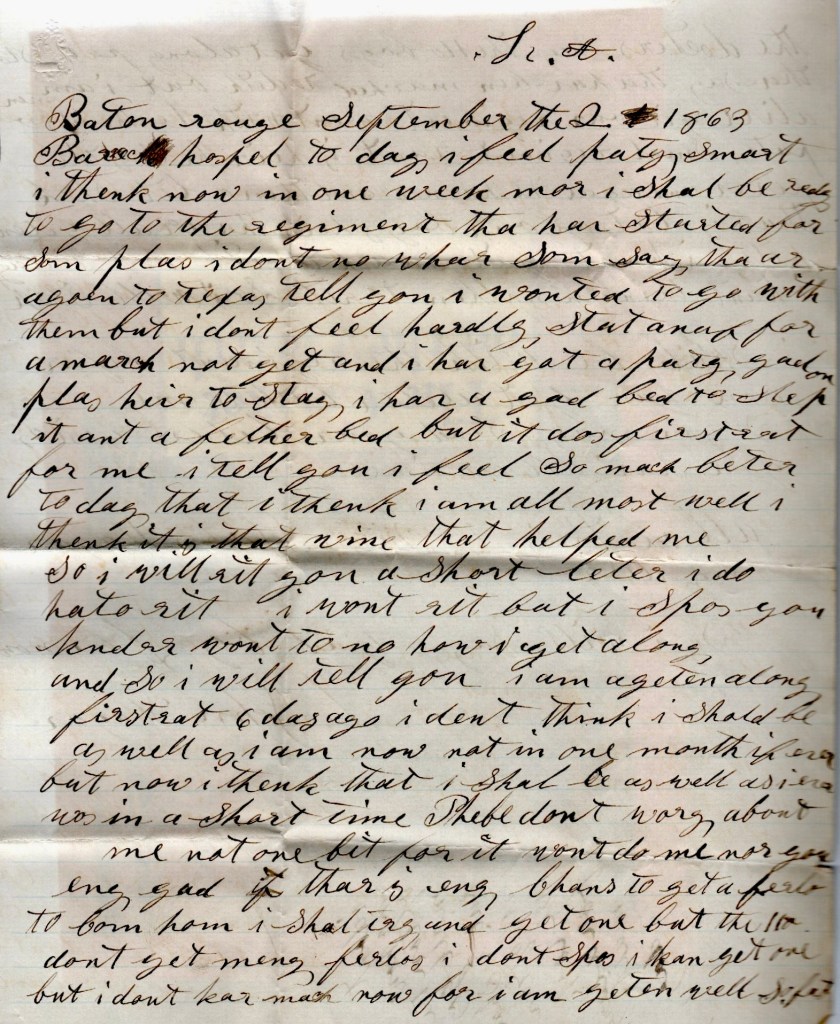
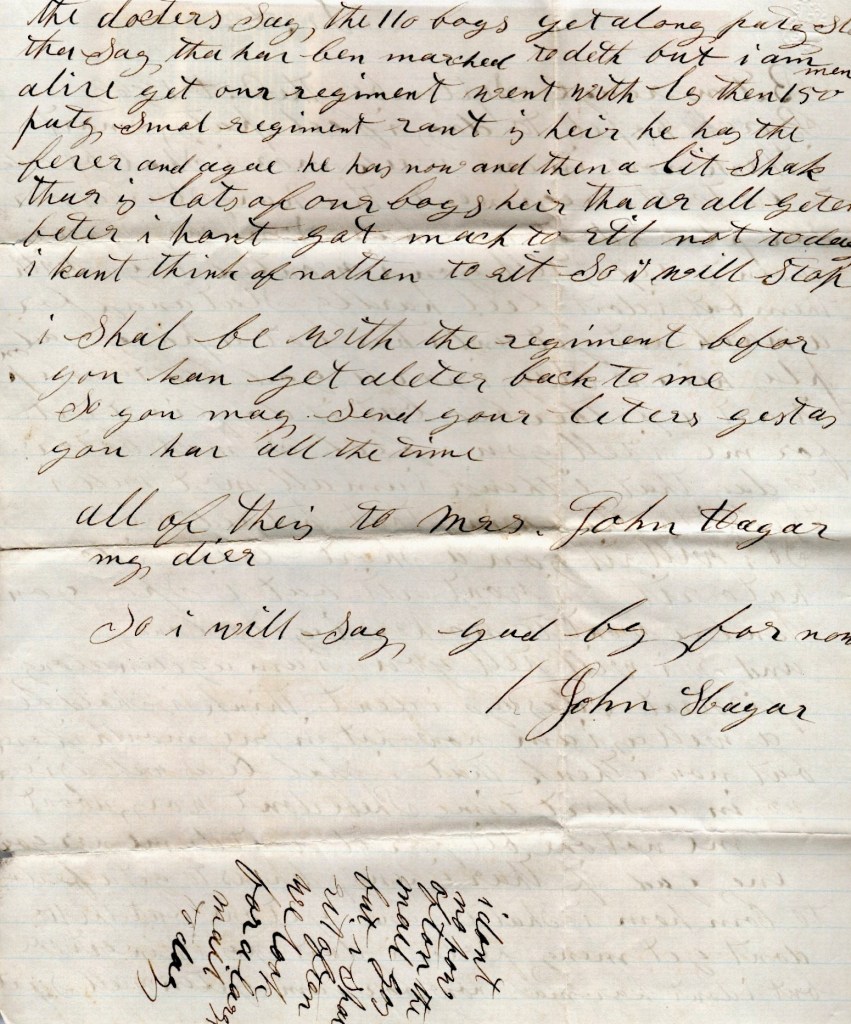
Letter 99

Baton Rouge [Louisiana]
September 8, 1863
Today I feel pretty smart. I think I am a gettin’ better but rather slow. I think I am a stouter than I was.
Now Phebe and all the rest of the good folks at home, l will tell a little about soldiering. We left Port Hudson August about the 20. We was all marched in this fort—all that was able and some that weren’t able. It was about dark when we got here. Some went in the hospital but the most of the boys laid down right where we stopped. But I went and laid in the piazza. It had a good brick floor. I laid there for four days and all of this time I had what I call the shits. I had to go back about 40 rods. I had to go down a steep hill. That was fun for a man to come back, you had better believe.
While here in the hospital, we have coffee and bread twice a day and beef soup once a day. Our bread is toasted. I must tell you how they toast it. They lay it on the stove. We had a little butter. We don’t have nothing more unless we buy it. Now I have got a pretty good appetite. I buy now and then a few potatoes and go down the hill where the niggers are baking and roast one or two. I don’t eat much yet. I go down there to make my tea. They make their coffee in an old iron kettle, black as hell. The coffee ain’t fit for the devil to drink and we poor devils ain’t allowed to make just a little tea on their fire. They say it is against the regulation. So, we have to go off down there.
But them that is so sick and can’t sit up, they have something a little different. Now I tell you if all hospitals are like this. God knows I don’t never want to see one. It is all a speculation. The government furnishes enough but there is so many damn Copperheads in the world they want to run the whole concern. It seems just so they tried to put in all the men devils for overseers and officers. I find a man has to go to the hospital and every other damn man plays, then he can get promoted. But as for me, I don’t want no office if there is any fightin’ to be done. I can fight just as well and be a private.
Well I am here but I ain’t a drafted man. And I have stayed it 13 months, and only 23 more. And that will soon pass along. If I am only well, then I can stand it as well as the rest. But there is some that don’t stand it. In these four buildings, we lost about one a day. I think they die as fast now as they did ten days ago.
Phoebe I don’t feel like writing much. I did think when I first began that I had a lot to write. We han’t heard where the regiment has gone. This from John Hager
Now my dear I must give you one word. You say you have sent me more money than I have let you have. I know all about that. I never sent for nothing only what I wanted. You say folks wonder how you live. God bless you. Roast potatoes. You have got one cow, you must have a little milk and you had plenty of pork to last until now.

Letter 100
Baton Rouge, Louisiana
Barracks Hospital
September 12, 1863
Today I am about the same, but hope I am getting better. But most darn slow. This is a pretty slow place to get well. I han’t had my letters in 3 weeks now from you.
Our regiment has gone on to Texas. When the letters get there, then the boys will send them back. I think I shall get well sometime but God only knows for I don’t. But some does die here with the shits. I see one of our boys in the 110th [New York] that was taken just about as I was. He was carried off in a box 3 or 4 days ago. So you see soldiers do die sometimes when they can’t live any longer. I have got a pretty bad cold just now but I think I shall get over that in a few days.
Phebe, I han’t nothing to write not that I know of so I will close by saying keep a stiff upper lip. So, I will say goodbye to one I love so well. – John Hagar
I don’t know but you would like to know what kind of medicine I am taking. Nothing but camphor and opium pills. This doctor don’t believe in giving much medicine. That suits me if he only cures. I think I shall stay here till I will get one letter.
Some days I have to run 7 or 8 times. Then others not more than 4 or 5 times in 24 hours. But I run just enough to keep me weak and kind of run down. You may send me answer to this letter. Baton Rouge Barracks Hospital.

Letter 101

Baton Rouge, Louisiana
Barracks Hospital
September 16, 1863
I now take my pen in hand today to write you a few lines. I tell the thing just as it is. I don’t get along—not very fast. I don’t think I am any stouter today than I was when I first came here, but otherwise I am some better. But you can’t tell nothin’ about it for one day you will feel pretty smart and the next be down. Some days I think I am most well. The 4th of this month I thought I had got almost well so I got a pass to go down town. When I got down there, I went to a eating saloon and what did I call for to eat? It was a plate of potatoes and tea and nothin’ else. They set it on a large plate full and told me to have some bread. So I ate about one half of the potatoes and drank 2 cups of tea. It never hurt me a bit. That was the 4th of the month. I hain’t been down there since. Think my cold is getting a little better today but I am pretty weak yet.
Phebe, I don’t know what to write you for I can’t write nothin’ good. Tell Chester that Hub Temple is dead but Joseph Preston is getting pretty smart now. Dammit all. I can’t think of nothin’ to write so I won’t. I try to write much if I could only keep this old head of mine right. When I get asleep, then I am a building all sorts of things and I lay and sweat like a butcher all night. But the talk is now that we poor devils are a goin’ to get our pay this week. If we do, I shall get me another bottle of wine. I think that would do me more good than anything else. And I shall buy something else good to eat if I can find it. And they have got plenty down town and I am able to go down there. And that is all and maybe a little more.
— John Hager, the Soldier
Phebe, don’t fret nor stew about one poor soldier.
I got my letter all done and was a sittin’ on the bed and there come up an awful rain. It wet my letter. The nurse said he would move my bed inside so I am inside now with the rest of the soldiers. Phebe, don’t for God sake worry about me for I have got money enough and I hope I am getting better. But I have got a pretty bad cold. It is mostly in my head.
This is a rather short letter but it has been over 3 weeks now since I got one from you. But I shall keep writing till I do get one. I am in hopes I soon shall be able to go to the regiment. It don’t seem half as bad here now as it did when I first come here. I have all the tea I want now. Some days I don’t have no diarrhea. Then maybe the next day it makes run all the time. You can’t tell when you are better. I have got a pretty good appetite to eat but some way vittles don’t do much good. The old doctor says eat all we can. Some of the men he tells them to eat raw potatoes and vinger onions. That is for the scurvy I s’pose but my legs ain’t swelled nor there ain’t no sores on them.
I don’t know what George does right but I heard today he was getting better—all but his foot. I hain’t seen him since we come from Port Hudson but Rant has been down there a number of times. When I get well enough to go down town I shall go and see George. We have sent our names down to New Orleans, what there is here—so we will have our letters sent here. I would like to get a letter about now. All of this to Phebe Hager.
This from John Hager, the soldier.


Letter 102
Baton Rouge [Louisiana]
Barracks Hospital
September 25, 1863
Today I take my pen in hand to let you know I am a gettin’ along first rate now. I begin to believe now that I am a gettin’ well. I don’t get no letters yet nor they don’t none of the boys in our company get any. When we get to the regiment, then I think we must have a few letters. I heard today that our regiment is at Brashear City and the old Colonel is sick at New Orleans and the Major is sick too. So they didn’t go no further than Brashear City.
I s’pose you would like to know what I have good to eat now-a-days. I have bread and butter and tea. I buy milk when I can get it. I can’t get it—not every day. Milk is very cheap here—only 10 cents a pint. We have to get it in the morning for it will get sour by noon. Milk don’t taste here like our old cow’s milk but it tastes pretty darned good to me when I can get it.
Phebe, I don’t s’pose you will thank me for writing so many letters all filled up with nonsense but I shan’t never make nothing any worse than it is. But there is lots of things that I have wrote that I shan’t of wrote if I had been sure that I could live to come home. But you said you want[ed] to know just how it is here, but you never will know all about it.
I am a getting so I can sit up almost all day now. I begin to feel much as a fish out of water. I do hate to lay abed the worst kind. I have got most over my cold now. If nothing happens to me, I shall be well in a few days. They are a sending off soldiers a’most every day to their regiments. There is a number of the 110th [New York] that is a’most ready to go. I han’t got much to write this time so I will close this. From John Hager to Phebe Hager, my wife.
Direct to New Orleans just as you have.


Letter 103
Baton Rouge [Louisiana]
Barracks Hospital
September the 28 1863
Today I am thinking whether it is best for me to enlist in the Cavalry or not. If I do, I have to stay three years more but I get 4200 [420] and two dollars [bounty]. I get the same pay besides. I don’t hardly know about enlisting for one year more. That is the devil of it. I wish I knew what you thought about it. You will get 400 dollars more. You will get that if I shan’t live two months. And the 75 dollars too when my three years is up. I don’t know what I shall go yet or not. When my first 3 years is up, then I can have a furlough. George—he talks of going to the cavalry. He says he knows he can stand it better if he does have to stay one more year. I don’t know yet what I shall do. I am a goin’ and see how they talk. Then I can tell better. George has been over here today. He is a gettin’ along first rate.
I will tell you when we get this bounty—40 dollars—when we are mustered in. Then the next pay day 50 more. Then every 6 months we get 50 besides our monthly pay.
Today is the 29th and I got two letters. One [was dated] the first of September; one the 5th. Phebe I am the same as well now. I feel pretty darn good today. The doctor is a comin’ around today and all that is able to do duty I s’pose he will send them off. I don’t know whether he will send me or not. I know I shan’t stay here much longer.
You tell Mr. Palmer that I hain’t sold nobody no trees—nor no timber nor nothing else. You can tell him just as I did when we was there. I told him that there hain’t nobody no claim on the place but you and Palmer and I wanted you and him to make some kind of bargain to see to it. If Jack Ouckart has cut any timber on your place, tell him to put him right there or you can do it yourself. Take him to [court in] Mexico [New York] and take Palmer for a witness. It won’t cost you much. I want you should make him pay dear. Don’t settle as easy as John Robbins did before. Make him pay or send him to jail. Get John to go to the village with you. Get him to help you and I will send the money. Have Whitney do the business for there is where we had them up before. Tell John Calkins if he will help you manage the suit, I will pay him well for it. Don’t settle for a little nothing as John did before. Put them right through.
Now Phebe, be sure and write to Palmer just as we talked it when we was at his house. I told him that I han’t sold no body no timber nor none of the crops. It all belongs to the old woman and now it is for her and you to do as you think best. I want you should write to Palmer and tell him that I ha’n’t sold nobody no trees nor one tree. The best way to take him is to serve a summons on him and then get him up there. Then if he don’t do as you want him, then take him with a warrant. Now I hope I have answered but I should think that was a damn pretty question to ask for Palmer as long as I told him all about it. Now I hope I have wrote this so you will understand it. Now I will close for I han’t nothing to write. I think Chester’s folks has done well and that is all they have done. Phebe I suppose you have had some pretty hard letters. I am sorry now that I wrote them but men die here pretty sudden sometimes. This from — John Hager
This to my wife, Phebe Hager
I don’t think I shall enlist over again for one year—not till I know what you think about it.
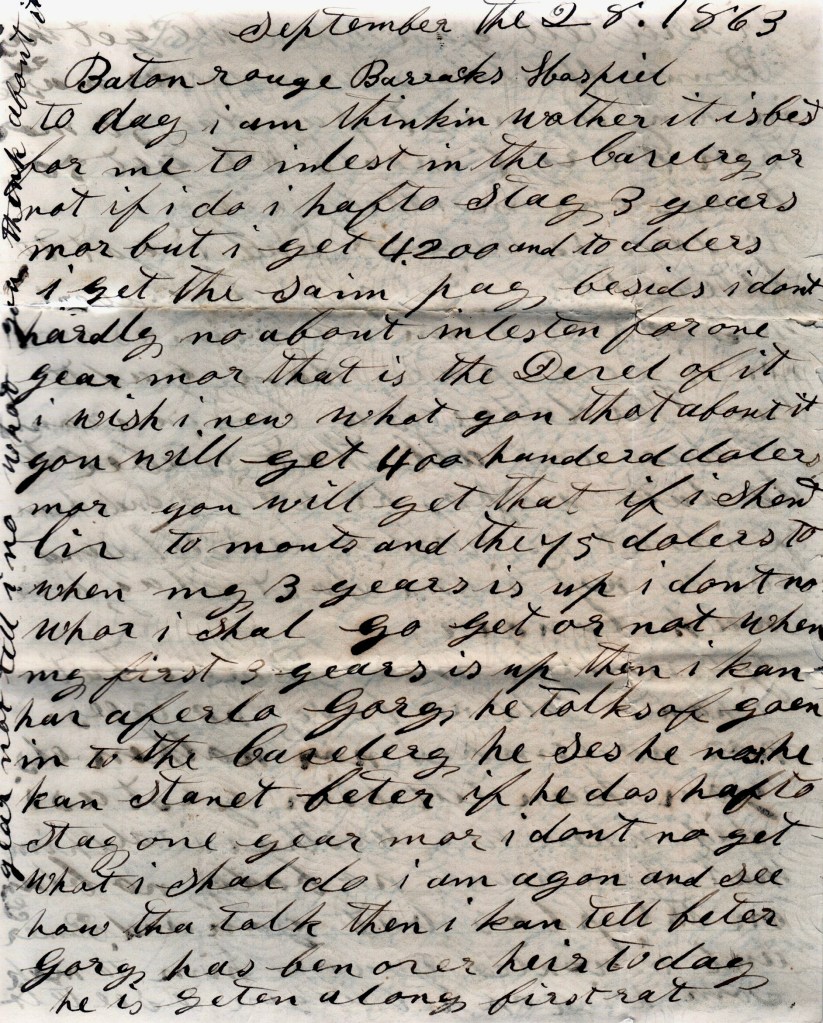

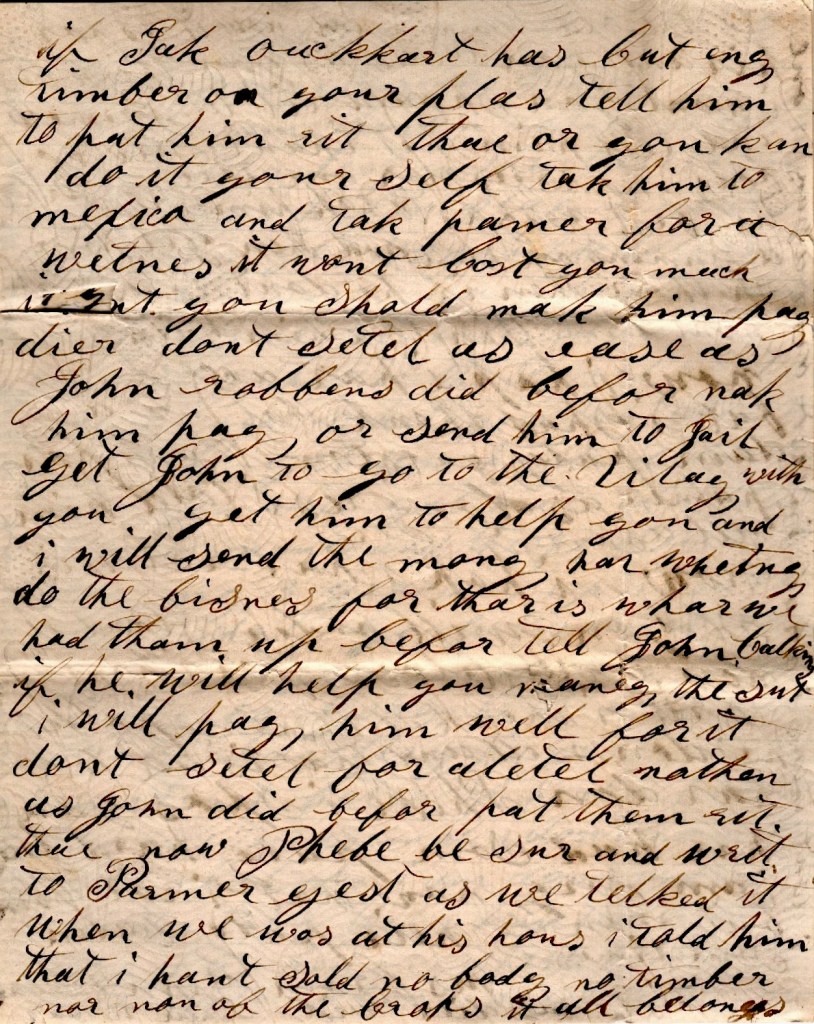

Letter 104
September 30, 1863
Today is the last day of September and I thought I would write a few lines more since I han’t nothing else to do. I am writing you should buy a sewing machine if you can pay for it. I think now that I shall send home a little more money. I don’t know when I shall leave here. I have used a good deal of money. I want to send Charlie what I owe him so he can buy his sheep and next foal. I must send Emma enough to buy her one. If I don’t this winter you will have to have some money to get clothes with and get [fire]wood. I suppose you will have to have some hay this winter. I want you to dress the children as well as you can and yourself. It rains today here but l am a getting along first rate and I feel middlin’ well contented here now. I am a gettin’ adjusted to it. It don’t seem as lonesome as it did at first.
I don’t got my cheese yet. It has gone on after the regiment. I shall let it stay there till I go. I could have it sent up here. I suppose the regiment is at Brashear City a doin’ guard duty in the railroad. There is a number of us here that is a’most ready for duty but some is a goin’ into the artillery and calvary. But I guess I shall stay with the 110th [New York] a spell longer yet. I think the old 110th will come out all right yet.
Phebe I han’t nothing much to write this time—only be sure and have any man that cuts any trees on the place put right through. Stick it right to them. Johnny is as good a hand as you can get.
This from John Hager, the soldier
This, if you can read it, is to Phebe, my wife. When you send a letter, put in a stamp [in] for I can’t get them.


Letter 105
Baton Rouge [Louisiana]
October 2, 1863
I now take my pen in hand to let you know I am a gettin’ along first rate now. The color has come back in my hands and face and you better believe I feel pretty well over it about these days. But I have to watch and pray to keep myself from eatin’ green stuff and eatin’ too much of anything. But I have done the best I could and I think I have got along pretty well but I have used a good deal of money but none for things that weren’t necessary.
I heard from our regiment today. They are a goin’ to camp down to New Orleans. One of the Lieutenants was here. He came from the regiment. He says the Colonel and Major has gone home and Colonel Smith is a goin’ to make cavalry of the 110th so we will have horses to ride. I am in hopes to get to the regiment now in a few days.
I began to feel some like John Hager now. If nothin’ else happens to me, I shall be as tough as a bear in less than one month. But I notice when the boys get about as well as I am, then the most of them have a fall back. But the most of them are a gettin’ well now. It is nice cold weather here now. Tomorrow is Sunday and then I will fish so I hain’t nothin’ more today.
Today is the 4th and I will write a little more. Phebe I didn’t make them figures right. I guess I didn’t alter them. You can do it for me. It was 100.70. We was all talking so I didn’t put it down right. I don’t know as you can read any of that or this. I don’t hear nothin’ about cooperin’ this summer. I guess Chester and John ain’t a doin’ much this year. If they be, they keep it pretty still. You said Pa had been sick but he has got better. I am glad of that. Have you wrote to Jane yet? If you hain’t, you better, for maybe she would like to hear from you.
Phebe, I swear I don’t know what to write but I am a gettin’ along first rate. My hands and face begin to look red and that makes me feel better. There was one spell, I tell you, sometimes looked pretty hard. But I hain’t got very fat yet, but [I’m] on the gain.
How does Milo and Mrs. Herkimer get along now-a-days? Tell them I am among the living yet. I won’t write much to them for they don’t to me. But I don’t care a damn whether they do or not.
Furloughs has played out here so I shan’t get none—not this winter. But next summer, then I shall try to get one if the war is a goin’ to last 2 or 3 years more. But I don’t think it will. But I don’t know nothin’ about it. How did John Robbins get along with his draft and Duane Spenser? I don’t see where they got the money [to pay for a substitute]. Where is Frank Wing now? Is he alive yet?
Phebe don’t you think I write pretty often? But I, like a damn fool, hate to write that I had the shits a little, so I have to keep writing or you would think I had gone to the devil or some other good place.
Phebe I want you to put them right through for cutting that timber. Phebe can’t you buy your wood for about 4 or 5 shillings a cord? 10 cords will last about all winter. Have it all dried and piled up at once. But you can do better than I do so I shan’t say nothing about it. I guess I hain’t nothin’ more to write in this. This to my wife and friend so all day for today. John Hager, the soldier down in Louisiana
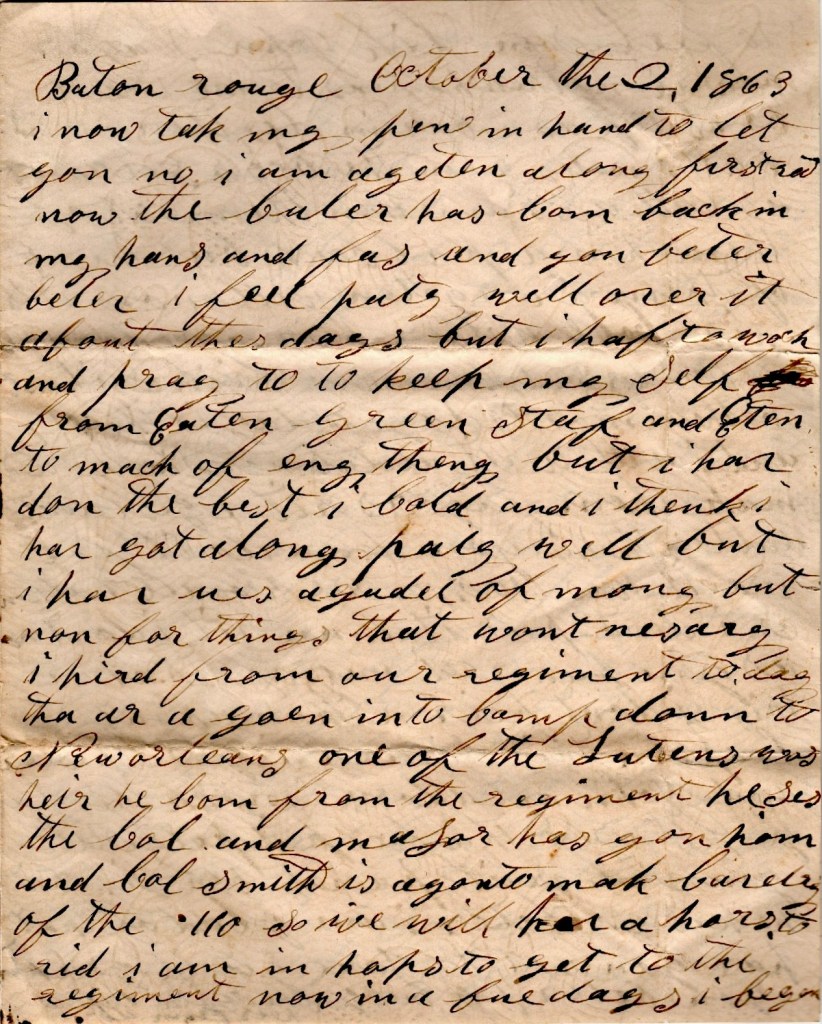


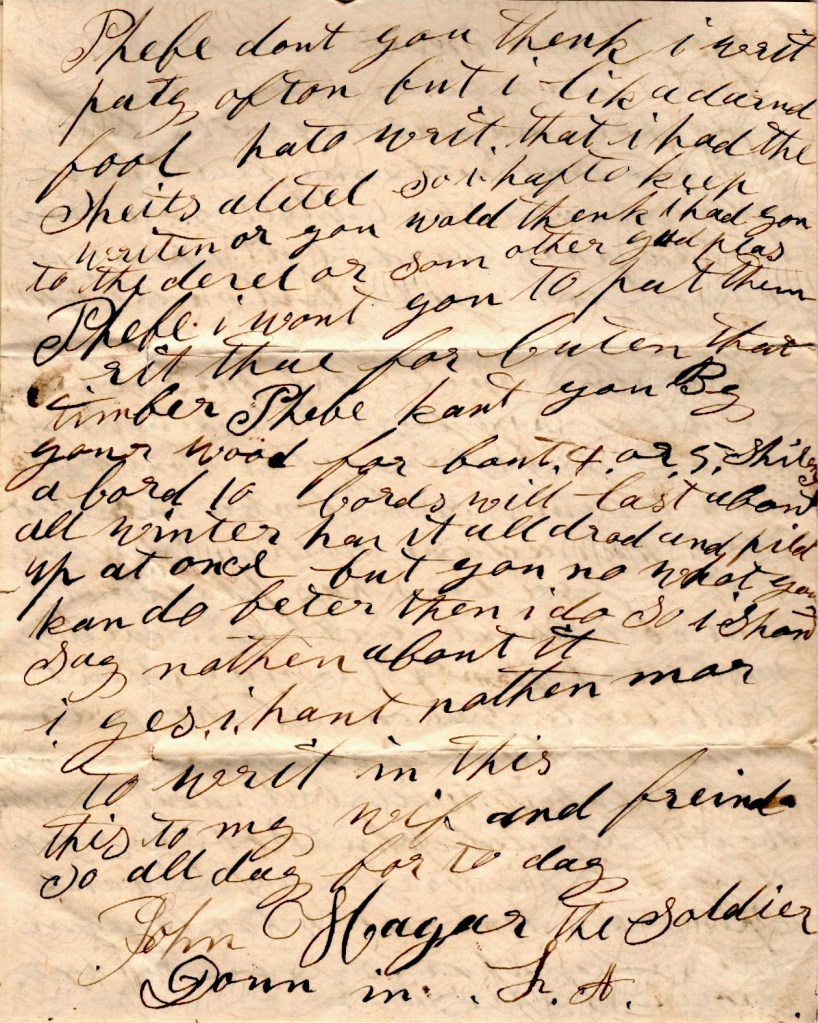
Letter 106
Baton Rouge [Louisiana]
October 15, 1863
I am here yet and I am doing first rate. I am the same as well now. I hope this will find you all well. I stewed some of them berries and they taste pretty good to a soldier. Now I must tell you just what we have here to eat in the morning—two slices of bread about 4 inches and both aren’t more than ½ inch thick, and tea—small cupful, and that is made so sweet that I don’t think much of it. And for dinner we have two small potatoes [that] ain’t hardly fit for the hogs to eat, and bean soup and beef. The soldiers call it salt horse or salt mule. And for supper, bread and tea. Once a week we have apple sauce. I don’t think a man will get fat very fast, do you, on the grub?
But there is lots of peddlers here so l buy one pumpkin pie a day and one pint of milk and 4 biscuits and I don’t have half as much as I could eat. I am as hungry as a bear all of the time. It does seem as though I can’t eat enough. But I do know I do eat too much amount every day. I don’t write this because I want anything from home or anywhere else for I can get enough here to eat and drink as long as I have got money and I have got a little left yet.
Phebe, you said you hoped I would get that box for it cost $16 dollars. I guess you must be crazy or out of your head for it don’t seem possible that that box could cost $16. This is the way you wrote it to me but I guess you put down one too many figures. I can buy such a pair of shoes here for $7 dollars and the hat $6 dollars. I could sell mine for that here. So you can see things are pretty high here—everything but niggers. They are cheap now. I am a nigger man now. I am [more] now than I ever was before. They make good soldiers. What won’t enlist, they draft them and make soldiers of them. They will get enough after a while to guard this river. Then the northern men can go somewhere else. There is some darn smart darkies. They have got some as high as Lieutenant. None for Captain yet. But there is some would make better than some of the white Copperheads.
I s’pose we shall have to leave here now pretty soon for they are a goin’ to have women nurses in all the hospitals now and send the men to their regiments. There is a good many men fit for duty in all the hospitals. They are a goin’ to have white women but I think it is a pretty hard place for anybody that is half white. I don’t care now how soon they send me away now but I hain’t got as stout as I was before I was sick yet. But I don’t care about staying here for it cost too much to stay.
I s’pose you seen Robert Aird 1 but he don’t know much about war. He was always sick or lame or behind when there was any fighting to be done. You may tell Mr. Blackhead when you see him if he don’t write to me I shall think he is one old shit ass. Tell little Caulkins to write to me. I should have wrote to him before now but I s’pose you read half of my letters to him so it is all the same. I hain’t got nothing new to write so I will stop.
This to Mrs. Phebe Hagar. — John Hagar, the soldier.
1 Robert Aird—Age, 38 years. Enlisted, August 6, 1862, at Richland, to serve three years; mustered in as private, Co. B, August 13, 1862; promoted sergeant, August 21, 1862; mus- tered out with company, August 28, 1865, at Albany, N . Y . [Robert was in New York State collecting conscripts to fill out the rosters of the 110th New York Infantry at the time.]


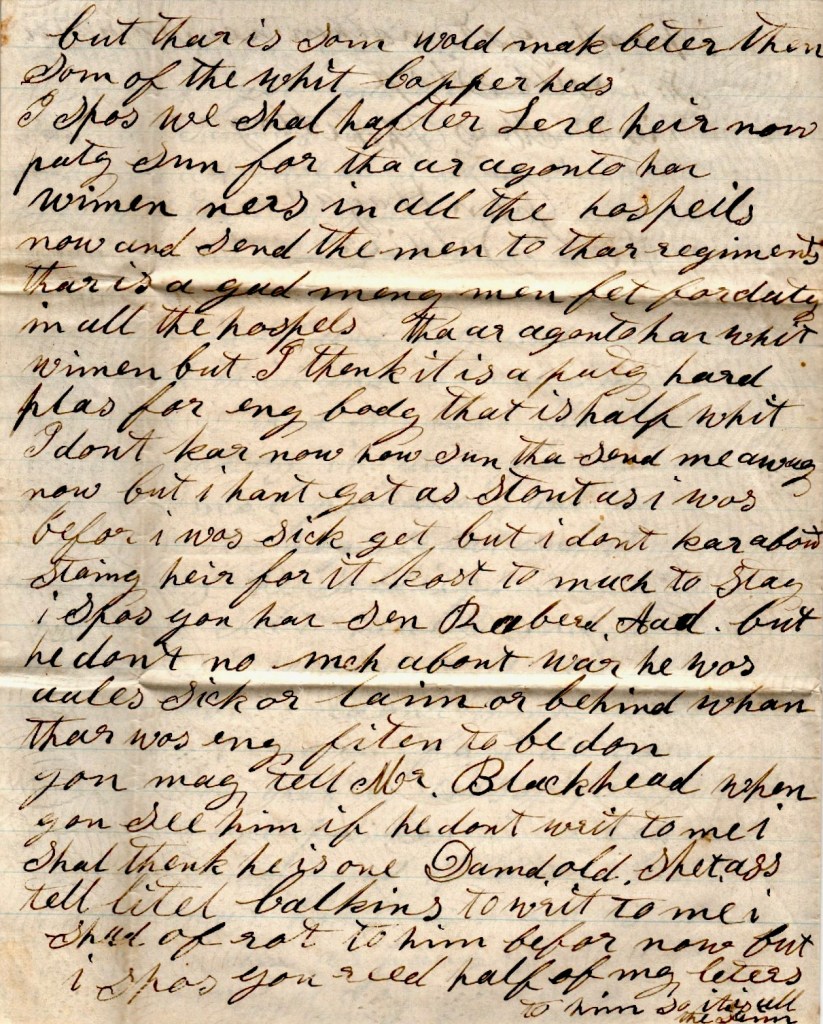

Letter 107
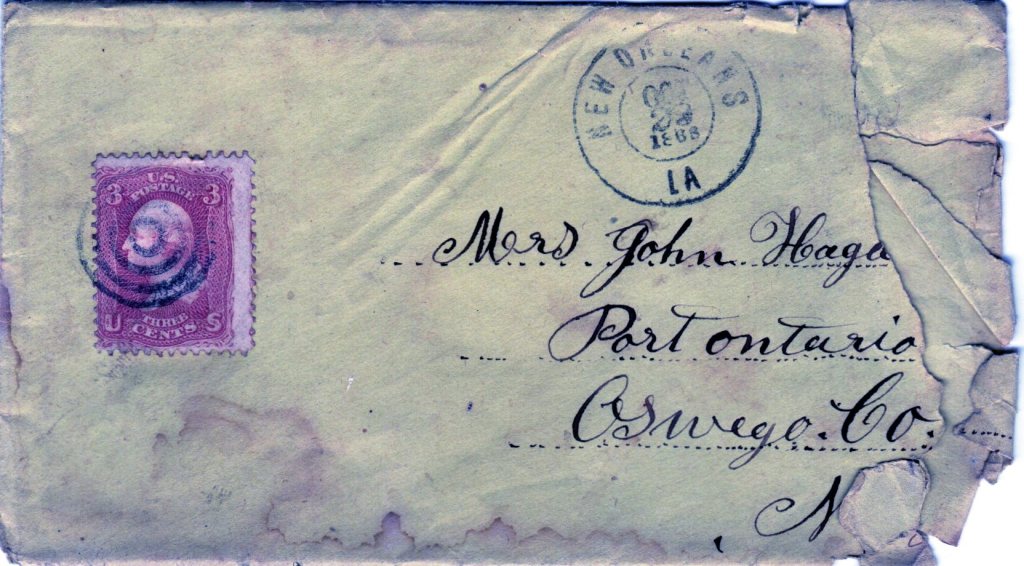
Baton Rouge, Louisiana
October the 18, 1863
Mrs. John Hager,
Today I take my pen in hand to write a few lines to you to let you know how I am a getting along. I am well once more and I do thank God for it. I don’t want to eat hardly as much as I did and I am glad of it. But I know I eat too much now. Phebe I can’t think of nothing to write today so I will wait till tomorrow then I will write a little more.
Well, old woman, another long Sunday has gone and I am here yet. And today is the 19th—Monday—and all sound as a brick. But I don’t know but you think I am homesick by my writing so much. But I s’pose I wrote some pretty hard letters to you. I guess they was. I didn’t stop to read them after I got it wrote. Then I do it up and send it all done. I don’t know as you get all of my letters.
I don’t know where I should go to. The old doctor says we can’t go to the regiment. He says we will have to go into some of these government plantations and stay and keep the darkies to work. They say we won’t have to work much.
Today is the 20th and I don’t know where I am a going to yet. They say we can’t go to the regiment for I s’pose they have gone to Texas. I don’t know what they will do with us poor devils. Some say they are a goin’ to send us to one place, some to another, but some of us will go to New York. But I don’t think they will send me there. I think I shall have to go into some other regiment but I don’t know as it makes much odds where if I am well. Then I can go it as long as the rest of them.
We don’t get no letters yet. I shan’t write as often as when I find out what I am a going to go, but I shall stay here till they send me off. There is seven of our company here a doin’ nothing. I hope they will put us into business pretty soon. If they don’t, we will get so lazy we can’t serve but we are a having a pretty good time here now. There is 23 of us all in this ward and they are all about the same as well. So we hain’t no sick ones in here now. We have all got good bunks to sleep in and we have good linen sheets. We have clean ones every Sunday morning. But it is getting rather cold nights now to sleep alone.
We don’t get much news about war this week. There was 4 or 5 boats come down this morning. They don’t bring no news from New Orleans. They didn’t have nothin’ new but I see in the papers that they are a doin’ a good deal of fighting down in Tennessee. I guess they will whip our old Rosecrans [at Chickamauga] but he took it to them first rate. There is where they fight. We don’t have much fightin’ to do here now-a-days. I guess we have got them about cleaned out and all the fightin’ men there is has gone to Texas. But that ain’t but a little way from here. When we were at Barre’s Landing last of May, it wasn’t but 50 miles to Texas and to Galveston, Texas, from here ain’t more than 100 miles [actually a little over 300 miles].
Well, old woman, I swear I don’t know nothing to write. But if I could see you, I might tell you one small war story. So, I will close htis up and send it but I s’pose you will say it all ain’t worth a damn but I don’t care a damn except for that you wanted I should write often and so l have done.
This from John Hager to Phebe Hager
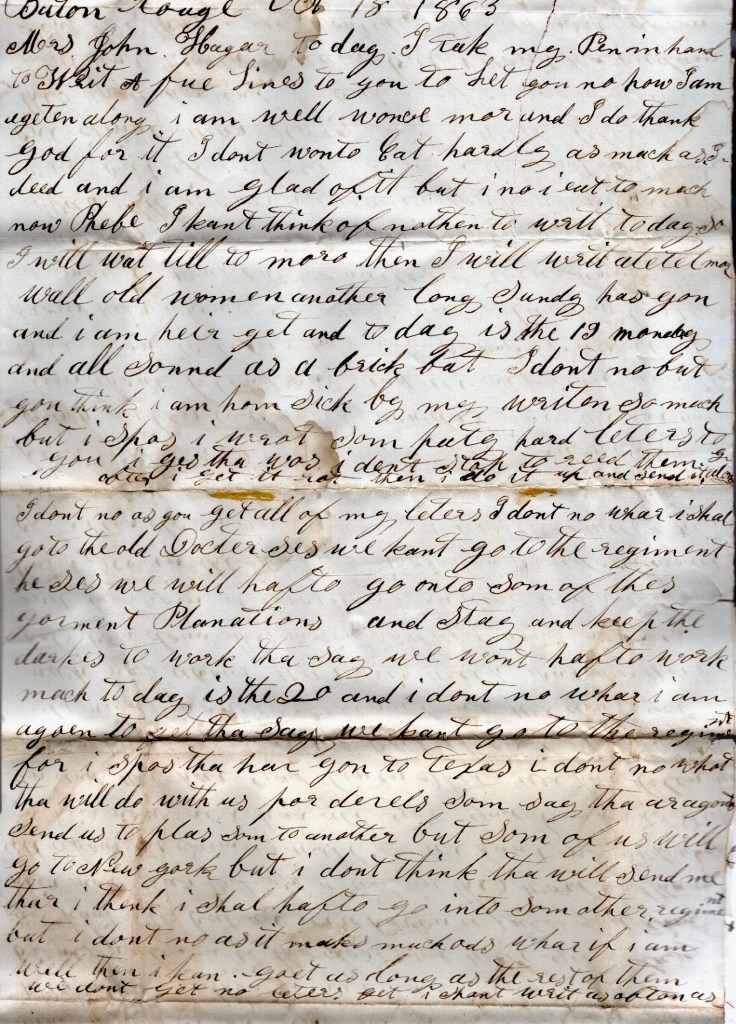

Letter 108
Baton Rouge [Louisiana]
October 30, 1863
I have got two letters from you today and you say you are all well. I got a letter from Rhoda. They are all well. Oh, what a good thing good health is, ain’t it?
Phebe, I got the 5 dollars [but] I hain’t got the cheese yet. I went down to the Express office three weeks ago to have them send down to New Orleans after it. They said they would, and if it is there, they would bring it up here. But it don’t come, so they will have to pay for it. That medicine I hain’t got, but I got two pair of socks. The last pair in July and they come darned good. I thought that I wrote all about it.
Phebe, I didn’t mean to find any fault with you for I do think you have done first rate. Phebe, don’t mind nothin’ about what I wrote for I was sick and pretty hard up. I don’t remember what I did write. If you don’t like it, then burn up the letters. I don’t mean to write anything to hurt your feelings.
Well, old woman, I feel first rate and I hope this will find you the same. Phebe, I should like to see you. I could tell you more in one day than I can write in a week although I can write you a letter in 10 minutes. Well, old woman, I hope you don’t mind anything about what I wrote for you know I was sick or I know I was sick and pretty darned hard up too. But it was money that helped me for I didn’t eat nothing hardly for about 10 days. I had spent almost all of my money at Port Hudson. But I sold my watch for 15 dollars and that lasted until I got paid and I have spent most all of that. But I shall get my pay now again the first of the month. Then I hope I shall be with the company for it does make me feel bad to pay out so much money and get so little for it. But if I live to see this war over and get home alive, and find you all alive, that is all I will ask for. But I should save all I can.
Some of the boys sent all of their money home and them poor fellows had to suffer and some don’t send home any. They spent it here. Some fooled it away. But I hain’t mine. Some went to the market and eat so much that they died the next day. I have been there 4 or 5 times but I never eat half what I wanted. I had the darndest appetite to eat that you ever did see, I know, but now I don’t want just as much. But I can eat all that two men gets here.
But now it is cold weather and I can buy potatoes and cook them myself and that won’t cost as much as it does to go down town to buy. But you say look for the best. I do. I hope I do. Phebe, I hain’t got them stamps. I got 4 at one time and I have forgot when it was but it was when I was at Port Hudson. I sent for a dollar or 2 worth. Them letters must have went to the regiment.
Phebe, I hain’t got that cheese. I went to Adams Express and they told me to tell you to go to the office and carry your receipt and they would [either] find the box or pay for it. I think you had ought to have something to pay for running so much. Cheese is 50, butter 50, sugar 12 cents here at the store.
Phebe, you said that I talked rather cold toward you. Phebe, I felt pretty cold for two or 3 days. My feet and legs to my knees was as cold as ice and it was as warm weather as you ever see. But I rubbed them and got them warm. This is something that I didn’t write when I was sick for fear you would worry about me. But I told you what the matter was and about how I felt. There was a spell that I did think I was a goin’ the same as Weed did. [William Weed died of Typhoid April 21, 1863] He kind of pined away. But I do think if he had of bought more to eat, he would have been alive now.
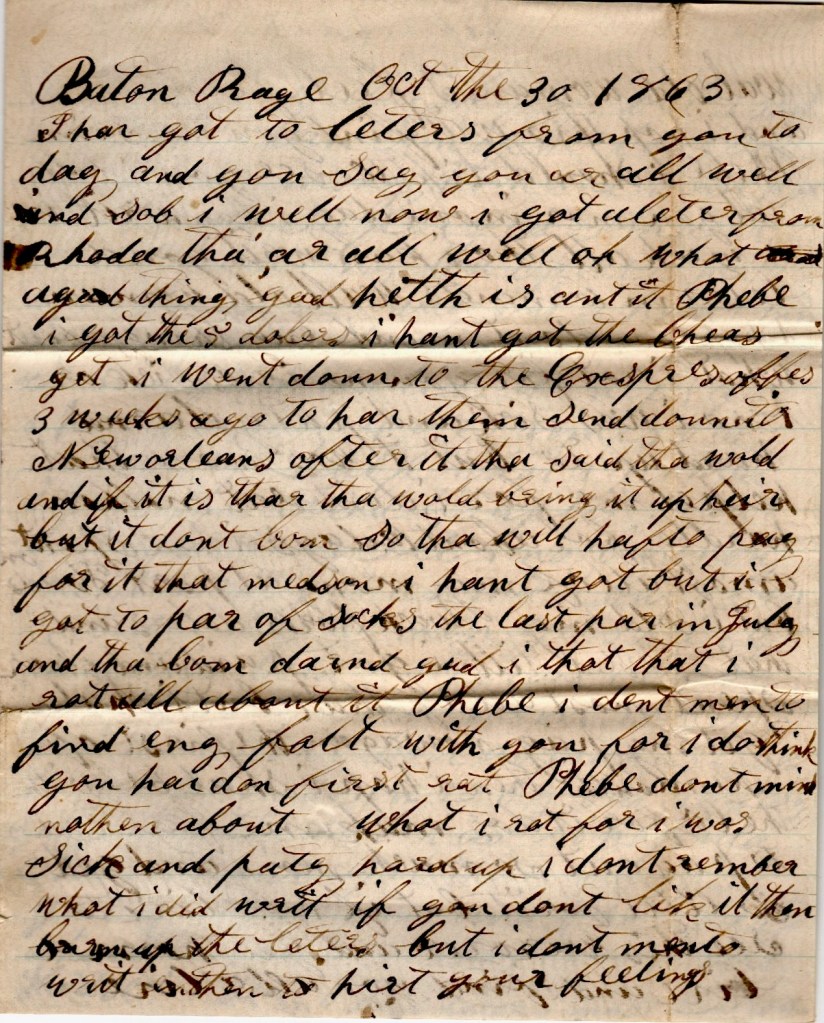


Letter 109
Baton Rouge, Louisiana
[Early] November 1863
Mrs. John Hagar, my dear,
Today is a rainy day and it is kinder lonesome and I thought that I would write a few lines to pass away time. But it ain’t lonesome here for we have got 35 in this ward now. But after all, it is kinder lonesome, but l feel first rate and I hope this will find you all well and all the rest of the good folks.
Phebe, I am afraid you are picking most too many berries. That is what made Mary sick. But you are a doctor and John is another. I do believe in your way of doctoring for I do think it is better than all the shadcakpop [?] in the whole world. The negroes—they doctor here about the same way and some of them are the best doctors we have got.
The reason I hain’t sent this before, I could not get any stamps. But one of our boys came back from New Orleans and he let me have two for 10 cents. But I shall go down there pretty soon.
Ike Fancher 1 has got back. He says he didn’t see any of my folks. He went and seen Jason’s wife. He lives up in Albion. He is the boy that got wounded at Franklin when we come down with the nigger train. He went home on a furlough and he stayed there 6 weeks. I should of thought Gardner would of seen him. He knows Mary and Gardner too.
I guess I have wrote more now than you can read so I will stop for this time. Phebe, don’t send me nothin’ more—not till I send for it. I don’t need anything. I have got clothes enough. I bought me a blanket for 75 cents. It was new. They cost 3.60. But I have got one in the tent and my dress coat is there and my overcoat. And my likeness—or your likeness and the children—are there. But I think I shall get them. I wouldn’t have left it, but I had a good pocket to carry it in so l forgot it. But when we get the tents, I guess it will be all right.
This to Phebe Hager, my dear. — John Hager
1 Isaac M. Fancher-Age 18 years. Enlisted, August 6, 1862, at Albion, to serve there years; mustered in as private Co. B, August 13, 1862; wounded in action, May 25, 1863 near Franklin, La; mustered out with company, August 28, 1865 at Albany N.Y.

Letter 110
Baton Rouge [Louisiana]
November the 6, 1863
My Dear,
Today I take my pen in hand to let you know that I am here yet. But I am well now and hope this will find you all well there. The talk now is that we are a going down to Camp Parapet. That is six miles above New Orleans. There to do guard duty. But I don’t know yet, not for certain. I got a story now that Banks is a going to be superseded by General Grant but we don’t know it—not for certain yet. Then maybe he will take us to some other place. I hope he will for I don’t like it down there. But I am ready to go anywhere. Now Phebe, I don’t know what to write so I will write a day or two before I send this.
Today is the 8th. It is Sunday and I must finish this and send it for it has been some time since I have wrote. But I thought I wait till I know where I was a going to. But I don’t know yet.
Phebe, I must tell you what cotton cloth is worth here: 60 cents, sugar 12, butter 50, pork 30 (that is fresh pork), eggs 100—ain’t that pretty high? Flour 20 dollars, potatoes 10 cents a pound. Everything is up to the top notch. I hear that potatoes are worth 50 cents there now. I hope you will have enough for your own. Please tell me what things are worth there. I s’pose they are high. I know they must be.
I was down in the city yesterday and the streets was full of teams loaded with cotton. There is lots of cotton here yet. Do you hear anything about that other 300,000 that Old Abe has called for to volunteer by the first of January or he shall draft them right straight along. What does Dave and the rest of the Copperheads say or does Dave I think his 300 dollars will clear him? But it won’t. If they want more men, he will have to come and help fight for the negroes. That is all we are fighting for now. They are free in this state now and there has a good many of them enlisted. There ain’t but a few other regiments now in Port Hudson but them. The 6th Michigan—they are there yet. They got into the artillery so they stay there. I think it is a pretty healthy place there.
Phebe, I don’t hardly want to send this—not till I know where I am a goin’ to. But I will for I s’pose you will look for it. I heard today that old [Colonel] Sage was a trying to get the 110th [New York] back to Baltimore but I think we shall go to New Orleans to do Provost Guard duty. I am getting tired of staying here. I do hope our regiment will come back as I hear it is or they will give me 100 rounds and send me on after them. I would start if I had a pass. There is 4 or 5 more that would go but we can’t get no pass to go—not yet. This ain’t a very bad place here but I don’t like to sleep in a room where there is so many. It ain’t healthy and we don’t get hardly enough to eat. It takes too much money to live here. We don’t get half as much as we do in camp. There we have all we want to eat. But I guess I can get along if the rest can. We must all remember it is war times.
Tell Emma to eat one apple for me for they are from 10 to 15 cents here and I ha’n’t eat but two this fall. They are too high for me.
Today is Monday morning and I will write a little more. Some of our boys has come up from New Orleans. Our Captain is there yet. They say Morgan Duell is dead. 1 I don’t know as you know him, but Chester and Rhoda does. He died up near Franklin. His brother Milt is in Co. E. 2
One sergeant in Co. E died since he went from here. His name was Doolittle. 3 He thought he got pretty smart before he left here. I was a goin’ when he died, but I thought I would best to stay here a little longer. He and sergeant Sweetland, 4 they was down below in a room. But I stayed with them more then half of the time till they went away from here. They thought it cost too much to stay here and I think it does too. But I think I shall stay here a spell longer. Yet the boys say Harrison has got his box and there is some things in it for George and me so I will send down after.
This is the poorest paper that ever was to write on. Phebe, I guess I han’t nothing more to write. So goodbye Phebe Hager. That is all for now, —John Hager, the soldier down in Dixieland
1 Morgan Duell–Age 38 years. Enlisted, August 6, 1862 at Albion, to serve three years; mustered in as private, Co.B, August 13, 1862; died of typhoid fever, October 17, 1863, at General Hospital, New Iberia, Louisiana.
2 Milton N. Duell–age 34 years; Enlisted, August 8, 1862, at Mexico, to serve three years; mustered in as private, Co. E. August 11, 1862; died August 31, 1864, at U. S. General Hospital, Key West, Florida.
3 Lorenzo S. Doolittle– age 37 years. Enlisted, August 6, 1862, at New Haven, to serve 3 years; mustered in as private, Co. E, August 11, 1862; promoted sergeant, August 19, 1862; died of typhoid fever, October 29, 1863, at Barracks Hospital, New Orleans, La.
4 Wilferd Sweetland –Age 28 years, Enlisted, August 8, 1862, at Palerno, to serve three years; mustered in as private, Co. E, August 11, 1862; promoted sergeant, August 19, 1862, mustered out with company, August 28, 1865, at Albany, N.Y.)

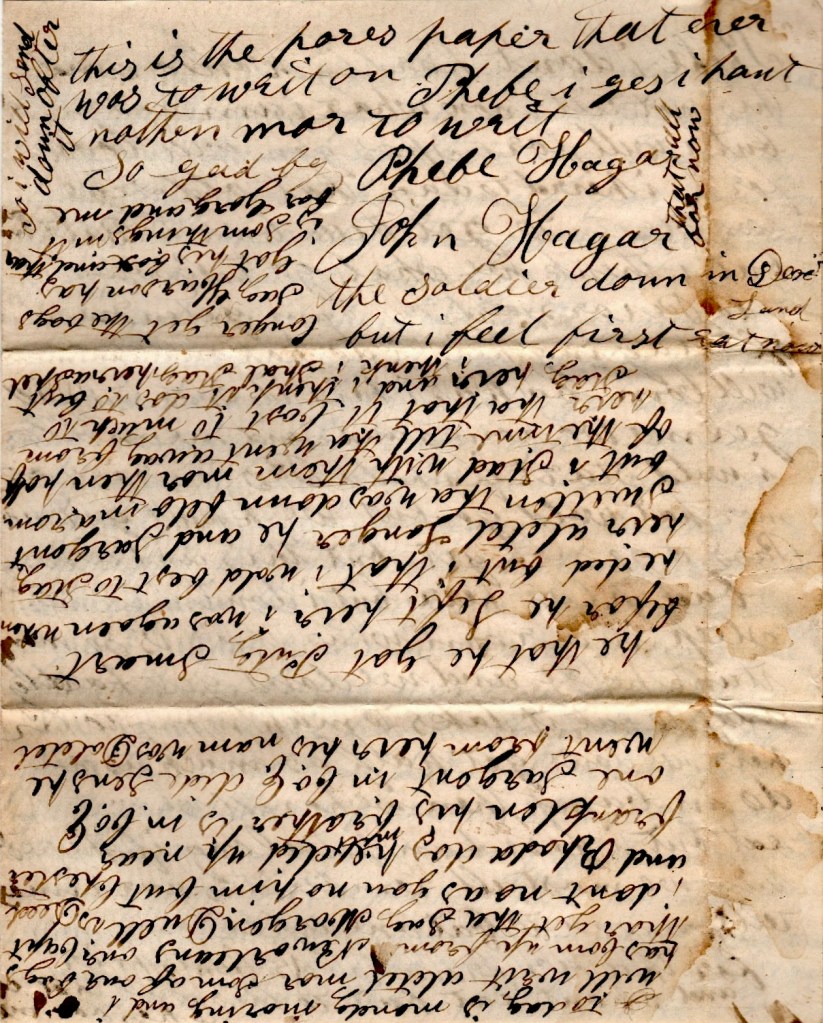
Letter 111

Baton Rouge
November 11th, 1863
Now I am all ready to start for New Orleans. I am a waitin’ for the boat to come down the river. Our Captain and Lieutenant is down there. I think we will go to the regiment soon after we get down there.
I got 2 letters from you today. I am sorry you are come sick and got the chiggers or the itch or something else but my dear, it is war times, and I hope you will get well. I am pretty smart now myself and I feel first rate because I am a goin’ to my regiment once more. But my old woman, I have been pretty darned hard up here. I got down so poor. But I have had a pretty good appetite a’most all of the time, and I had money, so l bought a good deal of my living and it has cost me about 46 dollars and I have eat it all up. But it has done me a good deal of good and I am alive and well yet.
Tonight, I take a boat for New Orleans. I have got my old gun. I shall take that. William Hoose 1 is a going with me. Rant and Jason [Wright]—they are a going to stay here a spell longer. But I have stayed here long enough. Jason says his folks say potatoes is 75 now. They are pretty well up for in the fall. You say wood is worth 100 dollars. Phebe, when I get my pay, I shall send you about 40 dollars and maybe more. I shan’t get no pay now—not till the first of January.
Now if I had of stayed here I would of got my pay this month but there is about 50 of us a goin’ down. I hain’t got much money but you sent me 6 stamps so I can keep writing. I hope I can get enough to eat down there. Here we don’t have not half enough and what we do have ain’t fit for no decent man to eat. I will write short a letter this time.
Phebe, can’t you get someone to get you 10 or 12 cords of wood and I will send you the money in January. I don’t think I shall have any till then. I don’t know hardly how you will get along but do the best you know, and it will be all right with me. This war won’t last always, I hope. You say Charles Douglass don’t use but 3 dollars a month. He ain’t down here. If I could of stayed inside of Port Hudson, I wouldn’t used more than 2 dollars a month—not if I was well. I don’t know as when I was at Baltimore [that I used] 2 dollars in 2 months. But it is different here.
George was over here today. He is a gettin’ some better. He says he has a good appetite to eat and so have I. I can eat all they give two men and then I won’t have half enough. But I don’t eat no beef—not if I can get anything else to eat. It is salt beef. I hain’t hardly got over the shits yet and that beef soup don’t go first rate you know. But I can eat anything. I don’t care what it is.
Well, old woman, when I get to someplace, I will write. Keep a writin’ for it does a soldier lots of good to get a letter from home. I know it does me good to hear from you. So keep writing. May God bless you all. So goodbye, my dear. This from John Hager, the soldier in Louisiana.
1 William Hoose—Age, 19 years. Enlisted, August 8, 1862, at Williamstown, to serve three years; mustered in as private, Oo. B, August 13, 1862; discharged, to date August 25, 1865.
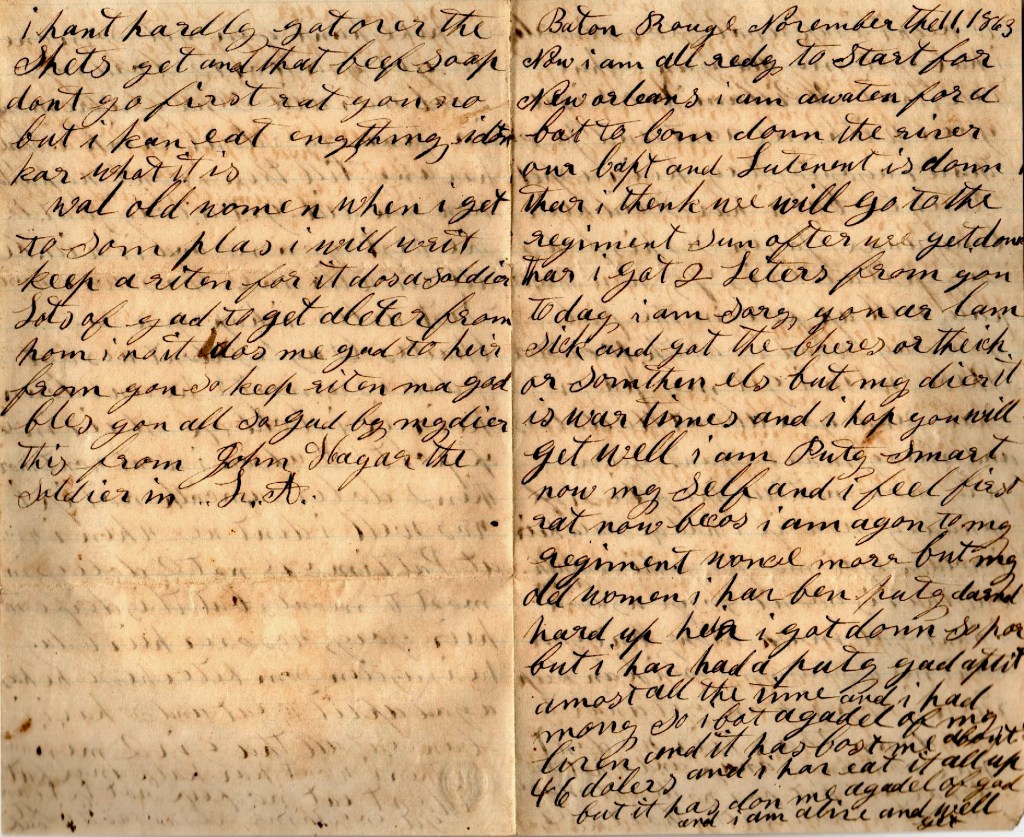
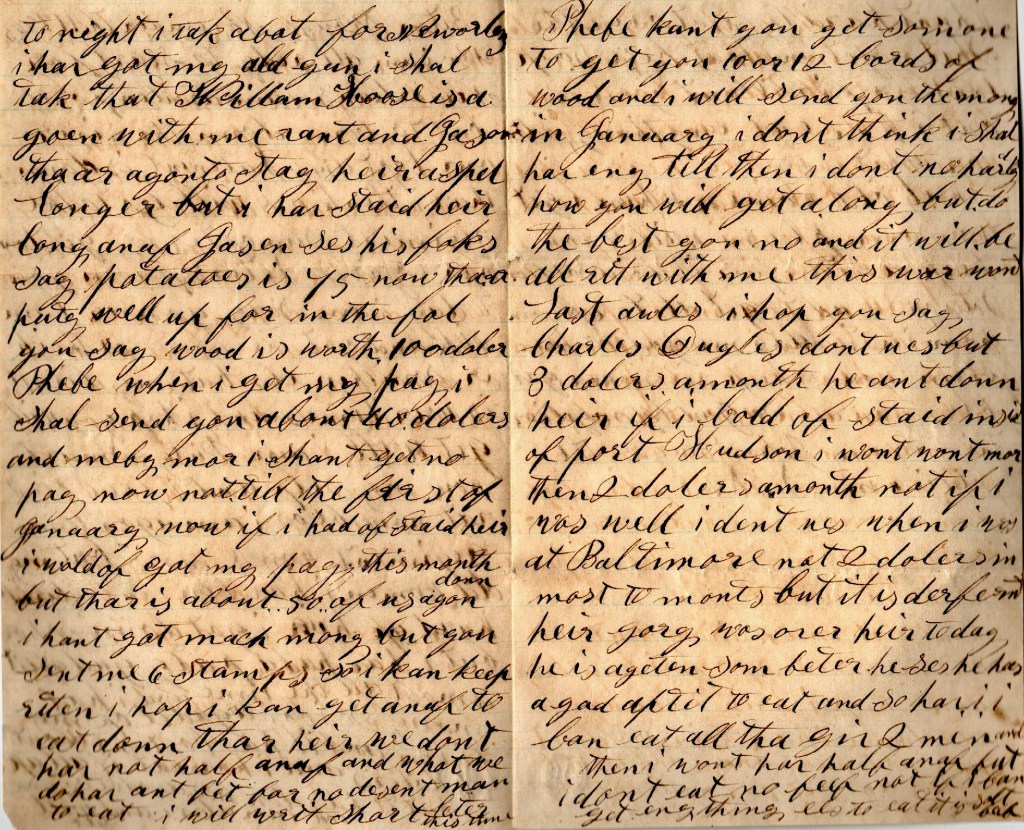
Letter 112
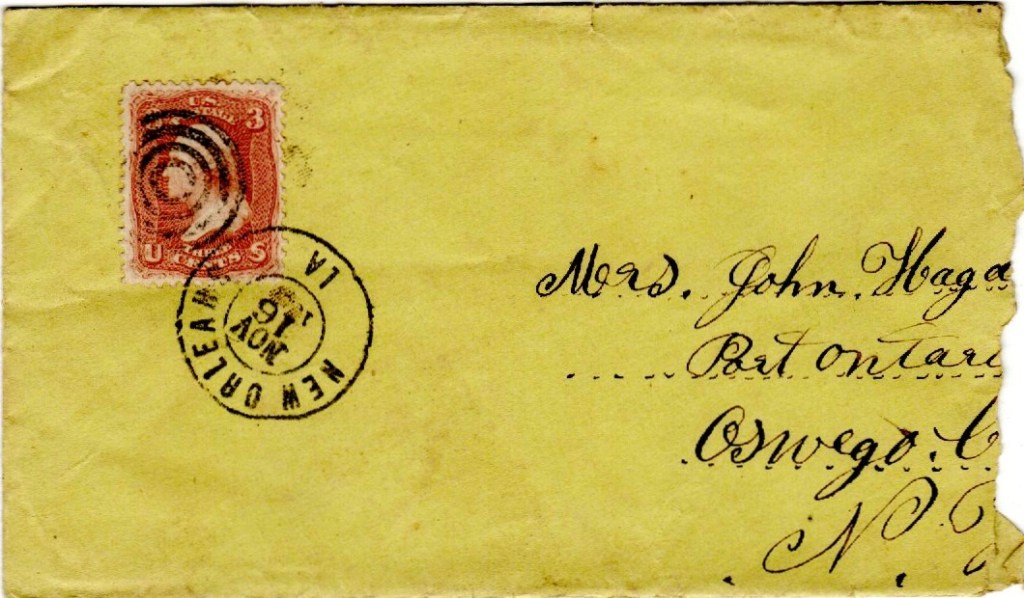
New Orleans Louisiana
November 14, 1863
Mrs. John Hager,
I am down here now. Part of our boys has gone to the regiment for they have started today and they left us here to do guard duty here in the City of New Orleans. I am now at the United States Barracks now. We have plenty to eat here. I see [ ] Dawley 1 today. He is in the [ ] right in sight of our quarters. He is well and tough now. I han’t seen him since last spring till today. He has a letter from home today.
Well, old woman, I must tell you when we started and what we done before we started. We went out on a little scout in the rear of Port Hudson and we took a lot of prisoners and we brought them down here. Some of them had broken legs and some a broken arm and some we [ ]. I believe we didn’t have none [ ] but some slightly wounded. I feel first rate now. I never felt better than now.
All them things that you sent to me in Harrison’s box was all gone. He says the corner come off and spilt the butter all out. He had sold the pail. He had drinked up all the medicine—or all but about half a teacup full and there was only tea left. I am very sorry that you sent with Marsden after working so hard to get the things ready to send but they are gone. So don’t never send nothin’ again with anybody. George’s things was all gone but a little tea, and that I have got. If I have a chance, I shall send it to him. I don’t know hardly what to write for I don’t know when I can send this and I don’t know when I will get an answer from it but you may send one here and direct it as Lon Dawley has his sent his. I believe he said he didn’t have one lost.
I will send again when I know how long I shall stay here but I think we will stay here till spring. It will be long enough for I don’t like this Provost Guard duty because it ain’t putting down the rebellion much. I don’t know as you know much about Provost Guard duty is. I will tell you. It is to travel all over the city and see if there is any soldiers without a pass or see if there is any of them drunk or anybody else. If we do find any such, we take them to the guard house. It ain’t very hard work. But I don’t like staying in the city. It ain’t as healthy as it is out. The streets ain’t but 30 feet wide in this city and it is a pretty large place. It is all whores [?] here.
So, I can’t think of nothing to write today so I will stop. In 3 or 4 days I will write again. I can buy things here for less than one half that I could at Baton Rouge but I don’t need to buy much here. I staid there till I spent all of my money but 1 dollar. That 5 dollar bill you sent me done more than 10 would if I was to Baton Rouge.
I don’t think now that I shall get any pay now not till January. I s’posed I was a goin’ to get my pay here but they paid two days before we got here. So now I can’t get any—not till next payday comes. I was in hopes I should get it so I could send home some. Phebe, I know I have spent a good deal of money but I ain’t sorry. If I had the same life to live over, I would spend the same money again if I had it. You don’t know what a little money will do. I have spent a pile. It makes me feel pretty poor but it can’t be helped now nor I don’t want to help it.
This from John Hager, your soldier.
1 Alonzo Dawley (“Lon Dawley”) –Age 27 years. Enlisted August 16, 1862, at Mexico, to serve three years; mustered in as private, Co. E, August 11, 1862; mustered out with company, August 28, 1865, at Albany, N.Y.


Letter 113

New Orleans, [Louisiana]
November 20, 1863
Tonight I am all alone so I write. The boys has all gone to guard Rebel prisoners. They are going to be exchanged when they get to Barre’s Landing? or near there. There is where the 110th [New York] is now. I would have liked to have gone up there but I was detailed to go to the court so I have to go there everyday. This makes 5 weeks [days?] now that I have been to court. This is the best court I have ever had since I have been a soldiering.
I don’t have nothin’ to do nights. It is pretty cold here and has been the last 10 days and nights. It is a’most too cold to write. I thought when I first began this letter that I would be the longest one you ever see but it is most too cold to write. I will say that I am well and tough now and hope this will find you and the children all well. I don’t care as much about the rest of the folks.
Phebe, I don’t want you to work out so. It seems to me you can get along without working out. I know I hain’t sent you much money but I am in hopes that I can send home more in the next year. If you go to Michigan, I shall send all the money that I have to spare.
Well it is morning again. I slept pretty well alone but I do think I should of slept a little warmer if I had of had you in here with me. You know we could of took turns. Then the cords wont of laid so hard all the time. Well, that is enough of this. I don’t know yet for certain as I shall get any pay now the first of January. If my Capt. sends mm my Descriptive List before the last day of this month for we are mustered the last day for pay. I sent for it a month ago and Capt. Phillips has sent for them—all that belong to the 110th so we can get our pay. I am in hopes that I can get it for I want to send you a little money. It has been a good while since I have sent any.
Well, old woman, I must stop writing to get ready to go down to court. It is pretty darn cold in my house this morning but I thought I would scratch a few line to the one I love so well. Now my dear, when you get this I want you to write what you are going to do with the things, if you go to Michigan. I hope you have gone there for I think you will be more content there with Jane than anywhere else. Nothing else this morning. I won’t write nothing bad in this for I don’t know where you are. But write an answer to it.
Direct to New Orleans, in care of Capt. Phillips, 110th Regiment, Box 323


Letter 114
New Orleans, [Louisiana]
November 29, 1863
My dear,
I take my pen in hand to let you know that I am a gettin’ along in these war times. I took an awful cold that night that I wrote my last letter [when] we slept on the ground. I am a gettin’ over it now. I have been on duty every day since I have been here. I have been to Provost Court. It takes four men and a corporal so we don’t have no duty in the night. Our duty hain’t hard here but it keeps us busy all the time.
I hain’t had no time to write to you but I guess you get more letters than I do. I hain’t had any since I left Baton Rouge. I shall look for one this week. It is pretty darned cold here today.

When you direct, you may send one to New Orleans. Don’t say nothin’ about the regiment. Maybe we shan’t stay here two weeks and maybe we shall stay here till next summer. Capt. [Charles] Phillips 1 got sent on to the regiment. He got drunk. There hain’t much danger of my getting tight for I hain’t got the money.
This from John Hager
Phebe Hagar
1 Charles Augustus Phillips.—Age, 22 years, Enrolled, August 19, 1862, at Oswego, to serve three years; mustered in as First Lieutenant, Co.H, August 25,1862; as captain, December 30, 1862; mustered out with company, August 28, 1865, at Albany, N. Y.; prior service, in Co. E , 24 New York Infantry. Commissioned first lieutenant, September 10, 1862, with rank from August 19, 1862, original; captain, December 8, 1862, with rank from November 14, 1862, vice John Steven- son, resigned.
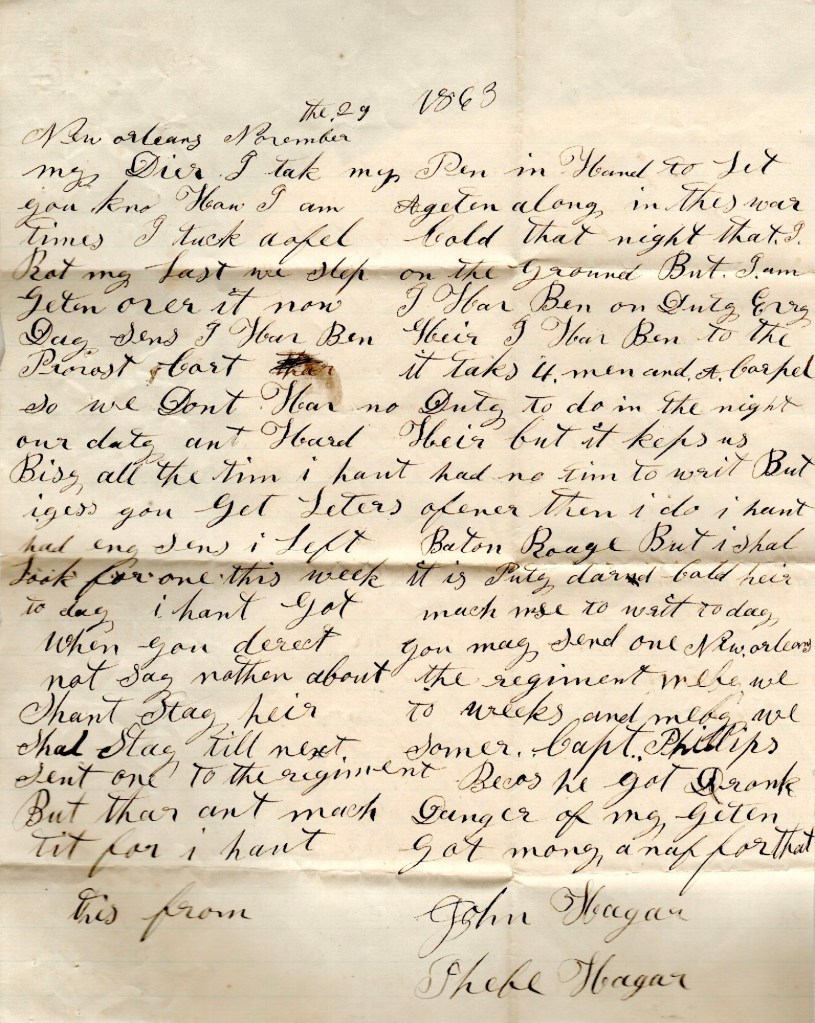
Letter 115

New Orleans [Louisiana]
December 25, 1863
Today is Christmas and I hain’t no woman so go to the dance so I have to stay at home. The boys have got back last night. Today makes me think of the 4th of July there to see the little boys in the streets with their fire crackers. It makes me think of my boy at home… But you promised me you would keep our little family all together as long as you could. And I hope you are all together today, let you be where you will. But I hope you are a going to [ ] for I think you will be more [ ] there.
Today is Sunday and it rains like the old Harry [Devil]. I never see half as much water fall in 3 days as has fell today and it rains yet. It looks rather strange to me why I don’t get letters that is wrote in December. November the 16 is the last letter and now it is December 27th. I have been here 5 weeks now and hain’t got any. Some has got the letters from home in 9 days. If you are all well, I don’t care, and if you are as sick, I don’t s’pose I could help you much.
Phebe, I want [to] buy me a watch when I get my pay but I don’t know as I shall. But I would like one, but I don’t know but you will need all the money that I will have to spare. Please tell me how you get along for money. I shall look for answer for this about 24 days. The first of January, I think I shall get some pay but they settle up for our clothes then and I have had more than belongs to me for one year. I don’t know whether they will take out [money for] these lost clothes or not. If they don’t, I shall have some a comin’ to me but shall send you a little money anyway. I have worn them shoes all the time since I got them and they are good yet. I can’t get as good a pair here for less than $4.50 now.
Things are pretty high and down to Brownsville in Texas, flour is 100 dollars, pork 8 dollars a pound and other things in proportion. Gen. Bank’s wife and 3 or 4 children come here and the old general only stayed one hour with them. He was all ready to start for Texas but he has got back again. He and his son rode by yesterday, so he didn’t stay to Texas long. But he is fitting out a lot of troops to go. But I don’t think I shall go, but that I don’t know. Col. Sage has resigned and is a goin’ on to a government plantation to stay. I s’pose he thinks he can make more money there. This is the way with all of the officers. Damn half of them. They doesn’t fight. That is what is the matter. Well, I will close by saying do the best you can. — John Hager
Direct to New Orleans in care of Capt. Phillips. To Phebe Hager, my dear.
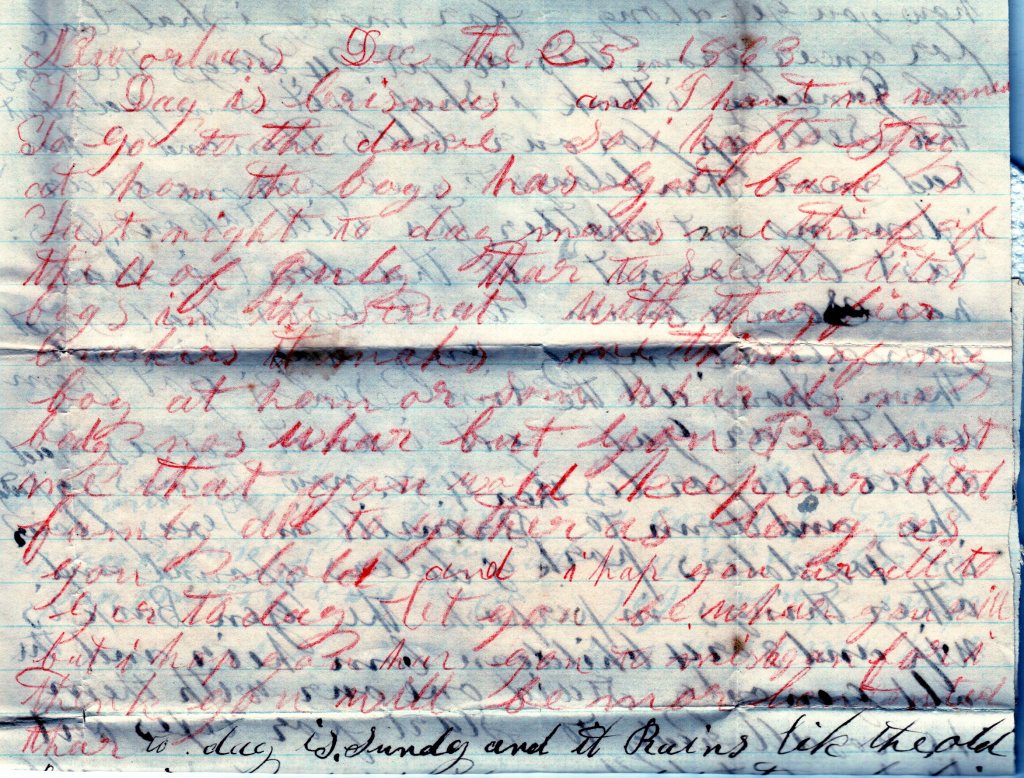


 Spared & Shared 23