
Return to “We Saved the Day”—the WWI Letters of William B. Moore, 6th Marine Regiment, 2nd Division, American Expeditionary Forces.
Letter 40
October 10th, 1918
Dearest Mama
Almost two weeks has elapsed since my last letter to you but during that time I was unable to write because we were mixed up in an attack and only last night were relieved and taken out. Heretofore I have usually found time during a drive to write when we were in over a week but this last time it was different. In a good many respects it was the worst fight we have been in yet—one of which was the fact that the country we were fighting over was practically desolate and for ten days I lived and slept in old trenches, shell holes, and a dugout occasionally. But dugouts were so popular that whenever one was available, it became crowded to the doors and it was usually more desirable to remain outside. Under those conditions, writing was not possible and as relief was imminent each day, I made no tremendous efforts to surmount those difficulties, expecting each day that the next would find us back of the lines in rest billets, temporary at least.
As I said, the past few days were fraught with much discomfort on account of the nature of the country, the severity of the fighting, and the cold nights. Just before we went in, I wrote you a letter from back near Châlons where we were held in reserve. There followed an all night camion ride, a day in the woods, and then we went into relieve a French Division. Our Division had been chosen by Foch as his own reserve to be used in the attack between Reims and Verdun where some good work was needed to insure the success of the operations. It was a great hour for the Division and when the French, after three days of the fiercest fighting, were bolted in the vicinity of Somme (Champagne), we were called in by an order issued to the division. General Legune told us that whether or not the attack succeeded depended upon what we did, for in front of us was the most difficult point in the whole line.
We went over the top at 6 o’clock one the morning of the 3rd and at 8:45 we had gained our objective—a high ridge—four kilometers from our starting point. The next day, due to our successful operation, the French on our left were able to advance and so Reims was delivered as the Boche had to pull back there on account of the advances of the allied forces on his flank. The general commanding the Fourth Army (French) has paid our division the greatest compliments and you can see that it was a tremendous honor in the first place to be taken out of our American Forces and used as the reserve of armies. The country over which we advanced was the scene of the famous Champaign battles of 1915 and 1916. In places the land is nothing but a rolling ocean of shell holes, which is given a terribly grotesque appearance by the chalky nature of the earth. During the whole time, I got very little sleep and became absolutely filthy. Needless to say, and I hasten to say it, the first thing I did today upon getting back was to bathe and put on clean clothes. The past ten days were hard ones and I’m heartily glad that we’re back for a rest no matter how short or whether we go back in or not.
To cap the climax, about five o’clock yesterday afternoon, I got word that one of my very best friends—and officer in the Sixth had been killed. He was wounded near Soisson in July and returned to duty only three days ago. I spent a day with him in his hospital when I was on leave chasing my trunk. I tried to fix it so that he could stay at regimental headquarters until we were relieved but he was sent out to one of the battalions in the line and in less than twelve hours he was dead. With three of my men, I went out and got what was left of his body and with the assistance of our chaplain, buried him along the road side. It was about an hour after dark and the guns on both sides which had boomed constantly all day, were, singularly enough, then silent.
The group of five, the three men, the chaplain, and myself, bowed our heads while the chaplain prayed. They left but I stayed and in the darkness said my own prayer over grave of one of my closest friends—the greatest loss I have yet felt in the war. I can’t tell you how that incident affected me. it is only one of many like it but it was so close to me that I tell you about it. Perhaps I had better left the details unsaid, but it has been on my mind all day—the last incident of ten days of war.
Still, I can’t see the dark side of it. Only the noble sacrifice of a young American. Why we are winning this war, that it’s not when we die but how; that a man’s life is not his own when God and country call. I hope his family will see it that way. His name was [William Noble] Wallace. 1
While we were at the front, some mail was brought up to us and I received several letters from you… I am worried because there are such long intervals between the receipt of my letters… You speak of others getting their mail regularly—well the senders are not in the Second Division. The amount of moving and fighting we do makes regularity in mail service both coming and going impossible. It’s a wonder a lot of mail isn’t lost in following us around…
My candle is just about burned down so I’ll have to stop. I think we will move back a little farther tomorrow and I will write again upon arrival at the new place. Please let experience be your teacher and don’t worry if my letters don’t arrive regularly. Love to all the family and bushels for yourself. Your devoted son, — Billy
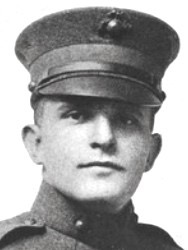
1 1st Lieutenant William Noble Wallace was awarded the Distinguished Service Cross while serving with the Sixth Regiment (Marines), 2d Division, A.E.F., in action near St. Etienne, France, 8 October 1918. First Lieutenant Wallace, with one comrade, while exposed frequently to direct hostile observation and heavy fire, accomplished an exceedingly hazardous reconnaissance of the front lines of his regiment. After having made his reconnaissance, locating the enemy strong points, and obtaining vitally important information, First Lieutenant Wallace was killed by hostile fire, but by the delivery of his careful notes and sketches to his commander, his mission was fulfilled. Wallace was from Indianapolis, Indiana.
Letter 41
October 19th 1918
Dearest Mama,
Well here I am in Belgium where we are stopping for two days rest. We are in a medium-sized town called Bellefontaine which is located in the part of Belgium lying between France and Luxembourg. We started out on our journey two days ago making about 15 kilometers the first day and spending the night in a town called La Terte in France near the Belgium border. The people there welcomed is most enthusiastically while the inhabitants of neighboring towns where none of our troops were billeted were greatly disappointed that they did not also have the opportunity of welcoming the Americans.
Yesterday dawned bright and clear and the regiment set out on its twenty-five kilometer march which brought it to Bellefontaine. I was sent out ahead in charge of the regiment billeting party. After going about ten kilometers we crossed the border into Belgium. Here was a little town and its inhabitants with those of its neighboring towns not on the route of march congregated at the main cross roads to pay tribute to the Americans. My small party was about the first to reach there and we were proclaimed heroes. The houses were decked with Belgium and American flags. A civilian band played and one old lady offered us coffee. I accepted some and if it had not been for the occasion and my natural constitution, it would have made me sick. She said it was “war coffee” and I didn’t dispute the statement.
We halted at this place for a while and the Belgians crowded around us to shake us by the hand and incidentally, I don’t doubt, to satisfy their curiosity as to what the Americans look like.

We moved on and reached here about 2:30 in the afternoon. Here our reception was no less enthusiastic. The roads entering the town were arched with colored streamers and branches of pine while banners bearing “Honneur aux Allies” occupied prominent positions. However it was not until a couple of hours later when the regiment reached the town that the enthusiasm reached its pitch. The band struck up a lively march which was the key for the church bells to start ringing and for the shouting to begin. “Vive l’ Amerique” was heard on all sides and there was great rejoicing.
The Germans left here only 24 hours before we arrived. Here, as in the last place we stopped. The people are full of tales of the misery they endured during the German occupation. With great indignation they tell of the various methods of oppression and extortion employed by the Huns. We have passed through several towns which were burned by the Germans in 1914 and have seen other signs of their wanton destruction. The main road leading into this town for a couple of miles is lined by [ ] stump of trees which were cut down by the Germans because the commune did not pay a certain impossible tax in the stipulated time.
We have one more day here and then we resume our march. Our next leap takes us into Luxembourg… Now that the fighting has ceased, my duties as liaison officer are no longer extant. I have been made the regimental billeting officer for this trip and my job is to precede the regiment and ascertain the billeting strength of [ ], then assign the battalions and other units of the regiment accordingly. It’s not the easiest of jobs by any means but it’s quite important as you perhaps can see. A talking knowledge of the local language is very necessary and when I have no interpreter with me, it’s all the more difficult. When we get into Germany, I think I’ll ask for an armed guard. From reliable information, it seems that if the present government in Germany is capable and trustworthy and fully qualified to enter into peace negotiations with the Allied powers, and at the same time if there is no considerable internal trouble in Germany, our stay here will be finished and we’ll start home. It’s hard now to prophesy or even hazard a guess, but I should set March 1st as the very latest date that will find the 2nd Division in Europe. There is so much that’s interesting to be seen and done that my impatience to get home is somewhat curbed but it can’t be too soon..
Must close now as it is time for dinner… Love to all the family & bushels for yourself. Your devoted son, — Billy

Letter 42
October 24th 1918
Dearest Mama,
Ten days has elapsed since my last letter but as has been the case before, we have been in a position from whence it has been impossible to get mail out… From our last place we moved about 40 kilometers up to the front. For some mysterious reason, only the Marines went. The Army regiments of the division being left behind. It seems that this was somewhat of an irregular proceeding so after two days of hard hiking and one day of rest behind the line waiting to go in, we were recalled and came all the way back without having accomplished a thing. And now another move to where? I don’t know. It is rumored that we are going back to the Americans First Army and leave the French for a while.
In moving up this tie, we passed through the country over which we had fought only a short time before during our last scrap which I wrote you about. The present line is some thirty kilometers beyond that now and it was extremely interesting to traverse the same ground again. There is always a certain fascination about returning to a battlefield when the fighting has passed on beyond and someday I hope and intend to return to Belleau Woods and Bouresches where we had our first real taste of war.
I learned a few days ago that I am to receive a Croix de Guerre for something I did in this last fight. It was a complete surprise to me as I had not the slightest idea that anything was coming to me and I can’t imagine what my citation will read like. Our French General, being greatly pleased with our work and its far-reaching effects, authorized the awarding of a certain rather large number of crosses and my colonel evidently at a loss as to how to dispose of them cited me for one. Although I did nothing particularly conspicuous, evidently he considered that I had done my liaison work well and that performance of my plain ordinary duty wit a few narrow escapes which are all part of the game combined to make the sum and substance of my activities. I did spend one whole afternoon during some heavy shelling looking for one of my men who had gone out the night before and hadn’t returned, but I don’t think the colonel knew anything about that. I thought perhaps the poor chap had been wounded and hadn’t ben found but I could find no trace of him and he has never been heard of since.
The philosophy, if there is any connected with these awards, I don’t quite understand. Why a man should receive any special recognition for doing his job well, or the way it ought to be done, I don’t know. Nevertheless, I shall cherish the Croix de Guerre as a souvenir of one of our most notable successes. I can hardly regard it as personal. And that cross was not the only thing I got. I came back with that famous brand of comrade known as “cootie” I tried to convince myself for some time that I was devoid of any such playmates but I couldn’t deceive myself by an ostrich policy, so finally my pride tumbled and I went after the cooties with a [ ], and I am quite sure by now that they have all either been captured or killed.
The last two days have been glorious. Along abut this time of the year the weather is usually so rotten in France that we appreciate so much a clear day when it comes around and two days in a row is almost too much. I just happened to think that one year ago today we left Quantico. It was raining and muddy and dreary and as the long train pulled out, the band played the “Star Spangled Banner” while the troops lined up along the tracks, presented arms. How well do I remember but what different circumstances today!
A band has just started up outside and knocked everything out of my head except music. I’m sure there’s something else I wanted to say but if there’s any chance at all, I’ll write at our next stop… Love to all. Your devoted son, — Billy
Letter 43
October 29th, 1918
Dearest Mama,
We aer now just behind the front lines and as usual it is difficult to get mail out… We are now living in an old shot-to-pieces barn, dirty within and muddy without. It’s the only shelter available and it is not much better than none at all. All the officers but the colonel are sleeping on the floor. Fortunately I have my mattress and plenty of blankets… The weather for the past few days has been fine for which we all thank our lucky stars for there are holes-a-plenty in the roof of our house and the men are sleeping out in the open. This is probably one of the worst places we have struck and in addition, as I mentioned in my last letter, I am afflicted with the cooties so I hope we move soon to some place where I can clean up and fight those animals with an even chance of winning…
Since we have been here, the Boche has been dropping propaganda on us from his aeroplanes. Two days ago, leaflets came floating down upon us urging the American soldiers to come over and fraternize with their comrades in gray and a lot of stuff to that effect. Yesterday some more was handed to us headed, “The German People Crave Peace” with many arguments to show their sincerity and the earnest desire on the part of the “new German democratic government” to conclude an covert and just peace…
Just before we moved up into Champagne I decided that inasmuch as we were moving about so much and doing such a lot of fighting, that I would find a home for my dog as I couldn’t care for him properly under ordinary conditions. So I left him in a town near Toul where we were billeted for a while, in the care of a kindly old French lady who seemed to take a fancy to him. If by any chance we are going to settle in any one place for the winter, I’ll go get him but I’m reasonably certain that he is well taken care of where he is and I’m going to leave him there until I can take care of him just as well.
The rumor is today that Austria has capitulated. That would be a sad blow for Germany. In fact, all the recent events seem to indicate a speedy end of hostilities. Germany is in a bad condition, both politically and on the field and I think that before very long more reliable people will get control of affairs and something more concrete will develop in the line of peace. My Croix de Guerre has not come through yet but I’ll probably get it in the next time we go back for a rest…
It’s nearly time for the motorcycle to be going so I’ll close. Love to all the family and a heartful for yourself. Your devoted son, — Billy
Letter 44
November 5th 1918
Dearest Mama,
I have been trying for several days to write this letter but one thing and another has turned up to prevent it.
We attacked on the morning of the 1st between the Argonne and the Meuse and the operation was so successful that the Boche is on the run and we hot after him. Consequently we have been moving forward all the time, spending no more that one night in any one place. So you see it’s pretty hard to find a chance to write.
We reached this little town yesterday afternoon and I thought we would move on this morning but we didn’t so I am availing myself of this little respite to write. We have gone so far that we are out of touch with the rear and as has been the case before, I’ll have to give this to somebody going back to mail. We had reached the Meuse last night and that accounts for our little halt, but our observation post has just reported that a town in front of us on the other side of the river is flying seven white flags so it now seems probable that a crossing can be affected without difficulty, so I imagine we will move on this afternoon.
Our front lines are now only about twenty kilometers from the Belgian border. I have seen no newspapers for four days and nobody knows what is going on in the outside world, but we have received the news of the abdication of the Kaiser, Austria’s plight, and Turkey’s capitulation, all of which are most encouraging signs. It doesn’t seem as if Germany, now isolated, can hold out much longer. The prisoners we have taken cheerfully admit that they are hopelessly beaten.
As usual the Second Division distinguished itself in this operation. this time we broke clean through the German line and to the present have advanced 22 kilometers with comparatively few casualties. We had our share of rain which has made it rather uncomfortable for the men who have had to advance though mud and sleep in the open. The roads are in such bad condition that it has been difficult to get supplies up to the troops, but we have had to push on regardless, once we got the Boche on the run. We have virtually cut off his main railroad line and pierced the center of his entire line. It seems that the only way to bring about a cessation of hostilities is by a decisive blow—an unquestionable military victory. Everybody from the General down realizes that and there has not been a murmur of discontent from the men who have had to live in mud, rain and cold throughout it all. As never before, the spirit has been magnificent and the precision and cohesion with which our American divisions have worked has been remarkable. It makes me feel proud and should this really be the end of the war, I think we could all claim that America has played it’s part…
There has been many wild rumors flying around today that I’m inclined to really believe—that it’s all over but the shouting. The prospects of peace and returning home make everybody willing to endure any hardships and I think that there will be an armistice before Christmas. When we first went into the trenches last March, I wrote to tell you to save a place for me at the family table for this Christmas, but I’m afraid I was a little previous. It won’t be long though. When we get back to the rear, I’m going to send some money home with which I want you to buy some Christmas presents for the children…
A heart full of love from your devoted son, — Billy
Letter 45
Youcy, France
November 11th 1918
Dearest Mama,
You probably couldn’t find Youcy on the map so I’ll tell you that it’s a small town just west of the Meuse river near Mouzon. I am able to tell you where we are now for as you know, the armistice has been signed and hostilities have ceased. This is probably one of the greatest days in the World’s history, yet we couldn’t be in a more unromantic place. I always felt that I should like to be in the front line when hostilities ceased, yet there’s not the excitement or wild celebration here that there probably is in Paris and New York. We had been waiting expectantly for the news and everybody was making all sorts of bets on the outcome of the negotiations. This time last night, most everybody except the extreme optimists felt that Germany would reject the Allies’ terms and that the war would drag on a few more months.
We received orders yesterday afternoon to effect a crossing of the Meuse beginning at 8:30 p.m. It was to be a very delicate and dangerous operation and the undertaking of something like that made me, for one, feel that our Corps headquarters had received the latest word that the war was to continue and that we were to steal a march on the Boche during the night. However, this morning at 9 o’clock our brigade commander called Colonel Lee on the phone and told him that the armistice had been signed to take effect at 11 o’clock. When the hour came we all let out a yell and then carried on with what we were doing. There was no demonstration in the lines, orders having been issued to the troops to remain in place and hold no intercourse with the enemy. Everything was very matter of fact, but the quietness is very unusual. There is no shelling of course, no firing of any kind, and everybody moves around with more sense of security, but with no extraordinary signs of emotion. It seems almost paradoxical that the celebrating is being done no doubt by those behind the lines. It seems queer and as I said paradoxical that the men who have beeb=n doing the fighting should feel the least like celebrating. Perhaps it’s the same old environment and the inability to fully realize and appreciate the situation, but i’m sure the realization will come in time.
I haven’t the slightest idea what the future holds in store for us. There are so many possibilities. My immediate concern is to get where I can bathe and clean up. Since the 26th of October we have been moving forward attacking and driving ahead, never halting, and consequently everybody from the colonel down has cooties and I haven’t changed clothes for well nigh a month. In that respect, this last drive has been the worst of the war. This division ought to be given a rest and some tangible manifestation of the appreciation for the work it has done now that peace has come.
The crossing of the river last night was made all right and according to a telephonic communication which has just been received, the fighting continued right up until eleven o’clock. The same communication stated that the Germans reported to the French officially that the 2nd Division refused to quit fighting. That may be only a rumor though.
I have received no mail now for three weeks because we have completely lost touch with the rear, but now that we have stopped, it ought to catch up to us for I know I have some waiting for me. I shall be able to write you oftener from now on and I’m sure I shall be able to give you some sort of an idea of what we are to do in a few days. I know you are happy now, like all civilized people, perhaps a little more so, and if I had the means I would cable you of my safe condition to remove all doubt from your mind as to my return home. Love to all the family and a heartful for yourself. Your devoted son, — Billy
 Spared & Shared 23