
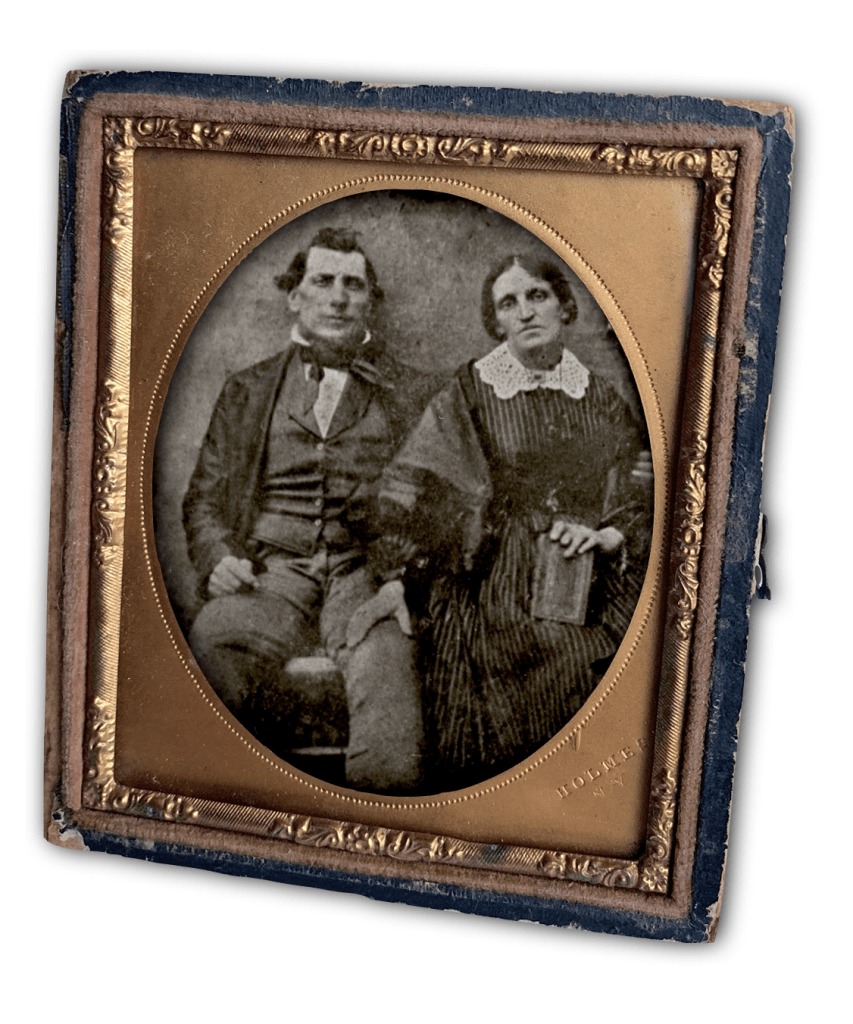
This letter was written by Jane (“Ginnie”) M. Ayre (1844-1885), the 17 year-old daughter of English emigrant William Mason Ayre (1818-1899) and his Virginia native wife, Martha Ann Reid (1817-1889), of Centreville, Fairfax county, Virginia. Ginnie and her older sister, Mary Catherine (“Kate”) Ayre (1843-1926) were the oldest of nine children born to the couple. The William Ayre farm was located on present-day Stringfellow Road (Section 45-3) near Chantilly, six miles west of Fairfax. It was known as the Buena Vista Farm in later years.
She wrote the six-page letter to a dear friend named “Minnie” who probably resided in Maryland, beyond enemy lines, with whom she mostly likely had a previous acquaintance while attending the Fair Hill Boarding School for Girls. Ginnie married Leander Makely in 1878 but died seven years later. The mail had to be smuggled across enemy lines by those who were able to obtain passes—more easily done at this stage of the war than later.
In her January 1862 letter Jennie speaks of the family’s displacement from Fairfax to Farquier county, Virginia, due to the war and also of the depredations by Union troops in their former home near Centreville.
[Note: This letter is from the private collection of Richard Weiner and is published on Spared & Shared by express consent.]
Letter 1
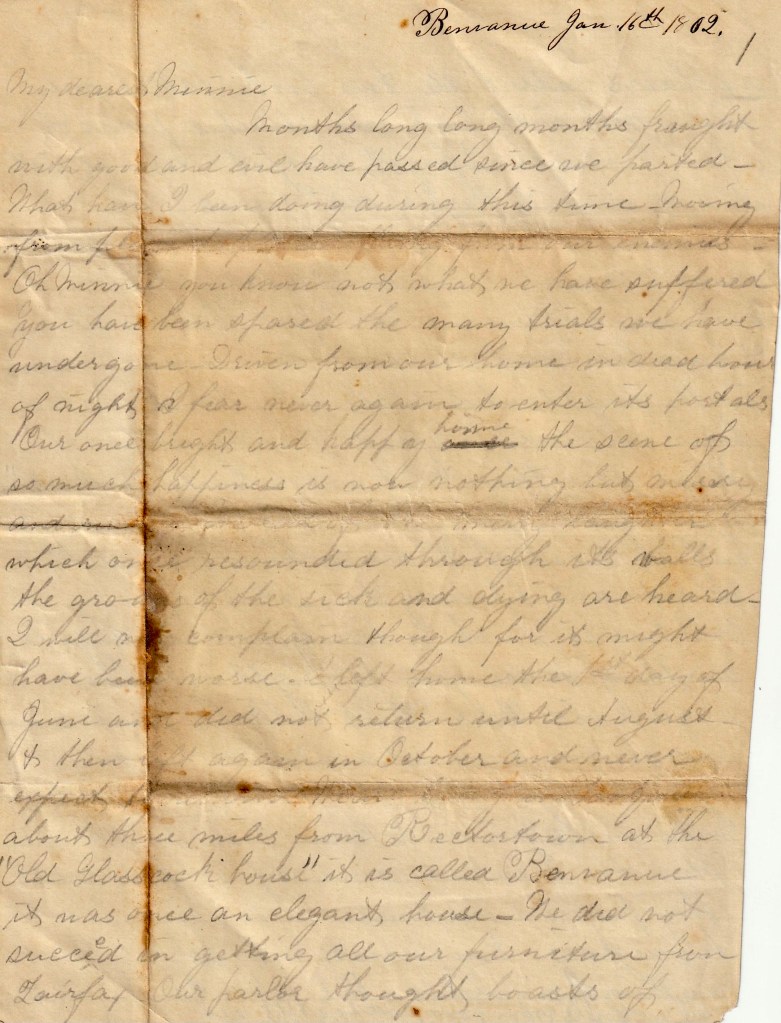
Benvanue 1
January 16th 1862
My dearest Minnie,
Months, long long months fraught with good and evil have passed. What have I been doing during this time? Moving from place to place, fleeing from our enemies. Oh, Minnie, you know not what we have suffered. You have been spared the many trials we have undergone—driven from our home in dead hour of night. I fear never again to enter its portals. Our once bright and happy home—the scene of so much happiness—is now nothing but misery and ruin. Where once the merry laughter which once resounded through its halls, the groans of the sick and dying are heard. I will not complain though for it might have been worse. I left home the 1st day of June and did not return until August & then left again in October and never expect to return.
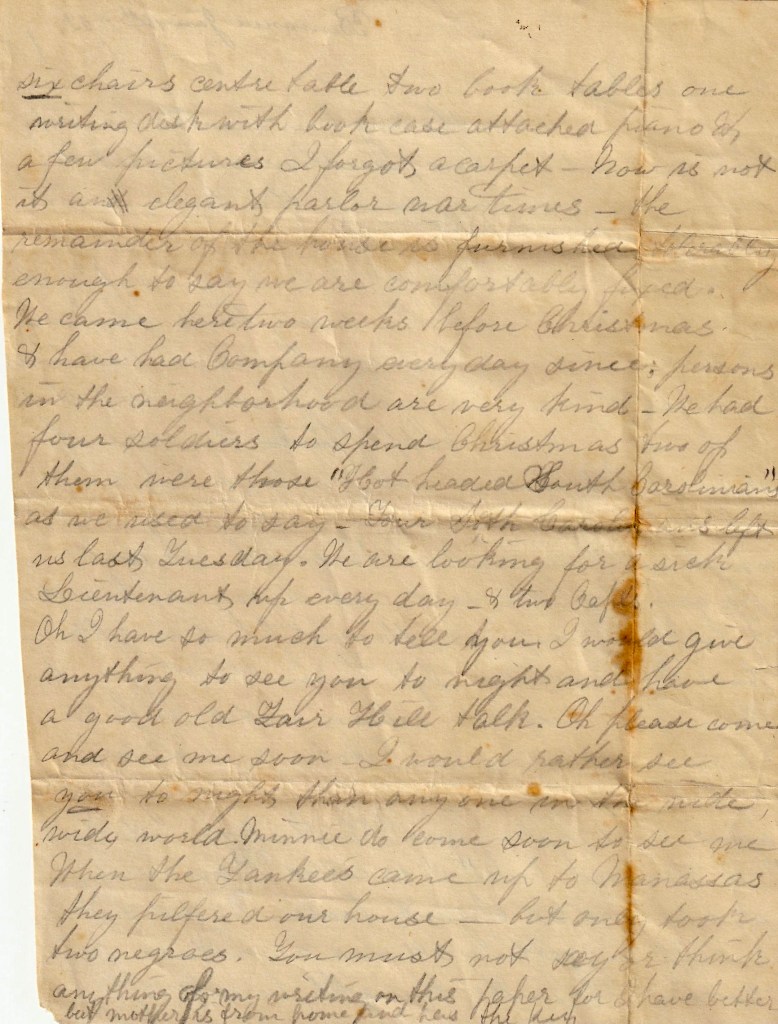
We are [now living] about three miles from Rectortown at the “Old Glasscock House.” It is called Benvanue. It was once an elegant house. We did not succeed in getting our furniture from Fairfax. Our parlor though boasts of six chairs, centre table, two book tables, one writing desk with book case attached, piano, & a few pictures. I forgot a carpet. Now, is not it an elegant parlor [these] war times? The remainder of the house is furnished tolerably enough to say we are comfortably fixed. We came here two weeks before Christmas & have had company every day since; persons in the neighborhood are very kind. We had four soldiers to spend Christmas. Two of them were those “hot headed South Carolinians” as we used to say. Four South Carolinians left us last Tuesday. We are looking for a sick Lieutenant up every day & two Captains.
Oh, I have so much to tell you. I would give anything to see you tonight and have a good old Fair Hill talk. 2 Oh please come and see me soon. I would rather see you tonight than anyone in the wide, wide, world. Minnie, do come soon to see me. When the Yankees came up to Manassas, they pilfered our house—but only took two negroes. You must not say or think anything of my writing on this paper for I have better but Mother is from home and has the desk.
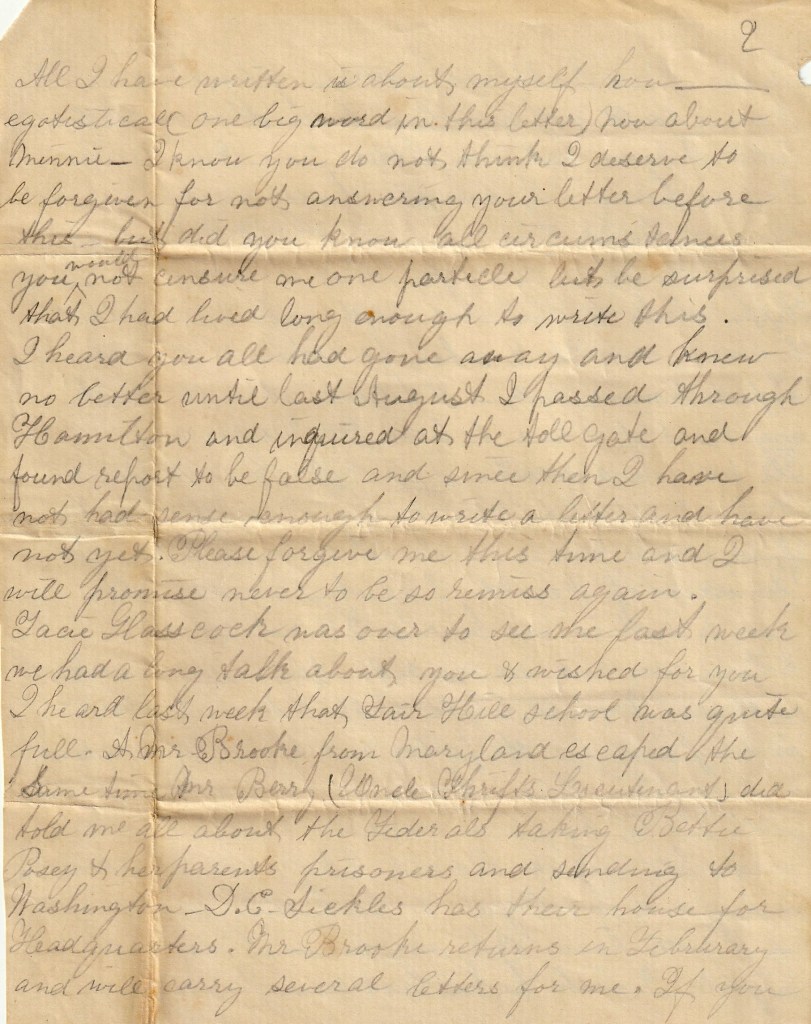
All I have written is about myself. How egotistical (one big word in this letter). How about Minnie? I know you do not think I deserve to be forgiven for not answering your letter before this—but did you know all circumstances, you would not censure me one particle but be surprised that I had lived long enough to write this. I heard you all had gone away and knew no better until last August. I passed through Hamilton and enquired at the toll gate and found report to be false and since them I have not had sense enough to write a letter and have not yet. Please forgive me this time and I will promise never to be so remiss again.

Lacie Glasscock was over to see me last week. We had a long talk about you & wished for you. I heard last week that Fair Hill school was quite full. A Mr. Brooke from Maryland, [who] escaped the same time Mr. Berry (Uncle [James] Thrift’s Lieutenant) [of Co. G, 8th Virginia] did, told me all about the Federals taking Bettie Posey & her parents prisoners 3 and sending to Washington D. C. [Gen. Dan] Sickles has their house for [his] headquarters. Mr. Brooke returns in February and will carry several letters for me. If you know Alice Matthews’ address, please send it to me. Would not you love to see Alice & Sallie Cole? I have had one letter from Edie Smee. It came home by private conveyance. Have you heard from any of them? I have so many things to tell you that I cannot write.
Pappa starts to Alabama next week and will be gone a month & when he returns, we all expect to move out. I believe it will break my heart if I have to leave Old Virginia. I’ll tell you a secret—I am not going there. I’ll tell you where I am going when we meet—-if we ever do, that is. I would come and see you tomorrow if I could. I expect I would talk you to death in one hour so I’ll not come. Please come and see me and stay several weeks with us. I would write with ink but there is company in the parlor and the only inkstand we have is in there. I am up in Mother’s room with slight headache (or heartache). I could write all night but old Professor Bartenstein 4 is here and is obliged to leave early tomorrow so I will have to take my music lesson tonight. I wish he had not come this evening.
When the Eighth [Virginia] Regiment 5 was at Leesburg, I visited it frequently and always thought of you as I passed through Hamilton. We have two lady friends of Mother’s from South Carolina staying with us. Minnie, I would not send you this scribble but knowing you will not think any less of me for it, for you know I am writing at night without paper, pen or ink—am I not excusable? I won’t have anything to do but write letters this whole winter and I expect you will get tired of reading my productions.
George Dandridge is down at [ ville]. Papa is going to Fairfax in the morning. He goes down about once every week. He expects to bring some soldiers up with him when he comes. I wish you could have seen Grandfather’s old place after the Yankees left it. They cut up all the carpets with their bayonets, poured out all the preserves, broke every door about the place, took all the wearing apparel of five families who had deposited them there & a quantity of bed clothes. Took all the horses on the place and then gave all the negroes free papers. Oh, you who have not seen them know nothing about the depredations they commit.
At our home, they were not quite so vicious. They enquired of the negroes where Kate and I were and sent their love to us. I expect some of our acquaintances were them. In fact, I know they were. Please don’t show this miserably written letter to anyone but burn it as soon as read. Please write soon—very soon—and the next letter I write I will promise to write more legibly.
I must go down now and take my music lesson. Please write soon. Your devoted friend, — Ginnie Ayre
Direct your letter to Rectortown P. O., Fauquier county, Va.
P. S. What has become of the Mr. Hopkins?
1 Built of stone construction, Benvenue was constructed around 1824 on 335 acres then owned by John P. Duval. Enoch Glasscock purchased the farm in 1849 and just as the Civil War began, Glasscock sold it to Samuel Tebbs. Interior chimneys are present on either end of the house. The facade (south elevation) holds a centrally located entrance that is flanked by tall six-over-six, wood-sash windows. A round-top transom is set above the entrance door and the bay is detailed with an elaborate pedimented aedicule surround. Other classical elements include the modillion blocks along the cornice line of the house. [See National Register of Historic Places.]

2 The Fair Hill Boarding School for Girls (Fair Hill Seminary) was “one of the earliest schools in the county to include a program for girls. With the help of the Baltimore Yearly Meeting, Samuel Thomas and his wife Anna, both Quakers, opened a school for boys at Fair Hill in 1819. A year later, Margaret Judge added a girls’ department. The Thomases’ school closed in 1829; ten years later, Phineas Paxson bought Fair Hill, and turned it into a girls’ boarding school. In 1850, Richard and Mary Kirk took over the school, with William H. Farquhar as Principal. Mary Coffin, a young woman from New York state, taught at Fair Hill from 1854 to 1865, when the school closed. Her memoirs, published in 1916, provide a wealth of detail about the school during its last decade. According to her recollections, the school averaged 45 students a year, primarily drawing from Montgomery County. About a quarter of the students were Friends (Quakers), and some of these girls were from Quaker families in DC and Alexandria. In the early days of the Civil War, nearly two-thirds of the students withdrew, because of the school’s proximity to the fighting in Baltimore. The school closed for good in 1865 (the building itself burned down in the 1970s), although the Fair Hill Fund continued to provide money for local education.” [See Digital Maryland
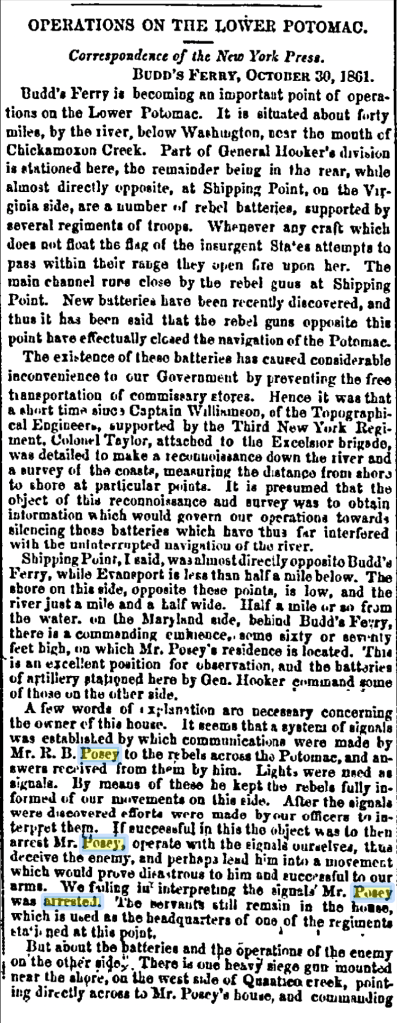
3 Richard Barnes Posey (1806-1880), his wife, Elizabeth (Berry) Posey (1812-1887), and his daughter Elizabeth (“Bettie”) Posey (1844-1923) were all arrested and taken to prison in Washington D. C. on the charge that they signaled Union troop movements to Confederates by displaying signal lights (see newspaper clipping above). The family was released from prison in late November 1861, “no just grounds of suspicion having been established against them.” The Posey residence was described as sitting on an eminence “some sixty or seventy feet high” commanding a view of the Potomac river approximately “a half mile or so” from the river behind Budd’s Ferry in Charles County, Maryland. Bettie Posey probably was a school mate of Ginnie’s at the Fair Hill Boarding School. Ginnie claims that the Posey Home was used by Gen. Daniel E. Sickles for his Headquarters. See historical marker on the Port Tobacco Road. Sickles was in Charles county from October 1861 until March 1862 while training troops.
4 Ferdinand Bartenstein (1815-1884) was a music teacher who resided in Alexandria, Virginia in 1860. He was born in Hochkirch, Saxony, Germany. He emigrated to the United States in 1846 and married Elizabeth Cole Gordon in 1847.
5 Co. G of the the 8th Virginia Infantry (“The Bloody Eighth”) was recruited in Fairfax county by Captain James Thrift, Gennie’s uncle. The regiment took part in the Battle of Manassas. Held in reserve until afternoon, it then advanced to Henry Hill where they fought hand to hand with the 69th New York and the United States Marine Battalion. In August, they relocated to Camp Carolina, just outside of Leesburg where they remained until March 1862, taking part in the Battle of Ball’s Bluff during that time. In April 1862, Capt. James Thrift was promoted to Major of the regiment. He was mortally wounded in the Battle of Seven Pines. He died at Richmond on 2 June 1862.
The Fairfax )Virginia) Herald of October 5, 1888 contained the following article: “War Incident. An incident occurred after the battle of Gettysburg, at night, which shows how kindness is appreciated by soldiers who have been prisoners in the enemy’s hands. A private by the name of Iden, a member of one of the companies of the 8th Va. Infantry, being wounded and left in the hands of the enemy, but able to walk, asked to be taken to the officer of the day. He was conducted to that officer, who asked what he wanted of him. He politely asked him if he would make a detail and have the wounded of his regiment brought off the field and carried to the hospital and cared for. The officer asked him what regiment he belonged to. He answered, ‘The 8th Va. regiment of infantry.’ Whereupon he promptly replied: ‘Certainly; I was taken prisoner by that regiment at Ball’s Bluff and caried to Manassas by Capt. Thrift, of that regiment, who treated me so kindly while I was a prisoner under his charge, that it will give me a great deal of pleasure to render any assistance to that command to alleviate their sufferings.’ He at once had the detail of men made, procured a flask of brandy and went in person with Iden, and had every man of that regiment removed to the hospital that could be found that night. I am sorry that I cannot give the officer’s name. He belonged to a Massachusetts regiment. A member of the 8th Va.” The soldier named Iden could have been one of the Iden brothers from Upperville – John or Joseph of Co. B. Joseph’s record lists him absent from May thru August, so maybe, John is the soldier. John was wounded July 3 at Gettysburg.


Letter 2
The following letter scans were sent to me on 17 August 2023 by Claiborne Stokes for inclusion here. With scans of the letter, Claiborne wrote:
Hello Griff,
What an awesome amount of work and incredible projects you have created on Spared and Shared. Really unbelievable. Whenever I run across sites like yours I always type in a name I might be researching and low and behold I have a hit on yours. It is very nice to see and read the letter you have transcribed from Ginnie Ayre.
I think you might want to add the attached to your collection. It is a letter from Ginnie’s first cousin, Maria Ellen “Nellie” Ayre written to none other than their friend Minnie. Nellie’s father was George Stephenson Ayre, brother of Ginnie’s father William. George Ayre owned “Ayrshire” north of Upperville, but prior to living there, had leased “Rose Hill” out on Rte 50 east of Upperville above the Goose Creek Bridge. That is where Nellie wrote her letter from.
Anyway, you will see all of that and I believe Nellie’s letter will help you glean some more information about the mysterious “Minnie”. The credit for this letter goes to the Library of Virginia under “Ellen Ayre of Loudoun County – Accession 37062”.
I grew up on “Ayrshire”. My family owned the farm from 1913 until 1996. I have studied the farm and the Ayre family my entire life, but really started focusing on it over the past three years, so seeing your blog is a victory. Thank you. If I can help you with anything else on the GSA family let me know and if you have anything else on the Ayre family, I would be grateful if you might consider sharing it.
Best regards.– Claiborne Stokes
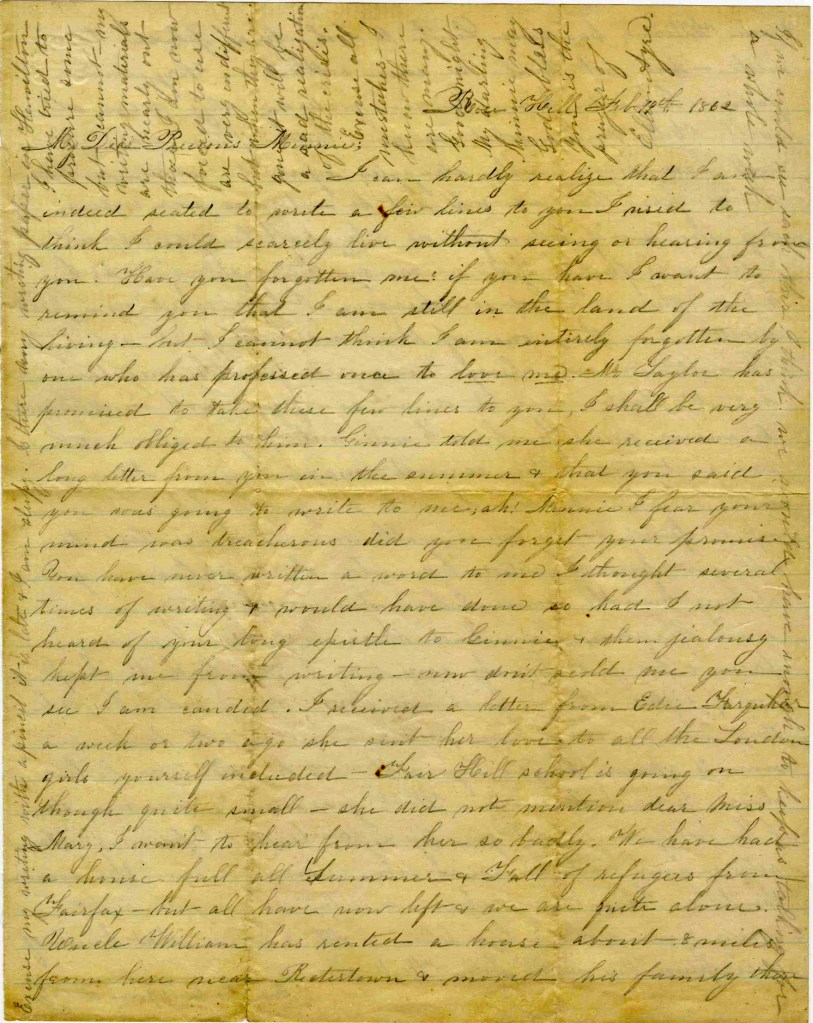
Rose Hill
February 19, 1862
My dear precious Minnie,
I can hardly realize that I am indeed seated to write a few lines to you. I used to think I could scarcely live without seeing or hearing from you. Have you forgotten me> If you have, I want to remind you that I am still in the land of the living—but I cannot think I am entirely forgotten by one who has professed once to love me. Mr. Taylor has promised to take these few lines to you. I shall be very much obliged to him. Ginnie told me she received a long letter from you in the summer & that you said you was going to write to me. Oh! Minnie, I fear your mind was treacherous. Did you forget your promise. You have never written a word to me. I thought several times of writing & would have done so had I not heard of your long epistle to Ginnie & then jealousy kept me from writing. Now don’t scold me—you see I am candid.
I received a letter from Edie Farquhar a week or two ago. She sent her love to all the Loudon girls—yourself included. Fair Hill School is going on though quite small. She did not mention dear Miss Mary. I want to hear from her so badly.
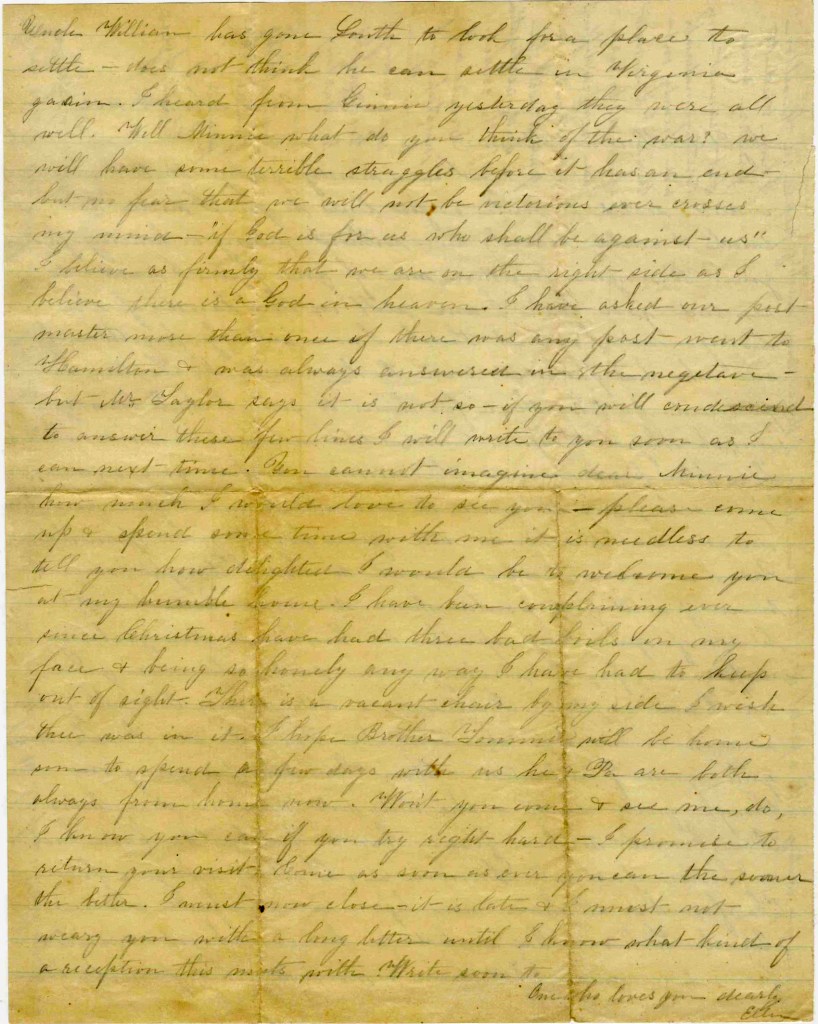
We have had a house full all summer and fall of refugees from Fairfax, but all have now left & we are quite alone. Uncle William has rented a house about 8 miles from here near Rectortown & moved his family there. uncle William has gone South to look for a place to settle. Does not think he can settle in Virginia again. I heard from Ginnie yesterday. They were all well.
Well, Minnie, what do you think of the war? We will have some terrible struggles before it has an end but no fear that we will not be victorious ever crosses my mind. “If God is for us, who shall be against us.” I believe as firmly that we are on the right side as I believe there is a God in heaven. I have asked our post master more than once if there was not a post went to Hamilton & was always answered in the negative. But Mr. Taylor says it is not so, If you will condescend to answer these few lines, I will write to you soon as I can next time. You cannot imagine, dear Minnie, how much I would love to see you. Please come up and spend some time with me. It is needless to tell you how delighted I would be to welcome you at my humble home. I have been complaining ever since Christmas. Have had three bad boils on my face and being so homely anyway, I have had to keep out of sight. There is a vacant chair by my side. I wish thee was in it. I hope Brother Tommie 1 will be home soon to spend a few days with us. He and Pa are both always from home now. Won’t you come and see me. Do. I know you can if you try right hard. I promise to return your visit. Come as soon as ever you can—the sooner the better. I must now close. It is late and I must not weary you with a long letter until I know what kind of a reception this meets with. write soon to one who loves you dearly, — Ellen
Excuse my handwriting with a pencil. It is late and I am sleepy. Is there any writing paper in Hamilton? I have tried to procure some but cannot. My writing materials are nearly out. Those I am now forced to use are very indifferent but when they are gone, it will be a sad realization of the crisis. Excuse all mistakes. I know there are many. Good night my darling Minnie. May God bless you is the prayer of — Ellen Ayre
If we could see each other, I think we would have enough to keep us talking for a whole week.
1 “Tommie” was Ellen’s brother, Lt William Thomas Ayre, Co F, 8th Virginia Infantry. Tom was mortally wounded on July 3, 1863, POW at Cashtown and then died at US hospital in Chester, PA on July 25.
 Spared & Shared 23
Very nice insight to the hardships faced by the young civilian population. My interest is also the 8th Virginia Infantry.
LikeLike
You, Sir, are a gentleman and a scholar. Your efforts are appreciated by far more worthy, dedicated, amateur historians than myself I’m sure.
They cannot be efforts more deeply loved, however, for they transport me through time, to a time very like our own today. What will happen to our country this year is unfolding very slowly, and yet far too fast. The more intimately I study that period, the more I see our own today. Will man ever learn to love his fellow man.
My deepest thanks for your ongoing efforts with your publishing of these amazing letters.
Sincerely,
David William Lowrie
LikeLike