
This letter was written by 20 year-old Mary Elizabeth (Gardner) Van Nest (1842-1928) to her husband, Joseph P. Van Nest (1841-1905) who enlisted as a private in Co. F, 120th Ohio Volunteer Infantry (OVI) in August 1862. Before his enlistment, Joseph worked with his father as a harness maker in Rowsburg, Ashland county, Ohio.
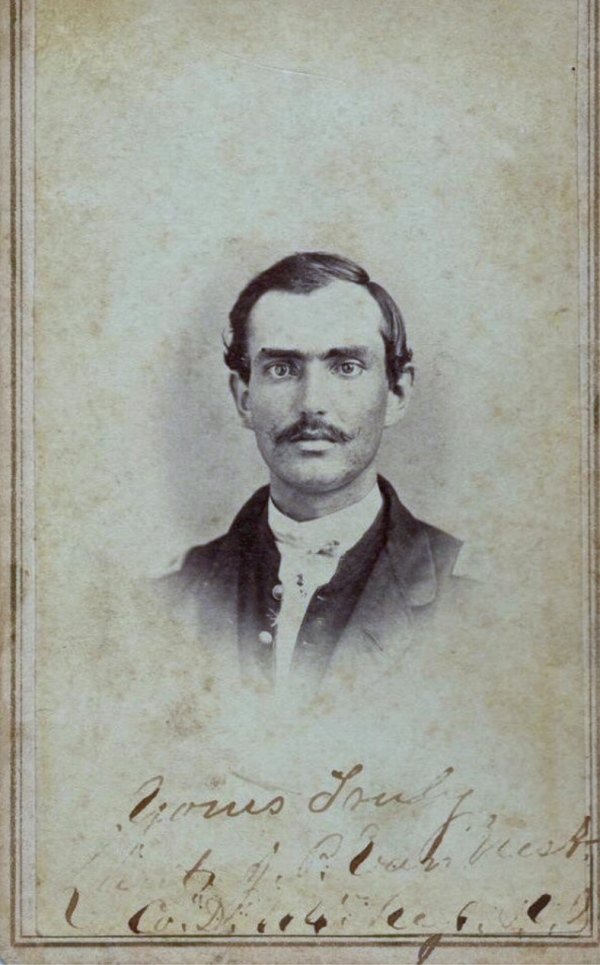
In his book, “A visitation of God: Northern Civilians Interpret the War,” author Sean A. Scott wrote that Joseph was “raised in a family old dyed-in-the-wool Democrats…and that Joseph went to war to preserve the old Constitution.” A few months after enlisting, however, Joseph “felt betrayed by the Emancipation Proclamation and evidently his dissatisfaction became known throughout the community. One minister even claimed that Joseph, if given the opportunity, would be willing to shoot the President if he did not retracts the edict. As would be expected, Joseph’s father took offense at this slanderous statement for he had seen the letter in question and knew that his son had expressed no such sentiment.” When Joseph’s father confronted the minister, the “Abolition preacher” apparently withdrew the charge claiming that he must have “misunderstood his wife.”
Despite Joseph’s anger regarding his government’s prosecution of the war and his wife’s pleadings to desert, he remained steadfast in his duties, rising in rank to 1st Sergeant of his company, and then accepted a commission as a 2nd Lieutenant in the 114th OVI.
To read letters previously transcribed and published on Spared & Shared that were written by Joseph P. Van Nest, see: Joseph P. Van Nest, Co. F, 120th Ohio (10 Letters)
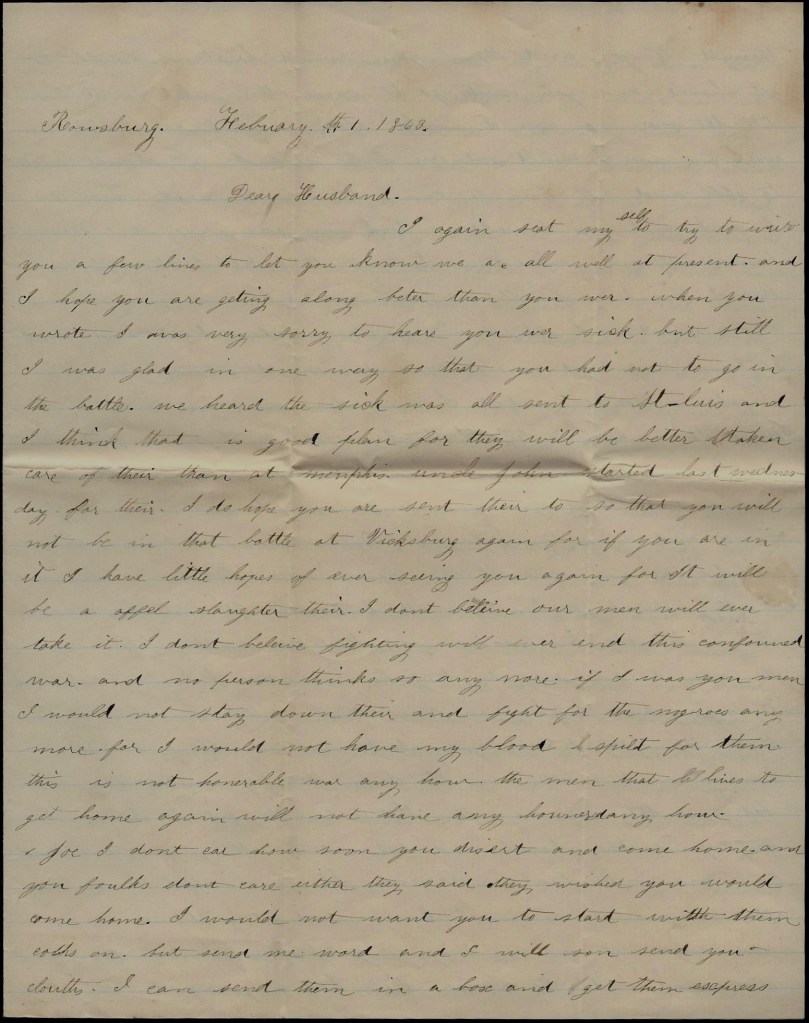
Letter 1
[Note: This letter is from the personal collection of Richard Weiner and is published on Spared & Shared by express consent.]

Rowsburg, [Ohio]
February 1, 1863
Dear Husband,
I again seat myself to try to write you a few lines to let you know we are all well at present and I hope you are getting along better than you were when you wrote. I was very sorry to hear you were sick, but still I was glad in one way, so that you had not to go in the battle. We heard that the sick was all sent to St. Louis and I think that is a good plan for they will be better taken care of than at Memphis. Uncle John started for there last Wednesday. I hope that you are sent there too so that you will not be in that battle at Vicksburg again for if you are in it, I have little hope of ever seeing you again. It will be an awful slaughter. I don’t believe our men will ever take it. I don’t believe the fighting will ever end this confounded war and no person thinks so anymore.
If I was you, I would not stay down there and fight for the negroes anymore for I would not have my blood spilt for them. This is not an honorable war anyhow. The men that lives to get home will not have any honor anyhow.
Joe, I don’t care how soon you desert and come home and your folks don’t care either. They said they wished you would come home. I would not want you to start with those [military] clothes on, but send me word and I will send you some [civilian] clothes. I can send them in a box and get them expressed to you and then you would have no trouble to get home, and you might go to some other state and work until the war was over. I would stay where I am [just] so I know where you were. I would not care.
Mother said she should write to [her brother] Al 1 and tell him to come home and start East. Oh! how I wish you would have taken my advice and stayed at home with me. Sometimes I think it can’t be that the one that I love best of all on earth must be so far from me. Oh, Joe, sometimes I sit down and cry when I think of times past and gone forever and never to return again. It is a solemn thought indeed that I may have seen you for the last time. It is hard to tell. I think sometimes I must just start and come and see you but the distance is too great. It seems awful hard to think you can’t come home until the war is over. Oh Joe, desert and come home. If you knew how bad I want to see you, I think you would.
Keifers feels very bad about the war. They think he may have drowned himself. It will be an awful thing if he has done it. Some say there was another man missing with him and maybe they have deserted together. I have not learned his name, but I glory in their spunk if they have deserted. I wrote in the other letter I sent you about so many things. Emerson wrote a letter in the Times that the sesech wanted things so bad and they were so mean that when they got to Ashland, they opened the barrels and distributed them. It was an awful mean trick after we went to so much trouble and getting it ready for our poor soldiers. If I hear anything about Keifers, I will send you word of it.
Dr. Cole’ wife had a son.
There was several of the boys wrote home that [Capt. Henry] Buck 2 and [1st Lieutenant Robert M.] Zuver 3 run when the battle was at Arkansas Post. I wish you would write if it is true or not. Everybody says you ought to shoot them both. I will never pity Buck a bit if he don’t get home. He wrote home if the soldiers did not get something pretty soon to eat, you would have to starve. Before I would starve, I would start home. Joe, do come home. I can’t hardly live without you. It seems so long since we were together. If Buck would start home, you should just start too for he promised before you went that he would stay with you.
I guess I’ll stay on in the little house. It is so good a place as I can get. It is pretty lonesome—nobody but me and [our son] Johnny. All I want is for you to come home. I can put up with anything. Bill Strayer has gone East with a patent-wright to stay all winter.
I guess I have written all the news for this time. I’ll write again. I feel out of heart today and can’t write as I wished. These are dreary days and I suppose they are to you too. Johnny is well and will soon walk. Your father gave me a new dress. It is oil calico [and] is very pretty. Joe, I hope you will excuse this poorly composed letter. I send you some newspapers with this letter. I must close by bidding you good night. I remain your affectionate wife, — Mary E. Van Nest
Tell me all that is sick when you write. I forgot to state when I received [your] letter. It was the 29th. Write soon for I can’t wait.
1 Alpheus A. Hamilton, in the 42nd OVI
2 Capt. Henry Buck of Co. F, 120th OVI resigned on 15 February 1863.
3 1st Lieutenant Robert M. Zuver of Co. F, 120th OVI resigned on 14 June 1863.


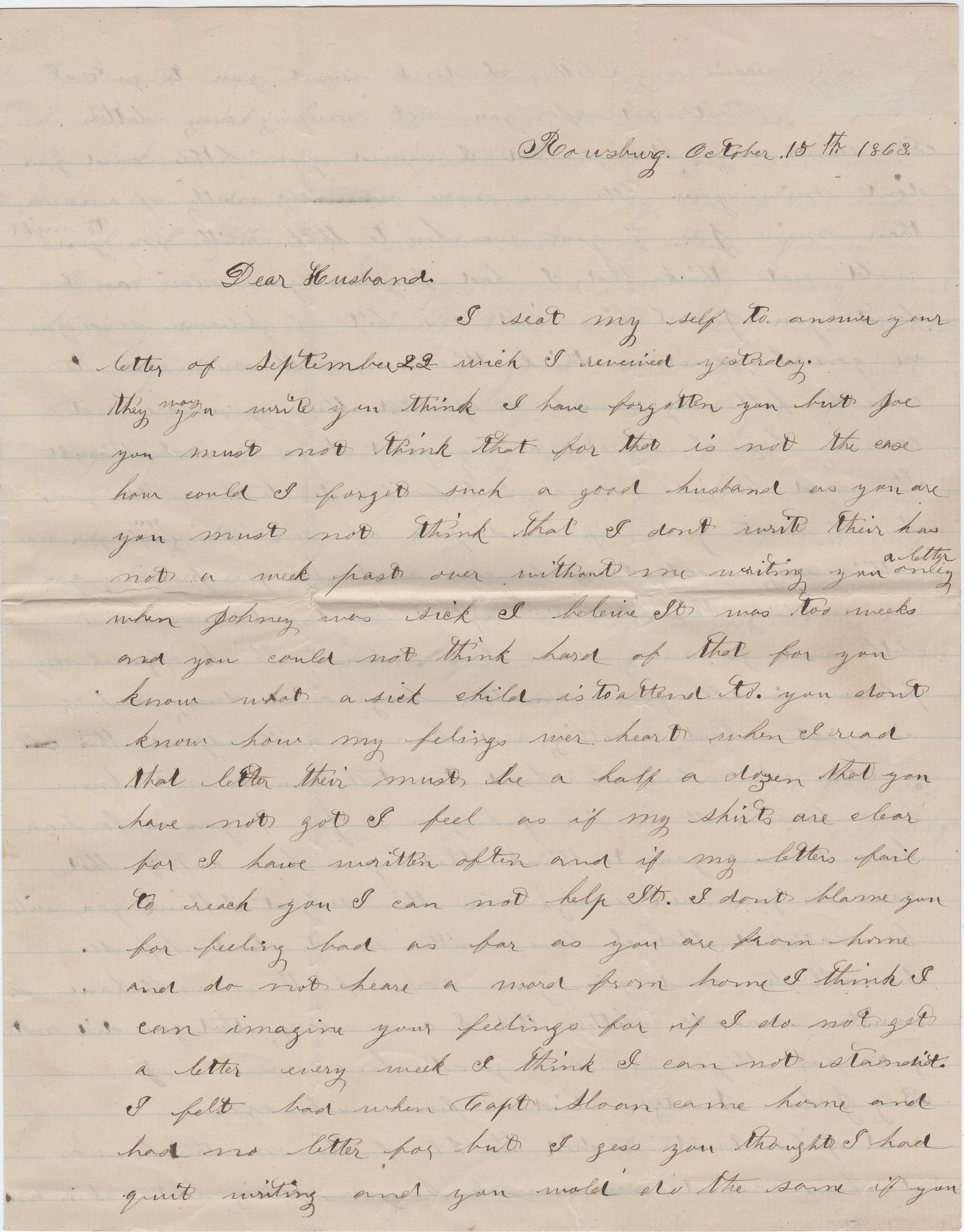
Letter 2
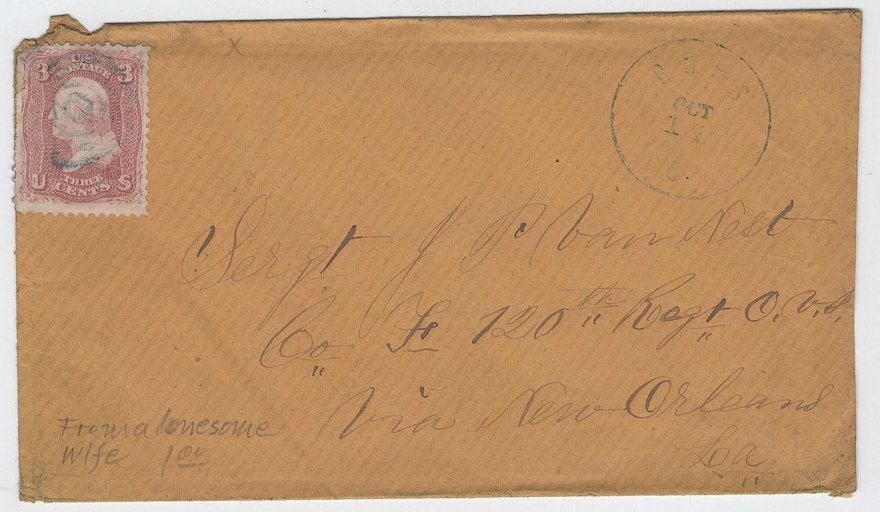
Rowsburg [Ohio]
October 15th 1863
Dear husband,
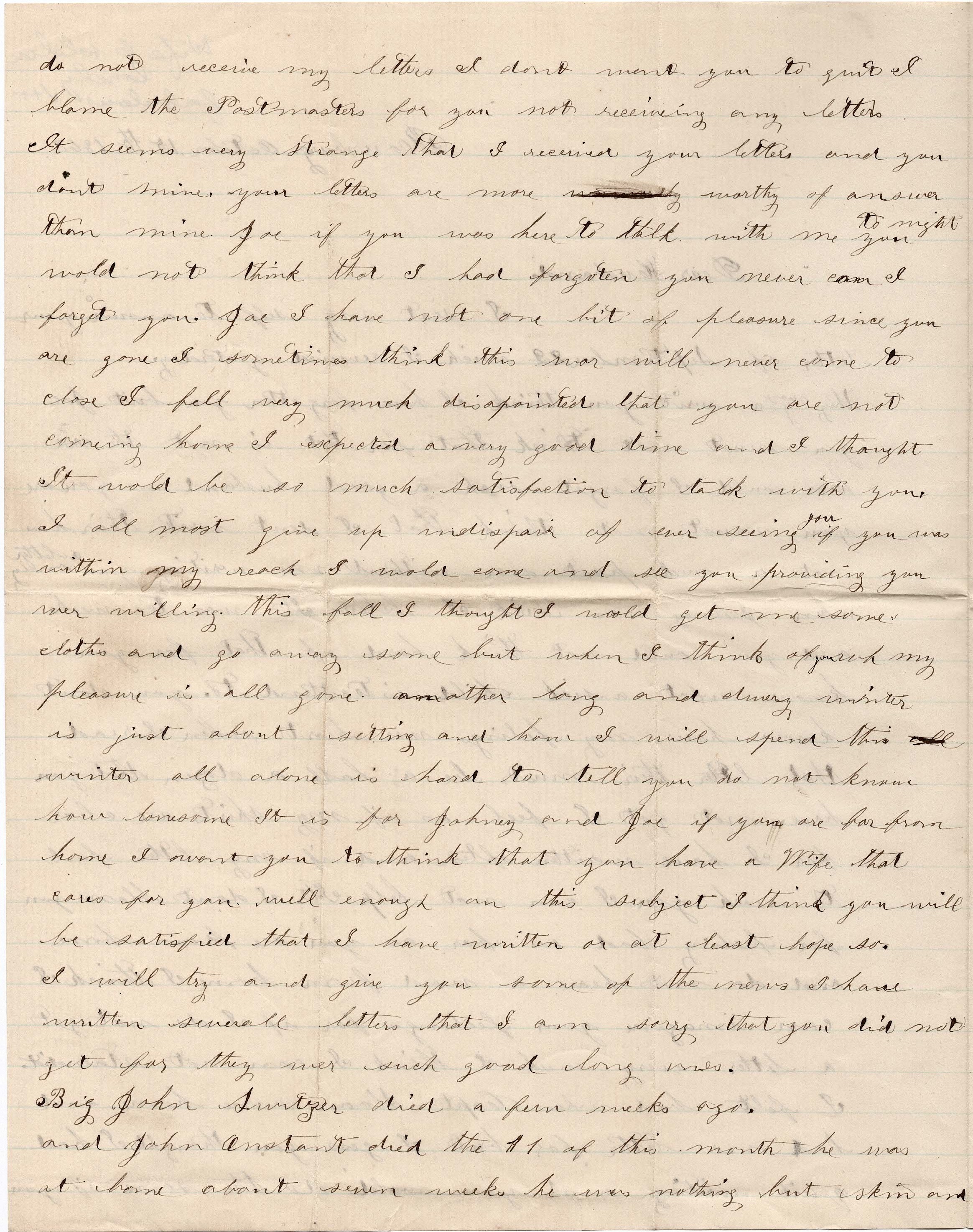
I seat myself to answer your letter of September 22 which I received yesterday. You write you think I have forgotten you but Joe, you must not think that for that is not the ccase. How could I forget such a good husband as you are. You must not think that I don’t write. There has not a week passed over without me writing you a letter. Only when Johnny was sick, I believe it two weeks, and you could not think hard of that for you know what a sick cild is to attend to. You don’t know how my feelings were hurt when I read that letter. There must be a half a dozen that you have not got. I feel as if my skirts are clear for I have written often and if my letters fail to reach you, I cannot help it. I don’t blame you for feeling bad as far as you are from home and do not hear a word from home. I think I can imagine your feelings for if I do not get a letter every week, I think I cannot stand it. I felt bad when Capt. Sloan came home and had no letter for [me] but I guess you thought I had quit writing and you would do the same. If you do not receive my letters, I don’t want you to quit. I blame the Postmaster for you not receiving any letters. It seems very strange that I received your letters and you don’t mine.
Joe, if you were here to talk with me tonight, you would not think that I had forgotten you. Never can I forget you, Joe. I have not one bit of pleasure since you are gone. I sometimes think this war will never come to close. I feel very much disappointed that you are not coming home. I expected a very good time and I thought it would be so much satisfaction to talk with you. I almost give up in despair of ever seeing you. If you was within my reach, I would come and see you providing you were willing this fall. I thought I would get me some clothes and go away some, but when I think my pleasure is all gone, another long and dreary winter is about setting and how I will spend this winter all alone is hard to tell. You do not know how lonesome it is for Johnny. And Joe, if you are far from home, I want you to think that you have a wife that cares for you.
Well, enough on this subject. I think you will be satisfied that I have written or at least hope so. I will try and give you some of the news. I have written several letters that I am sorry to say that you dis not get for they were such good, long ones.
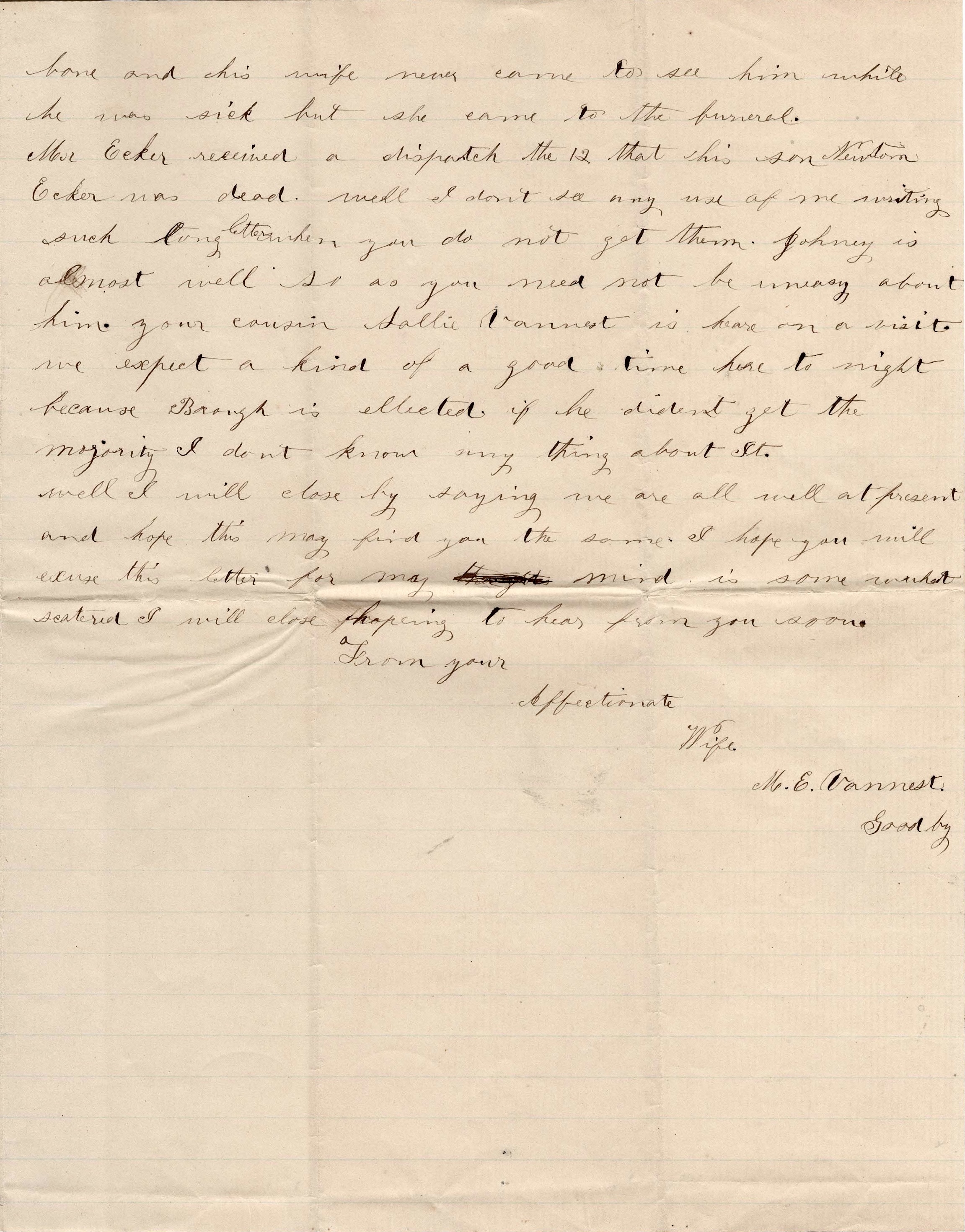
Brig. Gen. John Switzer died a few weeks ago. And John Anstant died the 11th of this month. He was at home about seven weeks. He was nothing but skin and bones adn his wife never came to see him while he was sick but she came to the funeral. Mr. Ecker received a dispatch the 12th that his son Newton Ecker was dead. Well, I don’t see any use of me writing such long letters when you do not get them. Johnny is almost well so as you need not be uneasy about him. Your cousin Sallie Van Nest is here on a visit. We expect a kind of a good time here tonight because [John] Brough is elected [Ohio Governor]. If he didn’t get the majority, I don’t know anything about it.
Well, I will close by saying we are all well at present and hope this may find you the same. I hope you will excuse this letter for my mind is somewhat scattered. I will close hoping to hear from you soon. From your affectionate wife, — M. E. Vannest
Goodbye.
 Spared & Shared 23