

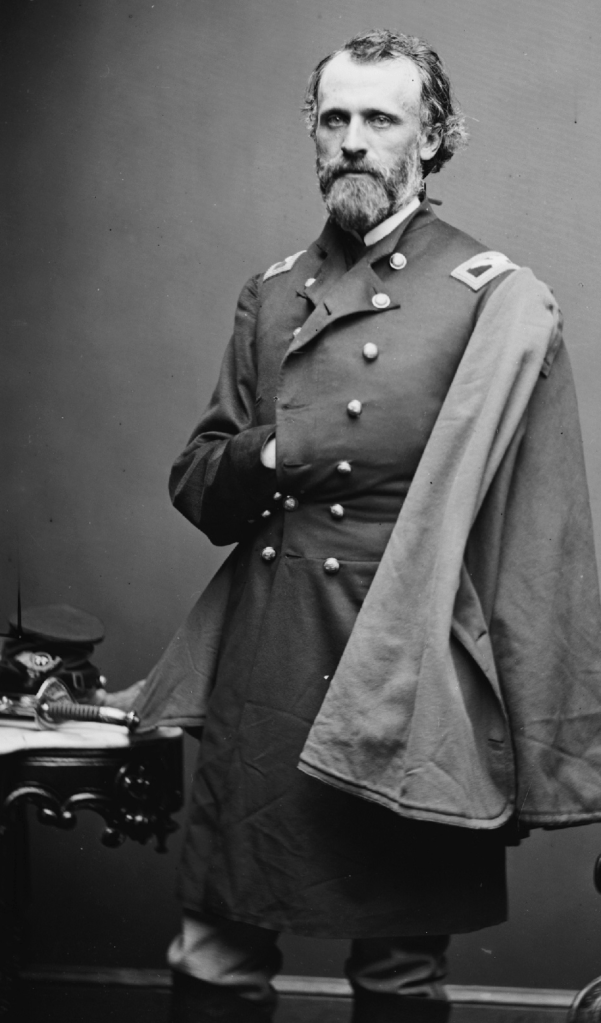
The following lengthy letter was written by 48 year-old Amanda (Angle) McPherson (1815-1887), the wife of Peter McPherson (1814-1891) of West Milton, Saratoga county, New York. She wrote the letter to Colonel James B. McKean of the 77th New York Infantry, pleading the case of her son Edwin L. McPherson (1837-Aft1910)—a member of that regiment—who was arrested for violating his parole by returning home rather than to remain in the convalescent camp after he he had been released by the Confederates following his capture during the Second Battle of Fredericksburg on 5 May 1863. Sent to the convalescent camp while awaiting his exchange, Edwin believed he could go home since he had to remain a noncombatant until properly exchanged but his absence from the camp without a furlough resulted in his being declared a deserter.
The 77th New York Infantry, known as the Saratoga Regiment, was mustered into service in November 1861 and Edwin, aged 24 at the time of his enlistment, entered as a private. The regiment was a hard fought regiment which lost heavily at Antietam before the fight at Fredericksburg.
Where Edwin went after he deserted from the army is not known but he showed up in Adrian, Lewanee county, Michigan after the war, married there and remained there the balance of his life. Amanda and her husband Peter relocated to Adrian as well and were buried there in Oakwood Cemetery.
Transcription
West Milton, Saratoga County, New York
August 10th 1863
Dear Sir,
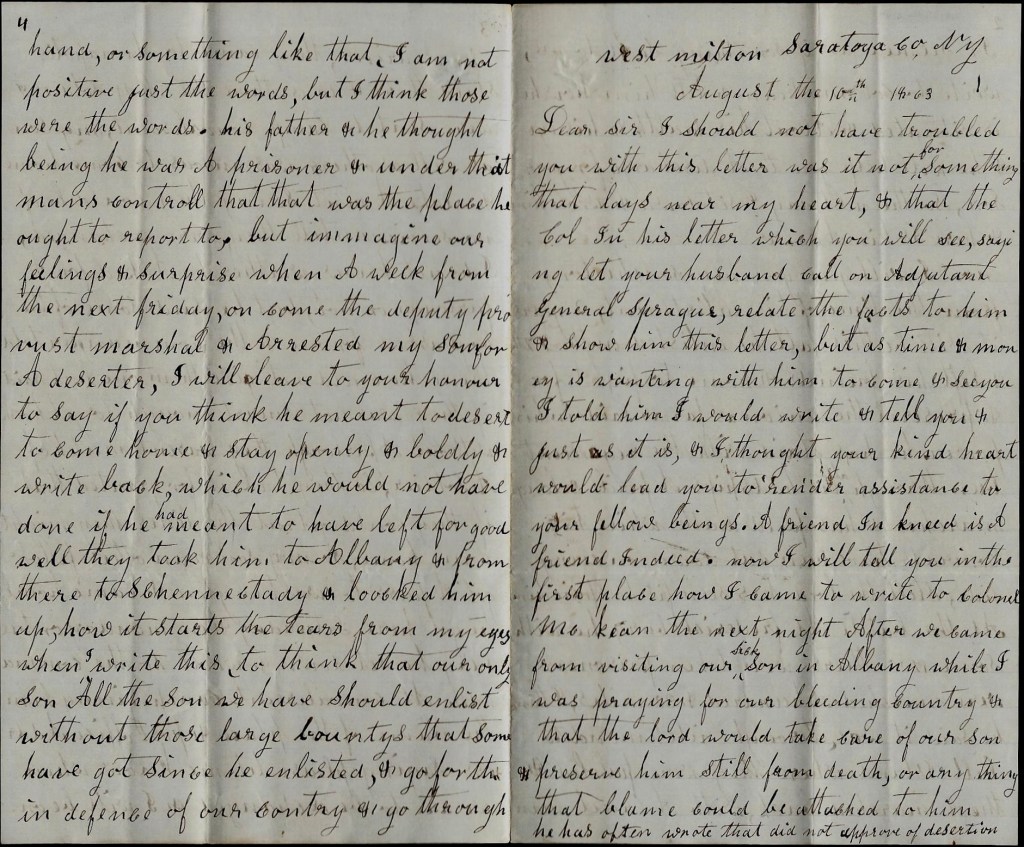
I should not have troubled you with this letter was it not for something that lays near my heart, and that the Colonel in his letter which you will see, saying let your husband call on Adjutant General Sprague, relate the facts to him & money is wanting with him to come and see you. I told him I would write & tell you just as it is, and I thought your kind heart would lead you to render assistance to your fellow beings. A friend in need is a friend indeed.
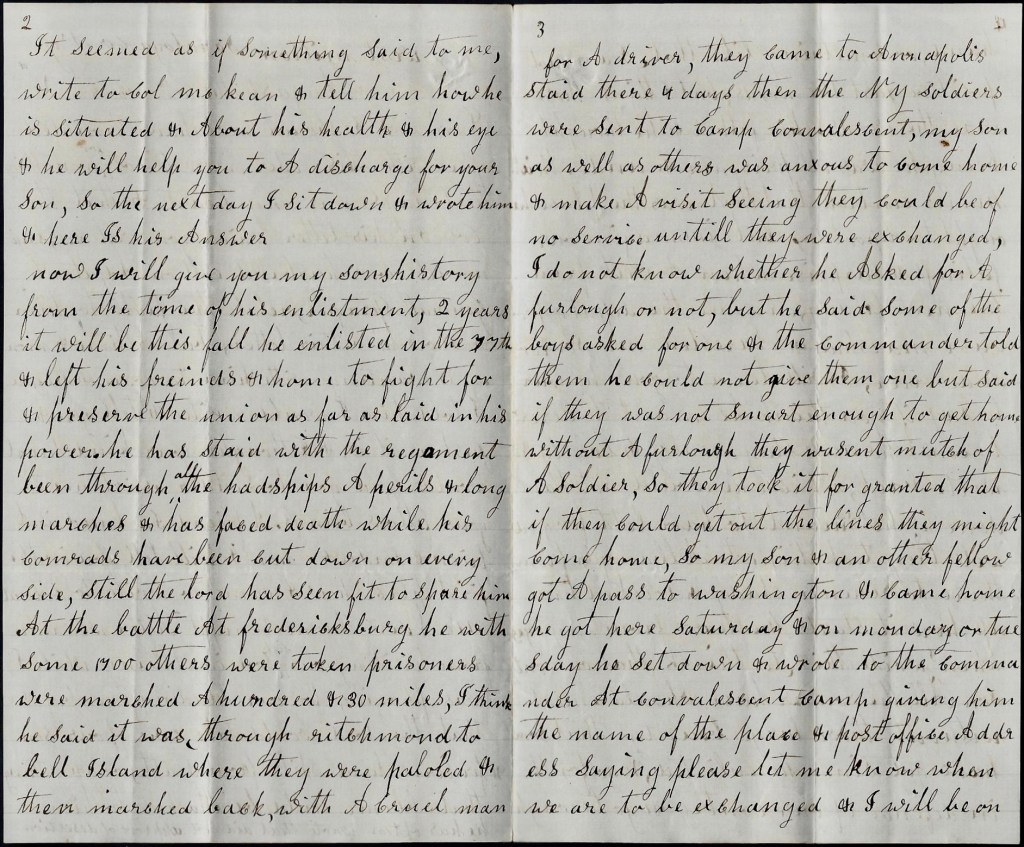
Now I will tell you in the first place how I came to write to Colonel McKean. The next night after we came from visiting our sick son in Albany, while I was praying for our bleeding country & that the Lord would take care of our son and preserve him still from death, or anything that blame could be attached to him, he has often wrote that did not approve of desertion. It seemed as if something said to me, write to Col. McKean & tell him how he is situated & about his health & his eye & he will help you to [obtain] a discharge for your son. So the next day I sit down to write him & here is his answer.
Now I will give you my son’s history from the time of his enlistment—two years it will be this fall. He enlisted in the 77th [New York Infantry] & left his friends & home to fight for & preserve the Union as far as laid in his power. He has stayed with his regiment, been through all the hardships and perils and long marches & has faced death while his comrades have been cut down on every side. Still the Lord has seen fit to spare him.
At the Battle of Fredericksburg, he with 1700 others were taken prisoners, were marched a hundred and thirty miles—I think he said it was—through Richmond to Belle Island where they were paroled & then marched back with a cruel man for a driver. They came to Annapolis, stayed there four days, then the New York soldiers were sent to Camp Convalescent. My son as well as others was anxious to come home and make a visit, seeing they could be of no service until they were exchanged. I do not know whether he asked for a furlough or not, but he said some of the boys asked for one & the commander told them he could not give them one, but said if they was not smart enough to get home without a furlough, they wasn’t much of a soldier. So they took it for granted that if they could get out of the lines, they might come home. So my son and another fellow got a pass to Washington & came home.
He got here Saturday & on Monday or Tuesday, he sat down & wrote to the commander at the Convalescent Camp giving him the name of the place & post office address saying, “Please let me know when we are to be exchanged & I will be on hand,” or something like that. I am not positive just the words, but I think those were the words. His father and he thought being he was a prisoner and under that man’s control that that was the place he ought to report to. But imagine our feelings & surprise when a week from the next Friday, on come the Deputy Provost Marshal and arrested my son for a deserter.
I shall leave to your honor to say if you think he meant to desert to come home & stay openly & boldly & write back, which he would not have done if he had meant to have left for good. Well, they took him to Albany & from there to Schenectady & locked him up. How it starts the tears from my eyes when I write this—to think that our only son—all the son we have—should enlist without those large bounties that some have got since he enlisted, & go for the defense of our country & go through what he has, & I think his health is ruined for life. He has such a pain in his right side & when he had been home a day or two, has spoke of his stomach swelling. When I come to look at him, it was swollen near as large as a quart bowl. His father asked him how long it had been so. He said some 5 or 6 months. I think those long marches & those straps across his breast is the cause of it. He said he has had his feet wet for ten days and nights & not had his boots off in the time. All those things has tended to undermine his health.
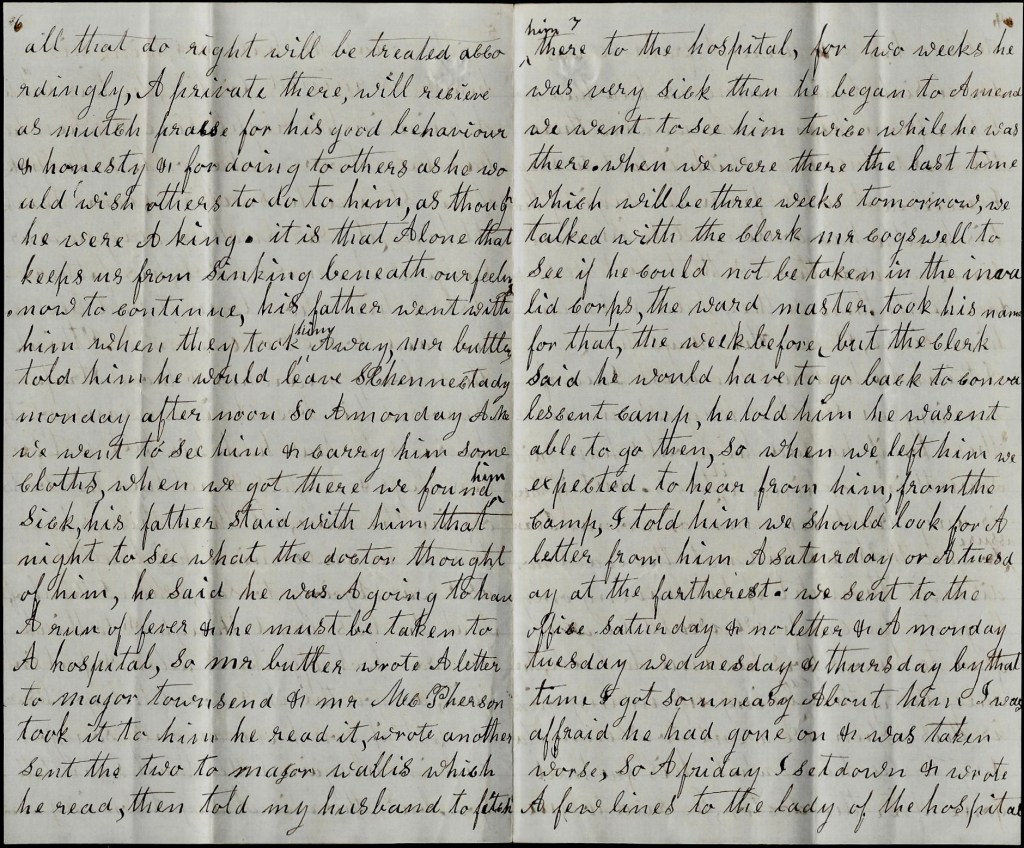
As I was going to say, when I think of what he has went through, and to think he was took off like a felon & put in jail. Do you think I could tell you how we felt? If you have an only son, you can imagine better than I can, I tell you. But there is a day a coming when all that do right will be treated accordingly. A private there will receive as much praise for his good behavior & honesty & for doing to others as he would wish others to do to him, as though he were a king. It is that alone that keeps us from sinking beneath our feelings now.
To continue, his father went with him when they took him away. Mr. Butler told him he would leave Schenectady Monday afternoon so on Monday a.m. we went to see him & carry him some clothes. When we got there, we found him sick. His father stayed with him that night to see what the doctors thought of him. He said he was a going to have a run of fever & he must be taken to a hospital. So Mr. Butler wrote a letter to Major Townsend & Mr. McPherson took it to him. He read it, wrote another, sent the two to Major Wallis which he read, then told my husband to fetch him to the hospital for two weeks. He was very sick. Then he began to mend. We went to see him twice while he was there. When we were there the last time, which will be three weeks tomorrow, we talked with the clerk, Mr. Cogswell, to see if he could not be taken into the Invalid Corps. The ward master took his name for that the week before but the clerk said he would have to go back to Convalescent Camp. He told him he wasn’t able to go then so when we left him from the camp, I told him we should look for a letter from him on Saturday or Tuesday at the farthest.
We sent to the [post] office Saturday & no letter. And on Monday, Tuesday, Wednesday, & Thursday—by that time I go to uneasy about him, I was afraid he had gone on and was taken worse. So on Friday I wrote a few lines to the lady of the hospital telling her we wee afraid he was down sick again seeing we had had no letter from him since we were there. The next Tuesday, which is last Tuesday, I received a letter from her saying that his health had continued to improve since we were there and that last Wednesday he left there & they had not seen him since. It was three days then.
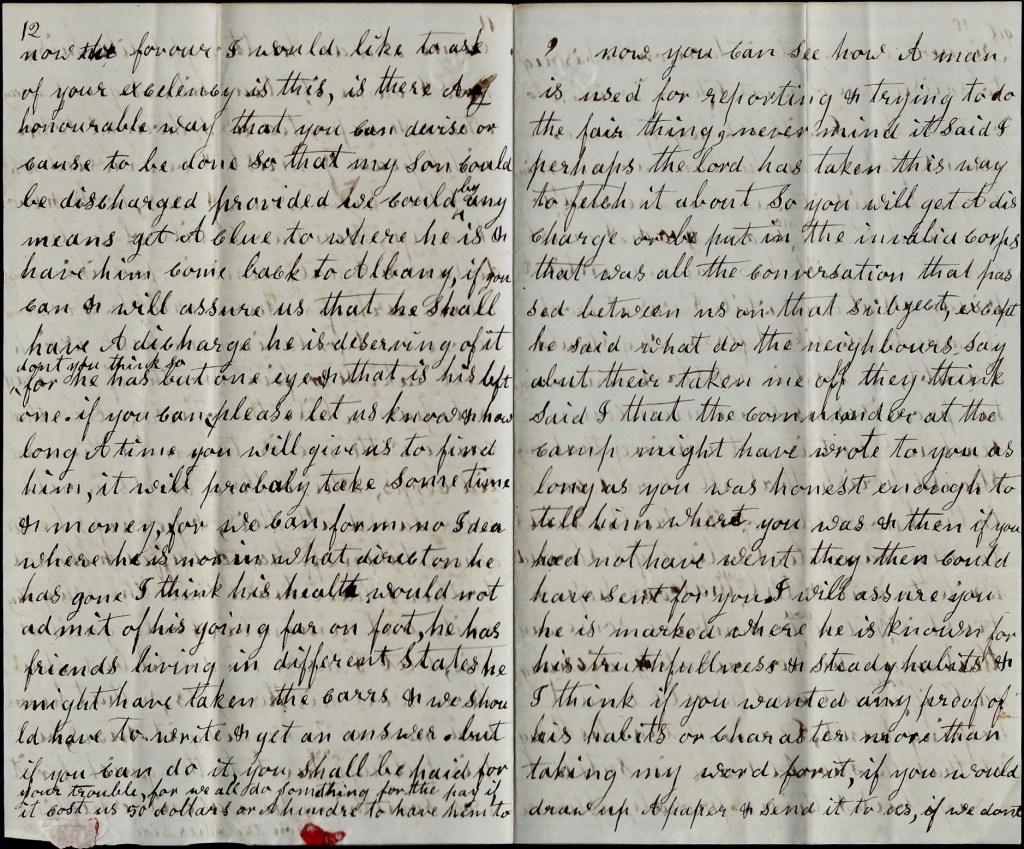
I think he had not the least idea of leaving in such a way when we were there for if he had, he would have said something or hinted it to us. But if there is any truth in man or woman, I can assure you that we had not the least nor distant thought of his leaving—only to go to the camp. We would be very glad to know how he came to leave. The only thing that I can bring up in my mind is this. When we went to Schenectady to see him while his Pa had gone after the doctor, he said to me, “Now you can see how a man is used for reporting and trying to do the fair thing.” “Never mind it,” I said, “Perhaps the Lord has taken this way to fetch it about so you will get a discharge or be put in the Invalid Corps.” That was all the conversation that passed between us on that subject, except he said, “What do the neighbors say about their taking me off?” “They think,” said I, “that the commander at the camp might have wrote to you as long as you was honest enough to tell him where you was and then if you had not have went, they then could have sent for you.”
I will assure you, he is marked where he is known for his truthfulness & steady habits & I think if you wanted any proof of his habits or character, more than taking my word for it, if you would draw up a paper & send it to us, if we don’t get 10 signers enough to it here ot to his regiment to satisfy you of what I have written to be true, then I will ask help of no one.
When I spoke to my husband about writing to you, he said it was of no use, it will not do any good. I must confess my faith has wavered until Friday all at once, while I was at work, it came to me like a flash. Why should I doubt. The Lord is not slack concerning His promises as some men count slackness but is not willing that any should perish—that all should come to the knowledge of truth. Said I to my daughter, “I believe if I should write to you & tell you that that our hope & trust is in God & you to contrive some way that [our son] may be honorably discharged, I cannot bear the thought that he should leave in such a way but think probably after we came away he thought like this.
Now I came, it’s true, like a great many others and reported as I thought to the right place & must I be arrested when I told him where I was, took and locked up, then have a bill of twelve dollars and a half sent in for taking me when perhaps there will be two or three more sent for taking me back, which will take four or five months of my wages to pay while the other fellow that came with me is taken in the Invalid Corps, when three cents [the price of a stamp] would have saved all this? Or perhaps he seen others taken off handcuffed & chained together. I have heard that’s the way they do it. But remember, I only guess at this. But I have no doubt but what those were his thoughts & that he had no way to remedy it now. But his feelings were hurt to the quick for it was something he wasn’t expecting.
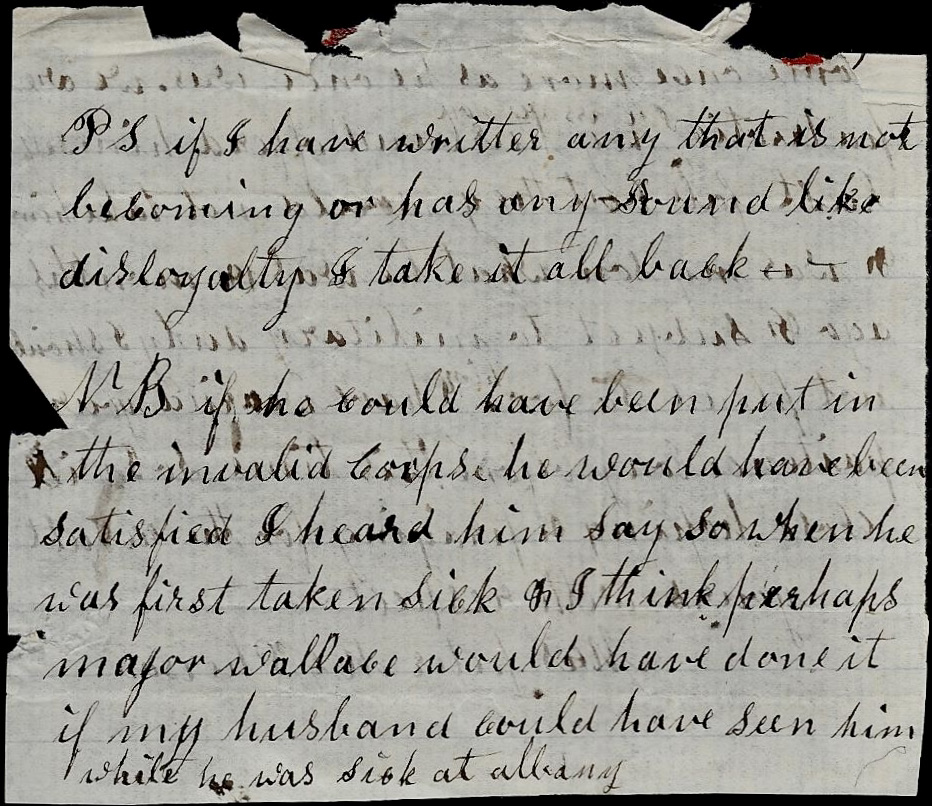
Now, for our part, I would like to ask your excellency this. Is there an honorable way that you can devise or cause to be done so that my son could be discharged provided we could by any means get a clue to where he is and have him come back to Albany. If you can & will assure us that he shall have a discharge, he is deserving of it, don’t you think so? For one, he has but one eye & that is his left one. If you can, please let us know and how long a time you will give us to find him. It will probably take some time & money for we can form no idea where he is now or in what direction he has gone. I think his health would not admit of his going far on foot. He has friends living in different states. He might have taken the cars and we should have to write & get an answer. But if you can do it, you shall be paid for your trouble for we all do something for the pay if it cost us 50 dollars or a hundred to have him to…P. S. If I have written any[thing] that is not becoming or has any sound like disloyalty, I take it all back.
N. B. If he should have been out in the Invalid Corps, he would have been satisfied. I heard him say so when he was first taken sick & I think perhaps Major Wallace would have done it if my husband could have seen him while he was sick at Albany.
…home once more as he once was. We are patriotic, I’ll assure you. My husband offered himself last fall but they would not take him & was my son, what he was 18 months ago & subject to military duty, I should not plead so for him. I have wearied your patience long before this time so I will close hoping and praying for the result.
Yours with respect, — Mrs. Peter McPherson




 Spared & Shared 23