

This letter was written by Albert Hayes (1839-1906), the son of James Hayes (1801-1871) and Juliana Berry (1808-1874) of Dover, Piscataquis county, Maine. Albert was enumerated in his father’s household at the time of the 1860 US Census and his employment was recorded as “blacksmith.” Albert would enter the service of his country in the Civil War but we learn from this letter that prior to his enlistment he had taken a situation as a nurse in a Portland military (unnamed) hospital where soldiers were being treated for typical camp diseases.
Military records indicate that 24 year-old Albert enlisted on 17 December 1863 as a private in Co. E, 1st Maine Heavy Artillery. He was wounded in the fighting at Cold Harbor on 4 June 1864 and again at Petersburg where the regiment—used as infantrymen—charged across an open field toward entrenched Confederate soldiers on 18 Jun 1864, resulting in the greatest single loss of life in a Union regiment in the war, with seven officers and 108 men killed, and another 25 officers and 464 men wounded. These casualties constituted 67% of the strength of the 900-man force. Somehow Albert survived the war and was discharged on 16 June 1865.
[Note: for a great documentary short film on the 1st Maine Heavy Artillery’s assault on the Confederate position at Petersburg, see “Forlorn Hope” on HistoryFix.]
Albert died in Stockton, California in 1906. More biographical material can be found on Find-A-Grave.
Albert wrote the letter to his friend, George D. Demeritt (1840-1881), the son of Daniel Chesley Demeritt (1800-1862) and Elizabeth G. Longfellow (1799-1853) of Dover, Piscataquis county, Maine. George later became a physician, married and settled in Sangerville, Maine.
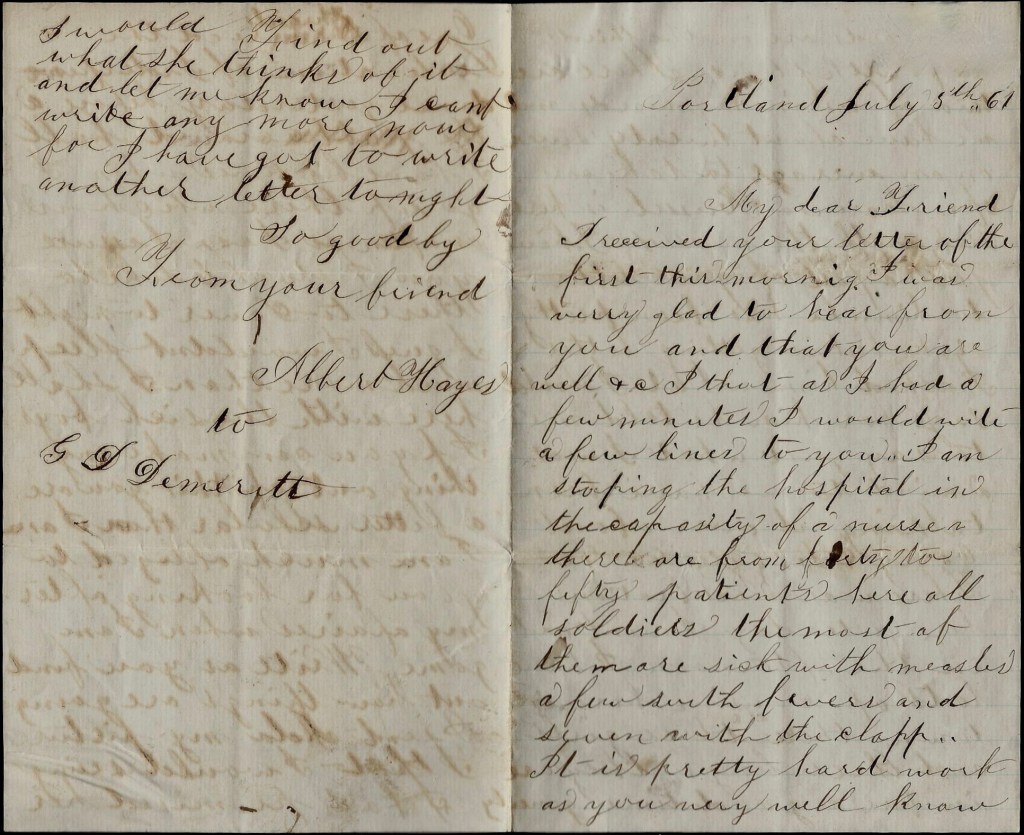
Transcription

Portland [Maine]
July 5, 1861
My dear friend,
I received your letter of the first this morning. I was very glad to hear from you and that you are well &c. I thought as I had a few minutes I would write a few lines to you.
I am staffing the hospital in the capacity of a nurse. There are from forty to fifty patients here. All the soldiers—the most of them—are sick with measles, a few with fevers, and seven with the clap [gonorrhea]. It is pretty hard work as you very well know. My wards are on the third and fourth floors. There are two of us in my wards and we have about twenty-seven on an average to take care of.

Lorenzo Russell is here sick with the measles. I have just read a part of your letter to him. He has been pretty sick but is getting better. I asked him what I should say for him. He told me to say just what I was a mind to. We have been talking it over about Cory and Lizzie, &c.
There was a celebration here yesterday. I went out in the afternoon. I have lots of cousins here in town—there are three girls and three boys. They are in for a good time generally. One of the girls read the Declaration of Independence yesterday before a crowded hall. I have big times when I go up there which is as often as I can, I assure you.
I should like to [be in ] Dover tonight. I guess I wouldn’t sleep much more than I shall here with the sick boys. If you can make anything out of this, you are a better scholar than I am. I am much obliged to you for looking after my affairs when I am gone. Write as you find out how things are going. I sent Ada my picture. I thought I would seeing I had promised her I would. Find out what she thinks of it and let me know.
I can’t write anymore now for I have got to write another letter tonight. So goodbye. From your friend, — Albert Hayes
to G. D. Demeritt

 Spared & Shared 23