
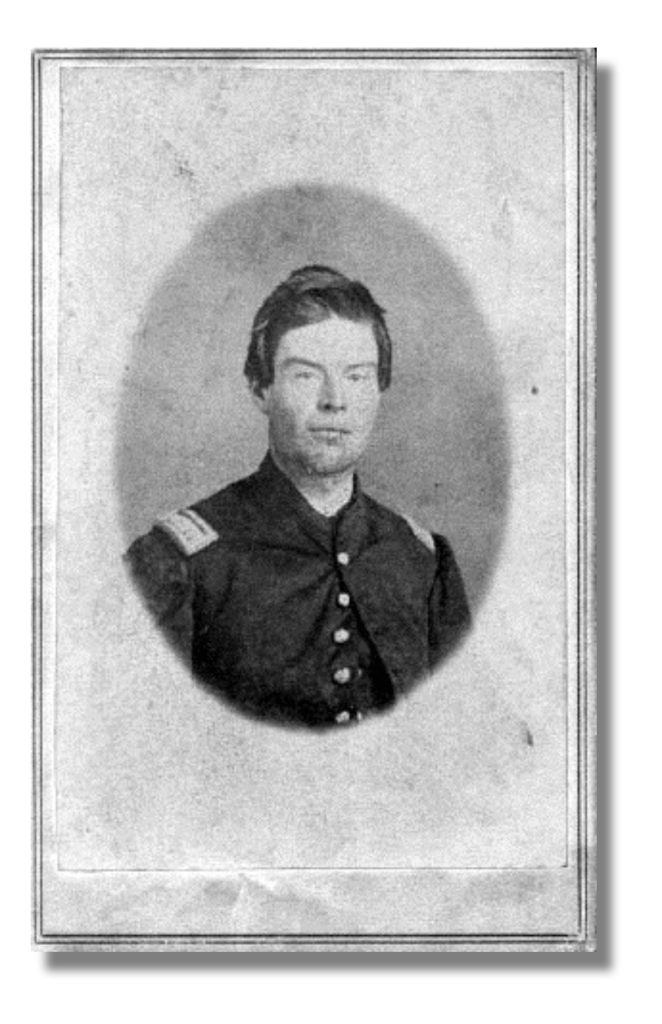
Images of this letter were sent me by Chris Bremner whose ancestor was David Francis Bremner (1839-1922) , a Canadian by birth, who was living in Illinois at the time of the Civil War and enlisted in Co. E, 19th Illinois Infantry on 17 June 1861. He was commissioned a 1st Lieutenant in the company on 18 December 1862 and was promoted to Captain on 9 July 1864.
In transmitting the letter to me, Chris informed me that the letter was found among various documents that included the Descriptive Rolls for the company and other handwritten telegrams and dispatches that had been found hidden in his ancestor’s home when it was being remodeled recently. (How lucky is that?!) It is presumed that the documents were concealed prior to his ancestor’s death in 1922 and have not seen the light of day for over 100 years.
He sent copies of several letters to me but I singled this one out to showcase on Spared & Shared. It was written by Brig. General Stephen A. Hurlbut—described as a “hard-drinking Chicago lawyer”—who was a political general conspicuous for lacking both scruples and ability. When he didn’t get a civilian patronage job in the Lincoln Administration, his Galena friends, and Senator Orville Browning of Illinois, had him commissioned and posted at Quincy, Illinois. He was rather quickly dismissed as an obnoxious drunkard and relegated to positions of unimportance due to his incompetence in military matters.
He addressed his letter to John Basil Turchin, a Russian emigrant with prior military experience abroad who settled in Mattoon, Illinois, in 1858 and then landed a job as a topographical engineer with the Illinois Central Railroad. He came to this country with the surname, Turchaninov but when that proved to be too much of a mouthful for Americans to pronounce, he shortened it to Turchin.
Given his prior military training, his support of the Lincoln administration, and his abhorrence of slavery, Turchin offered his services to Gov. Yates of Illinois who immediately considered him suitable for a Colonel’s appointment to one of two regiments being formed at the time—the 19th or the 21st. At the same time that Turchin offered his services, so did Ulysses S. Grant and it is said that Yates offered the men of the 19th a choice of the two for their Colonel. They chose Turchin, and Grant was sent to command the 21st.
Turchin’s military experience proved extremely valuable in molding the civilian volunteers into a well-drilled military unit, instilling discipline, and esprit de corps. They were finally ordered from Camp Long near Chicago to Hurlbut’s command at Quincy on July 10th. On the 14th of July, they were sent across the river to relieve Grant’s men in the 21st Illinois who were guarding the Hannibal & St. Joseph Railroad. A couple of the companies were strung out on the railroad line but six companies pitched their tents in Palmyra, the county seat of Marion county, some dozen miles northwest of Hannibal. Because they were ill-supplied with both arms, equipment, and provisions, with Turchin’s approval, the men of the 19th Illinois liberally requisitioned whatever they needed from the local citizens around Palmyra, most of whom they believed to be southern sympathizers. Citizens were so incensed by this outrage that they complained to Gen. Pope and other military leaders but Gen. Fremont—commander of the entire district, ignored their moaning.
This letter informs us that Turchin and his men soon feared they might be attacked by rebel citizenry around Palmyra and urgently requested arms to meet their needs though it appears nothing could be found but 53 “musketoons” already issued to Capt. Burnap’s company of the 1st Illinois Cavalry at Quincy. (A musketoon was a short-barreled musket which was better suited for cavalry than infantry.)
For those interested in reading more about John B. Turchin and the 19th Illinois Infantry, I highly recommend James A. Treichel’s graduate thesis prepared in 1962 entitled, “Union Cossack: General John B. Turchin’s Career in the American Civil War.”
Transcription
No. 23
Headquarters Brigade
Quincy, Illinois
July 17, 1861
Col. J. B. Turchin, 19th Regiment
Dear Sir,
I have just received a letter from Asst. Adjt. General Hardin at St. Louis Arsenal that there are no Minies at that Depot & consequently he cannot fill my requisition for your command.
I have telegraphed to Mr. [Orville H.] Browning, our Senator at Washington, and to Maj. General Fremont to push on as fast as possible. I shall write to Gen. Pope today at Springfield.
Capt. Williams of your regiment came in today and stating from your authority that the people of Palmyra were moving in expectation of attack & that the officers of the regiment anticipated one. [He] requested arms for his company.
I have given him an order for all I know of 53 State musketoons now in hands of Burnap’s Troop of Cavalry.
If the facts are as stated by him—that you have reason to apprehend attack—I should have known it formally. If it be true as he stated that artillery is in possession of citizens of Palmyra, unless they are true men beyond a doubt, they should be disarmed.
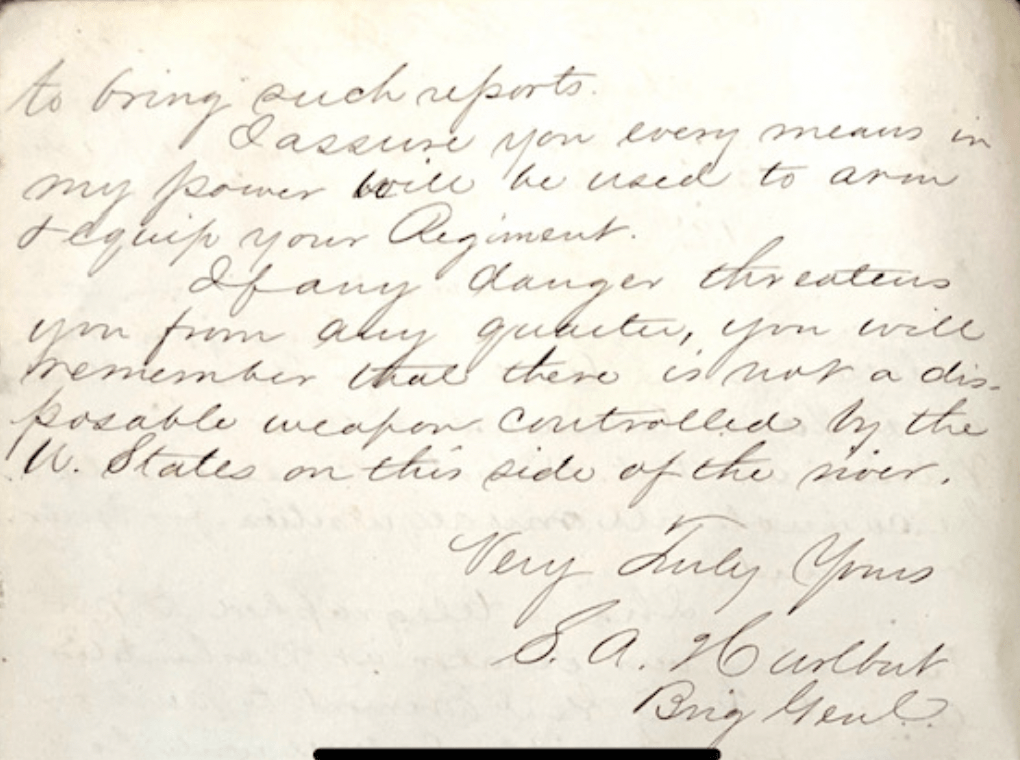
If these things are imaginations on his part, he should be advised not to bring such reports. I assure you every means in my power will be used to arm and equip your regiment. If any danger threatens you from any quarter, you will remember that there is not a disposable weapon controlled by the W. States on this side of the river.
Very truly yours, — S. A. Hurlbut, Brig. General
[Note: This letter was probably not in the handwriting of Hurlbut but prepared by an aide-de-camp. I have not checked his signature against known samples.]

 Spared & Shared 23