
These letters were written by William (“Willie”) Henry Payne (1840-1914), a native of Shelbyville, Kentucky. He was born on 2 March 1840 and came to Harrisonville, Cass county, Missouri, with his father, a cabinet maker named Winchester Payne, and family, when three years old. In 1850 the family moved to property on East Pearl Street in Harrisonville. Willie was married in September 1865 to Elizabeth Endres of Santa Fe, New Mexico. The couple returned to live in Harrisonville for a time but then relocated to Nebraska where Willie was engaged in the lumber business. He died there in 1914.
From these five letters (only two transcribed), we learn that Willie was working as a civilian in the Quartermaster’s Department at Fort Union in New Mexico Territory during the Civil War. Working in the same vicinity as a day laborer was his younger brother, George Winchester Payne (1841-1909). George’s obituary, published in the Selma Enterprise [Selma, California] on 30 October 1909, claims that he fought for the Confederacy throughout the entire Civil War under Old Pap Price who would call him “Sonny” but we know from these letters that by January 1864, George was working in New Mexico and seems to have been there for some time. It may be that both Willie and George went to New Mexico to avoid further service in the Civil War.
Cass County histories inform us that Winchester Payne was loyal to his southern heritage and supported the Confederacy. Local Union troops knew he was “secesh” an targeted his farm frequently when foraging. In the summer of 1862 alone it is reported that they took 28 hogs, 50 bushels of corn, and a ton of hay off his farm despite his having previously taken the Loyalty Oath. Things did not get any better in 1863 when General Ewing issued General Order No. 11 expelling Southern sympathizers from their homes in Cass county. It is reported that the Payne family moved temporarily to Boone county. These letters confirm that Winchester continued to look for alternative employment outside of the region despite his ailing health. They also suggest that several Cass county acquaintances had found employment at the military post or in Santa Fe while in exile from Missouri.
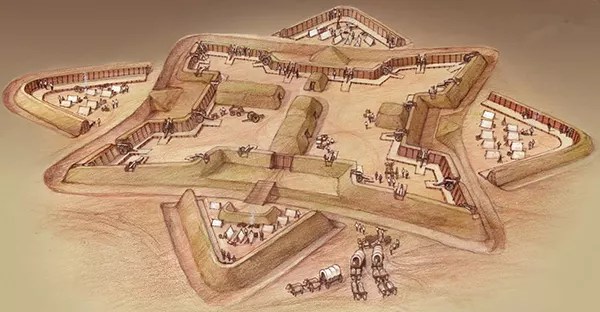
Willie’s letters were all written from Fort Union—a military post on the Santa Fe trail in New Mexico which was begun in 1851 to provide security along the trail as well as serving as a depot to other smaller forts. Work on the large Fort Union complex pictured below was started in August 1862, the structures constructed with adobe bricks set on stone foundations. They included officers quarters, enlisted men’s barracks, corrals, warehouses, a hospital, and other structures. Little of the complex remains today.
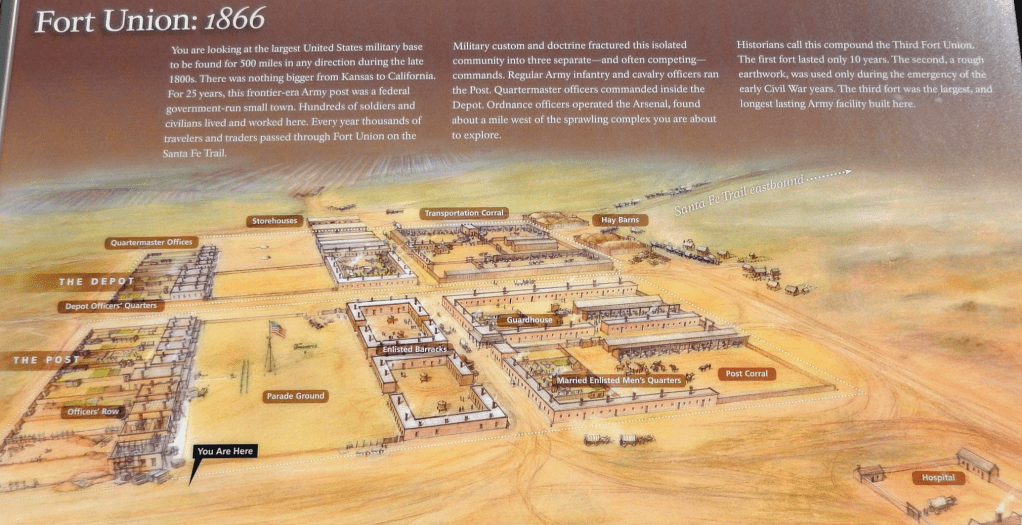
Letter 1
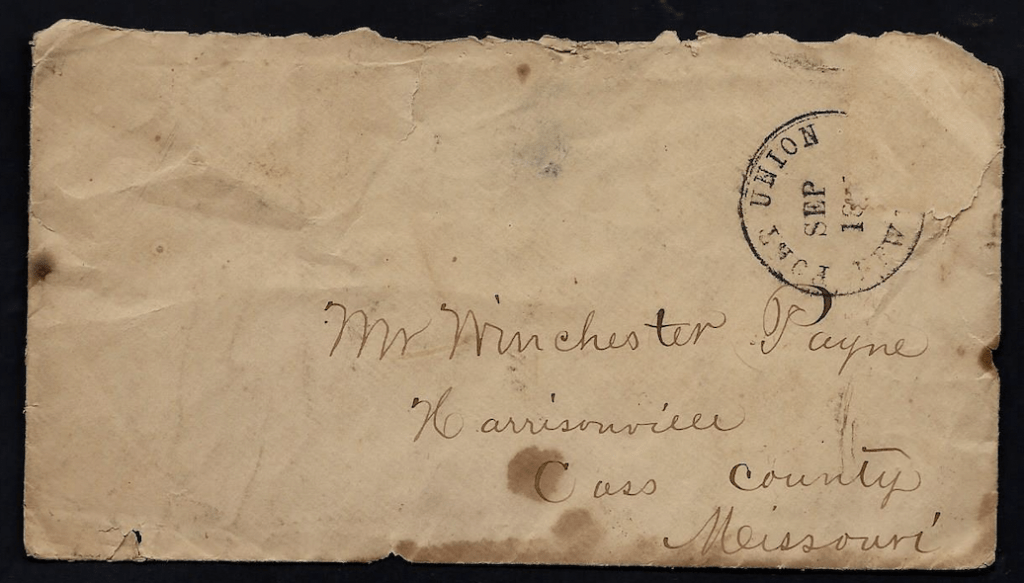
Fort Union, New Mexico
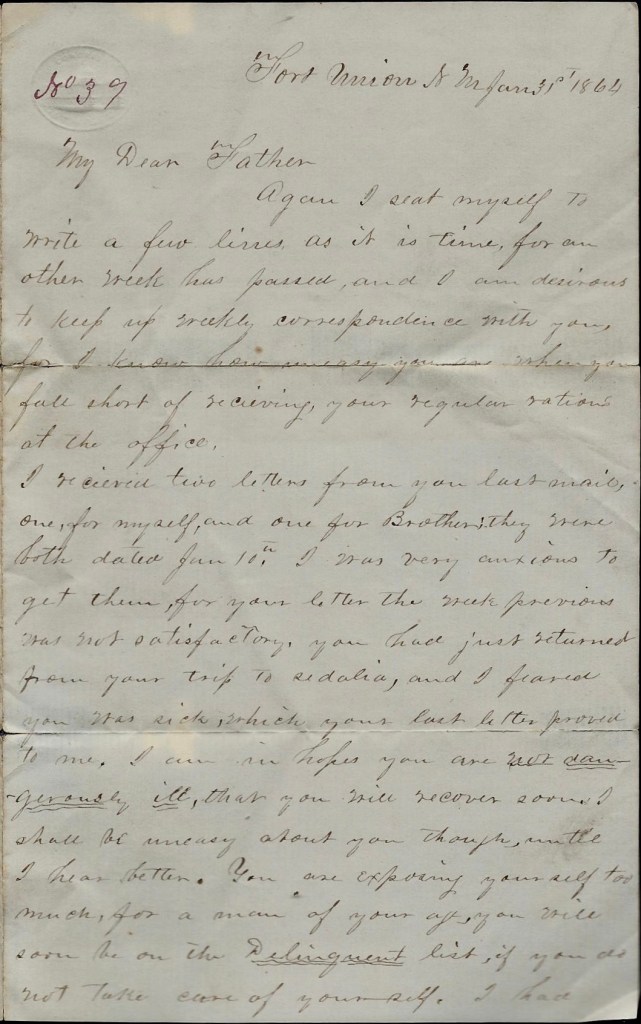
January 31, 1864
My Dear Father,
Again I seat myself to write a few lines as it is time, for another week has passed, and I am desirous to keep up weekly correspondence with you, for I know how uneasy you are when you fall short of receiving your regular rations at the office.
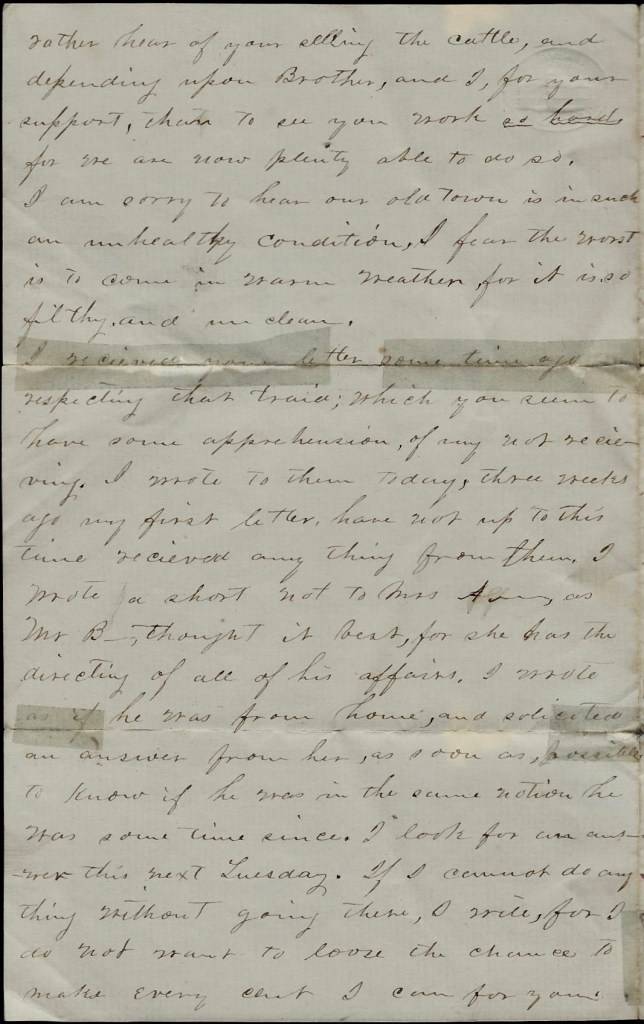
I received two letters from your last mail—one, for myself, and one for brother [George]. They were both dated January 10th. I was very anxious to get them, for your letter the week previous was not satisfactory. You had just returned from your trip to Sedalia and I feared you was sick, which your last letter proved to me. I am in hopes you are not dangerously ill [and] that you will recover soon. I shall be uneasy about you though until I hear better. You are exposing yourself too much for a man of your age. You will soon be on the delinquent list if you do not take care of yourself. I had rather hear of your selling the cattle and depending upon brother and I for your support, than to see you work as hard for we are now plenty able to do so.
I am sorry to hear our old town is in such an unhealthy condition. I fear the worst is to come in warm weather for it is so filthy and unclean.
I received your letter some time ago respecting that trade which you see, to have some apprehension of my not receiving. I wrote to them today, three weeks ago, my first letter. Have not up to this time received anything from them. I wrote a short note to Mrs. Avery as Mr. B thought it best for she has the directing of all of his affairs. I wrote as if he was from home and solicited an answer from her as soon as possible to know if he was in the same notion he was some time since. I look for an answer this next Tuesday. If I cannot do anything without going there, I will, for I do not want to lose the chance to make every cent I can for you.
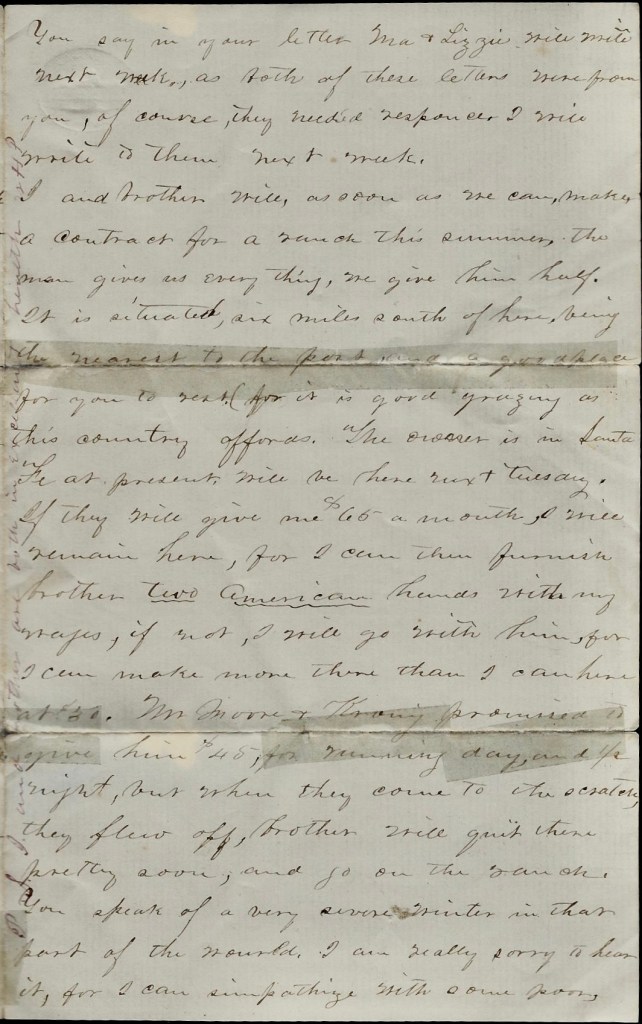
You say in your letter Ma & Lizzie will write next week, as both of these letters were from you, of course, they needed responses I will write to them next week.
I and brother will as soon as we can, make a contract for a ranch this summer. The man gives us everything. We give him half. It is situated six miles south of here, being the nearest to the pond and a good place for you to rest, for it is as good grazing as this country affords. The owner is in Santa Fe at present. Will be here next Tuesday. If they will give me $65 a month, I will remain here for I can then furnish brother two American hands with my wages. If not, I will go with him for I can make more there than I can here at $30. Mr. Moore & Krany promised to give him $45 for running day and half the night, but when they came to the scratch, they flew off. Brother will quit there pretty soon and go on the ranch.
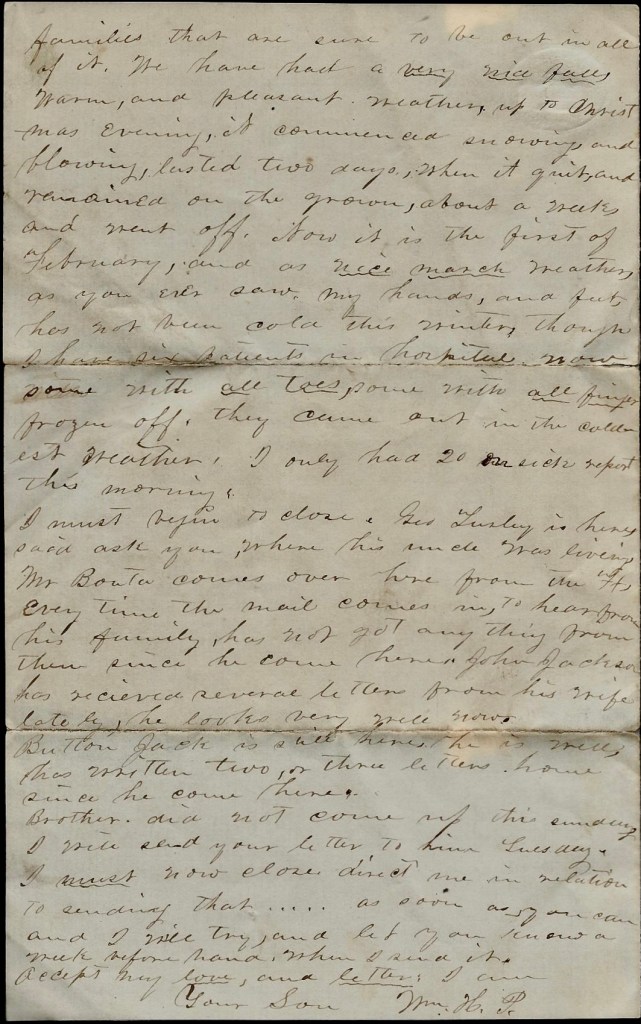
You speak of a very severe winter in that part of the world. I am really sorry to hear it for I can sympathize with some poor families that are sure to be out in all of it. We have had a very nice fall—warm and pleasant weather up to Christmas evening [when] it commenced snowing and blowing. It lasted two days when it quit and remained on the ground about a week and went off. Now it is the first of February and as nice March weather as you ever saw. My hands and feet has not been cold this winter though I have six patients in hospital now—some with all toes, some with all fingers frozen off. They came out in the coldest weather. I only had 20 on sick report this morning.
I must begin to close. Gus Yurley is here. Said ask you where his uncle was living. Mr. Bouta comes over here from the fort every time the mail comes in to hear from his family. Has not got anything from them since he come here. John Jackson has received several letters from his wife lately. He looks very well now.
Button Jack is still here. 1 He is well. Has written two or three letters home since he come here. Brother did not come up this Sunday. I will send your letter to him Tuesday. I must now close. Direct me in relation to sending that….as soon as you can and I will try and let you know a week before hand when I send it. Receive my love and letter, I am your son, — Wm. H. P.
1 I’m not positive but I think “Button Jack” may be “Col. William A. Jack” who served as the postmaster of Harrisonville in 1850 and was a merchant there before and during part of the Civil War. After the Civil War he ran a dry goods store in Pleasant Hill, Cass county, Missouri.
Letter 2
Quartermaster Hospital
Fort Union
March 6th 1864
My dear Father,
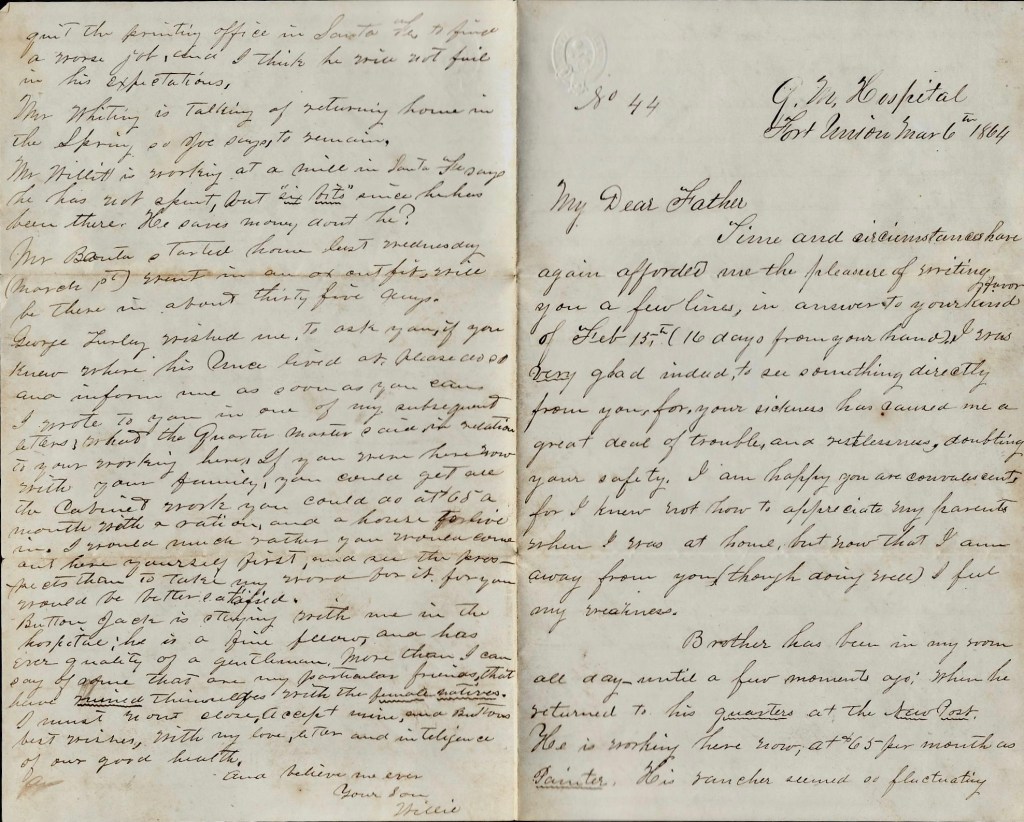
Time and circumstances have again afforded me the pleasure of writing you a few lines in answer to your kind favor of February 15th (16 days from your hand). I was very glad indeed to see something directly from you, for your sickness has caused me a great deal of trouble and restlessness, doubting your safety. I am happy you are convalescing for I knew not how to appreciate my parents when I was at home, but now that I am away from you (though doing well), I feel my weakness.
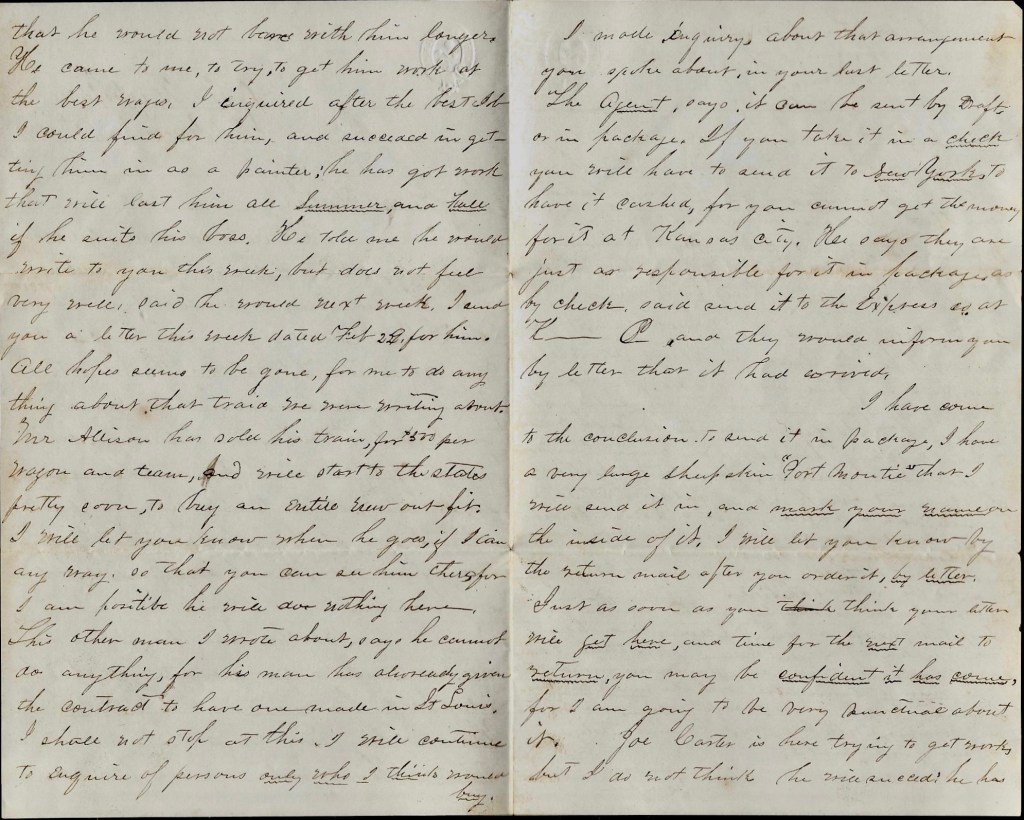
Brother has been in my room all day until a few moments ago when he returned to his quarters at the New Post. He is working here now at $65 per month as painter. His rancher seemed so fluctuating that he would not bear with him longer. He came to me to try to get him work at the best wages. I enquired after the best job I could find for him and succeeded in getting him in as a painter. He has got work that will last him all summer and fall if he suits his boss. He told me he would write to you this week but does not feel very well. Said he would next week. I send you a letter this week dated February 24th for him.
All hopes seem to be gone for me to do anything about that trade we were writing about. Mr. Allison has sold his train for $500 per wagon and team, and will start to the States pretty soon to buy an entire new outfit. I will let you know when he goes if I can anyway, so that you can see him there, for I am positive he will do nothing here. This other man I wrote about says he cannot do anything for his man has already given the contracts to have one made in St. Louis. I shall not stop at this. I will continue to enquire of persons only who I think would buy. I made enquiries about that arrangement you spoke about in your last letter. The agent says it can be sent by draft or in package. If you take it in a check, you will have to send it to New York to have it cashed, for you cannot get the money for it at Kansas City. He says they are just as responsible for it in package as by check. Said send it to the Express as at Kansas City and they would inform you by letter that it had arrived.
I have come to the conclusion to send it by package. I have a very large sheepskin “Port Montie” that I will send it in and mark your name on the inside of it. I will let you know by the return mail after you order it by letter. Just as soon as you think your letter will get here, and time for the next mail to return, you may be confident it has come for I am going to be very punctual about it. Joe Carter is here trying to get work but I do not think he will succeed. He has quit the printing office in Santa Fe to find a worse job, and I think he will not fail in his expectations. 1
Mr. Whiting is talking of returning home in the spring, so Joe [Carter] says, to remain. 2
Mr. Willett is working at a mill in Santa Fe. Says he has not spent but “six bits” since he has been there. He saves money, don’t he? 3
Mr. Banta started home last Wednesday (March 1st). Went in an ox cart outfit. Will be there in about thirty-five days. 4
George Farley wished me to ask you if you knew where his Uncle lived at. Please do so and inform me as soon as you can. I wrote to you in one of my subsequent letters what the Quartermaster said in relation to your working here. If you were here now with your family, you could get all the cabinet work you could do at $65 a month with a ration, and a house to live in. I would much rather you would come out here yourself first and see the prospects than to take my word for it, for you would be better satisfied.
Button Jack is staying with me in the hospital. He is a fine fellow adn has every quality of a gentleman—more than I can say of some that are my particular friends that have ruined themselves with the female natives.
I must now close. Accept mine and Button’s best wishes. With my love, letter and intelligence of our good health, and believe me ever your son, — Willie
1 Joseph Henry Carter (1841-1913) was from Harrisonville, Missouri. He learned the printers trade at an early age and worked for a variety of newspapers throughout his life until finally settling on a ranch in Kansas.
2 Probably W. E. Whiting (b. 1836) who was working as a tailor in Harrisonville, Missouri at the time of the 1860 US Census.
3 Probably Roberts Willett (b. 1828 in Tennessee) who was a banker in Harrisonville, Missouri, at the time of the 1860 US Census.
4 Dewitt Clinton Banta (1829-1869), a native of Kentucky, and a resident of Harrisonville, Missouri, in 1860 where he was enumerated as a farmer with a wife and three children.
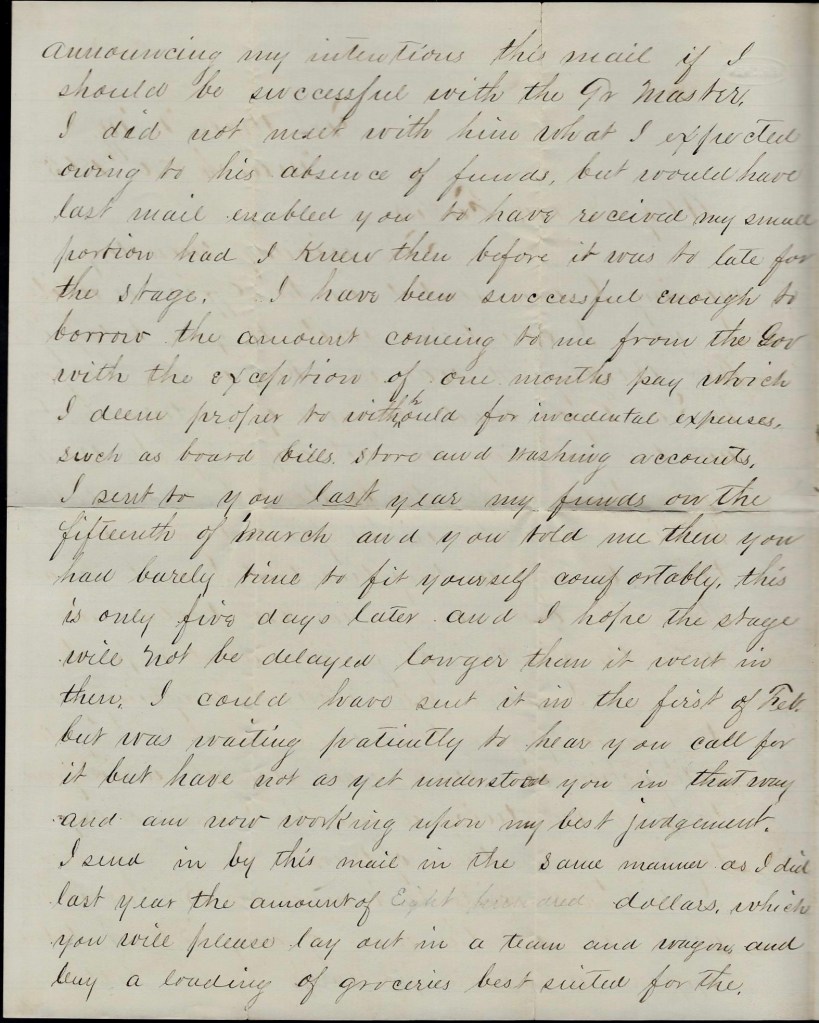
Letter 3
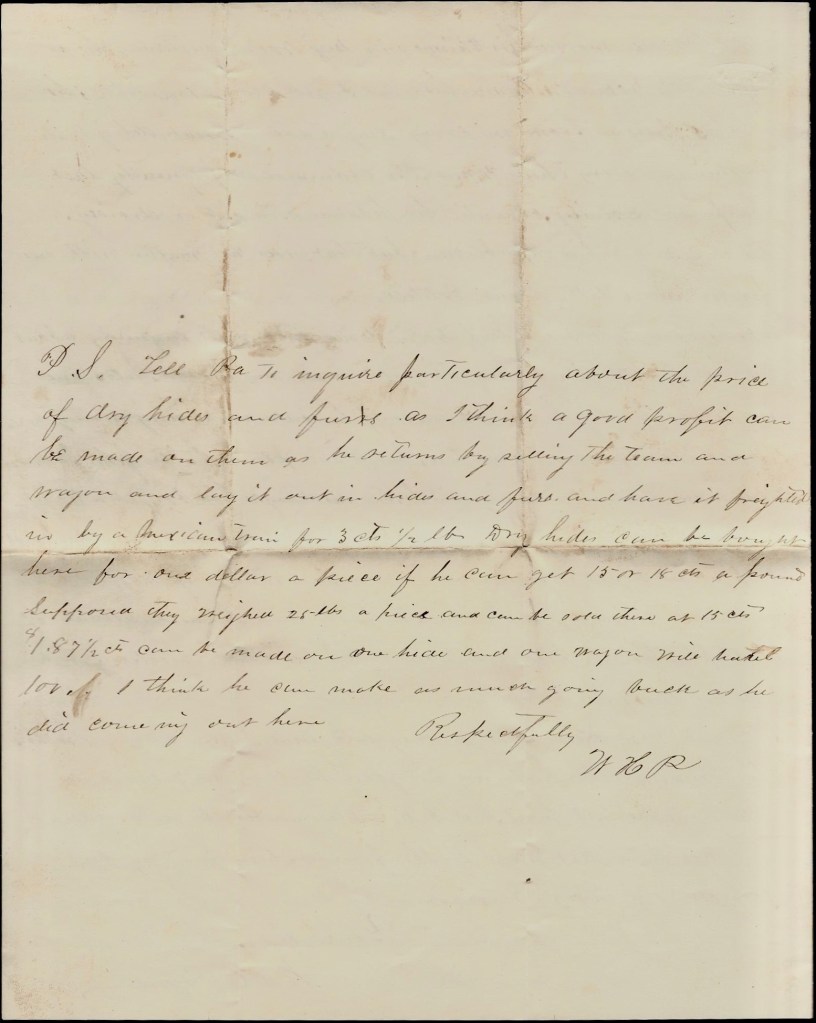
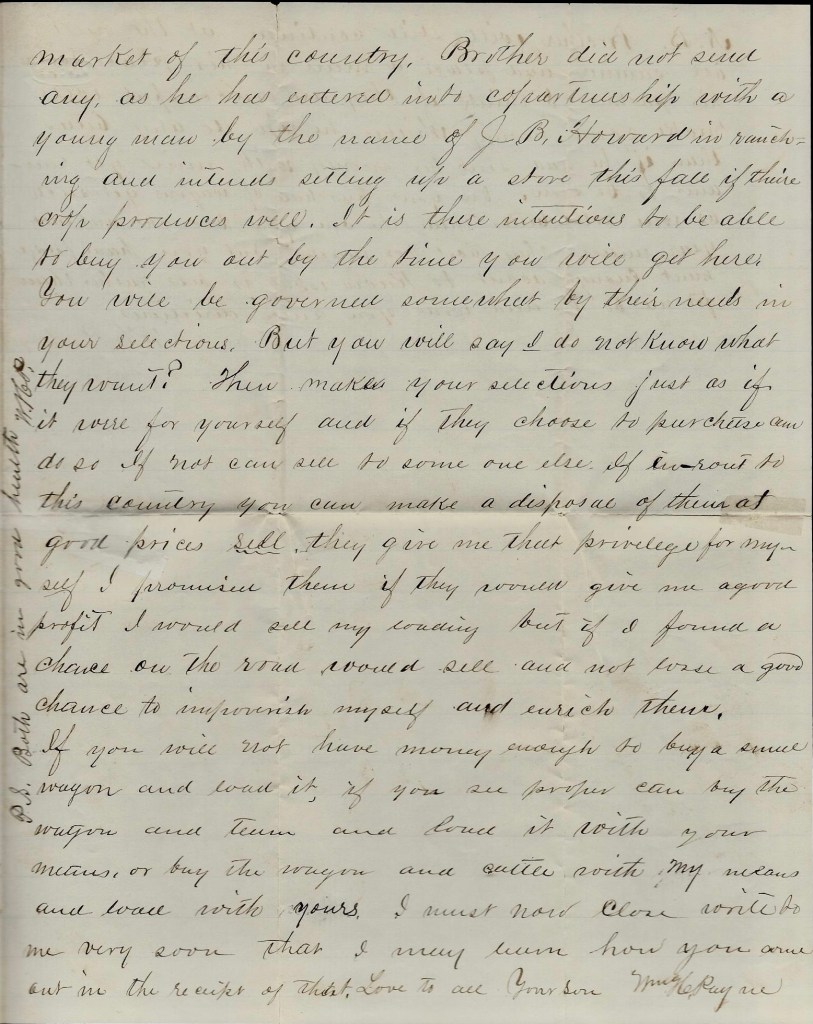
Letter 4
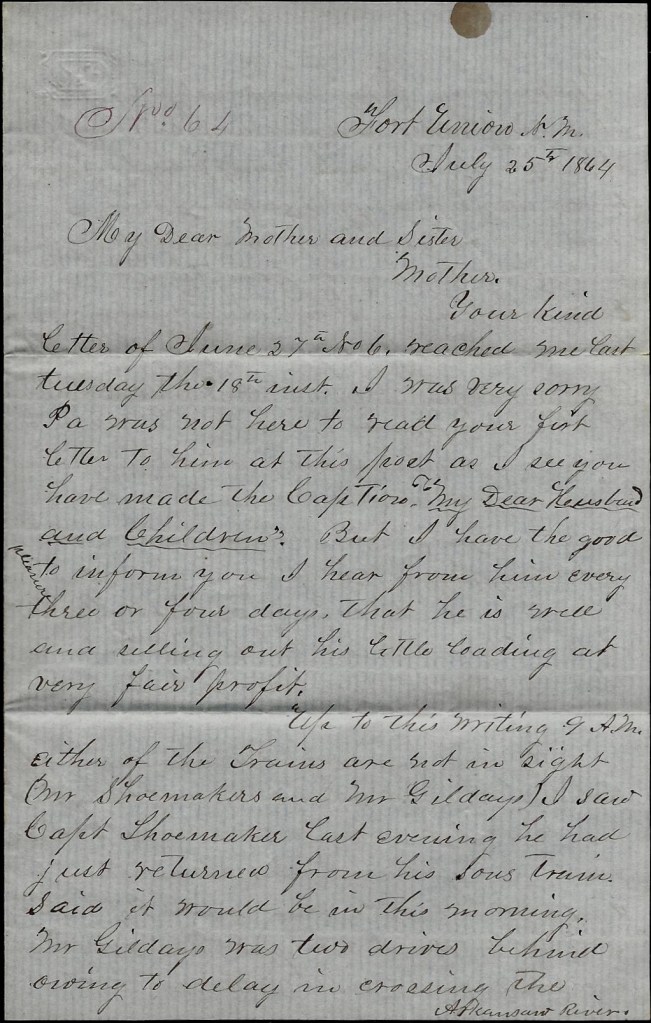
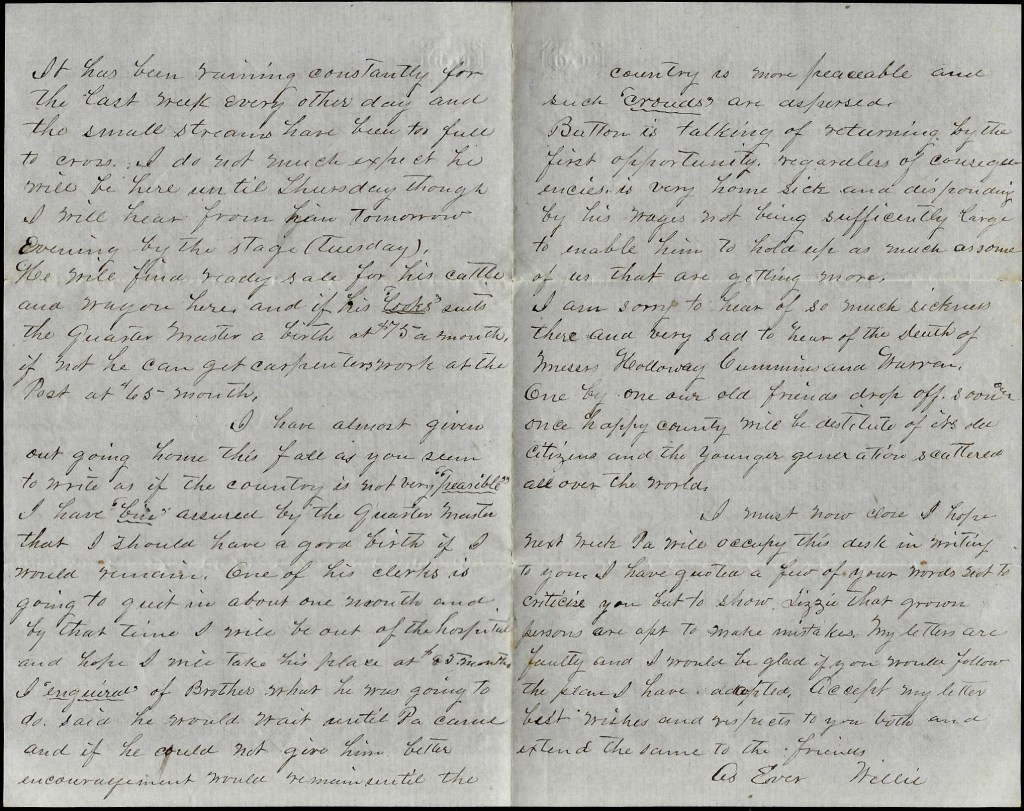
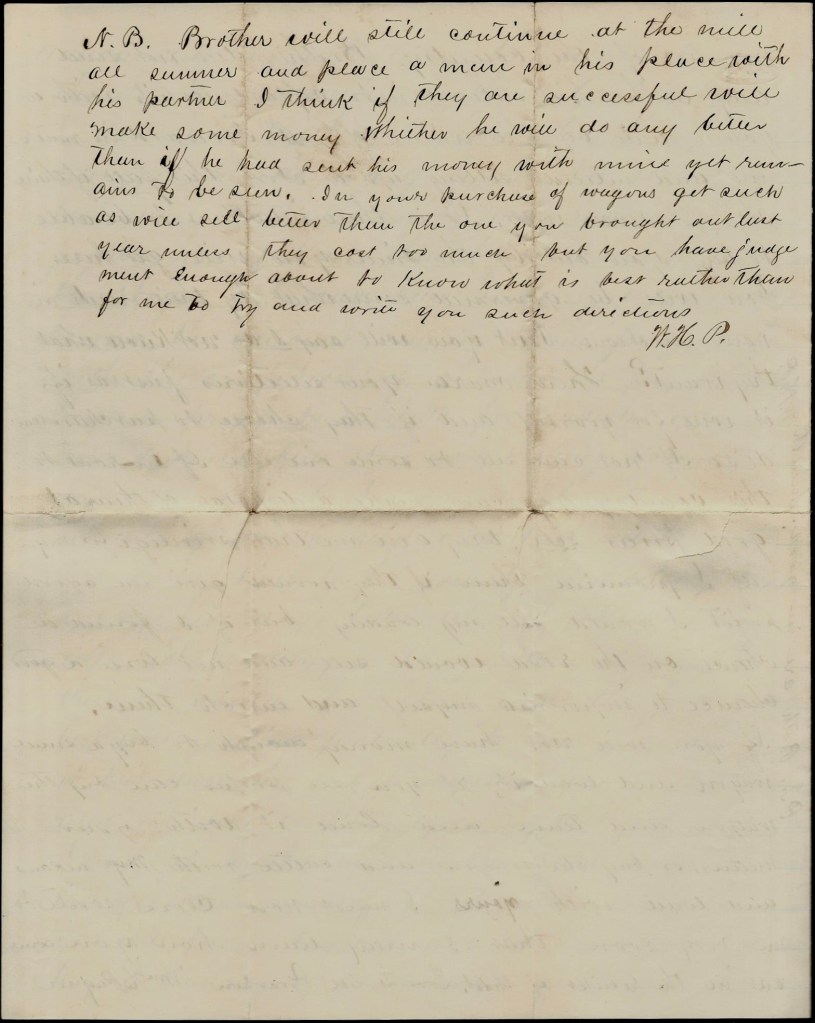
Letter 5
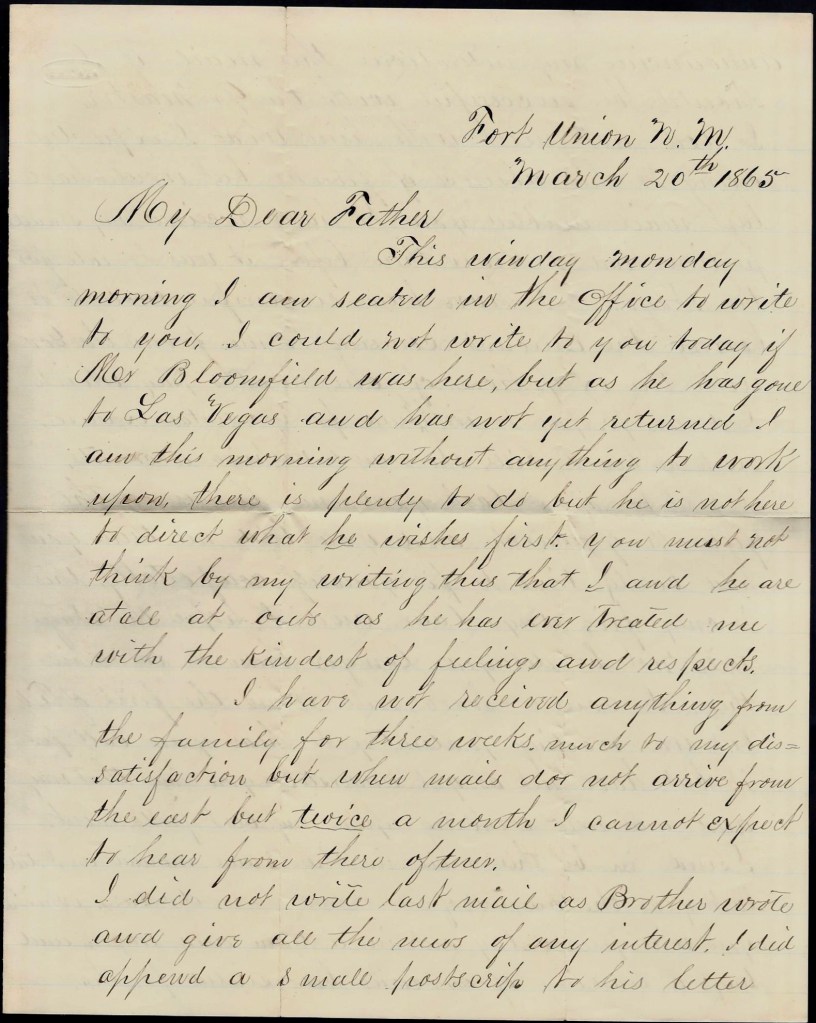
 Spared & Shared 23