
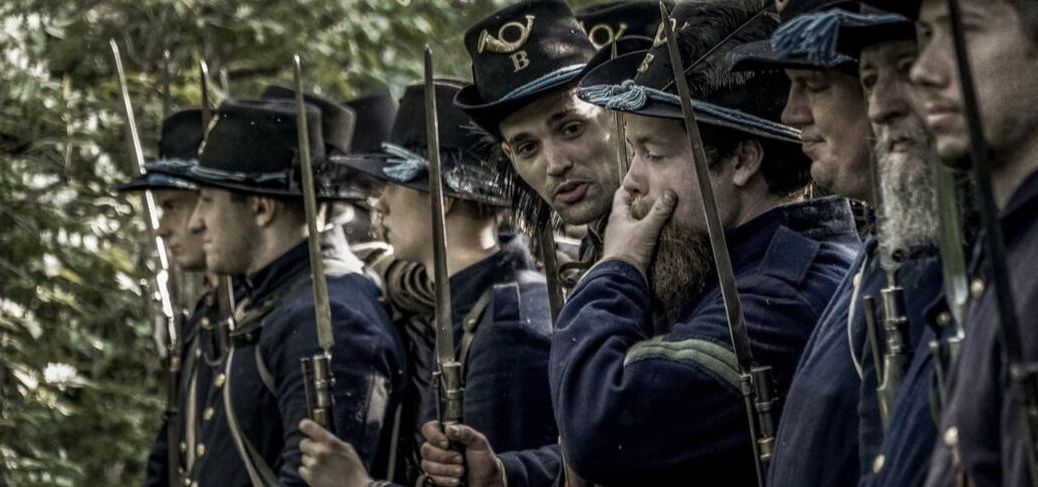
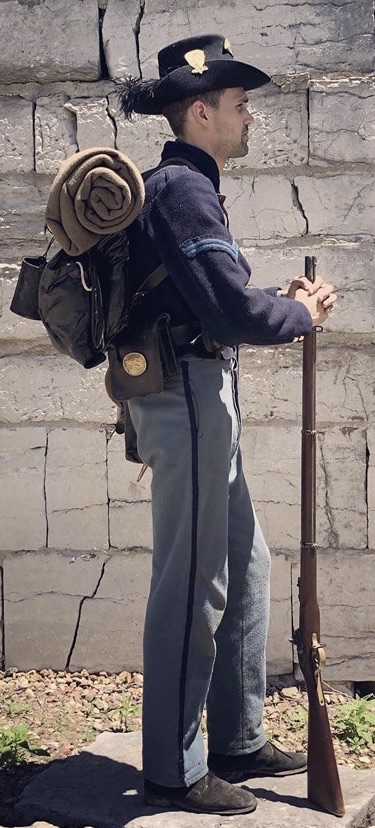
The following letters were written by James Betts Sifleet (1841-1863) who came to the United States with his parents from Kent, England, prior to the Civil War. The family settled in Verona, Grundy county, Illinois. His parents names were Robert Thomas Sifleet (1817-1893) and Sarah Betts (1819-1871). The Sifleet’s had two son’s that served in the Civil War—James, and his younger brother George Thomas Fleet (1842-1863. Neither son came home.
James enlisted in September 1861 as a private in Co. F, 36th Illinois Infantry—the “Fox River Regiment.” He died on 10 January 1863 in a Nashville Hospital from an infected wound received during the Battle of Stone Rivers [See The 36th Illinois Infantry at the Battle of Stones River]. His brother George served in Co. D, 127th Illinois Infantry and died of disease on 25 April 1863 at Youngs Point, Louisiana.
To read other letters by members of the 36th Illinois Infantry that I have transcribed and posted on Spared & Shared, see:
Freeman Stanton Dunklee, Co. A, 36th Illinois
Henry C. Baxter, Co. E, 36th Illinois
John F. Weeks, Co. K, 36th Illinois
[Note: The image in the header is from the Alton Jaeger Guards, portraying the 36th Illinois Infantry. They began forming in early August 1861 at Camp Hammond near Aurora, Illinois. They would take part in action at Pea Ridge, Perryville, Stone’s River, Chickamauga, Missionary Ridge, the Atlanta Campaign, Franklin, and Nashville.]
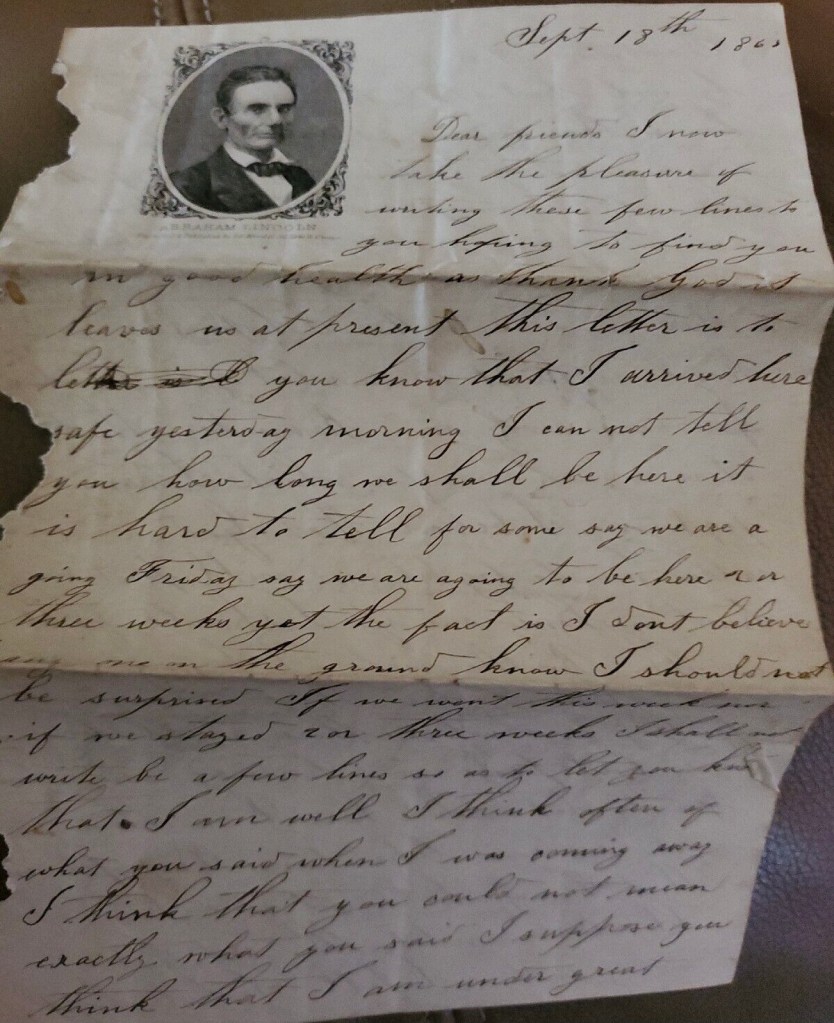
Letter 1
[Camp Hammond, Aurora, Illinois]
September 18, 1861
Dear Friends,
I now take the pleasure of writing these few lines to you hoping to find you in good health as, thank God, it leaves us at present. This letter is to let you know that I arrived here safe yesterday morning. I cannot tell you how long we shall be here. It is hard to tell for some say we are a going Friday [and some] say we are a going to be here two or three weeks yet. The fact is, I don’t believe anyone on the ground knows. I should not be surprised if we went this week nor if we stayed two or three weeks. I shall not write but a few lines so as to let you know that I am well.
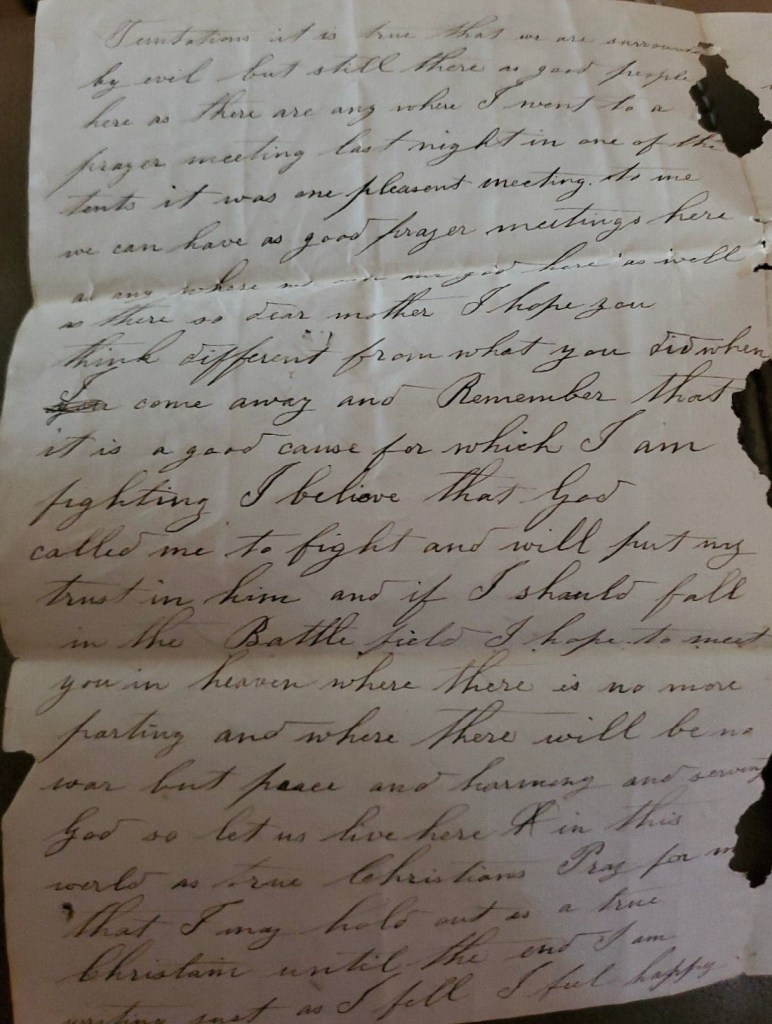
I think often of what you said when I was coming away. I think that you could not mean exactly what you said. I suppose you think that I am under great temptations. It is true that we are surrounded by evil but still there are good people here as there are anywhere.
I went to a prayer meeting last night in one of the tents. It was one pleasant meeting to me. We can have as good prayer meetings here as anywhere. We have our God here as well as there, so dear Mother, I hope you think different from what you did when I come away. And remember that it is a good cause for which I am fighting. I believe that God called me to fight and will put my trust in Him. And if I should fall in the battlefield, I hope to meet you in heaven where there is no more parting and where there will be no war, but peace and harmony and serving God. So let us live here in this world as true Christians. Pray for me that I may hold out as a true Christian until the end.
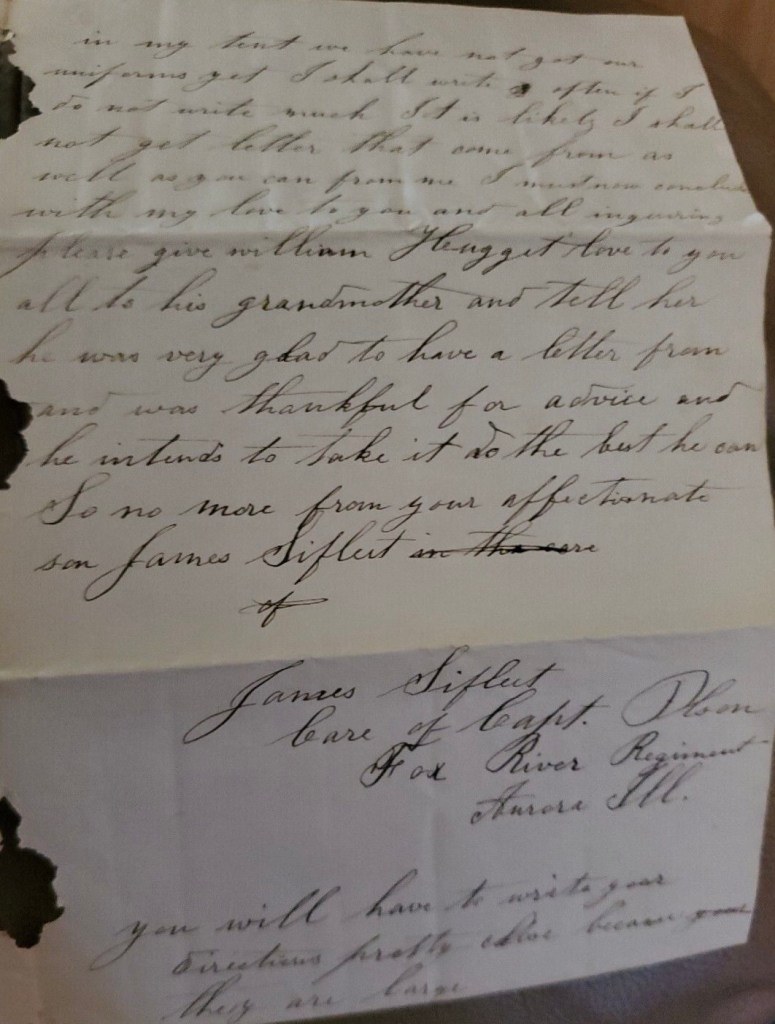
I am writing just as I feel. I feel happy in my tent. We have not got our uniforms yet. I shall write often if I do not write much. It is likely I shall not get letters that come from [you] as well as you can from me. I must now conclude with my love to you and all inquiring [friends].
Please give William Huggett 1 love to you all, to his grandmother, and tell her he was very glad to have a letter from [her] and was thankful for advice and he intends to take it [and] do the best he can. So no more from your affectionate son, — James Sifleet
Care of Capt. Olson, Fox River Regiment, Aurora, Illinois
You will have to write your directions pretty clear because they are large.
1 William Huggett enlisted in the same company at the same time as James. He was mortally wounded (like James) at the Battle of Stone River.
Letter 2
Camp Rolla, Missouri
October 13, 1861
Dear father and mother, brother and sister,
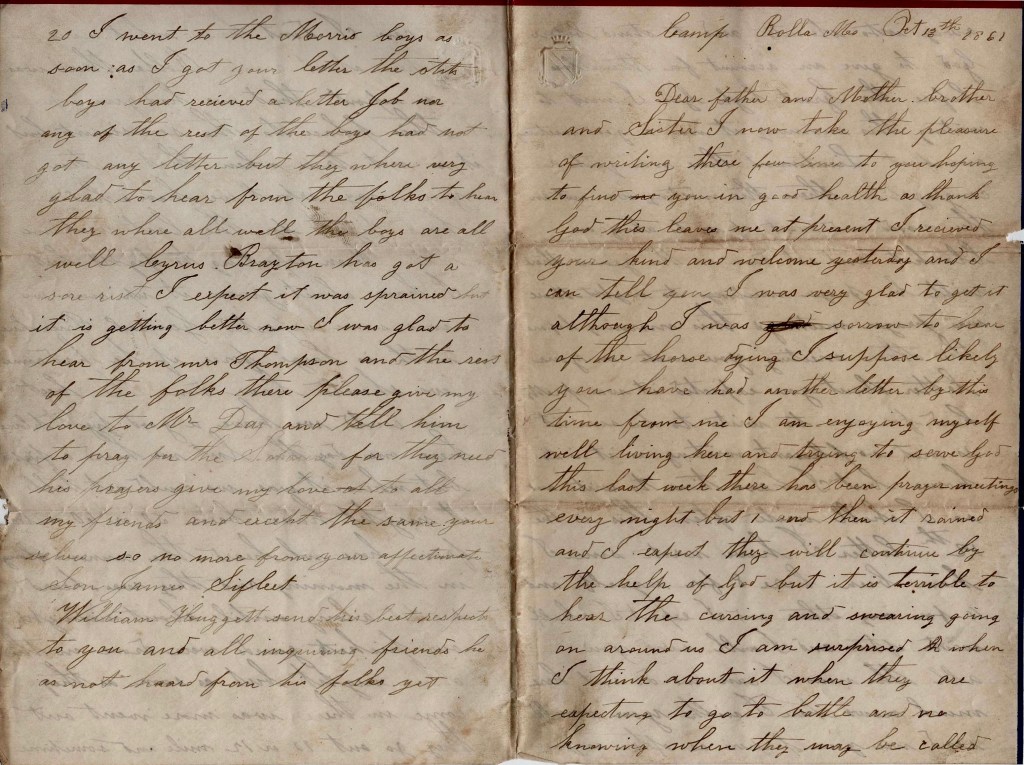
I now take the pleasure of writing these few lines to you hoping to find you in good health as thank God this leaves me at present. I received your kind and welcome [letter] yesterday and I can tell you, I was very glad to get it although I was sorry to hear of the horse dying. I suppose likely you have had another letter by this time from me.
I am enjoying myself well living here and trying to serve God. This last week there has been prayer meetings every night but one and it rained and I expect they will continue by the help of God. But it is terrible to hear the cursing and swearing going on around us. I am surprised when I think about it, [especially] when they are expecting to go to battle and no knowing when they may be called away into eternity adn to stand before God to give an account for themselves before the Great High God.
I went to meeting this morning. It was a good meeting. Our first lieutenant [was there]. There was quite a congregation there. The meeting was out in the woods and most of us took along our blankets and sat down on the ground. There will be prayer meeting tonight. There was prayer meetings this morning before the other meeting.
You wrote in your letter about [how] you expected it was hard for me to write. To be sure, it is not so pleasant writing as it is to home, but I have time to write and so I shall write often. This is the 12th letter I have wrote since I have been here, 8 for myself and four for others. And I expect I shall write often and I will send you all the news here. I wish you would send me your papers as often as you can.
I don’t know what you hear about Camp Rolla. There was a report that we had give up this place to the secessionists but it is not true. When that is true, you may expect we have had a hard fight. For the last week we have been expecting to fight but I have about given it up now. We some expected General Price here with his large force. If he had come, we should have done the best we could. We have a good fight place here. One day this last [week] we heard a fight but where it was, we could not tell. It might have been 50 or 60 miles from here. We heard the canons along in the morning and they was heard right along until about midnight.
Our picket guards were drove in the other night but as soon as they come in, there was more went out. They go out 10 or 12 miles and sometimes 20. I went to [see] the Morris boys as soon as I got your letter. The [ ] boys had received a letter. Job nor any of the rest of the boys had not got any letter but they were very glad to hear from the folks to hear they were all well. The boys are all well. Vyrus Brayton has got a sore wrist. I expect it was sprained but it is getting better now.
I was glad to hear from Mrs. Thompson and the rest of the folks there. Please give my love to Mr. Day and tell him to pray for the soldiers for thy need his prayers. Give my love to all my friends and accept the same yourselves. So no more from your affectionate son, — James Sifleet
William Huggett sends his best respects to you and all inquiring friends. He has not heard from his folks yet.

Letter 3
Camp Rolla, Missouri
October 21, 1861
Dear father and mother,
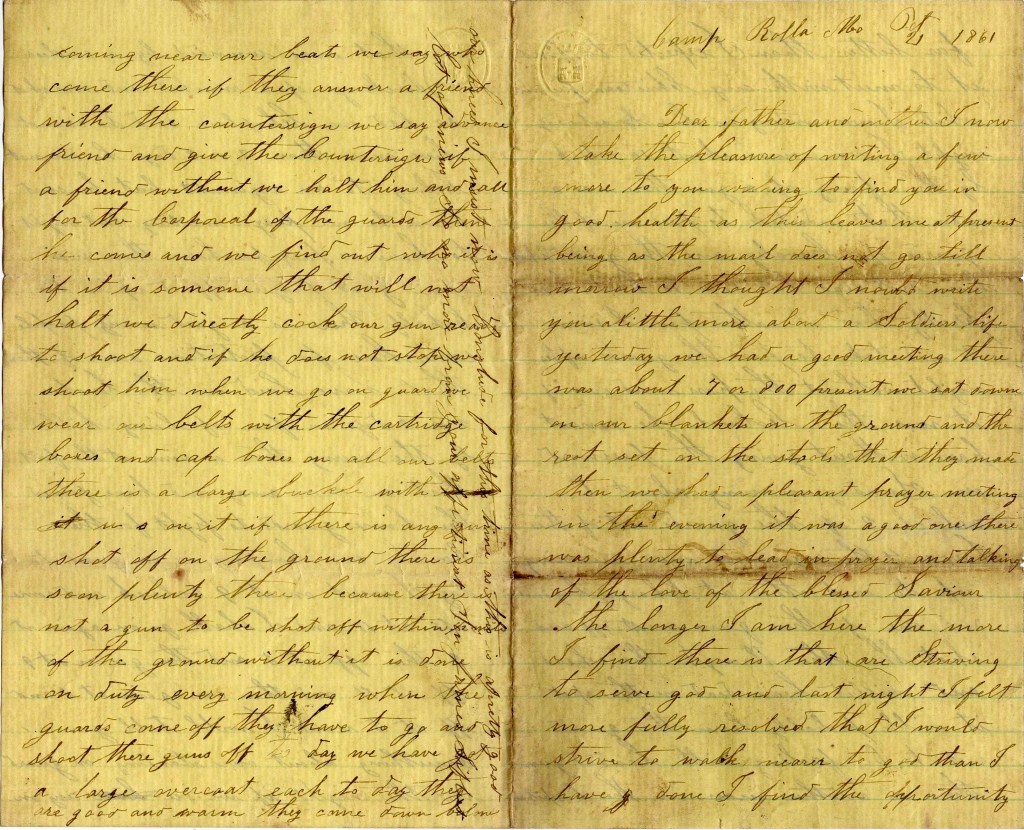
I now take the pleasure of writing a few more to you wishing to find you in good health as this leaves me at present. Being as the mail does not go till morrow, I thought I would write you a little more about a soldier’s life. Yesterday we had a good meeting. There was about 7 or 800 present. We sat down on our blankets on the ground and the rest sat on the stools that they made. Then we had a pleasant prayer meeting in the evening. It was a good one. There was plenty to lead in prayer and talking of the love of the blessed Savior. The longer I am here the more I find there is that are striving to serve God and last night I felt more fully resolved that I would strive to walk nearer to God than I have done. I find the opportunity far better than I expected to find it to meet with my Christian friends.
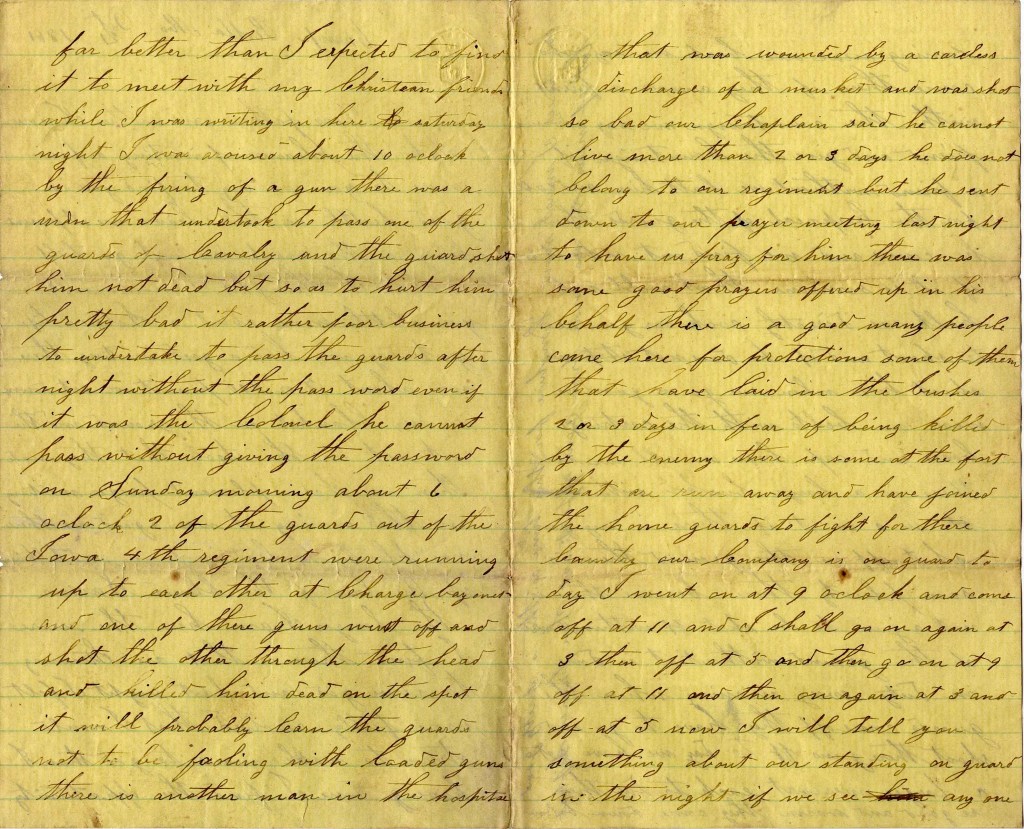
While I was writing in here Saturday night, I was aroused about 10 o’clock by the firing of a gun. There was a man that undertook to pass one of the guards of cavalry and the guard shot him—not dead, but so as to hurt him pretty bad. It’s rather poor business to undertake to pass the guards after night without the pass word, even if it was the Colonel. He cannot pass without giving the password.
On Sunday morning about 6 o’clock, two of the guards out of the 4th Iowa Regiment were running up to each other at charge bayonet and one of their guns went off and shot the other through the head and killed him dead on the spot. It will probably learn the guards not to be fooling with loaded guns. There is another man in the hospital that was wounded by a careless discharge of a musket and was shot so bad our chaplain said he cannot live more than two or three days. He does not belong to our regiment but he sent down to our prayer meeting last night to have us pray for him. There was some great prayers offered up in his behalf.
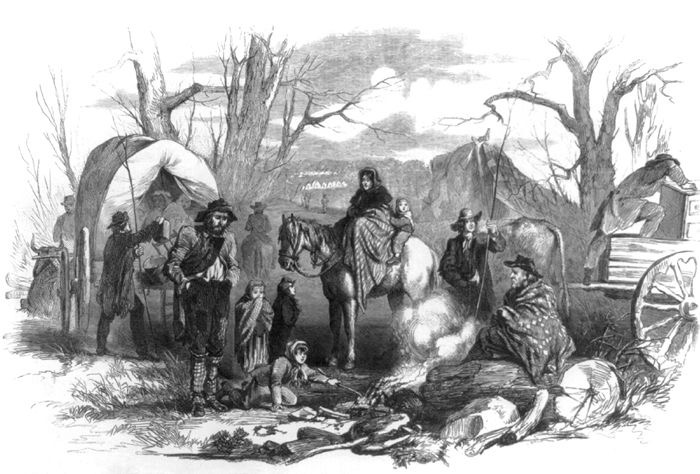
There is a good many people come here for protection—some of them that have laid in the bushes two or three days in fear of being killed by the enemy. There is some at the fort that are run away and have joined the home guards to fight for their country.
Our company is on guard today. I went on at 9 o’clock and come off at 11 and I shall go on again at 3, then off at 5, and then go on at 9, off at 11, and then on again at 3 and off at 5. Now I will tell you something about our standing on guard in the night. If we see anyone coming near our beats, we say, “Who comes there?” If they answer, “A friend with the countersign,” we say, “Advance friend and give the countersign.” If a friend without, we halt him and call for the Corporal of the Guard. Then he comes and we find out who it is. If it is someone that will not halt, we directly cock our gun ready to shoot and if he does not stop, we shoot him. When we go on guard, we wear our belts with the cartridge boxes and cap boxes. On all our belts there is a large buckle with “U. S.” on it. If there is any gun shot off on the ground, there is soon plenty there because there is not a gun to be shot off within half a mile of the ground without it is done on duty. Every morning when the guards come off, they have to go and shoot their guns off.
Today we have got a large overcoat each. They are good and warm. They come down below our knees. I must now conclude for this time as this is a pretty good lot of news, so no more from your affectionate son, — James Siffert
Letter 4
Camp Rolla, Missouri
October 28th 1861
Dear father and mother, brother and sister,
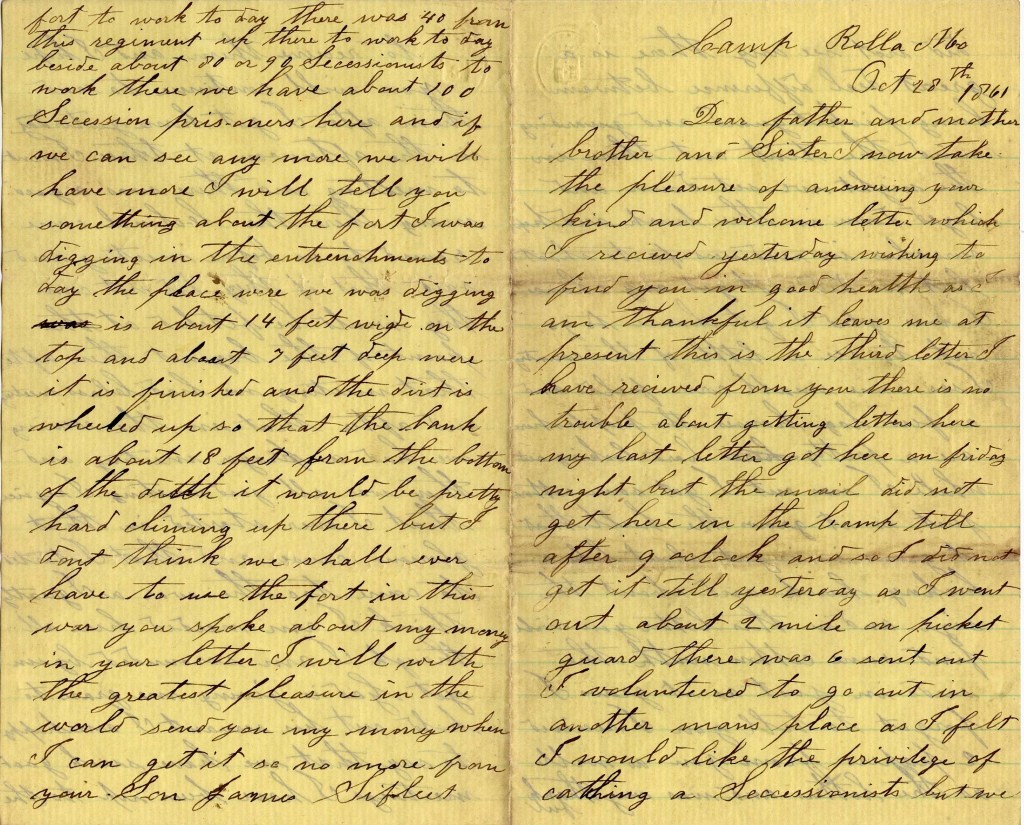
I now take the pleasure of answering your kind and welcome letter which I received yesterday wishing to find you in good health as I am thankful it leaves me at present. this is the third letter I have received from you. There is no trouble about getting letters here. My last letter got here on Friday night but the mail did not get here in the camp till after 9 o’clock and so I did not get it till yesterday as I went out about two miles on picket guard. There was six sent out. I volunteered to go out in another man’s place as I felt I would like the privilege of catching a secessionist but we did not see any.

There is a great deal of difference between being picket guard and guarding round the tent. Out there in the night, we sit down and lay down in the brush and keep ourselves in readiness for to shoot. But we did not get any chance. I was glad I got a chance to go out to see a little of the country. I seen some small corn fields and a few log gouses. The people here are a pretty hard-looking set. While I was out, I got some cotton just as it grows. The hull that it grows in is just about like a hickory husk and about the [same] size. And in this letter you will find some cotton with the seeds in just as it grows. I forgot to tell you I received two papers from you as well as the letters and was very thankful to receive them and I hope you will continue to send them.
After I got home yesterday in the afternoon at three, I went to meeting and there was a good many there. The Colonel came round to us before meeting and said that if they did not come, they would be fetched at the point of the bayonet. Then after that meeting we had class meeting and after that in the evening, we had a prayer meeting and they was all good meetings. I rejoice that I ever started in that glorious cause and that I started to come to the war as I greatly think I am needed here although I am surrounded by sin. Yet God is giving me grace to hold out his servant. I am happy to say that we have such good meetings.
I have been up to the fort to work today. There was 40 from this regiment up there to work today besides about 80 or 90 secessionists to work there. We have about 100 secession prisoners here and if we can see any more, we will have more.
I will tell you something about the fort. 1 I was digging in the entrenchments today. The place where we was digging is about 14 feet wide on the top and about 7 feet deep where it is finished and the dirt is wheeled up so that the bank is about 18 feet from the bottom of the ditch. It would be pretty hard climbing up there but I don’t think we shall ever have to use the fort in this war.
You spoke about my money in your letter. I will with the greatest pleasure in the world send you my money when I can get it. So no more. From your son, — James Sifleet
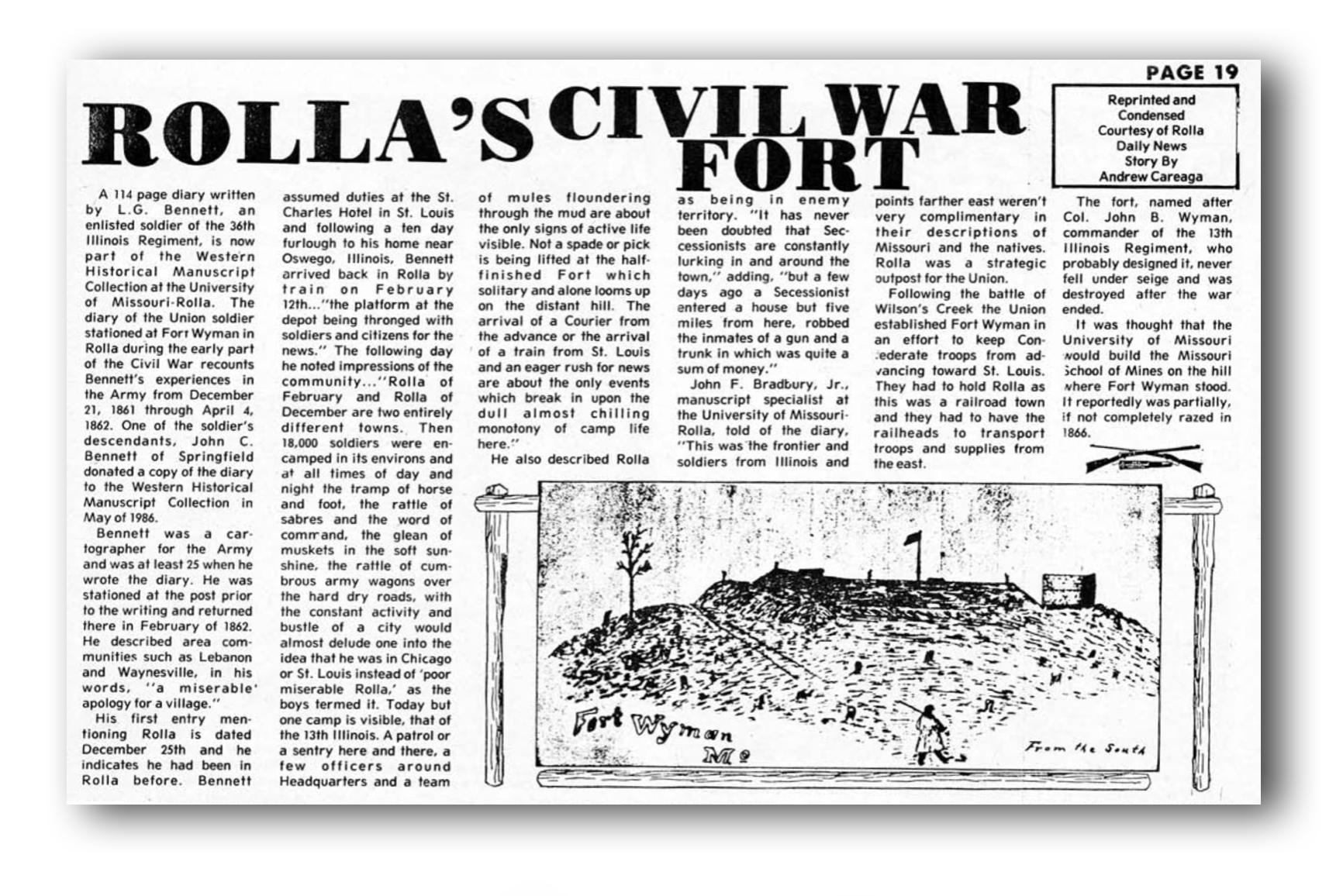
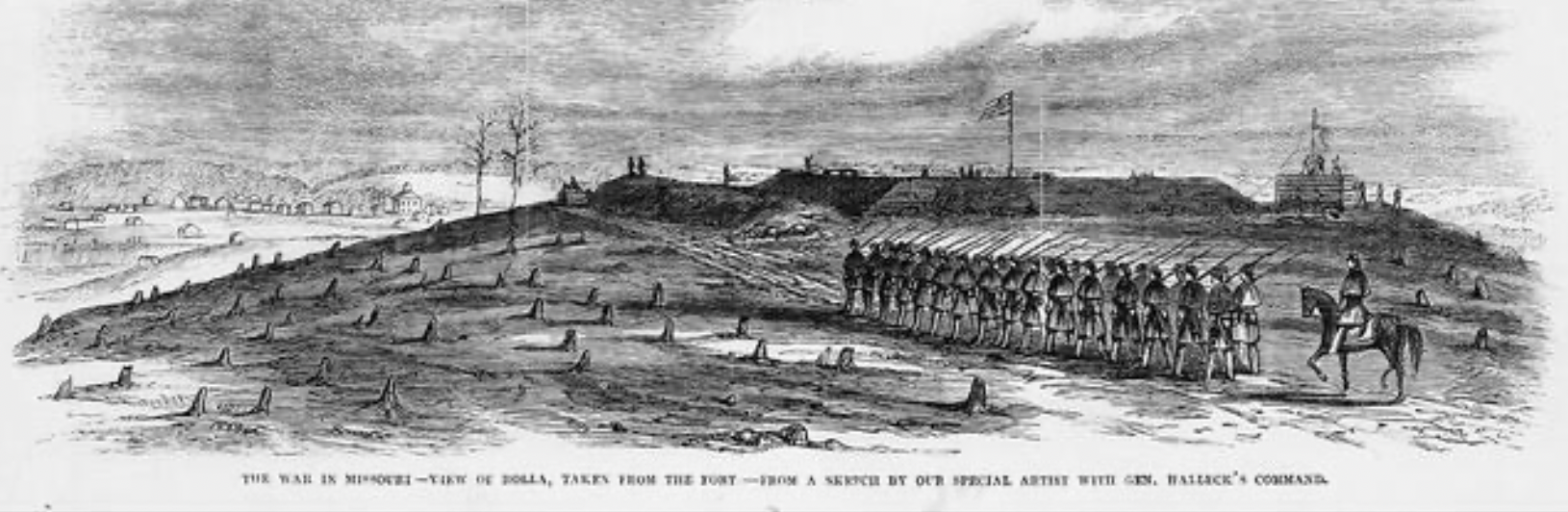
1 James does not give the name of the fort but it seems certain he was referring to the same fort that was eventually dubbed Fort Wyman, named after Col. John B. Wyman of the 13th Illinois Regiment who worked on its construction after the 36th Illinois. See newspaper article below. According to Larry Wood, a freelance write specializing in the history of the Ozarks, “Two forts were constructed, one called Fort Detty on the north side of town on what is now the campus of the University of Missouri-Rolla and the other called Fort Wyman located just south of town along present-day US Highway 63. In addition, a network of earthworks and trenches surrounded the town, the courthouse was fortified with rifle pits, and a strong headquarters encampment was located west of town.” [See “Rolla During the Civil War”]

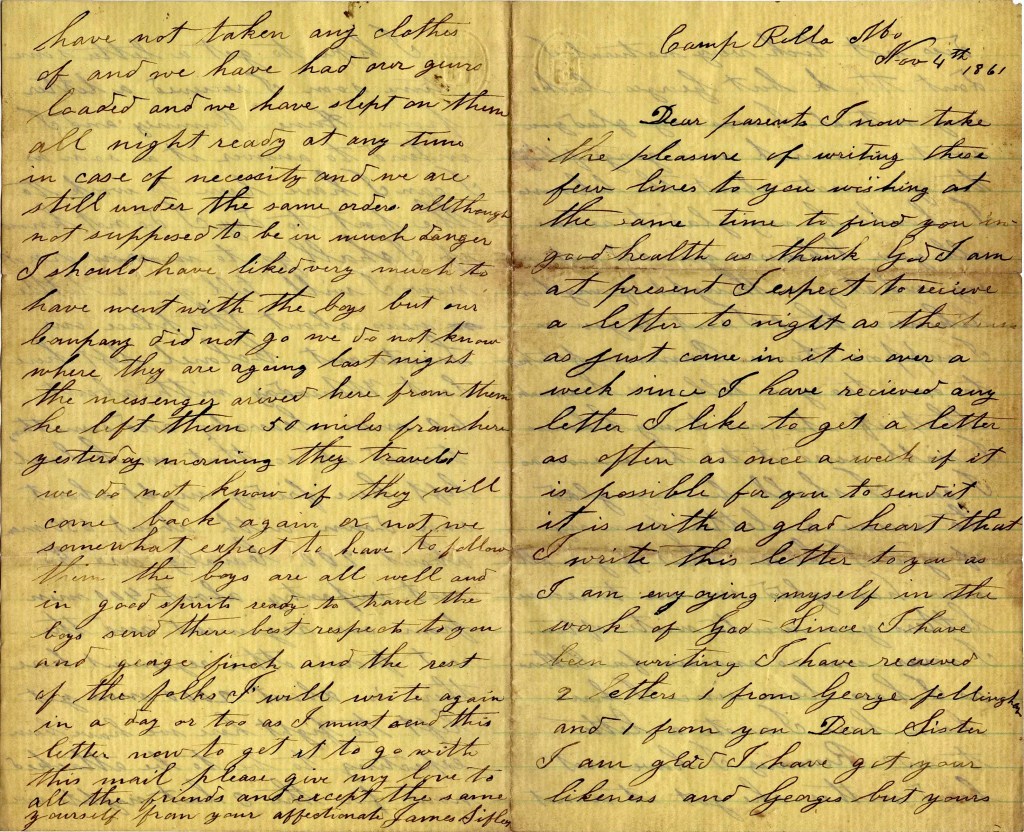
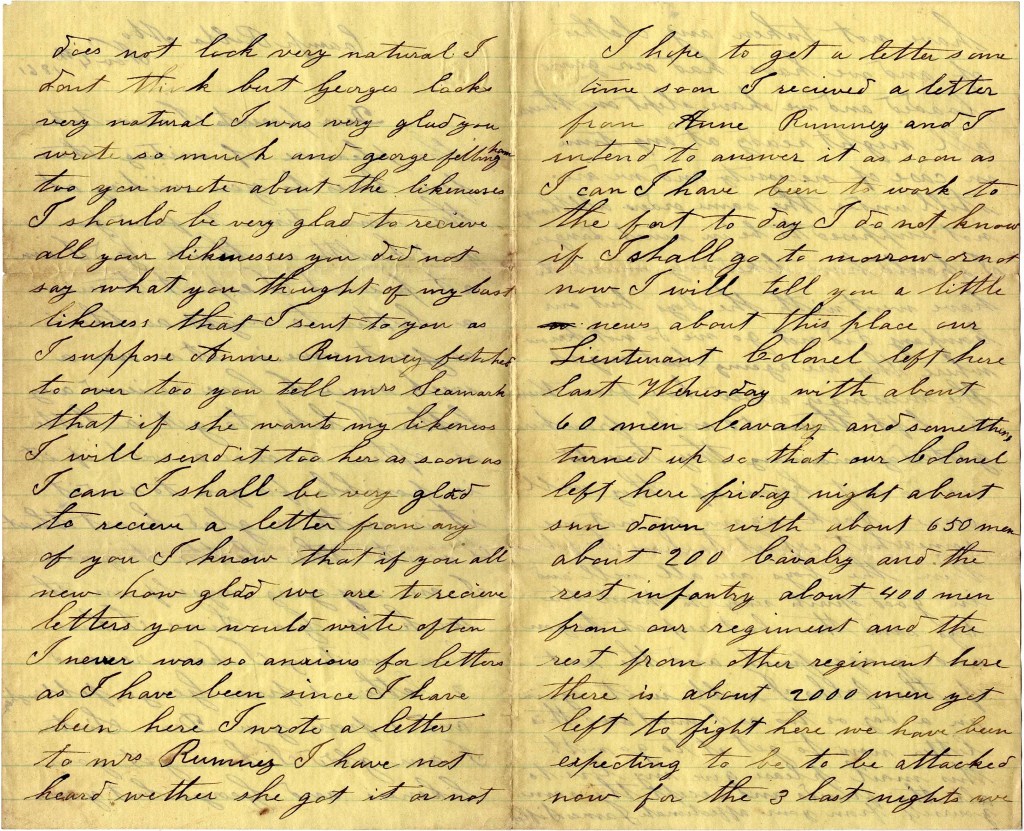
Letter 5
Camp Rolla, Missouri
November 4, 1861
Dear parents,
I now take the pleasure of writing these few lines to you wishing at the same time to find you in good health as thank God I am at present. I expect to receive a letter tonight as the train has just come in. It is over a week since I have received any letter. I like to get a letter as often as once a week if it is possible for you to send it. It is with a glad heart that I write this letter to you as I am enjoying myself in the work of God. Since I have been writing, I have received two letters—one from George Jellingham [?] and one from you.
Dear sister, I am glad I have got your likeness and George’s but yours does not look very natural, I don’t think. But George’s looks very natural. I was very glad you write so much and George getting home too. You wrote about the likeness. I should be very glad to receive all your likenesses. You did not say what you thought of my last likeness that I sent to you as I suppose Anne Rumney fetched over to you. Tell Mrs. Seamark that if she wants my likeness I will send it to her as soon as I can. I shall be very glad to receive a letter from any of you. I know that if you all knew how glad we are to receive letters, you would write often. I never was so anxious for letters as I have been since I have been here. I wrote a letter to Mrs. Rumney. I have not heard whether she got it or not. I hope to get a letter sometime soon. I received a letter from Anne Rumney and I intend to answer it as soon as I can.
I have been to work to the fort today. I do not know if I shall go tomorrow or not. Now I will tell you a little news about this place. Our Lieutenant Colonel left here last Wednesday with about 60 men, cavalry, and something turned up so that our Colonel left here Friday night about sundown with about 650 men—about 200 cavalry, and the rest infantry. [There were] about 400 men from our regiment and the rest from another regiment here. There is about 2,000 men yet left to fight here. We have been expecting to be attacked now. For the three last nights, we have not taken any clothes off and we have had our guns loaded and we have slept on them all night, ready at any time in case of necessity. And we are stil under the same orders although not supposed to be in much danger. I should have liked very much to have went with the boys but our company did not go. We do not know where they are a going.
Last night the messenger arrived here from them. He left them 50 miles from here yesterday morning [where] they traveled. We do not know if they will come back again or not. We somewhat expect to have to follow them. The boys are all well and in good spirits, ready to travel. The boys send their best respects to you and George Finch and the rest of the folks. I will write again in a day or two as I must send this letter now to get it to go with this mail. Please give my love to all the friends and accept the same yourself. From your affectionate, — James Sifleet
Letter 6
Camp Rolla, Missouri
December 10th 1861
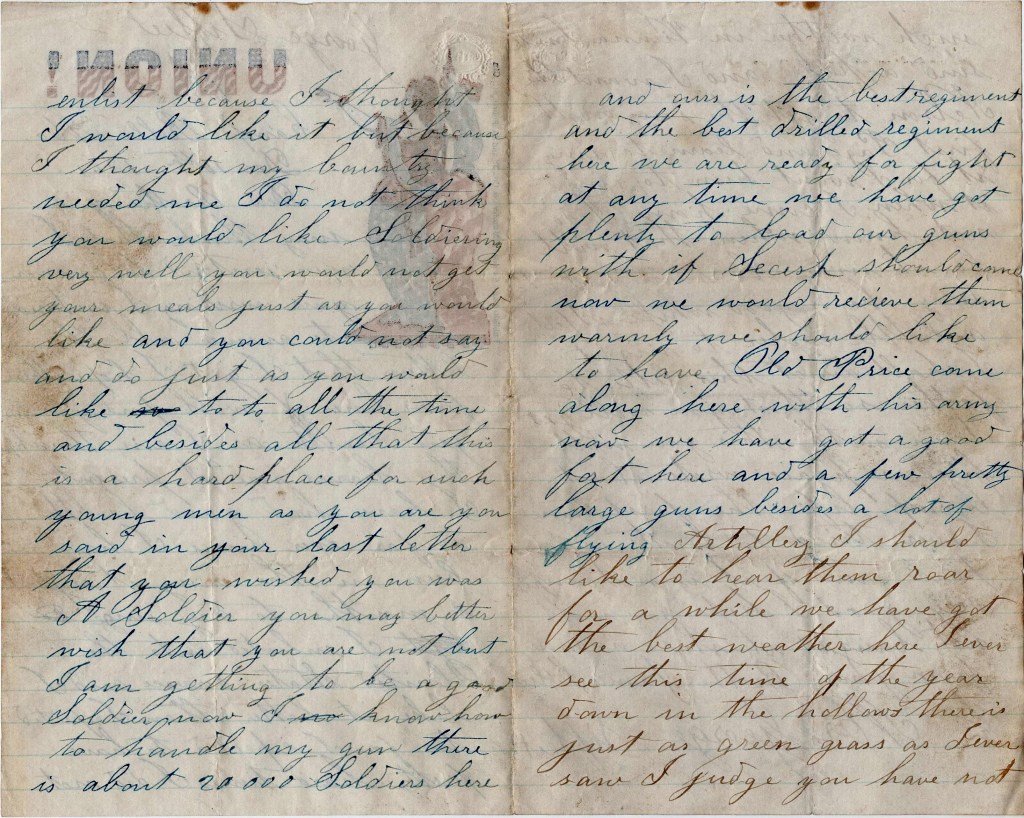
Dear Brother [George Sifleet],
You may think that I never intend to answer all the letters that I get. I hope these few lines will find you in good health as this leaves me at present.
I have had good health so far ever since I have been in the army. It is just three months today since I enlisted in the United States service and I like it better than I expected to for I expected to have pretty hard times. I did not enlist because I thought I would like it but because I thought mu country needed me. I do not think you would like soldiering very well. You would not get your meals just as you would like and you could not say and do just as you would like to all the time. And besides all that, this is a hard place for such a young man as you are. You said in your last letter that you wished you was a soldier. You may better wish that you are not. But I am getting to be a good soldier now [that] I know how to handle my gun.
There is about 20,000 soldiers here and ours is the best regiment and the best drilled regiment here. We are ready for a fight at any time. We have got plenty to load our guns with. Secesh should come now. We should like to have Old Price come along here with his army now. We have got a good fort here and a few pretty large guns besides a lot of flying artillery. I should like to hear them roar for awhile.
We have got the best weather here I ever saw this time of the year. Down in the hollows there is just as green grass as I ever saw. I judge you have not such weather in Vienna. I will send a paper and I want Ike Nelson to get the song on the first page and learn to sing it for I want him to sing it when I come home. I do not know when that will be. It may be soon and it may be a good while. It feels a little cooler tonight. I shall direct this letter to father so that you will get it. In with this you will find a piece wrote about camp life—the first time I ever tried to write any piece—and it is not composed very good. I hope you will not laugh at it. So no more. From your brother, — James Sifleet
To George Sifleet

Letter 7
Camp Rolla, Missouri
December 27, 1861
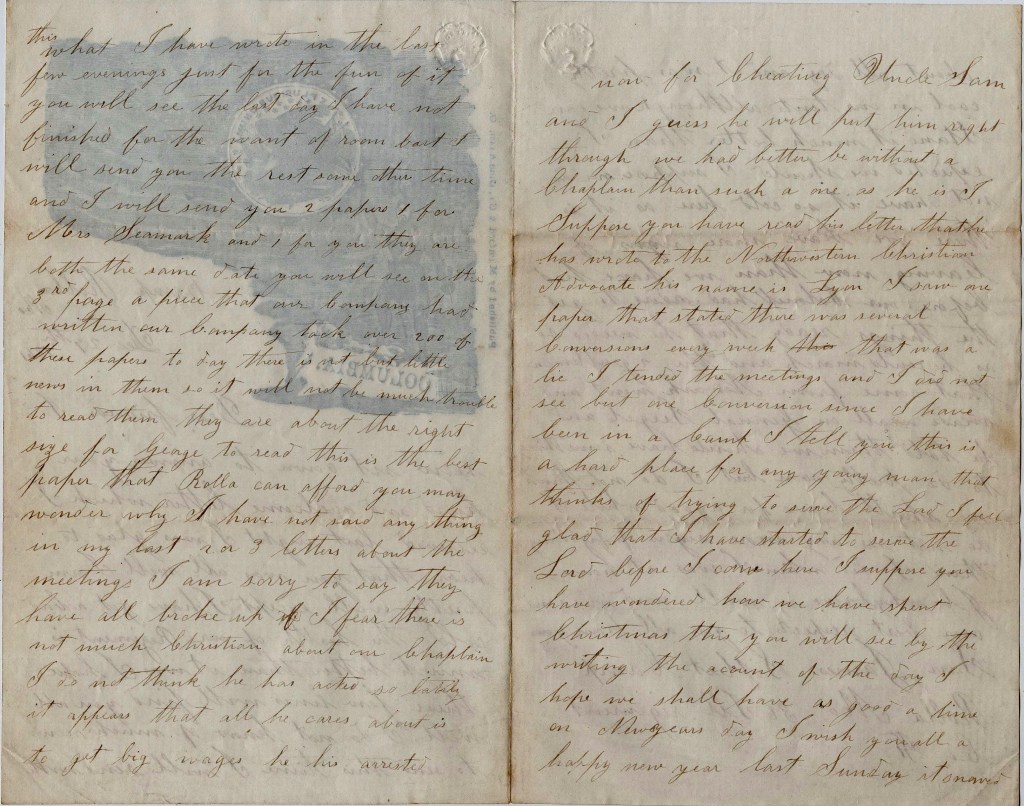
Dear friends,
I now sit down to answer your kind and welcome letter which I received last night. I was glad to hear that you was all well. I am pretty well except I have a bad cold. The health of our regiment is much better than it was. I hope these few lines will find you all well. I do not know of much news to send this time. I will send this with what I have wrote in the last few evenings just for the fun of it.
You will see the last day I have not finished for the want of room but I will send you the rest some other time and I will send you two papers–oone for Mrs. Seamark and one for you. They are both the same date. You will see on the 3rd page a piece that our company had written. Our company took over 200 of these papers today. There is not but little news in them so it will not be much trouble to read them. They are about the right size for George to read. This is the best paper that Rolla can afford.
You may wonder why I have not said anything in my last two or three letters about the meetings. I am sorry to say they are all broke up. I fear there is not much Christian about our chaplain. I do not think he has acted so lately. It appears that all he cares about is to get big wages. He has [been] arrested for cheating Uncle Sam and I guess he will be put him right through. We had better be without a chaplain than such a one as he is. I suppose you have read his letter that he has wrote to the Northwestern Christian Advocate? His name is [George G.] Lyon. 1 I saw one paper that states there was several conversions every week. That was a lie. I [at]tended the meetings and I did not see but one conversion since I have been in a camp. I tell you this is a hard place for any young man that thinks of trying to serve the Lord. I feel glad that I have started to serve the Lord before I came here.
I suppose you have wondered how we spent Christmas. This you will see by the writing the account of the day. I hope we shall have as good a time on New Year’s day. I wish you all a happy new year. Last Sunday it snowed about all day and it was pretty cool in our tents although we can stand it much better than I expected we should. I suppose we don’t have it so cold here as it is there.
We have more signs of leaving now than we have had before. Our Colonel had orders to get the things ready that he needed so as he could march and the two gentlemen that came from Newark went and made a call on General [Franz] Sigel and he told them we should have something to do pretty soon but I do not think we shall leave for a good while. I do not see any more signs of fighting than I did when I was at home.
Job Whybrow is well and we send our best respects to you all. From your son, — James Sifleet
Camp Rolla, Mo., 36th Illinois Regiment, Co. F
1 George G. Lyon (b. 1824 in Fayette county, Pa.) was appointed the Chaplain of the 36th Illinois on 20 August 1861 and was mustered in on 23 September 1861. He mustered out of the regiment on 11 June 1862 at Washington D. C., to take effect on 1 April 1862. He gave his residence as Woodstock, McHenry county, Illinois. The Woodstock Sentinel of 26 February 1862, published a notice that “Rev. George G. Lyon of this place…has been acquitted of the charges preferred against him by an officer of the regiment.”

Letter 8
[Curtis’ Campaign]
January 16, 1862
Dear father,
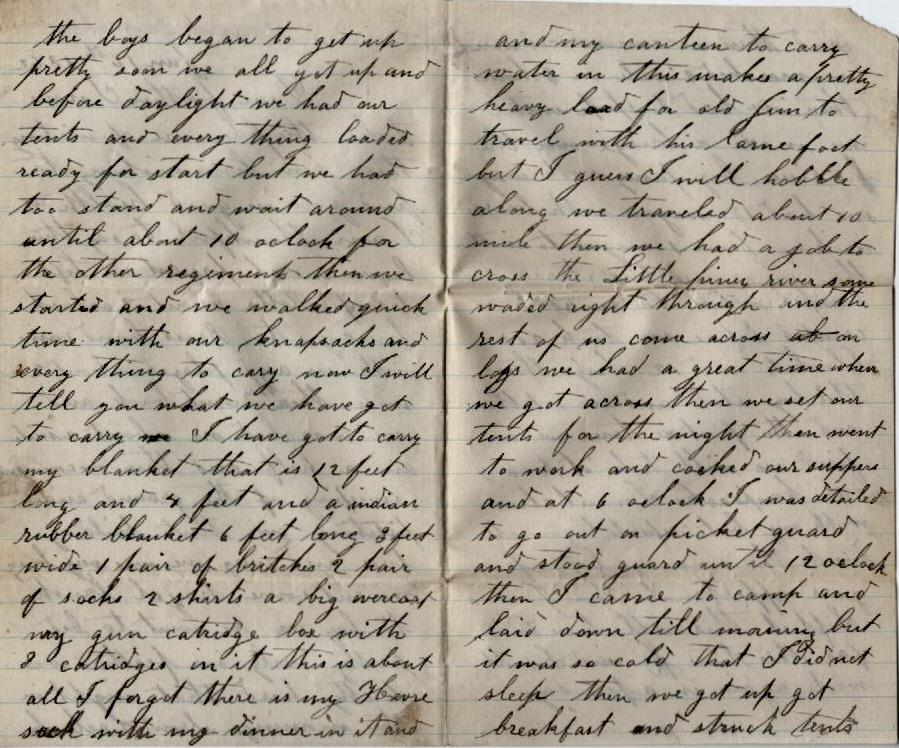
I now take the pleasure of writing these few lines wishing to find you in good health as I am thankful to say this leaves me at present. We left Camp Rolla about 2 o’clock Tuesday. The brass band came with us and played about two miles. Then they went back and we marched on about a mile and a half and then we commenced sweeping the ground and pitching our tents, building fires, and everyone was very busy. We cut some hazel brush to lay on. We went to bed pretty early. Our feathers was pretty hard that night.
In the morning about 2 o’clock the boys began to get up. Pretty soon we all got up and before daylight we had our tents and everything loaded, ready for start. But we had to stand and wait around until about 10 o’clock for the other regiments. Then we started and we walked quick time with our knapsacks and everything to carry.
Now I will tell you what we have to carry. I have got to carry my blanket that is 12 feet long and 4 feet wide, and a Indian rubber blanket 6 feet long and 3 feet wide, 1 pair of britches, two pair of socks, two shirts, a big overcoat, my gun cartridge box with 8 cartridges in it. This is about all. I forgot—there is [also] my haversack with my dinner in it and my canteen to carry water in. This makes a pretty heavy load for old Jim to travel with his lame foot, but I guess I will hobble along. We traveled about 10 miles, then we had a job to cross the Little Piney River. Some waded right through and the rest of us come across on logs. We had a great time when we got across. Then we set our tents for the night. Then went to work and cooked our suppers and at 6 o’clock I was detailed to go out on picket guard and stood guard until 12 o’clock. Then I came to camp and laid down till morning. But it was so cold that I did not sleep. Then we got up, got breakfast and struck tents, and then we commenced marching.
We marched 9 miles in three hours. Then we had to stop until we made a bridge over the Big Piney River with wagons. We had 15 wagons with boards reaching from one wagon to another. Then we crossed the street and camped where the secesh have camped before. We took 200 blankets and 12 hogs. These the boys stole and we eat them and the first team we can find, we will take it to carry our knapsacks.
I must close with my best respects to you all. Direct the same as before. From your affectionate son, — James Sifleet.
This will have to do for this time and I will write again in a few days.

Letter 9
Arkansas
February 10, 1862
Dear Father & Mother,
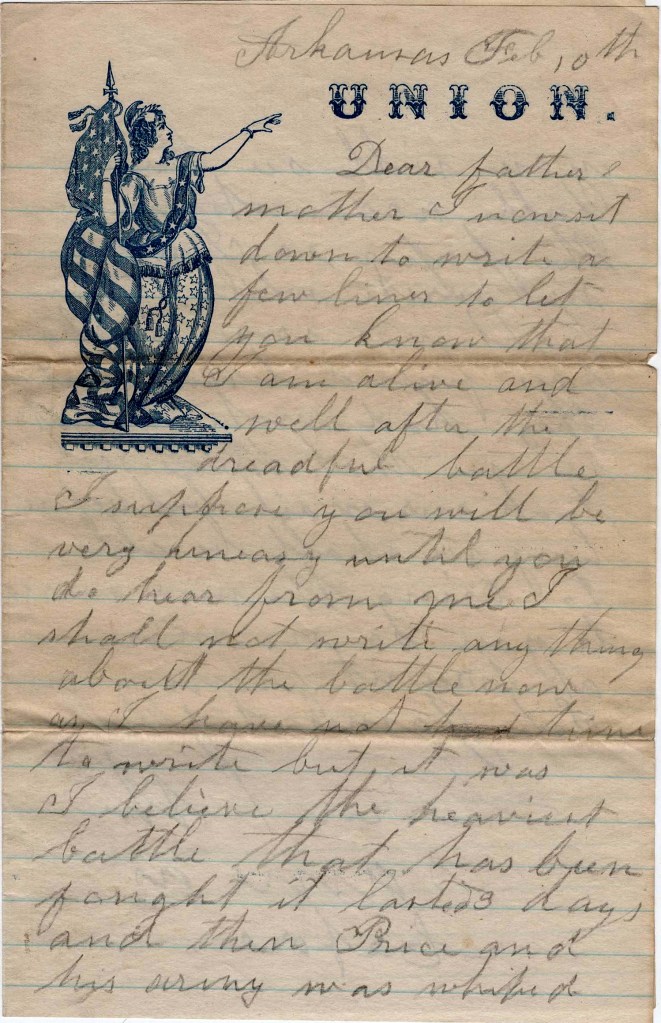
I now sit down to write a few lines to let you know that I am alive and well after the dreadful battle [of Pea Ridge]. I suppose you will be very uneasy until you do hear from me. I shall not write anything about the battle now as I have not time to write but it was, I believe, the heaviest battle that has been fought. It lasted three days and then Price and his army was whipped.
You will see the full accounts in the paper so I will not write while the fight was some of the boys found letters that they had wrote so that we see that the secesh took our mail but before long we shall be able to bring the news more to you. So no more at present. From your son, — James Sifleet
Direct the same as before.

Letter 10
[Six miles into] Arkansas
February 19th 1862
Dear parents,
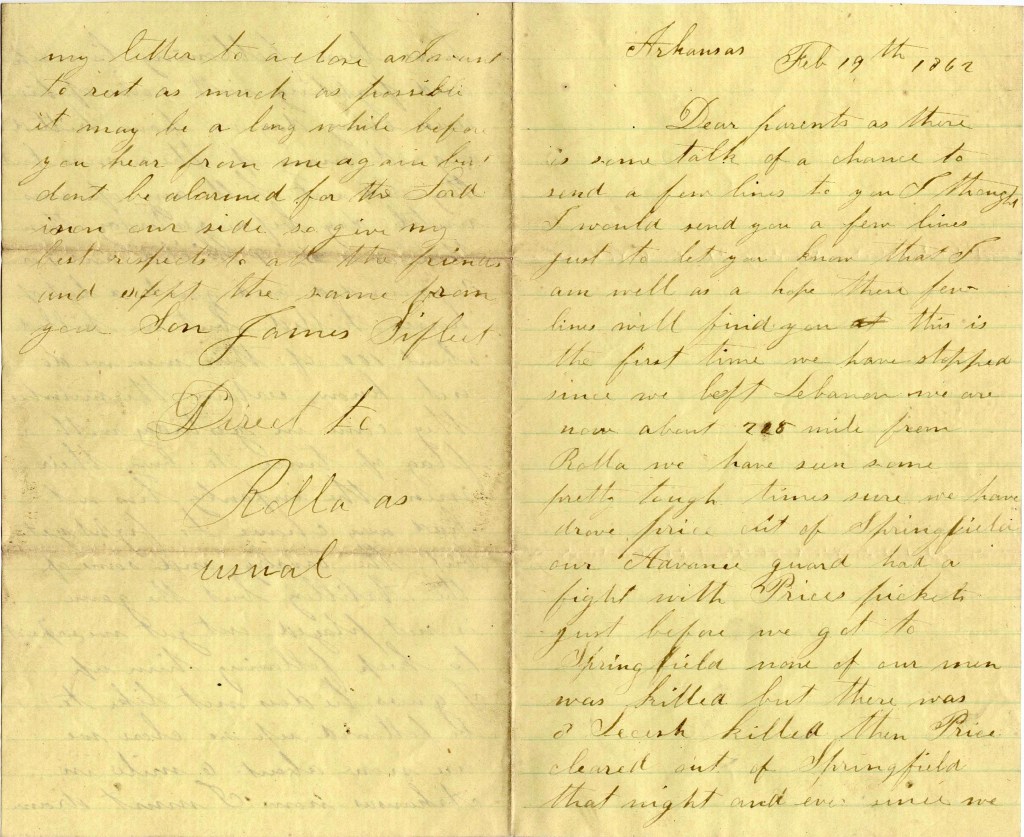
As there is some talk of a chance to send a few lines to you, I thought I would send you a few lines just to let you know that I am well as I hope these few lines will find you. This is the first time we have stopped since we left Lebanon.
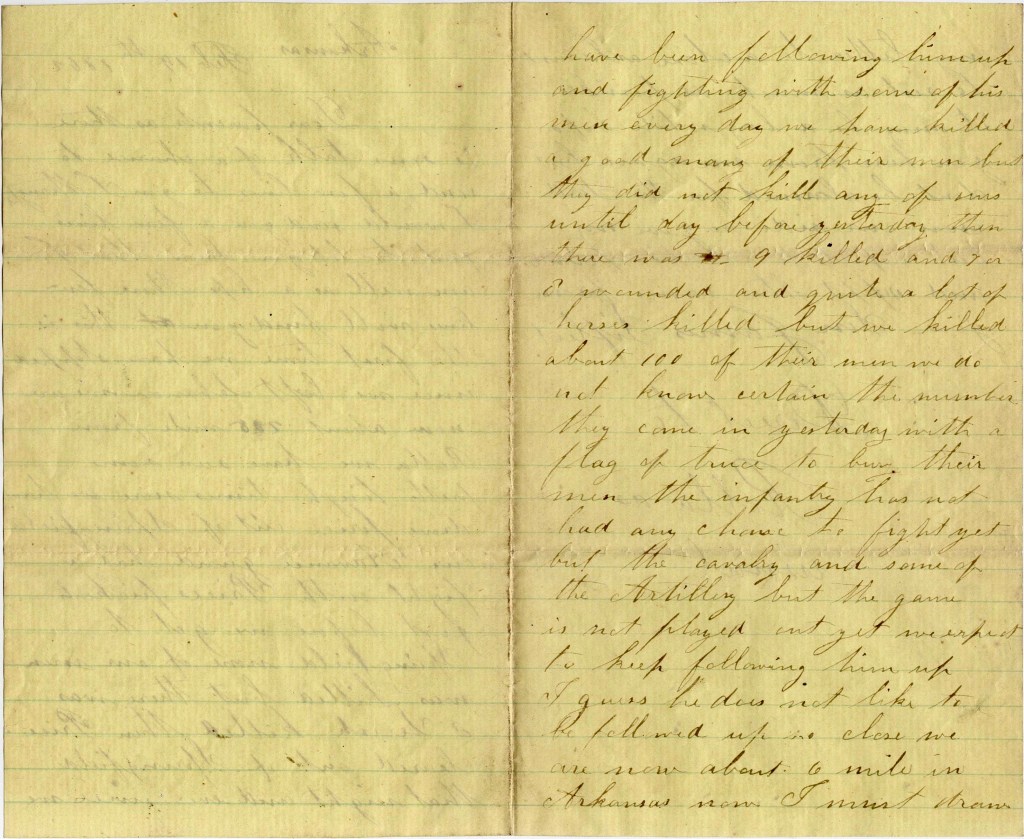
We are now about 205 miles from Rolla. We have seen some pretty tough times sure. We have drove Price out of Springfield. our advance guard had a fight with Price’s pickets just before we got to Springfield. None of our men was killed but there was a secesh killed. Then Price cleared out of Springfield that night and ever since we have been following him up and fighting with some of his men every day. We have killed a good many of their men but they did not kill any of ours until day before yesterday. Then there was 9 killed and 7 or 8 wounded and quite a lot of horses killed. But we killed about 100 of their men. We do not know certain the number. They came in yesterday with a flag of truce to bury their men. The infantry has not had any chance to fight yet but the cavalry and some of the artillery [have]. But the game is not played out yet. We expect to keep following him up. I guess he does not like to be followed up so close. We are now about six miles in Arkansas.
Now I must draw my letter to a close as I want to rest as much as possible. It may be a long while before you hear from me again but don’t be alarmed for the Lord is on our side. So give my best respects to all the friends and accept the same from yours on, — James Sifleet
Direct to Rolla as usual.
Letter 11
Camp Rienzi
Tishomingo county, State of Mississippi
June 16th [1862]
Dear Father and Mother, Sister and Brother,
I now sit down to answer your kind and welcome letter which I received yesterday. This leaves me enjoying good health and I hope it will find you all the same. I received two letters from you yesterday. One was posted 23rd April; the other 28th May. One had a letter from England in it. I do not know whether you have answered it yet or not. I will write a few lines in a day or two and send it to you so if you have not answered it, you can send it.
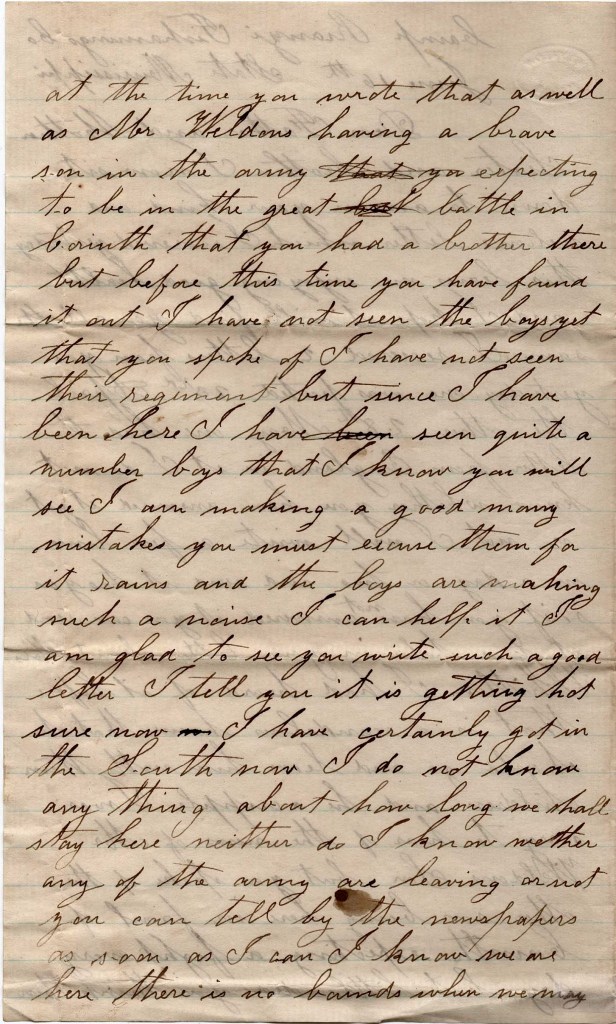
You told in your letter about Mrs. Whitton. I had heard of it before. That is a scandalous shame that she should go and leave him with them children and he a cripple. I was sorry to hear of the news of Mr. Weldon’s son but you spoke of the other son being here in front of Corinth expecting a fight every day. But little did you think then at the time you wrote that as well as Mr. Weldon’s having a brave son in the army expecting to be in the great battle in Corinth, that you had a brother there. But before this time you have found it out.
I have not seen the boys yet that you spoke of. I have not seen their regiment but since I have been here, I have seen quite a number boys that I know. You will see I am making a good many mistakes. You must excuse them for it rains and the boys are making such a noise I can’t help it. I am glad to see you write such a good letter. I tell you it is getting hot sure now. I have certainly got in the South now. I do not know anything about his long we shall stay here. Neither do I know whether any of the army are leaving or not. You can tell by the newspapers as soon as I can. I know we are here. There is no bounds [?] when we may have to fight. We have to be ready at any time so that if the rebels come, they will find us ready to give them the best we have in our cartridge boxes. We may never have to fight, but as long as we are in the service, we intend to be ready for them.
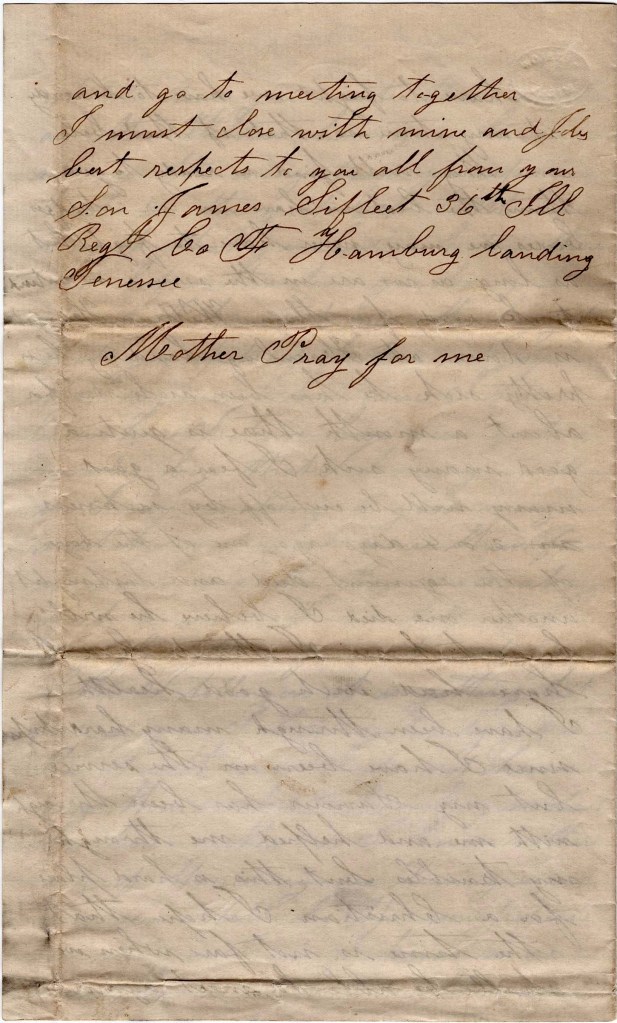
William Huggett is down at Hamburg Landing. He is pretty sick. He has been sick now for about a month. There is quite a good many sick. I fear a good many will be cut off by sickness. Three or four days ago one of the boys of this regiment died and last night another one died. I believe he will be sent home. I thank God I have had such good health. I have been through many hardships since I have been in the service but my Savior has been through with me and helped me through my troubles. But this is a hard place for a Christian. I hope that the time is not far when we shall be able to meet again and go to meeting together.
I must close wit mine and Job’s best respects to you all from your son, — James Sifleet, 36th Illinois Regt., Co. F, Hamburg Landing, Tennessee
Mother, pray for me.


Letter 12
Camp near Rienzi [Mississippi]
August 19, 1862
Dear parents and sister,
I now take the pleasure of writing a few lines in answer to two letters which I have just received. I was very glad to receive them to know that you was all well as I am thankful to say this leaves me at present. One of the letters had eight postage stamps in it. I am glad to get them for I sent the last one away last night with a few lines to you.
We moved out here today and we have got pretty well fixed again so that we can live comfortable. We are about a mile and a half from our regiment. There is another company here from our regiment besides us. We are here to protect a battery of artillery and it is here to protect us so you see that we are both here for to do that. Then we are here to protect them that are in Rienzi. Then if the enemy is too strong for us we shall fall back to Rienzi and they will protect us. Then we will join together and each man protect himself.
I don’t know as I have ever told you that artillery is one of the best of supports for us yet. It can’t do anything without us infantry. It was with artillery that Sigel wiped the rebels at Pea Ridge with on the last day. Te artillery drove the rebels yet without the infantry, they could not have done anything scarcely. Now when we fight, there is always infantry lying by the side of the artillery so as to protect it from a charge by the enemy. A good share of our regiment laid under the fire of the cannon at the Battle of Pea Ridge.
Well, the time is coming fast when we shall have to commence to operate again. We do not know but what we may have to fight here before we are prepared to go forward. Every day or two we hear that enemy is advancing on us but they have not got along yet. About a week ago,m the battery and two companies that was and all the cavalry went out to attack a force of secesh said to be 3 or 4,000. They was about 15 miles from here getting things for their army. But they heard our men was after them andn they left. Our men got about a hundred horses and mules that they had to leave because they was in such a hurry to get away before our men got there and about a hundred head of fat cattle. That is not the first time they have been routed in that way for they have had to get up and skedaddle in the night and out at Ripley, they did not have time to dress themselves. When we hear of any such men within our reach, we send out men in the night after them. Now if there is any such thing going on, we shall be about the first men to go if there is any need of any besides cavalry.
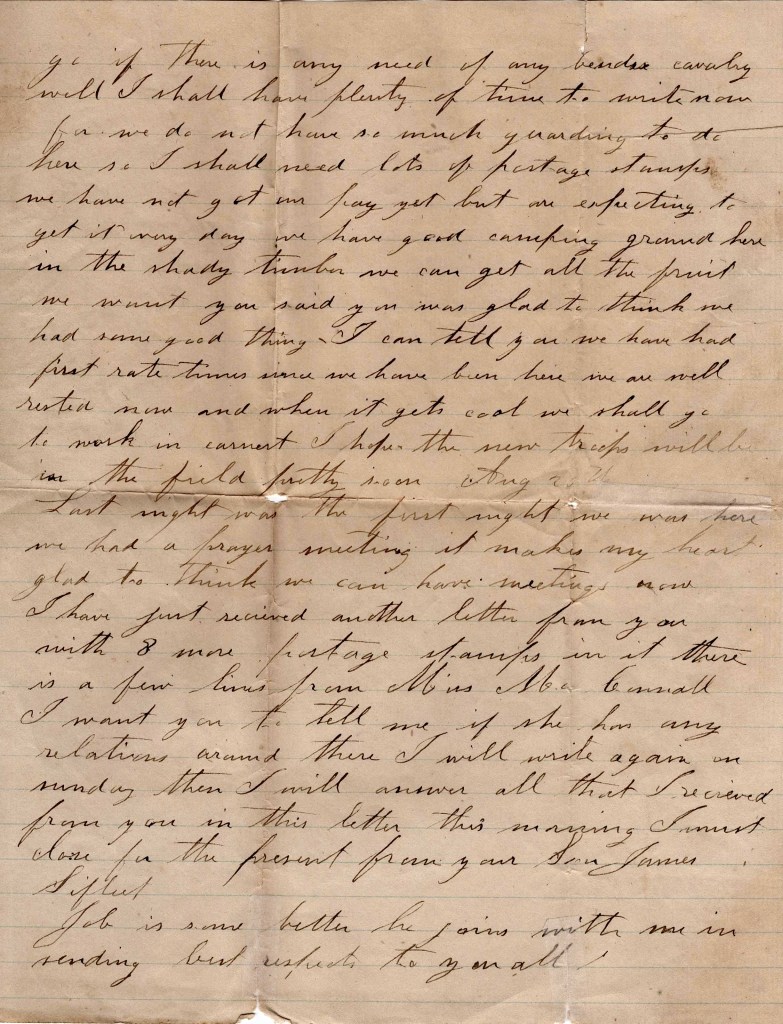
Well, I shall have plenty of time to write now for we do not have so much guarding to do here so I shall need lots of postage stamps. We have not got our pay yet but we are expecting to get it every day. We have a good camping ground here in the shady timber. We can get all the fruit we want. You said you was glad to think we had some good things. I can tell you we have had first rate times since we have been here. We are well rested now and when it gets cool, we shall go to work in earnest. I hope the new troops will be in the field pretty soon.
August 20th. Last night was the first night we was here we had a prayer meeting. It makes my heart glad to think we can have meetings now. I have just received another letter from you with eight more postage stamps in it. There is a few lines from Miss McConnell. I want you to tell me if she has any relations around there. I will write again on Sunday. Then I will answer all that I received from you in this letter this morning. I must close for the present. From your son, — James Sifleet
Job is some better. He joins with me in sending best respects to you all.


Letter 13
Bowling Green [Kentucky]
November 3rd 1862
Dear parents and sister,
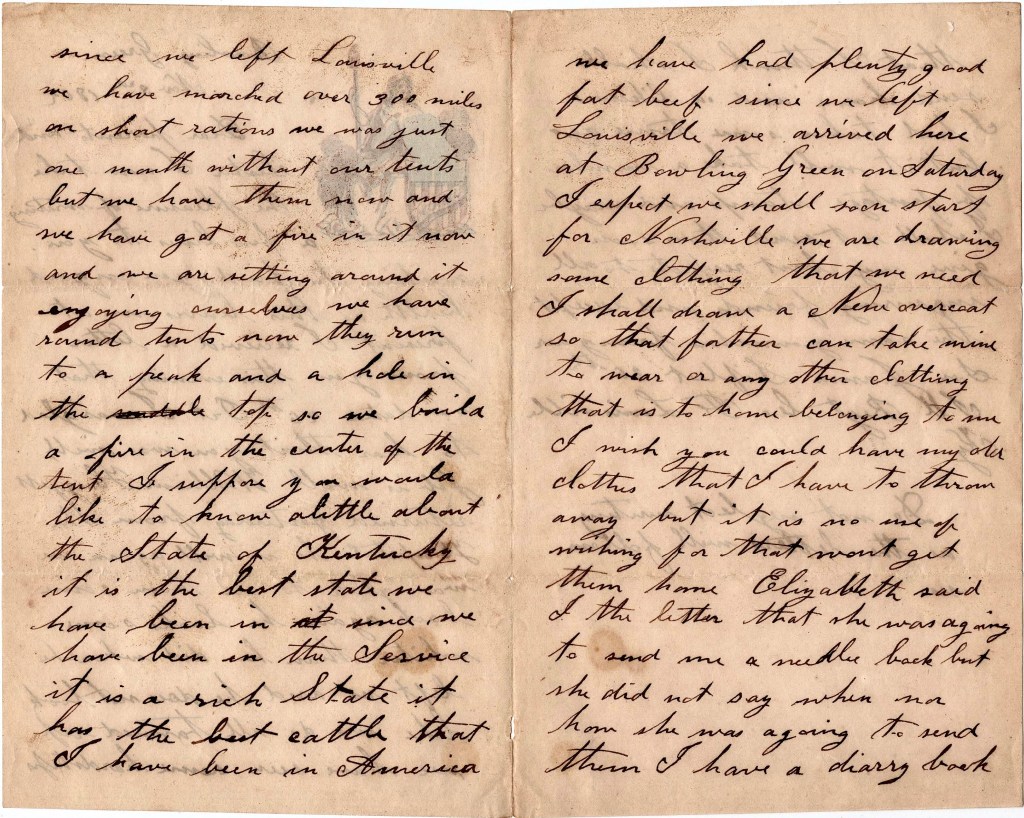
I now take the pleasure of writing a few lines to you wishing to find you in good health as this leaves me at present. I received a letter from you this evening that was dated 26th October. I was glad to hear that you was well. Job is well. William Huggett returned yesterday from the hospital. He is well again. We was glad to see him come back again. He looks some whiter than he did when he left us and he does not look like we do—all tanned up. We have seen some hardships since we left Louisville. We have marched over 300 miles on short rations. We was just one month without our tents but we have them now and we have got a fire in it now and we are sitting around it enjoying ourselves. We have round tents now. They run to a peak and a hole in the top so we build a fire in the center of the tent.
I suppose you would like to know a little about the State of Kentucky. It is the best state we have been in since we have been in the service. It is a rich state. It has the best earth that I have seen in America. We have plenty good fat beef since we left Louisville. We arrived here at Bowling Green on Saturday. I expect we shall soon start for Nashville. We are drawing some clothing that we need. I shall draw a new overcoat so that father can take mine to wear or any other clothing that is to home belonging to me. I wish you could have my old clothes that I have to throw away but it is no use of wishing for that won’t get them home.
Elizabeth said in the letter that she was a going to send me a needle book but she did not say when nor how she was a going to send them. I have a diary book that I think I shall send home and a likeness I had taken some time ago but it will take a number of postage stamps and maybe I shall not send them soon.
Give my best respects to all inquiring friends and accept the same yourselves. From your son, — James Sifleet
36th Regt., Co. F, Louisville, Kentucky
Do not neglect writing as the letters will follow us.

Letter 14
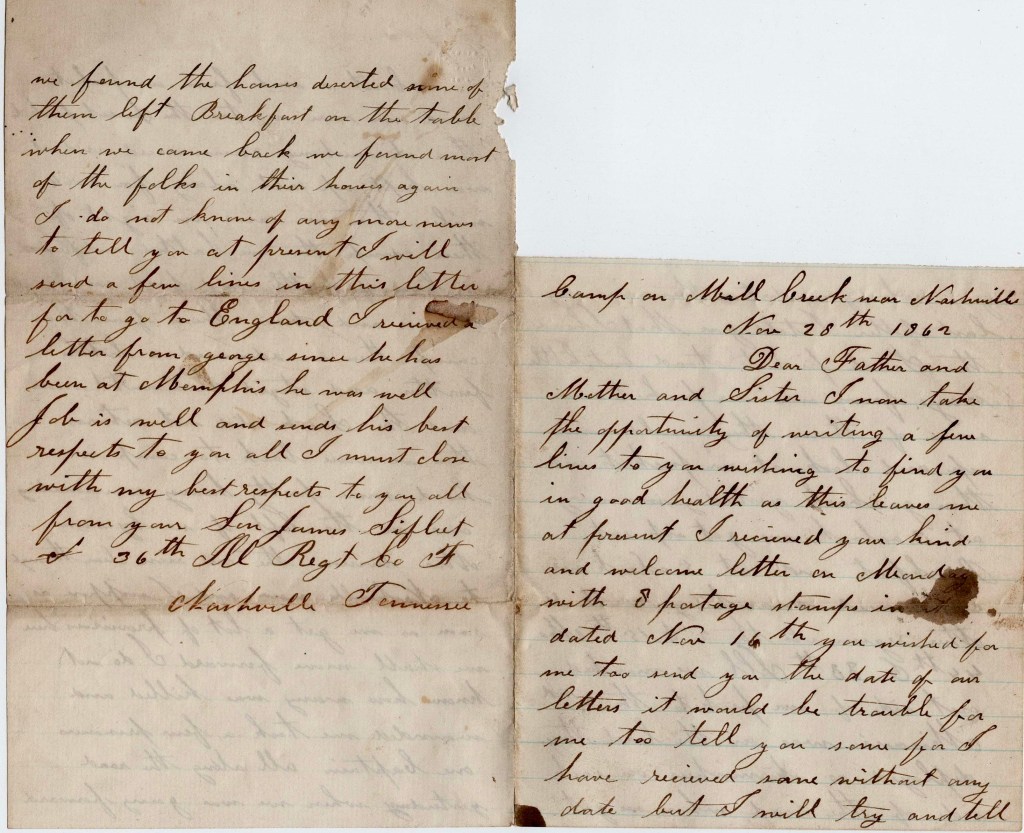
Camp on Mill Creek near Nashville [TN]
November 28, 1862
Dear Father and Mother and Sister,
I now take the opportunity of writing a few lines to you wising to find you in good health as this leaves me at present. I received your kind and welcome letter on Monday with eight postage stamps in it, dated November 16th. You wished for me to send you the date of our letters. It would be trouble for me to tell you some for I have received some without any date but I will try and tell you when you date them.
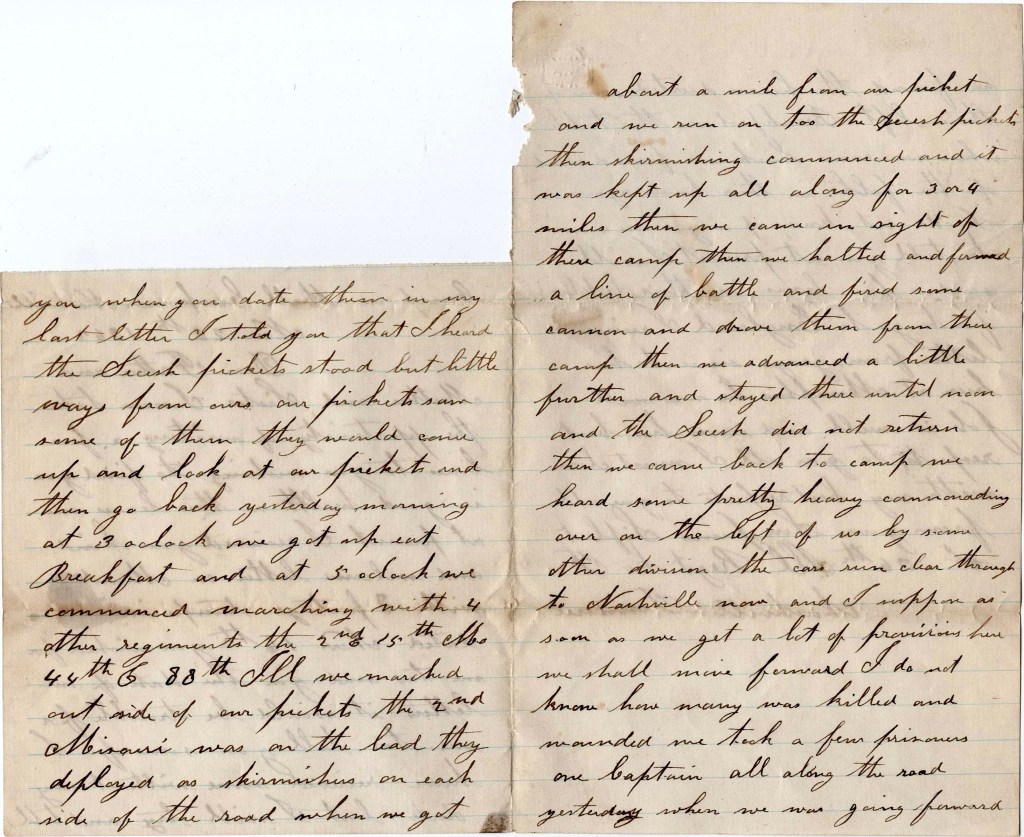
In my last letter I told you that I heard the secesh pickets stood but little ways from ours. Our pickets saw some of them. They would come up and look at our pickets and then go back. Yesterday morning at 3 o’clock we got up, eat breakfast, and at 5 o’clock we commenced marching with four other regiments—the 2nd and 15th Missouri, 44th and 88th Illinois. We marched outside of our pickets. The 2nd Missouri was on the lead. They deployed as skirmishers on each side of the road. When we got about a mile from our picket and we run on to the secesh pickets, then skirmishing commenced and it was kept up all along for three or four miles. Then we came in sight of their camp. Then we halted and formed a line of battle and fired some cannon and drove them from their camp. Then we advanced a little further and stayed there until noon and the secesh did not return. Then we came back to camp.
We heard some pretty heavy cannonading over on the left of us by some other division. The cars run clear through to Nashville now and I suppose as soon as we get a lot of provisions here we shall move forward. I do not now how many was killed and wounded. We took a few prisoners—one captain—all along the road yesterday when we was going forward. We found the houses deserted. Some of them left breakfast on the table. When we came back, we found most of the folks in their houses again.
I do not know of any more news to tell you at present. I will send a few lines in this letter for to go to England. I received a letter from George since he has been at Memphis. He was well. Job is well and sends his best respects to you all. From your son, — James Sifleet
36th Illinois Regt., Co. F, Nashville, Tennesssee
 Spared & Shared 23
The fort mentioned was indeed Fort Wyman. Rolla was the major base for the Union in the southern part of the state of Missouri. The railroad from St. Louis ended in Rolla when the war began. Military stores, thousands of troops filled the little town and surrounding the countryside. The wire road ran through Rolla to Springfield then down into Arkansas. Union patrols were sent along the Old Wire Road to protect communications, watch for bushwhackers and patrol for pro-southern men moving towards Arkansas to be recruited for the South. Another fort was also established in Rolla, constantly under construction but never quite finished by the war’s end. A two story, Greek-cross designed fortification, Fort Dette was to protect the northern side of the town and watch the railroad.
LikeLike