
This statement by Allen Hall (1815-1864), a neighbor, may have been submitted in support of a challenge to the Last Will & Testament of Elam Smith (1788-1859) of Greene County, Alabama. According to the Will that he executed in August 1858, Elam declared that he, having heretofore provided for his older children, intended to give the whole of his estate to his current wife and her children—Elam Smith and Franklin Smith. He also gave $1,000 to his daughter Sally Smith, the wife of Charles Stephens. All the rest of his estate—lands, negroes, stock, money and effects—were left to his wife, Mary (Harris) Smith and the aforementioned son. My hunch is that Elam’s daughter, Sally, and her husband, John Stephens, challenged the Will following his death in 1859.
Elam Smith was born in North Carolina in 1788. His first wife’s name was Cynthia Green (1786-1850). His second wife’s name was Mary Harris. Their sons, Elam Smith and Franklin Smith were born in 1851 and 1853, respectively.
Allen Hall was a farmer in Greene county, Alabama. He was a native of Tennessee. I have no other details on his death except that he was killed in action at the Battle of Mobile o 10 September 1864.
[Note: This document is from the personal collection of Greg Herr and was transcribed and published on Spared & Shared by express consent.]
Transcription
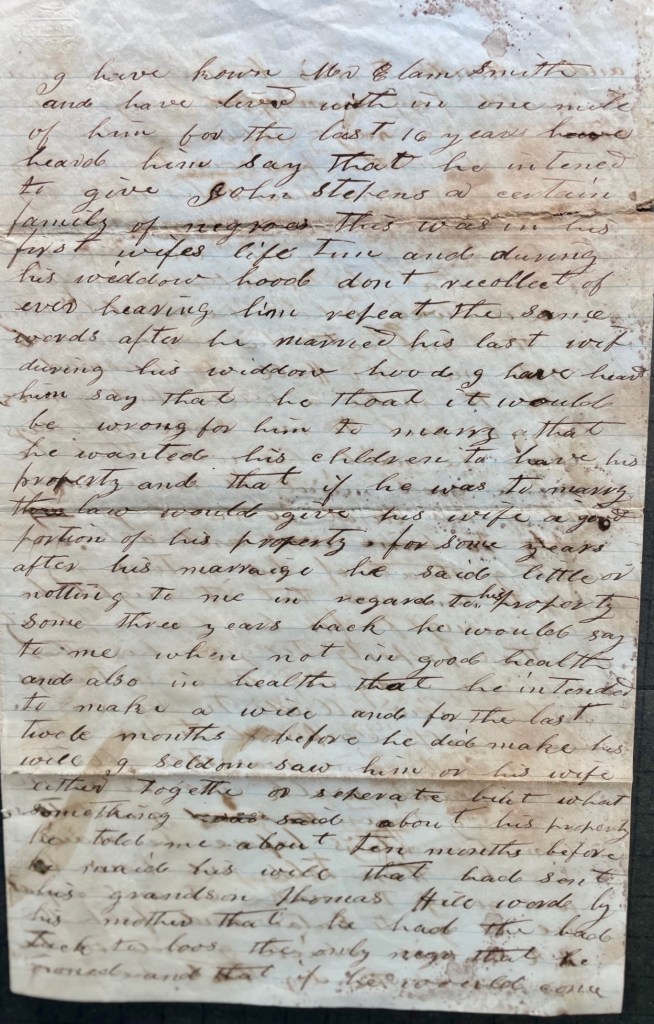
I have known Mr. Elam Smith and have lived within one mile of him for the last 16 years. Have heard him say that he intended to give John Stephens a certain family of negroes. This was in his first wife’s lifetime and during his widowhood. Don’t recollect of ever hearing him repeat the same words after he married his last wife. During his widowhood, I have heard him say that he thought it would be wrong for him to marry—that he wanted his children to have his property and that if he was to marry, the law would give his wife a good portion of his property.
For some years years after his marriage, he said little or nothing to me in regard to his property. Some three years back he would say to me when not in good health and also in health that he intended to make a will and for the last twelve months before he did make his will, I seldom saw him or his wife either together or separate but what something was said about his property.
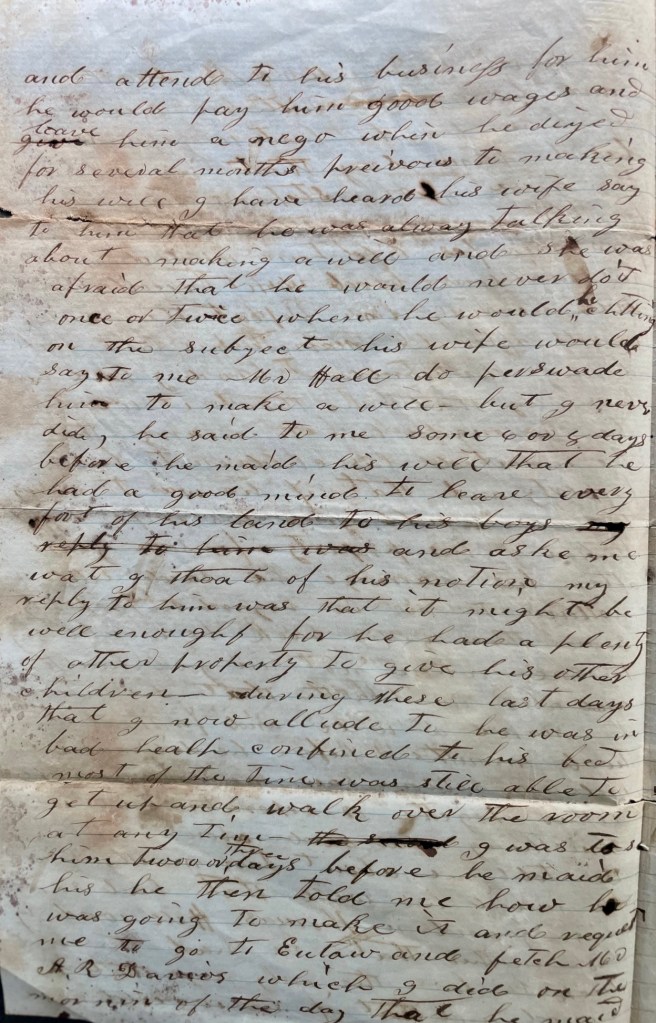
He told me about ten months before he made his will that he had sent his grandson Thomas Hill word by his mother that he had the bad luck to lose his only negro that he owned and that if he would come and attend to his business for him, he would pay him good wages and leave him a negro when he died. For several months previous to making his will, I have heard his wife say to him that he was always talking about making a will and she was afraid that he would never do it. Once or twice when he would be chatting on the subject, his wife would say to me, “Mr. Hall, do persuade him to make a will,” but I never did. He said to me some 6 or 8 days before he made his will that he had a good mind to leave every foot of his land to his boys and asked me what I thought of his notion. My reply to him was that it might be well enough for he had a plenty of other property to give his other children.
During these last days that I now allude to, he was in bad health, confined to his bed most of the time, was still able to get up and walk over the room at any time. I was to see him two or three days before he made his will. He then told me how he was going to make it and requested me to go to Eutaw and fetch Mr. A[ttoway Reeder] Davis which I did on the morning of the day that he made his will.
I went to see him early and told him that I knew his other children—that they were poor, and that I felt sorry for them and hoped he would think of them and their posterity. His reply was that his older children were of no account—that they were waiting for him to die to get his property and that they would miss it. I then turned to his wife and said to her that his daughters used to plow and hoe [that land] and that there were persons that knew it now living. Her reply was that his property was his own and that he had the right to dispose of it as he pleased.
Mr. Smith also said to my wife about three months after making of his will that his grown son John Stephens had professed religion and was rejoiced at it and said that he could never be satisfied without giving him something more. November 12, 1859
— Allen Hall

 Spared & Shared 23