
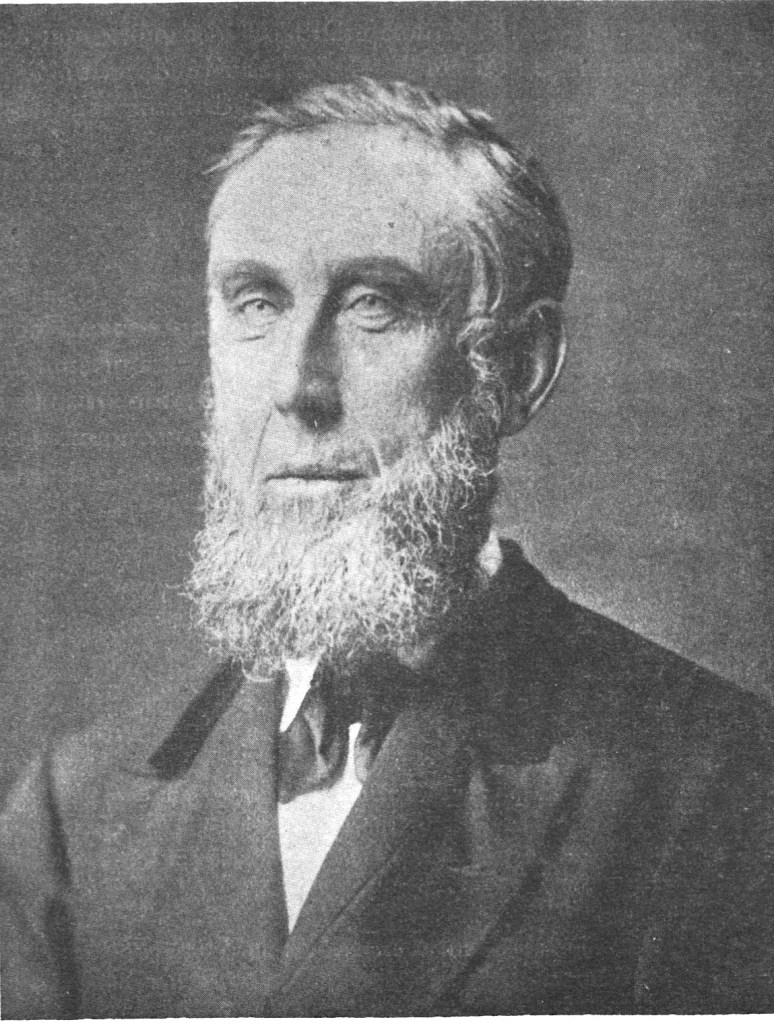
These two letters were written by Joseph Appleton Sanborn (1814-1877), the son of Peter and Sally (Fifield) Sanborn of East Readville, Kennebec county, Maine. Joseph was married to Lucy Ann Briggs Upham (1821-1888) and the couple had at least four children, the eldest of which is mentioned in this letter: Gustavus (“Gussy”) A. Sanborn (1845-1879).
Joseph wrote the letters to his niece, Sarah Frances Sanborn (1843-1927), the daughter of Peter Fifield Sanborn (1810-1884) and Desdemona Hunt (1819-1864) of Readville, Maine. Sarah was a graduate of the Maine Wesleyan Seminary and Female College and in 1864 was attending the Hudson River Institute in Claverack, New York. One or more of Sarah’s letters to her father may be found at, “Away at School: Letters Home,” by Candace Kanes.
Letter 1
East Readfield
Sunday p.m., May 29, 1864
My dearest Sarah,
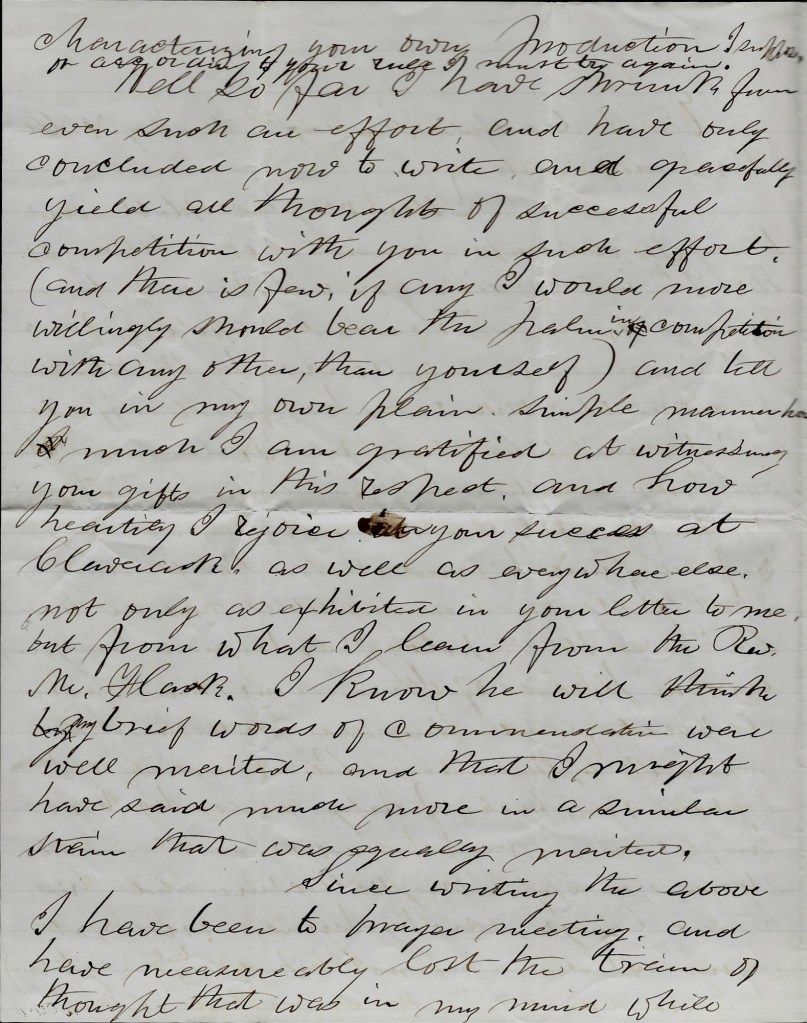
Your very acceptable, and to my poor comprehension, good letter of the 9th inst. which you pleased to characterize as a “miserable apology for a letter” measured of course by the standard of some of your own happiest efforts in that line, was duly received and it it was my intention to have answered it forthwith. But I did not immediately find time to undertake the writing of what I deemed a suitable answer to even the “miserable apology” (so termed by you) and in process of time, another more elaborate and finished production has made its appearance, the reading of portions of which fairly made my blood tingle in my veins and almost made me do as you say Gough’s lecture 1 did his hearers laugh and cry by turns, and yet I am expected (no, not expected, but only to try) to answer such a letter with somewhat of the ability characterizing your own production. I suppose, or according to your rule, I must try again. Well, so far I have shrunk from even such an effort and have only concluded now to write and gracefully yield all thoughts of successful competition with you in such effort (and there is few, if any, I would more willingly should bear the palm in competition with any others than yourself) and tell you in my own, plain, simple manner how much I am gratified at witnessing your gifts in this respect, and how heartily I rejoice in your success at Claverack as well as everywhere else, not only as exhibited in your letter to me, but from what I learn from the Rev. Mr. Flack. I know he will think my brief words of commendation were well merited and that I might have said much more in a similar strain that was equally merited.
Since writing the above, I have been to prayer meeting and have measurably lost the train of thought that was in my mind while writing the above, and as it is now half past seven, I will not pursue it further but proceed to tell you of some home affairs, &c. &c. as that is really about all I can do both for the want of time to write more, and also for the want of ability for I feel that I should need about a week at least to do full justice in answering according to my poor ability your lengthy and most interesting letter, so much so that I could not refrain from perhaps violating your confidence & with, by the reading portions of it to Rev. Mr. Brownold—who pronounced your deli____tions of Gough’s efforts admirable, not to say “splendid” and far better than he himself could give, though he thinks him up to the standard of excellence which you assign him as an orator.
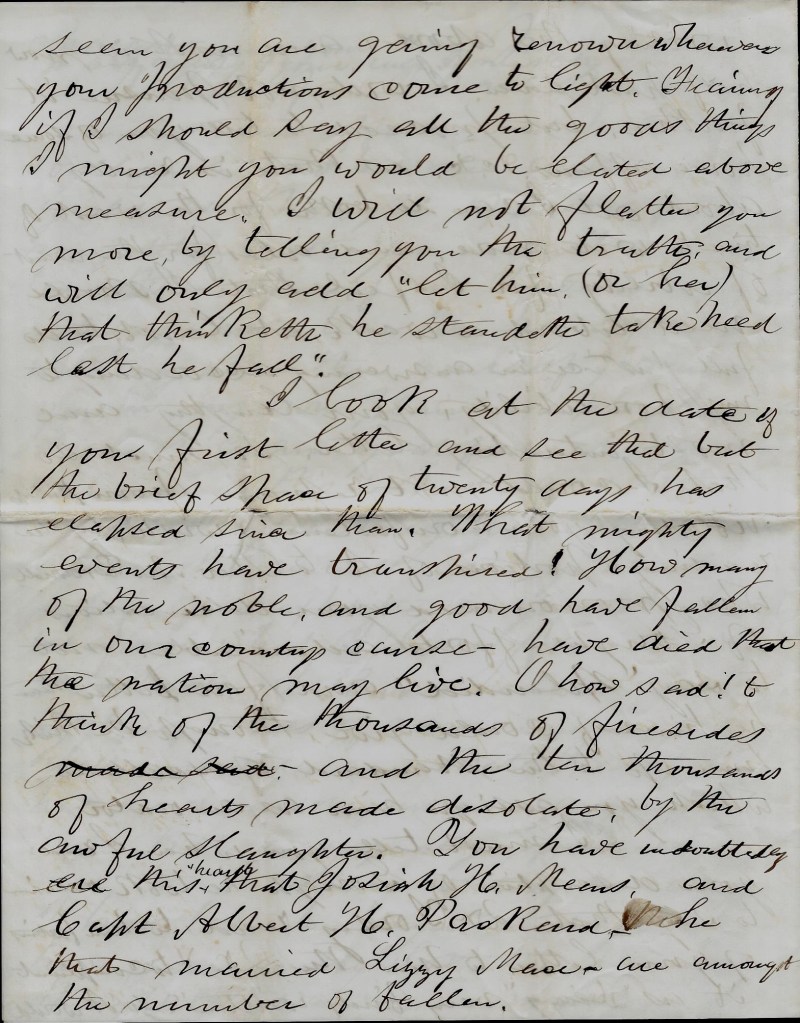
I must tell you when I read your description of Gough, he took occasion to say that Dr. Yorsey read to him portions of your letter to him the Dr. & to compliment it as being “very finely written.” So it would seem you are gaining renown whenever your “productions” come to light. Fearing if I should say all the good things I might you would be elevated above measure, I will not flatter you more by telling you the truth and will only add, “let him (or her) that thinketh he standeth take heed lest he fall.”
I look at the day of your first letter and see that but the brief space of twenty days has elapsed since then. What mighty events have transpired! How many of the noble and good have fallen in our country’s cause—have died that the Nation may live. Oh how sad! to think of the thousands of firesides and the ten thousands of hearts made desolate by the awful slaughter. You have undoubtedly ere this heard that Josiah H. Means and Capt. Albert H. Packard 2—he that married Lizzy Mase—are amongst the number of fallen.
[unsigned]
1 John B. Gough (1817-1886) was a temperance lecturer.
2 Capt. Albert H. Packard served in Co. A, 4th Maine Vol. Infantry. He was mortally wounded in the Wilderness in May 1864 and died of his wounds at Washington D. C.


Letter 2
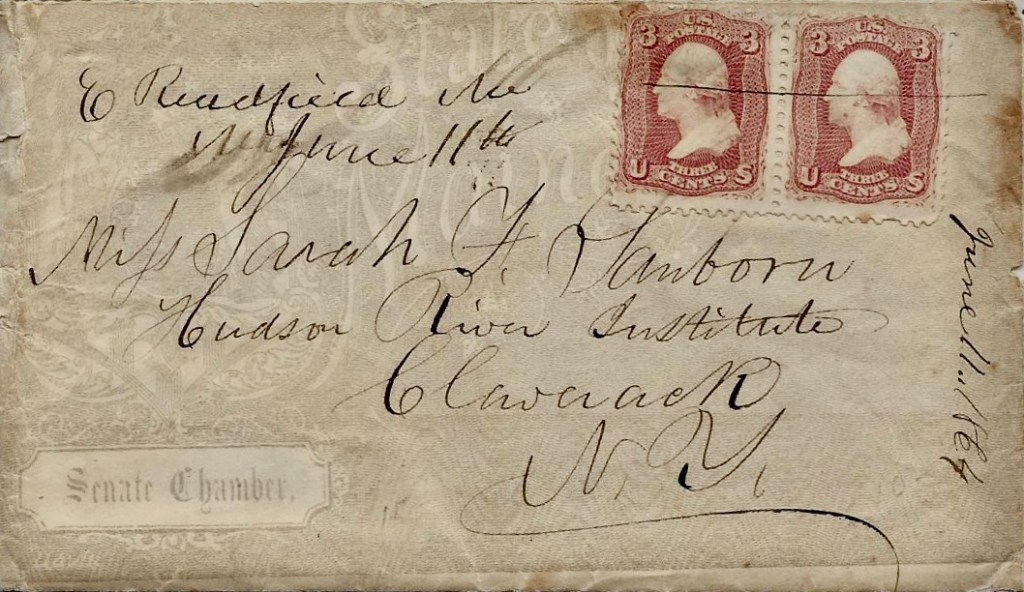
East Readfield
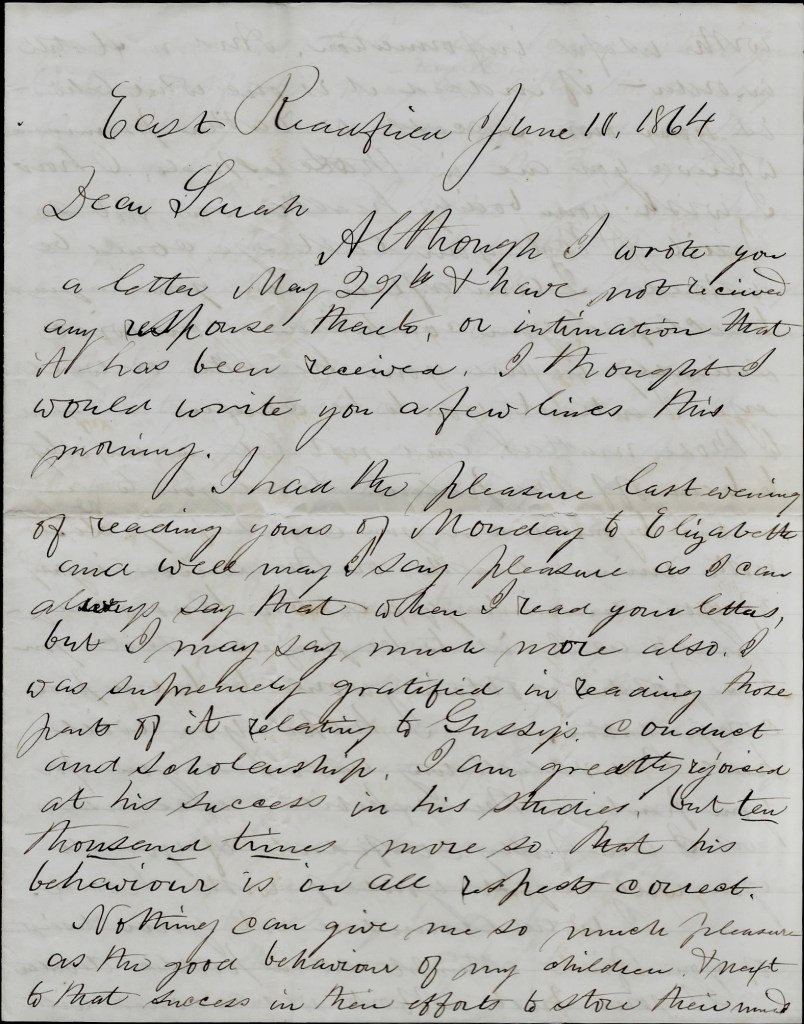
June 10, 1864
Dear Sarah,
Although I wrote you a letter May 29th & have not received any response thereto, or intimation that it has been received, I thought I would write you a few lines this morning.
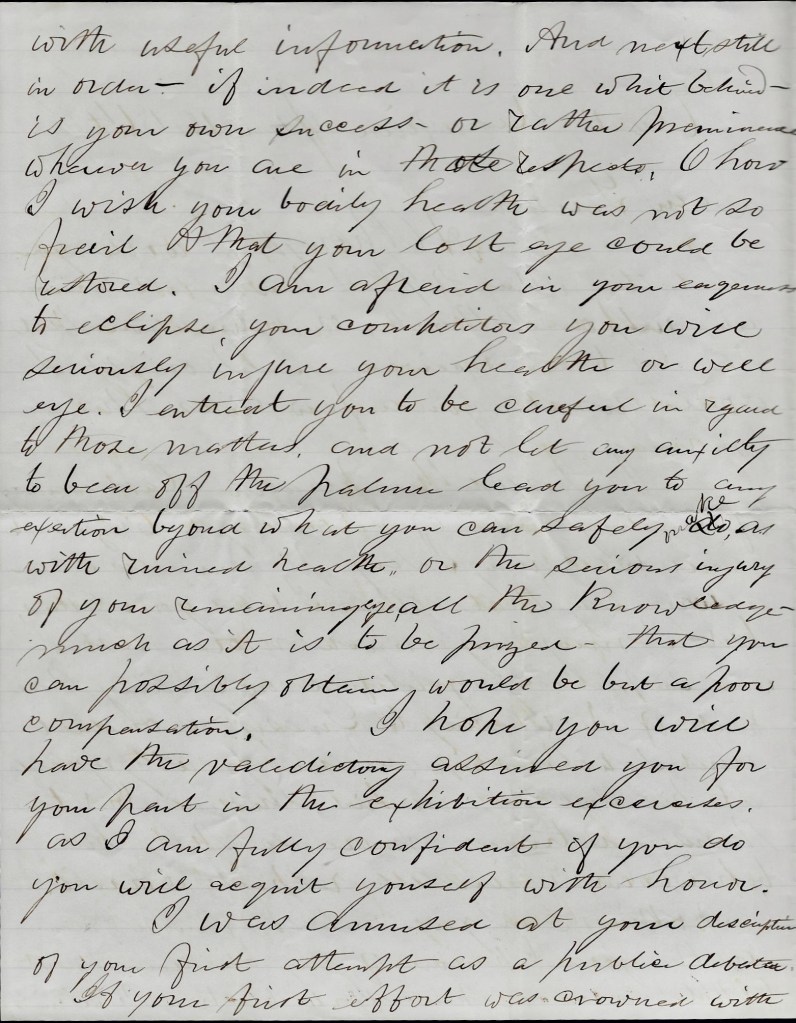
I had the pleasure last evening of reading yours of Monday to Elizabeth and well may I say pleasure as I can always say that when I read your letters, but I may say much more also. I was supremely gratified in reading those parts of it relating to Gussy’s conduct and scholarship. I am greatly rejoiced at his success in his studies but ten thousand times more so that his behavior is in all respects correct. Nothing can give me so much pleasure as the good behavior of my children & next to that success in their efforts to store their minds with useful information. And next still in order—if indeed it is is one whit behind—is your own success, or rather preeminence, wherever you are in those respects. Oh how I wish your bodily health was not so frail & that your lost eye could be restored. I am afraid in your eagerness to eclipse your competitors you will seriously injure your health or well eye. I entreat you to be careful in regard to those matters and not let any anxiety to bear off the palm, lead you to any exertion beyond what you can safely make as with ruined health, or the serious injury of your remaining eye, all the knowledge, much as it is to be prized, that you can possibly obtain, would be but a poor compensation.
I hope you will have the valedictory assured you for your part in the exhibition exercises as I am fully confident if you do you will acquit yourself with honor.
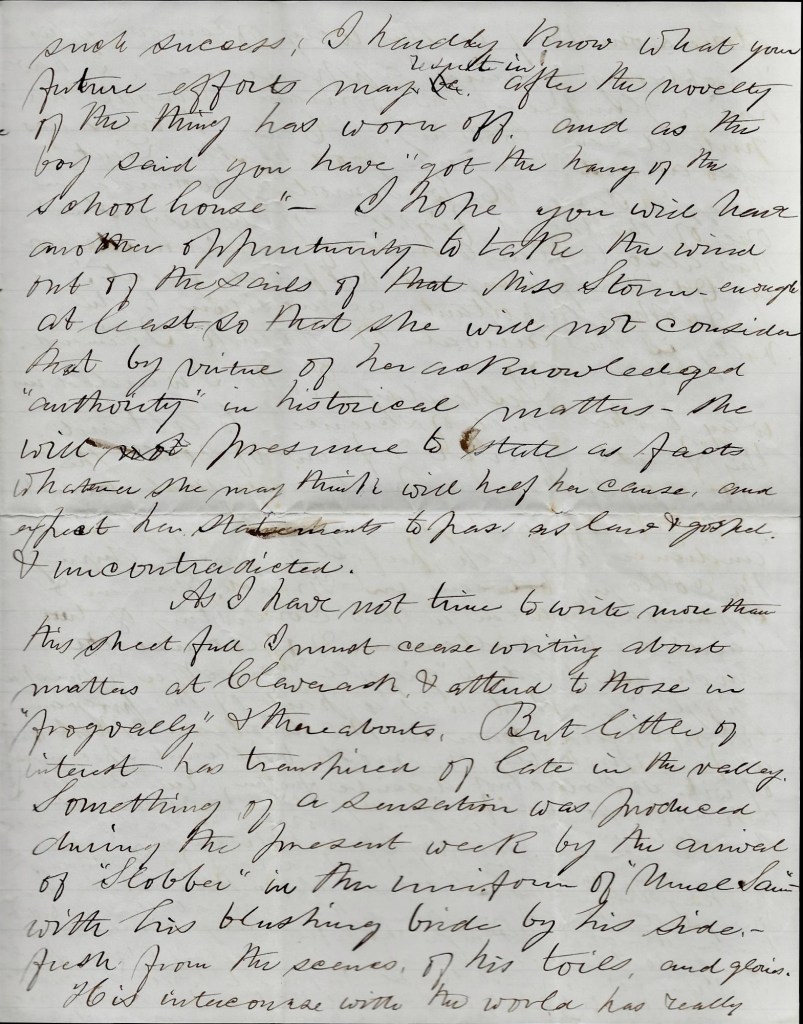
I was amused at your description of your first attempt as a public debater. If your first effort was crowned with such success, I hardly know what your future efforts may result in after the novelty of the thing has worn off and as the boy said, you have “got the hang of the school house.” I hope you will have another opportunity to take the wind out of the sails of that Miss Storm—enough at least so that she will not consider that by virtue of her acknowledged “authority” in historical matters she will presume to state as facts whatever she may think will help her cause, and expect her statements to pass as law & gospel & uncontradicted.
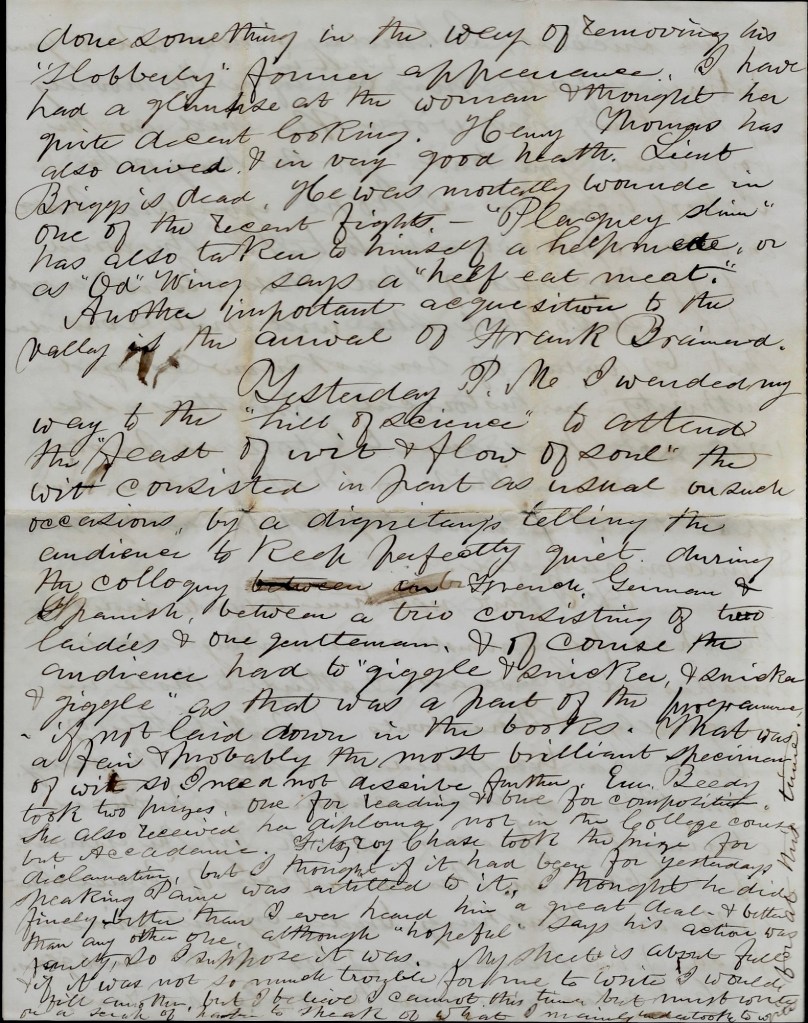
As I have not time to write more than this sheet full I must cease writing about matters at Claverack & attend to those in “Frog Valley” & thereabouts. But little of interest has transpired of late in the valley. Something of a sensation was produced during the present week by the arrival of “Slobber” in the uniform of “Uncle Sam” with his blushing bride by his side, fresh from the scenes of his toils and glories. His intercourse with the world has really done something in the way of removing his “slobberly” former appearance. I have had a glimpse at the woman & thought her quite decent looking. Henry Thomas has also arrived & in very good health. Lieut. Briggs is dead. He was mortally wounded in one of the recent fights. “Plaguey Slim” has also taken to himself a helpmate, or as “Od” Wing says, a “help-eat-meet.” Another important acquisition to the valley is the arrival of Frank Brainard.
Yesterday p.m., I wended my way to the “hill of science” to attend the “feast of wit & flow of soul.” The wit consisted in part as usual in such occasions, by a dignitary’s telling the audience to keep perfectly quiet during the colloquy in French, German, and Spanish, between a trio consisting of ladies & one gentleman, & of course the audience had to “giggle and snicker, * snicker and giggle” as that was a part of the programme—if not laid down in the books. That was a few & probably the most brilliant specimen of wit so I need no describe further. E,. Beedy took two prizes—one for reading and one for composition. She also received her diploma not in the college course but academic. Fitzroy Chase took the prize for declamation but I thought if it had been for yesterday’s speaking, Paine was entitled to it. I thought he did finely and bettter than I ever heard him—a great deal & better than any other one, although “hopeful” says his action was faulty so I suppose it was. My sheet is about full and if it was not so much trouble for me to write, I would fill another but I believe I cannot this time but must write on a scrap of paper to speak of what I mainly took to write for at this time.
In your letter to Lizze you spoke of having some idea of visiting the Catskill Mountains but expressed the opinion you should not so so on account of the cost. Now what I want to say is that I want you to go if you would like to and I will pay the expense. Say nothing to the “Old fellow” about it but when you get ready to go, up & start. I sent Gussy $50 yesterday and I will write him to hand you over enough for your expenses in making the trip, and if gentlemen are permitted to go, & Gussy is one of the favored ones, I want him to go with you and I shall write him the same. So don’t fail to go in account of the expense as I want you to enjoy yourself while you can for the time may come when neither your father nor I can do anything for your enjoyment.
What is right and proper for you to have, I want you should have & I think that would be both right and proper. It is so cold here today as to be uncomfortable. It rained more or less all day yesterday & quite hard a portion of the time in the p.m. and cleared off in the night cold and windy.
We are all as well as usual. With much affection, I am ever thine, — J. A. Sanborn
P. S. Only six weeks from tomorrow & we may expect to see you in the “Valley” again. I would like very much to see you sooner at Claverack but think it doubtful if I do as every day brings its cares and labors & the days and weeks roll rapidly away & I doubt if I find it convenient to visit Claverack & the cost too would be considerable. Still I may conclude to go, but I do not want you to make any particular calculation that I shall. I sent you today two papers giving an account of a sad accident at Lewiston resulting in the drowning of three little girls and the funeral services of the occasion. I pity the grieving parents & friends, — J. A. S.


 Spared & Shared 23