
The following letter was written by John B. Hammer of Hamilton, Butler county, Ohio, to his friend, James Clark Holbrook (1817-1895). James was married to Eliza Jane McDill (1822-1901) in May 1845 and we learn that he relocated to Randolph county, Illinois, sometime previous to the date of this letter. In the 1850 US Census, James was enumerated in Sparta where he practiced law.
I believe John B. Hammer was approximately the same age as Holbrook and may have emigrated to Hamilton, Ohio, from Pennsylvania, possibly with a brother named Logan Hammer.
Hammer’s letter speaks of the Hydraulic company in Hamilton, prospects for a railroad to be built to Cincinnati, and of the recent Butler count elections in which the Whigs defeated the Locofocos [Democrats].
Transcription

Hamilton, Butler county, Ohio
October 27, 1845
Dear Holbrook,
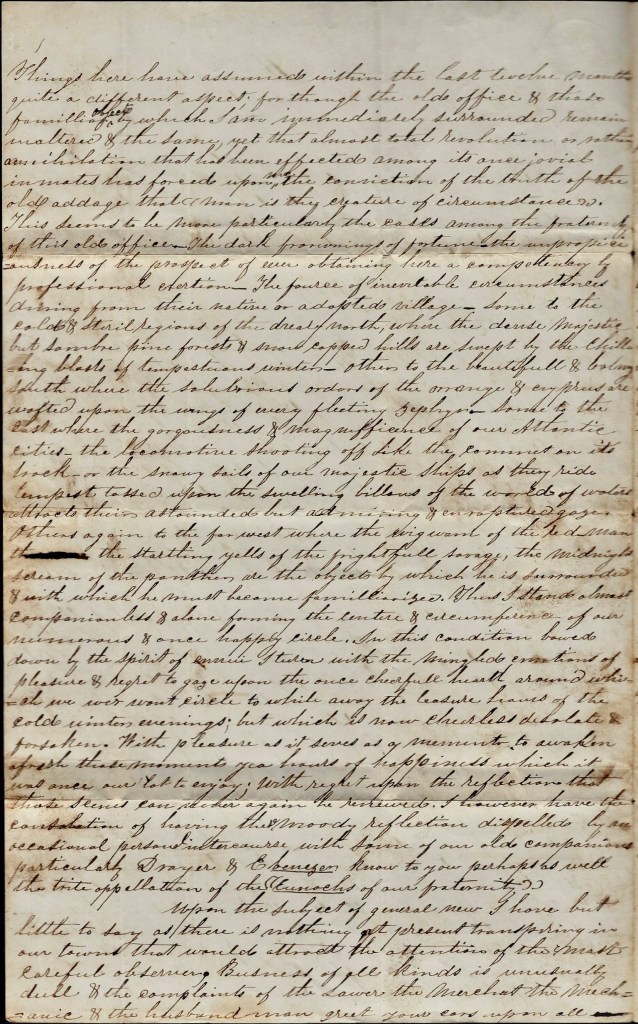
Numerous conflicting & portentions of evil are the conjectures entertained particularly in the circle of your more immediate acquaintance here since your departure for the West concerning your hazardous adventure and final destination. The fact of their not having heard anything from you since your departure together with the anxiety they feel in your welfare, had led them to interchangeably indulge in such ominous surmises as (I hope all visionary & foundationless); perhaps he has taken passage upon one of those unfortunate steamers that has been blown to pieces by the explosion of the boiler & participated in the dire calamity of his fellow passengers, the horrible accounts of which the columns of our ephemerial journals are literally filled. I wonder if the old craft upon which he has taken passage has not been foundered by running afoul of one of those dangerous breakers who so much infest our western waters & render it rather a precarious undertaking to travel thereon. Or it may be he has been caught out of port in a storm and been shipwrecked upon some of the sterile, rugged coasts of the Mississippi. But notwithstanding this difference of opinion of what may have been your fate, yet we are unanimous in this—that either some sad mishap had befallen you during your journey or else you have proven remiss in your duty in not writing. I therefore assume the responsibility of addressing you a few lines & if you are safely moored in the haven of your anticipated destination, to awaken you if possible to a sense of your delinquency in not letting us hear from you.
As I was confined to my room by illness at the time you took your leave of our village, I am consequently unaware of the occupation you have determined upon pursuing in the West—whether lawing, teaching, farming, or preaching—all of which laudable professions I believe you have considerable knowledge and some experience. However, having heard nothing to the contrary, & knowing that the profession of the law stands first in your estimation, I suppose your efforts will be directed in this line. But it whatever occupation you may deem most conducive to your feelings and interest, may fortune smile & your every effort be crowned with its merits and reward.
I still remain at the office of the old firm, Bebb & Reynolds. Things here have assumed within the last twelve months quite a different aspect for though the old office & those familiar objects by which I am immediately surrounded remain unaltered & the same, yet that almost total revolution, or rather annihilation that has been effected among its once jovial inmates has forced upon me the conviction of the truth of the old adage that man is the creature of circumstances. This seems to be more particularly the case among the fraternity of this old office…I stand almost companionless & alone forming the centre and circumference of our numerous and once happy circle. In this condition, bowed down by the spirit or ennui, I turn with the mingled emotions of pleasure and regret to gaze upon the once cheerful hearth around which we were wont to while away the leisure hours of the cold winter evenings; but which is now cheerless, desolate, and forsaken. With pleasure as it serves as a memento to awaken afresh those moments—yea hours—of happiness which it was once our lot to enjoy. With regret upon the reflection that those scenes can never again be renewed, I have the consolation of having the moody reflection dispelled by an occasional personal intercourse with some of our old companions—particularly Drayer and Ebenezer, known to you perhaps as well the trite appellation of the Eunuchs of our fraternity.
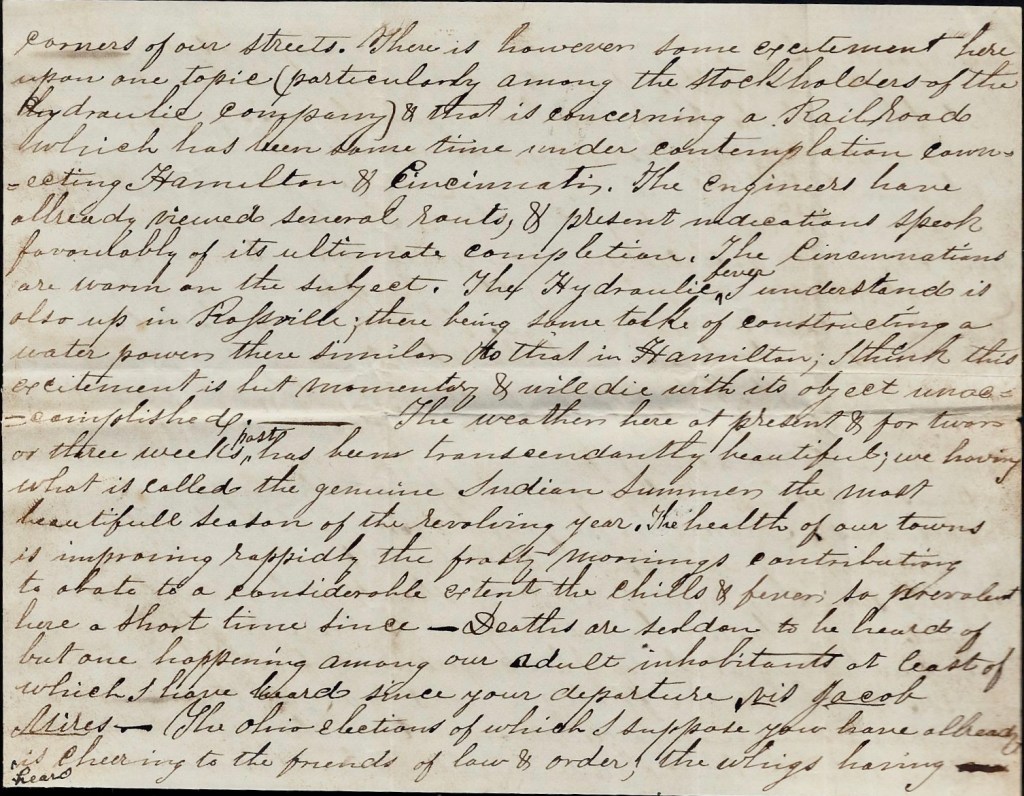
Upon the subject of general news, I have but little to say as there is nothing at present transpiring in our town that would attract the attention of the most careful of observer. Business of all kinds is unusually dull and the complaints of the lawyer, the merchant, the mechanic, and the husbandman greet your ears upon all corners of our streets.
There is, however, some excitement here upon one topic (particularly among the stockholders of the Hydraulic company) & that is concerning a railroad which has been some time under contemplation connecting Hamilton and Cincinnati. The engineers have already viewed several routes, & present indications speak favorably of its ultimate completion. The Cincinnatians are warm on the subject. The Hydraulic fever, I understand, is also up in Rossville; there being some talk of constructing a water power there similar to that in Hamilton. I think this excitement is but momentary & will die with its object unaccomplished. 1
The weather here at present & for two or three weeks past has been transcendentally beautiful—we having what is called the genuine Indian Summer—the most beautiful season of the revolving year. The health of our towns is improving rapidly; the frosty mornings contributing to abate to a considerable extent the chills & fevers so prevalent here a short time since. Deaths are seldom to be heard of—but one happening among our adult inhabitants at least of which I have heard since your departure—viz: Jacob Mires.
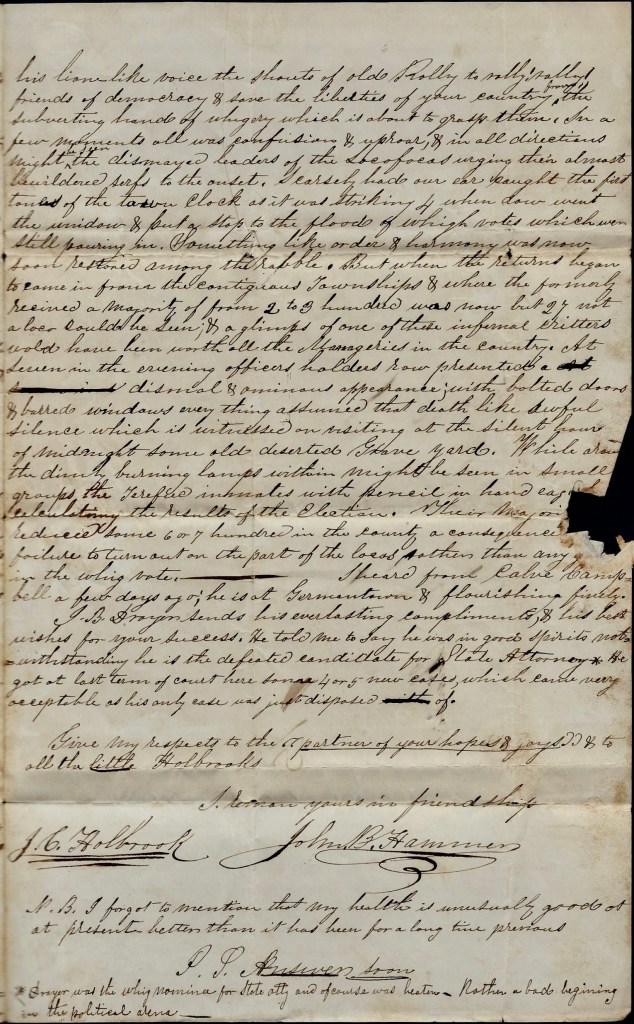
The Ohio elections of which I suppose you have already heard is cheering to the friends of law and order (the Whigs having a majority of 24 on joint ballot in the Legislature). The Whigs of our town and vicinity have had some capitol fun with the Locofocos here upon the occasion of our election last Tuesday. As an unusual occurrence here, there was little or nothing said about either men or measures previous to the election—at least in the ranks of the Whigs. Stokes as usual had been copious and pathetic in his appeals to the democracy (notwithstanding the silence of the Whigs) to turn out to a man and save the country from ruin. They came to the polls more than ordinarily elated with the reflection of their anticipated triumph. All went swimmingly on until about 2 o’clock p.m. when the Whigs, in pursuance of some preconcerted plan of a few who were fond of fun, came pouring in from all directions in such numbers as to terrify & utterly confound the Locofocos. Stokes broke gasping for breath for his office for a new supply of tickets. Oliver mounted a swhiched poney standing hard by and ere the shouts of hurrah boys, or, “By God we are beaten!” had died upon the breeze might be seen sending his way at the top of his cargers speed for the black bottours and Wilkins vociferated “To arms! to arms! The Coons [Whigs] are upon us in an unguarded moment,” while upon the opposite corner of the Public Square might be heard as the echoes of his lion-like voice, the shouts of Old Rolly to rally! “Rally! friends of democracy & save the liberties of your country from the subverting hands of whiggery which is about to grasp them.” In a few moments, all was confusion & uproar, and in all directions might be seen the dismayed leaders of the Locofocos urging their almost bewildered serfs to the onset.
Scarcely had our ear caught the first tolls of the town clock as it was striking 4 when down went the window & put a stop to the flood of Whig votes which were still pouring in. Something like order & harmony was now soon restored among the rabble. But when the returns began to come in from the contiguous townships & where the formerly received a majority of from two to three hundred was now but 27 not a loco could be seen; & a glimpse of one of those infernal critters would have been worth all the menageries in the country. At seven in the evening, office holders row presented a dismal and ominous appearance; with bolted doors and barred windows. Everything assumed that death-like awful silence which is witnessed on visiting at the silent hour of midnight some old deserted grave yard. While around the dimly burning lamps within might be seen in small groups the terrified inmates with pencil in hand eagerly calculating the results of the election. Their majority was reduced some 6 or 7 hundred in the country—a consequence of failure to turn out on the part of the locos rather than any boost in the whig vote.
I heard from Calve Campbell a few days ago; he is at Germantown & flourishing finely. J. B. Drayer 2 sends his everlasting compliments & his best wishes for your success. He told me to say he was in good spirits notwithstanding he is the defeated candidate for State Attorney. He got at last term of court here some 4 or 5 new cases which came very acceptable as his only case was just disposed of.
Give my respects to the partner of your hopes & joys, &c. and to all the little Holbrooks. I remain yours in friendship, — John B. Hammer
N. B. I forgot to mention that my health is unusually good at present—better than it has been for a long time previous.
P. S. Answer soon. Drayer was the Whig nominee for State Attorney and of course was beaten. Rather a bad beginning in the political arena.
1 “By the mid-1800s, Hamilton had become a significant manufacturing city, producing machines and equipment used to process the region’s farm produce. Completed in 1845, the Hamilton Hydraulic System spurred one of Hamilton’s greatest periods of industrial and population growth from 1840 to 1860. Hamilton Hydraulic was designed to be a system of canals interlocking with natural reservoirs to bring water from the Great Miami River into the city as a power source for future industry. Four miles to the north of Hamilton, a dam was built to funnel water into the Hamilton Hydraulic System along with two reservoirs to store extra water for the new system. The Hamilton Hydraulic System was a high risk/high reward project: while the City of Hamilton did not have many businesses that would need the power when construction began in 1842, if it could be successfully completed, the power generated by the system would bring in more industry. The gamble proved to be a successful one as the project attracted many businesses to the area, including the Beckett Paper Company in the late 1840s.” [City of Hamilton, Butler county, Ohio.]
2 John Breitenback Drayer (1823-1891) was born in Lebanon, Pennsylvania, and lived in Butler county, Ohio in the 1840s. He was a lawyer who moved to Henry county, Iowa, prior to the Civil War and was Captain of Co. H, 30th Iowa Infantry from 23 September 1862 to 23 March 1863 (6 months).


 Spared & Shared 23