
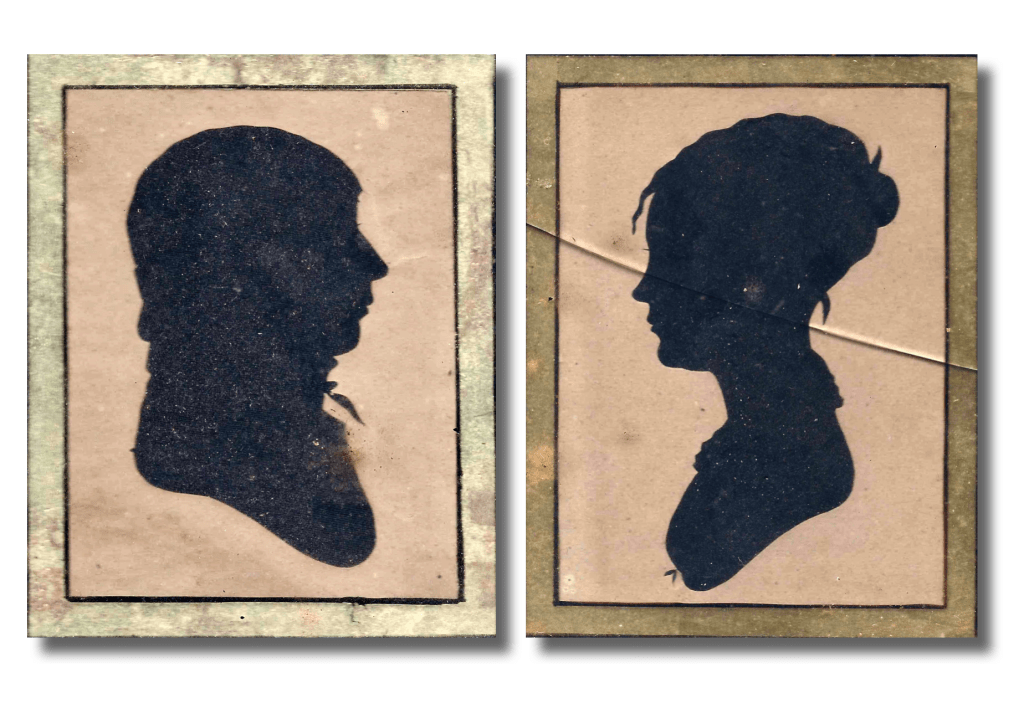
In the 1860s, Samuel Badger Neal of Kittery, York county, Maine began to conduct interviews with some of the older members of his community, thinking to record some oral history of the area before it was lost. He recorded their stories on stationery, some bound, some not, and kept them bundled together with a string thinking, perhaps, he might someday publish them. He did not. He passed away and they were handed down to a niece or nephew who slapped a note on the pile which read, “Most of these are Uncle Sam’s gossipy notes on early Kittery.” They were indeed, and while some of the recorded stories are of limited historical significance, there are nuggets of information buried within them that would likely be of keen interest to historians of the area and particularly Kittery—the oldest settlement in Maine.
Samuel (“Sam”) Badger Neal (1842-1901) was the son of John Robert and Anna Maria (Badger ) Neal. He was born in Portsmouth, New Hampshire, on 29 April 1842 and fitted for college at Phillips Exeter Academy. He graduated from Harvard College in 1864 and the following year entered the NH National Bank of Portsmouth as a cashier. He then went to New York as a salesman in the coal business, to Boston as a bookkeeper, and then as a coal salesman. He suffered from ill health and lived with his parents in Kittery for a while, managing his father’s coal business. He lived until 1901. He was found dead in his stable, having been knocked down and trampled by his horse.
1863 Interview of William Dennett (1786-1883)
One of Sam’s first interviews was with Mark Dennett (1786-1883), the son of William Dennett (1739-1803) and Mary Adams. Mark was born in Kittery, Maine, Aug. 28, 1786, died April 30, 1883. Among Mark’s personal papers is found a record of some events in his early life, written by himself in which he says:
“In early boyhood I hated school, until about nine years old, when my fancy changed and I like the school and began to stand at the head of my class. Our school privileges were very limited. I attended to nothing at school but reading, spelling and writing until I was thirteen years old; but I progressed in the old arithmetic at home under the instruction of my father and brother, to the rule of three. At thirteen years I commenced the arithmetic at school, and during the winter term I mastered about one-half Merrill’s Arithmetic. In the spring of 1800, at a short term of six weeks of Grammar School, I progressed in English Grammar so that I could parse simple sentences. In September a term of Grammar School commenced, and I attended to the study of Latin, and during the winter I advanced into Virgil and Cicero. In the spring my father said that I must help him on the farm. In the winter of 1801-2, there was no Grammar School, and I mastered the last half of the arithmetic. In the winter of 1802-3 I studied Latin at home and recited my lessons once a week with Rev. William Briggs. Oct. 25, 1803, my father died, and the care of the farm devolved on me, and I was thus deprived of school privileges. During the winter of 1803-4 I devoted every spare hour by day and very long evenings to the study of Greek, and in December, 1804, I received a certificate of qualification for teaching in the Grammar School from three ministers who were college graduates. Jan. 1, 1805, at the age of eighteen, I commenced teaching the Grammar School in Kittery, and excepting two or three years (when otherwise employed) I continued to do so several months each year until I was sixty years old, when my hearing failed and I declined the service. In 1807, my mind being religiously impressed, I was baptized and joined the Christian church, of which act I never repented.”
Mr. Dennett was much interested in local history, and was an honored leader in the town of Kittery. He was selectman seventeen years; deputy to the general court of Massachusetts from 1814 to 1819 inclusive, and a member of the first legislature of Maine. He was state senator several times, justice of the peace, and captain and major of the militia.
He married (first) Dec. 22, 1808, Alice, daughter of Edward Wilson. She was born Sept. 22, 1785, died Feb. 4, 1819. He married (second) May 4, 1820, Miriam Pettigrew, born Dec. 12, 1802, died Aug. 10, 1881.
Children of 1st wife:
1. Augustus, born Oct. 17, 1809, died Dec. 30, 1811.
2. Alexander, born Nov. 10, 1811, mentioned below.
3. Betsey, born Sept. 19, 1817, died Nov. 18, 1841.
4. Son, born & died Feb. 3, 1819.
Children of 2d wife:
5. Alice, born May 24, 1821.
6. Sylvester, born Nov. 26, 1822, died Aug. 30, 1847.
7. Sarah, born April 29, 1824, died Feb. 21, 1844.
8. Charles W., born Feb. 15, 1826, died April 6, 1847.
9. Julia Ann, born Jan. 21, 1828, died Nov. 29, 1903; married (first) a Mr. Clough; married (second) Nov. 10, 1858, Joseph Langton.
10. Mary, born Jan. 2, 1830, married Burlinton Paul; died March 22, 1863.
11. Mark Jackson, born April 22, 1834, died July 15, 1856.
12. John, born July 31, 1836, died May 12, 1838.
13. Oren, born Jan. 9, 1839, died Aug. 14, 1859.
14. Emily, born June 22, 1841, died Feb. 13, 1857.
15. Louisa, born Jan. 15, 1844, died June 17, 1847.
Interview 1
May 26, 1863
Major Mark Dennett recollects the time when there was only one tree on Navy Yard Island and that one in front of the Commodore’s house, a very large fine tree—something like the oak on Boston Common.
His brother owned the yard. He purchased it about 1790 or 4. The island was then destitute of trees but Dennett planted some apple trees.
Dennett sold the island for about $5000 to the government. His wife was not satisfied with the sum he obtained and demanded $500 more and got it. Dennett might have received twice as much for it but he was afraid to ask too much for Gov. [John] Langdon [of New Hampshire] was then trying hard to sell Badger Island to the commissioners who were to decide upon the location of the yard. 1

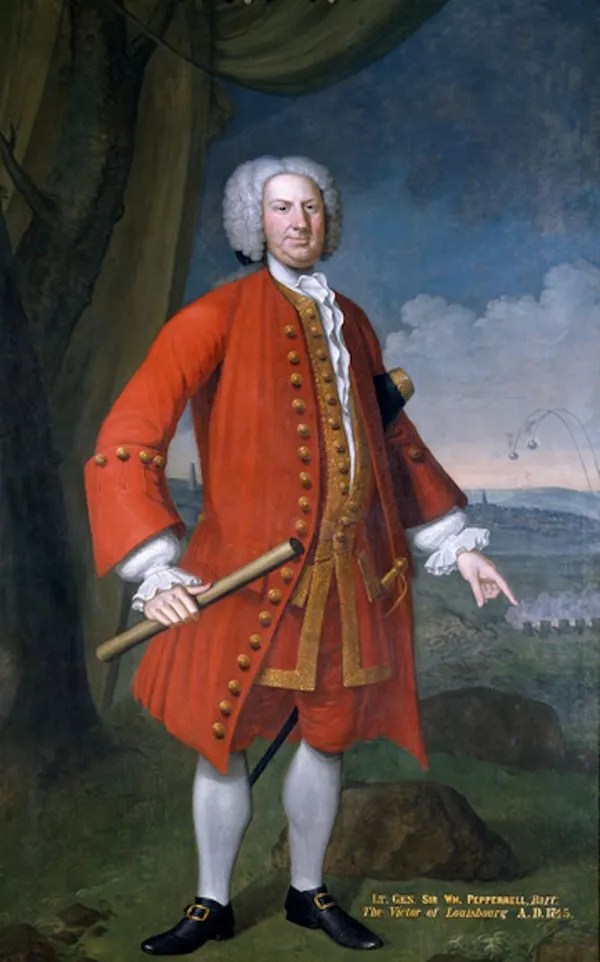
Sir Wm. Pepperell [who died in 1759].
Dennett’s grandfather was acquainted with [William] Pepperell and once went down to see him. His grandfather was a very tall man and as he went out of the door, which as can still be seen was very low, he struck his head against the top and loudly upbraided Pepperell for his low door. But Pepperell, drawing himself up to his full height (he was a short man) stood in the doorway and said, “There, is not this door high enough for a man to stand in?” Dennett had said to him, “Why don’t you have your door high enough for a man to stand up in?” Dennett was then a little overcome with the effects of of the liquor.
Two gentlemen were once going on the way to Saco with Pepperell. One of them was named Goodwin, the other —-? All went armed for the country was sparsely settled and Saco woods were a fit haunt for evil characters. Goodwin told Pepperell that he could disarm him. Pepperell wished him to try it. Goodwin dropped the subject and a little while after when it had escaped the mind of Pepperell, he suddenly went behind him (they were on horseback) and slyly drew his pistol from his belt. Pepperell was highly offended as he thought it disgraceful for an old soldier to be disarmed in that way. They made all up over a glass of punch probably.

1 The Portsmouth Naval Shipyard (PNSY) was established in 1800 when the U.S. government purchased Fernald’s Island (a.k.a. Dennett’s Island) in the Piscataqua River between Kittery and Portsmouth. In 1825, a bridge was built from Kittery to PNSY. In 1826, PNSY expanded to Seavey’s Island. In 1847, the side-wheel steam frigate USS Saranac, was built there.


Interview 2
September 1, 1863
This afternoon I had an interview of an hour or two with Mr. Dennett. I wished to obtain some information of the situation of Trafton’s Ferry near is the house of Thomas G___, the son of Ferdinand. Trafton’s Ferry is near the bridge which leads to York. 1
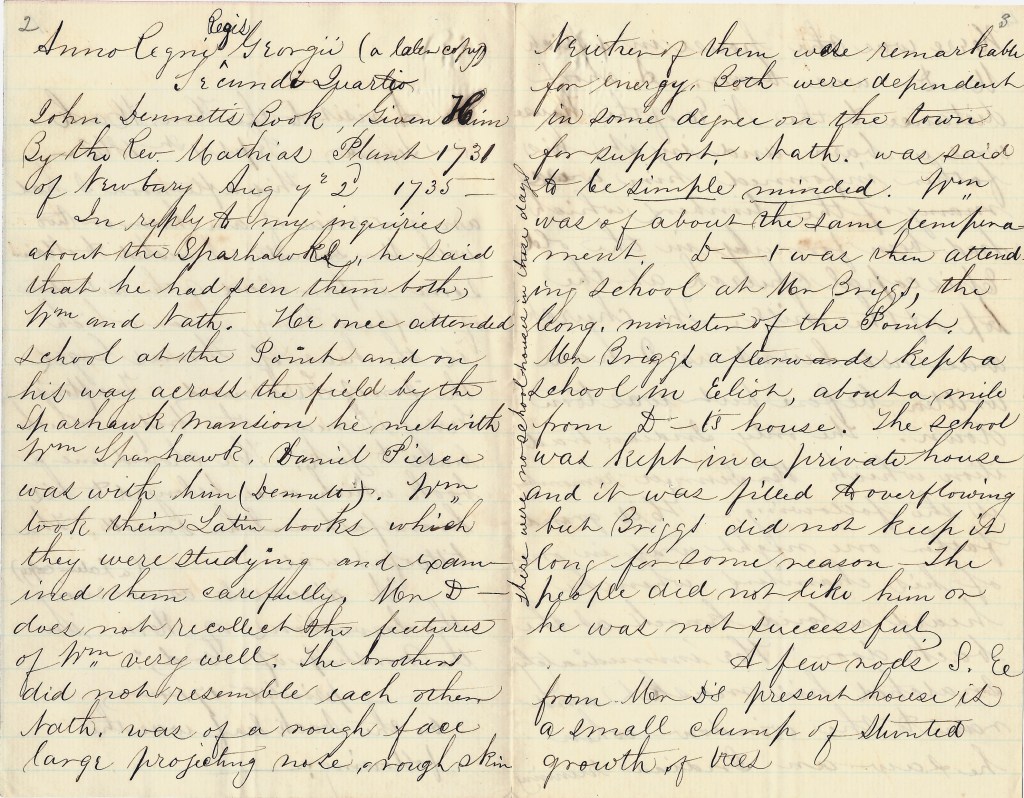
He showed me a book which once belonged to his Grandfather John Dennett [1708-1797]. The little of it was, “A discourse concerning the Inventions of Men in the Worship of God.” Printed 1714. On the back leaf was the following: “Anno Cegni Regus Georgii (a later copy) Secundi Quarto. John Dennett’s book, given him by the Rev. Mathias Plant 1731 of Newbury August 2d 1735.
In reply to my inquiries about the Sparhawks, he said that he had seen them both, William and Nathaniel. He once attented school at the Point and on his way across the field by the Sparhawk mansion he met with William Sparhawk. Daniel Pierce was with him (Dennett). William took their Latin books which they were studying and examined them caregully. Mr. Dennett does not recollect the features of William very well. the brothers did not resemble each other. Nath. was of a rough face, large projecting nose, and rough skin. Neither of them was remarkable for energy. Both were dependent in some degree on the town for support. Nath. was said to be simple minded. William was of about the same temperament.
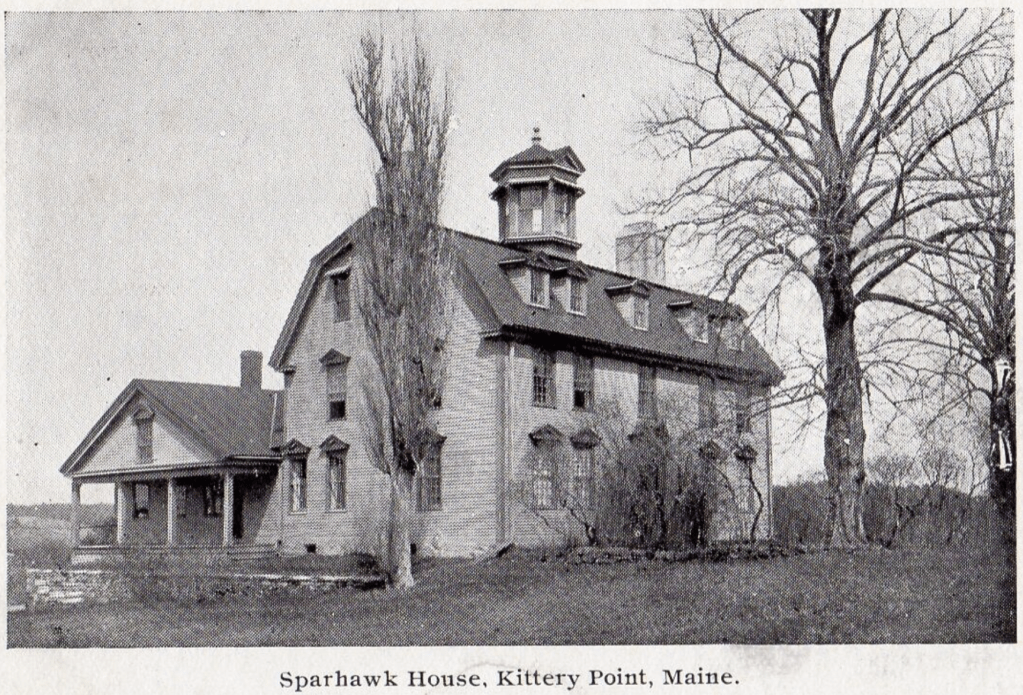
Dennett was then attending school at Mr. Briggs, the Congregational minister of the Point. Mr. Briggs afterwards kept a school in Eliot about a mile from the Demmett’s house. The school was kept in a private house and it was filled to overflowing but Briggs did not keep it long for some reason. The people did not like him or he was not successful.
A few rods southeast from Mr. Dennett’s present house is a small clump of stunted growth of trees. Here was the house in which Mr. Dennett was born. A short distance to the northeast of the house was a barn and in it, his father informed him were many of the timbers which had been formerly in the old Episcopal Church at the top of the hill. The church was not burnt as I have written before, but was torn down.
The only Indian tradition which Mr. Dennett remembers is the following. His grandfather one night was in one of his chambers when he heard a loud knock at the back door. He immediately snatched his musket and ran to the window when he saw an Indian running over the field at the back of the house at the top of his speed.
The house was used as a garrison house and families frequently flocked to it in time of danger. 2 There is an old house by the brick kiln which formerly stood by Mr. Dennett’s house. It was inhabited by a family of the name of —–. It is about as old as the Dennett House. At one time there was an attack threatened by the Indians. All of the family came over to the Dennett House with the exception of the old lady—the grandmother. “She was not afraid of the Indians and would not leave the house for them.” She was a little frightened, however, and towards the latter part of the night, she grew very fearful and anxious. She heard footsteps approaching and she cautiously looked out of the window fearing the worst but she found that the noise was made by a squad of men who were going by in pursuit of the Indians. The old lady was not so courageous but that she sat up all night carding flax. Mr. Dennett says that the hill in front of his house was 70 years ago as thickly settled as it is now.
He showed me a letter written by the wife of Mr. Eveleth about 7 years after his death [dated 5 September 1743] …The letter was written on a piece of paper of this size or a little less in a very compact form. The old lady was in difficult circumstances at this time. This letter and the book are the only remains of the family Mr. Dennett knows of.
1 Trafton’s Ferry on the York River operated at the site of Rice’s Bridge on Route 1 and replaced the Stiver ferry because a new road to Kittery and Portsmouth had been created at this location. I began operation in 1688 by the Freethy family and was tubsequently operated by the Trafton family.
2 In 1698, John Dennett (Mark’s grandfather) bought land in Kittery for a garrison homestead to protect his family from attacks (house no longer stands). A garrison house was built of heavy timbers and often had an overhanging second floor.



 Spared & Shared 23