
In the 1860s, Samuel Badger Neal of Kittery, York county, Maine began to conduct interviews with some of the older members of his community, thinking to record some oral history of the area before it was lost. He recorded their stories on stationery, some bound, some not, and kept them bundled together with a string thinking, perhaps, he might someday publish them. He did not. He passed away and they were handed down to a niece or nephew who slapped a note on the pile which read, “Most of these are Uncle Sam’s gossipy notes on early Kittery.” They were indeed, and while some of the recorded stories are of limited historical significance, there are nuggets of information buried within them that would likely be of keen interest to historians of the area and particularly Kittery—the oldest settlement in Maine.
Samuel (“Sam”) Badger Neal (1842-1901) was the son of John Robert and Anna Maria (Badger ) Neal. He was born in Portsmouth, New Hampshire, on 29 April 1842 and fitted for college at Phillips Exeter Academy. He graduated from Harvard College in 1864 and the following year entered the NH National Bank of Portsmouth as a cashier. He then went to New York as a salesman in the coal business, to Boston as a bookkeeper, and then as a coal salesman. He suffered from ill health and lived with his parents in Kittery for a while, managing his father’s coal business. He lived until 1901. He was found dead in his stable, having been knocked down and trampled by his horse.
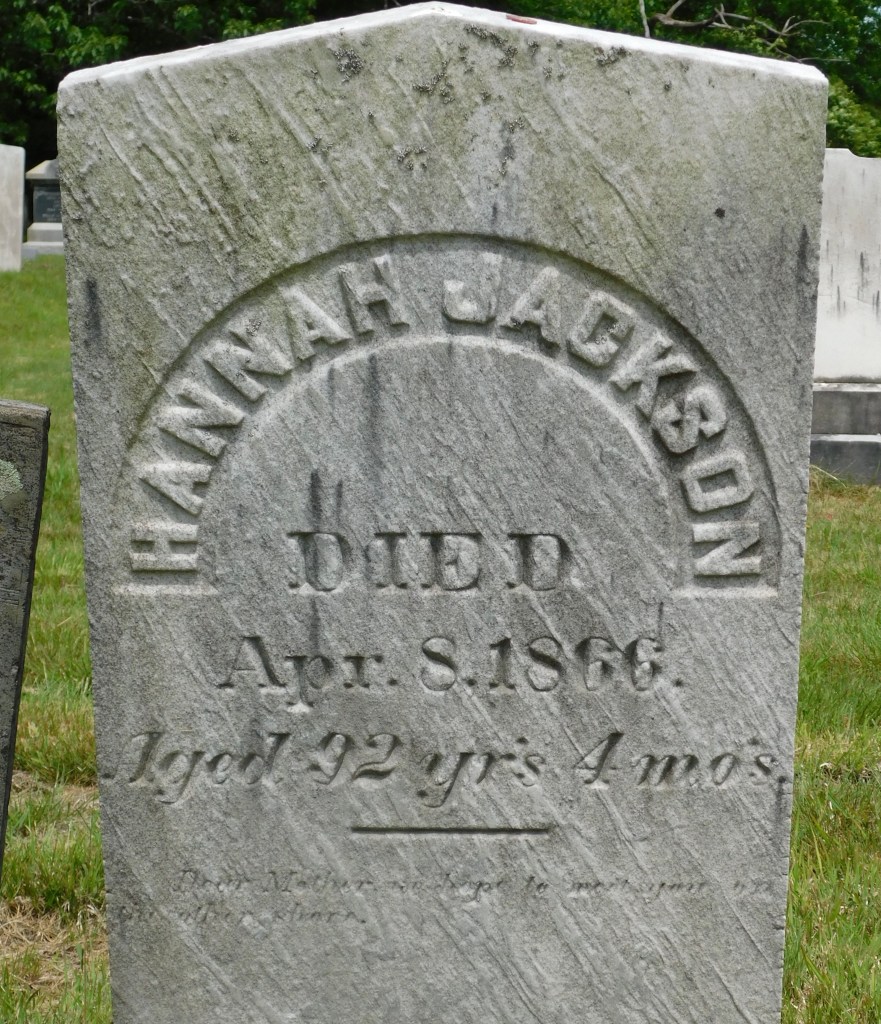
1860 Interview of Hannah Jackson (1774-1866)
Houses
There were eight houses in the place she recollects at first belonging to Nathan Dame, Jonathan Dame, Grand or great-grandfather Fernald, Chandler, Jackson, Traip, Whitten, and one other. The house enlarged by S. Badger formerly consisted merely of the portion now used as dining room, comprising two rooms, two closets, and cellar. In the cellar of what is now Jackson’s house used to be a house or room the old lady called it and her mother used to show her where the steps were. When her mother first came here there were no houses (on the foreside) but many clamshells all around the field where the Indians had been. Her mother was 92 years old and 5 months and died between 20 and 25 years ago. Mrs. Jackson (the above) is 86 or 7 and says the house she lives in (Jackson’s House) was built by her father 10 years before the Revolution. Her father died in Rhode Island of the yellow fever.
The house now belonging to the Hanscom (Isaiah) about 3 or 4 feet east of her own (Jackson’s) before consisted of a small house occupied by a Mr. Chandler. One day after going all round his field rather curiously, he came to the doorstep, stumbled in the house and dropped down in fit which he never came out of. In the War of 1812, folks carried their things back some distance of by Mendon’s somewhere and some of them 3 miles when the British were expected to attack them. The soldiers with drums and fifes passed by her house making a great noise on their way to the Point Fort McClary.

She could hear the bell ring down at Rye, and a fire alarm was touched off at the hay yard and there was great consternation. The could see the English with the naked eye. The old lady said she could recollect the first building on the Navy Yard and before it was done she went over there one night with a party of girls and found a bottle of rum and had a grand time over it. (Probably they drank it.) This building was part on the south part of the yard somewhere, probably one of the old ship houses. (The old lady whose apartment was in the cellar of Jackson’s house was old Mrs. Pope.) The old lady (Jackson) says that she dreamed twice that there was something buried down by the shore on the hill just southeast of where the present blacksmith shop of Badger’s yard stands, and says if she had the use of her legs, she would go there and dig it up.
Capt. Traip used to go to sea. He picked up a brass cannon there once. An old scow full of iron once laid in the river and the old man (Traip) used to dive after it in a diving bell. She said she often stood on a scow and watched when he came up. He would look as pale as a ghost. He used to get two or three barrels of iron every time.
Witches

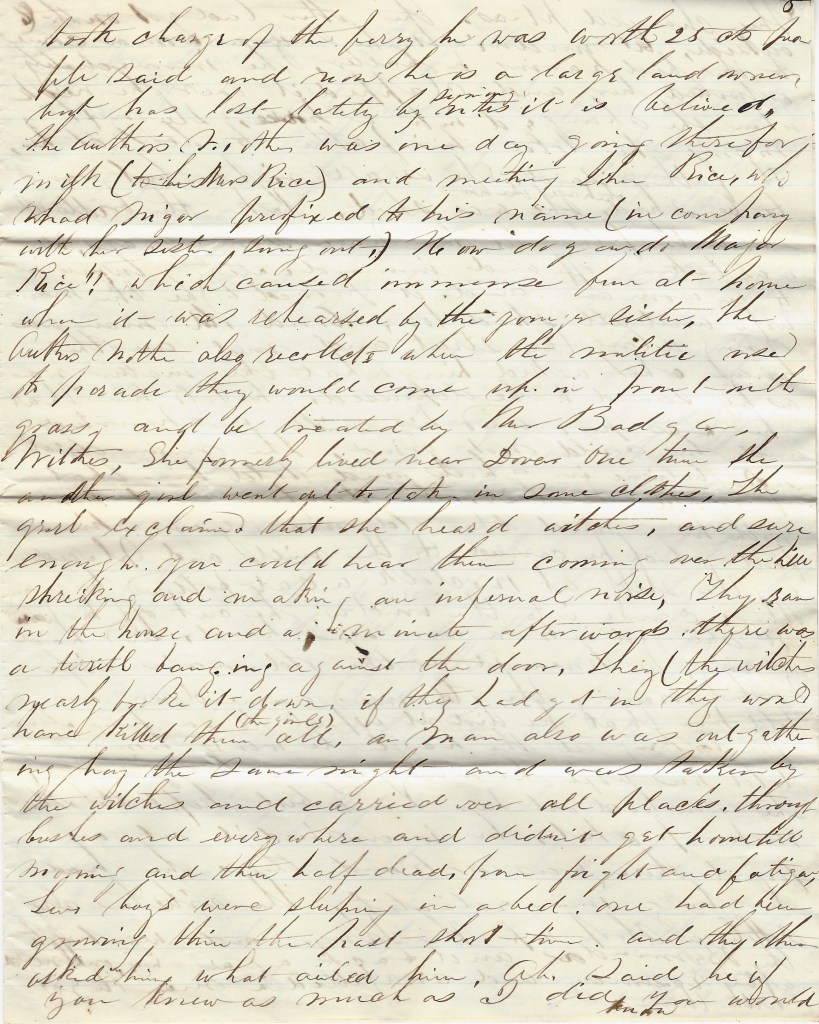
At the old ferry (by Mrs. Rice’s at present), Mrs. Rice used to have an parrot who would call people all kind of names. When Mr. John Rice [1788-1871] took charge of the ferry, he was worth 25 cents, people said, and now he is a large land owner, but has lost lately by signing notes it is believed. The author’s mother was one day going there for milk (to Mrs. Rice) and meeting John Rice who had major prefixed to his name (in company with her sister) sung out. “How do you do Major Rice!” which caused immense fun at home when it was rehearsed by the younger sister. The author’s mother also recollects when the militia used to parade, they would come up in front on the grass and be treated by the Badger witches. She formerly lived near Dover. One time she and another girl went to take in some clothes, the girl exclaimed that she heard witches, and sure enough, you could hear them coming over the hill shrieking and making an infernal noise. They ran in the house and a minute afterwards there was a terrible banging against the door. They (the witches) nearly broke it down. If they had got in, they would have killed them all (the girls). A man also was out gathering hay the same night and was taken by the witches and carried over all places, through bushes and everywhere and didn’t get home till morning and then half dead from fright and fatigue.
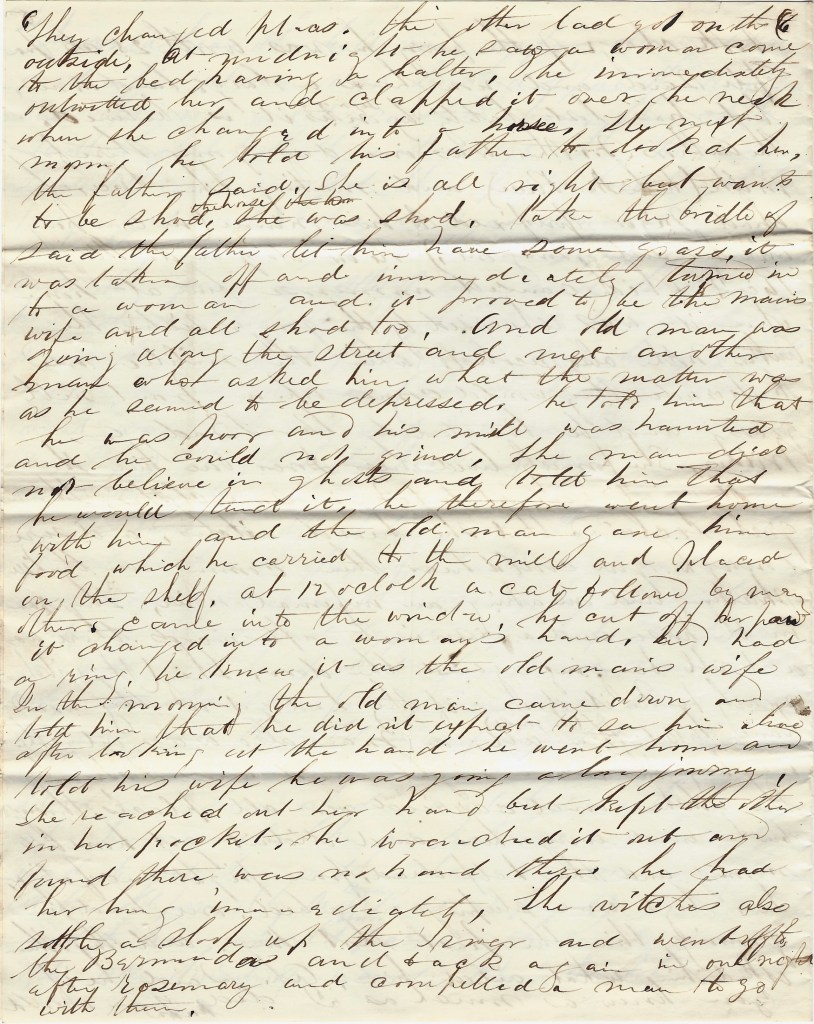
Two boys were sleeping in a bed. one had been growing thin the past short time and the other asked him what ailed him. “Oh,” said he, “if you knew as much as I did, you would know.” They changed places. The other lad got on the outside. At midnight he saw a woman come to the bed having a halter. He immediately outwitted her and clapped it over her neck when she changed into a horse. The next morning he told his father to look at her. The father said, she is all right but wants to be shod. The horse was shod. “Take the bridle off,” said the father. “Let him have some grass.” It was taken off and immediately turned into a woman and it proved to be the man’s wife and all shod too.
An old man was going along the street and met another man ad asked him what the matter was as he seemed to be depressed. He told him that he was poor and his mill was haunted and he could not grind. The man did not believe in ghosts and told him that he would tend it. He therefore went home with him and the old man gave him food which he carried to the mill and placed it on the shelf. At 12 o’clock, a cat followed by many others came into the window. He cut off her paw. It changed into a woman’s hand and had a ring. He knew it was the old man’s wife. In the morning the old man came down and told him that he did not expect to see him alive. After looking at the hand, he went home and told his wife he was going on a long journey. She reached out her hand but kept the other in her pocket. He wrenched it out and found there was no hand and there. He had her hung immediately. The witches also sailed a sloop up the river and went off to the Bermudas and back again in one night after rosemary and compelled a man to go with them.


 Spared & Shared 23