
In the 1860s, Samuel Badger Neal of Kittery, York county, Maine began to conduct interviews with some of the older members of his community, thinking to record some oral history of the area before it was lost. He recorded their stories on stationery, some bound, some not, and kept them bundled together with a string thinking, perhaps, he might someday publish them. He did not. He passed away and they were handed down to a niece or nephew who slapped a note on the pile which read, “Most of these are Uncle Sam’s gossipy notes on early Kittery.” They were indeed, and while some of the recorded stories are of limited historical significance, there are nuggets of information buried within them that would likely be of keen interest to historians of the area and particularly Kittery—the oldest settlement in Maine.
Samuel (“Sam”) Badger Neal (1842-1901) was the son of John Robert and Anna Maria (Badger ) Neal. He was born in Portsmouth, New Hampshire, on 29 April 1842 and fitted for college at Phillips Exeter Academy. He graduated from Harvard College in 1864 and the following year entered the NH National Bank of Portsmouth as a cashier. He then went to New York as a salesman in the coal business, to Boston as a bookkeeper, and then as a coal salesman. He suffered from ill health and lived with his parents in Kittery for a while, managing his father’s coal business. He lived until 1901. He was found dead in his stable, having been knocked down and trampled by his horse.
Some of Sam’s personal papers are at the Portsmouth Athenaeum under the title, Badger Neal Locke Collection, MS132.
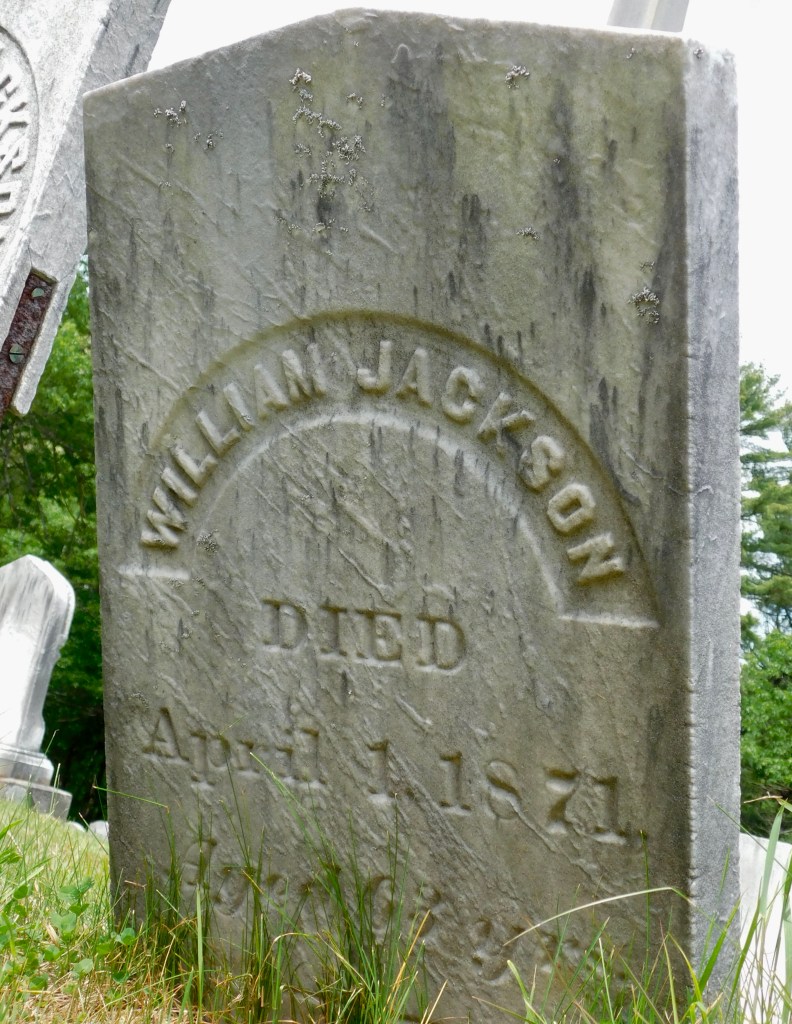
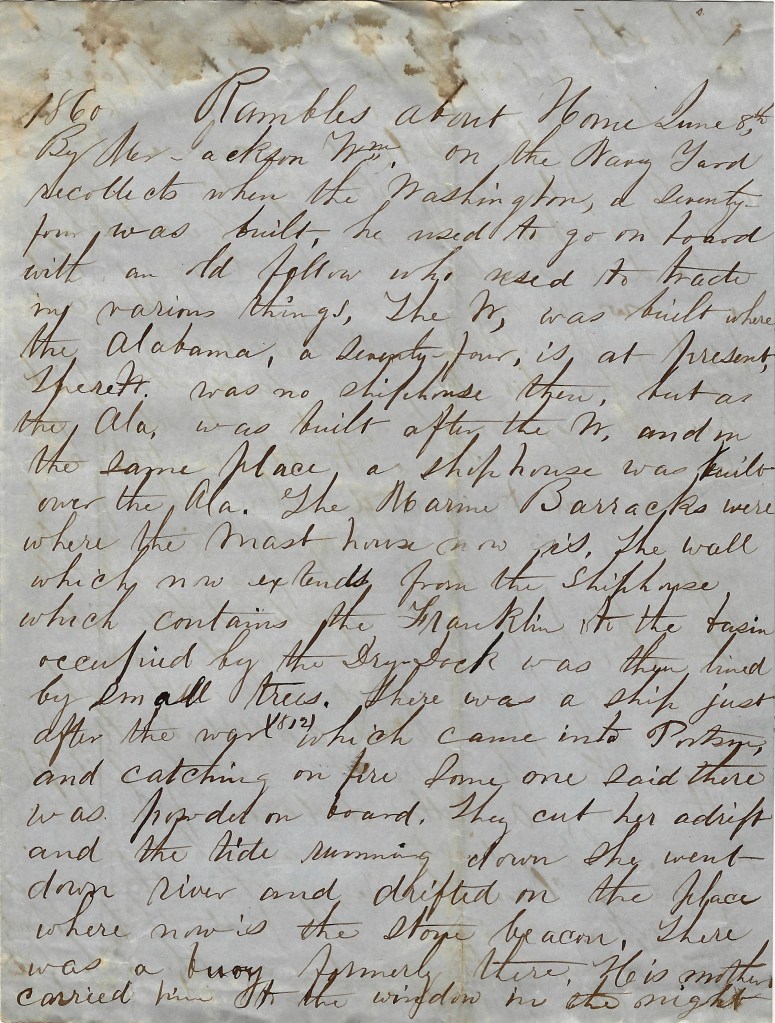
1860 Interview of William Jackson (1808-1871)
William Jackson (1808-1871) was a ship builder in Kittery. He was married to Mary C. Young (1820-1886). He died on 1 April 1871 and was buried in the Orchard Grove Cemetery in Kittery.
On the Navy Yard

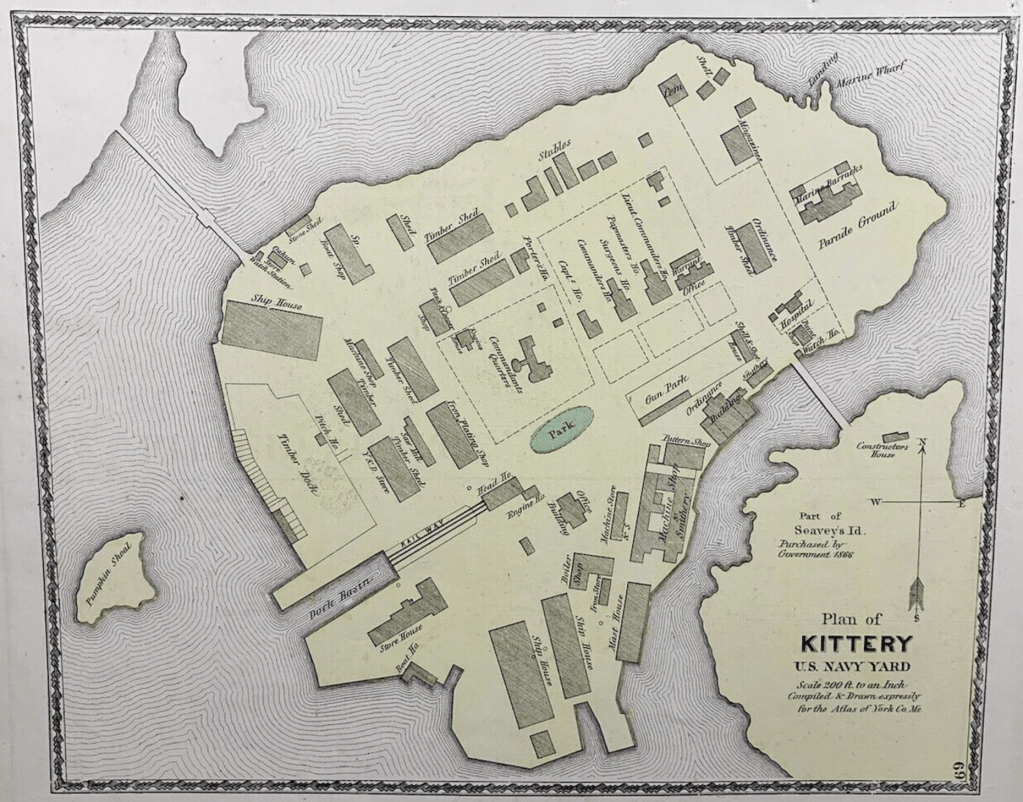
Mr. William Jackson recollects when the Washington, a seventy-four [gun], was built [during the War of 1812]. He used to go aboard with an old fellow who used to trade in various things. The Washington was built where the Alabama, a seventy-four, is at present. There was no ship house then, but as the Alabama 1 was built after the Washington, and in the same place, a ship house was built over the Alabama. The Marine Barracks were where the mast house now is. The wall which now extends from the ship house which contains the Franklin to the basin occupied by the dry dock was then lined with small trees.
There was a ship just after the War of 1812 which came into Portsmouth and catching on fire, someone said there was powder on board. They cut her adrift and the tide running down, she went down river and drifted on the place where now is the stone beacon. There was a buoy formerly there. His mother carried him to the window in the night. The ship was burned in the night. She was loaded with hemp. The place now having the red beacon over it was called Pumpkin Island because it was wholly planted with pumpkins by old Mother Shaw. The Huckleberry Island was also much larger but is now washed away on the eastern part of this shipyard and Samuel Badger’s great grandmother Fernald said she picked huckleberries on the part extending from Mr. Jackson’s house to the water.
A wall used to extend along the front of the yard by the water side and where the present wharf is, used to be the wharf of the old Master Whitten. On the southeastern part of the yard was a nice orchard and along the shore a row of pear trees called Button Pear trees.
He has seen the whole of it—the yard—planted with corn. A little distance from the house, southeastern direction, was what was called a “loom house” where they used to work weaving, &c.
The first ship [that] Samuel Badger launched from the yard was the Charlotte. She was pointed south and the ship ran against Huckleberry Island. The rudder got loose, cause of it, when then tide come down, she sustained serious damage. She was beached where the wood dock now is and he estimates the damage at $500.00.
It is said that the Indians used to go to the shoals. The Indians used to come up by the Portsmouth bridge, a hundred at a time, and steal everything. The America was built at Badger’s Island in 1690. The Falkland, 54 guns, was built here by order of the British government, and this place was selected as a naval depot prior to the Revolution. At this yard was the Ranger was built, commanded by John Paul Jones. The frigates Congress, Crescent, and Portsmouth of 24 guns were built here prior to 1799. The Washington, 74 guns, in 1814. Schooner Porpoise in 1820. Sloop Concord, 24 guns, in 1828. Sloop Preble, 16 guns, in 1839.
1 The 74-gun Alabama mentioned by Sam was one of “nine ships to rate not less than 74 guns each” authorized by Congress in 1816. She was laid down in the Naval Yard in June 1819 and ready for launch in 1825 but remained on the stocks until the Civil War when she was launched under the name USS New Hampshire instead and used as a store ship in the South Atlantic Blockading Squadron.



 Spared & Shared 23