
The following letter was written by 18 year-old William (“Will”) Dare Garrison (1826-1847), the eldest child of at least six born to Edmund Fithian Garrison (1802-1858) and Rebecca Dare (1808-1845) of Swedesboro, Gloucester county, New Jersey.
When war was declared on Mexico in May 1846, Will enlisted in Co. D (“Cambria Guards”), 2nd Pennsylvania Volunteers. Although he traveled with the volunteers in 1846 he did not officially enlist until 21 Jan. 1847. William would pass away on 11 July 1847 from illness at the Castle of Perote in Mexico City, aged twenty-one.
In this incredible letter, Will provides us with rich detail of the 4th of July events in Camden, New Jersey, in 1844 which happened to coincide with the Presidential campaign of Whig candidate Henry Clay and his running mate, Theodore Frelinghuysen. We learn that a political barbecue with food and speeches was held in the afternoon of the day’s events on Smith Island, in the middle of the Delaware river between Camden and Philadelphia. The letter was written on 6 July 1844, just one day before a major riot erupted across the river in Philadelphia between the Nativists and Roman Catholics.

Will wrote the letter to his sister, Harriet Fithian Garrison (1831-1919) who married John W. Kirby (1826-1897) in 1854. That the family admired the statesman Henry Clay seems to be of little doubt as Will had a younger brother named Henry Clay Garrison (1835-1913) who humorously wrote his own epitaph: “Poor old Garry, Here he lies. Nobody laughs, And nobody cries; Where he has gone, Or how he fares, Nobody knows, Nobody cares.”
[Note: to see a map of Lobos Island drawn by Will in April 1847 during the Mexican-American War, see Manuscript Map.]
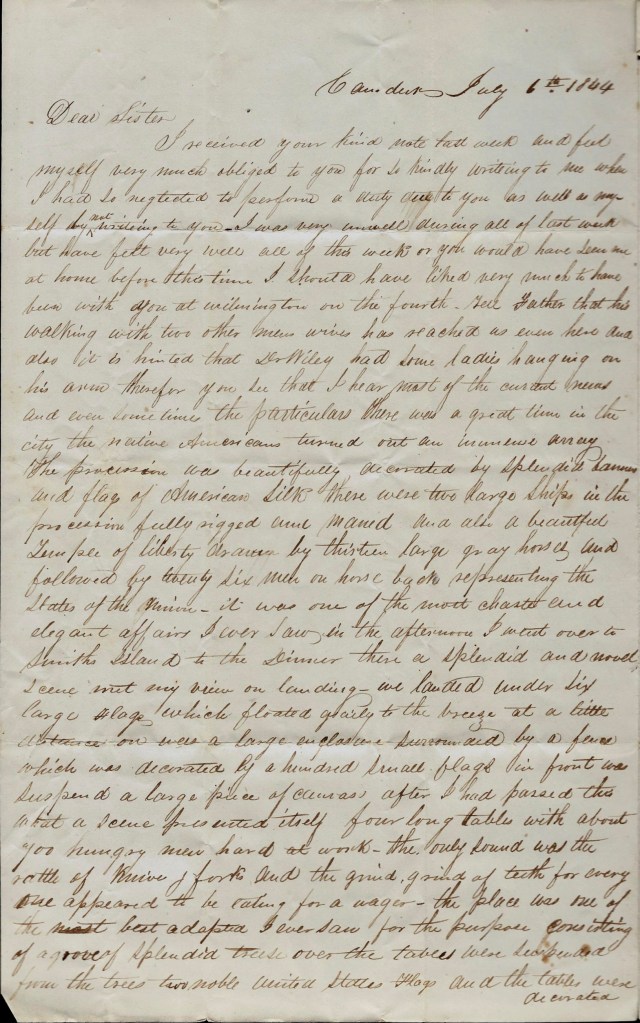
Transcription
Camden [New Jersey]
July 6th 1844
Dear Sister,
I received your kind note last week and feel myself very much obliged to you for so kindly writing to me when I had neglected to perform a duty due to you as well as myself by not writing to you. I was very unwell during all of last week but have felt very well all of this week or you would have seen me at home before this time. I should have liked very much to have been with you at Wilmington on the fourth. Tell Father that his walking with two other men’s wives has reached us even here and also it is hinted that Dr. Wiley had some ladies hanging on his arm. Therefore, you see that I hear most of the current news and even sometimes the particulars.
There was a great time in the city. The native Americans turned out an immense array. The procession was beautifully decorated by splendid banners and flags of American silk. There were two large ships in the procession fully rigged and manned and also a beautiful Temple of Liberty drawn by thirteen large gray horses and followed by twenty-six men on horseback representing the States of the Union. It was one of the most chaste and elegant affairs I ever saw.
“…what a scene presented itself. Four long tables with about 700 hungry men hard at work—the only sound was the rattle of knife and fork and the grind, grind of teeth for everyone appeared to be eating for a wager.”
— William Dare Garrison, 6 July 1844
In the afternoon, I went over to Smith’s Island to the dinner. There, a splendid and novel scene met my view on landing. We landed under six large flags which floated gaily to the breeze. At a little distance on were a large enclosure surrounded by a fence which was decorated by a hundred small flags. In front was suspended a large piece of canvas. After I had passed this, what a scene presented itself. Four long tables with about 700 hungry men hard at work—the only sound was the rattle of knife and fork and the grind, grind of teeth for everyone appeared to be eating for a wager. The place was one of the best adapted I ever saw for the purpose consisting of a grove of splendid trees. Over the tables were suspended from the trees two noble United States flags and the tables were decorated with numerous small flags bearing the names of Clay and Frelinghuysen. At one end and against the screen was an elevated platform and a table for the officers and speakers. Over them hung a portrait of Henry Clay with U. S. flags festooned over it and two splendid banners hung on either side of it. Opposite to it at the other end of the table, hung a splendid banner surmounted by a gilt eagle festooned with flowers. Upon the side nearest the water was erected a stand for the speakrs, gaily decorated with flags. After dinner we had some toasts and very good speaking interrupted only be cheers and the roar of cannon.
The afternoon concluded with cheers, the firing of cannon, and the bursting of rockets and other fireworks. In the evening there was a splendid display of fireworks.
Give my best respects to all my friends and kiss the family all around for me. There has been a great number of persons over here since the fourth and yesterday there were several fights in the [beer] gardens and a good deal of hard fun. The Dutch [Germans] brought over a band and they danced all the afternoon. Altogether the fourth has gone off with less trouble than was anticipated. I hope that the fourth at Swedesboro went off without any new sprees. Tell Mother that I aim to get up at 5 o’clock after this in order to take exercise and hope by that means to keep from getting sick any more. Give her my love. Tell Father I am looking for him every day in order to make some arrangements. I must now conclude for business calls me to attend to something else. Therefore, I subscribe myself your affectionate brother, — Will D. Garrison
Write back soon.
Burn all my letters for I do not want them kept as monuments of my foolishness and tell John to do the same. — WDG


 Spared & Shared 23