
This letter was written by Virginia Neville Alderson Ellison (1842-1907). the daughter of Henry Alderson Ellison (1801-1863) and Eliza Ann Tripp (1818-1880) of Beaufort county, North Carolina. Virginia married in 1860 to Macon Bonner (1836-1908) and was residing in Washington, North Carolina when the Civil War began in 1861. The couple had two small children, Elizabeth and Richard.
Confederate service records inform us that Macon Bonner was 25 years old when he enlisted in September 1861 as a 1st Lieutenant in Capt. William H. Tripp’s company (McMillan Artillery). By 1862 this unit was known as of Co. B, 40th Regiment N. C. Troops (Artillery) or the 3rd North Carolina Artillery. Macon was taken prisoner at Fort Anderson on 19 February 1865 and transferred to Washington D. C., and then to Fort Delaware where he remained until his release in mid-June 1865.
In the letter “Bettie” Blount is mentioned. Bettie was Elizabeth Watkins (Perry) Blount, the wife of Lieut. John Gray Blount (1831-1914) of the the same unit that Macon served in. He was acting quartermaster for a time and then in March 1863 he was promoted to Captain in the Quartermaster’s Department. He later rose to Major.
At the time this letter was penned in May 1862, Washington, North Carolina, was occupied by Federal forces and the 3rd North Carolina Artillery was posted at Fort Hill a few miles below Washington on the Confederate side of the Pamlico river. It appears that Virginia Bonner was visiting the Satterthwaite family elsewhere in Washington county when she wrote this letter to her husband who must have been stationed with or somewhere near his children. The Ellison and Satterthwaite families were related by marriage.
The letter itself is of considerable interest as it includes discussion of the large group of contraband presently in Washington, North Carolina, as well as multiple mentions of “the colonel”—a Union leader residing in the area whose jurisdiction included deciding who among the inhabitants got their “property” (slaves) back and who didn’t. Although technically not a colonel at the time of the letter, it would not have been surprising for him to portray himself as such to the local population, given his expectation that he would likely soon be a regiment commander.

It’s very likely the “colonel” was Edward Elmer Potter who enlisted (from NY) as Captain in the US Commissary Department and was known to be in Washington, North Carolina, at the time, assigned to Gen. Foster’s command. Turns out that at the time of this letter, Potter was also heavily involved in fostering connections with local citizens having Union sentiments (of which there were quite a few). Based on these contacts, Potter was a major recruiter the 1st NC Infantry Regiment (Union), with himself as a Lt. Col (one month later as Col., and subsequently Brigadier Gen. and finally being discharged in 1865 as Brevet Major Gen.). The formation of this unit had been authorized by Gen. Burnside the same month as the present letter.
The Bonner family was considered the first family of Washington, NC, with the town formed and named in 1776 (1st city in U.S. to be so named in honor of Gen. Washington) by James Bonner (probably related to Macon), a local landowner and politician who fought as an officer in the Revolutionary War. Macon’s father, Richard Hardison Bonner, was a soldier in the War of 1812. Macon himself would go on to become postmaster of Washington, NC following the war.
Many more of Virginia’s letters can be found in the Wilson Special Collections Library at the UNC Library under the title: Macon Bonner Papers, 1862-1864.
[Note: This letter is from the personal collection of Richard Weiner and was transcribed and published on Spared & Shared by express consent.]
Transcription
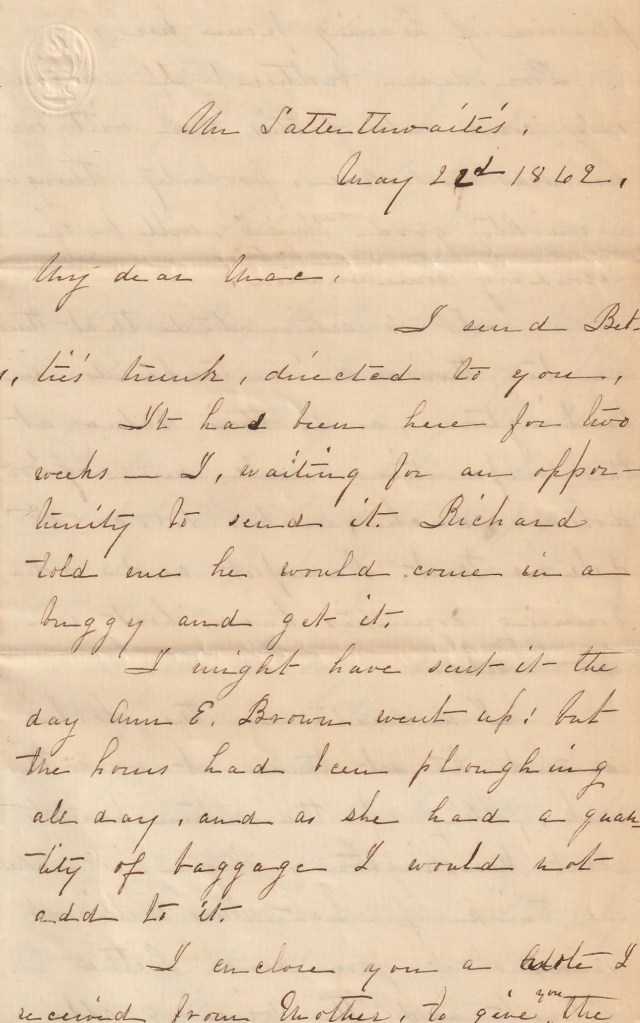
Mr. Satterthwaite’s
May 22d 1862
My dear Mac,
I send Bettie’s trunk, directed to you. It had been here for two weeks, I waiting for an opportunity to send it. Richard told me he would come in a buggy and get it. I might have sent it the day Ann E. Brown went up, but the hours had been ploughing all day, and as she had a quantity of baggage I would not add to it.
I enclose you a letter I received from Mother to give you the pleasure of hearing from her.
Poor dear brother! If we can only come out of this war with our numbers unbroken, property—though a mighty good thing—will be of secondary consideration. It is estimated that there are two thousand ‘contrabands’ in Washington and their value at the comparative small sum of 500 dollars each, makes 1,000,000 dollars that Beaufort and adjoining counties have lost in two weeks. I understand the Col. intends to set them at work this week filling up the entrenchments about Washington.
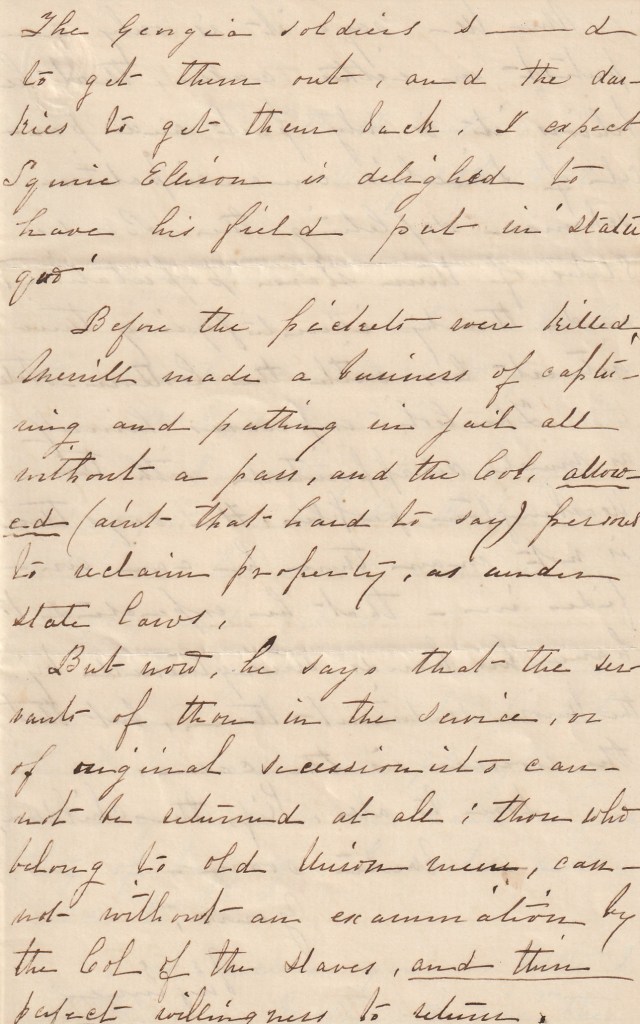
Mac, it makes me think of what Mrs. Williams said about you and Bettie Blount and the wire-grass. The Georgia soldiers s________d to get them out, and the darkies to get them back. I expect Squire Ellison is delighted to have his field put in status quo.
Before the pickets were killed, Merrill made a business of capturing and putting in jail all without a pass, and the Col. allowed (ain’t that hard to say) persons to reclaim property as under State laws. But now, he says that the servants of them in the service, or of original secessionists cannot be returned at all. Those who belong to old Union men cannot without an examination by the Col. of the slaves, and their perfect wilingness to return.
Mr. Williams says it is only a pretext in either case, that he believes it is only part and parcel of Lincoln’s emancipation scheme—depleting the Border States of their slave population and thereby identifying their interest less with the Cotton States.
The Col. expresses himself as much disappointed with the Washington people. He says there is not a man there he can confide in—that he expected to have his hands strengthened by the Union sentiment there but that the reverse is the case.
Love to all. Kiss the children. Write soon. Yours, — Virginia


 Spared & Shared 23