

With a lot more time it might be possible to identify the author of this letter but for the time being he will remain simply “John.” The letter contains a great description of Saint Louis, Missouri, in the spring of 1858. From the letter we learn that John is contemplating opening a fruit stand in the city. The content also informs us that he was from Baltimore and that his mother still lived there.
From a description of the Mercantile Library Hall and its curiosities, to the “floating palaces” on the Mississippi, the interior and services at St. Patrick’s church, to the death of Thomas Hart Benton, John’s 8-page letter is bursting with “newsy” details.
Transcription
St. Louis, [Missouri]
April 11th 1858
My Dear Mother,
I received your letter on Friday, April 9th. The letter you speak of, my dear Mother, I never received, or I should have answered immediately. I had become extremely anxious as to the reason of your not writing and on yesterday week sat down & wrote you a letter telling you I had not received one from you for at least five or six weeks. My letters here have been so far irregular & hereafter when I do receive a letter from you at the regular time, if I am in the city, I will write, taking it for granted you have written & the letter miscarried.
I think it very likely I will soon leave off my wandering life and settle down in St. Louis for a time at least. If I can get what little money together I have, I will open a small retail fruit store, which business from what I have seen I am satisfied will pay, so that I can make not only a good living, but save something over besides to carry home & settle me in a small business near you & Belle and all those I love.
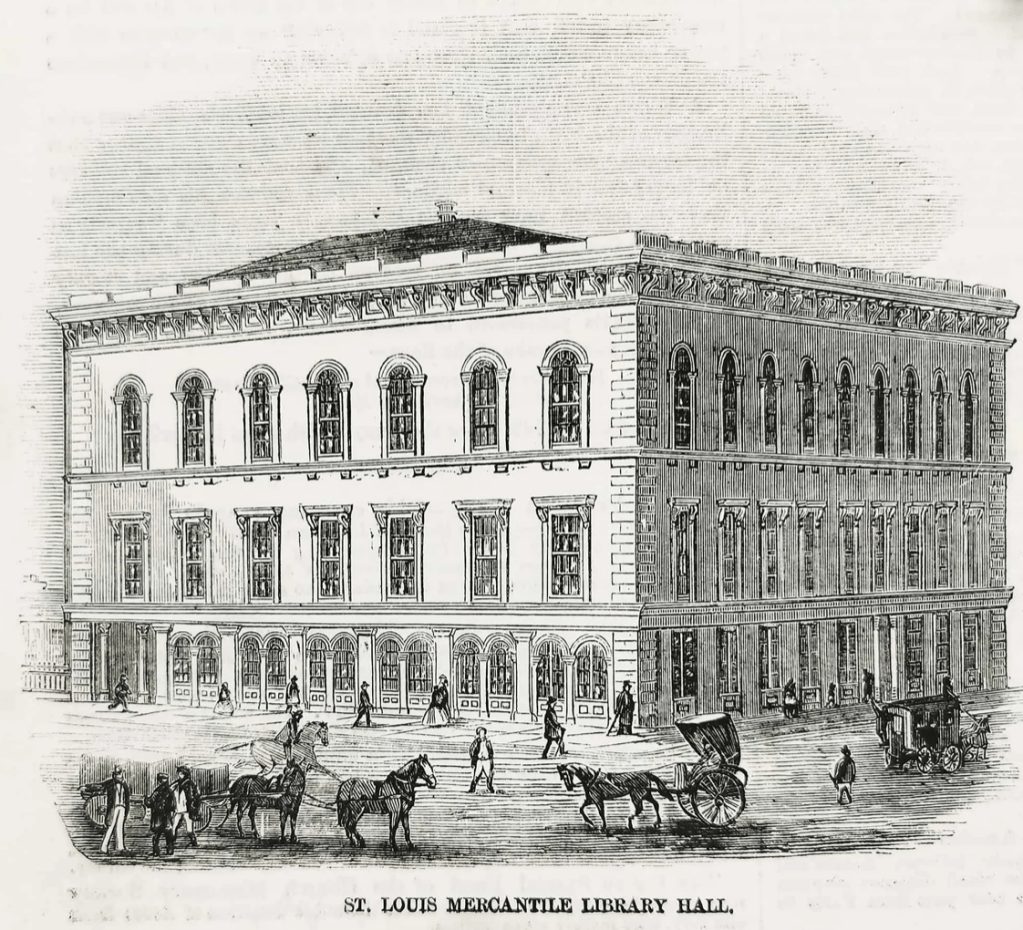
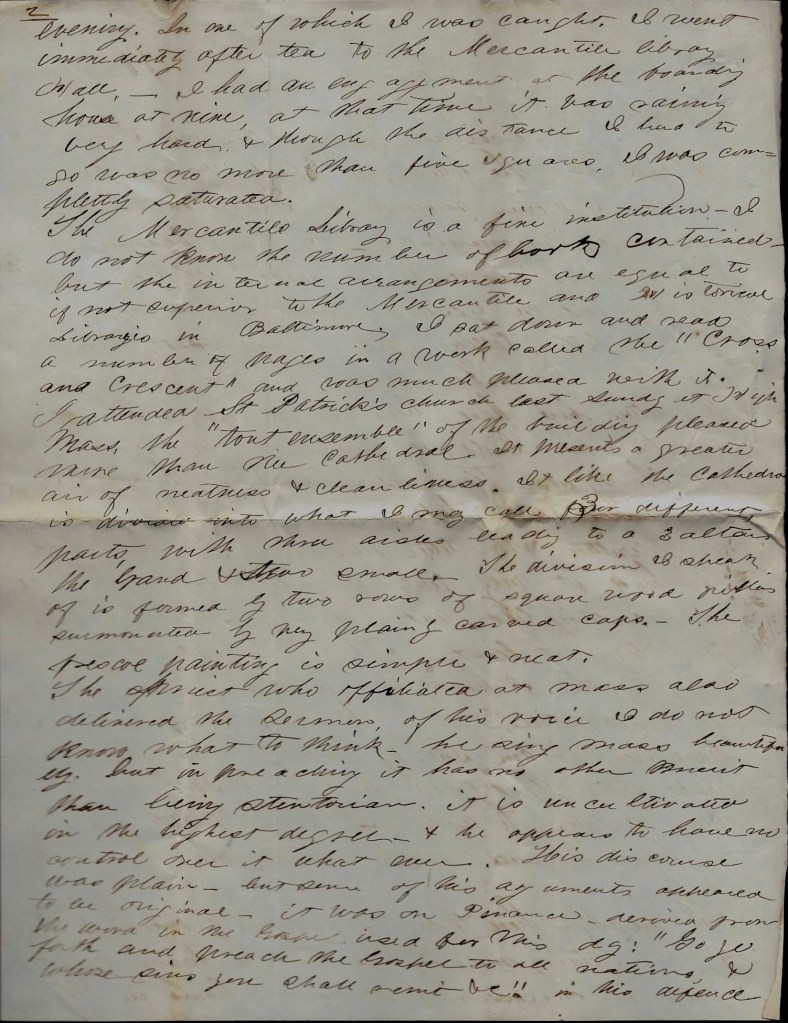
The weather here today is extremely warm and sultry. On Saturday morning we had a heavy gust, and gusts in succession for at least three hours in the evening, in one of which I was caught. I went immediately after tea to the Mercantile Library Hall. 1 I had an engagement at the boarding house at nine. At that time it was raining very hard & though the distance I had to go was no more than five squares, I was completely saturated.
The Mercantile Library is a fine institution. I do not know the number of books contained, but the internal arrangements are equal to, if not superior to, the Mercantile and Historical Libraries in Baltimore. I sat down and read a number of pages in a work called the “Cross and Crescent” and was much pleased with it.
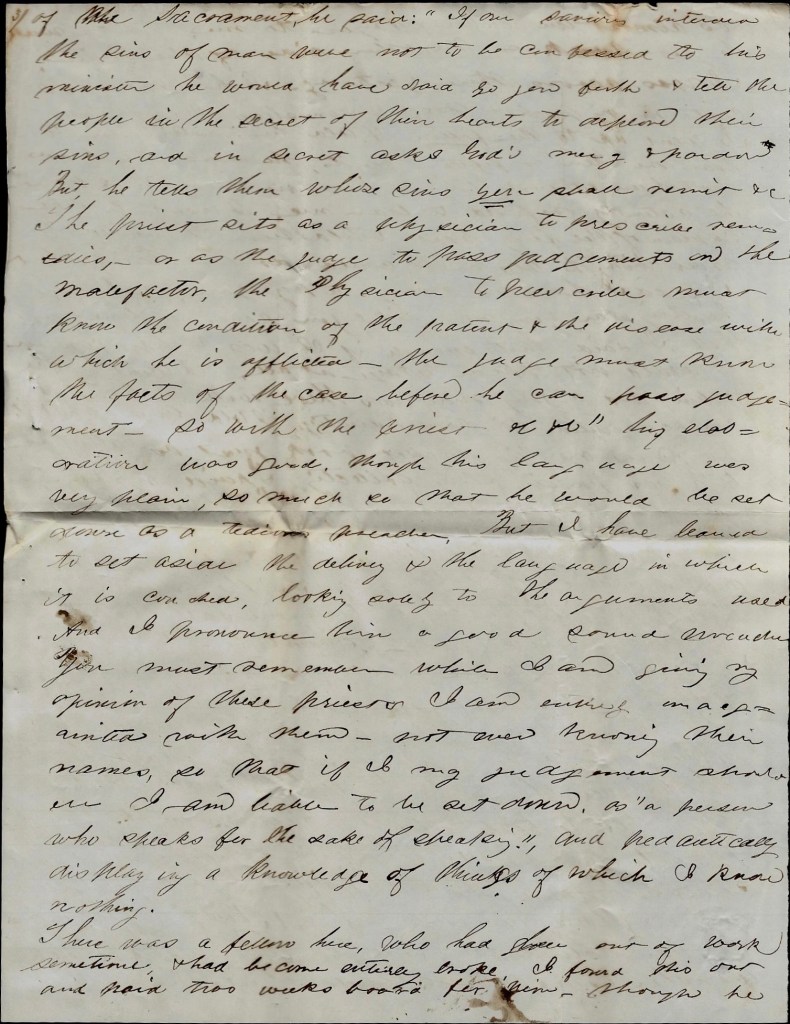
I attended St. Patrick’s church last Sunday at High Mass. The “tout ensemble” of the building pleased more than the Cathedral. It presents a greater air of neatness & cleanliness. It, like the Cathedral, is divided into what I may call 3 different parts, with three aisles leading to three altars—the grand & two small. The division I speak of is formed by two rows of square wood pillars surmounted by very plainly carved caps. The fresco painting is simple & neat. The priest who officiated at mass also delivered the sermon. Of his voice, I do not know what to think. He sings mass beautifully, but in preaching it has no other merit than being stentorian; it is uncultivated in the highest degree & he appears to have no control over it whatever. His discourse was plain, but some of his arguments appeared to be original. It was on penance—derived from the word in the gospel used for [ ]: “Go ye forth and preach the gospel to all nations &whose sins you shall remit, &c.” In his defense of the sacrament, he said, “If our Saior intended the sins of man were not to be confessed to his minuster, he would have said, go you forth & tell the people in the secret of their hearts to deplore their sins, and in secret ask Go’s mercy & pardon.” But he tells them whose sins you shall remit, &c. The priest sits as a physician to prescribe remedies, or as the judge to pass judgments on the malefactor. The physician, to prescribe. must know the condition of the patient & the disease with which he is afflicted. The judge must know the facts of the case before he can pass judgment. So with the priest, &c. His elocution was good, though his language was very plain, so much so that he would be set down as a tedious preacher. But I have learned to set aside the delivery & the language in which it is couched, looking solely to the arguments used, and I pronounce him a good, sound preacher. You must remember while I am giving my opinion of these priests, I am entirely unacquainted with them—not ever knowing their names, so that if I my judgment should err, I am liable to be set down as “a person who speaks for the sake of speaking,” & pedantically displaying a knowledge of things of which I know nothing.
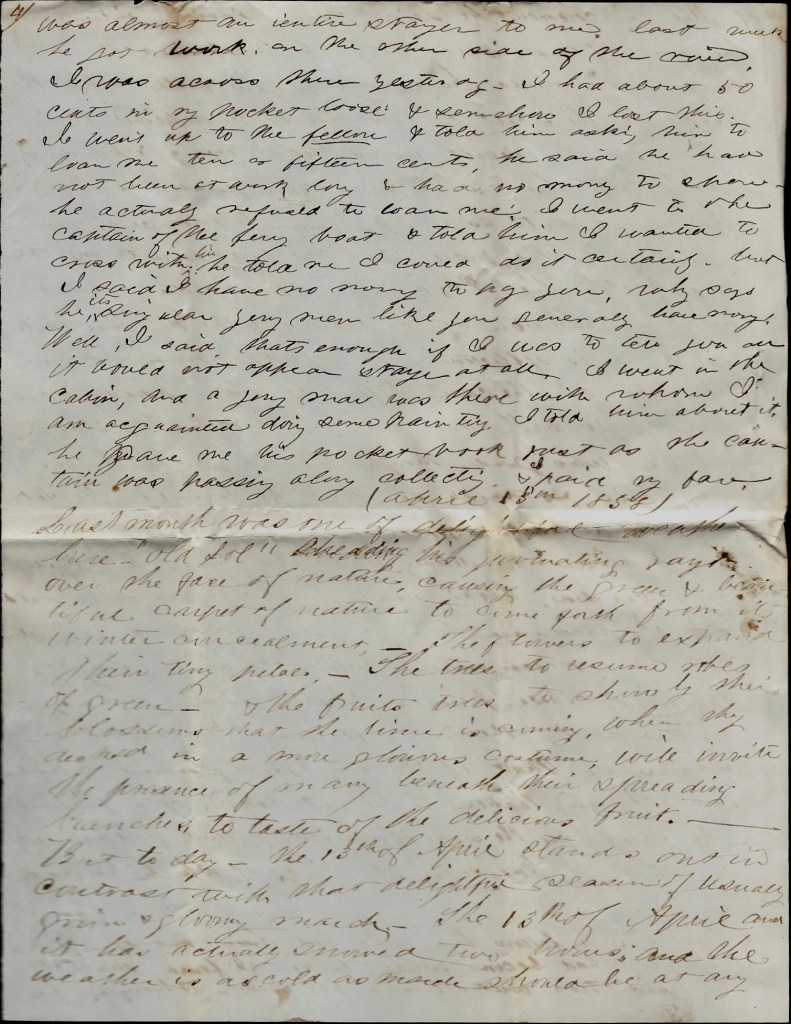
There was a fellow here who had been out of work some time & had become entirely broke. I found this out and paid two weeks board for him though he was almost an entire stranger to me. Last week he got work on the other side of the river. I was across there yesterday. I had about 50 cents in my pocket loose & somehow I lost this. I went up to the fellow & told him, asking him to loan me ten or fifteen cents. He said he had not been at work long & had no money to spare. He actually refused to loan me. I went to the captain of the ferry boat & told him I wanted to cross with him. He told me I could do it certainly, but I said I have no money to pay you. “Why,” says he, “it’s singular. Young men like you generally have nary.”
“Well,” I said, “that’s enough. If I was to tell you all, it would not appear strange at all.” I went in the Cabin and a young man was there with whom I am acquainted doing some painting. I told him about it. He gave me his pocket book just as the captain was passing along collecting & paid my fare.
April 13th, 1858
Last month was one of delightful weather here. “Old Sol” shedding his penetrating rays over the face of nature causing the green and beautiful carpet of nature to come forth from its winter concealment; the flowers to expand their tiny petals; the trees to resume robes of green; and the fruit trees to show by their blossoms that the time is coming when they decked in a more glorious costume, will invite the presence of many beneath their spreading branches to taste of the delicious fruit.
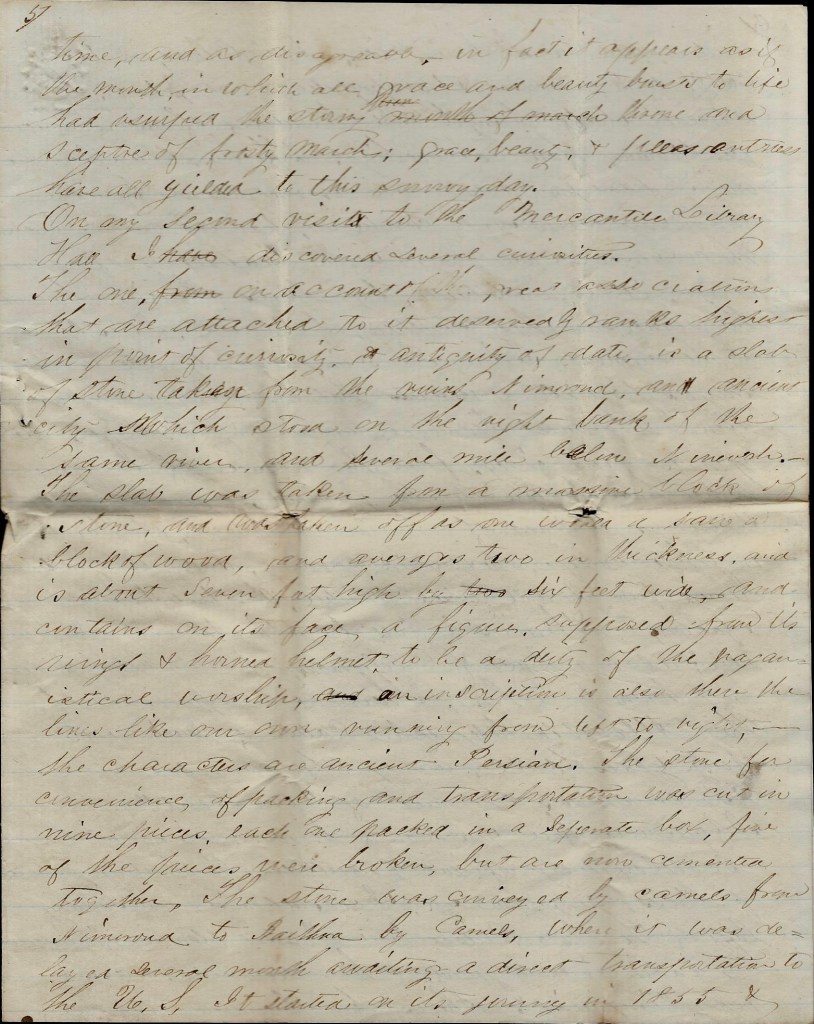
But today, the 13th of April, stands in contrast with that delightful season of usually grim & gloomy March. The 13th of April and it has actually snowed two times and the weather is as cold as March should be at any time, and as disagreeable. In fact, it appears as if the month in which all grace and beauty bursts to life had usurped the stormy throne and scepter of frosty March; grace, beauty, and pleasantness have all yields to this snowy day.
On my second visit to the Mercantile Library Hall, I discovered several curiosities. The one, on account of the great associations that are attached to it, deservedly ranks highest in point of curiosity & antiquity of date, is a slab of stone taken from the ruins of Nimrud—an ancient city which stood on the right bank of the same river and several miles below Nineveh. The slab was taken from a massive block of stone and was taken off as one would saw a block of wood, and averages two in thickness and is about seven feet high by six feet wide and contains on its face a figure, supposed from its wings & horned helmet to be a deity of the paganistical worshippers. An inscription is also there, the lines like our own, running from left to right. The characters are ancient Persian. The stone, for convenience of packing and transportation, was cut in nine pieces, each one packed in a separate box. Four of the pieces were broken, but are now cemented together. The stone was conveyed by camels from Nimrud to B_____a by camels, where it delayed several months awaiting a direct transportation to the U. S. It started on its journey in 1855 & arrived in St. Louis, via New Orleans, in 1857. Cost of wor, in ruins, & transportation, cost $150. The stone of itself, through the kindness of an American gentleman there, cost nothing.
The next, unlike the one I have just mentioned, is not food for the devouring curiosity of virtuous, but one on which the connoisseur can gaze with sentiments of admiration. It is a statuette by Miss Harriet [Goodhue] Hosmer, the American lady sculpture of Verona. It is taken at the moment when Paris, impelled by the soothsayer’s prediction that he should in Greece find the most beautiful woman of the ages, departs from Troy; from the violence of her grief, she has fallen to the ground.
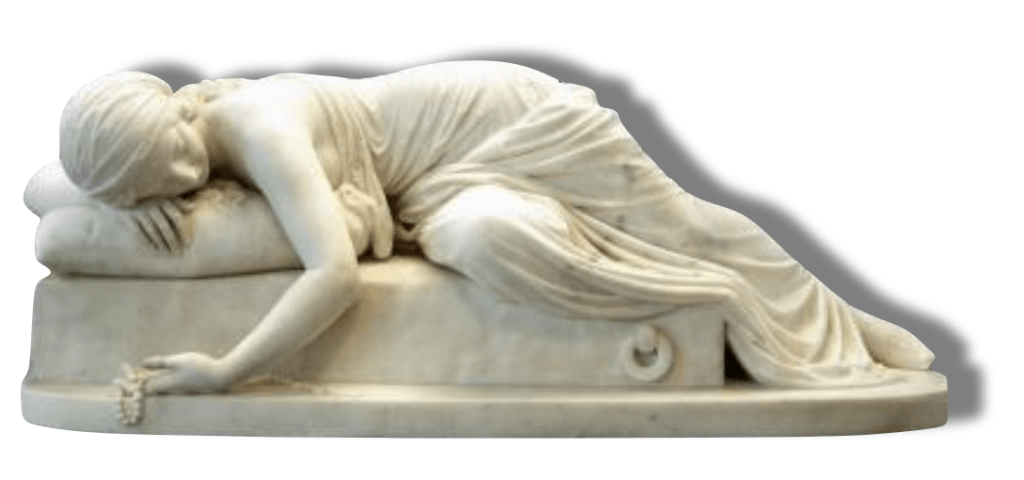
There is a of bust of Dr. [Joseph Nash] McDowell of this city in whose college she [Hosmer] studied anatomy and in gratitude hewed from the dull marble this bust of her benefactor. There is a full length statue of Daniel Webster. Also a bust of Christopher Columbus. The two latter I do not know by whom. There is a specimen of the Atlantic telegraph cable, banks notes forty years old, &c., among the number one for the enormous amount of “one cent.”
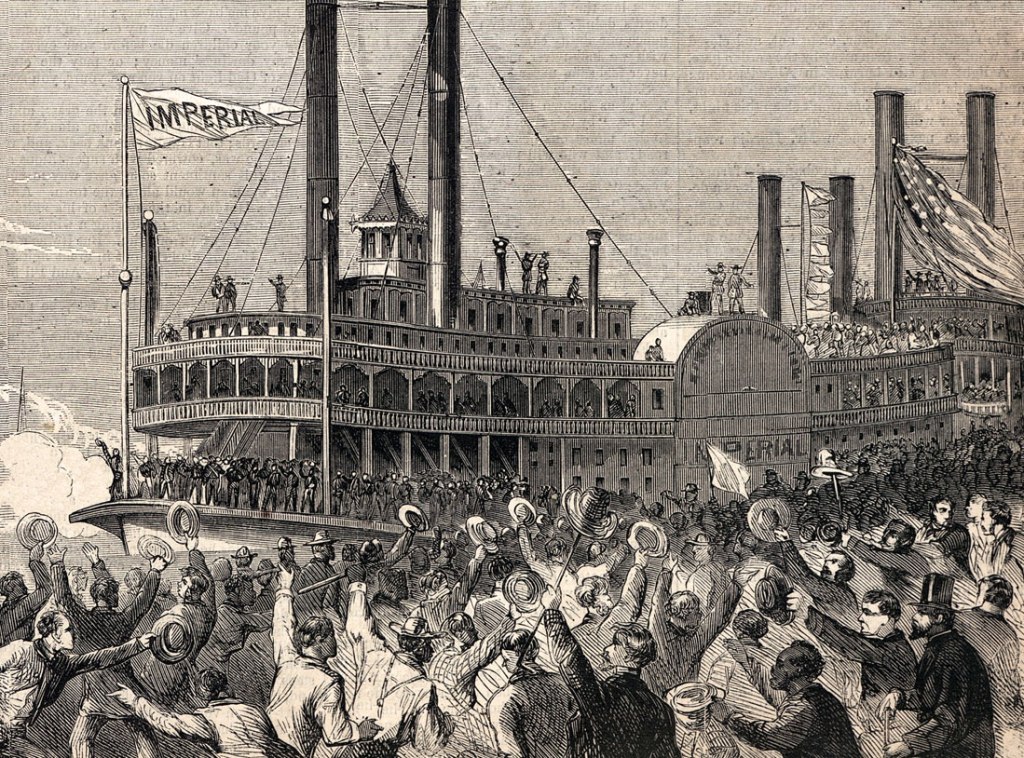
If you were here, you would be astonished at the scale of magnificent grandeur the floating palaces of Mississippi are gotten up. I was aboard on Sunday last of the New Railroad line Packet steamer “Imperial.” Her cabin is really grand & her decorations are really “imperial.” She is three hundred feet long.
I see by the papers the death of Col. Thomas Hart Benton. The mighty contemporaries of Clay & Calhoun are rapidly bidding adieu to earth. The citizens of St. Louis irrespective of party proclivities have joined and passed a suitable resolution regretting the death of an illustrious person; he has bequested by will to be buried beside his deceased wife in Bellefontaine Cemetery. The cortege that will follow his remains to the grave through the streets of the city will be immense. In my letter following the event, I will give you a description of the most striking features. He will rest within 6 miles from the place where he sent two men to their last account & to an eternity.
I have removed to my old quarters on the corner of Broadway and Mulberry. I did not like the other place. It was very disagreeable.
Business is very dull here. I hope it will soon brisk up. I understand through a letter from W. P. Cam___ that Joe I. Wynn has returned to Baltimore. I have not seen him since I was out. He was in Bunker Hill, Illinois.
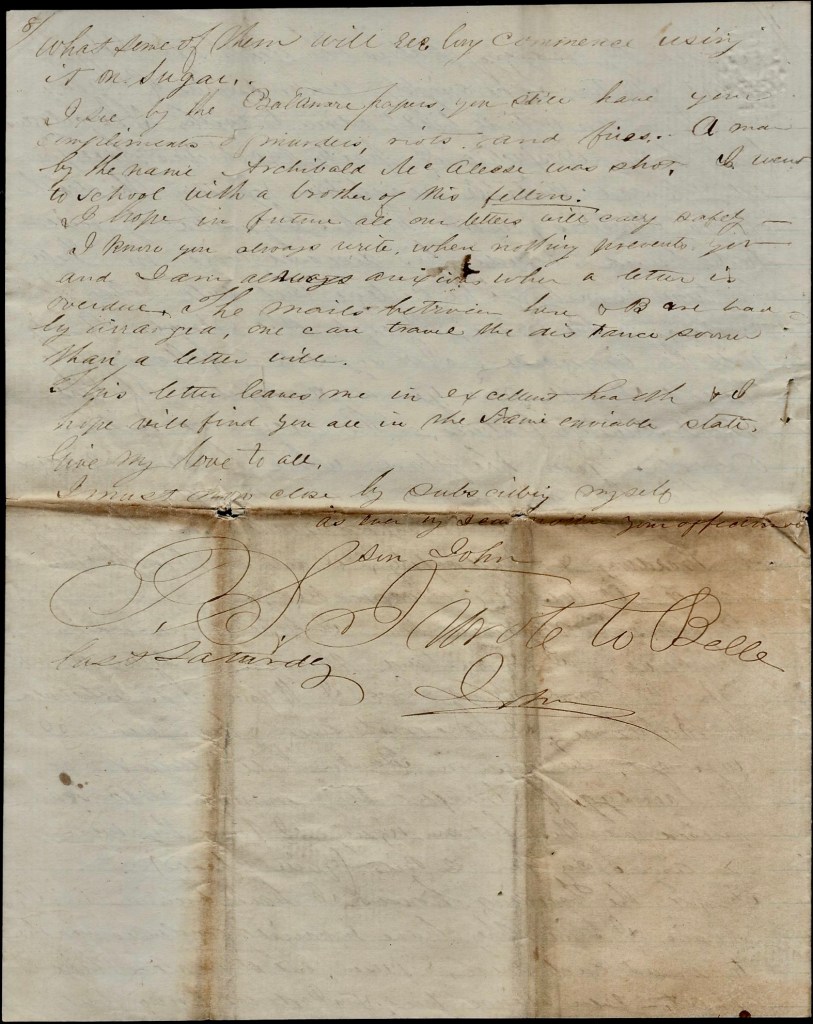
We have eggs for breakfast every morning. I was surprised at this, but on inquiry I found they were selling 3 dozen for 2 bits (quite cheap). In all the boarding houses I have been in in St. Louis, I find they have invariably molasses on the table at each meal, & persons eat it on all things most—even mince pies—and I do not know but what some of them will before long commence using it on sugar.
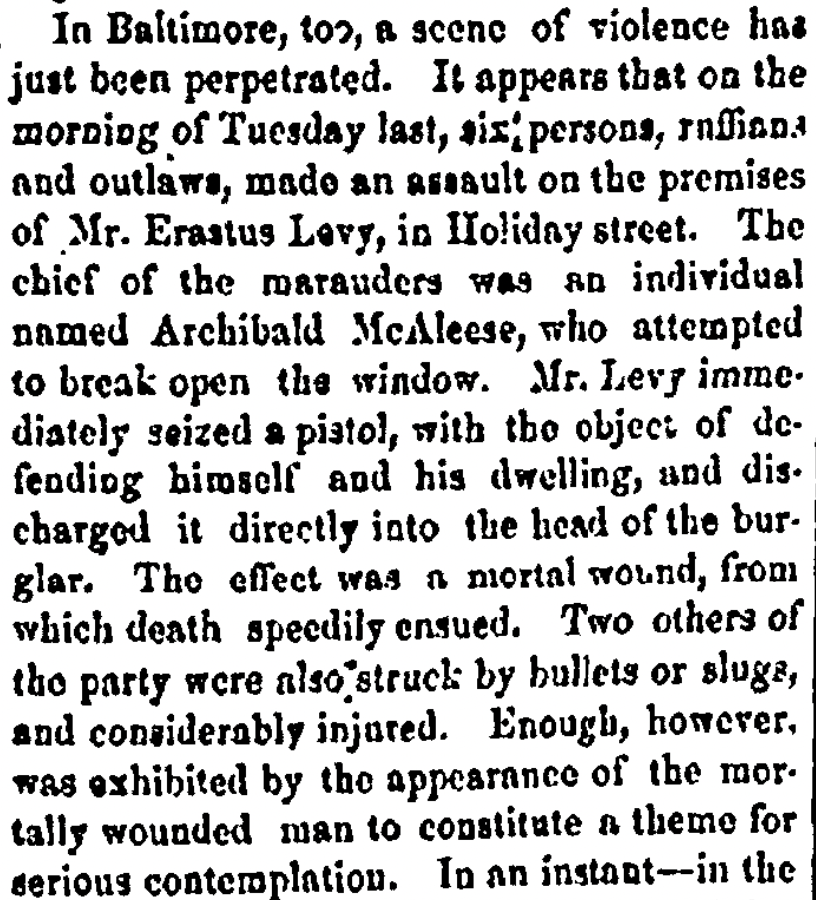
I see by the Baltimore papers you still have your compliments of murders, riots, and fuss. A man by the name Archibald McAlesse was shot. I went to school with a brother of his felon.
I hope in future all our letters will carry safely. I know you always write when nothing prevents, yet I am always anxious when a letter is overdue. The mails between here and Baltimore are badly arranged. One can travel the distance sooner than a letter will.
This letter leaves me in excellent health & I hope will find you all in the same enviable state. Give my love to all. I must now close by subscribing myself as ever, my dear Mother, your affectionate son, — John
P. S. I wrote to Belle last Saturday.
1 In December 1845 a group of civic leaders and philanthropists joined to establish a membership library with the intent of creating a place “where young men could pass their evenings agreeably and profitably, and thus be protected from the temptations to folly that ever beset unguarded youth in large towns. The library officially opened on April 19, 1846, and became chartered by the State of Missouri that year. At the time, public libraries were not a standard institution. The St. Louis Mercantile Library, with a reading room, meeting rooms, book stacks, and the largest auditorium in the city, became a primary hub of cultural and intellectual interchange in the city in the years preceding commonplace public and academic libraries. [Wikipedia]



 Spared & Shared 23