
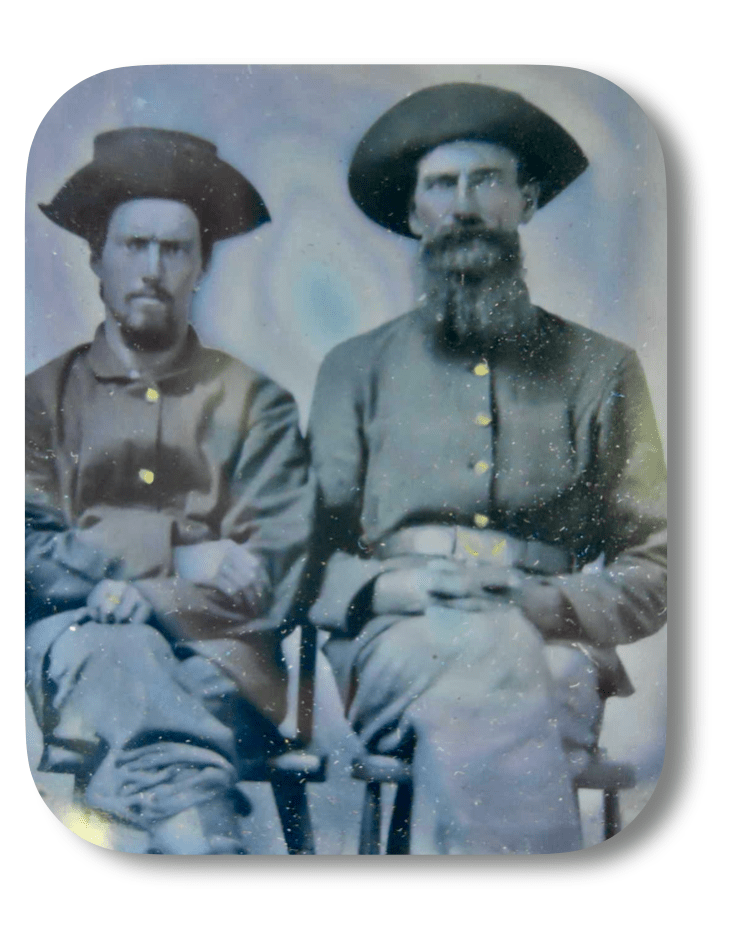
The following letter was written by William Bearl (1829-1913), a native of Germany, who was living in Somerset county, Pennsylvania, when he enlisted on 12 November 1861 to serve three years in Co. H, 85th Pennsylvania Infantry. He mustered out with the company on 22 November 1864.
William’s death certificate gives his parents names as Henry Bearl and Mary Knopschnider
Letter 1
Fort Good [Hope] 1
Near Washington City
February 13, 1862
Brother Peter Bearl,
I must give a few lines to you for you don’t write to me now. I will tell you now that I am well at this time and I hope these few lines may find you in the same state of health. And Now I will let you know that we had not much snow [but] a good deal of rain and the mud was shoe mouth deep and it is hard to get along. We don’t drill now [but] we stand guard. I get on guard about two times a week. One time at the camp and one time on vidette. There is no fun but we have plenty to eat and we have good clothes and [a] good bed. We split timber in two and then we lay on the soft side of it and so we sleep bully. I have plenty of money but we have to win every cent of it.
Now I would like to know how times are there. I would write a good deal more if I could write better. Now I want you to excuse my bad writing. I am afraid that you can’t read it and so I will stop it. But I will commence again for I don’t write enough. I will learn to write by it for I have plenty paper but a pen. If this letter comes to hand, then write soon. It is warm today. I was too much in a hurry. I was cooking. I am cook for the mess. But the next time I will write better.
Direct your letter to Washington City, D. C., Fort Good Hope, 85th Regiment Pa. Volunteers, in care of Captain [James B.] Treadwell, near Washington.
William Bearl to Peter Bearl
1 An anonymous letter from a soldier in the 85th PA appeared in the Monongahela Valley Republican on 20 February 1862. He wrote, “There are several forts on the heights of which ours is prominent. Fort Good Hope is, we believe, one of the largest and most important, being nearly completed. Our regiment has charge of many of these fortifications; sixty men under command of Lieutenant are each day detailed for guarding there, the furthest from camp being distant five miles. Our camp is rather pleasantly situated and our men have generally fared well. Six deaths have occurred among them since we left home nearly three months ago; three are only sixteen cases in the hospital at present.”


 Spared & Shared 23