

The following poignant letter was written by Lock Weems. Jr. (1835-1862), the son of Lock Weeks (1804-1853) and Maria F. Shepherd (1813-1850) of Columbus, Muskogee county, Georgia. Prior to 1860, Lock Jr., the subject of this post, moved to Macon, Alabama, where he entered the mercantile business. There he married Eugenia H. Blackmon on 21 February 1860. The couple’s only child, Feliciana, was born in 1861—just two months before 26 year-old Lock entered the service of the Confederacy on 3 July 1861 as lieutenant and adjutant of the 15th Alabama Volunteers.
The 15th Alabama was part of General Evander Law’s Brigade which was highly praised by Stonewall Jackson for their aggressive assault at Gaines’ Mill on 27 June 1862. Lock was in command of Co. A that day and bravely led his boys into the “storm of shot and shell” where he received a mortal wound early in the fight. We learn from this letter that it was a gun shot to the right breast that was not properly treated for a couple of days that led to his death on 10 July 1862. His body was sent to his birthplace in Columbus, Georgia where he was laid to rest at Linwood Cemetery. The news of his death was published in the Columbus Times:
Death of Capt. Lock Weems – A dispatch from Richmond, conveying the sad intelligence, reached this city last night. Only a few days ago reports came of his condition which greatly encouraged his friends to hope for his speedy recovery. But it has been ordered otherwise, and he has gone to swell the throng of noble martyrs to Southern liberty. This cruel war has robbed the country of a truer or braver spirit. Peace to his ashes and honor to his memory – Columbus Times.
There is a letter from Lieutenant Lock Weems to his wife written from Pageland Farm near Manassas, Va. on 27 August 1861 in the Library of Congress.
[Note: This letter is from the private collection of Richard Ferry and was made available for transcription and publication on Spared & Shared by express consent.]
Transcription
At House of Mr. Johnson
July 5, 1862
My dearest wife,
Your Pa has just [been] here. I was very glad indeed to see him. Uncle Haywood also came. Uncle Haywood will leave in a few minutes and I am able to write a short note.
I am rather badly wounded in the right breast—not dangerously. I have suffered very much [but] am getting along very well now. I had dispatched you saying that I was seriously wounded but I learn from your Pa that it was reported in Columbus that I was mortally hurt. I am sorry that such is the case for I regret that you all should have been so much troubled on my account. I will write you more at length when I have more leisure and more strength.
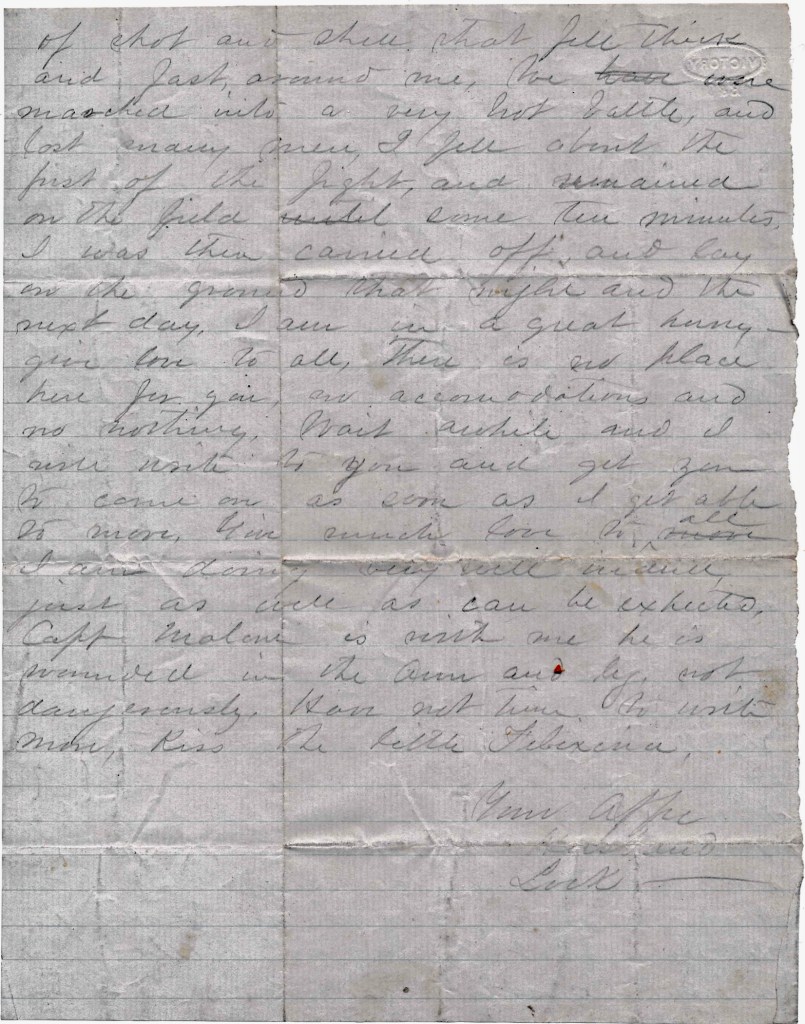
I do really thank God that it is as it is. I am grateful to Him that I am not killed. What a wonder that I was not in the storm of shot and shell that fell thick and fast around me. We were marched into a very hot battle and lost many men. I fell about the first of the fight and remained on the field some ten minutes. I was then carried off and lay on the ground that night and the next day.
I am in a great hurry. Give love to all. There is no place here for you, no accommodations, and no nothing. Wait awhile and I will write to you and get you to come on as soon as I get able to move. Give much love to all. I am doing very well indeed—just as well as can be expected. Capt. [George Yewel] Malone is with me. He is wounded in the arm and leg, not dangerously. 1
Have not time to write more. Kiss the little Felixina. Your affectionate husband, — Lock
1 Capt. George Y. Malone, Co. F, 15th Alabama Infantry, survived his wound at lived until 1906. His obituary states that he “retired from his position on account of severe wounds about the arm, which he received while doing valiant service for his country. He is mentioned in Col. Oates’ history of the 15th Alabama, and is paid high tribute for his bravery and judgement on the field of battle.” The descendants of Malone claim that Capt. Malone was carried to the rear but was abandoned when Col. Oates ordered his bearers back to the front, saying the Confederate forces needed the soldiers too much to spare them for such duties. After lying in the woods all night, Captain Malone was found by his personal slave, who cared for his wounds.

 Spared & Shared 23