
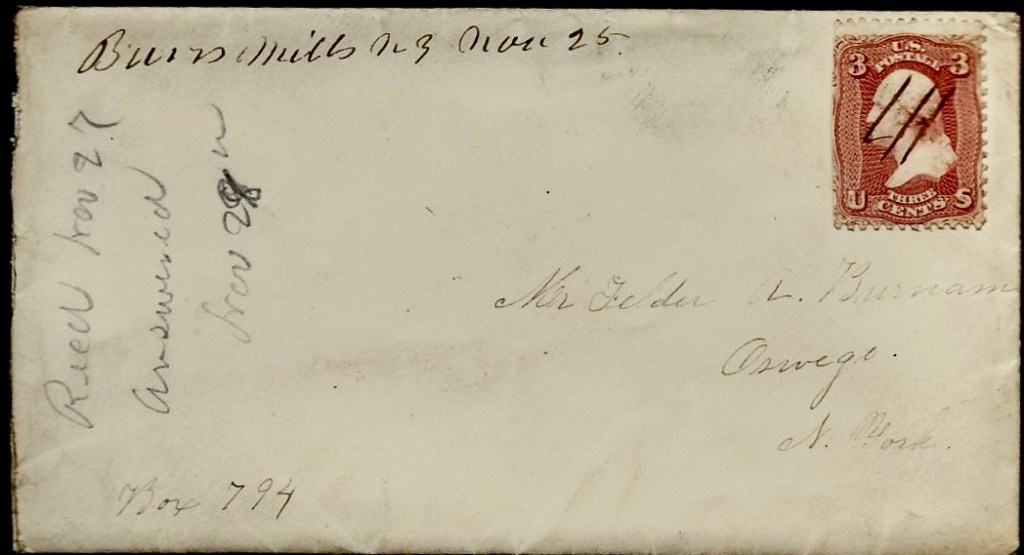
The following letter was written by Louisa Mary Burnam (1840-1924), the daughter of Nathaniel Noble Burnam (1809-1891) and Mary Florilla Leonard (1813-1880) of Burrville—a small village north of Waterville, the county seat of Jefferson county, New York. She wrote the letter to her older brother, Felder A. Burnam (1837-1914). Louisa married Schuyler Hose Bibbins (1833-1916) in 1865.
Louisa’s letter describes a Democratic mass meeting held in Watertown, New York, on the eve of the 1864 Presidential election. Allegations of lies and fraud perpetrated by the Democratic Party and the Copperheads are mentioned.

Transcription
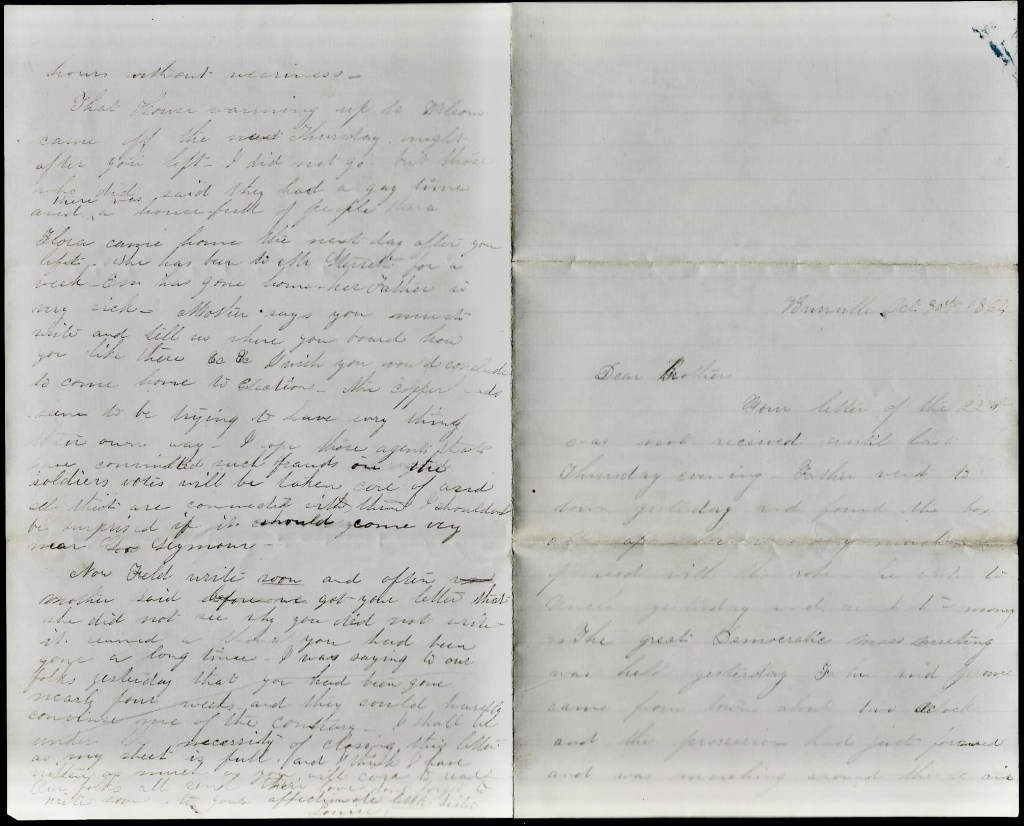
Burrville,
October 30th 1864
Dear Brother,
Your letter of the 22nd was not received until last Thursday evening. Father went to town yesterday and found the box all safe [illegible]. He wrote to Uncle yesterday and sent the money.
The great Democratic mass meeting was held yesterday. Father and Jerome came from town [Watertown] about two o’clock and the procession had just formed and was marching around the square. There were about 80 on horse, Marshal and all, and the procession on foot reached from where Sterling Street comes on Washington Street down to Stones and more than half of those were Irish boys. They were led by two bands. They had a large flag and a banner. The devise on the banner was a Negro’s head. I do not know what the motto was—probably some takeoff on the Abolitionists. There were a great many in town but probably half or two-thirds of them were Union men who went out of curiosity. I think the Union Party got full as many converts as the Democrats.

George Butterfield of Rodman and Gustave Champion have intended to vote for McClellan but they say they cannot go such lies as they heard yesterday and they shall go for Lincoln and Charles Wright has said all the time that he should not vote and he now says he shall go for Lincoln. Gov. Seymour addressed the meeting. 1
Last Friday there was to have been a Union mass meeting but it was so very stormy that there did not a great many go and they concluded to adjourn it until next Thursday. If it is pleasant, we will show the Democrats what a mass meeting is. The people from Whiteside, Tylersville, and a part of Rutland are going to meet here and all the boys that can get horses are going horseback. They are sure of about 20 and all that can get flags are going to carry them.
We had a Union meeting in the Church last Wednesday evening. The house was well filled. The Hon. Mr. Foster of Kansas addressed the meeting. He spoke nearly two hours and a half and I do not think there were many in the house but what would have listened another two hours without weariness.
That house warming up to Wilson’s came off the next Thursday night after you left. I did not go but those who did say they had a gay time and there was a house-full of people there.
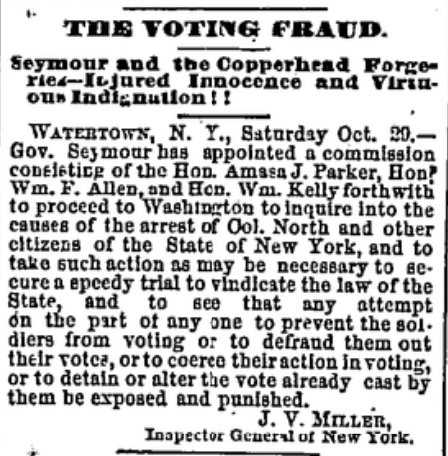
Flora came home the next day after you left. She has been to Mr. Sturett’s for a week. Em has gone home. Her Father is very sick. Mother says you must write and tell us where you board, how you like it there, &c. &c. I wish you would conclude to come home to election. The Copperheads seem to be trying to have everything their own way. I hope those agents that have committed such frauds on the soldiers votes will be taken care of and all that are connected with them. I shouldn’t be surprised if it should come very near Gov. Seymour.
Now Feld, write soon and often. Mother said before we got your letter that she did not see why you did not write. It seemed a shame you had been gone a long timer. I was saying to our folks yesterday that you had been gone nearly four weeks and they could hardly convince me of the contrary. I shall be under the necessity of closing this letter as my sheet is full and I think I have written as much as you will care to read. Our folks all send their love. Don’t forget to write soon to your affectionate little sister, — Louise

1 After New York Governor Horatio Seymour was reelected in 1862, he became an outspoken critic of the Lincoln Administration, questioning the constitutionality of the Emancipation Proclamation and the wartime limits on press freedom and other civil liberties. He supported voluntary enlistments but opposed federal conscription as a violation of states’ rights. His speech after the draft riots of July 1863, in which he addressed the rioters as “my friends,” was widely viewed as tantamount to treason and led to his defeat in 1864. [Source: Encyclopedia of New York State]

 Spared & Shared 23