
The following letter was written by John Bogart (1836-1920), the son of John Henry Bogart (1809-1901) and Eliza Hermans (1810-1889) of Albany, New York. John received in B. A. from Rutgers College in 1853 and took a position in the engineering corps of New York City working on the state canals of New York State. During the Civil War, he worked as a civilian engineer at Ft. Monroe and other points. After the war, he held a variety of position as an engineer in public and privates works in the US and abroad. He was married in 1870 at West Chester, Pennsylvania, to Emma Cherington Jefferis (1846-1926), to whom he addressed this letter.
The author drops the names of several officers at Fortress Monroe but I can only confirm the identify of Col. Henry Brewerton who was an engineer in charge of fortifications and the author may have been an engineer as well serving on the staff of the old colonel. We learn from the letter that the author has been living with the Eaton family and the names of Mr. & Mrs. Eaton’s three daughters are given as Mary, Emily, and Buddie—in chronological order, oldest to youngest—but I have not confirmed that family’s identity as yet.
I should also note that the two letter segments, identified as “1” and “2” do not seem to go together as the dates are inconsistent with one another. In fact, the handwriting even appears to be different but the phraseology convinces me they were written by the same person and probably sent to the same woman.
John Bogart had a younger brother names James Henry Bogart (1839-1863) who served as 1st Lieutenant and Adjutant of the 43rd New York Infantry. Lt. Bogart was killed on 14 June 1863 in the Battle of Port Hudson.

Transcription
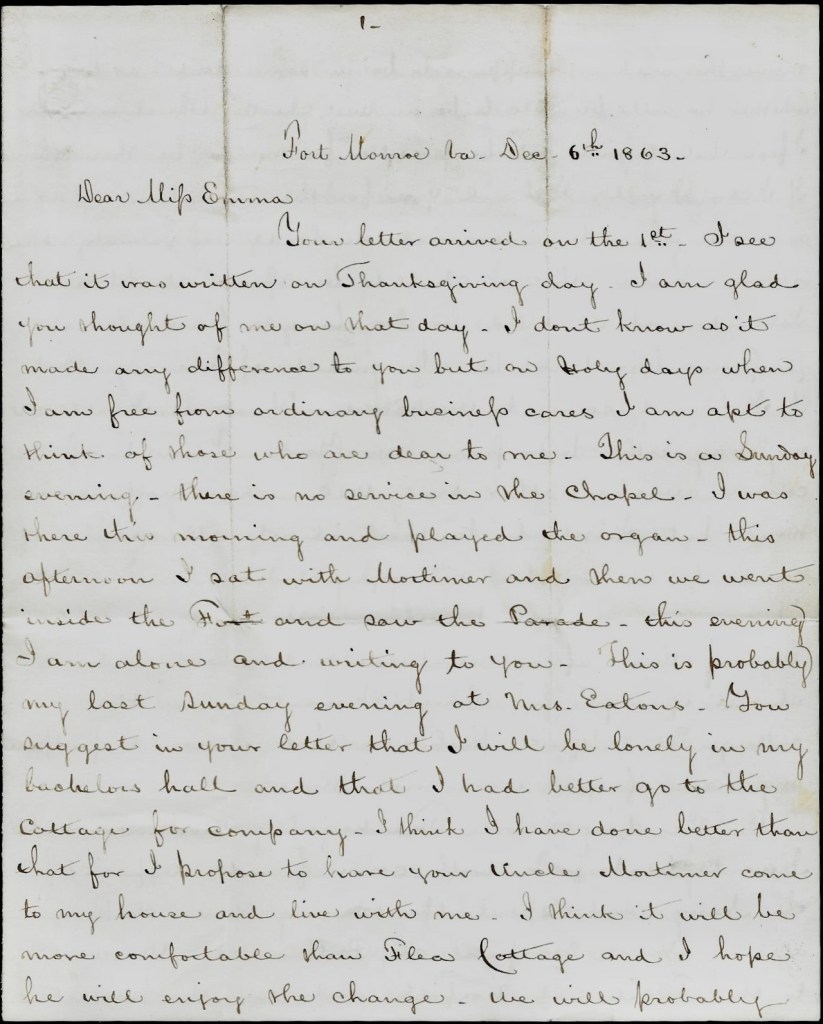
Fort Monroe, Virginia
December 6th 1863
Dear Miss Emma,
Your letter arrived on the 1st. I see that it was written on Thanksgiving Day. I am glad you thought of me on that day. I don’t know as it made any difference to you but on Holy days when I am free from ordinary business cares, I am apt to think of those who are dear to me. This is a Sunday evening. There is no service in the chapel. I was there this morning and played the organ. This afternoon I sat with Mortimer and then we went into the Fort and saw the parade. This evening I am alone and writing to you. This is probably my last Sunday evening at Mrs. Eaton’s.
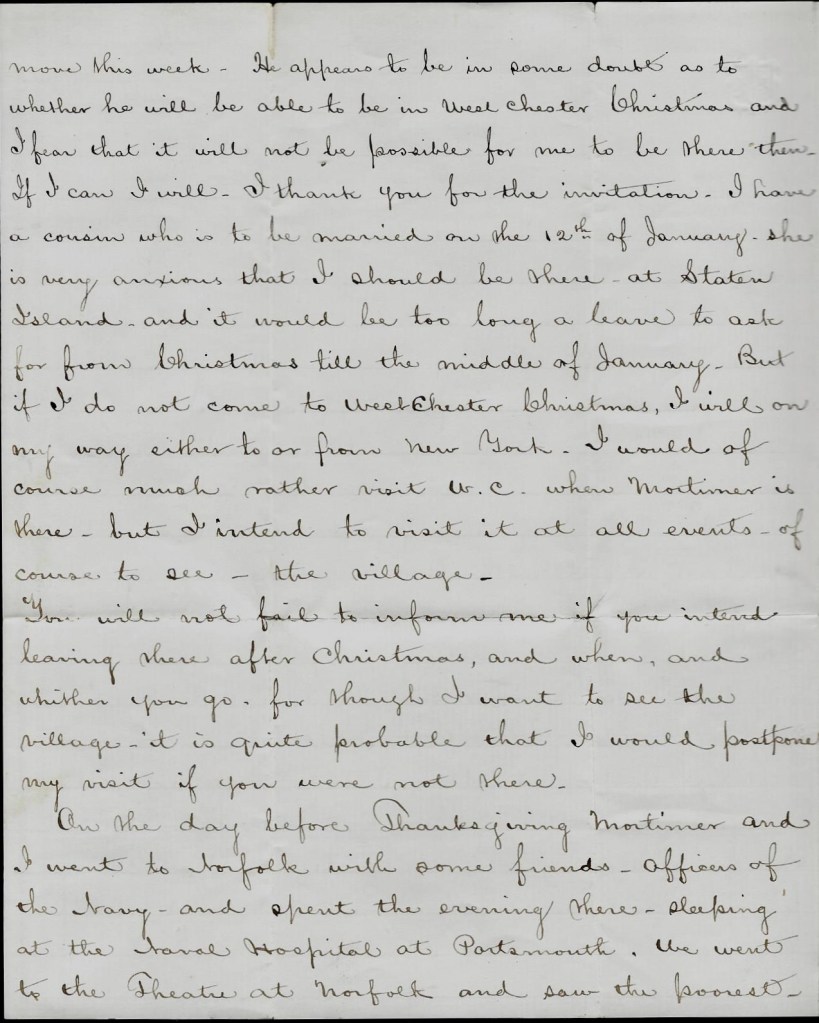
You suggest in your letter that I will be lonely in my bachelor’s hall and that I had better go to the cottage for company. I think I have done better than that for I propose to have your Uncle Mortimer come to my house and live with me. I think it will be more comfortable than Flea Cottage and I hope he will enjoy the change. We will probably move this week. He appears to be in some doubt as to whether he will be able to be in West Chester Christmas and I fear that it will not be possible for me to be there then. If I can, I will. I thank you for the invitation.
I have a cousin who is to be married on the 12th of January. She is very anxious that I should be there at Staten Island and it would be too long a leave to ask for from Christmas till the middle of January. But if I do not come to West Chester [for] Christmas, I will on my way either to or from New York. I would of course much rather visit West Chester when Mortimer is there, but I intend to visit it at all events—of course to see—the village. You will not fail to inform me if you intend leaving there after Christmas, and when, and whither you go, for though I want to see the village, it is quite probable that I would postpone my visit if you were not there.
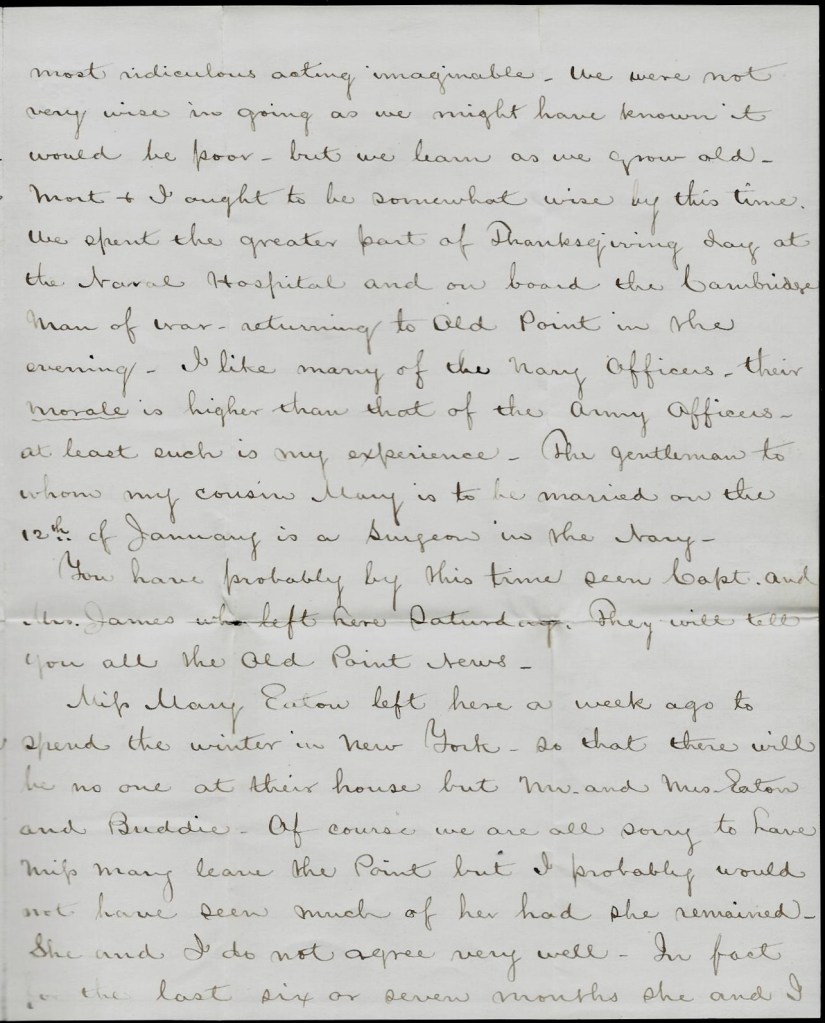
On the day before Thanksgiving, Mortimer and I went to Norfolk with some friends—officers of the Navy—and spent the evening there, sleeping at the Naval Hospital at Portsmouth. We went to the theatre at Norfolk and was the poorest, most ridiculous acting imaginable. We were not very wise in going as we might have known it would be poor—but we learn as we grow old. Mort and I ought to be somewhat wise by this time. We spent the greater part of Thanksgiving day at the Naval Hospital and on board the Cambridge Man-of-War, returning to Old Point in the evening. I like many of the Navy officers. Their morale is higher than that of the Army officers—at least such is my experience. The gentleman to whom my cousin Mary is to be married on the 12th of January is a surgeon in the Navy.
You have probably by this time seen Capt. and Mrs. James who left here Saturday. They will tell you all the Old Point news.
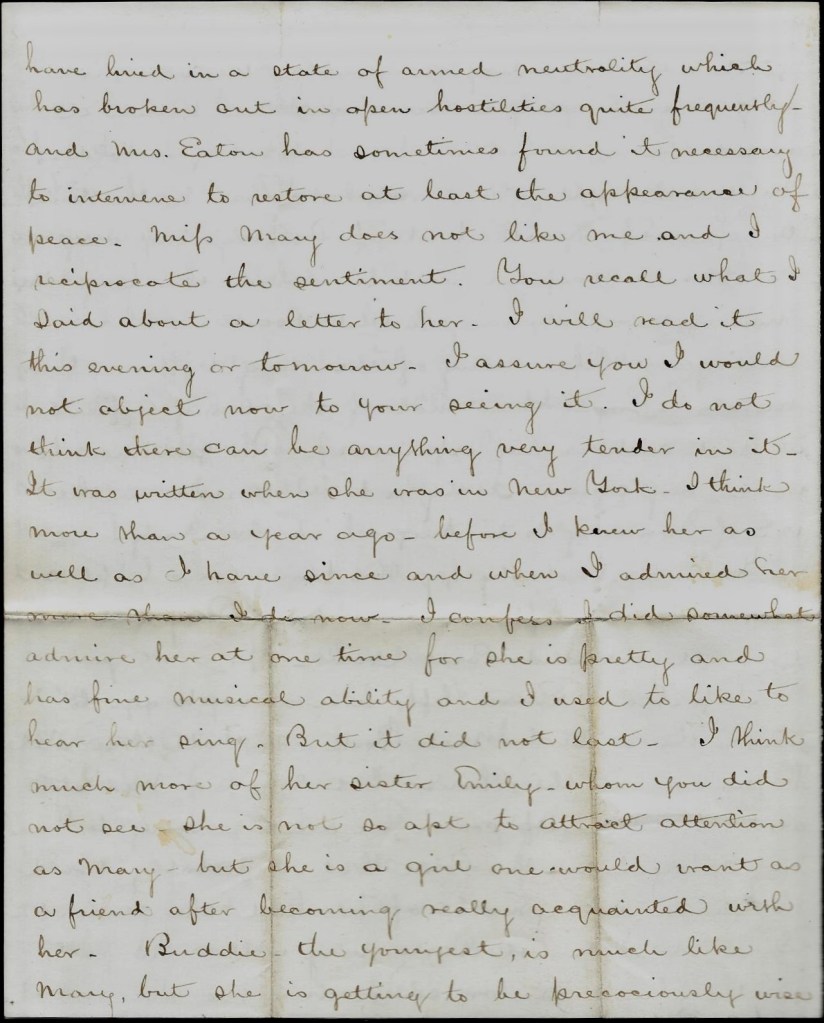
Miss Mary Eaton left here a week ago to spend the winter in New York, so that there will be no one at their house but Mr. and Mrs. Eaton and Buddie. Of course we are all sorry to have Miss Mary leave the Point but I probably would not have seen much of her had she remained. She and I do not agree very well. In fact, for the last six or seven months she and I have lived in a state of armed neutrality which has broken out in open hospitalities quite frequently and Mrs. Eaton has sometimes found it necessary to intervene to restore at least the appearance of peace. Miss Mary does not like me and I reciprocate the sentiment. You recall what I said about a letter to her. I will read it this evening or tomorrow. I assure you, I would not object now to your seeing it. I do not think there can be anything very tender in it. It was written when she was in New York, I think more than a year ago, before I knew her as well as I have since and when I admired her more than I do now. I confess I did somewhat admire her at one time for she is pretty and has fine musical ability and I used to like to hear her sing. But it did not last. I think much more of her sister Emily whom you did not see. She is not so apt to attract attention as Mary, but she is a girl one would want as a friend after becoming really acquainted with her. Buddie, the youngest, is much like Mary, but she is getting to be precociously wise.
[These two letter fragment do not appear to go together.]
Tuesday, the 27th.
I was so busy yesterday with the plan of a large fort that I did not finish my letter. I have read over what I wrote and it seems like a sermon. But never mind. I do not intend to “take back” what I wrote. I have nobody else, and never had, to whom I can write without a bit of restraint. So you will, unless you tell me not, continue to be sermonized if I am in a sermonizing mood. It is “perfectly splendid” to be able to write just what I think—just according to the present state of mind, without the feeling of there being a necessity to consult the peculiarities of my correspondent. I am terribly frank and I am afraid that you will say that I do not show much regard for my correspondent in writing so entirely selfishly or of myself. But that would be an error. It is the result and the proof of perfect regard. And a proof too that that correspondent is never long absent from my thoughts.
I have been looking at your letter again. You do not believe in sentences begun and not ended. If I should do so again, don’t imagine anything very horrid for the termination.
What a strange piece of experience you must have had at your friend’s house. It is strange what fascination there is in drink. I have an acquaintance who is ordinarily a temperate man, but who occasionally does not seem to know when to stop and consequently runs to horrible extremes. And he too has a wife and children.
We have had a strange affair here. I do not remember whether I mentioned it in my last. A general officer of volunteers has been staying at the Point some time—not on duty—with a family of wife and daughter, and after boarding several months without paying, it was discovered that he had been borrowing money from everybody that would lend and repaying nobody. However, under the fear of exposure he has gone forth to make an effort to get money enough to make a settlement. I hope he will do so. His daughter is a very pleasing girl and seems much grieved at her father’s delinquency.
Col. James was here a few days ago. We see little of him however now. I saw Mrs. Jefferis after her return. My sister and I are going to call there today or tomorrow. We started to do so while Mrs. Jefferis was away not knowing of her absence.
This letter was all written with the same pen (quill).
Col. [Henry] Brewerton is waiting for some work so I must say goodbye. Yours, — John B.
Last letter from you was waited for a long time.
I send you some sea horses prepared by my sister. If you think they are pretty, I can send you more.


 Spared & Shared 23