

The following letter was written by Edwin Atkins Merritt (1828-1916) to his wife, Eliza Rich. Biographical sketches of Edwin appear in Appletons’ Cyclopedia of American Biography and in the History of St. Lawrence County inform us that Edwin was born in Sudbury, Vermont, on 26 February 1828 and that he left Vermont when he was ten years of age and went to live with a married sister who resided in Westport, Essex county, New York. In 1841, with his father’s family, he emigrated to St. Lawrence county, New York, and became a surveyor in the Adirondack wilderness. He published the first map to guide tourists to this great resort.
In 1858, Edwin married Miss Eliza Rich and by her had five children, all of whom died young except Edwin A. Merritt, Jr. After holding local offices, Edwin was elected to a lower branch of the legislature as a Republican in 1859, and re-elected in 1860. At the beginning of the Civil War he became quartermaster of the 60th New York regiment, served with the Army of the Potomac, and in Sherman’s Georgia Campaign acted as commissary of subsistence with the rank of Captain.On 1 January 1865 he was made quartermaster-general of the state of New York, and he superintended the Soldier’s home in New York City. He also established free agencies for the collection of bounties, back pay, and pensions that were due New York volunteers. In 1869-70 he was naval officer of the port of New York. In 1875 he was the unsuccessful Republican candidate for state treasurer. In December 1877 he became surveyor of the port of New York, and in 1878 he was appointed collector on place of Chester A. Arthur. He was U. S. consul-general in London in 1881-85.”
What Edwin’s biographical sketches do not mention is that during his stint as Quartermaster-General on Gov. Reuben Fenton’s staff, he participated in the Lincoln funeral processions in New York City, Albany and Buffalo which are the subject of this letter dated 15 May 1865. This letter has long been a keepsake of the Merritt family descendants and it was recently offered to me for transcription and publication on Spared & Shared by Matthew Sisson, his great-great-grandson.
After transcribing the letter, I discovered that Edwin A. Merritt published an autobiography in 1911 entitled, Recollections, in which he also summarizes his eye-witness account of the Lincoln funeral processions in New York State though he does not quote this letter to his wife. In that same book he described the last time he saw the President before his assassination: “As I was passing by the White House Mr. Lincoln came out on the steps to bid farewell to a gentleman, who was dressed in the height of fashion. Mr. Lincoln was bare headed and wore a black alpaca coat and a pair of carpet slippers. A number of disabled soldiers who were in sight, seeing me talking with the President, came forward to shake hands with him and he greeted them cordially.”
Transcription
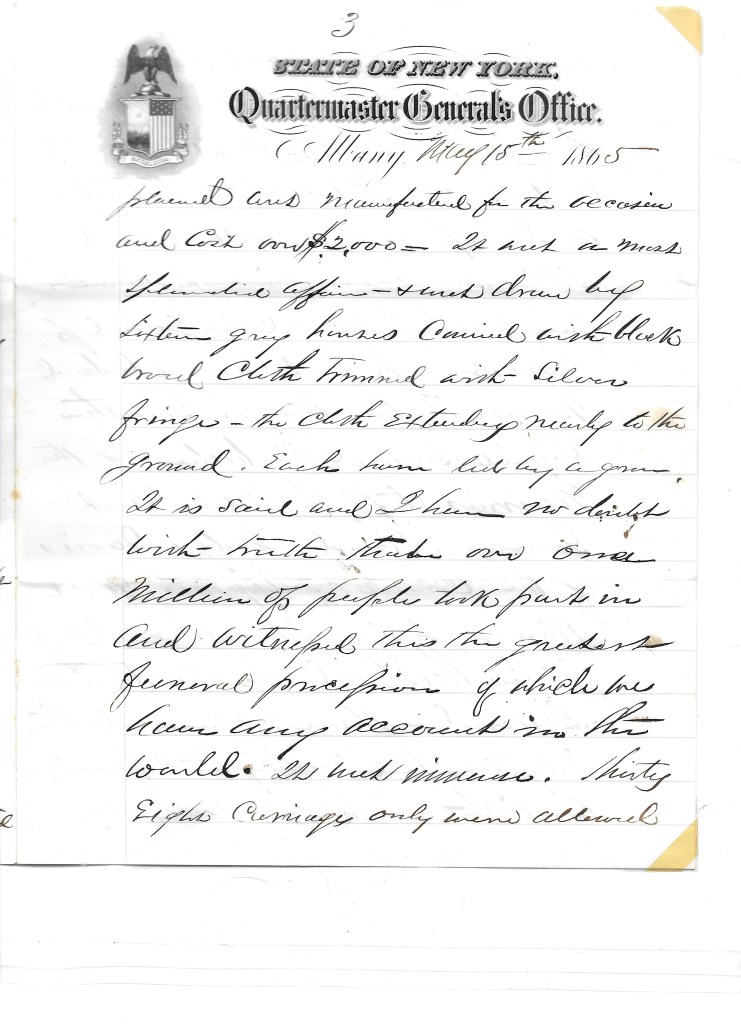
State of New York Quartermaster General’s Office
Albany, New York
May 15th 1865
My dear wife,
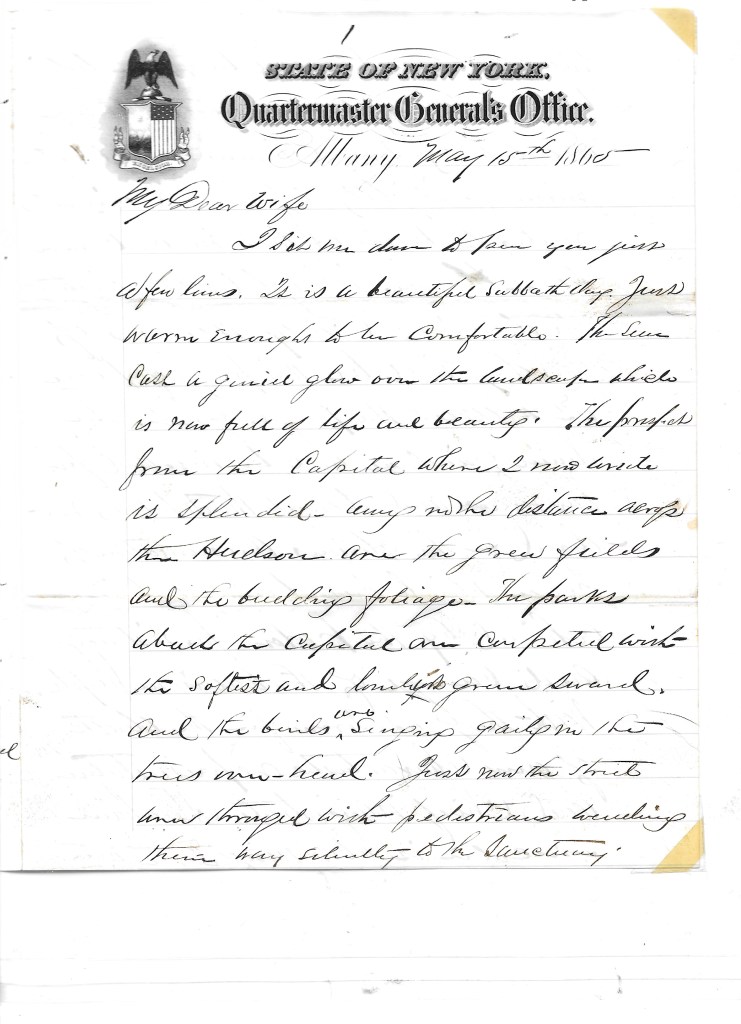
I sit me down to pen you just a few lines. It is a beautiful Sabbath day—just warm enough to be comfortable. The sun casts a genial glow over the landscape which is now full of life and beauty. The prospect from the Capitol where I now write is splendid. Away in the distance across the Hudson are the green fields and budding foliage. The parks about the Capitol are carpeted with the softest and loveliest green [ ] and the birds are singing gaily in the trees overhead. Just now the streets are thronged with pedestrians treading their way silently to the sanctuary where the sacred text will be expounded by the representatives of the various sects who are all laboring for a common end although pursuing slightly different and circuitous routes to meet at last in one common home—Heaven.
Mingled also with the devout and holy exercises of this day will be the prayer of peace as well as the prayer for it. The devine guidance will be invoked for our rulers and devout thankfulness rendered for the glorious consummation of peace which has been at last achieved by the valor, persistence, and courage of the American people. With the great sorrow for the death of our characteristic representative and Chief Magistrate Abraham Lincoln is also mingled the natural and exalted consciousness of assured hope—that this great and glorious republic is to go on and complete its mission of giving freedom to the world.
It has freely vindicated its integrity and justified the hopes and promises of its founders. the Statesmen and heroes of the Revolution. The leading and responsible traitors are to be tried and suitably punished, but the poor, misguided suffering and already punished people of the South will be forgiven on promise of future good behavior. While vindicating the law to which we and all [are] amenable, we must be magnanimous and forgiving. Let us not make their punishment greater than they can bear. Like prodigal children, they are returning to their father “Samuel’s” home where there is enough to spare. With them, side by side, come also the former millions of slaves enfranchised, holding up towards heaven their free hands from which have been struck every shackle and thanking God for their deliverance through the instrumentality of their father “Abraham” and their brothers, the patriot soldiers for the Union—the boys in blue.
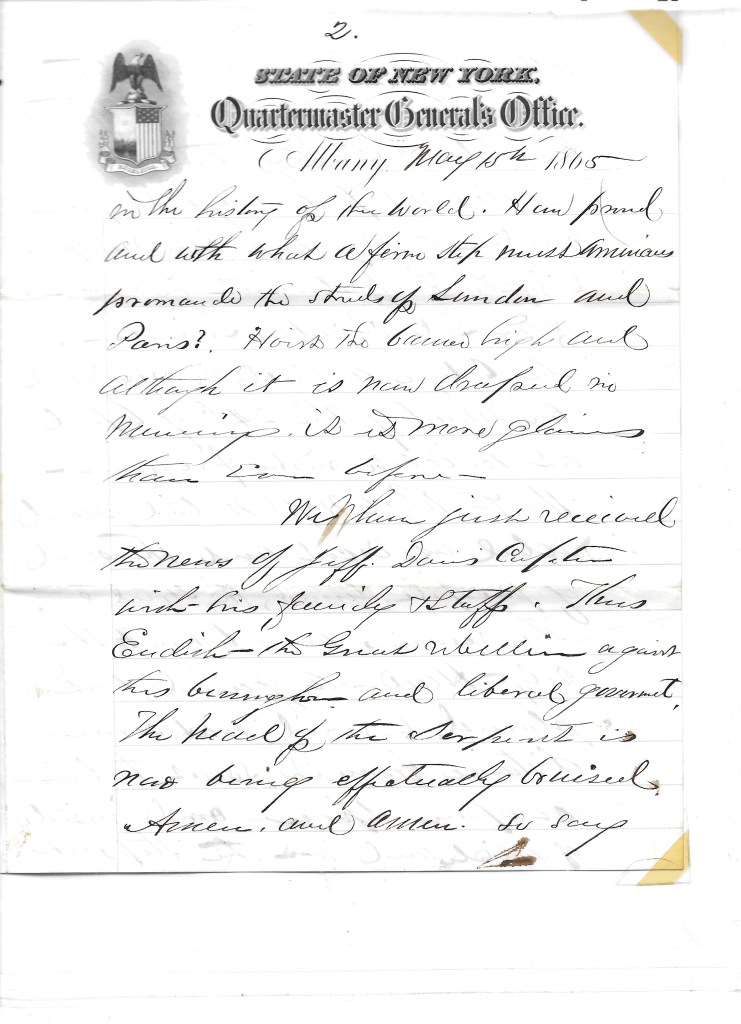
Every honest American must feel prouder of his country today than at any former period in his life. It is stronger at home in the hearts of the people as evidenced by confidence in its financial ability, stronger abroad as it has shown the world that we can carry our warlike operations never surpassed in the history of the world. How proud and with what a firm step must Americans promenade the streets of London and Paris? Hoist the banner high and although it is now draped in morning, it is more glorious than ever before.
We have just received the news of Jeff Davis’ capture with his family & staff. Thus endeth the great rebellion against this benevolent and liberal government. The head of the serpent is not being effectually bruised. Amen and amen. So say all the people—and the echo is heard to the furthermost bounds of civilization.
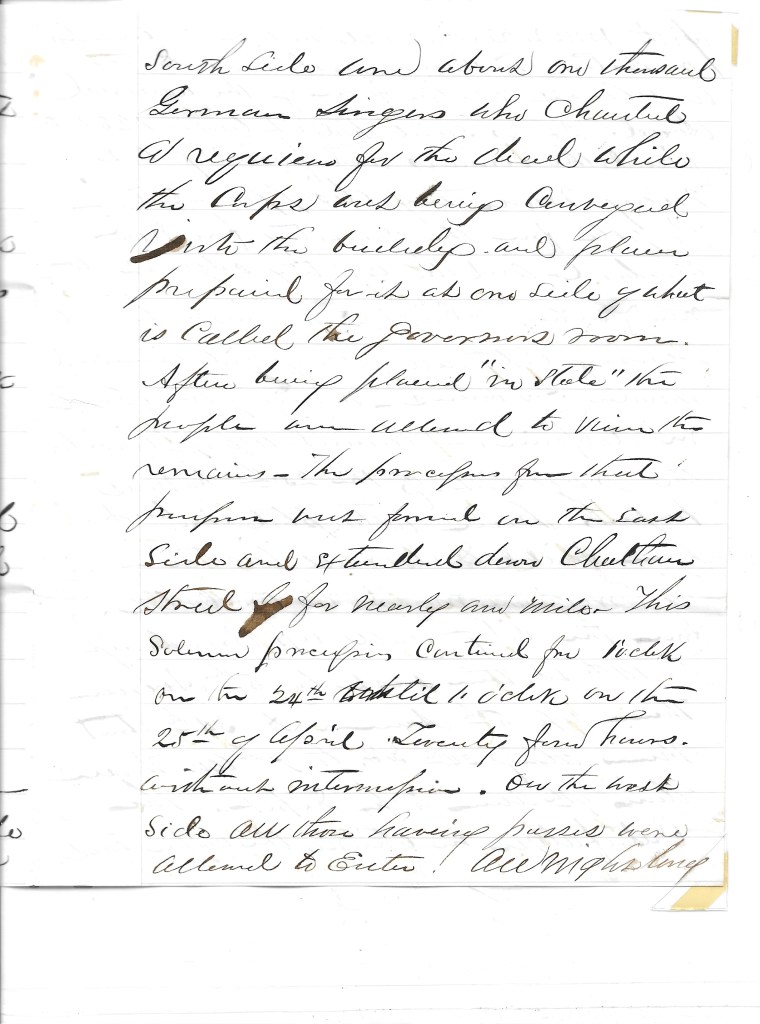
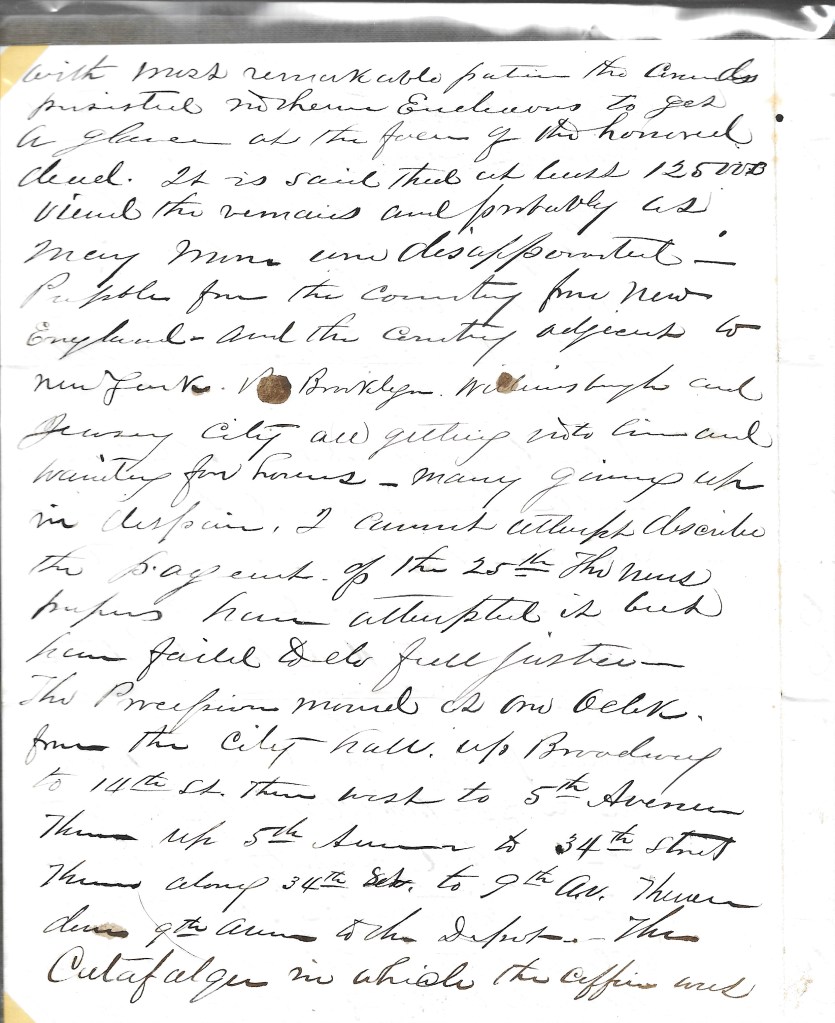
I did not particularly write you relative to my trip from New York City to Buffalo with the remains of the late President Lincoln. The cortege arrived in New York on Monday, the 24th of April at 10 o’clock in the forenoon. The 7th Regt. N. Y. S. National Guard acted as escort and thousands of people lined the streets. The remains were taken to the City Hall. A guard was placed around it as some distance from it so as to leave an open space and inside of which and on the steps at south side and about one thousand German singers who chanted a requiem for the dead while the corpse was being conveyed with the building and places prepared for it at one side of what is called the Governor’s room. After being placed “in state” the people were allowed to view the remains. The procession for that purpose was formal on the East side and extended down Chatham Street for nearly a mile. This solemn procession continued from 1 o’clock on the 25th of April twenty-four hours without interruption. On the west side all those having passes were allowed to enter. All night long, with most remarkable patience, the [ ] persisted [ ] endeavored to get a glance at the face of the honored dead. It is said that at least 125,000 viewed the remains and probably as many more were disappointed people from the country from New England and the country adjacent to New York, Brooklyn, Williamsburgh, and Jersey City all getting into line and waiting for hours—many giving up in despair.
I cannot attempt to describe the pageant of the 25th. The newspapers have attempted it but have failed to do full justice. The procession moved at one o’clock from the City Hall up Broadway to 4th Street, then west to 5th Avenue, then up the Avenue to 34th Street, then along 34th to 9th Avenue. Thence down 9th Avenue to the Depot [at 30th Street and 11th Avenue]. The catafalque in which the coffin was placed was manufactured for the occasion and cost over $2,000. It was a most splendid affair and was drawn by sixteen gray horses covered with black broadcloth trimmed with silver fringe—the cloth extending nearly to the ground. Each horse led by a groom.
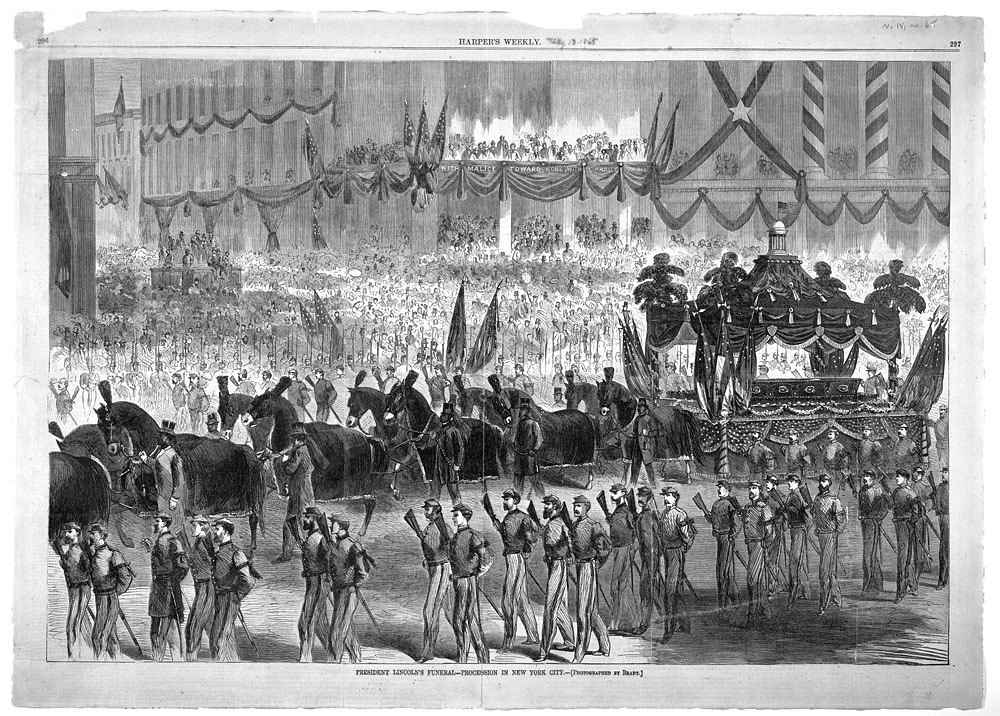
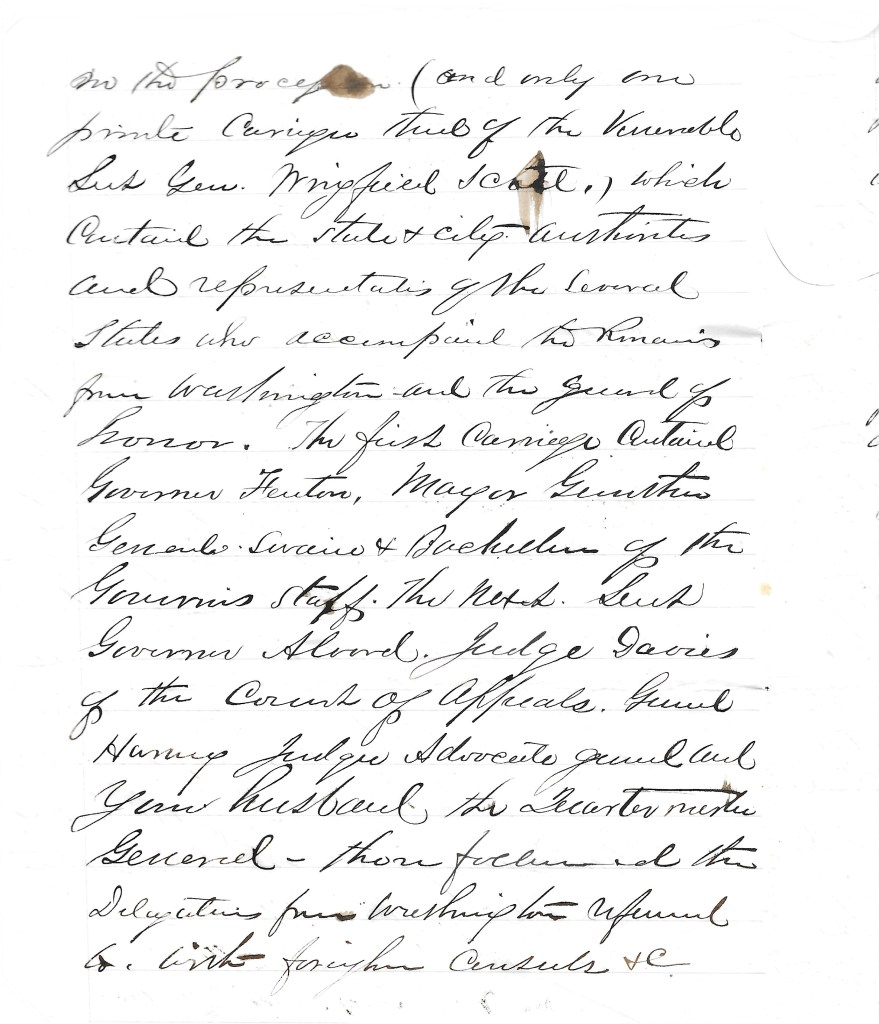
It is said and I have no doubt with truth that over one million of people took part in and witnessed this the greatest funeral procession of which we have any account in the world. It was immense. Thirty-eight carriages only were allowed in the procession (and only one private carriage—that of the venerable Lieut. General Winfield Scott) which contained the state and city authorities and representatives of the several states who accompanied the remains from Washington and the Guard of Honor. The first carriage contained Governor [Reuben E.] Fenton, Mayor [C. Godfrey] Gunther, Generals [James B.] Swaine & [George S.] Batchelder of the Governor’ staff. The next Lieut. Governor [Thomas G.] Alvord, Judge [Henry Ebenezer] Davies of the Court of Appeals, General [Alexander W.] Harvey, Judge-Advocate-General and your husband, the Quartermaster General. Then followed the Delegates from Washington referred to with foreign consuls, &c.
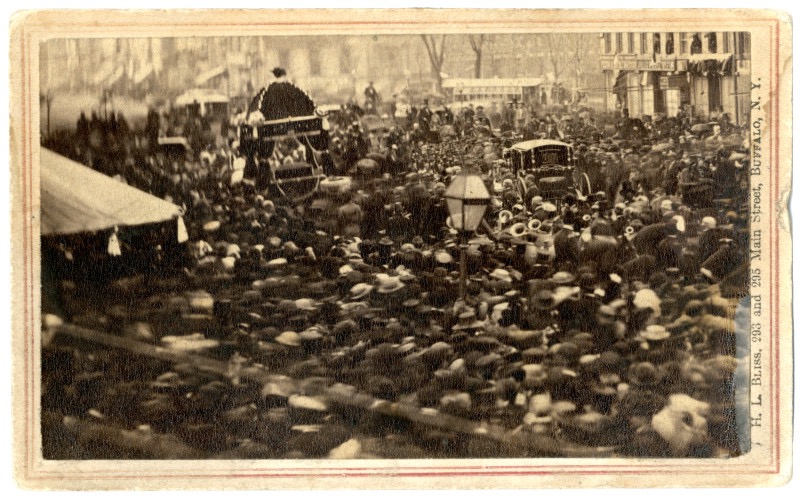
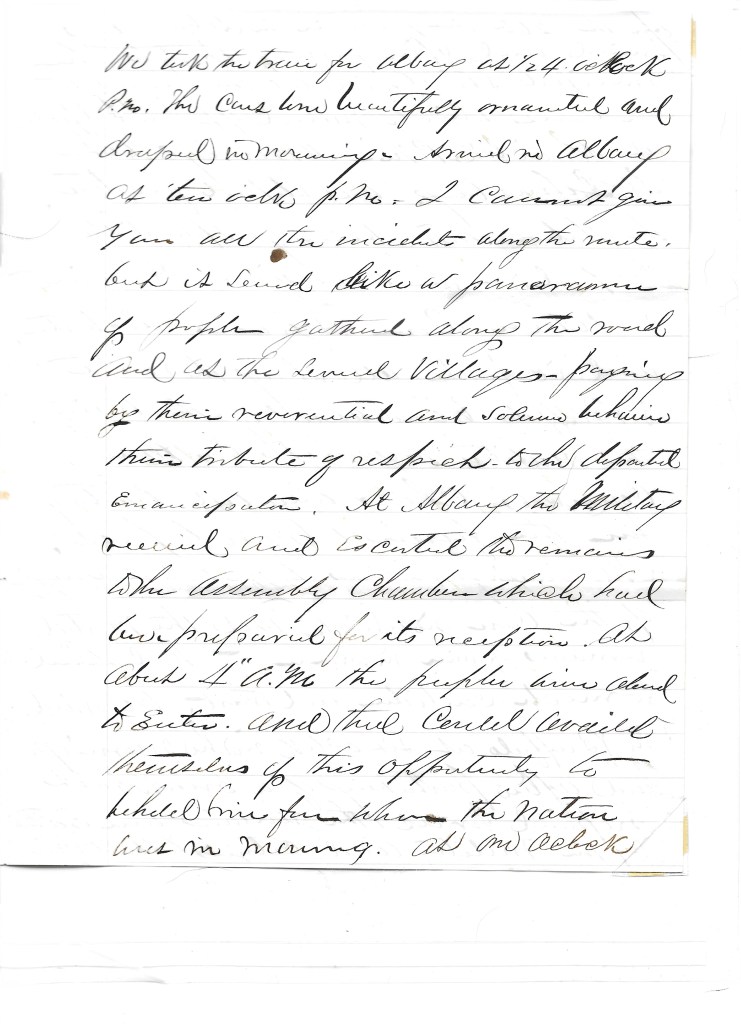
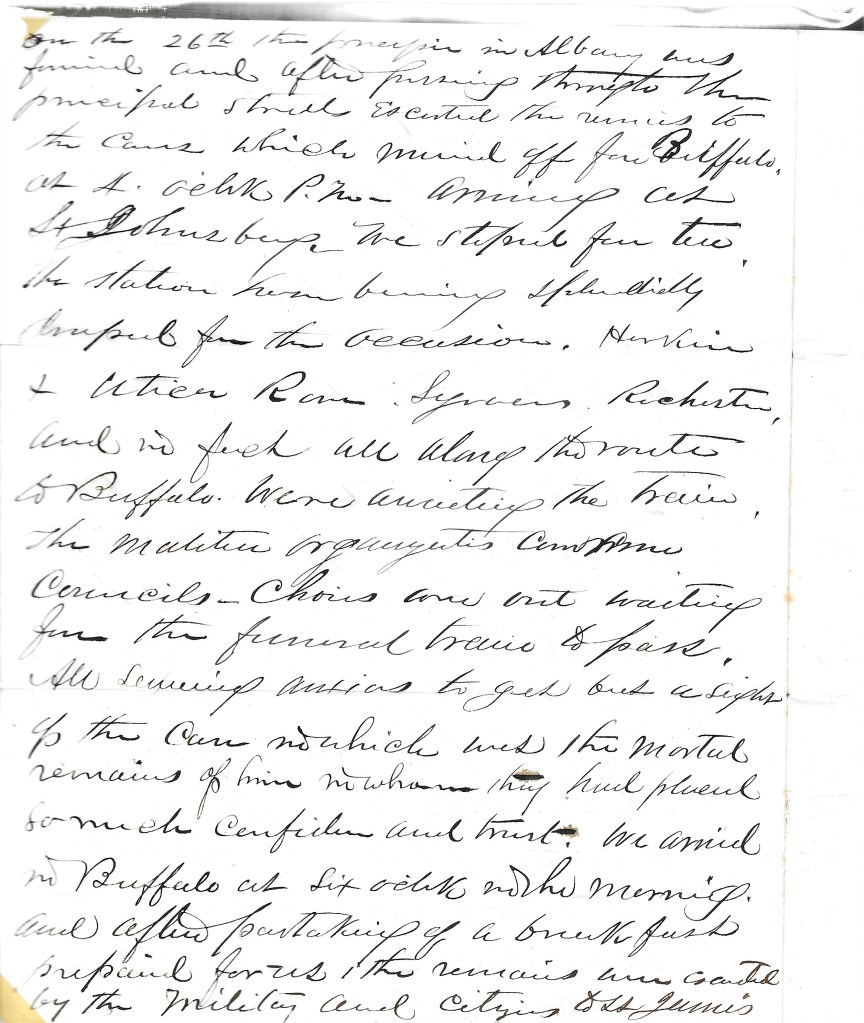
We took the train for Albany at 4:30 o’clock p.m. The cars were beautifully ornamented and draped in mourning. Arrived in Albany at ten o’clock p.m. I cannot give you all the incidents along the route but it seemed like a panorama of people gathered along the road and at the several villages passing by their reverential and solemn behavior their tribute of respect to the departed emancipator. At Albany the military received and escorted the remains to the Assembly Chamber which had been prepared for its reception. At about 4 a.m. the people were allowed to enter and thus could avail themselves of this opportunity to behold him for whom the Nation was in mourning. At one o’clock on the 26th, the procession in Albany was formed and after passing through the principal streets escorted the remains to the cars which hurried off for Buffalo at 4 o’clock p.m. Arriving at St. Johnsbury, we stopped for ten [minutes], the station here being splendidly draped for the occasion. Herkimer and Utica, Rome, Syracuse, Rochester, and in fact all along the route to Buffalo were [ ] the train. The militia organizations, committee councils, choirs were out waiting for the funeral train to pass, all seeming anxious to get but a sight of the car in which the mortal remains of him in whom they had placed so much confidence and trust.

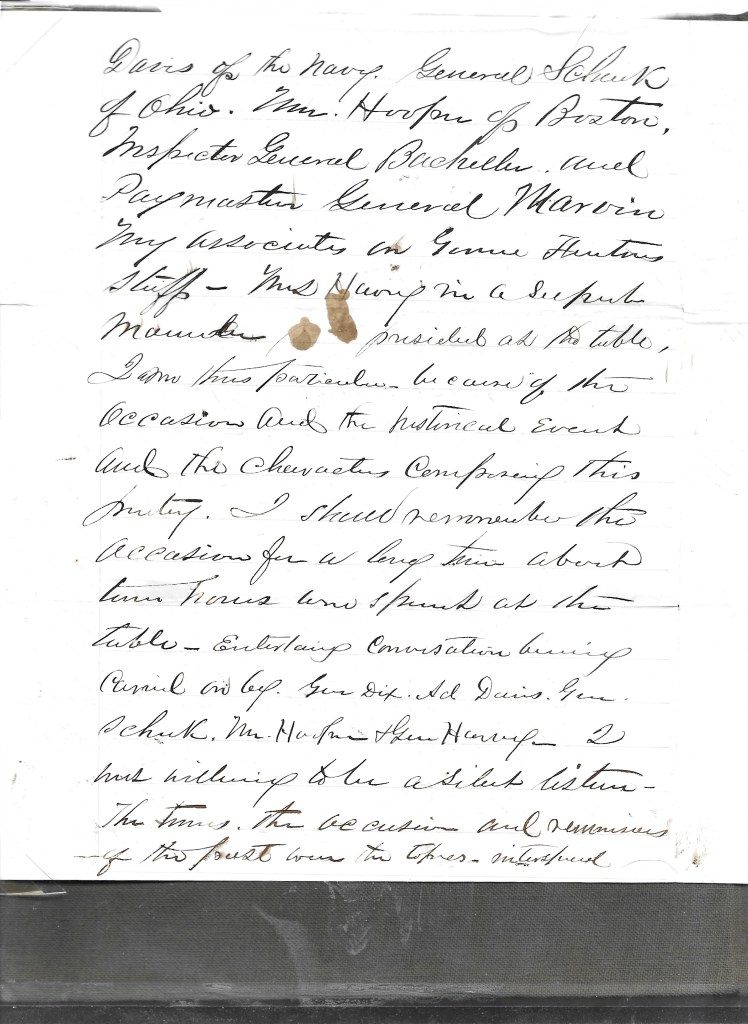
We arrived in Buffalo at six o’clock in the morning and after partaking of a breakfast prepared for us, the remains were escorted by the military and citizens to St. James Hall where splendid arrangements had been perfected for the occasion and as the body was being brought into the building a choir of 100 voices (St. Cecil Society) chanted a funeral dirge—the most solemn and effective singing I ever heard. The arrangement for viewing the corpse was much better here than in New York or Albany. All who desired had an opportunity. I was invited to dine with Judge Advocate General [Alexander W.] Harvey which I accepted. The other guests were Maj. Gen. John A Dix, Rear Admiral [Charles Henry] Davis of the Navy, General [Robert C.] Schenck of Ohio, William Hooper of Boston, Inspector General [George S.] Batchelder, and Paymaster General [S. B.] Marvin. My associates in General Henton’s staff, Mrs. Harvey in a support [ ] presided at the table. I am thus particular because of the occasion and the historical event and the characters composing this party. I shall remember the occasion for a long time. About two hours were spent at the table, entertaining conversation being carried on by Gen. Dix, Admiral Davis, Gen. Schenck, Mr. Hooper and Gen. Harvey. I was willing to be a silent listener. The Times, the occasion, and reminiscences of the past were the topics, interspersed with spicy anecdotes filled up the time. The best of fare and served with $40 per bottle and brandy worth sixty dollars per gallon. Very little, however, was drunk as nine o’clock the remains were again removed to the cars to be conveyed to Cleveland. A splendid train was fitted up for the occasion.
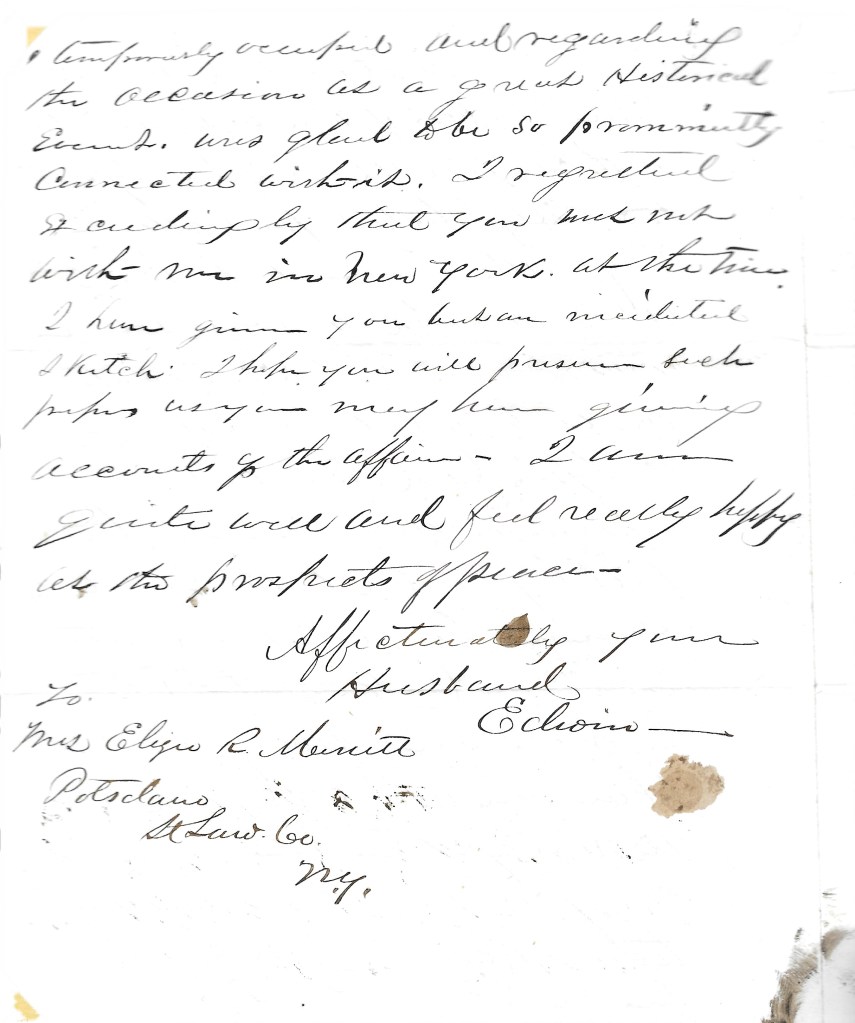
After bidding adieu to the Guard of Honor, General Dix and the escort, we (the Governor’s staff) took the train for Albany again where we arrived at 9 o’clock in the morning of the 28th. Perhaps you will think this a long and tedious account but excuse me for feeling proud of the position temporarily occupied and regarding the occasion as great historical event, was glad to be so prominently connected with it. I regretted exceedingly that you was not with me in New York at the time. I have given you but an incidental sketch. I hope you will preserve such papers as you may have giving accounts of the affair.
I am quite well and fel really happy at the prospect of peace. Affectionately your husband, — Edwin
To Mrs. Eliza R. Merritt
Potsdam, St, Lawrence county, New York





 Spared & Shared 23
My deepest appreciation for transcribing our great-great grandfather’s letter describing President Lincoln’s funeral procession. It has been known in our family for generations but until now has never been completely deciphered. This is an amazing piece of our family and our nation’s history! Thank you! Joan Sisson Baird Bloomer
LikeLike