
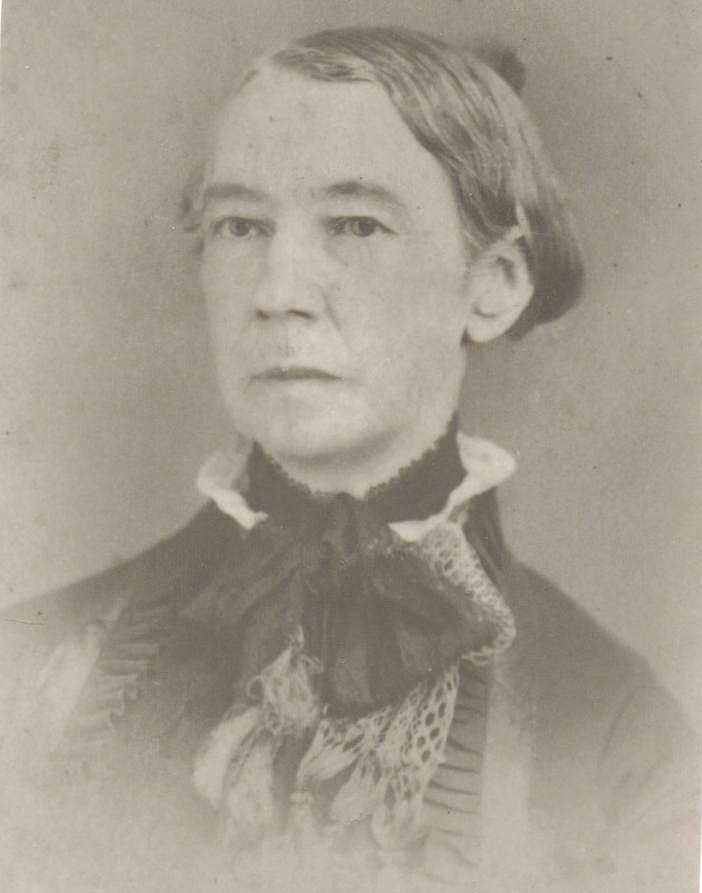
This letter was written by 35 year-old Mary Mitchell (Gatlin) Knox (1811-1890), the wife of Dr. Franklin Knox (1810-1895) of St. Louis, Missouri. Mary and Franklin had several children, all born in St. Louis: Sarah (“Sallie”) Knox (1838-1926), Emma Knox (1840-1840); Eliza Knox (1842-1842), Annie Knox (1845-1853), Franklin Knox, Jr. (1848-1848), and Richard Gatlin Knox (1851-1914).
Mary grew up in Kinston, Lenoir county, North Carolina, the daughter of John Gatlin and Susannah Caswell. She married Franklin Knox there in May 1837. In her letter, Mary mentions her brother, Richard Caswell Gatlin (1809-1896) who graduated from West Point in 1832 and served as an infantry officer in the War with Mexico (was wounded at the Battle of Monterey) and later on frontier duty in Indian Territory. In 1861, Richard resigned his commission and was appointed Colonel in the CSA. He was then promoted to Brigadier General in August 1861 and was assigned command of the Department of North Carolina and the coast defenses of the State.
Before the 1860 US Census, the Knox family had relocated to Crescent City, Del Norte, California, where Franklin worked as a physician.
Mary wrote the letter to Mary Strachan (Barret) Reavis (1812-1870), the wife of Judge Turner Reavis (1812-1872) of Gainesville, Sumter county, Alabama.
Transcription
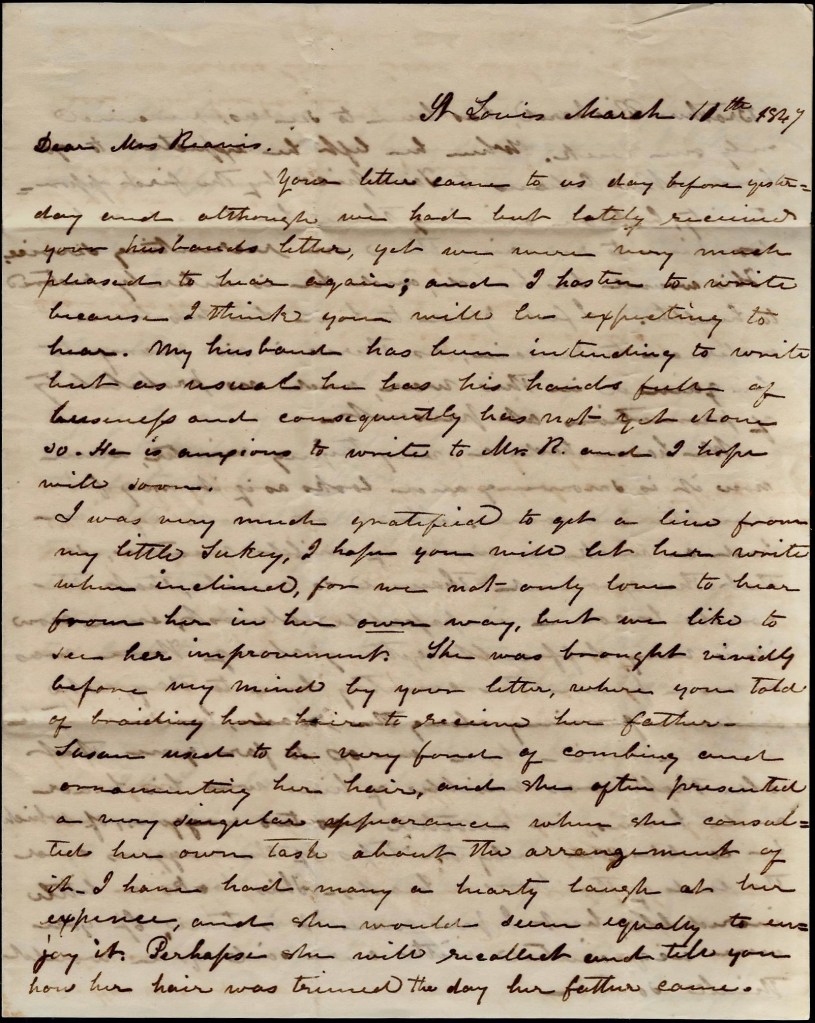
St. Louis [Missouri]
March 10th 1847
Dear Mrs. Reavis,
Your letter came to us day before yesterday and although we had but lately received your husband’s letter, yet we were very much pleased to hear again; and I hasten to write because I think you will be expecting to hear. My husband has been intending to write but as usual he has his hands full of business and consequently has not yet done so. He is anxious to write to Mr. Reavis and I hope will soon.
I was very much gratified to get a line from my little Sukey. I hope you will let her write when inclined for we not only love to hear from her in her own way, but we like to see her improvement. She was brought vividly before my mind by your letter, where you told of braiding her hair to receive her father. Susan used to be very fond of combing and ornamenting her hair, and she often presented a very singular appearance when she consulted her own task about the arrangement of it. I have had many a hearty laugh at her expense, and she would seem equally to enjoy it. Perhaps she will recollect and tell you how her hair was trimmed the day her father came.
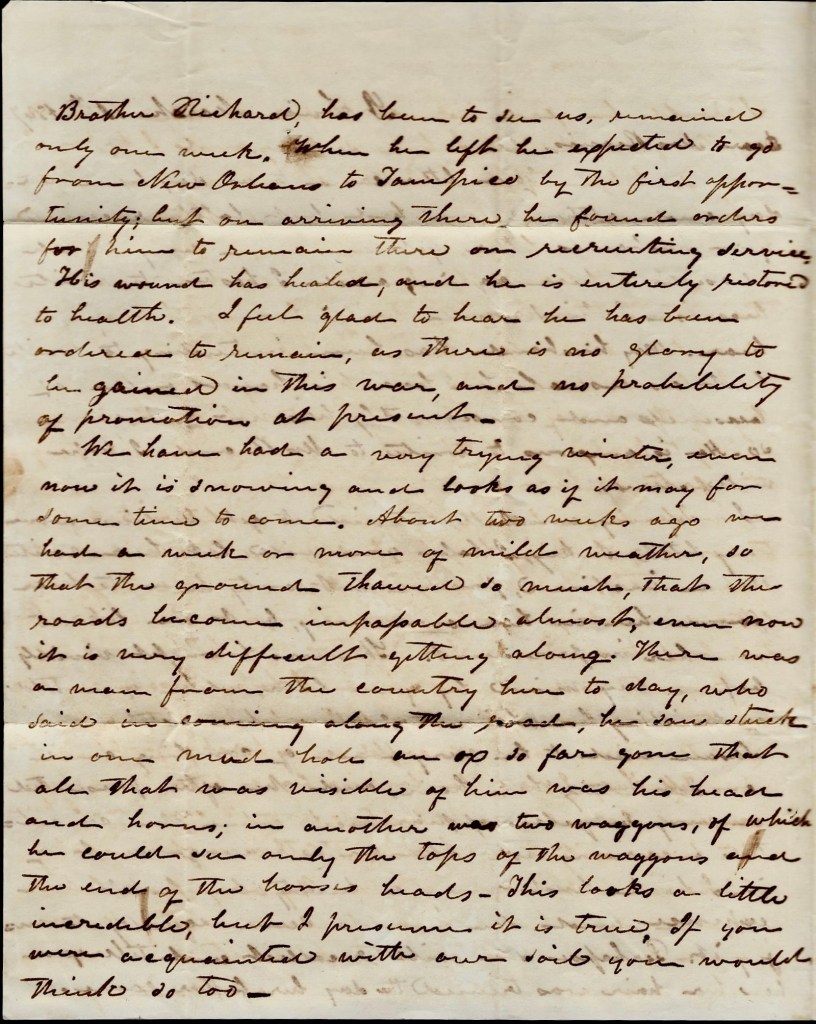
Brother Richard has been to see us, remained only one week. When he left he expected to go from New Orleans to Tampico by the first opportunity; but on arriving there he found orders for him to remain there on recruiting service. His wound has healed and he is entirely restored to health. I feel glad to hear he has been ordered to remain as there is no glory to be gained in this war and no probability of promotion at present
We have had a very trying winter. Even now it is snowing and looks as if it may for some time to come. About two weeks ago we had a week or more of mild weather, so that the ground thawed so much that the roads became impassable almost. Even now it is very difficult getting along. There was a man from the country here today who said in coming along the road, he saw stuck in one mud hole an ox so far gone that all that was visible of him was his head and horns; in another was two wagons and the end of the horses heads. This looks a little incredible but I presume it is true. If you were acquainted with our soil, you would think so too.
I should be glad indeed to spend next winter with you, should I live so long, and I hope it may so happen that I shall spend a few weeks with you. Mr. Reavis incited me to come this spring and was kind enough to offer to meet me at Orleans, but it will not be convenient for me to leave home this summer. Should we all live until another summer, I shall feel as if I ought to go away and try if the air of another climate will do anything to keep my little Annie from sharing the fate of her other sisters of the same age.
Tell Susan I shall commence a letter to her tomorrow, it being her birthday, and send it sometime this month. Sarah is anxious to write and began a letter some days ago, but she thought it was written too bad to send. She has written very little and does not write so well as Susan. I hope Susan will write like her father. Her mother’s hand writing was no better than mine. We could never boast of good penmanship. Tell Lucy I shall be looking for a letter from her soon and I should be delighted soon to see her. I have quite a curiosity to see her—her father so often spoke of her while he was with us.
My very best love to your dear husband and receive the same from your affectionate friend. — M. M. Knox


 Spared & Shared 23