

The following letter was written by Edward Munroe (1809-1915), a native of Nova Scotia, who served in the US Navy during the American Civil War. Edward lived to the ripe old age of 106 and was for many years a member of the London Branch of American Civil War Veterans. My friend and author, Gina Denham, has contributed greatly in the last several years publishing her research to preserve the memory of the Civil War veterans who lived out their days in England. She asked me to transcribe Munroe’s letter to include in the book she is currently working in which she hopes to give voice to this London Branch of veterans.
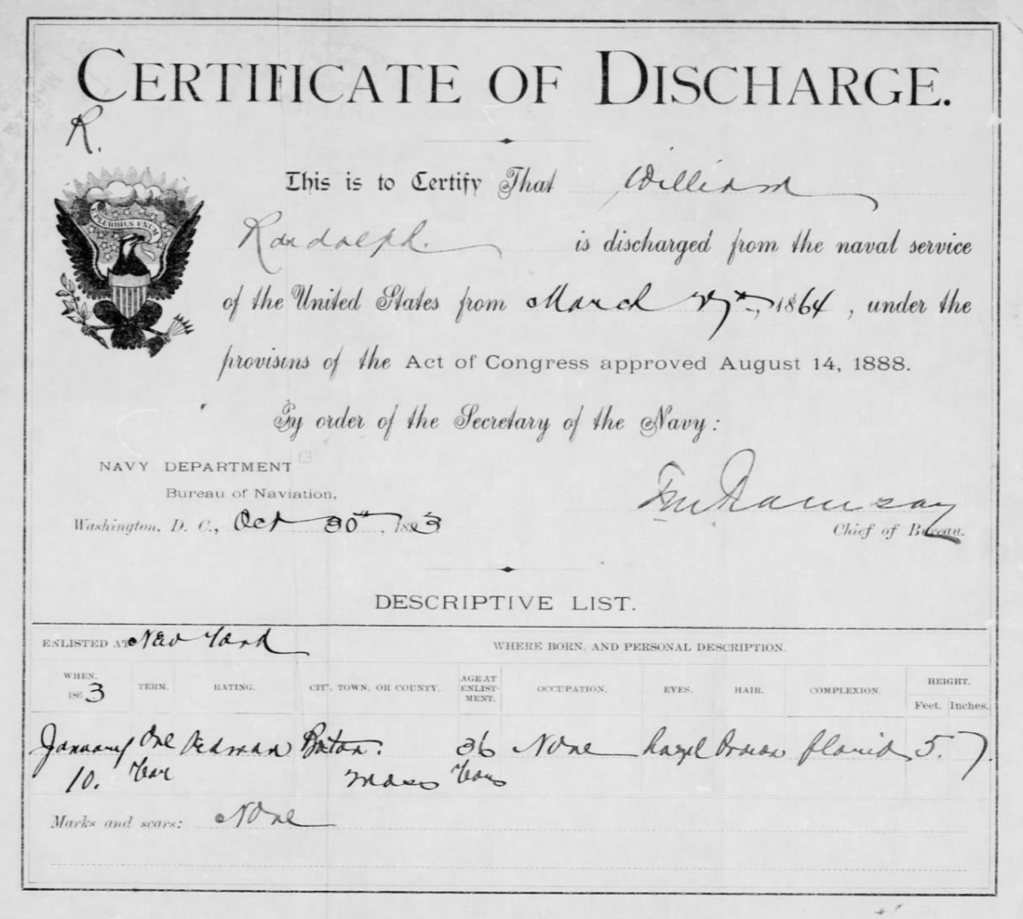
In his letter, 99 year-old Munroe, nearly blind from cataracts after years spent at sea, chronicles his service record in the U. S. Navy beginning with his initial enlistment under the name of William Randolph which he explains was done because he substituted for a man by that name who “was not much of a sailor.” Munroe’s pension file includes discharge certificates for both Randolph and Munroe. See footnotes.
Munroe also shares a wild tale of an attempt by the US Army to shanghai him into the service by drugging him while he was on shore leave in New York City.
Transcription
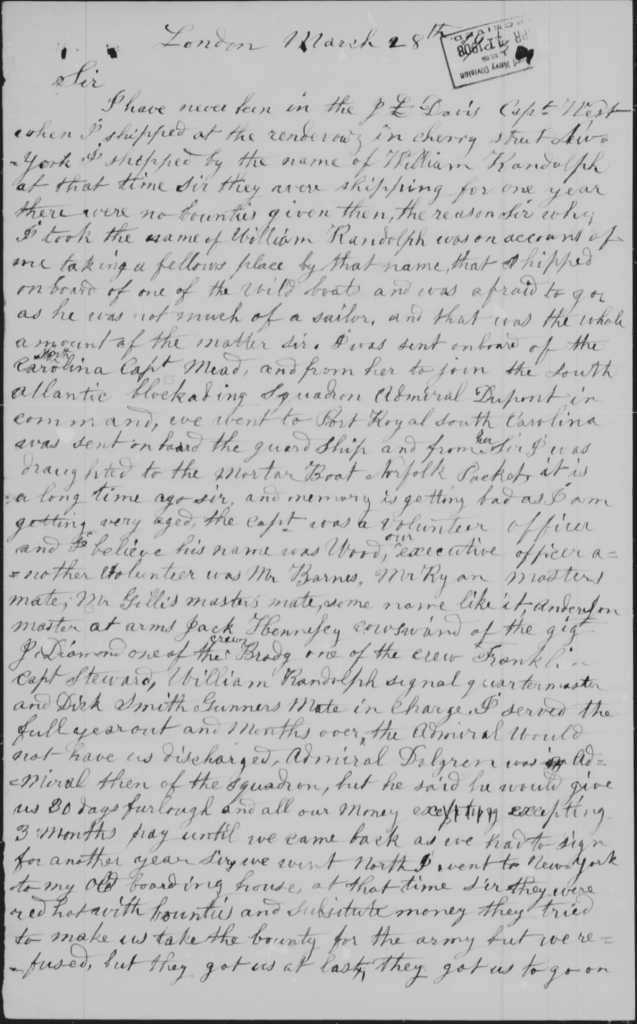
London [England]
March 28th 1908
Sir,
I have never been in the J. L. Davis, Capt. West. When I shipped at the rendezvous in Cherry Street, New York, I shipped by the name of William Randolph. At that time, sir, they were shipping for one year. There were no bounties given then. The reason, sir, why I took the name of William Randolph was on account of me taking a fellow’s place by that name that shipped on board of one of the wild boats and was afraid to go as he was not much of a sailor and that was the whole amount of the matter, sir.
I was sent on board of the North Carolina, Capt. Meade, and from her to join the South Atlantic Blockading Squadron, Admiral Dupont in command. We went to Port Royal, South Carolina, was sent on board the guard ship and from her, sir, I was draughted to the Mortar Boat Norfolk Packet. It is a long time ago, sir, and memory is getting bad as I am getting very aged. The captain was a volunteer officer and I believe his name was Wood. Our executive officer, another volunteer, was Mr. Barnes. Mr. Ryan, master mate, Mr. Gillis, master mate, some name like it, Anderson master at arms, Jack Hennessey boatswain of the gig J. Diamond one of the crew Brady one of the crew, Franklin, Captain’s steward, William Randolph signal quartermaster and Dirk Smith gunner’s mate in charge. I served the full year out and months over. The Admiral would not have us discharged. Admiral Dahlgren was admiral then of the squadron but he said he would give us 3 months pay until we came back as we had to sign for another year, sir.
We went North. I went to New York to my old boarding house at that time, sir. They were red hot with bounties and substitute money. They tried to make us take the bounty for the army but we refused, but they got us at last. They got us to go on a pleasure party to Staten Island where they drugged us nicely and got us off from that shanghai army place and next day when I came to my proper senses, I told them that we belonged to the Navy and didn’t know what we were doing and I wrote to Capt. [Richard Worsham] Meade of the North Carolina and he sent the first lieutenant and demanded us. I had no bounty, nor have I ever got the state bounty. The people I boarded with always knew me by the name of Edward Munroe and I suppose they gave in that name at the Depot. They asked me if I wanted to be sent south to the Mortar boat or would I sooner sign for three years and join the Augusta side wheeler, Capt. T[homas G.] Corbin, then fitting out at the Navy Yard. I told them about the name and they said I had better ship by my own name—it did not matter about the name as I had done no harm, and I got my discharge from the mortar boat which I sent, sir, when we signed on the 4th of March and two letters, sir.
I was sent again on the Charleston Station. We broke down in the Mona passage 1 convoying the Aspinwall steamer North Star and she took us in tow and took us to Fortress Monroe and from there we were towed to Baltimore and put onboard of the Allegheny receiving ship and from her, sir, we were draughted to Norfolk to join the Cambridge, Capt. Nichols, and went again to the South Atlantic Squadron and was blockading along the coast. She broke her back in Ogeechee Inlet and was sent north to Philadelphia. I got a fortnight’s liberty, came back, and was put on board of the Bienville guard ship and from her sent to Norfolk to join the Malvern, Admiral [William] Radford’s flagship, where the dysentery came on me and I applied for my discharge and got it. I was sent to Philadelphia and was sick for a long while.
When I got better I shipped again at Water Street, Philadelphia. Capt. Howell had charge—I believe that was his name. I was sent on board of the Princeton where I had a fall and got double ruptured and fractured forearm. Was discharged as unfit for service. I have, sir, all my discharges from the Malvern, the Augusta, and Cambridge, on the Mortar boat, and my sick discharge, sir. I was on board of 8 or 9 guard ships and sea going vessels during the war. I sent my discharge from the Mortar Boat Norfolk Packet on the 4th of March, sir, from the Consul General’s Office with a letter and I got another letter, sir, from the Department and they are both alike, sir. I send it to you, sir, to see it. It is dated the 13th of March and mine must have been miscarried. I hope, sir, that you will have the kindness to do all you can for me, sir, as I am getting very aged and need something more than what I am getting as I have not got no friend or relations living as I know of. If you will be pleased to return an answer, please send to the US Consul General’s Office, St. Helen’s Place. The reason, sir, that write this long letter to you is that you may have the full particulars to go by, sir, and see that it is a solid case. I have one shipmate here, sir, that was in the Augusta and Cambridge with me.
Very respectfully, — Edward Munroe
P. S. I am writing my own letters. My eyes are growing very dark. I would not be here now, sir, but I am always in debt as I can do no work, I suppose I shall soon be blind. The letter I am sending you is the same as I got before, sir.
1 The Mona Passage is the strait that separates Hispaniola and Puerto Rico.



 Spared & Shared 23