
The following letter was written by James McCally (1786-1872), the son of Capt. James J. McCally (1746-1810) and Elizabeth C. Watson (1764-1834) of Pendleton county, Virginia. When James wrote this letter in January 1862 from his home in Clarksburg, Harrison county, Virginia (now West Va.), he was a widower, his wife Penelope Williams (1795-1858) having passed some three years previous. He was still practicing medicine at the time of the 1860 US Census but in 1870 he was described as a retired farmer.
James wrote the letter to his daughter Helen McCalley (1833-1882) who married George Edward Pitkin (1826-1878) in Jackson county, Missouri, in 1858. Apparently Helen and George’s first child—Charles F. Pitkin (b. 1860) suffered from chronic catarrh. Helen’s husband George E. Pitkin was the assistant auditor of the Missouri River, Fort Scott, and Gulf Railroad in 1878 when, in a drunken stupor, “blew his brains out at the office of the company in Kansas City.”
Also mentioned in the letter was Virginia McCally (1823-1874) who married Judge George Hay Lee (1806-1873) after his first wife died in 1839. The wedding of Hugh Holmes Lee (1836-1869), one of the children of the Judge’s first marriages, is described. Hugh was married to Mary Marsh Criss (1843-1906) on 25 December 1860.
Finally, Penelope Rachel McCally (1818-1897) is mentioned. Rachel was married in 1840 to Thomas Ramage (1811-1861).
The letter contains a great description of James McCally’s heritage (the surname sometimes spelled McCauley) as well as his views on the war in 1862.
Transcription
Clarksburg, Virginia
January 3rd 1862
My dear Helen,
I received your affectionate and kind letter of the 24th ult. (Christmas eve) on yesterday & I will first reply to that part of it relating to our correspondence. There must have happened a failure of the mail. You did not receive two of my letters—the first promptly acknowledging the receipt of the box containing Dody’s clothes. I informed you of the fact, and how well they fit her and how well they pleased her, and of the other fact I think that there was some little delay in consequence of the box being directed to the care of G. Hoffman for it seemed to me strange that anything addressed to our house should be sent to the care of anyone else. I who have lived here upwards of fifty years can hardly be so obscure as to render it necessary to direct a package to my little granddaughter to anyone else.
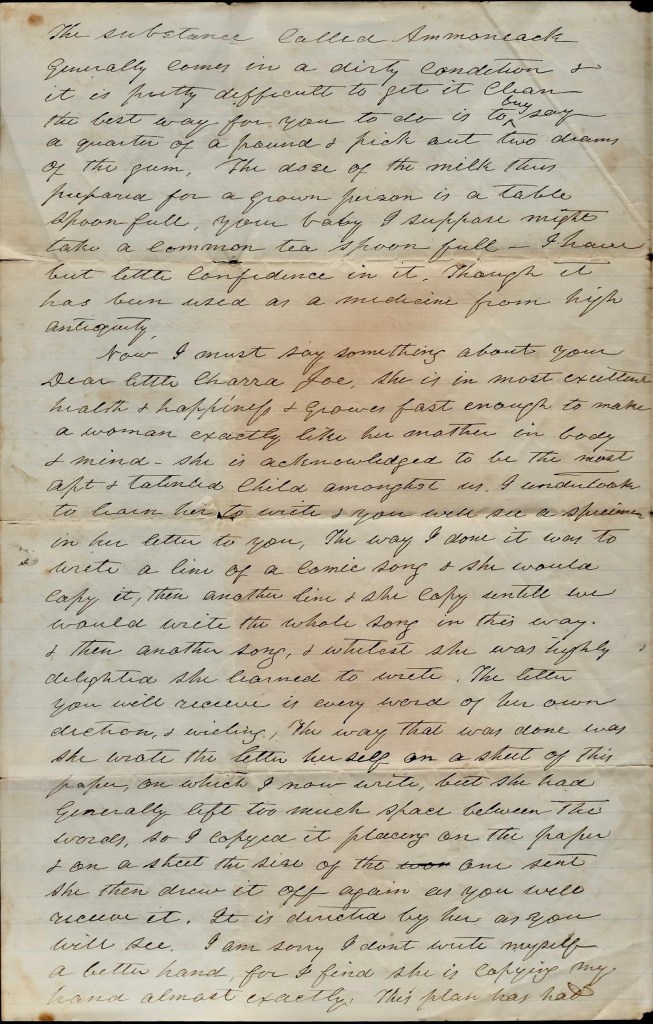
Next, how I gave the Gum Ammoneack. Well, I seldom have given it & lately not at all. It is not now much used but it is thought it has some good effects in chronic catarrh. The way to prepare it is as follows, Zake of Amononcac 2 drams, which is a quarter of an ounce, and water half a pint, rub in a mortar, the amoniac with the water gradually added until they are thoroughly mixed, then strain through a thin cloth in order to remove impurities. This is called Lac. Ammonieaci. The substance called Ammoniack generally comes in a dirty condition & ot is pretty difficult to get it clean. The best way for you to do is to buy say a quarterer of a pound & pick out two drams of the gum. The dose of the milk thus prepared for a grown person is a table spoonful. Your baby I suppose might take a common tea spoonful. I have but little confidence in it though it has been used as a medicine from high antiquity.
Now I must say something about your dear little Charra Joe. She is in most excellent health and happiness & grows fast enough to make a woman exactly like her mother in body & mind. She is acknowledged to be the most apt & talented child amongst us. I undertook to learn her to write & you will see a specimen in her letter to you. The way I done it was to write a line of a comic song & she would copy it, then another line, and she copy until we would write the whole song in this way. And then another song, and whilst she was highly delighted she learned to write. The letter you will receive is every word of her own diction, and writing. The way that was done was she wrote the letter herself on a sheet of this paper on which I now write, but she had generally left too much space between the words, so I copied it placing it on the paper & on a sheet the size of the one sent. She then drew it off again as you will receive it. It is directed by her as you will see. I am sorry I don’t write myself a better hand, for I find she is copying my hand almost exactly. This plan has had the advantage of learning her to read writing which she does with very considerable facility. She reads print remarkably well. I often get her to read pieces in the newspaper for me in the dim of the evening when I cannot well see, and she does it very satisfactorily. She is growing, I think, very handsome. The skin is smooth and her countenance very radiant, particularly when she is in a good humor which is her wont.
Your sister Virginia is at home with her fine baby. I was there last night. She sends her love to you & instructed me to say that she intends to write to you that her baby Grace Darling is very much like Maud was when a babe. I think her health is quite as good if not better than usual under similar circumstances. I think Judge Lee’s health good although he has had two attacks of gastritis (inflammation of the stomach) and is not yet quite over the last one which I think he brought on by eating a little too much & drinking a little too much wine at his son’s infare, who was married on Christmas Day evening and the infare at Lee’s on the next Friday. The entertainment at Cress & at Lee’s were certainly as fine as I ever saw. Hugh married Mary Cress, the 4th daughter. There is one single older than her & two younger. Aaron Cross has six daughters.
Your sister Rachel’s health is not good. She was dangerously ill two or three weeks ago but has got better. I have not seen her.
Tell Mr. Pitkin to give me his views on the disastrous affairs of the U. S. I wish I could give him mine to my own satisfaction. I am a native of about the middle of Virginia. My blood is full anglo-saxon. My grandfather Henry McCally was born in Scotland, married an English woman by the name of Aspy, and settled in Ireland in the linen draper business where my father was born who was raised a cabin boy at sea until he became a captain in the British Navy, which office he resigned on the approach of the Revolution in the United States Colonies and married in Virginia Elizabeth Watson, the daughter of the brother of that Bishop who wrote the apology of the bible in answer to Thomas Paine’s Age of Reason.
My grandmother was Margaret Hunter, a daughter of one of the Doctor Hunter’s of English medical fame so that I am of that stock of men that would rather lose their lives than liberty. I am in favor of the call of a convention of the People of Virginia and their amending the Constitution of the US and submitting it to all the states and with those states who ratify the Constitution thus amended unite, be they north, south, east, or west, and to dissolve with all who refuse. And that this amendment shall open the territories to the settlement of all the people of all the states, slaves or no slaves, and that no state shall ever come into this Union thus formed or reformed who prohibits the holding of African slaves except the states which now exists, and that they shall not harbor or admit the immigration of either free or runaway negroes, and that none of them shall allow negroes the right of suffrage.
Well, my dear child, my own dear daughter, I have filled my sheet. Excuse its errors and may God bless your pure heart. — J. McCally
to Helen



 Spared & Shared 23