
The following letters were written by Abel Starkey (1816-1864) of Boston who enlisted on 13 June 1861 as a private in Co. F, 11th Massachusetts Infantry—one of only three Massachusetts regiments to participate in the First Battle of Bull Run. The regiment spent the early fall of 1861 helping to build fortifications around Washington. In October, the 11th was stationed at Budd’s Ferry in Indian Head, Maryland where they remained on picket duty for the winter of 1861–1862. The 11th Massachusetts Infantry saw its first combat during the Peninsular Campaign in the spring of 1862. They were heavily engaged during the Second Battle of Bull Run, participated in the Battle of Fredericksburg, and suffered severe casualties at the Battle of Chancellorsville and the Battle of Gettysburg.
Presumably Abel was with his regiments throughout these engagements and was with them as well when the regiment marched into the Wilderness in May 1864 in Hancock’s Second Corps where they were engaged heavily on the Plank Road on 5 and 6 May 1864. It was Abel’s last fight. He died of wounds on 7 May 1864.
Abel wrote these letters to his older brother, Horace Starkey (1814-1872), a farmer near Rockford, Winnebago county, Illinois.
Other letters I’ve transcribed by members of the 11th Massachusetts:
Richard Whittock Clink, Co. B, 11th Massachusetts (1 Letter)
William H. Leslie, Co. B, 11th Massachusetts (2 Letters)
Charles Leland Fales, Co. E, 11th Massachusetts (2 Letters)
Charles A. Fiske, Co. K, 11th Massachusetts (1 Letter)
Charles H. Marcy, Co. K, 11th Massachusetts (1 letter)
William Wallace Chickering, Co. G, 11th Massachusetts (1 Letter)
Letter 1
In Camp 14 miles from Richmond
Sunday, June 1, 1862
Dear Brother,
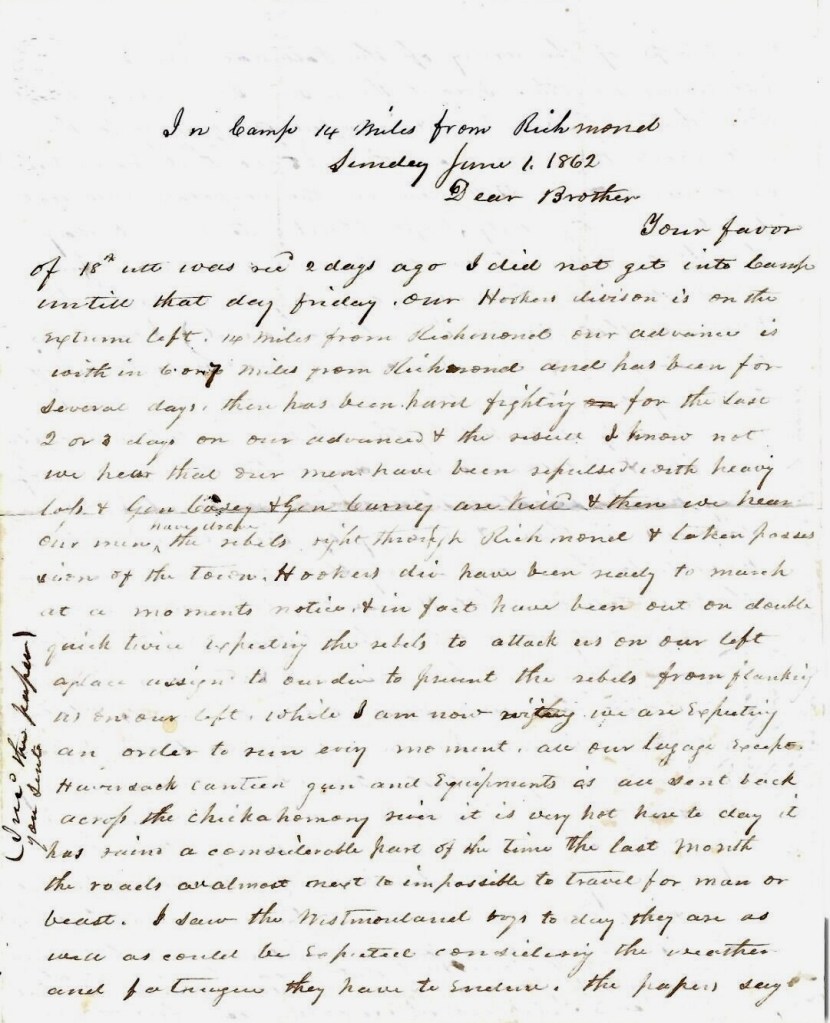
Your favor of the 18th instant was received 2 days ago. I did not get into camp until that day Friday. Our (Hooker’s) division is on the extreme left, 14 miles from Richmond. Our advance is within 6 or 7 miles from Richmond and has been for several days. There has been hard fighting for the last 2 or 3 days on our advance & the result I know not. We hear that our men have been repulsed with heavy losses & Gen. Casey & Gen. Carney are killed. And then we [also] hear our men drove the Rebels right through Richmond & taken possession of the town. Hooker’s Division have been ready to march at a moments notice & in fact have been out on double quick twice expecting the Rebels to attack us on our left—a place assigned to our division to prevent the Rebels from flanking us on our left. While I am now writing, we are expecting an order to run any moment.
All our luggage, except haversack, canteen, gun and equipments, is all sent back across the Chickahominy river. It is very hot here today. It has been raining a considerable part of the time the last month. The roads are almost next to impossible to travel for man or beast. I saw the Westmoreland boys today. They are as well as could be expected considering the weather and fatigue they have to Endure. The papers say our troops of the Army of the Potomac are in excellent health. I don’t think so—to say nothing about those that have been killed or wounded on our right last week. There is more than 25,000 that have been sent home or are still in the hospitals and not fit to do any duty. Capt. Barker told me today that the 2d New Hampshire Regiment could not muster over five hundred men that were able to go into battle (He told me that Abijah French was dead).
I came in the rear from Williamsburg and was 11 days coming. Took my own time. The houses on the main road were mostly deserted by the white population excepting families & seldom I saw any of them and nearly every house vacated. There were more or less sick soldiers in them & many of them turned into hospitals.
There was nearly three thousand sick in the hospitals at White House landing and more arriving daily and taking the steamboat for Fortress Monroe, Baltimore, Philadelphia, New York &c. News has just come in that we had drove the Rebels & taken lots of prisoners. I have not heard from home since I wrote you last. Two or three letters came in my absence & were sent back to White House Landing in our Captain’s trunk. I am well & hearty. Tell [your daughter] Ella I am very much obliged to her for the letter she sent me & tell her to write again. Tell her also that Jeff Davis was not quite patriotic to hang himself. Stanton’s Michigan Regt. encamped near us at Yorktown. They are away in the advance now. I will see Lewis Webster when we come near them again. Give my regards to your family and write again. Respectfully yours—Abel Starkey.
We are Off.

Letter 2

Camp Fair Oaks
6 Miles below Richmond
June 21, 1862
Dear Brother,
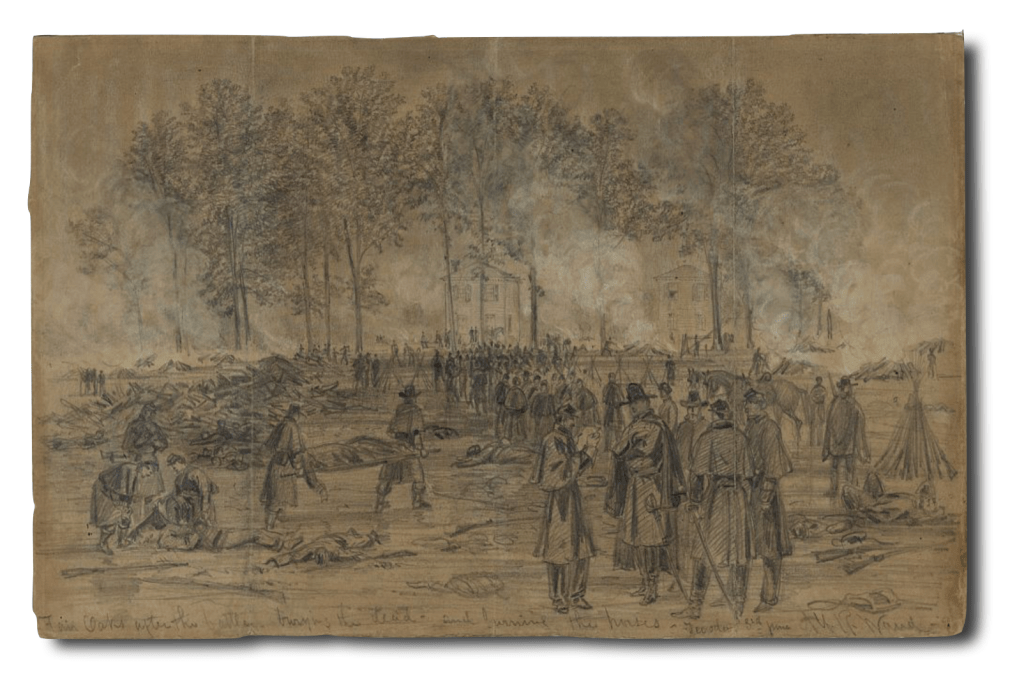
The Grand Army of the Potomac are spread out from James River to Chickahominy River & how much further I do not know, but quite a distance. Hooker’s Division is encamped on the same ground that Casey’s was at the time the battle was fought 3 weeks ago. When we came here, the ground was covered with dead men and horses, broken gun carriages, muskets, accoutrements, &c. It was 4 days after the battle. The men and horses were perfectly alive with maggots. It would make a well man spew to look at them and then the smell was enough to knock a whole regiment end ways. We covered the men over with dirt as well as we could & piled wood on the horses & burnt them. The air begins to seem fit to breathe again.
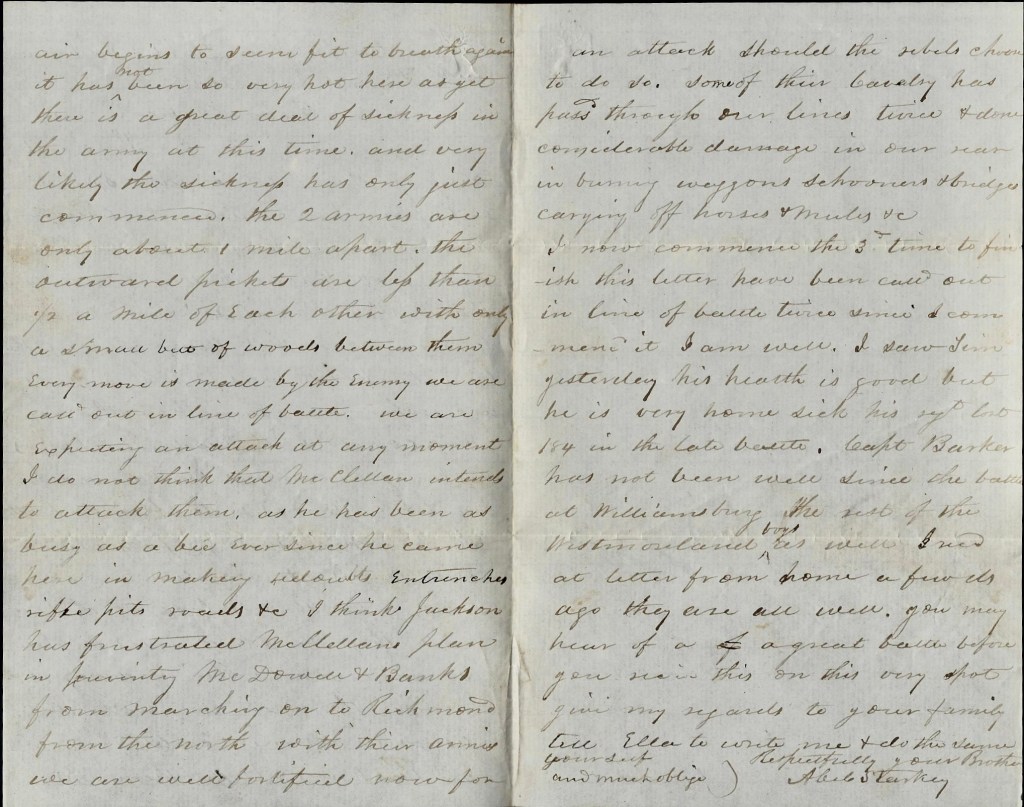
It has not been so very hot here as yet. There is a great deal of sickness in the army at this time and very likely the sickness has only just commenced. The two armies are only about 1 mile apart. The outward pickets are less than half a mile of each other with only a small bit of woods between them. Every move [that] is made by the enemy, we are called out in line of battle. We are expecting an attack at any moment. I do not think that McClellan intends to attack them as he has been as busy as a bee ever since he came here in making redoubts, entrenches, rifle pits, roads, &c. I think [Stonewall] Jackson has frustrated McClellan’s plan in preventing McDowell and Banks from marching on to Richmond from the North with their armies.
We are well fortified now for an attack should the rebels choose to do so. Some of their cavalry has passed through our lines twice and done considerable damage in our rear in burning wagons, schooners, & bridges, carrying off horses and mules, &c.
I now commence the 3rd time to finish this letter. Have been called out in line of battle since I commenced it. I am well. I saw Tim yesterday. His health is good but he is very homesick. His regiment lost 184 in the late battle. Capt. Barker has not been well since the battle at Williamsburg. The rest of the Westmoreland boys are well. I received a letter from home a few days ago. They are all well. You may hear of a great battle before you receive this on this very spot. Give my regards to your family. Tell Ella to write me & do the same yourself and much oblige. Respectfully your brother, — Abel Starkey

 Spared & Shared 23