
This letter was written by Hiram Ketchum, a lawyer, public servant, and a Trustee of the African Free School of New York City. He wrote the letter to Gideon Lee (1778-1841), a recently elected member of the New York State Assembly who shared some common interests with Ketchum. Lee later served as the mayor of New York City and was elected to the US Congress as a Jackson Democrat.
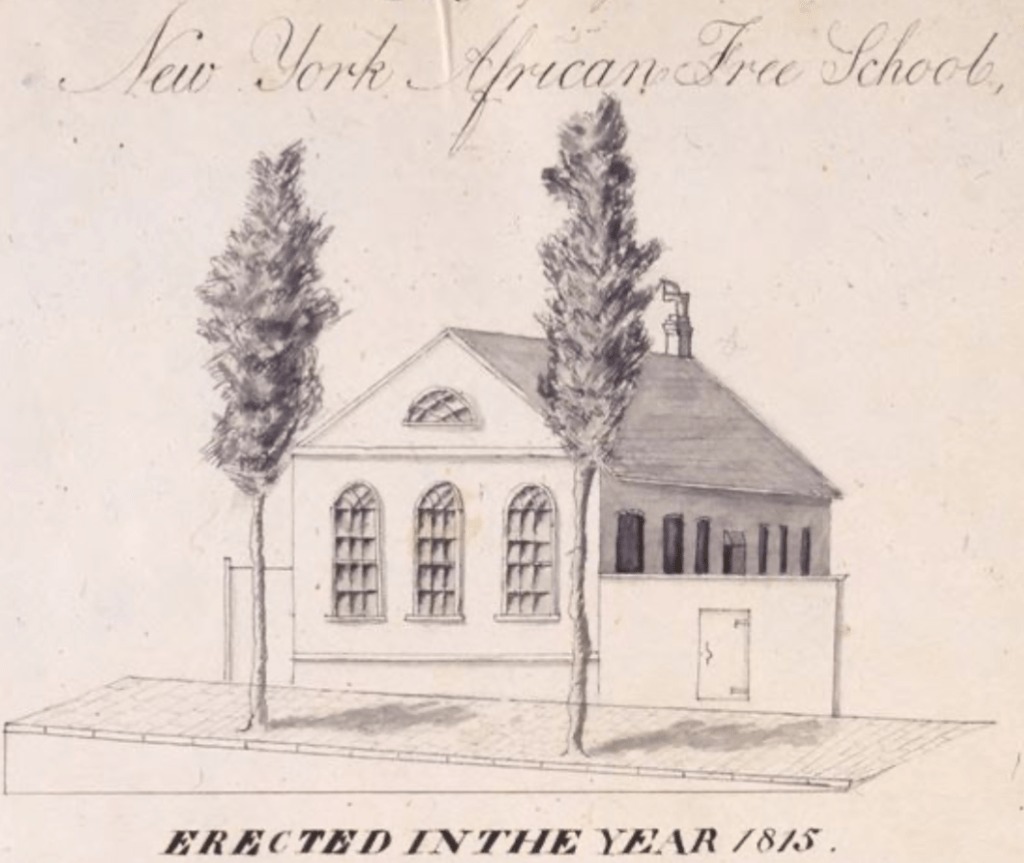
Hiram’s letter was penned in 1823–four years before slavery was fully and finally abolished in New York State. The impending abolishment of slavery caused tremendous social upheaval among the citizens of New York, particularly in New York City which was awash is social change, creating much anxiety among those who feared losing a grip on their power. In his letter, Hiram, calls attention to a bill passed in the previous session of the State Legislature called “Chase’s Law” which must have adversely affected the funding for the African Free School in New York City. The African Free School was founded by members of the New York Manumission Society, including Alexander Hamilton and John Jay, in 1787. The first school was established in 1794. In 1813 a state law provided that the African Free School would receive both city and county school funds. By 1820 the enrollment approached 700 students in multiple schools and they were gaining a reputation for success. Under the leadership of Charles C. Andrews, the institution grew significantly. Andrews believed passionately that his black students were just as bright as whites, if not even smarter. In 1834 the Free Schools were transferred to the control of the New York State Public School Society, the major local conduit for state funds. In reality, the schools had already ceased to be philanthropic institutions and had become public schools.
It is a matter of curiosity that when Gen. Marquis de La Fayette visited the United States in September 1824, one of his stops was to the African Free School on Mulberry Street in NYC, and it was Hiram Ketchum who gave the general a synopsis of the history of the school and proudly displayed examples of the black student’s work.
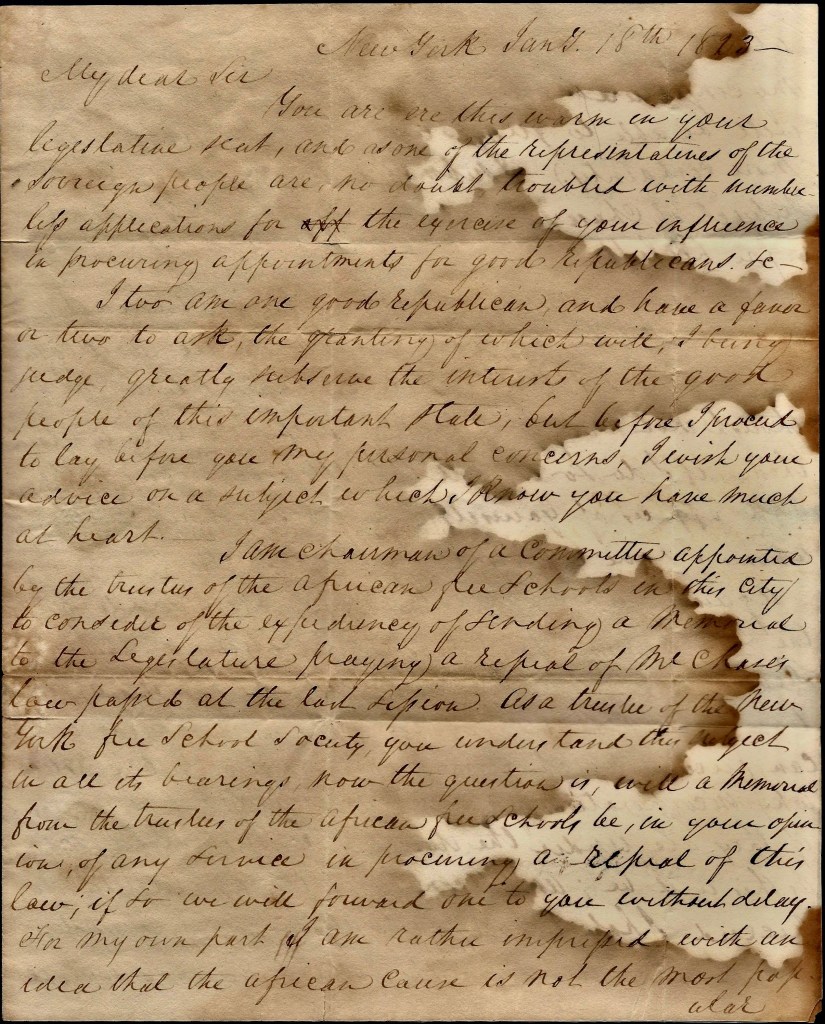
Transcription
New York [City]
January 18th 1823
My Dear Sir,
You are ere this warm in your legislative seat, and as one of the representatives of the sovereign people are no doubt troubled with numberless afflictions for the exercise of your influence in procuring appointments for good republicans, &c.
I too am one good republican and have a favor to ask, the granting of which will, I being judge, greatly subserve the interests of the good people of this important state. But before I proceed to lay before you my personal concerns, I wish your advice on a subject which I know you have much at heart.
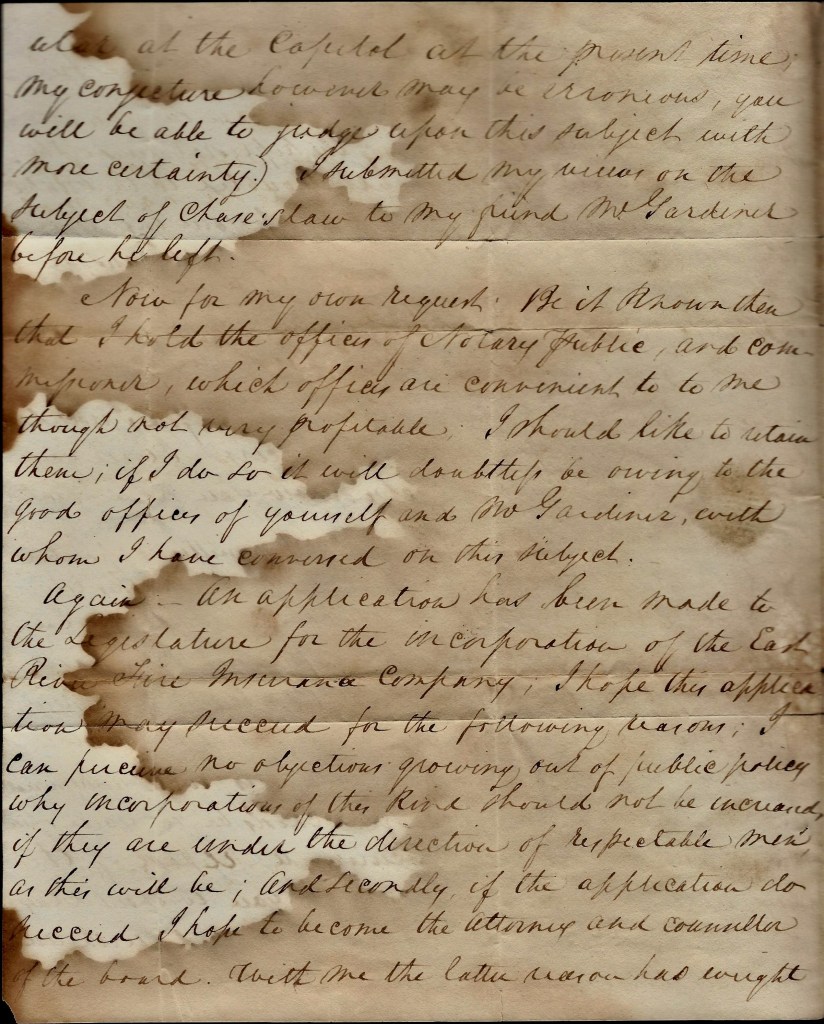
I am chairman of a committee appointed by the trustees of the African Free Schools in this city to consider of the expediency of sending a memorial to the Legislature praying a repeal of Mr. Chase’s law passed at the last session. As a trustee of the New York Free School Society, you understand this subject in all its bearings. Now the question is, will a Memorial from the trustees of the African Free Schools be, in your opinion, of any service in procuring a repeal of this law; if som we will forward one to you without delay. For my own part, I am rather impressed with an idea that the African cause is not the most popular at the Capitol at the present time. My conjecture, however, may be erroneous. You will be able to judge upon this subject with more certainty. I submitted my views on the subject of Chase’s law to my friend Mr. Gardiner before he left.
Now for my own request. Be it known then that I hold the offices of Notary Public, and Commissioner, which offices are convenient to me though not very profitable. I should like to retain them; if I do so, it will doubtless be owing to the good offices of yourself and Mr. Gardiner, with whom I have conversed on the subject.
Again, an application has been made to the Legislature for the incorporation of the East River Fire Insurance Company. I hope this application may succeed for the following reasons. I can perceive no objections growing out of public policy why incorporations of this kind should not be increased if they are under the direction of respectable men as this will be; and secondly, if the application does succeed, I hope to become the attorney and counsellor of the board. With me the latter reason has weight though it is not one in which the public feel much interest.
I have been threatening ever since you left to take a walk to Art Street 1 to see how matters are conducted in your absence, but have not yet executed my purpose; it will not be long, however, before I shall.
There is no domestic intelligence of interest here. The ladies of our acquaintance are, I believe, all well. By the bye, have you made acquaintance with a certain long, tall but good and agreeable girl who inhabits the basement story of the house where you lodge? If you have, please remember me to her. When I was at Albany last summer, I found it quite pleasant to spend some time in her company. as you well know, where ere I am, I cannot “let the gals alone.”
Please remember me to your colleague, Mr. Gardiner. Very sincerely, — Hiram Ketchum
[to] Gideon Lee, Esqr.
1 Art Street is now 8th Street in Manhattan. Gideon Lee’s leather store was located 20 Ferry Street, His home on Art Street.


 Spared & Shared 23