
The following letter was written by Albert Gallatin Patten (1831-1893), the son of Johnson Patten (1782-1848) and Lucy Towne (1790-1862) of Kennebunkport, Maine. He was married in Mary 1868 to Martha Elizabeth Hunt in Hennepin, Minnesota.
Prior to his enlistment in the US Army in July 1854, Albert was a 23 year-old carriage-maker in Kennebunk. Albert’s pension files inform us that he served in the military from 1854 to 1859 in Co. K, 2nd Infantry. When he wrote this letter in May 1858, he was a sergeant working on detail in the Quartermaster Department of Fort Ripley in Minnesota Territory. Following his discharge from the army, he may have been the same Albert G. Patten who enlisted as crewman aboard the whaling ship Parachute which departed New Bedford in 1859. He served in the Civil War in Co. C, 1st New Jersey Infantry.
Fort Ripley was located on the west bank of the Mississippi about 20 miles above the mouth of Swan river, and 7 miles south of Crow Wing, at a point where the channel runs southwest. The distance by wagon road from St. Paul was 150 miles. The road lay along the east bank of the Mississippi, with no approach to the fort except by ferry. The Post Reserve was a mile square and was surrounded by a dense forest. The fort was situated on a plateau elevated a little above the river, and consisted of several story and a half buildings constructed of wood, forming three sides of a square, with the open side facing the stream. On the right, looking towards the quadrangle, were the quarters of the officers, the chaplain’s residence, and the sutler’s store; on the left, also quarters for officers, a room set apart for a chapel, and a hospital; while the third side was filled by the barracks for the soldiers. The northwest and southwest corners were flanked by blockhouses of logs, with port-holes commanding the sides of the fort. The houses stood some fifteen to twenty feet apart, so that there was a free entrance between, excepting on the east side where there was a stockade built of logs set on end.

Transcription
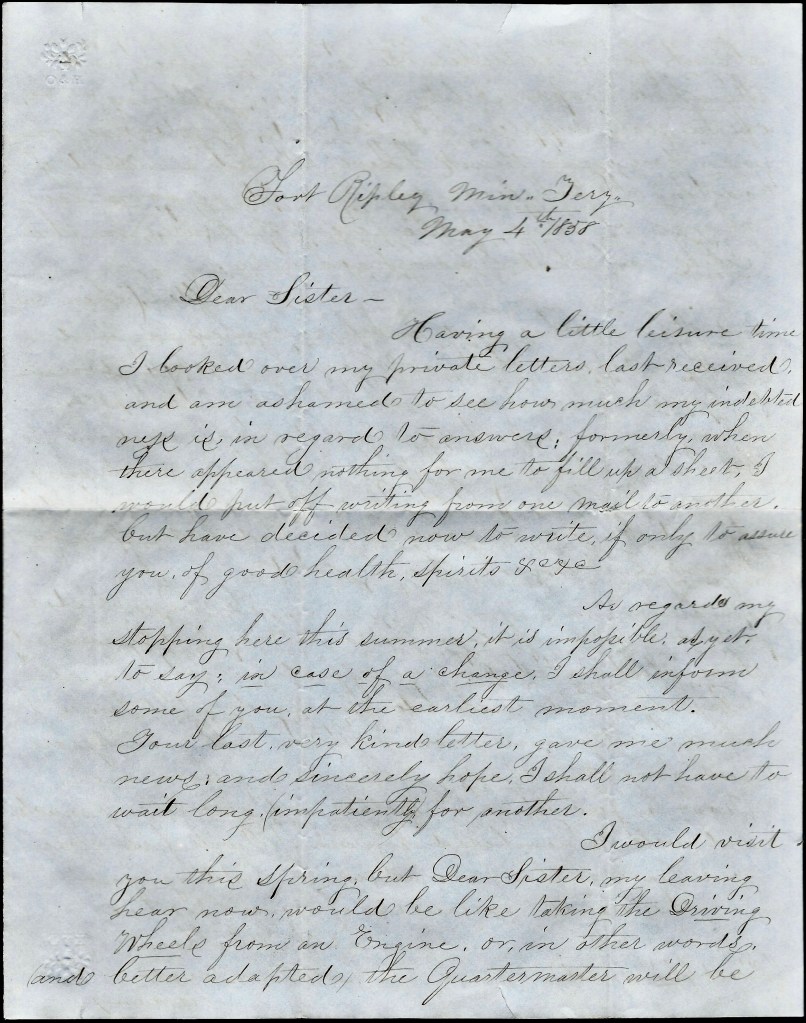
Fort Ripley, Minnesota Territory
May 4th 1858
Dear Sister,
Having a little leisure time, I looked over my private letters last received and am ashamed to see how much my indebtedness is in regard to answers. Formerly, when there appeared nothing for me to fill up a sheet, I would put off writing from one mail to another—but have decided now to write if only to assure you of god health, spirits, &c. &c.
As regards my stopping here this summer, it is impossible, as yet, to say. In case of a change, I shall inform some of you at the earliest moment. Your last very kind letter gave me much news and sincerely hope I shall not have to wait long (impatiently) for another. I would visit you this. Spring, but dear sister, my leaving here now would be like taking the driving wheels from an engine, or, in other words, and better adapted, the quartermaster will be absent for a considerable length of time, and the whole responsibility of receiving, storing, &c. &c. of the year’s supplies will, consequently, devolve on me. You may think I have adopted a method of boasting but believe me, I would as soon have charge of some of the larger warehouses in the cities as what I now have here.
Often, (when one and then another, and another comes in and makes a report that a wagon has broken down—a horse lame—an animal of some description is missing—or, perhaps, an order for provisions to be filled up immediately, all these are trying to ones patience) I think of the advice so kindly offered by you in your letter, and hope I may treasure it more than gold.
This, dear sister, is but a poor apology for a letter but be assured there still exists warm affection for you all. Pay my kind wishes to Mr. Hardy, Tell James I shall write him soon. John and family are not forgotten though I think they have me. Now a few lines to Mother and also to my much and well remembered Emma. I will first close your part of this poor sheet by bidding you the usual farewell of your brother, — A. G. Patten
Jr. Master Sergeant, US Army
(Direct plain as usual.)
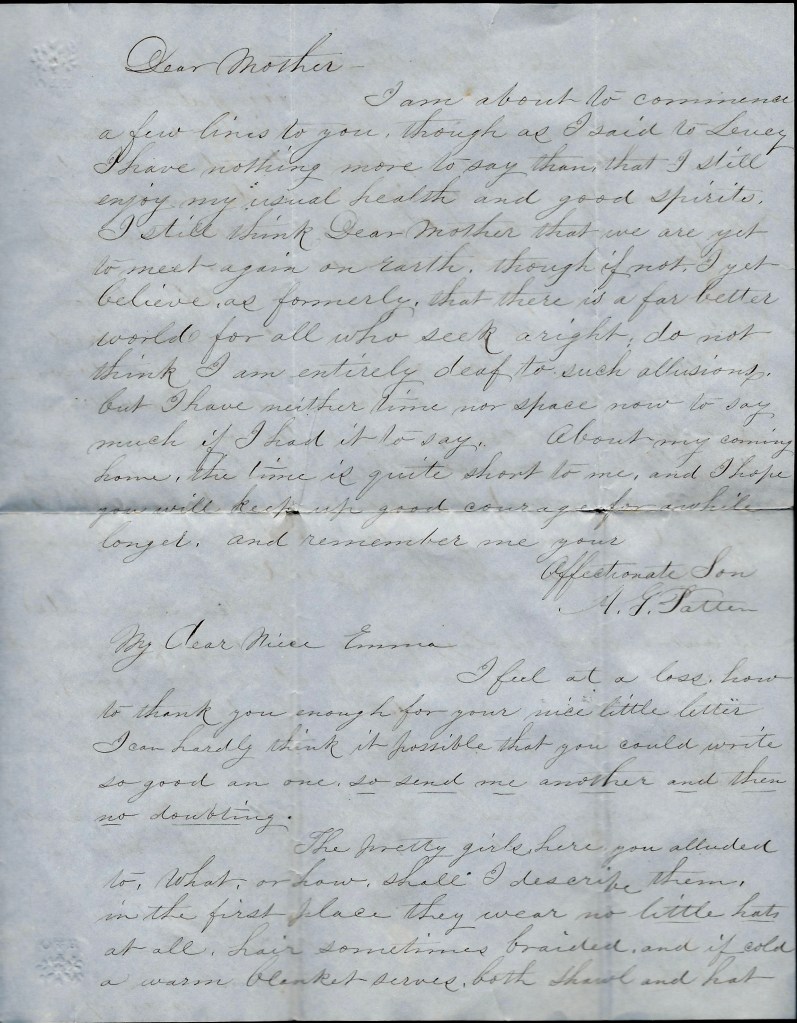
Dear Mother,
I am am about to commence a few lines to you, though as I said to Lucy, I have nothing more to say than that I still enjoy my usual health and good spirits. I still think, dear Mother, that we are yet to meet again on earth, though if not, I yet believe, as formerly, that there is a far better world for all who seek a right. Do not think I am entirely deaf to such allusions, but I have neither time nor space now to say much if I had it say. About my coming home, the time is quite short to me, and I hope you will keep up good courage for awhile longer and remember me your affectionate son, — A. G. Patten
My dear niece Emma,
I feel at a loss how to thank you enough for your nice little letter. I can hardly think it possible that you could write so good an one, so send me another and then no doubting.
The pretty girls here you alluded to, what, or how, shall I describe them. In the first place they wear no little hats at all, hair sometimes braided, and if cold a warm blanket serves both shawl and hat. Their other wearing apparel it is not best for me to enter into a minute detail until I can see you. I might ass without fear, that their complexion is such tat you would not desire to call one Aunt (being much too dark). I am now getting quite out of the notion of young ladies (except [our] own folks) probably shall settle down somewhere, at sometime, an old squizzled up “Bach.”
Do not forget to give me another trial on letters. I may do better than nonsense in returning you an answer. Be pleased to still remember me as your very affectionate Uncle. — A. G. Patten, Fort Ripley, M. T.


 Spared & Shared 23