
The following letter was written by Capt. Gideon J. Jenkins (1815-1893) of Co. K, 17th New York Infantry (the “Westchester Chasseuers”). Gideon was born and raised in Warsaw, Wyoming county, New York, where he worked principally in the mercantile business before the Civil War, including a two year stint in the State Assembly. At the outbreak of hostilities, Gideon stepped up to recruit the boys of Company K in his hometown and was awarded the command of it as they marched off to defend Washington D. C. toting their percussion muskets and wearing their uniforms—“light blue pants and dark blue jackets of strict regulation pattern.” The regiment was held in reserve, in garrison at Fort Ellsworth at the time of the Battle of First Manassas, though we learn from this letter that Gideon’s Company K was guarding government property in Alexandria on the day of the “Great Battle.”
Gideon’s account of the great skeddadle of McDowell’s army after the battle—still in flight in the early morning hours of the following day—is quite remarkable. He wrote the letter his wife of 25 years, Mary Amelia (Hovey) Jenkins (1816-1894), informing her that “Don’t worry about us. We may die. We may get killed or wounded, but some of us will never run.” Serving with him in the same regiment were his two sons—Charles Victor (“Vic”) Jenkins (b. 1839), and Adelbert (“Del”) H. Jenkins (b. 1841), both of whom are mentioned in this letter.
Being in his mid forties, however, the rigors of camp life proved to be too much for Gideon and he fell victim to typhoid fever, so debilitating that he was forced to resign his commission in December 1861, after only seven months service. In 2021, I transcribed another letter by a member of Gideon’s company named Manser M. Dunbar who also wrote from Fort Ellsworth, though a month later. In it, Manser mentions Gideon’s already having become ill: “I am sorry that our Captain is sick and First Lieutenant. All the commissioned officer we have is 2nd Lieutenant but I guess we will get along some way. We must hope for the best and do our duty in all cases and leave the rest with Providence.” [See 1861: Manser M. Dunbar to his Parents on Spared & Shared 22.]

Transcription

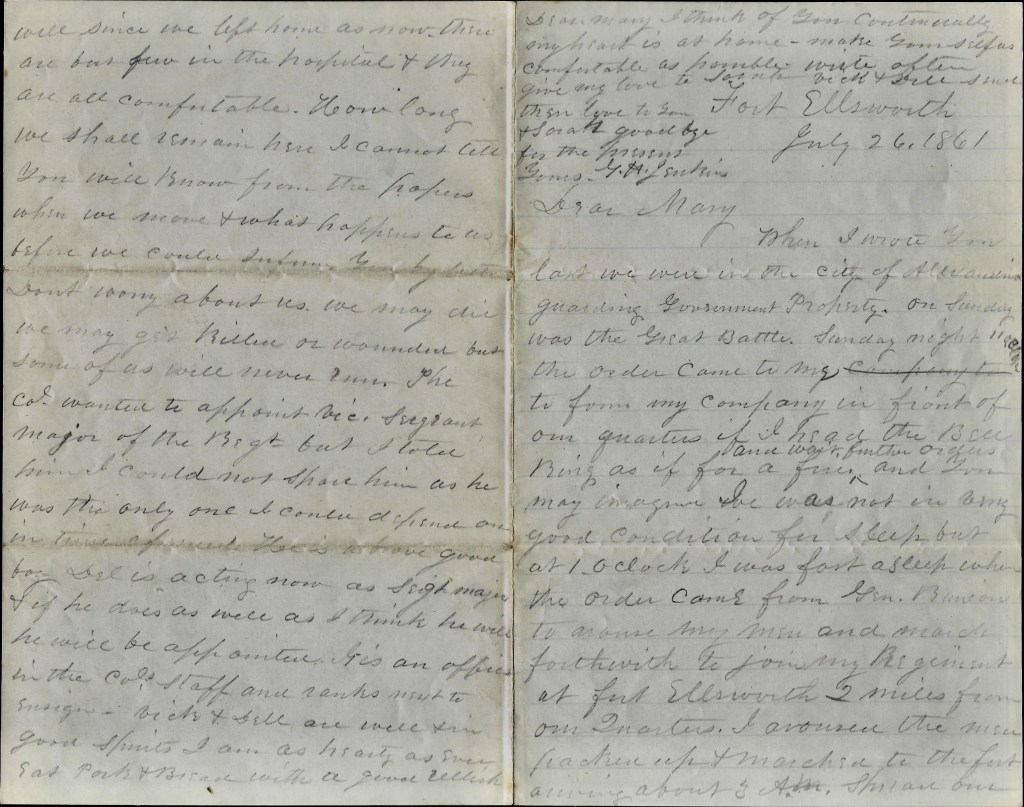
Fort Ellsworth
July 26, 1861
Dear Mary,
When I wrote you last we were in the city of Alexandria guarding government property. On Sunday was the Great Battle. Sunday night 11 o’clock, the order came to me to form my company in front of our quarters if I heard the bell ring as if for a fire and wait further orders, and you can imagine I was not in very good condition for sleep. But at 1 o’clock I was fast asleep when the order came from Gen. Bunion to arouse my men and march forthwith to join my regiment at Fort Ellsworth, 2 miles from our quarters.
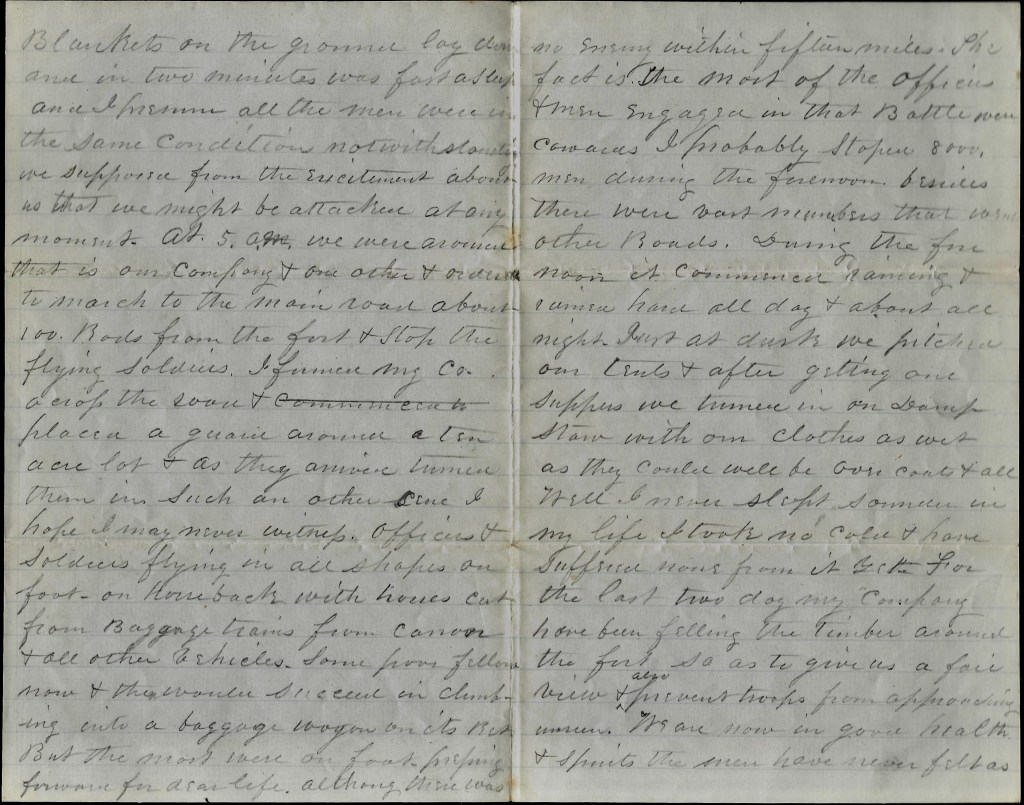
I aroused the men, packed up, & marched to the fort, arriving about 3 a.m. [We] spread our blankets on the ground, lay down, and in two minutes was fast asleep, and I presume all the men were in the same condition notwithstanding we supposed from the excitement about us that we might be attacked at any moment. At 5 a.m. we were aroused—that is, our company and one other—& ordered to march to the main road about 100 rods [550 yards] from the fort & stop the flying soldiers. I formed my company across the road & placed a guard around a ten-acre lot & as they arrived, turned them in. Such another scene I hope I may never witness—officers & soldiers flying in all shapes on foot, on horseback with horses cut from baggage trains, from cannon, & all other vehicles. Some poor fellow now & then would succeed in climbing into a baggage wagon on its bed, but the most were on foot pressing forward for dear life, although there was no enemy within fifteen miles. The fact is, the most of the officers & men engaged in that battle were cowards. I probably stopped 8,000 men during the forenoon besides there were vast numbers that went other roads.
During the forenoon, it commenced raining & rained hard all day, & about all night. Just at dark we pitched our tents & after getting our suppers, we turned in on damp straw with our clothes as wet as they could well be—overcoats & all. Well, I never slept sounder in my life. I took no cold & have suffered none from it yet. For the last two days my company have been felling the timber around the fort so as to give us a fair view & also prevent troops from approaching unseen. We are now in good health & spirits. The men have never felt as well since we left home as now. There are but few in the hospital & they are all comfortable. How long we shall remain here I cannot tell. You will know from the papers when we move & what happens to us before we could inform you by letter.
Don’t worry about us. We may die. We may get killed or wounded, but some of us will never run. The Col. wanted to appoint Vic Sergeant Major of the regiment, but I told him I could not spare him as he was the only one I could depend on in time of need. He is a brave good boy. Del is acting now as Sergt. Major & if he does as well as I think he will, he will be appointed. G is an officer in the Col.’s staff and ranks next to ensign. Vick & Dell are well & in good spirits. I am as hearty as ever. Eat pork & bread with a good relish.
Dear Mary, I think of you continually. My heart is at home. Make yourself as comfortable as possible. Write often. Give my love to Frank. Vick & Dell send their love to you & for all. Goodbye for the present. Yours, — G. H. Jenkins
 Spared & Shared 23