
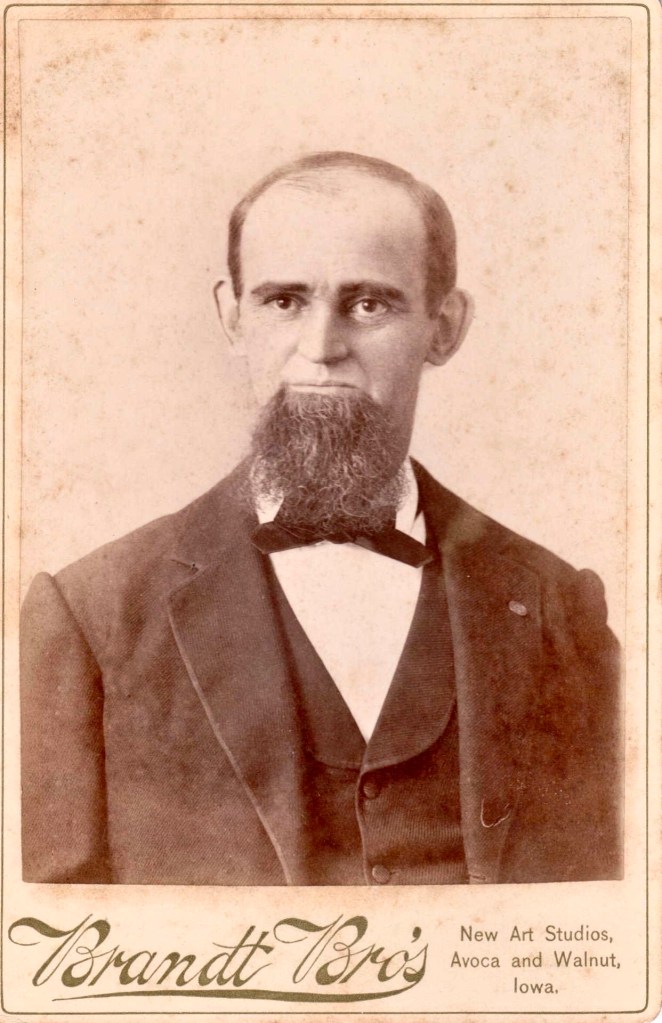
The following letter was written by Lawrence B. Worth (1834-1891), the son of Alexander Worth (1803-1875) and Adeline B. Vermilya (1811-1842) of Mooresville, Morgan county, Indiana. In 1854, Alexander Worth—an early day merchant in Mooresville, moved with his second wife and family to Indianapolis where he became Secretary of the Indianapolis, Cincinnati, and Lafayette Railroad. At the time or shortly after his father moved to Indianapolis, 21 year-old Lawrence struck out on his own and settled in Indianola, Warren county, Iowa. The 1860 Census enumerates him employed as a carpenter in Oskaloosa, Mahaska county, Iowa, with a wife of two years, Zerilda (Kinsey) Worth (1841-1893) and a one year-old son Frederick (1859-1935).
At the age of 26, Lawrence volunteered in July 1861 and was mustered into Co. C, 7th Iowa Infantry as a private. He was promoted to a corporal in January 1862, and mustered out of the regiment as a sergeant in July 1865 after four years service.
In his letter of 11 April 1862, Lawrence gives a detailed account of the 7th Iowa’s experience at the Battle of Shiloh from the time their encampment was overrun on Sunday morning until their retreat over a mile to the very heart of the Hornet’s Nest where they fought valiantly until after dark when the position could no longer be held. Although Gen. Grant had previously praised the 7th Iowa for its gallant service at Belmont and Donelson, Lawrence was less than impressed with Grant’s leadership. “General Grant should be courtmartialed for allowing himself to be surprised. He was notified time after time that the enemy were near his lines in strong force & intended to attack him. He hooted at the idea of them attacking him & for two days suffered things to go on in this way & his army to be surprised. I have always disliked the man & worse now than ever. He is not fit for a military man,” he wrote his father.
Transcription

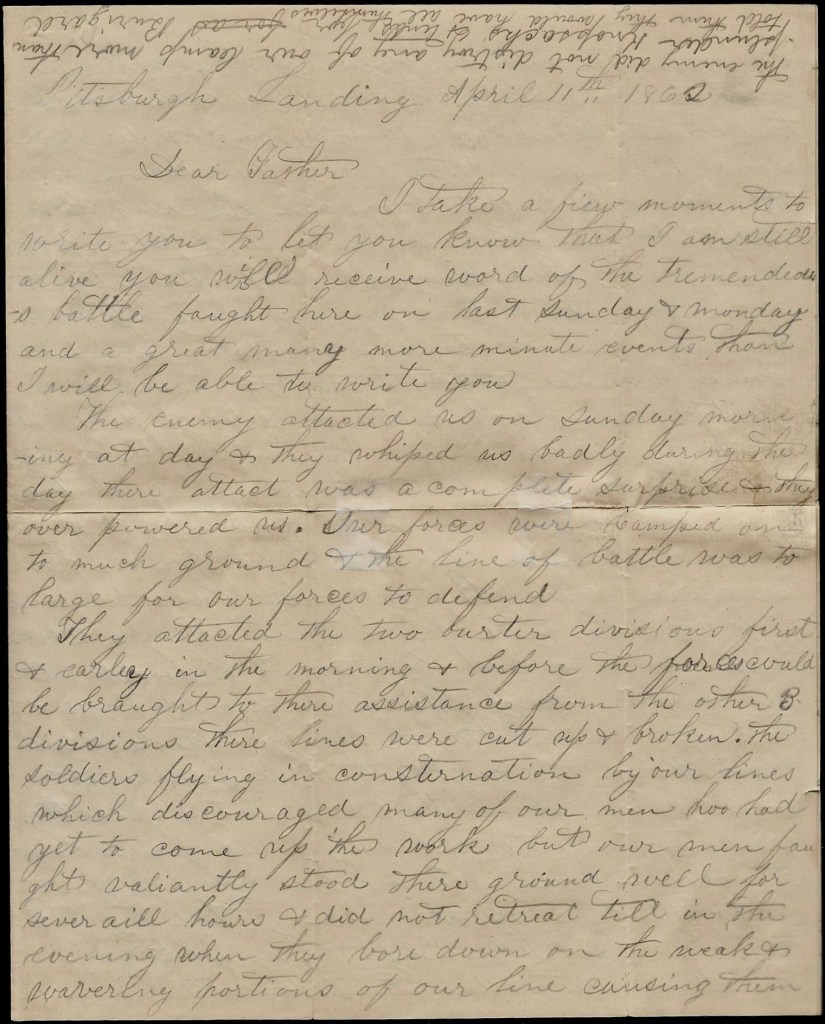
Pittsburg Landing
April 11th 1862
Dear Father,
I take a few moments to write you to let you know that I am still alive. You will receive word of the tremendous battle fought here on last Sunday & Monday and a great many more minute events than I will be able to write you.
The enemy attacked us on Sunday morning at day [break] & they whipped us badly during the day. Their attack was a complete surprise & they over powered us. Our forces were camped on too much ground & the line of battle was too large for our forces to defend. They attacked the two outer divisions first & early in the morning & before the forces could be brought to their assistance from the other 3 divisions, their lines were cut up & broken—the soldiers flying in consternation by our lines which discouraged many of our men who had yet to come up the work. But our men fought valiantly—stood their ground well for several hours & did not retreat till in the evening when they bore down on the weak & wavering portions of our line, causing them to fall back. And then began a flanking movement on the part of the enemy. We were ordered to retreat which was done in good order for some distance, but the enemy bore down on them so strong that soon all became confusion, & then became a general stampede equal to Bull Run, I suppose.
We retreated back, formed a line running along up & down the river near the landing & out for some distance. There was a howitzer (64 pounder), three or four 24-pound siege pieces placed on the hill near the landing [and] with these & one of the gun boats, they rained such torrents of shot & shell into the enemy that they dare not advance. This was kept [up] for one hour or more when Buell’s forces began to come up over the hill from the landing just in time to save us. Had it not been for the reinforcements of Buell, we would have [been] entirely annihilated, killed, or taken prisoners.
During the night the reinforcements were disposed of in the best manner possible for action in the morning. Our guns kept throwing shell all night every half hour into the lines of the enemy till they had to fall back during the night over a mile. How they did it, I do not know, but some that were taken prisoners & wounded say that every shell was thrown during the night [landed] immediately into their lines.
On Monday morning at daylight, the fight commenced again. This day the battle turned the other way. The enemy were routed entirely & driven back. All the guns they took from us were retaken & a number of theirs were also taken. The loss on both sides was great. They took a great many prisoners the first day & we took some of them prisoners the second day. How many, I do not know. I suppose they took 2,000 of our men on Sunday. On Monday we took, I think, near 1,000 of them prisoners.
The enemy is about seven miles from our lines & the supposition is they intend attacking us again soon. Johnston & Bragg were killed & Beauregard is wounded in the arm. The enemy lost some of their best officers & they had the flower of their army here—most of the Manassas troops.
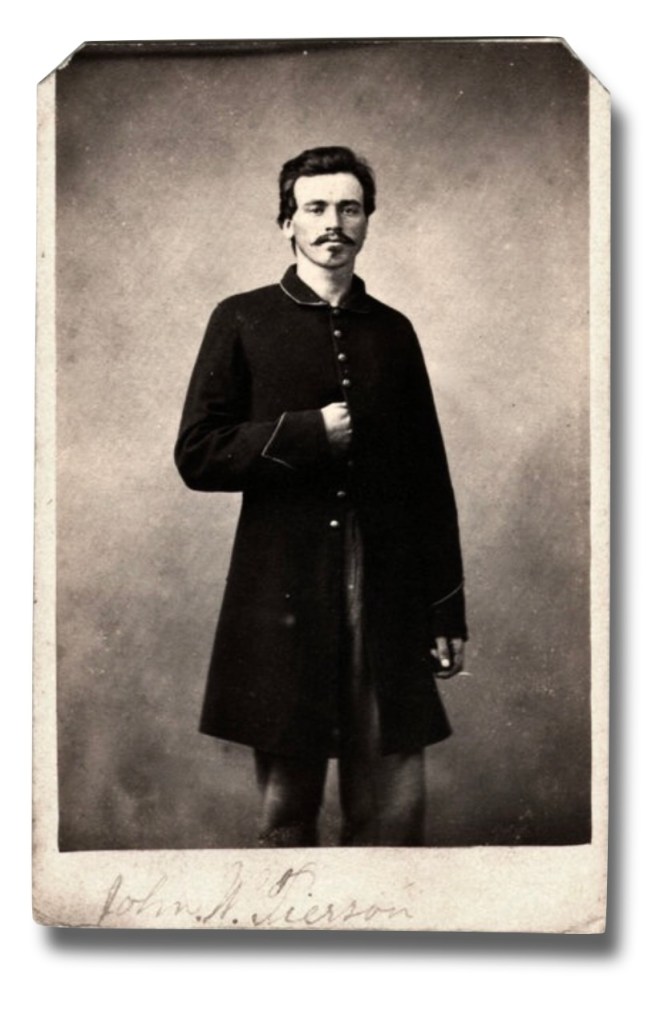
Two of our Belmont prisoners came to us yesterday—one of our company by the name of John W. Pierson. He is a man of iron will & determination. He escaped from them [for] the second time. He left them the first time at Memphis [but] was retaken at Jackson [and] was on the way to Tuscaloosa, Alabama. When they arrived at Corinth Monday evening in company with other prisoners, they had him in a house where they were to remain for the night. He slipped upstairs unnoticed by the guard, made a rope of carpet, fastening it to a bed rail which reached from one house to the other. Letting themselves down (he & his comrade) made their escape through the guard lines, passed on their way the retreating portion of the secesh army, shunned their camp & came into our lines safe. 1
General Grant should be courtmartialed for allowing himself to be surprised. He was notified time after time that the enemy were near his lines in strong force & intended to attack him. He hooted at the idea of them attacking him & for two days suffered things to go on in this way & his army to be surprised. I have always disliked the man & worse now than ever. He is not fit for a military man.
The 7th Iowa Regiment lost 10 Killed & 12 wounded, the 8th, 12th, and 14 Regiments of Iowa Volunteers were taken prisoners. They were cut off, surrounded, saw there was no chance of escape, laid down their arms & surrendered. I was in the fight, tried to do my duty, did not run like some others, but rallied on our colors with others, obeying the commands of my superior officers. Laid in line Sunday night in a drenching rain & am yet alive & safe for which I thank God for I am nearly sick from the exposure of 3 days but feel better this morning.
I remain as ever, your son, — L. B. Worth
The enemy did not destroy any of our camp more than plunder knapsacks & tents for Beauregard told them they would have all themselves.
1 An excellent article by Ron Coddington entitled, “The Great Escape” chronicles the saga of Pierson’s capture at the Battle of Belmont and weeks of captivity until he made good his escape.


 Spared & Shared 23