
The following letters were written by George Henry Hilton (1831-1901), the son of Dearborn Henry Hilton (1803-1860) and Eliza Ann Cummings of Chester, Windsor, Vermont. He was married in November 1853 to Miriam Helen Lowell (1833-1911) and had one child named George Lowell Hilton (b. 1856) at the time these letters were written in 1863.
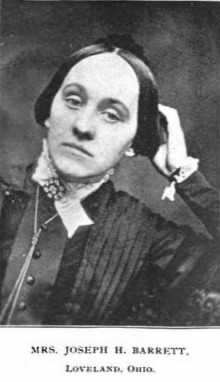
George was employed as a clerk in the office of Mr. Joseph Hartwell Barrett (1824-1910) who was the Commissioner of the Pension Bureau in Washington D. C. in 1863. The Evening Post (New York) described Barrett as one of “the few bold, radical and consistent anti-slavery men at the head of bureaus in Washington.” Barrett grew up in Windsor county, Vermont, and graduated from Middlebury College (Vermont) in 1845. He entered the printing and publishing business and by 1860 he was living and working at his trade in Cincinnati. He is best known for having written a biographical sketch on Abraham Lincoln when he was running for President in 1860 and when Lincoln was elected, he was rewarded with the patronage job. Barrett was married to Harriet Whiting Lowell in 1853 so Hilton and Barrett would have been brothers-in-law, having married the Lowell sisters.
In the years following the Civil War, George worked in the dry goods business in Chester. In 1872 he had his business in the new Fullerton Block on Main Street in Chester where he offered “ready made clothing” and groceries.
Letter 1
Washington D. C.
April 13, 1863
My dear wife Han,

Han, I am writing to you so that you may get it as soon as possible for I know (or think at least) you will miss the letter at the usual time & perhaps be disappointed if you do not get it, I did not write you & mother as usual yesterday for I was at Fortress Monroe & Norfolk all day. Mr. Barrett asked me on Friday if I dare go with him if he would get passes. I told him yes, but did not suppose he could get passes for since they commenced fighting, they issued orders not to grant them to anybody. Well. I thought no more of it until Saturday morning at 10 a.m. [when] he came in the room and said he was ready I dare risk it. Well, I dare and started.
We went to Baltimore, waited and went all over the city (beautiful warm day) until 5 p.m., then went on board the steamer & had a beautiful ride. Had supper and went to bed at 9. Got up about 5 a.m. and looked the country over until 6:30. We had breakfast and at 7:30 landed under the guns of Fort Monroe. Went about the fort and down on the beach. Picked up a lot of shells &c. &c. (as usual). Saw the big Lincoln Gun, the largest one ever made. We stayed about till 11 a.m. then took steamer (government transport) down to Norfolk. Went past Sewell’s Point, rip raps, Newport News, &c. as you can see by the map to Norfolk. Arrived at 12:20. Went all about town. The citizens—women and children—were leaving according to orders issued after we got there. The rebs were expected every minute—were fighting only 17 miles below all Saturday & Sunday up to 12 noon, so we went on board of boat again. 1 Saw the Monticello & Juniata (gunboats) swing out into the steam and open their port holes and point their guns on the town, ready to shell it at any moment the rebs should come in sight. It tell you, it was quite exciting. We left directly after that with a load of refugees and secesh ladies. Came on to where the Merrimack gave the Monitor battle. Saw the Cumberland was sunk with her two masts just sticking out of the mud & water. Back to the Fortress at 3:30 p.m. All along up the Elizabeth river saw peach orchards in full bloom & the lilacs just filled the air with the sweetest odor from the land I ever smelt.
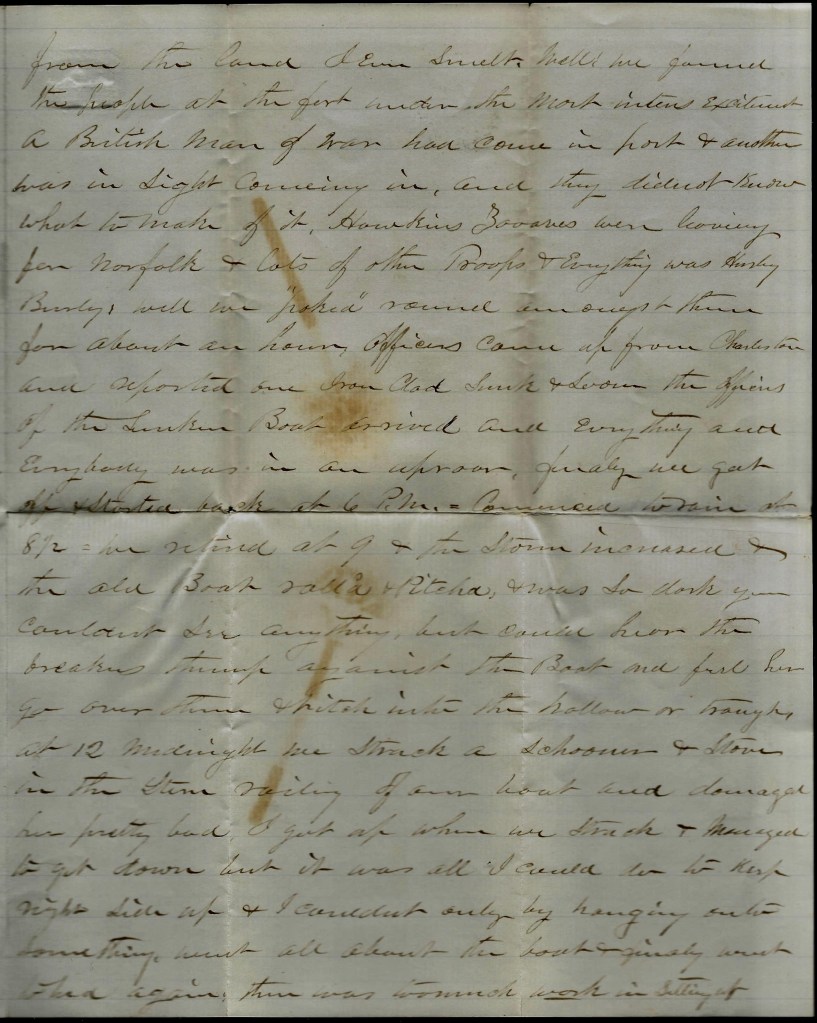
Well, we found the people of the fort under the most intense excitement. A British Man-of-War had come in port and another was in sight coming in, and they didn’t know what to make of it. Hawkins Zouaves 3 were leaving for Norfolk and lots of other troops & everything was hurly burly. Well we “poked” round amongst them for about an hour. Officers came up from Charleston and reported one ironclad sunk & soon the officers of the sunken boar arrived and everything and everybody was in an uproar. Finally we got off and started back at 6 p.m. Commenced to rain at 8:30. We retired at 9 & the storm increased & the old boat rolled and pitched & was so dark you couldn’t see anything but could hear the breakers thump against the boat and feel her go over them & pitch in the hollow or trough. At 12 midnight we struck a schooner and stove in the stern railing of our boat and damaged her pretty bad. I got up when we struck and managed to get down but it was all I could do to keep right side up and I couldn’t only by hanging onto something, Went all about the boat and finally went to bed again. There was too much work in sitting up although I wasn’t a bit sick nor Barrett either.
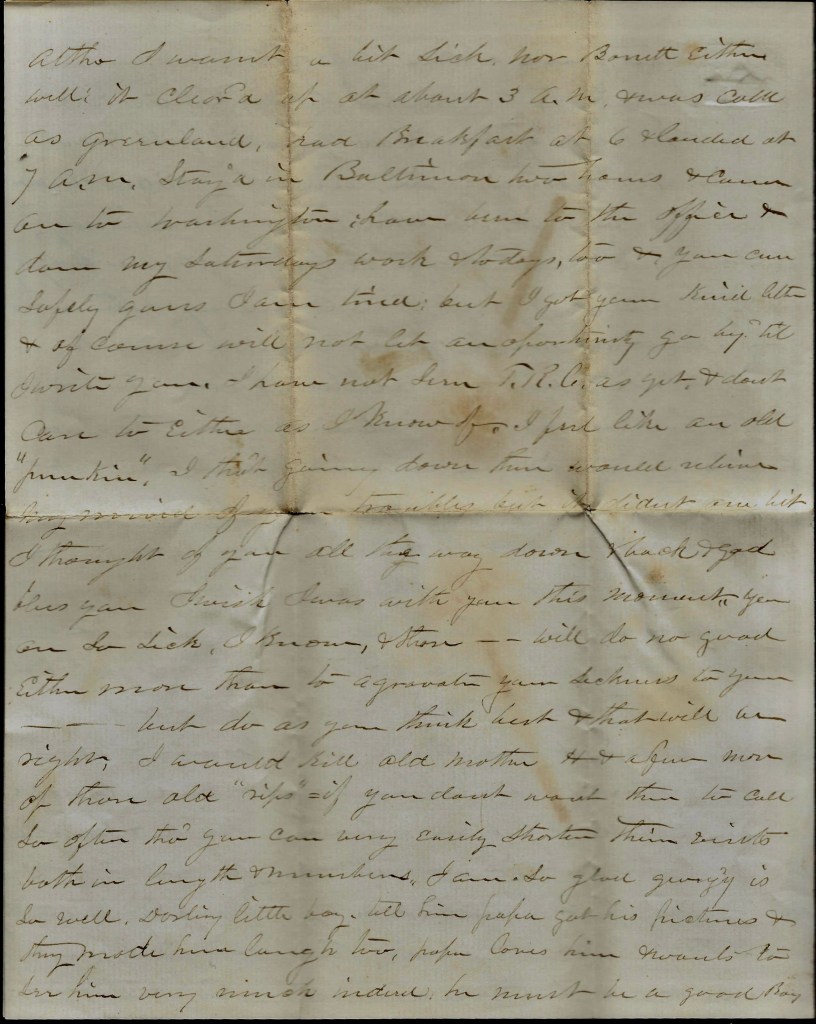
Well, it cleared up at about 3 a.m. and was calm as Greenland. Had breakfast at 6 and landed at 7 a.m. Stayed in Baltimore two hours and came on to Washington. Have been to the office and done my Saturday’s work & today’s too and you can safely guess I am tired. But I got your kind letter and of course will not let an opportunity go by till I write you. I have not seen R. R. C. as yet & don’t care to either as I know of. I feel liker an old “punkin.” I thought going down there would relieve my mind of your troubles but it didn’t one bit. I thought of you all the way down & back & God bless you, I wish I was with you this moment. You are so sick, I know, & those —– —- will do no good either more than to aggravate your sickness to your —- —- but do as you think best and that will be right. I would kill Old Mother H. and a few more of those old “rips” = if you don’t want them to call so often though you can very easily shorten their visits both in length and numbers. I am so glad Georgie is so well. Darling little boy, tell him papa got his pictures & they made him laugh too. Papa loves him & wants to see him very much indeed. He must be a good boy.
I want to write you lots more but I han’t got strength & am so sleepy I can hardly keep my eyes open & “spose” I must write Mother or there will be an “orfull” howl. So I will bid you goodbye for now & write you again & send some papers tomorrow. With much love for you, — George
1 The excitement in Norfolk was due to Gen. Longstreet’s investment of Suffolk in April 1863.
2 The two British ships anchored in Hampton Rodes were the Vesuvius and Petrel. There was speculation that the Brits were there as part of a plot to recapture Norfolk that was being threatened by land by Longstreet’s men.
3 The 9th New York Volunteers (“Hawkins Zouaves” ) were ordered from Falmouth, Virginia, to Norfolk where they remained until May 1863.


Letter 2
Washington D. C.
June 3rd 1863
My blessed wife,
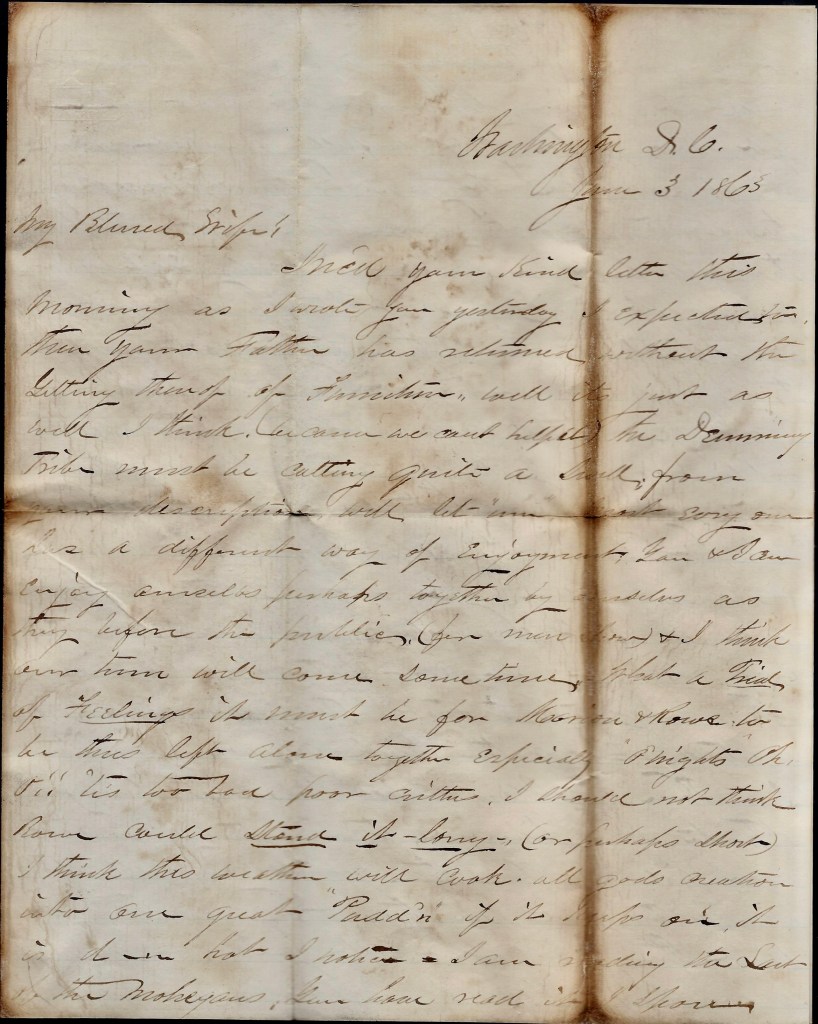
I received your kind letter this morning. As I wrote you yesterday, I expected then your Father has returned without the [ ]. Well, it’s just as well, I think (because we can’t help it). The Demming tribe must be cutting quite a [ ] from your description. Well, let [ ] has a different way of enjoyment. You & I can enjoy ourselves perhaps together by ourselves as they before the public and I think our turn will come some time. What a trial of feelings it must be for Marion & Rowe to be thus left alone together especially o’nights. Oh, oh tis too bad poor critters. I should not think Rowe could stand it long (or perhaps short).
I think this weather will cook all God’s creation into one great “Pudd’n” if it keeps on. It is damn hot, I notice. I am reading the Last of the Mohicans. You have read it, I suppose. It is quite interesting to me as I never read it before.
This town is not taken yet, 1 but people get awfully frightened and at Alexandria they are today barricading the streets expecting an attack through the lines. That place you know is only eight miles from here. If we get “tuck” all right. I would like to have them try it once. Perhaps they wouldn’t get in.
Mrs. “Comish” called the carriage & she and Mrs. Duvall went out to the Soldier’s Home yesterday evening. She is getting quite gay since the Comish has been absent. From the late order just issued, no person can go out of the city limits now on foot, horseback, or in carriages without being searched. So our little Mrs. Comish was subjected to that little inconvenience.
I rather think my bringing the Long Tom Spy Glass to bear upon the ladies opposite has silenced their Battery of Flirtation as I did not see them yesterday at all. That was pretty good on them & I guess they will mind their “Biz” now. Do you hear anything more about Henry’s drinking? I have not heard from him since I came back either by letter or paper or anybody but Fitch. I have the B. F. Times regularly from the office. I should like to go home very well as you say, but I think I shall stay here for the present if I can possibly stand it. You know you are and have so exposed yourself very much opposed to my going into troth [?] again or making an investment in the hotel and Mother too is very anxious that I should remain in Chester son on the whole, I think, unless sickness should call me home, I shall stay through the month of July. At least ’tis true I would like to be with my family & be at Chester, but can stay here a while I guess. How does the little Hiffins? He is happy I hope. He has got quite a notion of stooping over and if he is not checked and made to stand straight, he will grow up round shouldered & have the consumption. I don’t think you can too strongly impress that upon his mind—to stand straight. Poor little fellow. I do want to see him very much indeed. Kiss him for me & tell his papa gives him and thinks of him very much. He must be good too and mind Mama till papa comes home and then we will have grand times.
Saw Abel Putnam here yesterday. The [ ] said Tom Clark was well and doing well. Hope he will continue so….
With much love for you, my own little wife. Goodbye, – George
1 The “scare” was over the advance of Lee’s army that was once again making a push toward and beyond the Potomac River without a clear understanding of which way he was headed.


 Spared & Shared 23