
The following letter was written by Byron Densmore Paddock (1833-1920), the son Henry Paddock, Jr. (1791-1854) and Silence Hard (1800-1850). He wrote the letter to Harriet A. Crippen (1839-1903) with whom he would marry on 27 December 1865.
Byron enlisted in the 1st Michigan Light Artillery Regiment, Battery F, at Coldwater, Michigan, in October 1861. He was formally mustered into the Union Army on January 9, 1862, and served with the regiment until receiving his discharge on April 6, 1865. Paddock was promoted to quartermaster sergeant, lieutenant, and captain during the course of his service.
[Note: This letter is the property of Michigan’s Military Heritage Museum and was transcribed and published on Spared & Shared by express consent.]
TRANSCRIPTION
Bowling Green, Kentucky
March 22nd 1863
Dear Hattie,
It is Sabbath morning and one of those bright and beautiful ones that the Sunny South is so famous for. All nature looks gay, and seems striving to make me for get that this once happy country is now involved in a civil war. But I have only to listen and can hear the beating of the drums at guard mounting. Have only to look around me and can see the tents of the soldiers scattered in all directions.
Out yonder a few hundred yards from out in front of my camp is that of the 25th Michigan [Infantry]. 1 In one place I can see a squad of them playing ball. In another wrestling and jumping seems to be the order of the day. Then half a dozen or more are lying and sitting upon the ground enjoying the bright sunshine. But yonder in another part of the camp a different scene is being enacted. A hearse bearing the remains of a deceased soldier is moving along proceeded by a band with muffled drums and followed by a squad of soldiers with their guns reversed who are thus following their late comrade to his last resting place. Thus numbers are buried and soon forgotten by all save some dear ones at home.
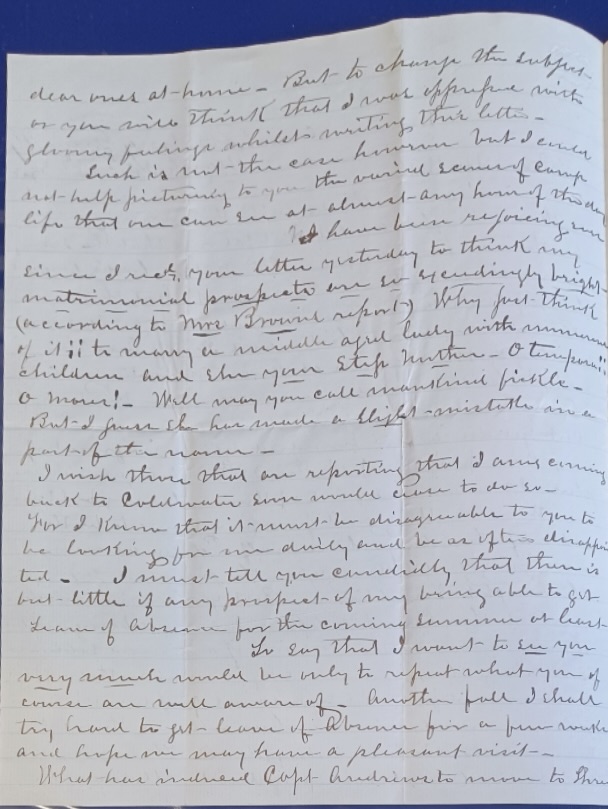
But to change the subject or you will think that I was oppressed with gloomy feelings whilst writing this letter. Such is not the case, however, but I could not help picturing to you the varied scenes of camp life that one can see at almost any hour of the day.
I have been rejoicing ever since I received your letter yesterday to think my matrimonial prospects are so exceedingly bright (according to Mrs. Brown’s report). Why just think of it—to marry a middle aged lady with numerous children and she your step mother. O tempora!! O mores! 2 Well, may you call mankind fickle. But I guess she has made a slight mistake in a part of the name.
I wish those that are reporting that I am coming back to Coldwater soon would cease to do so, for I know that it must be disagreeable to you to be looking for me daily and be as often disappointed. I must tell you candidly that there is but little if any prospect of my being able to get leave of absence for the coming summer at least.
To say that I want to see you very much would be only to repeat what you of course are well aware of. Another fall I shall try hard to get leave of absence for a few weeks and hope we may have a pleasant visit.
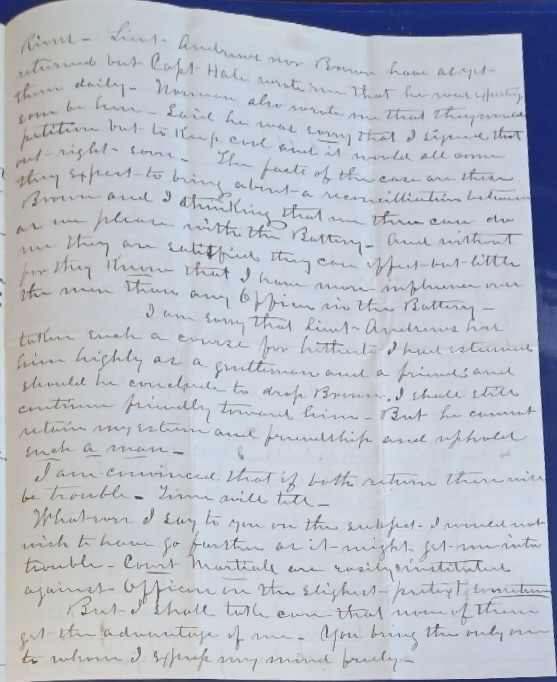
What has induced Capt. Andrews to move to Three Rivers? Lieut. Andrews nor Brown have as yet returned but Capt. Hale wrote me that he was expecting them daily. Norman also wrote me that they would come here. Said he was sorry that I signed that petition but to keep cool and it would all come out right soon. The facts of the case are these. They expect to bring about a reconciliation between Brown and I thinking that we three can do as we please with the Battery. And without me they are satisfied they can effect but little for they know that I have more influence over the men than any officer in the Battery.
I am sorry that Lieut. Andrews has taken such a course for hitherto I had esteemed him highly as a gentleman and a friend and should he conclude to drop Brown, I shall still continue friendly toward him. But he cannot return my esteem and friendship and uphold such a man.
I am convined that if both return there will be trouble. Time will tell.
Whatever I say to you on the subject I would not wish to have go farther as it might get me into trouble. Court martials are easily instituted against officers in the slightest pretext sometimes. But I shall take care that none of them get the advantage of me—you being the only one to whom I express my mind freely.
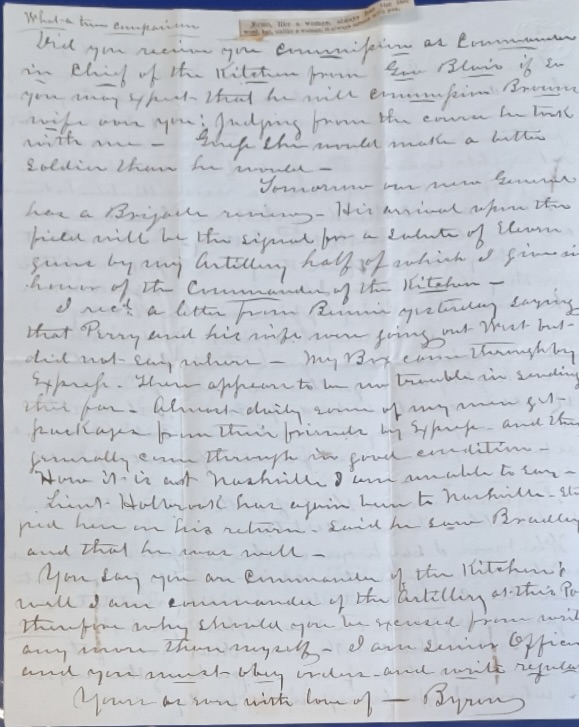
Did you receive your commission as commander in chief of the kitchen from Gov. Blair. If so, you may expect that he will commission Brown’s wife over you, judging from the course he took with me. Guess the world would make a better soldier than he would.
Tomorrow our new General has a Brigade Review. His arrival upon the field will be the signal for a salute of eleven guns by my artillery, half of which I give in honor of the commander of the kitchen.
I received a letter from Bennie yesterday saying that Perry and his wife were going out West but did not say where. My box came through by express. There appears to be no trouble in sending that far. Almost daily some of my men get packages from their friends by express and they generally come through in good condition. How is it at Nashville, I am unable to say. Lieut. Holbrook has again been to Nashville. Stopped here on his return. Said he saw Bradley and that he was well.
You say you are commander of the kitchen? Well I am commander of the artillery at this post. Therefore, why should you be excused from writing any more than myself? I am Senior Officer and you must obey orders and write regularly. Yours as ever with love of—Byron
1 The 25th Michigan Infantry was posted at Bowling Green, Kentucky from 8 January 1863 to 26 March 1863.
2 O tempora, o mores is a Latin phrase that translates literally as “Oh the times! Oh the customs!” first recorded to have been spoken by Cicero.

 Spared & Shared 23