

The following letter was written by Enos Ayres Axtell (1843-1906), the son of Timothy Clark Axtell (1796-1869) and Rachel DeBow (1808-1888) of Nassau county, New York. Axtell entered the service in April 1861 as a private in the “14th Brooklyn,” a State militia united that was later designated the 84th New York Infantry. He was later promoted to a corporal. He also served in the Navy for three years as an Engineer. At the battle of Fall’s Church in 1861 he was on the skirmish line that ran across a yard where a Southern home had just been wrecked by the explosion of a shell. Axtell stopped long enough to help a 17-year-old girl who was fleeing from the home. Here a romance began, and in spite of parental opposition, it resulted in an elopement and a marriage after the close of the war. Catherine Taylor of Fairfax, Virginia (a cousin of Zachary Taylor) and Enos’ dramatic battlefield meeting and romance furnished the basis for Marie Correlli’s “A Romance of Two Worlds.” The couple lived in Kansas City for 35 years and Enos became an influential Republican Ward Leader. He was killed by a street car in front of his own home in Kansas City on April 5, 1906. Catherine died in Kansas City in March 1925.
But the story of Axtell’s life doesn’t end there, according to the Regimental history, he was taken prisoner on 1 July 1863 as his regiment retreated through the town of Gettysburg. He was caught with a number of his comrades in a “high-walled yard” but before capture, he tore the guidon he was carrying from its pole and wound it around his leg inside of his stocking so that it would not be taken, and kept it on his person during his 6-month stay at Belle Isle prison in Richmond. [Axtell’s story can be found in “The History of the Fighting Fourteenth” with a section called “The Guidon in Prison and Enos A. Axtell“, page 198]
Once Axtell’s enlistment ran out in 1864—not long after the following letter was written—he joined the Navy and served as a 3rd class Ships Engineer on a number of steamers. By 1870 he and Katie were living in Kansas City.
This letter and Axtell’s image (a period clear ambrotype copy of a tintype of him in his uniform) surfaced at a Riverside, California, flea market a short while ago, along with some late 19th Century tintypes and letters from a James R. Oldham. Oldham married Enos and Katie Axtell’s daughter, Amelia Elizabeth Axtell, in 1909 at Katie’s home in Kansas City, then moved to Whittier California later in the century. Amelia passed away in 1943, James lived until 1965.
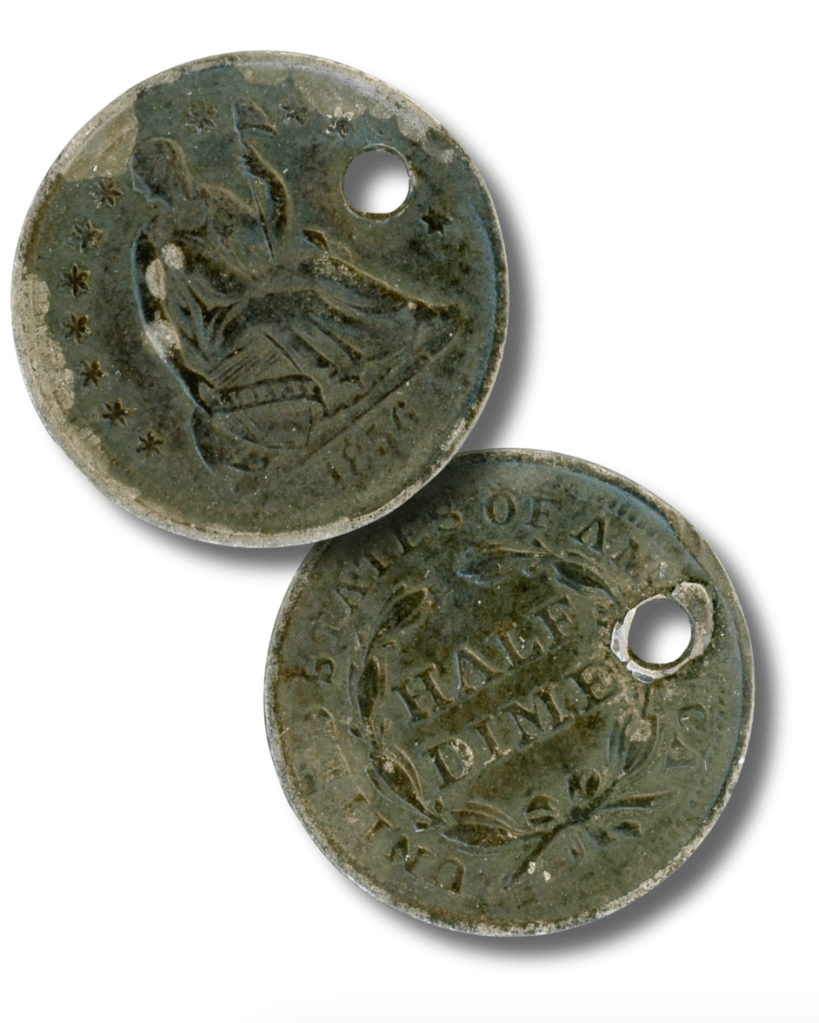
In addition to the 1864 letter, there are two letters from 1882—one of which speaks of his plans to go and see bank robber Frank James in prison—and an 1856 Seated Liberty half dime Enos or Katie might have worn as a pendant.
Of the men Axtell mentions in his March 1864 letter home, “John Cook” is likely “John E. Cook,” Co. D; “John Brown” is “John C. Brown,” Co. D, and William Smith is “William W. Smith,” Co. D who was later WIA at Spotsylvania Court House. They all appear to have transferred to the 5th New York Veteran Infantry except Axtell, who was discharged and went into the Navy.
This letter and the other items mentioned are from the collection of Charles Joyce who gave his consent to have it transcribed and published on Spared & Shared. He informs me that the grouping is available for trade or sale if any readers are interested in it.
Transcription
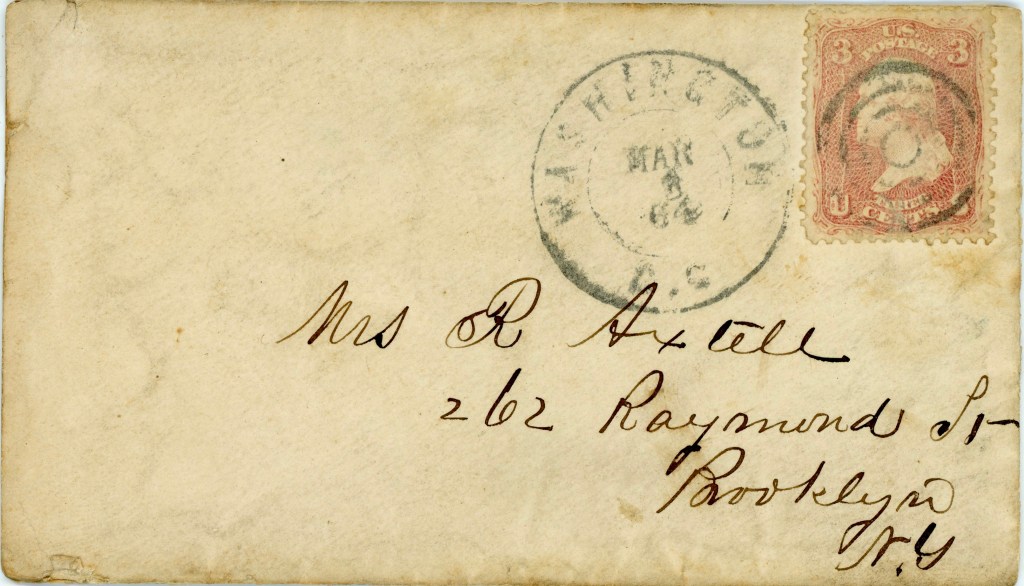
Headquarters 14th Regt. N. Y. S. M., Culpeper, Va.
Sunday morning, March 6th 1864
Dear Mother,
Two months and seventeen day. Oh dear, it seems a long time ahead, but not near so long as three years. Well, I am endeavoring to worry it out to the best of my ability. What a day it will be to the citizens of Brooklyn and also what a day it will be to the scums of (B) the demoralized scum.
I received a letter from John Brown am pleased to hear he has been to see you. Also that he is having a good time. I sent him a recommend for a commission approved by the Captain and Colonel. I hope he may be successful in procuring it. I am sure I have done all in my poor power to assist him. He is a good boy in camp or on the Field of Action. He is also a friend of mine for whom I would do almost anything. Tell the girls to handle him careful.
I was a little surprised to hear of Tillie’s wedding coming off so soon. I would dearly love to be there but as the thing now stands, I am to consume nearly 80 loaves of bread, several barrels of pork, and other articles too numerous to mention before I can again visit home. But as you see as I can not be present, at least I trust it will pass off pleasant. She has my best wishes. By the time you get this, she will be in a home of her own. Mother, you are too well aware of the past for me to say anything but for Tillie’s sake, and in fact for the future happiness of the family. Let it pass. We will all look forward to I hope a brighter and more happy life. I hope everything hereafter will pass off smooth. Hannah spoke of Mrs. Brown thinking I would reenlist. Although I think a great deal of Johnny yet, I will not reenlist just for the very reasons. I will not break my promise to you all. Tell Hannah if I am not mistaken I have my senses yet.
I have nothing to say concerning your not answering my letters. I see you have as usual been on an errand of what shall I call it. I am sorry that he—Mr. Ely, although I was not acquainted with him, is dead. I have been expecting to hear from you. I also want you to send me one of those cards as I want it for a special purpose. I am going to send in a few days a parcel to you and by all means, don’t let anyone take it. Keep it for me as I value it very highly. The field glass was found here in town and in all probability it was the property of some Confederate officer. But I don’t value it so much for that as I do for its real value. The revolver is also valued by me at $40. Keep them where they will be safe. Wm. Smith will bring them on, he having reenlisted.
The day is beautiful. I never heard of such weather before in March. I have no news to write—only there are flying rumors as to Kilpatrick’s whereabouts. He has gone somewhere, that is certain, and I bet the Rebels will find him when he strikes a blow.
Remember me to all my friends, Hattie, and Mary Bennett. I guess I will not mention names as you may tell the parties and there I would be in a fix. I mean Hattie and Mary’s brother. My love to all the folks with much love to you. I remain your son, — Enos A. Axtell
John Cook has arrived. He gave me the letter. I am pleased to hear you are all well. John feels sick since he has come back.


 Spared & Shared 23
I wish in todays world people still wrote such beautiful letters. I miss the letter writing. I wasn’t all that good at it but I tried. I use to transcribe census and things and learned to read the old cursive, my granddaughter has to learn to read the new cursive! lol She says printing is better as most people write illegibly.
LikeLike