
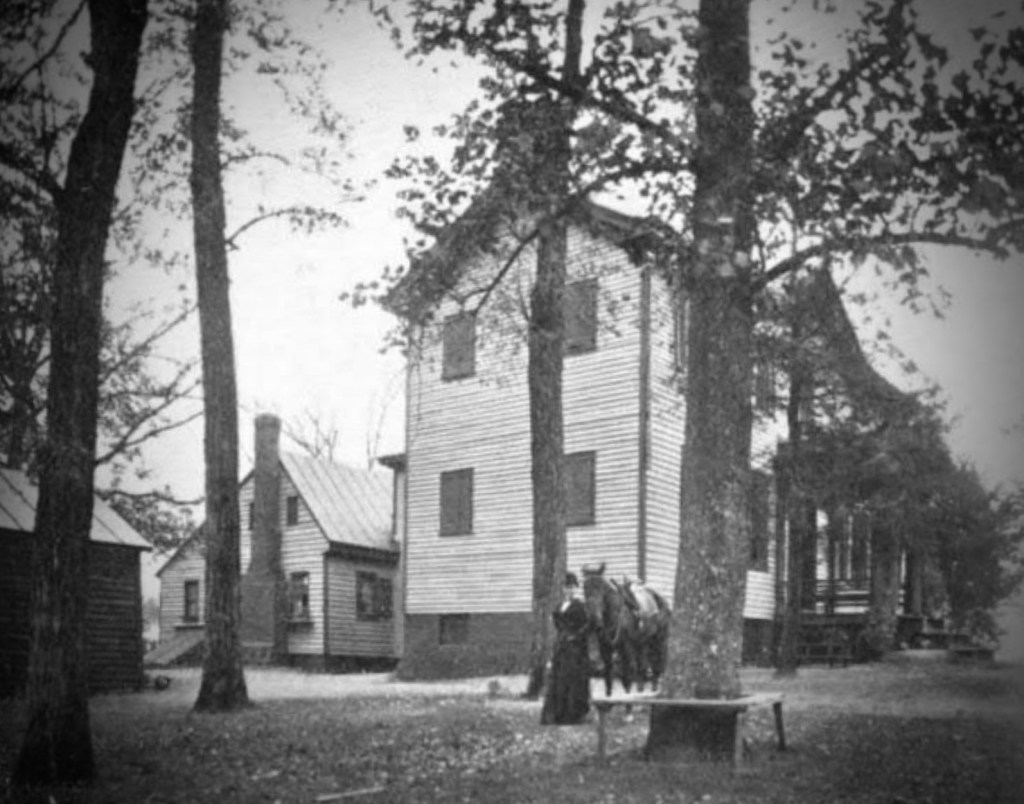
The following interesting letter was written by William T. Early (1817-1874), the son of Joab B. Early (1792-1845) and Betsy Thompson (1792-18xx) of Fredericksburg Parish, Virginia. William was a well-educated lawyer, politician, and owner of the Pen Park plantation of 410 acres near Charlottesville on the Rivanna river. The slave schedules of 1860 inform us that he was the owner of 36 slaves. At the time this letter was written in November 1860, he was serving as the mayor of Charlottesville.
From William’s letter, we learn that he considered the results of the 1860 Presidential election ruinous, believing that it would only lead to secession and the destruction of the Union. William’s political leanings were with the Whigs until the Republican Party emerged, strengthened by the anti-slavery extremists of the party. Though he hated to see the Union dissolved, he makes it clear in the letter that “my destiny is with the South, come what may.” Indeed, he remained in Virginia during the Civil War and in the summer of 1864 served as the captain of Co. A, 1st Battalion Virginia Reserves in the trenches near Chaffin’s Farm near Richmond. The Daily Progress July 1, 1902 issue listed Capt. W. T. Early among the Confederate Soldiers interred in Maplewood Cemetery.
Apparently William did his best to bind up the wounds of the Nation after the war. In a post-war article he was quoted as saying, “The sentiment of the people throughout this region is one of entire submission to the result of the contest. Slavery is universally regarded as extinct, and there is a general and absolute acquiescence in its fate. Indeed, may people rather rejoice at this result, as it cuts the Gordian knot of a vexed question, which morally, socially, and politically, like Banquo’s ghost, appeared before us everywhere, and frightened us from our propriety, and which swallowed up every other question, as Aaron’s rod swallowed up all other rods. Of course, at first, there will be much disorganization of labor, but not so much as anticipated, and the result will be that the negro will make a very good laborer, and will take his proper place in the social scale, or he will go elsewhere, which is probably his fate. There is no spirit of further resistance…disunionists are now perfectly satisfied with the experiment made.” [27 September 1865, The New Hampshire Patriot & Gazette.]
William wrote the letter to Septimus (“Sep”) Douglass Cabaniss (1815-1889), the son of Charles Cabaniss (1773-1825) and his wife Lucy Ingram (1775-1827), who moved from Lunenberg County, VA to Madison County, AL in 1810. In his early years, Septimus was educated at Green Academy in Huntsville, AL. He attended the University of Virginia between 1832-1835, and returned to Huntsville to read law with a local attorney. He passed the Alabama Bar in 1838 and practiced law, primarily dealing with estates, in Huntsville until his death. Septimus served the Confederacy as a member of the Alabama State Legislature from 1861-63 and a Colonel in the Confederate Intelligence Division during the Civil War.
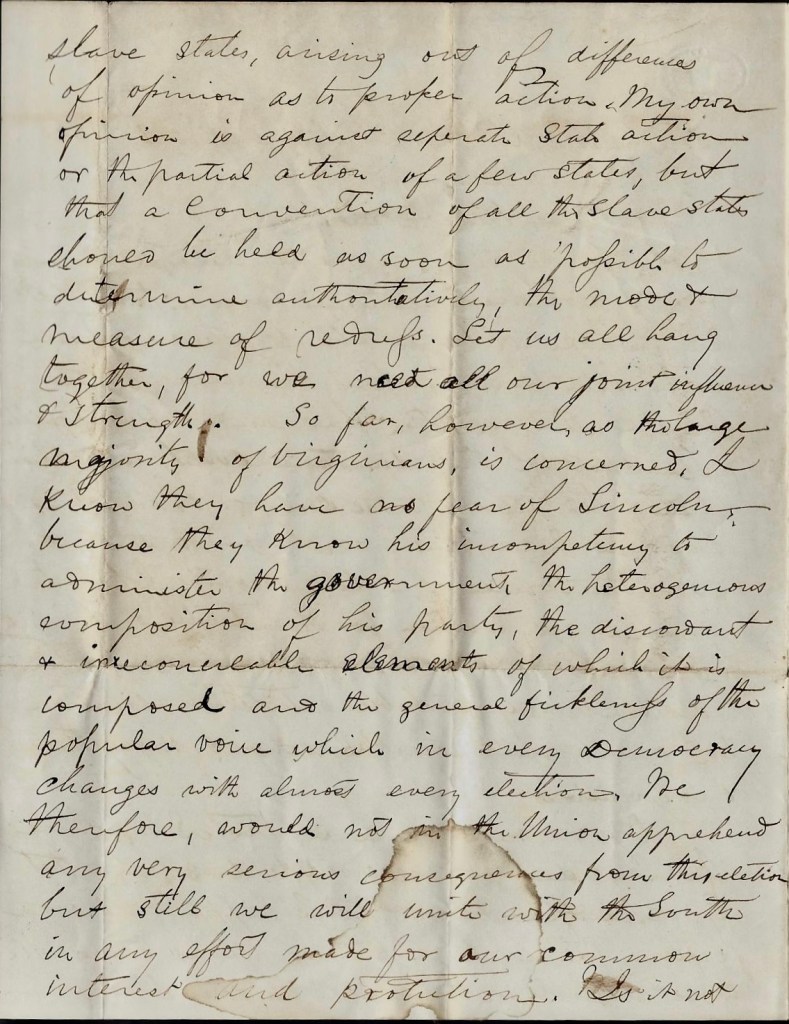
Transcription
Pen Park near Charlottesville
November 10th 1860
S. D. Cabaniss, Esqr.
My dear friend—I have delayed answering your very highly esteemed favor of the 18th ultimo in the hope of being able to attend your sale in Jackson county. But the result of the Presidential election has made it impossible. The effect of that disastrous event is to chain everybody here to the soil for the present as fast as Prometheus was chained to the rock. In the course of a few months, I hope to change my location for Huntsville, or its vicinity. So far as I can see now, I can’t discern any probable satisfactory solution of our present troubles without many throes and convulsions.
Our news here is that South Carolina has seceded—or resolved to do so—and that Georgia, Alabama, & Mississippi will soon follow. In such a state of affairs, there will be great trouble in this and the other border slave states arising out of differences of opinion as to proper action. My own opinion is against State action or the partial action of a few states, but that a Convention of all the slaves states should be held as soon as possible to determine authoritatively the mode and measure of redress. Let us all hang together, for we need all our joint influence and strength.
So far, however, as the large majority of Virginians is concerned, I know they have no fear of Lincoln because they know his incompetency to administer the government, the heterogenous composition of his party, the discordant & irreconcilable elements of which it is composed, and the general fickleness of the popular voice which in every Democracy changes with almost every election. We, therefore, would not in the Union apprehend any very serious consequences from this election, but still we will unite with the South in any effort made for our common interest and protection. Is it not therefore all important that our counsels should be joint and our action the same?
I fear that there are extremists at the South who will precipitate action and thus introduce the seeds of division at the South, whereas there should be unanimity from the Pennsylvania border to Mexico on that part of every state; and there will be, if a southern Convention is held, and firm, and at the same time, judicious measures adopted.
Before this reaches you, however, the die may be definitively cast and states committed to instant or unqualified secession. In that event, though I can see nothing but ruin ahead, my destiny is with the South come what may. With a melancholy but firm & undaunted spirit, I will take up arms against the sea of troubles trusting that Providence will vouchsafe us a happy issue out of all our afflictions. Such will be the sentiment of Eastern Virginians but I fear that west of the Blue Ridge we should have trouble for there the slaves are few and far between.
I regret much my inability to attend the sale, and indeed suppose it will be impossible to effect one in the present condition of the public mind, but hope in the course of a month or two to get some funds that will enable me to visit Alabama and invest at least enough to buy a home in or near Huntsville.
The public sentiment here is extremely feverish and excited and I would like to know your opinion of the action of Alabama. Hoping to hear from you at an early day. I am truly your friend, — W. T. Early



 Spared & Shared 23