
George Nelson Macy was born in Nantucket in 1837 to parents George Wendall and Lydia (Percival) Macy. In 1861, George was residing in Boston where he worked at a bank, when he heeded the call to join the Union Army during the U.S. Civil War. He was aged 23. He returned to Nantucket and recruited fellow islanders to join him in forming a company in the 20th Massachusetts Volunteer Infantry. In August 1861, George was commissioned 1st Lieutenant of Co. I.
Known as the “Harvard Regiment” due to the large number of Harvard graduates among its officers, the 20th Massachusetts played a major role in many of the most important battles of the Civil War, including Antietam, Fredericksburg, Chancellorsville, and Gettysburg, and was even present for General Robert E. Lee’s surrender at Appomattox. The Harvard Regiment also suffered the greatest number of casualties of any Massachusetts regiment, and ranked fifth in the Union Army overall, and became known as the “Bloody 20th.”
In one notable encounter when Union forces where routed at the Battle of Ball’s Bluff near Leesburg, Virginia, and forced to retreat across the Potomac River, George went in search for boats to ferry the wounded: “Lieutenant Macy now offered to swim over and see if there was a chance left for boats to be brought to the assistance of the others. Throwing off everything but his cap (in which he carried the miniature of his fiancé), and carrying his sword in his hand, he started and finally reached the island, but without his sword, which he was compelled to drop when nearly over. But not a boat of any kind was to be had.”
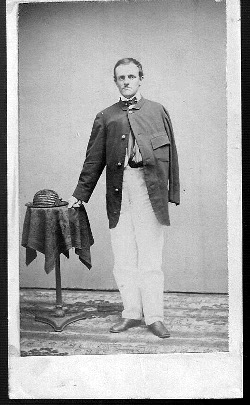
George was wounded several times even losing his left hand at the Battle of Gettysburg but returned to service. He married Mary M. Hayden in Feb 1863 (between the first Battle of Fredericksburg and the Chancellorsville Campaign).
George served as Brevet General from August 1864.
After the war, George returned to work at a bank in Boston. Despite surviving the war, he was killed in 1875 by a gunshot wound, apparently accidentally self-inflicted with his own pistol. He was aged 37.
Throughout the war, George Macy maintained a correspondence with his friend Amasa Lyman Lincoln, a Boston banker. Lincoln kept these letters, as well as a scrapbook containing clippings relating to the 20th Massachusetts and other contemporary events. After the end of the Civil War, Amasa Lincoln and his family moved to Santa Barbara, California, where they established a hotel they called the Lincoln House. Today known as the Upham Victorian Hotel & Cottage Gardens, it is the oldest continuously operating hostelry in Southern California. The George N. Macy / Amasa L. Lincoln Papers (ca. 1779-1899) are held in the UC Santa Barbara Special Collections.
At the time this letter was written the 20th Massachusetts was performing outpost duty at Edwards Ferry (four companies) and at Camp Lee (two companies), five nights a week. Camp Benton was located outside Poolesville, Maryland, on the east bank of the Potomac river, 35 miles from Washington. It was occupied at the time by both the 19th and 20th Massachusetts.
[Note: This letter is from the personal collection of Jeremiah Bowers who asked for help in identifying the author on the public website, The American Civil War on 27 May 2024.]
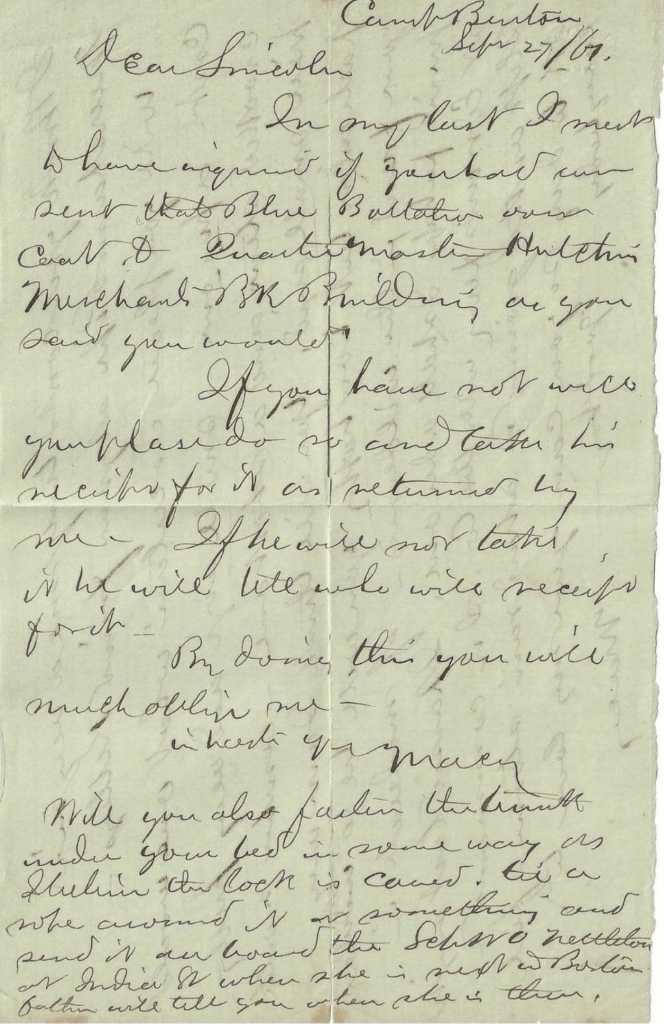
Transcription
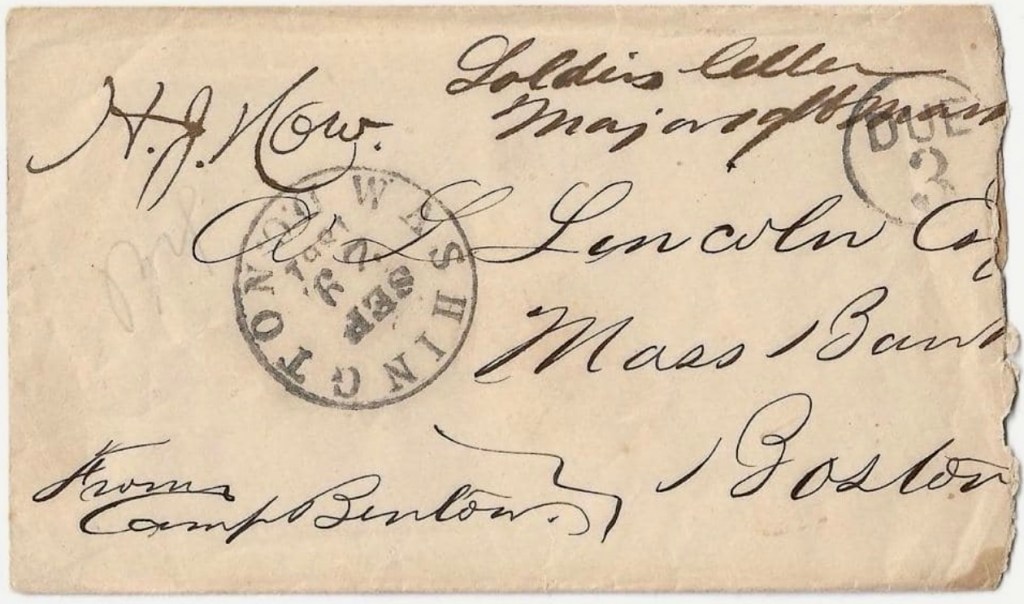
From Camp Benton
Camp Benton
September 27, 1861
Dear Lincoln
In my last I meant to have inquired if you had ever sent that Blue Battalion over coat to Quartermaster Hutchins, Merchants RR Building, as you said you would. If you have not, will you please do so and take his receipt for it as returned by me. If he will not take it, he will tell who will receipt for it. By doing this, you will much oblige me.
In haste, yours, — Macy
Will you also fasten the trunk under your bed is some way as I believe the lock is caved. Tie a rope around it or something and sent it on board the schooner Nettleboro at India St. when she is next in Boston. Father will tell you when she is there.
I think you could find me a very nice Meershaum Pipe at your friend Kelleys. Will you please ascertain what one would cost—a fine one—small size and very pretty, crooked stem and a short one–amber mouthpiece, small sized. You will think I am very particular but how happy you will be to indulge your friend in the wilderness. If moderate in price, perhaps I shall order one.
I passed last night at Edwards Ferry with the company—I in command. Slept on the ground in a hard rain storm—feel OK today. So you can give my love to everybody. Goodbye. — Macy

 Spared & Shared 23