

The following letter was written by Sgt. William W. Wright of Co. A, 44th Indiana Infantry. William was 21 years old when he enlisted in August 1861. He died in a St. Louis hospital on 2 March 1862—less than two months after this letter was penned. At the time of the 1860 US Census, William was working as a laborer on the farm of J. H. Chappell of Salem, Steuben county, Indiana.
In his letter, William describes the tramp of the 44th Indiana Infantry from Henderson to Calhoun, Kentucky—a distance of 40 miles—which took them four days due to inclement January weather. They reached Calhoun on 6 January 1862 and went into camp. They remained there until the 15th of January when they relocated to South Carrolton. In February the regiment in the battles of Fort Henry and Fort Donelson, and then later in April in the Battle of Shiloh.
To read letters by other member of the 44th Indiana Infantry published on Spared & Shared, see: Solomon Bean, Co. G, 44th Indiana (2 Letters), and Daniel Rowe, Co. H, 44th Indiana (1 Letter).
Transcription
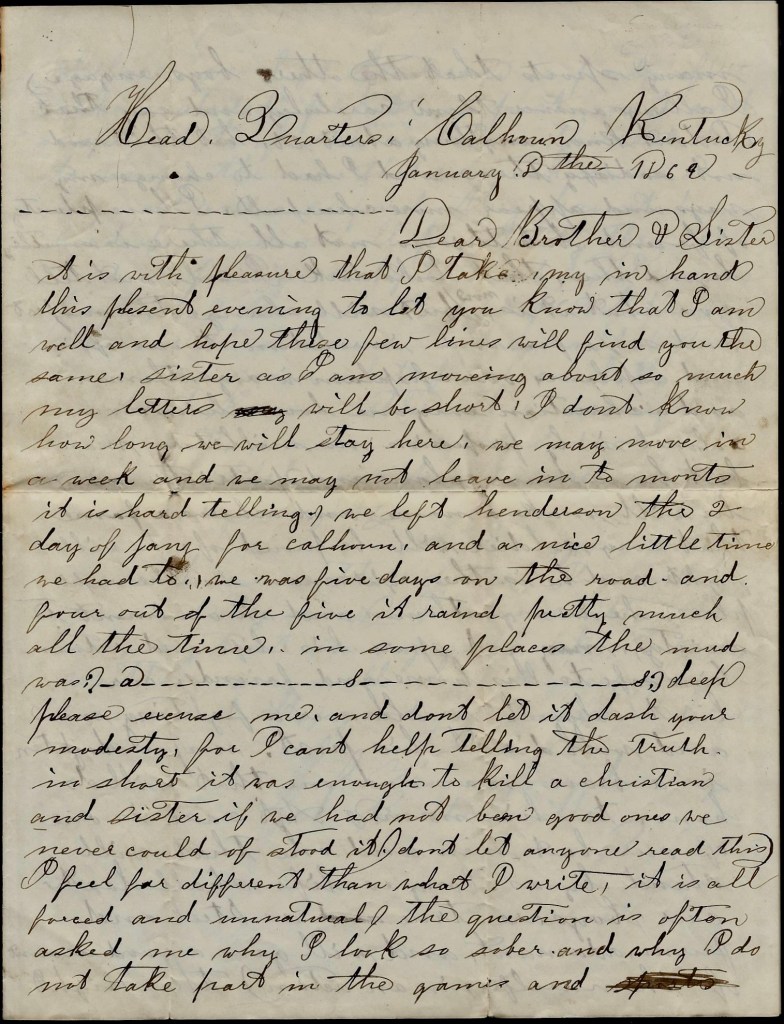
Headquarters, Calhoun, Kentucky
January 8th 1862
Dear Brother & Sister,
It is with pleasure that I take my [pen] in hand this pleasant evening to let you know that I am well and hope these few lines will find you the same. Sister, as I am moving about so much, my letters will be short. I don’t know how long we will stay here. We may move in a week and we may not leave in two months. It is hard telling.
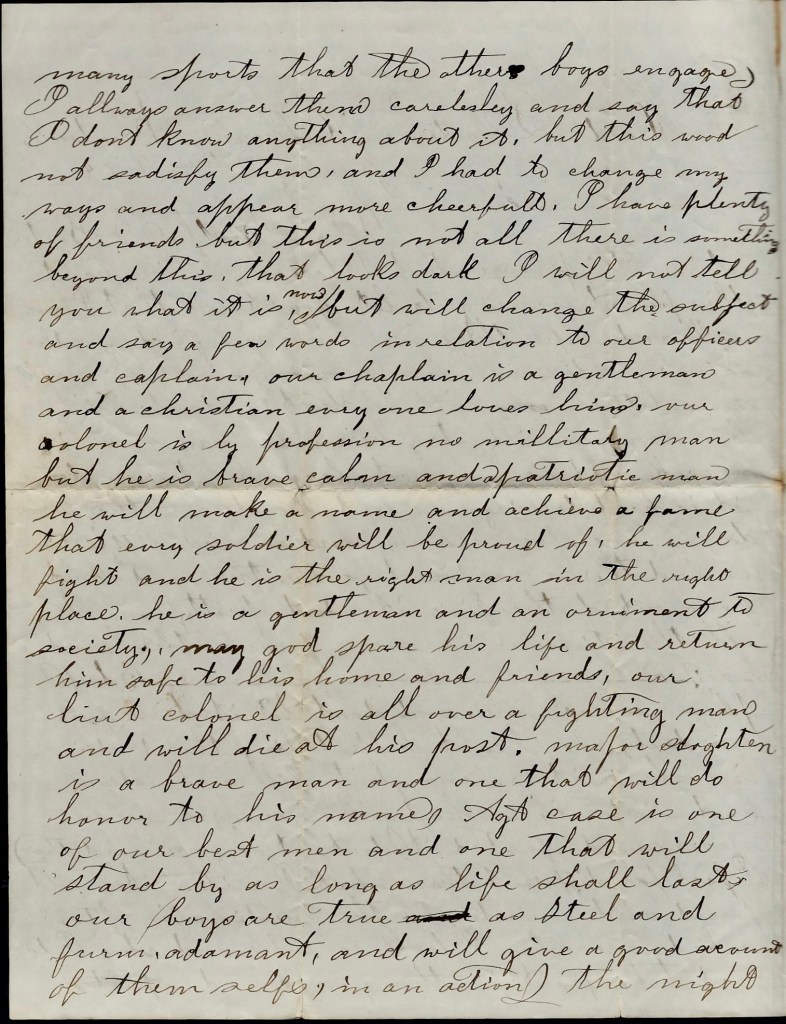
We left Henderson [Kentucky] the 2nd day of January for Calhoun and a nice little time we had too. We was five days on the road and four out of the five it rained pretty much all the time. In some places the mud was a—-s—s deep. Please excuse me and don’t let it dash your modesty for I can’t help telling the truth. In short, it was enough to kill a Christian and sister, if we had not been good ones, we never could of stood it. (Don’t let anyone read this.) I feel far different than what I write. It is all forced and unnatural. The question is often asked me why I look so sober and why I do not take part in the games and many sports that the other boys engage. I always answer them carelessly and say that I don’t know anything about it, but this would not satisfy them and I had to change my ways and appear more cheerful. I have plenty of friends, but this is not all. There is something beyond this that looks dark. I will not tell you what it is now, but will change the subject and say a few words in relation to our officers and chaplain.
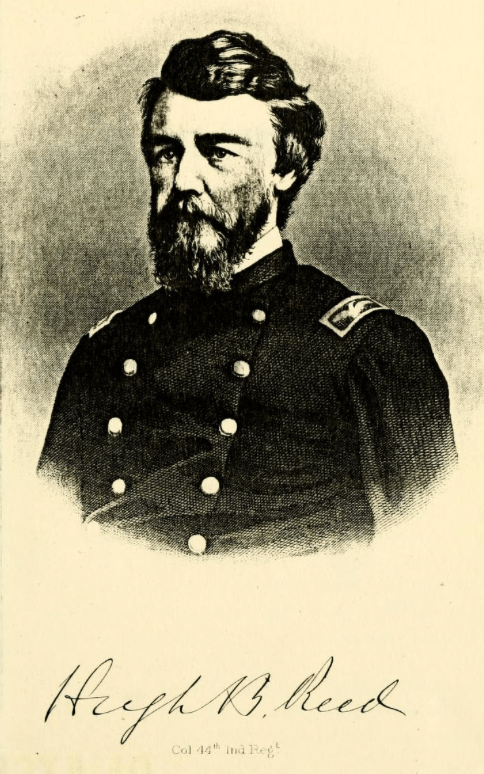
Our chaplain [G. W. Beeks] is a gentleman and a Christian. Everyone loves him. Our colonel [Hugh B. Reed] is by profession no military man but he is brave, calm, and a patriotic man. He will make a name and achieve a fame that every soldier will be proud of. He will fight and he is the right man in the right place. He is a gentleman and an ornament to society. May God spare his life and return him safe to his home and friends. Our lieutenant-colonel [Baldwin J. Crostweit] is all over a fighting man and will die at his post. Major [Sanford J] Sloughton is a brave man and one that will do honor to his name.
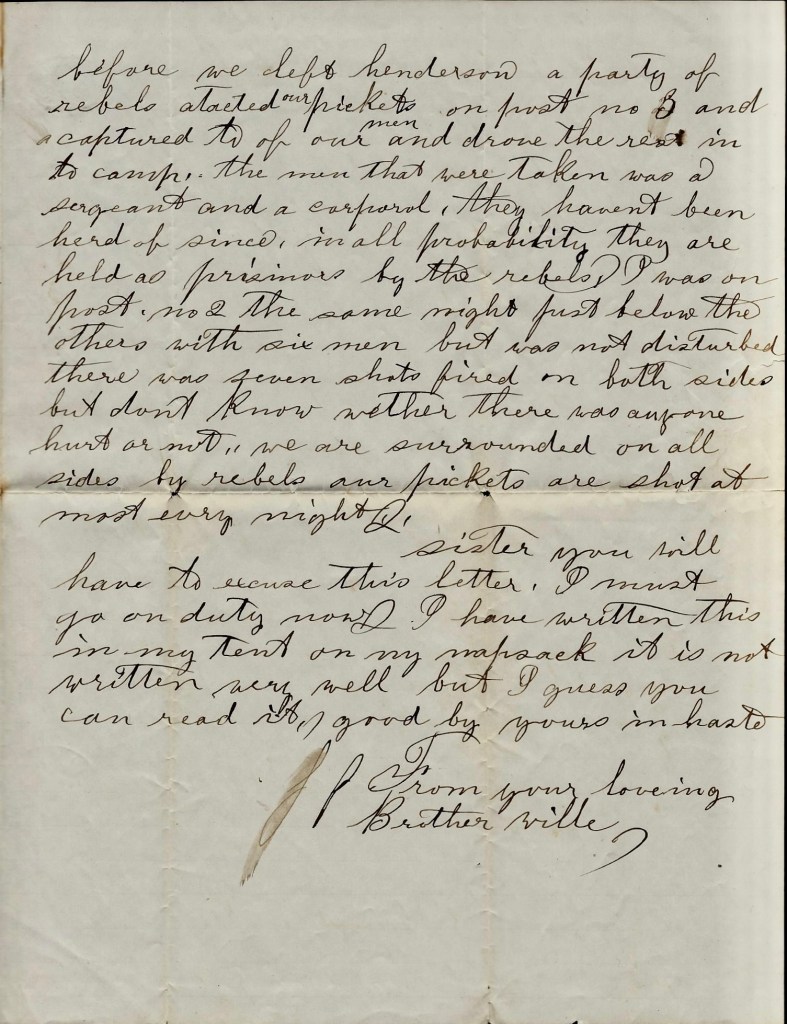
Adjutant [Charles] Case is one of our best men and one that will stand by as long as life shall last. Our boys are true as steel and firm, adamant, and will give a good account of themselves in an action. The night before we left Henderson, a party of rebels attacked our pickets on Post No. 3 and captured two of our men and drove the rest into camp. The men that were taken was a sergeant and a corporal. They haven’t been heard of since. In all probability they are held as prisoners by the rebels. I was on Post No. 2 the same night just below the others with six men but was not disturbed. There was seven shots fired on both sides but don’t know whether there was anyone hurt or not. We are surrounded on all sides by rebels. Our pickets are shot at most every night.
Sister, you will have to excuse this letter. I must go on duty now. I have written this in my tent on my knapsack. It is not written very well but I guess you can read it. Goodbye. Yours in haste, From your loving brother, — Wille
[Wm. W. Wright on reverse of letter]
 Spared & Shared 23