
This letter was written by Lt. Colonel John Payne Bull (1840-1911), the son of John Cardwell Bull (1812-1898) and Eliza Sprigg Payne (1819-1905) of Carondelet, St. Louis, Missouri. John began his service in the Confederate Army as Major of the 8th Arkansas Cavalry. He was later promoted to Lt. Colonel of Cabell’s Brigade.
In this letter, John’s appointment by Gen. Price as the Provost Marshal of the army preparing to invade Missouri in the fall of 1864 is announced. The following excerpt of Price’s 1864 Missouri Raid describes Bull’s role:
“Price remained in the vicinity of Pilot Knob until September 29. Having abandoned hope of capturing St. Louis, he headed for the Missouri capital. Jeffer- son City, where he hoped to achieve his political goals. During the first week In October, the Army of Missouri wound its way leisurely across the central part of the state. Rampaging far and wide, they captured countless small and Isolated militia garrisons, “liberated” dozens of towns, tore up track and burned bridges of the Pacific Railroad, and “exchanged” worn out horses for fresh ones.
They also looted. Price had issued strict orders against looting before the army left Pocahontas, but the practice began In the vicinity of Pilot Knob, where Price appointed Lt. Col. John P. Bull as Provost Marshal of the Army, Bull organized a 50-man provost guard for each brigade to prevent straggling and plundering, but lawlessness continued. The army’s wide dispersion. with its main column stretched out for five or six miles, made it difficult for the guards to maintain control.
Slow movement of the cumbersome wagon train gave the soldiers ample time to roam about and forage. The train, which originally consisted of about 300 wagons, soon grew to over 500 wagons, many of which were being used to carry the “fruits” of the expedition. Accompanying the train were many stragglers, described by one observer as “a rabble of deadheads.” The incompetence and indifference of many of the line officers, and the fact that much of the army consisted of unwilling conscripts, added to the slow rate of march and lack of discipline. As time went on, the more seasoned veterans began to fear that “the odious train would occasion disaster to the army.”
[Note: This letter is from the private collection of Greg Herr and was transcribed and published on Spared & Shared by express consent.]
Transcription
Union, [Missouri]
October 2, 1864
My own darling mother,
I wrote to you on yesterday from Franklin and hope you received my letter. I was slightly wounded in the knee on yesterday in the fight at Franklin and several good friends in this vicinity have promised me they would see you and assure you of the exact nature of it. It has been very painful but is now much better and I hope in a very few days I will again be able for duty. Gen. Price this morning issued a complimentary order with regard to our Brigade and appointed me Provost Marshal General of the Army of Missouri. When I left Arkansas, Willie & Nobia was both very well. I hope before many days I will be able to press my dear mother once more to my arms. Farewell. Love to all. Your affectionate son, — Johnie
[On opposite side in a different hand]
Union
October 27, 1864
Mrs. E. S. Bull,
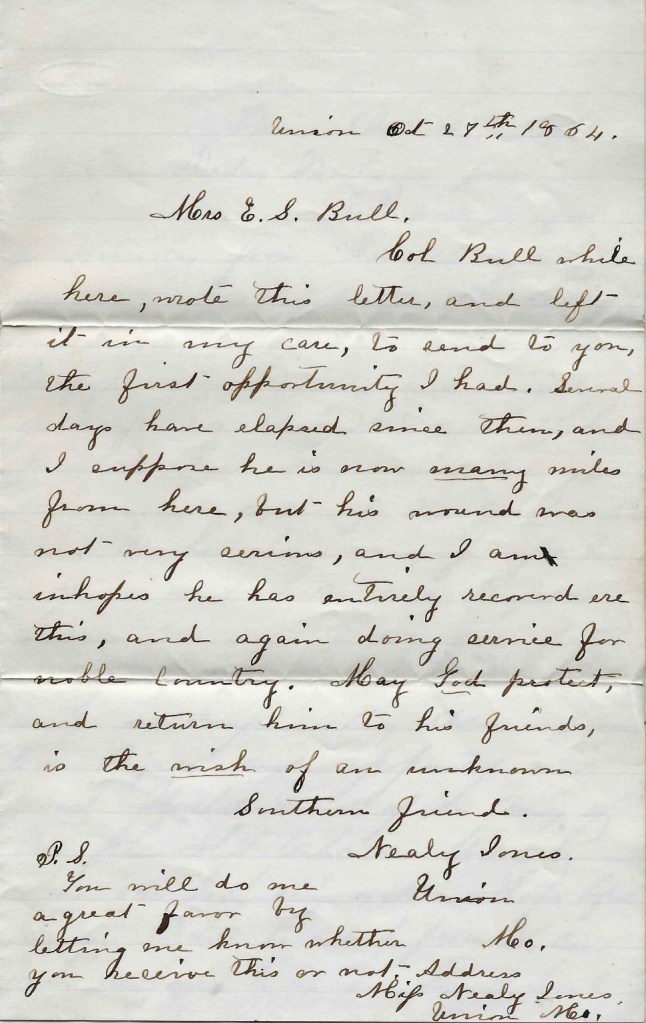
Col. Bull while here, wrote this letter and left it in my care to send to you the first opportunity I had. Several days have elapsed since then and I suppose he is now many miles from here, but his wound was not very serious and I am in hopes he has entirely recovered ere this and again doing service for noble country. May God protect and return him to his friends is the wish of an unknown Southern friend, — Nealy Jones, Union, Mo.
P. S. You will do me a great favor by letting me know whether you receive this or not. Address Miss Nealy Jones, Union, Mo.

 Spared & Shared 23