
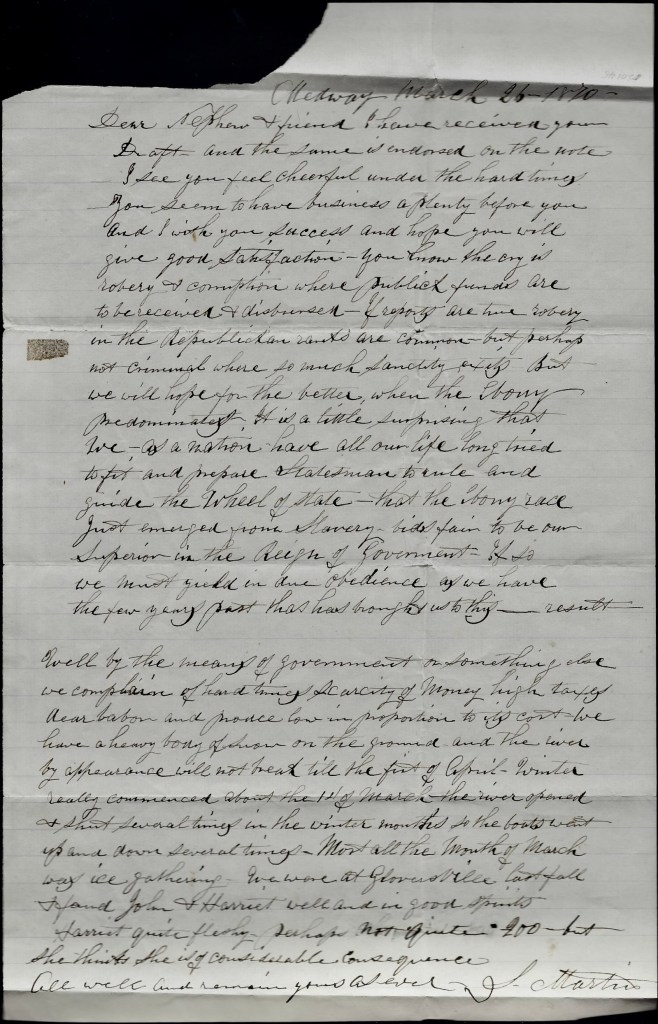
The identity of the author of this letter—whether male or female—could not be confirmed. It was datelined from Medway, Massachusetts, in late March 1870. There is no envelope with the letter to identify the addressee who we learn is the author’s “nephew and friend” and the benefactor of a note endorsed by the author. While completing this transaction, the author refers to the “radical Republican” corruption in the post-Civil War South and shares the belief that the “Ebony race” may prove better suited to govern than the Caucasian race.
Transcription
Medway [Massachusetts]
March 26, 1870
Dear Nephew & Friend,
I have received your Draft, and the same is endorsed on the Note. I see you feel cheerful under the hard times. You seem to have business a plenty before you. and I wish you success and hope you will give good satisfaction. You know the cry is robbery & corruption where public funds are to be received & dispersed. If reports are true, robbery in the Republican ranks are common—but perhaps not criminal were so much sanctity exists. But we will hope for the better when the Ebony predominates. It is a little surprising that we, as a nation, have all our life long tried to fit and prepare Statesmen to rule and guide the Wheel of State, that the Ebony race just emerged from Slavery bids fair to be our superior in the Reign of Government. If so, we must yield in due obedience as we have the few years past that has brought us to this result.
Well, by the means of government or something else, we complain of hard things, scarcity of money, high taxes, dear labor and produce low in proportion to its cost. We have a heavy body of snow on the ground and the [Charles] river by appearance will not break till the first of April. Winter really commenced about the 14 of March. The river opened & shut several times in the winter months so the boats went up and down several times. Most all the month of March was ice gathering. We were at Gloversville [N. Y.] last fall & found John & Harriett 1 well and in good spirits. Harriet quite fleshy. Perhaps not quite 200 but she thinks she is of considerable consequence.
All well and remain yours as ever, — S. Martin
1 Probably John Stewart (1834-1889) and his wife, Harriet (Macdougall) Stewart (1839-1901) of Gloversville, Fulton county, New York. John Stewart was a merchant.
 Spared & Shared 23