
The following letter was written by a government clerk working in Washington D. C. in June 1864. He signed his name “M. J. Farrell” and I have found only one Michael J. Ferrell, Jr. working in Washington, taxed and employed in the District of Columbia in 1864. He mentions a wife in his letter so he must have married between the time he wrote the letter and when he registered for the draft in June 1863, wherein he described himself as 26 years old, single, a native of Ohio, and a clerk in the Treasury Department.
Michael addressed the letter to “Hannegan” and though I can’t be certain of his identity, my hunch is that it was Sellman Key Hannegan, the son of US Senator from Indiana Edward Allen Hannegan (1807-1859) and Margaret Chambers Duncan (1796-1852). In 1861, at the outbreak of the rebellion, Sellman was serving as Deputy City Clerk in Terre Haute, Indiana. In 1863, Sellman was yet unmarried and living in Indianapolis. After his marriage in 1868 he worked in Washington D. C. in the US Documents Rooms.
From the content of the letter, it is revealed that the correspondents were previously acquainted in the College Hill area, a suburb of Cincinnati. It is possible that both individuals were students at the Farmer’s College, a topic that is extensively discussed in the letter. The college was experiencing significant financial constraints at the time and was at risk of failing.

Mathias C. Williams in College Hill (lower right), as it would have appeared prior to being
consumed in a fire in 1864. At left is the Farmers’ College and Cary’s Academy Buildings.
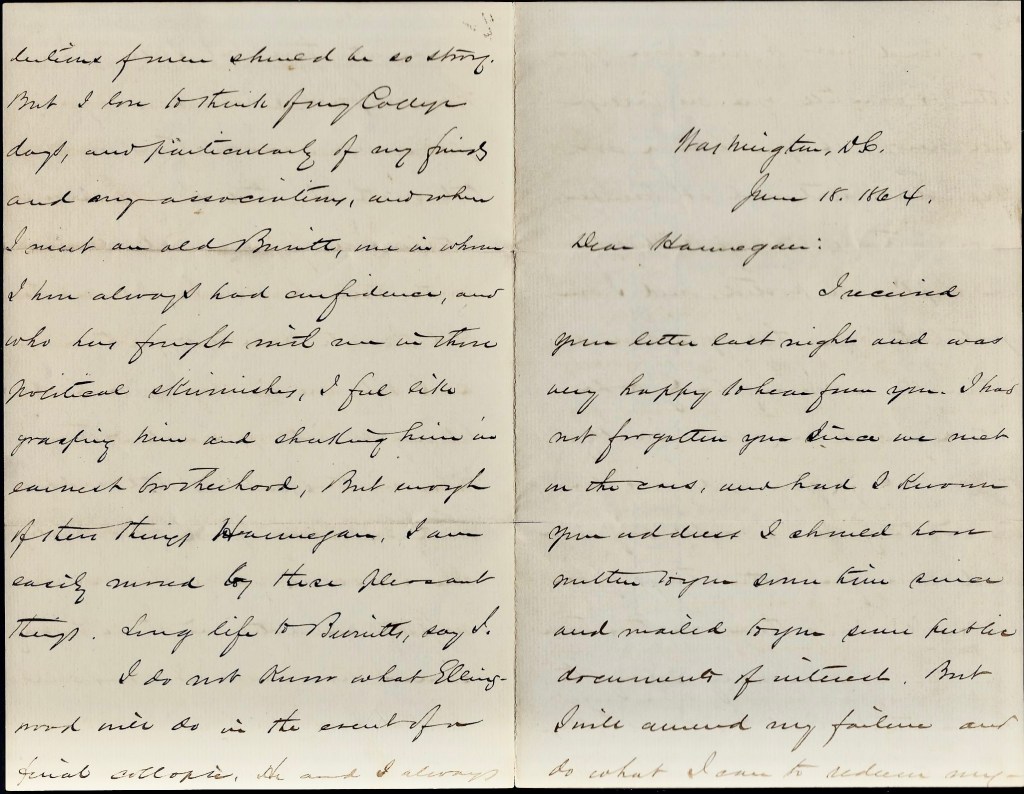
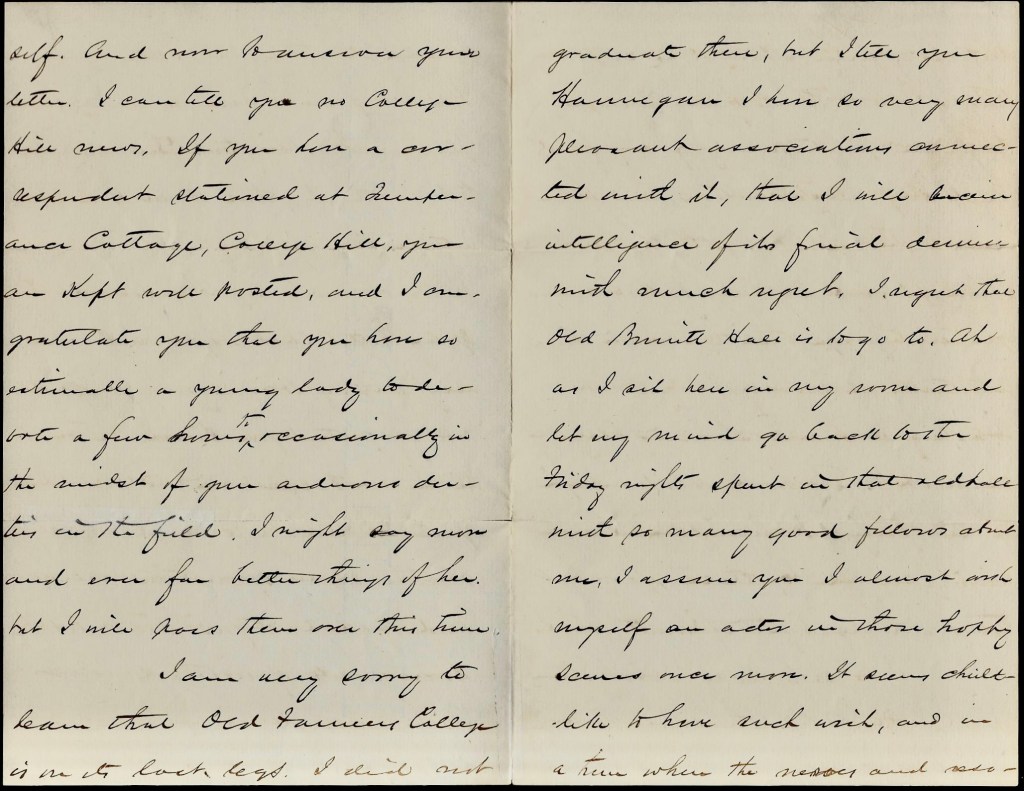
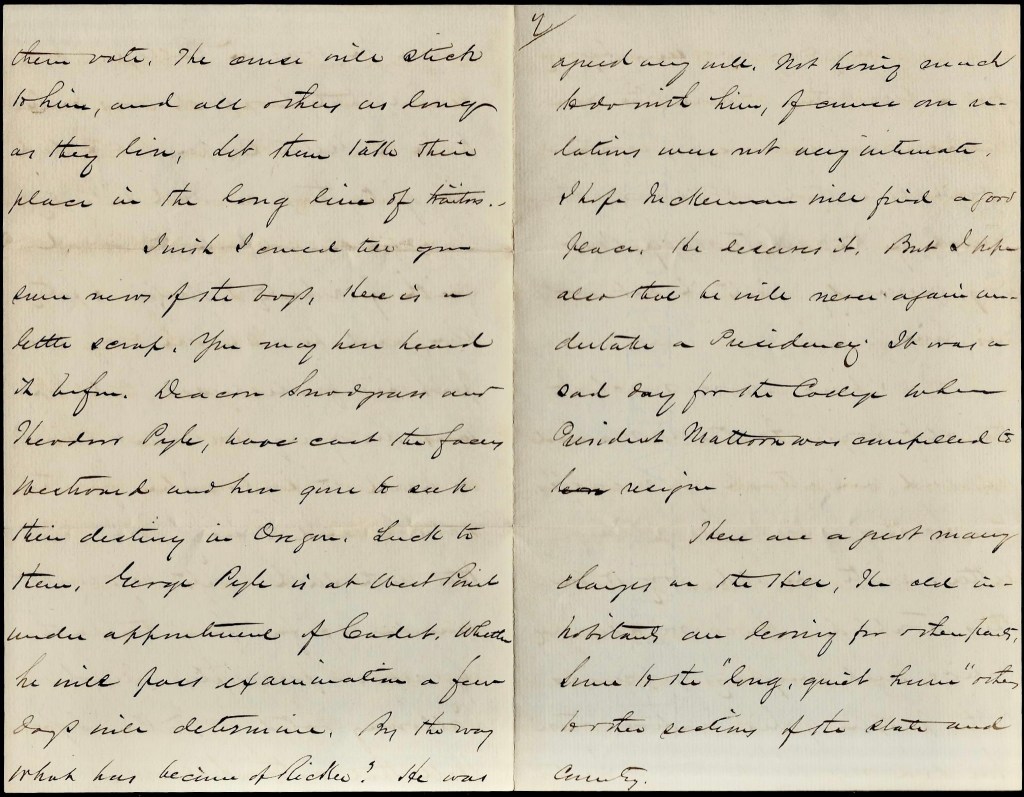
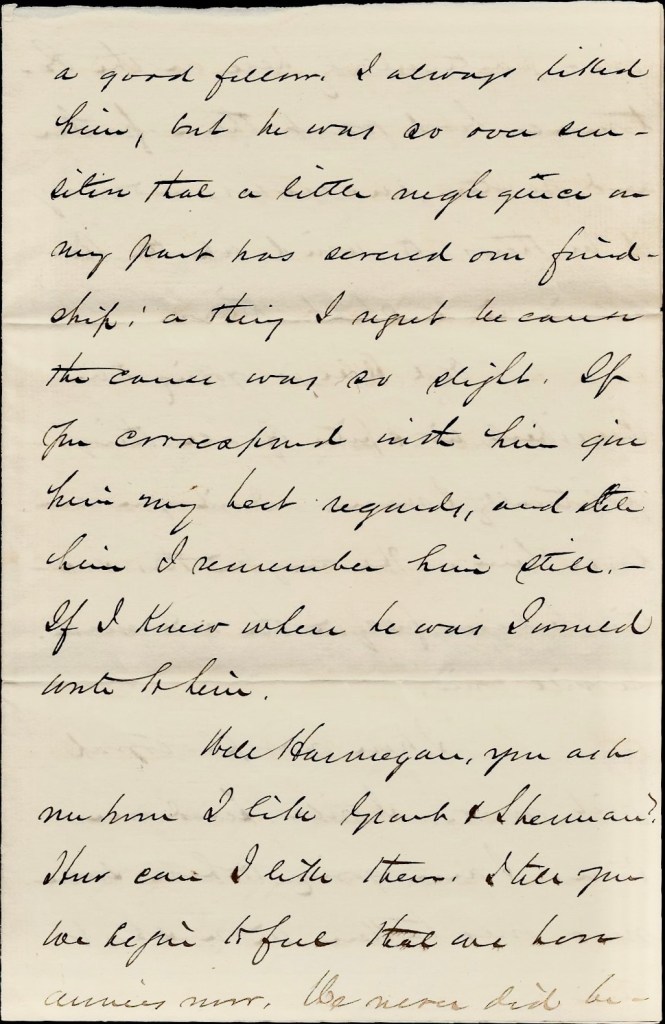
Transcription
Washington D. C.
June 18, 1864
Dear Hannegan,
I received your letter last night and was very happy to hear from you. I had not forgotten you since we met in the cars, and had I known your address, I should have written to you some time since and mailed to you some public documents of interest. but I will amend my failure and do what I can to redeem myself and now to answer your letter. I can tell you no College Hill news. If you have a correspondent stationed at Temperance Cottage, 1 College Hill, you are kept well posted, and I congratulate you that you have so estimable a young lady to devote a few hours to occasionally in the midst of your arduous duties in the field. I might say more adn even far better things of her but I will pass them over this time.
I am very sorry to learn that Old Farmer’s College is on its last legs. I did not graduate there, but I tell you, Hannegan, I have so very many pleasant associations connected with it that I will receive intelligence of its final demise with much regret. I regret that Old B___tt Hall is to go to. Oh, as I sit here in my rom and let my mind go back to the Friday nights spent in that old hall with so many good fellows about me, I assure you I almost wish myself an actor in those happy scenes once more. It seems child-like to have such a wish, and in a time when the news and resolutions of men should be so strong. But I love to think of my College days and particularly of my friends and my associations, and when I meet an Old Bu__tt, one in whom I have always had confidence, and who has fought with me in those political skirmishes, I feel like grasping him and shaking him in earnest brotherhood. But enough of these things. Hennegan, I am easily moved by these pleasant things. Long life to Bunitts, say I.
I do not know what [J. P.] Ellingwood 2 will do in the event of a final collapse. He and I always agreed very well. Not having much to do with him, of course our relations were not very intimate. I hope McKennan will find a good place. He deserves it. But I hope also that he will never again undertake a Presidency. It was a sad day for the College when President [Charles N.] Mattoon was compelled to resign. 3
There are a great many changes on the Hill. The old inhabitants are leaving for other parts, some to the “long, quiet home, others to other sections for the state and country. Pres. [Henry Noble] Day has been trying for a long time to have the commencement exercises [of the Ohio Female College] private. I don’t like that. It savors too much of the aristocracy. But Day generally fights it out on his line.
I don’t know much of the old boys. Fenton is married. He had an attack of measles this Spring, but he is getting better. Quite an old boy to be thus troubled. He is measuring calico and weighing groceries to the people of his native town. You did not think that of Fenton when he was in college.
I have heard that [William Jay] Coppock 4 was inclined to be a little Copper, but I did not quite think he had entirely lost his hold on the good faith of Liberty & Union. I pity him and we will one day repent his foolishness. Old Cop was one of my warmest friends. He used to subscribe for the Tribune and Evening Post. Alas, that was with such lights he should wander so far from the path of honest principles.
And Calloway voted for Vallandigham? Well that astonished me. Let them vote. The curse will stick to him, and all others as long as they live. Let them take their places in the long line of traitors.
I wish I could tell you some news of the boys. Here is a little scrap. You may have heard it before. Deacon [W. J. ] Snodgrass and Theodore [W.] Pyle have [ ] and have gone to seek their destiny in Oregon. Luck to them. George [W.] Pyle 5 is at West Point under appointment of Cadet. Whether he will pass examination a few days will determine. By the way, what has become of Ricker? He was a good fellow. I always liked him, but he was so over sensitive that a little negligence on my part has severed our friendship—a thing I regret because the cause was so slight. If you correspond with him, give him my best regards and tell him I remember him still. If I knew where he was, I would write to him.
Well, Hannegan, you ask me how I like Grant & Sherman? How can I [not] like them. I tell you, we begin to feel that we have armies now. We never did before—particularly here on the Potomac. God grant them further and greater success, and may it be theirs to wind up the Rebellion in a short time.
Old Abe is going to be President in spite of all things—politically I mean. Don’t you endorse him? The army in this section believes fully in the old man. He will win.
I have no photograph just now. I will send one soon. I am going to have some new ones taken in a short time.
Well, Hannegan, I must draw this letter to a close. I am quite busy now-a-days. Hands full.
Mrs. Farrell is well. we anticipate going to Ohio in July. Do you think you will be up about that time? I would like to see you. I wish we could have a meeting of the Old Br__tt’s.
Goodbye, Hannegan. The Lord of battles shield in these days of struggle. write soon. Truly yours, — M. J. Farrell
1 “Temperance Cottage” was the name of the home of Gen. Samuel Fenton Cary on College Hill in Cincinnati.
2 Probably J. P. Ellingwood who became the Principal of the Preparatory Department in 1857.
3 Rev. Charles. N. Mattoon, President of Farmer’s College, tendered his resignation on 11 July 1860. It was regretfully accepted on 14 August 1860.
4 Probably William Jay Coppock (1835-1912), A. M., Class of 1859—a lawyer in Cincinnati, Ohio. William had two younger brothers that fought for the preservation of the Union. William buried in an unmarked grave in Spring Grive Cemetery in Cincinnati.
5 George W. Pyle entered West Point in 1864. He was from College Hill, Ohio, and received an “at large” appointment. He graduated in 1868.


 Spared & Shared 23