
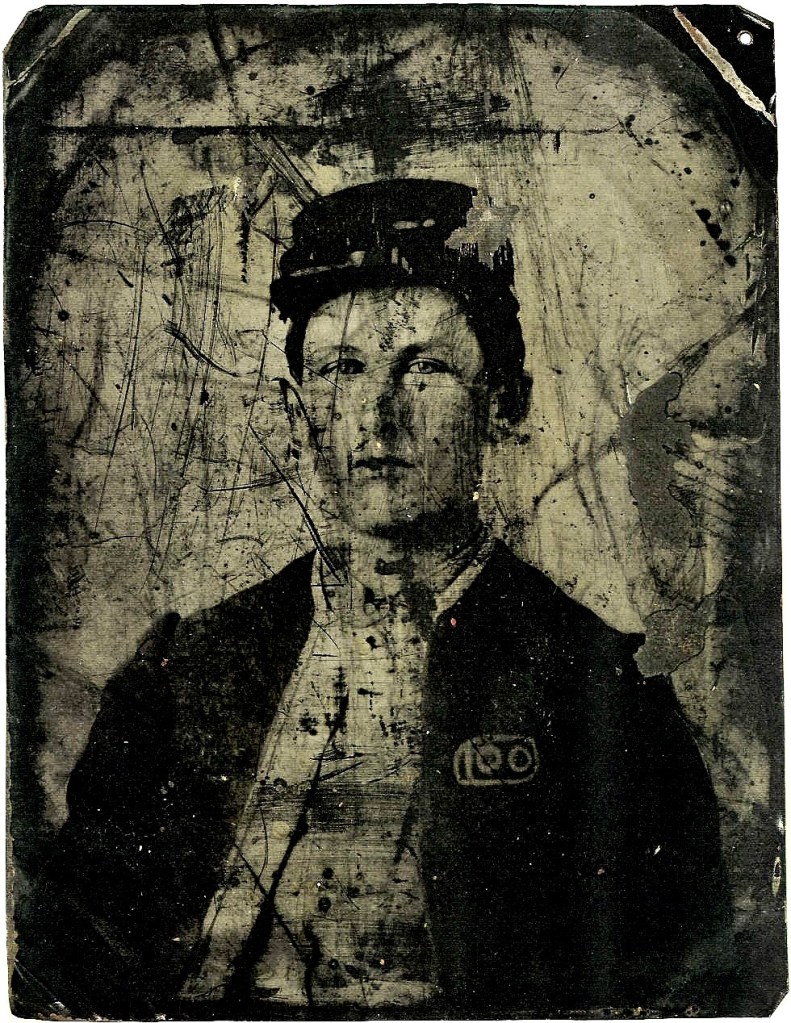
The following letters were written by Henry M. Scott (1843-1864), the son of Joseph Herbert Scott (1810-1888) and Mercy Kinsman (1811-1857) of Orland, Steuben county, Indiana. Henry mustered into Co. B, 100th Indiana Infantry in mid-August 1862. As will be seen in these letters, the regiment was organized quickly and sent to Kentucky in the event they were needed to turn back Bragg’s army threatening Louisville in the fall of 1862. Henry did not survive the war. He died at Chattanooga on 6 June 1864.
The scans of Henry’s letters were made available to me for transcription and publication on Spared & Shared by Ann Elizabeth Wilder whose ancestor, the recipent of Henry’s letters, should be credited for preserving Henry’s letters. The originals of these letters were gifted by the Wilder family to the Lilly Library at Indiana University. See Wilder mss. 1860-1868. Henry as well as other friends and relatives wrote these war letters to Edson Adelman Wilder (1845-1927) who became a hardware merchant in Orland. Two of the correspondents were Edson’s uncles: Charles Henry Wilder, the brother of his father, Orlando Wilder; and Otis M. Humphrey, his mother’s brother, who served as an army physician from Massachusetts in Virginia and Baton Rouge. The other correspondents were Charles C. Ellis, J. Monroe Haines, G.A. McKinley, and Henry M. Scott. To my knowledge, Henry’s letters have never been transcribed or made publicly available.

Letter 1

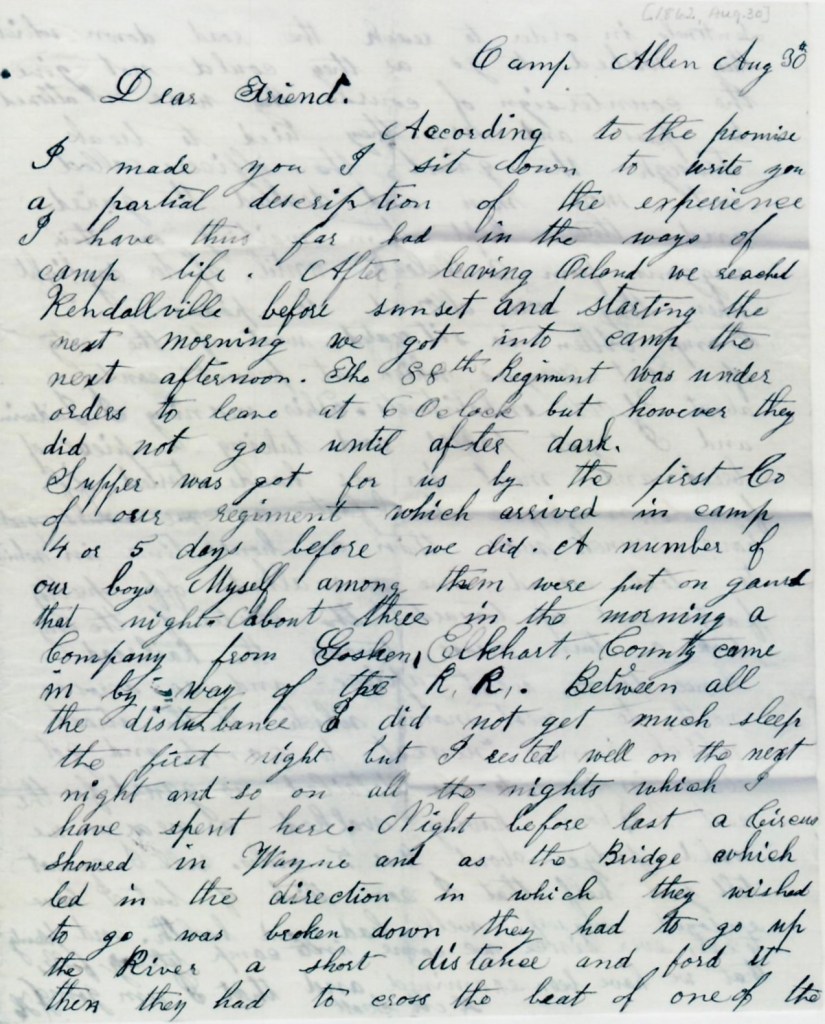
Camp Allen [Fort Wayne, Indiana]
August 30th [1862]
Dear Friend,
According to the promise I made you, I sit down to write you a partial description of the experience I have thus far had in the ways of camp life. After leaving Orland, we reached Kendallville before sunset and starting the next morning we got into camp the next afternoon. The 88th Regiment was under orders to leave at 6 o’clock but however they did not go until after dark.
Supper was got for us by the first company of our regiment which arrived in camp four or five days before we did. A number of our boys—myself among them—were put on guard that night. About three in the morning a company from Goshen, Elkhart county, came in by way of the railroad. Between all the disturbance, I did not get much sleep the first night but I rested well on the next night and so on all the nights which I have spent here.
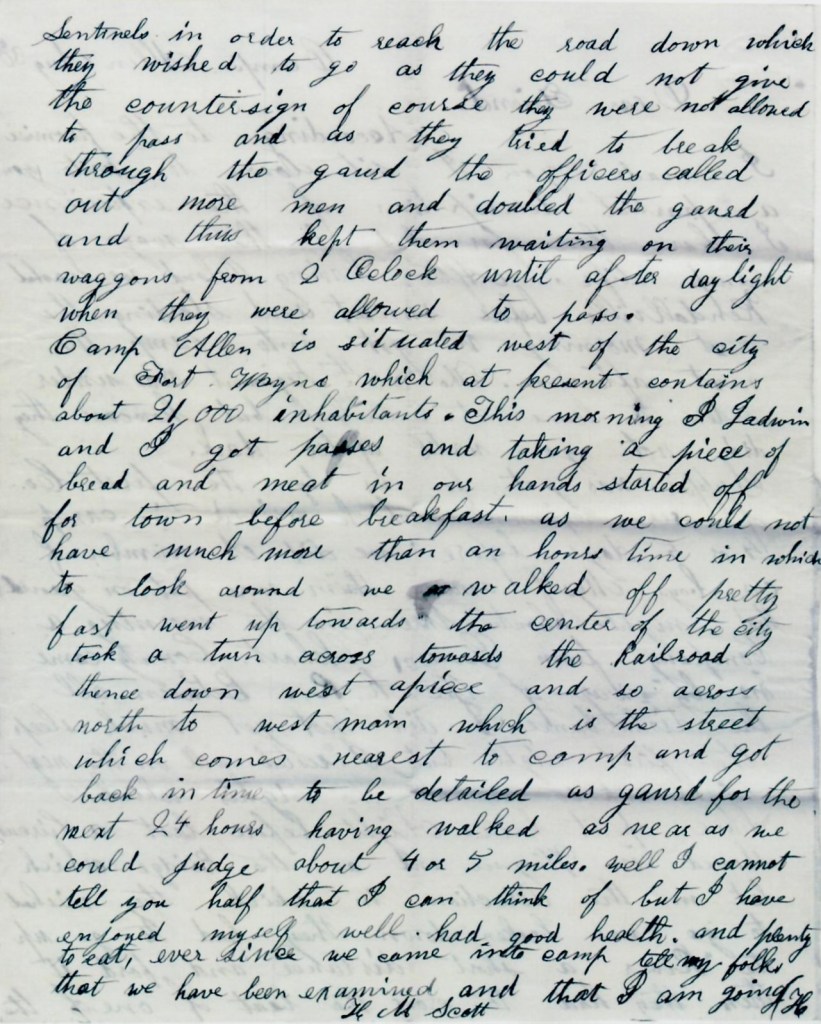
Night before last, a circus showed in Wayne and as the bridge which led in the direction in which they wished to go was broken down, they had to go up the river a short distance and ford it. Then they had to cross the beat of one of the sentinels in order to reach the road down which they wished to go. As they could not give the countersign of course, they were not allowed to pass and as they tried to break through the guard, the officers called out more men and doubled the guard and thus kept them waiting on their wagons from 2 o’clock until after daylight when they were allowed to pass.
Camp Allen is situated west of the city of Fort Wayne which at present contains about 21,000 inhabitants. This morning J[ohn] Jadwin and I got passes and taking a piece of bread and meat in our hands, started off for town before breakfast. As we could not have much more than an hour’s time in which to look around, we walked off pretty fast, went up towards the center of the city, took a turn across towards the railroad, thence down west apiece and so across north to West Main which is the street which comes nearest to camp and got back in time to be detailed as guard for the next 24 hours, having walked as near as we could judge about 4 or 5 miles.
Well, I cannot tell you half that I can think of but I have enjoyed myself well. Had good health and plenty to eat ever since we came into camp. Tell my folks that we have been examined and that I am going. — H. M. Scott
Letter 2
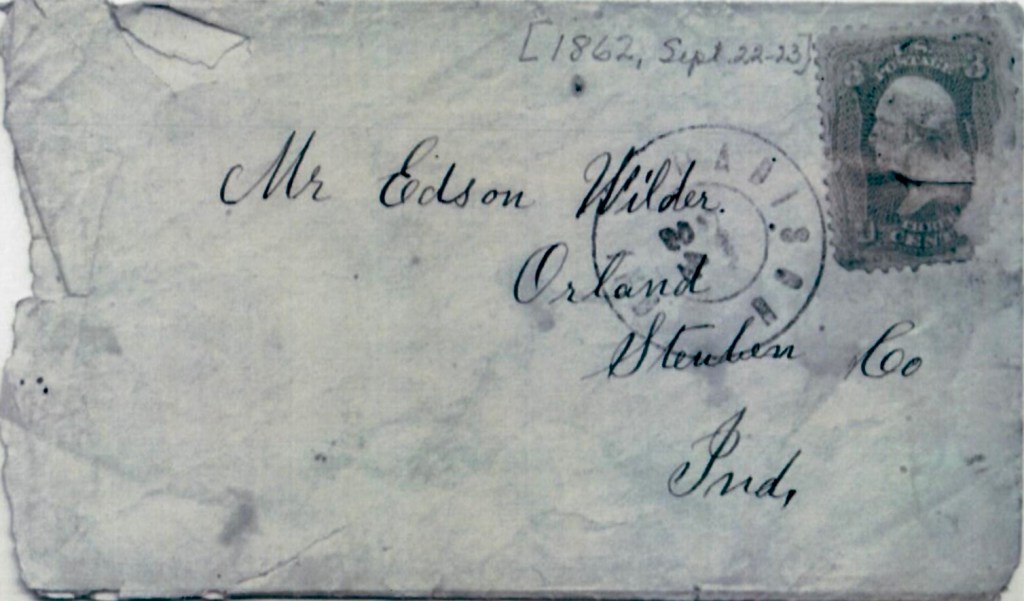
Camp Emerson [near Madison, Indiana]
September 22, 1862
Friend Ed,
I have not yet got an answer to the other letter which I wrote to you, but as I have an opportunity for writing I have come to the conclusion to give you a little more of my experience in my new line of life. As you will probably have heard ere this reaches you, we left the capital on last Wednesday morning and riding until the next morning, arrived here safely. We passed through a tract of country which seemed to consist mostly of timbered land and the latter part of it—or that which we saw by dasylight—was very rough and hilly. I did not see but one field of wheat which was up and but very few which were being plowed for the purpose of seeding and I [saw only] a single straw stack on the road. The railroad bridges were guarded some miles before arriving at this place.
The City of Madison near which we are encamped is situated on the Ohio River and contains about 12,000 inhabitants. As the river bank is so much lower than the surrounding country that the railroad passes down a grade of 6 feet to the hundred for over a mile. The road is so steep that take a common engine and lock all the wheels, it would run down into the river at a great rate. They have an engine made on purpose with cogs in a wheel made to fit a rail laid in the center of the track. The road passes through hills where it had to be dug down a hundred feet through solid rock. Altogether it was a rather droll ride.
I have had a swim in the Ohio which is here a large stream about as wide probably as from your house to the creek. At present the government is hurrying troops down from Cincinnati to Louisville for fear of an attack from Bragg. For several days past, steamer after steamer has passed down the river.
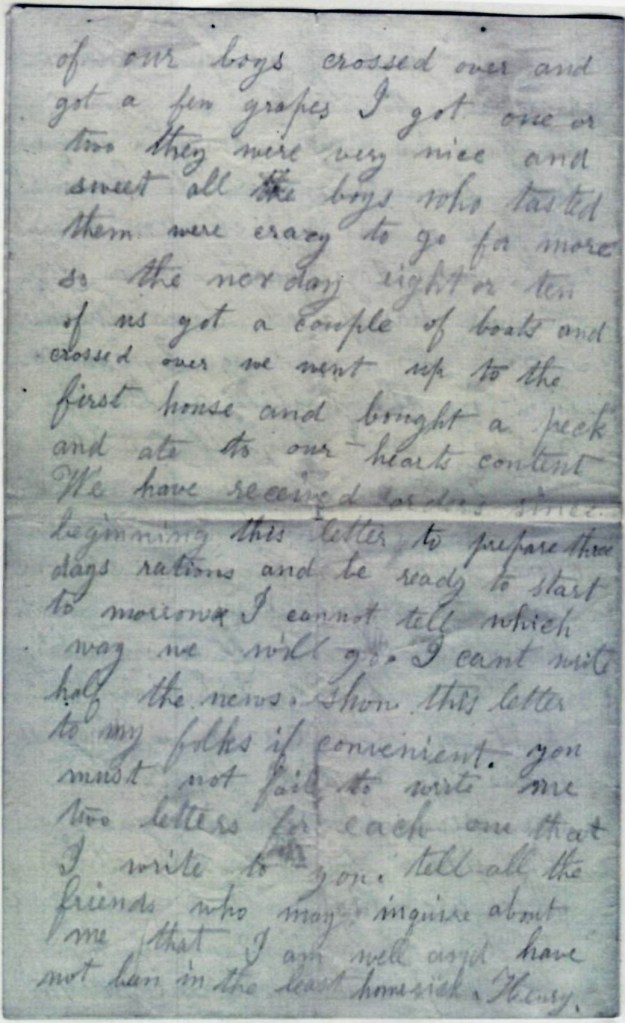
I am now writing by candlelight in the hospital as Bradley Rogers adn myself are staying with German Brown who is sick but he is getting better now. Across for camp on the Kentucky shore the ground rises in a steep hill probably half a mile long on the top of which in plain sight of the camp stands the house of a rebel colonel. There are several vineyards on the side of the hill and the vines, which are higher than a man’s head, look as if they are about knee high. Well, one night two of our boys crossed over and got a few grapes. I got one or two. They were very nice and sweet. All the boys who tasted them were crazy to go for more so the next day eight or ten of us got a couple of boats and crossed over. We went up to the first house and bought a peck and ate to our heart’s content.
We have received orders since beginning this letter to prepare three days rations and be ready to start tomorrow. I cannot tell which way we will go. I can’t write half the news. Show this letter to my folks if convenient. You must not fail to write me two letters for each one that I write to you. Tell all the friends who may inquire about me that I am well and have not been in the least homesick. — Henry
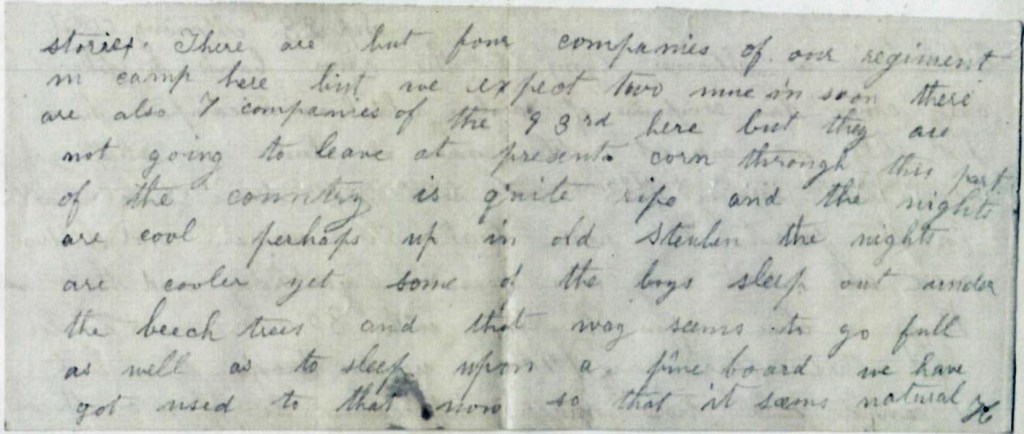
September 23rd Morning. There is a steamer lying at the river bank to take away two companies of cavalry which are encamped here but still we cannot tell when or where we shall go—some even saying that we will not leave here at all for the present. We hear that the women and children were all sent away from Louisville yesterday and that Bragg is close upon the city with 80,000 men. We also hear that there are 140,000 Union troops there but I cannot tell how much dependence to place on these stories. There are but four companies of our regiment in camp here, but we expect two more in soon. There are also 7 companies of the 93rd here but they are not going to leave at present.
Corn through this part of the country is quite ripe and the nights are cool. Perhaps up in Old Steuben the nights are cooler yet, Some of the boys sleep out under the beech trees and that way seems to go full as well as to sleep upon a pine board. We have got used to that now so that it seems natural. — H



Letter 3

[Camp near Madison, Indiana]
October 19, 1862
Friend Ed,
Although there has hardly been time for me to receive an answer to the last letter which I wrote, I have begun on this sheet as you probably have seem with a large October and stuck my fingers in it in fine style to start with.
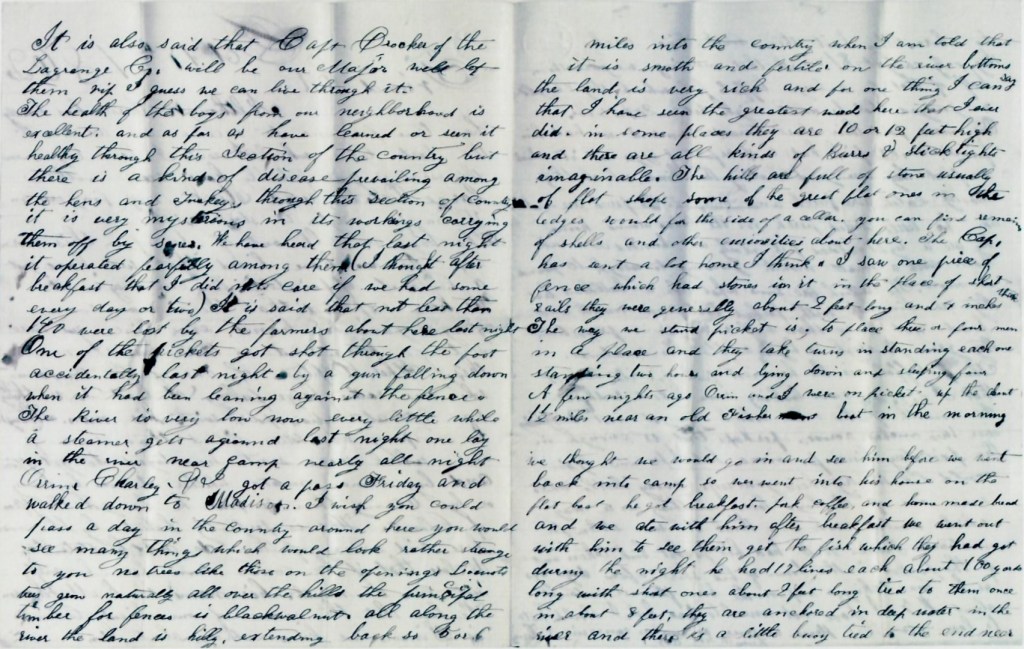
The boys are all out of temper this morning for we have heard that we have got a Colonel appointed for our regiment. We have expected that there was some gonge [?] game on hand ever since we were sent off here and so there was. I mean this. The Captain of one of the companies who was rather large feeling (at least so we thought) was left at Indianapolis with his men. Although his company was better drilled than some of those who were sent, he stayed to get office and by some means whether it was by bribery or by teasing those in power, he has got the office of Colonel. He is perfectly hated by the men here and many of them do not hesitate to declare that if he comes down here, he will not live a month. His name is R. M. Johnson. We hear that the name of our Lieut. Colonel is Simons. We know nothing about him. It is also said that Capt. Crocker of the Lagrange company will be our Major, Well, let them rip. I guess we can live through it.
The health of the boys from our neighborhood is excellent and as far as I have learned or seen it, healthy through this section of the country. But there is a kind of disease prevailing among the hens and turkeys through this section of country. It is very mysterious in its workings, carrying them off by scores. We have heard that last night it operated fearfully among them (I thought after breakfast that I did not care if we had some every day or two). It is said that not less than 140 were lost by the farmers about here last night.
One of the pickets got shot through the foot accidentally last night by a gun falling down when it had been leaning against the fence.
The river is very low now. Every little while a steamer gets aground. Last night one lay in the river near camp nearly all night. Orrin, Charley, and I got a pass Frday and walked down to Madison. I wish you could pass a dday in the country around here. You would see many things which would look rather strange to you. No trees like those on the openings, Locust trees grow naturally all over the hills. The principal timber for fences is black walnut. All along the river the land is hilly, extending back so 5 or 6 miles into the country where I am told that it is smooth and fertile. On the river bottoms, the land is very rich and for one thing, I can say that I have seen the greatest weeds here that I ever did. In some places they are 10 or 12 feet high and there are all kinds of burrs & stick tights imaginable. The hills are full of stone, usually of flat shape. Some ofthe great flat ones in the ledges would form the side of a cellar. You can find remains of shells and other curiosities about here. The Captain has sent a lot home, I think. I saw one piece of fence which had stones in it. In the place of short rails, they were generally about two feet long and 4 inches thick.
The way we stand picket is to place three or four men in a place and they take turns in standing, each one standing two hours and lying down and sleeping four. A few nights ago, Orrin and I were on picket [ ] 1.5 miles near an old fisher’s boat. In the morning we thought we would go in and see him before we went back into camp, so we went into his house on the flat boat. He got breakfast—pork, coffee, and home-made bread and we ate with him. After breakfast we went out with him to see them get the fish which they had got during the night. He had 17 lines each about 100 yards long with short ones about 2 feet long tied to them once in about 8 feet. They are anchored in deep water in the river and there is a little buoy tied to the end near the shore, They bait them with live crabs. They only caught a dollar’s worth that morning. We gave them half of that for a large buffalo fish which they caught. We judged that he would weigh between 20 and 25 pounds. Our mess paid their share towards him and we had him for dinner. The fish had a spider full of eggs in it which we friend. They were good eating. The kinds which they mostly catch are perch and catfish. The perch are not like the little striped perch in the lakes around home. They are a light-colored fish nearly as chunked as a rock bass with a small mouth, growing to weigh 10 pounds or more. The catfish are somewhat like a bullhead but they are slimmer with forked tail and mouth and head not more than half as large in proportion. They grow to weigh as high as 150 lbs. sometimes. The buffalo is the heaviest fish for its length that I ever saw—looking some like a red horse. The mouth of the one which we got not being over two inches across. Perhaps that is enough in the piscatory line for once but I presume you would like to try them yourself.
Every little while some of the boys loses something in a way which would make one think it was stolen. For instance, James Kale had his pocket book taken out of the pocket in the bosom of his shirt a few days ago as he was taking a nap on the barn floor. It contained about $7. I have not much to lose but I should hate to lose even that. Please answer as soon as convenient. — Henry M. Scott


Letter 4
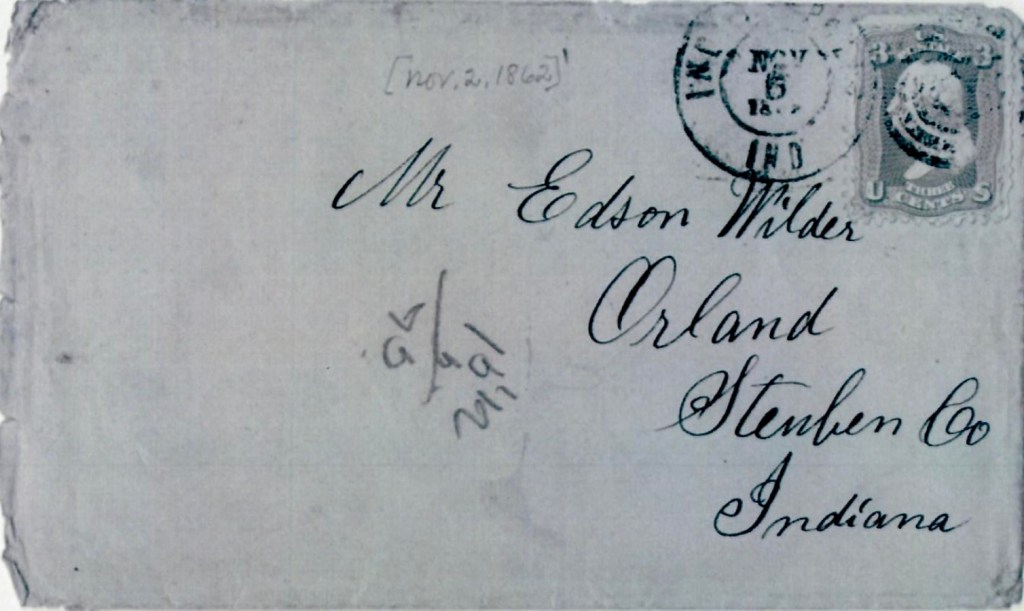
Camp Guthrie [Carrollton, Kentucky]
November 2nd 1862
Dear Friend,
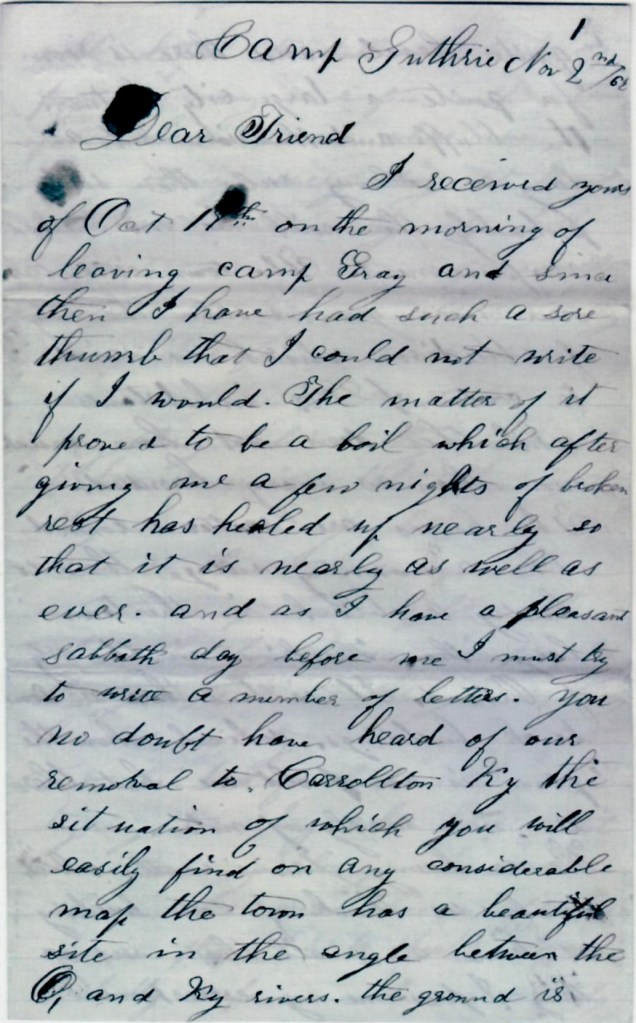
I received yours of October 19th on the morning of leaving Camp Gray and since then I have had such a sore thumb that I could not write if I would. The matter of it proved to be a boil which after giving me a few nights of broken rest, has healed up nearly so that it is nearly as well as ever and as I have a pleasant Sabbath day before me, I must try to write a number of letters.
You no doubt have heard of our removal to Carrollton, Kentucky, the situation of which you will easily find on any considerable map. The town has a beautiful site in the angle between the Ohio and Kentucky rivers. The ground is quite level and there is room for quite a large city between the bluff and the river but as long as slavery rules the soil, probably there will be no marked improvement. The town is scattered over more ground than the city of Madison which is said to contain 12,000 inhabitants while this does not have more than as many hundreds. The houses are scattered round like a country village. There is hardly a block in the town larger than Haskins in the city of Orland. It is true there are some brick buildings which show the place is an old one but there are none worthy of note.
We are having glorious weather which makes us think of corn husking at home and all that sort of thing. I presume my correspondent will have to pull the husks off from as many as a few nubbins this fall. Here we are where we can see slavery every day at least. We can occasionally see both masters and slaves, oftener the latter, for as elsewhere they know their friends and do not fear to come in and tell us anything which they think will be of service. Taken them together, they are more sprightly and smart than I had supposed. One was in camp last night who when the boys were jumping at three jumps, went through as though he did not try and went a foot over the best of those who were trying. One boy who had until our coming always been a slave and never ben off his owner’s place (so to speak) is now probably safe in our own country. He went with the captain who perhaps is in Orland this morning. I can think how the boy looked the day he came into camp—not half clothed. He shivered round the fire in the storm (for it was the worst day which we have seen yet), but it bot a very short time before a nice coat and cap out of a secesh store were brought in and given to him.
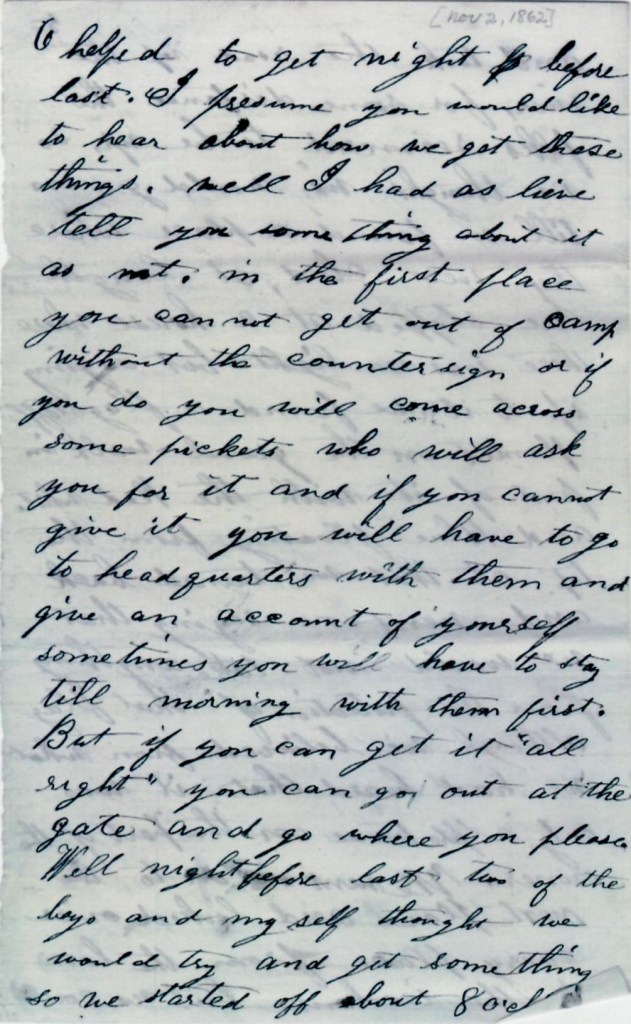
We have build good, comfortable barracks and fixed up to stay all winter. But we cannot tell anything about how long we shall stay. We are living on the top shelf at present. Can’t tell how long it will last. Our mess has had chickens for dinner every day for a week and expect to have some today which your humble servant helped to get night before last. I presume you would like to hear about how we get those things. Well, I had as leave tell you something about it as not. In the first place, you cannot get out of camp without the countersign or if you do, you will come across some pickets who will ask for it and if you cannot give it, you will have to go to headquarters with them and give an account of yourself. Sometimes you will have to stay till morning with them first. But if you can get it “all right,” you can go out at the gate and go where you please.
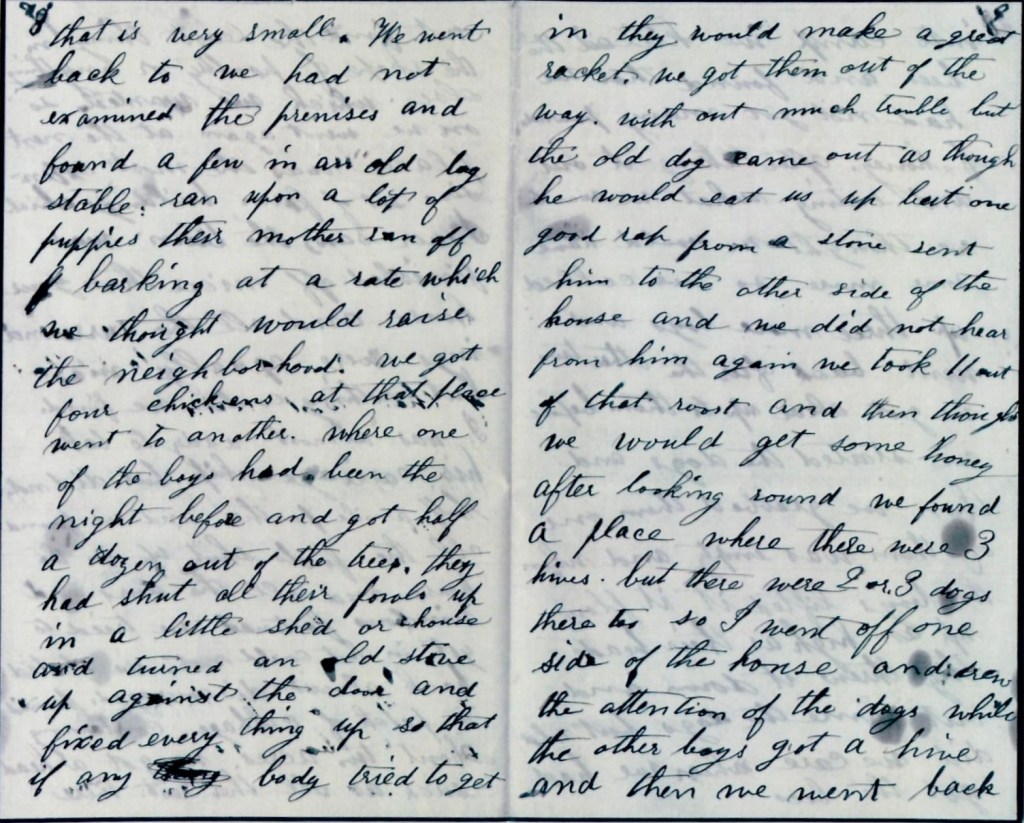
Well, night before last, two of the boys and myself thought we would try and get something so we started off about 8 o’clock and took the road up the river for some distance. The folks seemed to be up so we thought we would go on till we found a place where they were abed. At length we stopped at a house where there was no light but on going up to it, we found a flagstaff planted on the gravel walk in front of it with the Red, White & Blue floating from the top. At that we turned back and went on saying that we would not take anything from the protection of that flag although we believed from what we heard that it was only a pretense on the part of the owner. We went on to the next place and looked over every place from the barn to the icehouse but we could not find the least thing in the shape of poultry or anything else which we wanted. So on we went again. At the next place was the most expensive set of farm buildings which I ever saw. The barn was finished off nicer than your house and all the surroundings were equally nice but nothing could we find. I was almost ready to take his carriage whip but did not. Half a mile further and we found all the fowls shut up in the house and all the doors and windows fastened. We tried to get in but could not. We started back almost discouraged, found a patch of cabbage containing about two acres. We got a head such as all the rest were—that is, very small. We went back to [a place] we had not examined the premises and found a few in an old log stable. We ran upon a lot of puppies. Their mother ran off barking at a rate which we thought would raise the neighborhood. We got four chickens at that place, then went to another place where one of the boys had been the night before and got half a dozen out of the trees. They had shut all their fowls up in a little shed or house and turned an old stone up against the door and fixed everything up so that if anybody tried to get in they would make a great racket. We got them out of the way without much trouble but the old dog came out as though he would eat us up, but one good rap from a stone sent him to the other side of the house and we did not hear from him again. We took 11 out of that roost and then thought we would get some honey. After looking round we found a place where there were three hives but there were two or three dogs there too so I went off one side of the house and drew the attention of the dogs while the other boys got a hive and then we went back into camp. We killed the bees and found that we had not got many pounds of honey. After taking it out and eating what we wanted, we thought we would have some more so we called up three more boys and went back after the other two. We got clear up to them before we started the gogs and then we grabbed them. One of them was empty and when the boys lifted it, flew up as high as their heads. they threw it down and out came the dogs. But what did we care when we had got the bees. We carried them in and when we got to bed it was about 5 in the morning. After breakfast I went to bed and slept till noon which was the first sleeping which I have done in the day time since I enlisted.
Since morning when I began this letter, it has clouded up and has been raining for some time. I pity the boys who have to stand guard today in the storm. Well, tomorrow I shall have to take it myself along with the rest of the company for it takes the whole of us to guard the camp. As there are four companies of infantry, we come on once in four days. There are two companies of the 4th Cavalry and two of the 5th. They went off on a scout last Tuesday and did not come back till last night. They brought in 25 or 30 horses which they captured and some shotguns, &c. &c. They lived off the secesh entirely while they were gone and cleaned out some stores and played smash generally.
The sutler for the regiment has just come into camp and put up his tent so now the boys will have a chance to spend their money, if they did not before.
I believe that the last time I wrote to you we were all boiling over mad because we had heard that one of the captains was our colonel. It was a mistake. Our colonel is C. Case who formerly was representative from our district. He was adjutant of the 44th Regiment. You perhaps will be surprised to see the different kinds of paper which I have used. This sheet and the black edged sheet of drawing paper were given to me. They are some that the boys confiscated and I thought I would use them to show the style. I guess that this will do for one letter. So no more this time. Yours truly, — Henry Scott






Letter 5
Camp Occupation, Memphis, Tennessee
Monday, November 17th 1862
Friend Edson,
I received yours of November 2nd yesterday by the hand of the captain. Since leaving Madison the last time, we have seen a great many new things. Two weeks ago today we went from Carrollton, Kentucky, to Madison on our way to Indianapolis, And one week ago we got up in the morning at our new camp west of Camp Morton, having spent our first night in tents. The next night we started out for the cars. As we passed along, the general testimony was that our regiment was as fine a one as they had ever seen march & there were five or six thousand paroled prisoners i camp. They flocked us in the rain to bid us goodbye. They told us we might have four or five weeks to get back in. We told them we did not want to get back the way they [did] for we were going to give the rebels old Hundred.
We marched through the city in the rain grumbling because it would rust our new guns up so. The cars in which we were to go were standing on the track instead of in a depot. We crowded into them and at length we started. In almost no time we were out of the city and into the woods and among the farms. We went to sleep as soon as we could. When the train was running, we could sleep very well but when it stopped, we would wake up. As we were on a special train, we had to stop at nearly every station and wait for the regular trains to pass. We reached Terre Haute near the state line at three or four in the morning where I got off the cars and filled my canteen as I had been on guard just before starting and did not have an opportunity to get water then. We took an extra engine there to help us over the grades by the river and when we got up the grade west of the Wabash river near the Illinois state line, it went back to Terre Haute.
We continued on west till we struck the first railroad running to the southwest. We went on that road till we came to the Illinois Central at Centralia which is quite pretty town—or city, rather, for it is quite a large place although it is new as all the towns along the road seem to be for you know that Illinois has had a very rapid growth. The majority of the ground seemed to be prairie with oak openings between them. When I saw the oak trees and bushes, it made me feel more like going home that I had ever felt before, You cannot think how the large prairies look till you see them—some of them so large that you can look either way without seeing the trees of the edges. The country villages too standing out in the open prairie without a tree of any kind in them to interrupt the views. We did not change cars at all but we changed engines several times.
It was early Thursday morning when we reached Cairo on the most southern point of Illinois. This is a small place to what one would expect from its situation at the junction of the Mississippi and Ohio Rivers. I do not exactly know the population of the place but i think it has only about 3,000 inhabitants. We stayed there till a little after noon when we went on board the steamer Iowa and after some delay, we turned and went down stream. When we came to the Mississippi River, we could see the difference in the water of the two rivers t the first sight. That of the Ohio was clear and blue while that of th Mississippi is muddy and dirty all the way down the river. All the way down the river the water looked as though it did not thoroughly mix together but it looked like dirty soap suds or rather like cold suds not very dirty.
The first afternoon we went only a little past Columbus, Kentucky, which you will remember was held by the rebels last spring and it was very strongly fortified by them. It was only because Commodore Foote got his mortars ready to attack them that they left. The works are a little above or north of the town on a high bluff facing a bend in the river. Across the river on the flat is the place where the Battle of Belmont was fought. It looked like any low flat piece of ground, full of trees. We lay to for the night a few miles below Columbus and took on twenty cords of wood for the steamer which they used with coal of which they had a large quantity.
The next day we passed Island No. 10. this did not answer to my expectations at all. You can see the situation of it by looking at a map. It is in a bend of the river where it turns to the west and some after it turns to the north and goes up to New Madrid, Mo. I noticed six or eight earthworks on the Kentucky shore along opposite the Island and I saw a few guns on the Island but it did not look so very strong. The banks are not very high—probably not more than 30 feet. They are some higher on the Kentucky shore. We lay to for the night near the Arkansas line and just above a sandbar. In the morning we had to get off the boat and walk four or five miles around the bar. The land seems to be a sort of clayey loam—so low that there was a levee thrown up to keep the land from overflowing. There were but few trees in the woods which grow near home There were sweet gum, sweet oak, cottonwood, sycamore, cypress, once in a while a beech or ash, and in some of the low places some canebrake. But it did not grow to a very great height—say four to five feet. We saw a few patches of corn. It appeared to be a fair crop but it was hardly ripe. All along the shore wherever we saw any houses, we saw the poor slaves. They always waved their hands to us as though they were glad to see us but the general appearance of the country was that of a thinly settled and half civilized region.
At length we got back to the boat after going a mile or two more than we needed to. Going on down the river we saw during the day Ft. Wright or Pillow as it has been called by both names. It was the strongest looking place that I have yet seen. In fact, you know the place was never taken. All the rebels evacuated it because our army had got in behind them at Corinth. The works are thrown on the side of a steep hill which came down to the river, fronting a bend in the river as the other forts were. We also passed during the day the wreck of the steamer Eugene which had left Cairo the day before we did. It had run upon a snag in the river and pitched over upon the starboard side so that on that side the upper or hurricane deck touched the water. The river for miles below was full of boxes from the wreck, some of them full of apples adn others seemed to be filled with pilot bread, &c.
Down at Fort Wright there were a number of boats ashore the third night. They thought as they were so near to our destination we would go on to Memphis instead of stopping as usual. So a little after dark we ran upon a sandbar and it took till about midnight to get off again and they then lay to till morning. When we stopped at Centralia, Illinois, William Welch, our barber, stopped to get some shaving soap and the train went on and left him. He got on another steamer—the Mary Miller—which was smaller and lighter than the one on which we were, so that although it did not run as fast as ours, it could run nights and so he got down there first.
At length we landed and formed on the slope leading down from the city to the river, took a turn through the city, and came down to the bluff between the city and the river where we oitched our tents. I should judge the bluff to be 80 or 90 feet high and so steep to start with that it was just possible to crawl up and down it. But yesterday the officers detailed some 200 men to dig a road down to the river so now we have a very decent road if it had not rained so that it is so slippery that you can scarcely go up and down at all. The place where we are encamped is clay soil and mud is over a fellow’s shoes almost so that we have a very nasty place indeed. But I presume we shall see much worse places before we get back—if we ever do.
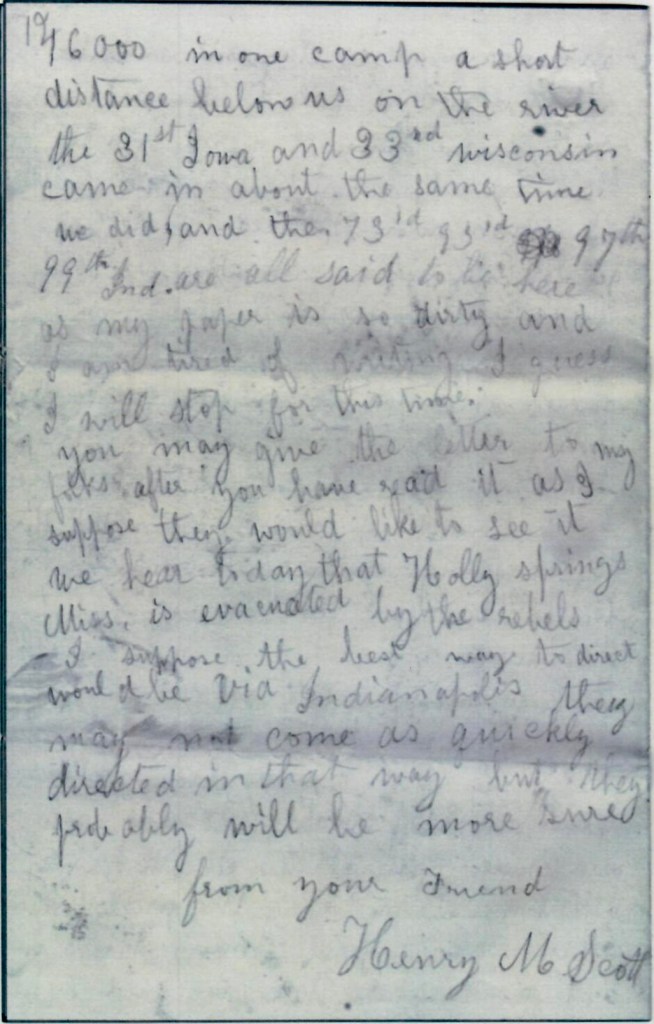
There are 10 of the mortar boats which we have heard of so often. They each have a 13-inch mortar on them. They are droll looking things for guns—as near the shape of a hogsnead with a large kettle turned up on one end of it as anything you can compare it to. The boats are flat like rafts but they have a protection of iron half inch thick around them. It is placed a little sloping inward at the top with loopholes around to fire musketry through. The pieces weigh about 17,200 lbs. each and were cast at the Ft. Pitt foundry, Pittsburgh, Penn. during the present year. There are a great many troops in and around here. There are said to be 16,000 in one camp a short distance below us on the river. The 31st Iowa and 33rd Wisconsin came in about the same time we did and the 73rd, 93rd, 97th, and 99th Indiana are all said to be here.
As my paper is so dirty and I am tired of writing, I guess I will stop for this time. You may give the letter to my folks after you have read it as I suppose they would like to see it. We hear today that Holly Springs, Mississippi, is evacuated by the rebels. I suppose the best way to direct would be via Indianapolis. They may not come as quickly directed in that way but they probably will be more sure.
From your friend, — Henry M. Scott


Letter 6
Grand Junction, Tennessee
January 18th 1863
Dear Friend,
I again undertake to pen a few lines for your perusal. You no doubt are thinking by this time that I owe you quite an amount in the shape of letters but for some weeks I have had little opportunity for answering letters. I received yours safely a few days ago telling of the death of your grandfather. His death is a great loss to you as also to the circle in which he was known. If we are all as well prepared for our end as we trust he was, it need make but little difference where or how we meet the monarch to whom we must all sooner or later submit.
This is the Sabbath morning but you would never know when it came by anything like the cessation of the stir and bustle which characterize a military town as this little place may be termed at present. The railroads which cross each other at this place being kept and run by the government though I do not see any trains go eastward toward Corinth. In the other directions, troops, cotton, or army stores as the case may be are moving every day though there does not seem to be as many troops moving as there were a few days ago. Probably they are waiting to see how things turn out at Vicksburg.
As near as I can judge, we are near the rear of General Grant’s army though if we are in it, we cannot tell about such things. One division of it will move one day on one road and perhaps others on three or four more a few miles apart. When we camp, we are usually off from the road in some field or piece of woods. At any rate, when we were back at Abbeville, a great many thousands of troops passed us. That was near Christmas. And now I think our brigade is to stay here some time to guard the railroad, Perhaps our whole division is somewhere along here but it is not in sight and so I cannot say.
Last Thursday it rained all day and in the evening it grew cold and froze so that in the morning we found it snowing. It snowed hard all day and part of the next night. The next day was cold so that it did not thaw but kept on freezing and so we have had one or two quite respectable winter nights and mornings. Yesterday it thawed a little but not as much as it froze last night. Today there is a prospect of quite a share of the snow leaving. I saw one or two fellows skating this morning and yesterday. The natives say they have not seen such a cold spell for 14 or 15 years. I have been told that some negroes who had come in here and not [had] proper shelter froze to death, but I can hardly believe it. The boys had rather a hard time of it in the tents (which we have had only about a week) but after it stopped storming, they could keep more comfortable for they could set a dish or two of coals in the tent and warm the air at night as we cannot if we would do any other way than to lie close we could sleep pretty well.
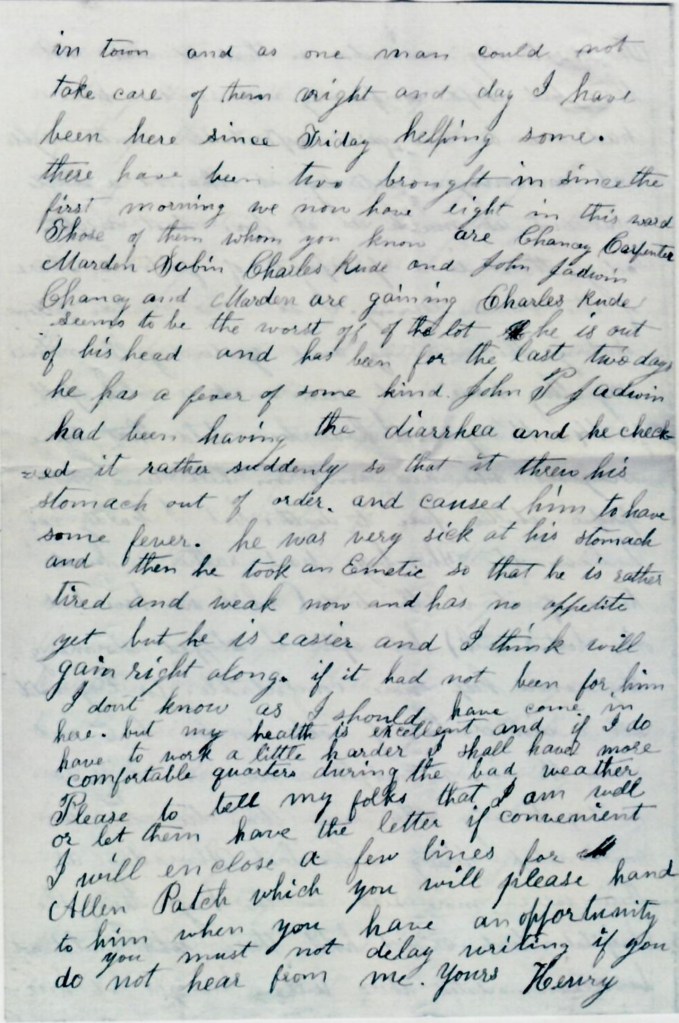
Last Thursday as there were more sick in the regiment than the hospital tent could hold, those who could not be accommodated there were brought up here in town and as one man could not take care of them night and day, I have been here since Friday helping some. There have been two brought in since the first morning. We now have eight in this ward. Those of them whom you know are Chancey Carpenter, Marden Sabin, Charles Rude, and John Jadwin. Chancy and Marden are gaining. Charles Rude seems to be the worst of the lot. He is out of his head and has been for the last two days. He has a fever of some kind. John P. Jadwin had been having the diarrhea and he checked it rather suddenly so that it threw his stomach out of order and caused him to have some fever. He was very sick at his stomach and then he took an emetic so that he is rather tired and weak now and has no appetite yet but he is easier and I think will gain right along. If it had not been for him, I don’t know as I should have come in here but my health is excellent and if I do have to work a little harder, I shall have more comfortable quarters during the bad weather.
Please to tell my folks that I am well or let them have the letter if convenient. I will enclose a few lines for Allen Patch which you will please hand to him when you have an opportunity. You must not delay writing if you do not hear from me. Yours, — Henry


Letter 7

Grand Junction, Tennessee
January 18th 1863
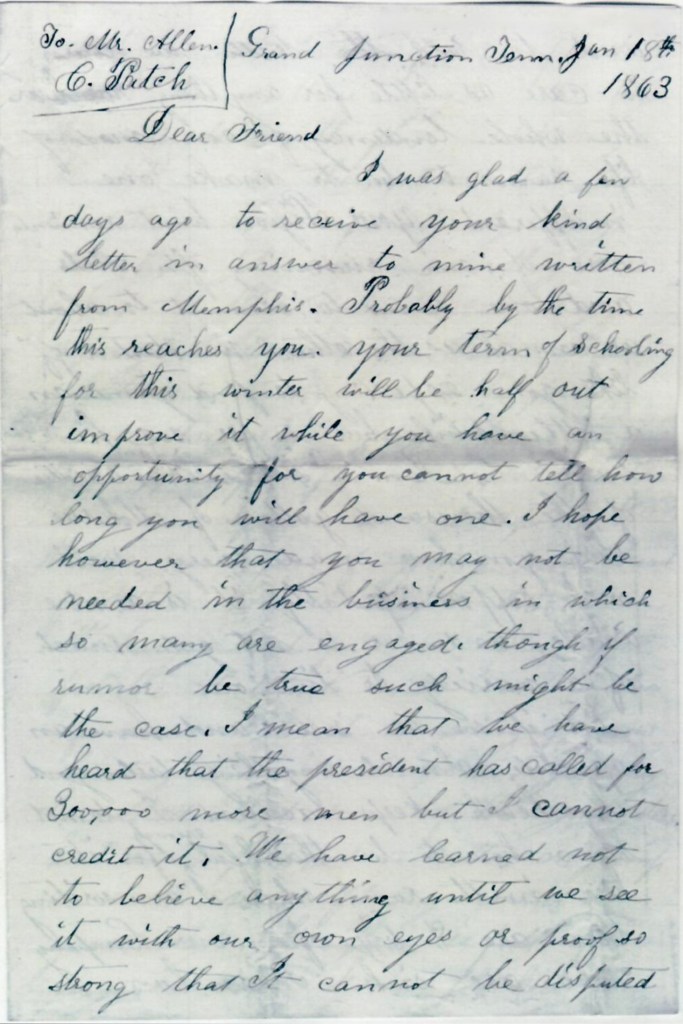
To Mr. Allen C. Patch, dear friend,
I was glad a few days ago to receive your kind letter in answer to mine written from Memphis. Probably by the time this reaches you, your term of schooling for this winter will be half out. Improve it while you have an opportunity for you cannot tell how long you will have one. I hope, however, that yo may not be needed in the business in which so many are engaged, though if rumor be true such might be the case. I mean that we have heard that the President has called for 300,000 more men but I cannot credit it. We have learned not to believe anything until we see it with our own eyes or proof so strong that it cannot be disputed. And to tell the truth, we learn to care as little for anything we hear. The whole tendency of our mode of life seems to be to make one indifferent.
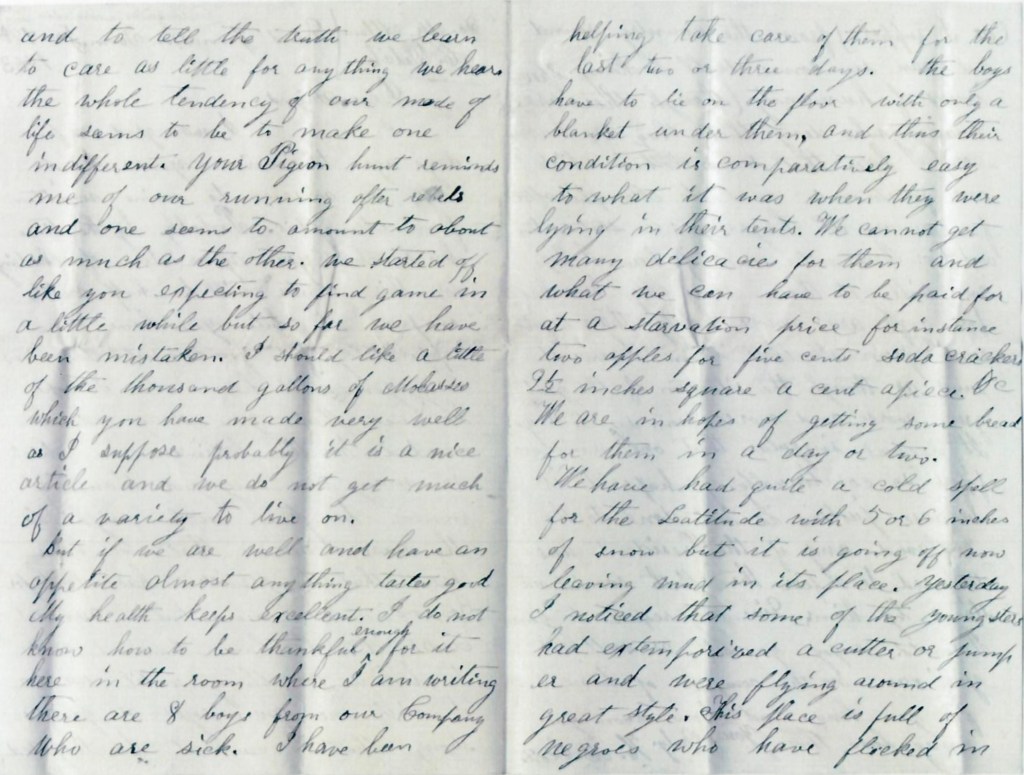
Your pigeon hunt reminds me of our running after rebels and one seems to amount to about as much as the other. We started off like you expecting to find game in a little while but so far we have been mistaken. I should like a little of the thousand gallons of molasses which you have made very well as I suppose probably it is a nice article and we do not get much of a variety to live on. But if we are well and have an appetite, almost anything tastes good.
My health keeps excellent. I do not know how to be thankful enough for it. Here in the room where I am writing there are eight boys from our company who are sick. I have been helping take care of them for the last two or three days. The boys have to lie on the floor with only a blanket under them and thus their condition is comparatively easy to what it was when they were lying in their tents. We cannot get many delicacies for them and what we can have to be paid for at a starvation price. For instance, two apples for five cents; soda crackers 2.5 inches square a cent apiece, &c. We are in hopes of getting some bread for them in a day or two.
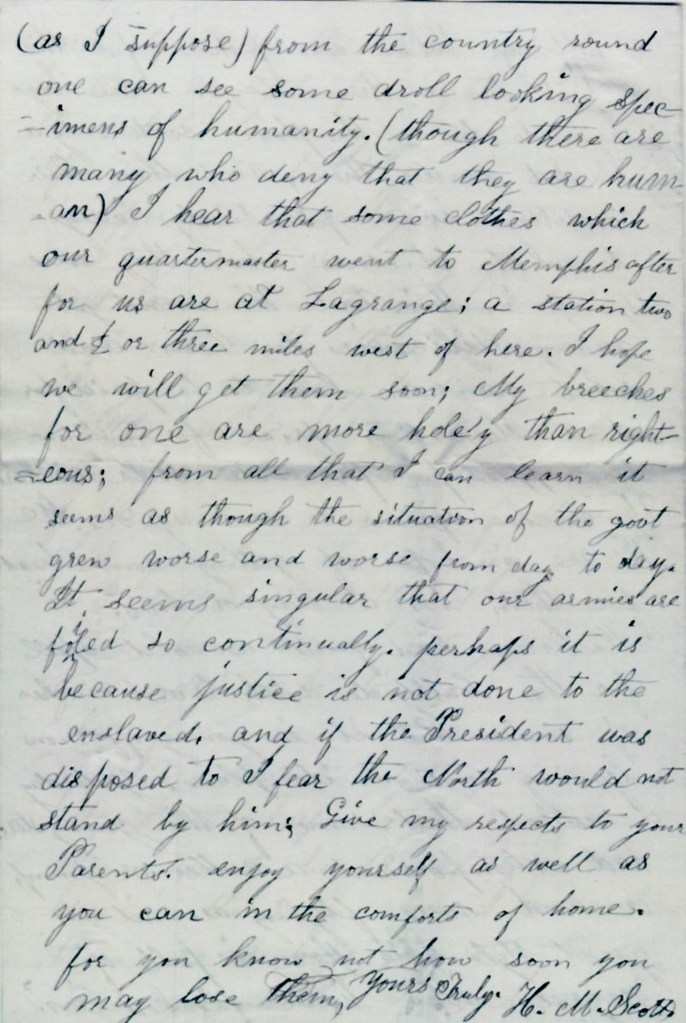
We have had quite a cold spell for the latitude with 5 or 6 inches of snow but it is going off now, leaving mud in its place. Yesterday I noticed that some of the youngsters had extemporized a cutter or jumper and were flying around in great style. This place is full of negroes who have flocked in (as I suppose) from the country round. One can see some drill looking specimens of humanity (though there are many who deny that they are human). I hear that some clothes which our quartermaster went to Memphis after for us are at Lagrange—a station two and a half miles west of here. I hope we will get them soon. My breeches for one are more holy than righeous.
From all that I can learn, it seems as though the situation of the government grew worse and worse from day to day. It seems singular that our armies are foiled so continually. Perhaps it is because justice is not done to the enslaved, and if the President was disposed to, I fear the North would not stand by him.
Give my respects to your parents. Enjoy yourself as well as you can in the comforts of home for you know not how soon you may lose them. Yours truly, — H. M. Scott
Letter 8
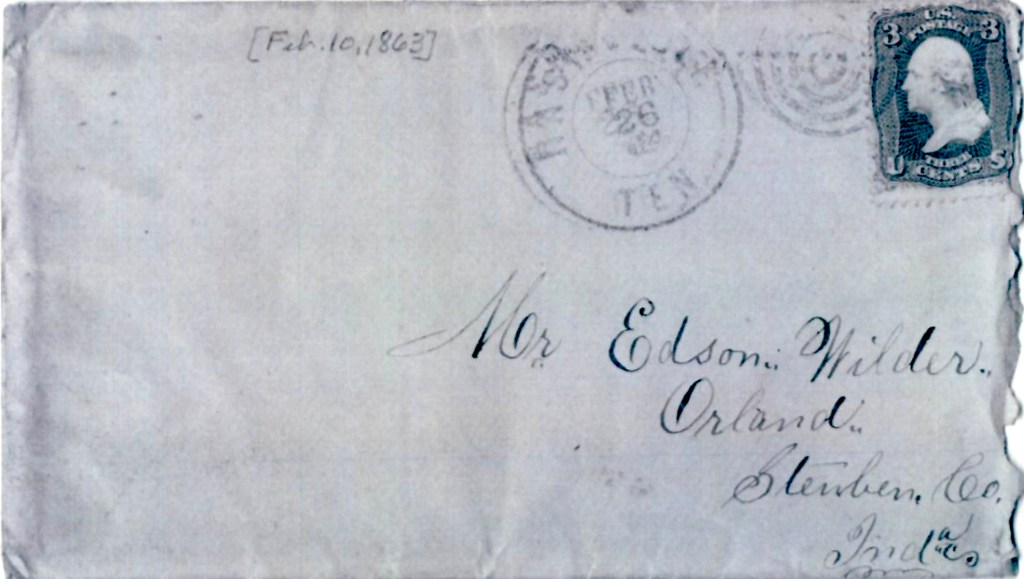
Grand Junction, Tennessee
February 10th 1863
Friend Ed,
I received yours of January 31st yesterday and was glad that you was still able to write such a powerful hand. Some of the comparisons I heard made to it were the tracks of wild geese in the mud or a spider running out of the ink bottle upon the paper. But if I don’t beat it in the way of scribbling before I get through, you may eat an apple for me or any other terrible thing you can think of. According to your story, this state can beat Indiana this winter at least for I have went out to the woods and cut wood when the snow was six inches deep and I have seen boys skating on the ice in town here so that we probably have seen about as much of winter as you though perhaps you will see some hereafter which will be colder. I do not think we will have much more freezing weather but we are likely to have a good many cold rains yet to initiate the coming spring.
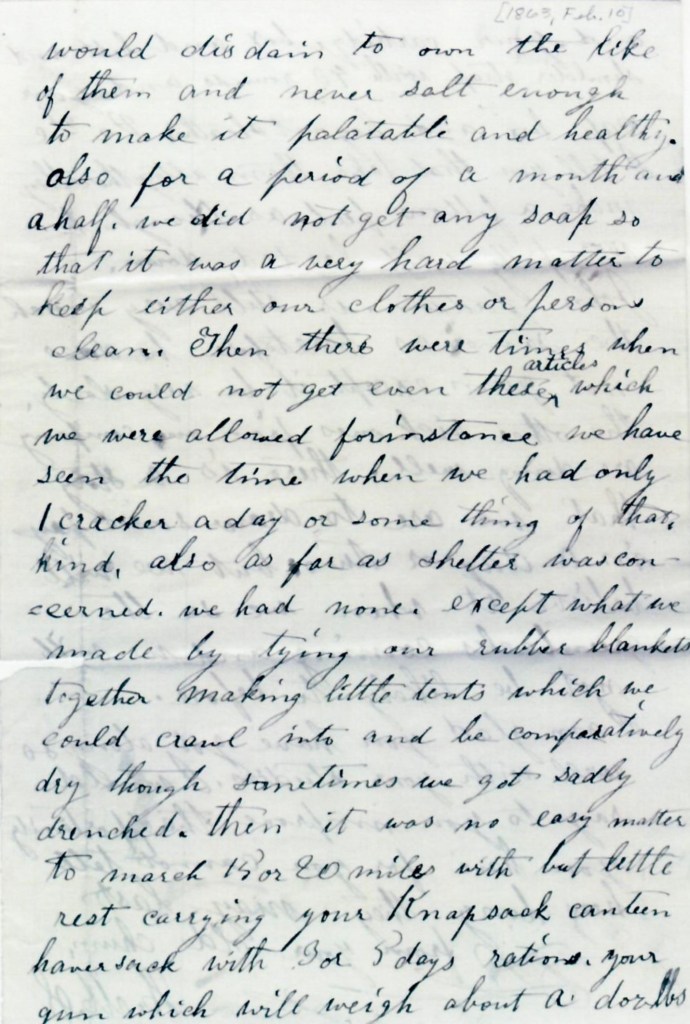
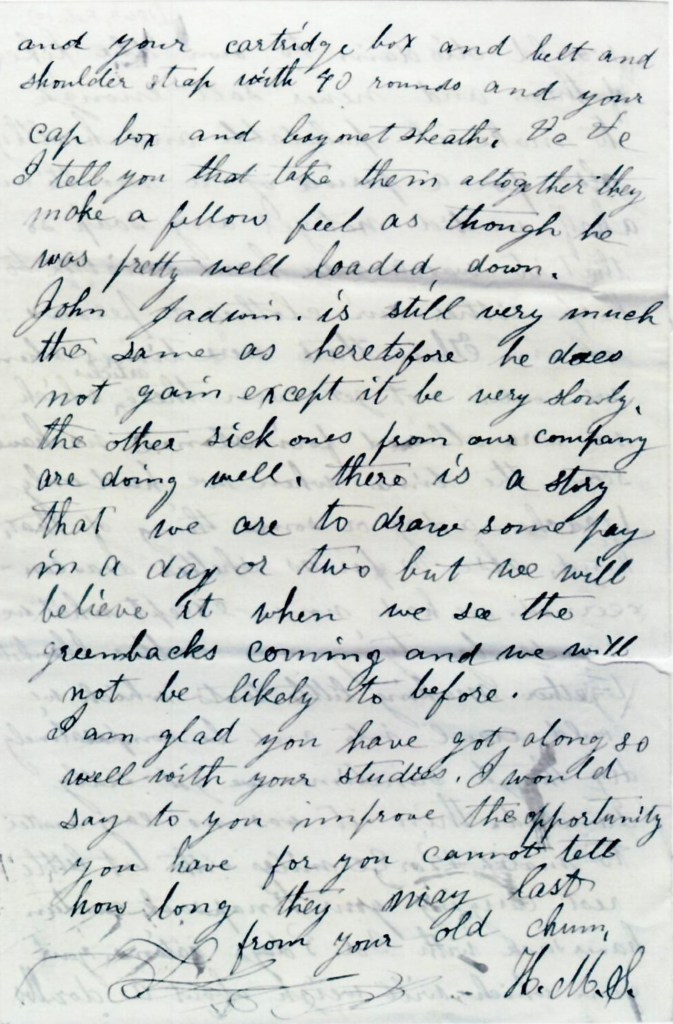
You say “give me an account of your travels and hardships.” I think I have written about where we have been. As to hardships, they do not seem to amount to much now. As far as rations are concerned, I can say that when we were on our marches we never drew full rations. We usually got three crackers a day with about a spoonful of sugar, a little tea or coffee, and beef from cattle so poor that you would disdain to own the like of them and never salt enough to make it palatable and healthy. Also for a period of a month and a half we did not get any soap so that it was a very hard matter to keep either our clothes or persons clean. There there were times when we could not get even these articles which we were allowed. For instance, we have seen the time when we had only one cracker a day or something of that kind. Also as far as shelter was concerned, we had none except what we made by tying our rubber blankets together making little tents which we could crawl into and be comparatively dry though sometimes we got sadly drenched. Then it was no easy matter to march 15 or 20 miles with but little rest, carrying our knapsack, canteen, haversack with three or five days rations, your gun which will weight about a dozen pounds, and your cartridge box and belt and should strap with 40 rounds and your cap box and bayonet sheath, &c. &c. I tell you that take them altogether, they make a fellow feel as though he was pretty well loaded down.
John Jadwin is still very much the same as heretofore. He does not gain except it be very slowly. The other sick ones from our company are doing well. There is a story that we are to draw some pay in a day or two but we will believe it when we see the greenbacks coming and we will not be likely to before.
I am glad you have got along so well with your studies. I would say to you improve the opportunities you have for you cannot tell how long they may last. From your old chum, — H. M. S.


Letter 9

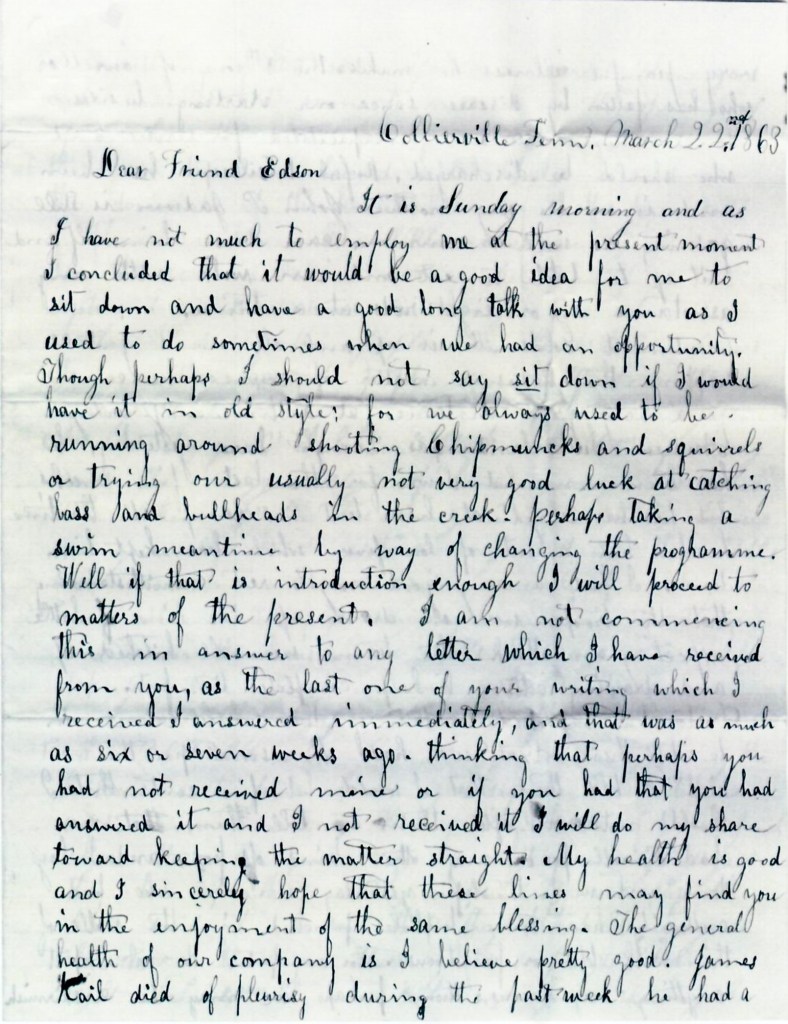
Collierville, Tennessee
March 22, 1863
Dear friend Edson,
It is Sunday morning and as I have not much to employ me at the present moment, I concluded that it would be a good idea for me to sit down and have a good long talk with you as I used to do sometimes when we had an opportunity. Though perhaps I should not say sit down if I would have it in the old style for we always used to be running around, shooting chipmunks and squirrels, or trying our usually not very good luck at catching bass and bullheads in the creek. Perhaps taking a swim meantime by way of changing the programme. Well, if that is introduction enough I will proceed to matters of the present.
I am not commencing this in answer to any letter which I have received from you as the last one of your writing which I received, I answered immediately, and that was as much as six or seven weeks ago. Thinking that perhaps you had not received mine or if you had that you had answered it and I not received it, I will do my share toward keeping the matter straight.
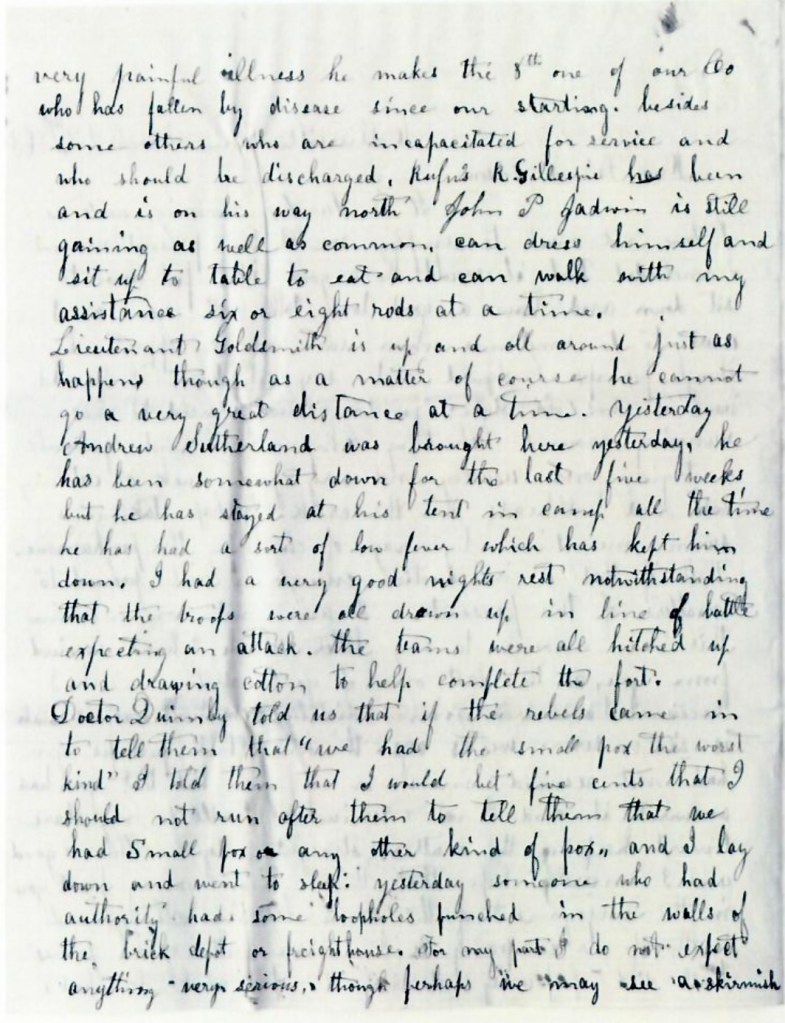
My health is good and I sincerely hope that these lines may find you in the enjoyment of the same blessing. The general health of our company is I believe pretty good. James Kale died of pleurisy during the past week. He had a very painful illness. He makes the 8th one of our company who has fallen by disease since our starting, besides some others who are incapacitated for service and who should be discharged. Rufus R. Gillespie has been [discharged] and is on his way north. John P. Jadwin is still gaining as well as common. Can dress himself and sit up to table to eat and can walk with my assistance six or eight rods at a time.
Lieut. Goldsmith is up and all around just as happens though as a matter of course he cannot go a very great distance at a time. Yesterday Andrew Sutherland was brought here. He has been somewhat down for the last five weeks but he has stated at his tent in camp all the time. He has had a sort of low fever which has kept him down. I had a very good night’s rest notwithstanding that the troops were all drawn up in line of battle expecting an attack. The teams were all hitched up and drawing cotton to help complete the fort.
Doctor Quimby told us that if the rebels came in to tell them that “we had the small pox—the worst kind.” I told them that I would bet five cents that I should not run after them to tell them that we had small pox or any other kind of pox and I lay down and went to sleep. Yesterday someone who had authority had some loopholes punched in the walls of the brick depot or freight house. For my part, I do not expect anything very serious, though perhaps we may see a skirmish or something of the sort.
You can scarcely [realize] how good and homelike it seems to me to see the opening of spring here. The air is full of the songs of birds and the fruit trees are loaded with blossoms, and in the dooryards of the houses there are half a dozen sorts of flowers in bloom. The little calves are lying around in the warm sunshine and make one think of sights and sounds at home in May.
The dialect of the people here shows them almost to be another race of people. You will hear them using such everlasting slang phrases as “a right smart”—“I’ll be dog gone”—“I low” or “reckon”—and “tote” for carry, and the nigger style of “have you got the ashes done taken up”—-“he has done gone”, &c. Their houses are generally built with a large hall in the middle and one room on each side, generally of one high story. You will see the pigs running round in the dooryard and under the house. The wells here are over 100 feet deep and the water is not very good at that.
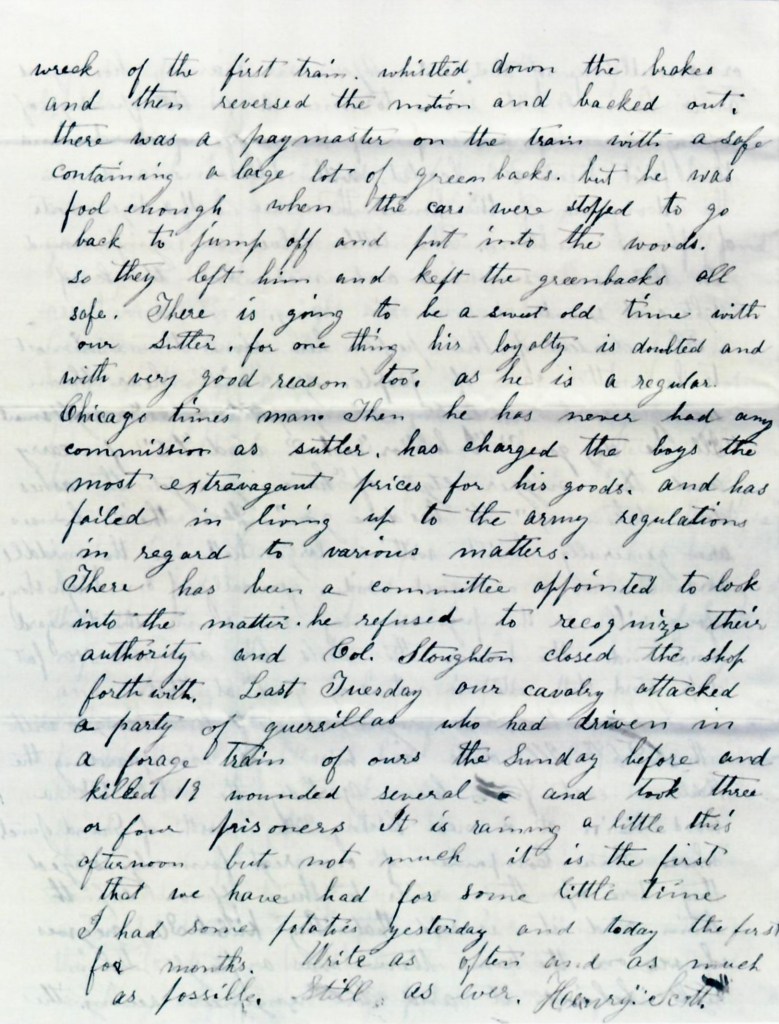
I hear that our regiment is to change with the 26th Illinois once in two weeks in guarding the railroad east from here. Yesterday the rebels took a wood train at or near Hickory Valley north of Grand Junction where three companies of our regiment formerly stayed. They tore up three rails to throw off or stop the train and it is said that they killed 30 negroes who were on the train. There was a freight train right behind it and the engineer, seeing the wreck of the first train, whistled down the brakes and then reveresed the motion and backed out. There was a paymaster on the train with a safe containing a large lot of greenbacks but he was fool enough when the cars were stopped to go back to jump off and put into the woods so they left him and kept the greenbacks safe.
There is going to be a sweet old time with our sutler. For one thing his loyalty is doubted and with very good reason too as he is a regular Chicago Times man. Then he has never had any commission as sutler, has charged the boys the most extravagant prices for his goods, and has failed in living up to the army regulations in regard to various matters. There has been a committee appointed to look into the matter. He refused to recognize their authority and Col. Stoughton closed the shop forthwith.
Last Tuesday our cavalry attacked a part of guerrillas who had driven in a forage train of ours the Sunday before and killed 19, wounded several, and took three or four prisoners. It is raining a little this afternoon but not much. It is the first we have had for some little time. I had some potatoes yesterday and today the first for months. Write as often and as much as possible. Still as ever, — Henry Scott

Letter 10
Collierville, [Tennessee]
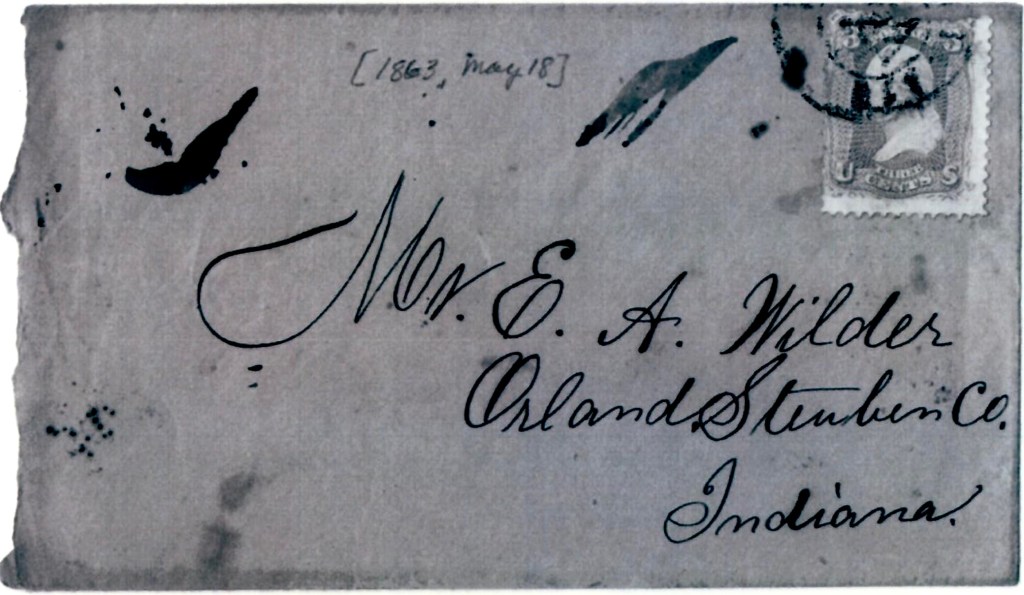
May 18, 1863
Friend Edson,
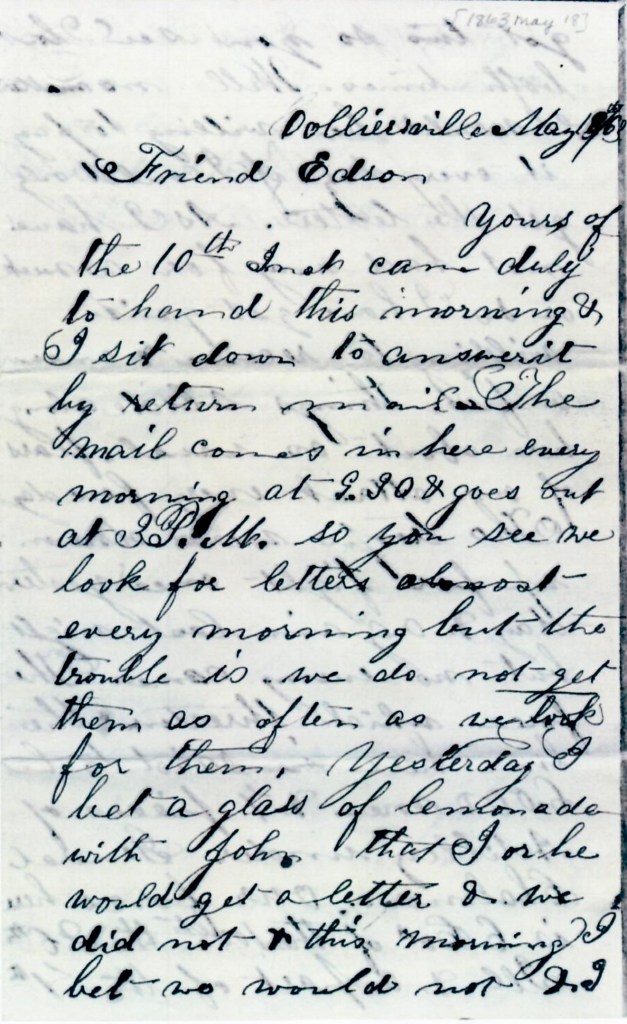
Yours of the 10th inst. came duly to hand this morning & I sit down to answer it by return mail. The mail comes in here every morning at 9:30 and goes out at 3 p.m. so you see we look for letters almost every morning but the trouble us we do not get them as often as we look for them. Yesterday I bet a glass of lemonade with John that I or he would get a letter & we did not & this morning I bet we would not and I got two so you see I lost both times. Well, no matter. I would be willing to pay it every day if I could only get the letters. As I have not had any for a week or so, I have got quite willing to receive & answer a few.
Things slide along here about as usual. Fears of an attack every few days. The troops were drawn up for fight once yesterday and again last night but no enemy came. The force which threatens the line here is said to be 6,000 men and four pieces of artillery under General Chalmers. Our force here is six companies of the100th [Indiana], the 26th Illinois, and a part of the 4th Illinois Cavalry with two guns of the 5th Indiana Battery. There is also quite a stout little fort here which I expect is worth a regiment or two of troops.
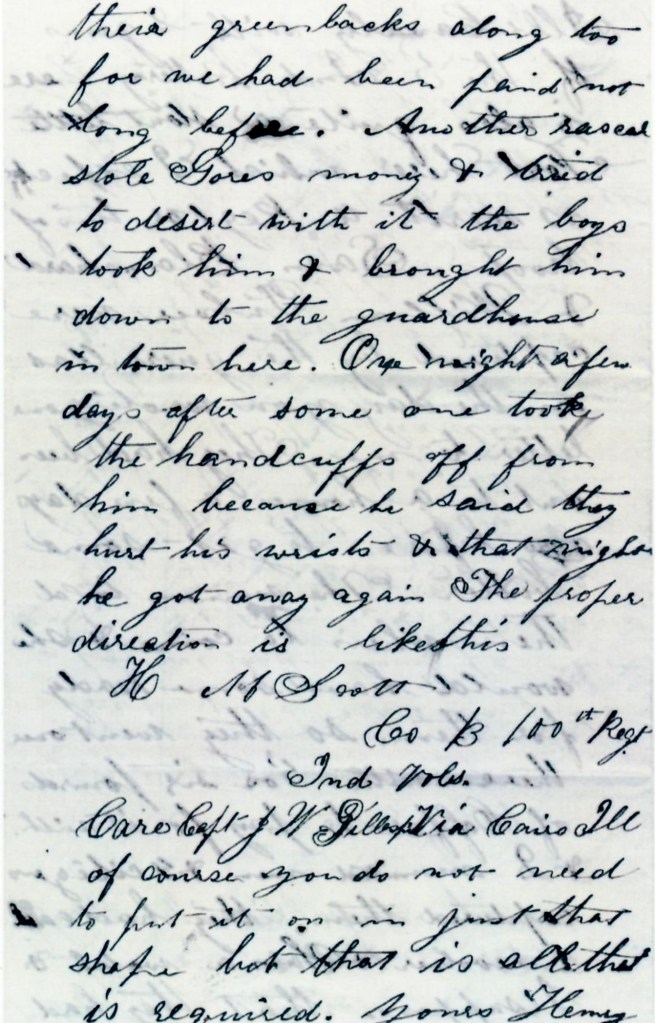
Sam Blanchard and William Pulver were captured by the guerrillas on the day you wrote your letter to me. They had been out to a house a few days before to get some butter. The woman told them when to come and she would have some ready for them so they went over there with five or six pounds of coffee to pay for it with and two mounted men and four citizens captured them. They had each a revolver and Sam a watch and I suppose that they had their greenbacks along too for we had been paid not long before.
Another rascal stole Gore’s money & tried to desert with it. The boys took him and brought him down to the guardhouse in town here. One night a few days after someone took the handcuffs off from him because he said they hurt his wrists & that night he got away again.
The proper direction is like this: H. M. Scott, Co. B, 100th Regt, Indiana Vols., Care Capt. J. W. Gillespie, via Cairo, Illinois
Of course you do not need to put it on in just that shape but that is all that is required. Yours, — Henry

Letter 11

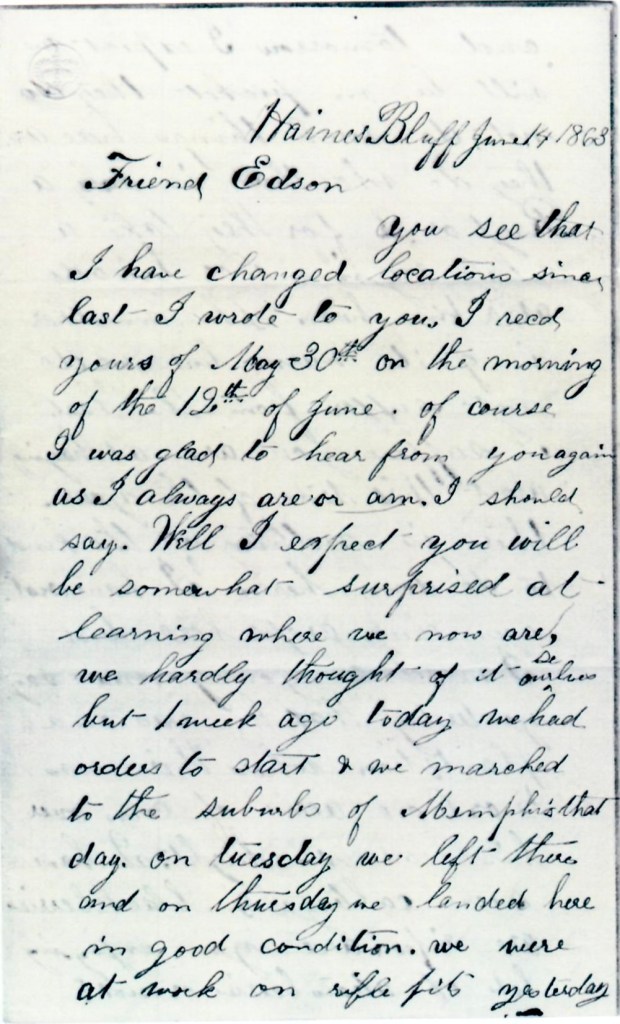
Haines Bluff
June 14, 1863
Friend Edson,
You see that I have changed locations since last I wrote to you. I received yours of May 30th on th morning of the 12th of June. Of course I was glad to hear from you again as I always are or am, I should say.
Well, I expect you will be somewhat surprised at learning where we now are. We hardly thought of it ourselves but 1 week ago today we had orders to start & we marched to the suburbs of Memphis that day. On Tuesday we left there and on Thursday we landed here in good condition. We were at work on rifle pits yesterday and tomorrow I expect we will be on picket. They do not do such things here as they do where there is only a regiment or two for they take a whole regiment or brigade at a time here.
The weather is quite war, but we do not suffer from the heat, I suppose you are at haying about this time of the year. There is nothing of the kind to do down here. I have not seen any crops here but I heard a young man say yesterday that he was on a plantation where there was 5 or 600 acres of corn over his head in height. I have seen cabbages and blackberries are ripe. Are you enjoying lots of strawberries or not?
We have never heard from Sam Blanchard & W[illiam] Pulver since they were taken.
I would like to have you here to take a stroll over the hills and bluffs with me for I know it would interest you. There are some very large siege guns here which the rebels left.
I have not seen a [religious] meeting for months excepting a Catholic performance in the 90th Illinois—an Irish regiment. Our opportunities for writing are poor but I can manage to scrawl a lone once in a while. Where are you going to spend the 4th of next month? I calculate to go up to town here and have a spree—get a pir or have my picture taken or something of that sort. Well, I have not much to wrote so I will close by telling you not to talk about waiting four weeks before I answer your communications. — H. S.


Letter 12
Camp Sherman
September 1, 1863
Friend Edson,
Yours of the August 16th came in last night after I was asleep and so I did not read it until this morning. After I read mine, I went down to the next tent where Charley stays and found him asleep. I went to tickling his nose with the letter and woke him up when I gave him the letter and came away.
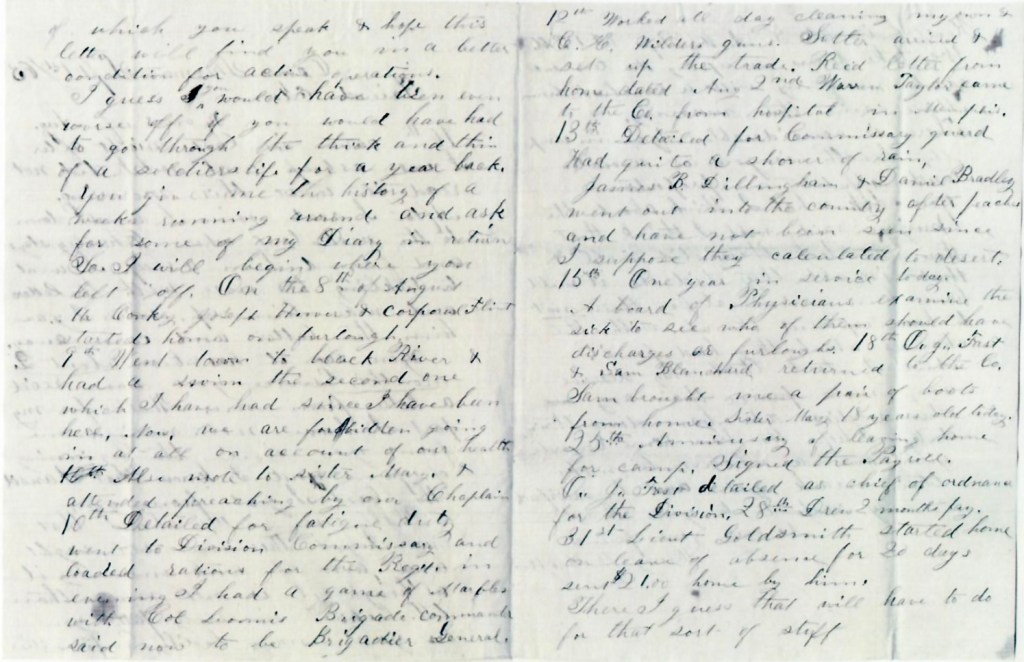
You said it has been about two months since you have received a letter from me. Well, for my part, I have not received one from you since the beginning of June and I know that I answered the last one I got from you. Well, no matter about that now. I got this one all right and am at work answering it although it is not more than 7 o’clock. I sincerely pity you for your many bodily infirmities of which you speak & hope this letter will find you in a better condition for active operations.
I guess U would have been even worse off if you would have had to go through the thick and thin of a soldier’s life for a year back. You gave me the history of a week’s running around and ask for some of my diary in return. So I will begin where you left off.
On the 8th of August, the cook Joseph Hoover and Corporal [Francis] Flint started home on furlough.
9th. Went down to Black River and had a swim—the second one which I have had since I have been here. Now we are forbidden going in at all in account of our health, Also wrote to sister Mary & attended preaching by our chaplain.
10th. Detailed for fatigue duty. Went to Division Commissary and loaded rations for the regiment. In evening I had a game of marbles with Col. Loomis Brigade Commander—said now to be Brigadier General.
12th. Worked all day cleaning my own and C. H. Wilder’s guns. Sutler arrived & set up the trade. Received letter from home dated August 2nd. Warren Taylor came to the company from hospital in Memphis.
13th. Detailed for Commissary Guard. Hade quite a shower of rain. James B. Dillingham and Daniel Bradley went out into the country after peaches and have not been seen since. I suppose they calculated to desert.
15th. One year in service today. A board of physicians examined the sick to see who of them should have discharges or furloughs.
18th. O. J. Frost and Samuel Blanchard returned to the company. Sam brought me a pair of boots from home. Sister Mary 18 years old today.
25th. Anniversary of leaving home for camp. Signed the pay roll. O. J. Fast detailed as Chief or Ordnance for the Division.
28th. Drew two months pay.
31st. Lieut. Goldsmith started home on leave of absence for 20 days. Sent $21 home by him.
There, I guess that will have to do for that sort of stuff.
Reveille is at 5 a.m. Taps at 9 p.m. We take turns sweeping the tent out each morning with a canebrake broom. Mine came this morning.
There is considerable ague in camp. My health is good as usual and appetite in proportion. You ask what I think about the Morgan raid. Well, I think that those who took them did well and that is all they did do. It would have been criminal for them not to have captured the rebs, with the chances which they had for it. And I don’t think they deserve any more praise than any other soldiers who have done their duty. I hope the brave Home Guards will have a chance to make their mark yet and be satisfied.
My respects to your parents. As ever, your friend—-Henry M. Scott


Letter 13

Camp Sherman, Mississippi
Saturday, September 16th 1863
Friend Edson,
I had just sat down and dated my sheet to write to Father when CHarles Ellis came up from the Post Office with your letter of September 13th so I will send it to you instead of two him as at first calculated.
I am in good health and enjoying myself as well sa can be expected. I am glad to learn that the friends are all well. Should think that seeding must be very late indeed from the date you give. From what I had heard, I was afraid that corn was very seriously damaged. I m glad to learn otherwise.
You are “mighty right”—I would do ample justice or else as good destruction to your peaches, melons, and apples if I could only get at them! But there is the stick—if I could.
A fellow’s chances for getting his “face smashed” are rather poor in the places which we generally occupy. I mean to get likenesses taken. Why we are out in the wilderness as far as such things are concerned.
Well now, to come to what made me start to write in such a scrawling style, we are going to march—really going to start. Expect it will be tomorrow as we move as often on Sunday as all other days put together. I expect we will go to Vicksburg and then up the old “Father of Waters” to Memphis or further. I rather think our destination will be to reinforce Rosecrans [at Chattanooga] for we have heard that he is in need of help. We may stop anywhere this side of there but cannot tell when or where. Those who are unable to march are to go today to the railroad and on that to Vicksburg. I hate the idea of carrying my old knapsack most confoundedly. I tell you what. It don’t set easy at all on a fellow’s shoulders. Well, let her rip. We will know what comes when we get there.
Please to let my folks know that we are going to move. I got a paper today which father sent. I will write again when I have an opportunity. My respets to all. Yours in haste. — H. M. Scott


Letter 14
Scottsboro, Alabama
December 30, 1863
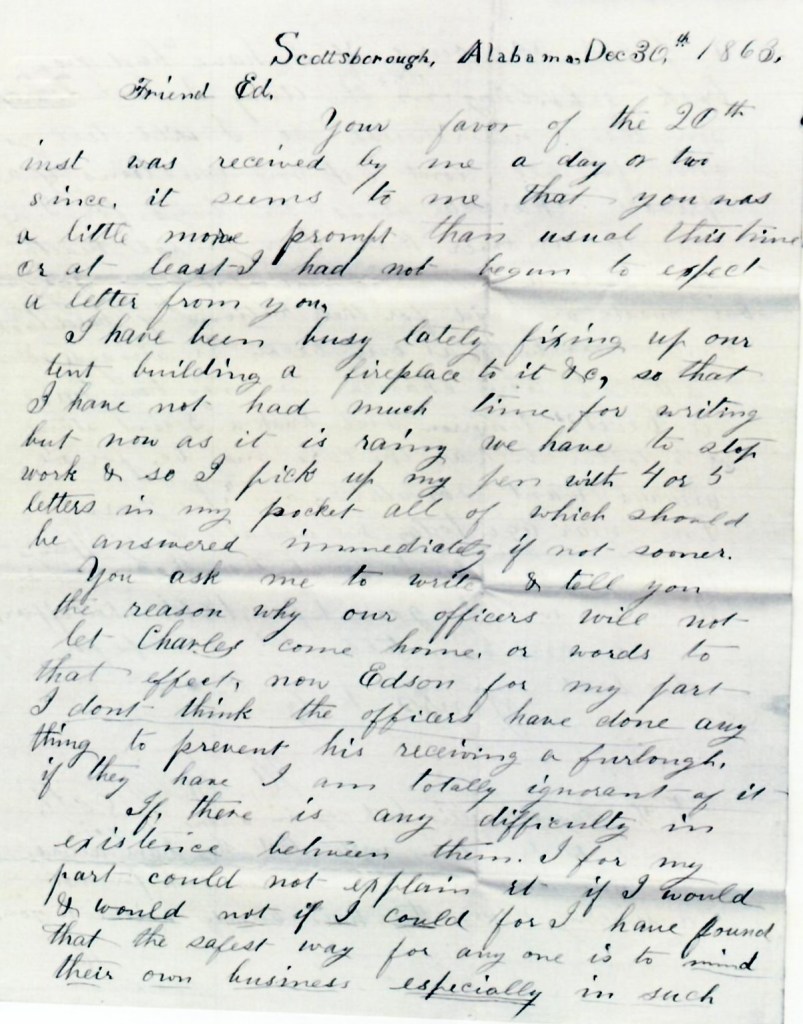
Friend Ed,
Your favor of the 20th inst. was received by me a day or two since. It seems to me that you was a little more prompt than usual this time or at least I had not begun to expect a letter from you.
I have been busy lately fixing up our tent, building a fire place to it, &c., so that I have not had much time for writing. But now as it is rainy, we have to stop work and so I pick up my pen with 4 or 5 letters in my pocket, all of which should be answered immediately if not sooner.
You ask me to write and tell you the reason why our officers will not let Charley come home—or words to that effect. Now Edson, for my part, I don’t think the officers have done anything to prevent his receiving a furlough. If they have, I am totally ignorant of it. If there is any difficulty in existence between them, I for my part could not explain it if I would, & I would not if I could for I have found that the safest way for anyone is to mind their own business—especially in such a place as ours. If I have had no book schooling in the Army, I have learned something nevertheless. So I will tell you once for all, don’t ask me questions of a private character about the boys for I cannot answer them.
Our general health is good. A few are not fit for duty but most are good for their rations of hard tack and sowbelly, as our bacon is always called. If there is any chance, we may have a “bust” tomorrow and break a 3-cent stamp or five dollar bill as the case may be for we always want something on “New Years.” One year ago today, we were at Holy Springs, Mississippi. Our number is much less than it was then. Who will be gone before 1865 shall appear? No one can tell. Let us hope for the best. Yours truly, — H. M. Scott
P. S. Haynes & Ellis both say in answer to your request to have them write that they have already set you down in their shit ass book for not answering letters they have already written to you. — H

Letter 15

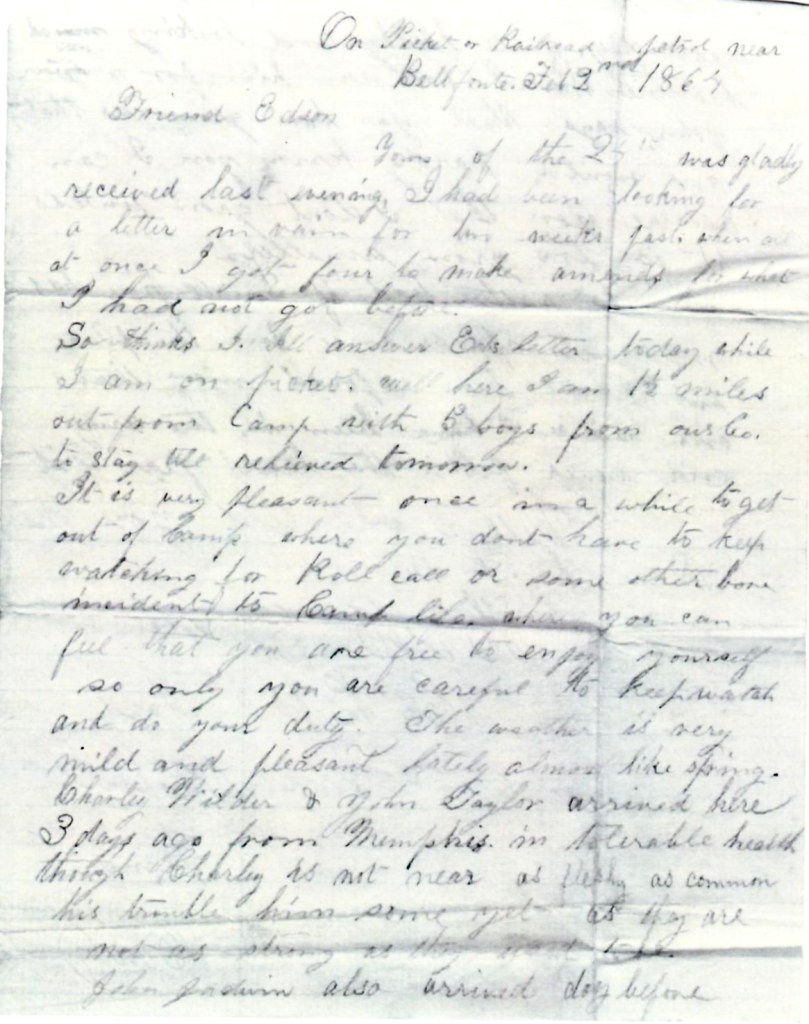
On picket or Railroad Patrol near Bellefonte [Alabama]
February 12th 1864
Friend Edson,
Yours of the 24th was gladly received last evening. I have been looking for a letter in vain for two weeks past when all at once I got four to make amends for what I had not got before. So thinks I, I’ll answer Ed’s letter today while I am on picket. Well, here I am 1 and a half miles out from camp with 5 boys from our company to stay till relieved tomorrow.
It is very pleasant once in a while to get out of camp where you don’t have to keep watching for roll call or some other bane incidents to camp life—a [place] where you can feel that you are free to enjoy yourself so only you are careful to keep watch and do your duty.
The weather is very mild and pleasant lately, almost like spring. Charley Wilder and John Taylor arrived here 3 days ago from Memphis in tolerable health though Charley is not near as fleshy as common. His [legs] trouble him some yet as they are not as strong as they used to be. John Jadwin also arrived day before yesterday quite fleshy and looking healthier than I had seen him for a year. John says that you have grown so that one would hardly know you. I can assure you that I don’t grow unless it is to grow smaller.
It is rather bad if small pox has made its appearance in the place but I have been exposed more than once since I have been in the army and never felt the least fear of it. Well, I will tell you this time how to direct.
H. M. Scott, Co. B, 100th Indiana, via Nashville, Tennesee
— Henry

Letter 16
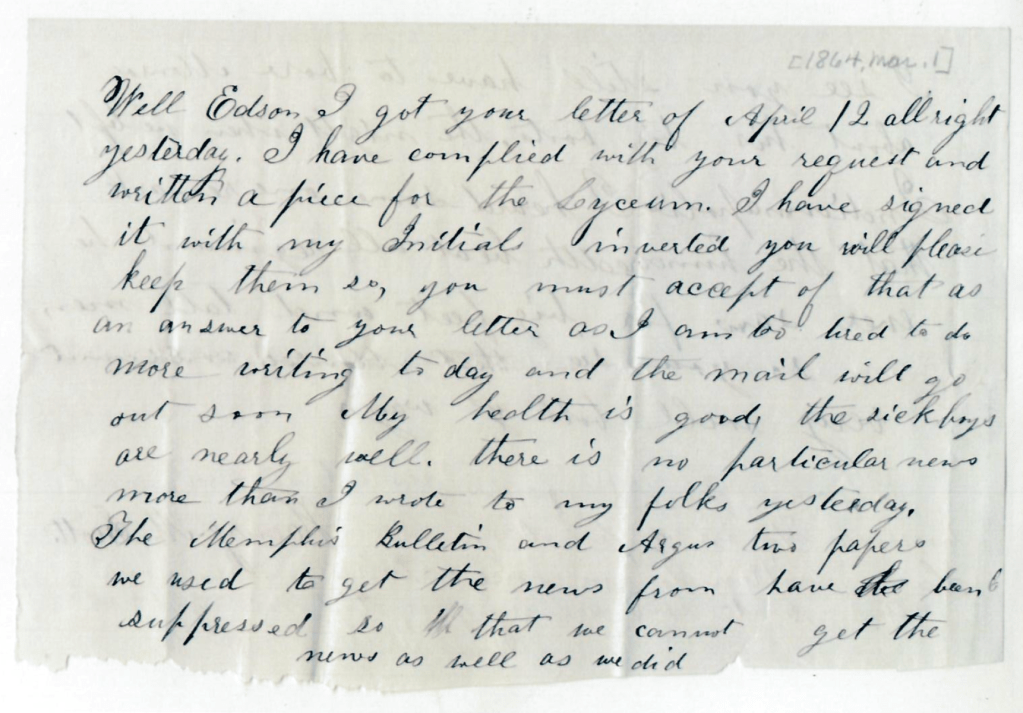
Well Edson, I got your letter of April 12th all right yesterday. I have complied with your request and written a piece for the Lyceum. I have signed it with my initial inverted. You will please keep them so. You must accept of that sa an answer to your letter as I am too tired to do more writing today and the mail will go out soon. My health is good. The sick boys are nearly well. There is no particular news more than I wrote to my folks yesterday. The Memphis Bulletin and Argus, two papers we used to get the news from, have been suppressed so that we cannot get the news as well as we did.
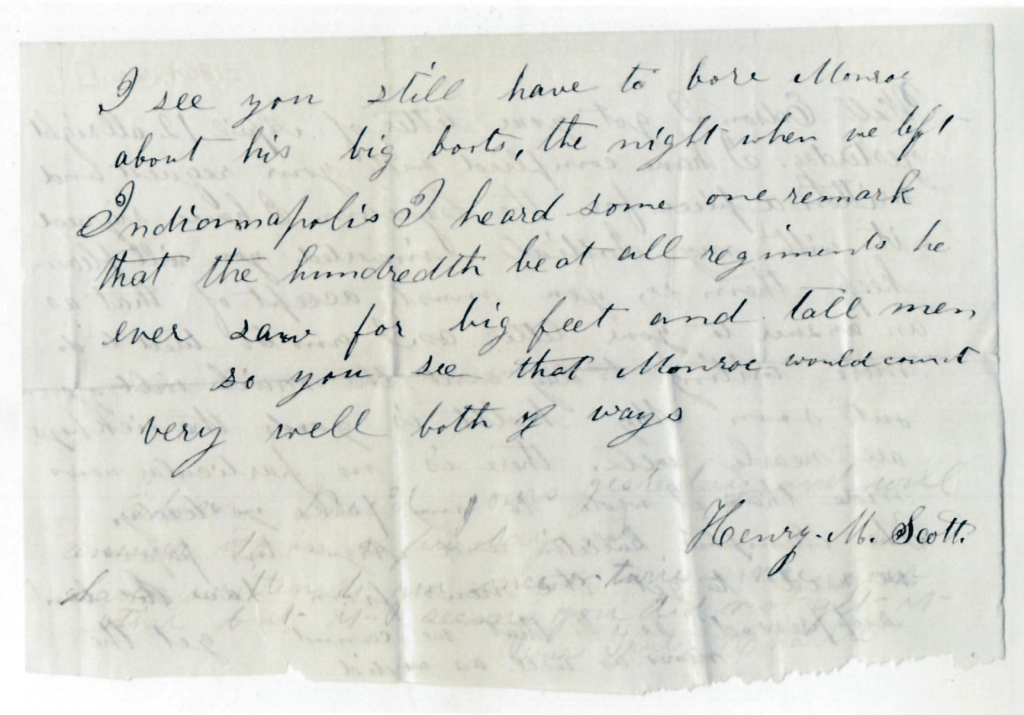
I see you still have to bore Monroe about his big boots. The night when we left Indianapolis I heard someone remark that the 100th beat all regiments he ever saw for big feet and tall men. So you see that Monroe would count very well both ways. — Henry M. Scott
The Generalship of the Fall campaign of 1863
All who are, or have been, conversant with the progress of our military affairs must remember among other matters the unparalleled march of the 15th Army Corps (then under the command of General W. T. Sherman) to the relief of the Army of the Cumberland, then acting on the defensive in their fortifications at Chattanooga.
After the surrender of Vicksburg and subsequent evacuation of Jackson, Mississippi, last July, the rebels forced to abandon Mississippi by the prowess of Grant, sought by concentrating their forces to regain possession of East Tennessee, which was being rapidly taken from them by the indefatigable Rosecrans. The bloody field of Chickamauga shows only too plainly how near they came to accomplishing their design. Rosecrans, although repulsed at that spot, fell back to the strong position of Chattanooga and fortified himself so securely that the rebels saw that it was useless to try to drive him from it by force. Still his route of supplies was very long and uncertain adn his army but scantily fed. Here though the rebels we are sure of a triumph. Leaving a strong force to hold Rosecrans in check, they dispatched Longstreet with a powerful army to take Knoxville that they might then flank Rosecrans, cut off his line of communication and then surround and overwhelm him.
This they were confident of doing as they thought that Sherman could not get from Vicksburg to the relief of Chattanooga before February or March. Here was their mistake and in it lies the cause of this failure. Sherman left the camp on Black River, Mississippi, with his Corps in the latter part of September, going up the river to Memhis. A part of the troops went by railroad as far east as Corinth, while others (among who was our division) marched the entire distance.
Sending a division ahead to skirmish with the enemy and make them think we were going to force our way through south of the Tennessee River, along the Mississippi & Charleston Railroad, Sherman with the balance of the corps crossed the river at Eastport and rapidly and silently marched through Northern Alabama and the southern part of Middle Tennessee till he struck like a thunderbolt upon the surprised rebels at Mission Ridge, who thought him still vainly struggling to get through the difficulties which they had thrown across the route which they imagined he was taking.
The sequel is well know. Our troops gallantly wrested Lookout Mountain and Mission Ridge from Bragg’s army and then an expedition under Sherman moved to the relief of Burnside who was hard pressed in Knoxville. Longstreet was compelled to raise the siege and retreat, and thus their army was defeated in detail instead of ours. No wonder that the rebels fear the name of Sherman who is ever executing such lightning vengeance on them.
And while the rain patters on the tent over my head as I write, he is far away on another expedition which the rebels have styled “the boldest move of the war.” May success attend him. — S. M. Co. B. 100th Indiana
March 1st 1864


Letter 17

Bellefonte Station, Alabama
Saturday, March 19th 1864
Mr. E. A. Wilder, President Lyceum Society
Dear Sir,
Your favor of March 6th came to hand and I seat myself at once to acknowledge the favor. Truly all this time I have been dealing with greatness in disguise, poking fun at one of the society’s best loved and behold I knew it not.
My Lord, let this servant find favor in thine eyes and discord not, I pray thee his humble offerings when they come into thy presence.
I am most happy to hear of your good health and I assure you that ours is good as ever.
News is scarce as you can well imagine. All goes on in the same round day after day. Nearly all the changes we see are those which the weather makes. Although it is now very comfortable, it was very cold a few days ago.
Those who have been absent from the regiment—sick or wounded—are dropping in nearly on plan. Dick Bloss is with us again. You will of course see W. R. Parker, the sergeant, who is sent home to recruit for our company. You see that when a company has less than 84 men, they can have but two commissioned officers so they are trying to fill our regiment up. It is the same way with the staff officers of the regiment. Until the regiment is filled up to the minimum number of a full regiment, we can have no Col. so you see there is interest in the matter for those who desire or expect promotion.
Lt. Goldsmith is Adjutant of the regiment. We are all sorry to lose him from the company but I suppose it is best on account of his health which never has seemed to be good enough to endure field service in the position of Lieutenant. Now he can have a horse to ride which will make it easier on a march.
If you are bothered any to eat your pound of sugar, just hand me the dish and I’ll finish it for you. — H. M. Scott


Letter 18

Bellefonte, Alabama
April 6th 1864
Friend Edson,
Your favor of March 27th which was mailed the day following came to hand on the third day of this month. I was as I ever am, glad to hear from a friend and to hear that friends were well. This is what makes us feel that we can rest wasy for time being at least. But when we hear of sickness at home, and we so far away, it is far different.
Your kind wishes in regard to my health were realized. I should be foolish indeed to murmur at my present condition when I know how much worse it might be.
Yesterday I was out on duty on what we call “Patrol”—i. e., we go out all along between the railroad stations to guard the railroad and telegraph wires. Your Uncle Charles & four other boys from our company were on the post with me. He and another of the boys went out and shot three pigs so we had some fresh pork to eat. This morning before I was relieved, I went out and took a short walk in the woods. I heard some hounds chasing something so I went out that way and first I knew, a nice red fox came running along and seemed quite tired. He stopped and looked at me not more than 5 rods off but I like a fool had not brought my rifle. So I threw a stone at home and he ran off into the mountains among the ricks.
Spring I think is now really close at hand. The blue, white, pink and yellow flowers have opened their eyes upon us again. The peach trees look “never so gay.”
Thank you for your information about my matrimonial interests. Yours, — H. M. Scott, Co. B, 100th Indiana


 Spared & Shared 23