
The first part of this letter was written by Elephalet Mason Rogers (1831-1862), the son of Isaac Rogers (1771-1846) and Zilpha Mason (1806-1859) of Bradford county. Eliphalet enlisted in July 1861 in Co. F (the “Northern Invincibles”), 6th Pennsylvania Reserve Infantry (35th Regt. Pennsylvania Vols.) and was killed in action at the Battle of Antietam on 17 September 1862. 1 He wrote the letter to his cousin, John Wesley Rogers (1840-1932), the son of Moses Austin Rogers (1806-1879) and Jane Sadler (1810-1892) of Forksville, Sullivan county, Pennsylvania. Wesley later enlisted in Co. G, 26th Pennsylvania Militia.
The second part of the letter was written by John Speaker Osler (1839-1934) who enlisted as a private in Co. C, 12th Pennsylvania Reserves (41st Regt. Pennsylvania Vols.). John was the eldest son of John Hinkle Osler (1808-1891) and Jane Myers (1813-1891) of Forksville, Sullivan county, Pennsylvania. John mustered into the regiment in August 1861 as a corporal. He was discharged for disability on 31 May 1862 after 11 and a half months of service. His letter mentions the Battle of Lewinsville that took place two days earlier.
[Note: This letter is from the personal collection of Greg Herr and was transcribed and published on Spared & Shared by express consent.]
Transcription
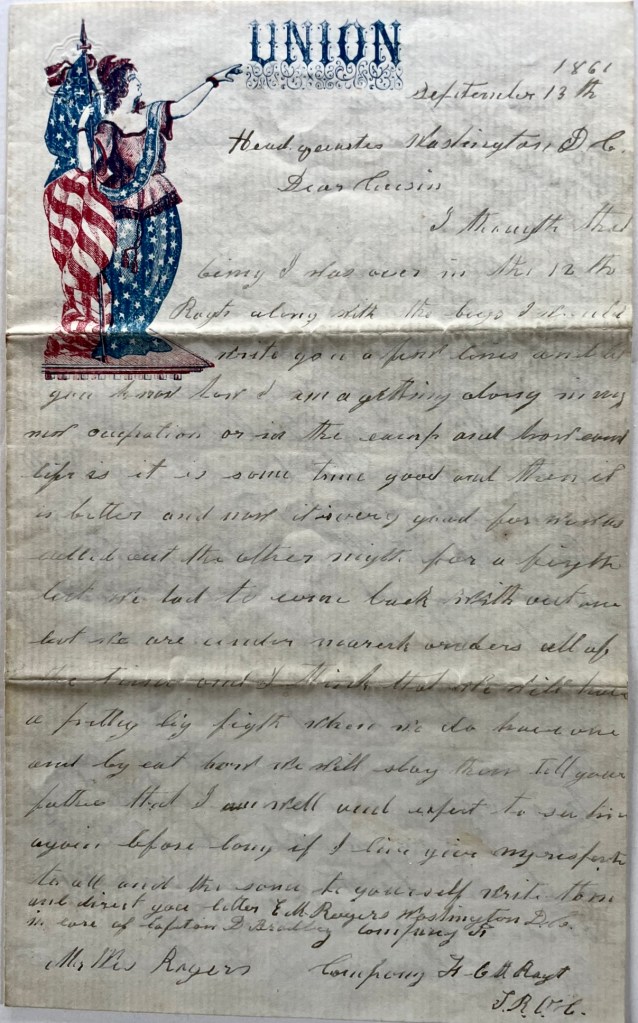
Headquarters, Washington D. C.
[Friday] September 13th 1861
Dear Cousin,
I thought that being [as] I was over in the 12th Regt. along with the boys, I would write you a few lines and let you know how I am getting along in my new occupation, or in the camp and brass wood [?] life. It is sometimes good and then it is better and now it is very good for we was called out the other night for a fight, but we had to come back without one. But we are under marching orders all of the time and I think that we will have a pretty big fight when we do have one, and by [ ] we will stay there. Tell your father that I am well and expect to see him again before long if I live. Give my respects to all and the same to yourself. Write to me and direct your letter—E. M. Rogers, Washington D. C., in care of Captain D. Bradley, Company F.
Company F, 6th Regt. P. R. V. C.
To Mr. Wes Rogers
[in a different hand]
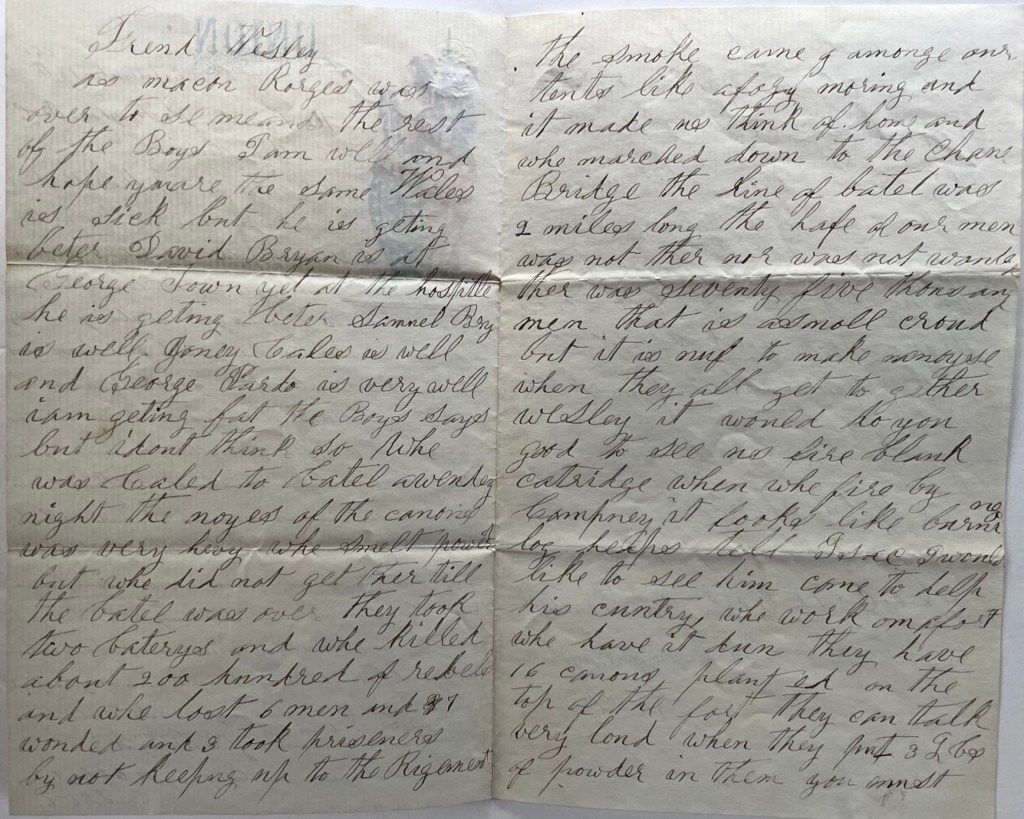
Friend Wesley,
As Macon Rogers was over to see me and the rest of the boys, I am well and hope you are the same. Wales is sick but he is getting better. David Bryan is at Georgetown yet at the hospital. He is getting better. Heter Samuel Brey is well. Joney Cales is well and George Parks is very well. I am getting fat, the boys says, but I don’t think so.
We was called to battle Wednesday night [11 September 1861]. 2 The noise of the cannons was very heavy. We smelled powder but we did not get there till the battle was over. They took two batteries and we killed about 200 hundred of rebels and we lost 6 men and 7 wounded and 3 took prisoners by not keeping up to the regiment. The smoke came among our tents like a foggy morning and it made me think of home and we marched down to the chain bridge. The line of battle was two miles long. The half of our men was not there nor was not wanted. There was seventy-five thousand men—that is a small crowd, but it is enough to make a noise when they all get together.
Wesley, it would do you good to see us fire blank cartridges when we fire by company. It looks like burning log [ ]. Tell Isaac I would like to see him come to help his country, who work on a fort. We have it done. They have 16 cannons planted on top of the fort. They can talk very loud when they put 3 lbs. of powder in them.
You must write to me and let me know all about the young folks. I send my best respects to all of the boys. Let my folks know that you got a letter from me. Will have to bring my scribbling to a close. Write soon and so goodbye. Your friend, — John S. Osler.
How to direct to me:
John S. Osler, Co. C, 12th Regiment, Pennsylvania Regt. Vols., In care of Captain [Richard] Gustin
1 Jake Wynn published a letter by a member of the 6th Pennsylvania Reserves following the Battle of Antietam. See “In April 1917, a Loose Floorboard Revealed a Letter Written in the Days After the Battle of Antietam.“
2 A reference to the Battle of Lewinsville.

 Spared & Shared 23