
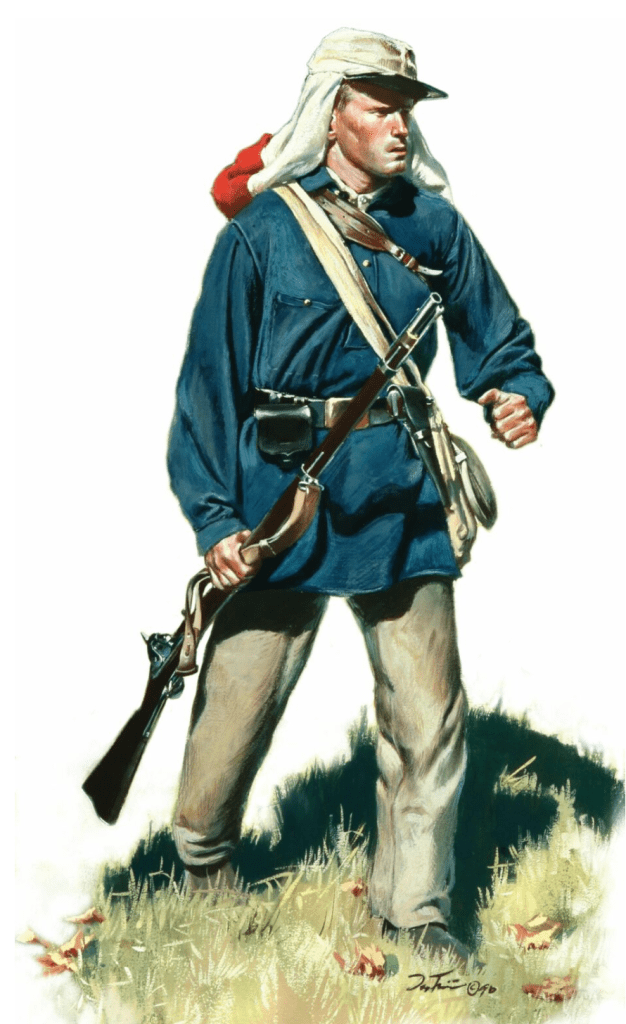
This letter was written two weeks prior to the Battle of Bull Run by George A. Church (1840-1921) of Co. D, 1st Rhode Island Detached Militia, to his mother, Eliza Alice (Richmond) Church (1810-1891), the wife of Frederick Seymour Church (1806-1863).
“When the Civil War broke out in April 1861, Rhode Island, unlike most states, did not have a statewide regimental militia organization. Rather, the state militia was composed of nearly twenty active companies spread throughout the state. Eight militia units—the Westerly Rifles, Woonsocket Guards, Newport Artillery, Providence Artillery, Mechanics Rifles, First Light Infantry, Pawtucket Light Guard, and the National Cadets—formed together to create the First Rhode Island Detached Militia. The organization was called such because it was a detached organization from the Rhode Island militia that was mustered into Federal service for ninety days.” [Source: “The Numbers Game…” Robert Grandchamp]
Transcription
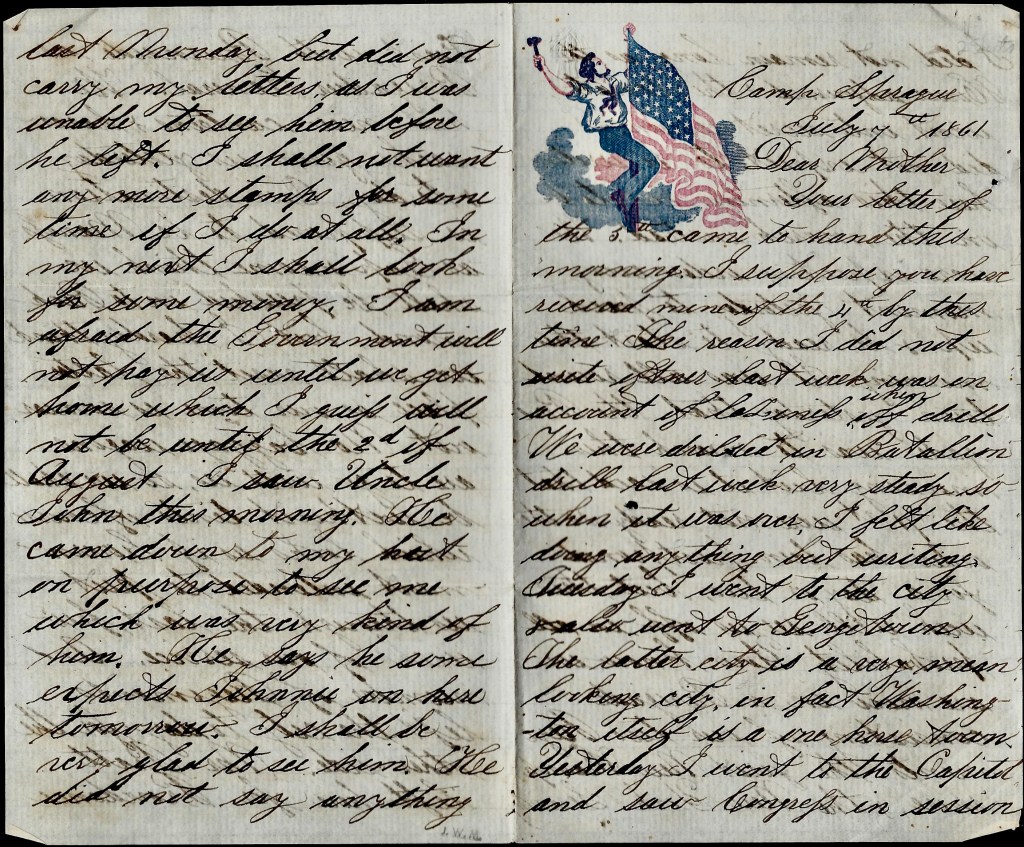
Camp Sprague
[Sunday] July 7th 1861
Dear Mother,
Your letter of the 5th came to hand this morning. I suppose you have received mine of the 4th by this time. The reason I did not write oftener last week was on account of laziness when off drill. We were drilled in Battalion drill last week very steady so when it was over I felt like doing anything but writing.
Tuesday [July 2nd] I went to the city and also went to Georgetown. The latter city is a very mean looking city. In fact, Washington itself is a one horse town. Yesterday I went to the Capitol and saw Congress in session. I did not remain long as the House adjourned & the Senate went into secret session.
I did not expect to be writing here this afternoon, but to be on the march instead. We were expecting orders every moment yesterday to pack up & be ready to start this morning. It was all round town yesterday that the Brigade was to march this morning, but it is said that the 71st were not ready so the order has been postponed for a day or two, but this week will see us off in all probability. You know we are now in a Brigade consisting of our two [Rhode Island] regiments, the 1st New Hampshire, and the New York Seventy-first, with Burnside as Brigadier General. 1 We had new canteens & haversacks given us yesterday & today. Our destination is supposed to be Manassas Gap & some think we shall be pushed in to Richmond, but I hardly think we shall visit the latter place as our time is sooner out. No baggage wagons are to go with us so we shall be without tents, of course, which looks as if Government intended to put us through the last few weeks of our service.
A number of regiments left the city today for the other side. Mr. Pratt left here for Providence last Monday but did not carry my letters as I was unable to see him before he left. I shall not want any more stamps for some time if I do at all. In my next I shall look for some money. I am afraid the Government will not pay us until we get home which I guess will not be until the 2nd of August.
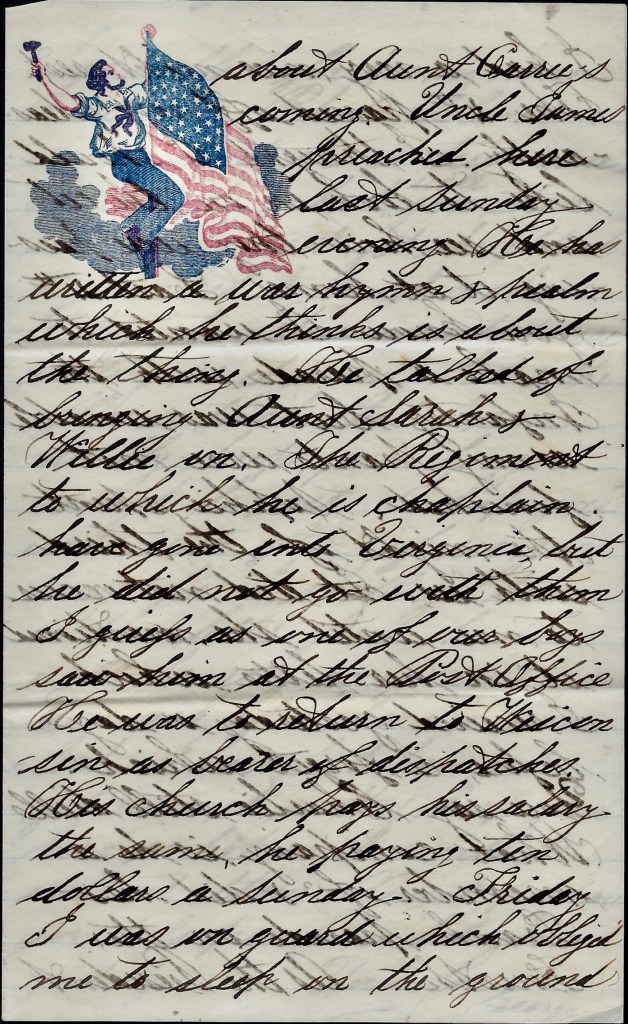
I saw Uncle John this morning. He came down to my hut 2 on purpose to see me which was very kind of him. He says he some expects Johnnie on here tomorrow. I shall be very glad to see him. He did not say anything about Aunt Carrie’s coming.
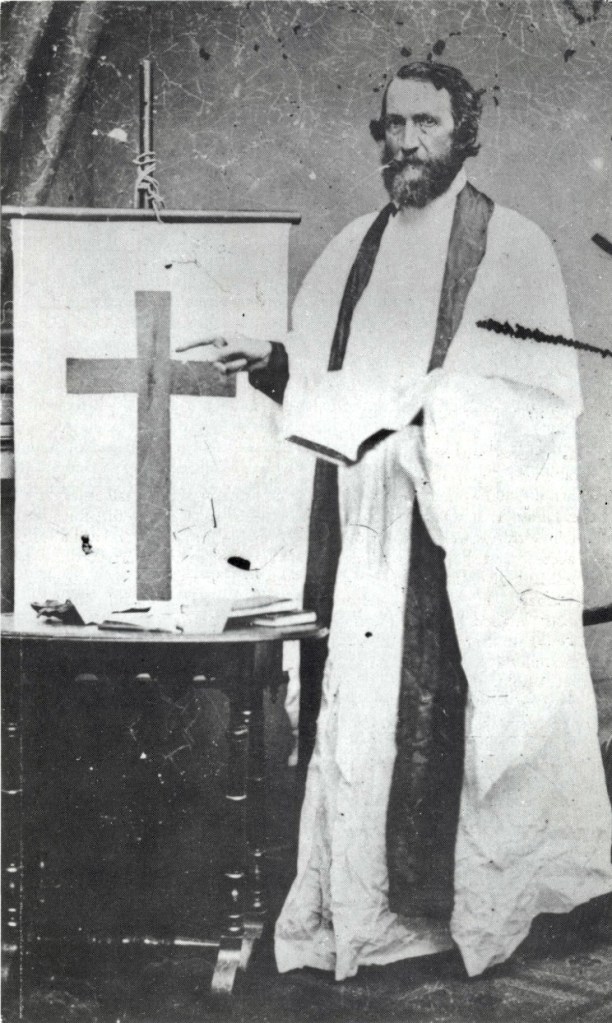
Uncle James [Cook Richmond] preached here last Sunday evening. He has written a war hymn & psalm which he thinks is about the thing. He talked of bringing Aunt Sarah & Willie on. The regiment to which he is chaplain have gone into Virginia, but he did not go with them, I guess, as one of our boys saw him at the Post Office. He was to return to Wisconsin as bearer of dispatches. His church pays his salary the same, he paying ten dollars a Sunday. 3
Friday I was on guard which obliged me to sleep on the ground. I had a very nice night’s rest. The 4th [of July] passed off very pleasantly. I thought I should like to look in on the city and see how they were passing it at home. Last 4th you know I wanted to make a parade with the infantry but was unable as my pants were not finished. Sophie spent the night of the third with us. It did not occur to me until she mentioned it in her letter which I received yesterday or day before, I forget which.
You say Charlie still drills. What company is he a member of and did he & Frank parade on the 4th? As the President has called for 400,000 men, I suppose Rhode Island will send one or two more regiments which will give those that have not yet shouldered a musket a chance to try it. You must excuse writing as it is very hot & the flies so thick that I can hardly keep quiet long enough to write. I hope you will write often if we go away for I shall get them and a letter from home will be very acceptable. You ask if I have a havelock. I have, but have not yet worn it as they keep your head as hot as it would be without them. Must prepare for dress parade so bid you goodbye.
Your son, — George
1 Special Orders No.167, Paragraph I, Headquarters, Department of Washington, Washington, D. C., 2 July, 1861: The 1st Rhode Island Detached Militia, the 2nd Rhode Island Infantry, the 71st New York State Militia, the 2nd New Hampshire Infantry, and the 2nd Rhode Island Artillery was assigned to Colonel A E Burnside, 1st Rhode Island Detached Militia, by Special Orders No.167, Paragraph I, Headquarters, Department of Washington, Washington, D. C., on 2 July, 1861.
2 The huts at Camp Sprague were 15×18 foot frame structures with sloped roofs and a covered porch eating area as shown in the following sketch. The camp was located on G. W. Keating’s farm near Bladensburg, Maryland. Prior to moving to Camp Sprague in mid-May, the 1st Rhode Island Detached Militia had been quartered in the Parent Office.

3 George’s uncle was Rev. James Cook Richmond (1808-1866), a native of Providence, Rhode Island, who graduated from Harvard in 1828 and became an Episcopal Priest in New York. At the outbreak of the Civil War, when he was 53 years old, he was ministering to a congregation in Milwaukee but volunteered to be the chaplain of the 2nd Wisconsin Infantry—a three-year regiment mustered into federal service in mid-June 1861—but was rarely with his regiment. According to muster rolls, he was dismissed on 8 May 1862 due to “inefficiency and neglect of duty.” He was married to Sarah Seaton and was the father of six children, including his youngest son Willie (b. 1846). His behavior grew to be erratic and he died of insanity in 1866. See: “Errant Chaplain of the Iron Brigade: Biography of Revent James C. Richmond, 2nd Wisconsin,” Military Images Magazine, Jan-Feb 1995, pp. 28-30 by Ben Maryniak.


 Spared & Shared 23