

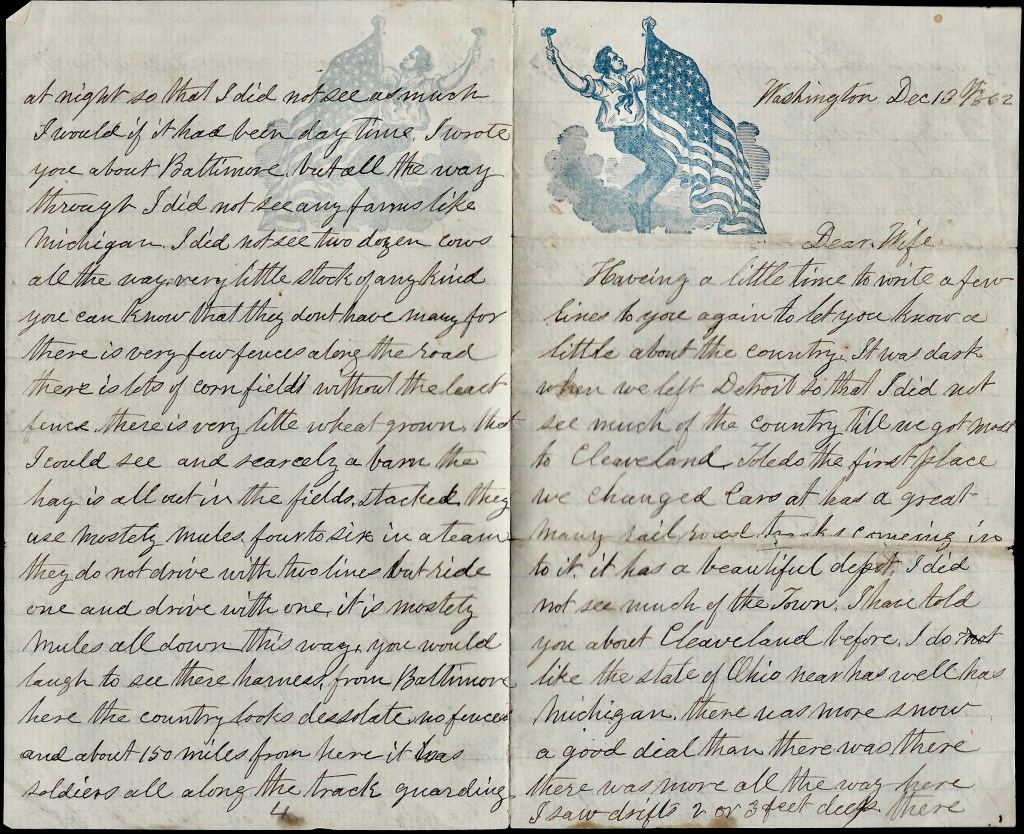
This partial letter was most likely written by a member of the 5th Michigan Cavalry to his wife. The regiment was mustered into the US Service in late August 1862 in Detroit but did not leave for Washington D. C. until 4 December 1862. They had been subjected to a long delay in procuring arms and equipments, having finally to leave Detroit only partly armed, but fully equipped, mounted and clothed.
The 5th, 6th, and 7th Michigan Cavalry Regiments were raised in the summer and fall of 1862 and the order creating the Michigan Cavalry Brigade (led by Brig. Gen. George A. Custer later in the war) was issued on 12 December 1862 shortly after the 5th and 6th Michigan Cavalry regiments arrived in Washington City. The regiment went into camp on East Capitol Hill, one mile from the Capitol Building and next to the Lincoln Hospital. The site was named Camp Copeland after the regiment’s original commander.
The letter describes the passage from Detroit to Washington City in December 1862 and includes observations of Toledo, Pittsburgh, and Harrisburg.
Transcription
Washington [D. C.]
December 13, 1862
Dear Wife,
Having a little time to write a few lines to you again to let you know a little about the country. It was dark when we left Detroit so that I did not see much of the country till we got most to Cleveland.

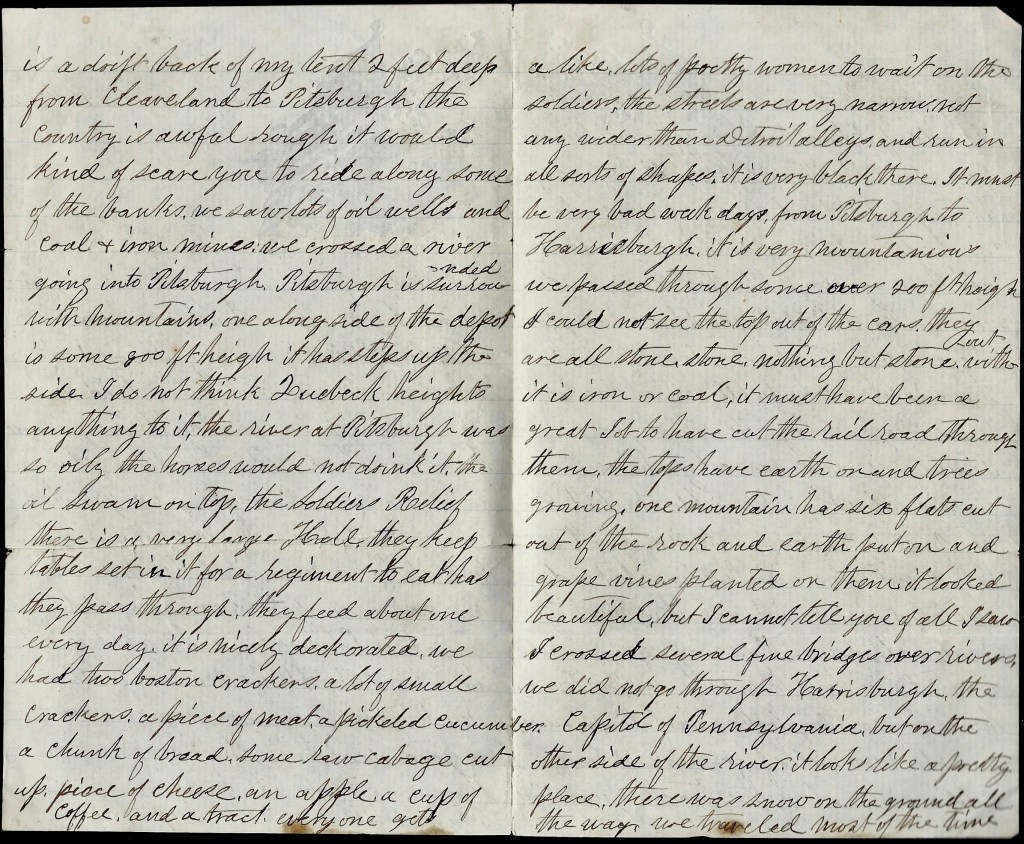
Toledo, the first place we changed cars at has a great many railroad tracks coming in to it. It has a beautiful depot. I did not see much of the town. I have told you about Cleveland before. I do not like the State of Ohio near as well as Michigan. There was more snow a good deal than there was there. There was more all the way here. I saw drifts 2 or 3 feet deep. There is a drift back of my tent two feet deep.
From Cleveland to Pittsburgh the country is awful rough. It would kind of scare you to ride along some of the banks. We saw lots of oil wells and coal & iron miles. We crossed a river into Pittsburgh.
Pittsburgh is surrounded with mountains. One along side of the depot is some 800 feet high. It has steps up the side. I do not think Quebec Heights anything to it. The river at Pittsburgh was so oily the horses would not drink it. The oil swam on top. The Soldier’s Relief there is a very large Hall. 1 They keep tables set in it for a regiment to eat as they pass through. They feed about one [regiment] every day. It is nicely decorated. We had two Boston Crackers [Hard Tack], a lot of small crackers, a piece of meat, a pickled cucumber, a chunk of bread, some raw cabbage cut up, piece of cheese, an apple, a cup of coffee, and a [religious] tract. Everyone gets alike. Lots of pretty women to wait on the soldiers. The streets are very narrow—not any wider than Detroit’s alleys—and run in all sorts of shapes. It is very black there. It must be very bad week days.
From Pittsburgh to Harrisburg it is very mountainous. We passed through some over 200 feet night. I could not see the top out of the cars. They are all stone, stone, nothing but stone without it is iron or coal. It must have been a great job to have cut the railroad through them. The tops have earth on and trees growing. One mountain has six flats cut out of the rock and earth put on and grape vines planted on them. It looked beautiful. But I cannot tell you all I saw.
I crossed several fine bridges over rivers. We did not go through Harrisburg, the Capitol of Pennsylvania, but on the other side of the river. It looks like a pretty place. There was snow on the ground all the way. We traveled most of the time at night so that I did not see as much [as] I would if it had been day time. I wrote you about Baltimore but all the way through I did not see any farms like Michigan. I did not see two dozen cows all the way. Very little stock of any kind. You can know that they don’t have many for there is very few fences along the road. There is lots of cornfields without the least fence. There is very little wheat grown that I could see and scarcely a barn. The hay is all out in the fields stacked. They use mostly mules, four to six in a team. They do not drive with two lines but ride one and drive with one. It is mostly mules all down this way. You would laugh to see their harness.
From Baltimore here the country looks desolate. No fences and about 150 miles from here it was soldiers all along the track guarding…[rest of letter is missing]
1 By December 1862, the Subsistence Committee had arranged for the use of City Hall as the dining facility for the regiments passing through the city. “The main floor was filled with ten long tables that culd seat twelve hundred soldiers.” [Source: “Our people are warlike”: Civil War Pittsburgh and Home-Front Mobilization, Allen Christopher York, page 155.]
 Spared & Shared 23